Nurul Sabrina Binti Ali
Sharifah Muslihah Binti Tuan Mat
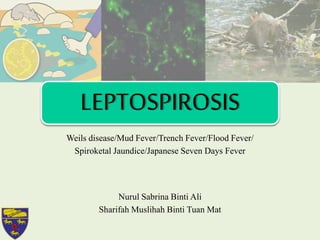
LEPTOSPIROSIS
Weils disease/Mud Fever/Trench Fever/Flood Fever/
Spiroketal Jaundice/Japanese Seven Days Fever
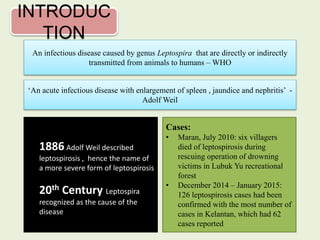
An infectious disease caused by genus Leptospira that are directly or indirectly
transmitted from animals to humans – WHO
INTRODUC
TION
Cases:
• Maran, July 2010: six villagers
died of leptospirosis during
rescuing operation of drowning
victims in Lubuk Yu recreational
forest
• December 2014 – January 2015:
126 leptospirosis cases had been
confirmed with the most number of
cases in Kelantan, which had 62
cases reported
‘An acute infectious disease with enlargement of spleen , jaundice and nephritis’ -
Adolf Weil
1886 Adolf Weil described
leptospirosis , hence the name of
a more severe form of leptospirosis
20th Century Leptospira
recognized as the cause of the
disease
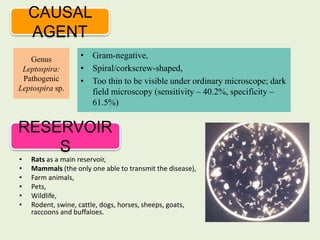
• Gram-negative,
• Spiral/corkscrew-shaped,
• Too thin to be visible under ordinary microscope; dark
field microscopy (sensitivity – 40.2%, specificity –
61.5%)
CAUSAL
AGENT
Genus
Leptospira:
Pathogenic
Leptospira sp.
RESERVOIR
S
• Rats as a main reservoir,
• Mammals (the only one able to transmit the disease),
• Farm animals,
• Pets,
• Wildlife,
• Rodent, swine, cattle, dogs, horses, sheeps, goats,
raccoons and buffaloes.
TRANSMISSIO
N MODE
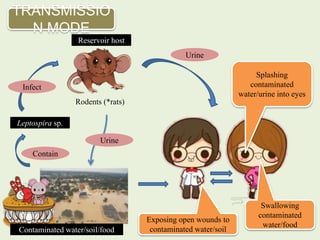
Splashing
contaminated
water/urine into eyes
Swallowing
contaminated
water/food
Exposing open wounds to
contaminated water/soil
Reservoir host
Leptospira sp.
Rodents (*rats)
Contain
Infect
Urine
Urine
Contaminated water/soil/food
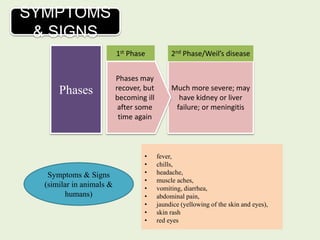
Much more severe; may
have kidney or liver
failure; or meningitis
SYMPTOMS
& SIGNS
Phases
1st Phase
Phases may
recover, but
becoming ill
after some
time again
2nd Phase/Weil’s disease
• fever,
• chills,
• headache,
• muscle aches,
• vomiting, diarrhea,
• abdominal pain,
• jaundice (yellowing of the skin and eyes),
• skin rash
• red eyes
Symptoms & Signs
(similar in animals &
humans)
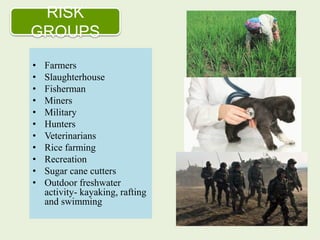
RISK
GROUPS
• Farmers
• Slaughterhouse
• Fisherman
• Miners
• Military
• Hunters
• Veterinarians
• Rice farming
• Recreation
• Sugar cane cutters
• Outdoor freshwater
activity- kayaking, rafting
and swimming
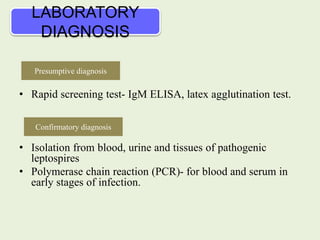
LABORATORY
DIAGNOSIS
• Rapid screening test- IgM ELISA, latex agglutination test.
• Isolation from blood, urine and tissues of pathogenic
leptospires
• Polymerase chain reaction (PCR)- for blood and serum in
early stages of infection.
Presumptive diagnosis
Confirmatory diagnosis
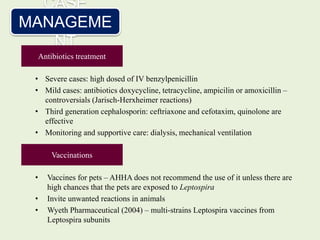
• Severe cases: high dosed of IV benzylpenicillin
• Mild cases: antibiotics doxycycline, tetracycline, ampicilin or amoxicillin –
controversials (Jarisch-Herxheimer reactions)
• Third generation cephalosporin: ceftriaxone and cefotaxim, quinolone are
effective
• Monitoring and supportive care: dialysis, mechanical ventilation
CASE
MANAGEME
NT
Antibiotics treatment
Vaccinations
• Vaccines for pets – AHHA does not recommend the use of it unless there are
high chances that the pets are exposed to Leptospira
• Invite unwanted reactions in animals
• Wyeth Pharmaceutical (2004) – multi-strains Leptospira vaccines from
Leptospira subunits
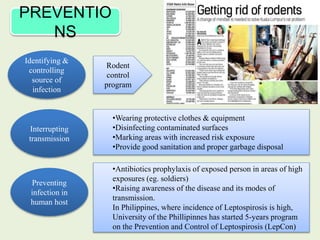
PREVENTIO
NS
Identifying &
controlling
source of
infection
Interrupting
transmission
Preventing
infection in
human host
Rodent
control
program
•Wearing protective clothes & equipment
•Disinfecting contaminated surfaces
•Marking areas with increased risk exposure
•Provide good sanitation and proper garbage disposal
•Antibiotics prophylaxis of exposed person in areas of high
exposures (eg. soldiers)
•Raising awareness of the disease and its modes of
transmission.
In Philippines, where incidence of Leptospirosis is high,
University of the Phillipinnes has started 5-years program
on the Prevention and Control of Leptospirosis (LepCon)

Leptospirosis

  • 1.
    Nurul Sabrina BintiAli Sharifah Muslihah Binti Tuan Mat LEPTOSPIROSIS Weils disease/Mud Fever/Trench Fever/Flood Fever/ Spiroketal Jaundice/Japanese Seven Days Fever
  • 2.
    An infectious diseasecaused by genus Leptospira that are directly or indirectly transmitted from animals to humans – WHO INTRODUC TION Cases: • Maran, July 2010: six villagers died of leptospirosis during rescuing operation of drowning victims in Lubuk Yu recreational forest • December 2014 – January 2015: 126 leptospirosis cases had been confirmed with the most number of cases in Kelantan, which had 62 cases reported ‘An acute infectious disease with enlargement of spleen , jaundice and nephritis’ - Adolf Weil 1886 Adolf Weil described leptospirosis , hence the name of a more severe form of leptospirosis 20th Century Leptospira recognized as the cause of the disease
  • 3.
    • Gram-negative, • Spiral/corkscrew-shaped, •Too thin to be visible under ordinary microscope; dark field microscopy (sensitivity – 40.2%, specificity – 61.5%) CAUSAL AGENT Genus Leptospira: Pathogenic Leptospira sp. RESERVOIR S • Rats as a main reservoir, • Mammals (the only one able to transmit the disease), • Farm animals, • Pets, • Wildlife, • Rodent, swine, cattle, dogs, horses, sheeps, goats, raccoons and buffaloes.
  • 4.
    TRANSMISSIO N MODE Splashing contaminated water/urine intoeyes Swallowing contaminated water/food Exposing open wounds to contaminated water/soil Reservoir host Leptospira sp. Rodents (*rats) Contain Infect Urine Urine Contaminated water/soil/food
  • 5.
    Much more severe;may have kidney or liver failure; or meningitis SYMPTOMS & SIGNS Phases 1st Phase Phases may recover, but becoming ill after some time again 2nd Phase/Weil’s disease • fever, • chills, • headache, • muscle aches, • vomiting, diarrhea, • abdominal pain, • jaundice (yellowing of the skin and eyes), • skin rash • red eyes Symptoms & Signs (similar in animals & humans)
  • 6.
    RISK GROUPS • Farmers • Slaughterhouse •Fisherman • Miners • Military • Hunters • Veterinarians • Rice farming • Recreation • Sugar cane cutters • Outdoor freshwater activity- kayaking, rafting and swimming
  • 7.
    LABORATORY DIAGNOSIS • Rapid screeningtest- IgM ELISA, latex agglutination test. • Isolation from blood, urine and tissues of pathogenic leptospires • Polymerase chain reaction (PCR)- for blood and serum in early stages of infection. Presumptive diagnosis Confirmatory diagnosis
  • 8.
    • Severe cases:high dosed of IV benzylpenicillin • Mild cases: antibiotics doxycycline, tetracycline, ampicilin or amoxicillin – controversials (Jarisch-Herxheimer reactions) • Third generation cephalosporin: ceftriaxone and cefotaxim, quinolone are effective • Monitoring and supportive care: dialysis, mechanical ventilation CASE MANAGEME NT Antibiotics treatment Vaccinations • Vaccines for pets – AHHA does not recommend the use of it unless there are high chances that the pets are exposed to Leptospira • Invite unwanted reactions in animals • Wyeth Pharmaceutical (2004) – multi-strains Leptospira vaccines from Leptospira subunits
  • 9.
    PREVENTIO NS Identifying & controlling source of infection Interrupting transmission Preventing infectionin human host Rodent control program •Wearing protective clothes & equipment •Disinfecting contaminated surfaces •Marking areas with increased risk exposure •Provide good sanitation and proper garbage disposal •Antibiotics prophylaxis of exposed person in areas of high exposures (eg. soldiers) •Raising awareness of the disease and its modes of transmission. In Philippines, where incidence of Leptospirosis is high, University of the Phillipinnes has started 5-years program on the Prevention and Control of Leptospirosis (LepCon)