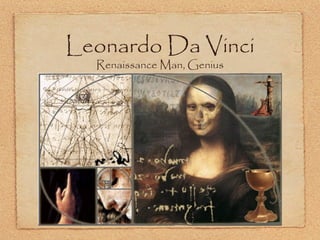
Leonardo Da Vinci
Renaissance Man, Genius
Leonardo Da Vinci
(1452-1519)

Born in Vinci, Italy, an illegitimate son to a peasant
woman and a successful notary, he began his life facing
hardship and obscurity.
With no privilege of a formal education, Da Vinci
launched a self-education program.

He grew up in nature, and began to use his keen skill of
observation to learn about the world around him.
He was alive during a tumultuous, yet progressive time
for Italy and for the world.
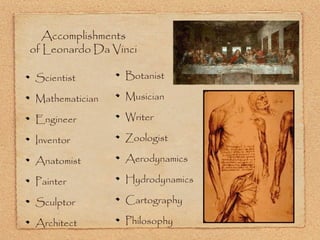
Accomplishments
of Leonardo Da Vinci
Scientist

Botanist

Mathematician

Musician

Engineer

Writer

Inventor

Zoologist

Anatomist

Aerodynamics

Painter

Hydrodynamics

Sculptor

Cartography

Architect

Philosophy
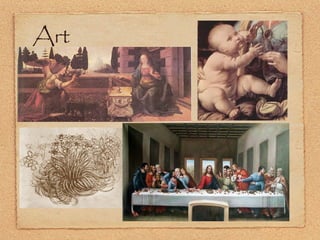
Art
Curious as well as observant, he constantly tried to explain what he
saw.
Because he wrote down and sketched so many of his observations,
we know that he was among the very first to take a scientific approach
towards understanding how our world works and how we see it
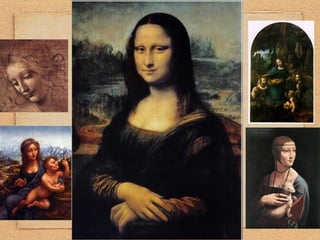
Leonardo’s desire to paint things realistically was bold and fresh, and
eventually became the standard for painters who followed in the 16th
century
Went beyond his teaching by making a scientific study of light and
shadow in nature
Objects were not comprised of outlines, but were actually 3-D
bodies defined by light and shadow
Art
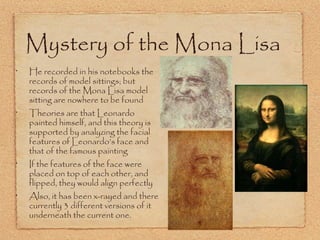
Mystery of the Mona Lisa
•

•

•

•

He recorded in his notebooks the
records of model sittings; but
records of the Mona Lisa model
sitting are nowhere to be found
Theories are that Leonardo
painted himself, and this theory is
supported by analyzing the facial
features of Leonardo’s face and
that of the famous painting

If the features of the face were
placed on top of each other, and
flipped, they would align perfectly

Also, it has been x-rayed and there
currently 3 different versions of it
underneath the current one.
Machines
Due to his highly inquisitive nature, Leonardo began hundreds of projects to learn about
the world around him. His projects were ranging from painting to war machine invention, but
never brought many of his projects to completion. Most of his scientific theories and
inventions never made it past the notebook stage. However, the ingenuity of his ideas are
still being used today.
War machines from the armored car, firearm with screw elevating gear, machine for storming
walls, hoist for lifting cannons, eight barreled organ, automatic igniting device, hull rammer,
giant cross bow, ballista for hurling stones, scythed chariot, split-trail gun carriage, and
many more.
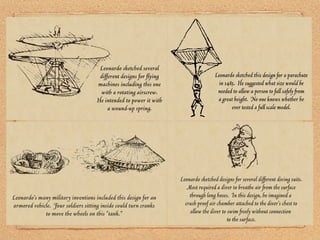
Flying machines such as the aerial screw, device for testing beating wings, flying ship,
articulated wing, parachute, anemometer, flapping-wing machine with vertical bearing, wing
structure, inclinometer, wing-beating device with a screw and lead screw system, leaf spring
engine for flying machine.
More machines

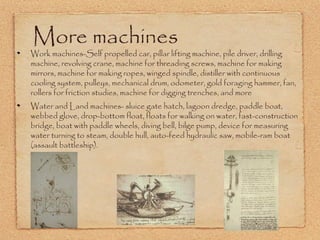
Work machines-Self propelled car, pillar lifting machine, pile driver, drilling
machine, revolving crane, machine for threading screws, machine for making
mirrors, machine for making ropes, winged spindle, distiller with continuous
cooling system, pulleys, mechanical drum, odometer, gold foraging hammer, fan,
rollers for friction studies, machine for digging trenches, and more
Water and Land machines- sluice gate hatch, lagoon dredge, paddle boat,
webbed glove, drop-bottom float, floats for walking on water, fast-construction
bridge, boat with paddle wheels, diving bell, bilge pump, device for measuring
water turning to steam, double hull, auto-feed hydraulic saw, mobile-ram boat
(assault battleship).
Science
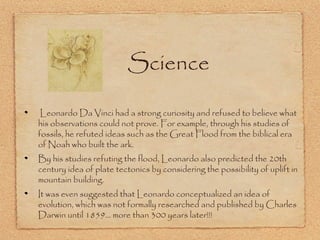
Leonardo Da Vinci had a strong curiosity and refused to believe what
his observations could not prove. For example, through his studies of
fossils, he refuted ideas such as the Great Flood from the biblical era
of Noah who built the ark.
By his studies refuting the flood, Leonardo also predicted the 20th
century idea of plate tectonics by considering the possibility of uplift in
mountain building.
It was even suggested that Leonardo conceptualized an idea of
evolution, which was not formally researched and published by Charles
Darwin until 1859... more than 300 years later!!!
Anatomy
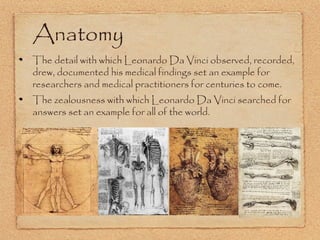
The detail with which Leonardo Da Vinci observed, recorded,
drew, documented his medical findings set an example for
researchers and medical practitioners for centuries to come.
The zealousness with which Leonardo Da Vinci searched for
answers set an example for all of the world.
Why he’s a genius
A genius, according to wikipedia.com, is a person
with great intelligence, who shows an exceptional
natural capacity of intellect, especially as shown in
creative and original work. Geniuses always show
strong individuality and imagination, and are not
only intelligent, but unique and innovative.
Leonardo gained his intimate knowledge of the
world despite lacking a formal education and
despite facing seemingly insurmountable odds.
He wrote out ideas, filling 20,000 pages of notes
which are still studied today.
His art and paintings are admired millions.
His interests, enthusiasm boundless. His work is
not only creative and original, but revolutionary.

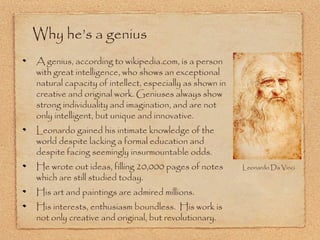
Leonardo Da Vinci
Mysteries of Vinci alsoVinci
Da had much
Despite being a genius, Da
mystery surrounding him. In fact, here are a few
interesting thoughts:

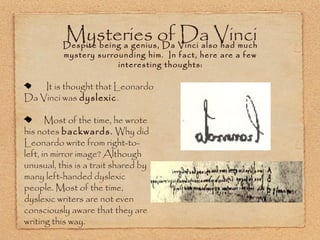
It is thought that Leonardo
Da Vinci was dyslexic.
Most of the time, he wrote
his notes backwards. Why did
Leonardo write from right-toleft, in mirror image? Although
unusual, this is a trait shared by
many left-handed dyslexic
people. Most of the time,
dyslexic writers are not even
consciously aware that they are
writing this way.
Mysteries of Da Vinci

Leonardo's spelling is also considered erratic and quite strange.
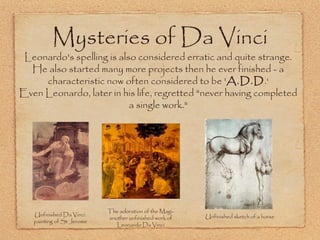
He also started many more projects then he ever finished - a
characteristic now often considered to be 'A.D.D.‘
Even Leonardo, later in his life, regretted "never having completed
a single work."

Unfinished Da Vinci
painting of St Jerome

The adoration of the Magianother unfinished work of
Leonardo Da Vinci

Unfinished sketch of a horse

Leonardo davinci

  • 1.
  • 2.
    Leonardo Da Vinci (1452-1519) Bornin Vinci, Italy, an illegitimate son to a peasant woman and a successful notary, he began his life facing hardship and obscurity. With no privilege of a formal education, Da Vinci launched a self-education program. He grew up in nature, and began to use his keen skill of observation to learn about the world around him. He was alive during a tumultuous, yet progressive time for Italy and for the world.
  • 3.
    Accomplishments of Leonardo DaVinci Scientist Botanist Mathematician Musician Engineer Writer Inventor Zoologist Anatomist Aerodynamics Painter Hydrodynamics Sculptor Cartography Architect Philosophy
  • 4.
    Art Curious as wellas observant, he constantly tried to explain what he saw. Because he wrote down and sketched so many of his observations, we know that he was among the very first to take a scientific approach towards understanding how our world works and how we see it Leonardo’s desire to paint things realistically was bold and fresh, and eventually became the standard for painters who followed in the 16th century Went beyond his teaching by making a scientific study of light and shadow in nature Objects were not comprised of outlines, but were actually 3-D bodies defined by light and shadow
  • 5.
  • 7.
    Mystery of theMona Lisa • • • • He recorded in his notebooks the records of model sittings; but records of the Mona Lisa model sitting are nowhere to be found Theories are that Leonardo painted himself, and this theory is supported by analyzing the facial features of Leonardo’s face and that of the famous painting If the features of the face were placed on top of each other, and flipped, they would align perfectly Also, it has been x-rayed and there currently 3 different versions of it underneath the current one.
  • 8.
    Machines Due to hishighly inquisitive nature, Leonardo began hundreds of projects to learn about the world around him. His projects were ranging from painting to war machine invention, but never brought many of his projects to completion. Most of his scientific theories and inventions never made it past the notebook stage. However, the ingenuity of his ideas are still being used today. War machines from the armored car, firearm with screw elevating gear, machine for storming walls, hoist for lifting cannons, eight barreled organ, automatic igniting device, hull rammer, giant cross bow, ballista for hurling stones, scythed chariot, split-trail gun carriage, and many more. Flying machines such as the aerial screw, device for testing beating wings, flying ship, articulated wing, parachute, anemometer, flapping-wing machine with vertical bearing, wing structure, inclinometer, wing-beating device with a screw and lead screw system, leaf spring engine for flying machine.
  • 9.
    More machines Work machines-Selfpropelled car, pillar lifting machine, pile driver, drilling machine, revolving crane, machine for threading screws, machine for making mirrors, machine for making ropes, winged spindle, distiller with continuous cooling system, pulleys, mechanical drum, odometer, gold foraging hammer, fan, rollers for friction studies, machine for digging trenches, and more Water and Land machines- sluice gate hatch, lagoon dredge, paddle boat, webbed glove, drop-bottom float, floats for walking on water, fast-construction bridge, boat with paddle wheels, diving bell, bilge pump, device for measuring water turning to steam, double hull, auto-feed hydraulic saw, mobile-ram boat (assault battleship).
  • 11.
    Science Leonardo Da Vincihad a strong curiosity and refused to believe what his observations could not prove. For example, through his studies of fossils, he refuted ideas such as the Great Flood from the biblical era of Noah who built the ark. By his studies refuting the flood, Leonardo also predicted the 20th century idea of plate tectonics by considering the possibility of uplift in mountain building. It was even suggested that Leonardo conceptualized an idea of evolution, which was not formally researched and published by Charles Darwin until 1859... more than 300 years later!!!
  • 12.
    Anatomy The detail withwhich Leonardo Da Vinci observed, recorded, drew, documented his medical findings set an example for researchers and medical practitioners for centuries to come. The zealousness with which Leonardo Da Vinci searched for answers set an example for all of the world.
  • 13.
    Why he’s agenius A genius, according to wikipedia.com, is a person with great intelligence, who shows an exceptional natural capacity of intellect, especially as shown in creative and original work. Geniuses always show strong individuality and imagination, and are not only intelligent, but unique and innovative. Leonardo gained his intimate knowledge of the world despite lacking a formal education and despite facing seemingly insurmountable odds. He wrote out ideas, filling 20,000 pages of notes which are still studied today. His art and paintings are admired millions. His interests, enthusiasm boundless. His work is not only creative and original, but revolutionary. Leonardo Da Vinci
  • 14.
    Mysteries of VincialsoVinci Da had much Despite being a genius, Da mystery surrounding him. In fact, here are a few interesting thoughts: It is thought that Leonardo Da Vinci was dyslexic. Most of the time, he wrote his notes backwards. Why did Leonardo write from right-toleft, in mirror image? Although unusual, this is a trait shared by many left-handed dyslexic people. Most of the time, dyslexic writers are not even consciously aware that they are writing this way.
  • 15.
    Mysteries of DaVinci Leonardo's spelling is also considered erratic and quite strange. He also started many more projects then he ever finished - a characteristic now often considered to be 'A.D.D.‘ Even Leonardo, later in his life, regretted "never having completed a single work." Unfinished Da Vinci painting of St Jerome The adoration of the Magianother unfinished work of Leonardo Da Vinci Unfinished sketch of a horse