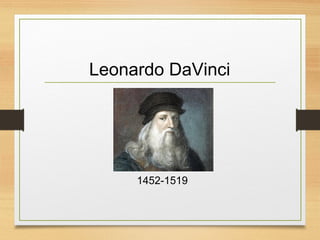
Leonardo DaVinci
1452-1519
Painter, sculptor, architect, musician,
scientist, mathematician, engineer,
inventor, anatomist, geologist, botanist,
and writer.
Renaissance Man
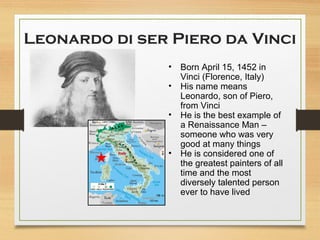
Leonardo di ser Piero da Vinci
• Born April 15, 1452 in
Vinci (Florence, Italy)
• His name means
Leonardo, son of Piero,
from Vinci
• He is the best example of
a Renaissance Man –
someone who was very
good at many things
• He is considered one of
the greatest painters of all
time and the most
diversely talented person
ever to have lived
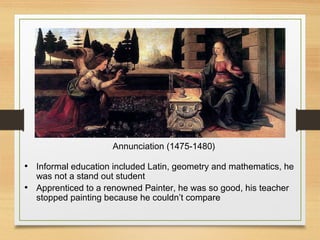
Annunciation (1475-1480)
• Informal education included Latin, geometry and mathematics, he
was not a stand out student
• Apprenticed to a renowned Painter, he was so good, his teacher
stopped painting because he couldn’t compare
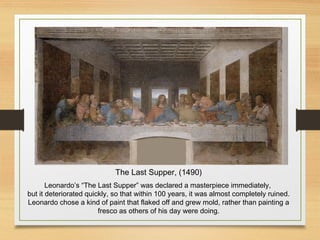
The Last Supper, (1490)
Leonardo’s “The Last Supper” was declared a masterpiece immediately,
but it deteriorated quickly, so that within 100 years, it was almost completely ruined.
Leonardo chose a kind of paint that flaked off and grew mold, rather than painting a
fresco as others of his day were doing.
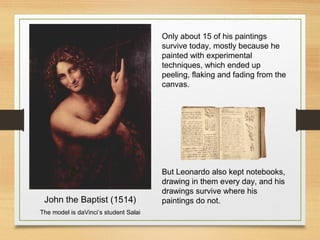
John the Baptist (1514)
The model is daVinci’s student Salai
Only about 15 of his paintings
survive today, mostly because he
painted with experimental
techniques, which ended up
peeling, flaking and fading from the
canvas.
But Leonardo also kept notebooks,
drawing in them every day, and his
drawings survive where his
paintings do not.
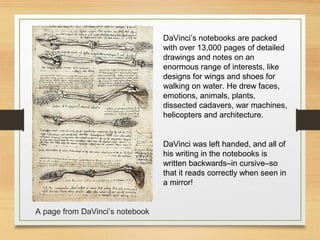
A page from DaVinci’s notebook
DaVinci’s notebooks are packed
with over 13,000 pages of detailed
drawings and notes on an
enormous range of interests, like
designs for wings and shoes for
walking on water. He drew faces,
emotions, animals, plants,
dissected cadavers, war machines,
helicopters and architecture.
DaVinci was left handed, and all of
his writing in the notebooks is
written backwards–in cursive–so
that it reads correctly when seen in
a mirror!
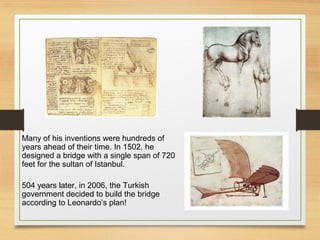
Many of his inventions were hundreds of
years ahead of their time. In 1502, he
designed a bridge with a single span of 720
feet for the sultan of Istanbul.
504 years later, in 2006, the Turkish
government decided to build the bridge
according to Leonardo’s plan!
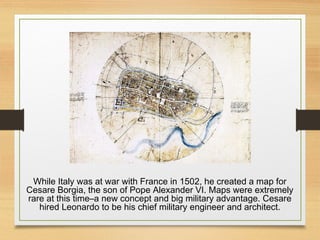
While Italy was at war with France in 1502, he created a map for
Cesare Borgia, the son of Pope Alexander VI. Maps were extremely
rare at this time–a new concept and big military advantage. Cesare
hired Leonardo to be his chief military engineer and architect.
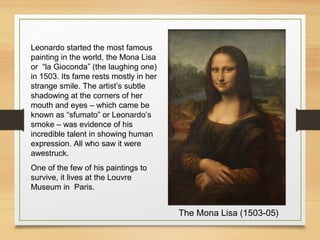
The Mona Lisa (1503-05)
Leonardo started the most famous
painting in the world, the Mona Lisa
or “la Gioconda” (the laughing one)
in 1503. Its fame rests mostly in her
strange smile. The artist’s subtle
shadowing at the corners of her
mouth and eyes – which came be
known as “sfumato” or Leonardo’s
smoke – was evidence of his
incredible talent in showing human
expression. All who saw it were
awestruck.
One of the few of his paintings to
survive, it lives at the Louvre
Museum in Paris.
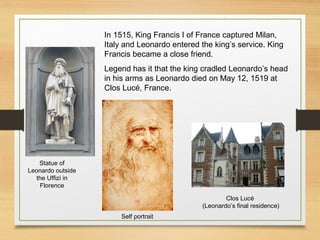
In 1515, King Francis I of France captured Milan,
Italy and Leonardo entered the king’s service. King
Francis became a close friend.
Legend has it that the king cradled Leonardo’s head
in his arms as Leonardo died on May 12, 1519 at
Clos Lucé, France.
Statue of
Leonardo outside
the Uffizi in
Florence
Self portrait
Clos Lucé
(Leonardo’s final residence)
“In the normal course of events many men and women are born
with remarkable talents; but occasionally, in a way that
transcends nature, a single person is marvellously endowed
by Heaven with beauty, grace and talent in such abundance
that he leaves other men far behind, all his actions seem
inspired and indeed everything he does clearly comes
from God rather than from human skill. Everyone
acknowledged that this was true of Leonardo da Vinci,
an artist of outstanding physical beauty, who displayed
infinite grace in everything that he did and who
cultivated his genius so brilliantly that all problems
he studied he solved with ease.”
— Art Historian Giorgio Vasari, 1568

Davinci

  • 1.
  • 2.
    Painter, sculptor, architect,musician, scientist, mathematician, engineer, inventor, anatomist, geologist, botanist, and writer. Renaissance Man
  • 3.
    Leonardo di serPiero da Vinci • Born April 15, 1452 in Vinci (Florence, Italy) • His name means Leonardo, son of Piero, from Vinci • He is the best example of a Renaissance Man – someone who was very good at many things • He is considered one of the greatest painters of all time and the most diversely talented person ever to have lived
  • 4.
    Annunciation (1475-1480) • Informaleducation included Latin, geometry and mathematics, he was not a stand out student • Apprenticed to a renowned Painter, he was so good, his teacher stopped painting because he couldn’t compare
  • 5.
    The Last Supper,(1490) Leonardo’s “The Last Supper” was declared a masterpiece immediately, but it deteriorated quickly, so that within 100 years, it was almost completely ruined. Leonardo chose a kind of paint that flaked off and grew mold, rather than painting a fresco as others of his day were doing.
  • 6.
    John the Baptist(1514) The model is daVinci’s student Salai Only about 15 of his paintings survive today, mostly because he painted with experimental techniques, which ended up peeling, flaking and fading from the canvas. But Leonardo also kept notebooks, drawing in them every day, and his drawings survive where his paintings do not.
  • 7.
    A page fromDaVinci’s notebook DaVinci’s notebooks are packed with over 13,000 pages of detailed drawings and notes on an enormous range of interests, like designs for wings and shoes for walking on water. He drew faces, emotions, animals, plants, dissected cadavers, war machines, helicopters and architecture. DaVinci was left handed, and all of his writing in the notebooks is written backwards–in cursive–so that it reads correctly when seen in a mirror!
  • 8.
    Many of hisinventions were hundreds of years ahead of their time. In 1502, he designed a bridge with a single span of 720 feet for the sultan of Istanbul. 504 years later, in 2006, the Turkish government decided to build the bridge according to Leonardo’s plan!
  • 9.
    While Italy wasat war with France in 1502, he created a map for Cesare Borgia, the son of Pope Alexander VI. Maps were extremely rare at this time–a new concept and big military advantage. Cesare hired Leonardo to be his chief military engineer and architect.
  • 10.
    The Mona Lisa(1503-05) Leonardo started the most famous painting in the world, the Mona Lisa or “la Gioconda” (the laughing one) in 1503. Its fame rests mostly in her strange smile. The artist’s subtle shadowing at the corners of her mouth and eyes – which came be known as “sfumato” or Leonardo’s smoke – was evidence of his incredible talent in showing human expression. All who saw it were awestruck. One of the few of his paintings to survive, it lives at the Louvre Museum in Paris.
  • 11.
    In 1515, KingFrancis I of France captured Milan, Italy and Leonardo entered the king’s service. King Francis became a close friend. Legend has it that the king cradled Leonardo’s head in his arms as Leonardo died on May 12, 1519 at Clos Lucé, France. Statue of Leonardo outside the Uffizi in Florence Self portrait Clos Lucé (Leonardo’s final residence)
  • 12.
    “In the normalcourse of events many men and women are born with remarkable talents; but occasionally, in a way that transcends nature, a single person is marvellously endowed by Heaven with beauty, grace and talent in such abundance that he leaves other men far behind, all his actions seem inspired and indeed everything he does clearly comes from God rather than from human skill. Everyone acknowledged that this was true of Leonardo da Vinci, an artist of outstanding physical beauty, who displayed infinite grace in everything that he did and who cultivated his genius so brilliantly that all problems he studied he solved with ease.” — Art Historian Giorgio Vasari, 1568