Beginning in the seventeenth century, a burgeoning slave trade saw Africans
captured and brought to America in bondage, separated from their relatives, sold
and forced into slavery on a new continent. Out of this desolation came the
unfortunate circumstance for Africans trying to develop a new culture due to their
abrupt change of situation and the remnants of their old lives carried in their
minds and bodies with them to the New World. Generations of Africans infused
music with their daily lives, developed under the harsh conditions of slavery. One
of these subsequent musical styles is known as reggae. It originated on the island
of Jamaica, a country that suffered plenty under British colonial rule. From the
outset, reggae music was a deeply political form of protest against social, cultural
and political oppression. Reggae artists like Bob Marley used their music as a
vehicle to spread their message of injustice towards African people.
Songs of Slavery
“Redemption Song”
Old pirates, yes, they rob I
Sold I to the merchant ships
Minutes after they took I
from the bottomless pit
But my hand was made strong
by the hand of the almighty
we forward in this generation
triumphantly
Won't you help to sing
these songs of freedom?
'Cause all I ever have
Redemption songs
Redemption songs
Emancipate yourselves from mental slavery
none but ourselves can free our minds
Have no fear for atomic energy
'Cause none of them can stop the time
How long shall they kill our prophets
while we stand aside and look? Ooh
Some say it's just a part of it
we’ve got to fulfill the book
Won't you help to sing
these songs of freedom?
'Cause all I ever have
Redemption songs
Redemption songs
Redemption songs
Emancipate yourselves from mental slavery
none but ourselves can free our mind
Whoa, have no fear for atomic energy
'Cause none of them-a can-a stop-a the time
How long shall they kill our prophets
while we stand aside and look?
Yes, some say it's just a part of it
we’ve got to fulfill the book
Won't you help to sing
these songs of freedom?
'Cause all I ever had
Redemption songs
All I ever had
Redemption songs
Redemption – the
action of saving or
being saved from
sin, error, or evil
Emancipate – to
set free, especially
from legal, social,
or political
restrictions
Prophet - a person
regarded as an
inspired teacher
John F. Kennedy –
president who took action
against segregation, killed
1963
Martin Luther King – civil
rights leader, killed 1968
The book – The
Bible
“Redemption Song”
About “Redemption Song”
Bob Marley wrote the song in
1979. By this time, he had been
diagnosed with cancer and was
said to have been in much pain.
He refused any form of treatment
other than a strict, vegetarian
diet. He died from his cancer in
1981 at age 36.
In 2004, Rolling Stone
Magazine came out with its
“500 Greatest Songs of All
Time” and ranked
“Redemption Song” as #66.
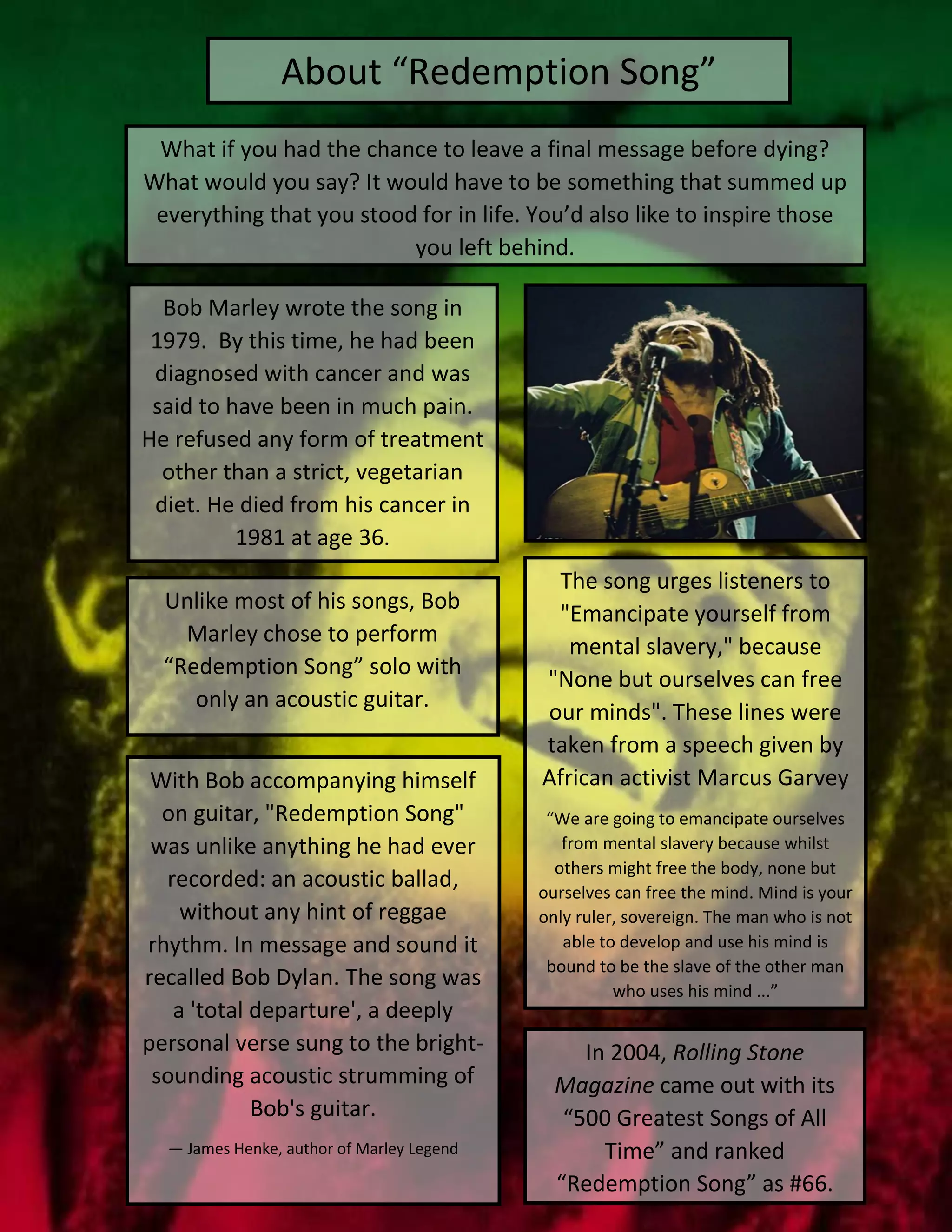
With Bob accompanying himself
on guitar, "Redemption Song"
was unlike anything he had ever
recorded: an acoustic ballad,
without any hint of reggae
rhythm. In message and sound it
recalled Bob Dylan. The song was
a 'total departure', a deeply
personal verse sung to the bright-
sounding acoustic strumming of
Bob's guitar.
— James Henke, author of Marley Legend
Unlike most of his songs, Bob
Marley chose to perform
“Redemption Song” solo with
only an acoustic guitar.
The song urges listeners to
"Emancipate yourself from
mental slavery," because
"None but ourselves can free
our minds". These lines were
taken from a speech given by
African activist Marcus Garvey
“We are going to emancipate ourselves
from mental slavery because whilst
others might free the body, none but
ourselves can free the mind. Mind is your
only ruler, sovereign. The man who is not
able to develop and use his mind is
bound to be the slave of the other man
who uses his mind ...”
What if you had the chance to leave a final message before dying?
What would you say? It would have to be something that summed up
everything that you stood for in life. You’d also like to inspire those
you left behind.

Bob Marley - Redemption Song

  • 1.
    Beginning in theseventeenth century, a burgeoning slave trade saw Africans captured and brought to America in bondage, separated from their relatives, sold and forced into slavery on a new continent. Out of this desolation came the unfortunate circumstance for Africans trying to develop a new culture due to their abrupt change of situation and the remnants of their old lives carried in their minds and bodies with them to the New World. Generations of Africans infused music with their daily lives, developed under the harsh conditions of slavery. One of these subsequent musical styles is known as reggae. It originated on the island of Jamaica, a country that suffered plenty under British colonial rule. From the outset, reggae music was a deeply political form of protest against social, cultural and political oppression. Reggae artists like Bob Marley used their music as a vehicle to spread their message of injustice towards African people. Songs of Slavery “Redemption Song” Old pirates, yes, they rob I Sold I to the merchant ships Minutes after they took I from the bottomless pit But my hand was made strong by the hand of the almighty we forward in this generation triumphantly Won't you help to sing these songs of freedom? 'Cause all I ever have Redemption songs Redemption songs Emancipate yourselves from mental slavery none but ourselves can free our minds Have no fear for atomic energy 'Cause none of them can stop the time How long shall they kill our prophets while we stand aside and look? Ooh Some say it's just a part of it we’ve got to fulfill the book Won't you help to sing these songs of freedom? 'Cause all I ever have Redemption songs Redemption songs Redemption songs Emancipate yourselves from mental slavery none but ourselves can free our mind Whoa, have no fear for atomic energy 'Cause none of them-a can-a stop-a the time How long shall they kill our prophets while we stand aside and look? Yes, some say it's just a part of it we’ve got to fulfill the book Won't you help to sing these songs of freedom? 'Cause all I ever had Redemption songs All I ever had Redemption songs Redemption – the action of saving or being saved from sin, error, or evil Emancipate – to set free, especially from legal, social, or political restrictions Prophet - a person regarded as an inspired teacher John F. Kennedy – president who took action against segregation, killed 1963 Martin Luther King – civil rights leader, killed 1968 The book – The Bible “Redemption Song”
  • 2.
    About “Redemption Song” BobMarley wrote the song in 1979. By this time, he had been diagnosed with cancer and was said to have been in much pain. He refused any form of treatment other than a strict, vegetarian diet. He died from his cancer in 1981 at age 36. In 2004, Rolling Stone Magazine came out with its “500 Greatest Songs of All Time” and ranked “Redemption Song” as #66. With Bob accompanying himself on guitar, "Redemption Song" was unlike anything he had ever recorded: an acoustic ballad, without any hint of reggae rhythm. In message and sound it recalled Bob Dylan. The song was a 'total departure', a deeply personal verse sung to the bright- sounding acoustic strumming of Bob's guitar. — James Henke, author of Marley Legend Unlike most of his songs, Bob Marley chose to perform “Redemption Song” solo with only an acoustic guitar. The song urges listeners to "Emancipate yourself from mental slavery," because "None but ourselves can free our minds". These lines were taken from a speech given by African activist Marcus Garvey “We are going to emancipate ourselves from mental slavery because whilst others might free the body, none but ourselves can free the mind. Mind is your only ruler, sovereign. The man who is not able to develop and use his mind is bound to be the slave of the other man who uses his mind ...” What if you had the chance to leave a final message before dying? What would you say? It would have to be something that summed up everything that you stood for in life. You’d also like to inspire those you left behind.