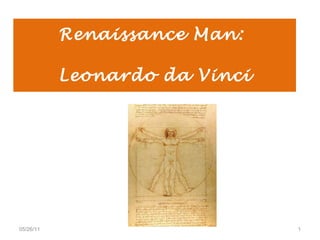
Renaissance Man:  Leonardo da Vinci 05/26/11
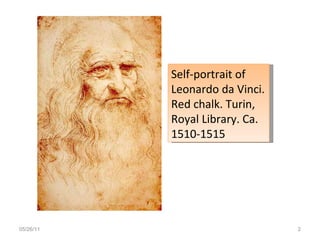
05/26/11 Self-portrait of Leonardo da Vinci. Red chalk. Turin, Royal Library. Ca. 1510-1515
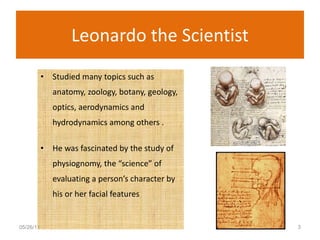
Leonardo the Scientist Studied many topics such as anatomy, zoology, botany, geology, optics, aerodynamics and hydrodynamics among others . He was fascinated by the study of physiognomy, the “science” of evaluating a person’s character by his or her facial features  05/26/11
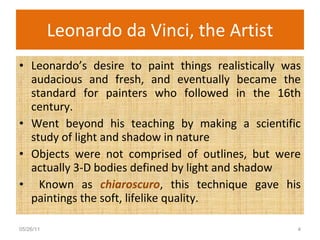
Leonardo da Vinci, the Artist Leonardo’s desire to paint things realistically was audacious and fresh, and eventually became the standard for painters who followed in the 16th century. Went beyond his teaching by making a scientific study of light and shadow in nature Objects were not comprised of outlines, but were actually 3-D bodies defined by light and shadow Known as  chiaroscuro , this technique gave his paintings the soft, lifelike quality. 05/26/11
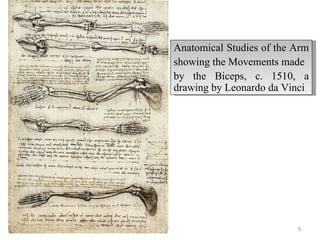
05/26/11 Anatomical Studies of the Arm  showing the Movements made  by the Biceps, c. 1510, a drawing by Leonardo da Vinci
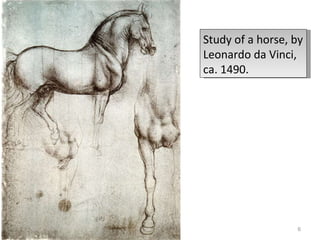
05/26/11 Study of a horse, by Leonardo da Vinci, ca. 1490.
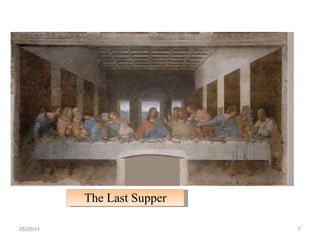
05/26/11 The Last Supper
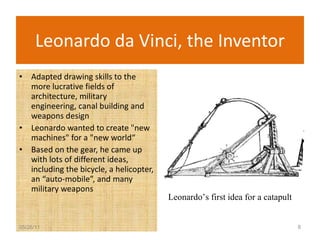
Leonardo da Vinci, the Inventor Adapted drawing skills to the more lucrative fields of architecture, military engineering, canal building and weapons design Leonardo wanted to create "new machines" for a "new world“ Based on the gear, he came up with lots of different ideas, including the bicycle, a helicopter, an “auto-mobile”, and many military weapons 05/26/11 Leonardo’s first idea for a catapult
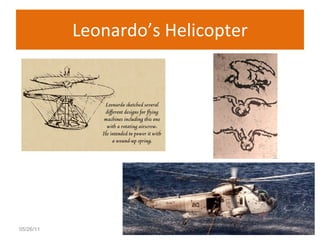
Leonardo’s Helicopter 05/26/11
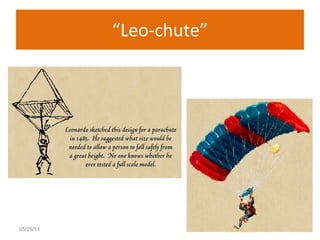
“ Leo-chute” 05/26/11
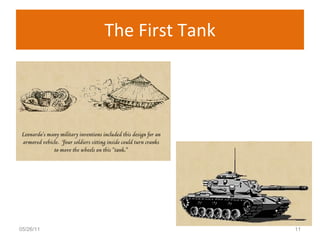
The First Tank 05/26/11
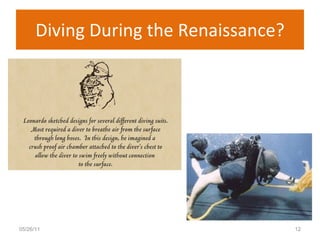
Diving During the Renaissance? 05/26/11
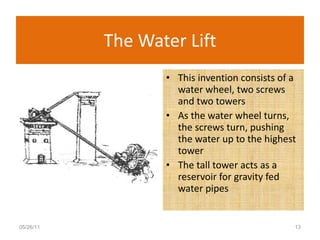
The Water Lift This invention consists of a water wheel, two screws and two towers As the water wheel turns, the screws turn, pushing the water up to the highest tower The tall tower acts as a reservoir for gravity fed water pipes 05/26/11
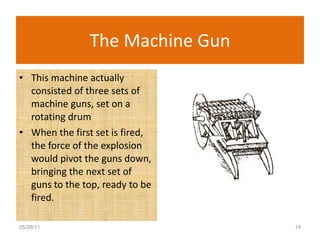
The Machine Gun This machine actually consisted of three sets of machine guns, set on a rotating drum  When the first set is fired, the force of the explosion would pivot the guns down, bringing the next set of guns to the top, ready to be fired.  05/26/11
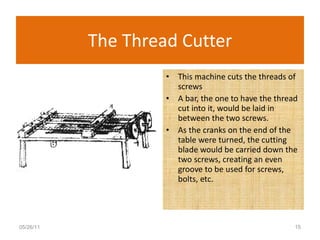
The Thread Cutter This machine cuts the threads of screws  A bar, the one to have the thread cut into it, would be laid in between the two screws.  As the cranks on the end of the table were turned, the cutting blade would be carried down the two screws, creating an even groove to be used for screws, bolts, etc.  05/26/11
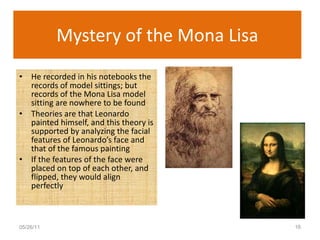
Mystery of the Mona Lisa He recorded in his notebooks the records of model sittings; but records of the Mona Lisa model sitting are nowhere to be found Theories are that Leonardo painted himself, and this theory is supported by analyzing the facial features of Leonardo’s face and that of the famous painting If the features of the face were placed on top of each other, and flipped, they would align perfectly 05/26/11
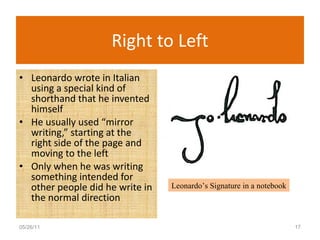
Right to Left Leonardo wrote in Italian using a special kind of shorthand that he invented himself He usually used “mirror writing,” starting at the right side of the page and moving to the left Only when he was writing something intended for other people did he write in the normal direction 05/26/11 Leonardo’s Signature in a notebook

Leonardo da Vinci

  • 1.
    Renaissance Man: Leonardo da Vinci 05/26/11
  • 2.
    05/26/11 Self-portrait ofLeonardo da Vinci. Red chalk. Turin, Royal Library. Ca. 1510-1515
  • 3.
    Leonardo the ScientistStudied many topics such as anatomy, zoology, botany, geology, optics, aerodynamics and hydrodynamics among others . He was fascinated by the study of physiognomy, the “science” of evaluating a person’s character by his or her facial features 05/26/11
  • 4.
    Leonardo da Vinci,the Artist Leonardo’s desire to paint things realistically was audacious and fresh, and eventually became the standard for painters who followed in the 16th century. Went beyond his teaching by making a scientific study of light and shadow in nature Objects were not comprised of outlines, but were actually 3-D bodies defined by light and shadow Known as chiaroscuro , this technique gave his paintings the soft, lifelike quality. 05/26/11
  • 5.
    05/26/11 Anatomical Studiesof the Arm showing the Movements made by the Biceps, c. 1510, a drawing by Leonardo da Vinci
  • 6.
    05/26/11 Study ofa horse, by Leonardo da Vinci, ca. 1490.
  • 7.
  • 8.
    Leonardo da Vinci,the Inventor Adapted drawing skills to the more lucrative fields of architecture, military engineering, canal building and weapons design Leonardo wanted to create "new machines" for a "new world“ Based on the gear, he came up with lots of different ideas, including the bicycle, a helicopter, an “auto-mobile”, and many military weapons 05/26/11 Leonardo’s first idea for a catapult
  • 9.
  • 10.
  • 11.
  • 12.
    Diving During theRenaissance? 05/26/11
  • 13.
    The Water LiftThis invention consists of a water wheel, two screws and two towers As the water wheel turns, the screws turn, pushing the water up to the highest tower The tall tower acts as a reservoir for gravity fed water pipes 05/26/11
  • 14.
    The Machine GunThis machine actually consisted of three sets of machine guns, set on a rotating drum When the first set is fired, the force of the explosion would pivot the guns down, bringing the next set of guns to the top, ready to be fired. 05/26/11
  • 15.
    The Thread CutterThis machine cuts the threads of screws A bar, the one to have the thread cut into it, would be laid in between the two screws. As the cranks on the end of the table were turned, the cutting blade would be carried down the two screws, creating an even groove to be used for screws, bolts, etc. 05/26/11
  • 16.
    Mystery of theMona Lisa He recorded in his notebooks the records of model sittings; but records of the Mona Lisa model sitting are nowhere to be found Theories are that Leonardo painted himself, and this theory is supported by analyzing the facial features of Leonardo’s face and that of the famous painting If the features of the face were placed on top of each other, and flipped, they would align perfectly 05/26/11
  • 17.
    Right to LeftLeonardo wrote in Italian using a special kind of shorthand that he invented himself He usually used “mirror writing,” starting at the right side of the page and moving to the left Only when he was writing something intended for other people did he write in the normal direction 05/26/11 Leonardo’s Signature in a notebook