The Most Curious and
Creative Scientist Yet
• LEONARDO DA VINCI
“True greatness consists
in the use of a powerful
understanding to
enlighten oneself and
others.”
-MARK TWAIN
• Brief biography of Leonardo.
• Fields of interest.
• Literary work.
• Ideas & Inventions.
• Paintings.
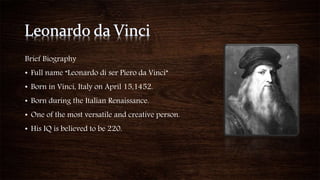
Brief Biography
• Full name “Leonardo di ser Piero da Vinci”
• Born in Vinci, Italy on April 15,1452.
• Born during the Italian Renaissance.
• One of the most versatile and creative person.
• His IQ is believed to be 220.
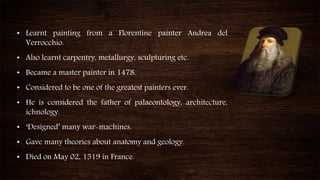
• Learnt painting from a Florentine painter Andrea del
Verrocchio.
• Also learnt carpentry, metallurgy, sculpturing etc.
• Became a master painter in 1478.
• Considered to be one of the greatest painters ever.
• He is considered the father of palaeontology, architecture,
ichnology.
• ‘Designed’ many war-machines.
• Gave many theories about anatomy and geology.
• Died on May 02, 1519 in France.
 Fields of Interest
• Painting
• Architecture
• Science
• Mathematics
• Literature
• Geology
• Botany
• Many more…
• Sculpturing
• Carpentry
• Music
• Engineering
• Anatomy
• Astronomy
• Cartography
Let us now explore some of these fields randomly.
Leonardo’s Journals
• Leonardo's studies in science and
engineering are quite impressive and
innovative.
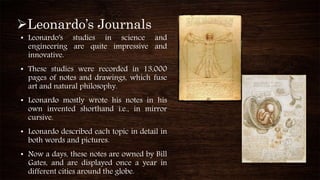
• These studies were recorded in 13,000
pages of notes and drawings, which fuse
art and natural philosophy.
• Leonardo mostly wrote his notes in his
own invented shorthand i.e., in mirror
cursive.
• Leonardo described each topic in detail in
both words and pictures.
• Now a days, these notes are owned by Bill
Gates, and are displayed once a year in
different cities around the globe.
 Anatomy
• Leonardo’s teacher Verrocchio urged him to study anatomy.
• As an artist, he quickly became a master of topographic anatomy.
• He was permitted to dissect human corpuses.
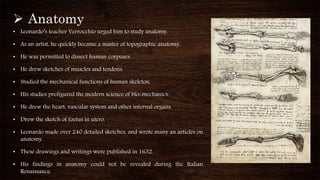
• He drew sketches of muscles and tendons.
• Studied the mechanical functions of human skeleton.
• His studies prefigured the modern science of bio-mechanics.
• He drew the heart, vascular system and other internal organs.
• Drew the sketch of foetus in utero.
• Leonardo made over 240 detailed sketches, and wrote many an articles on
anatomy.
• These drawings and writings were published in 1632.
• His findings in anatomy could not be revealed during the Italian
Renaissance.
Cartography
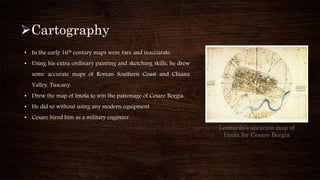
Leonardo’s accurate map of
Imola for Cesare Borgia
• In the early 16th century maps were rare and inaccurate.
• Using his extra-ordinary painting and sketching skills, he drew
some accurate maps of Roman Southern Coast and Chiana
Valley, Tuscany.
• Drew the map of Imola to win the patronage of Cesare Borgia.
• He did so without using any modern equipment.
• Cesare hired him as a military engineer.
Flying Machine
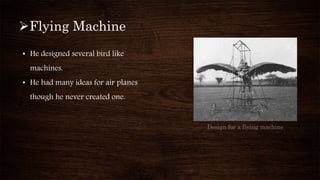
• He designed several bird like
machines.
• He had many ideas for air planes
though he never created one.
Design for a flying machine
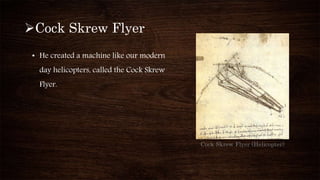
Cock Skrew Flyer (Helicopter)
Cock Skrew Flyer
• He created a machine like our modern
day helicopters, called the Cock Skrew
Flyer.
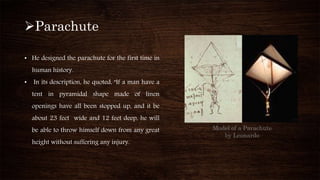
Model of a Parachute
by Leonardo
Parachute
• He designed the parachute for the first time in
human history.
• In its description, he quoted, "If a man have a
tent in pyramidal shape made of linen
openings have all been stopped up, and it be
about 23 feet wide and 12 feet deep, he will
be able to throw himself down from any great
height without suffering any injury.
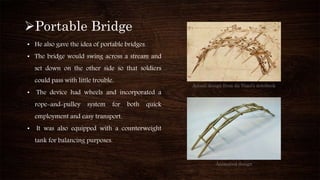
Portable Bridge
• He also gave the idea of portable bridges.
• The bridge would swing across a stream and
set down on the other side so that soldiers
could pass with little trouble.
• The device had wheels and incorporated a
rope-and-pulley system for both quick
employment and easy transport.
• It was also equipped with a counterweight
tank for balancing purposes.
Actual design from da Vinci’s notebook
Animated design
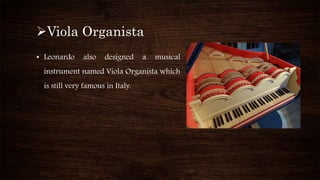
Viola Organista
• Leonardo also designed a musical
instrument named Viola Organista which
is still very famous in Italy.
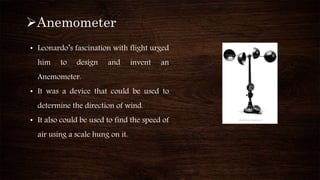
Anemometer
• Leonardo’s fascination with flight urged
him to design and invent an
Anemometer.
• It was a device that could be used to
determine the direction of wind.
• It also could be used to find the speed of
air using a scale hung on it.
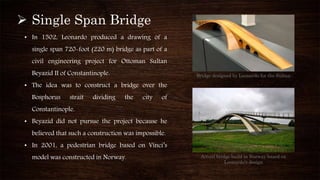
 Single Span Bridge
• In 1502, Leonardo produced a drawing of a
single span 720-foot (220 m) bridge as part of a
civil engineering project for Ottoman Sultan
Beyazid II of Constantinople.
• The idea was to construct a bridge over the
Bosphorus strait dividing the city of
Constantinople.
• Beyazid did not pursue the project because he
believed that such a construction was impossible.
• In 2001, a pedestrian bridge based on Vinci’s
model was constructed in Norway.
Bridge designed by Leonardo for the Sultan
Actual bridge build in Norway based on
Leonardo’s design
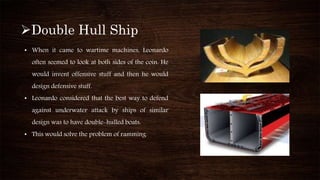
Double Hull Ship
• When it came to wartime machines, Leonardo
often seemed to look at both sides of the coin. He
would invent offensive stuff and then he would
design defensive stuff.
• Leonardo considered that the best way to defend
against underwater attack by ships of similar
design was to have double-hulled boats.
• This would solve the problem of ramming.
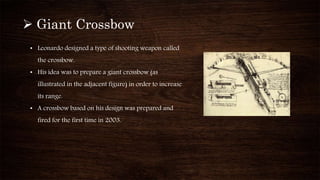
 Giant Crossbow
• Leonardo designed a type of shooting weapon called
the crossbow.
• His idea was to prepare a giant crossbow (as
illustrated in the adjacent figure) in order to increase
its range.
• A crossbow based on his design was prepared and
fired for the first time in 2003.
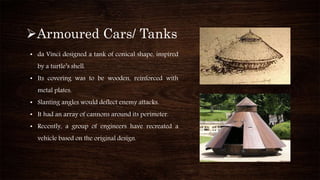
Armoured Cars/ Tanks
• da Vinci designed a tank of conical shape, inspired
by a turtle’s shell.
• Its covering was to be wooden, reinforced with
metal plates.
• Slanting angles would deflect enemy attacks.
• It had an array of cannons around its perimeter.
• Recently, a group of engineers have recreated a
vehicle based on the original design.
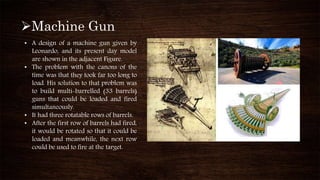
Machine Gun
• A design of a machine gun given by
Leonardo, and its present day model
are shown in the adjacent Figure.
• The problem with the canons of the
time was that they took far too long to
load. His solution to that problem was
to build multi-barrelled (33 barrels)
guns that could be loaded and fired
simultaneously.
• It had three rotatable rows of barrels.
• After the first row of barrels had fired,
it would be rotated so that it could be
loaded and meanwhile, the next row
could be used to fire at the target.
“Where the spirit does not work with the
hand, there is no art.”
-Leonardo da Vinci
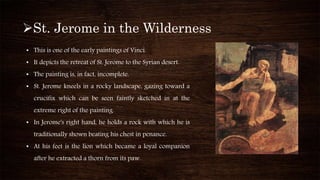
St. Jerome in the Wilderness
• This is one of the early paintings of Vinci.
• It depicts the retreat of St. Jerome to the Syrian desert.
• The painting is, in fact, incomplete.
• St. Jerome kneels in a rocky landscape, gazing toward a
crucifix which can be seen faintly sketched in at the
extreme right of the painting.
• In Jerome's right hand, he holds a rock with which he is
traditionally shown beating his chest in penance.
• At his feet is the lion which became a loyal companion
after he extracted a thorn from its paw.
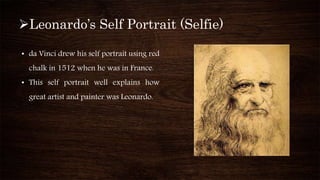
Leonardo’s Self Portrait (Selfie)
• da Vinci drew his self portrait using red
chalk in 1512 when he was in France.
• This self portrait well explains how
great artist and painter was Leonardo.
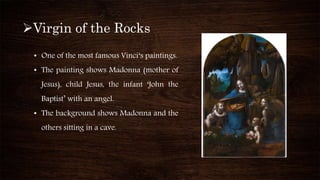
Virgin of the Rocks
• One of the most famous Vinci‘s paintings.
• The painting shows Madonna (mother of
Jesus), child Jesus, the infant ‘John the
Baptist’ with an angel.
• The background shows Madonna and the
others sitting in a cave.
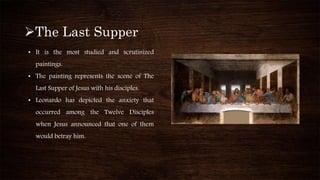
The Last Supper
• It is the most studied and scrutinized
paintings.
• The painting represents the scene of The
Last Supper of Jesus with his disciples.
• Leonardo has depicted the anxiety that
occurred among the Twelve Disciples
when Jesus announced that one of them
would betray him.
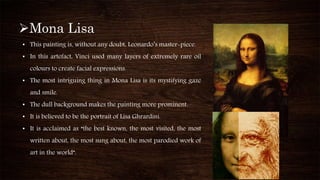
Mona Lisa
• This painting is, without any doubt, Leonardo’s master-piece.
• In this artefact, Vinci used many layers of extremely rare oil
colours to create facial expressions.
• The most intriguing thing in Mona Lisa is its mystifying gaze
and smile.
• The dull background makes the painting more prominent.
• It is believed to be the portrait of Lisa Ghrardini.
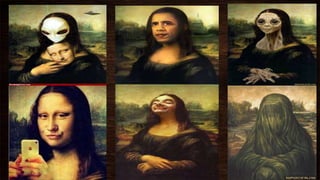
• It is acclaimed as “the best known, the most visited, the most
written about, the most sung about, the most parodied work of
art in the world”.
“To live a creative life, we
must lose our fear of being
wrong.”
-LEONARDO DA VINCI
Bibliography
• https://en.wikipedia.org/wiki/Leonardo_da_Vinci
• https://en.wikipedia.org/.../Science_and_inventions_of_Leonardo_da_Vinci
• https://en.wikipedia.org/wiki/Mona_Lisa
• www.leonardoda-vinci.org/biography.html
• www.leonardo-da-vinci-anatomy.touchpress.com
Group Members
• Muhammad Usman Arif (32540)
• Mian Muhammad Sharjeel Safdar (32472)
• Muhammad Ehsan-ul-Haq Zaheer (34045)
• Masoud Ahmed Tarar (34569)
• Shoaib Ali (34947)

Leonardo da vinci

  • 2.
    The Most Curiousand Creative Scientist Yet • LEONARDO DA VINCI
  • 3.
    “True greatness consists inthe use of a powerful understanding to enlighten oneself and others.” -MARK TWAIN
  • 4.
    • Brief biographyof Leonardo. • Fields of interest. • Literary work. • Ideas & Inventions. • Paintings.
  • 5.
    Brief Biography • Fullname “Leonardo di ser Piero da Vinci” • Born in Vinci, Italy on April 15,1452. • Born during the Italian Renaissance. • One of the most versatile and creative person. • His IQ is believed to be 220.
  • 6.
    • Learnt paintingfrom a Florentine painter Andrea del Verrocchio. • Also learnt carpentry, metallurgy, sculpturing etc. • Became a master painter in 1478. • Considered to be one of the greatest painters ever. • He is considered the father of palaeontology, architecture, ichnology. • ‘Designed’ many war-machines. • Gave many theories about anatomy and geology. • Died on May 02, 1519 in France.
  • 7.
     Fields ofInterest • Painting • Architecture • Science • Mathematics • Literature • Geology • Botany • Many more… • Sculpturing • Carpentry • Music • Engineering • Anatomy • Astronomy • Cartography Let us now explore some of these fields randomly.
  • 8.
    Leonardo’s Journals • Leonardo'sstudies in science and engineering are quite impressive and innovative. • These studies were recorded in 13,000 pages of notes and drawings, which fuse art and natural philosophy. • Leonardo mostly wrote his notes in his own invented shorthand i.e., in mirror cursive. • Leonardo described each topic in detail in both words and pictures. • Now a days, these notes are owned by Bill Gates, and are displayed once a year in different cities around the globe.
  • 9.
     Anatomy • Leonardo’steacher Verrocchio urged him to study anatomy. • As an artist, he quickly became a master of topographic anatomy. • He was permitted to dissect human corpuses. • He drew sketches of muscles and tendons. • Studied the mechanical functions of human skeleton. • His studies prefigured the modern science of bio-mechanics. • He drew the heart, vascular system and other internal organs. • Drew the sketch of foetus in utero. • Leonardo made over 240 detailed sketches, and wrote many an articles on anatomy. • These drawings and writings were published in 1632. • His findings in anatomy could not be revealed during the Italian Renaissance.
  • 10.
    Cartography Leonardo’s accurate mapof Imola for Cesare Borgia • In the early 16th century maps were rare and inaccurate. • Using his extra-ordinary painting and sketching skills, he drew some accurate maps of Roman Southern Coast and Chiana Valley, Tuscany. • Drew the map of Imola to win the patronage of Cesare Borgia. • He did so without using any modern equipment. • Cesare hired him as a military engineer.
  • 12.
    Flying Machine • Hedesigned several bird like machines. • He had many ideas for air planes though he never created one. Design for a flying machine
  • 13.
    Cock Skrew Flyer(Helicopter) Cock Skrew Flyer • He created a machine like our modern day helicopters, called the Cock Skrew Flyer.
  • 14.
    Model of aParachute by Leonardo Parachute • He designed the parachute for the first time in human history. • In its description, he quoted, "If a man have a tent in pyramidal shape made of linen openings have all been stopped up, and it be about 23 feet wide and 12 feet deep, he will be able to throw himself down from any great height without suffering any injury.
  • 15.
    Portable Bridge • Healso gave the idea of portable bridges. • The bridge would swing across a stream and set down on the other side so that soldiers could pass with little trouble. • The device had wheels and incorporated a rope-and-pulley system for both quick employment and easy transport. • It was also equipped with a counterweight tank for balancing purposes. Actual design from da Vinci’s notebook Animated design
  • 16.
    Viola Organista • Leonardoalso designed a musical instrument named Viola Organista which is still very famous in Italy.
  • 17.
    Anemometer • Leonardo’s fascinationwith flight urged him to design and invent an Anemometer. • It was a device that could be used to determine the direction of wind. • It also could be used to find the speed of air using a scale hung on it.
  • 18.
     Single SpanBridge • In 1502, Leonardo produced a drawing of a single span 720-foot (220 m) bridge as part of a civil engineering project for Ottoman Sultan Beyazid II of Constantinople. • The idea was to construct a bridge over the Bosphorus strait dividing the city of Constantinople. • Beyazid did not pursue the project because he believed that such a construction was impossible. • In 2001, a pedestrian bridge based on Vinci’s model was constructed in Norway. Bridge designed by Leonardo for the Sultan Actual bridge build in Norway based on Leonardo’s design
  • 19.
    Double Hull Ship •When it came to wartime machines, Leonardo often seemed to look at both sides of the coin. He would invent offensive stuff and then he would design defensive stuff. • Leonardo considered that the best way to defend against underwater attack by ships of similar design was to have double-hulled boats. • This would solve the problem of ramming.
  • 20.
     Giant Crossbow •Leonardo designed a type of shooting weapon called the crossbow. • His idea was to prepare a giant crossbow (as illustrated in the adjacent figure) in order to increase its range. • A crossbow based on his design was prepared and fired for the first time in 2003.
  • 21.
    Armoured Cars/ Tanks •da Vinci designed a tank of conical shape, inspired by a turtle’s shell. • Its covering was to be wooden, reinforced with metal plates. • Slanting angles would deflect enemy attacks. • It had an array of cannons around its perimeter. • Recently, a group of engineers have recreated a vehicle based on the original design.
  • 22.
    Machine Gun • Adesign of a machine gun given by Leonardo, and its present day model are shown in the adjacent Figure. • The problem with the canons of the time was that they took far too long to load. His solution to that problem was to build multi-barrelled (33 barrels) guns that could be loaded and fired simultaneously. • It had three rotatable rows of barrels. • After the first row of barrels had fired, it would be rotated so that it could be loaded and meanwhile, the next row could be used to fire at the target.
  • 23.
    “Where the spiritdoes not work with the hand, there is no art.” -Leonardo da Vinci
  • 24.
    St. Jerome inthe Wilderness • This is one of the early paintings of Vinci. • It depicts the retreat of St. Jerome to the Syrian desert. • The painting is, in fact, incomplete. • St. Jerome kneels in a rocky landscape, gazing toward a crucifix which can be seen faintly sketched in at the extreme right of the painting. • In Jerome's right hand, he holds a rock with which he is traditionally shown beating his chest in penance. • At his feet is the lion which became a loyal companion after he extracted a thorn from its paw.
  • 25.
    Leonardo’s Self Portrait(Selfie) • da Vinci drew his self portrait using red chalk in 1512 when he was in France. • This self portrait well explains how great artist and painter was Leonardo.
  • 26.
    Virgin of theRocks • One of the most famous Vinci‘s paintings. • The painting shows Madonna (mother of Jesus), child Jesus, the infant ‘John the Baptist’ with an angel. • The background shows Madonna and the others sitting in a cave.
  • 27.
    The Last Supper •It is the most studied and scrutinized paintings. • The painting represents the scene of The Last Supper of Jesus with his disciples. • Leonardo has depicted the anxiety that occurred among the Twelve Disciples when Jesus announced that one of them would betray him.
  • 28.
    Mona Lisa • Thispainting is, without any doubt, Leonardo’s master-piece. • In this artefact, Vinci used many layers of extremely rare oil colours to create facial expressions. • The most intriguing thing in Mona Lisa is its mystifying gaze and smile. • The dull background makes the painting more prominent. • It is believed to be the portrait of Lisa Ghrardini. • It is acclaimed as “the best known, the most visited, the most written about, the most sung about, the most parodied work of art in the world”.
  • 30.
    “To live acreative life, we must lose our fear of being wrong.” -LEONARDO DA VINCI
  • 31.
    Bibliography • https://en.wikipedia.org/wiki/Leonardo_da_Vinci • https://en.wikipedia.org/.../Science_and_inventions_of_Leonardo_da_Vinci •https://en.wikipedia.org/wiki/Mona_Lisa • www.leonardoda-vinci.org/biography.html • www.leonardo-da-vinci-anatomy.touchpress.com
  • 32.
    Group Members • MuhammadUsman Arif (32540) • Mian Muhammad Sharjeel Safdar (32472) • Muhammad Ehsan-ul-Haq Zaheer (34045) • Masoud Ahmed Tarar (34569) • Shoaib Ali (34947)