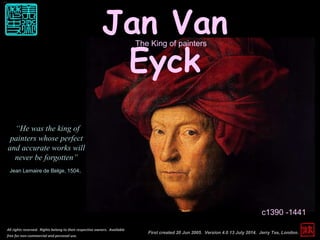
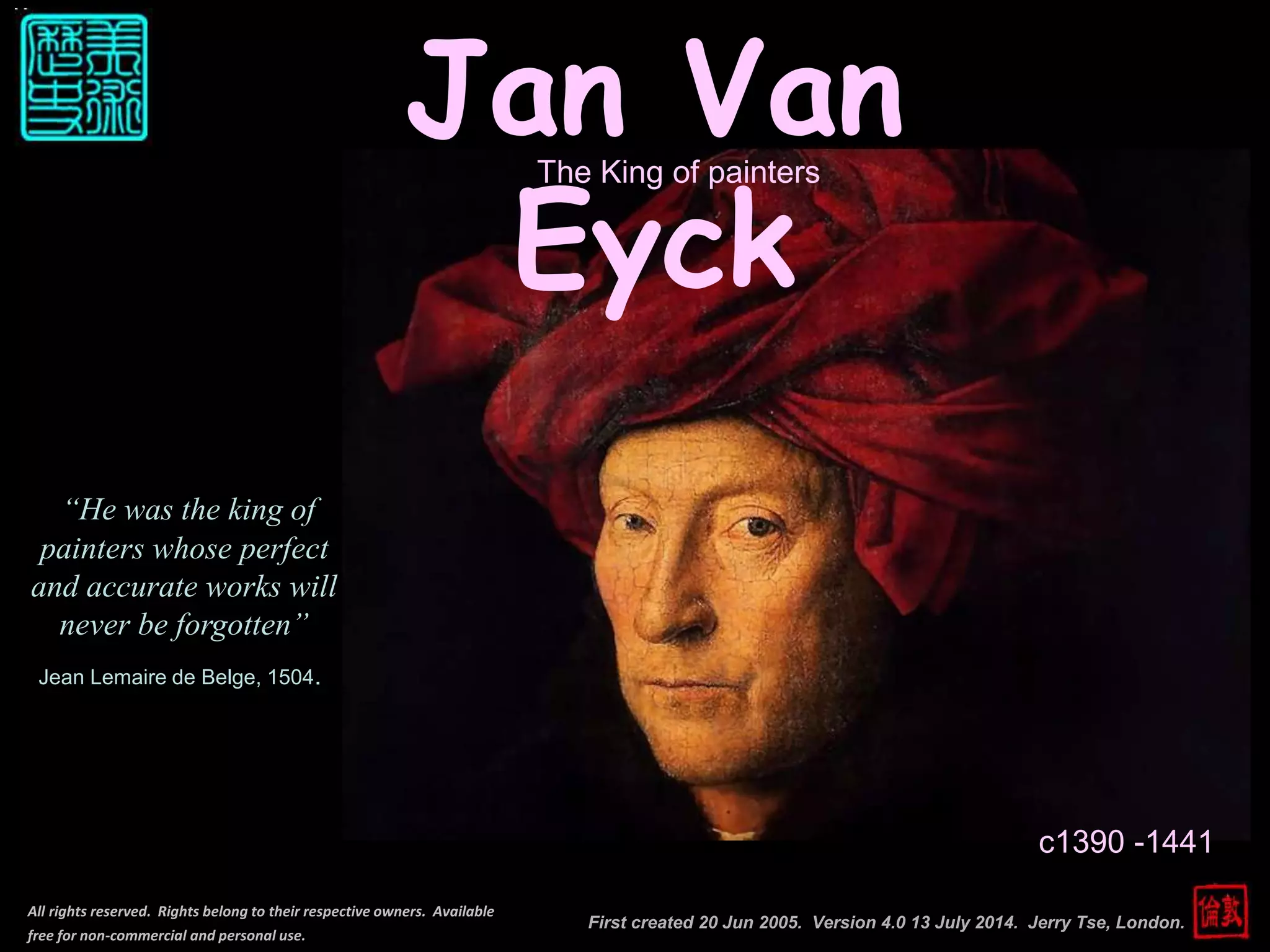
Jan Van
Eyck
c1390 -1441
First created 20 Jun 2005. Version 4.0 13 July 2014. Jerry Tse, London.
All rights reserved. Rights belong to their respective owners. Available
free for non-commercial and personal use.
“He was the king of
painters whose perfect
and accurate works will
never be forgotten”
Jean Lemaire de Belge, 1504.
The King of painters
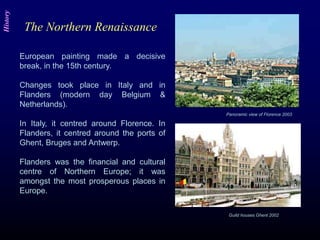
European painting made a decisive
break, in the 15th century.
Changes took place in Italy and in
Flanders (modern day Belgium &
Netherlands).
In Italy, it centred around Florence. In
Flanders, it centred around the ports of
Ghent, Bruges and Antwerp.
Flanders was the financial and cultural
centre of Northern Europe; it was
amongst the most prosperous places in
Europe.
Panoramic view of Florence 2003
Guild houses Ghent 2002
The Northern Renaissance
History
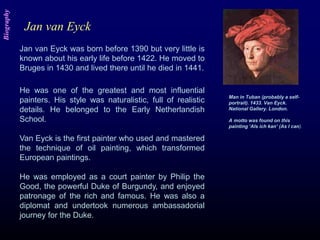
Man in Tuban (probably a self-
portrait). 1433. Van Eyck.
National Gallery. London.
A motto was found on this
painting ‘Als ich kan’ (As I can).
Jan van Eyck was born before 1390 but very little is
known about his early life before 1422. He moved to
Bruges in 1430 and lived there until he died in 1441.
He was one of the greatest and most influential
painters. His style was naturalistic, full of realistic
details. He belonged to the Early Netherlandish
School.
Van Eyck is the first painter who used and mastered
the technique of oil painting, which transformed
European paintings.
He was employed as a court painter by Philip the
Good, the powerful Duke of Burgundy, and enjoyed
patronage of the rich and famous. He was also a
diplomat and undertook numerous ambassadorial
journey for the Duke.
Jan van Eyck
Biography
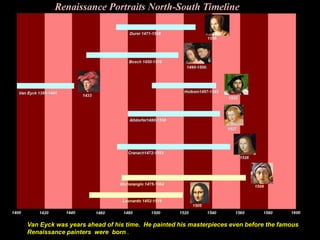
Van Eyck was years ahead of his time. He painted his masterpieces even before the famous
Renaissance painters were born .
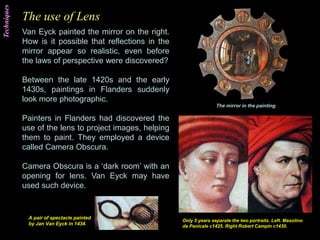
The use of Lens
Van Eyck painted the mirror on the right.
How is it possible that reflections in the
mirror appear so realistic, even before
the laws of perspective were discovered?
Between the late 1420s and the early
1430s, paintings in Flanders suddenly
look more photographic.
Painters in Flanders had discovered the
use of the lens to project images, helping
them to paint. They employed a device
called Camera Obscura.
Camera Obscura is a ‘dark room’ with an
opening for lens. Van Eyck may have
used such device.
The mirror in the painting.
Only 5 years separate the two portraits. Left. Masolino
da Panicale c1425. Right Robert Campin c1430.
A pair of spectacle painted
by Jan Van Eyck in 1434.
Techniques
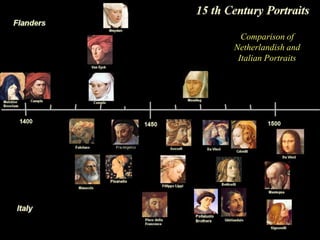
Comparison of
Netherlandish and
Italian Portraits
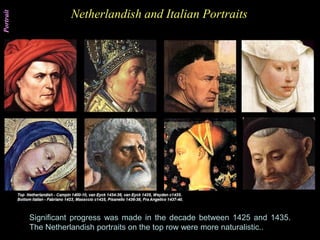
Netherlandish and Italian Portraits
Portrait
Significant progress was made in the decade between 1425 and 1435.
The Netherlandish portraits on the top row were more naturalistic..
Portrait
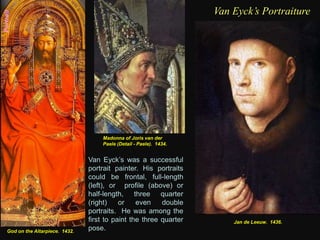
God on the Altarpiece. 1432.
Van Eyck’s Portraiture
Van Eyck’s was a successful
portrait painter. His portraits
could be frontal, full-length
(left), or profile (above) or
half-length, three quarter
(right) or even double
portraits. He was among the
first to paint the three quarter
pose.
Madonna of Joris van der
Paele (Detail - Paele). 1434.
Jan de Leeuw. 1436.
Costume
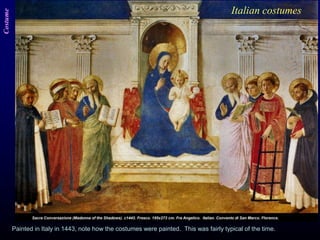
Painted in Italy in 1443, note how the costumes were painted. This was fairly typical of the time.
Italian costumes
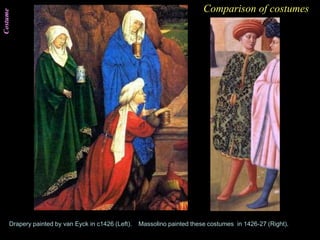
Costume Comparison of costumes
Drapery painted by van Eyck in c1426 (Left). Massolino painted these costumes in 1426-27 (Right).
Costume
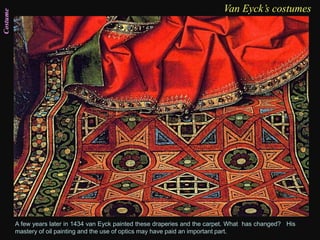
A few years later in 1434 van Eyck painted these draperies and the carpet. What has changed? His
mastery of oil painting and the use of optics may have paid an important part.
Van Eyck’s costumes
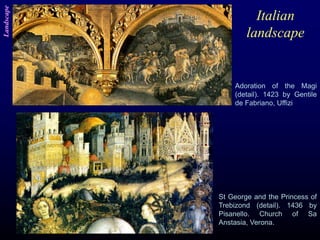
Italian
landscape
Adoration of the Magi
(detail). 1423 by Gentile
de Fabriano, Uffizi
St George and the Princess of
Trebizond (detail). 1436 by
Pisanello. Church of Sa
Anstasia, Verona.
Landscape
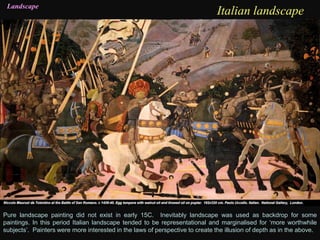
Italian landscapeLandscape
Pure landscape painting did not exist in early 15C. Inevitably landscape was used as backdrop for some
paintings. In this period Italian landscape tended to be representational and marginalised for ‘more worthwhile
subjects’. Painters were more interested in the laws of perspective to create the illusion of depth as in the above.
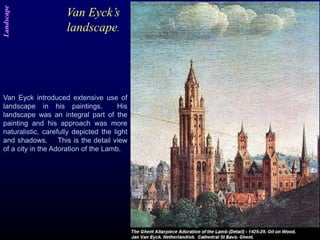
Van Eyck introduced extensive use of
landscape in his paintings. His
landscape was an integral part of the
painting and his approach was more
naturalistic, carefully depicted the light
and shadows. This is the detail view
of a city in the Adoration of the Lamb.
Van Eyck’s
landscape.
Landscape
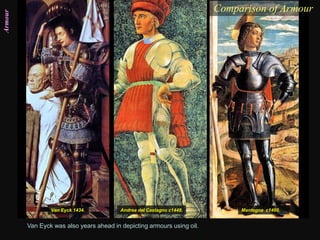
Armour Comparison of Armour
Van Eyck 1434. Andrea del Castagno c1448.
Van Eyck was also years ahead in depicting armours using oil.
Mantegna c1460.
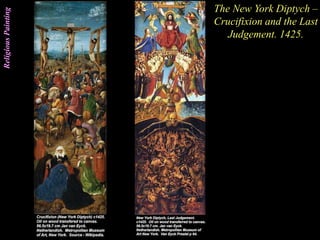
The New York Diptych –
Crucifixion and the Last
Judgement. 1425.
ReligiousPainting
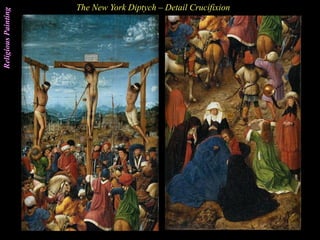
The New York Diptych – Detail CrucifixionReligiousPainting
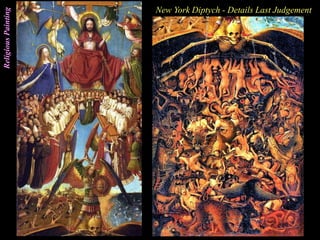
New York Diptych - Details Last JudgementReligiousPainting
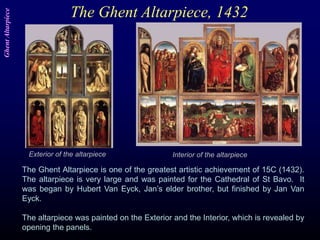
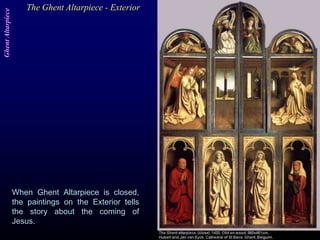
The Ghent Altarpiece, 1432
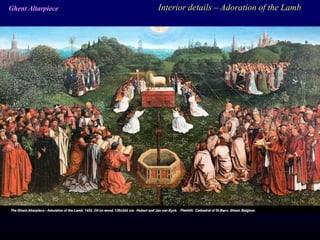
The Ghent Altarpiece is one of the greatest artistic achievement of 15C (1432).
The altarpiece is very large and was painted for the Cathedral of St Bavo. It
was began by Hubert Van Eyck, Jan’s elder brother, but finished by Jan Van
Eyck.
The altarpiece was painted on the Exterior and the Interior, which is revealed by
opening the panels.
Interior of the altarpieceExterior of the altarpiece
GhentAltarpiece
The Ghent Altarpiece - Exterior
When Ghent Altarpiece is closed,
the paintings on the Exterior tells
the story about the coming of
Jesus.
GhentAltarpiece
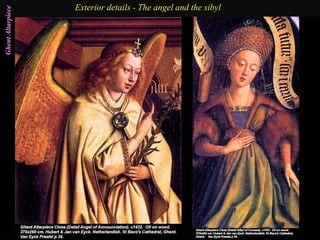
Exterior details - The angel and the sibylGhentAltarpiece
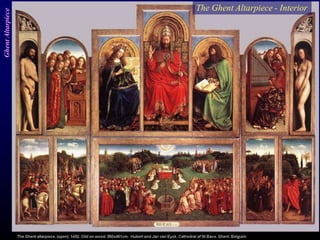
The Ghent Altarpiece - InteriorGhentAltarpiece
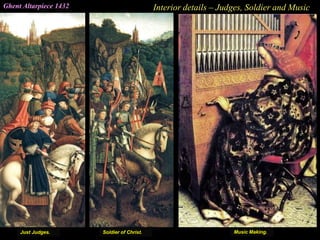
Ghent Altarpiece 1432 Interior details – Judges, Soldier and Music
Music Making.Soldier of Christ.Just Judges.
Interior details – Adoration of the LambGhent Altarpiece
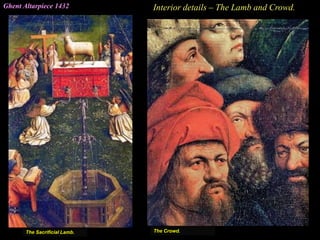
Ghent Altarpiece 1432 Interior details – The Lamb and Crowd.
The Crowd.The Sacrificial Lamb.
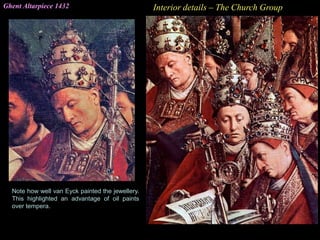
Ghent Altarpiece 1432 Interior details – The Church Group
Note how well van Eyck painted the jewellery.
This highlighted an advantage of oil paints
over tempera.
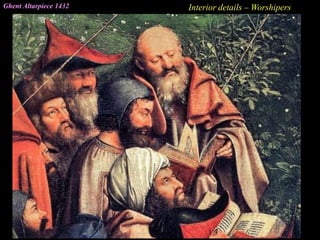
Ghent Altarpiece 1432 Interior details – Worshipers
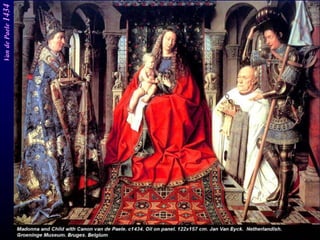
VandePaele1434
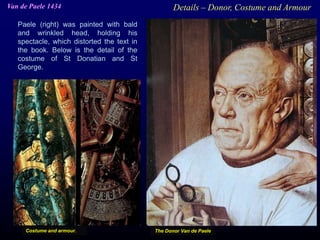
Paele (right) was painted with bald
and wrinkled head, holding his
spectacle, which distorted the text in
the book. Below is the detail of the
costume of St Donatian and St
George.
Van de Paele 1434 Details – Donor, Costume and Armour
The Donor Van de PaeleCostume and armour.
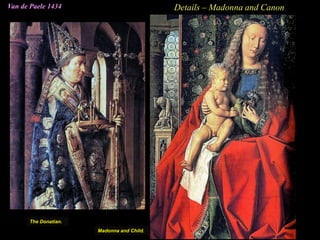
Van de Paele 1434 Details – Madonna and Canon
Madonna and Child.
The Donatian.
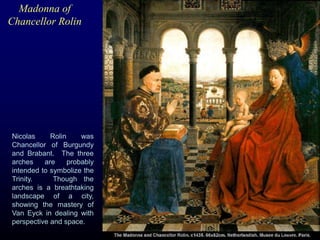
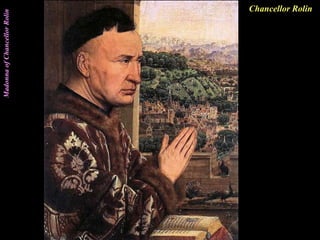
Madonna of
Chancellor Rolin
Nicolas Rolin was
Chancellor of Burgundy
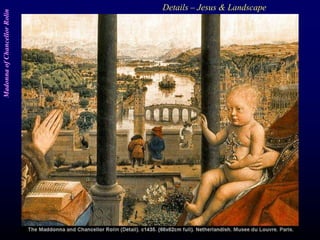
and Brabant. The three
arches are probably
intended to symbolize the
Trinity. Though the
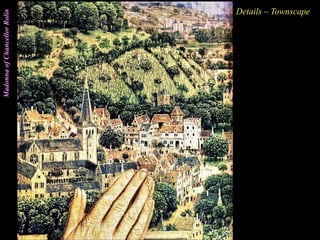
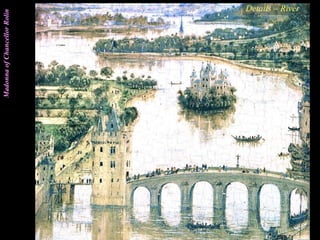
arches is a breathtaking
landscape of a city,
showing the mastery of
Van Eyck in dealing with
perspective and space.
Chancellor RolinMadonnaofChancellorRolin
MadonnaofChancellorRolin Details – Jesus & Landscape
MadonnaofChancellorRolin
Details – Townscape
MadonnaofChancellorRolin Details – River
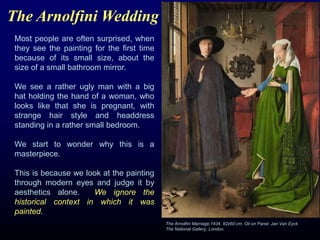
The Arnolfini Wedding
Most people are often surprised, when
they see the painting for the first time
because of its small size, about the
size of a small bathroom mirror.
We see a rather ugly man with a big
hat holding the hand of a woman, who
looks like that she is pregnant, with
strange hair style and headdress
standing in a rather small bedroom.
We start to wonder why this is a
masterpiece.
This is because we look at the painting
through modern eyes and judge it by
aesthetics alone. We ignore the
historical context in which it was
painted.
The Arnolfini Marriage.1434. 82x60 cm. Oil on Panel. Jan Van Eyck
The National Gallery, London.
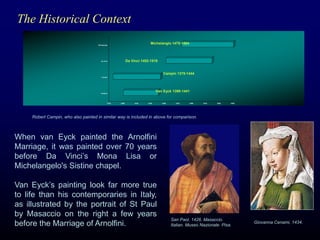
The Historical Context
1370 1390 1410 1430 1450 1470 1490 1510 1530 1550
VanEyck
Campin
Da Vinci
Michelanglo
Da Vinci 1452-1519
Michelanglo 1475-1564
Campin 1375-1444
Van Eyck 1390-1441
When van Eyck painted the Arnolfini
Marriage, it was painted over 70 years
before Da Vinci’s Mona Lisa or
Michelangelo's Sistine chapel.
Van Eyck’s painting look far more true
to life than his contemporaries in Italy,
as illustrated by the portrait of St Paul
by Masaccio on the right a few years
before the Marriage of Arnolfini.
San Paol. 1426. Masaccio.
Italian. Museo Nazionale. Pisa.
Robert Campin, who also painted in similar way is included in above for comparison.
Giovanna Cenami, 1434.
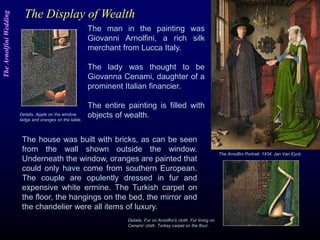
The Display of Wealth
The house was built with bricks, as can be seen
from the wall shown outside the window.
Underneath the window, oranges are painted that
could only have come from southern European.
The couple are opulently dressed in fur and
expensive white ermine. The Turkish carpet on
the floor, the hangings on the bed, the mirror and
the chandelier were all items of luxury.
The man in the painting was
Giovanni Arnolfini, a rich silk
merchant from Lucca Italy.
The lady was thought to be
Giovanna Cenami, daughter of a
prominent Italian financier.
The entire painting is filled with
objects of wealth.Details. Apple on the window
ledge and oranges on the table.
Details. Fur on Arnolfini’s cloth. Fur lining on
Cenami’ cloth. Turkey carpet on the floor.
The Arnolfini Portrait. 1434. Jan Van Eyck.
TheArnolfiniWedding
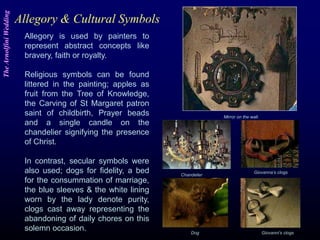
Allegory & Cultural Symbols
Mirror on the wall.
Chandelier
Giovanna’s clogs
Giovanni’s clogsDog
Allegory is used by painters to
represent abstract concepts like
bravery, faith or royalty.
Religious symbols can be found
littered in the painting; apples as
fruit from the Tree of Knowledge,
the Carving of St Margaret patron
saint of childbirth, Prayer beads
and a single candle on the
chandelier signifying the presence
of Christ.
In contrast, secular symbols were
also used; dogs for fidelity, a bed
for the consummation of marriage,
the blue sleeves & the white lining
worn by the lady denote purity,
clogs cast away representing the
abandoning of daily chores on this
solemn occasion.
TheArnolfiniWedding
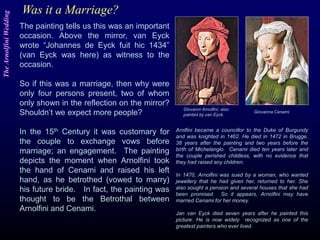
Was it a Marriage?
The painting tells us this was an important
occasion. Above the mirror, van Eyck
wrote “Johannes de Eyck fuit hic 1434”
(van Eyck was here) as witness to the
occasion.
So if this was a marriage, then why were
only four persons present, two of whom
only shown in the reflection on the mirror?
Shouldn’t we expect more people?
In the 15th Century it was customary for
the couple to exchange vows before
marriage; an engagement. The painting
depicts the moment when Arnolfini took
the hand of Cenami and raised his left
hand, as he betrothed (vowed to marry)
his future bride. In fact, the painting was
thought to be the Betrothal between
Arnolfini and Cenami.
Arnlfini became a councillor to the Duke of Burgundy
and was knighted in 1462. He died in 1472 in Brugge,
38 years after the painting and two years before the
birth of Michelanglo. Cenami died ten years later and
the couple perished childless, with no evidence that
they had raised any children.
In 1470, Arnolfini was sued by a woman, who wanted
jewellery that he had given her, returned to her. She
also sought a pension and several houses that she had
been promised. So it appears, Arnolfini may have
married Cenami for her money.
Jan van Eyck died seven years after he painted this
picture. He is now widely recognized as one of the
greatest painters who ever lived.
Giovanni Arnolfini, also
painted by van Eyck.
Giovanna Cenami
TheArnolfiniWedding
TheArnolfiniWedding
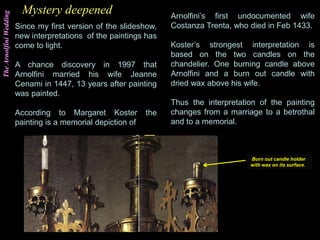
Since my first version of the slideshow,
new interpretations of the paintings has
come to light.
A chance discovery in 1997 that
Arnolfini married his wife Jeanne
Cenami in 1447, 13 years after painting
was painted.
According to Margaret Koster the
painting is a memorial depiction of
Mystery deepened Arnolfini’s first undocumented wife
Costanza Trenta, who died in Feb 1433.
Koster’s strongest interpretation is
based on the two candles on the
chandelier. One burning candle above
Arnolfini and a burn out candle with
dried wax above his wife.
Thus the interpretation of the painting
changes from a marriage to a betrothal
and to a memorial.
Burn out candle holder
with wax on its surface.
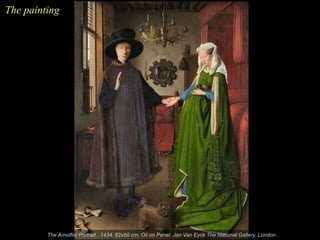
The painting
The Arnolfini Portrait. .1434. 82x60 cm. Oil on Panel. Jan Van Eyck The National Gallery, London.
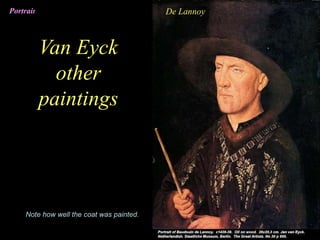
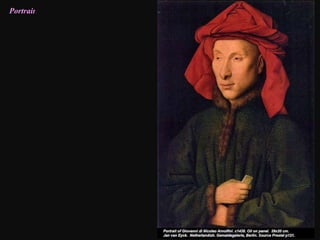
De LannoyPortrait
Note how well the coat was painted.
Van Eyck
other
paintings
Portrait
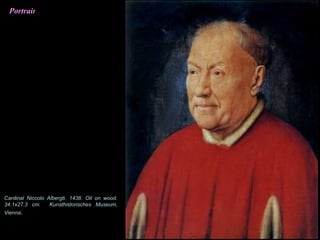
Cardinal Niccolo Albergti. 1438. Oil on wood.
34.1x27.3 cm. Kunsthistorisches Museum,
Vienna.
Portrait
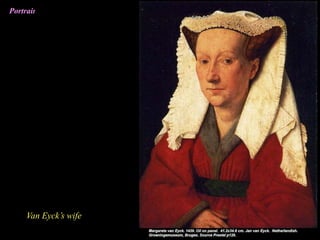
Van Eyck’s wife
Portrait
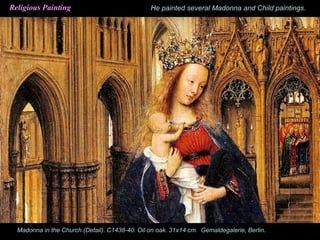
Madonna in the Church (Detail). C1438-40. Oil on oak. 31x14 cm. Gemaldegalerie, Berlin.
Religious Painting He painted several Madonna and Child paintings.
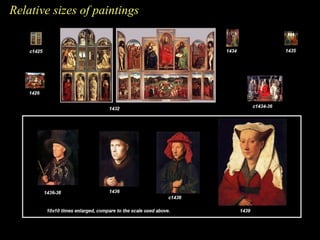
Relative sizes of paintings
Music – Bach, Sheep May Graze Peacefully
All rights reserved. Rights belong to their respective owners.
Available free for non-commercial and personal use.
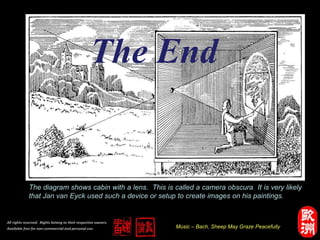
The diagram shows cabin with a lens. This is called a camera obscura. It is very likely
that Jan van Eyck used such a device or setup to create images on his paintings.
The End

Jan van Eyck

  • 1.
    Jan Van Eyck c1390 -1441 Firstcreated 20 Jun 2005. Version 4.0 13 July 2014. Jerry Tse, London. All rights reserved. Rights belong to their respective owners. Available free for non-commercial and personal use. “He was the king of painters whose perfect and accurate works will never be forgotten” Jean Lemaire de Belge, 1504. The King of painters
  • 2.
    European painting madea decisive break, in the 15th century. Changes took place in Italy and in Flanders (modern day Belgium & Netherlands). In Italy, it centred around Florence. In Flanders, it centred around the ports of Ghent, Bruges and Antwerp. Flanders was the financial and cultural centre of Northern Europe; it was amongst the most prosperous places in Europe. Panoramic view of Florence 2003 Guild houses Ghent 2002 The Northern Renaissance History
  • 3.
    Man in Tuban(probably a self- portrait). 1433. Van Eyck. National Gallery. London. A motto was found on this painting ‘Als ich kan’ (As I can). Jan van Eyck was born before 1390 but very little is known about his early life before 1422. He moved to Bruges in 1430 and lived there until he died in 1441. He was one of the greatest and most influential painters. His style was naturalistic, full of realistic details. He belonged to the Early Netherlandish School. Van Eyck is the first painter who used and mastered the technique of oil painting, which transformed European paintings. He was employed as a court painter by Philip the Good, the powerful Duke of Burgundy, and enjoyed patronage of the rich and famous. He was also a diplomat and undertook numerous ambassadorial journey for the Duke. Jan van Eyck Biography
  • 4.
    Van Eyck wasyears ahead of his time. He painted his masterpieces even before the famous Renaissance painters were born .
  • 5.
    The use ofLens Van Eyck painted the mirror on the right. How is it possible that reflections in the mirror appear so realistic, even before the laws of perspective were discovered? Between the late 1420s and the early 1430s, paintings in Flanders suddenly look more photographic. Painters in Flanders had discovered the use of the lens to project images, helping them to paint. They employed a device called Camera Obscura. Camera Obscura is a ‘dark room’ with an opening for lens. Van Eyck may have used such device. The mirror in the painting. Only 5 years separate the two portraits. Left. Masolino da Panicale c1425. Right Robert Campin c1430. A pair of spectacle painted by Jan Van Eyck in 1434. Techniques
  • 6.
  • 7.
    Netherlandish and ItalianPortraits Portrait Significant progress was made in the decade between 1425 and 1435. The Netherlandish portraits on the top row were more naturalistic..
  • 8.
    Portrait God on theAltarpiece. 1432. Van Eyck’s Portraiture Van Eyck’s was a successful portrait painter. His portraits could be frontal, full-length (left), or profile (above) or half-length, three quarter (right) or even double portraits. He was among the first to paint the three quarter pose. Madonna of Joris van der Paele (Detail - Paele). 1434. Jan de Leeuw. 1436.
  • 9.
    Costume Painted in Italyin 1443, note how the costumes were painted. This was fairly typical of the time. Italian costumes
  • 10.
    Costume Comparison ofcostumes Drapery painted by van Eyck in c1426 (Left). Massolino painted these costumes in 1426-27 (Right).
  • 11.
    Costume A few yearslater in 1434 van Eyck painted these draperies and the carpet. What has changed? His mastery of oil painting and the use of optics may have paid an important part. Van Eyck’s costumes
  • 12.
    Italian landscape Adoration of theMagi (detail). 1423 by Gentile de Fabriano, Uffizi St George and the Princess of Trebizond (detail). 1436 by Pisanello. Church of Sa Anstasia, Verona. Landscape
  • 13.
    Italian landscapeLandscape Pure landscapepainting did not exist in early 15C. Inevitably landscape was used as backdrop for some paintings. In this period Italian landscape tended to be representational and marginalised for ‘more worthwhile subjects’. Painters were more interested in the laws of perspective to create the illusion of depth as in the above.
  • 14.
    Van Eyck introducedextensive use of landscape in his paintings. His landscape was an integral part of the painting and his approach was more naturalistic, carefully depicted the light and shadows. This is the detail view of a city in the Adoration of the Lamb. Van Eyck’s landscape. Landscape
  • 15.
    Armour Comparison ofArmour Van Eyck 1434. Andrea del Castagno c1448. Van Eyck was also years ahead in depicting armours using oil. Mantegna c1460.
  • 16.
    The New YorkDiptych – Crucifixion and the Last Judgement. 1425. ReligiousPainting
  • 17.
    The New YorkDiptych – Detail CrucifixionReligiousPainting
  • 18.
    New York Diptych- Details Last JudgementReligiousPainting
  • 19.
    The Ghent Altarpiece,1432 The Ghent Altarpiece is one of the greatest artistic achievement of 15C (1432). The altarpiece is very large and was painted for the Cathedral of St Bavo. It was began by Hubert Van Eyck, Jan’s elder brother, but finished by Jan Van Eyck. The altarpiece was painted on the Exterior and the Interior, which is revealed by opening the panels. Interior of the altarpieceExterior of the altarpiece GhentAltarpiece
  • 20.
    The Ghent Altarpiece- Exterior When Ghent Altarpiece is closed, the paintings on the Exterior tells the story about the coming of Jesus. GhentAltarpiece
  • 21.
    Exterior details -The angel and the sibylGhentAltarpiece
  • 22.
    The Ghent Altarpiece- InteriorGhentAltarpiece
  • 23.
    Ghent Altarpiece 1432Interior details – Judges, Soldier and Music Music Making.Soldier of Christ.Just Judges.
  • 24.
    Interior details –Adoration of the LambGhent Altarpiece
  • 25.
    Ghent Altarpiece 1432Interior details – The Lamb and Crowd. The Crowd.The Sacrificial Lamb.
  • 26.
    Ghent Altarpiece 1432Interior details – The Church Group Note how well van Eyck painted the jewellery. This highlighted an advantage of oil paints over tempera.
  • 27.
    Ghent Altarpiece 1432Interior details – Worshipers
  • 28.
  • 29.
    Paele (right) waspainted with bald and wrinkled head, holding his spectacle, which distorted the text in the book. Below is the detail of the costume of St Donatian and St George. Van de Paele 1434 Details – Donor, Costume and Armour The Donor Van de PaeleCostume and armour.
  • 30.
    Van de Paele1434 Details – Madonna and Canon Madonna and Child. The Donatian.
  • 31.
    Madonna of Chancellor Rolin NicolasRolin was Chancellor of Burgundy and Brabant. The three arches are probably intended to symbolize the Trinity. Though the arches is a breathtaking landscape of a city, showing the mastery of Van Eyck in dealing with perspective and space.
  • 32.
  • 33.
  • 34.
  • 35.
  • 36.
    The Arnolfini Wedding Mostpeople are often surprised, when they see the painting for the first time because of its small size, about the size of a small bathroom mirror. We see a rather ugly man with a big hat holding the hand of a woman, who looks like that she is pregnant, with strange hair style and headdress standing in a rather small bedroom. We start to wonder why this is a masterpiece. This is because we look at the painting through modern eyes and judge it by aesthetics alone. We ignore the historical context in which it was painted. The Arnolfini Marriage.1434. 82x60 cm. Oil on Panel. Jan Van Eyck The National Gallery, London.
  • 37.
    The Historical Context 13701390 1410 1430 1450 1470 1490 1510 1530 1550 VanEyck Campin Da Vinci Michelanglo Da Vinci 1452-1519 Michelanglo 1475-1564 Campin 1375-1444 Van Eyck 1390-1441 When van Eyck painted the Arnolfini Marriage, it was painted over 70 years before Da Vinci’s Mona Lisa or Michelangelo's Sistine chapel. Van Eyck’s painting look far more true to life than his contemporaries in Italy, as illustrated by the portrait of St Paul by Masaccio on the right a few years before the Marriage of Arnolfini. San Paol. 1426. Masaccio. Italian. Museo Nazionale. Pisa. Robert Campin, who also painted in similar way is included in above for comparison. Giovanna Cenami, 1434.
  • 38.
    The Display ofWealth The house was built with bricks, as can be seen from the wall shown outside the window. Underneath the window, oranges are painted that could only have come from southern European. The couple are opulently dressed in fur and expensive white ermine. The Turkish carpet on the floor, the hangings on the bed, the mirror and the chandelier were all items of luxury. The man in the painting was Giovanni Arnolfini, a rich silk merchant from Lucca Italy. The lady was thought to be Giovanna Cenami, daughter of a prominent Italian financier. The entire painting is filled with objects of wealth.Details. Apple on the window ledge and oranges on the table. Details. Fur on Arnolfini’s cloth. Fur lining on Cenami’ cloth. Turkey carpet on the floor. The Arnolfini Portrait. 1434. Jan Van Eyck. TheArnolfiniWedding
  • 39.
    Allegory & CulturalSymbols Mirror on the wall. Chandelier Giovanna’s clogs Giovanni’s clogsDog Allegory is used by painters to represent abstract concepts like bravery, faith or royalty. Religious symbols can be found littered in the painting; apples as fruit from the Tree of Knowledge, the Carving of St Margaret patron saint of childbirth, Prayer beads and a single candle on the chandelier signifying the presence of Christ. In contrast, secular symbols were also used; dogs for fidelity, a bed for the consummation of marriage, the blue sleeves & the white lining worn by the lady denote purity, clogs cast away representing the abandoning of daily chores on this solemn occasion. TheArnolfiniWedding
  • 40.
    Was it aMarriage? The painting tells us this was an important occasion. Above the mirror, van Eyck wrote “Johannes de Eyck fuit hic 1434” (van Eyck was here) as witness to the occasion. So if this was a marriage, then why were only four persons present, two of whom only shown in the reflection on the mirror? Shouldn’t we expect more people? In the 15th Century it was customary for the couple to exchange vows before marriage; an engagement. The painting depicts the moment when Arnolfini took the hand of Cenami and raised his left hand, as he betrothed (vowed to marry) his future bride. In fact, the painting was thought to be the Betrothal between Arnolfini and Cenami. Arnlfini became a councillor to the Duke of Burgundy and was knighted in 1462. He died in 1472 in Brugge, 38 years after the painting and two years before the birth of Michelanglo. Cenami died ten years later and the couple perished childless, with no evidence that they had raised any children. In 1470, Arnolfini was sued by a woman, who wanted jewellery that he had given her, returned to her. She also sought a pension and several houses that she had been promised. So it appears, Arnolfini may have married Cenami for her money. Jan van Eyck died seven years after he painted this picture. He is now widely recognized as one of the greatest painters who ever lived. Giovanni Arnolfini, also painted by van Eyck. Giovanna Cenami TheArnolfiniWedding
  • 41.
    TheArnolfiniWedding Since my firstversion of the slideshow, new interpretations of the paintings has come to light. A chance discovery in 1997 that Arnolfini married his wife Jeanne Cenami in 1447, 13 years after painting was painted. According to Margaret Koster the painting is a memorial depiction of Mystery deepened Arnolfini’s first undocumented wife Costanza Trenta, who died in Feb 1433. Koster’s strongest interpretation is based on the two candles on the chandelier. One burning candle above Arnolfini and a burn out candle with dried wax above his wife. Thus the interpretation of the painting changes from a marriage to a betrothal and to a memorial. Burn out candle holder with wax on its surface.
  • 42.
    The painting The ArnolfiniPortrait. .1434. 82x60 cm. Oil on Panel. Jan Van Eyck The National Gallery, London.
  • 43.
    De LannoyPortrait Note howwell the coat was painted. Van Eyck other paintings
  • 44.
  • 45.
    Cardinal Niccolo Albergti.1438. Oil on wood. 34.1x27.3 cm. Kunsthistorisches Museum, Vienna. Portrait
  • 46.
  • 47.
    Madonna in theChurch (Detail). C1438-40. Oil on oak. 31x14 cm. Gemaldegalerie, Berlin. Religious Painting He painted several Madonna and Child paintings.
  • 48.
  • 49.
    Music – Bach,Sheep May Graze Peacefully All rights reserved. Rights belong to their respective owners. Available free for non-commercial and personal use. The diagram shows cabin with a lens. This is called a camera obscura. It is very likely that Jan van Eyck used such a device or setup to create images on his paintings. The End