INTRODUCTION:-
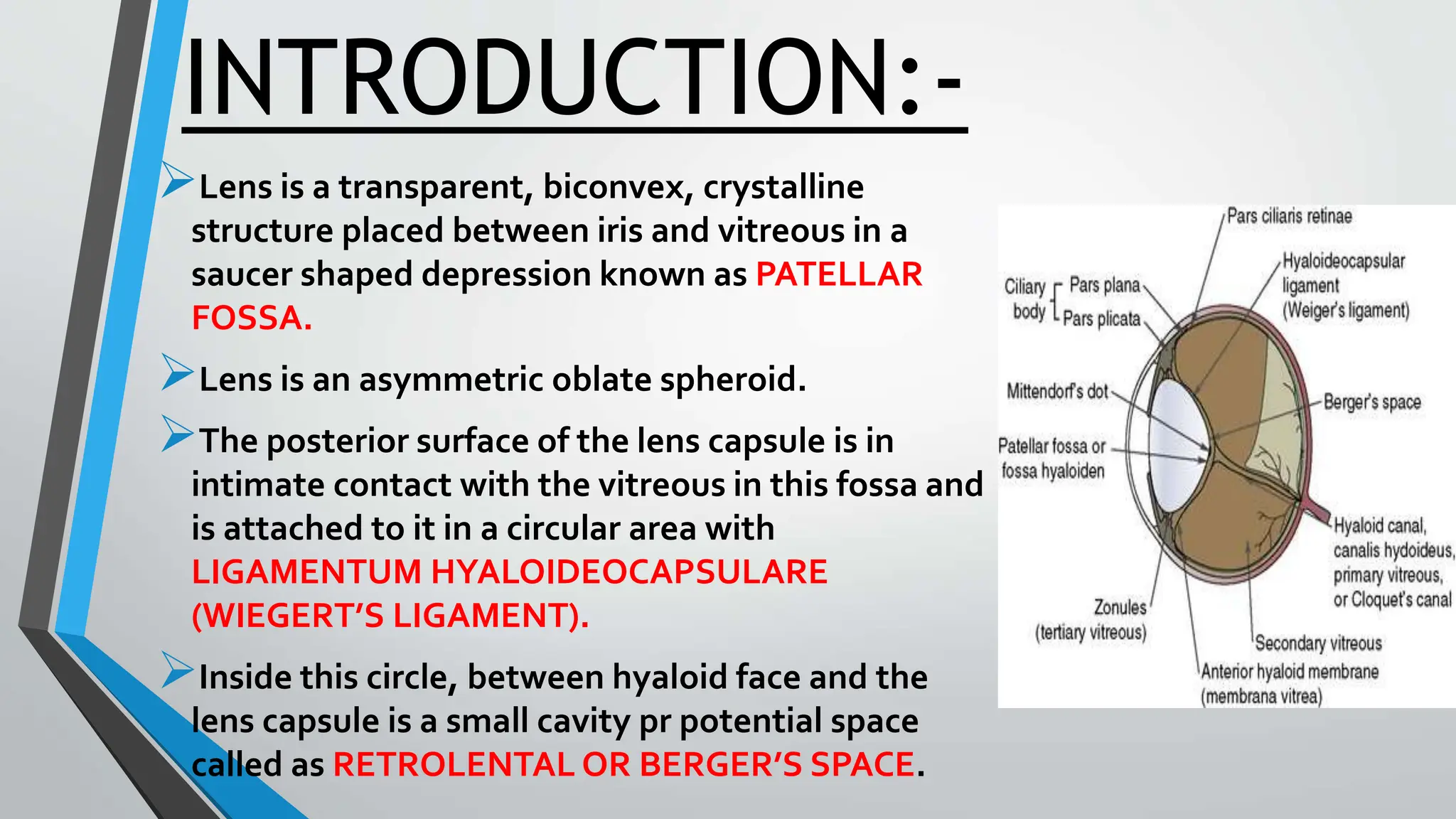
Lens is a transparent, biconvex, crystalline
structure placed between iris and vitreous in a
saucer shaped depression known as PATELLAR
FOSSA.
Lens is an asymmetric oblate spheroid.
The posterior surface of the lens capsule is in
intimate contact with the vitreous in this fossa and
is attached to it in a circular area with
LIGAMENTUM HYALOIDEOCAPSULARE
(WIEGERT’S LIGAMENT).
Inside this circle, between hyaloid face and the
lens capsule is a small cavity pr potential space
called as RETROLENTAL OR BERGER’S SPACE.
GROSS ANATOMY:-
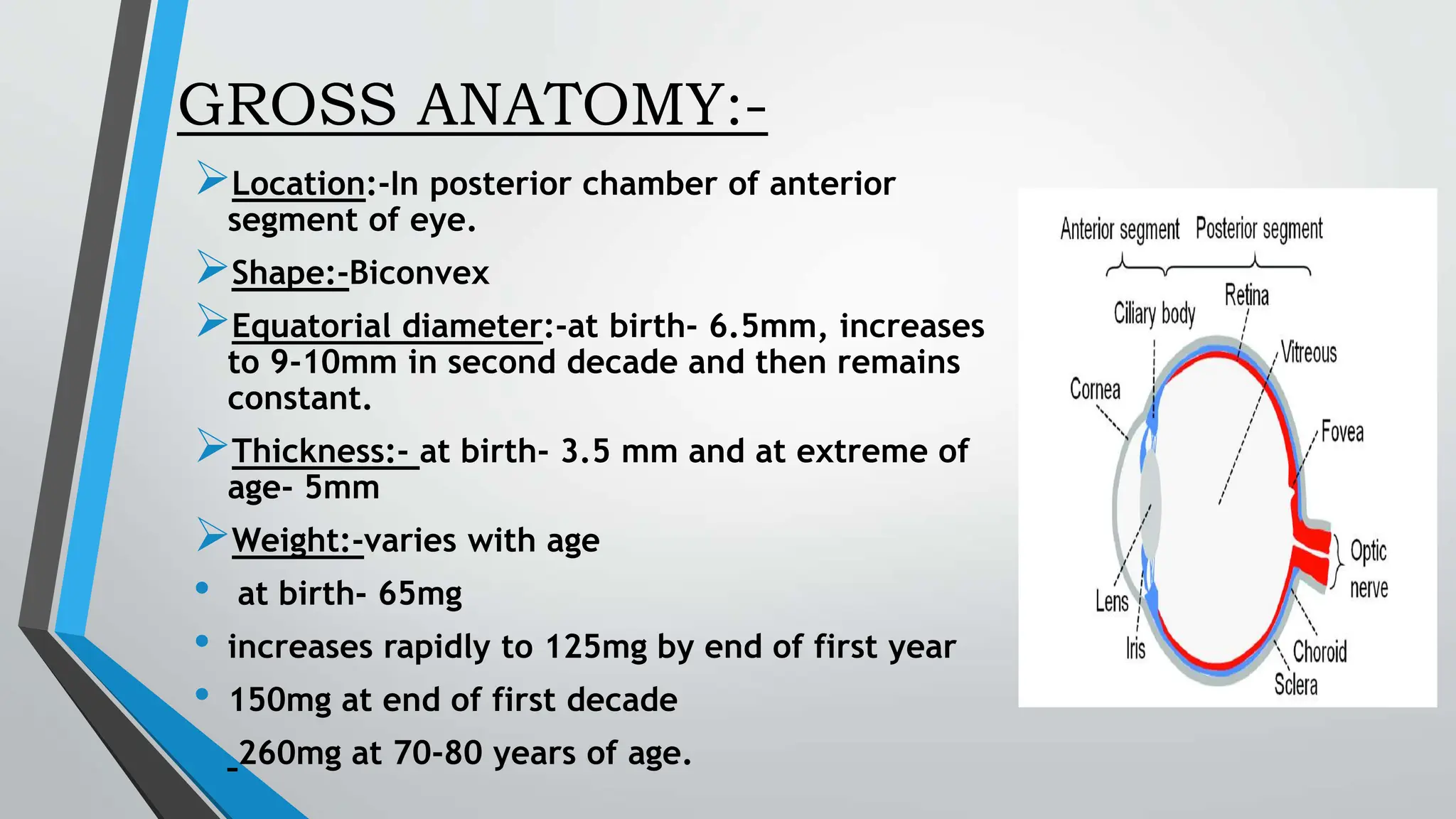
Location:-In posterior chamber of anterior
segment of eye.
Shape:-Biconvex
Equatorial diameter:-at birth- 6.5mm, increases
to 9-10mm in second decade and then remains
constant.
Thickness:- at birth- 3.5 mm and at extreme of
age- 5mm
Weight:-varies with age
• at birth- 65mg
• increases rapidly to 125mg by end of first year
• 150mg at end of first decade
• 260mg at 70-80 years of age.
Surfaces:- two surfaces
oAnterior-radius of curvature 10mm(less convex
than posterior surface)
oPosterior- radius of curvature is 6mm
The two surfaces meet at equator.
Equator is almost circular and has an undulated
or rippled appearance.
POLES:- two poles anterior and posterior
Anterior pole is about 3mm from back of
cornea.
REFRACTIVE INDEX:-
oof lens is 1.39
oOf cortex is 1.38
oOf nucleus is 1.42
Refractive power of lens is 16-17 dioptres.
Accommodative power:- varies with age
oAt birth- 14-16 dioptres
oAt 25 years of age- 7-8 dioptres
oAt 50 years- 1-2 dioptre
Colour:- varies with age
oIn infants- transparent
oIn young adults:- colourless
oAt 30 years :- yellow tinge
oOld age:- amber coloured
Consistency of lens cortex differs from the nucleus, the former being
softer than the latter.
LENS EMBRYOLOGY:-
Lens develops from surface ectoderm.
Lens placode formation occurs at 27 days of gestation, which forms
lens pit and enters into optic vesicle and thus, converts optic vesicle
into optic cup and it forms a circular structure in the eye known as
LENSVESICLE.
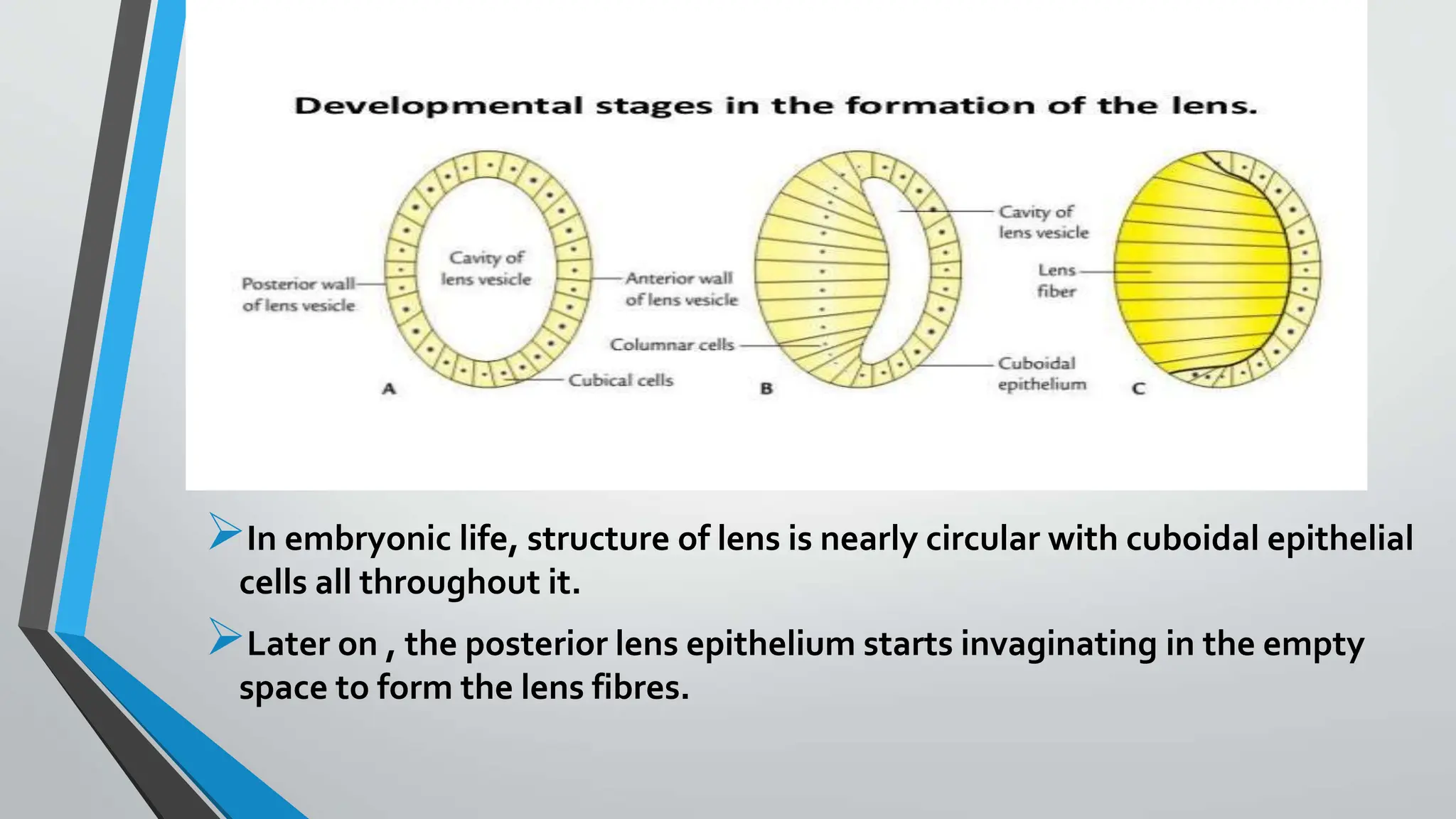
In embryonic life, structure of lens is nearly circular with cuboidal epithelial
cells all throughout it.
Later on , the posterior lens epithelium starts invaginating in the empty
space to form the lens fibres.
MICROSCOPIC LAYERS OF ADULT LENS ARE:-
FROM ANTERIOR TO
POSTERIOR ARE:-
1.ANTERIOR CAPSULE
2.ANTERIOR EPITHELIUM
3.LENS FIBERS
4.POSTERIOR CAPSULE
STRUCTURE OF LENS:-
Lens is a crystalline structure that is AVASCULAR and is devoid
of nerves and connective tissue.
It consists of three distinct parts:-
Lens capsule
Anterior lens epithelium
Lens substance or lens fibres.
LENS CAPSULE
It is a thin, transparent, hyaline collagenous membrane which surrounds the
lens completely.
It is highly elastic but doesn’t contain any elastic tissue.
CLINICAL IMPLICATION:- elasticity of lens decreases with age
Decrease in accommodation and increase in near point
PRESBYOPIA
Capsule is secreted by the basal cell area of the lens epithelium anteriorly
and by the basal area of elongated fibres posteriorly.
The lens capsule is thickest base in membrane in the body.
On microscopic exam it shows lamellar appearance which contain fine
filaments.
The lens capsule is composed of TYPE4 COLLAGEN.
CAPSULE is thinnest at posterior pole.
ANTERIOR LENS EPITHELIUM
• Single layer of cuboidal nucleated epithelial cells which
liesdeep toanteriorcapsule.
• All metabolic, synthetic & transport process of lens
occurin thislayer.
• Na-K ATPases and acid phosphatases are localized on
theapico-lateralmembraneofanteriorepithelium.
• In the equatorial region, these cells become columnar,
are actively dividing & elongating to form new lens
fibersthroughoutlife.
ZONES OF LENS EPITHELIUM
(A) Central Zone :
• Cuboidal cells
• Nuclei rounded & located apically
• Normally do not show mitosis
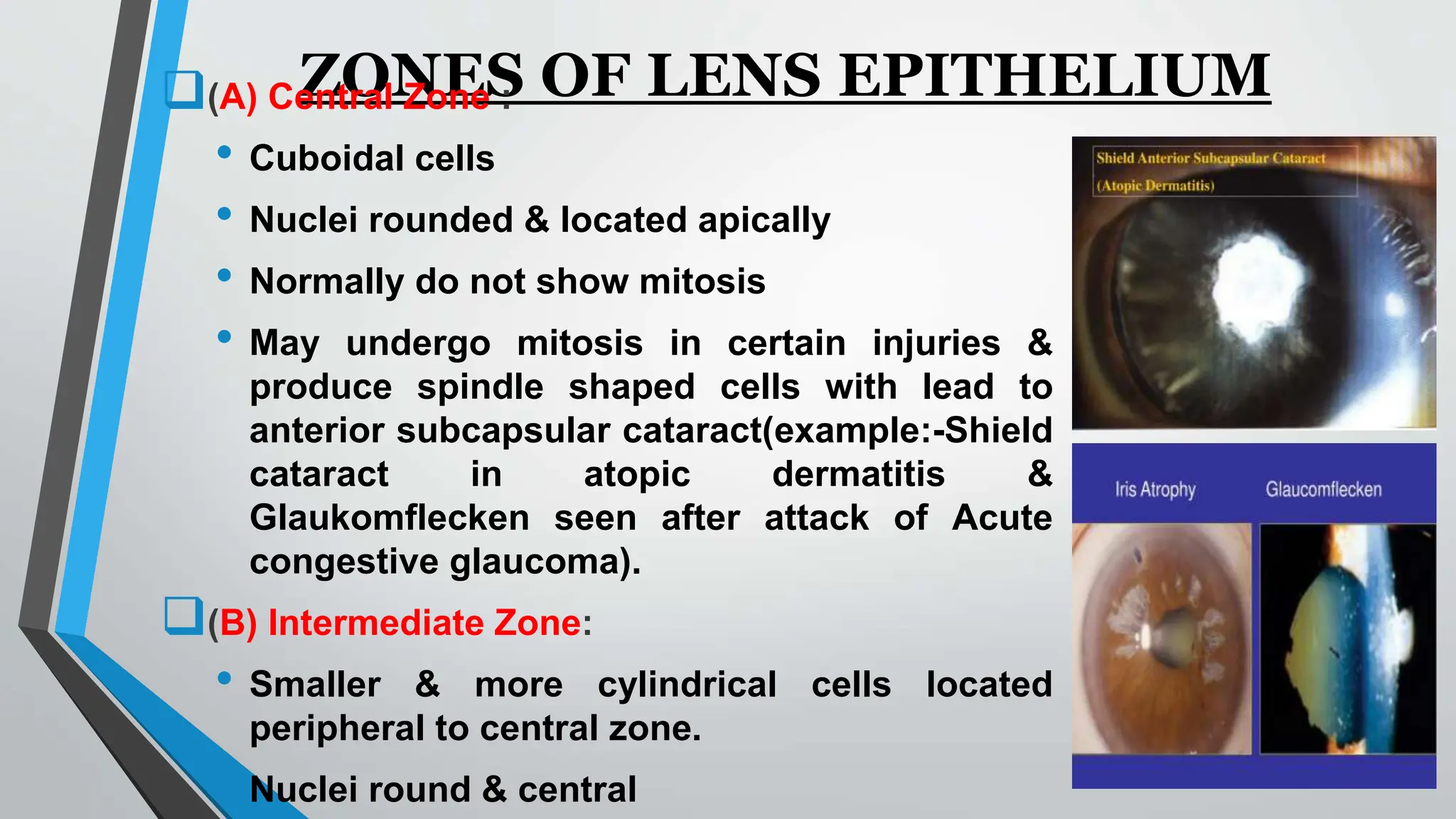
• May undergo mitosis in certain injuries &
produce spindle shaped cells with lead to
anterior subcapsular cataract(example:-Shield
cataract in atopic dermatitis &
Glaukomflecken seen after attack of Acute
congestive glaucoma).
(B) Intermediate Zone:
• Smaller & more cylindrical cells located
peripheral to central zone.
• Nuclei round & central
(C) Germinative Zone :
• Most peripheral columnar cells, located just pre-equatorial.
• Nuclei flattened & lie in plane of cell axis.
• Actively dividing to from new cells which migrate posteriorly to form lens
fibers.
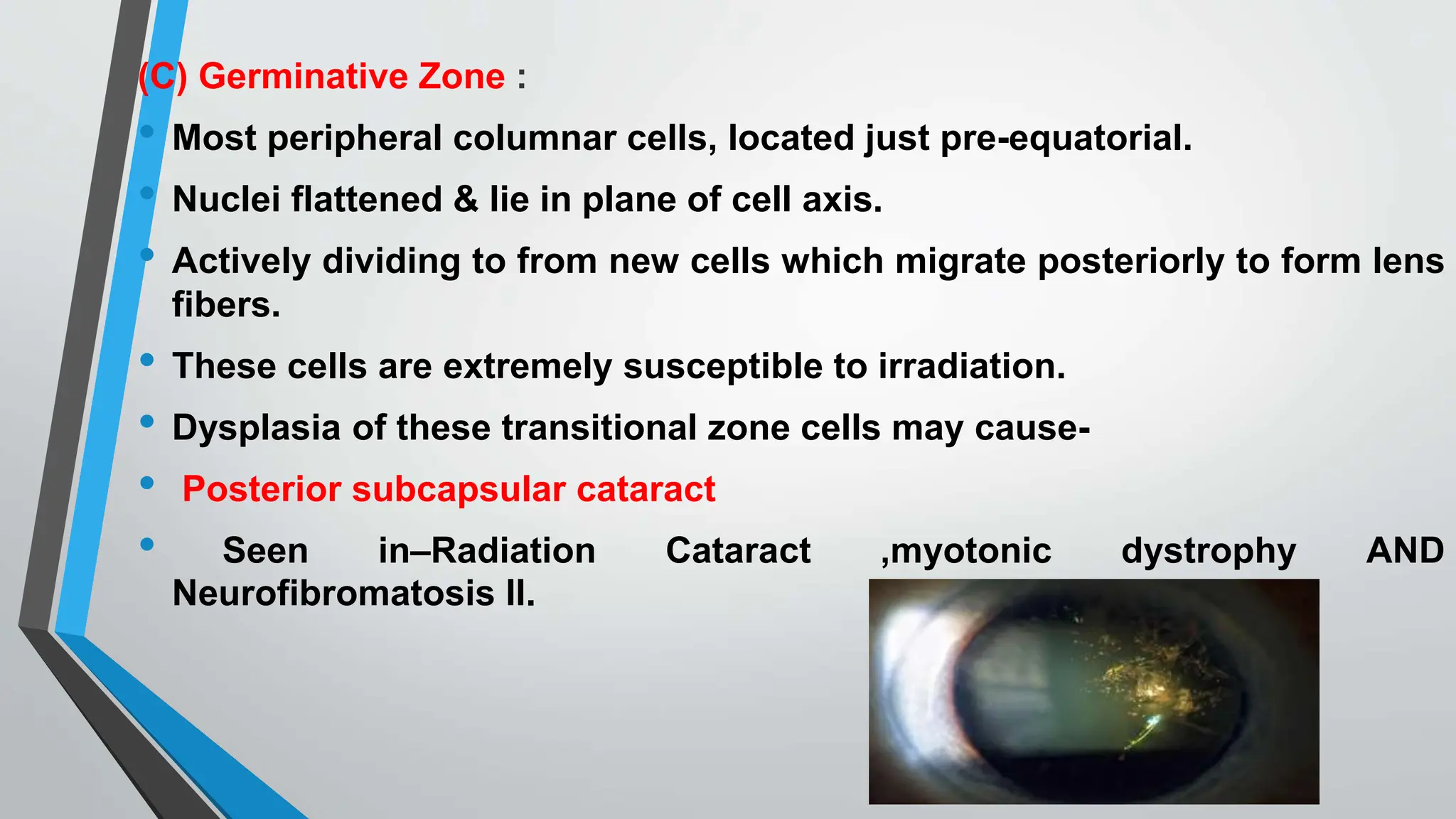
• These cells are extremely susceptible to irradiation.
• Dysplasia of these transitional zone cells may cause-
• Posterior subcapsular cataract
• Seen in–Radiation Cataract ,myotonic dystrophy AND
Neurofibromatosis II.
LENS FIBERS
The epithelial cells elongate to form the lens
fibres.
Initially formed by posterior epithelium which
runs from posterior to anterior to fill lens vesicle
but, later on, they are derived from cells of
equatorial region of anterior epithelium.
Successively, the new lens fibres are laid on the
deeper fibres.
The superficial new fibre are nucleated with
elongation of the cell; the nuclei assume a
relatively more anterior position.
As the new fibres are laid down, the anterior
shifted nucleus forms a line convex forward at the
equator, known as LENS OR NUCLEAR BOW.
STRUCTURE OF LENS FIBRES
oHexagonal in shape.
oThere are interlocking processes between cells( ball and socket and tongue
and groove interdigitations) with zonulae occludentes present.
oThe interdigitations are less complicated in the superficial zone of the lens;
and this may permit moulding of the lens shape during accommodation.
STRUCTURAL ARRANGEMENT OF LENS FIBRES
The initial fibres forming the FETAL NUCLEUS
surrounding embryonic nucleus are arranged in
such away that they terminate with twoY-
shaped sutures:- Anterior UprightY & Posterior
invertedY.
Later in gestation, irregular and asymmetrical
growth of lens sutures forms complicated
dendritic patterns.
The formation of sutures enables the shape of
the lens to change from spherical to a flattened
biconvex shape.
ZONAL ARRANGEMENT OF LENS FIBRES
NUCLEUS:-
 Nucleus contains oldest fibres.
• Fibers of nucleus are compactly arranged-
nucleus is harder in consistency.
• The size of embryonic and fetal nuclei remains
constant while that of adult nucleus is always
increasing.
CORTEX:-
 It comprises the youngest most recently formed
lens fibres.
 Fibres of cortex are loosely arranged.
CILIARY ZONULES
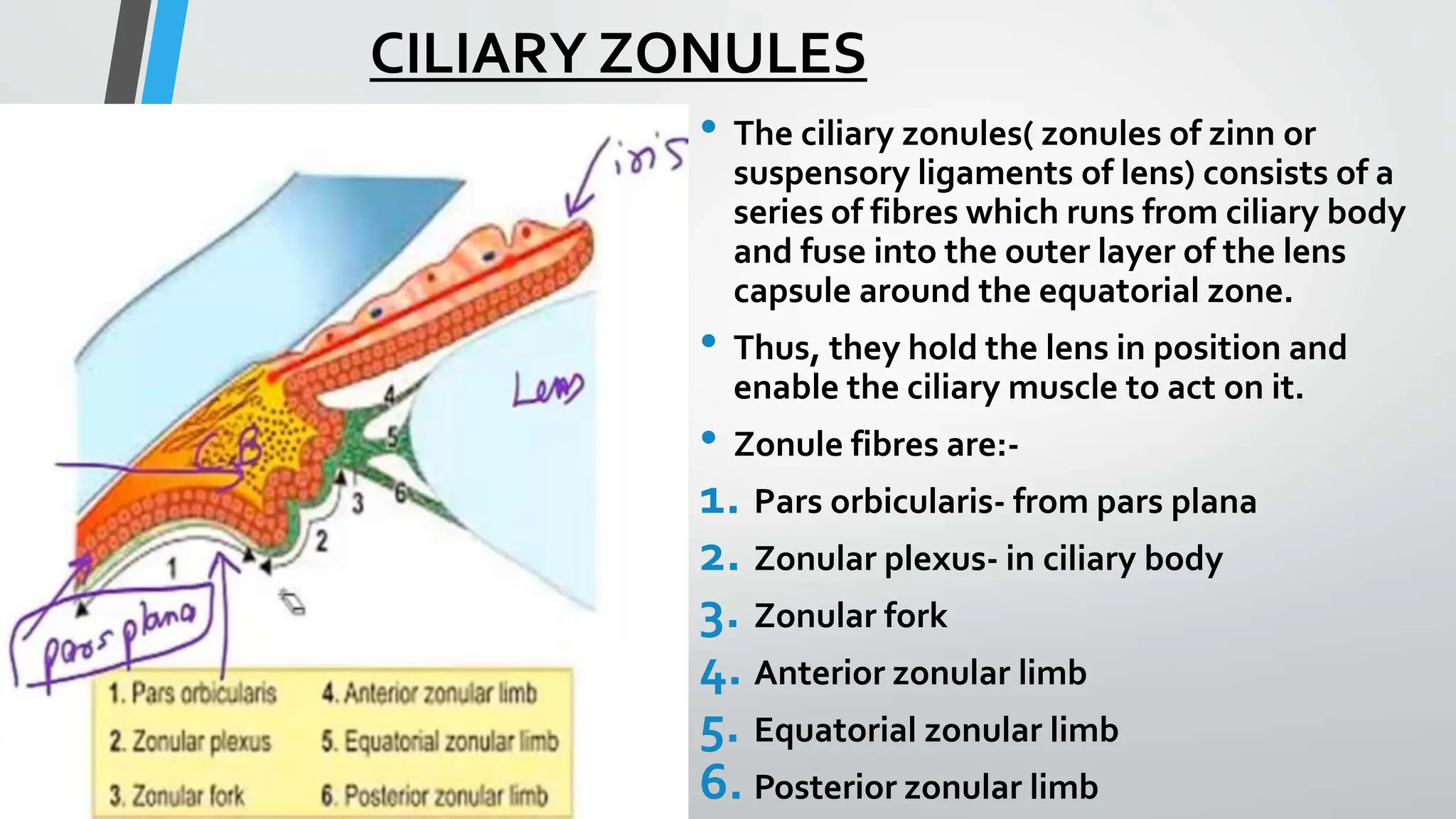
• The ciliary zonules( zonules of zinn or
suspensory ligaments of lens) consists of a
series of fibres which runs from ciliary body
and fuse into the outer layer of the lens
capsule around the equatorial zone.
• Thus, they hold the lens in position and
enable the ciliary muscle to act on it.
• Zonule fibres are:-
1. Pars orbicularis- from pars plana
2. Zonular plexus- in ciliary body
3. Zonular fork
4. Anterior zonular limb
5. Equatorial zonular limb
6. Posterior zonular limb
CANAL OF HANNOVER:-
The space between the anterior and posterior
limb of the zonules.
CANAL OF PETIT:-
The space between the hyaloid zonule and the
posterior zonule.
The hyaloid zonule comprises a single layer of
zonules connecting the anterior hyaloid at the
border of the patellar fossa with the pars plana and
pars plicata.
PHYSIOLOGY OF LENS
Biochemical composition :– Lens contains
• Water – 65%
• Protein – 34%
• Lipid, Carbohydrate, Ascorbic Acid, Glutathione, Amino acid &
Inorganic ions-1%
WATER CONTENT OF LENS
• Lens is relatively dehydrated organ.
• Dehydration is maintained by active Na+ pump within cell
membrane of lens epithelium & each lens fiber.
• 80% water is free & rest 20% bound.
• In normal lens there is no significant alteration in hydration
with age.
PROTEIN CONTENT
 Protein content of lens is Higher than that of any organ of body.
 Water Soluble fraction k/a crystalline.
 Water Insoluble fraction k/a albuminoid.
 Young lens fibers contain more soluble fraction than older fibers.
 Three types of Soluble Fraction (Crystallin)
 α – crystalline — 31.7%(Highest molecular weight)
 β – crystalline — 53.4%(Most abundant proteins)
 γ – crystalline — 1.5% (a/w cry-g gene i.e, a/w congenital cataract)
 Insoluble Fraction (Albuminoids) – 12.5%
 Other Proteins :— Mucoprotein – 0.8% Nucleoprotein – 0.07%
 Amino acids
Lens contains all amino acids except tryptophan,
cysteine & hydroxy proline.
Amino acids actively transported from aqueous
humor to lens.
Amino acid concentration of lens is not affected by
aging.
 Carbohydrates
Glucose:–level of glucose in lens is 1/10th of
aqueous, where glucose concentration has been
found to be 20-120 mg%.
Fructose:–produced from glucose in the crystalline
lens.
 GLUTATHIONE
 Glutathione present in lens varies from 3.5 to 5.5 mg% of wet weight.
 It’s amount altered with age.
 It is a tripeptide & consist of 3 amino acids I.e. glycine, cysteine and
glutamic acid.
 Glutathione contributes to the redox system of lens micro-
environment.
 More than 95% of glutathione is reduced state(GSH).
 ASCORBIC ACID
 The mean value of ascorbic acid in human lens is 30 mg % of wet
weight of lens.
 It is neither synthesized nor actively transported into lens.
 The precise role of ascorbic acid in lens metabolism is not established.
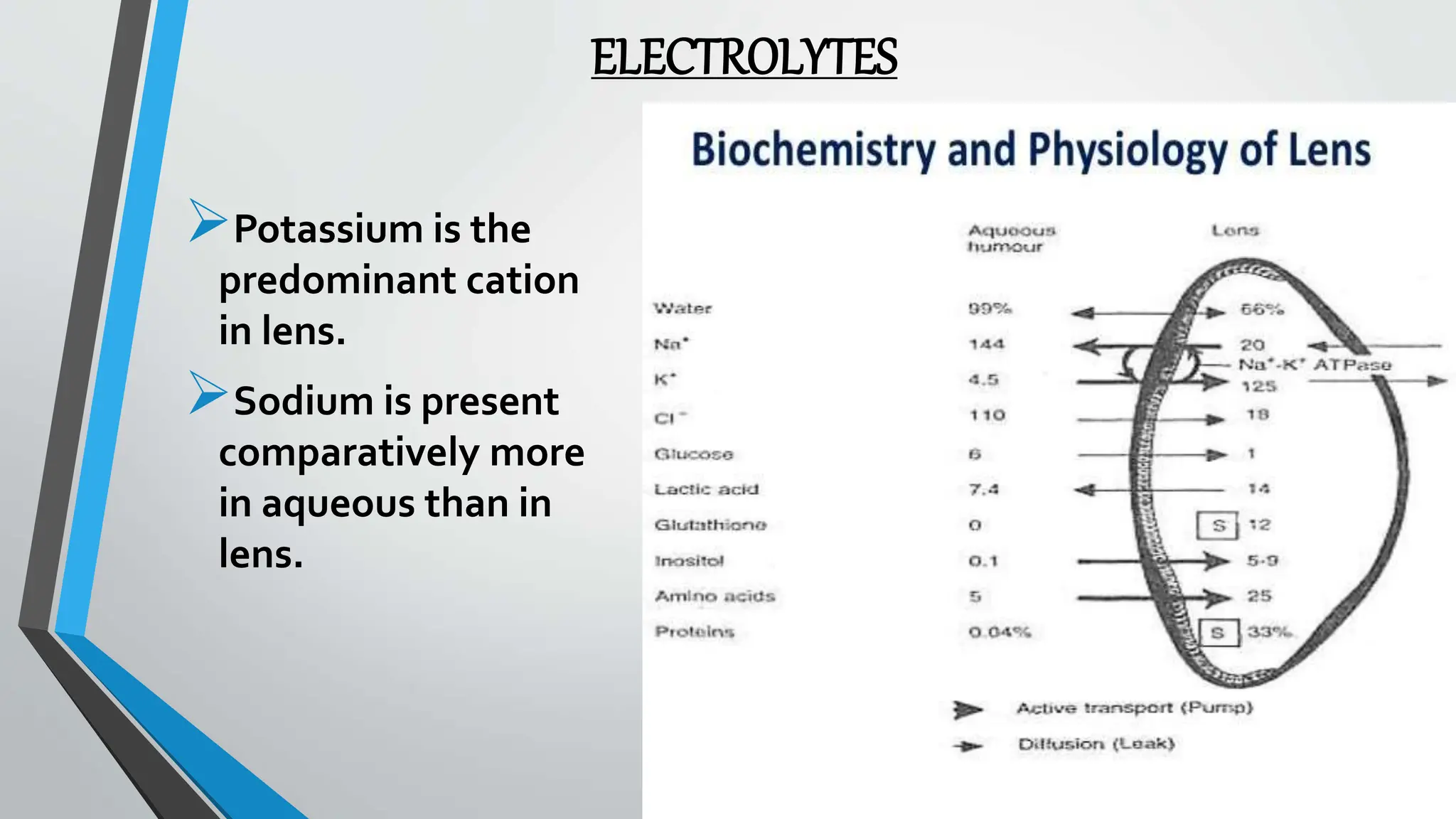
ELECTROLYTES
Potassium is the
predominant cation
in lens.
Sodium is present
comparatively more
in aqueous than in
lens.
Metabolic activities of lens
Glucose metabolism is the main source of energy.
The lens requires a continuous supply of ATP for active transport of ions,
amino acids, maintenance of lens dehydration, and lens transparency,
and for a continuous protein and GSH(reduced glutathione) synthesis.
Glucose from the aqueous and vitreous diffuses into the lens and is
rapidly metabolized through four main pathways:-
1. Anaerobic glycolysis
2. Krebs cycle
3. Hexose monophosphate shunt
4. Sorbitol pathway
ANAEROBIC GLYCOLYSIS:-
• About 80% of the lens glucose is metabolized through anaerobic glycolysis.
• End product of glucose metabolism is lactic acid.
• Metabolism of one molecule of glucose by anaerobic glycolysis yields only 2
molecules of ATP.
KREBS CYCLE:-
• Only 3% of lens glucose is metabolized via Kreb’s cycle.
• But since efficiency of the pathway is more i.e 1 mol of glucose produces 36 mol of
ATP, so it generates about 20% of the total ATP production from glucose in lens.
HEXOSE MONOPHOSPHATE SHUNT:-
• HMP shunt uses glucose-6-phosphate as substrate and doesn’t produce ATP.
• It produces pentose and reduced NADPH which is utilized to maintain lens
glutathione in reduced state and is also a necessary factor in sorbitol pathway.
SORBITOL PATHWAY:-
• Under normal conditions, only 5% of glucose used by lens is metabolized by
sorbitol pathway.
• No ATP is generated.
• In diabetes mellitus, glucose is converted into sorbitol by enzyme aldose
reductase
Sorbitol remains in lens and imbibes water(hygroscopic nature)
Lens swells up due to hydration
Leads to frequent change of glasses in diabetic patients.
PATHWAYS OF GLUCOSE METABOLISMIN LENS
PROTEIN METABOLISM
SYNTHESIS
 From free amino-acids which are actively transported into lens from
aqueous.
 Peptides formed from amino acids with requires ATP & RNA template.
 Rate of protein synthesis is slow in nucleus than other part of lens
BREAK DOWN
 Protein catalyzed by enzyme peptidases & proteases.
 Normally the process of autolysis is inhibited.
PERMEABILITY & TRANSPORT
MECHANISM
ACTIVE TRANSPORT (90% of ATP used)
 Transport of amino acid, K+ , taurine, inositol & extrusion of Na+ .
PASSIVE TRANSPORT :
 Occurs across the lens capsule for water, ions & waste product of metabolism
(lactic acid & CO2).
 Lens capsule is permeable to low molecular weight compound & restrict the
larger colloids.
 Transport of AA takes place by pump & leak mechanism.
Glucose Transport-
 By simple diffusion & facilitated diffusion
Transport of Amino Acid
WATER AND ELECTROLYTE TRANSPORT
Cation Pump Mechanism :
 Functioning at level of anterior lens epithelium.
 With the help of ATP, active extrusion of Na+
coupled with uptake of K+ takes place.
 This process of active transport stimulates
passive diffusion & is k/a pump & leak theory.
Lens as Osmometer :
 Lens considered as a single giant cell, which
swells up in hypertonic media.
 Increase in Na+ & K+ increase osmolarity &
causes lens swelling & loss of transparency.
FACTORS AFFECTING LENS TRANSPARENCY
Presence of crystal clear proteins.
Avascularity of lens.
Lamellar Arrangement of nuclear and cortical lens fibres.
Presence of free radical scavengers such as REDUCED GLUTATHIONE
prevent oxidation.
Single layer of epithelial cells.
Semipermeable character of lens capsule.
Pump mechanism of lens fibre, thus maintaining relative dehydration of
lens.
THANK YOU

ANATOMY OF LENS AND FACTORS AFFECTING LENS TRANSPARENCY.pptx

  • 2.
    INTRODUCTION:- Lens is atransparent, biconvex, crystalline structure placed between iris and vitreous in a saucer shaped depression known as PATELLAR FOSSA. Lens is an asymmetric oblate spheroid. The posterior surface of the lens capsule is in intimate contact with the vitreous in this fossa and is attached to it in a circular area with LIGAMENTUM HYALOIDEOCAPSULARE (WIEGERT’S LIGAMENT). Inside this circle, between hyaloid face and the lens capsule is a small cavity pr potential space called as RETROLENTAL OR BERGER’S SPACE.
  • 3.
    GROSS ANATOMY:- Location:-In posteriorchamber of anterior segment of eye. Shape:-Biconvex Equatorial diameter:-at birth- 6.5mm, increases to 9-10mm in second decade and then remains constant. Thickness:- at birth- 3.5 mm and at extreme of age- 5mm Weight:-varies with age • at birth- 65mg • increases rapidly to 125mg by end of first year • 150mg at end of first decade • 260mg at 70-80 years of age.
  • 4.
    Surfaces:- two surfaces oAnterior-radiusof curvature 10mm(less convex than posterior surface) oPosterior- radius of curvature is 6mm The two surfaces meet at equator. Equator is almost circular and has an undulated or rippled appearance. POLES:- two poles anterior and posterior Anterior pole is about 3mm from back of cornea. REFRACTIVE INDEX:- oof lens is 1.39 oOf cortex is 1.38 oOf nucleus is 1.42
  • 5.
    Refractive power oflens is 16-17 dioptres. Accommodative power:- varies with age oAt birth- 14-16 dioptres oAt 25 years of age- 7-8 dioptres oAt 50 years- 1-2 dioptre Colour:- varies with age oIn infants- transparent oIn young adults:- colourless oAt 30 years :- yellow tinge oOld age:- amber coloured Consistency of lens cortex differs from the nucleus, the former being softer than the latter.
  • 6.
    LENS EMBRYOLOGY:- Lens developsfrom surface ectoderm. Lens placode formation occurs at 27 days of gestation, which forms lens pit and enters into optic vesicle and thus, converts optic vesicle into optic cup and it forms a circular structure in the eye known as LENSVESICLE.
  • 7.
    In embryonic life,structure of lens is nearly circular with cuboidal epithelial cells all throughout it. Later on , the posterior lens epithelium starts invaginating in the empty space to form the lens fibres.
  • 8.
    MICROSCOPIC LAYERS OFADULT LENS ARE:- FROM ANTERIOR TO POSTERIOR ARE:- 1.ANTERIOR CAPSULE 2.ANTERIOR EPITHELIUM 3.LENS FIBERS 4.POSTERIOR CAPSULE
  • 9.
    STRUCTURE OF LENS:- Lensis a crystalline structure that is AVASCULAR and is devoid of nerves and connective tissue. It consists of three distinct parts:- Lens capsule Anterior lens epithelium Lens substance or lens fibres.
  • 10.
    LENS CAPSULE It isa thin, transparent, hyaline collagenous membrane which surrounds the lens completely. It is highly elastic but doesn’t contain any elastic tissue. CLINICAL IMPLICATION:- elasticity of lens decreases with age Decrease in accommodation and increase in near point PRESBYOPIA Capsule is secreted by the basal cell area of the lens epithelium anteriorly and by the basal area of elongated fibres posteriorly. The lens capsule is thickest base in membrane in the body. On microscopic exam it shows lamellar appearance which contain fine filaments. The lens capsule is composed of TYPE4 COLLAGEN. CAPSULE is thinnest at posterior pole.
  • 11.
    ANTERIOR LENS EPITHELIUM •Single layer of cuboidal nucleated epithelial cells which liesdeep toanteriorcapsule. • All metabolic, synthetic & transport process of lens occurin thislayer. • Na-K ATPases and acid phosphatases are localized on theapico-lateralmembraneofanteriorepithelium. • In the equatorial region, these cells become columnar, are actively dividing & elongating to form new lens fibersthroughoutlife.
  • 12.
    ZONES OF LENSEPITHELIUM (A) Central Zone : • Cuboidal cells • Nuclei rounded & located apically • Normally do not show mitosis • May undergo mitosis in certain injuries & produce spindle shaped cells with lead to anterior subcapsular cataract(example:-Shield cataract in atopic dermatitis & Glaukomflecken seen after attack of Acute congestive glaucoma). (B) Intermediate Zone: • Smaller & more cylindrical cells located peripheral to central zone. • Nuclei round & central
  • 13.
    (C) Germinative Zone: • Most peripheral columnar cells, located just pre-equatorial. • Nuclei flattened & lie in plane of cell axis. • Actively dividing to from new cells which migrate posteriorly to form lens fibers. • These cells are extremely susceptible to irradiation. • Dysplasia of these transitional zone cells may cause- • Posterior subcapsular cataract • Seen in–Radiation Cataract ,myotonic dystrophy AND Neurofibromatosis II.
  • 14.
    LENS FIBERS The epithelialcells elongate to form the lens fibres. Initially formed by posterior epithelium which runs from posterior to anterior to fill lens vesicle but, later on, they are derived from cells of equatorial region of anterior epithelium. Successively, the new lens fibres are laid on the deeper fibres. The superficial new fibre are nucleated with elongation of the cell; the nuclei assume a relatively more anterior position. As the new fibres are laid down, the anterior shifted nucleus forms a line convex forward at the equator, known as LENS OR NUCLEAR BOW.
  • 15.
    STRUCTURE OF LENSFIBRES oHexagonal in shape. oThere are interlocking processes between cells( ball and socket and tongue and groove interdigitations) with zonulae occludentes present. oThe interdigitations are less complicated in the superficial zone of the lens; and this may permit moulding of the lens shape during accommodation.
  • 16.
    STRUCTURAL ARRANGEMENT OFLENS FIBRES The initial fibres forming the FETAL NUCLEUS surrounding embryonic nucleus are arranged in such away that they terminate with twoY- shaped sutures:- Anterior UprightY & Posterior invertedY. Later in gestation, irregular and asymmetrical growth of lens sutures forms complicated dendritic patterns. The formation of sutures enables the shape of the lens to change from spherical to a flattened biconvex shape.
  • 17.
    ZONAL ARRANGEMENT OFLENS FIBRES NUCLEUS:-  Nucleus contains oldest fibres. • Fibers of nucleus are compactly arranged- nucleus is harder in consistency. • The size of embryonic and fetal nuclei remains constant while that of adult nucleus is always increasing. CORTEX:-  It comprises the youngest most recently formed lens fibres.  Fibres of cortex are loosely arranged.
  • 18.
    CILIARY ZONULES • Theciliary zonules( zonules of zinn or suspensory ligaments of lens) consists of a series of fibres which runs from ciliary body and fuse into the outer layer of the lens capsule around the equatorial zone. • Thus, they hold the lens in position and enable the ciliary muscle to act on it. • Zonule fibres are:- 1. Pars orbicularis- from pars plana 2. Zonular plexus- in ciliary body 3. Zonular fork 4. Anterior zonular limb 5. Equatorial zonular limb 6. Posterior zonular limb
  • 19.
    CANAL OF HANNOVER:- Thespace between the anterior and posterior limb of the zonules. CANAL OF PETIT:- The space between the hyaloid zonule and the posterior zonule. The hyaloid zonule comprises a single layer of zonules connecting the anterior hyaloid at the border of the patellar fossa with the pars plana and pars plicata.
  • 20.
    PHYSIOLOGY OF LENS Biochemicalcomposition :– Lens contains • Water – 65% • Protein – 34% • Lipid, Carbohydrate, Ascorbic Acid, Glutathione, Amino acid & Inorganic ions-1% WATER CONTENT OF LENS • Lens is relatively dehydrated organ. • Dehydration is maintained by active Na+ pump within cell membrane of lens epithelium & each lens fiber. • 80% water is free & rest 20% bound. • In normal lens there is no significant alteration in hydration with age.
  • 21.
    PROTEIN CONTENT  Proteincontent of lens is Higher than that of any organ of body.  Water Soluble fraction k/a crystalline.  Water Insoluble fraction k/a albuminoid.  Young lens fibers contain more soluble fraction than older fibers.  Three types of Soluble Fraction (Crystallin)  α – crystalline — 31.7%(Highest molecular weight)  β – crystalline — 53.4%(Most abundant proteins)  γ – crystalline — 1.5% (a/w cry-g gene i.e, a/w congenital cataract)  Insoluble Fraction (Albuminoids) – 12.5%  Other Proteins :— Mucoprotein – 0.8% Nucleoprotein – 0.07%
  • 22.
     Amino acids Lenscontains all amino acids except tryptophan, cysteine & hydroxy proline. Amino acids actively transported from aqueous humor to lens. Amino acid concentration of lens is not affected by aging.  Carbohydrates Glucose:–level of glucose in lens is 1/10th of aqueous, where glucose concentration has been found to be 20-120 mg%. Fructose:–produced from glucose in the crystalline lens.
  • 23.
     GLUTATHIONE  Glutathionepresent in lens varies from 3.5 to 5.5 mg% of wet weight.  It’s amount altered with age.  It is a tripeptide & consist of 3 amino acids I.e. glycine, cysteine and glutamic acid.  Glutathione contributes to the redox system of lens micro- environment.  More than 95% of glutathione is reduced state(GSH).  ASCORBIC ACID  The mean value of ascorbic acid in human lens is 30 mg % of wet weight of lens.  It is neither synthesized nor actively transported into lens.  The precise role of ascorbic acid in lens metabolism is not established.
  • 24.
    ELECTROLYTES Potassium is the predominantcation in lens. Sodium is present comparatively more in aqueous than in lens.
  • 25.
    Metabolic activities oflens Glucose metabolism is the main source of energy. The lens requires a continuous supply of ATP for active transport of ions, amino acids, maintenance of lens dehydration, and lens transparency, and for a continuous protein and GSH(reduced glutathione) synthesis. Glucose from the aqueous and vitreous diffuses into the lens and is rapidly metabolized through four main pathways:- 1. Anaerobic glycolysis 2. Krebs cycle 3. Hexose monophosphate shunt 4. Sorbitol pathway
  • 26.
    ANAEROBIC GLYCOLYSIS:- • About80% of the lens glucose is metabolized through anaerobic glycolysis. • End product of glucose metabolism is lactic acid. • Metabolism of one molecule of glucose by anaerobic glycolysis yields only 2 molecules of ATP. KREBS CYCLE:- • Only 3% of lens glucose is metabolized via Kreb’s cycle. • But since efficiency of the pathway is more i.e 1 mol of glucose produces 36 mol of ATP, so it generates about 20% of the total ATP production from glucose in lens. HEXOSE MONOPHOSPHATE SHUNT:- • HMP shunt uses glucose-6-phosphate as substrate and doesn’t produce ATP. • It produces pentose and reduced NADPH which is utilized to maintain lens glutathione in reduced state and is also a necessary factor in sorbitol pathway.
  • 27.
    SORBITOL PATHWAY:- • Undernormal conditions, only 5% of glucose used by lens is metabolized by sorbitol pathway. • No ATP is generated. • In diabetes mellitus, glucose is converted into sorbitol by enzyme aldose reductase Sorbitol remains in lens and imbibes water(hygroscopic nature) Lens swells up due to hydration Leads to frequent change of glasses in diabetic patients.
  • 28.
    PATHWAYS OF GLUCOSEMETABOLISMIN LENS
  • 29.
    PROTEIN METABOLISM SYNTHESIS  Fromfree amino-acids which are actively transported into lens from aqueous.  Peptides formed from amino acids with requires ATP & RNA template.  Rate of protein synthesis is slow in nucleus than other part of lens BREAK DOWN  Protein catalyzed by enzyme peptidases & proteases.  Normally the process of autolysis is inhibited.
  • 30.
    PERMEABILITY & TRANSPORT MECHANISM ACTIVETRANSPORT (90% of ATP used)  Transport of amino acid, K+ , taurine, inositol & extrusion of Na+ . PASSIVE TRANSPORT :  Occurs across the lens capsule for water, ions & waste product of metabolism (lactic acid & CO2).  Lens capsule is permeable to low molecular weight compound & restrict the larger colloids.  Transport of AA takes place by pump & leak mechanism. Glucose Transport-  By simple diffusion & facilitated diffusion Transport of Amino Acid
  • 31.
    WATER AND ELECTROLYTETRANSPORT Cation Pump Mechanism :  Functioning at level of anterior lens epithelium.  With the help of ATP, active extrusion of Na+ coupled with uptake of K+ takes place.  This process of active transport stimulates passive diffusion & is k/a pump & leak theory. Lens as Osmometer :  Lens considered as a single giant cell, which swells up in hypertonic media.  Increase in Na+ & K+ increase osmolarity & causes lens swelling & loss of transparency.
  • 32.
    FACTORS AFFECTING LENSTRANSPARENCY Presence of crystal clear proteins. Avascularity of lens. Lamellar Arrangement of nuclear and cortical lens fibres. Presence of free radical scavengers such as REDUCED GLUTATHIONE prevent oxidation. Single layer of epithelial cells. Semipermeable character of lens capsule. Pump mechanism of lens fibre, thus maintaining relative dehydration of lens.
  • 33.