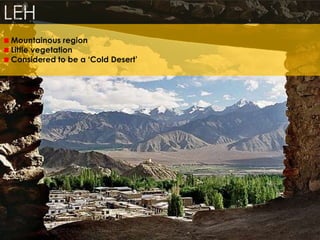
Mountainous region
Little vegetation
Considered to be a ‘Cold Desert’
COLD and SUNNY type of climate is experienced here.
TEMPERATURE VARIATIONS
• Summer
during day : 17 - 24°C
during night : 4 - 11°C
• Winter
during day : 7 - 9°C
during night : -14 – 0 °C
Relative humidity – consistently low : 10-50%
Winds – occasionally intense
Sky is fairly clear throughout the year
Cloud cover is less than 50%
Resist heat loss
Decrease exposed surface area
Increase thermal resistance
Increase thermal capacity (Time
lag)
Increase buffer spaces
Decrease air exchange rate
Increase surface absorptivity
Promote heat gain
Reduce shading
Utilize heat from appliances
Trapping heat
Orientation and shape of building.
Use of trees as wind barriers
Roof insulation, wall insulation and
double glazing
Thicker walls
Air locks/ Lobbies
Weather stripping
Darker colors
Walls and glass surfaces
Sun spaces/ green houses/ Trombe
walls etc
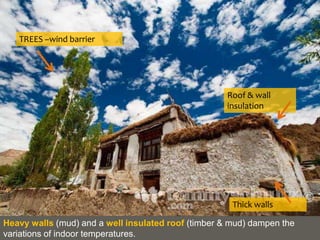
TREES –wind barrier
Roof & wall
insulation
Thick walls
Heavy walls (mud) and a well insulated roof (timber & mud) dampen the
variations of indoor temperatures.
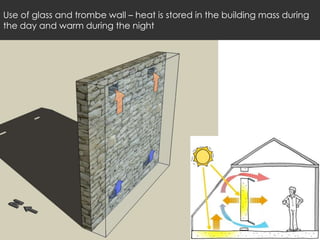
Use of glass and trombe wall – heat is stored in the building mass during
the day and warm during the night
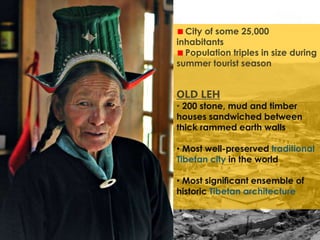
City of some 25,000
inhabitants
Population triples in size during
summer tourist season
OLD LEH
• 200 stone, mud and timber
houses sandwiched between
thick rammed earth walls
• Most well-preserved traditional
Tibetan city in the world
• Most significant ensemble of
historic Tibetan architecture
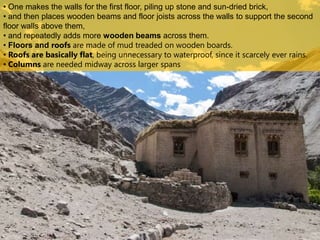
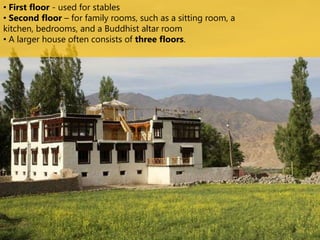
• One makes the walls for the first floor, piling up stone and sun-dried brick,
• and then places wooden beams and floor joists across the walls to support the second
floor walls above them,
• and repeatedly adds more wooden beams across them.
• Floors and roofs are made of mud treaded on wooden boards.
• Roofs are basically flat, being unnecessary to waterproof, since it scarcely ever rains.
• Columns are needed midway across larger spans
• First floor - used for stables
• Second floor – for family rooms, such as a sitting room, a
kitchen, bedrooms, and a Buddhist altar room
• A larger house often consists of three floors.
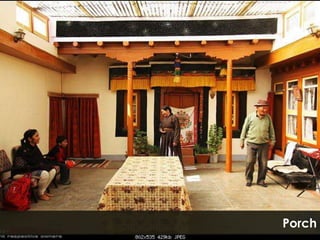
Porch
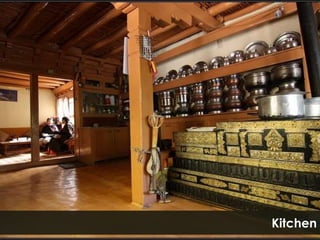
Kitchen
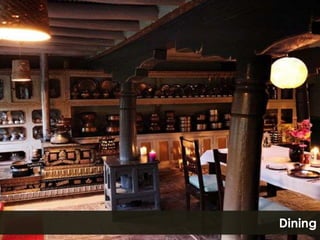
Dining
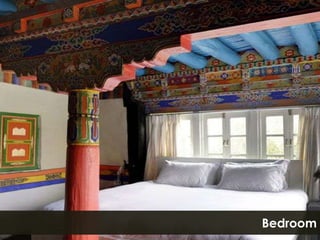
Bedroom

Leh, ladakh - climate and architecture

  • 2.
  • 3.
    COLD and SUNNYtype of climate is experienced here. TEMPERATURE VARIATIONS • Summer during day : 17 - 24°C during night : 4 - 11°C • Winter during day : 7 - 9°C during night : -14 – 0 °C Relative humidity – consistently low : 10-50% Winds – occasionally intense Sky is fairly clear throughout the year Cloud cover is less than 50%
  • 4.
    Resist heat loss Decreaseexposed surface area Increase thermal resistance Increase thermal capacity (Time lag) Increase buffer spaces Decrease air exchange rate Increase surface absorptivity Promote heat gain Reduce shading Utilize heat from appliances Trapping heat Orientation and shape of building. Use of trees as wind barriers Roof insulation, wall insulation and double glazing Thicker walls Air locks/ Lobbies Weather stripping Darker colors Walls and glass surfaces Sun spaces/ green houses/ Trombe walls etc
  • 5.
    TREES –wind barrier Roof& wall insulation Thick walls Heavy walls (mud) and a well insulated roof (timber & mud) dampen the variations of indoor temperatures.
  • 6.
    Use of glassand trombe wall – heat is stored in the building mass during the day and warm during the night
  • 7.
    City of some25,000 inhabitants Population triples in size during summer tourist season OLD LEH • 200 stone, mud and timber houses sandwiched between thick rammed earth walls • Most well-preserved traditional Tibetan city in the world • Most significant ensemble of historic Tibetan architecture
  • 8.
    • One makesthe walls for the first floor, piling up stone and sun-dried brick, • and then places wooden beams and floor joists across the walls to support the second floor walls above them, • and repeatedly adds more wooden beams across them. • Floors and roofs are made of mud treaded on wooden boards. • Roofs are basically flat, being unnecessary to waterproof, since it scarcely ever rains. • Columns are needed midway across larger spans
  • 9.
    • First floor- used for stables • Second floor – for family rooms, such as a sitting room, a kitchen, bedrooms, and a Buddhist altar room • A larger house often consists of three floors.
  • 10.
  • 11.
  • 12.
  • 13.