NAGALAND

BY :
INTRODUCTION
A term used to categorize methods of construction which use locally available
resources and traditions to address local needs.

We see that vernacular architecture in India’s diverse regions has evolved a unique
way of responding to the climate and the environment that is sustainable, shows an
intelligent approach to the problems of climate and is a delicate balance of social and
cultural factors through spatial vocabulary such as walls, courtyards, floors and semiprivate and private spaces.
Climate, of course is a predominant factor in determining the forms of vernacular
architecture in India.
NAGALAND

One of India's most colourful states is Nagaland,
located on the eastern margin of the Himalayan
range in Northeast India.
Nagas have a hoary
past, which is reflected
in the village patterns,

locales and house
constructions.
Nagas are hill dwellers and their settlements are highly inaccessible as
they are located on hill slopes or the highest possible points along a hill
slope.
Climate was yet another factor which
influenced Naga settlement pattern.

Below 500 m the climate is hot and
unhealthy;
Above 1500 m it is unpleasant – cold
in winter,
And during monsoon, cloud is
perpetual.
Abundant springs are infrequent
above 1500 m and water tends to be
scare.

Due to these climatic factors most of the Naga villages are located along
the hill slope.
TYPICAL NAGA HOUSE
A typical Naga house is an elongated rectangular plan, a short length
forming the side .

A few tribes
built in
circular
shapes as
well.

The houses traditionally faces eastern
direction.
TYPICAL NAGA HOUSE
TYPICAL NAGA HOUSE
The roofs are thatched with paddy
straws and palm leaves.

Broad wooden boards
forming the house
front are often
elaborately carved.
The subjects of the
carving are usually
from wildlife, horn
bull and horns of the
bison.

Generally there is no
window and no mode
of ventilation.

This housing type has very limited entrances usually one.
Each tribe has a unique way of constructing huts.
A common practices among all the tribes is decorating entrances of their
dwellings with the heads of buffaloes.
The Naga tribes are expert craftsmen.
Their dwellings are made of wood and are systematically carved and
arranged.
.
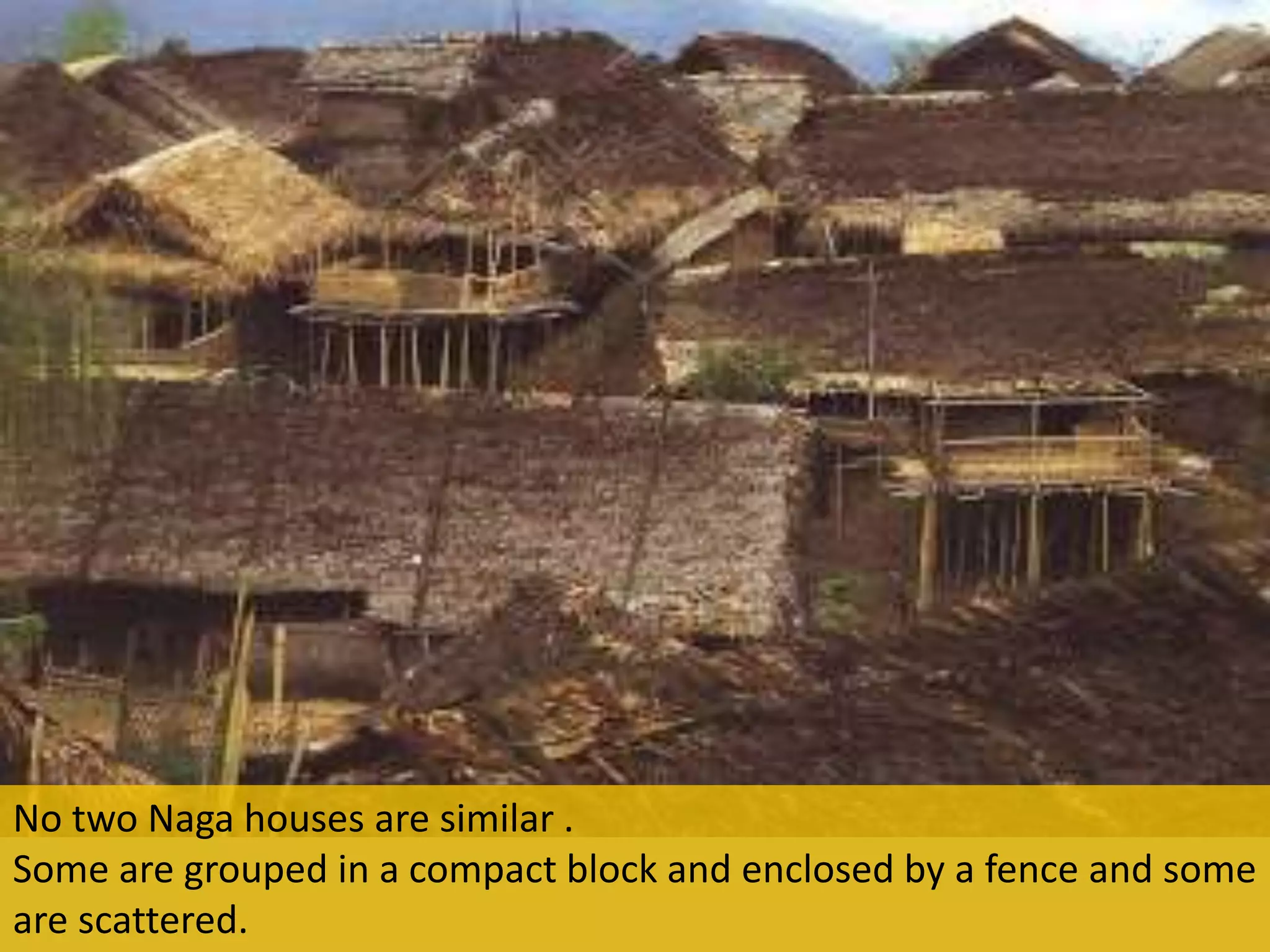
No two Naga houses are similar .
Some are grouped in a compact block and enclosed by a fence and some
are scattered.

Naga

  • 1.
  • 2.
    INTRODUCTION A term usedto categorize methods of construction which use locally available resources and traditions to address local needs. We see that vernacular architecture in India’s diverse regions has evolved a unique way of responding to the climate and the environment that is sustainable, shows an intelligent approach to the problems of climate and is a delicate balance of social and cultural factors through spatial vocabulary such as walls, courtyards, floors and semiprivate and private spaces. Climate, of course is a predominant factor in determining the forms of vernacular architecture in India.
  • 3.
    NAGALAND One of India'smost colourful states is Nagaland, located on the eastern margin of the Himalayan range in Northeast India.
  • 4.
    Nagas have ahoary past, which is reflected in the village patterns, locales and house constructions.
  • 5.
    Nagas are hilldwellers and their settlements are highly inaccessible as they are located on hill slopes or the highest possible points along a hill slope.
  • 6.
    Climate was yetanother factor which influenced Naga settlement pattern. Below 500 m the climate is hot and unhealthy; Above 1500 m it is unpleasant – cold in winter, And during monsoon, cloud is perpetual. Abundant springs are infrequent above 1500 m and water tends to be scare. Due to these climatic factors most of the Naga villages are located along the hill slope.
  • 7.
    TYPICAL NAGA HOUSE Atypical Naga house is an elongated rectangular plan, a short length forming the side . A few tribes built in circular shapes as well. The houses traditionally faces eastern direction.
  • 8.
  • 9.
    TYPICAL NAGA HOUSE Theroofs are thatched with paddy straws and palm leaves. Broad wooden boards forming the house front are often elaborately carved. The subjects of the carving are usually from wildlife, horn bull and horns of the bison. Generally there is no window and no mode of ventilation. This housing type has very limited entrances usually one.
  • 10.
    Each tribe hasa unique way of constructing huts. A common practices among all the tribes is decorating entrances of their dwellings with the heads of buffaloes.
  • 11.
    The Naga tribesare expert craftsmen. Their dwellings are made of wood and are systematically carved and arranged.
  • 13.
  • 14.
    No two Nagahouses are similar . Some are grouped in a compact block and enclosed by a fence and some are scattered.