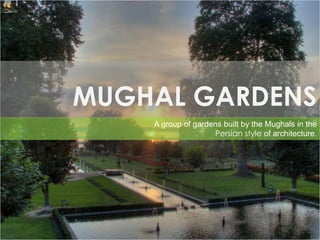
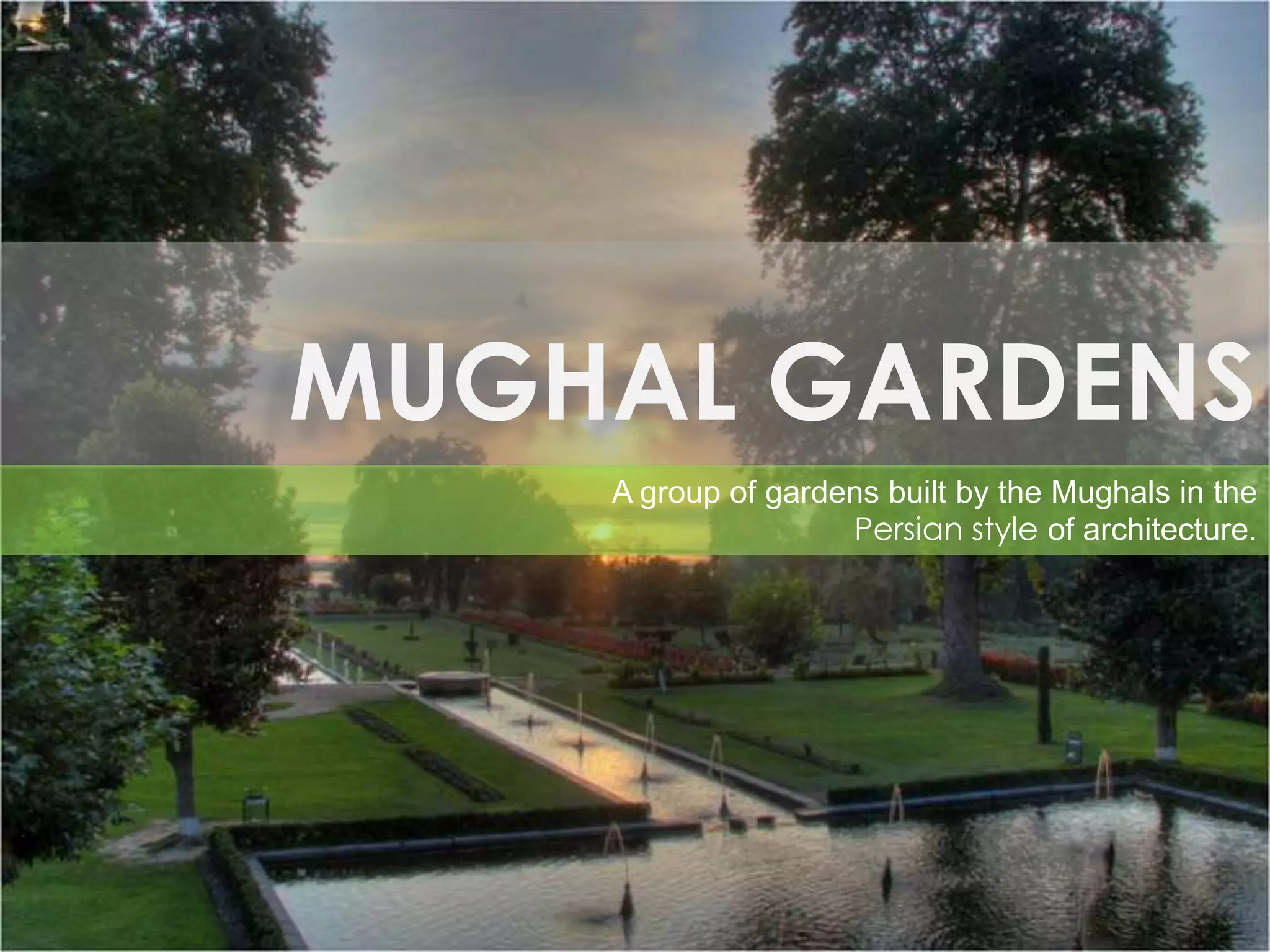
MUGHAL GARDENS
A group of gardens built by the Mughals in the
Persian style of architecture.
Humayun, his son, does
not seem to have had
much time for building.

The founder of
the Mughal empire,
BABUR , described
his favourite type of
garden as
a CHARBAGH.
(dividing the
garden into four
equal quarters)

Akbar built several
gardens first in
Delhi, then in Agra,
Akbar’s new capital.

Jahangir's son, SHAH
JAHAN, marks the
apex of Mughal
garden architecture
and floral design.

He is famous for the
construction of
Akbar’s
the Taj Mahal and
heir, JAHANGIR, did
the Red Fort which
not build as much, but
contains the Mahtab
he helped to lay out
bagh.
the famous Shalimar
garden and was
known for his great
love for flowers.
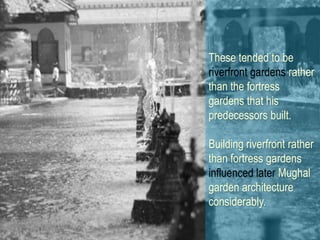
These tended to be
riverfront gardens rather
than the fortress
gardens that his
predecessors built.
Building riverfront rather
than fortress gardens
influenced later Mughal
garden architecture
considerably.
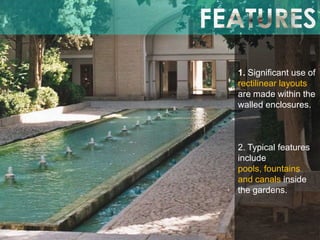
1. Significant use of
rectilinear layouts
are made within the
walled enclosures.

2. Typical features
include
pools, fountains
and canals inside
the gardens.
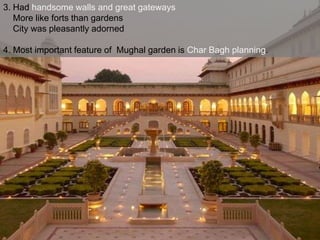
3. Had handsome walls and great gateways
More like forts than gardens
City was pleasantly adorned
4. Most important feature of Mughal garden is Char Bagh planning.
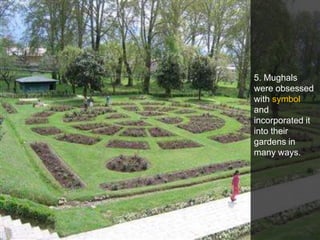
5. Mughals
were obsessed
with symbol
and
incorporated it
into their
gardens in
many ways.
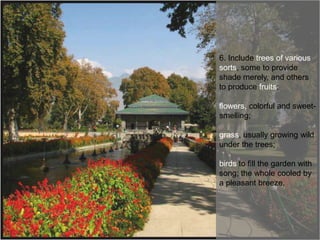
6. Include trees of various
sorts, some to provide
shade merely, and others
to produce fruits;
flowers, colorful and sweetsmelling;

grass, usually growing wild
under the trees;
birds to fill the garden with
song; the whole cooled by
a pleasant breeze.
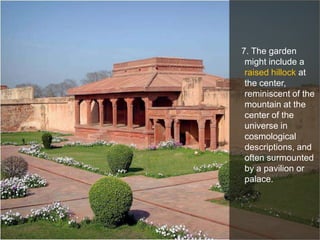
7. The garden
might include a
raised hillock at
the center,
reminiscent of the
mountain at the
center of the
universe in
cosmological
descriptions, and
often surmounted
by a pavilion or
palace.
•

•

•

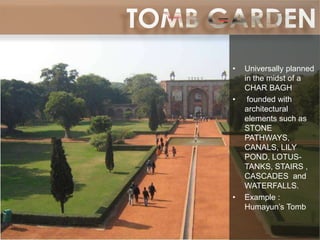
Universally planned
in the midst of a
CHAR BAGH
founded with
architectural
elements such as
STONE
PATHWAYS,
CANALS, LILY
POND, LOTUSTANKS, STAIRS ,
CASCADES and
WATERFALLS.
Example :
Humayun’s Tomb
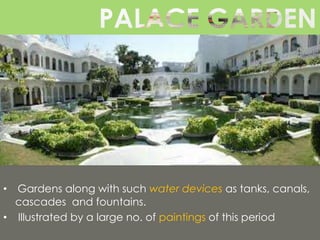
• Gardens along with such water devices as tanks, canals,
cascades and fountains.
• Illustrated by a large no. of paintings of this period
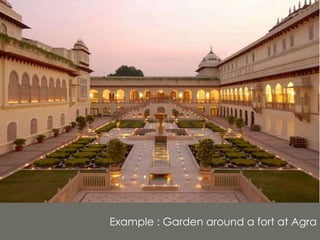
Example : Garden around a fort at Agra
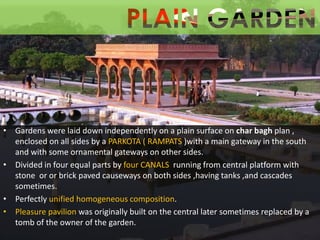
• Gardens were laid down independently on a plain surface on char bagh plan ,
enclosed on all sides by a PARKOTA ( RAMPATS )with a main gateway in the south
and with some ornamental gateways on other sides.
• Divided in four equal parts by four CANALS running from central platform with
stone or or brick paved causeways on both sides ,having tanks ,and cascades
sometimes.
• Perfectly unified homogeneous composition.
• Pleasure pavilion was originally built on the central later sometimes replaced by a
tomb of the owner of the garden.
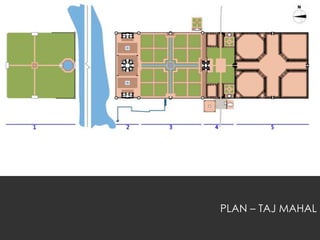
PLAN – TAJ MAHAL
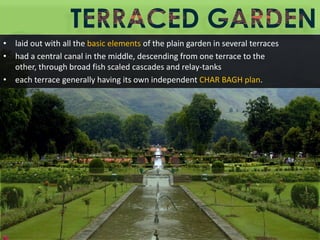
• laid out with all the basic elements of the plain garden in several terraces
• had a central canal in the middle, descending from one terrace to the
other, through broad fish scaled cascades and relay-tanks
• each terrace generally having its own independent CHAR BAGH plan.
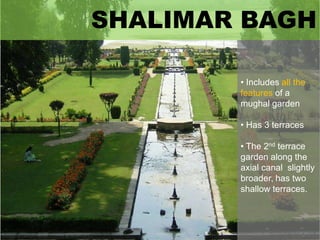
SHALIMAR BAGH
• Includes all the
features of a
mughal garden
• Has 3 terraces
• The 2nd terrace
garden along the
axial canal slightly
broader, has two
shallow terraces.
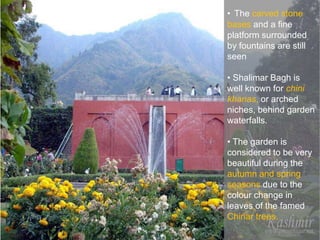
• The carved stone
bases and a fine
platform surrounded
by fountains are still
seen
• Shalimar Bagh is
well known for chini
khanas, or arched
niches, behind garden
waterfalls.
• The garden is
considered to be very
beautiful during the
autumn and spring
seasons due to the
colour change in
leaves of the famed
Chinar trees.
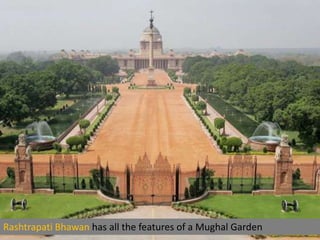
Rashtrapati Bhawan has all the features of a Mughal Garden

Mughal Gardens

  • 1.
    MUGHAL GARDENS A groupof gardens built by the Mughals in the Persian style of architecture.
  • 2.
    Humayun, his son,does not seem to have had much time for building. The founder of the Mughal empire, BABUR , described his favourite type of garden as a CHARBAGH. (dividing the garden into four equal quarters) Akbar built several gardens first in Delhi, then in Agra, Akbar’s new capital. Jahangir's son, SHAH JAHAN, marks the apex of Mughal garden architecture and floral design. He is famous for the construction of Akbar’s the Taj Mahal and heir, JAHANGIR, did the Red Fort which not build as much, but contains the Mahtab he helped to lay out bagh. the famous Shalimar garden and was known for his great love for flowers.
  • 3.
    These tended tobe riverfront gardens rather than the fortress gardens that his predecessors built. Building riverfront rather than fortress gardens influenced later Mughal garden architecture considerably.
  • 4.
    1. Significant useof rectilinear layouts are made within the walled enclosures. 2. Typical features include pools, fountains and canals inside the gardens.
  • 5.
    3. Had handsomewalls and great gateways More like forts than gardens City was pleasantly adorned 4. Most important feature of Mughal garden is Char Bagh planning.
  • 6.
    5. Mughals were obsessed withsymbol and incorporated it into their gardens in many ways.
  • 7.
    6. Include treesof various sorts, some to provide shade merely, and others to produce fruits; flowers, colorful and sweetsmelling; grass, usually growing wild under the trees; birds to fill the garden with song; the whole cooled by a pleasant breeze.
  • 8.
    7. The garden mightinclude a raised hillock at the center, reminiscent of the mountain at the center of the universe in cosmological descriptions, and often surmounted by a pavilion or palace.
  • 9.
    • • • Universally planned in themidst of a CHAR BAGH founded with architectural elements such as STONE PATHWAYS, CANALS, LILY POND, LOTUSTANKS, STAIRS , CASCADES and WATERFALLS. Example : Humayun’s Tomb
  • 10.
    • Gardens alongwith such water devices as tanks, canals, cascades and fountains. • Illustrated by a large no. of paintings of this period
  • 11.
    Example : Gardenaround a fort at Agra
  • 12.
    • Gardens werelaid down independently on a plain surface on char bagh plan , enclosed on all sides by a PARKOTA ( RAMPATS )with a main gateway in the south and with some ornamental gateways on other sides. • Divided in four equal parts by four CANALS running from central platform with stone or or brick paved causeways on both sides ,having tanks ,and cascades sometimes. • Perfectly unified homogeneous composition. • Pleasure pavilion was originally built on the central later sometimes replaced by a tomb of the owner of the garden.
  • 13.
  • 14.
    • laid outwith all the basic elements of the plain garden in several terraces • had a central canal in the middle, descending from one terrace to the other, through broad fish scaled cascades and relay-tanks • each terrace generally having its own independent CHAR BAGH plan.
  • 15.
    SHALIMAR BAGH • Includesall the features of a mughal garden • Has 3 terraces • The 2nd terrace garden along the axial canal slightly broader, has two shallow terraces.
  • 16.
    • The carvedstone bases and a fine platform surrounded by fountains are still seen • Shalimar Bagh is well known for chini khanas, or arched niches, behind garden waterfalls. • The garden is considered to be very beautiful during the autumn and spring seasons due to the colour change in leaves of the famed Chinar trees.
  • 17.
    Rashtrapati Bhawan hasall the features of a Mughal Garden