COLD AND DRY
PRESENTED BY
B.ARCH 3RD SEM.
SUMBITTED TO:-
AR.GIRISH MISTRY SUMBITTED BY:-
AR.KHUSHBOO JAIN SANDEEP SUTRADHAR
KIKANI YOGI
PATEL AMI
CLIMATE IN INDIA
India is home to an extraordinary variety
of climatic regions, ranging from tropical in the
south to temperate and alpine in the Himalayan
north, where elevated regions receive sustained
winter snowfall. The nation's climate is strongly
influenced by the Himalayas and the Thar
Desert.
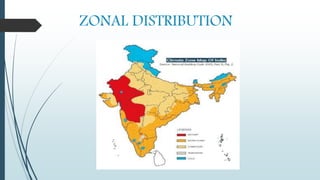
ZONAL DISTRIBUTION
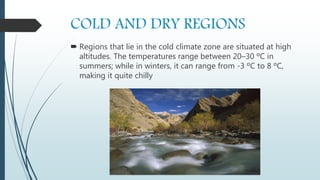
COLD AND DRY REGIONS
 Regions that lie in the cold climate zone are situated at high
altitudes. The temperatures range between 20–30 ºC in
summers; while in winters, it can range from -3 ºC to 8 ºC,
making it quite chilly
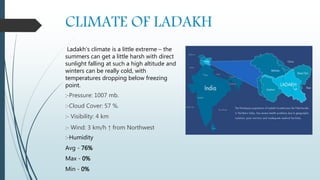
CLIMATE OF LADAKH
:-Pressure: 1007 mb.
:-Cloud Cover: 57 %.
:- Visibility: 4 km
:- Wind: 3 km/h ↑ from Northwest
:-Humidity
Avg - 76%
Max - 0%
Min - 0%
Ladakh’s climate is a little extreme – the
summers can get a little harsh with direct
sunlight falling at such a high altitude and
winters can be really cold, with
temperatures dropping below freezing
point.
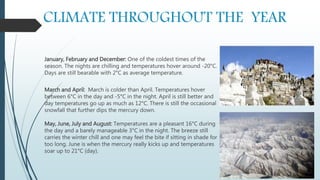
CLIMATE THROUGHOUT THE YEAR
January, February and December: One of the coldest times of the
season. The nights are chilling and temperatures hover around -20°C.
Days are still bearable with 2°C as average temperature.
March and April: March is colder than April. Temperatures hover
between 6°C in the day and -5°C in the night. April is still better and
day temperatures go up as much as 12°C. There is still the occasional
snowfall that further dips the mercury down.
May, June, July and August: Temperatures are a pleasant 16°C during
the day and a barely manageable 3°C in the night. The breeze still
carries the winter chill and one may feel the bite if sitting in shade for
too long. June is when the mercury really kicks up and temperatures
soar up to 21°C (day).
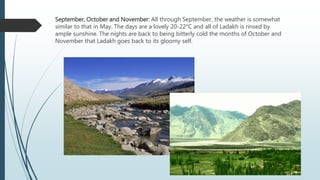
September, October and November: All through September, the weather is somewhat
similar to that in May. The days are a lovely 20-22°C and all of Ladakh is rinsed by
ample sunshine. The nights are back to being bitterly cold the months of October and
November that Ladakh goes back to its gloomy self.
ESSENTIAL FEATURE IN THE DESIGNING
OF HOUSE
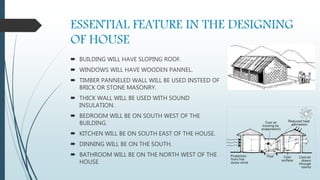
 BUILDING WILL HAVE SLOPING ROOF.
 WINDOWS WILL HAVE WOODEN PANNEL.
 TIMBER PANNELED WALL WILL BE USED INSTEED OF
BRICK OR STONE MASONRY.
 THICK WALL WILL BE USED WITH SOUND
INSULATION.
 BEDROOM WILL BE ON SOUTH WEST OF THE
BUILDING.
 KITCHEN WILL BE ON SOUTH EAST OF THE HOUSE.
 DINNING WILL BE ON THE SOUTH.
 BATHROOM WILL BE ON THE NORTH WEST OF THE
HOUSE
 Natural light is important in the house.
 Flooring of the house must be of timber .
 Noisy place is avoided for building.
 Living area should be in the north of the building.
 Utility rooms [washing and domestic works] should be in the south.
 Cross ventilation is very important for healthy living.
 Trees can be planted near windows to block cold air.
TECHNIQUES
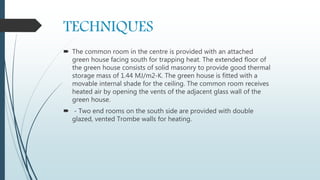
 The common room in the centre is provided with an attached
green house facing south for trapping heat. The extended floor of
the green house consists of solid masonry to provide good thermal
storage mass of 1.44 MJ/m2-K. The green house is fitted with a
movable internal shade for the ceiling. The common room receives
heated air by opening the vents of the adjacent glass wall of the
green house.
 - Two end rooms on the south side are provided with double
glazed, vented Trombe walls for heating.
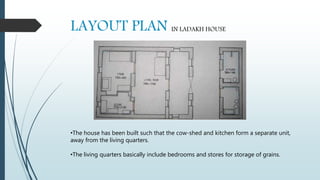
LAYOUT PLAN IN LADAKH HOUSE
•The house has been built such that the cow-shed and kitchen form a separate unit,
away from the living quarters.
•The living quarters basically include bedrooms and stores for storage of grains.
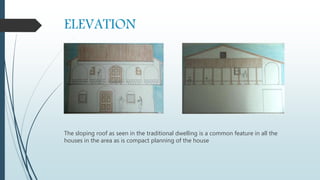
ELEVATION
The sloping roof as seen in the traditional dwelling is a common feature in all the
houses in the area as is compact planning of the house
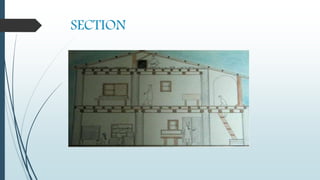
SECTION
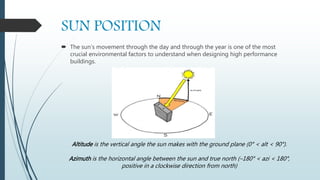
SUN POSITION
 The sun’s movement through the day and through the year is one of the most
crucial environmental factors to understand when designing high performance
buildings.
Altitude is the vertical angle the sun makes with the ground plane (0° < alt < 90°).
Azimuth is the horizontal angle between the sun and true north (–180° < azi < 180°,
positive in a clockwise direction from north)
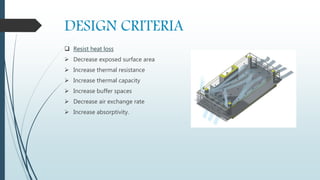
DESIGN CRITERIA
 Resist heat loss
 Decrease exposed surface area
 Increase thermal resistance
 Increase thermal capacity
 Increase buffer spaces
 Decrease air exchange rate
 Increase absorptivity.
BUILDING MATERIAL
 The building is an innovative articulation of material like stone mud clay.
 In ladak houses are very close to each other.
 All the building construction material used is locally available like the stone and
sand of which the walls are made, the timber is also readily available.
- Mud and clay house in ladak
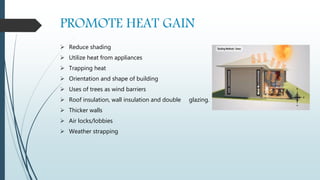
PROMOTE HEAT GAIN
 Reduce shading
 Utilize heat from appliances
 Trapping heat
 Orientation and shape of building
 Uses of trees as wind barriers
 Roof insulation, wall insulation and double glazing.
 Thicker walls
 Air locks/lobbies
 Weather strapping
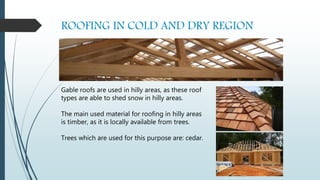
ROOFING IN COLD AND DRY REGION
Gable roofs are used in hilly areas, as these roof
types are able to shed snow in hilly areas.
The main used material for roofing in hilly areas
is timber, as it is locally available from trees.
Trees which are used for this purpose are: cedar.
THANK YOU

Cold and dry

  • 1.
    COLD AND DRY PRESENTEDBY B.ARCH 3RD SEM. SUMBITTED TO:- AR.GIRISH MISTRY SUMBITTED BY:- AR.KHUSHBOO JAIN SANDEEP SUTRADHAR KIKANI YOGI PATEL AMI
  • 2.
    CLIMATE IN INDIA Indiais home to an extraordinary variety of climatic regions, ranging from tropical in the south to temperate and alpine in the Himalayan north, where elevated regions receive sustained winter snowfall. The nation's climate is strongly influenced by the Himalayas and the Thar Desert.
  • 3.
  • 4.
    COLD AND DRYREGIONS  Regions that lie in the cold climate zone are situated at high altitudes. The temperatures range between 20–30 ºC in summers; while in winters, it can range from -3 ºC to 8 ºC, making it quite chilly
  • 5.
    CLIMATE OF LADAKH :-Pressure:1007 mb. :-Cloud Cover: 57 %. :- Visibility: 4 km :- Wind: 3 km/h ↑ from Northwest :-Humidity Avg - 76% Max - 0% Min - 0% Ladakh’s climate is a little extreme – the summers can get a little harsh with direct sunlight falling at such a high altitude and winters can be really cold, with temperatures dropping below freezing point.
  • 6.
    CLIMATE THROUGHOUT THEYEAR January, February and December: One of the coldest times of the season. The nights are chilling and temperatures hover around -20°C. Days are still bearable with 2°C as average temperature. March and April: March is colder than April. Temperatures hover between 6°C in the day and -5°C in the night. April is still better and day temperatures go up as much as 12°C. There is still the occasional snowfall that further dips the mercury down. May, June, July and August: Temperatures are a pleasant 16°C during the day and a barely manageable 3°C in the night. The breeze still carries the winter chill and one may feel the bite if sitting in shade for too long. June is when the mercury really kicks up and temperatures soar up to 21°C (day).
  • 7.
    September, October andNovember: All through September, the weather is somewhat similar to that in May. The days are a lovely 20-22°C and all of Ladakh is rinsed by ample sunshine. The nights are back to being bitterly cold the months of October and November that Ladakh goes back to its gloomy self.
  • 8.
    ESSENTIAL FEATURE INTHE DESIGNING OF HOUSE  BUILDING WILL HAVE SLOPING ROOF.  WINDOWS WILL HAVE WOODEN PANNEL.  TIMBER PANNELED WALL WILL BE USED INSTEED OF BRICK OR STONE MASONRY.  THICK WALL WILL BE USED WITH SOUND INSULATION.  BEDROOM WILL BE ON SOUTH WEST OF THE BUILDING.  KITCHEN WILL BE ON SOUTH EAST OF THE HOUSE.  DINNING WILL BE ON THE SOUTH.  BATHROOM WILL BE ON THE NORTH WEST OF THE HOUSE
  • 9.
     Natural lightis important in the house.  Flooring of the house must be of timber .  Noisy place is avoided for building.  Living area should be in the north of the building.  Utility rooms [washing and domestic works] should be in the south.  Cross ventilation is very important for healthy living.  Trees can be planted near windows to block cold air.
  • 10.
    TECHNIQUES  The commonroom in the centre is provided with an attached green house facing south for trapping heat. The extended floor of the green house consists of solid masonry to provide good thermal storage mass of 1.44 MJ/m2-K. The green house is fitted with a movable internal shade for the ceiling. The common room receives heated air by opening the vents of the adjacent glass wall of the green house.  - Two end rooms on the south side are provided with double glazed, vented Trombe walls for heating.
  • 11.
    LAYOUT PLAN INLADAKH HOUSE •The house has been built such that the cow-shed and kitchen form a separate unit, away from the living quarters. •The living quarters basically include bedrooms and stores for storage of grains.
  • 12.
    ELEVATION The sloping roofas seen in the traditional dwelling is a common feature in all the houses in the area as is compact planning of the house
  • 13.
  • 14.
    SUN POSITION  Thesun’s movement through the day and through the year is one of the most crucial environmental factors to understand when designing high performance buildings. Altitude is the vertical angle the sun makes with the ground plane (0° < alt < 90°). Azimuth is the horizontal angle between the sun and true north (–180° < azi < 180°, positive in a clockwise direction from north)
  • 15.
    DESIGN CRITERIA  Resistheat loss  Decrease exposed surface area  Increase thermal resistance  Increase thermal capacity  Increase buffer spaces  Decrease air exchange rate  Increase absorptivity.
  • 16.
    BUILDING MATERIAL  Thebuilding is an innovative articulation of material like stone mud clay.  In ladak houses are very close to each other.  All the building construction material used is locally available like the stone and sand of which the walls are made, the timber is also readily available. - Mud and clay house in ladak
  • 17.
    PROMOTE HEAT GAIN Reduce shading  Utilize heat from appliances  Trapping heat  Orientation and shape of building  Uses of trees as wind barriers  Roof insulation, wall insulation and double glazing.  Thicker walls  Air locks/lobbies  Weather strapping
  • 18.
    ROOFING IN COLDAND DRY REGION Gable roofs are used in hilly areas, as these roof types are able to shed snow in hilly areas. The main used material for roofing in hilly areas is timber, as it is locally available from trees. Trees which are used for this purpose are: cedar.
  • 19.