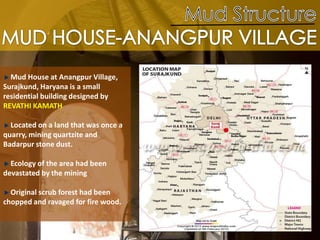
Mud House at Anangpur Village,
Surajkund, Haryana is a small
residential building designed by
REVATHI KAMATH
Located on a land that was once a
quarry, mining quartzite and
Badarpur stone dust.
Ecology of the area had been
devastated by the mining
Original scrub forest had been
chopped and ravaged for fire wood.
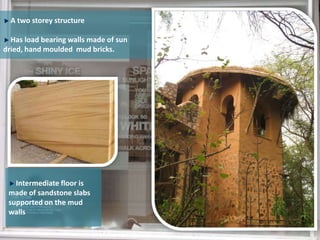
A two storey structure
Has load bearing walls made of sun
dried, hand moulded mud bricks.
Intermediate floor is
made of sandstone slabs
supported on the mud
walls
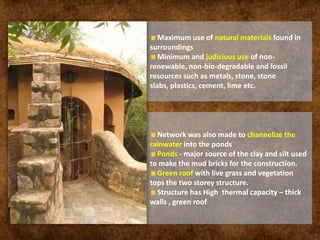
Maximum use of natural materials found in
surroundings
Minimum and judicious use of non-
renewable, non-bio-degradable and fossil
resources such as metals, stone, stone
slabs, plastics, cement, lime etc.
Network was also made to channelize the
rainwater into the ponds
Ponds - major source of the clay and silt used
to make the mud bricks for the construction.
Green roof with live grass and vegetation
tops the two storey structure.
Structure has High thermal capacity – thick
walls , green roof
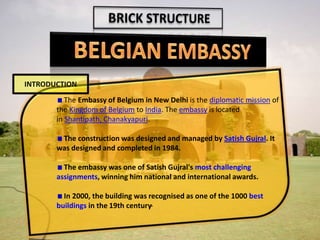
The Embassy of Belgium in New Delhi is the diplomatic mission of
the Kingdom of Belgium to India. The embassy is located
in Shantipath, Chanakyapuri.
The construction was designed and managed by Satish Gujral. It
was designed and completed in 1984.
The embassy was one of Satish Gujral's most challenging
assignments, winning him national and international awards.
In 2000, the building was recognised as one of the 1000 best
buildings in the 19th century.
INTRODUCTION
Some parts of the
building near the
entrance are open to
visitors, while the parts
hosting the residence and
the administrative blocks
are not accessible to the
public.
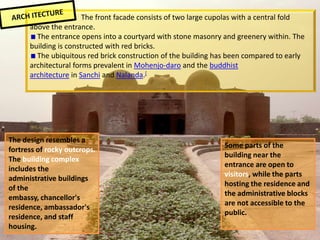
The design resembles a
fortress of rocky outcrops.
The building complex
includes the
administrative buildings
of the
embassy, chancellor's
residence, ambassador's
residence, and staff
housing.
The front facade consists of two large cupolas with a central fold
above the entrance.
The entrance opens into a courtyard with stone masonry and greenery within. The
building is constructed with red bricks.
The ubiquitous red brick construction of the building has been compared to early
architectural forms prevalent in Mohenjo-daro and the buddhist
architecture in Sanchi and Nalanda.[
Placing it in context of history of design Arjun
Thapar(an architect) feels that it made
architectural history, in the manner it broke
norms of office buildings.
It was probably the first time that exposed
bricks were used for a formal building, bricks
were usually considered and informal medium.
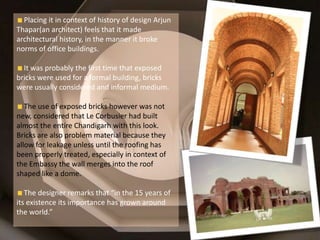
The use of exposed bricks however was not
new, considered that Le Corbusier had built
almost the entire Chandigarh with this look.
Bricks are also problem material because they
allow for leakage unless until the roofing has
been properly treated, especially in context of
the Embassy the wall merges into the roof
shaped like a dome.
The designer remarks that “in the 15 years of
its existence its importance has grown around
the world.”

A mud and brick structure

  • 2.
    Mud House atAnangpur Village, Surajkund, Haryana is a small residential building designed by REVATHI KAMATH Located on a land that was once a quarry, mining quartzite and Badarpur stone dust. Ecology of the area had been devastated by the mining Original scrub forest had been chopped and ravaged for fire wood.
  • 3.
    A two storeystructure Has load bearing walls made of sun dried, hand moulded mud bricks. Intermediate floor is made of sandstone slabs supported on the mud walls
  • 4.
    Maximum use ofnatural materials found in surroundings Minimum and judicious use of non- renewable, non-bio-degradable and fossil resources such as metals, stone, stone slabs, plastics, cement, lime etc. Network was also made to channelize the rainwater into the ponds Ponds - major source of the clay and silt used to make the mud bricks for the construction. Green roof with live grass and vegetation tops the two storey structure. Structure has High thermal capacity – thick walls , green roof
  • 5.
    The Embassy ofBelgium in New Delhi is the diplomatic mission of the Kingdom of Belgium to India. The embassy is located in Shantipath, Chanakyapuri. The construction was designed and managed by Satish Gujral. It was designed and completed in 1984. The embassy was one of Satish Gujral's most challenging assignments, winning him national and international awards. In 2000, the building was recognised as one of the 1000 best buildings in the 19th century. INTRODUCTION
  • 6.
    Some parts ofthe building near the entrance are open to visitors, while the parts hosting the residence and the administrative blocks are not accessible to the public. The design resembles a fortress of rocky outcrops. The building complex includes the administrative buildings of the embassy, chancellor's residence, ambassador's residence, and staff housing. The front facade consists of two large cupolas with a central fold above the entrance. The entrance opens into a courtyard with stone masonry and greenery within. The building is constructed with red bricks. The ubiquitous red brick construction of the building has been compared to early architectural forms prevalent in Mohenjo-daro and the buddhist architecture in Sanchi and Nalanda.[
  • 7.
    Placing it incontext of history of design Arjun Thapar(an architect) feels that it made architectural history, in the manner it broke norms of office buildings. It was probably the first time that exposed bricks were used for a formal building, bricks were usually considered and informal medium. The use of exposed bricks however was not new, considered that Le Corbusier had built almost the entire Chandigarh with this look. Bricks are also problem material because they allow for leakage unless until the roofing has been properly treated, especially in context of the Embassy the wall merges into the roof shaped like a dome. The designer remarks that “in the 15 years of its existence its importance has grown around the world.”