LED
LIGHT EMITING DIODE
WHAT IS LED?
Light Emitting Diodes,
commonly called LED’s, are
real unsung heroes in the
electronics world.
• They do dozens of different jobs and are found
in all kinds of devices.
• Among other things, they form numbers on
digital clocks, transmit information from
remote controls, light up watches and tell you
when your appliances are turned on.
• Collected together, they can form images on a
jumbo television screen or illuminate a traffic
light.
• Basically, LED’s are just tiny light bulbs that fit
easily into an electrical circuit.
• But unlike ordinary incandescent, they don’t
have a filament that will burn out, and they
don’t get especially hot.
• The lifespan of an LED surpasses the short life
of an incandescent bulb by thousands of
hours.
• Tiny LED’s are already replacing the tubes that
light up LCD, HDTV’s to make dramatically
thinner televisions.
WHAT IS HAPPENING?
• The hole exist at a lower
energy level than the free
electrons.
• An electron releases an energy
when it drops from a higher
orbital to a lower one. This
energy is released in the form
of a photon.
• The energy is emitted in the
form of light photon.
• The size of the electrons fall
determines the energy level of
the photon, which determines
its color.
• A bigger fall produces a
photon with a higher energy
level and therefore a higher
light frequency.
DIODE VS LED
• In a ordinary diode, the
semiconductor material
itself ends up absorbing a
lot of the light energy.
• LED’s are specially
constructed to release a
large number of photons
outward.
• They are housed in a
plastic bulb that
concentrates a the light in
a particular direction.
INFRARED LED’s
• You can only see the photons when the diode is
composed of certain material.
• The atoms in a standard silicon diode, for
example, are arranged in such a way that the
electron drops a relatively short distance. As a
result, the photon’s frequency is so low that it is
invisible to the human eye.
• It is in the infrared portion of the light spectrum.
• Infrared LED’s are ideal for remote controls.
VISIBLE LED’s
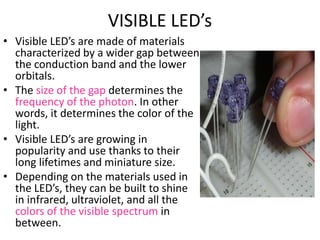
• Visible LED’s are made of materials
characterized by a wider gap between
the conduction band and the lower
orbitals.
• The size of the gap determines the
frequency of the photon. In other
words, it determines the color of the
light.
• Visible LED’s are growing in
popularity and use thanks to their
long lifetimes and miniature size.
• Depending on the materials used in
the LED’s, they can be built to shine
in infrared, ultraviolet, and all the
colors of the visible spectrum in
between.
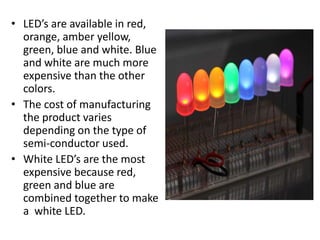
• LED’s are available in red,
orange, amber yellow,
green, blue and white. Blue
and white are much more
expensive than the other
colors.
• The cost of manufacturing
the product varies
depending on the type of
semi-conductor used.
• White LED’s are the most
expensive because red,
green and blue are
combined together to make
a white LED.
THANK
YOU!

Light Emitting Diodes.

  • 1.
  • 2.
    WHAT IS LED? LightEmitting Diodes, commonly called LED’s, are real unsung heroes in the electronics world.
  • 3.
    • They dodozens of different jobs and are found in all kinds of devices. • Among other things, they form numbers on digital clocks, transmit information from remote controls, light up watches and tell you when your appliances are turned on. • Collected together, they can form images on a jumbo television screen or illuminate a traffic light.
  • 4.
    • Basically, LED’sare just tiny light bulbs that fit easily into an electrical circuit. • But unlike ordinary incandescent, they don’t have a filament that will burn out, and they don’t get especially hot. • The lifespan of an LED surpasses the short life of an incandescent bulb by thousands of hours. • Tiny LED’s are already replacing the tubes that light up LCD, HDTV’s to make dramatically thinner televisions.
  • 5.
    WHAT IS HAPPENING? •The hole exist at a lower energy level than the free electrons. • An electron releases an energy when it drops from a higher orbital to a lower one. This energy is released in the form of a photon. • The energy is emitted in the form of light photon. • The size of the electrons fall determines the energy level of the photon, which determines its color. • A bigger fall produces a photon with a higher energy level and therefore a higher light frequency.
  • 6.
    DIODE VS LED •In a ordinary diode, the semiconductor material itself ends up absorbing a lot of the light energy. • LED’s are specially constructed to release a large number of photons outward. • They are housed in a plastic bulb that concentrates a the light in a particular direction.
  • 7.
    INFRARED LED’s • Youcan only see the photons when the diode is composed of certain material. • The atoms in a standard silicon diode, for example, are arranged in such a way that the electron drops a relatively short distance. As a result, the photon’s frequency is so low that it is invisible to the human eye. • It is in the infrared portion of the light spectrum. • Infrared LED’s are ideal for remote controls.
  • 8.
    VISIBLE LED’s • VisibleLED’s are made of materials characterized by a wider gap between the conduction band and the lower orbitals. • The size of the gap determines the frequency of the photon. In other words, it determines the color of the light. • Visible LED’s are growing in popularity and use thanks to their long lifetimes and miniature size. • Depending on the materials used in the LED’s, they can be built to shine in infrared, ultraviolet, and all the colors of the visible spectrum in between.
  • 9.
    • LED’s areavailable in red, orange, amber yellow, green, blue and white. Blue and white are much more expensive than the other colors. • The cost of manufacturing the product varies depending on the type of semi-conductor used. • White LED’s are the most expensive because red, green and blue are combined together to make a white LED.
  • 10.