LASER, LED,LCD display
What’s So Different?
Incandescent Lamp only around 10% of the energy is
used to make visible light.
INTRODUCTION
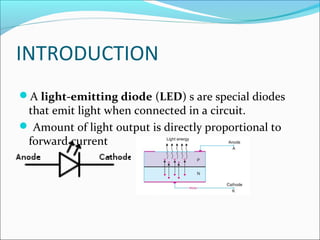
A light-emitting diode (LED) s are special diodes
that emit light when connected in a circuit.
 Amount of light output is directly proportional to
forward current
SC materials – Gallium Phosphide (red or green)
Gallium arsenide Phosphide(red or
yellow)
Gallium arsenide ( infrared)
Gallium nitrite (blue)
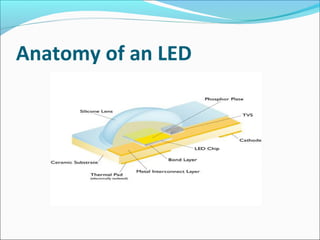
Anatomy of an LED
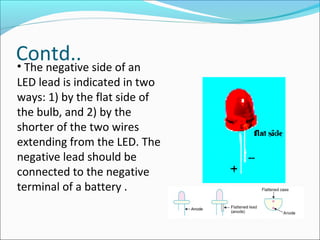
Contd..• The negative side of an
LED lead is indicated in two
ways: 1) by the flat side of
the bulb, and 2) by the
shorter of the two wires
extending from the LED. The
negative lead should be
connected to the negative
terminal of a battery .
COLOUR OF LED
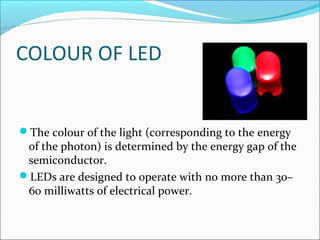
The colour of the light (corresponding to the energy
of the photon) is determined by the energy gap of the
semiconductor.
LEDs are designed to operate with no more than 30–
60 milliwatts of electrical power.
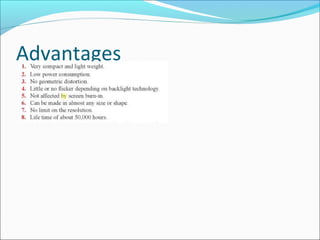
ADVANTAGES
Lower energy consumption
Longer lifetime
Improved robustness
Smaller size
Faster switching
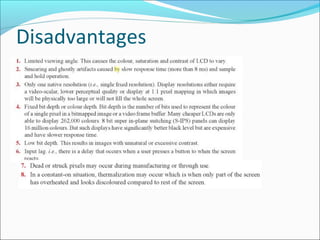
DISADVANTAGES
 LEDs powerful enough for room lighting and are
relatively expensive.
It requires more precise current and heat
management than compact fluorescent lamp sources
of comparable output.
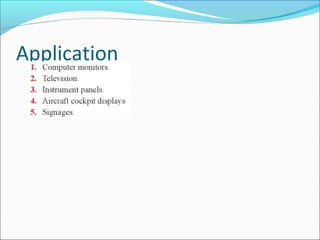
APPLICATIONS
Light-emitting diodes are used as
Low current LED –low power dc circuits,
telecommunication indicator, portable equipment,
keyboard indicator
Automotive lighting
Traffic signals
Infrared LEDs are also used in the remote control
units of many commercial products including
televisions, DVD players, and other domestic
appliances.
How LED Lighting Distinguishes
Every Application Area
LEDs in Retail Environments
provide a wide range of effects – from the strikingly
dramatic to the intriguing and inviting – that
contribute to the total shopping experience.
highlight a product, create drama and interest, but it
can also reflect mood, helping create the perfect
environment for the shopping experience.
LEDs in Office Environments
uniform level of illumination throughout.
Reflections on computer screens can prove tiring as
the day draws on, and as concentration drops, so does
efficiency.
 making people feel more comfortable at work and
stimulating their performance – but also considerable
energy and maintenance cost reductions.
LEDs in Hospitality Environments
Lighting a hotel or restaurant is a complicated
business.
Hotels, for example, need to have lighting 24/7 – in
corridors and hallways, for example, or in reception.
Yet the lighting must also be adaptable, capable of
creating a wide range of moods to make the guest feel
welcome, safe and comfortable.
LED solutions can make guests feel comfortable, at
home. And do it while offering enormous savings in
maintenance and energy-costs. LED solutions can
create an ever-changing palette of moods, each tailor-
made for a specific moment, a specific use.
low maintenance such systems required thus greatly
reducing running costs.
LED in Outdoor Environments
The needs of urban lighting are changing.
creating flexible ambiances that could, for example,
change with the weather or the season, and provide
an extra festive color on public holidays.
energy consumption that is only a fraction of
conventional lighting techniques.
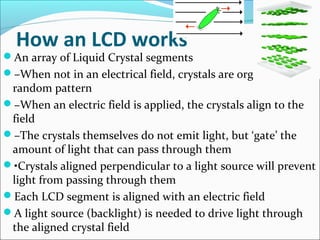
How an LCD works
An array of Liquid Crystal segments
–When not in an electrical field, crystals are organized in a
random pattern
–When an electric field is applied, the crystals align to the
field
–The crystals themselves do not emit light, but ‘gate’ the
amount of light that can pass through them
•Crystals aligned perpendicular to a light source will prevent
light from passing through them
Each LCD segment is aligned with an electric field
A light source (backlight) is needed to drive light through
the aligned crystal field
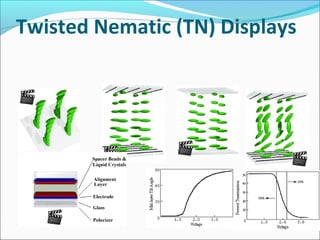
Twisted Nematic (TN) Displays
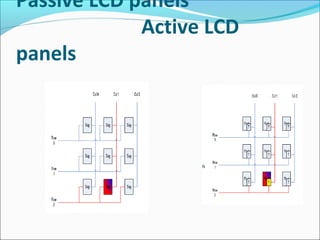
Passive LCD panels
Active LCD
panels
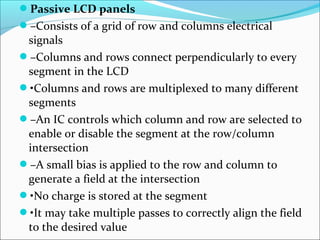
Passive LCD panels
–Consists of a grid of row and columns electrical
signals
–Columns and rows connect perpendicularly to every
segment in the LCD
•Columns and rows are multiplexed to many different
segments
–An IC controls which column and row are selected to
enable or disable the segment at the row/column
intersection
–A small bias is applied to the row and column to
generate a field at the intersection
•No charge is stored at the segment
•It may take multiple passes to correctly align the field
to the desired value
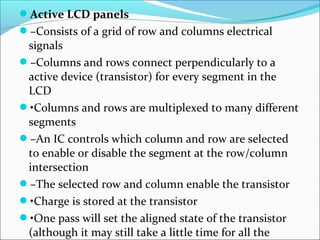
Active LCD panels
–Consists of a grid of row and columns electrical
signals
–Columns and rows connect perpendicularly to a
active device (transistor) for every segment in the
LCD
•Columns and rows are multiplexed to many different
segments
–An IC controls which column and row are selected
to enable or disable the segment at the row/column
intersection
–The selected row and column enable the transistor
•Charge is stored at the transistor
•One pass will set the aligned state of the transistor
(although it may still take a little time for all the
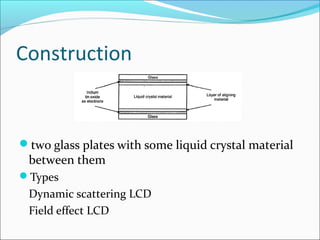
Construction
two glass plates with some liquid crystal material
between them
Types
Dynamic scattering LCD
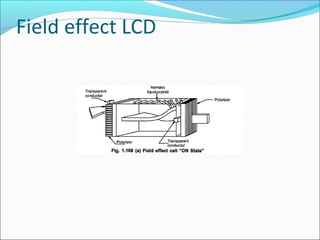
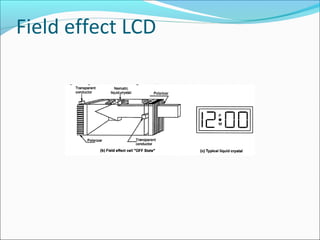
Field effect LCD
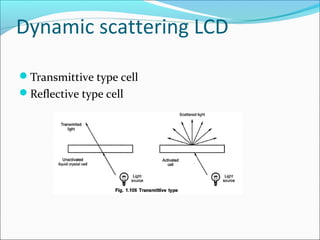
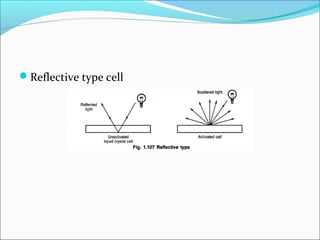
Dynamic scattering LCD
Transmittive type cell
Reflective type cell
Field effect LCD
Field effect LCD
Advantages
Disadvantages
Application
LASER INTRODUCTION
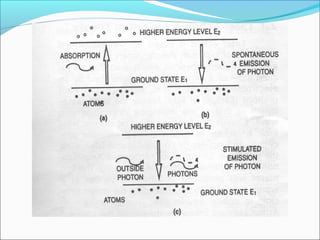
Light Amplification by Stimulated Emission of Radiation
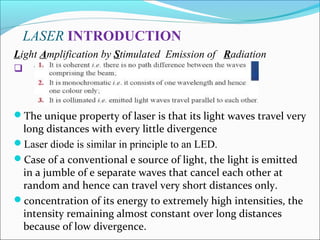
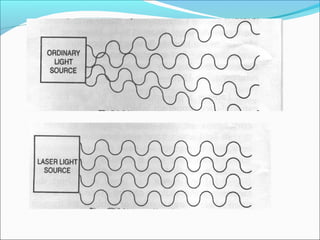
 The Laser is a source of highly directional,
monochromatic, coherent light.
The unique property of laser is that its light waves travel very
long distances with every little divergence
Laser diode is similar in principle to an LED.
Case of a conventional e source of light, the light is emitted
in a jumble of e separate waves that cancel each other at
random and hence can travel very short distances only.
concentration of its energy to extremely high intensities, the
intensity remaining almost constant over long distances
because of low divergence.
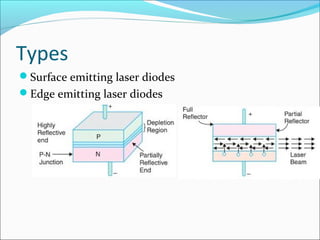
Types
Surface emitting laser diodes
Edge emitting laser diodes
ADVANTAGES
The semiconductor laser differs from other lasers (solid,
gas, and liquid lasers):
 small size (typical on the order of 0.1 × 0.1 × 0.3 mm3)
 high efficiency
 the laser output is easily modulated at high frequency
by controlling the junction current
 low or medium power (as compared with ruby or CO2
laser, but is comparable to the He-Ne laser)
 particularly suitable for fiber optic communication
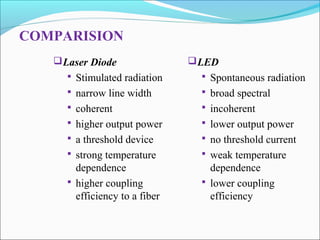
COMPARISION
Laser Diode
 Stimulated radiation
 narrow line width
 coherent
 higher output power
 a threshold device
 strong temperature
dependence
 higher coupling
efficiency to a fiber
LED
 Spontaneous radiation
 broad spectral
 incoherent
 lower output power
 no threshold current
 weak temperature
dependence
 lower coupling
efficiency
APPLICATIONS
 Optical-fiber communication
 Video recording
 Optical reading
 High-speed laser printing
 High-resolution gas spectroscopy
 Hologram scanners
Draw mindmap
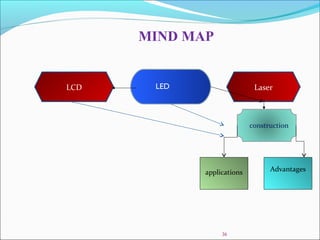
MIND MAP
36
LCD LED Laser
construction
applications Advantages
Summary
LED,LCD, LASER
Definition
Construction
Principle
Advantages
Application
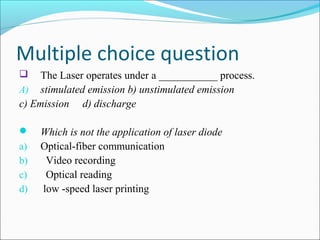
Multiple choice question
 The Laser operates under a ___________ process.
A) stimulated emission b) unstimulated emission
c) Emission d) discharge
 Which is not the application of laser diode
a) Optical-fiber communication
b) Video recording
c) Optical reading
d) low -speed laser printing

Laser, led,lcd display

  • 1.
  • 2.
    What’s So Different? IncandescentLamp only around 10% of the energy is used to make visible light.
  • 3.
    INTRODUCTION A light-emitting diode(LED) s are special diodes that emit light when connected in a circuit.  Amount of light output is directly proportional to forward current
  • 4.
    SC materials –Gallium Phosphide (red or green) Gallium arsenide Phosphide(red or yellow) Gallium arsenide ( infrared) Gallium nitrite (blue)
  • 5.
  • 6.
    Contd..• The negativeside of an LED lead is indicated in two ways: 1) by the flat side of the bulb, and 2) by the shorter of the two wires extending from the LED. The negative lead should be connected to the negative terminal of a battery .
  • 7.
    COLOUR OF LED Thecolour of the light (corresponding to the energy of the photon) is determined by the energy gap of the semiconductor. LEDs are designed to operate with no more than 30– 60 milliwatts of electrical power.
  • 8.
    ADVANTAGES Lower energy consumption Longerlifetime Improved robustness Smaller size Faster switching
  • 9.
    DISADVANTAGES  LEDs powerfulenough for room lighting and are relatively expensive. It requires more precise current and heat management than compact fluorescent lamp sources of comparable output.
  • 10.
    APPLICATIONS Light-emitting diodes areused as Low current LED –low power dc circuits, telecommunication indicator, portable equipment, keyboard indicator Automotive lighting Traffic signals Infrared LEDs are also used in the remote control units of many commercial products including televisions, DVD players, and other domestic appliances.
  • 11.
    How LED LightingDistinguishes Every Application Area LEDs in Retail Environments provide a wide range of effects – from the strikingly dramatic to the intriguing and inviting – that contribute to the total shopping experience. highlight a product, create drama and interest, but it can also reflect mood, helping create the perfect environment for the shopping experience.
  • 12.
    LEDs in OfficeEnvironments uniform level of illumination throughout. Reflections on computer screens can prove tiring as the day draws on, and as concentration drops, so does efficiency.  making people feel more comfortable at work and stimulating their performance – but also considerable energy and maintenance cost reductions.
  • 13.
    LEDs in HospitalityEnvironments Lighting a hotel or restaurant is a complicated business. Hotels, for example, need to have lighting 24/7 – in corridors and hallways, for example, or in reception. Yet the lighting must also be adaptable, capable of creating a wide range of moods to make the guest feel welcome, safe and comfortable. LED solutions can make guests feel comfortable, at home. And do it while offering enormous savings in maintenance and energy-costs. LED solutions can create an ever-changing palette of moods, each tailor- made for a specific moment, a specific use. low maintenance such systems required thus greatly reducing running costs.
  • 14.
    LED in OutdoorEnvironments The needs of urban lighting are changing. creating flexible ambiances that could, for example, change with the weather or the season, and provide an extra festive color on public holidays. energy consumption that is only a fraction of conventional lighting techniques.
  • 15.
    How an LCDworks An array of Liquid Crystal segments –When not in an electrical field, crystals are organized in a random pattern –When an electric field is applied, the crystals align to the field –The crystals themselves do not emit light, but ‘gate’ the amount of light that can pass through them •Crystals aligned perpendicular to a light source will prevent light from passing through them Each LCD segment is aligned with an electric field A light source (backlight) is needed to drive light through the aligned crystal field
  • 16.
  • 17.
  • 18.
    Passive LCD panels –Consistsof a grid of row and columns electrical signals –Columns and rows connect perpendicularly to every segment in the LCD •Columns and rows are multiplexed to many different segments –An IC controls which column and row are selected to enable or disable the segment at the row/column intersection –A small bias is applied to the row and column to generate a field at the intersection •No charge is stored at the segment •It may take multiple passes to correctly align the field to the desired value
  • 19.
    Active LCD panels –Consistsof a grid of row and columns electrical signals –Columns and rows connect perpendicularly to a active device (transistor) for every segment in the LCD •Columns and rows are multiplexed to many different segments –An IC controls which column and row are selected to enable or disable the segment at the row/column intersection –The selected row and column enable the transistor •Charge is stored at the transistor •One pass will set the aligned state of the transistor (although it may still take a little time for all the
  • 20.
    Construction two glass plateswith some liquid crystal material between them Types Dynamic scattering LCD Field effect LCD
  • 21.
    Dynamic scattering LCD Transmittivetype cell Reflective type cell
  • 22.
  • 23.
  • 24.
  • 25.
  • 26.
  • 27.
  • 28.
    LASER INTRODUCTION Light Amplificationby Stimulated Emission of Radiation  The Laser is a source of highly directional, monochromatic, coherent light. The unique property of laser is that its light waves travel very long distances with every little divergence Laser diode is similar in principle to an LED. Case of a conventional e source of light, the light is emitted in a jumble of e separate waves that cancel each other at random and hence can travel very short distances only. concentration of its energy to extremely high intensities, the intensity remaining almost constant over long distances because of low divergence.
  • 31.
    Types Surface emitting laserdiodes Edge emitting laser diodes
  • 32.
    ADVANTAGES The semiconductor laserdiffers from other lasers (solid, gas, and liquid lasers):  small size (typical on the order of 0.1 × 0.1 × 0.3 mm3)  high efficiency  the laser output is easily modulated at high frequency by controlling the junction current  low or medium power (as compared with ruby or CO2 laser, but is comparable to the He-Ne laser)  particularly suitable for fiber optic communication
  • 33.
    COMPARISION Laser Diode  Stimulatedradiation  narrow line width  coherent  higher output power  a threshold device  strong temperature dependence  higher coupling efficiency to a fiber LED  Spontaneous radiation  broad spectral  incoherent  lower output power  no threshold current  weak temperature dependence  lower coupling efficiency
  • 34.
    APPLICATIONS  Optical-fiber communication Video recording  Optical reading  High-speed laser printing  High-resolution gas spectroscopy  Hologram scanners
  • 35.
  • 36.
    MIND MAP 36 LCD LEDLaser construction applications Advantages
  • 37.
  • 38.
    Multiple choice question The Laser operates under a ___________ process. A) stimulated emission b) unstimulated emission c) Emission d) discharge  Which is not the application of laser diode a) Optical-fiber communication b) Video recording c) Optical reading d) low -speed laser printing