Syntax Analysis I
Lecture 5
Introduction to Parsing
Regular Languages
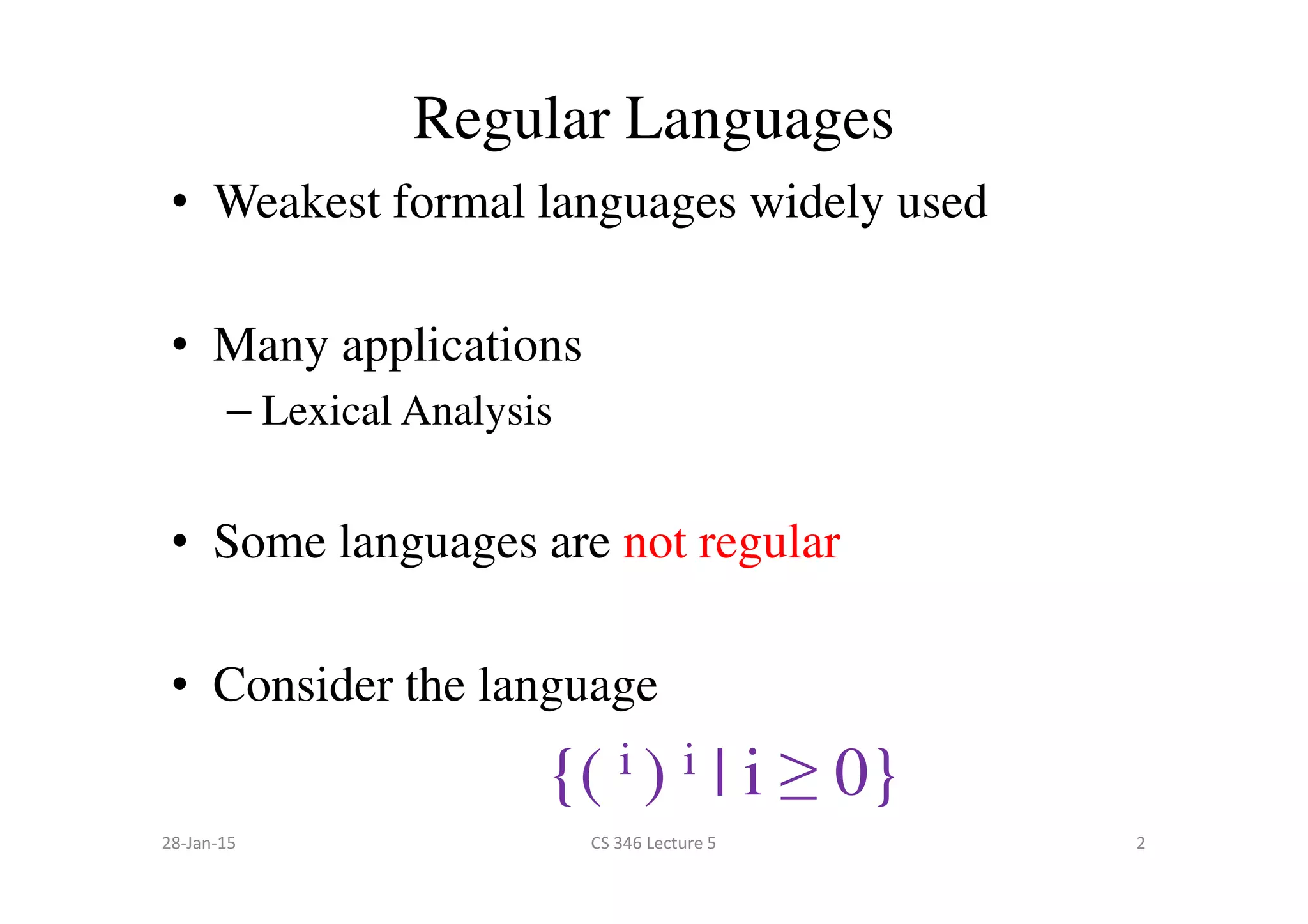
• Weakest formal languages widely used
• Many applications
– Lexical Analysis
• Some languages are not regular
• Consider the language
{( i ) i | i ≥ 0}
28-Jan-15 2CS 346 Lecture 5
Limitation of Regular Expression
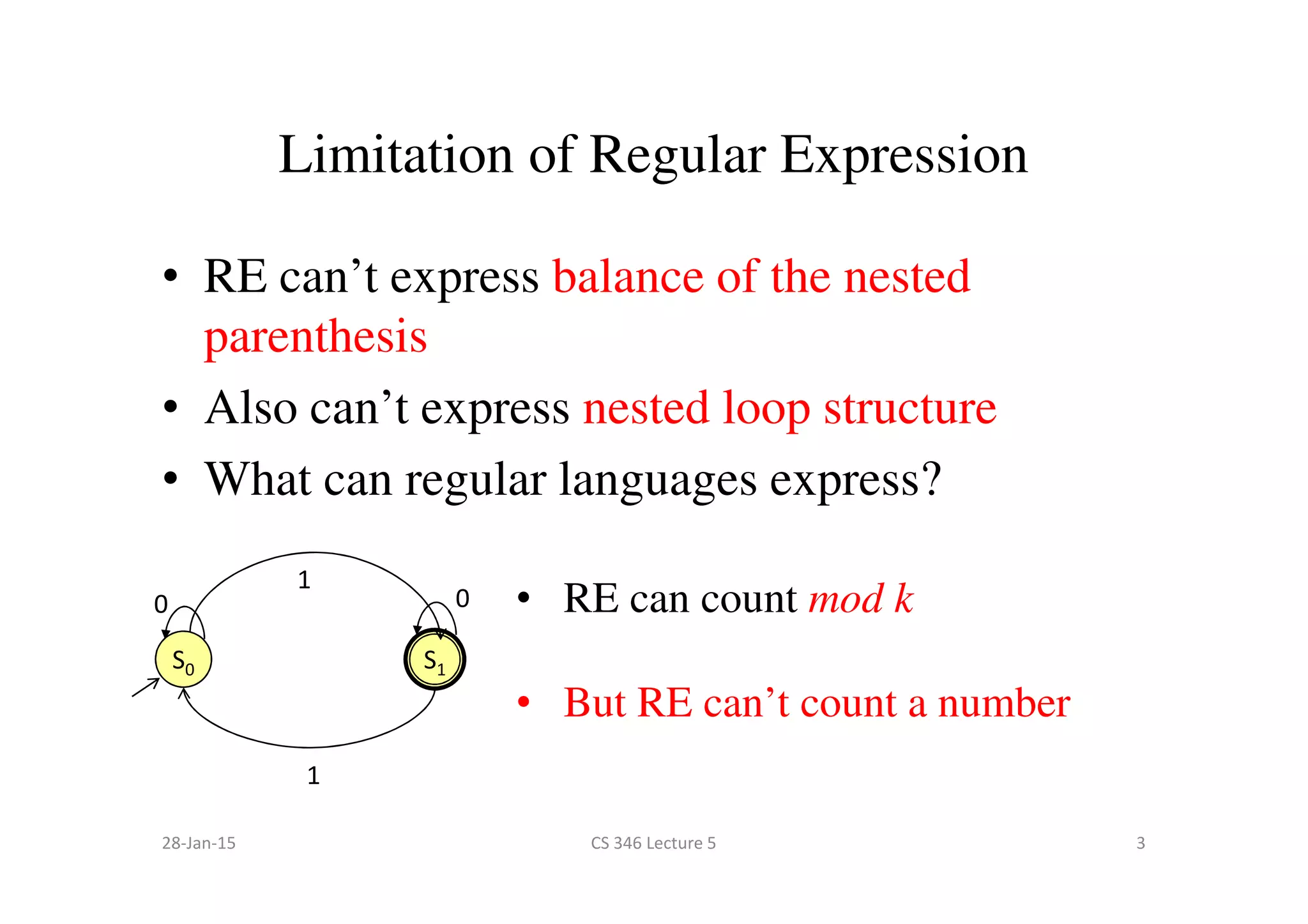
• RE can’t express balance of the nested
parenthesis
• Also can’t express nested loop structure
• What can regular languages express?• What can regular languages express?
S0 S1
1
1
00 • RE can count mod k
• But RE can’t count a number
28-Jan-15 3CS 346 Lecture 5
Introduction to Parser
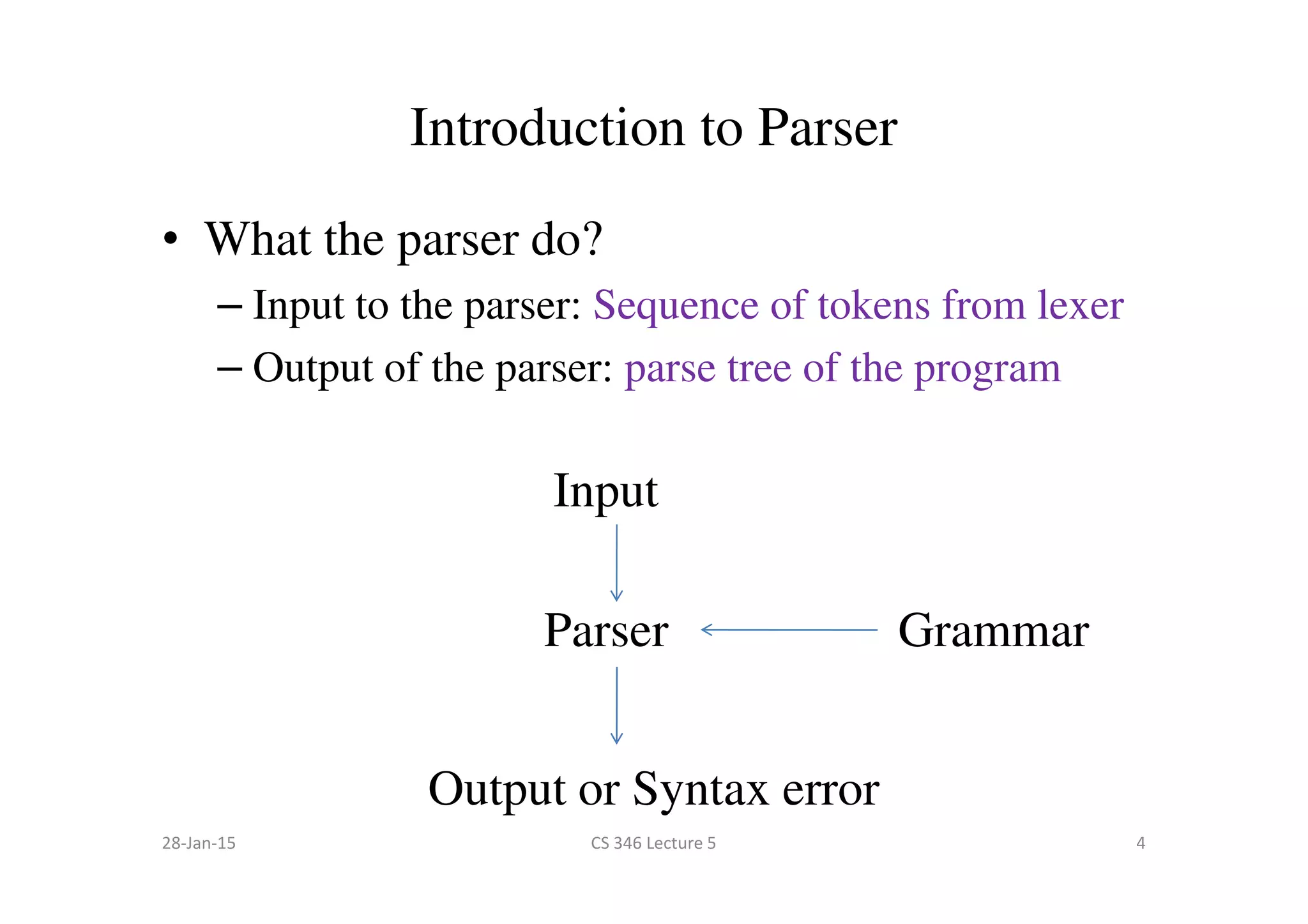
• What the parser do?
– Input to the parser: Sequence of tokens from lexer
– Output of the parser: parse tree of the program
Parser
Input
Grammar
Output or Syntax error
28-Jan-15 4CS 346 Lecture 5
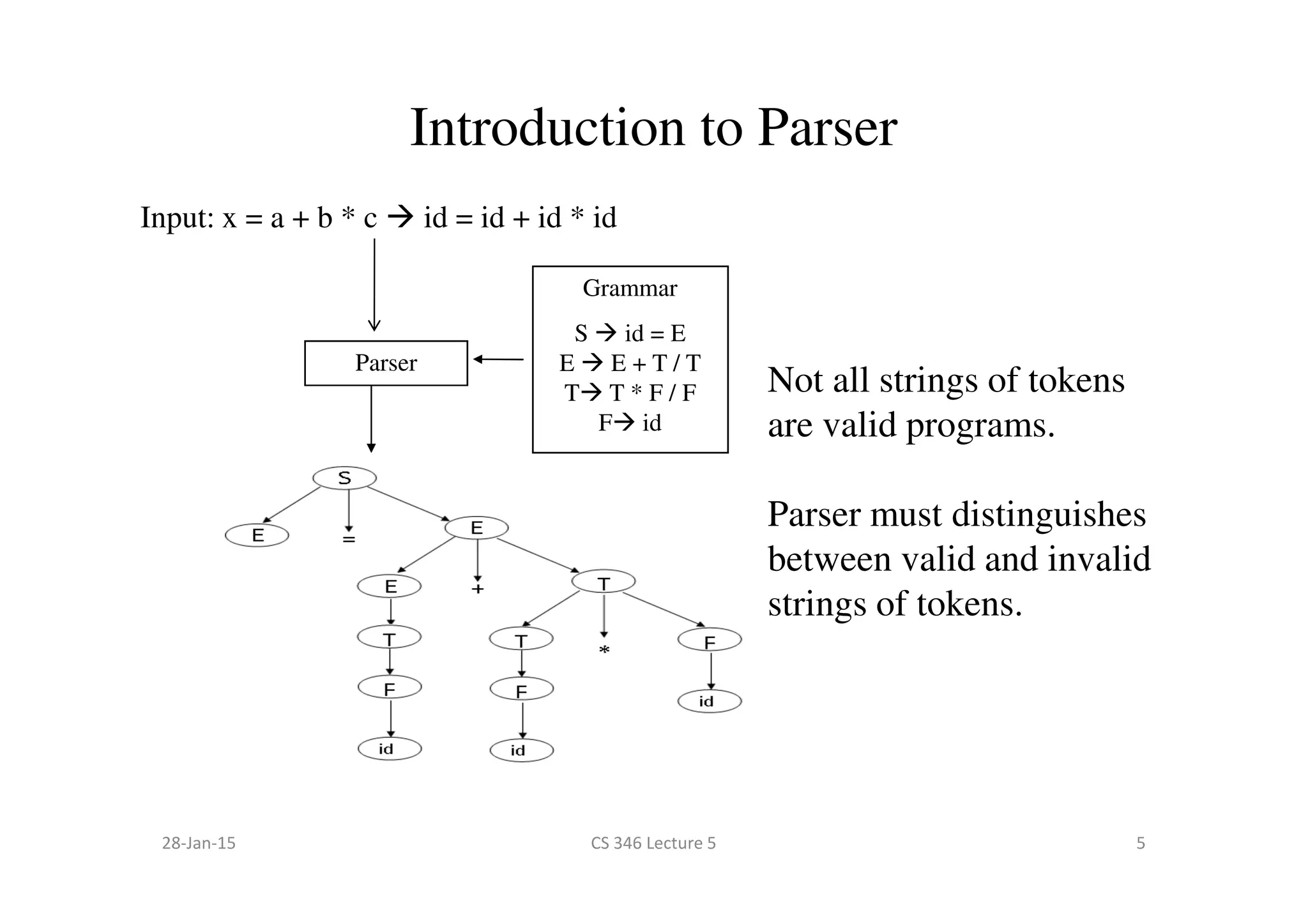
Parser
Input: x = a + b * c id = id + id * id
Grammar
S id = E
E E + T / T
T T * F / F
F id
Introduction to Parser
Not all strings of tokens
are valid programs.
Parser must distinguishes
between valid and invalid
strings of tokens.
28-Jan-15 5CS 346 Lecture 5
Requirements
• A language is needed for describing valid
strings of tokens
• A method for distinguishing valid strings from• A method for distinguishing valid strings from
the invalid strings
• Programming languages have natural recursive
structure
– if (expr) expr else expr
28-Jan-15 6CS 346 Lecture 5
Context Free Grammar
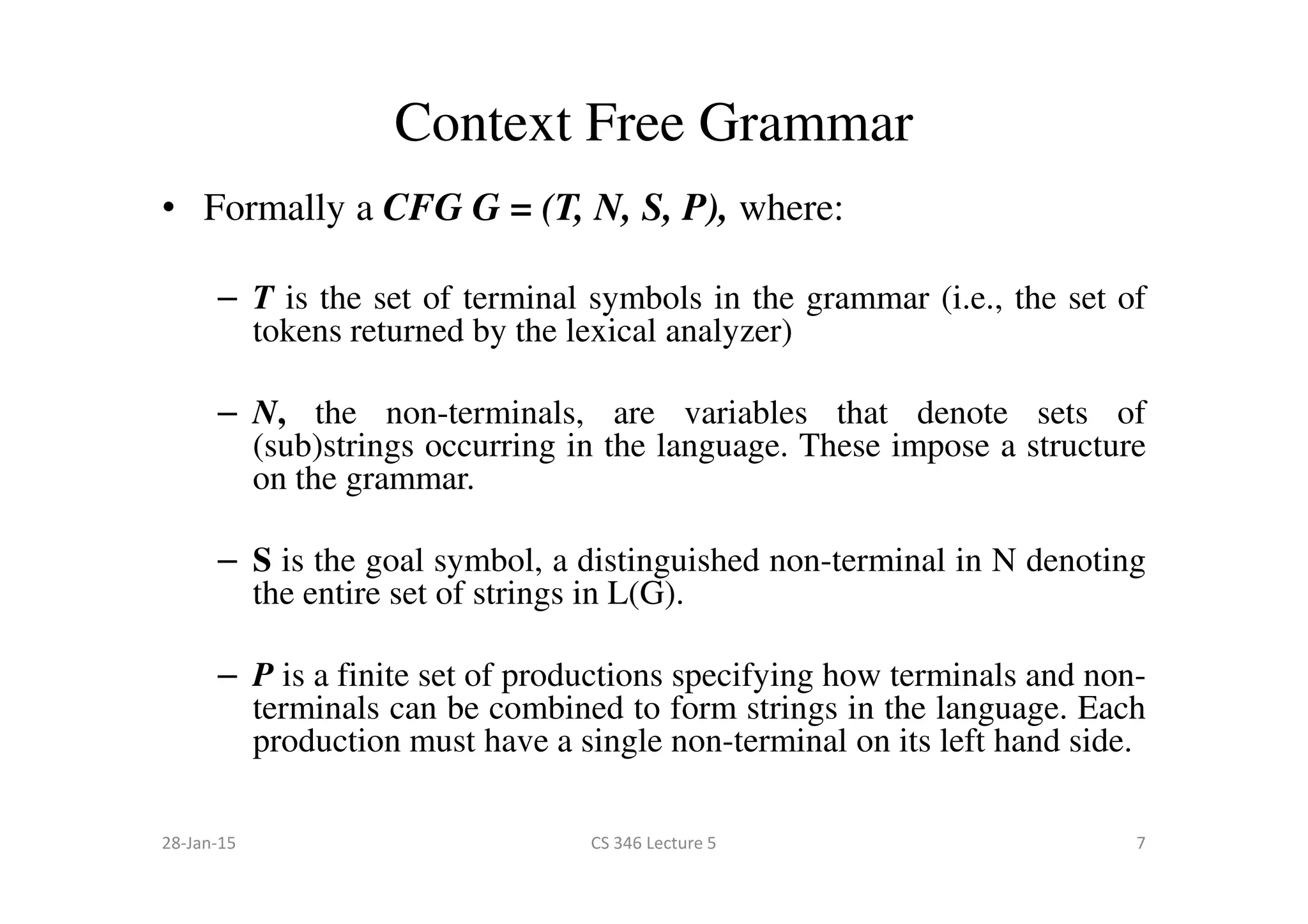
• Formally a CFG G = (T, N, S, P), where:
– T is the set of terminal symbols in the grammar (i.e., the set of
tokens returned by the lexical analyzer)
– N, the non-terminals, are variables that denote sets of
(sub)strings occurring in the language. These impose a structure
on the grammar.
(sub)strings occurring in the language. These impose a structure
on the grammar.
– S is the goal symbol, a distinguished non-terminal in N denoting
the entire set of strings in L(G).
– P is a finite set of productions specifying how terminals and non-
terminals can be combined to form strings in the language. Each
production must have a single non-terminal on its left hand side.
28-Jan-15 7CS 346 Lecture 5
CFG – An Example
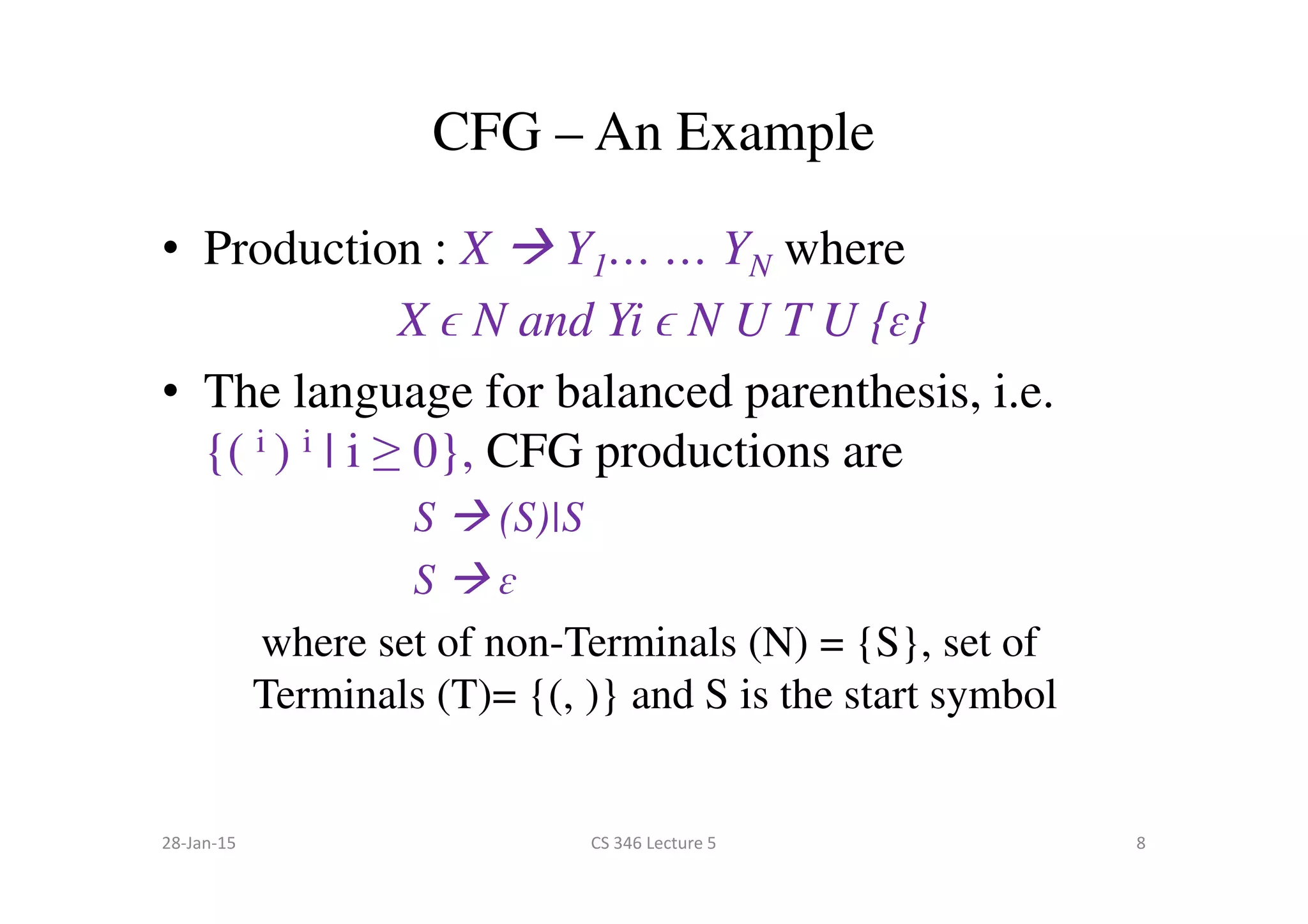
• Production : X Y1… … YN where
X ϵ N and Yi ϵ N U T U {ɛ}
• The language for balanced parenthesis, i.e.
{( i ) i | i ≥ 0}, CFG productions are{( ) | i ≥ 0}, CFG productions are
S (S)|S
S ɛ
where set of non-Terminals (N) = {S}, set of
Terminals (T)= {(, )} and S is the start symbol
28-Jan-15 8CS 346 Lecture 5
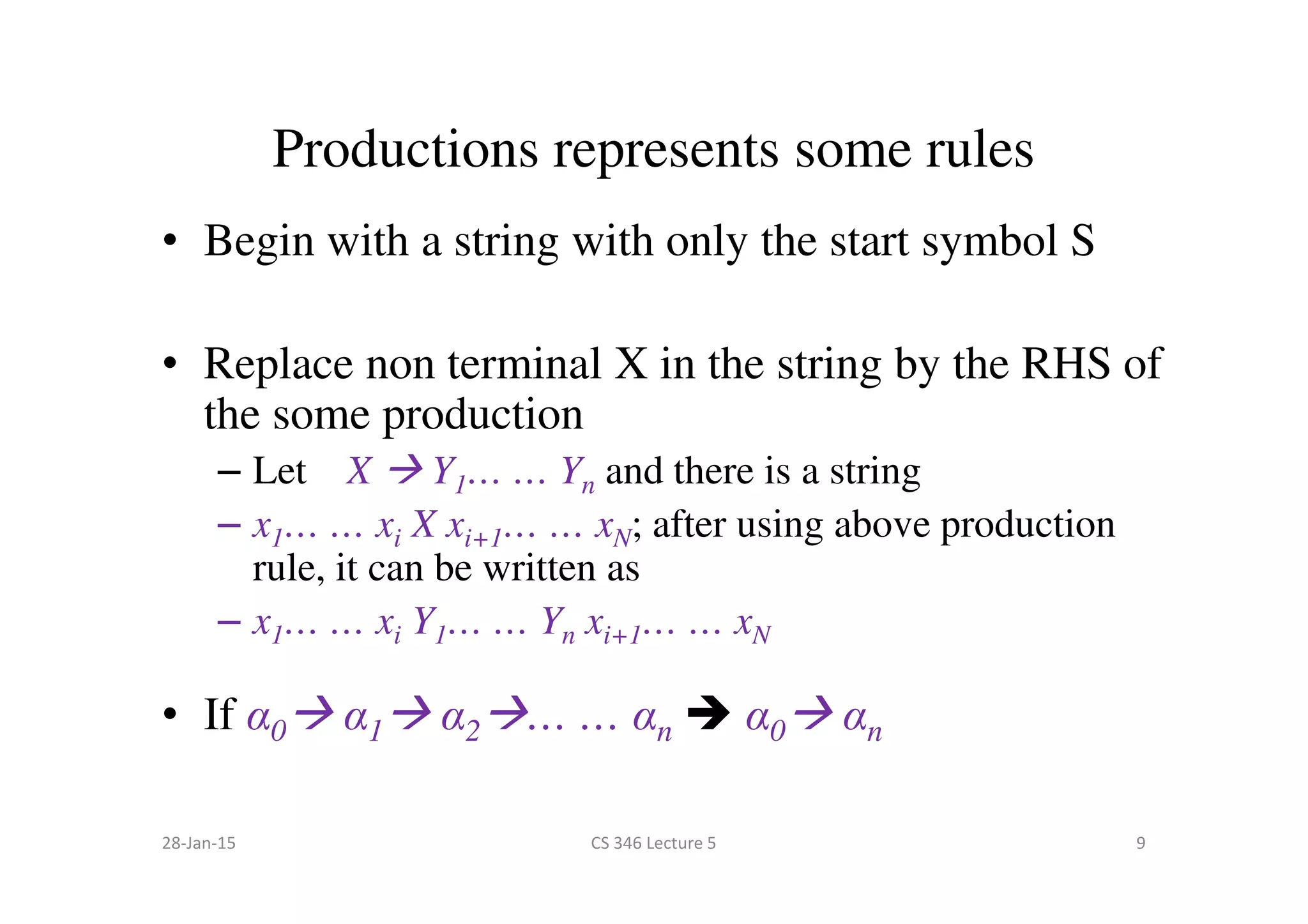
Productions represents some rules
• Begin with a string with only the start symbol S
• Replace non terminal X in the string by the RHS of
the some production
– Let X Y … … Y and there is a string– Let X Y1… … Yn and there is a string
– x1… … xi X xi+1… … xN; after using above production
rule, it can be written as
– x1… … xi Y1… … Yn xi+1… … xN
• If α0 α1 α2 … … αn α0 αn
28-Jan-15 9CS 346 Lecture 5
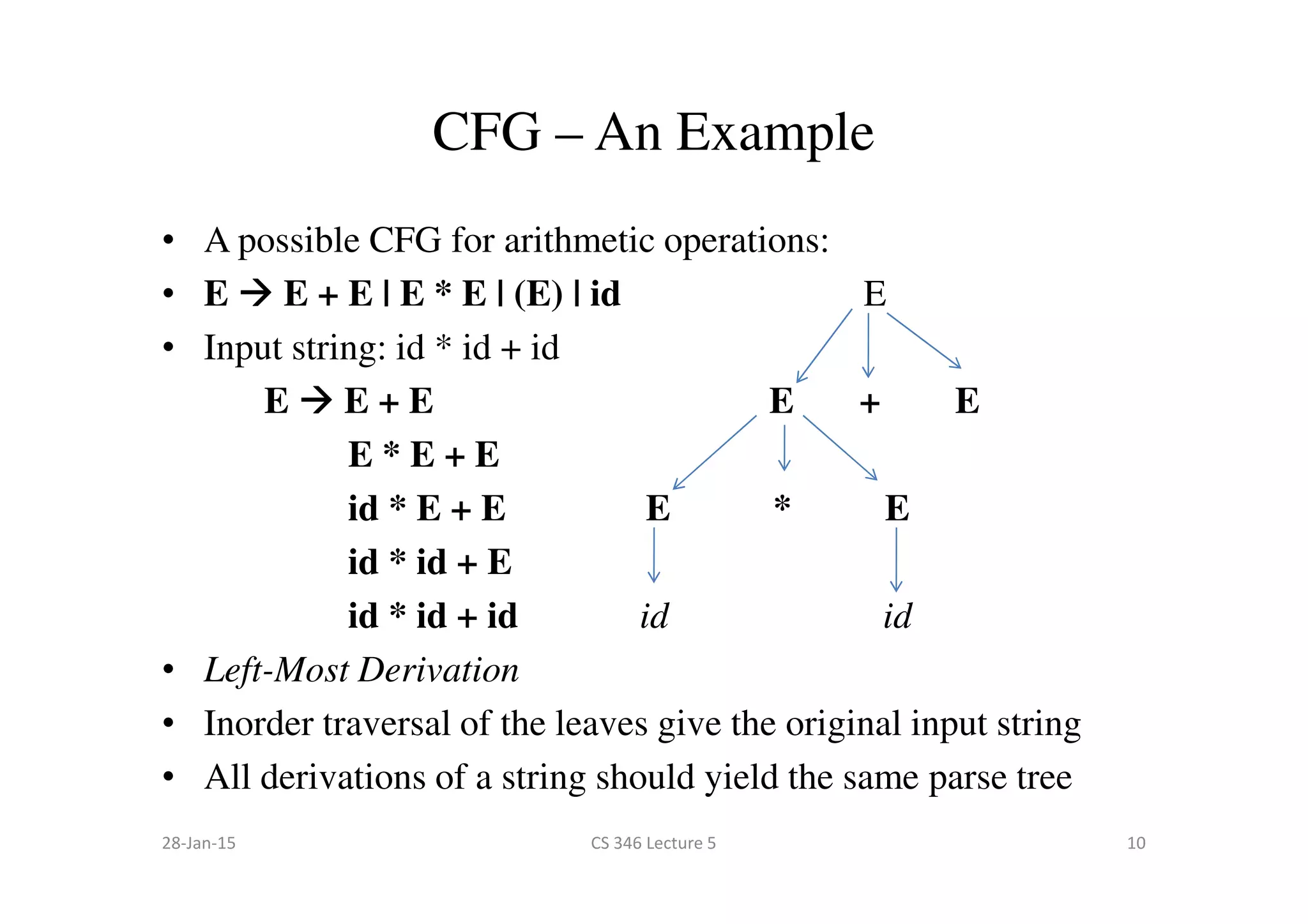
• A possible CFG for arithmetic operations:
• E E + E | E * E | (E) | id E
• Input string: id * id + id
E E + E E + E
E * E + E
CFG – An Example
E * E + E
id * E + E E * E
id * id + E
id * id + id id id
• Left-Most Derivation
• Inorder traversal of the leaves give the original input string
• All derivations of a string should yield the same parse tree
28-Jan-15 10CS 346 Lecture 5
Lecture5 syntax analysis_1

Lecture5 syntax analysis_1

  • 1.
    Syntax Analysis I Lecture5 Introduction to Parsing
  • 2.
    Regular Languages • Weakestformal languages widely used • Many applications – Lexical Analysis • Some languages are not regular • Consider the language {( i ) i | i ≥ 0} 28-Jan-15 2CS 346 Lecture 5
  • 3.
    Limitation of RegularExpression • RE can’t express balance of the nested parenthesis • Also can’t express nested loop structure • What can regular languages express?• What can regular languages express? S0 S1 1 1 00 • RE can count mod k • But RE can’t count a number 28-Jan-15 3CS 346 Lecture 5
  • 4.
    Introduction to Parser •What the parser do? – Input to the parser: Sequence of tokens from lexer – Output of the parser: parse tree of the program Parser Input Grammar Output or Syntax error 28-Jan-15 4CS 346 Lecture 5
  • 5.
    Parser Input: x =a + b * c id = id + id * id Grammar S id = E E E + T / T T T * F / F F id Introduction to Parser Not all strings of tokens are valid programs. Parser must distinguishes between valid and invalid strings of tokens. 28-Jan-15 5CS 346 Lecture 5
  • 6.
    Requirements • A languageis needed for describing valid strings of tokens • A method for distinguishing valid strings from• A method for distinguishing valid strings from the invalid strings • Programming languages have natural recursive structure – if (expr) expr else expr 28-Jan-15 6CS 346 Lecture 5
  • 7.
    Context Free Grammar •Formally a CFG G = (T, N, S, P), where: – T is the set of terminal symbols in the grammar (i.e., the set of tokens returned by the lexical analyzer) – N, the non-terminals, are variables that denote sets of (sub)strings occurring in the language. These impose a structure on the grammar. (sub)strings occurring in the language. These impose a structure on the grammar. – S is the goal symbol, a distinguished non-terminal in N denoting the entire set of strings in L(G). – P is a finite set of productions specifying how terminals and non- terminals can be combined to form strings in the language. Each production must have a single non-terminal on its left hand side. 28-Jan-15 7CS 346 Lecture 5
  • 8.
    CFG – AnExample • Production : X Y1… … YN where X ϵ N and Yi ϵ N U T U {ɛ} • The language for balanced parenthesis, i.e. {( i ) i | i ≥ 0}, CFG productions are{( ) | i ≥ 0}, CFG productions are S (S)|S S ɛ where set of non-Terminals (N) = {S}, set of Terminals (T)= {(, )} and S is the start symbol 28-Jan-15 8CS 346 Lecture 5
  • 9.
    Productions represents somerules • Begin with a string with only the start symbol S • Replace non terminal X in the string by the RHS of the some production – Let X Y … … Y and there is a string– Let X Y1… … Yn and there is a string – x1… … xi X xi+1… … xN; after using above production rule, it can be written as – x1… … xi Y1… … Yn xi+1… … xN • If α0 α1 α2 … … αn α0 αn 28-Jan-15 9CS 346 Lecture 5
  • 10.
    • A possibleCFG for arithmetic operations: • E E + E | E * E | (E) | id E • Input string: id * id + id E E + E E + E E * E + E CFG – An Example E * E + E id * E + E E * E id * id + E id * id + id id id • Left-Most Derivation • Inorder traversal of the leaves give the original input string • All derivations of a string should yield the same parse tree 28-Jan-15 10CS 346 Lecture 5