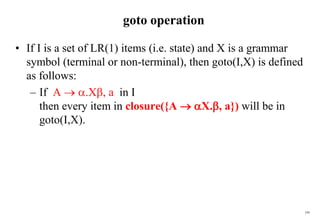
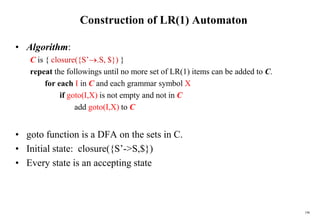
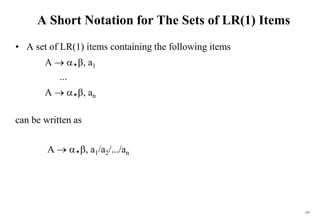
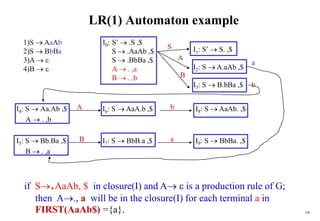
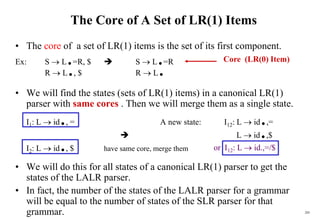
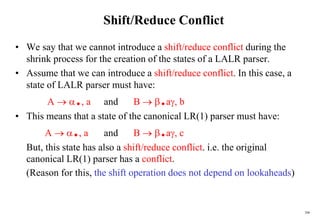
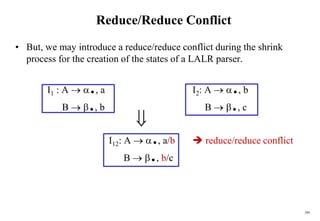
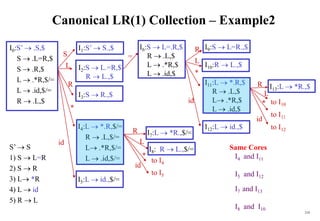
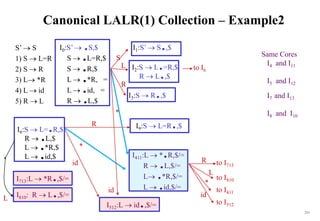
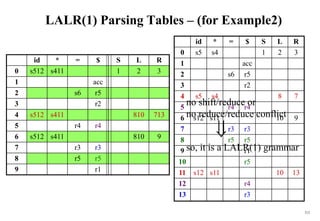
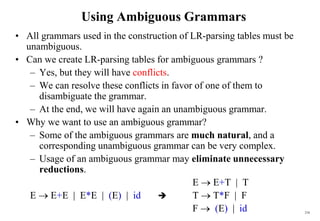
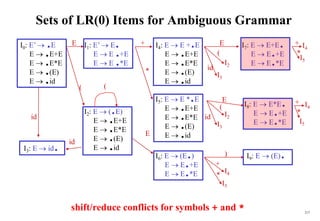
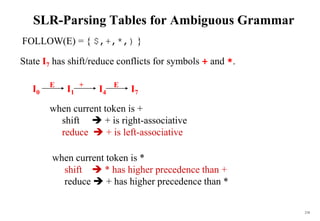
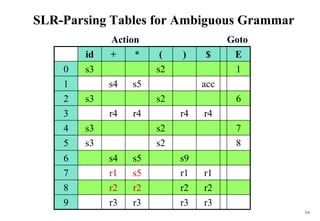
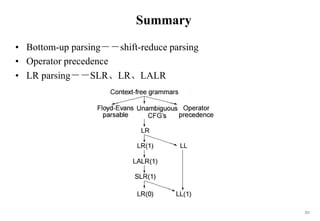
1
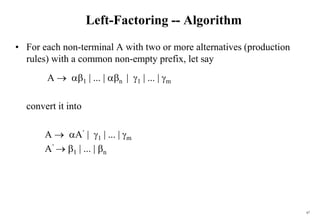
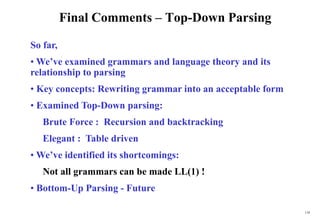
Syntax Analysis (Parsing)
 An overview of parsing
 Functions & Responsibilities
 Context Free Grammars
 Concepts & Terminology
 Writing and Designing Grammars
 Resolving Grammar Problems / Difficulties
 Top-Down Parsing
 Recursive Descent & Predictive LL
 Bottom-Up Parsing
 SLR、LR & LALR
 Concluding Remarks/Looking Ahead
2
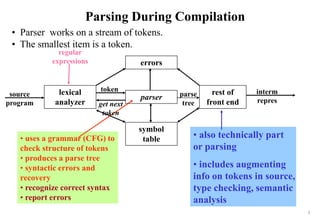
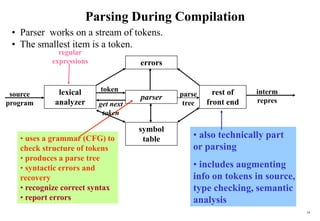
Parsing During Compilation
• Parser works on a stream of tokens.
• The smallest item is a token.
regular
expressions
• also technically part
or parsing
• includes augmenting
info on tokens in source,
type checking, semantic
analysis
• uses a grammar (CFG) to
check structure of tokens
• produces a parse tree
• syntactic errors and
recovery
• recognize correct syntax
• report errors
interm
repres
errors
lexical
analyzer
parser
rest of
front end
symbol
table
source
program
parse
tree
get next
token
token
3
Lexical Analysis Review: RE2NFA
Regular expression r::= | a | r + s | rs | r*
L()

start i f
a
start i f L(a)
start 
i f

N(s)
N(t) 

L(s)  L(t)
N(s)

start i f
N(t) 

f
N(s)

start i 


L(s) L(t)
(L(s))*
RE to NFA
4
Lexical Analysis Review: NFA2DFA
put -closure({s0}) as an unmarked state into the set of DFA
(DStates)
while (there is one unmarked S1 in DStates) do
mark S1
for (each input symbol a)
S2  -closure(move(S1,a))
if (S2 is not in DStates) then
add S2 into DStates as an unmarked state
transfunc[S1,a]  S2
• the start state of DFA is -closure({s0})
• a state S in DStates is an accepting state of DFA if a state in S is an
accepting state of NFA
5
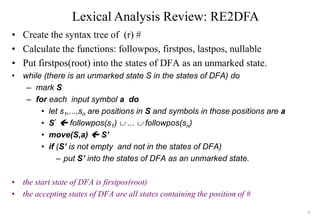
Lexical Analysis Review: RE2DFA
• Create the syntax tree of (r) #
• Calculate the functions: followpos, firstpos, lastpos, nullable
• Put firstpos(root) into the states of DFA as an unmarked state.
• while (there is an unmarked state S in the states of DFA) do
– mark S
– for each input symbol a do
• let s1,...,sn are positions in S and symbols in those positions are a
• S’  followpos(s1)  ...  followpos(sn)
• move(S,a)  S’
• if (S’ is not empty and not in the states of DFA)
– put S’ into the states of DFA as an unmarked state.
• the start state of DFA is firstpos(root)
• the accepting states of DFA are all states containing the position of #
6
Lexical Analysis Review: RE2DFA
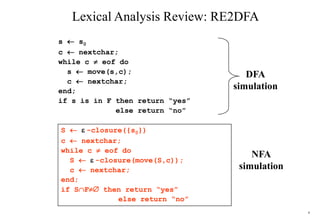
s  s0
c  nextchar;
while c  eof do
s  move(s,c);
c  nextchar;
end;
if s is in F then return “yes”
else return “no”
S   -closure({s0})
c  nextchar;
while c  eof do
S   -closure(move(S,c));
c  nextchar;
end;
if SF then return “yes”
else return “no”
DFA
simulation
NFA
simulation
7
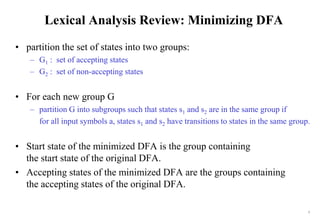
Lexical Analysis Review: Minimizing DFA
• partition the set of states into two groups:
– G1 : set of accepting states
– G2 : set of non-accepting states
• For each new group G
– partition G into subgroups such that states s1 and s2 are in the same group if
for all input symbols a, states s1 and s2 have transitions to states in the same group.
• Start state of the minimized DFA is the group containing
the start state of the original DFA.
• Accepting states of the minimized DFA are the groups containing
the accepting states of the original DFA.
8
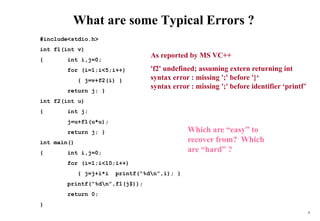
What are some Typical Errors ?
#include<stdio.h>
int f1(int v)
{ int i,j=0;
for (i=1;i<5;i++)
{ j=v+f2(i) }
return j; }
int f2(int u)
{ int j;
j=u+f1(u*u);
return j; }
int main()
{ int i,j=0;
for (i=1;i<10;i++)
{ j=j+i*i printf(“%dn”,i); }
printf(“%dn”,f1(j$));
return 0;
}
Which are “easy” to
recover from? Which
are “hard” ?
As reported by MS VC++
'f2' undefined; assuming extern returning int
syntax error : missing ';' before '}‘
syntax error : missing ';' before identifier ‘printf’
9
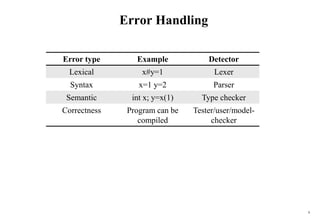
Error Handling
Error type Example Detector
Lexical x#y=1 Lexer
Syntax x=1 y=2 Parser
Semantic int x; y=x(1) Type checker
Correctness Program can be
compiled
Tester/user/model-
checker
10
Error Processing
• Detecting errors
• Finding position at which they occur
• Clear / accurate presentation
• Recover (pass over) to continue and find later errors
• Don’t impact compilation of “correct” programs
11
Error Recovery Strategies
Panic Mode– Discard tokens until a “synchronizing” token is
found ( end, “;”, “}”, etc. )
-- Decision of designer
E.g., (1 + + 2) * 3 skip +
-- Problems:
skip input miss declaration – causing more errors
miss errors in skipped material
-- Advantages:
simple suited to 1 error per statement
Phrase Level – Local correction on input
-- “,” ”;” – Delete “,” – insert “;”……
-- Also decision of designer, Not suited to all situations
-- Used in conjunction with panic mode to allow less
input to be skipped
E.g., x=1 ; y=2
12
Error Recovery Strategies – (2)
Error Productions:
-- Augment grammar with rules
-- Augment grammar used for parser
construction / generation
-- example: add a rule for
:= in C assignment statements
Report error but continue compile
-- Self correction + diagnostic messages
Error -> ID := Expr
Global Correction:
-- Adding / deleting / replacing symbols is
chancy – may do many changes !
-- Algorithms available to minimize changes
costly - key issues
-- Rarely used in practice
13
Error Recovery Strategies – (3)
Past
– Slow recompilation cycle (even once a day)
– Find as many errors in one cycle as possible
– Researchers could not let go of the topic
Present
– Quick recompilation cycle
– Users tend to correct one error/cycle
– Complex error recovery is less compelling
– Panic-mode seems enough
14
Parsing During Compilation
• Parser works on a stream of tokens.
• The smallest item is a token.
regular
expressions
• also technically part
or parsing
• includes augmenting
info on tokens in source,
type checking, semantic
analysis
• uses a grammar (CFG) to
check structure of tokens
• produces a parse tree
• syntactic errors and
recovery
• recognize correct syntax
• report errors
interm
repres
errors
lexical
analyzer
parser
rest of
front end
symbol
table
source
program
parse
tree
get next
token
token
15
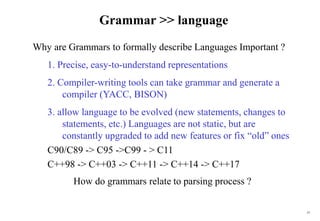
Grammar >> language
Why are Grammars to formally describe Languages Important ?
1. Precise, easy-to-understand representations
2. Compiler-writing tools can take grammar and generate a
compiler (YACC, BISON)
3. allow language to be evolved (new statements, changes to
statements, etc.) Languages are not static, but are
constantly upgraded to add new features or fix “old” ones
C90/C89 -> C95 ->C99 - > C11
C++98 -> C++03 -> C++11 -> C++14 -> C++17
How do grammars relate to parsing process ?
16
CFLs
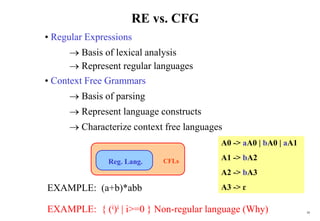
RE vs. CFG
• Regular Expressions
 Basis of lexical analysis
 Represent regular languages
• Context Free Grammars
 Basis of parsing
 Represent language constructs
 Characterize context free languages
Reg. Lang.
EXAMPLE: (a+b)*abb
A0 -> aA0 | bA0 | aA1
A1 -> bA2
A2 -> bA3
A3 -> ɛ
EXAMPLE: { (i)i | i>=0 } Non-regular language (Why)
17
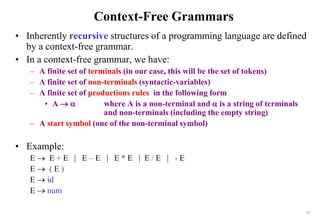
Context-Free Grammars
• Inherently recursive structures of a programming language are defined
by a context-free grammar.
• In a context-free grammar, we have:
– A finite set of terminals (in our case, this will be the set of tokens)
– A finite set of non-terminals (syntactic-variables)
– A finite set of productions rules in the following form
• A   where A is a non-terminal and  is a string of terminals
and non-terminals (including the empty string)
– A start symbol (one of the non-terminal symbol)
• Example:
E  E + E | E – E | E * E | E / E | - E
E  ( E )
E  id
E  num
18
Concepts & Terminology
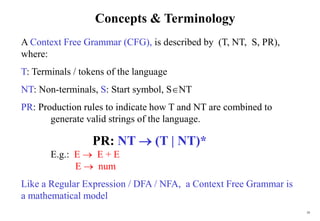
A Context Free Grammar (CFG), is described by (T, NT, S, PR),
where:
T: Terminals / tokens of the language
NT: Non-terminals, S: Start symbol, SNT
PR: Production rules to indicate how T and NT are combined to
generate valid strings of the language.
PR: NT  (T | NT)*
E.g.: E  E + E
E  num
Like a Regular Expression / DFA / NFA, a Context Free Grammar is
a mathematical model
19
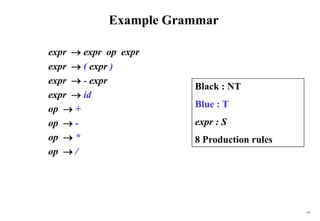
Example Grammar
expr  expr op expr
expr  ( expr )
expr  - expr
expr  id
op  +
op  -
op  *
op  /
Black : NT
Blue : T
expr : S
8 Production rules
20
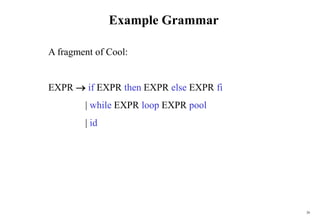
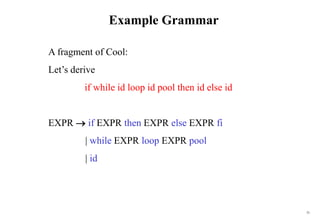
Example Grammar
A fragment of Cool:
EXPR  if EXPR then EXPR else EXPR fi
| while EXPR loop EXPR pool
| id
21
Terminology (cont.)
• L(G) is the language of G (the language generated by G) which is a
set of sentences.
• A sentence of L(G) is a string of terminal symbols of G.
• If S is the start symbol of G then
 is a sentence of L(G) if S   where  is a string of terminals of G.
• A language that can be generated by a context-free grammar is said
to be a context-free language
• Two grammars are equivalent if they produce the same language.
• S   - If  contains non-terminals, it is called as a sentential form of G.
- If  does not contain non-terminals, it is called as a sentence of G.
+
*
EX. E  E+E  id+E  id+id
22
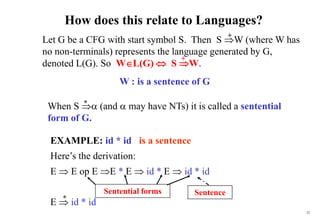
How does this relate to Languages?
Let G be a CFG with start symbol S. Then S W (where W has
no non-terminals) represents the language generated by G,
denoted L(G). So WL(G)  S W.
+
+
W : is a sentence of G
When S  (and  may have NTs) it is called a sentential
form of G.
*
EXAMPLE: id * id is a sentence
Here’s the derivation:
E  E op E E * E  id * E  id * id
E  id * id
*
Sentence
Sentential forms
23
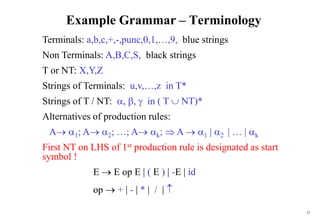
Example Grammar – Terminology
Terminals: a,b,c,+,-,punc,0,1,…,9, blue strings
Non Terminals: A,B,C,S, black strings
T or NT: X,Y,Z
Strings of Terminals: u,v,…,z in T*
Strings of T / NT:  ,  in ( T  NT)*
Alternatives of production rules:
A 1; A 2; …; A k;  A  1 | 2 | … | k
First NT on LHS of 1st production rule is designated as start
symbol !
E  E op E | ( E ) | -E | id
op  + | - | * | / | 
24
Derivations
The central idea here is that a production is treated as a rewriting rule
in which the non-terminal on the left is replaced by the string on the
right side of the production.
E  E+E
• E+E derives from E
– we can replace E by E+E
– to able to do this, we have to have a production rule EE+E in our grammar.
E  E+E  id+E  id+id
• A sequence of replacements of non-terminal symbols is called a
derivation of id+id from E.
• In general a derivation step is
1  2  ...  n (n derives from 1 or 1 derives n )
25
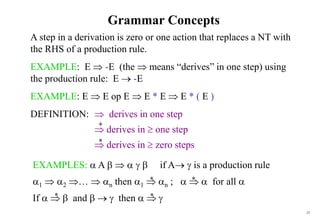
Grammar Concepts
A step in a derivation is zero or one action that replaces a NT with
the RHS of a production rule.
EXAMPLE: E  -E (the  means “derives” in one step) using
the production rule: E  -E
EXAMPLE: E  E op E  E * E  E * ( E )
DEFINITION:  derives in one step
 derives in  one step
 derives in  zero steps
+
*
EXAMPLES:  A      if A  is a production rule
1  2 …  n then 1  n ;    for all 
If    and    then   
* *
*
*
26
Other Derivation Concepts
Example
OR
• At each derivation step, we can choose any of the non-terminal in the sentential
form of G for the replacement.
• If we always choose the left-most non-terminal in each derivation step, this
derivation is called as left-most derivation.
• If we always choose the right-most non-terminal in each derivation step, this
derivation is called as right-most derivation.
E  -E  -(E)  -(E+E)  -(id+E)  -(id+id)
E  -E  -(E)  -(E+E)  -(E+id)  -(id+id)
27

lm
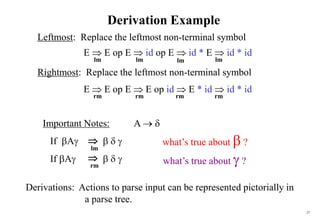
Derivation Example
Leftmost: Replace the leftmost non-terminal symbol
E  E op E  id op E  id * E  id * id
Rightmost: Replace the leftmost non-terminal symbol
E  E op E  E op id  E * id  id * id
lm
lm
lm
lm
rm
rm
rm
rm
Important Notes: A  
If A   
If A   

rm
Derivations: Actions to parse input can be represented pictorially in
a parse tree.
what’s true about  ?
what’s true about  ?
28
Left-Most and Right-Most Derivations
Left-Most Derivation
E  -E  -(E)  -(E+E)  -(id+E)  -(id+id) (4.4)
Right-Most Derivation (called canonical derivation)
E  -E  -(E)  -(E+E)  -(E+id)  -(id+id)
• We will see that the top-down parsers try to find the left-most
derivation of the given source program.
• We will see that the bottom-up parsers try to find the right-most
derivation of the given source program in the reverse order.
lm
lm
lm
lm
lm
rm
rm
rm
rm
rm
How mapping?
29
Derivation exercise 1 in class
Productions:
assign_stmt  id := expr ;
expr  expr op term
expr  term
term  id
term  real
term  integer
op  +
op  -
Let’s derive:
id := id + real – integer ;
Please use left-most derivation or
right-most derivation.
30
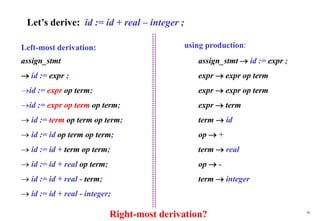
Let’s derive: id := id + real – integer ;
assign_stmt assign_stmt  id := expr ;
 id := expr ; expr  expr op term
id := expr op term; expr  expr op term
id := expr op term op term; expr  term
 id := term op term op term; term  id
 id := id op term op term; op  +
 id := id + term op term; term  real
 id := id + real op term; op  -
 id := id + real - term; term  integer
 id := id + real - integer;
using production:
Left-most derivation:
Right-most derivation?
31
Example Grammar
A fragment of Cool:
Let’s derive
if while id loop id pool then id else id
EXPR  if EXPR then EXPR else EXPR fi
| while EXPR loop EXPR pool
| id
32
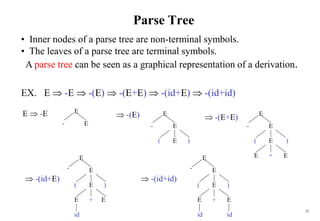
Parse Tree
• Inner nodes of a parse tree are non-terminal symbols.
• The leaves of a parse tree are terminal symbols.
A parse tree can be seen as a graphical representation of a derivation.
EX. E  -E  -(E)  -(E+E)  -(id+E)  -(id+id)
E  -E E
E
-
E
E
E
-
( )
 -(E)
E
E
E
E
E
+
-
( )
 -(E+E)
E
E
E
E
E +
-
( )
id
 -(id+E)
E
E
id
E
E
E +
-
( )
id
 -(id+id)
33
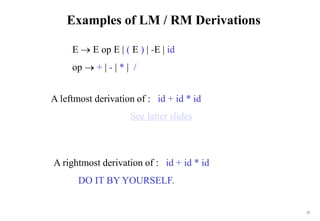
Examples of LM / RM Derivations
E  E op E | ( E ) | -E | id
op  + | - | * | /
A leftmost derivation of : id + id * id
A rightmost derivation of : id + id * id
DO IT BY YOURSELF.
See latter slides
34
E  E op E
 id + E op E
 id op E
 id + E
 id + id op E
 id + id * E
 id + id * id
id +
E
E op E
E
E op
*
id id
A rightmost derivation of : id + id * id
DO IT BY YOURSELF.
35
Parse Trees and Derivations
Consider the expression grammar:
E  E+E | E*E | (E) | -E | id
Leftmost derivations of id + id * id
E  E + E E + E  id + E
E
E
E +
id
E
E
E *
id + E  id + E * E
E
E
E +
id
E
E
E +
36
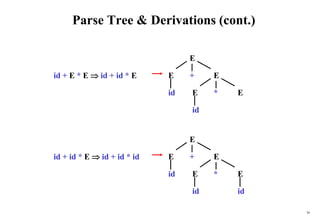
Parse Tree & Derivations (cont.)
E
E
E *
id + E * E  id + id * E
E
E
E +
id
id
id + id * E  id + id * id E
E
E *
E
E
E +
id
id
id
37
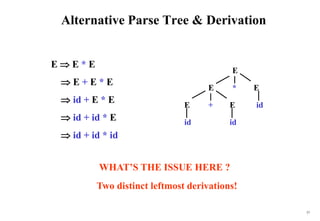
Alternative Parse Tree & Derivation
E  E * E
 E + E * E
 id + E * E
 id + id * E
 id + id * id
E
E E
+
E
E E
*
id
id id
WHAT’S THE ISSUE HERE ?
Two distinct leftmost derivations!
38
Ambiguity
• A grammar produces more than one parse tree for a sentence is
called as an ambiguous grammar.
E  E+E  id+E  id+E*E
 id+id*E  id+id*id
E  E*E  E+E*E  id+E*E
 id+id*E  id+id*id
E
id
E +
id
id
E
E
* E
E
E +
id E
E
* E
id id
Two parse trees for id+id*id.
39
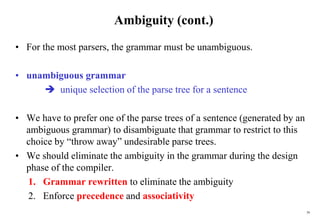
Ambiguity (cont.)
• For the most parsers, the grammar must be unambiguous.
• unambiguous grammar
 unique selection of the parse tree for a sentence
• We have to prefer one of the parse trees of a sentence (generated by an
ambiguous grammar) to disambiguate that grammar to restrict to this
choice by “throw away” undesirable parse trees.
• We should eliminate the ambiguity in the grammar during the design
phase of the compiler.
1. Grammar rewritten to eliminate the ambiguity
2. Enforce precedence and associativity
40
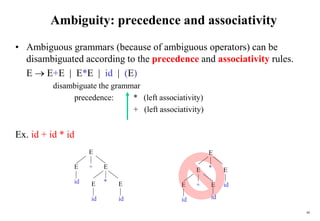
Ambiguity: precedence and associativity
• Ambiguous grammars (because of ambiguous operators) can be
disambiguated according to the precedence and associativity rules.
E  E+E | E*E | id | (E)
disambiguate the grammar
precedence: * (left associativity)
+ (left associativity)
Ex. id + id * id
E
id
E +
id
id
E
E
* E
E
E +
id E
E
* E
id id
41
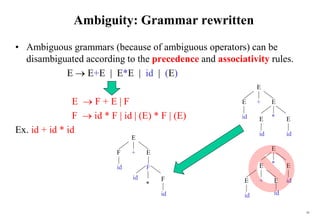
Ambiguity: Grammar rewritten
• Ambiguous grammars (because of ambiguous operators) can be
disambiguated according to the precedence and associativity rules.
E  E+E | E*E | id | (E)
E  F + E | F
F  id * F | id | (E) * F | (E)
Ex. id + id * id
E
id
E +
id
id
E
E
* E
E
E +
id E
E
* E
id id
E
F +
id
*
E
F
F
id
id
42
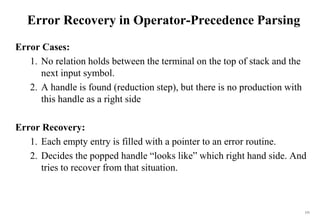
Eliminating Ambiguity
Consider the following grammar segment:
stmt  if expr then stmt
| if expr then stmt else stmt
| other (any other statement)
if E1 then if E2 then S1 else S2
How is this parsed ?
43
Parse Trees for Example
Form 1:
stmt
stmt
stmt
expr
E1 S2
then else
if
expr
E2
S1
then
if
stmt
Form 2:
Two parse trees for an ambiguous sentence.
stmt
expr
E1
then
if stmt
expr
E2
S2
S1
then else
if
stmt stmt
stmt  if expr then stmt
| if expr then stmt else stmt
| other (any other statement)
if E1 then if E2 then S1 else S2
Else must match to previous then.
Structure indicates parse subtree
for expression.
44
Ambiguity (cont.)
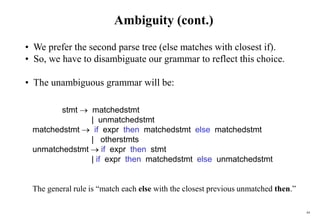
• We prefer the second parse tree (else matches with closest if).
• So, we have to disambiguate our grammar to reflect this choice.
• The unambiguous grammar will be:
stmt  matchedstmt
| unmatchedstmt
matchedstmt  if expr then matchedstmt else matchedstmt
| otherstmts
unmatchedstmt  if expr then stmt
| if expr then matchedstmt else unmatchedstmt
The general rule is “match each else with the closest previous unmatched then.”
45
Non-Context Free Language Constructs
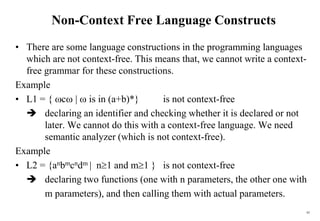
• There are some language constructions in the programming languages
which are not context-free. This means that, we cannot write a context-
free grammar for these constructions.
Example
• L1 = { c |  is in (a+b)*} is not context-free
 declaring an identifier and checking whether it is declared or not
later. We cannot do this with a context-free language. We need
semantic analyzer (which is not context-free).
Example
• L2 = {anbmcndm | n1 and m1 } is not context-free
 declaring two functions (one with n parameters, the other one with
m parameters), and then calling them with actual parameters.
46
Review
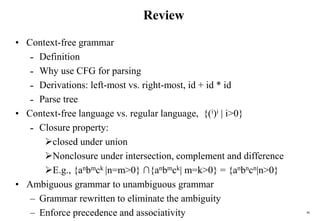
• Context-free grammar
˗ Definition
˗ Why use CFG for parsing
˗ Derivations: left-most vs. right-most, id + id * id
˗ Parse tree
• Context-free language vs. regular language, {(i)i | i>0}
˗ Closure property:
closed under union
Nonclosure under intersection, complement and difference
E.g., {anbmck |n=m>0} ∩{anbmck| m=k>0} = {anbncn|n>0}
• Ambiguous grammar to unambiguous grammar
– Grammar rewritten to eliminate the ambiguity
– Enforce precedence and associativity
47
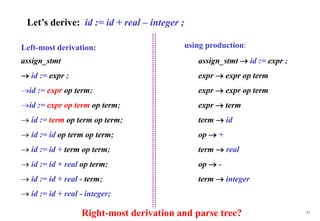
Let’s derive: id := id + real – integer ;
assign_stmt assign_stmt  id := expr ;
 id := expr ; expr  expr op term
id := expr op term; expr  expr op term
id := expr op term op term; expr  term
 id := term op term op term; term  id
 id := id op term op term; op  +
 id := id + term op term; term  real
 id := id + real op term; op  -
 id := id + real - term; term  integer
 id := id + real - integer;
using production:
Left-most derivation:
Right-most derivation and parse tree?
48
Top-Down Parsing
• The parse tree is created top to bottom (from root to leaves).
• By always replacing the leftmost non-terminal symbol via a
production rule, we are guaranteed of developing a parse tree in a
left-to-right fashion that is consistent with scanning the input.
• Top-down parser
– Recursive-Descent Parsing
• Backtracking is needed (If a choice of a production rule does not work, we backtrack
to try other alternatives.)
• It is a general parsing technique, but not widely used.
• Not efficient
– Predictive Parsing
• no backtracking, at each step, only one choices of production to use
• efficient
• needs a special form of grammars (LL(k) grammars, k=1 in practice).
• Recursive Predictive Parsing is a special form of Recursive Descent parsing
without backtracking.
• Non-Recursive (Table Driven) Predictive Parser is also known as LL(k) parser.
A  aBc  adDc  adec
(scan a, scan d, scan e, scan c - accept!)
49
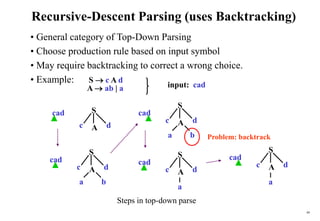
Recursive-Descent Parsing (uses Backtracking)
Steps in top-down parse
• General category of Top-Down Parsing
• Choose production rule based on input symbol
• May require backtracking to correct a wrong choice.
• Example: S  c A d
A  ab | a input: cad
cad S
c d
A
cad
S
c d
A
a b
cad
S
c d
A
a b Problem: backtrack
cad
S
c d
A
a
cad
S
c d
A
a
50
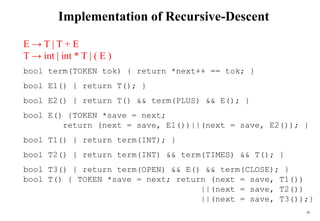
Implementation of Recursive-Descent
E → T | T + E
T → int | int * T | ( E )
bool term(TOKEN tok) { return *next++ == tok; }
bool E1() { return T(); }
bool E2() { return T() && term(PLUS) && E(); }
bool E() {TOKEN *save = next;
return (next = save, E1())||(next = save, E2()); }
bool T1() { return term(INT); }
bool T2() { return term(INT) && term(TIMES) && T(); }
bool T3() { return term(OPEN) && E() && term(CLOSE); }
bool T() { TOKEN *save = next; return (next = save, T1())
||(next = save, T2())
||(next = save, T3());}
51
When Recursive Descent Does Not Work ?
• Example: S → S a
• Implementation:
bool S1() { return S() && term(a); }
bool S() { return S1(); } infinite recursion
S →+ S a left-recursive grammar
we should remove left-recursive grammar
52
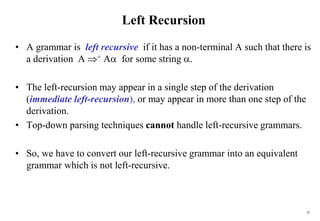
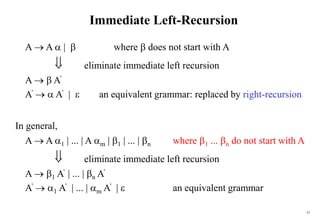
Left Recursion
• A grammar is left recursive if it has a non-terminal A such that there is
a derivation A + A for some string .
• The left-recursion may appear in a single step of the derivation
(immediate left-recursion), or may appear in more than one step of the
derivation.
• Top-down parsing techniques cannot handle left-recursive grammars.
• So, we have to convert our left-recursive grammar into an equivalent
grammar which is not left-recursive.
53
Immediate Left-Recursion
A  A  |  where  does not start with A
 eliminate immediate left recursion
A   A’
A’   A’ |  an equivalent grammar: replaced by right-recursion
A  A 1 | ... | A m | 1 | ... | n where 1 ... n do not start with A
 eliminate immediate left recursion
A  1 A’ | ... | n A’
A’  1 A’ | ... | m A’ |  an equivalent grammar
In general,
54
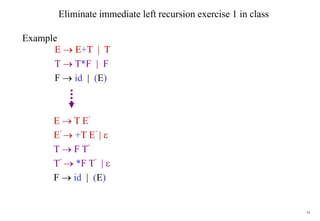
Eliminate immediate left recursion exercise 1 in class
E  E+T | T
T  T*F | F
F  id | (E)
Example
E  T E’
E’  +T E’ | 
T  F T’
T’  *F T’ | 
F  id | (E)
55
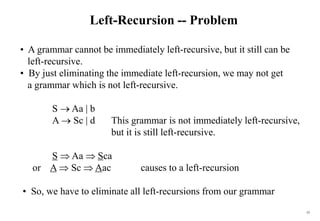
Left-Recursion -- Problem
• A grammar cannot be immediately left-recursive, but it still can be
left-recursive.
• By just eliminating the immediate left-recursion, we may not get
a grammar which is not left-recursive.
S  Aa | b
A  Sc | d This grammar is not immediately left-recursive,
but it is still left-recursive.
S  Aa  Sca
or A  Sc  Aac causes to a left-recursion
• So, we have to eliminate all left-recursions from our grammar
56
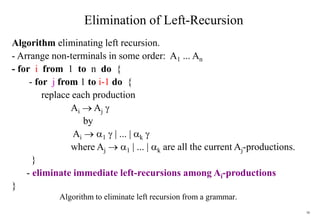
Elimination of Left-Recursion
Algorithm to eliminate left recursion from a grammar.
Algorithm eliminating left recursion.
- Arrange non-terminals in some order: A1 ... An
- for i from 1 to n do {
- for j from 1 to i-1 do {
replace each production
Ai  Aj 
by
Ai  1  | ... | k 
where Aj  1 | ... | k are all the current Aj-productions.
}
- eliminate immediate left-recursions among Ai-productions
}
57
Example
Example
S  Aa | b
A  Ac | Sd | 
- Order of non-terminals: S, A
for S:
- we do not enter the inner loop.
- there is no immediate left recursion in S.
for A:
- Replace A  Sd with A  Aad | bd
So, we will have A  Ac | Aad | bd | 
- Eliminate the immediate left-recursion in A
A  bdA’ | A’
A’  cA’ | adA’ | 
So, the resulting equivalent grammar which is not left-recursive is:
S  Aa | b
A  bdA’ | A’
A’  cA’ | adA’ | 
not immediately left-recursive
immediate left-recursive
eliminating immediate
left-recursive
58
Reading materials
• This algorithm crucially depends on the ordering of the nonterminals
• The number of resulting production rules is large
[1] Moore, Robert C. (2000). Removing Left Recursion from Context-Free
Grammars
1. A novel strategy for ordering the nonterminals
2. An alternative approach
59
Predictive Parser vs. Recursive Descent Parser
• In recursive-descent,
– At each step, many choices of production to use
– Backtracking used to undo bad choices
• In Predictive Parser
– At each step, only one choice of production
– That is
When a non-terminal A is leftmost in a derivation
The k input symbols are a1a2…ak
There is a unique production A → α to use
Or no production to use (an error state)
LL(k) is a recursive descent variant without backtracking
60
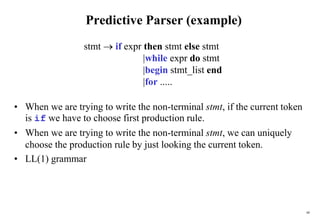
Predictive Parser (example)
• When we are trying to write the non-terminal stmt, if the current token
is if we have to choose first production rule.
• When we are trying to write the non-terminal stmt, we can uniquely
choose the production rule by just looking the current token.
• LL(1) grammar
stmt  if expr then stmt else stmt
|while expr do stmt
|begin stmt_list end
|for .....
61
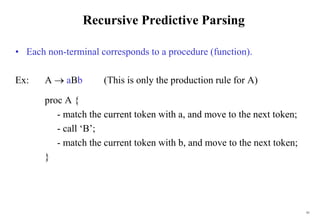
Recursive Predictive Parsing
• Each non-terminal corresponds to a procedure (function).
Ex: A  aBb (This is only the production rule for A)
proc A {
- match the current token with a, and move to the next token;
- call ‘B’;
- match the current token with b, and move to the next token;
}
62
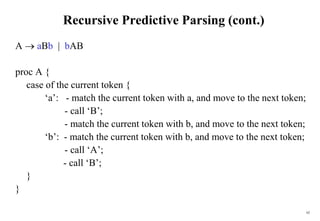
Recursive Predictive Parsing (cont.)
A  aBb | bAB
proc A {
case of the current token {
‘a’: - match the current token with a, and move to the next token;
- call ‘B’;
- match the current token with b, and move to the next token;
‘b’: - match the current token with b, and move to the next token;
- call ‘A’;
- call ‘B’;
}
}
63
Recursive Predictive Parsing (cont.)
• When to apply -productions.
A  aA | bB | 
• If all other productions fail, we should apply an -production. For
example, if the current token is not a or b, we may apply the
-production.
• Most correct choice: We should apply an -production for a non-
terminal A when the current token is in the follow set of A (which
terminals can follow A in the sentential forms).
64
Recursive Predictive Parsing (Example)
A  aBe | cBd | C
B  bB | 
C  f
proc C { match the current token with f,
proc A { and move to the next token; }
case of the current token {
a: - match the current token with a,
and move to the next token; proc B {
- call B; case of the current token {
- match the current token with e, b:- match the current token with b,
and move to the next token; and move to the next token;
c: - match the current token with c, - call B
and move to the next token; e,d: do nothing
- call B; }
- match the current token with d, }
and move to the next token;
f: - call C
}
}
follow set of B
first set of C/A
65
Predictive Parsing and Left Factoring
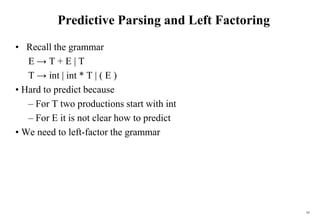
• Recall the grammar
E → T + E | T
T → int | int * T | ( E )
• Hard to predict because
– For T two productions start with int
– For E it is not clear how to predict
• We need to left-factor the grammar
66
Left-Factoring
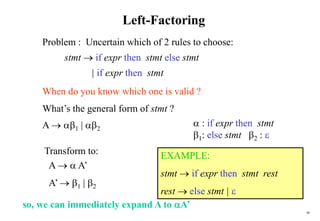
Problem : Uncertain which of 2 rules to choose:
stmt  if expr then stmt else stmt
| if expr then stmt
When do you know which one is valid ?
What’s the general form of stmt ?
A  1 | 2
Transform to:
A   A’
A’  1 | 2
EXAMPLE:
stmt  if expr then stmt rest
rest  else stmt | 
 : if expr then stmt
1: else stmt 2 : 
so, we can immediately expand A to A’
67
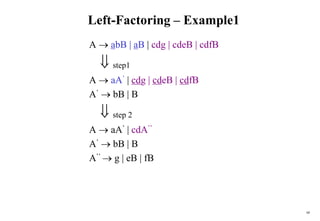
Left-Factoring -- Algorithm
• For each non-terminal A with two or more alternatives (production
rules) with a common non-empty prefix, let say
A  1 | ... | n | 1 | ... | m
convert it into
A  A’ | 1 | ... | m
A’  1 | ... | n
68
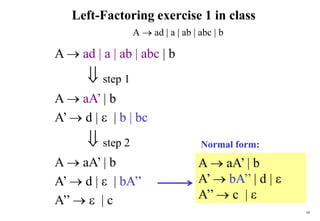
Left-Factoring – Example1
A  abB | aB | cdg | cdeB | cdfB
 step1
A  aA’ | cdg | cdeB | cdfB
A’  bB | B
 step 2
A  aA’ | cdA’’
A’  bB | B
A’’  g | eB | fB
69
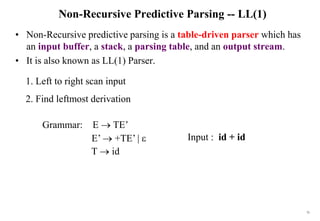
Left-Factoring exercise 1 in class
A  ad | a | ab | abc | b
 step 1
A  aA’ | b
A’  d |  | b | bc
 step 2
A  aA’ | b
A’  d |  | bA’’
A’’   | c
A  aA’ | b
A’  bA’’ | d | 
A’’  c | 
Normal form:
70
Predictive Parser
a grammar   a grammar suitable for predictive
eliminate left parsing (a LL(1) grammar)
left recursion factor no %100 guarantee.
• When re-writing a non-terminal in a derivation step, a predictive parser
can uniquely choose a production rule by just looking the current
symbol in the input string.
current token
A  1 | ... | n input: ... a .......
current token
71
Non-Recursive Predictive Parsing -- LL(1)
• Non-Recursive predictive parsing is a table-driven parser which has
an input buffer, a stack, a parsing table, and an output stream.
• It is also known as LL(1) Parser.
1. Left to right scan input
2. Find leftmost derivation
Grammar: E  TE’
E’  +TE’ | 
T  id
Input : id + id
72
Questions
• Compiler justification: correctness, usability, efficiency, more functionality
• Compiler update: less on frond-end, more on back-end
• Performance (speed, security, etc. ) vary from programming languages
• Naï
ve or horrible
• Just-in-time (JIT) compilation
• Compiler and security (post-optimization): stack/heap canaries, CFI
• Optimization, more advanced techniques from research: graduate course
• Projects independent from class
• Notations in slides
• Why do we use flex/lex and bison/Yacc for projects
• Project assignments not clear
• Why latex, not markdown or word?
73
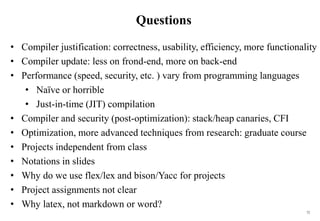
Review
Context-free grammar
Top-down parsing
• recursive-descent parsing
• recursive predicate parsing
Recursive-descent parser
• backtracking
• eliminating left-recursion
B  begin DL SL end
DL  DL; d | d
SL  SL; s | s
Write the recursive-descent parser (d,s, begin and end are
terminals, suppose term(Token tok) return True iff tok==next)
74
Implementation of Recursive-Descent
E → T | T + E
T → int | int * T | ( E )
bool term(TOKEN tok) { return *next++ == tok; }
bool E1() { return T(); }
bool E2() { return T() && term(PLUS) && E(); }
bool E() {TOKEN *save = next;
return (next = save, E1())||(next = save, E2()); }
bool T1() { return term(INT); }
bool T2() { return term(INT) && term(TIMES) && T(); }
bool T3() { return term(OPEN) && E() && term(CLOSE); }
bool T() { TOKEN *save = next; return (next = save, T1())
||(next = save, T2())
||(next = save, T3());}
75
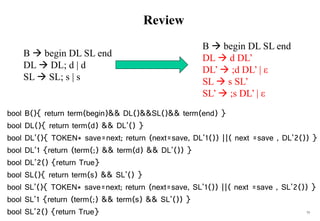
Review
B  begin DL SL end
DL  DL; d | d
SL  SL; s | s
bool B(){ return term(begin)&& DL()&&SL()&& term(end) }
bool DL(){ return term(d) && DL’() }
bool DL’(){ TOKEN* save=next; return (next=save, DL’1()) ||( next =save , DL’2()) }
bool DL’1 {return (term(;) && term(d) && DL’()) }
bool DL’2() {return True}
bool SL(){ return term(s) && SL’() }
bool SL’(){ TOKEN* save=next; return (next=save, SL’1()) ||( next =save , SL’2()) }
bool SL’1 {return (term(;) && term(s) && SL’()) }
bool SL’2() {return True}
B  begin DL SL end
DL  d DL’
DL’  ;d DL’ | ε
SL  s SL’
SL’  ;s DL’ | ε
76
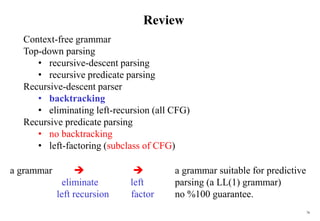
Review
Context-free grammar
Top-down parsing
• recursive-descent parsing
• recursive predicate parsing
Recursive-descent parser
• backtracking
• eliminating left-recursion (all CFG)
Recursive predicate parsing
• no backtracking
• left-factoring (subclass of CFG)
a grammar   a grammar suitable for predictive
eliminate left parsing (a LL(1) grammar)
left recursion factor no %100 guarantee.
77
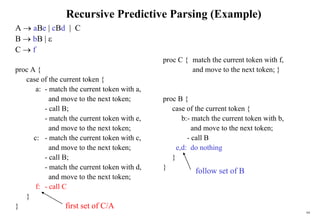
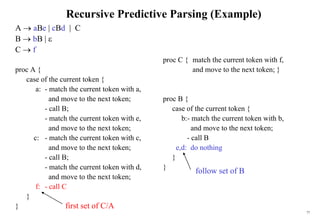
Recursive Predictive Parsing (Example)
A  aBe | cBd | C
B  bB | 
C  f
proc C { match the current token with f,
proc A { and move to the next token; }
case of the current token {
a: - match the current token with a,
and move to the next token; proc B {
- call B; case of the current token {
- match the current token with e, b:- match the current token with b,
and move to the next token; and move to the next token;
c: - match the current token with c, - call B
and move to the next token; e,d: do nothing
- call B; }
- match the current token with d, }
and move to the next token;
f: - call C
}
}
follow set of B
first set of C/A
78
Review
B  begin DL SL end
DL  DL; d | d
SL  SL; s | s
Write the recursive predicate parser (d,s, begin and end are
terminals, lookahead 1 symbol)
B  begin DL SL end
DL  d DL’
DL’  ;d DL’ | ε
SL  s SL’
SL’  ;s DL’ | ε
79
Review
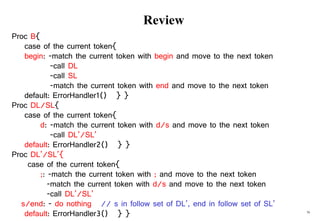
Proc B{
case of the current token{
begin: -match the current token with begin and move to the next token
-call DL
-call SL
-match the current token with end and move to the next token
default: ErrorHandler1() } }
Proc DL/SL{
case of the current token{
d: -match the current token with d/s and move to the next token
-call DL’/SL’
default: ErrorHandler2() } }
Proc DL’/SL’{
case of the current token{
;: -match the current token with ; and move to the next token
-match the current token with d/s and move to the next token
-call DL’/SL’
s/end: - do nothing // s in follow set of DL’, end in follow set of SL’
default: ErrorHandler3() } }
80
Non-Recursive / Table Driven
General parser behavior: X : top of stack a : current input
1. When X=a = $ halt, accept, success
2. When X=a  $ , POP X off stack, advance input, go to 1.
3. When X is a non-terminal, examine M[X,a]
if it is an error  call recovery routine
if M[X,a] = {X  UVW}, POP X, PUSH W,V,U
DO NOT expend any input
Empty stack
symbol
a + b $
Y
X
$
Z
Input
Predictive Parsing
Program
Stack Output
Parsing Table
M[A,a]
(String + terminator)
NT + T
symbols of
CFG What actions parser
should take based on
stack / input
Notice the pushing order
81
Algorithm for Non-Recursive Parsing
Set ip to point to the first symbol of w$;
repeat
let X be the top stack symbol and a the symbol pointed to by ip;
if X is terminal or $ then
if X=a then
pop X from the stack and advance ip
else error()
else /* X is a non-terminal */
if M[X,a] = XY1Y2…Yk then begin
pop X from stack;
push Yk, Yk-1, … , Y1 onto stack, with Y1 on top
output the production XY1Y2…Yk
end
else error()
until X=$ /* stack is empty */
Input pointer
May also execute other code
based on the production used,
such as creating parse tree.
82
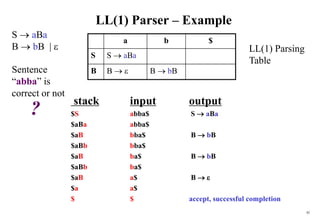
LL(1) Parser – Example
stack input output
$S abba$ S  aBa
$aBa abba$
$aB bba$ B  bB
$aBb bba$
$aB ba$ B  bB
$aBb ba$
$aB a$ B  
$a a$
$ $ accept, successful completion
a b $
S S  aBa
B B   B  bB
?
Sentence
“abba” is
correct or not
S  aBa
B  bB |  LL(1) Parsing
Table
83
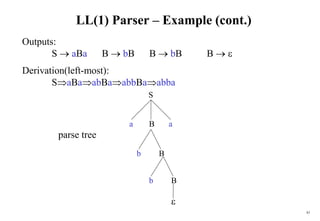
LL(1) Parser – Example (cont.)
Outputs:
S  aBa B  bB B  bB B  
Derivation(left-most):
SaBaabBaabbBaabba
S
B
a a
B
B
b
b

parse tree
84
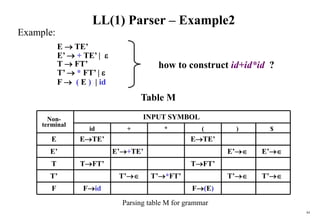
LL(1) Parser – Example2
Example:
Parsing table M for grammar
E  TE’
E’  + TE’ | 
T  FT’
T’  * FT’ | 
F  ( E ) | id
Table M
Non-
terminal
INPUT SYMBOL
id + * ( ) $
E
E’
T
T’
F
ETE’
TFT’
Fid
E’+TE’
T’ T’*FT’
F(E)
TFT’
ETE’
T’
E’ E’
T’
how to construct id+id*id ?
85
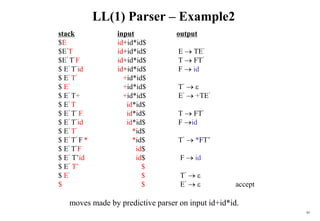
LL(1) Parser – Example2
stack input output
$E id+id*id$
$E’T id+id*id$ E  TE’
$E’ T’F id+id*id$ T  FT’
$ E’ T’id id+id*id$ F  id
$ E’ T’ +id*id$
$ E’ +id*id$ T’  
$ E’ T+ +id*id$ E’  +TE’
$ E’ T id*id$
$ E’ T’ F id*id$ T  FT’
$ E’ T’id id*id$ F id
$ E’ T’ *id$
$ E’ T’ F * *id$ T’  *FT’
$ E’ T’F id$
$ E’ T’id id$ F  id
$ E’ T’ $
$ E’ $ T’  
$ $ E’   accept
moves made by predictive parser on input id+id*id.
86
Leftmost Derivation for the Example
The leftmost derivation for the example is as follows:
E  TE’
 FT’E’
 id T’E’
 id E’
 id + TE’
 id + FT’E’
 id + id T’E’
 id + id * FT’E’
 id + id * id T’E’
 id + id * id E’
 id + id * id
87
Constructing LL(1) Parsing Tables
Constructing the Parsing Table M !
1st : Calculate FIRST & FOLLOW for Grammar
2nd: Apply Construction Algorithm for Parsing Table
( We’ll see this shortly )
Basic Functions:
FIRST: Let  be a string of grammar symbols. FIRST() is the set that
includes every terminal that appears leftmost in  or in any string
originating from .
NOTE: If   , then  is FIRST( ).
FOLLOW: Let A be a non-terminal. FOLLOW(A) is the set of terminals a
that can appear directly to the right of A in some sentential form.
(S  Aa, for some  and ).
NOTE: If S  A, then $ is FOLLOW(A).
88
Compute FIRST for Any String X
1. If X is a terminal, FIRST(X) = {X}
2. If X  is a production rule, add  to FIRST (X)
3. If X is a non-terminal, and X Y1Y2…Yk is a production rule
Place FIRST(Y1) in FIRST (X)
if Y1 , Place FIRST (Y2) in FIRST(X)
if Y2  , Place FIRST(Y3) in FIRST(X)
…
if Yk-1  , Place FIRST(Yk) in FIRST(X)
NOTE: As soon as Yi   , Stop.
Repeat above steps until no more elements are added to any
FIRST( ) set.
Checking “Yi   ?” essentially amounts to checking whether 
belongs to FIRST(Yi)
*
89
Computing FIRST(X) :
All Grammar Symbols - continued
Informally, suppose we want to compute
FIRST(X1 X2 … Xn ) = FIRST (X1)
“+”FIRST (X2) if  is in FIRST (X1)
“+”FIRST (X3) if  is in FIRST (X2)
…
“+”FIRST (Xn) if  is in FIRST (Xn-1)
Note 1: Only add  to FIRST (X1 X2 … Xn) if  is in FIRST (Xi) for all i
Note 2: For FIRST(Xi), if Xi Z1 Z2 … Zm , then we need to compute
FIRST(Z1 Z2 … Zm) !
90
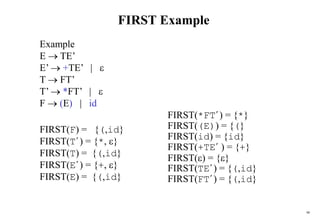
FIRST Example
Example
E  TE’
E’  +TE’ | 
T  FT’
T’  *FT’ | 
F  (E) | id
FIRST(*FT’) = {*}
FIRST((E)) = {(}
FIRST(id) = {id}
FIRST(+TE’ ) = {+}
FIRST() = {}
FIRST(TE’) = {(,id}
FIRST(FT’) = {(,id}
FIRST(F) = {(,id}
FIRST(T’) = {*, }
FIRST(T) = {(,id}
FIRST(E’) = {+, }
FIRST(E) = {(,id}
91
Alternative way to compute FIRST
Computing FIRST for:E  TE’
E’  + TE’ | 
T  FT’
T’  * FT’ | 
F  ( E ) | id
FIRST(E)
FIRST(TE’)
FIRST(T)
FIRST(T) “+” FIRST(E’)
FIRST(F)
FIRST((E)) “+” FIRST(id)
FIRST(F) “+” FIRST(T’)
“(“ and “id”
Not FIRST(E’) since T  
Not FIRST(T’) since F  
Overall: FIRST(E) = FIRST(T) =FIRST(F) = { ( , id }
FIRST(E’) = { + ,  } FIRST(T’) = { * ,  }
*
*
92
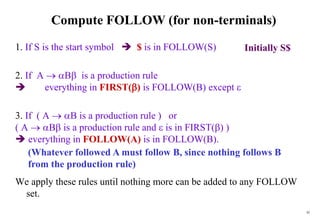
Compute FOLLOW (for non-terminals)
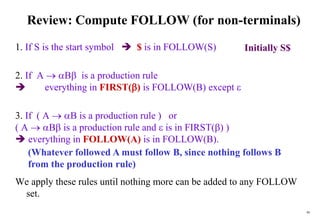
1. If S is the start symbol  $ is in FOLLOW(S)
2. If A  B is a production rule
 everything in FIRST() is FOLLOW(B) except 
3. If ( A  B is a production rule ) or
( A  B is a production rule and  is in FIRST() )
 everything in FOLLOW(A) is in FOLLOW(B).
We apply these rules until nothing more can be added to any FOLLOW
set.
(Whatever followed A must follow B, since nothing follows B
from the production rule)
Initially S$
93
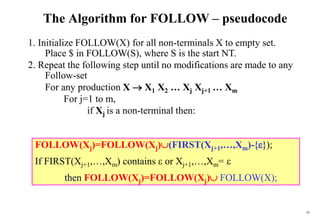
The Algorithm for FOLLOW – pseudocode
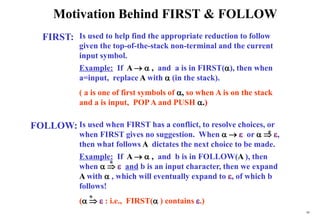
1. Initialize FOLLOW(X) for all non-terminals X to empty set.
Place $ in FOLLOW(S), where S is the start NT.
2. Repeat the following step until no modifications are made to any
Follow-set
For any production X  X1 X2 … Xj Xj+1 … Xm
For j=1 to m,
if Xj is a non-terminal then:
FOLLOW(Xj)=FOLLOW(Xj)(FIRST(Xj+1,…,Xm)-{});
If FIRST(Xj+1,…,Xm) contains  or Xj+1,…,Xm= 
then FOLLOW(Xj)=FOLLOW(Xj) FOLLOW(X);
94
FOLLOW Example
Example :
E  TE’
E’  +TE’ | 
T  FT’
T’  *FT’ | 
F  (E) | id
FOLLOW(E) = { ), $ }
FOLLOW(E’) = { ), $ }
FOLLOW(T) = { +, ), $ }
FOLLOW(T’) = { +, ), $ }
FOLLOW(F) = {*, +, ), $ }
FIRST(F) = {(,id}
FIRST(T’) = {*, }
FIRST(T) = {(,id}
FIRST(E’) = {+, }
FIRST(E) = {(,id}
X  X1 X2 … Xj Xj+1 … Xm
For j=1 to m,
if Xj is a non-terminal then:
FOLLOW(Xj)=FOLLOW(Xj)(FIRST(Xj+1,…,Xm)-{});
If FIRST(Xj+1,…,Xm) contains  or Xj+1,…,Xm= 
then FOLLOW(Xj)=FOLLOW(Xj) FOLLOW(X);
FIRST(*FT’) = {*}
FIRST((E)) = {(}
FIRST(id) = {id}
FIRST(+TE’ ) = {+}
FIRST() = {}
FIRST(TE’) = {(,id}
FIRST(FT’) = {(,id}
95
Motivation Behind FIRST & FOLLOW
FIRST:
FOLLOW:
Is used to help find the appropriate reduction to follow
given the top-of-the-stack non-terminal and the current
input symbol.
Example: If A   , and a is in FIRST(), then when
a=input, replace A with  (in the stack).
( a is one of first symbols of , so when A is on the stack
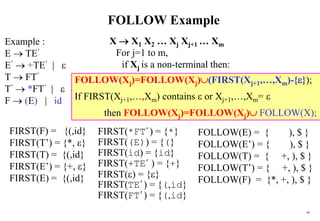
and a is input, POPA and PUSH .)
Is used when FIRST has a conflict, to resolve choices, or
when FIRST gives no suggestion. When    or   ,
then what follows A dictates the next choice to be made.
Example: If A   , and b is in FOLLOW(A ), then
when    and b is an input character, then we expand
A with  , which will eventually expand to , of which b
follows!
(   : i.e., FIRST( ) contains .)
*
*
*
96
Review: Non-Recursive / Table Driven
General parser behavior: X : top of stack a : current input
1. When X=a = $ halt, accept, success
2. When X=a  $ , POP X off stack, advance input, go to 1.
3. When X is a non-terminal, examine M[X,a]
if it is an error  call recovery routine
if M[X,a] = {X  UVW}, POP X, PUSH W,V,U
DO NOT expend any input
Empty stack
symbol
a + b $
Y
X
$
Z
Input
Predictive Parsing
Program
Stack Output
Parsing Table
M[A,a]
(String + terminator)
NT + T
symbols of
CFG What actions parser
should take based on
stack / input
Notice the pushing order
97
Review: FIRST & FOLLOW
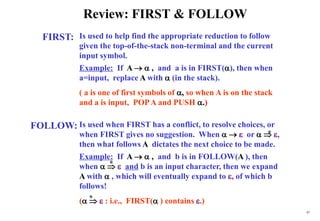
FIRST:
FOLLOW:
Is used to help find the appropriate reduction to follow
given the top-of-the-stack non-terminal and the current
input symbol.
Example: If A   , and a is in FIRST(), then when
a=input, replace A with  (in the stack).
( a is one of first symbols of , so when A is on the stack
and a is input, POPA and PUSH .)
Is used when FIRST has a conflict, to resolve choices, or
when FIRST gives no suggestion. When    or   ,
then what follows A dictates the next choice to be made.
Example: If A   , and b is in FOLLOW(A ), then
when    and b is an input character, then we expand
A with  , which will eventually expand to , of which b
follows!
(   : i.e., FIRST( ) contains .)
*
*
*
98
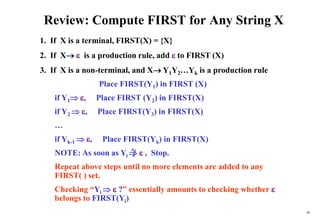
Review: Compute FIRST for Any String X
1. If X is a terminal, FIRST(X) = {X}
2. If X  is a production rule, add  to FIRST (X)
3. If X is a non-terminal, and X Y1Y2…Yk is a production rule
Place FIRST(Y1) in FIRST (X)
if Y1 , Place FIRST (Y2) in FIRST(X)
if Y2  , Place FIRST(Y3) in FIRST(X)
…
if Yk-1  , Place FIRST(Yk) in FIRST(X)
NOTE: As soon as Yi   , Stop.
Repeat above steps until no more elements are added to any
FIRST( ) set.
Checking “Yi   ?” essentially amounts to checking whether 
belongs to FIRST(Yi)
*
99
Review: Compute FOLLOW (for non-terminals)
1. If S is the start symbol  $ is in FOLLOW(S)
2. If A  B is a production rule
 everything in FIRST() is FOLLOW(B) except 
3. If ( A  B is a production rule ) or
( A  B is a production rule and  is in FIRST() )
 everything in FOLLOW(A) is in FOLLOW(B).
We apply these rules until nothing more can be added to any FOLLOW
set.
(Whatever followed A must follow B, since nothing follows B
from the production rule)
Initially S$
100
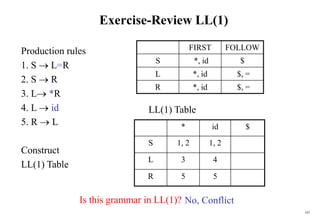
Exercises
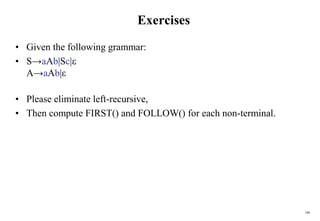
• Given the following grammar:
• S→aAb|Sc|ε
A→aAb|ε
• Please eliminate left-recursive,
• Then compute FIRST() and FOLLOW() for each non-terminal.
101
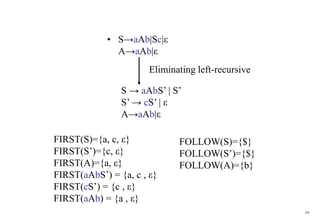
• S→aAb|Sc|ε
A→aAb|ε
FIRST(S)={a, c, ε}
FIRST(S’)={c, ε}
FIRST(A)={a, ε}
FIRST(aAbS’) = {a, c , ε}
FIRST(cS’) = {c , ε}
FIRST(aAb) = {a , ε}
FOLLOW(S)={$}
FOLLOW(S’)={$}
FOLLOW(A)={b}
S → aAbS’ | S’
S’ → cS’ | ε
A→aAb|ε
Eliminating left-recursive
102
Constructing LL(1) Parsing Table
Algorithm:
1. Repeat Steps 2 & 3 for each rule A
2. Terminal a in FIRST()? Add A to M[A, a ]
3.1 ε in FIRST()? Add A  to M[A, b ] for all terminals b in
FOLLOW(A).
3.2 ε in FIRST() and $ in FOLLOW(A)? Add A  to M[A, $ ]
4. All undefined entries are errors.
103
FOLLOW Example
Example :
E  TE’
E’  +TE’ | 
T  FT’
T’  *FT’ | 
F  (E) | id
FOLLOW(E) = { ), $ }
FOLLOW(E’) = { ), $ }
FOLLOW(T) = { +, ), $ }
FOLLOW(T’) = { +, ), $ }
FOLLOW(F) = {*, +, ), $ }
FIRST(F) = {(,id}
FIRST(T’) = {*, }
FIRST(T) = {(,id}
FIRST(E’) = {+, }
FIRST(E) = {(,id}
FIRST(TE’) = {(,id}
FIRST(+TE’ ) = {+}
FIRST() = {}
FIRST(FT’) = {(,id}
FIRST(*FT’) = {*}
FIRST((E)) = {(}
FIRST(id) = {id}
104
Constructing LL(1) Parsing Table -- Example
Example:
E  TE’ FIRST(TE’)={(,id}  E  TE’ into M[E,(] and M[E,id]
E’  +TE’ FIRST(+TE’ )={+}  E’  +TE’ into M[E’,+]
E’   FIRST()={}  none
but since  in FIRST()
and FOLLOW(E’)={$,)}  E’   into M[E’,$] and M[E’,)]
T  FT’ FIRST(FT’)={(,id}  T  FT’ into M[T,(] and M[T,id]
T’  *FT’ FIRST(*FT’ )={*}  T’  *FT’ into M[T’,*]
T’   FIRST()={}  none
but since  in FIRST()
and FOLLOW(T’)={$,),+} T’   into M[T’,$], M[T’,)] and M[T’,+]
F  (E) FIRST((E) )={(}  F  (E) into M[F,(]
F  id FIRST(id)={id}  F  id into M[F,id]
105
Constructing LL(1) Parsing Table (cont.)
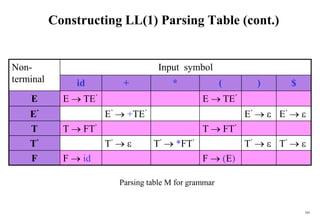
Parsing table M for grammar
Non-
terminal
Input symbol
id + * ( ) $
E E  TE’ E  TE’
E’ E’  +TE’ E’   E’  
T T  FT’ T  FT’
T’ T’   T’  *FT’ T’   T’  
F F  id F  (E)
106
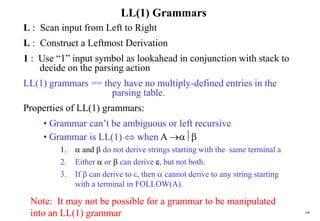
LL(1) Grammars
L : Scan input from Left to Right
L : Construct a Leftmost Derivation
1 : Use “1” input symbol as lookahead in conjunction with stack to
decide on the parsing action
LL(1) grammars == they have no multiply-defined entries in the
parsing table.
Properties of LL(1) grammars:
• Grammar can’t be ambiguous or left recursive
• Grammar is LL(1)  when A 
1.  and  do not derive strings starting with the same terminal a
2. Either  or  can derive , but not both.
3. If  can derive to , then  cannot derive to any string starting
with a terminal in FOLLOW(A).
Note: It may not be possible for a grammar to be manipulated
into an LL(1) grammar
107
A Grammar which is not LL(1)
Example:
S  i C t S E | a
E  e S | 
C  b
a b e i t $
S S  a S  iCtSE
E E  e S
E  
E  
C C  b
two production rules for M[E,e]
FOLLOW(S) = { $,e }
FOLLOW(E) = { $,e }
FOLLOW(C) = { t }
FIRST(iCtSE) = {i}
FIRST(a) = {a}
FIRST(eS) = {e}
FIRST() = {}
FIRST(b) = {b}
Problem  ambiguity
108
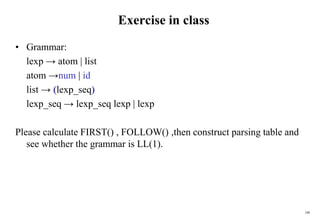
Exercise in class
• Grammar:
lexp → atom | list
atom →num | id
list → (lexp_seq)
lexp_seq → lexp_seq lexp | lexp
Please calculate FIRST() , FOLLOW() ,then construct parsing table and
see whether the grammar is LL(1).
109
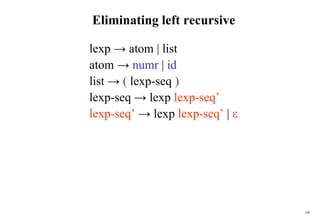
Eliminating left recursive
lexp → atom | list
atom → numr | id
list → ( lexp-seq )
lexp-seq → lexp lexp-seq’
lexp-seq’ → lexp lexp-seq’ | ε
110
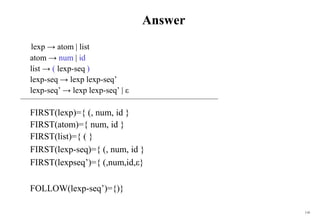
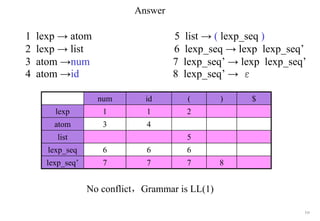
Answer
lexp → atom | list
atom → num | id
list → ( lexp-seq )
lexp-seq → lexp lexp-seq’
lexp-seq’ → lexp lexp-seq’ | ε
FIRST(lexp)={ (, num, id }
FIRST(atom)={ num, id }
FIRST(list)={ ( }
FIRST(lexp-seq)={ (, num, id }
FIRST(lexpseq’)={ (,num,id,ε}
FOLLOW(lexp-seq’)={)}
111
1 lexp → atom 5 list → ( lexp_seq )
2 lexp → list 6 lexp_seq → lexp lexp_seq’
3 atom →num 7 lexp_seq’ → lexp lexp_seq’
4 atom →id 8 lexp_seq’ → ε
num id ( ) $
lexp 1 1 2
atom 3 4
list 5
lexp_seq 6 6 6
lexp_seq’ 7 7 7 8
No conflict,Grammar is LL(1)
Answer
112
A Grammar which is not LL(1) (cont.)
• A left recursive grammar cannot be a LL(1) grammar.
– A  A | 
 any terminal that appears in FIRST() also appears FIRST(A) because
A  .
 If  is , any terminal that appears in FIRST() also appears in FIRST(A)
and FOLLOW(A).
• A grammar is not left factored, it cannot be a LL(1) grammar
• A  1 | 2
any terminal that appears in FIRST(1) also appears in FIRST(2).
• An ambiguous grammar cannot be a LL(1) grammar.
• What do we have to do it if the resulting parsing table contains
multiply defined entries?
– If we didn’t eliminate left recursion, eliminate the left recursion in the
grammar.
– If the grammar is not left factored, we have to left factor the grammar.
– If its (new grammar’s) parsing table still contains multiply defined
entries, that grammar is ambiguous or it is inherently not a LL(1)
grammar.
113
Error Recovery in Predictive Parsing
• An error may occur in the predictive parsing (LL(1) parsing)
– if the terminal symbol on the top of stack does not match
with the current input symbol.
– if the top of stack is a non-terminal A, the current input
symbol is a, and the parsing table entry M[A,a] is empty.
• What should the parser do in an error case?
– The parser should be able to give an error message (as
much as possible meaningful error message).
– It should be recover from that error case, and it should be
able to continue the parsing with the rest of the input.
114
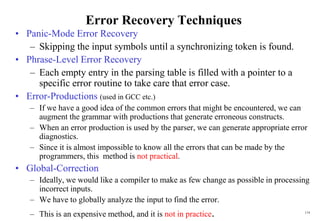
Error Recovery Techniques
• Panic-Mode Error Recovery
– Skipping the input symbols until a synchronizing token is found.
• Phrase-Level Error Recovery
– Each empty entry in the parsing table is filled with a pointer to a
specific error routine to take care that error case.
• Error-Productions (used in GCC etc.)
– If we have a good idea of the common errors that might be encountered, we can
augment the grammar with productions that generate erroneous constructs.
– When an error production is used by the parser, we can generate appropriate error
diagnostics.
– Since it is almost impossible to know all the errors that can be made by the
programmers, this method is not practical.
• Global-Correction
– Ideally, we would like a compiler to make as few change as possible in processing
incorrect inputs.
– We have to globally analyze the input to find the error.
– This is an expensive method, and it is not in practice.
115
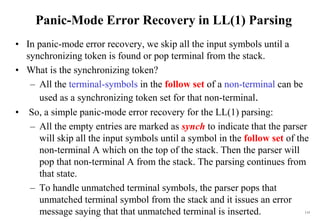
Panic-Mode Error Recovery in LL(1) Parsing
• In panic-mode error recovery, we skip all the input symbols until a
synchronizing token is found or pop terminal from the stack.
• What is the synchronizing token?
– All the terminal-symbols in the follow set of a non-terminal can be
used as a synchronizing token set for that non-terminal.
• So, a simple panic-mode error recovery for the LL(1) parsing:
– All the empty entries are marked as synch to indicate that the parser
will skip all the input symbols until a symbol in the follow set of the
non-terminal A which on the top of the stack. Then the parser will
pop that non-terminal A from the stack. The parsing continues from
that state.
– To handle unmatched terminal symbols, the parser pops that
unmatched terminal symbol from the stack and it issues an error
message saying that that unmatched terminal is inserted.
116
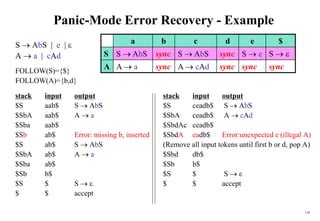
Panic-Mode Error Recovery - Example
S  AbS | e | 
A  a | cAd
FOLLOW(S)={$}
FOLLOW(A)={b,d}
stack input output stack input output
$S aab$ S  AbS $S ceadb$ S  AbS
$SbA aab$ A  a $SbA ceadb$ A  cAd
$Sba aab$ $SbdAc ceadb$
$Sb ab$ Error: missing b, inserted $SbdA eadb$ Error:unexpected e (illegal A)
$S ab$ S  AbS (Remove all input tokens until first b or d, pop A)
$SbA ab$ A  a $Sbd db$
$Sba ab$ $Sb b$
$Sb b$ $S $ S  
$S $ S   $ $ accept
$ $ accept
a b c d e $
S S  AbS sync S  AbS sync S  e S  
A A  a sync A  cAd sync sync sync
117
Phrase-Level Error Recovery
• Each empty entry in the parsing table is filled with a pointer to a special
error routine which will take care that error case.
• These error routines may:
– change, insert, or delete input symbols.
– issue appropriate error messages
– pop items from the stack.
• We should be careful when we design these error routines, because we
may put the parser into an infinite loop.
118
Final Comments – Top-Down Parsing
So far,
• We’ve examined grammars and language theory and its
relationship to parsing
• Key concepts: Rewriting grammar into an acceptable form
• Examined Top-Down parsing:
Brute Force : Recursion and backtracking
Elegant : Table driven
• We’ve identified its shortcomings:
Not all grammars can be made LL(1) !
• Bottom-Up Parsing - Future
119
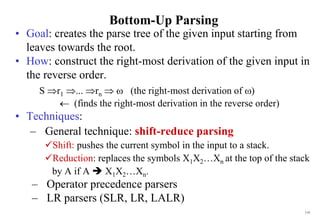
Bottom-Up Parsing
• Goal: creates the parse tree of the given input starting from
leaves towards the root.
• How: construct the right-most derivation of the given input in
the reverse order.
S r1 ... rn   (the right-most derivation of )
 (finds the right-most derivation in the reverse order)
• Techniques:
– General technique: shift-reduce parsing
Shift: pushes the current symbol in the input to a stack.
Reduction: replaces the symbols X1X2…Xn at the top of the stack
by A if A  X1X2…Xn.
– Operator precedence parsers
– LR parsers (SLR, LR, LALR)
120
Bottom-Up Parsing -- Example
S  aABb
A  aA | a
B  bB | b
rm
rm
rm
rm
S  aABb  aAbb  aaAbb  aaabb
Right Sentential Forms
S
a
b
A
a
b
B
A
a
aaabb
aaAbb
aAbb reduction
aABb
S
input string:

121
Naive algorithm
S=0  1  2  ...  n-1  n= 
input string
rm
rm
rm rm
rm
Let  = input string
repeat
pick a non-empty substring β of  where A→ β is a production
if (no such β)
backtrack
else
replace one β by A in 
until  = “S” (the start symbol) or all possibilities are exhausted
122
Questions
• Does this algorithm terminate?
• How fast is the algorithm?
• Does the algorithm handle all cases?
• How do we choose the substring to reduce at each step?
Let  = input string
repeat
pick a non-empty substring β of  where A→ β is a production
if (no such β)
backtrack
else
replace one β by A in 
until  = “S” (the start symbol) or all possibilities are exhausted
123
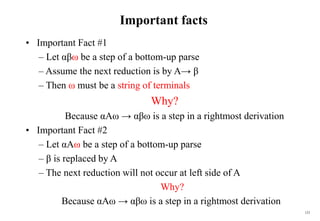
Important facts
• Important Fact #1
– Let αβω be a step of a bottom-up parse
– Assume the next reduction is by A→ β
– Then ω must be a string of terminals
Why?
Because αAω → αβω is a step in a rightmost derivation
• Important Fact #2
– Let αAω be a step of a bottom-up parse
– β is replaced by A
– The next reduction will not occur at left side of A
Why?
Because αAω → αβω is a step in a rightmost derivation
124
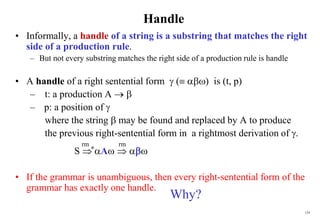
Handle
• Informally, a handle of a string is a substring that matches the right
side of a production rule.
– But not every substring matches the right side of a production rule is handle
• A handle of a right sentential form  ( ) is (t, p)
– t: a production A  
– p: a position of 
where the string  may be found and replaced by A to produce
the previous right-sentential form in a rightmost derivation of .
S  A  
• If the grammar is unambiguous, then every right-sentential form of the
grammar has exactly one handle.
rm rm
*
Why?
125
Handle
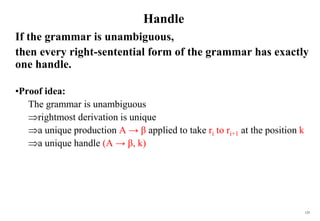
If the grammar is unambiguous,
then every right-sentential form of the grammar has exactly
one handle.
•Proof idea:
The grammar is unambiguous
rightmost derivation is unique
a unique production A → β applied to take ri to ri+1 at the position k
a unique handle (A → β, k)
126
Handle Pruning
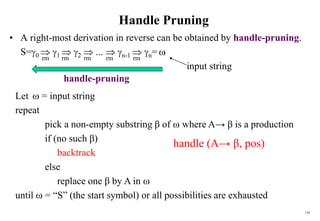
• A right-most derivation in reverse can be obtained by handle-pruning.
S=0  1  2  ...  n-1  n= 
input string
rm
rm
rm rm
rm
Let  = input string
repeat
pick a non-empty substring β of  where A→ β is a production
if (no such β)
backtrack
else
replace one β by A in 
until  = “S” (the start symbol) or all possibilities are exhausted
handle-pruning
handle (A→ β, pos)
127
Review: Bottom-up Parsing and Handle
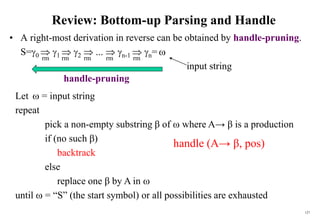
• A right-most derivation in reverse can be obtained by handle-pruning.
S=0  1  2  ...  n-1  n= 
input string
rm
rm
rm rm
rm
Let  = input string
repeat
pick a non-empty substring β of  where A→ β is a production
if (no such β)
backtrack
else
replace one β by A in 
until  = “S” (the start symbol) or all possibilities are exhausted
handle-pruning
handle (A→ β, pos)
128
Example
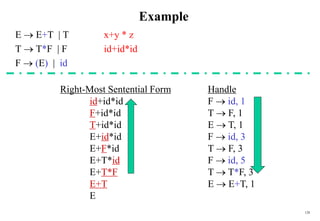
E  E+T | T x+y * z
T  T*F | F id+id*id
F  (E) | id
Right-Most Sentential Form Handle
id+id*id F  id, 1
F+id*id T  F, 1
T+id*id E  T, 1
E+id*id F  id, 3
E+F*id T  F, 3
E+T*id F  id, 5
E+T*F T  T*F, 3
E+T E  E+T, 1
E
129
Shift-Reduce Parser
• Shift-reduce parsers require a stack and an input buffer
– Initial stack just contains only the end-marker $
– The end of the input string is marked by the end-marker $.
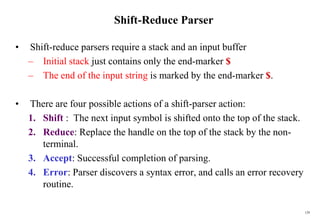
• There are four possible actions of a shift-parser action:
1. Shift : The next input symbol is shifted onto the top of the stack.
2. Reduce: Replace the handle on the top of the stack by the non-
terminal.
3. Accept: Successful completion of parsing.
4. Error: Parser discovers a syntax error, and calls an error recovery
routine.
130
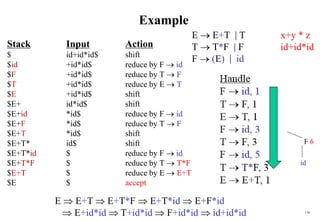
Example
Stack Input Action
$ id+id*id$ shift
$id +id*id$ reduce by F  id
$F +id*id$ reduce by T  F
$T +id*id$ reduce by E  T
$E +id*id$ shift
$E+ id*id$ shift
$E+id *id$ reduce by F  id
$E+F *id$ reduce by T  F
$E+T *id$ shift
$E+T* id$ shift
$E+T*id $ reduce by F  id
$E+T*F $ reduce by T  T*F
$E+T $ reduce by E  E+T
$E $ accept
Parse Tree
E 8
E 3 + T 7
T 2 T 5 * F 6
F 1 F 4 id
id id
E  E+T  E+T*F  E+T*id  E+F*id
 E+id*id  T+id*id  F+id*id  id+id*id
E  E+T | T x+y * z
T  T*F | F id+id*id
F  (E) | id
131
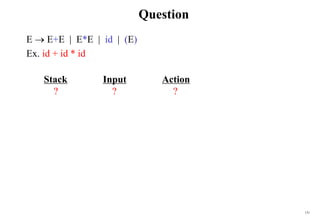
Question
E  E+E | E*E | id | (E)
Ex. id + id * id
Stack Input Action
? ? ?
132
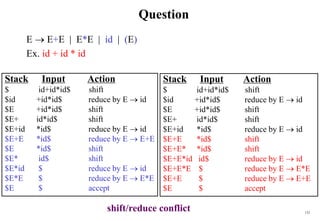
Question
E  E+E | E*E | id | (E)
Ex. id + id * id
Stack Input Action
$ id+id*id$ shift
$id +id*id$ reduce by E  id
$E +id*id$ shift
$E+ id*id$ shift
$E+id *id$ reduce by E  id
$E+E *id$ reduce by E  E+E
$E *id$ shift
$E* id$ shift
$E*id $ reduce by E  id
$E*E $ reduce by E  E*E
$E $ accept
Stack Input Action
$ id+id*id$ shift
$id +id*id$ reduce by E  id
$E +id*id$ shift
$E+ id*id$ shift
$E+id *id$ reduce by E  id
$E+E *id$ shift
$E+E* *id$ shift
$E+E*id id$ reduce by E  id
$E+E*E $ reduce by E  E*E
$E+E $ reduce by E  E+E
$E $ accept
shift/reduce conflict
133
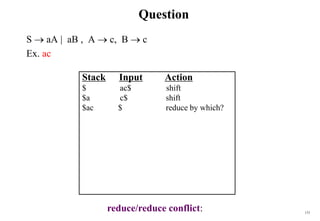
Question
S  aA | aB , A  c, B  c
Ex. ac
Stack Input Action
$ ac$ shift
$a c$ shift
$ac $ reduce by which?
reduce/reduce conflict:
134
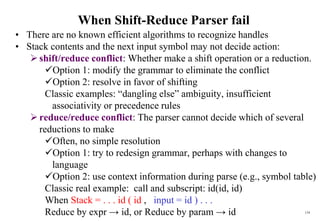
When Shift-Reduce Parser fail
• There are no known efficient algorithms to recognize handles
• Stack contents and the next input symbol may not decide action:
shift/reduce conflict: Whether make a shift operation or a reduction.
Option 1: modify the grammar to eliminate the conflict
Option 2: resolve in favor of shifting
Classic examples: “dangling else” ambiguity, insufficient
associativity or precedence rules
reduce/reduce conflict: The parser cannot decide which of several
reductions to make
Often, no simple resolution
Option 1: try to redesign grammar, perhaps with changes to
language
Option 2: use context information during parse (e.g., symbol table)
Classic real example: call and subscript: id(id, id)
When Stack = . . . id ( id , input = id ) . . .
Reduce by expr → id, or Reduce by param → id
135
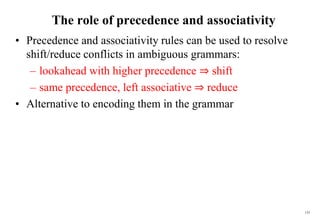
The role of precedence and associativity
• Precedence and associativity rules can be used to resolve
shift/reduce conflicts in ambiguous grammars:
– lookahead with higher precedence ⇒ shift
– same precedence, left associative ⇒ reduce
• Alternative to encoding them in the grammar
136
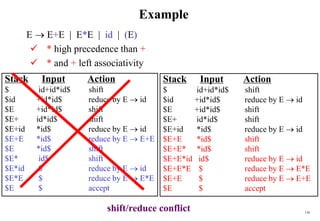
Example
E  E+E | E*E | id | (E)
 * high precedence than +
 * and + left associativity
Stack Input Action
$ id+id*id$ shift
$id +id*id$ reduce by E  id
$E +id*id$ shift
$E+ id*id$ shift
$E+id *id$ reduce by E  id
$E+E *id$ reduce by E  E+E
$E *id$ shift
$E* id$ shift
$E*id $ reduce by E  id
$E*E $ reduce by E  E*E
$E $ accept
Stack Input Action
$ id+id*id$ shift
$id +id*id$ reduce by E  id
$E +id*id$ shift
$E+ id*id$ shift
$E+id *id$ reduce by E  id
$E+E *id$ shift
$E+E* *id$ shift
$E+E*id id$ reduce by E  id
$E+E*E $ reduce by E  E*E
$E+E $ reduce by E  E+E
$E $ accept
shift/reduce conflict
137
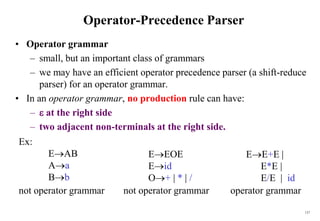
Operator-Precedence Parser
• Operator grammar
– small, but an important class of grammars
– we may have an efficient operator precedence parser (a shift-reduce
parser) for an operator grammar.
• In an operator grammar, no production rule can have:
–  at the right side
– two adjacent non-terminals at the right side.
EEOE
Eid
O+ | * | /
Ex:
EAB
Aa
Bb
EE+E |
E*E |
E/E | id
not operator grammar not operator grammar operator grammar
138
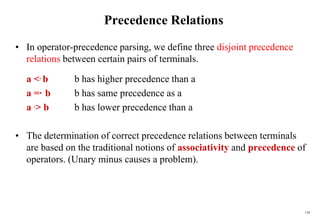
Precedence Relations
• In operator-precedence parsing, we define three disjoint precedence
relations between certain pairs of terminals.
a <. b b has higher precedence than a
a =·b b has same precedence as a
a .> b b has lower precedence than a
• The determination of correct precedence relations between terminals
are based on the traditional notions of associativity and precedence of
operators. (Unary minus causes a problem).
139
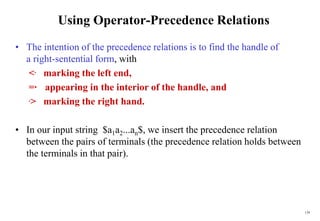
Using Operator-Precedence Relations
• The intention of the precedence relations is to find the handle of
a right-sentential form, with
<. marking the left end,
=· appearing in the interior of the handle, and
.> marking the right hand.
• In our input string $a1a2...an$, we insert the precedence relation
between the pairs of terminals (the precedence relation holds between
the terminals in that pair).
140
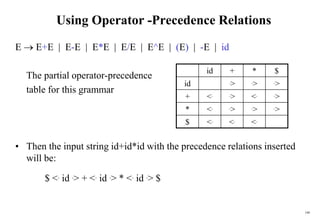
Using Operator -Precedence Relations
E  E+E | E-E | E*E | E/E | E^E | (E) | -E | id
The partial operator-precedence
table for this grammar
• Then the input string id+id*id with the precedence relations inserted
will be:
$ <. id .> + <. id .> * <. id .> $
id + * $
id .> .> .>
+ <. .> <. .>
* <. .> .> .>
$ <. <. <.
141
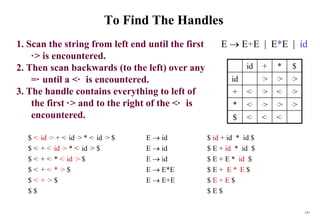
To Find The Handles
$ <. id .> + <. id .> * <. id .> $ E  id $ id + id * id $
$ <. + <. id .> * <. id .> $ E  id $ E + id * id $
$ <. + <. * <. id .> $ E  id $ E + E * id $
$ <. + <. * .> $ E  E*E $ E + E * .E $
$ <. + .> $ E  E+E $ E + E $
$ $ $ E $
id + * $
id .> .> .>
+ <. .> <. .>
* <. .> .> .>
$ <. <. <.
1. Scan the string from left end until the first
·
> is encountered.
2. Then scan backwards (to the left) over any
=·until a <·is encountered.
3. The handle contains everything to left of
the first ·
> and to the right of the <·is
encountered.
E  E+E | E*E | id
142
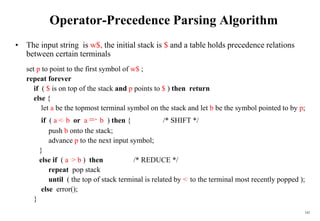
Operator-Precedence Parsing Algorithm
• The input string is w$, the initial stack is $ and a table holds precedence relations
between certain terminals
set p to point to the first symbol of w$ ;
repeat forever
if ( $ is on top of the stack and p points to $ ) then return
else {
let a be the topmost terminal symbol on the stack and let b be the symbol pointed to by p;
if ( a <. b or a =·
b ) then { /* SHIFT */
push b onto the stack;
advance p to the next input symbol;
}
else if ( a .> b ) then /* REDUCE */
repeat pop stack
until ( the top of stack terminal is related by <. to the terminal most recently popped );
else error();
}
143
Operator-Precedence Parsing Algorithm -- Example
stack input action
$ id+id*id$ $ <. id shift
$id +id*id$ id .> + reduce E  id
$ +id*id$ shift
$+ id*id$ shift
$+id *id$ id .> * reduce E  id
$+ *id$ shift
$+* id$ shift
$+*id $ id .> $ reduce E  id
$+* $ * .> $ reduce E  E*E
$+ $ + .> $ reduce E  E+E
$ $ accept
EE+E
| E*E
| id
144
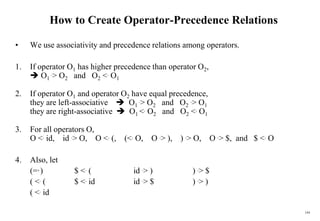
How to Create Operator-Precedence Relations
• We use associativity and precedence relations among operators.
1. If operator O1 has higher precedence than operator O2,
 O1
.> O2 and O2 <. O1
2. If operator O1 and operator O2 have equal precedence,
they are left-associative  O1
.> O2 and O2
.> O1
they are right-associative  O1 <. O2 and O2 <. O1
3. For all operators O,
O <. id, id .> O, O <. (, (<. O, O .> ), ) .> O, O .> $, and $ <. O
4. Also, let
(=·
) $ <. ( id .> ) ) .> $
( <. ( $ <. id id .> $ ) .> )
( <. id
145
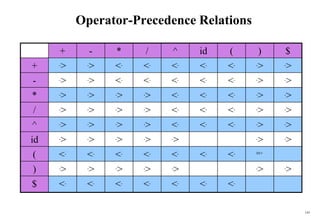
Operator-Precedence Relations
+ - * / ^ id ( ) $
+ .> .> <. <. <. <. <. .> .>
- .> .> <. <. <. <. <. .> .>
* .> .> .> .> <. <. <. .> .>
/ .> .> .> .> <. <. <. .> .>
^ .> .> .> .> <. <. <. .> .>
id .> .> .> .> .> .> .>
( <. <. <. <. <. <. <. =·
) .> .> .> .> .> .> .>
$ <. <. <. <. <. <. <.
146
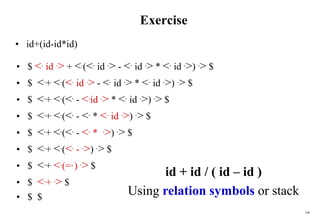
Exercise
• id+(id-id*id)
• $ <. id .> + <.(<. id .> - <. id .> * <. id .>) .> $
• $ <.+ <.(<. id .> - <. id .> * <. id .>) .> $
• $ <.+ <.(<. - <.id .> * <. id .>) .> $
• $ <.+ <.(<. - <. * <. id .>) .> $
• $ <.+ <.(<. - <. * .>) .> $
• $ <.+ <.(<. - .>) .> $
• $ <.+ <.(=·
) .> $
• $ <.+ .> $
• $ $
id + id / ( id – id )
Using relation symbols or stack
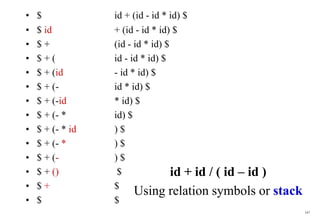
147
• $ id + (id - id * id) $
• $ + (id - id * id) $
• $ + ( id - id * id) $
• $ + (id - id * id) $
• $ + (- id * id) $
• $ + (-id * id) $
• $ + (- * id) $
• $ + (- * id ) $
• $ + (- * ) $
• $ + (- ) $
• $ + () $
• $ + $
• $ $
id + id / ( id – id )
Using relation symbols or stack
148
Handling Unary Minus
• Operator-Precedence parsing cannot handle the unary minus
when we also have the binary minus in our grammar.
• The best approach to solve this problem, let the lexical
analyzer handle this problem.
– The lexical analyzer will return two different operators for
the unary minus and the binary minus.
– The lexical analyzer will need a lookahead to distinguish
the binary minus from the unary minus.
• Then, we make
O <. unary-minus for any operator
unary-minus .> O if unary-minus has higher precedence than O
unary-minus <. O if unary-minus has lower (or equal) precedence than O
149
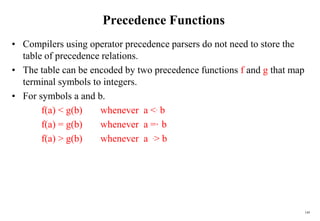
Precedence Functions
• Compilers using operator precedence parsers do not need to store the
table of precedence relations.
• The table can be encoded by two precedence functions f and g that map
terminal symbols to integers.
• For symbols a and b.
f(a) < g(b) whenever a <. b
f(a) = g(b) whenever a =·b
f(a) > g(b) whenever a .> b
150
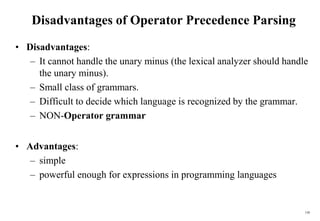
Disadvantages of Operator Precedence Parsing
• Disadvantages:
– It cannot handle the unary minus (the lexical analyzer should handle
the unary minus).
– Small class of grammars.
– Difficult to decide which language is recognized by the grammar.
– NON-Operator grammar
• Advantages:
– simple
– powerful enough for expressions in programming languages
151
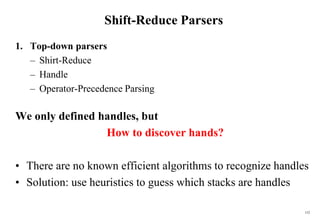
Error Recovery in Operator-Precedence Parsing
Error Cases:
1. No relation holds between the terminal on the top of stack and the
next input symbol.
2. A handle is found (reduction step), but there is no production with
this handle as a right side
Error Recovery:
1. Each empty entry is filled with a pointer to an error routine.
2. Decides the popped handle “looks like” which right hand side. And
tries to recover from that situation.
152
Shift-Reduce Parsers
1. Top-down parsers
– Shirt-Reduce
– Handle
– Operator-Precedence Parsing
We only defined handles, but
How to discover hands?
• There are no known efficient algorithms to recognize handles
• Solution: use heuristics to guess which stacks are handles
153
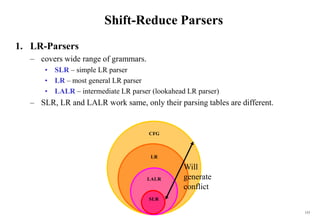
Shift-Reduce Parsers
1. LR-Parsers
– covers wide range of grammars.
• SLR – simple LR parser
• LR – most general LR parser
• LALR – intermediate LR parser (lookahead LR parser)
– SLR, LR and LALR work same, only their parsing tables are different.
SLR
LALR
LR
CFG
Will
generate
conflict
154
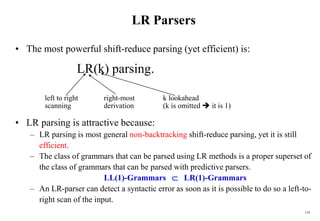
LR Parsers
• The most powerful shift-reduce parsing (yet efficient) is:
LR(k) parsing.
left to right right-most k lookahead
scanning derivation (k is omitted  it is 1)
• LR parsing is attractive because:
– LR parsing is most general non-backtracking shift-reduce parsing, yet it is still
efficient.
– The class of grammars that can be parsed using LR methods is a proper superset of
the class of grammars that can be parsed with predictive parsers.
LL(1)-Grammars  LR(1)-Grammars
– An LR-parser can detect a syntactic error as soon as it is possible to do so a left-to-
right scan of the input.
155
LR Parsing Algorithm Framework
a1 ... ai ... an $
Parsing Algorithm
stack
input
output
Action Table
terminals and $
s
t four different
a actions
t
e
s
Goto Table
non-terminal
s
t each item is
a a state number
t
e
s
Sm
Xm
Sm-1
Xm-1
.
.
S1
X1
S0
156
A Trivial Bottom-Up Parsing Algorithm
LR Parsers avoid backtrack
Let  = input string
repeat
pick a non-empty substring β of  where A→ β is a production
if (no such β)
backtrack
else
replace one β by A in 
until  = “S” (the start symbol) or all possibilities are exhausted
We only want to reduce at handles
We have defined handles
Stack is: …T, input *…
But, how to detect handles ?
157
Viable Prefix
• At each step the parser sees:
The stack content must be a prefix of a right-sentential form
• E  …  F*id  (E)* id
— (, (E, (E) are prefix of (E)* id
• But, not all prefix can be the stack content
— (E)* cannot be appear on the stack, it should be reduced by F->(E)
• A viable prefix is a prefix of a right-sentential form that can appear on
the stack
• If the bottom-up parser enforces that the stack can only hold viable
prefix, then, we do not backtrack
158
Observations on Viable Prefix
• A viable prefix does not extend past the right end of handle
stack: a1a2…an input: r1r2
either ai…an is a handle, or there is no handle
Why?
a1a2…an-k A | r2 => a1a2an-kan-k+1…an | r1r2  by A an-k+1…an r1
• It is always possible to shift symbol from input onto the stack and obtain a
new viable prefix
• A production A-> β1β2 is valid for viable prefix β1 if
S=>* A =>  β1β2 
• Reduce: if β2 =
• Shift: if β2 !=
• Item: A-> β1β2
159
LR(0) Items and LR(0) Automaton
• How to compute viable prefix and its corresponding valid productions?
Key point: the set of viable prefixes is a regular language
• We construct a finite state automaton recognizing the set of viable
prefixes,
– each state s represents a set of valid items if the initial state s0 goes
to the state s items after reading the viable prefix 
• LR(0) Items: One production produces a set of items by placing  in to
productions
E.g. The production T-> (E) gives items
• T-> (E) // we have seen  of T-> (E) , shift
• T->( E) // we have seen ( of T-> (E) , shift
• T->(E ) // we have seen (E of T-> (E), shift
• T->(E)  // we have seen (E) of T-> (E), reduce
The production T->  gives the item
• T-> 
160
LR(0) Items and LR(0) Automaton
• The stack may have many prefixes of productions
Prefix1Prefix2…Prefixn-1Prefixn
Let Prefixn be a valid prefix of An->n
– Prefixn will eventually reduce to An
– Prefixn-1An is a valid prefix of An-1-> Prefixn-1Anβ
• Finally, Prefixk…Prefixn eventually reduces to Ak
– Prefixk-1Ak is a valid prefix of Ak-1-> Prefixk-1Akβ
161
LR(0) Items and LR(0) Automaton
• Consider: (id * id) Stack: (id* input id)
– ( is a viable prefix of T->(E)
–  is a viable prefix of E->T
– id * is a viable prefix of T->id * T
A state (a set of items) {T->(E), E-> T, T->id *T} says:
– We have seen (of T->(E)
– We have seen  of E->T
– We have seen id * of T->id * T
Example:
E → T + E | T
T → id * T | id | (E)
162
Closure Operation: States
• If I is a set of LR(0) items for a grammar G, then closure(I) is the set of
LR(0) items constructed from I by the two rules:
1. Initially, every LR(0) item in I is added to closure(I).
2. Repeat
– If A  .B is in closure(I) and B is a production in G;
– then B. will be in the closure(I).
Unitl no more new LR(0) items can be added to closure(I).
• The stack may have many prefixes of productions
Prefix1Prefix2…Prefixn-1Prefixn
Prefixk…Prefixn eventually reduces to Ak
– Prefixk-1Ak is a valid prefix of Ak-1-> Prefixk-1Akβ
163
Closure Operation -- Example
E’  E I0: closure({E’  .E}) =
E  E+T { E’  .E kernel items
E  T E  .E+T
T  T*F E  .T
T  F T  .T*F
F  (E) T  .F
F  id F  .(E)
F  .id }
1. kernel items: the initial item
and all items whose dots are
not at the left end
2. Nonkernel items: otherwise
1. Initially, every LR(0) item in I is added to closure(I).
2. If A    B is in closure(I) and B is a production rule of G;
then B   will be in the closure(I).
164
Closure Operation -- Example
E’  E I0: closure({E  E+.T}) =
E  E+T { E  E+.T kernel items
E  T T  .T*F
T  T*F T  .F
T  F F  .(E)
F  (E) F  .id }
F  id
1. kernel items: the initial item
and all items whose dots are
not at the left end
2. Nonkernel items: otherwise
1. Initially, every LR(0) item in I is added to closure(I).
2. If A  B is in closure(I) and B is a production rule of G;
then B will be in the closure(I).
165
Goto Operation: Transitions
• If I is a set of LR(0) items and X is a grammar symbol (terminal or non-
terminal), then goto(I,X) is defined as follows:
– If A  .X in I
– then every item in closure({A  X.}) will be in goto(I,X).
Example:
I ={ E’  .E, E  .E+T, E  .T, T  .T*F,
T  .F, F  .(E), F  .id }
goto(I,E) = { E’  E., E  E.+T }
goto(I,T) = { E  T., T  T.*F }
goto(I,F) = {T  F.}
goto(I,() = { F  (.E), E  .E+T, E  .T, T  .T*F, T  .F,
F  .(E), F  .id }
goto(I,id) = { F  id.}
166
LR(0) Automaton
• Add a dummy production S’->S into G, get G’
• Algorithm:
C is { closure({S’.S}) }
repeat
for each I in C and each grammar symbol X
if goto(I,X) is not empty and not in C
add goto(I,X) to C
until no more set of LR(0) items can be added to C.
• goto function is the transition function of the DFA
• Initial state: closure({S’->S})
• Every state is an accepting state
New item, corresponding
to new state in DFA
167
The Canonical LR(0) Collection -- Example
I0: E’  .E
E  .E+T
E  .T
T  .T*F
T  .F
F  .(E)
F  .id
I9: E  E+T.
T  T.*F
I10: T  T*F.
I11: F  (E).
I6: E  E+.T
T  .T*F
T  .F
F  .(E)
F  .id
I7: T  T*.F
F  .(E)
F  .id
I8: F  (E.)
E  E.+T
id
(
F
T
E
I2
+
*
E
(
T
id
F
I3
*
I6
id
)
F
T
F
id
(
(
I4
I3
I5
I5
I4
+
I1: E’  E.
E  E.+T
I2: E  T.
T  T.*F
I3: T  F.
I4: F  (.E)
E  .E+T
E  .T
T  .T*F
T  .F
F  .(E)
F  .id
I5: F  id.
I7
$ accept
168
LR(0) Parsing Algorithm Implmentation
a1 ... ai ... an $
LR(0) Parsing Algorithm
stack
input
output
LR(0) Action Table
terminals and $
s
t four different
a actions
t
e
S
Goto Table
non-terminal
s
t each item is
a a state number
t
e
s
Sm
Xm
Sm-1
Xm-1
.
.
S1
X1
S0
Idea: Assume: stack contains β and next input is a
DFA on input β terminates in state s
• Reduce by X → β
− if s contains item X → β•
• Shift if s contains item X → β•aω,
i.e. DFA has (s, a, s’)
How to
update state?
169
A Configuration of LR(0) Parsing Algorithm
• A configuration of a LR(0) parsing is:
( So X1 S1 ... Xm Sm, ai ai+1 ... an $ )
Stack Rest of Input
• Sm and ai decides the parser action by consulting the parsing action
table. (Initial Stack contains just So )
• A configuration of a LR(0) parsing represents the right sentential
form:
X1 ... Xm ai ai+1 ... an $
170
Constructing LR(0) Parsing Table)
(of an augumented grammar G’)
1. Construct the canonical collection of sets of LR(0) items for G’.
C{I0,...,In}
2. Create the parsing action table as follows:
• If a is a terminal, Aa in Ii and goto(Ii,a)=Ij then action[i,a] is shift j.
• If A is in Ii , then action[i,a] is reduce A.
• If S’S is in Ii , then action[i,$] is accept.
• If any conflicting actions generated by these rules, the grammar is not LR(0).
3. Create the parsing goto table :
• for all non-terminals A, if goto(Ii,A)=Ij then goto[i,A]=j
4. All entries not defined by (2) and (3) are errors.
5. Initial state of the parser contains S’.S
171
Actions of A LR(0)-Parser
1. shift s -- shifts the next input symbol ai and the state s onto the stack
(sn where n is a state number)
( So X1 S1 ... Xm Sm, ai ai+1 ... an $ )  ( So X1 S1 ... Xm Sm ai s, ai+1 ... an $ )
2. reduce A
– pop 2|| (=r) items from the stack;
– then push A and s where s=goto[sm-r,A]
( So X1 S1 ... Xm Sm, ai ai+1 ... an $ )  ( So X1 S1 ... Xm-r Sm-r A s, ai ... an $ )
– Output is the reducing production reduce A, (and others)
3. Accept – Parsing successfully completed
4. Error -- Parser detected an error (an empty entry in the action table)
?
172
LR(0) Conflicts
• LR(0) has a reduce/reduce conflict if:
− Any state has two reduce items:
− E.g., X → β. and Y → ω.
• LR(0) has a shift/reduce conflict if:
− Any state has a reduce item and a shift item:
− E.g., X → β. and Y → ω.tδ
G is in LR(0) Grammar if no conflict
173
LR(0) Conflicts
I0: E’  .E
E  .E+T
E  .T
T  .T*F
T  .F
F  .(E)
F  .id
I9: E  E+T.
T  T.*F
I10: T  T*F.
I11: F  (E).
I6: E  E+.T
T  .T*F
T  .F
F  .(E)
F  .id
I7: T  T*.F
F  .(E)
F  .id
I8: F  (E.)
E  E.+T
id
(
F
T
E
I2
+
*
E
(
T
id
F
I3
*
I6
id
)
F
T
F
id
(
(
I4
I3
I5
I5
I4
+
I1: E’  E.
E  E.+T
I2: E  T.
T  T.*F
I3: T  F.
I4: F  (.E)
E  .E+T
E  .T
T  .T*F
T  .F
F  .(E)
F  .id
I5: F  id.
I7
shift/reduce conflict
$ accept
174
Parsing Tables of Expression Grammar
state id + * ( ) $ E T F
0 s5 s4 1 2 3
1 s6 acc
2 r2 r2 s7
r2
r2 r2 r2
3 r4 r4 r4 r4
4 s5 s4 8 2 3
5 r6 r6 r6 r6
6 s5 s4 9 3
7 s5 s4 10
8 s6 s11
9 r1 r1 s7
r1
r1 r1 r1
10 r3 r3 r3 r3
11 r5 r5 r5 r5
LR(0) Action Table Goto Table
1) E  E+T
2) E  T
3) T  T*F
4) T  F
5) F  (E)
6) F  id
175
SLR(1) Parsing Algorithm
Sm
Sm-1
.
.
S1
S0
a1 ... ai ... an $
SLR(1) Parsing
Algorithm
stack
input
output
Idea: Assume: stack contains β and next input is a
DFA on input β terminates in state s
• Reduce by X → β
− if a in FOLLOW(X) (details refer to next slide)
• Shift if s contains item X → β.aω,
i.e. DFA has (s, a, s’)
176
Constructing SLR(1) Parsing Table)
(of an augumented grammar G’)
1. Construct the canonical collection of sets of LR(0) items for G’.
C{I0,...,In}
2. Create the parsing action table as follows:
• If a is a terminal, Aa in Ii and goto(Ii,a)=Ij then action[i,a] is shift j.
• If A is in Ii , then action[i,a] is reduce A for all a in FOLLOW(A)
where AS’.
• If S’S. is in Ii , then action[i,$] is accept.
• If any conflicting actions generated by these rules, the grammar is not SLR(1).
3. Create the parsing goto table :
• for all non-terminals A, if goto(Ii,A)=Ij then goto[i,A]=j
4. All entries not defined by (2) and (3) are errors.
5. Initial state of the parser contains S’.S
177
SLR(1) Parsing Algorithm Implmentation
a1 ... ai ... an $
SLR(1) Parsing
Algorithm
stack
input
output
SLR(1) Action Table
terminals and $
s
t four different
a actions
t
e
S
Goto Table
non-terminal
s
t each item is
a a state number
t
e
s
Sm
Xm
Sm-1
Xm-1
.
.
S1
X1
S0
178
Parsing Tables of Expression Grammar
state id + * ( ) $ E T F
0 s5 s4 1 2 3
1 s6 acc
2 r2 r2 s7
r2
r2 r2 r2
3 r4 r4 r4 r4
4 s5 s4 8 2 3
5 r6 r6 r6 r6
6 s5 s4 9 3
7 s5 s4 10
8 s6 s11
9 r1 r1 s7
r1
r1 r1 r1
10 r3 r3 r3 r3
11 r5 r5 r5 r5
SLR(1) Action Table Goto Table
1) E  E+T
2) E  T
3) T  T*F
4) T  F
5) F  (E)
6) F  id
Follow(E) =?
{+,),$}
179
LR(0) Conflicts
I0: E’  .E
E  .E+T
E  .T
T  .T*F
T  .F
F  .(E)
F  .id
I9: E  E+T.
T  T.*F
I10: T  T*F.
I11: F  (E).
I6: E  E+.T
T  .T*F
T  .F
F  .(E)
F  .id
I7: T  T*.F
F  .(E)
F  .id
I8: F  (E.)
E  E.+T
id
(
F
T
E
I2
+
*
E
(
T
id
F
I3
*
I6
id
)
F
T
F
id
(
(
I4
I3
I5
I5
I4
+
I1: E’  E.
E  E.+T
I2: E  T.
T  T.*F
I3: T  F.
I4: F  (.E)
E  .E+T
E  .T
T  .T*F
T  .F
F  .(E)
F  .id
I5: F  id.
I7
shift/reduce conflict solved
$ accept
180
Actions of A SLR(1) Parser – Example
stack input action output
0 id*id+id$ shift 5
0id5 *id+id$ reduce by Fid Fid
0F3 *id+id$ reduce by TF TF
0T2 *id+id$ shift 7
0T2*7 id+id$ shift 5
0T2*7id5 +id$ reduce by Fid Fid
0T2*7F10 +id$ reduce by TT*F TT*F
0T2 +id$ reduce by ET ET
0E1 +id$ shift 6
0E1+6 id$ shift 5
0E1+6id5 $ reduce by Fid Fid
0E1+6F3 $ reduce by TF TF
0E1+6T9 $ reduce by EE+T EE+T
0E1 $ accept
181
SLR(1) Grammar
• An LR parser using SLR(1) parsing tables for a grammar G is called
as the SLR(1) parser for G.
• If a grammar G has an SLR(1) parsing table, it is called SLR(1)
grammar (or SLR grammar in short).
• Every SLR grammar is unambiguous, but not every unambiguous
grammar is a SLR grammar.
182
Exercise
Construction LR(0) automaton
S  L=R
S  R
L *R
L  id
R  L
183
Conflict Example
S  L=R I0: S’  .S I1:S’  S. I6:S  L=.R I9: S  L=R.
S  R S  .L=R R  .L
L *R S  .R I2:S  L.=R L .*R
L  id L  .*R R  L. L  .id
R  L L  .id
R  .L I3:S  R.
I4:L  *.R I7:L  *R.
R  .L
L .*R I8:R  L.
L  .id
I5:L  id.
S
L
R
*
id
accept
=
R
L
id
*
R
id
L
*
184
Conflict Example
S  L=R I0: S’  .S I1:S’  S. I6:S  L=.R I9: S  L=R.
S  R S  .L=R R  .L
L *R S  .R I2:S  L.=R L .*R
L  id L  .*R R  L. L  .id
R  L L  .id
R  .L I3:S  R.
I4:L  *.R I7:L  *R.
R  .L
L .*R I8:R  L.
L  .id
I5:L  id.
S
L
R
*
id
accept
=
R
L
id
*
R
id
L
*
Problem ?
FOLLOW(R)={=,$}
1. shift 6
2. reduce by R  L
shift/reduce conflict
If A is in Ii , then action[i,a] is reduce A for all a in FOLLOW(A) where AS’.
185
shift/reduce and reduce/reduce conflicts
• If a state does not know whether it will make a shift operation or
reduction for a terminal, we say that there is a shift/reduce conflict.
• If a state does not know whether it will make a reduction operation
using the production rule i or j for a terminal, we say that there is a
reduce/reduce conflict.
• If the SLR parsing table of a grammar G has a conflict, we say that
that grammar is not SLR grammar.
186
Review
• LR(0) Items and LR(0) automaton
– Closure and goto function
• LR(0) Parser
– Action table and goto table
• Reduce/reduce conflict
• Reduce/shift conflict
• SLR(1) Parser
– Action table and goto table
187
Exercise-Review LL(1)
FIRST FOLLOW
S *, id $
L *, id $, =
R *, id $, =
* id $
S 1, 2 1, 2
L 3 4
R 5 5
Production rules
1. S  L=R
2. S  R
3. L *R
4. L  id
5. R  L
Construct
LL(1) Table
LL(1) Table
Is this grammar in LL(1)? No, Conflict
188
Conflict Example
S  L=R I0: S’  .S I1:S’  S. I6:S  L=.R I9: S  L=R.
S  R S  .L=R R  .L
L *R S  .R I2:S  L.=R L .*R
L  id L  .*R R  L. L  .id
R  L L  .id
R  .L I3:S  R.
I4:L  *.R I7:L  *R.
R  .L
L .*R I8:R  L.
L  .id
I5:L  id.
S
L
R
*
id
accept
=
R
L
id
*
R
id
L
*
Problem ?
FOLLOW(R)={=,$}
1. shift 6
2. reduce by R  L
shift/reduce conflict
If A is in Ii , then action[i,a] is reduce A for all a in FOLLOW(A) where AS’.
189
Exercise- review LL(1)
FIRST FOLLOW
S a, b $
A  a, b
B  a, b
a b $
S 1 2
A 3 3
B 4 4
Productions
1. S-> AaAb
2. S-> BbBa
3. A-> 
4. B -> 
Construct
LL(1) Table
LL(1) Table
This grammar in LL(1)? Yes, no Conflict
190
SLR(1)
S  AaAb I0: S’  .S
S  BbBa S  .AaAb
A   S  .BbBa
B   A  .
B  .
Construct
SLR(1) action table
Problem
FOLLOW(A)={a,b}
FOLLOW(B)={a,b}
a reduce by A   b reduce by A  
reduce by B   reduce by B  
reduce/reduce conflict reduce/reduce conflict
191
Constructing Canonical LR(1) Parsing Tables
• In SLR method, the state i makes a reduction by A when the
current token is a:
– if A. in the Ii and a is FOLLOW(A)
• In some situations, A cannot be followed by the terminal a in
a right-sentential form when  and the state i are on the top stack.
This means that making reduction in this case is not correct.
S  AaAb SAaAbAabab SBbBaBbaba
S  BbBa
A   AaAb  Aa  b BbBa  Bb  a
B   Aab   ab Bba   ba
{ I0: S  AaAb, S  BbBa, A  , B   }: reduce/reduce conflict
FOLLOW(A)=FOLLOW(B)={a,b}
192
LR(1) Item
• To avoid some of invalid reductions, the states need to carry more
information.
• Extra information is put into a state by including a terminal symbol
as a second component in an item.
• A LR(0) item is:
A  .
• A LR(1) item is:
A  ., a where a is the look-ahead of the LR(1) item
(a is a terminal or end-marker.)
193
LR(1) Item (cont.)
• When  ( in the LR(1) item A  ., a ) is not empty, the look-ahead
does not have any affect.
• When  is empty (A  ., a ), we do the reduction by A only if
the next input symbol is a (not for any terminal in FOLLOW(A)).
• A state will contain where {a1,...,an}  FOLLOW(A)
A  ., a1
...
A  ., an
194
LR(1) Automaton
• The states of LR(1) automaton are similar to the construction of the
one for LR(0) automaton, except that closure and goto operations
work a little bit different.
closure(I) is: ( where I is a set of LR(1) items)
– every LR(1) item in I is in closure(I)
– if A.B, a in closure(I) and B is a production rule of G;
then B., b will be in the closure(I) for each terminal b in
FIRST(a) .
LR(0) automaton
– if A.B in closure(I) and B is a production rule of G;
then B., will be in the closure(I) .
195
goto operation
• If I is a set of LR(1) items (i.e. state) and X is a grammar
symbol (terminal or non-terminal), then goto(I,X) is defined
as follows:
– If A  .X, a in I
then every item in closure({A  X., a}) will be in
goto(I,X).
196
Construction of LR(1) Automaton
• Algorithm:
C is { closure({S’.S, $}) }
repeat the followings until no more set of LR(1) items can be added to C.
for each I in C and each grammar symbol X
if goto(I,X) is not empty and not in C
add goto(I,X) to C
• goto function is a DFA on the sets in C.
• Initial state: closure({S’->S,$})
• Every state is an accepting state
197
A Short Notation for The Sets of LR(1) Items
• A set of LR(1) items containing the following items
A  ., a1
...
A  ., an
can be written as
A  ., a1/a2/.../an
198
LR(1) Automaton example
I4: S  Aa.Ab ,$
A  . ,b
I5: S  Bb.Ba ,$
B  . ,a
S
A
B
A
B
b
a
a
b
I1: S’  S. ,$
I2: S  A.aAb ,$
I3: S  B.bBa ,$
1)S  AaAb I0: S’  .S ,$
2)S  BbBa S  .AaAb ,$
3)A   S  .BbBa ,$
4)B   A  . ,a
B  . ,b
I6: S  AaA.b ,$
I7: S  BbB.a ,$
I8: S  AaAb. ,$
I9: S  BbBa. ,$
if S.AaAb, $ in closure(I) and A  is a production rule of G;
then A., a will be in the closure(I) for each terminal a in
FIRST(AaAb$) ={a}.
199
Construction of LR(1) Parsing Tables
1. Construct the canonical collection of sets of LR(1) items for G’.
C{I0,...,In}
2. Create the parsing action table as follows
• If a is a terminal, A.a, b in Ii and goto(Ii,a)=Ij then action[i,a] is shift j.
• If A., a is in Ii , then action[i,a] is reduce A where AS’.
• If S’S., $ is in Ii , then action[i,$] is accept.
• If any conflicting actions generated by these rules, the grammar is not LR(1).
3. Create the parsing goto table
• for all non-terminals A, if goto(Ii,A)=Ij then goto[i,A]=j
4. All entries not defined by (2) and (3) are errors.
5. Initial state of the parser contains S’.S, $
200
LR(1) Parsing Tables
I4: S  Aa.Ab ,$
A  . ,b
I5: S  Bb.Ba ,$
B  . ,a
S
A
B
A
B
b
a
a
b
to I4
to I5
I1: S’  S. ,$
I2: S  A.aAb ,$
I3: S  B.bBa ,$
1)S  AaAb I0: S’  .S ,$
2)S  BbBa S  .AaAb ,$
3)A   S  .BbBa ,$
4)B   A  . ,a
B  . ,b
I6: S  AaA.b ,$
I7: S  BbB.a ,$
I8: S  AaAb. ,$
I9: S  BbBa. ,$
a b $ S L R
0 r3 r4 1 2 3
1 acc
2 s4
3 s5
4 r3 6
5 r4 7
6 s8
7 s9
8 r1
9 r2
no shift/reduce or
no reduce/reduce conflict

so, it is a LR(1) grammar
201
Conflict Example SLR(1)
S  L=R I0: S’  .S I1:S’  S. I6:S  L=.R I9: S  L=R.
S  R S  .L=R R  .L
L *R S  .R I2:S  L.=R L .*R
L  id L  .*R R  L. L  .id
R  L L  .id
R  .L I3:S  R.
I4:L  *.R I7:L  *R.
R  .L
L .*R I8:R  L.
L  .id
I5:L  id.
S
L
R
*
id
accept
=
R
L
id
*
R
id
L
*
Problem ?
FOLLOW(R)={=,$}
1. shift 6
2. reduce by R  L
shift/reduce conflict
If A is in Ii , then action[i,a] is reduce A for all a in FOLLOW(A) where AS’.
202
Canonical LR(1) Collection – Example2
S’  S
1) S  L=R
2) S  R
3) L *R
4) L  id
5) R  L
I0:S’  .S,$
S  .L=R,$
S  .R,$
L  .*R,$/=
L  .id,$/=
R  .L,$
I9:S  L=R.,$
I10:R  L.,$
I11:L  *.R,$
R  .L,$
L .*R,$
L  .id,$
I12:L  id.,$
I13:L  *R.,$
to I10
to I11
to I12
id
R
L
*
I1:S’  S.,$
I2:S  L.=R,$
R  L.,$
I3:S  R.,$
I4:L  *.R,$/=
R  .L,$/=
L .*R,$/=
L  .id,$/=
I5:L  id.,$/=
S
L
R
id
*
I6:S  L=.R,$
R  .L,$
L  .*R,$
L  .id,$
I7:L  *R.,$/=
I8: R  L.,$/=
L
R
id
*
to I4
to I5
L
id
R
*
=
Draw LR(1) automaton and LR(1) parsing table
203
LR(1) Parsing Tables – (for Example2)
id * = $ S L R
0 s5 s4 1 2 3
1 acc
2 s6 r5
3 r2
4 s5 s4 8 7
5 r4 r4
6 s12 s11 10 9
7 r3 r3
8 r5 r5
9 r1
10 r5
11 s12 s11 10 13
12 r4
13 r3
no shift/reduce or
no reduce/reduce conflict

so, it is a LR(1) grammar
204
LALR Parsing Tables
• LALR stands for LookAhead LR.
• LALR parsers are often used in practice because LALR parsing tables
are smaller than LR(1) parsing tables.
• The number of states in SLR and LALR parsing tables for a grammar
G are equal.
• But LALR parsers recognize more grammars than SLR parsers.
• YACC/Bison creates a LALR parser for the given grammar.
• A state of LALR parser will be again a set of LR(1) items.
205
The Core of A Set of LR(1) Items
• The core of a set of LR(1) items is the set of its first component.
Ex: S  L.=R, $  S  L.=R
R  L., $ R  L.
• We will find the states (sets of LR(1) items) in a canonical LR(1)
parser with same cores . Then we will merge them as a single state.
I1: L  id., = A new state: I12: L  id.,=
 L  id.,$
I2: L  id., $ have same core, merge them
• We will do this for all states of a canonical LR(1) parser to get the
states of the LALR parser.
• In fact, the number of the states of the LALR parser for a grammar
will be equal to the number of states of the SLR parser for that
grammar.
or I12: L  id.,=/$
Core (LR(0) Item)
206
Creation of LALR Parsing Tables
• Create the canonical LR(1) collection of the sets of LR(1) items for
the given grammar.
• Find each core; find all sets having that same core; replace those sets
having same cores with a single set which is their union.
C={I0,...,In}  C’={J1,...,Jm} where m  n
• Create the parsing tables (action and goto tables) same as the
construction of the parsing tables of LR(1) parser.
– Note that: If J=I1  ...  Ik since I1,...,Ik have same cores 
cores of goto(I1,X),...,goto(I2,X) must be same.
– So, goto(J,X)=K where K is the union of all sets of items having
same cores as goto(I1,X).
• If no conflict is introduced, the grammar is LALR(1) grammar.
(We may only introduce reduce/reduce conflicts; we cannot introduce
a shift/reduce conflict)
207
Creating LALR Parsing Tables
Canonical LR(1) Parser  LALR Parser
shrink # of states
• This shrink process may introduce a reduce/reduce conflict in the
resulting LALR parser (so the grammar is NOT LALR)
• But, this shrink process does not produce a shift/reduce conflict.
?
208
Shift/Reduce Conflict
• We say that we cannot introduce a shift/reduce conflict during the
shrink process for the creation of the states of a LALR parser.
• Assume that we can introduce a shift/reduce conflict. In this case, a
state of LALR parser must have:
A  ., a and B  .a, b
• This means that a state of the canonical LR(1) parser must have:
A  ., a and B  .a, c
But, this state has also a shift/reduce conflict. i.e. the original
canonical LR(1) parser has a conflict.
(Reason for this, the shift operation does not depend on lookaheads)
209
Reduce/Reduce Conflict
• But, we may introduce a reduce/reduce conflict during the shrink
process for the creation of the states of a LALR parser.
I1 : A  ., a I2: A  ., b
B  ., b B  ., c

I12: A  ., a/b  reduce/reduce conflict
B  ., b/c
210
Canonical LR(1) Collection – Example2
S’  S
1) S  L=R
2) S  R
3) L *R
4) L  id
5) R  L
I0:S’  .S,$
S  .L=R,$
S  .R,$
L  .*R,$/=
L  .id,$/=
R  .L,$
I9:S  L=R.,$
I10:R  L.,$
I11:L  *.R,$
R  .L,$
L .*R,$
L  .id,$
I12:L  id.,$
I13:L  *R.,$
to I10
to I11
to I12
id
R
L
*
I1:S’  S.,$
I2:S  L.=R,$
R  L.,$
I3:S  R.,$
I4:L  *.R,$/=
R  .L,$/=
L .*R,$/=
L  .id,$/=
I5:L  id.,$/=
S
L
R
id
*
I6:S  L=.R,$
R  .L,$
L  .*R,$
L  .id,$
I7:L  *R.,$/=
I8: R  L.,$/=
L
R
id
*
to I4
to I5
L
id
R
*
=
Same Cores
I4 and I11
I5 and I12
I7 and I13
I8 and I10
211
Canonical LALR(1) Collection – Example2
S’  S
1) S  L=R
2) S  R
3) L *R
4) L  id
5) R  L
I6:S  L=.R,$
R  .L,$
L  .*R,$
L  .id,$
I713:L  *R.,$/=
I810: R  L.,$/=
I9:S  L=R.,$
L
R
id
*
I0:S’  .S,$
S  .L=R,$
S  .R,$
L  .*R,$/=
L  .id,$/=
R  .L,$
I1:S’  S.,$
I2:S  L.=R,$
R  L.,$
I3:S  R.,$
I411:L  *.R,$/=
R  .L,$/=
L .*R,$/=
L  .id,$/=
I512:L  id.,$/=
to I6
S
L
R
id
to I713
to I810
to I411
to I512
L
id
R
*
*
Same Cores
I4 and I11
I5 and I12
I7 and I13
I8 and I10
212
LALR(1) Parsing Tables – (for Example2)
id * = $ S L R
0 s512 s411 1 2 3
1 acc
2 s6 r5
3 r2
4 s512 s411 810 713
5 r4 r4
6 s512 s411 810 9
7 r3 r3
8 r5 r5
9 r1
no shift/reduce or
no reduce/reduce conflict

so, it is a LALR(1) grammar
id * = $ S L R
0 s5 s4 1 2 3
1 acc
2 s6 r5
3 r2
4 s5 s4 8 7
5 r4 r4
6 s12 s11 10 9
7 r3 r3
8 r5 r5
9 r1
10 r5
11 s12 s11 10 13
12 r4
13 r3
213
Panic Mode Error Recovery in LR Parsing
• Scan down the stack until a state s with a goto on a particular
nonterminal A is found. (Get rid of everything from the stack before
this state s).
• Discard zero or more input symbols until a symbol a is found that can
legitimately follow A.
– The symbol a is simply in FOLLOW(A), but this may not work
for all situations.
214
Phrase-Level Error Recovery in LR Parsing
• Each empty entry in the action table is marked with a specific
error routine.
• An error routine reflects the error that the user most likely
will make in that case.
• An error routine inserts the symbols into the stack or the input
(or it deletes the symbols from the stack and the input, or it
can do both insertion and deletion).
– missing operand
– unbalanced right parenthesis
215
Shift-Reduce Parsers
LR-Parsers
– covers wide range of grammars.
• SLR – simple LR parser
• LR – most general LR parser
• LALR – intermediate LR parser (lookahead LR parser)
– SLR, LR and LALR work same, only their parsing tables are
different.
1. Efficient Construction of LALR parsing table
2. Compaction of LR parsing table
SLR
LALR
LR
CFG
216
Using Ambiguous Grammars
• All grammars used in the construction of LR-parsing tables must be
unambiguous.
• Can we create LR-parsing tables for ambiguous grammars ?
– Yes, but they will have conflicts.
– We can resolve these conflicts in favor of one of them to
disambiguate the grammar.
– At the end, we will have again an unambiguous grammar.
• Why we want to use an ambiguous grammar?
– Some of the ambiguous grammars are much natural, and a
corresponding unambiguous grammar can be very complex.
– Usage of an ambiguous grammar may eliminate unnecessary
reductions.
E  E+T | T
E  E+E | E*E | (E) | id  T  T*F | F
F  (E) | id
217
Sets of LR(0) Items for Ambiguous Grammar
I0: E’  .E
E  .E+E
E  .E*E
E  .(E)
E  .id
I1: E’  E.
E  E .+E
E  E .*E
I2: E  (.E)
E  .E+E
E  .E*E
E  .(E)
E  .id
I3: E  id.
I4: E  E +.E
E  .E+E
E  .E*E
E  .(E)
E  .id
I5: E  E *.E
E  .E+E
E  .E*E
E  .(E)
E  .id
I6: E  (E.)
E  E.+E
E  E.*E
I7: E  E+E.
E  E.+E
E  E.*E
I8: E  E*E.
E  E.+E
E  E.*E
I9: E  (E).
E
(
id
E
*
+
(
id
I5
+
+
*
*
I4
I4
I5
)
E
E
+
*
(
(
id
id
I4
I2
I2
I3
I3
I5
shift/reduce conflicts for symbols + and *
218
SLR-Parsing Tables for Ambiguous Grammar
FOLLOW(E) = { $,+,*,) }
State I7 has shift/reduce conflicts for symbols + and *.
I0 I1 I7
I4
E
+
E
when current token is +
shift  + is right-associative
reduce  + is left-associative
when current token is *
shift  * has higher precedence than +
reduce  + has higher precedence than *
219
SLR-Parsing Tables for Ambiguous Grammar
FOLLOW(E) = { $,+,*,) }
State I8 has shift/reduce conflicts for symbols + and *.
I0 I1 I8
I5
E
*
E
when current token is *
shift  * is right-associative
reduce  * is left-associative
when current token is +
shift  + has higher precedence than *
reduce  * has higher precedence than +
220
SLR-Parsing Tables for Ambiguous Grammar
id + * ( ) $ E
0 s3 s2 1
1 s4 s5 acc
2 s3 s2 6
3 r4 r4 r4 r4
4 s3 s2 7
5 s3 s2 8
6 s4 s5 s9
7 r1 s5 r1 r1
8 r2 r2 r2 r2
9 r3 r3 r3 r3
Action Goto
221
Summary
• Bottom-up parsing--shift-reduce parsing
• Operator precedence
• LR parsing--SLR、LR、LALR
222
Reading materials
[1] Frost, R.; R. Hafiz (2006). A New Top-Down Parsing Algorithm to
Accommodate Ambiguity and Left Recursion in Polynomial Time.
[2] Frost, R.; R. Hafiz; P. Callaghan (2007). Modular and Efficient Top-
Down Parsing for Ambiguous Left-Recursive Grammars.

New compiler design 101 April 13 2024.pdf

  • 1.
    1 Syntax Analysis (Parsing) An overview of parsing  Functions & Responsibilities  Context Free Grammars  Concepts & Terminology  Writing and Designing Grammars  Resolving Grammar Problems / Difficulties  Top-Down Parsing  Recursive Descent & Predictive LL  Bottom-Up Parsing  SLR、LR & LALR  Concluding Remarks/Looking Ahead
  • 2.
    2 Parsing During Compilation •Parser works on a stream of tokens. • The smallest item is a token. regular expressions • also technically part or parsing • includes augmenting info on tokens in source, type checking, semantic analysis • uses a grammar (CFG) to check structure of tokens • produces a parse tree • syntactic errors and recovery • recognize correct syntax • report errors interm repres errors lexical analyzer parser rest of front end symbol table source program parse tree get next token token
  • 3.
    3 Lexical Analysis Review:RE2NFA Regular expression r::= | a | r + s | rs | r* L()  start i f a start i f L(a) start  i f  N(s) N(t)   L(s)  L(t) N(s)  start i f N(t)   f N(s)  start i    L(s) L(t) (L(s))* RE to NFA
  • 4.
    4 Lexical Analysis Review:NFA2DFA put -closure({s0}) as an unmarked state into the set of DFA (DStates) while (there is one unmarked S1 in DStates) do mark S1 for (each input symbol a) S2  -closure(move(S1,a)) if (S2 is not in DStates) then add S2 into DStates as an unmarked state transfunc[S1,a]  S2 • the start state of DFA is -closure({s0}) • a state S in DStates is an accepting state of DFA if a state in S is an accepting state of NFA
  • 5.
    5 Lexical Analysis Review:RE2DFA • Create the syntax tree of (r) # • Calculate the functions: followpos, firstpos, lastpos, nullable • Put firstpos(root) into the states of DFA as an unmarked state. • while (there is an unmarked state S in the states of DFA) do – mark S – for each input symbol a do • let s1,...,sn are positions in S and symbols in those positions are a • S’  followpos(s1)  ...  followpos(sn) • move(S,a)  S’ • if (S’ is not empty and not in the states of DFA) – put S’ into the states of DFA as an unmarked state. • the start state of DFA is firstpos(root) • the accepting states of DFA are all states containing the position of #
  • 6.
    6 Lexical Analysis Review:RE2DFA s  s0 c  nextchar; while c  eof do s  move(s,c); c  nextchar; end; if s is in F then return “yes” else return “no” S   -closure({s0}) c  nextchar; while c  eof do S   -closure(move(S,c)); c  nextchar; end; if SF then return “yes” else return “no” DFA simulation NFA simulation
  • 7.
    7 Lexical Analysis Review:Minimizing DFA • partition the set of states into two groups: – G1 : set of accepting states – G2 : set of non-accepting states • For each new group G – partition G into subgroups such that states s1 and s2 are in the same group if for all input symbols a, states s1 and s2 have transitions to states in the same group. • Start state of the minimized DFA is the group containing the start state of the original DFA. • Accepting states of the minimized DFA are the groups containing the accepting states of the original DFA.
  • 8.
    8 What are someTypical Errors ? #include<stdio.h> int f1(int v) { int i,j=0; for (i=1;i<5;i++) { j=v+f2(i) } return j; } int f2(int u) { int j; j=u+f1(u*u); return j; } int main() { int i,j=0; for (i=1;i<10;i++) { j=j+i*i printf(“%dn”,i); } printf(“%dn”,f1(j$)); return 0; } Which are “easy” to recover from? Which are “hard” ? As reported by MS VC++ 'f2' undefined; assuming extern returning int syntax error : missing ';' before '}‘ syntax error : missing ';' before identifier ‘printf’
  • 9.
    9 Error Handling Error typeExample Detector Lexical x#y=1 Lexer Syntax x=1 y=2 Parser Semantic int x; y=x(1) Type checker Correctness Program can be compiled Tester/user/model- checker
  • 10.
    10 Error Processing • Detectingerrors • Finding position at which they occur • Clear / accurate presentation • Recover (pass over) to continue and find later errors • Don’t impact compilation of “correct” programs
  • 11.
    11 Error Recovery Strategies PanicMode– Discard tokens until a “synchronizing” token is found ( end, “;”, “}”, etc. ) -- Decision of designer E.g., (1 + + 2) * 3 skip + -- Problems: skip input miss declaration – causing more errors miss errors in skipped material -- Advantages: simple suited to 1 error per statement Phrase Level – Local correction on input -- “,” ”;” – Delete “,” – insert “;”…… -- Also decision of designer, Not suited to all situations -- Used in conjunction with panic mode to allow less input to be skipped E.g., x=1 ; y=2
  • 12.
    12 Error Recovery Strategies– (2) Error Productions: -- Augment grammar with rules -- Augment grammar used for parser construction / generation -- example: add a rule for := in C assignment statements Report error but continue compile -- Self correction + diagnostic messages Error -> ID := Expr Global Correction: -- Adding / deleting / replacing symbols is chancy – may do many changes ! -- Algorithms available to minimize changes costly - key issues -- Rarely used in practice
  • 13.
    13 Error Recovery Strategies– (3) Past – Slow recompilation cycle (even once a day) – Find as many errors in one cycle as possible – Researchers could not let go of the topic Present – Quick recompilation cycle – Users tend to correct one error/cycle – Complex error recovery is less compelling – Panic-mode seems enough
  • 14.
    14 Parsing During Compilation •Parser works on a stream of tokens. • The smallest item is a token. regular expressions • also technically part or parsing • includes augmenting info on tokens in source, type checking, semantic analysis • uses a grammar (CFG) to check structure of tokens • produces a parse tree • syntactic errors and recovery • recognize correct syntax • report errors interm repres errors lexical analyzer parser rest of front end symbol table source program parse tree get next token token
  • 15.
    15 Grammar >> language Whyare Grammars to formally describe Languages Important ? 1. Precise, easy-to-understand representations 2. Compiler-writing tools can take grammar and generate a compiler (YACC, BISON) 3. allow language to be evolved (new statements, changes to statements, etc.) Languages are not static, but are constantly upgraded to add new features or fix “old” ones C90/C89 -> C95 ->C99 - > C11 C++98 -> C++03 -> C++11 -> C++14 -> C++17 How do grammars relate to parsing process ?
  • 16.
    16 CFLs RE vs. CFG •Regular Expressions  Basis of lexical analysis  Represent regular languages • Context Free Grammars  Basis of parsing  Represent language constructs  Characterize context free languages Reg. Lang. EXAMPLE: (a+b)*abb A0 -> aA0 | bA0 | aA1 A1 -> bA2 A2 -> bA3 A3 -> ɛ EXAMPLE: { (i)i | i>=0 } Non-regular language (Why)
  • 17.
    17 Context-Free Grammars • Inherentlyrecursive structures of a programming language are defined by a context-free grammar. • In a context-free grammar, we have: – A finite set of terminals (in our case, this will be the set of tokens) – A finite set of non-terminals (syntactic-variables) – A finite set of productions rules in the following form • A   where A is a non-terminal and  is a string of terminals and non-terminals (including the empty string) – A start symbol (one of the non-terminal symbol) • Example: E  E + E | E – E | E * E | E / E | - E E  ( E ) E  id E  num
  • 18.
    18 Concepts & Terminology AContext Free Grammar (CFG), is described by (T, NT, S, PR), where: T: Terminals / tokens of the language NT: Non-terminals, S: Start symbol, SNT PR: Production rules to indicate how T and NT are combined to generate valid strings of the language. PR: NT  (T | NT)* E.g.: E  E + E E  num Like a Regular Expression / DFA / NFA, a Context Free Grammar is a mathematical model
  • 19.
    19 Example Grammar expr expr op expr expr  ( expr ) expr  - expr expr  id op  + op  - op  * op  / Black : NT Blue : T expr : S 8 Production rules
  • 20.
    20 Example Grammar A fragmentof Cool: EXPR  if EXPR then EXPR else EXPR fi | while EXPR loop EXPR pool | id
  • 21.
    21 Terminology (cont.) • L(G)is the language of G (the language generated by G) which is a set of sentences. • A sentence of L(G) is a string of terminal symbols of G. • If S is the start symbol of G then  is a sentence of L(G) if S   where  is a string of terminals of G. • A language that can be generated by a context-free grammar is said to be a context-free language • Two grammars are equivalent if they produce the same language. • S   - If  contains non-terminals, it is called as a sentential form of G. - If  does not contain non-terminals, it is called as a sentence of G. + * EX. E  E+E  id+E  id+id
  • 22.
    22 How does thisrelate to Languages? Let G be a CFG with start symbol S. Then S W (where W has no non-terminals) represents the language generated by G, denoted L(G). So WL(G)  S W. + + W : is a sentence of G When S  (and  may have NTs) it is called a sentential form of G. * EXAMPLE: id * id is a sentence Here’s the derivation: E  E op E E * E  id * E  id * id E  id * id * Sentence Sentential forms
  • 23.
    23 Example Grammar –Terminology Terminals: a,b,c,+,-,punc,0,1,…,9, blue strings Non Terminals: A,B,C,S, black strings T or NT: X,Y,Z Strings of Terminals: u,v,…,z in T* Strings of T / NT:  ,  in ( T  NT)* Alternatives of production rules: A 1; A 2; …; A k;  A  1 | 2 | … | k First NT on LHS of 1st production rule is designated as start symbol ! E  E op E | ( E ) | -E | id op  + | - | * | / | 
  • 24.
    24 Derivations The central ideahere is that a production is treated as a rewriting rule in which the non-terminal on the left is replaced by the string on the right side of the production. E  E+E • E+E derives from E – we can replace E by E+E – to able to do this, we have to have a production rule EE+E in our grammar. E  E+E  id+E  id+id • A sequence of replacements of non-terminal symbols is called a derivation of id+id from E. • In general a derivation step is 1  2  ...  n (n derives from 1 or 1 derives n )
  • 25.
    25 Grammar Concepts A stepin a derivation is zero or one action that replaces a NT with the RHS of a production rule. EXAMPLE: E  -E (the  means “derives” in one step) using the production rule: E  -E EXAMPLE: E  E op E  E * E  E * ( E ) DEFINITION:  derives in one step  derives in  one step  derives in  zero steps + * EXAMPLES:  A      if A  is a production rule 1  2 …  n then 1  n ;    for all  If    and    then    * * * *
  • 26.
    26 Other Derivation Concepts Example OR •At each derivation step, we can choose any of the non-terminal in the sentential form of G for the replacement. • If we always choose the left-most non-terminal in each derivation step, this derivation is called as left-most derivation. • If we always choose the right-most non-terminal in each derivation step, this derivation is called as right-most derivation. E  -E  -(E)  -(E+E)  -(id+E)  -(id+id) E  -E  -(E)  -(E+E)  -(E+id)  -(id+id)
  • 27.
    27  lm Derivation Example Leftmost: Replacethe leftmost non-terminal symbol E  E op E  id op E  id * E  id * id Rightmost: Replace the leftmost non-terminal symbol E  E op E  E op id  E * id  id * id lm lm lm lm rm rm rm rm Important Notes: A   If A    If A     rm Derivations: Actions to parse input can be represented pictorially in a parse tree. what’s true about  ? what’s true about  ?
  • 28.
    28 Left-Most and Right-MostDerivations Left-Most Derivation E  -E  -(E)  -(E+E)  -(id+E)  -(id+id) (4.4) Right-Most Derivation (called canonical derivation) E  -E  -(E)  -(E+E)  -(E+id)  -(id+id) • We will see that the top-down parsers try to find the left-most derivation of the given source program. • We will see that the bottom-up parsers try to find the right-most derivation of the given source program in the reverse order. lm lm lm lm lm rm rm rm rm rm How mapping?
  • 29.
    29 Derivation exercise 1in class Productions: assign_stmt  id := expr ; expr  expr op term expr  term term  id term  real term  integer op  + op  - Let’s derive: id := id + real – integer ; Please use left-most derivation or right-most derivation.
  • 30.
    30 Let’s derive: id:= id + real – integer ; assign_stmt assign_stmt  id := expr ;  id := expr ; expr  expr op term id := expr op term; expr  expr op term id := expr op term op term; expr  term  id := term op term op term; term  id  id := id op term op term; op  +  id := id + term op term; term  real  id := id + real op term; op  -  id := id + real - term; term  integer  id := id + real - integer; using production: Left-most derivation: Right-most derivation?
  • 31.
    31 Example Grammar A fragmentof Cool: Let’s derive if while id loop id pool then id else id EXPR  if EXPR then EXPR else EXPR fi | while EXPR loop EXPR pool | id
  • 32.
    32 Parse Tree • Innernodes of a parse tree are non-terminal symbols. • The leaves of a parse tree are terminal symbols. A parse tree can be seen as a graphical representation of a derivation. EX. E  -E  -(E)  -(E+E)  -(id+E)  -(id+id) E  -E E E - E E E - ( )  -(E) E E E E E + - ( )  -(E+E) E E E E E + - ( ) id  -(id+E) E E id E E E + - ( ) id  -(id+id)
  • 33.
    33 Examples of LM/ RM Derivations E  E op E | ( E ) | -E | id op  + | - | * | / A leftmost derivation of : id + id * id A rightmost derivation of : id + id * id DO IT BY YOURSELF. See latter slides
  • 34.
    34 E  Eop E  id + E op E  id op E  id + E  id + id op E  id + id * E  id + id * id id + E E op E E E op * id id A rightmost derivation of : id + id * id DO IT BY YOURSELF.
  • 35.
    35 Parse Trees andDerivations Consider the expression grammar: E  E+E | E*E | (E) | -E | id Leftmost derivations of id + id * id E  E + E E + E  id + E E E E + id E E E * id + E  id + E * E E E E + id E E E +
  • 36.
    36 Parse Tree &Derivations (cont.) E E E * id + E * E  id + id * E E E E + id id id + id * E  id + id * id E E E * E E E + id id id
  • 37.
    37 Alternative Parse Tree& Derivation E  E * E  E + E * E  id + E * E  id + id * E  id + id * id E E E + E E E * id id id WHAT’S THE ISSUE HERE ? Two distinct leftmost derivations!
  • 38.
    38 Ambiguity • A grammarproduces more than one parse tree for a sentence is called as an ambiguous grammar. E  E+E  id+E  id+E*E  id+id*E  id+id*id E  E*E  E+E*E  id+E*E  id+id*E  id+id*id E id E + id id E E * E E E + id E E * E id id Two parse trees for id+id*id.
  • 39.
    39 Ambiguity (cont.) • Forthe most parsers, the grammar must be unambiguous. • unambiguous grammar  unique selection of the parse tree for a sentence • We have to prefer one of the parse trees of a sentence (generated by an ambiguous grammar) to disambiguate that grammar to restrict to this choice by “throw away” undesirable parse trees. • We should eliminate the ambiguity in the grammar during the design phase of the compiler. 1. Grammar rewritten to eliminate the ambiguity 2. Enforce precedence and associativity
  • 40.
    40 Ambiguity: precedence andassociativity • Ambiguous grammars (because of ambiguous operators) can be disambiguated according to the precedence and associativity rules. E  E+E | E*E | id | (E) disambiguate the grammar precedence: * (left associativity) + (left associativity) Ex. id + id * id E id E + id id E E * E E E + id E E * E id id
  • 41.
    41 Ambiguity: Grammar rewritten •Ambiguous grammars (because of ambiguous operators) can be disambiguated according to the precedence and associativity rules. E  E+E | E*E | id | (E) E  F + E | F F  id * F | id | (E) * F | (E) Ex. id + id * id E id E + id id E E * E E E + id E E * E id id E F + id * E F F id id
  • 42.
    42 Eliminating Ambiguity Consider thefollowing grammar segment: stmt  if expr then stmt | if expr then stmt else stmt | other (any other statement) if E1 then if E2 then S1 else S2 How is this parsed ?
  • 43.
    43 Parse Trees forExample Form 1: stmt stmt stmt expr E1 S2 then else if expr E2 S1 then if stmt Form 2: Two parse trees for an ambiguous sentence. stmt expr E1 then if stmt expr E2 S2 S1 then else if stmt stmt stmt  if expr then stmt | if expr then stmt else stmt | other (any other statement) if E1 then if E2 then S1 else S2 if E1 then if E2 then S1 else S2 Else must match to previous then. Structure indicates parse subtree for expression.
  • 44.
    44 Ambiguity (cont.) • Weprefer the second parse tree (else matches with closest if). • So, we have to disambiguate our grammar to reflect this choice. • The unambiguous grammar will be: stmt  matchedstmt | unmatchedstmt matchedstmt  if expr then matchedstmt else matchedstmt | otherstmts unmatchedstmt  if expr then stmt | if expr then matchedstmt else unmatchedstmt The general rule is “match each else with the closest previous unmatched then.”
  • 45.
    45 Non-Context Free LanguageConstructs • There are some language constructions in the programming languages which are not context-free. This means that, we cannot write a context- free grammar for these constructions. Example • L1 = { c |  is in (a+b)*} is not context-free  declaring an identifier and checking whether it is declared or not later. We cannot do this with a context-free language. We need semantic analyzer (which is not context-free). Example • L2 = {anbmcndm | n1 and m1 } is not context-free  declaring two functions (one with n parameters, the other one with m parameters), and then calling them with actual parameters.
  • 46.
    46 Review • Context-free grammar ˗Definition ˗ Why use CFG for parsing ˗ Derivations: left-most vs. right-most, id + id * id ˗ Parse tree • Context-free language vs. regular language, {(i)i | i>0} ˗ Closure property: closed under union Nonclosure under intersection, complement and difference E.g., {anbmck |n=m>0} ∩{anbmck| m=k>0} = {anbncn|n>0} • Ambiguous grammar to unambiguous grammar – Grammar rewritten to eliminate the ambiguity – Enforce precedence and associativity
  • 47.
    47 Let’s derive: id:= id + real – integer ; assign_stmt assign_stmt  id := expr ;  id := expr ; expr  expr op term id := expr op term; expr  expr op term id := expr op term op term; expr  term  id := term op term op term; term  id  id := id op term op term; op  +  id := id + term op term; term  real  id := id + real op term; op  -  id := id + real - term; term  integer  id := id + real - integer; using production: Left-most derivation: Right-most derivation and parse tree?
  • 48.
    48 Top-Down Parsing • Theparse tree is created top to bottom (from root to leaves). • By always replacing the leftmost non-terminal symbol via a production rule, we are guaranteed of developing a parse tree in a left-to-right fashion that is consistent with scanning the input. • Top-down parser – Recursive-Descent Parsing • Backtracking is needed (If a choice of a production rule does not work, we backtrack to try other alternatives.) • It is a general parsing technique, but not widely used. • Not efficient – Predictive Parsing • no backtracking, at each step, only one choices of production to use • efficient • needs a special form of grammars (LL(k) grammars, k=1 in practice). • Recursive Predictive Parsing is a special form of Recursive Descent parsing without backtracking. • Non-Recursive (Table Driven) Predictive Parser is also known as LL(k) parser. A  aBc  adDc  adec (scan a, scan d, scan e, scan c - accept!)
  • 49.
    49 Recursive-Descent Parsing (usesBacktracking) Steps in top-down parse • General category of Top-Down Parsing • Choose production rule based on input symbol • May require backtracking to correct a wrong choice. • Example: S  c A d A  ab | a input: cad cad S c d A cad S c d A a b cad S c d A a b Problem: backtrack cad S c d A a cad S c d A a
  • 50.
    50 Implementation of Recursive-Descent E→ T | T + E T → int | int * T | ( E ) bool term(TOKEN tok) { return *next++ == tok; } bool E1() { return T(); } bool E2() { return T() && term(PLUS) && E(); } bool E() {TOKEN *save = next; return (next = save, E1())||(next = save, E2()); } bool T1() { return term(INT); } bool T2() { return term(INT) && term(TIMES) && T(); } bool T3() { return term(OPEN) && E() && term(CLOSE); } bool T() { TOKEN *save = next; return (next = save, T1()) ||(next = save, T2()) ||(next = save, T3());}
  • 51.
    51 When Recursive DescentDoes Not Work ? • Example: S → S a • Implementation: bool S1() { return S() && term(a); } bool S() { return S1(); } infinite recursion S →+ S a left-recursive grammar we should remove left-recursive grammar
  • 52.
    52 Left Recursion • Agrammar is left recursive if it has a non-terminal A such that there is a derivation A + A for some string . • The left-recursion may appear in a single step of the derivation (immediate left-recursion), or may appear in more than one step of the derivation. • Top-down parsing techniques cannot handle left-recursive grammars. • So, we have to convert our left-recursive grammar into an equivalent grammar which is not left-recursive.
  • 53.
    53 Immediate Left-Recursion A A  |  where  does not start with A  eliminate immediate left recursion A   A’ A’   A’ |  an equivalent grammar: replaced by right-recursion A  A 1 | ... | A m | 1 | ... | n where 1 ... n do not start with A  eliminate immediate left recursion A  1 A’ | ... | n A’ A’  1 A’ | ... | m A’ |  an equivalent grammar In general,
  • 54.
    54 Eliminate immediate leftrecursion exercise 1 in class E  E+T | T T  T*F | F F  id | (E) Example E  T E’ E’  +T E’ |  T  F T’ T’  *F T’ |  F  id | (E)
  • 55.
    55 Left-Recursion -- Problem •A grammar cannot be immediately left-recursive, but it still can be left-recursive. • By just eliminating the immediate left-recursion, we may not get a grammar which is not left-recursive. S  Aa | b A  Sc | d This grammar is not immediately left-recursive, but it is still left-recursive. S  Aa  Sca or A  Sc  Aac causes to a left-recursion • So, we have to eliminate all left-recursions from our grammar
  • 56.
    56 Elimination of Left-Recursion Algorithmto eliminate left recursion from a grammar. Algorithm eliminating left recursion. - Arrange non-terminals in some order: A1 ... An - for i from 1 to n do { - for j from 1 to i-1 do { replace each production Ai  Aj  by Ai  1  | ... | k  where Aj  1 | ... | k are all the current Aj-productions. } - eliminate immediate left-recursions among Ai-productions }
  • 57.
    57 Example Example S  Aa| b A  Ac | Sd |  - Order of non-terminals: S, A for S: - we do not enter the inner loop. - there is no immediate left recursion in S. for A: - Replace A  Sd with A  Aad | bd So, we will have A  Ac | Aad | bd |  - Eliminate the immediate left-recursion in A A  bdA’ | A’ A’  cA’ | adA’ |  So, the resulting equivalent grammar which is not left-recursive is: S  Aa | b A  bdA’ | A’ A’  cA’ | adA’ |  not immediately left-recursive immediate left-recursive eliminating immediate left-recursive
  • 58.
    58 Reading materials • Thisalgorithm crucially depends on the ordering of the nonterminals • The number of resulting production rules is large [1] Moore, Robert C. (2000). Removing Left Recursion from Context-Free Grammars 1. A novel strategy for ordering the nonterminals 2. An alternative approach
  • 59.
    59 Predictive Parser vs.Recursive Descent Parser • In recursive-descent, – At each step, many choices of production to use – Backtracking used to undo bad choices • In Predictive Parser – At each step, only one choice of production – That is When a non-terminal A is leftmost in a derivation The k input symbols are a1a2…ak There is a unique production A → α to use Or no production to use (an error state) LL(k) is a recursive descent variant without backtracking
  • 60.
    60 Predictive Parser (example) •When we are trying to write the non-terminal stmt, if the current token is if we have to choose first production rule. • When we are trying to write the non-terminal stmt, we can uniquely choose the production rule by just looking the current token. • LL(1) grammar stmt  if expr then stmt else stmt |while expr do stmt |begin stmt_list end |for .....
  • 61.
    61 Recursive Predictive Parsing •Each non-terminal corresponds to a procedure (function). Ex: A  aBb (This is only the production rule for A) proc A { - match the current token with a, and move to the next token; - call ‘B’; - match the current token with b, and move to the next token; }
  • 62.
    62 Recursive Predictive Parsing(cont.) A  aBb | bAB proc A { case of the current token { ‘a’: - match the current token with a, and move to the next token; - call ‘B’; - match the current token with b, and move to the next token; ‘b’: - match the current token with b, and move to the next token; - call ‘A’; - call ‘B’; } }
  • 63.
    63 Recursive Predictive Parsing(cont.) • When to apply -productions. A  aA | bB |  • If all other productions fail, we should apply an -production. For example, if the current token is not a or b, we may apply the -production. • Most correct choice: We should apply an -production for a non- terminal A when the current token is in the follow set of A (which terminals can follow A in the sentential forms).
  • 64.
    64 Recursive Predictive Parsing(Example) A  aBe | cBd | C B  bB |  C  f proc C { match the current token with f, proc A { and move to the next token; } case of the current token { a: - match the current token with a, and move to the next token; proc B { - call B; case of the current token { - match the current token with e, b:- match the current token with b, and move to the next token; and move to the next token; c: - match the current token with c, - call B and move to the next token; e,d: do nothing - call B; } - match the current token with d, } and move to the next token; f: - call C } } follow set of B first set of C/A
  • 65.
    65 Predictive Parsing andLeft Factoring • Recall the grammar E → T + E | T T → int | int * T | ( E ) • Hard to predict because – For T two productions start with int – For E it is not clear how to predict • We need to left-factor the grammar
  • 66.
    66 Left-Factoring Problem : Uncertainwhich of 2 rules to choose: stmt  if expr then stmt else stmt | if expr then stmt When do you know which one is valid ? What’s the general form of stmt ? A  1 | 2 Transform to: A   A’ A’  1 | 2 EXAMPLE: stmt  if expr then stmt rest rest  else stmt |   : if expr then stmt 1: else stmt 2 :  so, we can immediately expand A to A’
  • 67.
    67 Left-Factoring -- Algorithm •For each non-terminal A with two or more alternatives (production rules) with a common non-empty prefix, let say A  1 | ... | n | 1 | ... | m convert it into A  A’ | 1 | ... | m A’  1 | ... | n
  • 68.
    68 Left-Factoring – Example1 A abB | aB | cdg | cdeB | cdfB  step1 A  aA’ | cdg | cdeB | cdfB A’  bB | B  step 2 A  aA’ | cdA’’ A’  bB | B A’’  g | eB | fB
  • 69.
    69 Left-Factoring exercise 1in class A  ad | a | ab | abc | b A  ad | a | ab | abc | b  step 1 A  aA’ | b A’  d |  | b | bc  step 2 A  aA’ | b A’  d |  | bA’’ A’’   | c A  aA’ | b A’  bA’’ | d |  A’’  c |  Normal form:
  • 70.
    70 Predictive Parser a grammar  a grammar suitable for predictive eliminate left parsing (a LL(1) grammar) left recursion factor no %100 guarantee. • When re-writing a non-terminal in a derivation step, a predictive parser can uniquely choose a production rule by just looking the current symbol in the input string. current token A  1 | ... | n input: ... a ....... current token
  • 71.
    71 Non-Recursive Predictive Parsing-- LL(1) • Non-Recursive predictive parsing is a table-driven parser which has an input buffer, a stack, a parsing table, and an output stream. • It is also known as LL(1) Parser. 1. Left to right scan input 2. Find leftmost derivation Grammar: E  TE’ E’  +TE’ |  T  id Input : id + id
  • 72.
    72 Questions • Compiler justification:correctness, usability, efficiency, more functionality • Compiler update: less on frond-end, more on back-end • Performance (speed, security, etc. ) vary from programming languages • Naï ve or horrible • Just-in-time (JIT) compilation • Compiler and security (post-optimization): stack/heap canaries, CFI • Optimization, more advanced techniques from research: graduate course • Projects independent from class • Notations in slides • Why do we use flex/lex and bison/Yacc for projects • Project assignments not clear • Why latex, not markdown or word?
  • 73.
    73 Review Context-free grammar Top-down parsing •recursive-descent parsing • recursive predicate parsing Recursive-descent parser • backtracking • eliminating left-recursion B  begin DL SL end DL  DL; d | d SL  SL; s | s Write the recursive-descent parser (d,s, begin and end are terminals, suppose term(Token tok) return True iff tok==next)
  • 74.
    74 Implementation of Recursive-Descent E→ T | T + E T → int | int * T | ( E ) bool term(TOKEN tok) { return *next++ == tok; } bool E1() { return T(); } bool E2() { return T() && term(PLUS) && E(); } bool E() {TOKEN *save = next; return (next = save, E1())||(next = save, E2()); } bool T1() { return term(INT); } bool T2() { return term(INT) && term(TIMES) && T(); } bool T3() { return term(OPEN) && E() && term(CLOSE); } bool T() { TOKEN *save = next; return (next = save, T1()) ||(next = save, T2()) ||(next = save, T3());}
  • 75.
    75 Review B  beginDL SL end DL  DL; d | d SL  SL; s | s bool B(){ return term(begin)&& DL()&&SL()&& term(end) } bool DL(){ return term(d) && DL’() } bool DL’(){ TOKEN* save=next; return (next=save, DL’1()) ||( next =save , DL’2()) } bool DL’1 {return (term(;) && term(d) && DL’()) } bool DL’2() {return True} bool SL(){ return term(s) && SL’() } bool SL’(){ TOKEN* save=next; return (next=save, SL’1()) ||( next =save , SL’2()) } bool SL’1 {return (term(;) && term(s) && SL’()) } bool SL’2() {return True} B  begin DL SL end DL  d DL’ DL’  ;d DL’ | ε SL  s SL’ SL’  ;s DL’ | ε
  • 76.
    76 Review Context-free grammar Top-down parsing •recursive-descent parsing • recursive predicate parsing Recursive-descent parser • backtracking • eliminating left-recursion (all CFG) Recursive predicate parsing • no backtracking • left-factoring (subclass of CFG) a grammar   a grammar suitable for predictive eliminate left parsing (a LL(1) grammar) left recursion factor no %100 guarantee.
  • 77.
    77 Recursive Predictive Parsing(Example) A  aBe | cBd | C B  bB |  C  f proc C { match the current token with f, proc A { and move to the next token; } case of the current token { a: - match the current token with a, and move to the next token; proc B { - call B; case of the current token { - match the current token with e, b:- match the current token with b, and move to the next token; and move to the next token; c: - match the current token with c, - call B and move to the next token; e,d: do nothing - call B; } - match the current token with d, } and move to the next token; f: - call C } } follow set of B first set of C/A
  • 78.
    78 Review B  beginDL SL end DL  DL; d | d SL  SL; s | s Write the recursive predicate parser (d,s, begin and end are terminals, lookahead 1 symbol) B  begin DL SL end DL  d DL’ DL’  ;d DL’ | ε SL  s SL’ SL’  ;s DL’ | ε
  • 79.
    79 Review Proc B{ case ofthe current token{ begin: -match the current token with begin and move to the next token -call DL -call SL -match the current token with end and move to the next token default: ErrorHandler1() } } Proc DL/SL{ case of the current token{ d: -match the current token with d/s and move to the next token -call DL’/SL’ default: ErrorHandler2() } } Proc DL’/SL’{ case of the current token{ ;: -match the current token with ; and move to the next token -match the current token with d/s and move to the next token -call DL’/SL’ s/end: - do nothing // s in follow set of DL’, end in follow set of SL’ default: ErrorHandler3() } }
  • 80.
    80 Non-Recursive / TableDriven General parser behavior: X : top of stack a : current input 1. When X=a = $ halt, accept, success 2. When X=a  $ , POP X off stack, advance input, go to 1. 3. When X is a non-terminal, examine M[X,a] if it is an error  call recovery routine if M[X,a] = {X  UVW}, POP X, PUSH W,V,U DO NOT expend any input Empty stack symbol a + b $ Y X $ Z Input Predictive Parsing Program Stack Output Parsing Table M[A,a] (String + terminator) NT + T symbols of CFG What actions parser should take based on stack / input Notice the pushing order
  • 81.
    81 Algorithm for Non-RecursiveParsing Set ip to point to the first symbol of w$; repeat let X be the top stack symbol and a the symbol pointed to by ip; if X is terminal or $ then if X=a then pop X from the stack and advance ip else error() else /* X is a non-terminal */ if M[X,a] = XY1Y2…Yk then begin pop X from stack; push Yk, Yk-1, … , Y1 onto stack, with Y1 on top output the production XY1Y2…Yk end else error() until X=$ /* stack is empty */ Input pointer May also execute other code based on the production used, such as creating parse tree.
  • 82.
    82 LL(1) Parser –Example stack input output $S abba$ S  aBa $aBa abba$ $aB bba$ B  bB $aBb bba$ $aB ba$ B  bB $aBb ba$ $aB a$ B   $a a$ $ $ accept, successful completion a b $ S S  aBa B B   B  bB ? Sentence “abba” is correct or not S  aBa B  bB |  LL(1) Parsing Table
  • 83.
    83 LL(1) Parser –Example (cont.) Outputs: S  aBa B  bB B  bB B   Derivation(left-most): SaBaabBaabbBaabba S B a a B B b b  parse tree
  • 84.
    84 LL(1) Parser –Example2 Example: Parsing table M for grammar E  TE’ E’  + TE’ |  T  FT’ T’  * FT’ |  F  ( E ) | id Table M Non- terminal INPUT SYMBOL id + * ( ) $ E E’ T T’ F ETE’ TFT’ Fid E’+TE’ T’ T’*FT’ F(E) TFT’ ETE’ T’ E’ E’ T’ how to construct id+id*id ?
  • 85.
    85 LL(1) Parser –Example2 stack input output $E id+id*id$ $E’T id+id*id$ E  TE’ $E’ T’F id+id*id$ T  FT’ $ E’ T’id id+id*id$ F  id $ E’ T’ +id*id$ $ E’ +id*id$ T’   $ E’ T+ +id*id$ E’  +TE’ $ E’ T id*id$ $ E’ T’ F id*id$ T  FT’ $ E’ T’id id*id$ F id $ E’ T’ *id$ $ E’ T’ F * *id$ T’  *FT’ $ E’ T’F id$ $ E’ T’id id$ F  id $ E’ T’ $ $ E’ $ T’   $ $ E’   accept moves made by predictive parser on input id+id*id.
  • 86.
    86 Leftmost Derivation forthe Example The leftmost derivation for the example is as follows: E  TE’  FT’E’  id T’E’  id E’  id + TE’  id + FT’E’  id + id T’E’  id + id * FT’E’  id + id * id T’E’  id + id * id E’  id + id * id
  • 87.
    87 Constructing LL(1) ParsingTables Constructing the Parsing Table M ! 1st : Calculate FIRST & FOLLOW for Grammar 2nd: Apply Construction Algorithm for Parsing Table ( We’ll see this shortly ) Basic Functions: FIRST: Let  be a string of grammar symbols. FIRST() is the set that includes every terminal that appears leftmost in  or in any string originating from . NOTE: If   , then  is FIRST( ). FOLLOW: Let A be a non-terminal. FOLLOW(A) is the set of terminals a that can appear directly to the right of A in some sentential form. (S  Aa, for some  and ). NOTE: If S  A, then $ is FOLLOW(A).
  • 88.
    88 Compute FIRST forAny String X 1. If X is a terminal, FIRST(X) = {X} 2. If X  is a production rule, add  to FIRST (X) 3. If X is a non-terminal, and X Y1Y2…Yk is a production rule Place FIRST(Y1) in FIRST (X) if Y1 , Place FIRST (Y2) in FIRST(X) if Y2  , Place FIRST(Y3) in FIRST(X) … if Yk-1  , Place FIRST(Yk) in FIRST(X) NOTE: As soon as Yi   , Stop. Repeat above steps until no more elements are added to any FIRST( ) set. Checking “Yi   ?” essentially amounts to checking whether  belongs to FIRST(Yi) *
  • 89.
    89 Computing FIRST(X) : AllGrammar Symbols - continued Informally, suppose we want to compute FIRST(X1 X2 … Xn ) = FIRST (X1) “+”FIRST (X2) if  is in FIRST (X1) “+”FIRST (X3) if  is in FIRST (X2) … “+”FIRST (Xn) if  is in FIRST (Xn-1) Note 1: Only add  to FIRST (X1 X2 … Xn) if  is in FIRST (Xi) for all i Note 2: For FIRST(Xi), if Xi Z1 Z2 … Zm , then we need to compute FIRST(Z1 Z2 … Zm) !
  • 90.
    90 FIRST Example Example E TE’ E’  +TE’ |  T  FT’ T’  *FT’ |  F  (E) | id FIRST(*FT’) = {*} FIRST((E)) = {(} FIRST(id) = {id} FIRST(+TE’ ) = {+} FIRST() = {} FIRST(TE’) = {(,id} FIRST(FT’) = {(,id} FIRST(F) = {(,id} FIRST(T’) = {*, } FIRST(T) = {(,id} FIRST(E’) = {+, } FIRST(E) = {(,id}
  • 91.
    91 Alternative way tocompute FIRST Computing FIRST for:E  TE’ E’  + TE’ |  T  FT’ T’  * FT’ |  F  ( E ) | id FIRST(E) FIRST(TE’) FIRST(T) FIRST(T) “+” FIRST(E’) FIRST(F) FIRST((E)) “+” FIRST(id) FIRST(F) “+” FIRST(T’) “(“ and “id” Not FIRST(E’) since T   Not FIRST(T’) since F   Overall: FIRST(E) = FIRST(T) =FIRST(F) = { ( , id } FIRST(E’) = { + ,  } FIRST(T’) = { * ,  } * *
  • 92.
    92 Compute FOLLOW (fornon-terminals) 1. If S is the start symbol  $ is in FOLLOW(S) 2. If A  B is a production rule  everything in FIRST() is FOLLOW(B) except  3. If ( A  B is a production rule ) or ( A  B is a production rule and  is in FIRST() )  everything in FOLLOW(A) is in FOLLOW(B). We apply these rules until nothing more can be added to any FOLLOW set. (Whatever followed A must follow B, since nothing follows B from the production rule) Initially S$
  • 93.
    93 The Algorithm forFOLLOW – pseudocode 1. Initialize FOLLOW(X) for all non-terminals X to empty set. Place $ in FOLLOW(S), where S is the start NT. 2. Repeat the following step until no modifications are made to any Follow-set For any production X  X1 X2 … Xj Xj+1 … Xm For j=1 to m, if Xj is a non-terminal then: FOLLOW(Xj)=FOLLOW(Xj)(FIRST(Xj+1,…,Xm)-{}); If FIRST(Xj+1,…,Xm) contains  or Xj+1,…,Xm=  then FOLLOW(Xj)=FOLLOW(Xj) FOLLOW(X);
  • 94.
    94 FOLLOW Example Example : E TE’ E’  +TE’ |  T  FT’ T’  *FT’ |  F  (E) | id FOLLOW(E) = { ), $ } FOLLOW(E’) = { ), $ } FOLLOW(T) = { +, ), $ } FOLLOW(T’) = { +, ), $ } FOLLOW(F) = {*, +, ), $ } FIRST(F) = {(,id} FIRST(T’) = {*, } FIRST(T) = {(,id} FIRST(E’) = {+, } FIRST(E) = {(,id} X  X1 X2 … Xj Xj+1 … Xm For j=1 to m, if Xj is a non-terminal then: FOLLOW(Xj)=FOLLOW(Xj)(FIRST(Xj+1,…,Xm)-{}); If FIRST(Xj+1,…,Xm) contains  or Xj+1,…,Xm=  then FOLLOW(Xj)=FOLLOW(Xj) FOLLOW(X); FIRST(*FT’) = {*} FIRST((E)) = {(} FIRST(id) = {id} FIRST(+TE’ ) = {+} FIRST() = {} FIRST(TE’) = {(,id} FIRST(FT’) = {(,id}
  • 95.
    95 Motivation Behind FIRST& FOLLOW FIRST: FOLLOW: Is used to help find the appropriate reduction to follow given the top-of-the-stack non-terminal and the current input symbol. Example: If A   , and a is in FIRST(), then when a=input, replace A with  (in the stack). ( a is one of first symbols of , so when A is on the stack and a is input, POPA and PUSH .) Is used when FIRST has a conflict, to resolve choices, or when FIRST gives no suggestion. When    or   , then what follows A dictates the next choice to be made. Example: If A   , and b is in FOLLOW(A ), then when    and b is an input character, then we expand A with  , which will eventually expand to , of which b follows! (   : i.e., FIRST( ) contains .) * * *
  • 96.
    96 Review: Non-Recursive /Table Driven General parser behavior: X : top of stack a : current input 1. When X=a = $ halt, accept, success 2. When X=a  $ , POP X off stack, advance input, go to 1. 3. When X is a non-terminal, examine M[X,a] if it is an error  call recovery routine if M[X,a] = {X  UVW}, POP X, PUSH W,V,U DO NOT expend any input Empty stack symbol a + b $ Y X $ Z Input Predictive Parsing Program Stack Output Parsing Table M[A,a] (String + terminator) NT + T symbols of CFG What actions parser should take based on stack / input Notice the pushing order
  • 97.
    97 Review: FIRST &FOLLOW FIRST: FOLLOW: Is used to help find the appropriate reduction to follow given the top-of-the-stack non-terminal and the current input symbol. Example: If A   , and a is in FIRST(), then when a=input, replace A with  (in the stack). ( a is one of first symbols of , so when A is on the stack and a is input, POPA and PUSH .) Is used when FIRST has a conflict, to resolve choices, or when FIRST gives no suggestion. When    or   , then what follows A dictates the next choice to be made. Example: If A   , and b is in FOLLOW(A ), then when    and b is an input character, then we expand A with  , which will eventually expand to , of which b follows! (   : i.e., FIRST( ) contains .) * * *
  • 98.
    98 Review: Compute FIRSTfor Any String X 1. If X is a terminal, FIRST(X) = {X} 2. If X  is a production rule, add  to FIRST (X) 3. If X is a non-terminal, and X Y1Y2…Yk is a production rule Place FIRST(Y1) in FIRST (X) if Y1 , Place FIRST (Y2) in FIRST(X) if Y2  , Place FIRST(Y3) in FIRST(X) … if Yk-1  , Place FIRST(Yk) in FIRST(X) NOTE: As soon as Yi   , Stop. Repeat above steps until no more elements are added to any FIRST( ) set. Checking “Yi   ?” essentially amounts to checking whether  belongs to FIRST(Yi) *
  • 99.
    99 Review: Compute FOLLOW(for non-terminals) 1. If S is the start symbol  $ is in FOLLOW(S) 2. If A  B is a production rule  everything in FIRST() is FOLLOW(B) except  3. If ( A  B is a production rule ) or ( A  B is a production rule and  is in FIRST() )  everything in FOLLOW(A) is in FOLLOW(B). We apply these rules until nothing more can be added to any FOLLOW set. (Whatever followed A must follow B, since nothing follows B from the production rule) Initially S$
  • 100.
    100 Exercises • Given thefollowing grammar: • S→aAb|Sc|ε A→aAb|ε • Please eliminate left-recursive, • Then compute FIRST() and FOLLOW() for each non-terminal.
  • 101.
    101 • S→aAb|Sc|ε A→aAb|ε FIRST(S)={a, c,ε} FIRST(S’)={c, ε} FIRST(A)={a, ε} FIRST(aAbS’) = {a, c , ε} FIRST(cS’) = {c , ε} FIRST(aAb) = {a , ε} FOLLOW(S)={$} FOLLOW(S’)={$} FOLLOW(A)={b} S → aAbS’ | S’ S’ → cS’ | ε A→aAb|ε Eliminating left-recursive
  • 102.
    102 Constructing LL(1) ParsingTable Algorithm: 1. Repeat Steps 2 & 3 for each rule A 2. Terminal a in FIRST()? Add A to M[A, a ] 3.1 ε in FIRST()? Add A  to M[A, b ] for all terminals b in FOLLOW(A). 3.2 ε in FIRST() and $ in FOLLOW(A)? Add A  to M[A, $ ] 4. All undefined entries are errors.
  • 103.
    103 FOLLOW Example Example : E TE’ E’  +TE’ |  T  FT’ T’  *FT’ |  F  (E) | id FOLLOW(E) = { ), $ } FOLLOW(E’) = { ), $ } FOLLOW(T) = { +, ), $ } FOLLOW(T’) = { +, ), $ } FOLLOW(F) = {*, +, ), $ } FIRST(F) = {(,id} FIRST(T’) = {*, } FIRST(T) = {(,id} FIRST(E’) = {+, } FIRST(E) = {(,id} FIRST(TE’) = {(,id} FIRST(+TE’ ) = {+} FIRST() = {} FIRST(FT’) = {(,id} FIRST(*FT’) = {*} FIRST((E)) = {(} FIRST(id) = {id}
  • 104.
    104 Constructing LL(1) ParsingTable -- Example Example: E  TE’ FIRST(TE’)={(,id}  E  TE’ into M[E,(] and M[E,id] E’  +TE’ FIRST(+TE’ )={+}  E’  +TE’ into M[E’,+] E’   FIRST()={}  none but since  in FIRST() and FOLLOW(E’)={$,)}  E’   into M[E’,$] and M[E’,)] T  FT’ FIRST(FT’)={(,id}  T  FT’ into M[T,(] and M[T,id] T’  *FT’ FIRST(*FT’ )={*}  T’  *FT’ into M[T’,*] T’   FIRST()={}  none but since  in FIRST() and FOLLOW(T’)={$,),+} T’   into M[T’,$], M[T’,)] and M[T’,+] F  (E) FIRST((E) )={(}  F  (E) into M[F,(] F  id FIRST(id)={id}  F  id into M[F,id]
  • 105.
    105 Constructing LL(1) ParsingTable (cont.) Parsing table M for grammar Non- terminal Input symbol id + * ( ) $ E E  TE’ E  TE’ E’ E’  +TE’ E’   E’   T T  FT’ T  FT’ T’ T’   T’  *FT’ T’   T’   F F  id F  (E)
  • 106.
    106 LL(1) Grammars L :Scan input from Left to Right L : Construct a Leftmost Derivation 1 : Use “1” input symbol as lookahead in conjunction with stack to decide on the parsing action LL(1) grammars == they have no multiply-defined entries in the parsing table. Properties of LL(1) grammars: • Grammar can’t be ambiguous or left recursive • Grammar is LL(1)  when A  1.  and  do not derive strings starting with the same terminal a 2. Either  or  can derive , but not both. 3. If  can derive to , then  cannot derive to any string starting with a terminal in FOLLOW(A). Note: It may not be possible for a grammar to be manipulated into an LL(1) grammar
  • 107.
    107 A Grammar whichis not LL(1) Example: S  i C t S E | a E  e S |  C  b a b e i t $ S S  a S  iCtSE E E  e S E   E   C C  b two production rules for M[E,e] FOLLOW(S) = { $,e } FOLLOW(E) = { $,e } FOLLOW(C) = { t } FIRST(iCtSE) = {i} FIRST(a) = {a} FIRST(eS) = {e} FIRST() = {} FIRST(b) = {b} Problem  ambiguity
  • 108.
    108 Exercise in class •Grammar: lexp → atom | list atom →num | id list → (lexp_seq) lexp_seq → lexp_seq lexp | lexp Please calculate FIRST() , FOLLOW() ,then construct parsing table and see whether the grammar is LL(1).
  • 109.
    109 Eliminating left recursive lexp→ atom | list atom → numr | id list → ( lexp-seq ) lexp-seq → lexp lexp-seq’ lexp-seq’ → lexp lexp-seq’ | ε
  • 110.
    110 Answer lexp → atom| list atom → num | id list → ( lexp-seq ) lexp-seq → lexp lexp-seq’ lexp-seq’ → lexp lexp-seq’ | ε FIRST(lexp)={ (, num, id } FIRST(atom)={ num, id } FIRST(list)={ ( } FIRST(lexp-seq)={ (, num, id } FIRST(lexpseq’)={ (,num,id,ε} FOLLOW(lexp-seq’)={)}
  • 111.
    111 1 lexp →atom 5 list → ( lexp_seq ) 2 lexp → list 6 lexp_seq → lexp lexp_seq’ 3 atom →num 7 lexp_seq’ → lexp lexp_seq’ 4 atom →id 8 lexp_seq’ → ε num id ( ) $ lexp 1 1 2 atom 3 4 list 5 lexp_seq 6 6 6 lexp_seq’ 7 7 7 8 No conflict,Grammar is LL(1) Answer
  • 112.
    112 A Grammar whichis not LL(1) (cont.) • A left recursive grammar cannot be a LL(1) grammar. – A  A |   any terminal that appears in FIRST() also appears FIRST(A) because A  .  If  is , any terminal that appears in FIRST() also appears in FIRST(A) and FOLLOW(A). • A grammar is not left factored, it cannot be a LL(1) grammar • A  1 | 2 any terminal that appears in FIRST(1) also appears in FIRST(2). • An ambiguous grammar cannot be a LL(1) grammar. • What do we have to do it if the resulting parsing table contains multiply defined entries? – If we didn’t eliminate left recursion, eliminate the left recursion in the grammar. – If the grammar is not left factored, we have to left factor the grammar. – If its (new grammar’s) parsing table still contains multiply defined entries, that grammar is ambiguous or it is inherently not a LL(1) grammar.
  • 113.
    113 Error Recovery inPredictive Parsing • An error may occur in the predictive parsing (LL(1) parsing) – if the terminal symbol on the top of stack does not match with the current input symbol. – if the top of stack is a non-terminal A, the current input symbol is a, and the parsing table entry M[A,a] is empty. • What should the parser do in an error case? – The parser should be able to give an error message (as much as possible meaningful error message). – It should be recover from that error case, and it should be able to continue the parsing with the rest of the input.
  • 114.
    114 Error Recovery Techniques •Panic-Mode Error Recovery – Skipping the input symbols until a synchronizing token is found. • Phrase-Level Error Recovery – Each empty entry in the parsing table is filled with a pointer to a specific error routine to take care that error case. • Error-Productions (used in GCC etc.) – If we have a good idea of the common errors that might be encountered, we can augment the grammar with productions that generate erroneous constructs. – When an error production is used by the parser, we can generate appropriate error diagnostics. – Since it is almost impossible to know all the errors that can be made by the programmers, this method is not practical. • Global-Correction – Ideally, we would like a compiler to make as few change as possible in processing incorrect inputs. – We have to globally analyze the input to find the error. – This is an expensive method, and it is not in practice.
  • 115.
    115 Panic-Mode Error Recoveryin LL(1) Parsing • In panic-mode error recovery, we skip all the input symbols until a synchronizing token is found or pop terminal from the stack. • What is the synchronizing token? – All the terminal-symbols in the follow set of a non-terminal can be used as a synchronizing token set for that non-terminal. • So, a simple panic-mode error recovery for the LL(1) parsing: – All the empty entries are marked as synch to indicate that the parser will skip all the input symbols until a symbol in the follow set of the non-terminal A which on the top of the stack. Then the parser will pop that non-terminal A from the stack. The parsing continues from that state. – To handle unmatched terminal symbols, the parser pops that unmatched terminal symbol from the stack and it issues an error message saying that that unmatched terminal is inserted.
  • 116.
    116 Panic-Mode Error Recovery- Example S  AbS | e |  A  a | cAd FOLLOW(S)={$} FOLLOW(A)={b,d} stack input output stack input output $S aab$ S  AbS $S ceadb$ S  AbS $SbA aab$ A  a $SbA ceadb$ A  cAd $Sba aab$ $SbdAc ceadb$ $Sb ab$ Error: missing b, inserted $SbdA eadb$ Error:unexpected e (illegal A) $S ab$ S  AbS (Remove all input tokens until first b or d, pop A) $SbA ab$ A  a $Sbd db$ $Sba ab$ $Sb b$ $Sb b$ $S $ S   $S $ S   $ $ accept $ $ accept a b c d e $ S S  AbS sync S  AbS sync S  e S   A A  a sync A  cAd sync sync sync
  • 117.
    117 Phrase-Level Error Recovery •Each empty entry in the parsing table is filled with a pointer to a special error routine which will take care that error case. • These error routines may: – change, insert, or delete input symbols. – issue appropriate error messages – pop items from the stack. • We should be careful when we design these error routines, because we may put the parser into an infinite loop.
  • 118.
    118 Final Comments –Top-Down Parsing So far, • We’ve examined grammars and language theory and its relationship to parsing • Key concepts: Rewriting grammar into an acceptable form • Examined Top-Down parsing: Brute Force : Recursion and backtracking Elegant : Table driven • We’ve identified its shortcomings: Not all grammars can be made LL(1) ! • Bottom-Up Parsing - Future
  • 119.
    119 Bottom-Up Parsing • Goal:creates the parse tree of the given input starting from leaves towards the root. • How: construct the right-most derivation of the given input in the reverse order. S r1 ... rn   (the right-most derivation of )  (finds the right-most derivation in the reverse order) • Techniques: – General technique: shift-reduce parsing Shift: pushes the current symbol in the input to a stack. Reduction: replaces the symbols X1X2…Xn at the top of the stack by A if A  X1X2…Xn. – Operator precedence parsers – LR parsers (SLR, LR, LALR)
  • 120.
    120 Bottom-Up Parsing --Example S  aABb A  aA | a B  bB | b rm rm rm rm S  aABb  aAbb  aaAbb  aaabb Right Sentential Forms S a b A a b B A a aaabb aaAbb aAbb reduction aABb S input string: 
  • 121.
    121 Naive algorithm S=0 1  2  ...  n-1  n=  input string rm rm rm rm rm Let  = input string repeat pick a non-empty substring β of  where A→ β is a production if (no such β) backtrack else replace one β by A in  until  = “S” (the start symbol) or all possibilities are exhausted
  • 122.
    122 Questions • Does thisalgorithm terminate? • How fast is the algorithm? • Does the algorithm handle all cases? • How do we choose the substring to reduce at each step? Let  = input string repeat pick a non-empty substring β of  where A→ β is a production if (no such β) backtrack else replace one β by A in  until  = “S” (the start symbol) or all possibilities are exhausted
  • 123.
    123 Important facts • ImportantFact #1 – Let αβω be a step of a bottom-up parse – Assume the next reduction is by A→ β – Then ω must be a string of terminals Why? Because αAω → αβω is a step in a rightmost derivation • Important Fact #2 – Let αAω be a step of a bottom-up parse – β is replaced by A – The next reduction will not occur at left side of A Why? Because αAω → αβω is a step in a rightmost derivation
  • 124.
    124 Handle • Informally, ahandle of a string is a substring that matches the right side of a production rule. – But not every substring matches the right side of a production rule is handle • A handle of a right sentential form  ( ) is (t, p) – t: a production A   – p: a position of  where the string  may be found and replaced by A to produce the previous right-sentential form in a rightmost derivation of . S  A   • If the grammar is unambiguous, then every right-sentential form of the grammar has exactly one handle. rm rm * Why?
  • 125.
    125 Handle If the grammaris unambiguous, then every right-sentential form of the grammar has exactly one handle. •Proof idea: The grammar is unambiguous rightmost derivation is unique a unique production A → β applied to take ri to ri+1 at the position k a unique handle (A → β, k)
  • 126.
    126 Handle Pruning • Aright-most derivation in reverse can be obtained by handle-pruning. S=0  1  2  ...  n-1  n=  input string rm rm rm rm rm Let  = input string repeat pick a non-empty substring β of  where A→ β is a production if (no such β) backtrack else replace one β by A in  until  = “S” (the start symbol) or all possibilities are exhausted handle-pruning handle (A→ β, pos)
  • 127.
    127 Review: Bottom-up Parsingand Handle • A right-most derivation in reverse can be obtained by handle-pruning. S=0  1  2  ...  n-1  n=  input string rm rm rm rm rm Let  = input string repeat pick a non-empty substring β of  where A→ β is a production if (no such β) backtrack else replace one β by A in  until  = “S” (the start symbol) or all possibilities are exhausted handle-pruning handle (A→ β, pos)
  • 128.
    128 Example E  E+T| T x+y * z T  T*F | F id+id*id F  (E) | id Right-Most Sentential Form Handle id+id*id F  id, 1 F+id*id T  F, 1 T+id*id E  T, 1 E+id*id F  id, 3 E+F*id T  F, 3 E+T*id F  id, 5 E+T*F T  T*F, 3 E+T E  E+T, 1 E
  • 129.
    129 Shift-Reduce Parser • Shift-reduceparsers require a stack and an input buffer – Initial stack just contains only the end-marker $ – The end of the input string is marked by the end-marker $. • There are four possible actions of a shift-parser action: 1. Shift : The next input symbol is shifted onto the top of the stack. 2. Reduce: Replace the handle on the top of the stack by the non- terminal. 3. Accept: Successful completion of parsing. 4. Error: Parser discovers a syntax error, and calls an error recovery routine.
  • 130.
    130 Example Stack Input Action $id+id*id$ shift $id +id*id$ reduce by F  id $F +id*id$ reduce by T  F $T +id*id$ reduce by E  T $E +id*id$ shift $E+ id*id$ shift $E+id *id$ reduce by F  id $E+F *id$ reduce by T  F $E+T *id$ shift $E+T* id$ shift $E+T*id $ reduce by F  id $E+T*F $ reduce by T  T*F $E+T $ reduce by E  E+T $E $ accept Parse Tree E 8 E 3 + T 7 T 2 T 5 * F 6 F 1 F 4 id id id E  E+T  E+T*F  E+T*id  E+F*id  E+id*id  T+id*id  F+id*id  id+id*id E  E+T | T x+y * z T  T*F | F id+id*id F  (E) | id
  • 131.
    131 Question E  E+E| E*E | id | (E) Ex. id + id * id Stack Input Action ? ? ?
  • 132.
    132 Question E  E+E| E*E | id | (E) Ex. id + id * id Stack Input Action $ id+id*id$ shift $id +id*id$ reduce by E  id $E +id*id$ shift $E+ id*id$ shift $E+id *id$ reduce by E  id $E+E *id$ reduce by E  E+E $E *id$ shift $E* id$ shift $E*id $ reduce by E  id $E*E $ reduce by E  E*E $E $ accept Stack Input Action $ id+id*id$ shift $id +id*id$ reduce by E  id $E +id*id$ shift $E+ id*id$ shift $E+id *id$ reduce by E  id $E+E *id$ shift $E+E* *id$ shift $E+E*id id$ reduce by E  id $E+E*E $ reduce by E  E*E $E+E $ reduce by E  E+E $E $ accept shift/reduce conflict
  • 133.
    133 Question S  aA| aB , A  c, B  c Ex. ac Stack Input Action $ ac$ shift $a c$ shift $ac $ reduce by which? reduce/reduce conflict:
  • 134.
    134 When Shift-Reduce Parserfail • There are no known efficient algorithms to recognize handles • Stack contents and the next input symbol may not decide action: shift/reduce conflict: Whether make a shift operation or a reduction. Option 1: modify the grammar to eliminate the conflict Option 2: resolve in favor of shifting Classic examples: “dangling else” ambiguity, insufficient associativity or precedence rules reduce/reduce conflict: The parser cannot decide which of several reductions to make Often, no simple resolution Option 1: try to redesign grammar, perhaps with changes to language Option 2: use context information during parse (e.g., symbol table) Classic real example: call and subscript: id(id, id) When Stack = . . . id ( id , input = id ) . . . Reduce by expr → id, or Reduce by param → id
  • 135.
    135 The role ofprecedence and associativity • Precedence and associativity rules can be used to resolve shift/reduce conflicts in ambiguous grammars: – lookahead with higher precedence ⇒ shift – same precedence, left associative ⇒ reduce • Alternative to encoding them in the grammar
  • 136.
    136 Example E  E+E| E*E | id | (E)  * high precedence than +  * and + left associativity Stack Input Action $ id+id*id$ shift $id +id*id$ reduce by E  id $E +id*id$ shift $E+ id*id$ shift $E+id *id$ reduce by E  id $E+E *id$ reduce by E  E+E $E *id$ shift $E* id$ shift $E*id $ reduce by E  id $E*E $ reduce by E  E*E $E $ accept Stack Input Action $ id+id*id$ shift $id +id*id$ reduce by E  id $E +id*id$ shift $E+ id*id$ shift $E+id *id$ reduce by E  id $E+E *id$ shift $E+E* *id$ shift $E+E*id id$ reduce by E  id $E+E*E $ reduce by E  E*E $E+E $ reduce by E  E+E $E $ accept shift/reduce conflict
  • 137.
    137 Operator-Precedence Parser • Operatorgrammar – small, but an important class of grammars – we may have an efficient operator precedence parser (a shift-reduce parser) for an operator grammar. • In an operator grammar, no production rule can have: –  at the right side – two adjacent non-terminals at the right side. EEOE Eid O+ | * | / Ex: EAB Aa Bb EE+E | E*E | E/E | id not operator grammar not operator grammar operator grammar
  • 138.
    138 Precedence Relations • Inoperator-precedence parsing, we define three disjoint precedence relations between certain pairs of terminals. a <. b b has higher precedence than a a =·b b has same precedence as a a .> b b has lower precedence than a • The determination of correct precedence relations between terminals are based on the traditional notions of associativity and precedence of operators. (Unary minus causes a problem).
  • 139.
    139 Using Operator-Precedence Relations •The intention of the precedence relations is to find the handle of a right-sentential form, with <. marking the left end, =· appearing in the interior of the handle, and .> marking the right hand. • In our input string $a1a2...an$, we insert the precedence relation between the pairs of terminals (the precedence relation holds between the terminals in that pair).
  • 140.
    140 Using Operator -PrecedenceRelations E  E+E | E-E | E*E | E/E | E^E | (E) | -E | id The partial operator-precedence table for this grammar • Then the input string id+id*id with the precedence relations inserted will be: $ <. id .> + <. id .> * <. id .> $ id + * $ id .> .> .> + <. .> <. .> * <. .> .> .> $ <. <. <.
  • 141.
    141 To Find TheHandles $ <. id .> + <. id .> * <. id .> $ E  id $ id + id * id $ $ <. + <. id .> * <. id .> $ E  id $ E + id * id $ $ <. + <. * <. id .> $ E  id $ E + E * id $ $ <. + <. * .> $ E  E*E $ E + E * .E $ $ <. + .> $ E  E+E $ E + E $ $ $ $ E $ id + * $ id .> .> .> + <. .> <. .> * <. .> .> .> $ <. <. <. 1. Scan the string from left end until the first · > is encountered. 2. Then scan backwards (to the left) over any =·until a <·is encountered. 3. The handle contains everything to left of the first · > and to the right of the <·is encountered. E  E+E | E*E | id
  • 142.
    142 Operator-Precedence Parsing Algorithm •The input string is w$, the initial stack is $ and a table holds precedence relations between certain terminals set p to point to the first symbol of w$ ; repeat forever if ( $ is on top of the stack and p points to $ ) then return else { let a be the topmost terminal symbol on the stack and let b be the symbol pointed to by p; if ( a <. b or a =· b ) then { /* SHIFT */ push b onto the stack; advance p to the next input symbol; } else if ( a .> b ) then /* REDUCE */ repeat pop stack until ( the top of stack terminal is related by <. to the terminal most recently popped ); else error(); }
  • 143.
    143 Operator-Precedence Parsing Algorithm-- Example stack input action $ id+id*id$ $ <. id shift $id +id*id$ id .> + reduce E  id $ +id*id$ shift $+ id*id$ shift $+id *id$ id .> * reduce E  id $+ *id$ shift $+* id$ shift $+*id $ id .> $ reduce E  id $+* $ * .> $ reduce E  E*E $+ $ + .> $ reduce E  E+E $ $ accept EE+E | E*E | id
  • 144.
    144 How to CreateOperator-Precedence Relations • We use associativity and precedence relations among operators. 1. If operator O1 has higher precedence than operator O2,  O1 .> O2 and O2 <. O1 2. If operator O1 and operator O2 have equal precedence, they are left-associative  O1 .> O2 and O2 .> O1 they are right-associative  O1 <. O2 and O2 <. O1 3. For all operators O, O <. id, id .> O, O <. (, (<. O, O .> ), ) .> O, O .> $, and $ <. O 4. Also, let (=· ) $ <. ( id .> ) ) .> $ ( <. ( $ <. id id .> $ ) .> ) ( <. id
  • 145.
    145 Operator-Precedence Relations + -* / ^ id ( ) $ + .> .> <. <. <. <. <. .> .> - .> .> <. <. <. <. <. .> .> * .> .> .> .> <. <. <. .> .> / .> .> .> .> <. <. <. .> .> ^ .> .> .> .> <. <. <. .> .> id .> .> .> .> .> .> .> ( <. <. <. <. <. <. <. =· ) .> .> .> .> .> .> .> $ <. <. <. <. <. <. <.
  • 146.
    146 Exercise • id+(id-id*id) • $<. id .> + <.(<. id .> - <. id .> * <. id .>) .> $ • $ <.+ <.(<. id .> - <. id .> * <. id .>) .> $ • $ <.+ <.(<. - <.id .> * <. id .>) .> $ • $ <.+ <.(<. - <. * <. id .>) .> $ • $ <.+ <.(<. - <. * .>) .> $ • $ <.+ <.(<. - .>) .> $ • $ <.+ <.(=· ) .> $ • $ <.+ .> $ • $ $ id + id / ( id – id ) Using relation symbols or stack
  • 147.
    147 • $ id+ (id - id * id) $ • $ id + (id - id * id) $ • $ + (id - id * id) $ • $ + ( id - id * id) $ • $ + (id - id * id) $ • $ + (- id * id) $ • $ + (-id * id) $ • $ + (- * id) $ • $ + (- * id ) $ • $ + (- * ) $ • $ + (- ) $ • $ + () $ • $ + $ • $ $ id + id / ( id – id ) Using relation symbols or stack
  • 148.
    148 Handling Unary Minus •Operator-Precedence parsing cannot handle the unary minus when we also have the binary minus in our grammar. • The best approach to solve this problem, let the lexical analyzer handle this problem. – The lexical analyzer will return two different operators for the unary minus and the binary minus. – The lexical analyzer will need a lookahead to distinguish the binary minus from the unary minus. • Then, we make O <. unary-minus for any operator unary-minus .> O if unary-minus has higher precedence than O unary-minus <. O if unary-minus has lower (or equal) precedence than O
  • 149.
    149 Precedence Functions • Compilersusing operator precedence parsers do not need to store the table of precedence relations. • The table can be encoded by two precedence functions f and g that map terminal symbols to integers. • For symbols a and b. f(a) < g(b) whenever a <. b f(a) = g(b) whenever a =·b f(a) > g(b) whenever a .> b
  • 150.
    150 Disadvantages of OperatorPrecedence Parsing • Disadvantages: – It cannot handle the unary minus (the lexical analyzer should handle the unary minus). – Small class of grammars. – Difficult to decide which language is recognized by the grammar. – NON-Operator grammar • Advantages: – simple – powerful enough for expressions in programming languages
  • 151.
    151 Error Recovery inOperator-Precedence Parsing Error Cases: 1. No relation holds between the terminal on the top of stack and the next input symbol. 2. A handle is found (reduction step), but there is no production with this handle as a right side Error Recovery: 1. Each empty entry is filled with a pointer to an error routine. 2. Decides the popped handle “looks like” which right hand side. And tries to recover from that situation.
  • 152.
    152 Shift-Reduce Parsers 1. Top-downparsers – Shirt-Reduce – Handle – Operator-Precedence Parsing We only defined handles, but How to discover hands? • There are no known efficient algorithms to recognize handles • Solution: use heuristics to guess which stacks are handles
  • 153.
    153 Shift-Reduce Parsers 1. LR-Parsers –covers wide range of grammars. • SLR – simple LR parser • LR – most general LR parser • LALR – intermediate LR parser (lookahead LR parser) – SLR, LR and LALR work same, only their parsing tables are different. SLR LALR LR CFG Will generate conflict
  • 154.
    154 LR Parsers • Themost powerful shift-reduce parsing (yet efficient) is: LR(k) parsing. left to right right-most k lookahead scanning derivation (k is omitted  it is 1) • LR parsing is attractive because: – LR parsing is most general non-backtracking shift-reduce parsing, yet it is still efficient. – The class of grammars that can be parsed using LR methods is a proper superset of the class of grammars that can be parsed with predictive parsers. LL(1)-Grammars  LR(1)-Grammars – An LR-parser can detect a syntactic error as soon as it is possible to do so a left-to- right scan of the input.
  • 155.
    155 LR Parsing AlgorithmFramework a1 ... ai ... an $ Parsing Algorithm stack input output Action Table terminals and $ s t four different a actions t e s Goto Table non-terminal s t each item is a a state number t e s Sm Xm Sm-1 Xm-1 . . S1 X1 S0
  • 156.
    156 A Trivial Bottom-UpParsing Algorithm LR Parsers avoid backtrack Let  = input string repeat pick a non-empty substring β of  where A→ β is a production if (no such β) backtrack else replace one β by A in  until  = “S” (the start symbol) or all possibilities are exhausted We only want to reduce at handles We have defined handles Stack is: …T, input *… But, how to detect handles ?
  • 157.
    157 Viable Prefix • Ateach step the parser sees: The stack content must be a prefix of a right-sentential form • E  …  F*id  (E)* id — (, (E, (E) are prefix of (E)* id • But, not all prefix can be the stack content — (E)* cannot be appear on the stack, it should be reduced by F->(E) • A viable prefix is a prefix of a right-sentential form that can appear on the stack • If the bottom-up parser enforces that the stack can only hold viable prefix, then, we do not backtrack
  • 158.
    158 Observations on ViablePrefix • A viable prefix does not extend past the right end of handle stack: a1a2…an input: r1r2 either ai…an is a handle, or there is no handle Why? a1a2…an-k A | r2 => a1a2an-kan-k+1…an | r1r2  by A an-k+1…an r1 • It is always possible to shift symbol from input onto the stack and obtain a new viable prefix • A production A-> β1β2 is valid for viable prefix β1 if S=>* A =>  β1β2  • Reduce: if β2 = • Shift: if β2 != • Item: A-> β1β2
  • 159.
    159 LR(0) Items andLR(0) Automaton • How to compute viable prefix and its corresponding valid productions? Key point: the set of viable prefixes is a regular language • We construct a finite state automaton recognizing the set of viable prefixes, – each state s represents a set of valid items if the initial state s0 goes to the state s items after reading the viable prefix  • LR(0) Items: One production produces a set of items by placing  in to productions E.g. The production T-> (E) gives items • T-> (E) // we have seen  of T-> (E) , shift • T->( E) // we have seen ( of T-> (E) , shift • T->(E ) // we have seen (E of T-> (E), shift • T->(E)  // we have seen (E) of T-> (E), reduce The production T->  gives the item • T-> 
  • 160.
    160 LR(0) Items andLR(0) Automaton • The stack may have many prefixes of productions Prefix1Prefix2…Prefixn-1Prefixn Let Prefixn be a valid prefix of An->n – Prefixn will eventually reduce to An – Prefixn-1An is a valid prefix of An-1-> Prefixn-1Anβ • Finally, Prefixk…Prefixn eventually reduces to Ak – Prefixk-1Ak is a valid prefix of Ak-1-> Prefixk-1Akβ
  • 161.
    161 LR(0) Items andLR(0) Automaton • Consider: (id * id) Stack: (id* input id) – ( is a viable prefix of T->(E) –  is a viable prefix of E->T – id * is a viable prefix of T->id * T A state (a set of items) {T->(E), E-> T, T->id *T} says: – We have seen (of T->(E) – We have seen  of E->T – We have seen id * of T->id * T Example: E → T + E | T T → id * T | id | (E)
  • 162.
    162 Closure Operation: States •If I is a set of LR(0) items for a grammar G, then closure(I) is the set of LR(0) items constructed from I by the two rules: 1. Initially, every LR(0) item in I is added to closure(I). 2. Repeat – If A  .B is in closure(I) and B is a production in G; – then B. will be in the closure(I). Unitl no more new LR(0) items can be added to closure(I). • The stack may have many prefixes of productions Prefix1Prefix2…Prefixn-1Prefixn Prefixk…Prefixn eventually reduces to Ak – Prefixk-1Ak is a valid prefix of Ak-1-> Prefixk-1Akβ
  • 163.
    163 Closure Operation --Example E’  E I0: closure({E’  .E}) = E  E+T { E’  .E kernel items E  T E  .E+T T  T*F E  .T T  F T  .T*F F  (E) T  .F F  id F  .(E) F  .id } 1. kernel items: the initial item and all items whose dots are not at the left end 2. Nonkernel items: otherwise 1. Initially, every LR(0) item in I is added to closure(I). 2. If A    B is in closure(I) and B is a production rule of G; then B   will be in the closure(I).
  • 164.
    164 Closure Operation --Example E’  E I0: closure({E  E+.T}) = E  E+T { E  E+.T kernel items E  T T  .T*F T  T*F T  .F T  F F  .(E) F  (E) F  .id } F  id 1. kernel items: the initial item and all items whose dots are not at the left end 2. Nonkernel items: otherwise 1. Initially, every LR(0) item in I is added to closure(I). 2. If A  B is in closure(I) and B is a production rule of G; then B will be in the closure(I).
  • 165.
    165 Goto Operation: Transitions •If I is a set of LR(0) items and X is a grammar symbol (terminal or non- terminal), then goto(I,X) is defined as follows: – If A  .X in I – then every item in closure({A  X.}) will be in goto(I,X). Example: I ={ E’  .E, E  .E+T, E  .T, T  .T*F, T  .F, F  .(E), F  .id } goto(I,E) = { E’  E., E  E.+T } goto(I,T) = { E  T., T  T.*F } goto(I,F) = {T  F.} goto(I,() = { F  (.E), E  .E+T, E  .T, T  .T*F, T  .F, F  .(E), F  .id } goto(I,id) = { F  id.}
  • 166.
    166 LR(0) Automaton • Adda dummy production S’->S into G, get G’ • Algorithm: C is { closure({S’.S}) } repeat for each I in C and each grammar symbol X if goto(I,X) is not empty and not in C add goto(I,X) to C until no more set of LR(0) items can be added to C. • goto function is the transition function of the DFA • Initial state: closure({S’->S}) • Every state is an accepting state New item, corresponding to new state in DFA
  • 167.
    167 The Canonical LR(0)Collection -- Example I0: E’  .E E  .E+T E  .T T  .T*F T  .F F  .(E) F  .id I9: E  E+T. T  T.*F I10: T  T*F. I11: F  (E). I6: E  E+.T T  .T*F T  .F F  .(E) F  .id I7: T  T*.F F  .(E) F  .id I8: F  (E.) E  E.+T id ( F T E I2 + * E ( T id F I3 * I6 id ) F T F id ( ( I4 I3 I5 I5 I4 + I1: E’  E. E  E.+T I2: E  T. T  T.*F I3: T  F. I4: F  (.E) E  .E+T E  .T T  .T*F T  .F F  .(E) F  .id I5: F  id. I7 $ accept
  • 168.
    168 LR(0) Parsing AlgorithmImplmentation a1 ... ai ... an $ LR(0) Parsing Algorithm stack input output LR(0) Action Table terminals and $ s t four different a actions t e S Goto Table non-terminal s t each item is a a state number t e s Sm Xm Sm-1 Xm-1 . . S1 X1 S0 Idea: Assume: stack contains β and next input is a DFA on input β terminates in state s • Reduce by X → β − if s contains item X → β• • Shift if s contains item X → β•aω, i.e. DFA has (s, a, s’) How to update state?
  • 169.
    169 A Configuration ofLR(0) Parsing Algorithm • A configuration of a LR(0) parsing is: ( So X1 S1 ... Xm Sm, ai ai+1 ... an $ ) Stack Rest of Input • Sm and ai decides the parser action by consulting the parsing action table. (Initial Stack contains just So ) • A configuration of a LR(0) parsing represents the right sentential form: X1 ... Xm ai ai+1 ... an $
  • 170.
    170 Constructing LR(0) ParsingTable) (of an augumented grammar G’) 1. Construct the canonical collection of sets of LR(0) items for G’. C{I0,...,In} 2. Create the parsing action table as follows: • If a is a terminal, Aa in Ii and goto(Ii,a)=Ij then action[i,a] is shift j. • If A is in Ii , then action[i,a] is reduce A. • If S’S is in Ii , then action[i,$] is accept. • If any conflicting actions generated by these rules, the grammar is not LR(0). 3. Create the parsing goto table : • for all non-terminals A, if goto(Ii,A)=Ij then goto[i,A]=j 4. All entries not defined by (2) and (3) are errors. 5. Initial state of the parser contains S’.S
  • 171.
    171 Actions of ALR(0)-Parser 1. shift s -- shifts the next input symbol ai and the state s onto the stack (sn where n is a state number) ( So X1 S1 ... Xm Sm, ai ai+1 ... an $ )  ( So X1 S1 ... Xm Sm ai s, ai+1 ... an $ ) 2. reduce A – pop 2|| (=r) items from the stack; – then push A and s where s=goto[sm-r,A] ( So X1 S1 ... Xm Sm, ai ai+1 ... an $ )  ( So X1 S1 ... Xm-r Sm-r A s, ai ... an $ ) – Output is the reducing production reduce A, (and others) 3. Accept – Parsing successfully completed 4. Error -- Parser detected an error (an empty entry in the action table) ?
  • 172.
    172 LR(0) Conflicts • LR(0)has a reduce/reduce conflict if: − Any state has two reduce items: − E.g., X → β. and Y → ω. • LR(0) has a shift/reduce conflict if: − Any state has a reduce item and a shift item: − E.g., X → β. and Y → ω.tδ G is in LR(0) Grammar if no conflict
  • 173.
    173 LR(0) Conflicts I0: E’ .E E  .E+T E  .T T  .T*F T  .F F  .(E) F  .id I9: E  E+T. T  T.*F I10: T  T*F. I11: F  (E). I6: E  E+.T T  .T*F T  .F F  .(E) F  .id I7: T  T*.F F  .(E) F  .id I8: F  (E.) E  E.+T id ( F T E I2 + * E ( T id F I3 * I6 id ) F T F id ( ( I4 I3 I5 I5 I4 + I1: E’  E. E  E.+T I2: E  T. T  T.*F I3: T  F. I4: F  (.E) E  .E+T E  .T T  .T*F T  .F F  .(E) F  .id I5: F  id. I7 shift/reduce conflict $ accept
  • 174.
    174 Parsing Tables ofExpression Grammar state id + * ( ) $ E T F 0 s5 s4 1 2 3 1 s6 acc 2 r2 r2 s7 r2 r2 r2 r2 3 r4 r4 r4 r4 4 s5 s4 8 2 3 5 r6 r6 r6 r6 6 s5 s4 9 3 7 s5 s4 10 8 s6 s11 9 r1 r1 s7 r1 r1 r1 r1 10 r3 r3 r3 r3 11 r5 r5 r5 r5 LR(0) Action Table Goto Table 1) E  E+T 2) E  T 3) T  T*F 4) T  F 5) F  (E) 6) F  id
  • 175.
    175 SLR(1) Parsing Algorithm Sm Sm-1 . . S1 S0 a1... ai ... an $ SLR(1) Parsing Algorithm stack input output Idea: Assume: stack contains β and next input is a DFA on input β terminates in state s • Reduce by X → β − if a in FOLLOW(X) (details refer to next slide) • Shift if s contains item X → β.aω, i.e. DFA has (s, a, s’)
  • 176.
    176 Constructing SLR(1) ParsingTable) (of an augumented grammar G’) 1. Construct the canonical collection of sets of LR(0) items for G’. C{I0,...,In} 2. Create the parsing action table as follows: • If a is a terminal, Aa in Ii and goto(Ii,a)=Ij then action[i,a] is shift j. • If A is in Ii , then action[i,a] is reduce A for all a in FOLLOW(A) where AS’. • If S’S. is in Ii , then action[i,$] is accept. • If any conflicting actions generated by these rules, the grammar is not SLR(1). 3. Create the parsing goto table : • for all non-terminals A, if goto(Ii,A)=Ij then goto[i,A]=j 4. All entries not defined by (2) and (3) are errors. 5. Initial state of the parser contains S’.S
  • 177.
    177 SLR(1) Parsing AlgorithmImplmentation a1 ... ai ... an $ SLR(1) Parsing Algorithm stack input output SLR(1) Action Table terminals and $ s t four different a actions t e S Goto Table non-terminal s t each item is a a state number t e s Sm Xm Sm-1 Xm-1 . . S1 X1 S0
  • 178.
    178 Parsing Tables ofExpression Grammar state id + * ( ) $ E T F 0 s5 s4 1 2 3 1 s6 acc 2 r2 r2 s7 r2 r2 r2 r2 3 r4 r4 r4 r4 4 s5 s4 8 2 3 5 r6 r6 r6 r6 6 s5 s4 9 3 7 s5 s4 10 8 s6 s11 9 r1 r1 s7 r1 r1 r1 r1 10 r3 r3 r3 r3 11 r5 r5 r5 r5 SLR(1) Action Table Goto Table 1) E  E+T 2) E  T 3) T  T*F 4) T  F 5) F  (E) 6) F  id Follow(E) =? {+,),$}
  • 179.
    179 LR(0) Conflicts I0: E’ .E E  .E+T E  .T T  .T*F T  .F F  .(E) F  .id I9: E  E+T. T  T.*F I10: T  T*F. I11: F  (E). I6: E  E+.T T  .T*F T  .F F  .(E) F  .id I7: T  T*.F F  .(E) F  .id I8: F  (E.) E  E.+T id ( F T E I2 + * E ( T id F I3 * I6 id ) F T F id ( ( I4 I3 I5 I5 I4 + I1: E’  E. E  E.+T I2: E  T. T  T.*F I3: T  F. I4: F  (.E) E  .E+T E  .T T  .T*F T  .F F  .(E) F  .id I5: F  id. I7 shift/reduce conflict solved $ accept
  • 180.
    180 Actions of ASLR(1) Parser – Example stack input action output 0 id*id+id$ shift 5 0id5 *id+id$ reduce by Fid Fid 0F3 *id+id$ reduce by TF TF 0T2 *id+id$ shift 7 0T2*7 id+id$ shift 5 0T2*7id5 +id$ reduce by Fid Fid 0T2*7F10 +id$ reduce by TT*F TT*F 0T2 +id$ reduce by ET ET 0E1 +id$ shift 6 0E1+6 id$ shift 5 0E1+6id5 $ reduce by Fid Fid 0E1+6F3 $ reduce by TF TF 0E1+6T9 $ reduce by EE+T EE+T 0E1 $ accept
  • 181.
    181 SLR(1) Grammar • AnLR parser using SLR(1) parsing tables for a grammar G is called as the SLR(1) parser for G. • If a grammar G has an SLR(1) parsing table, it is called SLR(1) grammar (or SLR grammar in short). • Every SLR grammar is unambiguous, but not every unambiguous grammar is a SLR grammar.
  • 182.
    182 Exercise Construction LR(0) automaton S L=R S  R L *R L  id R  L
  • 183.
    183 Conflict Example S L=R I0: S’  .S I1:S’  S. I6:S  L=.R I9: S  L=R. S  R S  .L=R R  .L L *R S  .R I2:S  L.=R L .*R L  id L  .*R R  L. L  .id R  L L  .id R  .L I3:S  R. I4:L  *.R I7:L  *R. R  .L L .*R I8:R  L. L  .id I5:L  id. S L R * id accept = R L id * R id L *
  • 184.
    184 Conflict Example S L=R I0: S’  .S I1:S’  S. I6:S  L=.R I9: S  L=R. S  R S  .L=R R  .L L *R S  .R I2:S  L.=R L .*R L  id L  .*R R  L. L  .id R  L L  .id R  .L I3:S  R. I4:L  *.R I7:L  *R. R  .L L .*R I8:R  L. L  .id I5:L  id. S L R * id accept = R L id * R id L * Problem ? FOLLOW(R)={=,$} 1. shift 6 2. reduce by R  L shift/reduce conflict If A is in Ii , then action[i,a] is reduce A for all a in FOLLOW(A) where AS’.
  • 185.
    185 shift/reduce and reduce/reduceconflicts • If a state does not know whether it will make a shift operation or reduction for a terminal, we say that there is a shift/reduce conflict. • If a state does not know whether it will make a reduction operation using the production rule i or j for a terminal, we say that there is a reduce/reduce conflict. • If the SLR parsing table of a grammar G has a conflict, we say that that grammar is not SLR grammar.
  • 186.
    186 Review • LR(0) Itemsand LR(0) automaton – Closure and goto function • LR(0) Parser – Action table and goto table • Reduce/reduce conflict • Reduce/shift conflict • SLR(1) Parser – Action table and goto table
  • 187.
    187 Exercise-Review LL(1) FIRST FOLLOW S*, id $ L *, id $, = R *, id $, = * id $ S 1, 2 1, 2 L 3 4 R 5 5 Production rules 1. S  L=R 2. S  R 3. L *R 4. L  id 5. R  L Construct LL(1) Table LL(1) Table Is this grammar in LL(1)? No, Conflict
  • 188.
    188 Conflict Example S L=R I0: S’  .S I1:S’  S. I6:S  L=.R I9: S  L=R. S  R S  .L=R R  .L L *R S  .R I2:S  L.=R L .*R L  id L  .*R R  L. L  .id R  L L  .id R  .L I3:S  R. I4:L  *.R I7:L  *R. R  .L L .*R I8:R  L. L  .id I5:L  id. S L R * id accept = R L id * R id L * Problem ? FOLLOW(R)={=,$} 1. shift 6 2. reduce by R  L shift/reduce conflict If A is in Ii , then action[i,a] is reduce A for all a in FOLLOW(A) where AS’.
  • 189.
    189 Exercise- review LL(1) FIRSTFOLLOW S a, b $ A  a, b B  a, b a b $ S 1 2 A 3 3 B 4 4 Productions 1. S-> AaAb 2. S-> BbBa 3. A->  4. B ->  Construct LL(1) Table LL(1) Table This grammar in LL(1)? Yes, no Conflict
  • 190.
    190 SLR(1) S  AaAbI0: S’  .S S  BbBa S  .AaAb A   S  .BbBa B   A  . B  . Construct SLR(1) action table Problem FOLLOW(A)={a,b} FOLLOW(B)={a,b} a reduce by A   b reduce by A   reduce by B   reduce by B   reduce/reduce conflict reduce/reduce conflict
  • 191.
    191 Constructing Canonical LR(1)Parsing Tables • In SLR method, the state i makes a reduction by A when the current token is a: – if A. in the Ii and a is FOLLOW(A) • In some situations, A cannot be followed by the terminal a in a right-sentential form when  and the state i are on the top stack. This means that making reduction in this case is not correct. S  AaAb SAaAbAabab SBbBaBbaba S  BbBa A   AaAb  Aa  b BbBa  Bb  a B   Aab   ab Bba   ba { I0: S  AaAb, S  BbBa, A  , B   }: reduce/reduce conflict FOLLOW(A)=FOLLOW(B)={a,b}
  • 192.
    192 LR(1) Item • Toavoid some of invalid reductions, the states need to carry more information. • Extra information is put into a state by including a terminal symbol as a second component in an item. • A LR(0) item is: A  . • A LR(1) item is: A  ., a where a is the look-ahead of the LR(1) item (a is a terminal or end-marker.)
  • 193.
    193 LR(1) Item (cont.) •When  ( in the LR(1) item A  ., a ) is not empty, the look-ahead does not have any affect. • When  is empty (A  ., a ), we do the reduction by A only if the next input symbol is a (not for any terminal in FOLLOW(A)). • A state will contain where {a1,...,an}  FOLLOW(A) A  ., a1 ... A  ., an
  • 194.
    194 LR(1) Automaton • Thestates of LR(1) automaton are similar to the construction of the one for LR(0) automaton, except that closure and goto operations work a little bit different. closure(I) is: ( where I is a set of LR(1) items) – every LR(1) item in I is in closure(I) – if A.B, a in closure(I) and B is a production rule of G; then B., b will be in the closure(I) for each terminal b in FIRST(a) . LR(0) automaton – if A.B in closure(I) and B is a production rule of G; then B., will be in the closure(I) .
  • 195.
    195 goto operation • IfI is a set of LR(1) items (i.e. state) and X is a grammar symbol (terminal or non-terminal), then goto(I,X) is defined as follows: – If A  .X, a in I then every item in closure({A  X., a}) will be in goto(I,X).
  • 196.
    196 Construction of LR(1)Automaton • Algorithm: C is { closure({S’.S, $}) } repeat the followings until no more set of LR(1) items can be added to C. for each I in C and each grammar symbol X if goto(I,X) is not empty and not in C add goto(I,X) to C • goto function is a DFA on the sets in C. • Initial state: closure({S’->S,$}) • Every state is an accepting state
  • 197.
    197 A Short Notationfor The Sets of LR(1) Items • A set of LR(1) items containing the following items A  ., a1 ... A  ., an can be written as A  ., a1/a2/.../an
  • 198.
    198 LR(1) Automaton example I4:S  Aa.Ab ,$ A  . ,b I5: S  Bb.Ba ,$ B  . ,a S A B A B b a a b I1: S’  S. ,$ I2: S  A.aAb ,$ I3: S  B.bBa ,$ 1)S  AaAb I0: S’  .S ,$ 2)S  BbBa S  .AaAb ,$ 3)A   S  .BbBa ,$ 4)B   A  . ,a B  . ,b I6: S  AaA.b ,$ I7: S  BbB.a ,$ I8: S  AaAb. ,$ I9: S  BbBa. ,$ if S.AaAb, $ in closure(I) and A  is a production rule of G; then A., a will be in the closure(I) for each terminal a in FIRST(AaAb$) ={a}.
  • 199.
    199 Construction of LR(1)Parsing Tables 1. Construct the canonical collection of sets of LR(1) items for G’. C{I0,...,In} 2. Create the parsing action table as follows • If a is a terminal, A.a, b in Ii and goto(Ii,a)=Ij then action[i,a] is shift j. • If A., a is in Ii , then action[i,a] is reduce A where AS’. • If S’S., $ is in Ii , then action[i,$] is accept. • If any conflicting actions generated by these rules, the grammar is not LR(1). 3. Create the parsing goto table • for all non-terminals A, if goto(Ii,A)=Ij then goto[i,A]=j 4. All entries not defined by (2) and (3) are errors. 5. Initial state of the parser contains S’.S, $
  • 200.
    200 LR(1) Parsing Tables I4:S  Aa.Ab ,$ A  . ,b I5: S  Bb.Ba ,$ B  . ,a S A B A B b a a b to I4 to I5 I1: S’  S. ,$ I2: S  A.aAb ,$ I3: S  B.bBa ,$ 1)S  AaAb I0: S’  .S ,$ 2)S  BbBa S  .AaAb ,$ 3)A   S  .BbBa ,$ 4)B   A  . ,a B  . ,b I6: S  AaA.b ,$ I7: S  BbB.a ,$ I8: S  AaAb. ,$ I9: S  BbBa. ,$ a b $ S L R 0 r3 r4 1 2 3 1 acc 2 s4 3 s5 4 r3 6 5 r4 7 6 s8 7 s9 8 r1 9 r2 no shift/reduce or no reduce/reduce conflict  so, it is a LR(1) grammar
  • 201.
    201 Conflict Example SLR(1) S L=R I0: S’  .S I1:S’  S. I6:S  L=.R I9: S  L=R. S  R S  .L=R R  .L L *R S  .R I2:S  L.=R L .*R L  id L  .*R R  L. L  .id R  L L  .id R  .L I3:S  R. I4:L  *.R I7:L  *R. R  .L L .*R I8:R  L. L  .id I5:L  id. S L R * id accept = R L id * R id L * Problem ? FOLLOW(R)={=,$} 1. shift 6 2. reduce by R  L shift/reduce conflict If A is in Ii , then action[i,a] is reduce A for all a in FOLLOW(A) where AS’.
  • 202.
    202 Canonical LR(1) Collection– Example2 S’  S 1) S  L=R 2) S  R 3) L *R 4) L  id 5) R  L I0:S’  .S,$ S  .L=R,$ S  .R,$ L  .*R,$/= L  .id,$/= R  .L,$ I9:S  L=R.,$ I10:R  L.,$ I11:L  *.R,$ R  .L,$ L .*R,$ L  .id,$ I12:L  id.,$ I13:L  *R.,$ to I10 to I11 to I12 id R L * I1:S’  S.,$ I2:S  L.=R,$ R  L.,$ I3:S  R.,$ I4:L  *.R,$/= R  .L,$/= L .*R,$/= L  .id,$/= I5:L  id.,$/= S L R id * I6:S  L=.R,$ R  .L,$ L  .*R,$ L  .id,$ I7:L  *R.,$/= I8: R  L.,$/= L R id * to I4 to I5 L id R * = Draw LR(1) automaton and LR(1) parsing table
  • 203.
    203 LR(1) Parsing Tables– (for Example2) id * = $ S L R 0 s5 s4 1 2 3 1 acc 2 s6 r5 3 r2 4 s5 s4 8 7 5 r4 r4 6 s12 s11 10 9 7 r3 r3 8 r5 r5 9 r1 10 r5 11 s12 s11 10 13 12 r4 13 r3 no shift/reduce or no reduce/reduce conflict  so, it is a LR(1) grammar
  • 204.
    204 LALR Parsing Tables •LALR stands for LookAhead LR. • LALR parsers are often used in practice because LALR parsing tables are smaller than LR(1) parsing tables. • The number of states in SLR and LALR parsing tables for a grammar G are equal. • But LALR parsers recognize more grammars than SLR parsers. • YACC/Bison creates a LALR parser for the given grammar. • A state of LALR parser will be again a set of LR(1) items.
  • 205.
    205 The Core ofA Set of LR(1) Items • The core of a set of LR(1) items is the set of its first component. Ex: S  L.=R, $  S  L.=R R  L., $ R  L. • We will find the states (sets of LR(1) items) in a canonical LR(1) parser with same cores . Then we will merge them as a single state. I1: L  id., = A new state: I12: L  id.,=  L  id.,$ I2: L  id., $ have same core, merge them • We will do this for all states of a canonical LR(1) parser to get the states of the LALR parser. • In fact, the number of the states of the LALR parser for a grammar will be equal to the number of states of the SLR parser for that grammar. or I12: L  id.,=/$ Core (LR(0) Item)
  • 206.
    206 Creation of LALRParsing Tables • Create the canonical LR(1) collection of the sets of LR(1) items for the given grammar. • Find each core; find all sets having that same core; replace those sets having same cores with a single set which is their union. C={I0,...,In}  C’={J1,...,Jm} where m  n • Create the parsing tables (action and goto tables) same as the construction of the parsing tables of LR(1) parser. – Note that: If J=I1  ...  Ik since I1,...,Ik have same cores  cores of goto(I1,X),...,goto(I2,X) must be same. – So, goto(J,X)=K where K is the union of all sets of items having same cores as goto(I1,X). • If no conflict is introduced, the grammar is LALR(1) grammar. (We may only introduce reduce/reduce conflicts; we cannot introduce a shift/reduce conflict)
  • 207.
    207 Creating LALR ParsingTables Canonical LR(1) Parser  LALR Parser shrink # of states • This shrink process may introduce a reduce/reduce conflict in the resulting LALR parser (so the grammar is NOT LALR) • But, this shrink process does not produce a shift/reduce conflict. ?
  • 208.
    208 Shift/Reduce Conflict • Wesay that we cannot introduce a shift/reduce conflict during the shrink process for the creation of the states of a LALR parser. • Assume that we can introduce a shift/reduce conflict. In this case, a state of LALR parser must have: A  ., a and B  .a, b • This means that a state of the canonical LR(1) parser must have: A  ., a and B  .a, c But, this state has also a shift/reduce conflict. i.e. the original canonical LR(1) parser has a conflict. (Reason for this, the shift operation does not depend on lookaheads)
  • 209.
    209 Reduce/Reduce Conflict • But,we may introduce a reduce/reduce conflict during the shrink process for the creation of the states of a LALR parser. I1 : A  ., a I2: A  ., b B  ., b B  ., c  I12: A  ., a/b  reduce/reduce conflict B  ., b/c
  • 210.
    210 Canonical LR(1) Collection– Example2 S’  S 1) S  L=R 2) S  R 3) L *R 4) L  id 5) R  L I0:S’  .S,$ S  .L=R,$ S  .R,$ L  .*R,$/= L  .id,$/= R  .L,$ I9:S  L=R.,$ I10:R  L.,$ I11:L  *.R,$ R  .L,$ L .*R,$ L  .id,$ I12:L  id.,$ I13:L  *R.,$ to I10 to I11 to I12 id R L * I1:S’  S.,$ I2:S  L.=R,$ R  L.,$ I3:S  R.,$ I4:L  *.R,$/= R  .L,$/= L .*R,$/= L  .id,$/= I5:L  id.,$/= S L R id * I6:S  L=.R,$ R  .L,$ L  .*R,$ L  .id,$ I7:L  *R.,$/= I8: R  L.,$/= L R id * to I4 to I5 L id R * = Same Cores I4 and I11 I5 and I12 I7 and I13 I8 and I10
  • 211.
    211 Canonical LALR(1) Collection– Example2 S’  S 1) S  L=R 2) S  R 3) L *R 4) L  id 5) R  L I6:S  L=.R,$ R  .L,$ L  .*R,$ L  .id,$ I713:L  *R.,$/= I810: R  L.,$/= I9:S  L=R.,$ L R id * I0:S’  .S,$ S  .L=R,$ S  .R,$ L  .*R,$/= L  .id,$/= R  .L,$ I1:S’  S.,$ I2:S  L.=R,$ R  L.,$ I3:S  R.,$ I411:L  *.R,$/= R  .L,$/= L .*R,$/= L  .id,$/= I512:L  id.,$/= to I6 S L R id to I713 to I810 to I411 to I512 L id R * * Same Cores I4 and I11 I5 and I12 I7 and I13 I8 and I10
  • 212.
    212 LALR(1) Parsing Tables– (for Example2) id * = $ S L R 0 s512 s411 1 2 3 1 acc 2 s6 r5 3 r2 4 s512 s411 810 713 5 r4 r4 6 s512 s411 810 9 7 r3 r3 8 r5 r5 9 r1 no shift/reduce or no reduce/reduce conflict  so, it is a LALR(1) grammar id * = $ S L R 0 s5 s4 1 2 3 1 acc 2 s6 r5 3 r2 4 s5 s4 8 7 5 r4 r4 6 s12 s11 10 9 7 r3 r3 8 r5 r5 9 r1 10 r5 11 s12 s11 10 13 12 r4 13 r3
  • 213.
    213 Panic Mode ErrorRecovery in LR Parsing • Scan down the stack until a state s with a goto on a particular nonterminal A is found. (Get rid of everything from the stack before this state s). • Discard zero or more input symbols until a symbol a is found that can legitimately follow A. – The symbol a is simply in FOLLOW(A), but this may not work for all situations.
  • 214.
    214 Phrase-Level Error Recoveryin LR Parsing • Each empty entry in the action table is marked with a specific error routine. • An error routine reflects the error that the user most likely will make in that case. • An error routine inserts the symbols into the stack or the input (or it deletes the symbols from the stack and the input, or it can do both insertion and deletion). – missing operand – unbalanced right parenthesis
  • 215.
    215 Shift-Reduce Parsers LR-Parsers – coverswide range of grammars. • SLR – simple LR parser • LR – most general LR parser • LALR – intermediate LR parser (lookahead LR parser) – SLR, LR and LALR work same, only their parsing tables are different. 1. Efficient Construction of LALR parsing table 2. Compaction of LR parsing table SLR LALR LR CFG
  • 216.
    216 Using Ambiguous Grammars •All grammars used in the construction of LR-parsing tables must be unambiguous. • Can we create LR-parsing tables for ambiguous grammars ? – Yes, but they will have conflicts. – We can resolve these conflicts in favor of one of them to disambiguate the grammar. – At the end, we will have again an unambiguous grammar. • Why we want to use an ambiguous grammar? – Some of the ambiguous grammars are much natural, and a corresponding unambiguous grammar can be very complex. – Usage of an ambiguous grammar may eliminate unnecessary reductions. E  E+T | T E  E+E | E*E | (E) | id  T  T*F | F F  (E) | id
  • 217.
    217 Sets of LR(0)Items for Ambiguous Grammar I0: E’  .E E  .E+E E  .E*E E  .(E) E  .id I1: E’  E. E  E .+E E  E .*E I2: E  (.E) E  .E+E E  .E*E E  .(E) E  .id I3: E  id. I4: E  E +.E E  .E+E E  .E*E E  .(E) E  .id I5: E  E *.E E  .E+E E  .E*E E  .(E) E  .id I6: E  (E.) E  E.+E E  E.*E I7: E  E+E. E  E.+E E  E.*E I8: E  E*E. E  E.+E E  E.*E I9: E  (E). E ( id E * + ( id I5 + + * * I4 I4 I5 ) E E + * ( ( id id I4 I2 I2 I3 I3 I5 shift/reduce conflicts for symbols + and *
  • 218.
    218 SLR-Parsing Tables forAmbiguous Grammar FOLLOW(E) = { $,+,*,) } State I7 has shift/reduce conflicts for symbols + and *. I0 I1 I7 I4 E + E when current token is + shift  + is right-associative reduce  + is left-associative when current token is * shift  * has higher precedence than + reduce  + has higher precedence than *
  • 219.
    219 SLR-Parsing Tables forAmbiguous Grammar FOLLOW(E) = { $,+,*,) } State I8 has shift/reduce conflicts for symbols + and *. I0 I1 I8 I5 E * E when current token is * shift  * is right-associative reduce  * is left-associative when current token is + shift  + has higher precedence than * reduce  * has higher precedence than +
  • 220.
    220 SLR-Parsing Tables forAmbiguous Grammar id + * ( ) $ E 0 s3 s2 1 1 s4 s5 acc 2 s3 s2 6 3 r4 r4 r4 r4 4 s3 s2 7 5 s3 s2 8 6 s4 s5 s9 7 r1 s5 r1 r1 8 r2 r2 r2 r2 9 r3 r3 r3 r3 Action Goto
  • 221.
    221 Summary • Bottom-up parsing--shift-reduceparsing • Operator precedence • LR parsing--SLR、LR、LALR
  • 222.
    222 Reading materials [1] Frost,R.; R. Hafiz (2006). A New Top-Down Parsing Algorithm to Accommodate Ambiguity and Left Recursion in Polynomial Time. [2] Frost, R.; R. Hafiz; P. Callaghan (2007). Modular and Efficient Top- Down Parsing for Ambiguous Left-Recursive Grammars.