Section5.1 Attributes
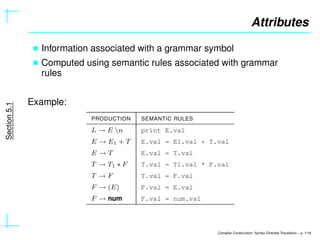
Information associated with a grammar symbol
Computed using semantic rules associated with grammar
rules
Example:
PRODUCTION SEMANTIC RULES
L → E n print E.val
E → E1 + T E.val = E1.val + T.val
E → T E.val = T.val
T → T1 ∗ F T.val = T1.val * F.val
T → F T.val = F.val
F → (E) F.val = E.val
F → num F.val = num.val
Compiler Construction: Syntax Directed Translation – p. 1/16
Attributes
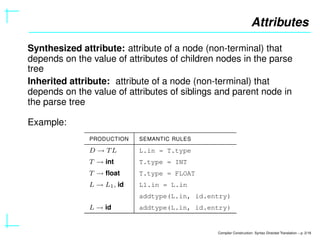
Synthesized attribute: attribute of a node (non-terminal) that
depends on the value of attributes of children nodes in the parse
tree
Inherited attribute: attribute of a node (non-terminal) that
depends on the value of attributes of siblings and parent node in
the parse tree
Example:
PRODUCTION SEMANTIC RULES
D → TL L.in = T.type
T → int T.type = INT
T → float T.type = FLOAT
L → L1, id L1.in = L.in
addtype(L.in, id.entry)
L → id addtype(L.in, id.entry)
Compiler Construction: Syntax Directed Translation – p. 2/16
Syntax-directed definitions
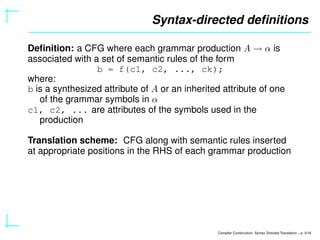
Definition: a CFG where each grammar production A → α is
associated with a set of semantic rules of the form
b = f(c1, c2, ..., ck);
where:
b is a synthesized attribute of A or an inherited attribute of one
of the grammar symbols in α
c1, c2, ... are attributes of the symbols used in the
production
Translation scheme: CFG along with semantic rules inserted
at appropriate positions in the RHS of each grammar production
Compiler Construction: Syntax Directed Translation – p. 3/16
Dependency graph
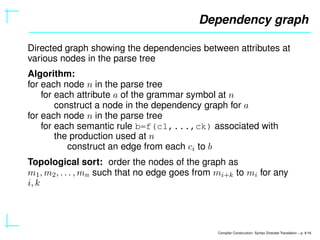
Directed graph showing the dependencies between attributes at
various nodes in the parse tree
Algorithm:
for each node n in the parse tree
for each attribute a of the grammar symbol at n
construct a node in the dependency graph for a
for each node n in the parse tree
for each semantic rule b=f(c1,...,ck) associated with
the production used at n
construct an edge from each ci to b
Topological sort: order the nodes of the graph as
m1, m2, . . . , mn such that no edge goes from mi+k to mi for any
i, k
Compiler Construction: Syntax Directed Translation – p. 4/16
Evaluation of SDDs
General scheme:
1. Parse the input program and construct the parse tree.
2. Draw the dependency graph for the parse tree.
3. Do a topological sort for the dependency graph.
4. Traverse nodes in topologically sorted order, and evaluate
attributes at each node.
Compiler Construction: Syntax Directed Translation – p. 5/16
Section5.3 S-attributed definitions
Definition: SDD with only synthesized attributes
Scheme:
1. Extend parser stack to have an extra field that stores the
value of attributes.
ALT. have a parsing stack and a parallel, value stack.
top → X X.x
Y Y.y
...
...
2. When pushing a terminal symbol on parsing stack, push
corresponding attribute value on value stack
Compiler Construction: Syntax Directed Translation – p. 6/16
S-attributed definitions
3. For the rule
A → X1X2 . . . Xr A.a = f(X1.x1, X2.x2, . . . , Xr.xr)
modify the value stack as follows:
ntop = top - r + 1;
val[ntop] = f(val[top-r+1], ..., val[top]);
top = ntop;
Example:
PRODUCTION SEMANTIC RULES
L → E n print val[top]
E → E1 + T val[ntop] = val[top-2] + val[top]
E → T
T → T ∗ F val[ntop] = val[top-2] * val[top]
T → F
F → (E) val[ntop] = val[top-1]
F → num
Compiler Construction: Syntax Directed Translation – p. 7/16
Section5.4 L-attributed definitions
Definition: A SDD istb L-attributed if each inherited attribute of
Xi in the RHS of A → X1 . . . Xn depends only on
1. attributes of X1, X2, . . . , Xi−1 (symbols to the left of Xi in the
RHS);
2. inherited attributes of A.
Restrictions for translation schemes:
1. Inherited attribute of Xi must be computed by an action
before Xi.
2. An action must not refer to synthesized attribute of any
symbol to the right of that action.
3. Synthesized attribute for A can only be computed after all
attributes it references have been completed (usually at end
of RHS).
Compiler Construction: Syntax Directed Translation – p. 8/16
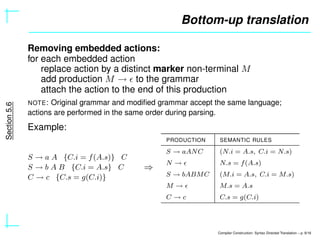
Section5.6 Bottom-up translation
Removing embedded actions:
for each embedded action
replace action by a distinct marker non-terminal M
add production M → to the grammar
attach the action to the end of this production
NOTE: Original grammar and modified grammar accept the same language;
actions are performed in the same order during parsing.
Example:
S → a A {C.i = f(A.s)} C
S → b A B {C.i = A.s} C
C → c {C.s = g(C.i)}
⇒
PRODUCTION SEMANTIC RULES
S → aANC (N.i = A.s, C.i = N.s)
N → N.s = f(A.s)
S → bABMC (M.i = A.s, C.i = M.s)
M → M.s = A.s
C → c C.s = g(C.i)
Compiler Construction: Syntax Directed Translation – p. 9/16
Bottom-up translation
Assumption: Each symbol X has one synthesized (X.s) and
one inherited (X.i) attribute.
1. Replace each A → X1 . . . Xn by
A → M1X1 . . . MnXn, Mi → {Xi.i = f(. . .)}
where each Mi is a new marker non-terminal
2. When reducing by Mi → :
top → Xi−1 Xi−1.s
top − 1 → Mi−1 Xi−1.i
.
.
.
.
.
.
top − 2i + 4 → X1 X1.s
top − 2i + 3 → M1 X1.i
top − 2i + 2 → MA A.i
. . . . . .
Compute Xi.i and
push on stack;
top ← top + 1
Compiler Construction: Syntax Directed Translation – p. 10/16
Bottom-up translation
3. When reducing by A → M1X1 . . . MnXn :
A.s = f(val[top-2n+2],...,val[top]);
val[top-2n+1] = A.s;
top = top-2n+1;
4. Simplifications:
If Xj has no inherited attributes or is computed by a copy rule
Xj.i = Xj−1.s discard Mj; adjust indices of val array suitably.
If X1.i exists and X1.i = A.i, omit M1.
(avoids parsing conflicts in left recursive grammars)
NOTES:
i) LL(1) grammar + markers is LL(1) ⇒ no conflicts
ii) LR(1) grammar + markers may not be LR(1) ⇒ conflicts may occur
Compiler Construction: Syntax Directed Translation – p. 11/16
Bottom-up translation
Example:
PRODUCTION SEMANTIC RULES STACK OPS
S → aANC (N.i = A.s, C.i = N.s)
N → N.s = f(A.s) val[ntop] = f(val[top])
S → bABMC (M.i = A.s, C.i = M.s)
M → M.s = A.s val[ntop] = val[top-1]
C → c C.s = g(C.i) val[ntop] = g(val[top-1])
Compiler Construction: Syntax Directed Translation – p. 12/16
Miscellaneous
non-L-attributed definitions:
D → L : T
T → integer | char
L → L, id | id
⇒
D → id L
T → integer | char
L → , id L | : T
“Hard” L-attributed definitions:
PRODUCTION SEMANTIC RULES
S → L L.count = 0
L → L11 L1.count = L.count + 1
L → print(L.count)
Compiler Construction: Syntax Directed Translation – p. 13/16
Section5.5 Top-down translation
Left-recursion elimination:
Input: A → A1Y { A.a = g(A1.a, Y.y) }
A → X { A.a = f(X.x) }
Output: A → X { R.i = f(X.x) } R { A.a = R.s }
R → Y { R1.i = g(R.i, Y.y) } R1 { R.s = R1.s }
R → { R.s = R.i }
Example:
E → E1 + T { E.val = E1.val + T.val }
E → E1 − T { E.val = E1.val − T.val }
E → T { E.val = T.val }
T → (E) { T.val = E.val }
T → num { T.val = num.val }
E → T { R.i = T.val } R
{ E.val = R.s }
R → + T { R1.i = R.i + T.val } R1
{ R.s = R1.s }
R → − T { R1.i = R.i − T.val } R1
{ R.s = R1.s }
R → { R.s = R.i }
Compiler Construction: Syntax Directed Translation – p. 14/16
Predictive translation
Input: translation scheme based on a grammar suitable for
predictive parsing
Output: Code for a syntax-directed translator
Method:
1. For each nonterminal A, construct a function with
Input parameters: one for each inherited attribute of A;
Return value: synthesized attributes of A;
Local variables: one for each attribute of each grammar
symbol that appears in a production for A.
2. Code for non-terminal A decides what production to use
based on the current input symbol (switch statement). Code
for each production forms one case of a switch statement.
Compiler Construction: Syntax Directed Translation – p. 15/16
Predictive translation
3. In the code for a production, tokens, nonterminals, actions in
the RHS are considered left to right.
(i) For token X: save X.s in the variable created for X;
generate a call to match X and advance input.
(ii) For nonterminal B: generate an assignment
c = B(b1, b2, ..., bk);
where:
b1, b2, ... are variables corresponding to
inherited attributes of B,
c is the variable for synthesized attribute of B,
B is the function created for B.
(iii) For an action, copy the code into the function, replacing
each reference to an attribute by the variable created for
that attribute.
Compiler Construction: Syntax Directed Translation – p. 16/16

Sdt

  • 1.
    Section5.1 Attributes Information associatedwith a grammar symbol Computed using semantic rules associated with grammar rules Example: PRODUCTION SEMANTIC RULES L → E n print E.val E → E1 + T E.val = E1.val + T.val E → T E.val = T.val T → T1 ∗ F T.val = T1.val * F.val T → F T.val = F.val F → (E) F.val = E.val F → num F.val = num.val Compiler Construction: Syntax Directed Translation – p. 1/16
  • 2.
    Attributes Synthesized attribute: attributeof a node (non-terminal) that depends on the value of attributes of children nodes in the parse tree Inherited attribute: attribute of a node (non-terminal) that depends on the value of attributes of siblings and parent node in the parse tree Example: PRODUCTION SEMANTIC RULES D → TL L.in = T.type T → int T.type = INT T → float T.type = FLOAT L → L1, id L1.in = L.in addtype(L.in, id.entry) L → id addtype(L.in, id.entry) Compiler Construction: Syntax Directed Translation – p. 2/16
  • 3.
    Syntax-directed definitions Definition: aCFG where each grammar production A → α is associated with a set of semantic rules of the form b = f(c1, c2, ..., ck); where: b is a synthesized attribute of A or an inherited attribute of one of the grammar symbols in α c1, c2, ... are attributes of the symbols used in the production Translation scheme: CFG along with semantic rules inserted at appropriate positions in the RHS of each grammar production Compiler Construction: Syntax Directed Translation – p. 3/16
  • 4.
    Dependency graph Directed graphshowing the dependencies between attributes at various nodes in the parse tree Algorithm: for each node n in the parse tree for each attribute a of the grammar symbol at n construct a node in the dependency graph for a for each node n in the parse tree for each semantic rule b=f(c1,...,ck) associated with the production used at n construct an edge from each ci to b Topological sort: order the nodes of the graph as m1, m2, . . . , mn such that no edge goes from mi+k to mi for any i, k Compiler Construction: Syntax Directed Translation – p. 4/16
  • 5.
    Evaluation of SDDs Generalscheme: 1. Parse the input program and construct the parse tree. 2. Draw the dependency graph for the parse tree. 3. Do a topological sort for the dependency graph. 4. Traverse nodes in topologically sorted order, and evaluate attributes at each node. Compiler Construction: Syntax Directed Translation – p. 5/16
  • 6.
    Section5.3 S-attributed definitions Definition:SDD with only synthesized attributes Scheme: 1. Extend parser stack to have an extra field that stores the value of attributes. ALT. have a parsing stack and a parallel, value stack. top → X X.x Y Y.y ... ... 2. When pushing a terminal symbol on parsing stack, push corresponding attribute value on value stack Compiler Construction: Syntax Directed Translation – p. 6/16
  • 7.
    S-attributed definitions 3. Forthe rule A → X1X2 . . . Xr A.a = f(X1.x1, X2.x2, . . . , Xr.xr) modify the value stack as follows: ntop = top - r + 1; val[ntop] = f(val[top-r+1], ..., val[top]); top = ntop; Example: PRODUCTION SEMANTIC RULES L → E n print val[top] E → E1 + T val[ntop] = val[top-2] + val[top] E → T T → T ∗ F val[ntop] = val[top-2] * val[top] T → F F → (E) val[ntop] = val[top-1] F → num Compiler Construction: Syntax Directed Translation – p. 7/16
  • 8.
    Section5.4 L-attributed definitions Definition:A SDD istb L-attributed if each inherited attribute of Xi in the RHS of A → X1 . . . Xn depends only on 1. attributes of X1, X2, . . . , Xi−1 (symbols to the left of Xi in the RHS); 2. inherited attributes of A. Restrictions for translation schemes: 1. Inherited attribute of Xi must be computed by an action before Xi. 2. An action must not refer to synthesized attribute of any symbol to the right of that action. 3. Synthesized attribute for A can only be computed after all attributes it references have been completed (usually at end of RHS). Compiler Construction: Syntax Directed Translation – p. 8/16
  • 9.
    Section5.6 Bottom-up translation Removingembedded actions: for each embedded action replace action by a distinct marker non-terminal M add production M → to the grammar attach the action to the end of this production NOTE: Original grammar and modified grammar accept the same language; actions are performed in the same order during parsing. Example: S → a A {C.i = f(A.s)} C S → b A B {C.i = A.s} C C → c {C.s = g(C.i)} ⇒ PRODUCTION SEMANTIC RULES S → aANC (N.i = A.s, C.i = N.s) N → N.s = f(A.s) S → bABMC (M.i = A.s, C.i = M.s) M → M.s = A.s C → c C.s = g(C.i) Compiler Construction: Syntax Directed Translation – p. 9/16
  • 10.
    Bottom-up translation Assumption: Eachsymbol X has one synthesized (X.s) and one inherited (X.i) attribute. 1. Replace each A → X1 . . . Xn by A → M1X1 . . . MnXn, Mi → {Xi.i = f(. . .)} where each Mi is a new marker non-terminal 2. When reducing by Mi → : top → Xi−1 Xi−1.s top − 1 → Mi−1 Xi−1.i . . . . . . top − 2i + 4 → X1 X1.s top − 2i + 3 → M1 X1.i top − 2i + 2 → MA A.i . . . . . . Compute Xi.i and push on stack; top ← top + 1 Compiler Construction: Syntax Directed Translation – p. 10/16
  • 11.
    Bottom-up translation 3. Whenreducing by A → M1X1 . . . MnXn : A.s = f(val[top-2n+2],...,val[top]); val[top-2n+1] = A.s; top = top-2n+1; 4. Simplifications: If Xj has no inherited attributes or is computed by a copy rule Xj.i = Xj−1.s discard Mj; adjust indices of val array suitably. If X1.i exists and X1.i = A.i, omit M1. (avoids parsing conflicts in left recursive grammars) NOTES: i) LL(1) grammar + markers is LL(1) ⇒ no conflicts ii) LR(1) grammar + markers may not be LR(1) ⇒ conflicts may occur Compiler Construction: Syntax Directed Translation – p. 11/16
  • 12.
    Bottom-up translation Example: PRODUCTION SEMANTICRULES STACK OPS S → aANC (N.i = A.s, C.i = N.s) N → N.s = f(A.s) val[ntop] = f(val[top]) S → bABMC (M.i = A.s, C.i = M.s) M → M.s = A.s val[ntop] = val[top-1] C → c C.s = g(C.i) val[ntop] = g(val[top-1]) Compiler Construction: Syntax Directed Translation – p. 12/16
  • 13.
    Miscellaneous non-L-attributed definitions: D →L : T T → integer | char L → L, id | id ⇒ D → id L T → integer | char L → , id L | : T “Hard” L-attributed definitions: PRODUCTION SEMANTIC RULES S → L L.count = 0 L → L11 L1.count = L.count + 1 L → print(L.count) Compiler Construction: Syntax Directed Translation – p. 13/16
  • 14.
    Section5.5 Top-down translation Left-recursionelimination: Input: A → A1Y { A.a = g(A1.a, Y.y) } A → X { A.a = f(X.x) } Output: A → X { R.i = f(X.x) } R { A.a = R.s } R → Y { R1.i = g(R.i, Y.y) } R1 { R.s = R1.s } R → { R.s = R.i } Example: E → E1 + T { E.val = E1.val + T.val } E → E1 − T { E.val = E1.val − T.val } E → T { E.val = T.val } T → (E) { T.val = E.val } T → num { T.val = num.val } E → T { R.i = T.val } R { E.val = R.s } R → + T { R1.i = R.i + T.val } R1 { R.s = R1.s } R → − T { R1.i = R.i − T.val } R1 { R.s = R1.s } R → { R.s = R.i } Compiler Construction: Syntax Directed Translation – p. 14/16
  • 15.
    Predictive translation Input: translationscheme based on a grammar suitable for predictive parsing Output: Code for a syntax-directed translator Method: 1. For each nonterminal A, construct a function with Input parameters: one for each inherited attribute of A; Return value: synthesized attributes of A; Local variables: one for each attribute of each grammar symbol that appears in a production for A. 2. Code for non-terminal A decides what production to use based on the current input symbol (switch statement). Code for each production forms one case of a switch statement. Compiler Construction: Syntax Directed Translation – p. 15/16
  • 16.
    Predictive translation 3. Inthe code for a production, tokens, nonterminals, actions in the RHS are considered left to right. (i) For token X: save X.s in the variable created for X; generate a call to match X and advance input. (ii) For nonterminal B: generate an assignment c = B(b1, b2, ..., bk); where: b1, b2, ... are variables corresponding to inherited attributes of B, c is the variable for synthesized attribute of B, B is the function created for B. (iii) For an action, copy the code into the function, replacing each reference to an attribute by the variable created for that attribute. Compiler Construction: Syntax Directed Translation – p. 16/16