Lexical Analysis II
Lecture 4
Lexical Analysis II
Finite Automata
• Regular Expression = specification
• Finite Automata = implementation
• A Finite Automata consists of
– An input alphabet (Σ)
– A finite set of states (S)
– A start state (say n)
– A set of accepting states [F ϵ S]
– A set of transitions
S0 S1
a
Start State
Accepting
State
8-Jan-15 2CS 346 Lecture 4
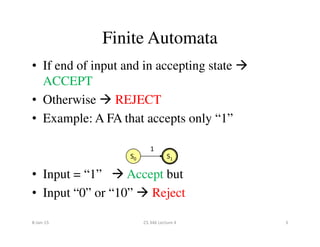
• If end of input and in accepting state
ACCEPT
• Otherwise REJECT
• Example: A FA that accepts only “1”
Finite Automata
• Example: A FA that accepts only “1”
• Input = “1” Accept but
• Input “0” or “10” Reject
S0 S1
1
8-Jan-15 3CS 346 Lecture 4
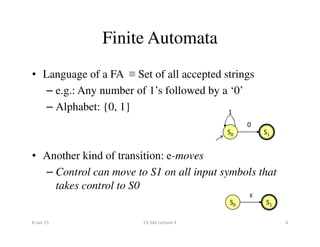
• Language of a FA ≡ Set of all accepted strings
– e.g.: Any number of 1’s followed by a ‘0’
– Alphabet: {0, 1}
0
1
Finite Automata
• Another kind of transition: e-moves
– Control can move to S1 on all input symbols that
takes control to S0
S0 S1
0
S0 S1
ɛ
8-Jan-15 4CS 346 Lecture 4
Non-deterministic Finite Automata (NFA)
• Can have multiple transition for one input for a
given state
• Can have ε move
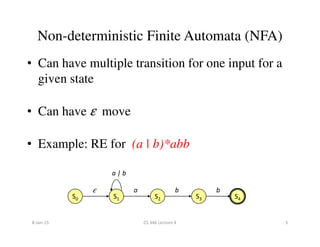
• Example: RE for (a | b)*abb
S0 S1 S2 S3 S4
ε a b b
a | b
8-Jan-15 5CS 346 Lecture 4
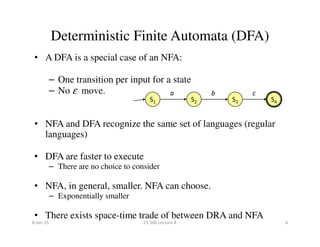
• A DFA is a special case of an NFA:
– One transition per input for a state
– No ε move.
• NFA and DFA recognize the same set of languages (regular
Deterministic Finite Automata (DFA)
S1 S2 S3 S4
a b c
• NFA and DFA recognize the same set of languages (regular
languages)
• DFA are faster to execute
– There are no choice to consider
• NFA, in general, smaller. NFA can choose.
– Exponentially smaller
• There exists space-time trade of between DRA and NFA
8-Jan-15 6CS 346 Lecture 4
Motivation
Automatic Lexical Analyser Construction
To convert a specification into code:
• Write down the RE for the input language.
• Convert the RE to a NFA (Thompson’s construction)
• Build the DFA that simulates the NFA (subset construction)
• Shrink the DFA (Hopcroft’s algorithm)• Shrink the DFA (Hopcroft’s algorithm)
(for the curious: there is a full cycle - DFA to RE construction is all pairs, all paths)
Lexical analyser generators:
• lex or flex work along these lines.
• Algorithms are well-known and understood.
• Key issue is the interface to parser.
8-Jan-15 7CS 346 Lecture 4
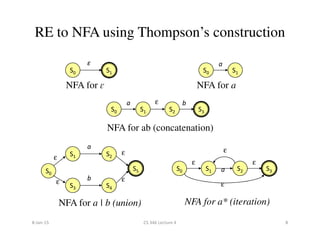
RE to NFA using Thompson’s construction
S0 S1
ɛ a
S0 S1
NFA for ɛ NFA for a
NFA for ab (concatenation)
S0 S1 S2 S3
a bε
S0 S1 S2 S3a
ε
S0
S5
S4
S2
S3
S1
a
b
ε
ε
ε
ε
ε ε
ε
NFA for a | b (union) NFA for a* (iteration)
NFA for ab (concatenation)
8-Jan-15 8CS 346 Lecture 4
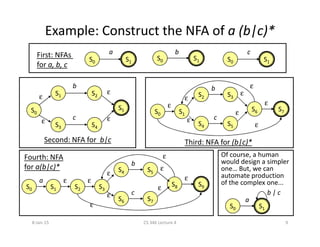
Example: Construct the NFA of a (b|c)*
S0 S1
a
S0 S1
c
S0 S1
b
S0
S5
S
S2
S
S1
b
c
ε
ε
ε
ε
First: NFAs
for a, b, c
S0 S1
S2
S4
S3
S5
S6 S7
b
c
ε
ε
εε
ε
ε
ε
ε
S4S3
ε
ε
S0 S1 S2 S3
S4
S6
S5
S7
S8 S9
ε ε ε
ε
ε
ε
ε
ε
b
c
a
b | c
S0 S1
a
Second: NFA for b|c
S4 S5 ε
ε
Third: NFA for (b|c)*
Fourth: NFA
for a(b|c)*
Of course, a human
would design a simpler
one… But, we can
automate production
of the complex one...
8-Jan-15 9CS 346 Lecture 4
NFA to DFA: two key functions
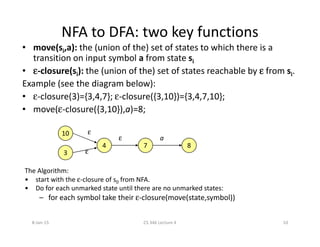
• move(si,a): the (union of the) set of states to which there is a
transition on input symbol a from state si
• εεεε-closure(si): the (union of the) set of states reachable by εεεε from si.
Example (see the diagram below):
• ε-closure(3)={3,4,7}; ε-closure({3,10})={3,4,7,10};
• move(ε-closure({3,10}),a)=8;
10
4 7 8
3
The Algorithm:
• start with the ε-closure of s0 from NFA.
• Do for each unmarked state until there are no unmarked states:
– for each symbol take their ε-closure(move(state,symbol))
aε
ε
ε
8-Jan-15 10CS 346 Lecture 4
NFA to DFA with subset construction
Initially, ε-closure is the only state in Dstates and it is unmarked.
while there is an unmarked state T in Dstates
mark T
for each input symbol a
U:=ε-closure(move(T,a))
if U is not in Dstates then add U as unmarked to Dstates
Dtable[T,a]:=U
• Dstates (set of states for DFA) and Dtable form the DFA.
• Each state of DFA corresponds to a set of NFA states that NFA
could be in after reading some sequences of input symbols.
• This is a fixed-point computation.
It sounds more complex than it actually is!
8-Jan-15 11CS 346 Lecture 4
Example: NFA for (a | b)*abb
• A=ε-closure(0)={0,1,2,4,7}
• for each input symbol (that is, a and b):
0 1
2 3
6
4 5
7 8 9 10
ε
ε ε
εεε
b
a
b ba
ε
ε
• for each input symbol (that is, a and b):
– B=ε-closure(move(A,a))=ε-closure({3,8})={1,2,3,4,6,7,8}
– C=ε-closure(move(A,b))=ε-closure({5})={1,2,4,5,6,7}
– Dtable[A,a]=B; Dtable[A,b]=C
• B and C are unmarked. Repeating the above we end up with:
– C={1,2,4,5,6,7}; D={1,2,4,5,6,7,9}; E={1,2,4,5,6,7,10}; and
– Dtable[B,a]=B; Dtable[B,b]=D; Dtable[C,a]=B; Dtable[C,b]=C;
Dtable[D,a]=B; Dtable[D,b]=E; Dtable[E,a]=B; Dtable[E,b]=C; no
more unmarked sets at this point!
8-Jan-15 12CS 346 Lecture 4
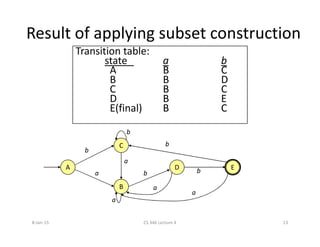
Result of applying subset construction
Transition table:
state a b
A B C
B B D
C B C
D B E
E(final) B C
A
B
D E
C
b
a
a
a
a
a
b
bb
b
8-Jan-15 13CS 346 Lecture 4
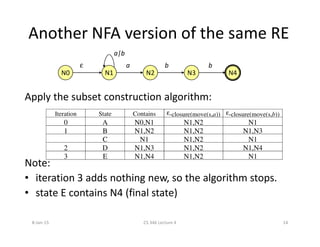
Another NFA version of the same RE
Apply the subset construction algorithm:
Iteration State Contains ε-closure(move(s,a)) ε-closure(move(s,b))
0 A N0,N1 N1,N2 N1
N0 N1 N2 N3 N4
ε
a|b
a b b
Note:
• iteration 3 adds nothing new, so the algorithm stops.
• state E contains N4 (final state)
0 A N0,N1 N1,N2 N1
1 B N1,N2 N1,N2 N1,N3
C N1 N1,N2 N1
2 D N1,N3 N1,N2 N1,N4
3 E N1,N4 N1,N2 N1
8-Jan-15 14CS 346 Lecture 4
DFA Minimisation: the problem
A
B
D E
C
b
a
a
a
a
a
b
bb
b
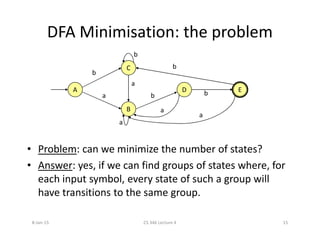
• Problem: can we minimize the number of states?
• Answer: yes, if we can find groups of states where, for
each input symbol, every state of such a group will
have transitions to the same group.
a
8-Jan-15 15CS 346 Lecture 4
DFA minimisation: the algorithm
(Hopcroft’s algorithm: simple version)
Divide the states of the DFA into two groups: those containing
final states and those containing non-final states.
while there are group changes
for each group
for each input symbol
if for any two states of the group and a given inputif for any two states of the group and a given input
symbol, their transitions do not lead to the same group, these
states must belong to different groups.
For the curious, there is an alternative approach: create a graph in which there is an
edge between each pair of states which cannot coexist in a group because of the
conflict above. Then use a graph colouring algorithm to find the minimum number
of colours needed so that any two nodes connected by an edge do not have the
same colour (we’ll examine graph colouring algorithms later on, in register
allocation)
8-Jan-15 16CS 346 Lecture 4
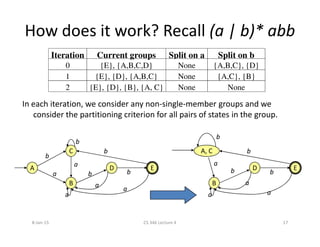
How does it work? Recall (a | b)* abb
In each iteration, we consider any non-single-member groups and we
consider the partitioning criterion for all pairs of states in the group.
Iteration Current groups Split on a Split on b
0 {E}, {A,B,C,D} None {A,B,C}, {D}
1 {E}, {D}, {A,B,C} None {A,C}, {B}
2 {E}, {D}, {B}, {A, C} None None
A
B
D E
C
b
a
a
a
a
a
b
bb
b
B
D E
A, C
a
a
aa
b
bb
b
8-Jan-15 17CS 346 Lecture 4
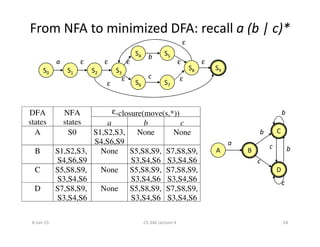
From NFA to minimized DFA: recall a (b | c)*
S0 S1 S2 S3
S4
S6
S5
S7
S8 S9
a ε ε
ε
ε
ε
ε
ε
ε
ε
b
c
ε-closure(move(s,*))DFA
states
NFA
states a b c
b
states states a b c
A S0 S1,S2,S3,
S4,S6,S9
None None
B S1,S2,S3,
S4,S6,S9
None S5,S8,S9,
S3,S4,S6
S7,S8,S9,
S3,S4,S6
C S5,S8,S9,
S3,S4,S6
None S5,S8,S9,
S3,S4,S6
S7,S8,S9,
S3,S4,S6
D S7,S8,S9,
S3,S4,S6
None S5,S8,S9,
S3,S4,S6
S7,S8,S9,
S3,S4,S6
A
D
C
B
a
c
c
c b
b
8-Jan-15 18CS 346 Lecture 4
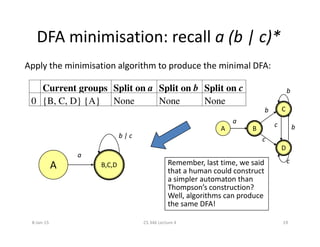
DFA minimisation: recall a (b | c)*
Apply the minimisation algorithm to produce the minimal DFA:
C
a c b
b
bCurrent groups Split on a Split on b Split on c
0 {B, C, D} {A} None None None
A
D
B
a
c
c
c b
A B,C,D
b | c
a
Remember, last time, we said
that a human could construct
a simpler automaton than
Thompson’s construction?
Well, algorithms can produce
the same DFA!
8-Jan-15 19CS 346 Lecture 4
Lecture4 lexical analysis2

Lecture4 lexical analysis2

  • 1.
    Lexical Analysis II Lecture4 Lexical Analysis II
  • 2.
    Finite Automata • RegularExpression = specification • Finite Automata = implementation • A Finite Automata consists of – An input alphabet (Σ) – A finite set of states (S) – A start state (say n) – A set of accepting states [F ϵ S] – A set of transitions S0 S1 a Start State Accepting State 8-Jan-15 2CS 346 Lecture 4
  • 3.
    • If endof input and in accepting state ACCEPT • Otherwise REJECT • Example: A FA that accepts only “1” Finite Automata • Example: A FA that accepts only “1” • Input = “1” Accept but • Input “0” or “10” Reject S0 S1 1 8-Jan-15 3CS 346 Lecture 4
  • 4.
    • Language ofa FA ≡ Set of all accepted strings – e.g.: Any number of 1’s followed by a ‘0’ – Alphabet: {0, 1} 0 1 Finite Automata • Another kind of transition: e-moves – Control can move to S1 on all input symbols that takes control to S0 S0 S1 0 S0 S1 ɛ 8-Jan-15 4CS 346 Lecture 4
  • 5.
    Non-deterministic Finite Automata(NFA) • Can have multiple transition for one input for a given state • Can have ε move • Example: RE for (a | b)*abb S0 S1 S2 S3 S4 ε a b b a | b 8-Jan-15 5CS 346 Lecture 4
  • 6.
    • A DFAis a special case of an NFA: – One transition per input for a state – No ε move. • NFA and DFA recognize the same set of languages (regular Deterministic Finite Automata (DFA) S1 S2 S3 S4 a b c • NFA and DFA recognize the same set of languages (regular languages) • DFA are faster to execute – There are no choice to consider • NFA, in general, smaller. NFA can choose. – Exponentially smaller • There exists space-time trade of between DRA and NFA 8-Jan-15 6CS 346 Lecture 4
  • 7.
    Motivation Automatic Lexical AnalyserConstruction To convert a specification into code: • Write down the RE for the input language. • Convert the RE to a NFA (Thompson’s construction) • Build the DFA that simulates the NFA (subset construction) • Shrink the DFA (Hopcroft’s algorithm)• Shrink the DFA (Hopcroft’s algorithm) (for the curious: there is a full cycle - DFA to RE construction is all pairs, all paths) Lexical analyser generators: • lex or flex work along these lines. • Algorithms are well-known and understood. • Key issue is the interface to parser. 8-Jan-15 7CS 346 Lecture 4
  • 8.
    RE to NFAusing Thompson’s construction S0 S1 ɛ a S0 S1 NFA for ɛ NFA for a NFA for ab (concatenation) S0 S1 S2 S3 a bε S0 S1 S2 S3a ε S0 S5 S4 S2 S3 S1 a b ε ε ε ε ε ε ε NFA for a | b (union) NFA for a* (iteration) NFA for ab (concatenation) 8-Jan-15 8CS 346 Lecture 4
  • 9.
    Example: Construct theNFA of a (b|c)* S0 S1 a S0 S1 c S0 S1 b S0 S5 S S2 S S1 b c ε ε ε ε First: NFAs for a, b, c S0 S1 S2 S4 S3 S5 S6 S7 b c ε ε εε ε ε ε ε S4S3 ε ε S0 S1 S2 S3 S4 S6 S5 S7 S8 S9 ε ε ε ε ε ε ε ε b c a b | c S0 S1 a Second: NFA for b|c S4 S5 ε ε Third: NFA for (b|c)* Fourth: NFA for a(b|c)* Of course, a human would design a simpler one… But, we can automate production of the complex one... 8-Jan-15 9CS 346 Lecture 4
  • 10.
    NFA to DFA:two key functions • move(si,a): the (union of the) set of states to which there is a transition on input symbol a from state si • εεεε-closure(si): the (union of the) set of states reachable by εεεε from si. Example (see the diagram below): • ε-closure(3)={3,4,7}; ε-closure({3,10})={3,4,7,10}; • move(ε-closure({3,10}),a)=8; 10 4 7 8 3 The Algorithm: • start with the ε-closure of s0 from NFA. • Do for each unmarked state until there are no unmarked states: – for each symbol take their ε-closure(move(state,symbol)) aε ε ε 8-Jan-15 10CS 346 Lecture 4
  • 11.
    NFA to DFAwith subset construction Initially, ε-closure is the only state in Dstates and it is unmarked. while there is an unmarked state T in Dstates mark T for each input symbol a U:=ε-closure(move(T,a)) if U is not in Dstates then add U as unmarked to Dstates Dtable[T,a]:=U • Dstates (set of states for DFA) and Dtable form the DFA. • Each state of DFA corresponds to a set of NFA states that NFA could be in after reading some sequences of input symbols. • This is a fixed-point computation. It sounds more complex than it actually is! 8-Jan-15 11CS 346 Lecture 4
  • 12.
    Example: NFA for(a | b)*abb • A=ε-closure(0)={0,1,2,4,7} • for each input symbol (that is, a and b): 0 1 2 3 6 4 5 7 8 9 10 ε ε ε εεε b a b ba ε ε • for each input symbol (that is, a and b): – B=ε-closure(move(A,a))=ε-closure({3,8})={1,2,3,4,6,7,8} – C=ε-closure(move(A,b))=ε-closure({5})={1,2,4,5,6,7} – Dtable[A,a]=B; Dtable[A,b]=C • B and C are unmarked. Repeating the above we end up with: – C={1,2,4,5,6,7}; D={1,2,4,5,6,7,9}; E={1,2,4,5,6,7,10}; and – Dtable[B,a]=B; Dtable[B,b]=D; Dtable[C,a]=B; Dtable[C,b]=C; Dtable[D,a]=B; Dtable[D,b]=E; Dtable[E,a]=B; Dtable[E,b]=C; no more unmarked sets at this point! 8-Jan-15 12CS 346 Lecture 4
  • 13.
    Result of applyingsubset construction Transition table: state a b A B C B B D C B C D B E E(final) B C A B D E C b a a a a a b bb b 8-Jan-15 13CS 346 Lecture 4
  • 14.
    Another NFA versionof the same RE Apply the subset construction algorithm: Iteration State Contains ε-closure(move(s,a)) ε-closure(move(s,b)) 0 A N0,N1 N1,N2 N1 N0 N1 N2 N3 N4 ε a|b a b b Note: • iteration 3 adds nothing new, so the algorithm stops. • state E contains N4 (final state) 0 A N0,N1 N1,N2 N1 1 B N1,N2 N1,N2 N1,N3 C N1 N1,N2 N1 2 D N1,N3 N1,N2 N1,N4 3 E N1,N4 N1,N2 N1 8-Jan-15 14CS 346 Lecture 4
  • 15.
    DFA Minimisation: theproblem A B D E C b a a a a a b bb b • Problem: can we minimize the number of states? • Answer: yes, if we can find groups of states where, for each input symbol, every state of such a group will have transitions to the same group. a 8-Jan-15 15CS 346 Lecture 4
  • 16.
    DFA minimisation: thealgorithm (Hopcroft’s algorithm: simple version) Divide the states of the DFA into two groups: those containing final states and those containing non-final states. while there are group changes for each group for each input symbol if for any two states of the group and a given inputif for any two states of the group and a given input symbol, their transitions do not lead to the same group, these states must belong to different groups. For the curious, there is an alternative approach: create a graph in which there is an edge between each pair of states which cannot coexist in a group because of the conflict above. Then use a graph colouring algorithm to find the minimum number of colours needed so that any two nodes connected by an edge do not have the same colour (we’ll examine graph colouring algorithms later on, in register allocation) 8-Jan-15 16CS 346 Lecture 4
  • 17.
    How does itwork? Recall (a | b)* abb In each iteration, we consider any non-single-member groups and we consider the partitioning criterion for all pairs of states in the group. Iteration Current groups Split on a Split on b 0 {E}, {A,B,C,D} None {A,B,C}, {D} 1 {E}, {D}, {A,B,C} None {A,C}, {B} 2 {E}, {D}, {B}, {A, C} None None A B D E C b a a a a a b bb b B D E A, C a a aa b bb b 8-Jan-15 17CS 346 Lecture 4
  • 18.
    From NFA tominimized DFA: recall a (b | c)* S0 S1 S2 S3 S4 S6 S5 S7 S8 S9 a ε ε ε ε ε ε ε ε ε b c ε-closure(move(s,*))DFA states NFA states a b c b states states a b c A S0 S1,S2,S3, S4,S6,S9 None None B S1,S2,S3, S4,S6,S9 None S5,S8,S9, S3,S4,S6 S7,S8,S9, S3,S4,S6 C S5,S8,S9, S3,S4,S6 None S5,S8,S9, S3,S4,S6 S7,S8,S9, S3,S4,S6 D S7,S8,S9, S3,S4,S6 None S5,S8,S9, S3,S4,S6 S7,S8,S9, S3,S4,S6 A D C B a c c c b b 8-Jan-15 18CS 346 Lecture 4
  • 19.
    DFA minimisation: recalla (b | c)* Apply the minimisation algorithm to produce the minimal DFA: C a c b b bCurrent groups Split on a Split on b Split on c 0 {B, C, D} {A} None None None A D B a c c c b A B,C,D b | c a Remember, last time, we said that a human could construct a simpler automaton than Thompson’s construction? Well, algorithms can produce the same DFA! 8-Jan-15 19CS 346 Lecture 4