1
Lexical Analysis and
Lexical Analyzer Generators
Chapter 3
COP5621 Compiler Construction
Copyright Robert van Engelen, Florida State University, 2007
2
The Reason Why Lexical
Analysis is a Separate Phase
• Simplifies the design of the compiler
– LL(1) or LR(1) parsing with 1 token lookahead would
not be possible (multiple characters/tokens to match)
• Provides efficient implementation
– Systematic techniques to implement lexical analyzers
by hand or automatically from specifications
– Stream buffering methods to scan input
• Improves portability
– Non-standard symbols and alternate character
encodings can be normalized (e.g. trigraphs)
3
Interaction of the Lexical
Analyzer with the Parser
Lexical
Analyzer
Parser
Source
Program
Token,
tokenval
Symbol Table
Get next
token
error error
4
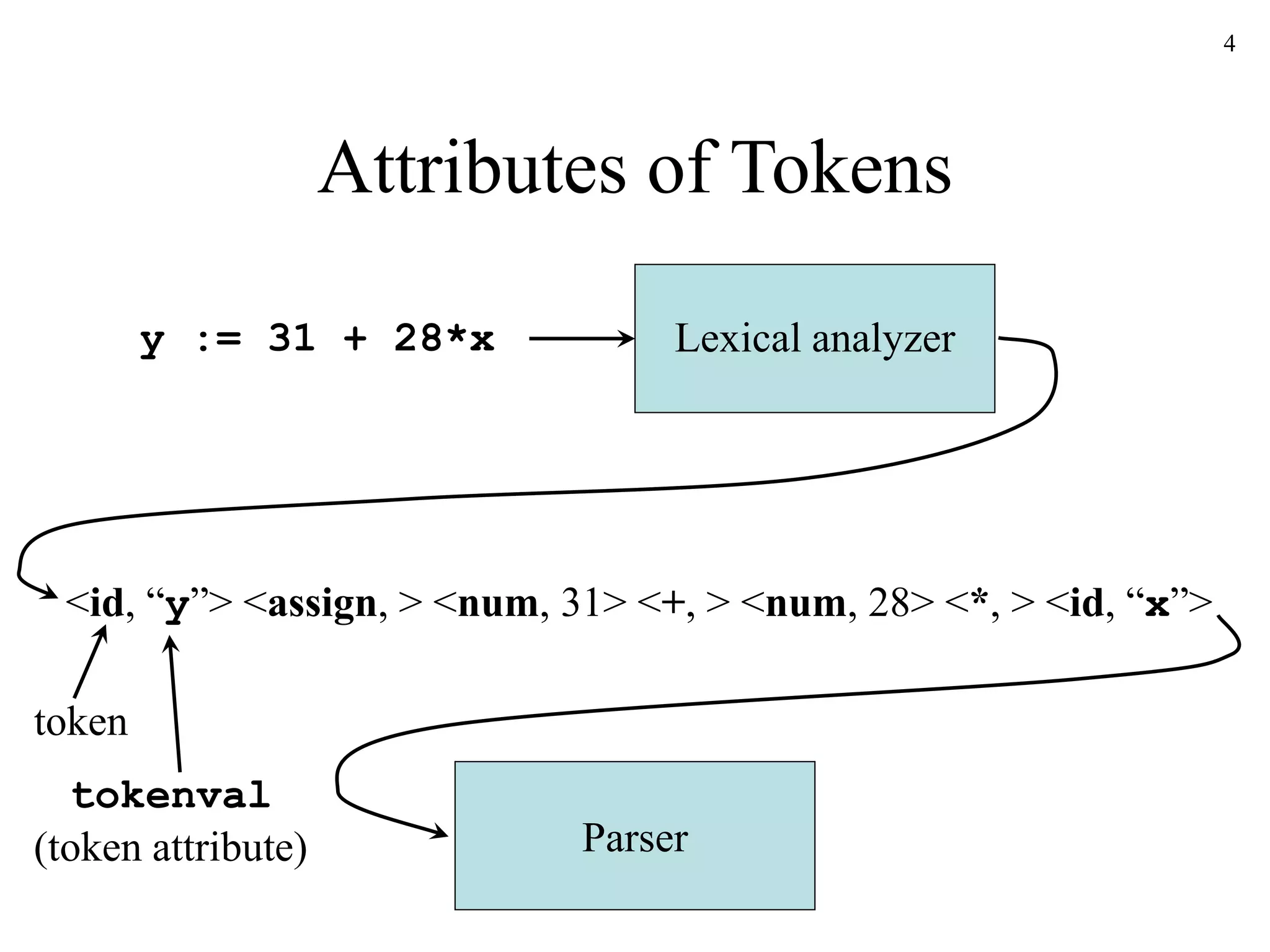
Attributes of Tokens
Lexical analyzer
<id, “y”> <assign, > <num, 31> <+, > <num, 28> <*, > <id, “x”>
y := 31 + 28*x
Parser
token
tokenval
(token attribute)
5
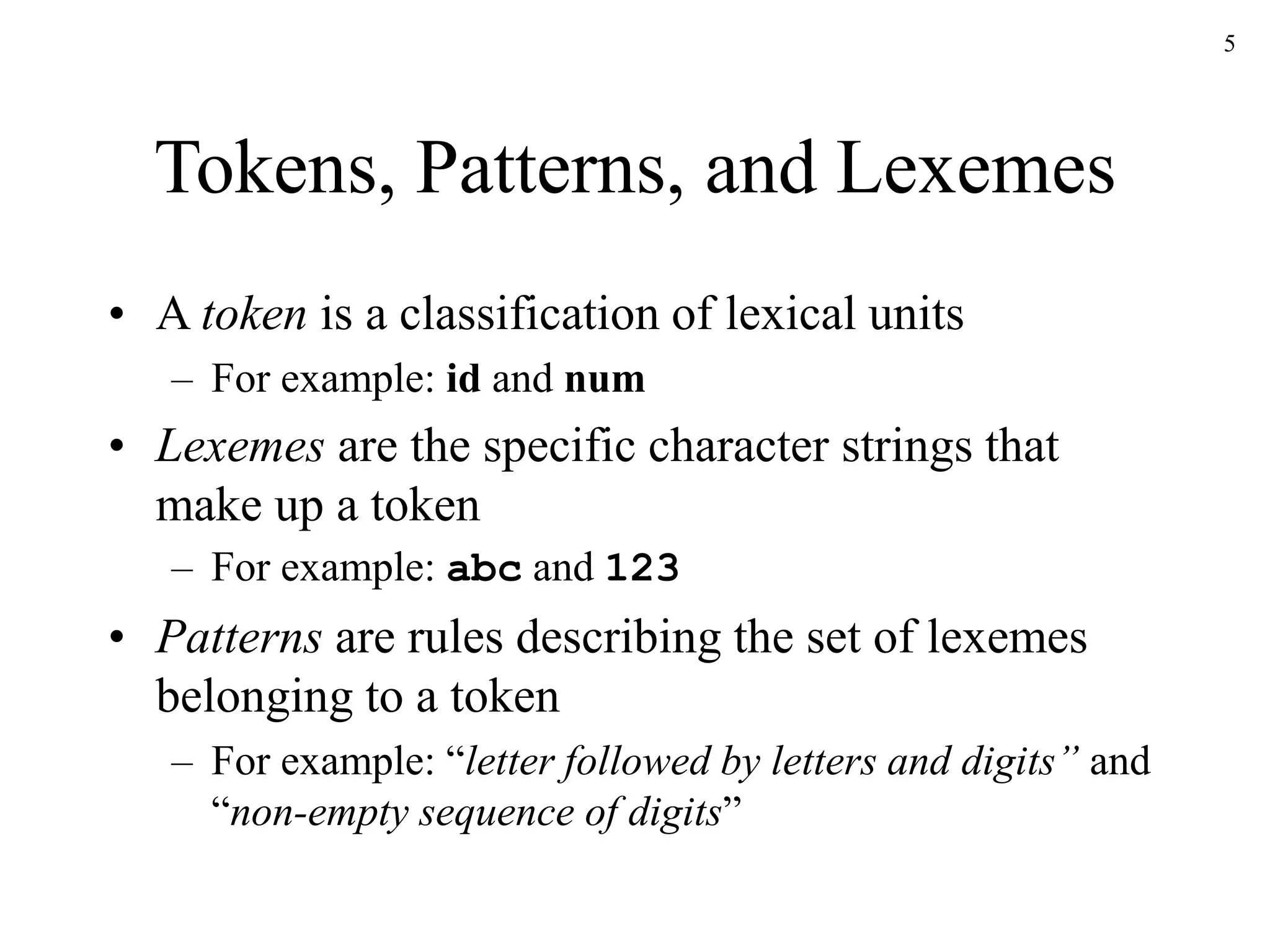
Tokens, Patterns, and Lexemes
• A token is a classification of lexical units
– For example: id and num
• Lexemes are the specific character strings that
make up a token
– For example: abc and 123
• Patterns are rules describing the set of lexemes
belonging to a token
– For example: “letter followed by letters and digits” and
“non-empty sequence of digits”
6
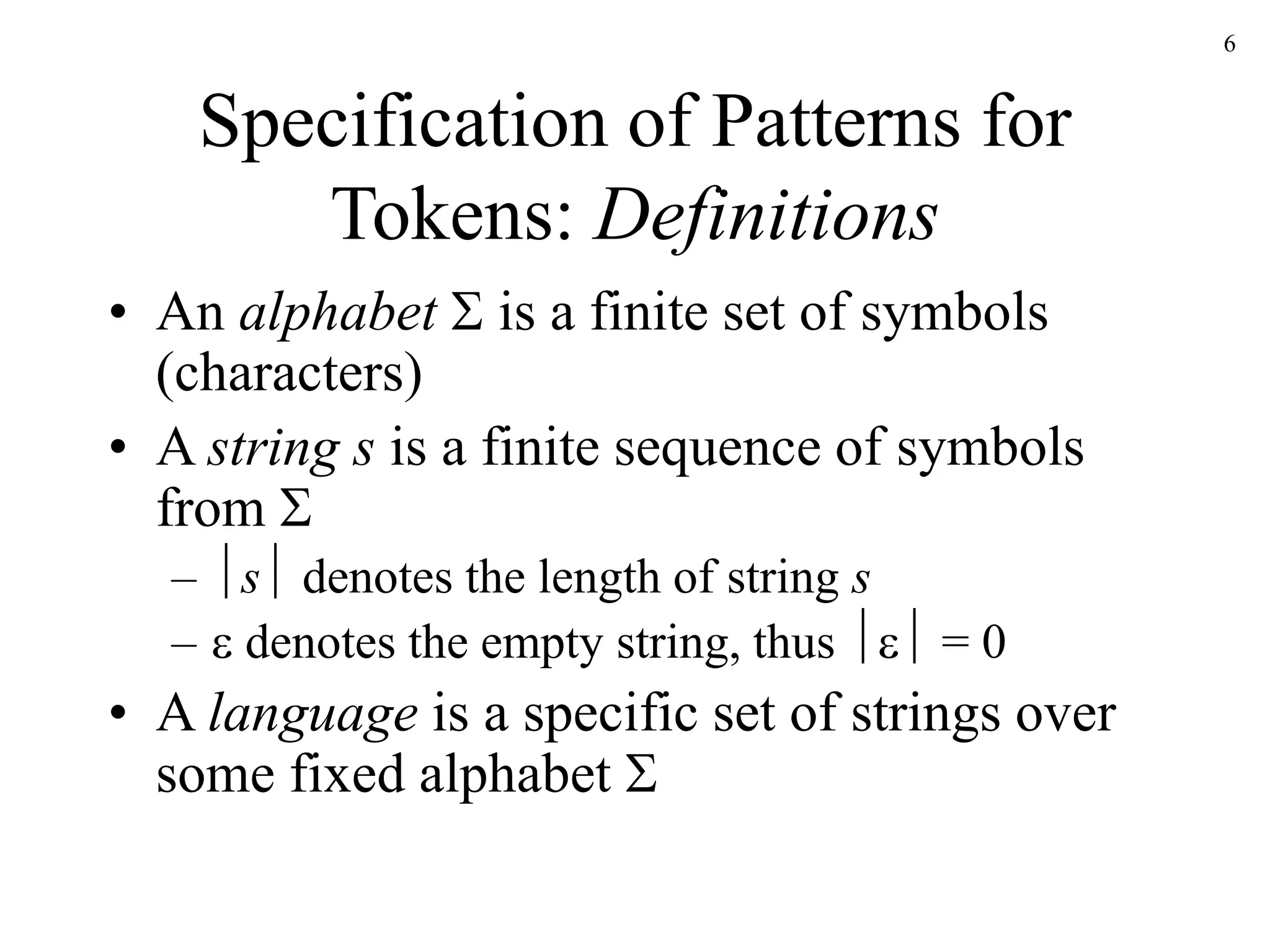
Specification of Patterns for
Tokens: Definitions
• An alphabet  is a finite set of symbols
(characters)
• A string s is a finite sequence of symbols
from 
– s denotes the length of string s
–  denotes the empty string, thus  = 0
• A language is a specific set of strings over
some fixed alphabet 
7
Specification of Patterns for
Tokens: String Operations
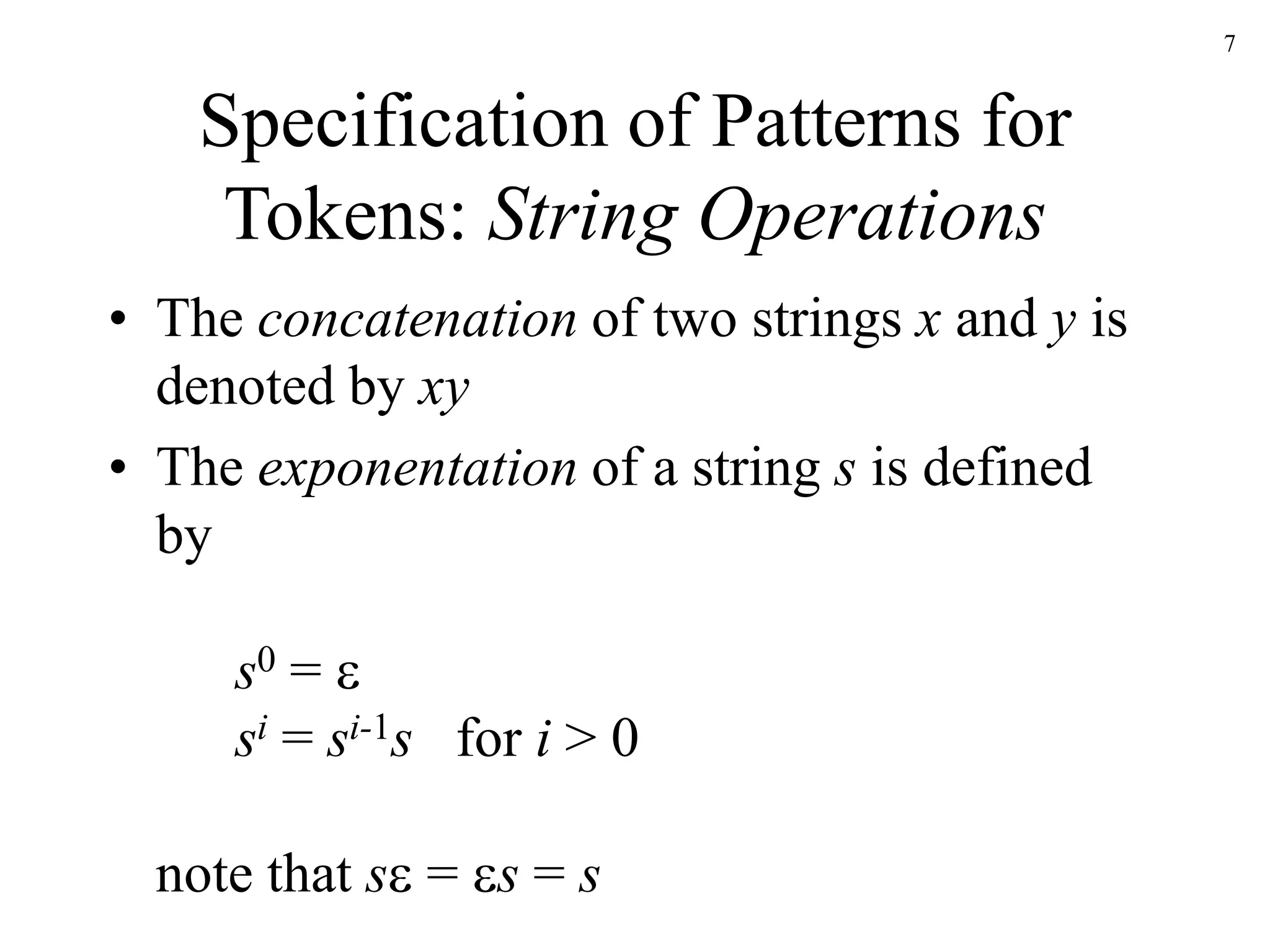
• The concatenation of two strings x and y is
denoted by xy
• The exponentation of a string s is defined
by
s0 = 
si = si-1s for i > 0
note that s = s = s
8
Specification of Patterns for
Tokens: Language Operations
• Union
L  M = {s  s  L or s  M}
• Concatenation
LM = {xy  x  L and y  M}
• Exponentiation
L0 = {}; Li = Li-1L
• Kleene closure
L* = i=0,…, Li
• Positive closure
L+ = i=1,…, Li
9
Specification of Patterns for
Tokens: Regular Expressions
• Basis symbols:
–  is a regular expression denoting language {}
– a   is a regular expression denoting {a}
• If r and s are regular expressions denoting
languages L(r) and M(s) respectively, then
– rs is a regular expression denoting L(r)  M(s)
– rs is a regular expression denoting L(r)M(s)
– r* is a regular expression denoting L(r)*
– (r) is a regular expression denoting L(r)
• A language defined by a regular expression is
called a regular set
10
Specification of Patterns for
Tokens: Regular Definitions
• Regular definitions introduce a naming
convention:
d1  r1
d2  r2
…
dn  rn
where each ri is a regular expression over
  {d1, d2, …, di-1 }
• Any dj in ri can be textually substituted in ri to
obtain an equivalent set of definitions
11
Specification of Patterns for
Tokens: Regular Definitions
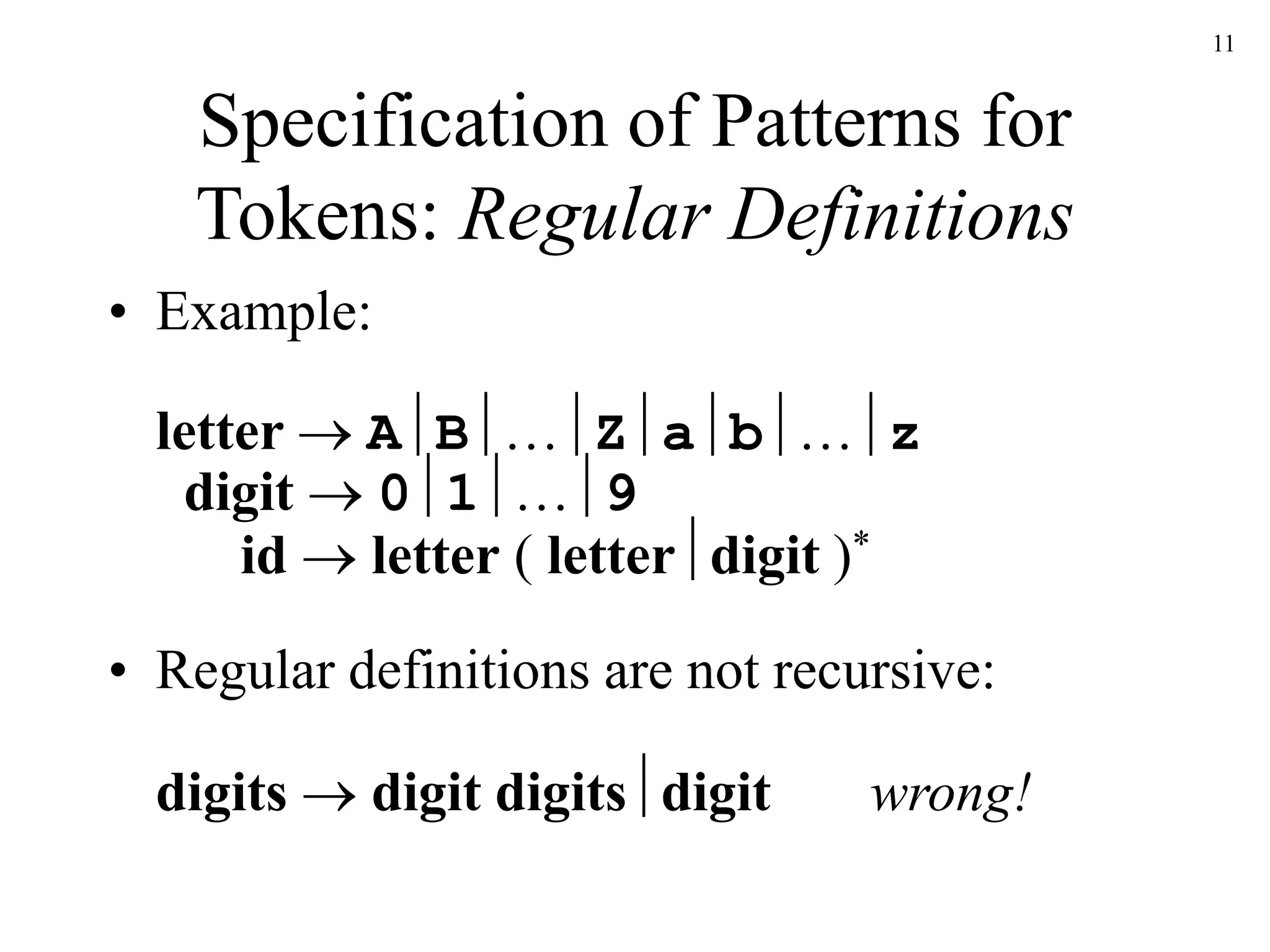
• Example:
letter  AB…Zab…z
digit  01…9
id  letter ( letterdigit )*
• Regular definitions are not recursive:
digits  digit digitsdigit wrong!
12
Specification of Patterns for
Tokens: Notational Shorthand
• The following shorthands are often used:
r+ = rr*
r? = r
[a-z] = abc…z
• Examples:
digit  [0-9]
num  digit+ (. digit+)? ( E (+-)? digit+ )?
13
Regular Definitions and
Grammars
stmt  if expr then stmt
 if expr then stmt else stmt
 
expr  term relop term
 term
term  id
 num
if  if
then  then
else  else
relop  <  <=  <>  >  >=  =
id  letter ( letter | digit )*
num  digit+ (. digit+)? ( E (+-)? digit+ )?
Grammar
Regular definitions
14
Coding Regular Definitions in
Transition Diagrams
0 2
1
6
3
4
5
7
8
return(relop, LE)
return(relop, NE)
return(relop, LT)
return(relop, EQ)
return(relop, GE)
return(relop, GT)
start <
=
>
=
>
=
other
other
*
*
9
start letter
10 11*
other
letter or digit
return(gettoken(),
install_id())
relop  <<=<>>>==
id  letter ( letterdigit )*
15
Coding Regular Definitions in
Transition Diagrams: Code
token nexttoken()
{ while (1) {
switch (state) {
case 0: c = nextchar();
if (c==blank || c==tab || c==newline) {
state = 0;
lexeme_beginning++;
}
else if (c==‘<’) state = 1;
else if (c==‘=’) state = 5;
else if (c==‘>’) state = 6;
else state = fail();
break;
case 1:
…
case 9: c = nextchar();
if (isletter(c)) state = 10;
else state = fail();
break;
case 10: c = nextchar();
if (isletter(c)) state = 10;
else if (isdigit(c)) state = 10;
else state = 11;
break;
…
int fail()
{ forward = token_beginning;
swith (start) {
case 0: start = 9; break;
case 9: start = 12; break;
case 12: start = 20; break;
case 20: start = 25; break;
case 25: recover(); break;
default: /* error */
}
return start;
}
Decides the
next start state
to check
16
The Lex and Flex Scanner
Generators
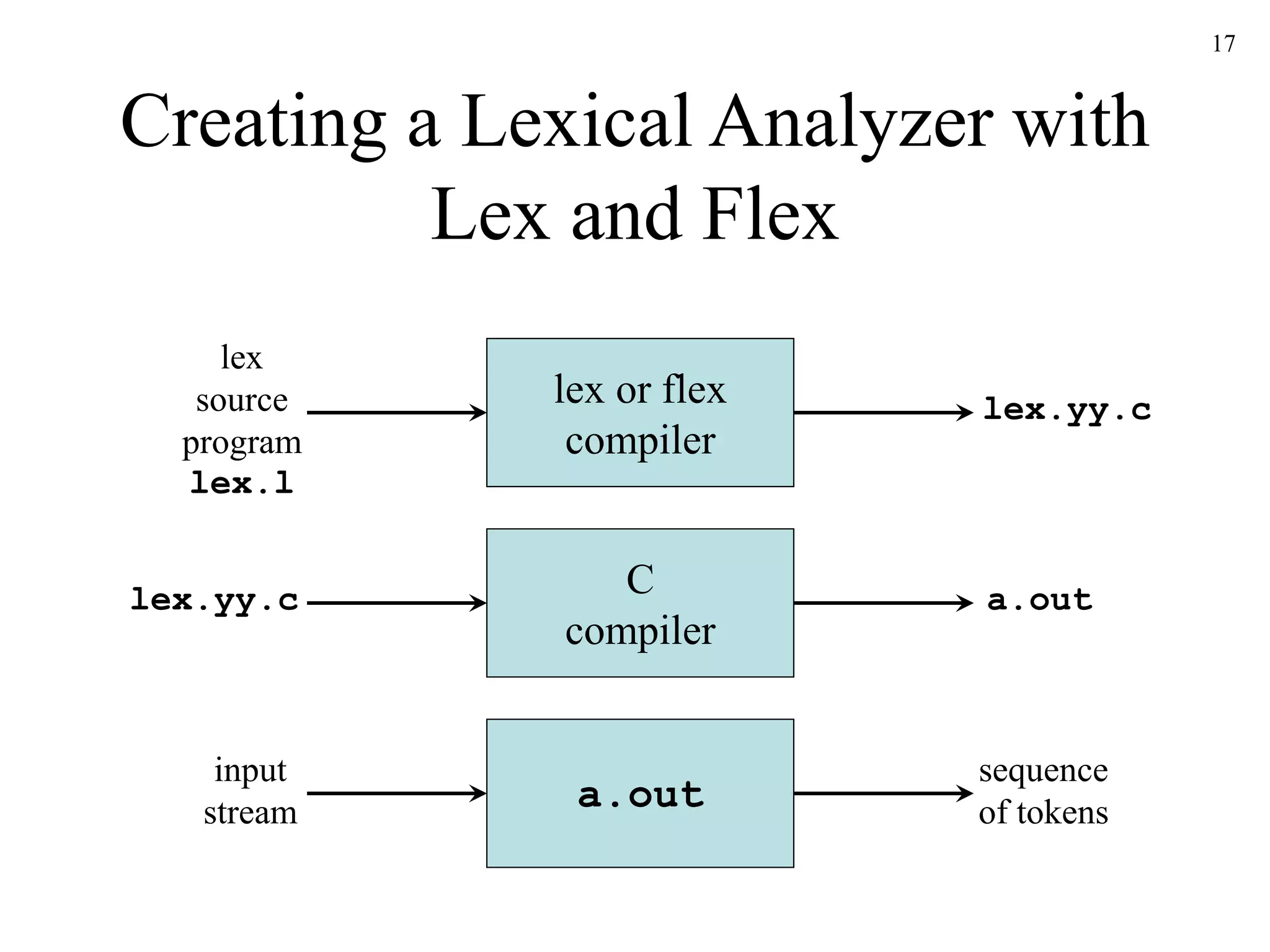
• Lex and its newer cousin flex are scanner
generators
• Systematically translate regular definitions
into C source code for efficient scanning
• Generated code is easy to integrate in C
applications
17
Creating a Lexical Analyzer with
Lex and Flex
lex or flex
compiler
lex
source
program
lex.l
lex.yy.c
input
stream
C
compiler
a.out
sequence
of tokens
lex.yy.c
a.out
18
Lex Specification
• A lex specification consists of three parts:
regular definitions, C declarations in %{ %}
%%
translation rules
%%
user-defined auxiliary procedures
• The translation rules are of the form:
p1 { action1 }
p2 { action2 }
…
pn { actionn }
19
Regular Expressions in Lex
x match the character x
. match the character .
“string”match contents of string of characters
. match any character except newline
^ match beginning of a line
$ match the end of a line
[xyz] match one character x, y, or z (use  to escape -)
[^xyz]match any character except x, y, and z
[a-z] match one of a to z
r* closure (match zero or more occurrences)
r+ positive closure (match one or more occurrences)
r? optional (match zero or one occurrence)
r1r2 match r1 then r2 (concatenation)
r1|r2 match r1 or r2 (union)
( r ) grouping
r1r2 match r1 when followed by r2
{d} match the regular expression defined by d
20
Example Lex Specification 1
%{
#include <stdio.h>
%}
%%
[0-9]+ { printf(“%sn”, yytext); }
.|n { }
%%
main()
{ yylex();
}
Contains
the matching
lexeme
Invokes
the lexical
analyzer
lex spec.l
gcc lex.yy.c -ll
./a.out < spec.l
Translation
rules
21
Example Lex Specification 2
%{
#include <stdio.h>
int ch = 0, wd = 0, nl = 0;
%}
delim [ t]+
%%
n { ch++; wd++; nl++; }
^{delim} { ch+=yyleng; }
{delim} { ch+=yyleng; wd++; }
. { ch++; }
%%
main()
{ yylex();
printf("%8d%8d%8dn", nl, wd, ch);
}
Regular
definition
Translation
rules
22
Example Lex Specification 3
%{
#include <stdio.h>
%}
digit [0-9]
letter [A-Za-z]
id {letter}({letter}|{digit})*
%%
{digit}+ { printf(“number: %sn”, yytext); }
{id} { printf(“ident: %sn”, yytext); }
. { printf(“other: %sn”, yytext); }
%%
main()
{ yylex();
}
Regular
definitions
Translation
rules
23
Example Lex Specification 4
%{ /* definitions of manifest constants */
#define LT (256)
…
%}
delim [ tn]
ws {delim}+
letter [A-Za-z]
digit [0-9]
id {letter}({letter}|{digit})*
number {digit}+(.{digit}+)?(E[+-]?{digit}+)?
%%
{ws} { }
if {return IF;}
then {return THEN;}
else {return ELSE;}
{id} {yylval = install_id(); return ID;}
{number} {yylval = install_num(); return NUMBER;}
“<“ {yylval = LT; return RELOP;}
“<=“ {yylval = LE; return RELOP;}
“=“ {yylval = EQ; return RELOP;}
“<>“ {yylval = NE; return RELOP;}
“>“ {yylval = GT; return RELOP;}
“>=“ {yylval = GE; return RELOP;}
%%
int install_id()
…
Return
token to
parser
Token
attribute
Install yytext as
identifier in symbol table
24
Design of a Lexical Analyzer
Generator
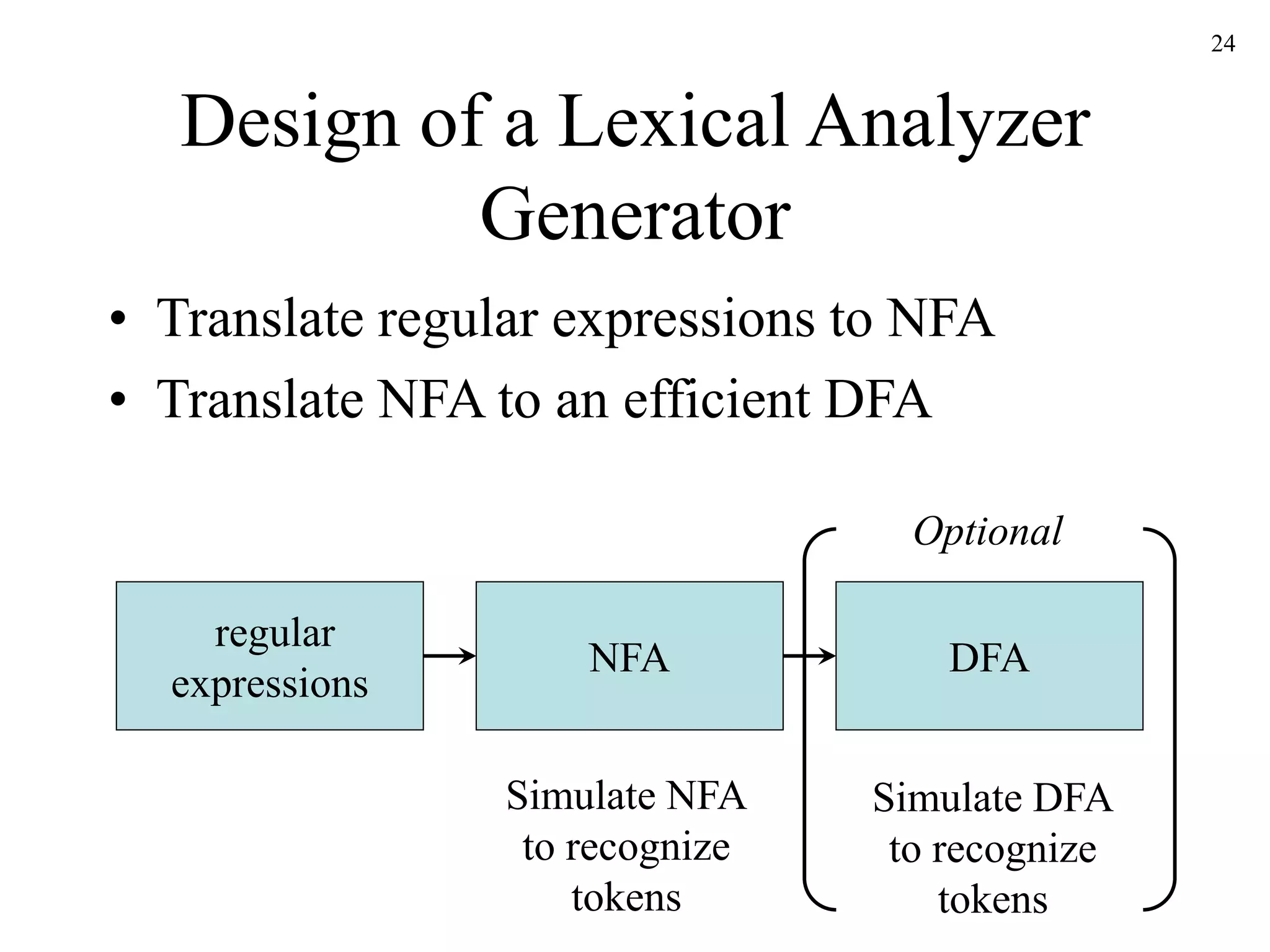
• Translate regular expressions to NFA
• Translate NFA to an efficient DFA
regular
expressions
NFA DFA
Simulate NFA
to recognize
tokens
Simulate DFA
to recognize
tokens
Optional
25
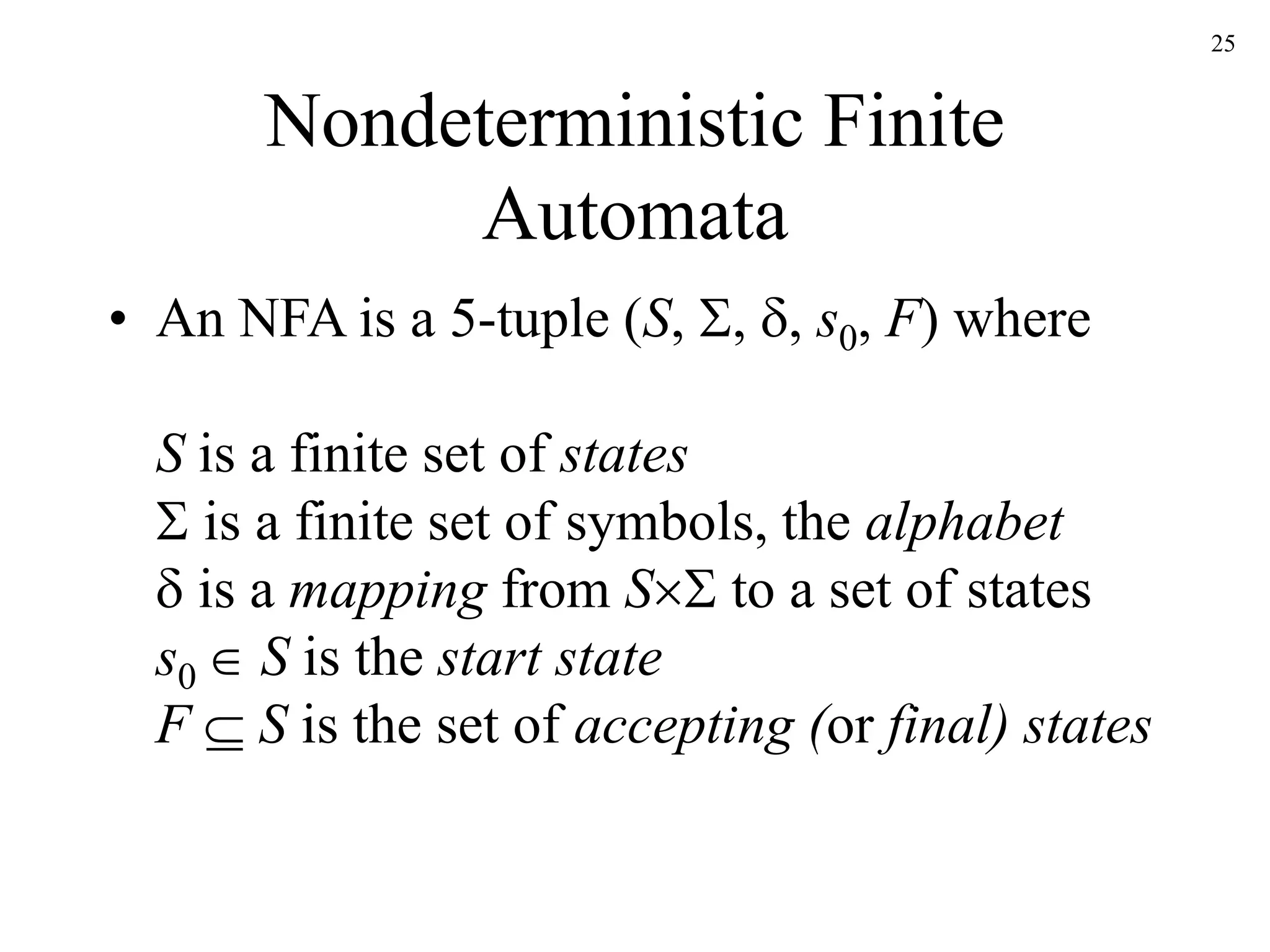
Nondeterministic Finite
Automata
• An NFA is a 5-tuple (S, , , s0, F) where
S is a finite set of states
 is a finite set of symbols, the alphabet
 is a mapping from S to a set of states
s0  S is the start state
F  S is the set of accepting (or final) states
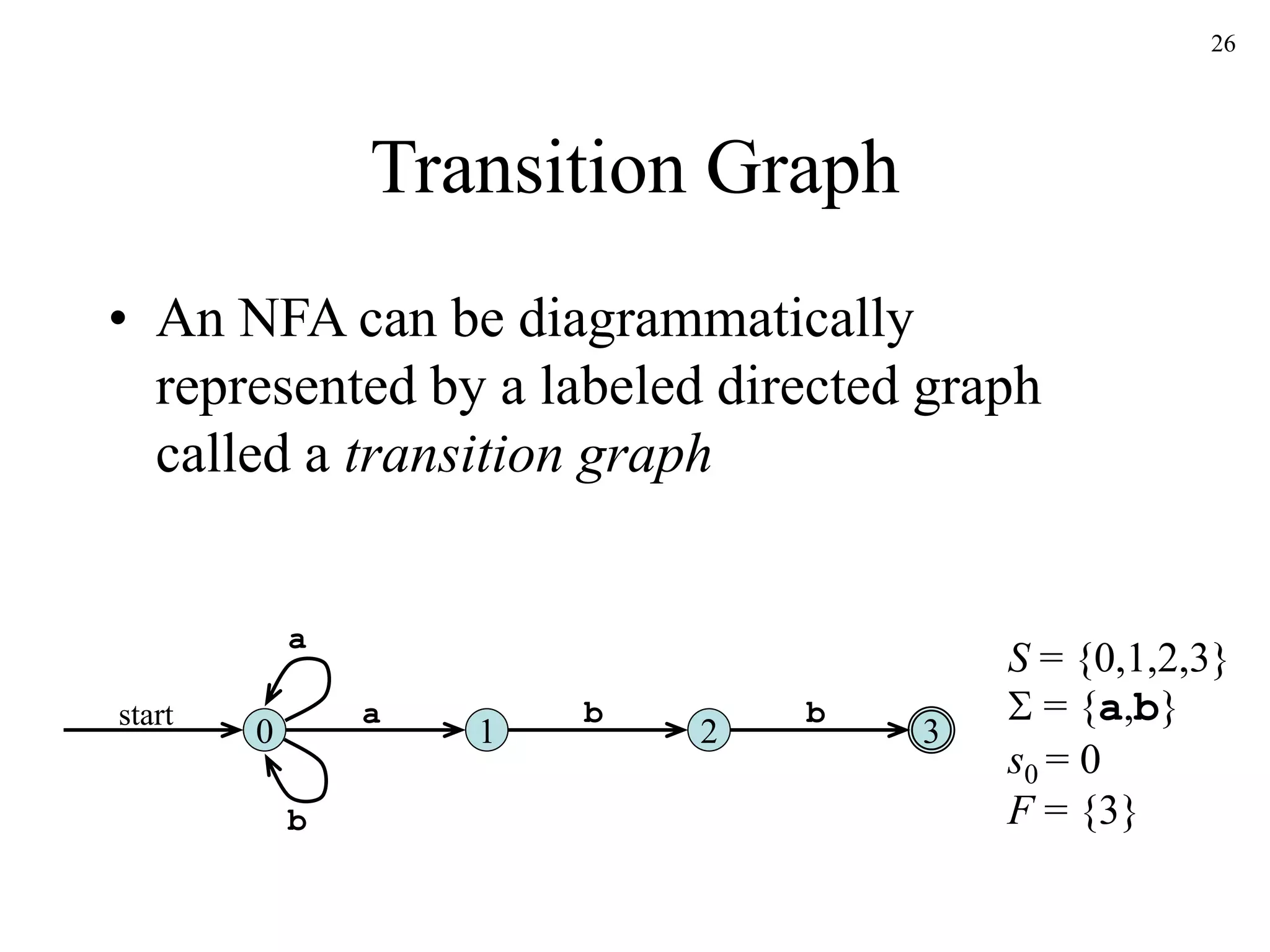
26
Transition Graph
• An NFA can be diagrammatically
represented by a labeled directed graph
called a transition graph
0
start a
1 3
2
b b
a
b
S = {0,1,2,3}
 = {a,b}
s0 = 0
F = {3}
27
Transition Table
• The mapping  of an NFA can be
represented in a transition table
State
Input
a
Input
b
0 {0, 1} {0}
1 {2}
2 {3}
(0,a) = {0,1}
(0,b) = {0}
(1,b) = {2}
(2,b) = {3}
28
The Language Defined by an
NFA
• An NFA accepts an input string x if and only if
there is some path with edges labeled with
symbols from x in sequence from the start state to
some accepting state in the transition graph
• A state transition from one state to another on the
path is called a move
• The language defined by an NFA is the set of input
strings it accepts, such as (ab)*abb for the
example NFA
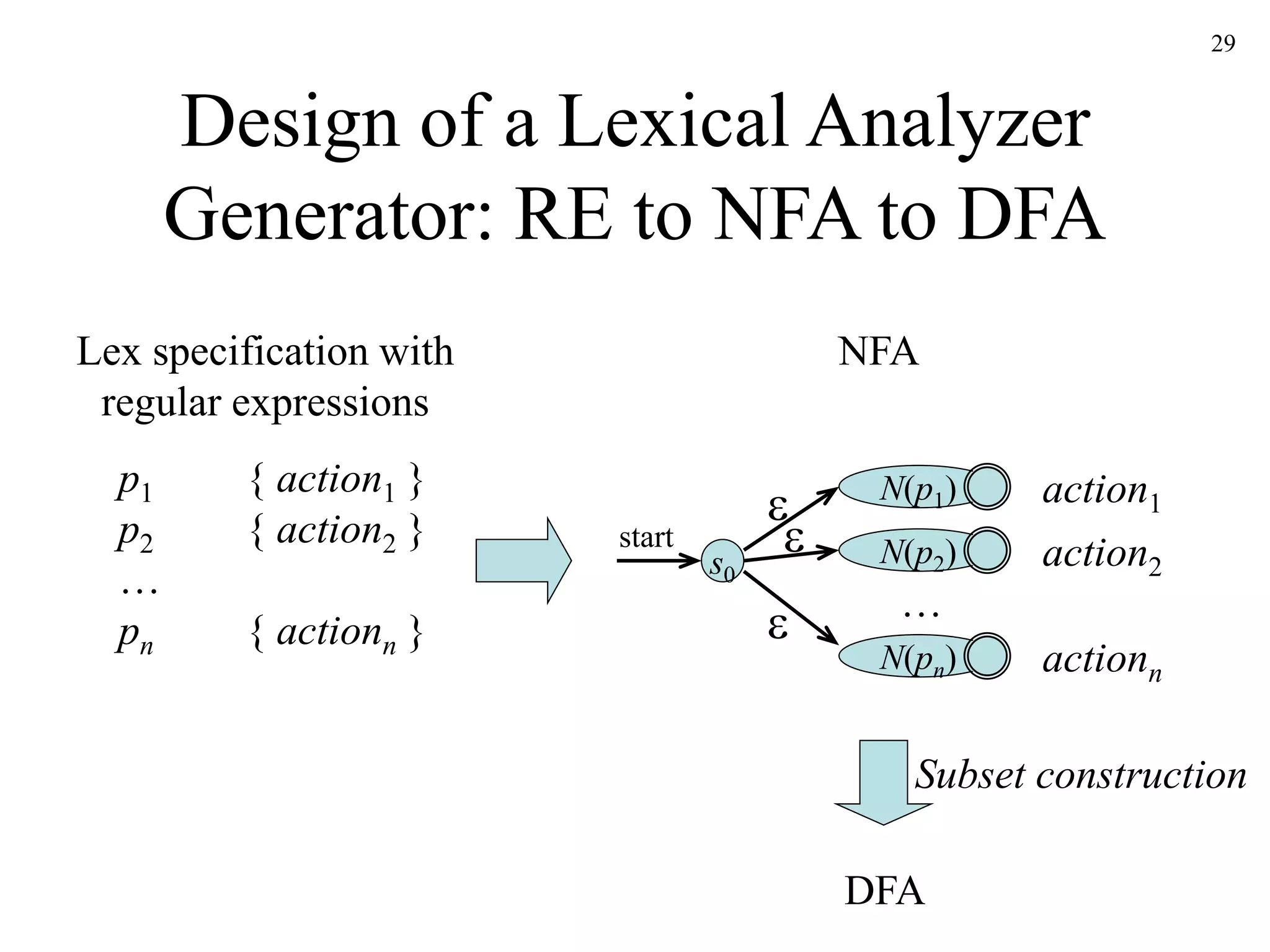
29
Design of a Lexical Analyzer
Generator: RE to NFA to DFA
s0
N(p1)
N(p2)
start


N(pn)

…
p1 { action1 }
p2 { action2 }
…
pn { actionn }
action1
action2
actionn
Lex specification with
regular expressions
NFA
DFA
Subset construction
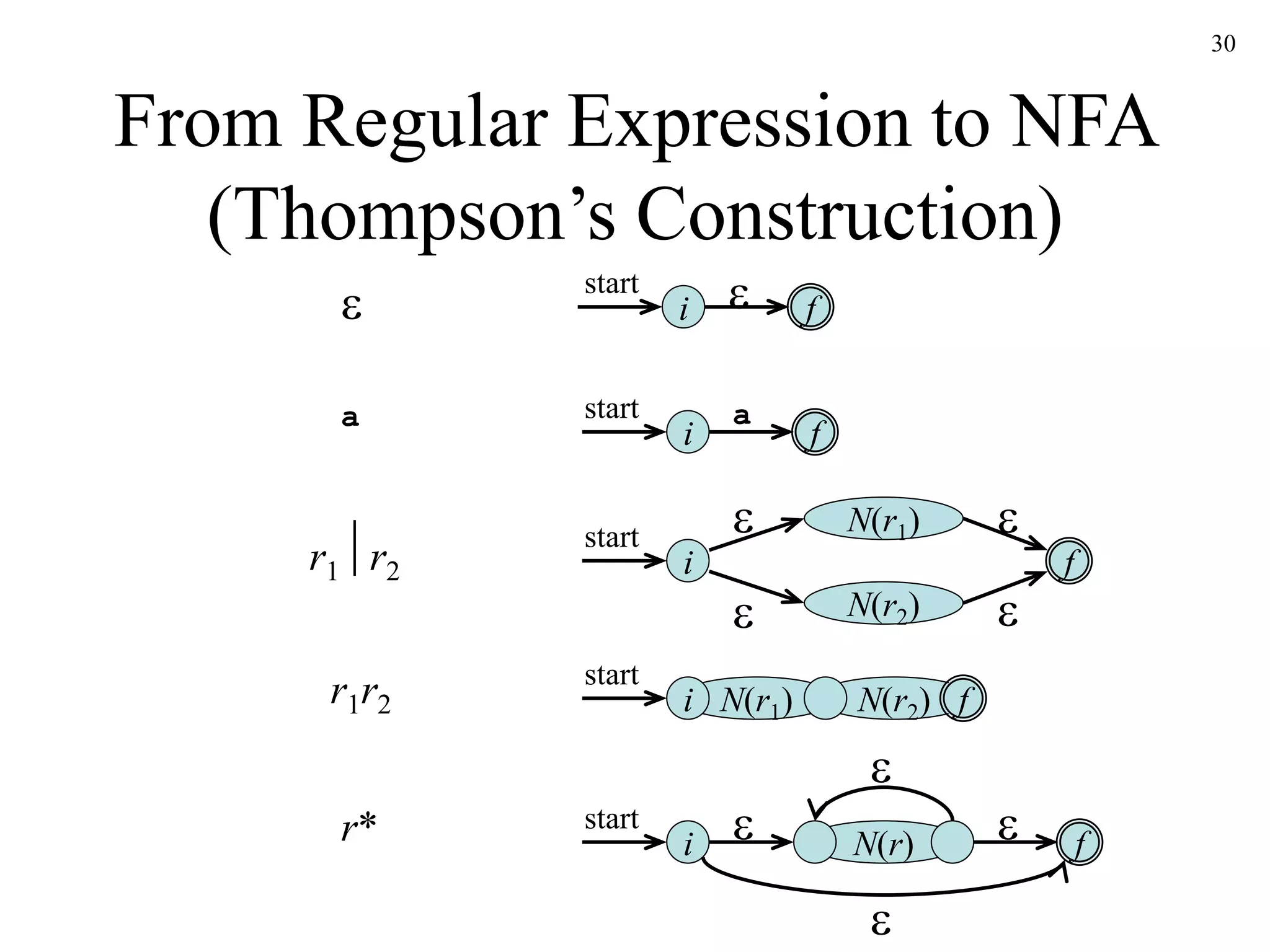
30
N(r2)
N(r1)
From Regular Expression to NFA
(Thompson’s Construction)
f
i 
f
a
i
f
i
N(r1)
N(r2)
start
start
start 
 

f
i
start
N(r) f
i
start



a
r1r2
r1r2
r*  
31
Combining the NFAs of a Set of
Regular Expressions
2
a
1
start
6
a
3
start
4 5
b b
8
b
7
start
a b
a { action1 }
abb { action2 }
a*b+ { action3 }
2
a
1
6
a
3 4 5
b b
8
b
7
a b
0
start



32
Simulating the Combined NFA
Example 1
2
a
1
6
a
3 4 5
b b
8
b
7
a b
0
start



0
1
3
7
2
4
7
7 8
Must find the longest match:
Continue until no further moves are possible
When last state is accepting: execute action
action1
action2
action3
a b
a a
none
action3
33
Simulating the Combined NFA
Example 2
2
a
1
6
a
3 4 5
b b
8
b
7
a b
0
start



0
1
3
7
2
4
7
5
8
6
8
When two or more accepting states are reached, the
first action given in the Lex specification is executed
action1
action2
action3
a b
b a
none
action2
action3
34
Deterministic Finite Automata
• A deterministic finite automaton is a special case
of an NFA
– No state has an -transition
– For each state s and input symbol a there is at most one
edge labeled a leaving s
• Each entry in the transition table is a single state
– At most one path exists to accept a string
– Simulation algorithm is simple
35
Example DFA
0
start a
1 3
2
b b
b
b
a
a
a
A DFA that accepts (ab)*abb
36
Conversion of an NFA into a
DFA
• The subset construction algorithm converts an
NFA into a DFA using:
-closure(s) = {s}  {t  s  …  t}
-closure(T) = sT -closure(s)
move(T,a) = {t  s a t and s  T}
• The algorithm produces:
Dstates is the set of states of the new DFA
consisting of sets of states of the NFA
Dtran is the transition table of the new DFA
37
-closure and move Examples
2
a
1
6
a
3 4 5
b b
8
b
7
a b
0
start



-closure({0}) = {0,1,3,7}
move({0,1,3,7},a) = {2,4,7}
-closure({2,4,7}) = {2,4,7}
move({2,4,7},a) = {7}
-closure({7}) = {7}
move({7},b) = {8}
-closure({8}) = {8}
move({8},a) = 
0
1
3
7
2
4
7
7 8
a b
a a
none
Also used to simulate NFAs
38
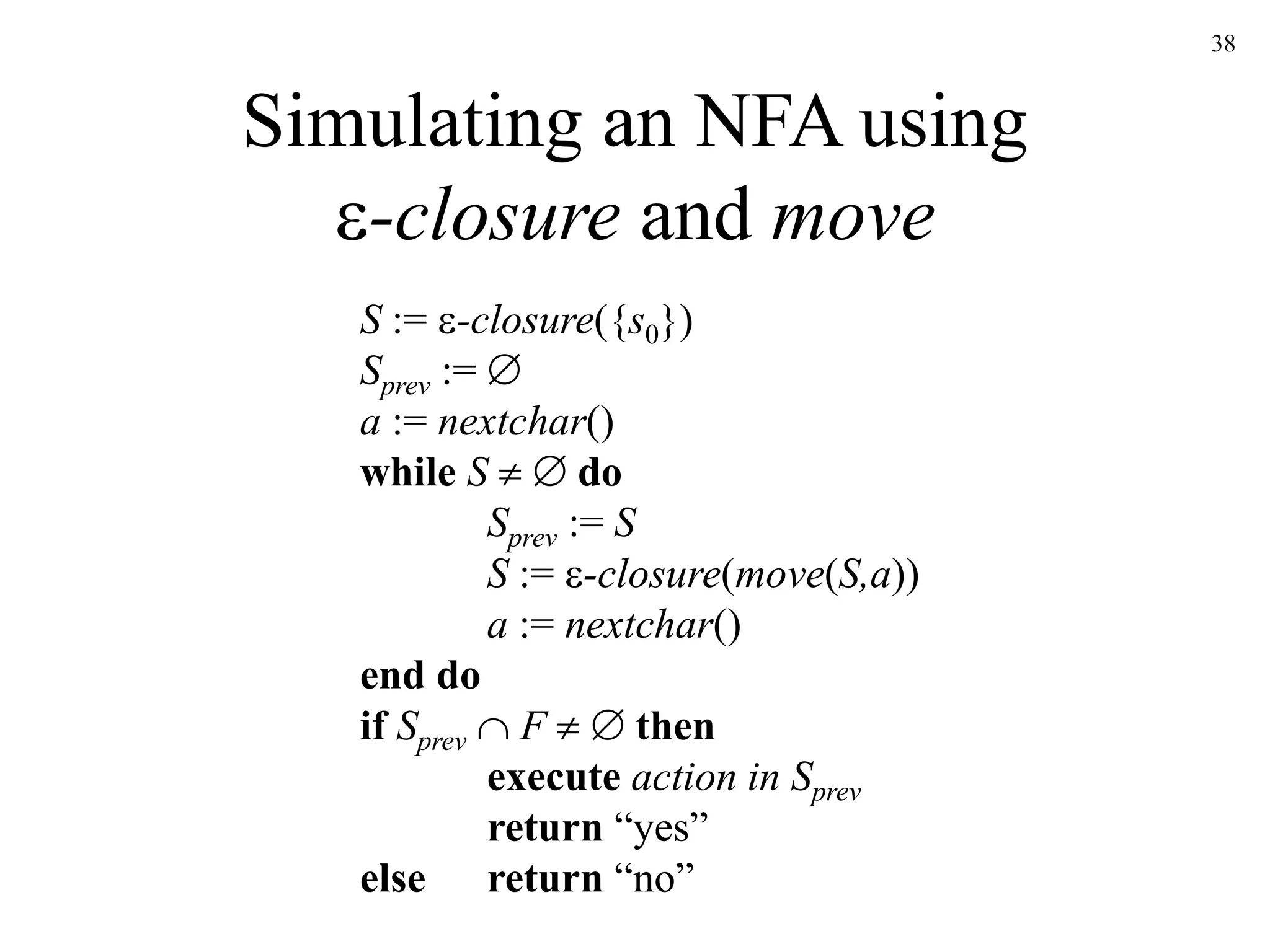
Simulating an NFA using
-closure and move
S := -closure({s0})
Sprev := 
a := nextchar()
while S   do
Sprev := S
S := -closure(move(S,a))
a := nextchar()
end do
if Sprev  F   then
execute action in Sprev
return “yes”
else return “no”
39
The Subset Construction
Algorithm
Initially, -closure(s0) is the only state in Dstates and it is unmarked
while there is an unmarked state T in Dstates do
mark T
for each input symbol a   do
U := -closure(move(T,a))
if U is not in Dstates then
add U as an unmarked state to Dstates
end if
Dtran[T,a] := U
end do
end do
40
Subset Construction Example 1
0
start a
1 10
2
b
b
a
b
3
4 5
6 7 8 9
 






A
start
B
C
D E
b
b
b
b
b
a
a
a
a
Dstates
A = {0,1,2,4,7}
B = {1,2,3,4,6,7,8}
C = {1,2,4,5,6,7}
D = {1,2,4,5,6,7,9}
E = {1,2,4,5,6,7,10}
a
41
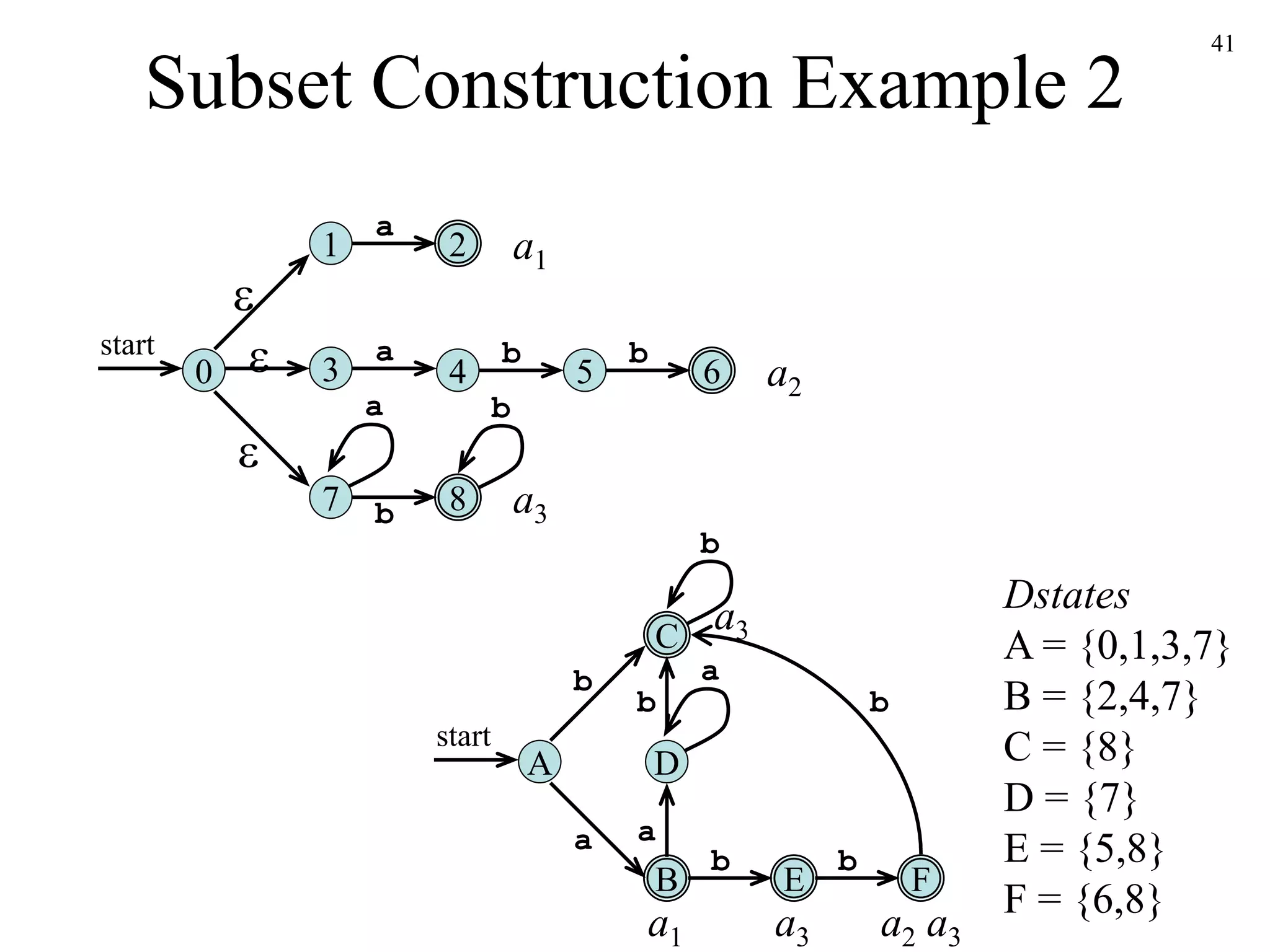
Subset Construction Example 2
2
a
1
6
a
3 4 5
b b
8
b
7
a b
0
start



a1
a2
a3
Dstates
A = {0,1,3,7}
B = {2,4,7}
C = {8}
D = {7}
E = {5,8}
F = {6,8}
A
start
a
D
b
b
b
a
b
b
B
C
E F
a
b
a1
a3
a3 a2 a3
42
Minimizing the Number of States
of a DFA
A
start
B
C
D E
b
b
b
b
b
a
a
a
a
a
A
start
B D E
b b
a
a
b
a
a
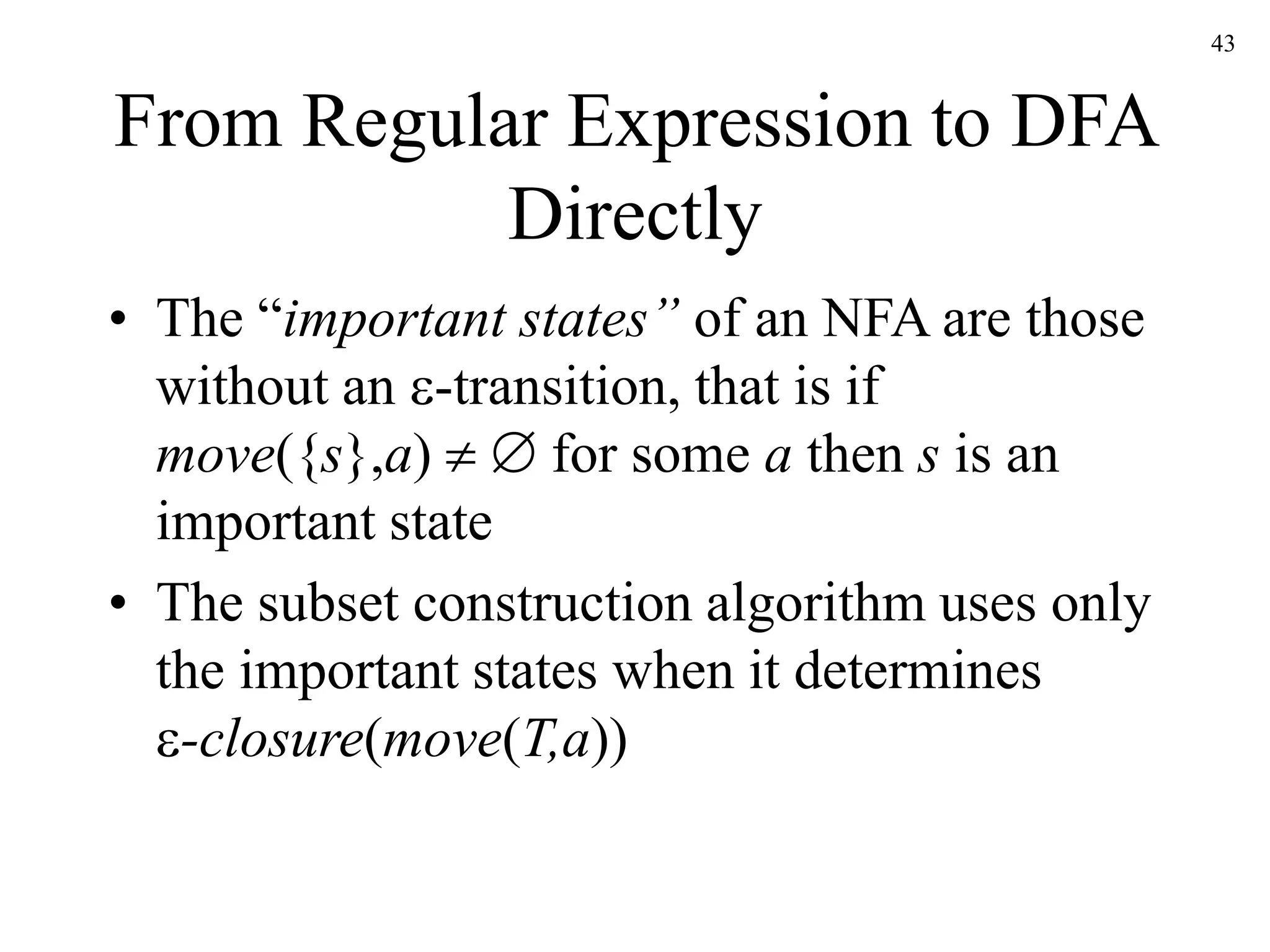
43
From Regular Expression to DFA
Directly
• The “important states” of an NFA are those
without an -transition, that is if
move({s},a)   for some a then s is an
important state
• The subset construction algorithm uses only
the important states when it determines
-closure(move(T,a))
44
From Regular Expression to DFA
Directly (Algorithm)
• Augment the regular expression r with a
special end symbol # to make accepting
states important: the new expression is r#
• Construct a syntax tree for r#
• Traverse the tree to construct functions
nullable, firstpos, lastpos, and followpos
45
From Regular Expression to DFA
Directly: Syntax Tree of (a|b)*abb#
*
|
1
a
2
b
3
a
4
b
5
b
#
6
concatenation
closure
alternation
position
number
(for leafs )
46
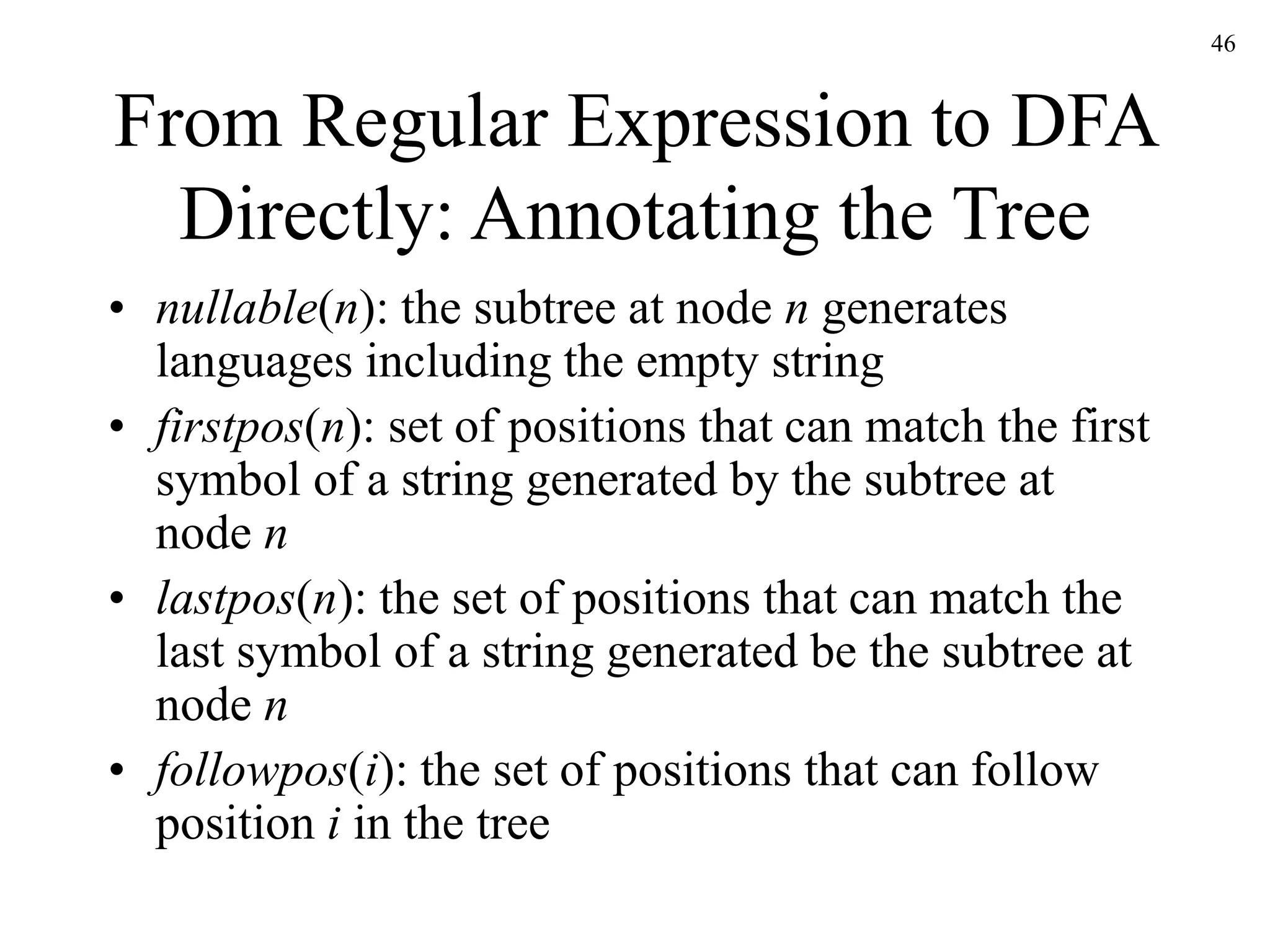
From Regular Expression to DFA
Directly: Annotating the Tree
• nullable(n): the subtree at node n generates
languages including the empty string
• firstpos(n): set of positions that can match the first
symbol of a string generated by the subtree at
node n
• lastpos(n): the set of positions that can match the
last symbol of a string generated be the subtree at
node n
• followpos(i): the set of positions that can follow
position i in the tree
47
From Regular Expression to DFA
Directly: Annotating the Tree
Node n nullable(n) firstpos(n) lastpos(n)
Leaf  true  
Leaf i false {i} {i}
|
/ 
c1 c2
nullable(c1)
or
nullable(c2)
firstpos(c1)

firstpos(c2)
lastpos(c1)

lastpos(c2)
•
/ 
c1 c2
nullable(c1)
and
nullable(c2)
if nullable(c1) then
firstpos(c1) 
firstpos(c2)
else firstpos(c1)
if nullable(c2) then
lastpos(c1) 
lastpos(c2)
else lastpos(c2)
*
|
c1
true firstpos(c1) lastpos(c1)
48
From Regular Expression to DFA
Directly: Syntax Tree of (a|b)*abb#
{6}
{1, 2, 3}
{5}
{1, 2, 3}
{4}
{1, 2, 3}
{3}
{1, 2, 3}
{1, 2}
{1, 2}
*
{1, 2}
{1, 2} |
{1}
{1} a {2}
{2} b
{3}
{3} a
{4}
{4} b
{5}
{5} b
{6}
{6} #
nullable
firstpos lastpos
1 2
3
4
5
6
49
From Regular Expression to DFA
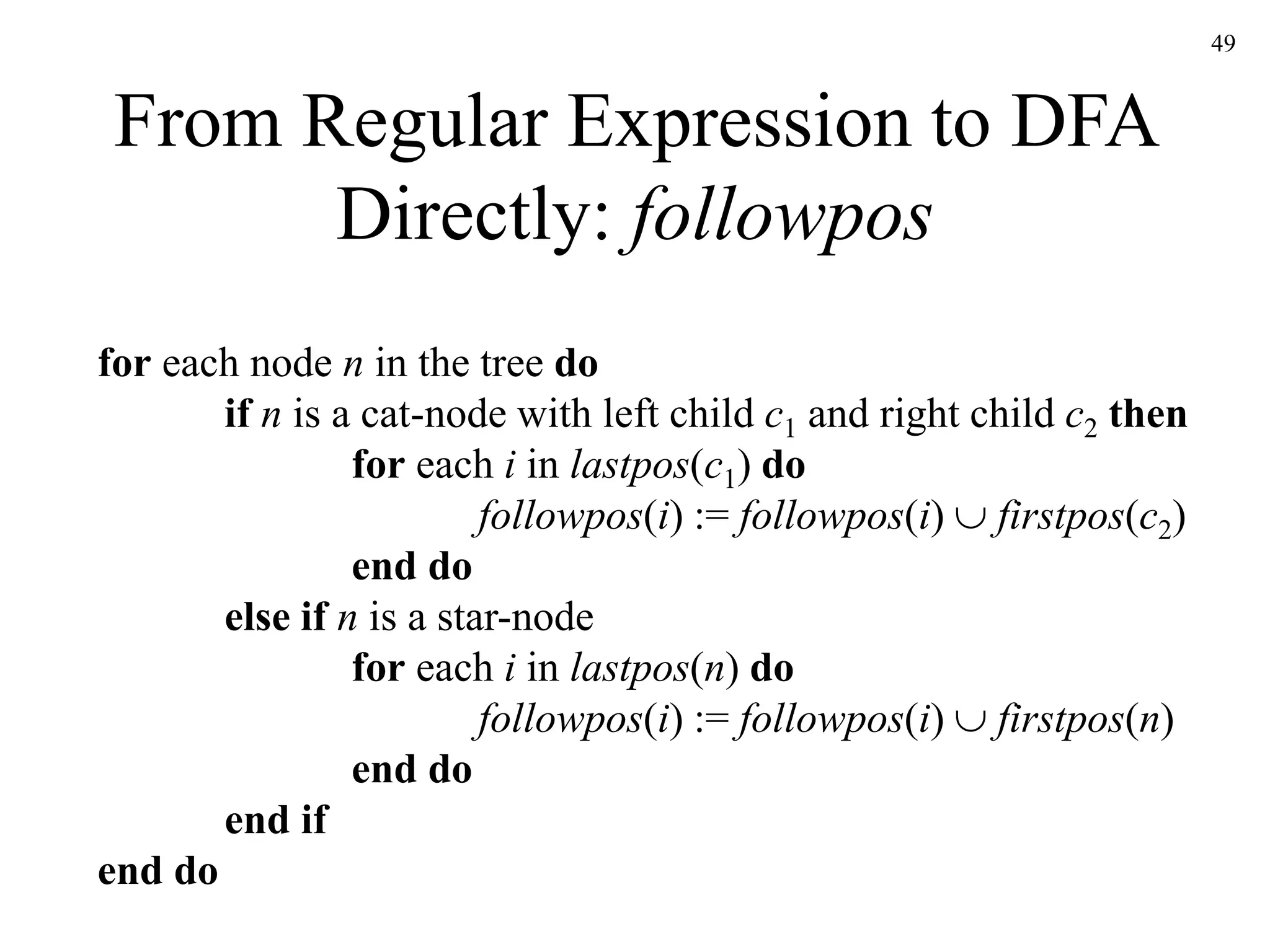
Directly: followpos
for each node n in the tree do
if n is a cat-node with left child c1 and right child c2 then
for each i in lastpos(c1) do
followpos(i) := followpos(i)  firstpos(c2)
end do
else if n is a star-node
for each i in lastpos(n) do
followpos(i) := followpos(i)  firstpos(n)
end do
end if
end do
50
From Regular Expression to DFA
Directly: Algorithm
s0 := firstpos(root) where root is the root of the syntax tree
Dstates := {s0} and is unmarked
while there is an unmarked state T in Dstates do
mark T
for each input symbol a   do
let U be the set of positions that are in followpos(p)
for some position p in T,
such that the symbol at position p is a
if U is not empty and not in Dstates then
add U as an unmarked state to Dstates
end if
Dtran[T,a] := U
end do
end do
51
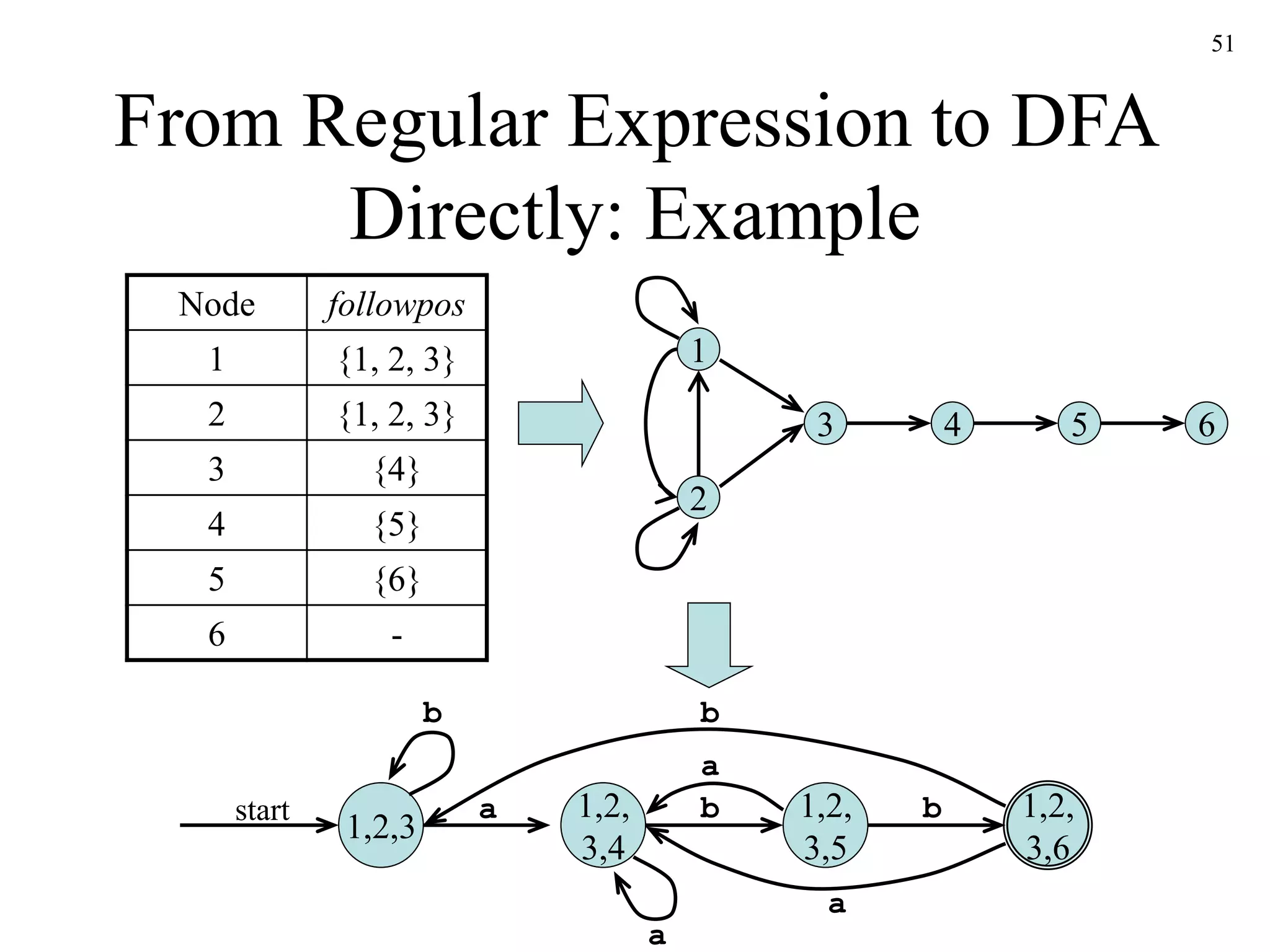
From Regular Expression to DFA
Directly: Example
1,2,3
start a 1,2,
3,4
1,2,
3,6
1,2,
3,5
b b
b b
a
a
a
Node followpos
1 {1, 2, 3}
2 {1, 2, 3}
3 {4}
4 {5}
5 {6}
6 -
1
2
3 4 5 6
52
Time-Space Tradeoffs
Automaton
Space
(worst case)
Time
(worst case)
NFA O(r) O(rx)
DFA O(2|r|) O(x)

Ch3.ppt

  • 1.
    1 Lexical Analysis and LexicalAnalyzer Generators Chapter 3 COP5621 Compiler Construction Copyright Robert van Engelen, Florida State University, 2007
  • 2.
    2 The Reason WhyLexical Analysis is a Separate Phase • Simplifies the design of the compiler – LL(1) or LR(1) parsing with 1 token lookahead would not be possible (multiple characters/tokens to match) • Provides efficient implementation – Systematic techniques to implement lexical analyzers by hand or automatically from specifications – Stream buffering methods to scan input • Improves portability – Non-standard symbols and alternate character encodings can be normalized (e.g. trigraphs)
  • 3.
    3 Interaction of theLexical Analyzer with the Parser Lexical Analyzer Parser Source Program Token, tokenval Symbol Table Get next token error error
  • 4.
    4 Attributes of Tokens Lexicalanalyzer <id, “y”> <assign, > <num, 31> <+, > <num, 28> <*, > <id, “x”> y := 31 + 28*x Parser token tokenval (token attribute)
  • 5.
    5 Tokens, Patterns, andLexemes • A token is a classification of lexical units – For example: id and num • Lexemes are the specific character strings that make up a token – For example: abc and 123 • Patterns are rules describing the set of lexemes belonging to a token – For example: “letter followed by letters and digits” and “non-empty sequence of digits”
  • 6.
    6 Specification of Patternsfor Tokens: Definitions • An alphabet  is a finite set of symbols (characters) • A string s is a finite sequence of symbols from  – s denotes the length of string s –  denotes the empty string, thus  = 0 • A language is a specific set of strings over some fixed alphabet 
  • 7.
    7 Specification of Patternsfor Tokens: String Operations • The concatenation of two strings x and y is denoted by xy • The exponentation of a string s is defined by s0 =  si = si-1s for i > 0 note that s = s = s
  • 8.
    8 Specification of Patternsfor Tokens: Language Operations • Union L  M = {s  s  L or s  M} • Concatenation LM = {xy  x  L and y  M} • Exponentiation L0 = {}; Li = Li-1L • Kleene closure L* = i=0,…, Li • Positive closure L+ = i=1,…, Li
  • 9.
    9 Specification of Patternsfor Tokens: Regular Expressions • Basis symbols: –  is a regular expression denoting language {} – a   is a regular expression denoting {a} • If r and s are regular expressions denoting languages L(r) and M(s) respectively, then – rs is a regular expression denoting L(r)  M(s) – rs is a regular expression denoting L(r)M(s) – r* is a regular expression denoting L(r)* – (r) is a regular expression denoting L(r) • A language defined by a regular expression is called a regular set
  • 10.
    10 Specification of Patternsfor Tokens: Regular Definitions • Regular definitions introduce a naming convention: d1  r1 d2  r2 … dn  rn where each ri is a regular expression over   {d1, d2, …, di-1 } • Any dj in ri can be textually substituted in ri to obtain an equivalent set of definitions
  • 11.
    11 Specification of Patternsfor Tokens: Regular Definitions • Example: letter  AB…Zab…z digit  01…9 id  letter ( letterdigit )* • Regular definitions are not recursive: digits  digit digitsdigit wrong!
  • 12.
    12 Specification of Patternsfor Tokens: Notational Shorthand • The following shorthands are often used: r+ = rr* r? = r [a-z] = abc…z • Examples: digit  [0-9] num  digit+ (. digit+)? ( E (+-)? digit+ )?
  • 13.
    13 Regular Definitions and Grammars stmt if expr then stmt  if expr then stmt else stmt   expr  term relop term  term term  id  num if  if then  then else  else relop  <  <=  <>  >  >=  = id  letter ( letter | digit )* num  digit+ (. digit+)? ( E (+-)? digit+ )? Grammar Regular definitions
  • 14.
    14 Coding Regular Definitionsin Transition Diagrams 0 2 1 6 3 4 5 7 8 return(relop, LE) return(relop, NE) return(relop, LT) return(relop, EQ) return(relop, GE) return(relop, GT) start < = > = > = other other * * 9 start letter 10 11* other letter or digit return(gettoken(), install_id()) relop  <<=<>>>== id  letter ( letterdigit )*
  • 15.
    15 Coding Regular Definitionsin Transition Diagrams: Code token nexttoken() { while (1) { switch (state) { case 0: c = nextchar(); if (c==blank || c==tab || c==newline) { state = 0; lexeme_beginning++; } else if (c==‘<’) state = 1; else if (c==‘=’) state = 5; else if (c==‘>’) state = 6; else state = fail(); break; case 1: … case 9: c = nextchar(); if (isletter(c)) state = 10; else state = fail(); break; case 10: c = nextchar(); if (isletter(c)) state = 10; else if (isdigit(c)) state = 10; else state = 11; break; … int fail() { forward = token_beginning; swith (start) { case 0: start = 9; break; case 9: start = 12; break; case 12: start = 20; break; case 20: start = 25; break; case 25: recover(); break; default: /* error */ } return start; } Decides the next start state to check
  • 16.
    16 The Lex andFlex Scanner Generators • Lex and its newer cousin flex are scanner generators • Systematically translate regular definitions into C source code for efficient scanning • Generated code is easy to integrate in C applications
  • 17.
    17 Creating a LexicalAnalyzer with Lex and Flex lex or flex compiler lex source program lex.l lex.yy.c input stream C compiler a.out sequence of tokens lex.yy.c a.out
  • 18.
    18 Lex Specification • Alex specification consists of three parts: regular definitions, C declarations in %{ %} %% translation rules %% user-defined auxiliary procedures • The translation rules are of the form: p1 { action1 } p2 { action2 } … pn { actionn }
  • 19.
    19 Regular Expressions inLex x match the character x . match the character . “string”match contents of string of characters . match any character except newline ^ match beginning of a line $ match the end of a line [xyz] match one character x, y, or z (use to escape -) [^xyz]match any character except x, y, and z [a-z] match one of a to z r* closure (match zero or more occurrences) r+ positive closure (match one or more occurrences) r? optional (match zero or one occurrence) r1r2 match r1 then r2 (concatenation) r1|r2 match r1 or r2 (union) ( r ) grouping r1r2 match r1 when followed by r2 {d} match the regular expression defined by d
  • 20.
    20 Example Lex Specification1 %{ #include <stdio.h> %} %% [0-9]+ { printf(“%sn”, yytext); } .|n { } %% main() { yylex(); } Contains the matching lexeme Invokes the lexical analyzer lex spec.l gcc lex.yy.c -ll ./a.out < spec.l Translation rules
  • 21.
    21 Example Lex Specification2 %{ #include <stdio.h> int ch = 0, wd = 0, nl = 0; %} delim [ t]+ %% n { ch++; wd++; nl++; } ^{delim} { ch+=yyleng; } {delim} { ch+=yyleng; wd++; } . { ch++; } %% main() { yylex(); printf("%8d%8d%8dn", nl, wd, ch); } Regular definition Translation rules
  • 22.
    22 Example Lex Specification3 %{ #include <stdio.h> %} digit [0-9] letter [A-Za-z] id {letter}({letter}|{digit})* %% {digit}+ { printf(“number: %sn”, yytext); } {id} { printf(“ident: %sn”, yytext); } . { printf(“other: %sn”, yytext); } %% main() { yylex(); } Regular definitions Translation rules
  • 23.
    23 Example Lex Specification4 %{ /* definitions of manifest constants */ #define LT (256) … %} delim [ tn] ws {delim}+ letter [A-Za-z] digit [0-9] id {letter}({letter}|{digit})* number {digit}+(.{digit}+)?(E[+-]?{digit}+)? %% {ws} { } if {return IF;} then {return THEN;} else {return ELSE;} {id} {yylval = install_id(); return ID;} {number} {yylval = install_num(); return NUMBER;} “<“ {yylval = LT; return RELOP;} “<=“ {yylval = LE; return RELOP;} “=“ {yylval = EQ; return RELOP;} “<>“ {yylval = NE; return RELOP;} “>“ {yylval = GT; return RELOP;} “>=“ {yylval = GE; return RELOP;} %% int install_id() … Return token to parser Token attribute Install yytext as identifier in symbol table
  • 24.
    24 Design of aLexical Analyzer Generator • Translate regular expressions to NFA • Translate NFA to an efficient DFA regular expressions NFA DFA Simulate NFA to recognize tokens Simulate DFA to recognize tokens Optional
  • 25.
    25 Nondeterministic Finite Automata • AnNFA is a 5-tuple (S, , , s0, F) where S is a finite set of states  is a finite set of symbols, the alphabet  is a mapping from S to a set of states s0  S is the start state F  S is the set of accepting (or final) states
  • 26.
    26 Transition Graph • AnNFA can be diagrammatically represented by a labeled directed graph called a transition graph 0 start a 1 3 2 b b a b S = {0,1,2,3}  = {a,b} s0 = 0 F = {3}
  • 27.
    27 Transition Table • Themapping  of an NFA can be represented in a transition table State Input a Input b 0 {0, 1} {0} 1 {2} 2 {3} (0,a) = {0,1} (0,b) = {0} (1,b) = {2} (2,b) = {3}
  • 28.
    28 The Language Definedby an NFA • An NFA accepts an input string x if and only if there is some path with edges labeled with symbols from x in sequence from the start state to some accepting state in the transition graph • A state transition from one state to another on the path is called a move • The language defined by an NFA is the set of input strings it accepts, such as (ab)*abb for the example NFA
  • 29.
    29 Design of aLexical Analyzer Generator: RE to NFA to DFA s0 N(p1) N(p2) start   N(pn)  … p1 { action1 } p2 { action2 } … pn { actionn } action1 action2 actionn Lex specification with regular expressions NFA DFA Subset construction
  • 30.
    30 N(r2) N(r1) From Regular Expressionto NFA (Thompson’s Construction) f i  f a i f i N(r1) N(r2) start start start     f i start N(r) f i start    a r1r2 r1r2 r*  
  • 31.
    31 Combining the NFAsof a Set of Regular Expressions 2 a 1 start 6 a 3 start 4 5 b b 8 b 7 start a b a { action1 } abb { action2 } a*b+ { action3 } 2 a 1 6 a 3 4 5 b b 8 b 7 a b 0 start   
  • 32.
    32 Simulating the CombinedNFA Example 1 2 a 1 6 a 3 4 5 b b 8 b 7 a b 0 start    0 1 3 7 2 4 7 7 8 Must find the longest match: Continue until no further moves are possible When last state is accepting: execute action action1 action2 action3 a b a a none action3
  • 33.
    33 Simulating the CombinedNFA Example 2 2 a 1 6 a 3 4 5 b b 8 b 7 a b 0 start    0 1 3 7 2 4 7 5 8 6 8 When two or more accepting states are reached, the first action given in the Lex specification is executed action1 action2 action3 a b b a none action2 action3
  • 34.
    34 Deterministic Finite Automata •A deterministic finite automaton is a special case of an NFA – No state has an -transition – For each state s and input symbol a there is at most one edge labeled a leaving s • Each entry in the transition table is a single state – At most one path exists to accept a string – Simulation algorithm is simple
  • 35.
    35 Example DFA 0 start a 13 2 b b b b a a a A DFA that accepts (ab)*abb
  • 36.
    36 Conversion of anNFA into a DFA • The subset construction algorithm converts an NFA into a DFA using: -closure(s) = {s}  {t  s  …  t} -closure(T) = sT -closure(s) move(T,a) = {t  s a t and s  T} • The algorithm produces: Dstates is the set of states of the new DFA consisting of sets of states of the NFA Dtran is the transition table of the new DFA
  • 37.
    37 -closure and moveExamples 2 a 1 6 a 3 4 5 b b 8 b 7 a b 0 start    -closure({0}) = {0,1,3,7} move({0,1,3,7},a) = {2,4,7} -closure({2,4,7}) = {2,4,7} move({2,4,7},a) = {7} -closure({7}) = {7} move({7},b) = {8} -closure({8}) = {8} move({8},a) =  0 1 3 7 2 4 7 7 8 a b a a none Also used to simulate NFAs
  • 38.
    38 Simulating an NFAusing -closure and move S := -closure({s0}) Sprev :=  a := nextchar() while S   do Sprev := S S := -closure(move(S,a)) a := nextchar() end do if Sprev  F   then execute action in Sprev return “yes” else return “no”
  • 39.
    39 The Subset Construction Algorithm Initially,-closure(s0) is the only state in Dstates and it is unmarked while there is an unmarked state T in Dstates do mark T for each input symbol a   do U := -closure(move(T,a)) if U is not in Dstates then add U as an unmarked state to Dstates end if Dtran[T,a] := U end do end do
  • 40.
    40 Subset Construction Example1 0 start a 1 10 2 b b a b 3 4 5 6 7 8 9         A start B C D E b b b b b a a a a Dstates A = {0,1,2,4,7} B = {1,2,3,4,6,7,8} C = {1,2,4,5,6,7} D = {1,2,4,5,6,7,9} E = {1,2,4,5,6,7,10} a
  • 41.
    41 Subset Construction Example2 2 a 1 6 a 3 4 5 b b 8 b 7 a b 0 start    a1 a2 a3 Dstates A = {0,1,3,7} B = {2,4,7} C = {8} D = {7} E = {5,8} F = {6,8} A start a D b b b a b b B C E F a b a1 a3 a3 a2 a3
  • 42.
    42 Minimizing the Numberof States of a DFA A start B C D E b b b b b a a a a a A start B D E b b a a b a a
  • 43.
    43 From Regular Expressionto DFA Directly • The “important states” of an NFA are those without an -transition, that is if move({s},a)   for some a then s is an important state • The subset construction algorithm uses only the important states when it determines -closure(move(T,a))
  • 44.
    44 From Regular Expressionto DFA Directly (Algorithm) • Augment the regular expression r with a special end symbol # to make accepting states important: the new expression is r# • Construct a syntax tree for r# • Traverse the tree to construct functions nullable, firstpos, lastpos, and followpos
  • 45.
    45 From Regular Expressionto DFA Directly: Syntax Tree of (a|b)*abb# * | 1 a 2 b 3 a 4 b 5 b # 6 concatenation closure alternation position number (for leafs )
  • 46.
    46 From Regular Expressionto DFA Directly: Annotating the Tree • nullable(n): the subtree at node n generates languages including the empty string • firstpos(n): set of positions that can match the first symbol of a string generated by the subtree at node n • lastpos(n): the set of positions that can match the last symbol of a string generated be the subtree at node n • followpos(i): the set of positions that can follow position i in the tree
  • 47.
    47 From Regular Expressionto DFA Directly: Annotating the Tree Node n nullable(n) firstpos(n) lastpos(n) Leaf  true   Leaf i false {i} {i} | / c1 c2 nullable(c1) or nullable(c2) firstpos(c1)  firstpos(c2) lastpos(c1)  lastpos(c2) • / c1 c2 nullable(c1) and nullable(c2) if nullable(c1) then firstpos(c1)  firstpos(c2) else firstpos(c1) if nullable(c2) then lastpos(c1)  lastpos(c2) else lastpos(c2) * | c1 true firstpos(c1) lastpos(c1)
  • 48.
    48 From Regular Expressionto DFA Directly: Syntax Tree of (a|b)*abb# {6} {1, 2, 3} {5} {1, 2, 3} {4} {1, 2, 3} {3} {1, 2, 3} {1, 2} {1, 2} * {1, 2} {1, 2} | {1} {1} a {2} {2} b {3} {3} a {4} {4} b {5} {5} b {6} {6} # nullable firstpos lastpos 1 2 3 4 5 6
  • 49.
    49 From Regular Expressionto DFA Directly: followpos for each node n in the tree do if n is a cat-node with left child c1 and right child c2 then for each i in lastpos(c1) do followpos(i) := followpos(i)  firstpos(c2) end do else if n is a star-node for each i in lastpos(n) do followpos(i) := followpos(i)  firstpos(n) end do end if end do
  • 50.
    50 From Regular Expressionto DFA Directly: Algorithm s0 := firstpos(root) where root is the root of the syntax tree Dstates := {s0} and is unmarked while there is an unmarked state T in Dstates do mark T for each input symbol a   do let U be the set of positions that are in followpos(p) for some position p in T, such that the symbol at position p is a if U is not empty and not in Dstates then add U as an unmarked state to Dstates end if Dtran[T,a] := U end do end do
  • 51.
    51 From Regular Expressionto DFA Directly: Example 1,2,3 start a 1,2, 3,4 1,2, 3,6 1,2, 3,5 b b b b a a a Node followpos 1 {1, 2, 3} 2 {1, 2, 3} 3 {4} 4 {5} 5 {6} 6 - 1 2 3 4 5 6
  • 52.
    52 Time-Space Tradeoffs Automaton Space (worst case) Time (worstcase) NFA O(r) O(rx) DFA O(2|r|) O(x)