Lexical Analysis
Lecture 3
Lexical Analysis
Introduction
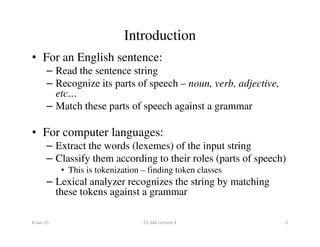
• For an English sentence:
– Read the sentence string
– Recognize its parts of speech – noun, verb, adjective,
etc…
– Match these parts of speech against a grammar
• For computer languages:
– Extract the words (lexemes) of the input string
– Classify them according to their roles (parts of speech)
• This is tokenization – finding token classes
– Lexical analyzer recognizes the string by matching
these tokens against a grammar
8-Jan-15 2CS 346 Lecture 3
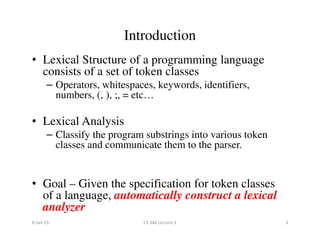
• Lexical Structure of a programming language
consists of a set of token classes
– Operators, whitespaces, keywords, identifiers,
numbers, (, ), ;, = etc…
• Lexical Analysis
Introduction
• Lexical Analysis
– Classify the program substrings into various token
classes and communicate them to the parser.
• Goal – Given the specification for token classes
of a language, automatically construct a lexical
analyzer
8-Jan-15 3CS 346 Lecture 3
Regular Expressions
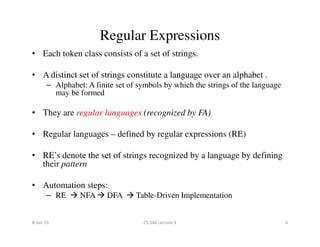
• Each token class consists of a set of strings.
• A distinct set of strings constitute a language over an alphabet .
– Alphabet: A finite set of symbols by which the strings of the language
may be formed
• They are regular languages (recognized by FA)
• Regular languages – defined by regular expressions (RE)
• RE’s denote the set of strings recognized by a language by defining
their pattern
• Automation steps:
– RE NFA DFA Table-Driven Implementation
8-Jan-15 4CS 346 Lecture 3
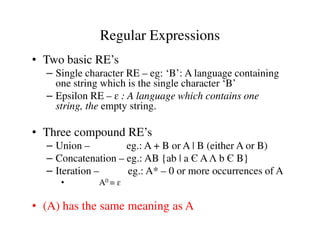
• Two basic RE’s
– Single character RE – eg: ‘B’: A language containing
one string which is the single character ‘B’
– Epsilon RE – ɛ : A language which contains one
string, the empty string.
Regular Expressions
• Three compound RE’s
– Union – eg.: A + B or A | B (either A or B)
– Concatenation – eg.: AB {ab | a Є AΛ b Є B}
– Iteration – eg.: A* – 0 or more occurrences of A
• A0 = ɛ
• (A) has the same meaning as A
Regular Language (Set)
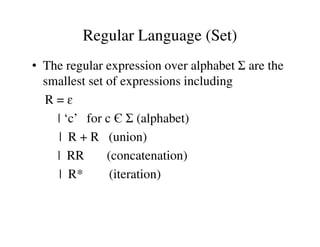
• The regular expression over alphabet Σ are the
smallest set of expressions including
R = ɛ
| ‘c’ for c Є Σ (alphabet)| ‘c’ for c Є Σ (alphabet)
| R + R (union)
| RR (concatenation)
| R* (iteration)
• Operator precedence: (A), A*, AB, A|B
– So ab*c|d is parsed as ((a(b*))c)|d
• Describe the languages denoted by the following
REs when alphabet (Σ) = {0,1}
– 1*; (1+0)1; 0*+1*; 01(01)*, (0+1)*, 11(0+1)*
Regular Expressions
– 1*; (1+0)1; 0*+1*; 01(01)*, (0+1)*, 11(0+1)*
• Short-hands:
– Character range: [a-d] for a | b | c | d;
– Atleast one: r+ for rr*;
– Option: r? for r | e
– Excluded range: [^a-z] = Complement of [a-z]
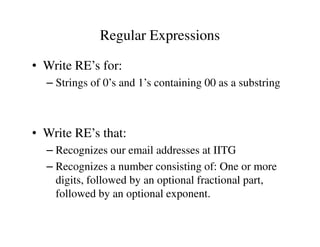
• Write RE’s for:
– Strings of 0’s and 1’s containing 00 as a substring
Regular Expressions
• Write RE’s that:
– Recognizes our email addresses at IITG
– Recognizes a number consisting of: One or more
digits, followed by an optional fractional part,
followed by an optional exponent.
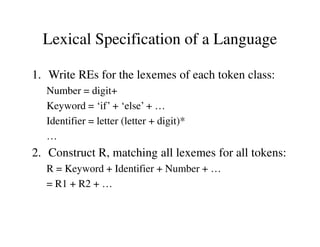
Lexical Specification of a Language
1. Write REs for the lexemes of each token class:
Number = digit+
Keyword = ‘if’ + ‘else’ + …
Identifier = letter (letter + digit)*Identifier = letter (letter + digit)*
…
2. Construct R, matching all lexemes for all tokens:
R = Keyword + Identifier + Number + …
= R1 + R2 + …
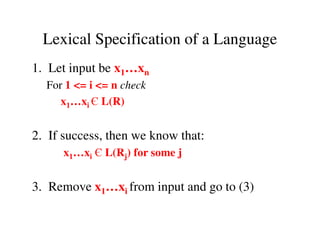
1. Let input be x1…xn
For 1 <= i <= n check
x1…xi Є L(R)
Lexical Specification of a Language
2. If success, then we know that:
x1…xi Є L(Rj) for some j
3. Remove x1…xi from input and go to (3)
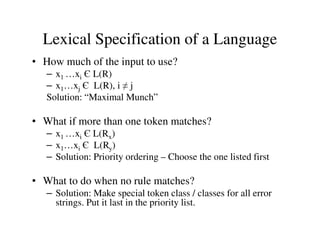
• How much of the input to use?
– x1 …xi Є L(R)
– x1…xj Є L(R), i ≠ j
Solution: “Maximal Munch”
• What if more than one token matches?
Lexical Specification of a Language
• What if more than one token matches?
– x1 …xi Є L(Rx)
– x1…xi Є L(Ry)
– Solution: Priority ordering – Choose the one listed first
• What to do when no rule matches?
– Solution: Make special token class / classes for all error
strings. Put it last in the priority list.
Lecture3 lexical analysis

Lecture3 lexical analysis

  • 1.
  • 2.
    Introduction • For anEnglish sentence: – Read the sentence string – Recognize its parts of speech – noun, verb, adjective, etc… – Match these parts of speech against a grammar • For computer languages: – Extract the words (lexemes) of the input string – Classify them according to their roles (parts of speech) • This is tokenization – finding token classes – Lexical analyzer recognizes the string by matching these tokens against a grammar 8-Jan-15 2CS 346 Lecture 3
  • 3.
    • Lexical Structureof a programming language consists of a set of token classes – Operators, whitespaces, keywords, identifiers, numbers, (, ), ;, = etc… • Lexical Analysis Introduction • Lexical Analysis – Classify the program substrings into various token classes and communicate them to the parser. • Goal – Given the specification for token classes of a language, automatically construct a lexical analyzer 8-Jan-15 3CS 346 Lecture 3
  • 4.
    Regular Expressions • Eachtoken class consists of a set of strings. • A distinct set of strings constitute a language over an alphabet . – Alphabet: A finite set of symbols by which the strings of the language may be formed • They are regular languages (recognized by FA) • Regular languages – defined by regular expressions (RE) • RE’s denote the set of strings recognized by a language by defining their pattern • Automation steps: – RE NFA DFA Table-Driven Implementation 8-Jan-15 4CS 346 Lecture 3
  • 5.
    • Two basicRE’s – Single character RE – eg: ‘B’: A language containing one string which is the single character ‘B’ – Epsilon RE – ɛ : A language which contains one string, the empty string. Regular Expressions • Three compound RE’s – Union – eg.: A + B or A | B (either A or B) – Concatenation – eg.: AB {ab | a Є AΛ b Є B} – Iteration – eg.: A* – 0 or more occurrences of A • A0 = ɛ • (A) has the same meaning as A
  • 6.
    Regular Language (Set) •The regular expression over alphabet Σ are the smallest set of expressions including R = ɛ | ‘c’ for c Є Σ (alphabet)| ‘c’ for c Є Σ (alphabet) | R + R (union) | RR (concatenation) | R* (iteration)
  • 7.
    • Operator precedence:(A), A*, AB, A|B – So ab*c|d is parsed as ((a(b*))c)|d • Describe the languages denoted by the following REs when alphabet (Σ) = {0,1} – 1*; (1+0)1; 0*+1*; 01(01)*, (0+1)*, 11(0+1)* Regular Expressions – 1*; (1+0)1; 0*+1*; 01(01)*, (0+1)*, 11(0+1)* • Short-hands: – Character range: [a-d] for a | b | c | d; – Atleast one: r+ for rr*; – Option: r? for r | e – Excluded range: [^a-z] = Complement of [a-z]
  • 8.
    • Write RE’sfor: – Strings of 0’s and 1’s containing 00 as a substring Regular Expressions • Write RE’s that: – Recognizes our email addresses at IITG – Recognizes a number consisting of: One or more digits, followed by an optional fractional part, followed by an optional exponent.
  • 9.
    Lexical Specification ofa Language 1. Write REs for the lexemes of each token class: Number = digit+ Keyword = ‘if’ + ‘else’ + … Identifier = letter (letter + digit)*Identifier = letter (letter + digit)* … 2. Construct R, matching all lexemes for all tokens: R = Keyword + Identifier + Number + … = R1 + R2 + …
  • 10.
    1. Let inputbe x1…xn For 1 <= i <= n check x1…xi Є L(R) Lexical Specification of a Language 2. If success, then we know that: x1…xi Є L(Rj) for some j 3. Remove x1…xi from input and go to (3)
  • 11.
    • How muchof the input to use? – x1 …xi Є L(R) – x1…xj Є L(R), i ≠ j Solution: “Maximal Munch” • What if more than one token matches? Lexical Specification of a Language • What if more than one token matches? – x1 …xi Є L(Rx) – x1…xi Є L(Ry) – Solution: Priority ordering – Choose the one listed first • What to do when no rule matches? – Solution: Make special token class / classes for all error strings. Put it last in the priority list.