Syntax Analysis V
Lecture 10
Syntax Analysis V
Bottom-Up Parsing
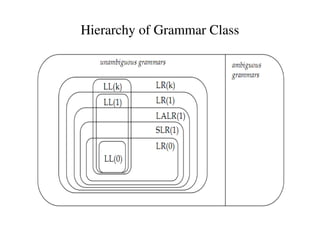
Hierarchy of Grammar Class
Viable Prefixes
• α is a viable prefix of a given grammar if:
– There is a such that αw is a right sentential form
• α | ω is a state of the shift-reduce parser
• As long as the parser has viable prefixes on the stack no• As long as the parser has viable prefixes on the stack no
parser error has been seen
• The set of viable prefixes is a regular language (not
obvious)
• Construct an automaton that accepts viable prefixes
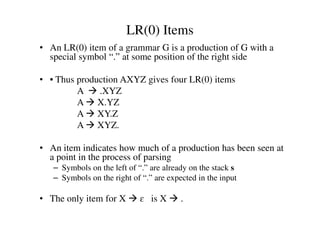
LR(0) Items
• An LR(0) item of a grammar G is a production of G with a
special symbol “.” at some position of the right side
• • Thus production AXYZ gives four LR(0) items
A .XYZ
A X.YZ
A XY.ZA XY.Z
A XYZ.
• An item indicates how much of a production has been seen at
a point in the process of parsing
– Symbols on the left of “.” are already on the stack s
– Symbols on the right of “.” are expected in the input
• The only item for X ɛ is X .
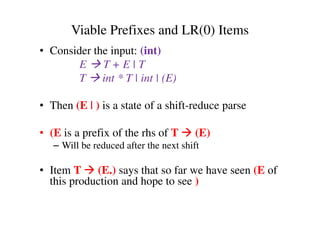
Viable Prefixes and LR(0) Items
• Consider the input: (int)
E T + E | T
T int * T | int | (E)
• Then (E | ) is a state of a shift-reduce parse
• (E is a prefix of the rhs of T (E)
– Will be reduced after the next shift
• Item T (E.) says that so far we have seen (E of
this production and hope to see )
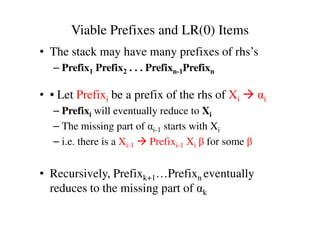
Viable Prefixes and LR(0) Items
• The stack may have many prefixes of rhs’s
– Prefix1 Prefix2 . . . Prefixn-1Prefixn
• • Let Prefixi be a prefix of the rhs of Xi αi
– Prefixi will eventually reduce to Xi– Prefixi will eventually reduce to Xi
– The missing part of αi-1 starts with Xi
– i.e. there is a Xi-1 Prefixi-1 Xi β for some β
• Recursively, Prefixk+1…Prefixn eventually
reduces to the missing part of αk
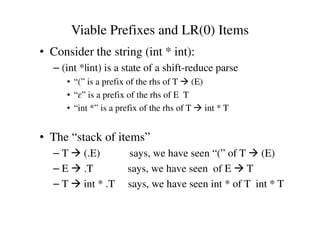
Viable Prefixes and LR(0) Items
• Consider the string (int * int):
– (int *|int) is a state of a shift-reduce parse
• “(” is a prefix of the rhs of T (E)
• “ɛ” is a prefix of the rhs of E T
• “int *” is a prefix of the rhs of T int * T
• The “stack of items”
– T (.E) says, we have seen “(” of T (E)
– E .T says, we have seen of E T
– T int * .T says, we have seen int * of T int * T
Recognizing Viable Prefixes
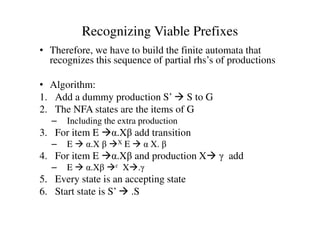
• Therefore, we have to build the finite automata that
recognizes this sequence of partial rhs’s of productions
• Algorithm:
1. Add a dummy production S’ S to G
2. The NFA states are the items of G2. The NFA states are the items of G
– Including the extra production
3. For item E α.Xβ add transition
– E α.X β X E α X. β
4. For item E α.Xβ and production X γ add
– E α.Xβ ɛ X .γ
5. Every state is an accepting state
6. Start state is S’ .S
Recognizing Viable Prefixes
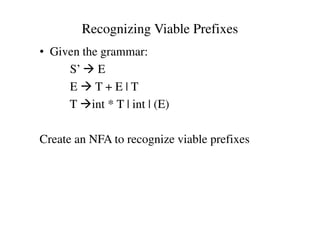
• Given the grammar:
S’ E
E T + E | T
T int * T | int | (E)
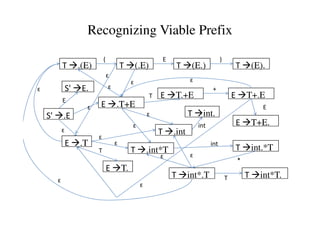
Create an NFA to recognize viable prefixes
Recognizing Viable Prefix
S' .E
S' E.
E
E .T+Eɛ
T
T .(E)
ɛ
E T.+E E T+.E
+
ɛ
ɛ
T (.E)
(
T (E.)
E
ɛ
ɛ
T (E).
)
E
ɛ
T int.
ɛ
S' .E
E .T
E T.
T .int
ɛ
T .int*T
ɛ
ɛ
ɛ E T+E.
ɛ
T int.
int
T int.*Tint
T int*.T
*
T int*T.T
ɛ ɛ
ɛ
T
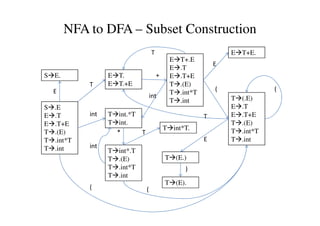
NFA to DFA – Subset Construction
S .E
E .T
S E.
E
E T.
E T.+ET
T int.*Tint
E T+.E
E .T
E .T+E
T .(E)
T .int*T
T .int
+
T
int
E T+E.
E
T (.E)
E .T
E .T+E
(
T
(
E .T
E .T+E
T .(E)
T .int*T
T .int
T int.*T
T int.
int
T int*.T
T .(E)
T .int*T
T .int
*
int
E .T+E
T .(E)
T .int*T
T .int
T
T int*T.
T
T (E.)
T (E).
E
)
((
Valid Items
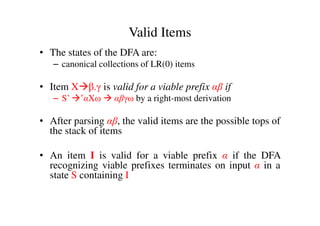
• The states of the DFA are:
– canonical collections of LR(0) items
• Item X β.γ is valid for a viable prefix αβ if
– S’ *αXω αβγω by a right-most derivation
• After parsing αβ, the valid items are the possible tops of
the stack of items
• An item I is valid for a viable prefix α if the DFA
recognizing viable prefixes terminates on input α in a
state S containing I
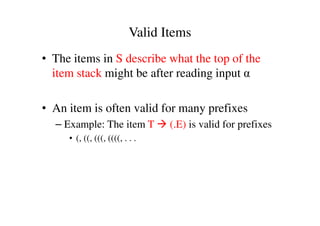
• The items in S describe what the top of the
item stack might be after reading input α
• An item is often valid for many prefixes
Valid Items
• An item is often valid for many prefixes
– Example: The item T (.E) is valid for prefixes
• (, ((, (((, ((((, . . .
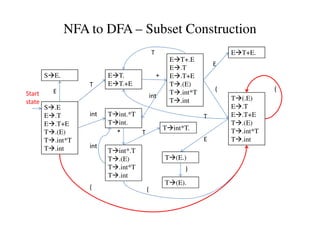
NFA to DFA – Subset Construction
S .E
E .T
S E.
E
E T.
E T.+ET
T int.*Tint
E T+.E
E .T
E .T+E
T .(E)
T .int*T
T .int
+
T
int
E T+E.
E
T (.E)
E .T
E .T+E
(
T
(
Start
state
E .T
E .T+E
T .(E)
T .int*T
T .int
T int.*T
T int.
int
T int*.T
T .(E)
T .int*T
T .int
*
int
E .T+E
T .(E)
T .int*T
T .int
T
T int*T.
T
T (E.)
T (E).
E
)
((
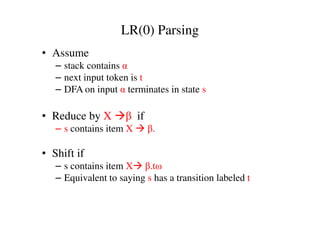
LR(0) Parsing
• Assume
– stack contains α
– next input token is t
– DFA on input α terminates in state s
• Reduce by X β if• Reduce by X β if
– s contains item X β.
• Shift if
– s contains item X β.tω
– Equivalent to saying s has a transition labeled t
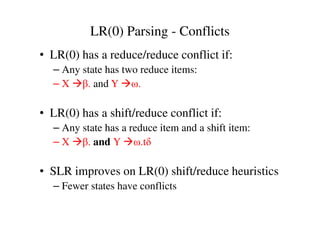
LR(0) Parsing - Conflicts
• LR(0) has a reduce/reduce conflict if:
– Any state has two reduce items:
– X β. and Y ω.
• LR(0) has a shift/reduce conflict if:• LR(0) has a shift/reduce conflict if:
– Any state has a reduce item and a shift item:
– X β. and Y ω.tδ
• SLR improves on LR(0) shift/reduce heuristics
– Fewer states have conflicts
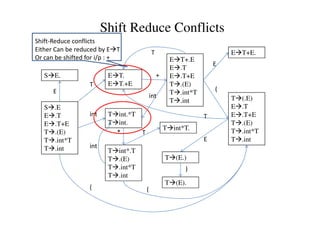
Shift Reduce Conflicts
S .E
E .T
S E.
E
E T.
E T.+ET
T int.*Tint
E T+.E
E .T
E .T+E
T .(E)
T .int*T
T .int
+
T
int
E T+E.
E
T (.E)
E .T
E .T+E
(
T
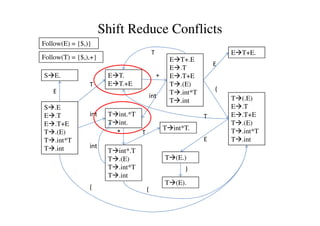
Shift-Reduce conflicts
Either Can be reduced by E T
Or can be shifted for i/p : +
E .T
E .T+E
T .(E)
T .int*T
T .int
T int.*T
T int.
int
T int*.T
T .(E)
T .int*T
T .int
*
int
E .T+E
T .(E)
T .int*T
T .int
T
T int*T.
T
T (E.)
T (E).
E
)
((
Countermeasure
• SLR = Simple LR
• Improve on LR(0) shift/reduce heuristics
– Fewer states have conflicts
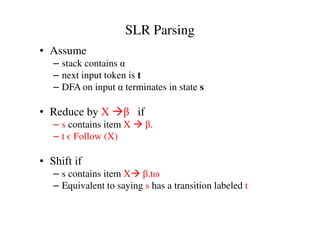
SLR Parsing
• Assume
– stack contains α
– next input token is t
– DFA on input α terminates in state s
• Reduce by X β if• Reduce by X β if
– s contains item X β.
– t ϵ Follow (X)
• Shift if
– s contains item X β.tω
– Equivalent to saying s has a transition labeled t
• If there are conflicts under these rules, the
grammar is not SLR
• The rules amount to a heuristic for detecting
SLR Parsing
• The rules amount to a heuristic for detecting
handle
– The SLR grammars are those where the heuristics
detect exactly the handle
Shift Reduce Conflicts
S .E
E .T
S E.
E
E T.
E T.+ET
T int.*Tint
E T+.E
E .T
E .T+E
T .(E)
T .int*T
T .int
+
T
int
E T+E.
E
T (.E)
E .T
E .T+E
(
T
Follow(E) = {$,)}
Follow(T) = {$,),+}
E .T
E .T+E
T .(E)
T .int*T
T .int
T int.*T
T int.
int
T int*.T
T .(E)
T .int*T
T .int
*
int
E .T+E
T .(E)
T .int*T
T .int
T
T int*T.
T
T (E.)
T (E).
E
)
((
SLR Parsing Algorithm
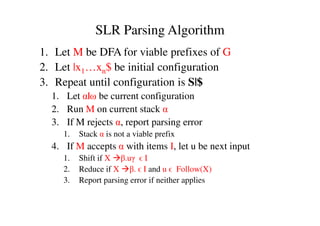
1. Let M be DFA for viable prefixes of G
2. Let |x1…xn$ be initial configuration
3. Repeat until configuration is S|$
1. Let α|ω be current configuration
2. Run M on current stack α2. Run M on current stack α
3. If M rejects α, report parsing error
1. Stack α is not a viable prefix
4. If M accepts α with items I, let u be next input
1. Shift if X β.uγ ϵ I
2. Reduce if X β. ϵ I and u ϵ Follow(X)
3. Report parsing error if neither applies
SLR Parsing - Improvements
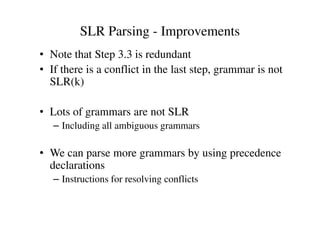
• Note that Step 3.3 is redundant
• If there is a conflict in the last step, grammar is not
SLR(k)
• Lots of grammars are not SLR• Lots of grammars are not SLR
– Including all ambiguous grammars
• We can parse more grammars by using precedence
declarations
– Instructions for resolving conflicts
SLR Parsing
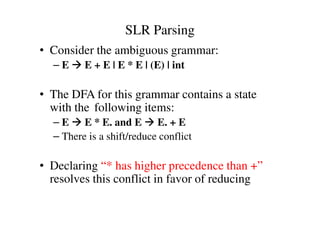
• Consider the ambiguous grammar:
– E E + E | E * E | (E) | int
• The DFA for this grammar contains a state
with the following items:with the following items:
– E E * E. and E E. + E
– There is a shift/reduce conflict
• Declaring “* has higher precedence than +”
resolves this conflict in favor of reducing
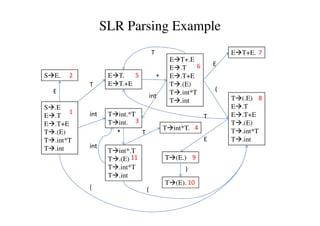
SLR Parsing Example
S .E
E .T
S E.
E
E T.
E T.+ET
T int.*Tint
E T+.E
E .T
E .T+E
T .(E)
T .int*T
T .int
+
T
int
E T+E.
E
T (.E)
E .T
E .T+E
(
T
1
2 5
7
6
8
E .T
E .T+E
T .(E)
T .int*T
T .int
T int.*T
T int.
int
T int*.T
T .(E)
T .int*T
T .int
*
int
E .T+E
T .(E)
T .int*T
T .int
T
T int*T.
T
T (E.)
T (E).
E
)
((
1
3
4
10
911
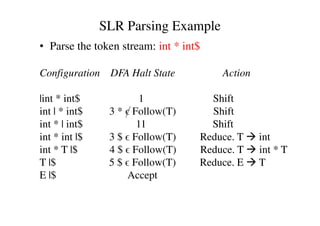
• Parse the token stream: int * int$
Configuration DFA Halt State Action
|int * int$ 1 Shift
int | * int$ 3 * ϵ Follow(T) Shift
SLR Parsing Example
int | * int$ 3 * ϵ Follow(T) Shift
int * | int$ 11 Shift
int * int |$ 3 $ ϵ Follow(T) Reduce. T int
int * T |$ 4 $ ϵ Follow(T) Reduce. T int * T
T |$ 5 $ ϵ Follow(T) Reduce. E T
E |$ Accept
Lecture10 syntax analysis_6

Lecture10 syntax analysis_6

  • 1.
    Syntax Analysis V Lecture10 Syntax Analysis V Bottom-Up Parsing
  • 2.
  • 3.
    Viable Prefixes • αis a viable prefix of a given grammar if: – There is a such that αw is a right sentential form • α | ω is a state of the shift-reduce parser • As long as the parser has viable prefixes on the stack no• As long as the parser has viable prefixes on the stack no parser error has been seen • The set of viable prefixes is a regular language (not obvious) • Construct an automaton that accepts viable prefixes
  • 4.
    LR(0) Items • AnLR(0) item of a grammar G is a production of G with a special symbol “.” at some position of the right side • • Thus production AXYZ gives four LR(0) items A .XYZ A X.YZ A XY.ZA XY.Z A XYZ. • An item indicates how much of a production has been seen at a point in the process of parsing – Symbols on the left of “.” are already on the stack s – Symbols on the right of “.” are expected in the input • The only item for X ɛ is X .
  • 5.
    Viable Prefixes andLR(0) Items • Consider the input: (int) E T + E | T T int * T | int | (E) • Then (E | ) is a state of a shift-reduce parse • (E is a prefix of the rhs of T (E) – Will be reduced after the next shift • Item T (E.) says that so far we have seen (E of this production and hope to see )
  • 6.
    Viable Prefixes andLR(0) Items • The stack may have many prefixes of rhs’s – Prefix1 Prefix2 . . . Prefixn-1Prefixn • • Let Prefixi be a prefix of the rhs of Xi αi – Prefixi will eventually reduce to Xi– Prefixi will eventually reduce to Xi – The missing part of αi-1 starts with Xi – i.e. there is a Xi-1 Prefixi-1 Xi β for some β • Recursively, Prefixk+1…Prefixn eventually reduces to the missing part of αk
  • 7.
    Viable Prefixes andLR(0) Items • Consider the string (int * int): – (int *|int) is a state of a shift-reduce parse • “(” is a prefix of the rhs of T (E) • “ɛ” is a prefix of the rhs of E T • “int *” is a prefix of the rhs of T int * T • The “stack of items” – T (.E) says, we have seen “(” of T (E) – E .T says, we have seen of E T – T int * .T says, we have seen int * of T int * T
  • 8.
    Recognizing Viable Prefixes •Therefore, we have to build the finite automata that recognizes this sequence of partial rhs’s of productions • Algorithm: 1. Add a dummy production S’ S to G 2. The NFA states are the items of G2. The NFA states are the items of G – Including the extra production 3. For item E α.Xβ add transition – E α.X β X E α X. β 4. For item E α.Xβ and production X γ add – E α.Xβ ɛ X .γ 5. Every state is an accepting state 6. Start state is S’ .S
  • 9.
    Recognizing Viable Prefixes •Given the grammar: S’ E E T + E | T T int * T | int | (E) Create an NFA to recognize viable prefixes
  • 10.
    Recognizing Viable Prefix S'.E S' E. E E .T+Eɛ T T .(E) ɛ E T.+E E T+.E + ɛ ɛ T (.E) ( T (E.) E ɛ ɛ T (E). ) E ɛ T int. ɛ S' .E E .T E T. T .int ɛ T .int*T ɛ ɛ ɛ E T+E. ɛ T int. int T int.*Tint T int*.T * T int*T.T ɛ ɛ ɛ T
  • 11.
    NFA to DFA– Subset Construction S .E E .T S E. E E T. E T.+ET T int.*Tint E T+.E E .T E .T+E T .(E) T .int*T T .int + T int E T+E. E T (.E) E .T E .T+E ( T ( E .T E .T+E T .(E) T .int*T T .int T int.*T T int. int T int*.T T .(E) T .int*T T .int * int E .T+E T .(E) T .int*T T .int T T int*T. T T (E.) T (E). E ) ((
  • 12.
    Valid Items • Thestates of the DFA are: – canonical collections of LR(0) items • Item X β.γ is valid for a viable prefix αβ if – S’ *αXω αβγω by a right-most derivation • After parsing αβ, the valid items are the possible tops of the stack of items • An item I is valid for a viable prefix α if the DFA recognizing viable prefixes terminates on input α in a state S containing I
  • 13.
    • The itemsin S describe what the top of the item stack might be after reading input α • An item is often valid for many prefixes Valid Items • An item is often valid for many prefixes – Example: The item T (.E) is valid for prefixes • (, ((, (((, ((((, . . .
  • 14.
    NFA to DFA– Subset Construction S .E E .T S E. E E T. E T.+ET T int.*Tint E T+.E E .T E .T+E T .(E) T .int*T T .int + T int E T+E. E T (.E) E .T E .T+E ( T ( Start state E .T E .T+E T .(E) T .int*T T .int T int.*T T int. int T int*.T T .(E) T .int*T T .int * int E .T+E T .(E) T .int*T T .int T T int*T. T T (E.) T (E). E ) ((
  • 15.
    LR(0) Parsing • Assume –stack contains α – next input token is t – DFA on input α terminates in state s • Reduce by X β if• Reduce by X β if – s contains item X β. • Shift if – s contains item X β.tω – Equivalent to saying s has a transition labeled t
  • 16.
    LR(0) Parsing -Conflicts • LR(0) has a reduce/reduce conflict if: – Any state has two reduce items: – X β. and Y ω. • LR(0) has a shift/reduce conflict if:• LR(0) has a shift/reduce conflict if: – Any state has a reduce item and a shift item: – X β. and Y ω.tδ • SLR improves on LR(0) shift/reduce heuristics – Fewer states have conflicts
  • 17.
    Shift Reduce Conflicts S.E E .T S E. E E T. E T.+ET T int.*Tint E T+.E E .T E .T+E T .(E) T .int*T T .int + T int E T+E. E T (.E) E .T E .T+E ( T Shift-Reduce conflicts Either Can be reduced by E T Or can be shifted for i/p : + E .T E .T+E T .(E) T .int*T T .int T int.*T T int. int T int*.T T .(E) T .int*T T .int * int E .T+E T .(E) T .int*T T .int T T int*T. T T (E.) T (E). E ) ((
  • 18.
    Countermeasure • SLR =Simple LR • Improve on LR(0) shift/reduce heuristics – Fewer states have conflicts
  • 19.
    SLR Parsing • Assume –stack contains α – next input token is t – DFA on input α terminates in state s • Reduce by X β if• Reduce by X β if – s contains item X β. – t ϵ Follow (X) • Shift if – s contains item X β.tω – Equivalent to saying s has a transition labeled t
  • 20.
    • If thereare conflicts under these rules, the grammar is not SLR • The rules amount to a heuristic for detecting SLR Parsing • The rules amount to a heuristic for detecting handle – The SLR grammars are those where the heuristics detect exactly the handle
  • 21.
    Shift Reduce Conflicts S.E E .T S E. E E T. E T.+ET T int.*Tint E T+.E E .T E .T+E T .(E) T .int*T T .int + T int E T+E. E T (.E) E .T E .T+E ( T Follow(E) = {$,)} Follow(T) = {$,),+} E .T E .T+E T .(E) T .int*T T .int T int.*T T int. int T int*.T T .(E) T .int*T T .int * int E .T+E T .(E) T .int*T T .int T T int*T. T T (E.) T (E). E ) ((
  • 22.
    SLR Parsing Algorithm 1.Let M be DFA for viable prefixes of G 2. Let |x1…xn$ be initial configuration 3. Repeat until configuration is S|$ 1. Let α|ω be current configuration 2. Run M on current stack α2. Run M on current stack α 3. If M rejects α, report parsing error 1. Stack α is not a viable prefix 4. If M accepts α with items I, let u be next input 1. Shift if X β.uγ ϵ I 2. Reduce if X β. ϵ I and u ϵ Follow(X) 3. Report parsing error if neither applies
  • 23.
    SLR Parsing -Improvements • Note that Step 3.3 is redundant • If there is a conflict in the last step, grammar is not SLR(k) • Lots of grammars are not SLR• Lots of grammars are not SLR – Including all ambiguous grammars • We can parse more grammars by using precedence declarations – Instructions for resolving conflicts
  • 24.
    SLR Parsing • Considerthe ambiguous grammar: – E E + E | E * E | (E) | int • The DFA for this grammar contains a state with the following items:with the following items: – E E * E. and E E. + E – There is a shift/reduce conflict • Declaring “* has higher precedence than +” resolves this conflict in favor of reducing
  • 25.
    SLR Parsing Example S.E E .T S E. E E T. E T.+ET T int.*Tint E T+.E E .T E .T+E T .(E) T .int*T T .int + T int E T+E. E T (.E) E .T E .T+E ( T 1 2 5 7 6 8 E .T E .T+E T .(E) T .int*T T .int T int.*T T int. int T int*.T T .(E) T .int*T T .int * int E .T+E T .(E) T .int*T T .int T T int*T. T T (E.) T (E). E ) (( 1 3 4 10 911
  • 26.
    • Parse thetoken stream: int * int$ Configuration DFA Halt State Action |int * int$ 1 Shift int | * int$ 3 * ϵ Follow(T) Shift SLR Parsing Example int | * int$ 3 * ϵ Follow(T) Shift int * | int$ 11 Shift int * int |$ 3 $ ϵ Follow(T) Reduce. T int int * T |$ 4 $ ϵ Follow(T) Reduce. T int * T T |$ 5 $ ϵ Follow(T) Reduce. E T E |$ Accept