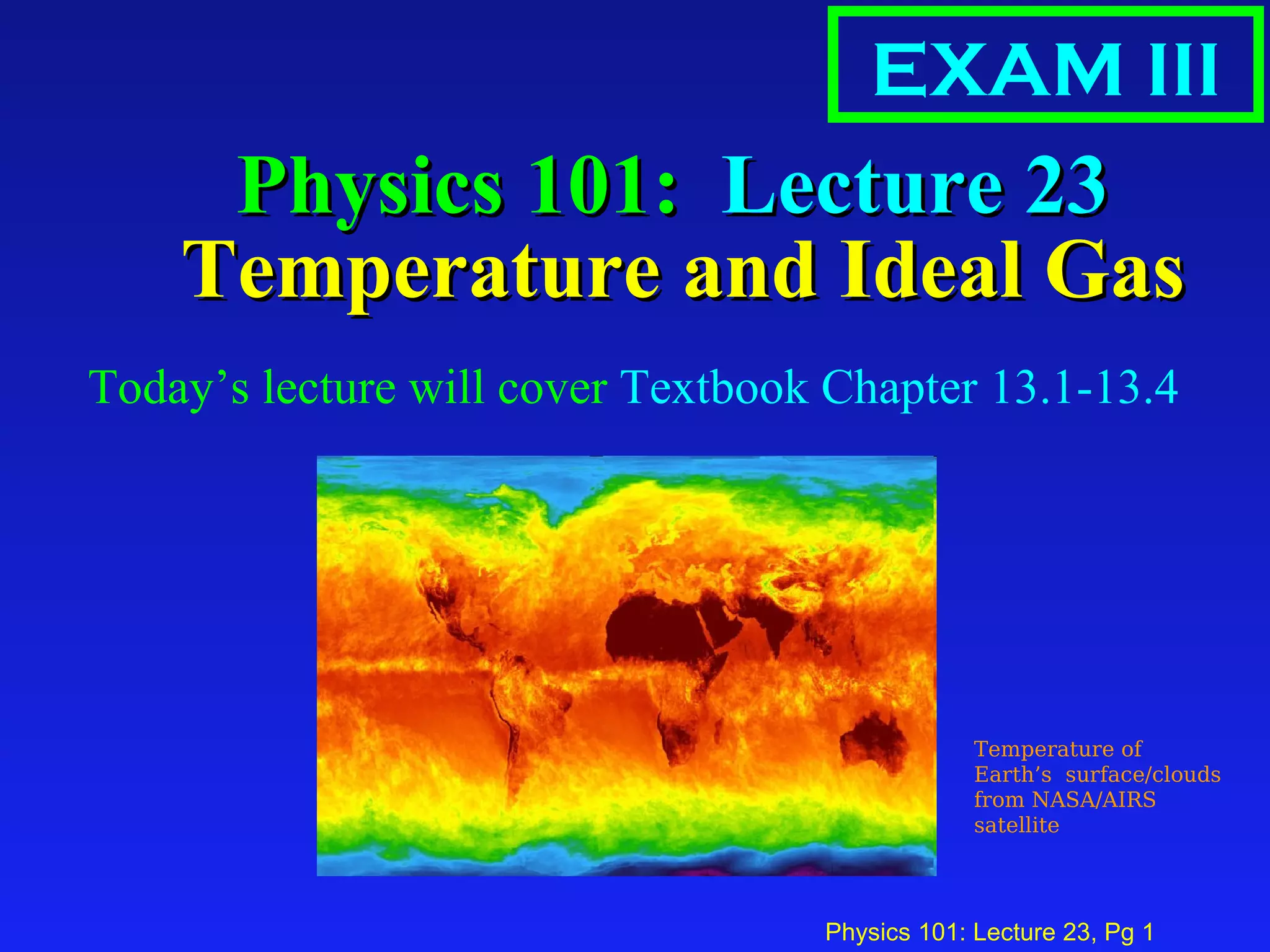
Physics 101:  Lecture 23  Temperature and Ideal Gas Today’s lecture will cover  Textbook Chapter 13.1-13.4 EXAM III Temperature of Earth’s  surface/clouds from NASA/AIRS satellite
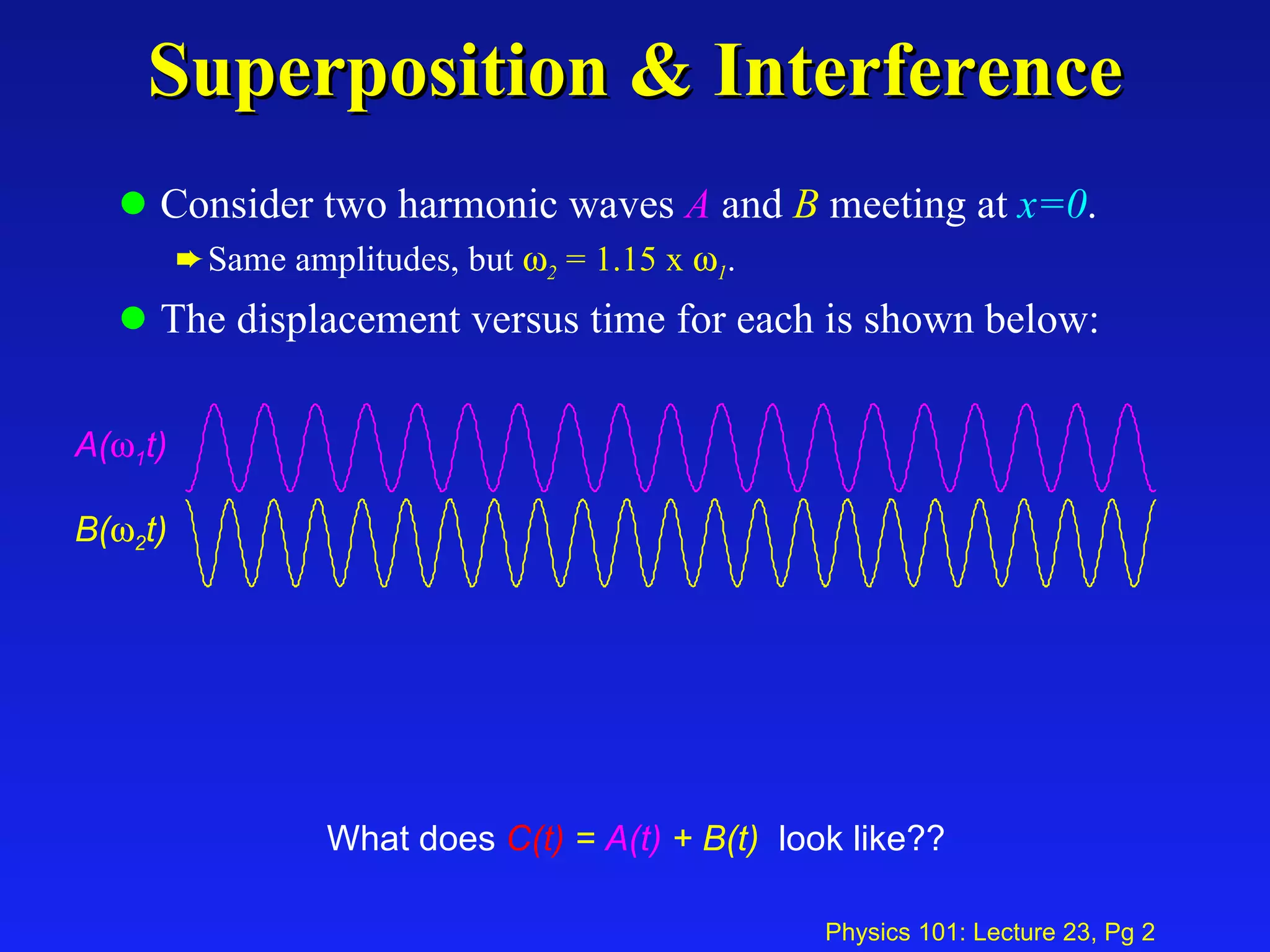
Superposition & Interference Consider two harmonic waves  A  and  B  meeting at  x=0 . Same amplitudes, but   2  = 1.15 x   1 . The displacement versus time for each is shown below: What does  C(t)  =   A(t)   +   B(t)   look like?? A(  1 t) B(  2 t)
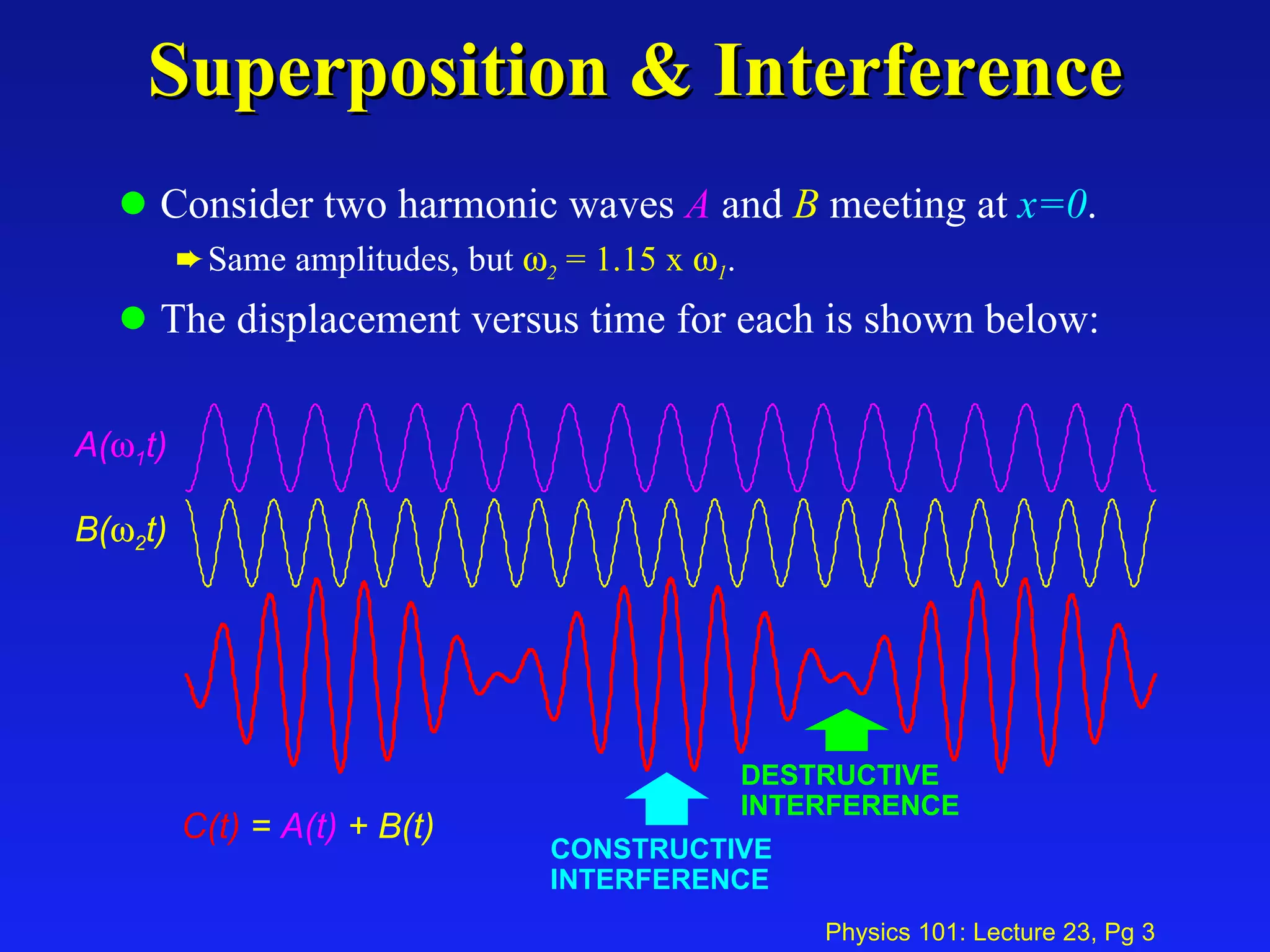
Superposition & Interference Consider two harmonic waves  A  and  B  meeting at  x=0 . Same amplitudes, but   2  = 1.15 x   1 . The displacement versus time for each is shown below: A(  1 t) B(  2 t) C(t)  =   A(t)   +   B(t) CONSTRUCTIVE INTERFERENCE DESTRUCTIVE INTERFERENCE
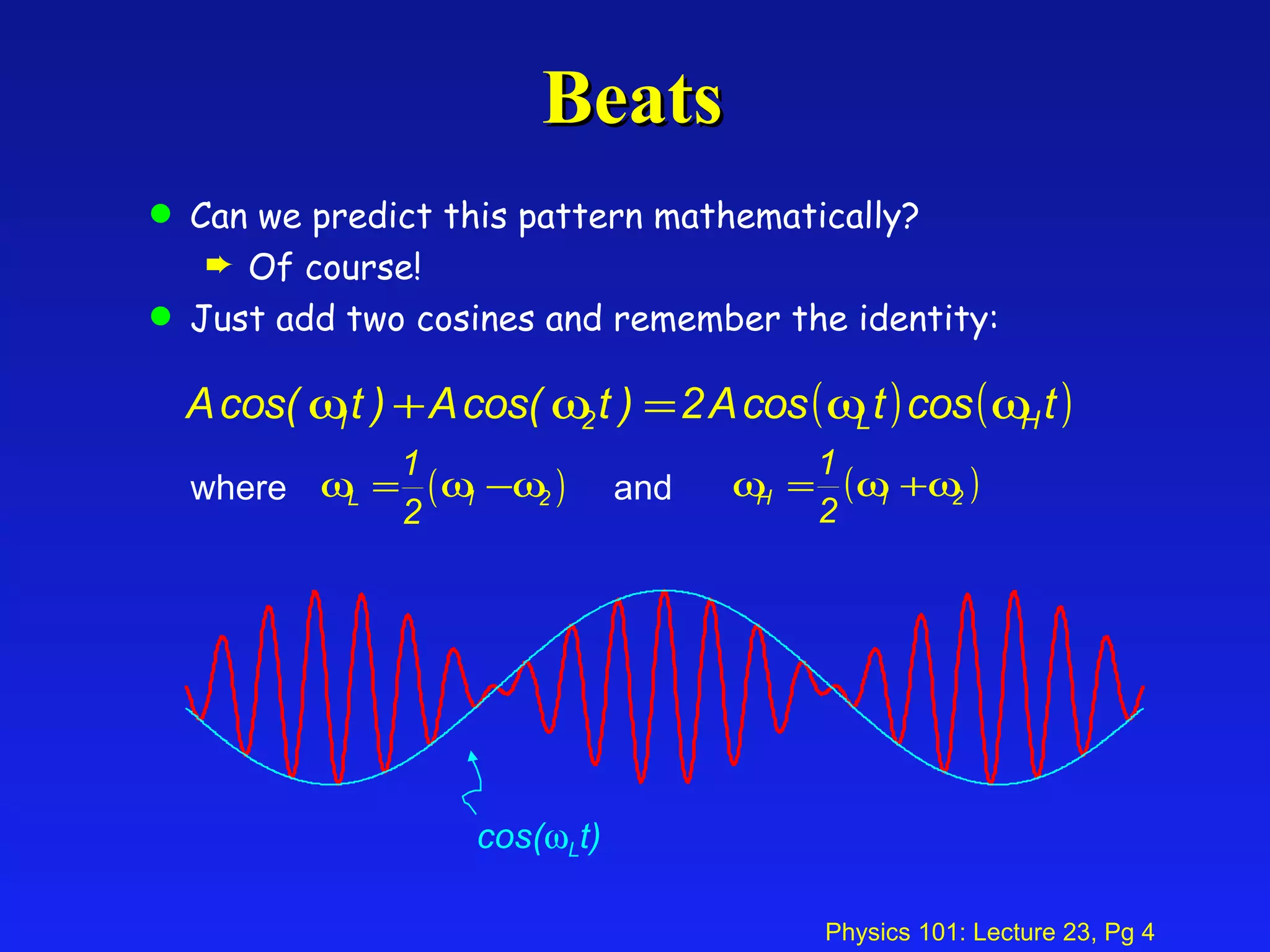
Beats Can we predict this pattern mathematically? Of course! Just add two cosines and remember the identity: where and cos(  L t)
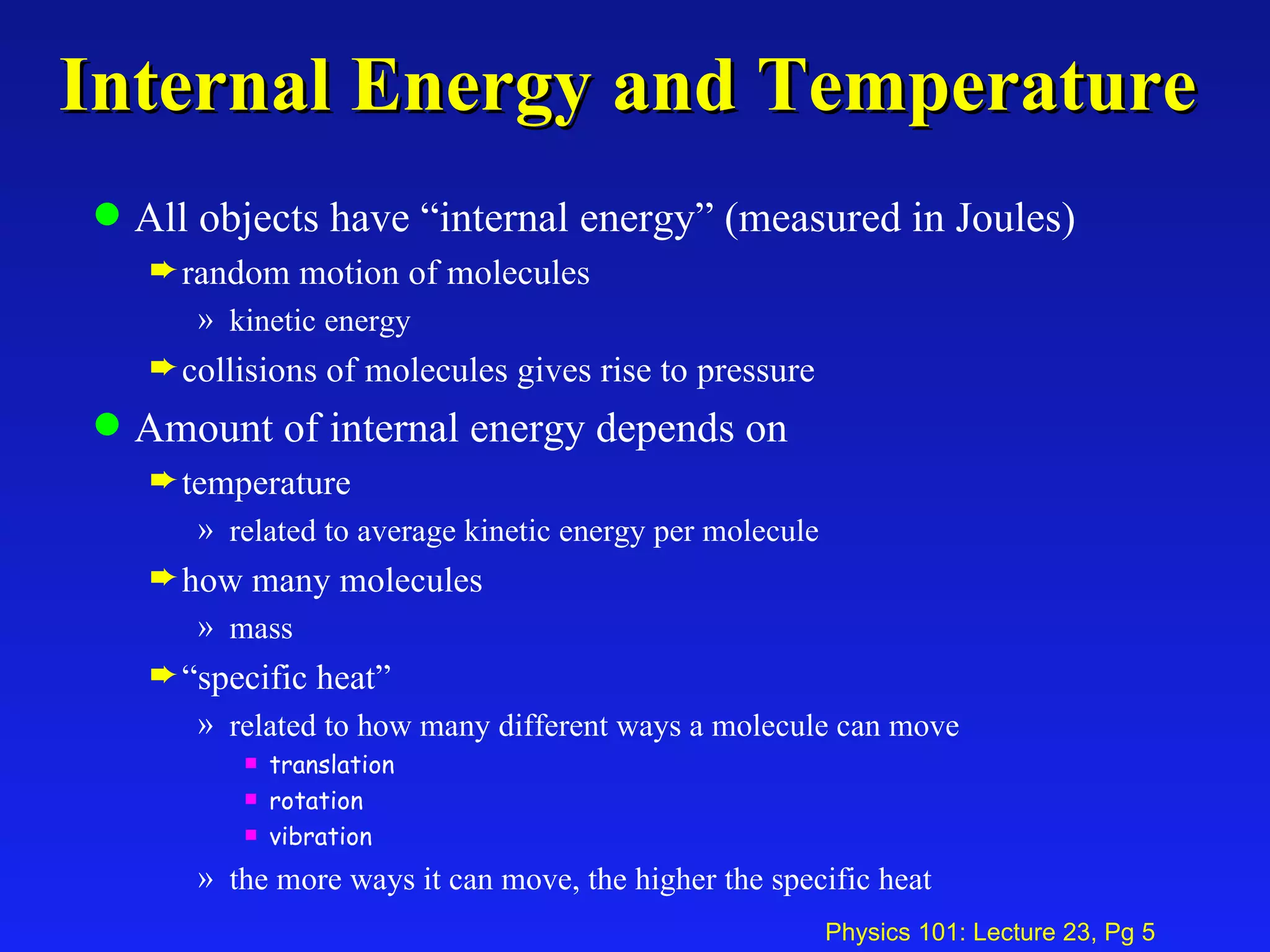
Internal Energy and Temperature All objects have “internal energy” (measured in Joules) random motion of molecules  kinetic energy collisions of molecules gives rise to pressure Amount of internal energy depends on  temperature related to average kinetic energy per molecule how many molecules  mass “ specific heat” related to how many different ways a molecule can move translation rotation vibration the more ways it can move, the higher the specific heat
Zeroth law of Thermodynamics If two objects are in thermo equilibrium with a third, then the two are in equilibrium with each other. If they are in equilibrium, they are at the same temperature
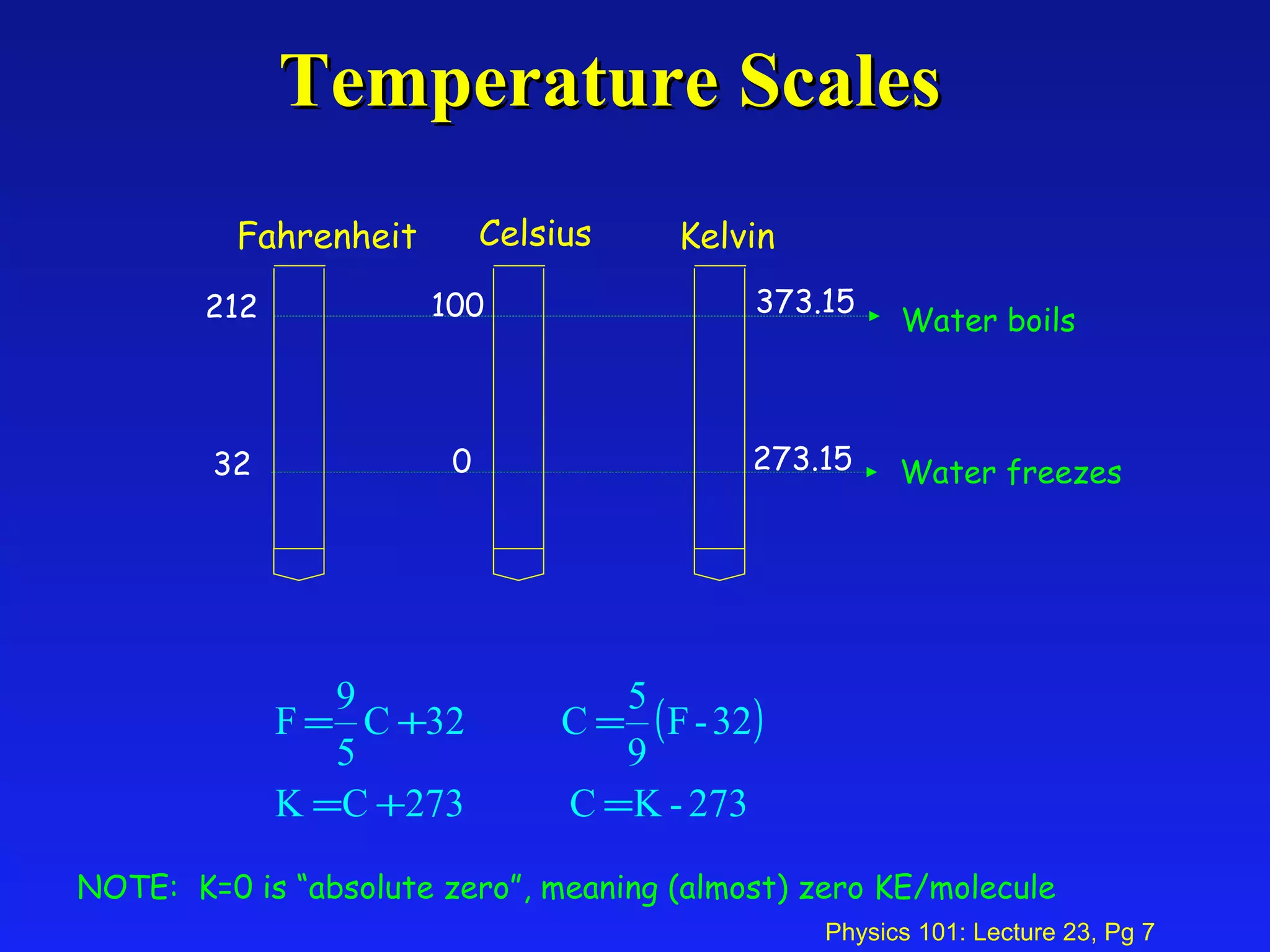
Temperature Scales NOTE:  K=0 is “absolute zero”, meaning (almost) zero KE/molecule Water boils Water freezes 212 32 Fahrenheit 100 0 Celsius 273.15 373.15 Kelvin
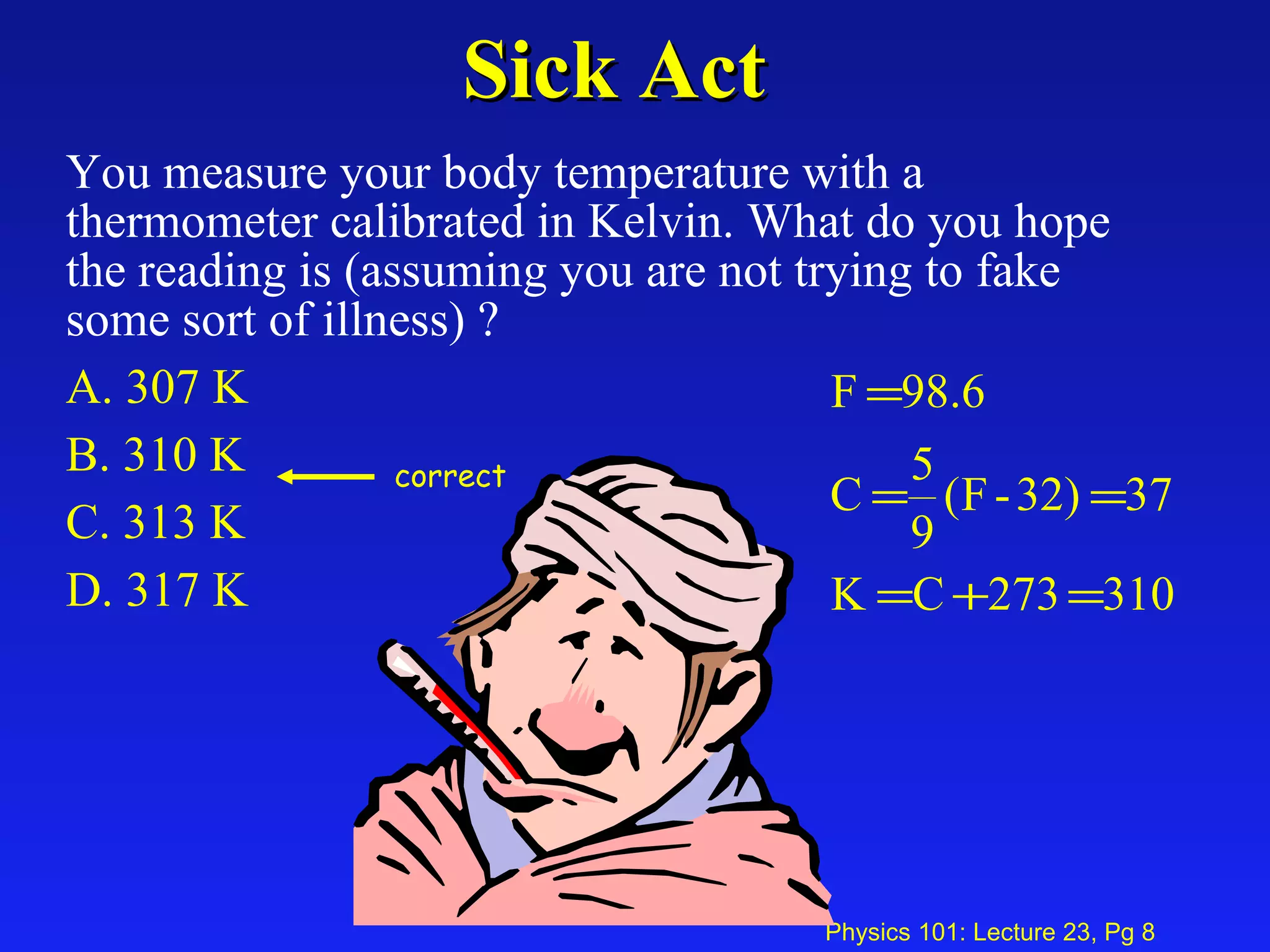
Sick Act You measure your body temperature with a thermometer calibrated in Kelvin. What do you hope the reading is (assuming you are not trying to fake some sort of illness) ?  A. 307 K  B. 310 K  C. 313 K  D. 317 K  correct
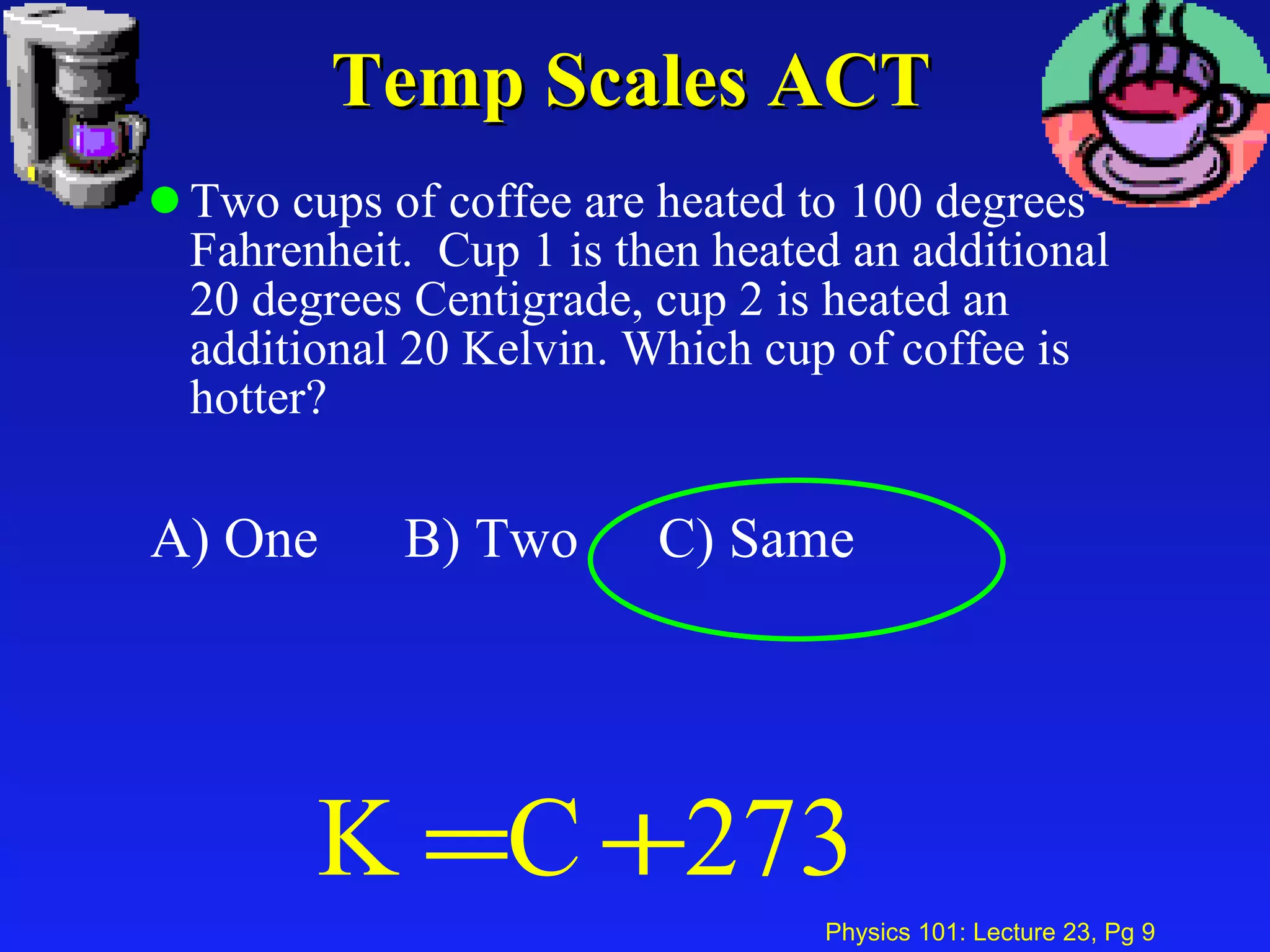
Temp Scales ACT Two cups of coffee are heated to 100 degrees Fahrenheit.  Cup 1 is then heated an additional 20 degrees Centigrade, cup 2 is heated an additional 20 Kelvin. Which cup of coffee is hotter? A) One B) Two C) Same
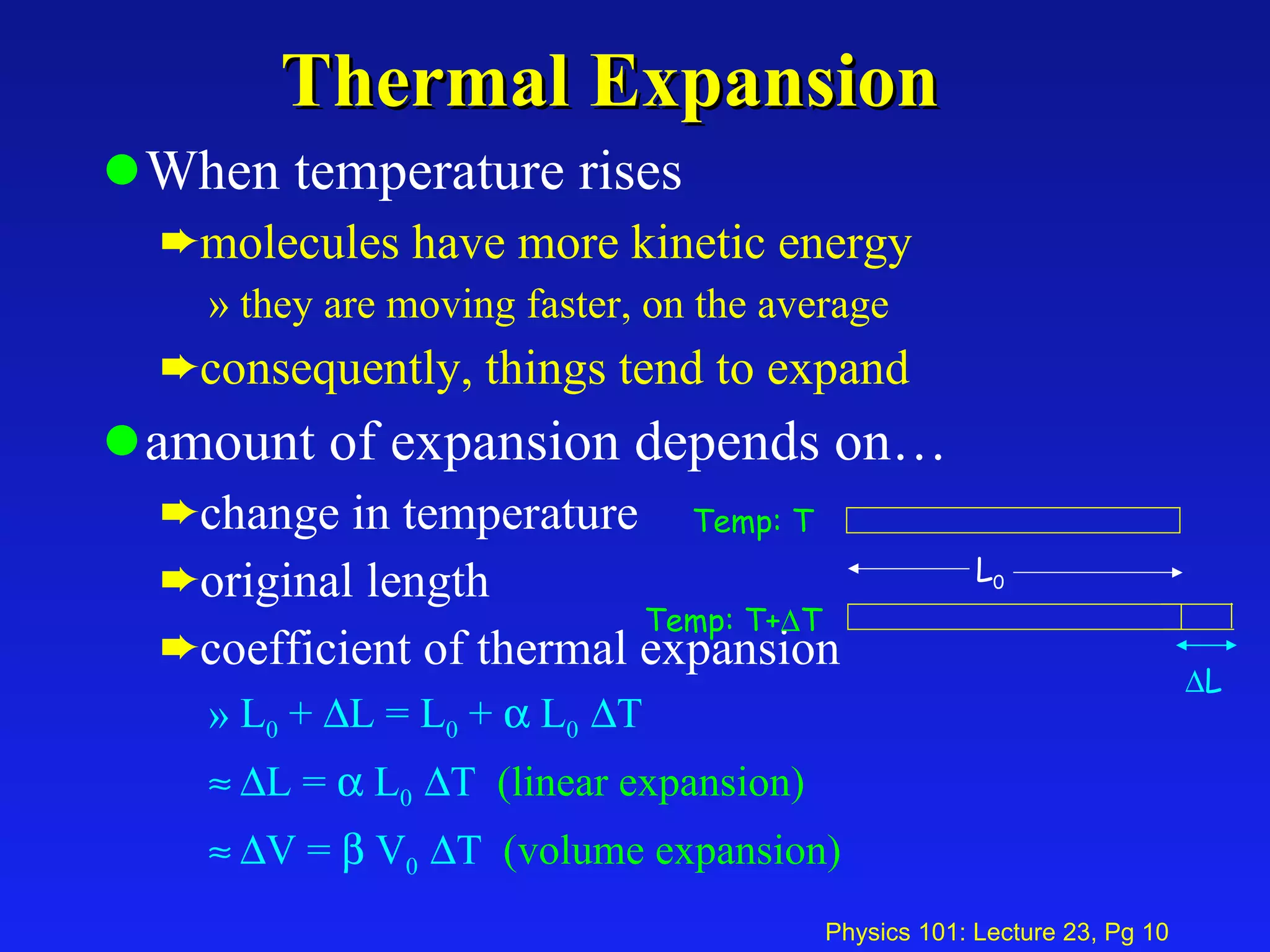
Thermal Expansion When temperature rises molecules have more kinetic energy  they are moving faster, on the average consequently, things tend to expand amount of expansion depends on… change in temperature original length coefficient of thermal expansion L 0  +   L = L 0  +    L 0   T  L =    L 0   T  (linear expansion)  V =    V 0   T  (volume expansion) Temp: T Temp: T+  T L 0  L
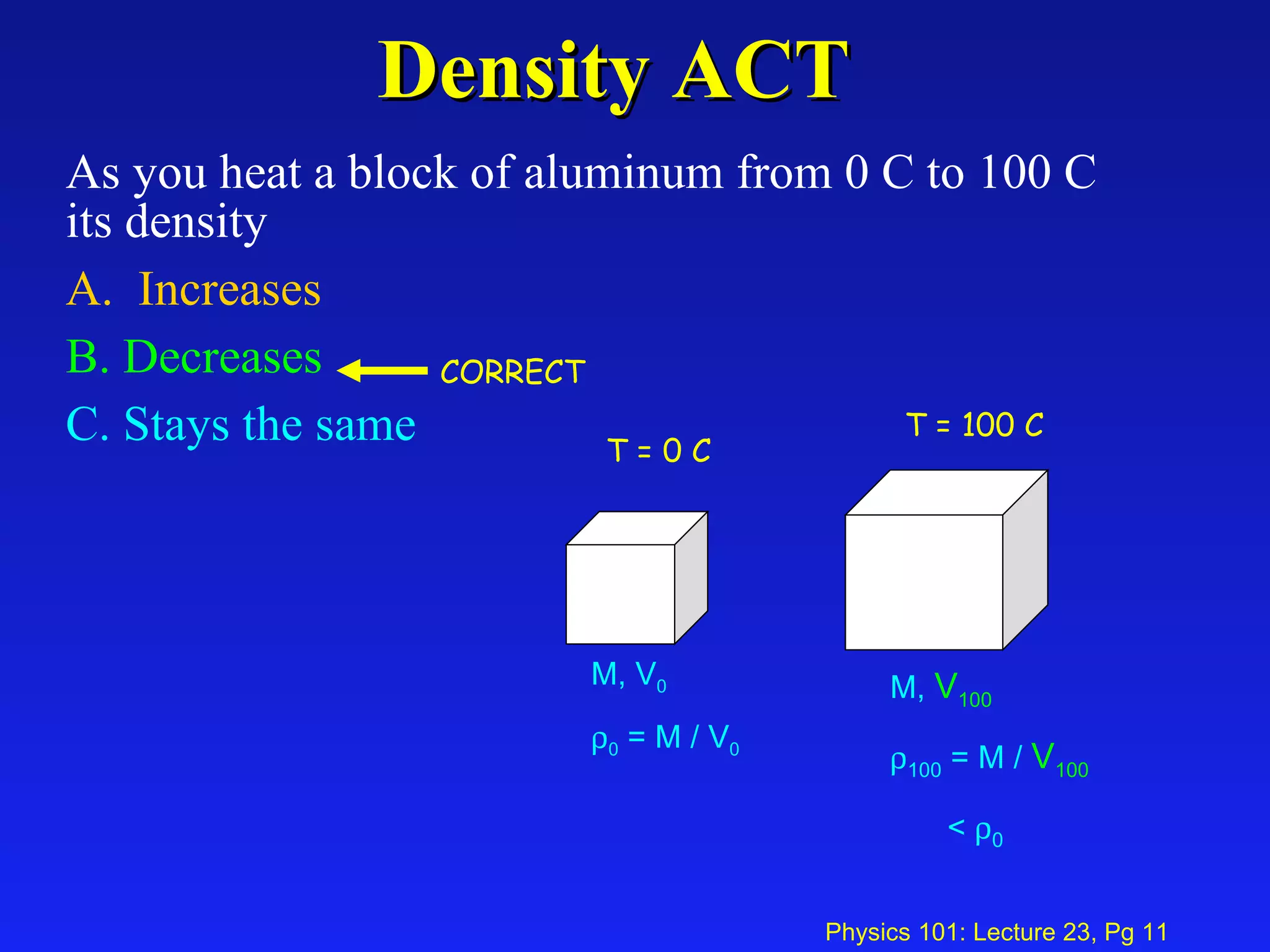
Density ACT As you heat a block of aluminum from 0 C to 100 C its density  A.  Increases   B. Decreases   C. Stays the same T = 0 C M, V 0  0  = M / V 0 T = 100 C M,  V 100  100  = M /  V 100  <   0 CORRECT
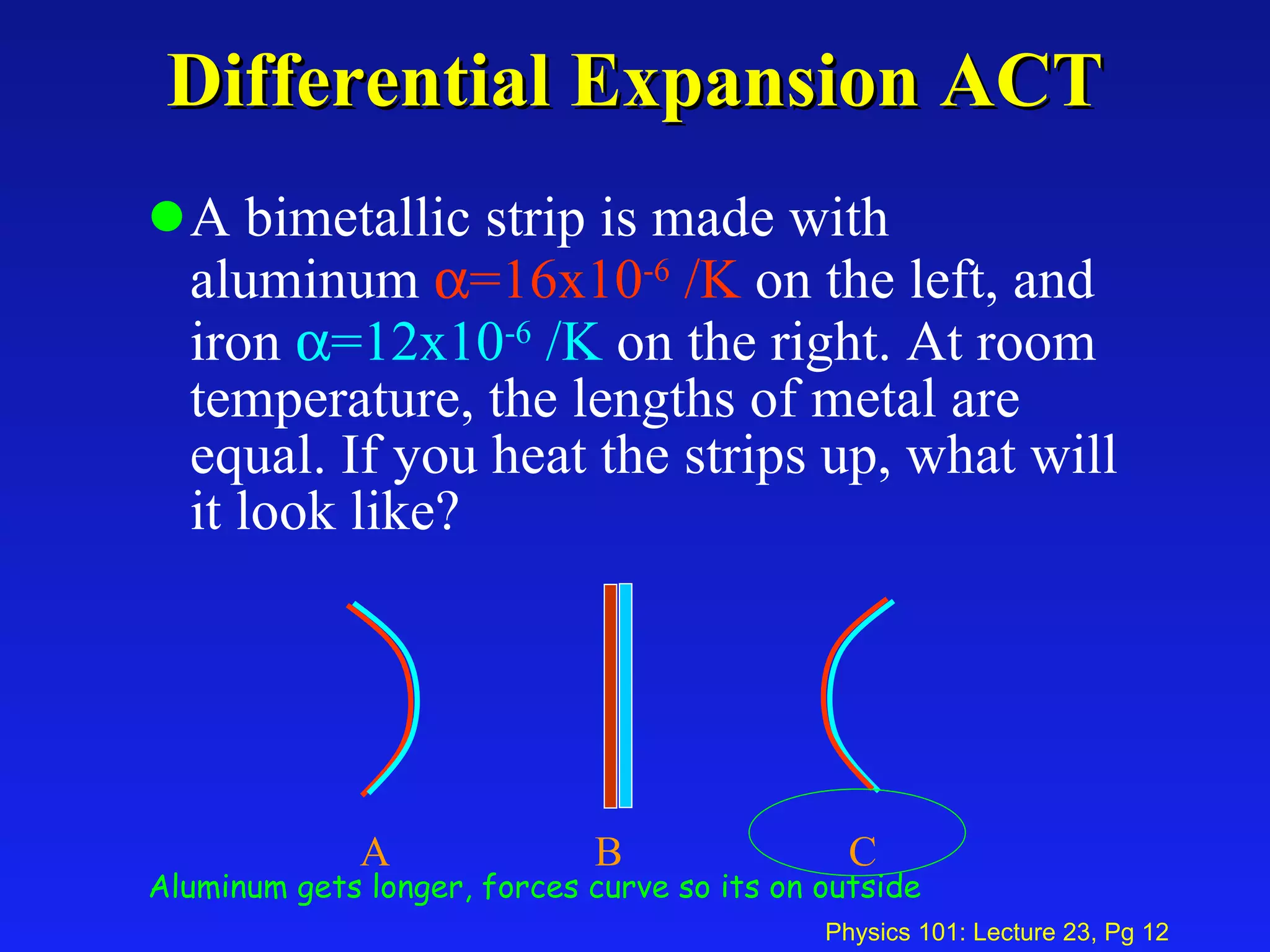
Differential Expansion ACT A bimetallic strip is made with aluminum   =16x10 -6  /K  on the left, and iron   =12x10 -6  /K  on the right. At room temperature, the lengths of metal are equal. If you heat the strips up, what will it look like? A  B C  Aluminum gets longer, forces curve so its on outside
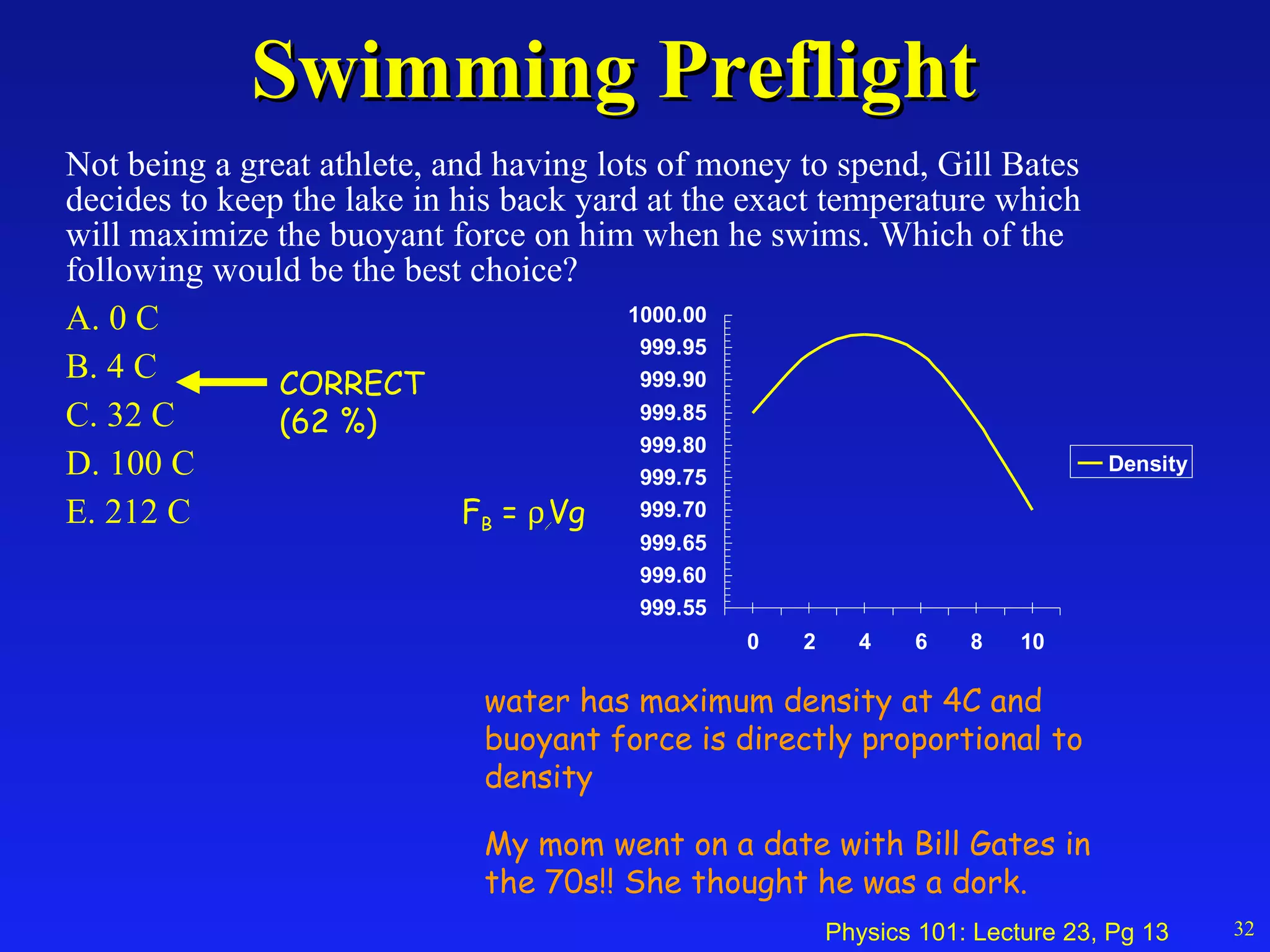
Swimming Preflight Not being a great athlete, and having lots of money to spend, Gill Bates decides to keep the lake in his back yard at the exact temperature which will maximize the buoyant force on him when he swims. Which of the following would be the best choice?  A. 0 C  B. 4 C  C. 32 C  D. 100 C  E. 212 C F B  =   l Vg 32 water has maximum density at 4C and buoyant force is directly proportional to density My mom went on a date with Bill Gates in the 70s!! She thought he was a dork. CORRECT (62 %)
Tight Fit Preflight An aluminum plate has a circular hole cut in it. An aluminum ball (solid sphere) has exactly the same diameter as the hole when both are at room temperature, and hence can just barely be pushed through it. If both the plate and the ball are now heated up to a few hundred degrees Celsius, how will the ball and the hole fit ?  A. The ball won’t fit through the hole any more  B. The ball will fit more easily through the hole  C. Same as at room temperature Both are made of the same material so heating it up will mean the objects will expand at the same rate.  Both the ball and the plate will expand when heated, so the diameter of the ball will increase, while the diameter of the hole will decrease, as the aluminum plate has expanded, and the ball will not fit through the hole. demo CORRECT
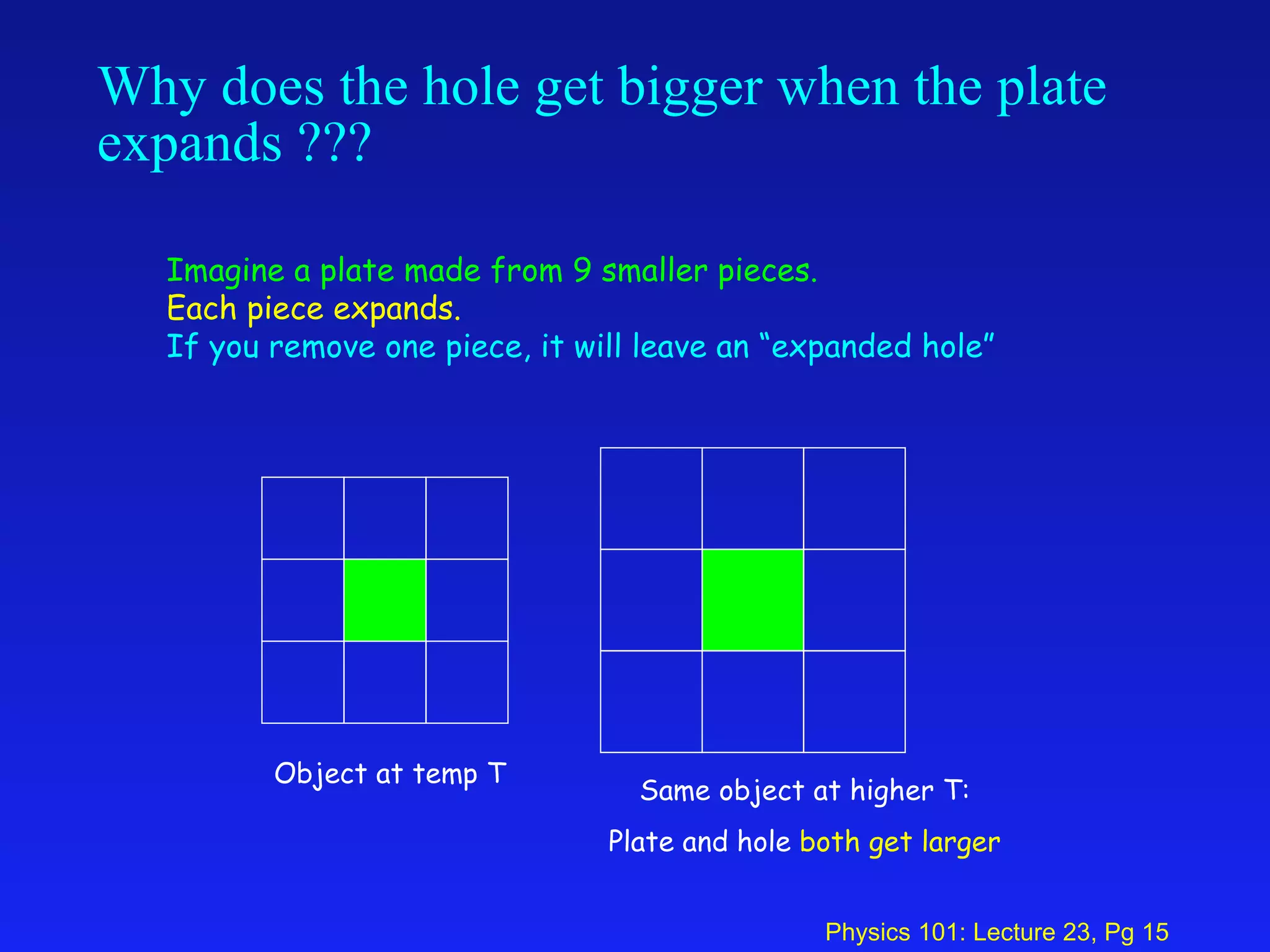
Why does the hole get bigger when the plate expands ??? Imagine a plate made from 9 smaller pieces.  Each piece expands.  If you remove one piece, it will leave an “expanded hole” Object at temp T Same object at higher T: Plate and hole  both get larger
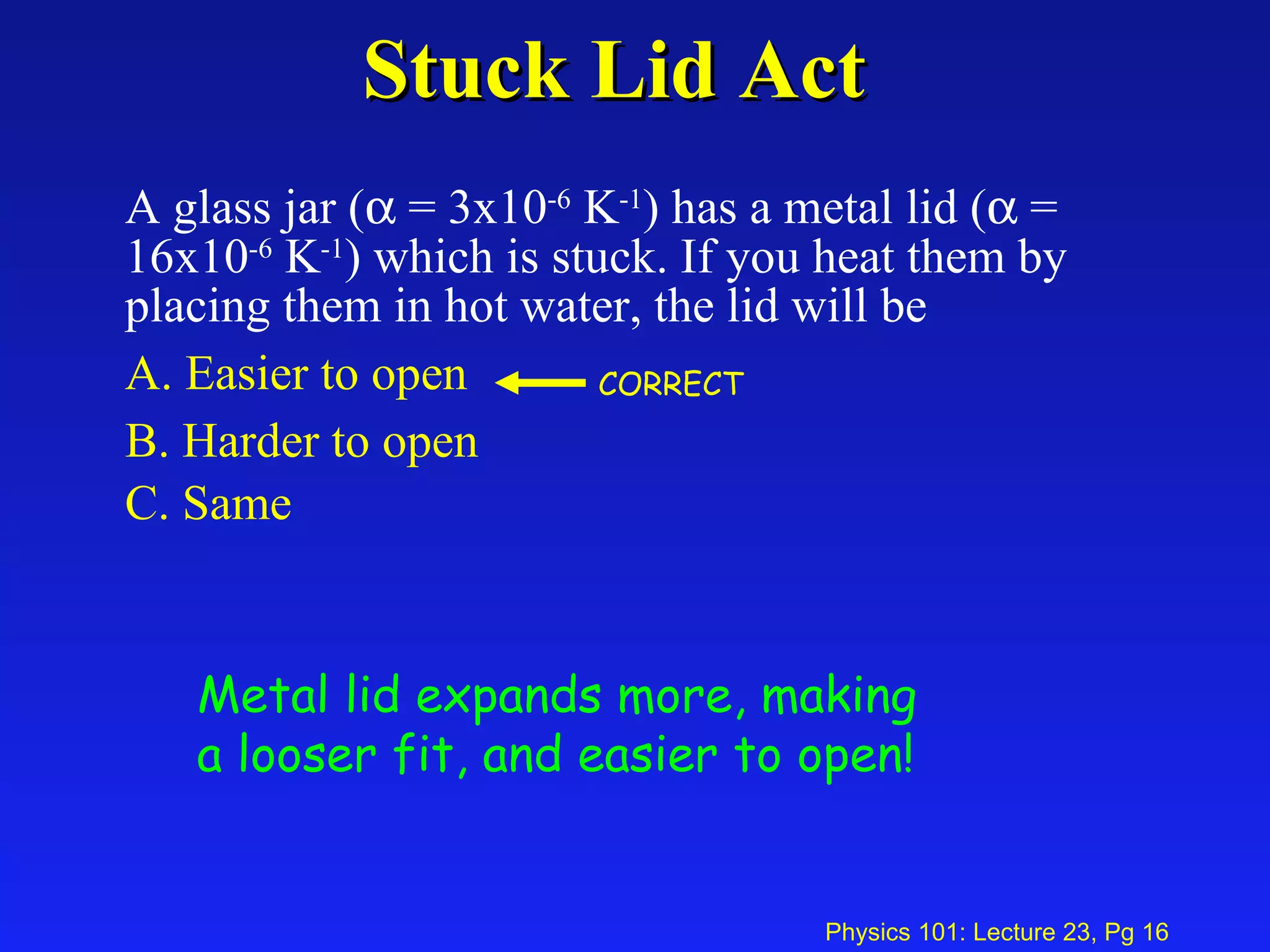
Stuck Lid Act A glass jar (   = 3x10 -6  K -1 ) has a metal lid (   = 16x10 -6  K -1 ) which is stuck. If you heat them by placing them in hot water, the lid will be   A. Easier to open  B. Harder to open  C. Same   Metal lid expands more, making a looser fit, and easier to open! CORRECT
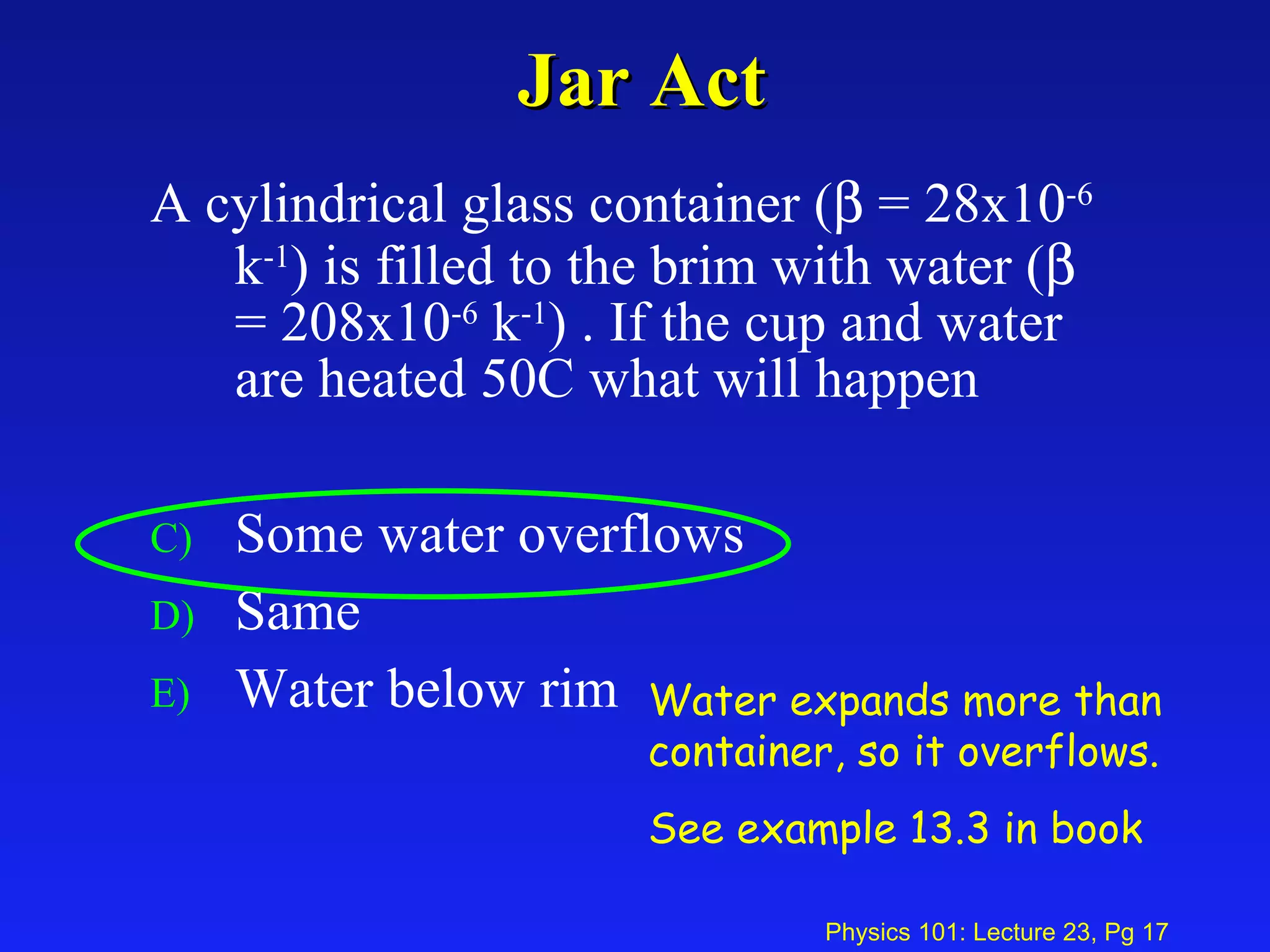
Jar Act A cylindrical glass container (   = 28x10 -6  k -1 ) is filled to the brim with water (   = 208x10 -6  k -1 ) . If the cup and water are heated 50C what will happen Some water overflows Same Water below rim Water expands more than container, so it overflows. See example 13.3 in book
Molecular Picture of Gas Gas is made up of many individual molecules Number density  is number of molecules/volume  N/V =   /m    is the mass density m is the mass for one molecule Number of  moles   n=N / N A N A  = Avogadro’s number 6.022x10 23  mole -1
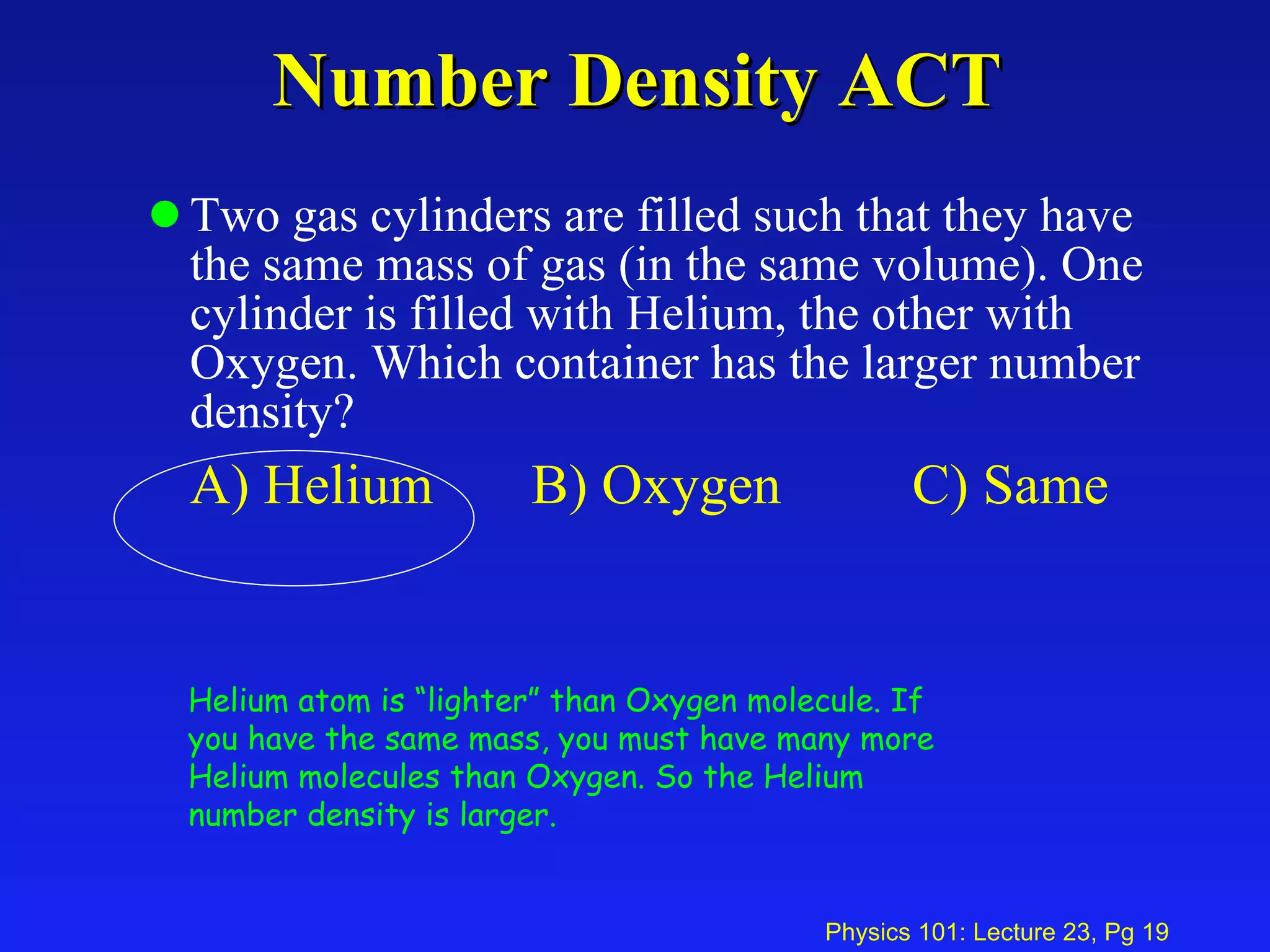
Number Density ACT Two gas cylinders are filled such that they have the same mass of gas (in the same volume). One cylinder is filled with Helium, the other with Oxygen. Which container has the larger number density? A) Helium B) Oxygen C) Same Helium atom is “lighter” than Oxygen molecule. If you have the same mass, you must have many more Helium molecules than Oxygen. So the Helium number density is larger.
Summary Temperature measure of average Kinetic Energy of molecules Thermal Expansion  L =    L 0   T  (linear expansion)  V =    L 0   T  (volume expansion) Gas made up of molecules

Lecture23

  • 1.
    Physics 101: Lecture 23 Temperature and Ideal Gas Today’s lecture will cover Textbook Chapter 13.1-13.4 EXAM III Temperature of Earth’s surface/clouds from NASA/AIRS satellite
  • 2.
    Superposition & InterferenceConsider two harmonic waves A and B meeting at x=0 . Same amplitudes, but  2 = 1.15 x  1 . The displacement versus time for each is shown below: What does C(t) = A(t) + B(t) look like?? A(  1 t) B(  2 t)
  • 3.
    Superposition & InterferenceConsider two harmonic waves A and B meeting at x=0 . Same amplitudes, but  2 = 1.15 x  1 . The displacement versus time for each is shown below: A(  1 t) B(  2 t) C(t) = A(t) + B(t) CONSTRUCTIVE INTERFERENCE DESTRUCTIVE INTERFERENCE
  • 4.
    Beats Can wepredict this pattern mathematically? Of course! Just add two cosines and remember the identity: where and cos(  L t)
  • 5.
    Internal Energy andTemperature All objects have “internal energy” (measured in Joules) random motion of molecules kinetic energy collisions of molecules gives rise to pressure Amount of internal energy depends on temperature related to average kinetic energy per molecule how many molecules mass “ specific heat” related to how many different ways a molecule can move translation rotation vibration the more ways it can move, the higher the specific heat
  • 6.
    Zeroth law ofThermodynamics If two objects are in thermo equilibrium with a third, then the two are in equilibrium with each other. If they are in equilibrium, they are at the same temperature
  • 7.
    Temperature Scales NOTE: K=0 is “absolute zero”, meaning (almost) zero KE/molecule Water boils Water freezes 212 32 Fahrenheit 100 0 Celsius 273.15 373.15 Kelvin
  • 8.
    Sick Act Youmeasure your body temperature with a thermometer calibrated in Kelvin. What do you hope the reading is (assuming you are not trying to fake some sort of illness) ? A. 307 K B. 310 K C. 313 K D. 317 K correct
  • 9.
    Temp Scales ACTTwo cups of coffee are heated to 100 degrees Fahrenheit. Cup 1 is then heated an additional 20 degrees Centigrade, cup 2 is heated an additional 20 Kelvin. Which cup of coffee is hotter? A) One B) Two C) Same
  • 10.
    Thermal Expansion Whentemperature rises molecules have more kinetic energy they are moving faster, on the average consequently, things tend to expand amount of expansion depends on… change in temperature original length coefficient of thermal expansion L 0 +  L = L 0 +  L 0  T  L =  L 0  T (linear expansion)  V =  V 0  T (volume expansion) Temp: T Temp: T+  T L 0  L
  • 11.
    Density ACT Asyou heat a block of aluminum from 0 C to 100 C its density A. Increases B. Decreases C. Stays the same T = 0 C M, V 0  0 = M / V 0 T = 100 C M, V 100  100 = M / V 100 <  0 CORRECT
  • 12.
    Differential Expansion ACTA bimetallic strip is made with aluminum  =16x10 -6 /K on the left, and iron  =12x10 -6 /K on the right. At room temperature, the lengths of metal are equal. If you heat the strips up, what will it look like? A B C Aluminum gets longer, forces curve so its on outside
  • 13.
    Swimming Preflight Notbeing a great athlete, and having lots of money to spend, Gill Bates decides to keep the lake in his back yard at the exact temperature which will maximize the buoyant force on him when he swims. Which of the following would be the best choice? A. 0 C B. 4 C C. 32 C D. 100 C E. 212 C F B =  l Vg 32 water has maximum density at 4C and buoyant force is directly proportional to density My mom went on a date with Bill Gates in the 70s!! She thought he was a dork. CORRECT (62 %)
  • 14.
    Tight Fit PreflightAn aluminum plate has a circular hole cut in it. An aluminum ball (solid sphere) has exactly the same diameter as the hole when both are at room temperature, and hence can just barely be pushed through it. If both the plate and the ball are now heated up to a few hundred degrees Celsius, how will the ball and the hole fit ? A. The ball won’t fit through the hole any more B. The ball will fit more easily through the hole C. Same as at room temperature Both are made of the same material so heating it up will mean the objects will expand at the same rate. Both the ball and the plate will expand when heated, so the diameter of the ball will increase, while the diameter of the hole will decrease, as the aluminum plate has expanded, and the ball will not fit through the hole. demo CORRECT
  • 15.
    Why does thehole get bigger when the plate expands ??? Imagine a plate made from 9 smaller pieces. Each piece expands. If you remove one piece, it will leave an “expanded hole” Object at temp T Same object at higher T: Plate and hole both get larger
  • 16.
    Stuck Lid ActA glass jar (  = 3x10 -6 K -1 ) has a metal lid (  = 16x10 -6 K -1 ) which is stuck. If you heat them by placing them in hot water, the lid will be A. Easier to open B. Harder to open C. Same Metal lid expands more, making a looser fit, and easier to open! CORRECT
  • 17.
    Jar Act Acylindrical glass container (  = 28x10 -6 k -1 ) is filled to the brim with water (  = 208x10 -6 k -1 ) . If the cup and water are heated 50C what will happen Some water overflows Same Water below rim Water expands more than container, so it overflows. See example 13.3 in book
  • 18.
    Molecular Picture ofGas Gas is made up of many individual molecules Number density is number of molecules/volume N/V =  /m  is the mass density m is the mass for one molecule Number of moles n=N / N A N A = Avogadro’s number 6.022x10 23 mole -1
  • 19.
    Number Density ACTTwo gas cylinders are filled such that they have the same mass of gas (in the same volume). One cylinder is filled with Helium, the other with Oxygen. Which container has the larger number density? A) Helium B) Oxygen C) Same Helium atom is “lighter” than Oxygen molecule. If you have the same mass, you must have many more Helium molecules than Oxygen. So the Helium number density is larger.
  • 20.
    Summary Temperature measureof average Kinetic Energy of molecules Thermal Expansion  L =  L 0  T (linear expansion)  V =  L 0  T (volume expansion) Gas made up of molecules

Editor's Notes

  • #2 1
  • #5 Check factor of ½ in w_L
  • #7 Perhaps do hot water, and cold, comment on what happens after time.
  • #17 Example?