Temperature, Expansion, Ideal Gas Law
Physics 1425 Lecture 30
Michael Fowler, UVa
Everything’s Made of Atoms
• This idea was only fully accepted about 100
years ago—in part because of Einstein’s
analysis of Brownian motion.
• Brown, who studied the sex life of plants,
noticed a lot of jiggling pollen grains under his
microscope in 1827. He assumed it was
because they were alive, but later found the
identical jiggling with definitely dead stone
powder.
• This was not understood for half a century….!
Applet Movie
Size and Mass of Atoms
• The hydrogen atom is about 10-10 m across,
others are a few times bigger.
• Avogadro’s Number: NA = 6.02 x 10²³, the
number of atoms (or molecules) in one gram-
mole, 22.4 L volume at NTP.
• The atomic mass unit is 1.66 x 10⁻²⁷ kg. The
mass of a molecule in amu = mass of NA atoms
in grams: one gram mole of H2O is 18 grams.
• NOTE: this is just a reminder—you should be
very familiar with all this from chemistry!
Clicker Question
• Assume the molecules Shakespeare breathed out in
his last breath (say, one liter) are now uniformly
distributed throughout the atmosphere. What is the
probability you breathed one in just now, in your
most recent breath?
A. 1 in 10,000
B. 1 in 1,000
C. 1 in 100
D. 1 in 10
E. More likely than not.
Clicker Answer
The answer is: more likely than not.
There are 6 X 10²³ molecules in 22.4 L, so about
3 X 10²² in one liter.
The Earth’s atmosphere has volume 4πR2d, take
R = 6 x 10⁶ m, d = 2 x 10⁴ m. This gives a
volume about 1015 m3, or 1021 L.
Measuring Temperature
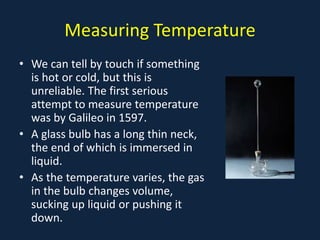
• We can tell by touch if something
is hot or cold, but this is
unreliable. The first serious
attempt to measure temperature
was by Galileo in 1597.
• A glass bulb has a long thin neck,
the end of which is immersed in
liquid.
• As the temperature varies, the gas
in the bulb changes volume,
sucking up liquid or pushing it
down.
Clicker Question
• Why was Galileo’s thermometer no good for
comparing temperatures from day to day?
A. The fluid would evaporate.
B. The gas expansion was too small to see
clearly.
C. This instrument is also a barometer.
Thermometers
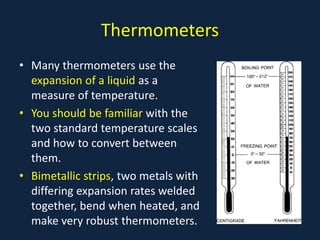
• Many thermometers use the
expansion of a liquid as a
measure of temperature.
• You should be familiar with the
two standard temperature scales
and how to convert between
them.
• Bimetallic strips, two metals with
differing expansion rates welded
together, bend when heated, and
make very robust thermometers.
Zeroth Law of Thermodynamics
• If two things at different temperatures are in
thermal contact, so heat can flow, and no heat is
being supplied from or being drained to the
environment, they will reach the same
temperature. They are then said to be in “thermal
equilibrium”.
• The Zeroth Law states that if A is in thermal
equilibrium with B, and B is with C, then A will be
with C.
• If this wasn’t true, thermometers would be
meaningless—but thermodynamics guys like to
see it written down…
Thermal Expansion
• A solid rod will increase in length when
heated, typically by of order 10-5 of its original
length for each degree celsius (centigrade). (It
will expand by the same proportion in the
other directions too.)
• This means there will only be a change of one
part in 1,000 over a 100°C temperature range,
so these changes are not visible to the naked
eye, some device is needed to detect them.
Thermal Expansion Notation
• The coefficient of linear expansion, denoted
by α, is defined by Δℓ/ℓ0 = αΔT.
• α = 1.2 x 10⁻⁵ for iron, 0.9 x 10⁻⁵ for glass.
• The coefficient of volume expansion β
is defined by ΔV/V0 = βΔT.
Relating Linear and Volume Expansion
• Imagine a cube of solid of side L, volume V = L3.
• On increasing the temperature by ΔT, the
length of each side goes from L to L(1 + αΔT), so
the volume increases from L3 to L3(1 + αΔT)3.
• Now αΔT is a very small number, so
L3(1 + αΔT)3 = L3(1 + 3αΔT + 3(αΔT)2 + (αΔT)3)
= L3(1 + 3αΔT) – those other terms are
really tiny! (for solids, α ~10-5)
• Recall the volume goes to V(1 + βΔT): so β = 3α
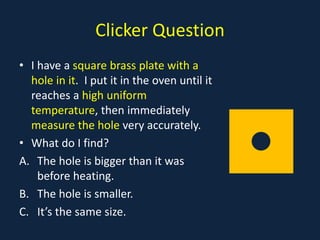
Clicker Question
• I have a square brass plate with a
hole in it. I put it in the oven until it
reaches a high uniform
temperature, then immediately
measure the hole very accurately.
• What do I find?
A. The hole is bigger than it was
before heating.
B. The hole is smaller.
C. It’s the same size.
• z
Clicker Question
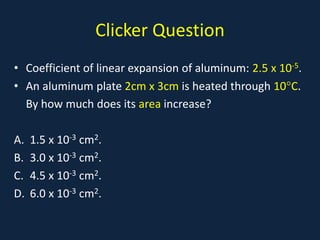
• Coefficient of linear expansion of aluminum: 2.5 x 10⁻⁵.
• An aluminum plate 2cm x 3cm is heated through 10°C.
By how much does its area increase?
A. 1.5 x 10⁻³ cm2.
B. 3.0 x 10⁻³ cm2.
C. 4.5 x 10⁻³ cm2.
D. 6.0 x 10⁻³ cm2.
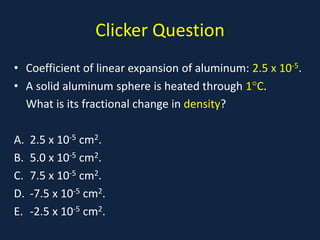
Clicker Question
• Coefficient of linear expansion of aluminum: 2.5 x 10⁻⁵.
• A solid aluminum sphere is heated through 1°C.
What is its fractional change in density?
A. 2.5 x 10⁻⁵ cm2.
B. 5.0 x 10⁻⁵ cm2.
C. 7.5 x 10⁻⁵ cm2.
D. -7.5 x 10⁻⁵ cm2.
E. -2.5 x 10⁻⁵ cm2.
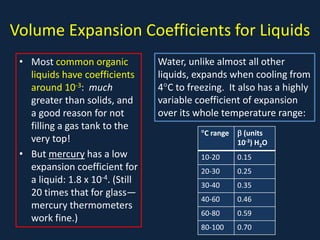
Volume Expansion Coefficients for Liquids
• Most common organic
liquids have coefficients
around 10-3: much
greater than solids, and
a good reason for not
filling a gas tank to the
very top!
• But mercury has a low
expansion coefficient for
a liquid: 1.8 x 10⁻⁴. (Still
20 times that for glass—
mercury thermometers
work fine.)
°C range β (units
10-3) H2O
10-20 0.15
20-30 0.25
30-40 0.35
40-60 0.46
60-80 0.59
80-100 0.70
Water, unlike almost all other
liquids, expands when cooling from
4°C to freezing. It also has a highly
variable coefficient of expansion
over its whole temperature range:
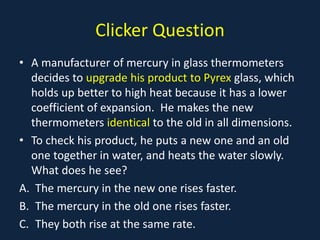
Clicker Question
• A manufacturer of mercury in glass thermometers
decides to upgrade his product to Pyrex glass, which
holds up better to high heat because it has a lower
coefficient of expansion. He makes the new
thermometers identical to the old in all dimensions.
• To check his product, he puts a new one and an old
one together in water, and heats the water slowly.
What does he see?
A. The mercury in the new one rises faster.
B. The mercury in the old one rises faster.
C. They both rise at the same rate.
Boyle’s Law
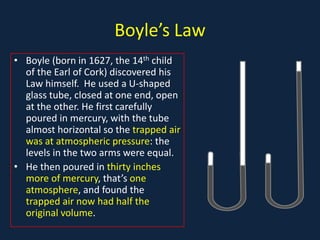
• Boyle (born in 1627, the 14th child
of the Earl of Cork) discovered his
Law himself. He used a U-shaped
glass tube, closed at one end, open
at the other. He first carefully
poured in mercury, with the tube
almost horizontal so the trapped air
was at atmospheric pressure: the
levels in the two arms were equal.
• He then poured in thirty inches
more of mercury, that’s one
atmosphere, and found the
trapped air now had half the
original volume.
• m
Boyle’s Law
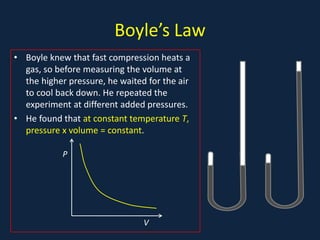
• Boyle knew that fast compression heats a
gas, so before measuring the volume at
the higher pressure, he waited for the air
to cool back down. He repeated the
experiment at different added pressures.
• He found that at constant temperature T,
pressure x volume = constant.
• m
P
V
Expansion Coefficient for Gases
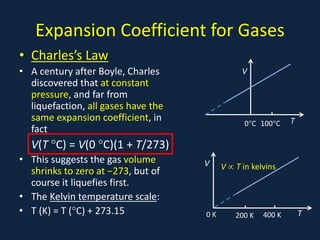
• Charles’s Law
• A century after Boyle, Charles
discovered that at constant
pressure, and far from
liquefaction, all gases have the
same expansion coefficient, in
fact
V(T °C) = V(0 °C)(1 + T/273)
• This suggests the gas volume
shrinks to zero at −273, but of
course it liquefies first.
• The Kelvin temperature scale:
• T (K) = T (°C) + 273.15
• a V
0°C 100°C T
V
T
V ∝ T in kelvins
400 K
200 K
0 K
The Ideal Gas Law
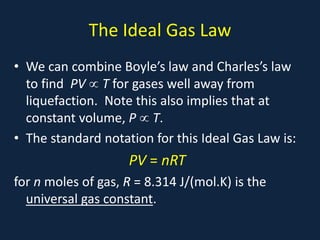
• We can combine Boyle’s law and Charles’s law
to find PV ∝ T for gases well away from
liquefaction. Note this also implies that at
constant volume, P ∝ T.
• The standard notation for this Ideal Gas Law is:
PV = nRT
for n moles of gas, R = 8.314 J/(mol.K) is the
universal gas constant.
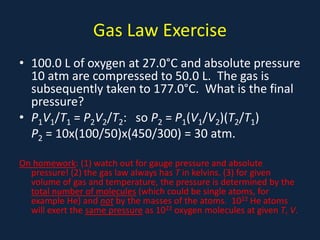
Gas Law Exercise
• 100.0 L of oxygen at 27.0°C and absolute pressure
10 atm are compressed to 50.0 L. The gas is
subsequently taken to 177.0°C. What is the final
pressure?
• P1V1/T1 = P2V2/T2: so P2 = P1(V1/V2)(T2/T1)
P2 = 10x(100/50)x(450/300) = 30 atm.
On homework: (1) watch out for gauge pressure and absolute
pressure! (2) the gas law always has T in kelvins. (3) for given
volume of gas and temperature, the pressure is determined by the
total number of molecules (which could be single atoms, for
example He) and not by the masses of the atoms. 1022 He atoms
will exert the same pressure as 1022 oxygen molecules at given T, V.

TemperatureEtc.pdf

  • 1.
    Temperature, Expansion, IdealGas Law Physics 1425 Lecture 30 Michael Fowler, UVa
  • 2.
    Everything’s Made ofAtoms • This idea was only fully accepted about 100 years ago—in part because of Einstein’s analysis of Brownian motion. • Brown, who studied the sex life of plants, noticed a lot of jiggling pollen grains under his microscope in 1827. He assumed it was because they were alive, but later found the identical jiggling with definitely dead stone powder. • This was not understood for half a century….! Applet Movie
  • 3.
    Size and Massof Atoms • The hydrogen atom is about 10-10 m across, others are a few times bigger. • Avogadro’s Number: NA = 6.02 x 10²³, the number of atoms (or molecules) in one gram- mole, 22.4 L volume at NTP. • The atomic mass unit is 1.66 x 10⁻²⁷ kg. The mass of a molecule in amu = mass of NA atoms in grams: one gram mole of H2O is 18 grams. • NOTE: this is just a reminder—you should be very familiar with all this from chemistry!
  • 4.
    Clicker Question • Assumethe molecules Shakespeare breathed out in his last breath (say, one liter) are now uniformly distributed throughout the atmosphere. What is the probability you breathed one in just now, in your most recent breath? A. 1 in 10,000 B. 1 in 1,000 C. 1 in 100 D. 1 in 10 E. More likely than not.
  • 5.
    Clicker Answer The answeris: more likely than not. There are 6 X 10²³ molecules in 22.4 L, so about 3 X 10²² in one liter. The Earth’s atmosphere has volume 4πR2d, take R = 6 x 10⁶ m, d = 2 x 10⁴ m. This gives a volume about 1015 m3, or 1021 L.
  • 6.
    Measuring Temperature • Wecan tell by touch if something is hot or cold, but this is unreliable. The first serious attempt to measure temperature was by Galileo in 1597. • A glass bulb has a long thin neck, the end of which is immersed in liquid. • As the temperature varies, the gas in the bulb changes volume, sucking up liquid or pushing it down.
  • 7.
    Clicker Question • Whywas Galileo’s thermometer no good for comparing temperatures from day to day? A. The fluid would evaporate. B. The gas expansion was too small to see clearly. C. This instrument is also a barometer.
  • 8.
    Thermometers • Many thermometersuse the expansion of a liquid as a measure of temperature. • You should be familiar with the two standard temperature scales and how to convert between them. • Bimetallic strips, two metals with differing expansion rates welded together, bend when heated, and make very robust thermometers.
  • 9.
    Zeroth Law ofThermodynamics • If two things at different temperatures are in thermal contact, so heat can flow, and no heat is being supplied from or being drained to the environment, they will reach the same temperature. They are then said to be in “thermal equilibrium”. • The Zeroth Law states that if A is in thermal equilibrium with B, and B is with C, then A will be with C. • If this wasn’t true, thermometers would be meaningless—but thermodynamics guys like to see it written down…
  • 10.
    Thermal Expansion • Asolid rod will increase in length when heated, typically by of order 10-5 of its original length for each degree celsius (centigrade). (It will expand by the same proportion in the other directions too.) • This means there will only be a change of one part in 1,000 over a 100°C temperature range, so these changes are not visible to the naked eye, some device is needed to detect them.
  • 11.
    Thermal Expansion Notation •The coefficient of linear expansion, denoted by α, is defined by Δℓ/ℓ0 = αΔT. • α = 1.2 x 10⁻⁵ for iron, 0.9 x 10⁻⁵ for glass. • The coefficient of volume expansion β is defined by ΔV/V0 = βΔT.
  • 12.
    Relating Linear andVolume Expansion • Imagine a cube of solid of side L, volume V = L3. • On increasing the temperature by ΔT, the length of each side goes from L to L(1 + αΔT), so the volume increases from L3 to L3(1 + αΔT)3. • Now αΔT is a very small number, so L3(1 + αΔT)3 = L3(1 + 3αΔT + 3(αΔT)2 + (αΔT)3) = L3(1 + 3αΔT) – those other terms are really tiny! (for solids, α ~10-5) • Recall the volume goes to V(1 + βΔT): so β = 3α
  • 13.
    Clicker Question • Ihave a square brass plate with a hole in it. I put it in the oven until it reaches a high uniform temperature, then immediately measure the hole very accurately. • What do I find? A. The hole is bigger than it was before heating. B. The hole is smaller. C. It’s the same size. • z
  • 14.
    Clicker Question • Coefficientof linear expansion of aluminum: 2.5 x 10⁻⁵. • An aluminum plate 2cm x 3cm is heated through 10°C. By how much does its area increase? A. 1.5 x 10⁻³ cm2. B. 3.0 x 10⁻³ cm2. C. 4.5 x 10⁻³ cm2. D. 6.0 x 10⁻³ cm2.
  • 15.
    Clicker Question • Coefficientof linear expansion of aluminum: 2.5 x 10⁻⁵. • A solid aluminum sphere is heated through 1°C. What is its fractional change in density? A. 2.5 x 10⁻⁵ cm2. B. 5.0 x 10⁻⁵ cm2. C. 7.5 x 10⁻⁵ cm2. D. -7.5 x 10⁻⁵ cm2. E. -2.5 x 10⁻⁵ cm2.
  • 16.
    Volume Expansion Coefficientsfor Liquids • Most common organic liquids have coefficients around 10-3: much greater than solids, and a good reason for not filling a gas tank to the very top! • But mercury has a low expansion coefficient for a liquid: 1.8 x 10⁻⁴. (Still 20 times that for glass— mercury thermometers work fine.) °C range β (units 10-3) H2O 10-20 0.15 20-30 0.25 30-40 0.35 40-60 0.46 60-80 0.59 80-100 0.70 Water, unlike almost all other liquids, expands when cooling from 4°C to freezing. It also has a highly variable coefficient of expansion over its whole temperature range:
  • 17.
    Clicker Question • Amanufacturer of mercury in glass thermometers decides to upgrade his product to Pyrex glass, which holds up better to high heat because it has a lower coefficient of expansion. He makes the new thermometers identical to the old in all dimensions. • To check his product, he puts a new one and an old one together in water, and heats the water slowly. What does he see? A. The mercury in the new one rises faster. B. The mercury in the old one rises faster. C. They both rise at the same rate.
  • 18.
    Boyle’s Law • Boyle(born in 1627, the 14th child of the Earl of Cork) discovered his Law himself. He used a U-shaped glass tube, closed at one end, open at the other. He first carefully poured in mercury, with the tube almost horizontal so the trapped air was at atmospheric pressure: the levels in the two arms were equal. • He then poured in thirty inches more of mercury, that’s one atmosphere, and found the trapped air now had half the original volume. • m
  • 19.
    Boyle’s Law • Boyleknew that fast compression heats a gas, so before measuring the volume at the higher pressure, he waited for the air to cool back down. He repeated the experiment at different added pressures. • He found that at constant temperature T, pressure x volume = constant. • m P V
  • 20.
    Expansion Coefficient forGases • Charles’s Law • A century after Boyle, Charles discovered that at constant pressure, and far from liquefaction, all gases have the same expansion coefficient, in fact V(T °C) = V(0 °C)(1 + T/273) • This suggests the gas volume shrinks to zero at −273, but of course it liquefies first. • The Kelvin temperature scale: • T (K) = T (°C) + 273.15 • a V 0°C 100°C T V T V ∝ T in kelvins 400 K 200 K 0 K
  • 21.
    The Ideal GasLaw • We can combine Boyle’s law and Charles’s law to find PV ∝ T for gases well away from liquefaction. Note this also implies that at constant volume, P ∝ T. • The standard notation for this Ideal Gas Law is: PV = nRT for n moles of gas, R = 8.314 J/(mol.K) is the universal gas constant.
  • 22.
    Gas Law Exercise •100.0 L of oxygen at 27.0°C and absolute pressure 10 atm are compressed to 50.0 L. The gas is subsequently taken to 177.0°C. What is the final pressure? • P1V1/T1 = P2V2/T2: so P2 = P1(V1/V2)(T2/T1) P2 = 10x(100/50)x(450/300) = 30 atm. On homework: (1) watch out for gauge pressure and absolute pressure! (2) the gas law always has T in kelvins. (3) for given volume of gas and temperature, the pressure is determined by the total number of molecules (which could be single atoms, for example He) and not by the masses of the atoms. 1022 He atoms will exert the same pressure as 1022 oxygen molecules at given T, V.