The following points are to be discussed:
Temperature and heat
Measurement of temperature
Ideal-gas equation and absolute temperature
Thermal expansion
Specific heat capacity
Calorimetry
Change of state
Heat transfer
Newton’s law of cooling
CHAPTER -11
THERMAL PROPERTIES OF MATTER
LEARNING OBJECTIVES
2.2.1 Thermal expansion of solids, liquids and
gases
Core • Describe qualitatively the thermal
expansion of solids, liquids, and gases at
constant pressure • Identify and explain some
of the everyday applications and consequences
of thermal expansion
2.2.2 Measurement of temperature
Core • Appreciate how a physical property
that varies with temperature may be used for
the measurement of temperature, and state
examples of such properties • Recognise the
need for and identify fixed points
• Describe and explain the structure and action
of liquid-in-glass thermometers
Supplement • Explain, in terms of the motion
and arrangement of molecules, the relative
order of the magnitude of the expansion of
solids, liquids and gases
Supplement • Demonstrate understanding of
sensitivity, range and linearity • Describe the
structure of a thermocouple and show
understanding of its use as a thermometer for
measuring high temperatures and those that
vary rapidly • Describe and explain how the
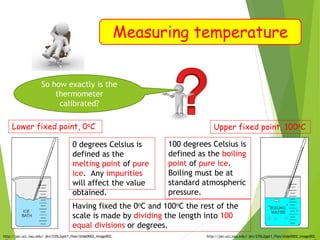
structure of a liquid-in-glass thermometer
relates to its sensitivity, range and linearity
Temperature and Heat
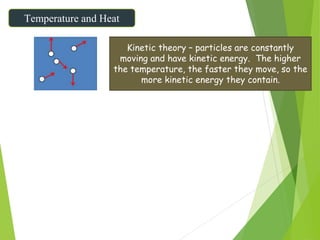
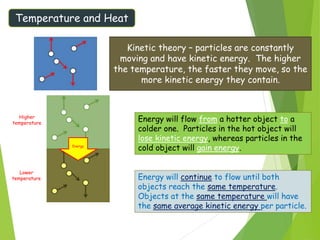
Kinetic theory – particles are constantly
moving and have kinetic energy. The higher
the temperature, the faster they move, so the
more kinetic energy they contain.
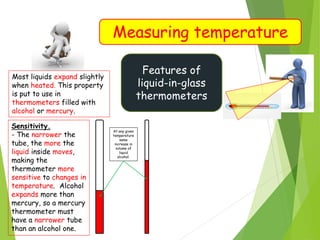
Temperature and Heat
Kinetic theory – particles are constantly
moving and have kinetic energy. The higher
the temperature, the faster they move, so the
more kinetic energy they contain.
Higher
temperature
Lower
temperature
Energy
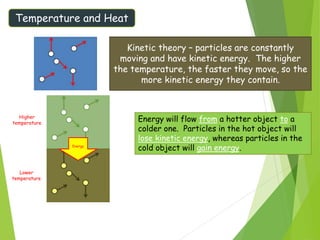
Energy will flow from a hotter object to a
colder one. Particles in the hot object will
lose kinetic energy, whereas particles in the
cold object will gain energy.
Temperature and Heat
Kinetic theory – particles are constantly
moving and have kinetic energy. The higher
the temperature, the faster they move, so the
more kinetic energy they contain.
Higher
temperature
Lower
temperature
Energy
Energy will flow from a hotter object to a
colder one. Particles in the hot object will
lose kinetic energy, whereas particles in the
cold object will gain energy.
Energy will continue to flow until both
objects reach the same temperature.
Objects at the same temperature will have
the same average kinetic energy per particle.
Temperature and Heat
Are temperature and
heat the same?
Temperature and Heat
Are temperature and
heat the same?
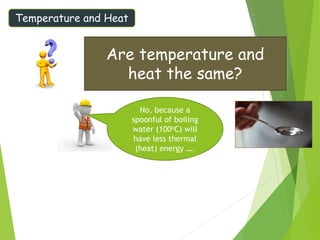
No, because a
spoonful of boiling
water (100oC) will
have less thermal
(heat) energy ….
Temperature and Heat
Are temperature and
heat the same?
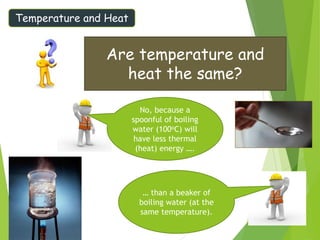
No, because a
spoonful of boiling
water (100oC) will
have less thermal
(heat) energy ….
… than a beaker of
boiling water (at the
same temperature).
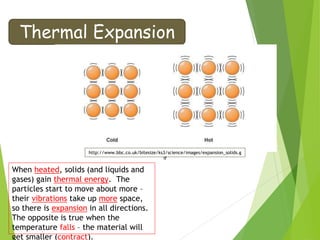
Thermal Expansion
http://www.bbc.co.uk/bitesize/ks3/science/images/expansion_solids.g
if
When heated, solids (and liquids and
gases) gain thermal energy. The
particles start to move about more –
their vibrations take up more space,
so there is expansion in all directions.
The opposite is true when the
temperature falls – the material will
get smaller (contract).
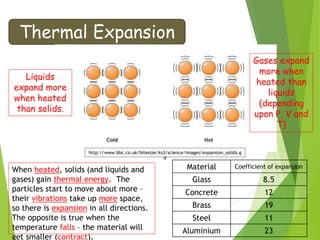
Thermal Expansion
http://www.bbc.co.uk/bitesize/ks3/science/images/expansion_solids.g
if
When heated, solids (and liquids and
gases) gain thermal energy. The
particles start to move about more –
their vibrations take up more space,
so there is expansion in all directions.
The opposite is true when the
temperature falls – the material will
get smaller (contract).
Material Coefficient of expansion
Glass 8.5
Concrete 12
Brass 19
Steel 11
Aluminium 23
Liquids
expand more
when heated
than solids.
Gases expand
more when
heated than
liquids
(depending
upon P, V and
T)
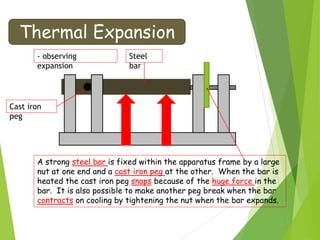
Thermal Expansion
- observing
expansion
Cast iron
peg
Steel
bar
A strong steel bar is fixed within the apparatus frame by a large
nut at one end and a cast iron peg at the other. When the bar is
heated the cast iron peg snaps because of the huge force in the
bar. It is also possible to make another peg break when the bar
contracts on cooling by tightening the nut when the bar expands.
Thermal Expansion - examples
Girders in buildings and bridges are
made with gaps at the ends.
Glass to be used in cooking has to be a
low expansion type such as Pyrex
otherwise it would shatter as it got hot.
Rivets are heated before they are put
in place to hold two metal plates
together.
Thermal Expansion - examples
Girders in buildings and bridges are
made with gaps at the ends.
Glass to be used in cooking has to be a
low expansion type such as Pyrex
otherwise it would shatter as it got hot.
Rivets are heated before they are put
in place to hold two metal plates
together.
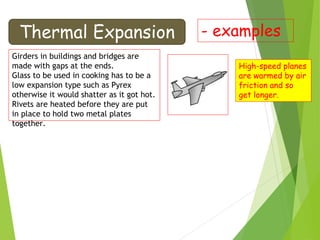
High-speed planes
are warmed by air
friction and so
get longer.
Thermal Expansion - examples
Girders in buildings and bridges are
made with gaps at the ends.
Glass to be used in cooking has to be a
low expansion type such as Pyrex
otherwise it would shatter as it got hot.
Rivets are heated before they are put
in place to hold two metal plates
together.
High-speed planes
are warmed by air
friction and so
get longer.
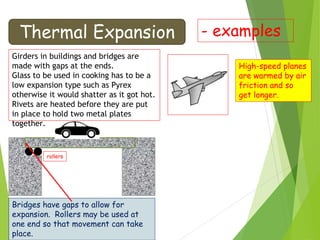
Bridges have gaps to allow for
expansion. Rollers may be used at
one end so that movement can take
place.
rollers
Thermal Expansion - examples
Girders in buildings and bridges are
made with gaps at the ends.
Glass to be used in cooking has to be a
low expansion type such as Pyrex
otherwise it would shatter as it got hot.
Rivets are heated before they are put
in place to hold two metal plates
together.
High-speed planes
are warmed by air
friction and so
get longer.
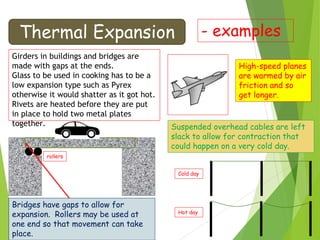
Suspended overhead cables are left
slack to allow for contraction that
could happen on a very cold day.
rollers
Bridges have gaps to allow for
expansion. Rollers may be used at
one end so that movement can take
place.
Cold day
Hot day
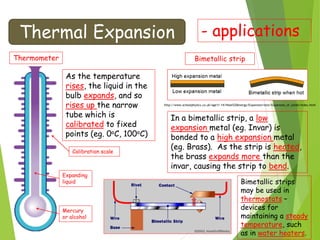
Thermal Expansion - applications
Thermometer
Mercury
or alcohol
Expanding
liquid
Calibration scale
As the temperature
rises, the liquid in the
bulb expands, and so
rises up the narrow
tube which is
calibrated to fixed
points (eg. 0oC, 100oC)
Thermal Expansion - applications
Thermometer
Mercury
or alcohol
Expanding
liquid
Calibration scale
As the temperature
rises, the liquid in the
bulb expands, and so
rises up the narrow
tube which is
calibrated to fixed
points (eg. 0oC, 100oC)
Bimetallic strip
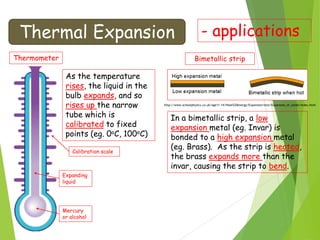
In a bimetallic strip, a low
expansion metal (eg. Invar) is
bonded to a high expansion metal
(eg. Brass). As the strip is heated,
the brass expands more than the
invar, causing the strip to bend.
http://www.schoolphysics.co.uk/age11-14/Heat%20energy/Expansion/text/Expansion_of_solids/index.html
Thermal Expansion - applications
Thermometer
Mercury
or alcohol
Expanding
liquid
Calibration scale
As the temperature
rises, the liquid in the
bulb expands, and so
rises up the narrow
tube which is
calibrated to fixed
points (eg. 0oC, 100oC)
Bimetallic strip
In a bimetallic strip, a low
expansion metal (eg. Invar) is
bonded to a high expansion metal
(eg. Brass). As the strip is heated,
the brass expands more than the
invar, causing the strip to bend.
http://www.schoolphysics.co.uk/age11-14/Heat%20energy/Expansion/text/Expansion_of_solids/index.html
Bimetallic strips
may be used in
thermostats –
devices for
maintaining a steady
temperature, such
as in water heaters.
Thermal Expansion
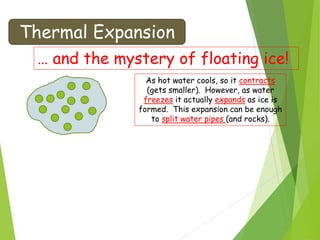
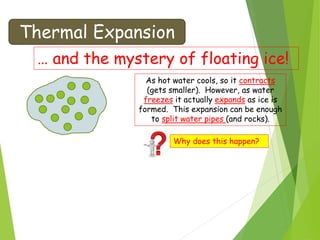
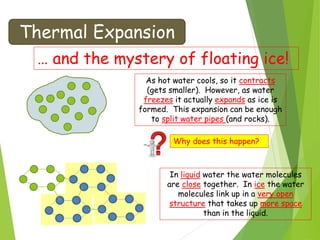
… and the mystery of floating ice!
As hot water cools, so it contracts
(gets smaller). However, as water
freezes it actually expands as ice is
formed. This expansion can be enough
to split water pipes (and rocks).
Thermal Expansion
… and the mystery of floating ice!
As hot water cools, so it contracts
(gets smaller). However, as water
freezes it actually expands as ice is
formed. This expansion can be enough
to split water pipes (and rocks).
Why does this happen?
Thermal Expansion
… and the mystery of floating ice!
As hot water cools, so it contracts
(gets smaller). However, as water
freezes it actually expands as ice is
formed. This expansion can be enough
to split water pipes (and rocks).
Why does this happen?
In liquid water the water molecules
are close together. In ice the water
molecules link up in a very open
structure that takes up more space
than in the liquid.
Thermal Expansion
… and the mystery of floating ice!
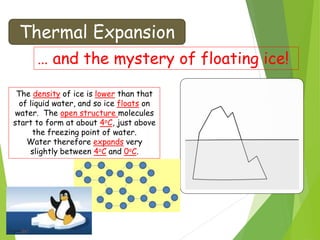
The density of ice is lower than that
of liquid water, and so ice floats on
water. The open structure molecules
start to form at about 4oC, just above
the freezing point of water.
Water therefore expands very
slightly between 4oC and 0oC.
Thermal Expansion and gases
So what is the
relationship
between gas
pressure and
temperature?
At
constant
volume!
Thermal Expansion and gases
So what is the
relationship
between gas
pressure and
temperature?
At
constant
volume!
http://www.passmyexams.co.uk/GCSE/physics/pressure-
temperature-relationship-of-gas-pressure-law.html
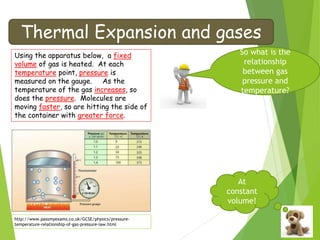
Using the apparatus below, a fixed
volume of gas is heated. At each
temperature point, pressure is
measured on the gauge. As the
temperature of the gas increases, so
does the pressure. Molecules are
moving faster, so are hitting the side of
the container with greater force.
Thermal Expansion and gases
So what is the
relationship
between gas
pressure and
temperature?
At
constant
volume!
http://www.passmyexams.co.uk/GCSE/physics/pressure-
temperature-relationship-of-gas-pressure-law.html
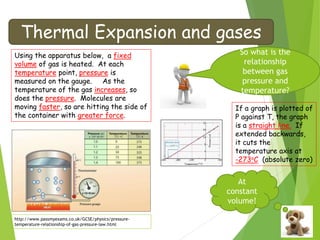
Using the apparatus below, a fixed
volume of gas is heated. At each
temperature point, pressure is
measured on the gauge. As the
temperature of the gas increases, so
does the pressure. Molecules are
moving faster, so are hitting the side of
the container with greater force.
If a graph is plotted of
P against T, the graph
is a straight line. If
extended backwards,
it cuts the
temperature axis at
-273oC (absolute zero)
Thermal Expansion and gases
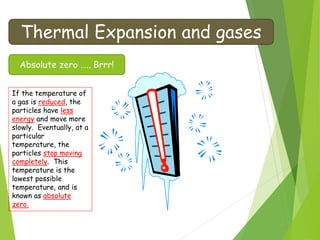
Absolute zero ….. Brrr!
If the temperature of
a gas is reduced, the
particles have less
energy and move more
slowly. Eventually, at a
particular
temperature, the
particles stop moving
completely. This
temperature is the
lowest possible
temperature, and is
known as absolute
zero.
Thermal Expansion and gases
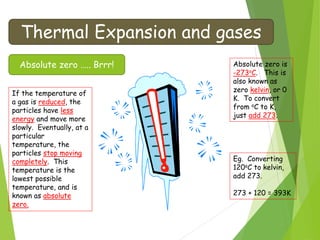
Absolute zero ….. Brrr!
If the temperature of
a gas is reduced, the
particles have less
energy and move more
slowly. Eventually, at a
particular
temperature, the
particles stop moving
completely. This
temperature is the
lowest possible
temperature, and is
known as absolute
zero.
Absolute zero is
-273oC. This is
also known as
zero kelvin, or 0
K. To convert
from oC to K,
just add 273.
Eg. Converting
120oC to kelvin,
add 273.
273 + 120 = 393K
Thermal Expansion and gases
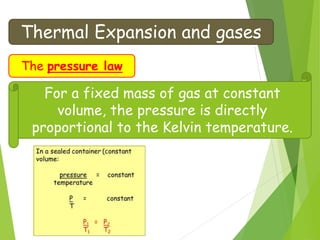
The pressure law
For a fixed mass of gas at constant
volume, the pressure is directly
proportional to the Kelvin temperature.
Thermal Expansion and gases
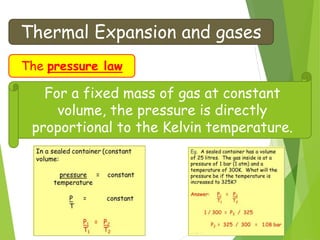
The pressure law
For a fixed mass of gas at constant
volume, the pressure is directly
proportional to the Kelvin temperature.
Thermal Expansion and gases
Charles’s law Links together volume and temperature
Thermal Expansion and gases
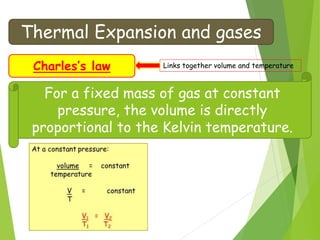
Charles’s law Links together volume and temperature
For a fixed mass of gas at constant
pressure, the volume is directly
proportional to the Kelvin temperature.
Thermal Expansion and gases
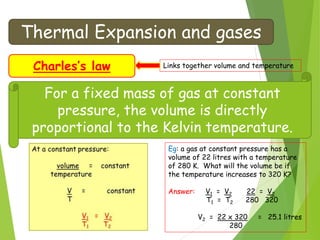
Charles’s law Links together volume and temperature
For a fixed mass of gas at constant
pressure, the volume is directly
proportional to the Kelvin temperature.
Eg: a gas at constant pressure has a
volume of 22 litres with a temperature
of 280 K. What will the volume be if
the temperature increases to 320 K?
Answer: V1 = V2 22 = V2
T1 = T2 280 320
V2 = 22 x 320 = 25.1 litres
280
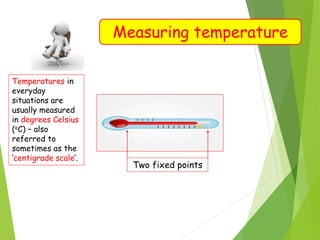
Measuring temperature
Temperatures in
everyday
situations are
usually measured
in degrees Celsius
(oC) – also
referred to
sometimes as the
‘centigrade scale’.
Measuring temperature
Temperatures in
everyday
situations are
usually measured
in degrees Celsius
(oC) – also
referred to
sometimes as the
‘centigrade scale’.
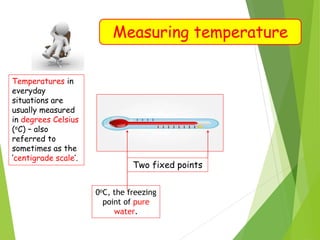
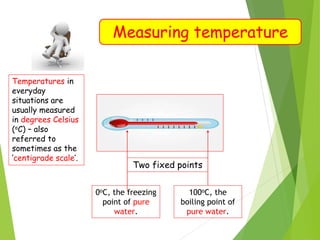
Two fixed points
Measuring temperature
Temperatures in
everyday
situations are
usually measured
in degrees Celsius
(oC) – also
referred to
sometimes as the
‘centigrade scale’.
Two fixed points
0oC, the freezing
point of pure
water.
Measuring temperature
Temperatures in
everyday
situations are
usually measured
in degrees Celsius
(oC) – also
referred to
sometimes as the
‘centigrade scale’.
Two fixed points
0oC, the freezing
point of pure
water.
100oC, the
boiling point of
pure water.
Measuring temperature
Temperatures in
everyday
situations are
usually measured
in degrees Celsius
(oC) – also
referred to
sometimes as the
‘centigrade scale’.
Two fixed points
0oC, the freezing
point of pure
water.
100oC, the
boiling point of
pure water.
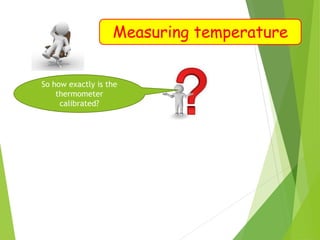
Sun’s surface 6000oC
Bunsen flame 1500oC
Human body 37oC
Freezer food -20oC
Absolute zero -273oC
Measuring temperature
So how exactly is the
thermometer
calibrated?
Measuring temperature
So how exactly is the
thermometer
calibrated?
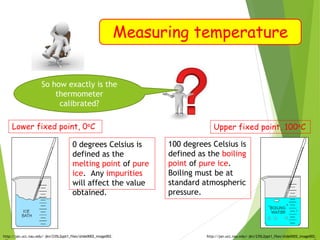
Lower fixed point, 0oC
http://jan.ucc.nau.edu/~jkn/235L2ppt1_files/slide0002_image002.
0 degrees Celsius is
defined as the
melting point of pure
ice. Any impurities
will affect the value
obtained.
Measuring temperature
Lower fixed point, 0oC
http://jan.ucc.nau.edu/~jkn/235L2ppt1_files/slide0002_image002.
0 degrees Celsius is
defined as the
melting point of pure
ice. Any impurities
will affect the value
obtained.
Upper fixed point, 100oC
http://jan.ucc.nau.edu/~jkn/235L2ppt1_files/slide0002_image002.
100 degrees Celsius is
defined as the boiling
point of pure ice.
Boiling must be at
standard atmospheric
pressure.
So how exactly is the
thermometer
calibrated?
Measuring temperature
Lower fixed point, 0oC
http://jan.ucc.nau.edu/~jkn/235L2ppt1_files/slide0002_image002.
0 degrees Celsius is
defined as the
melting point of pure
ice. Any impurities
will affect the value
obtained.
Upper fixed point, 100oC
http://jan.ucc.nau.edu/~jkn/235L2ppt1_files/slide0002_image002.
100 degrees Celsius is
defined as the boiling
point of pure ice.
Boiling must be at
standard atmospheric
pressure.
Having fixed the 0oC and 100oC the rest of the
scale is made by dividing the length into 100
equal divisions or degrees.
So how exactly is the
thermometer
calibrated?
Measuring temperature
Lower fixed point, 0oC
http://jan.ucc.nau.edu/~jkn/235L2ppt1_files/slide0002_image002.
0 degrees Celsius is
defined as the
melting point of pure
ice. Any impurities
will affect the value
obtained.
Upper fixed point, 100oC
http://jan.ucc.nau.edu/~jkn/235L2ppt1_files/slide0002_image002.
100 degrees Celsius is
defined as the boiling
point of pure ice.
Boiling must be at
standard atmospheric
pressure.
Having fixed the 0oC and 100oC the rest of the
scale is made by dividing the length into 100
equal divisions or degrees.
If the scale is divided up
into equal divisions then
it is known as a linear
scale.
So how exactly is the
thermometer
calibrated?
Measuring temperature
Features of
liquid-in-glass
thermometers
Measuring temperature
Features of
liquid-in-glass
thermometers
Most liquids expand slightly
when heated. This property
is put to use in
thermometers filled with
alcohol or mercury.
Measuring temperature
Features of
liquid-in-glass
thermometers
Most liquids expand slightly
when heated. This property
is put to use in
thermometers filled with
alcohol or mercury.
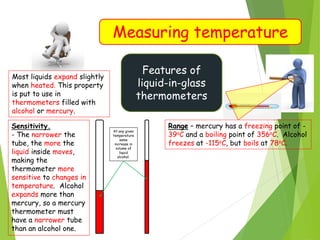
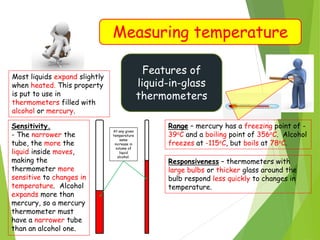
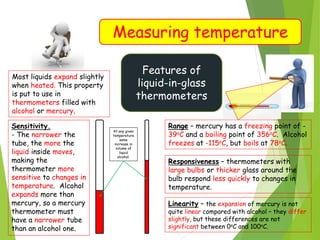
Sensitivity.
- The narrower the
tube, the more the
liquid inside moves,
making the
thermometer more
sensitive to changes in
temperature. Alcohol
expands more than
mercury, so a mercury
thermometer must
have a narrower tube
than an alcohol one.
At any given
temperature
same
increase in
volume of
liquid
alcohol.
Measuring temperature
Features of
liquid-in-glass
thermometers
Most liquids expand slightly
when heated. This property
is put to use in
thermometers filled with
alcohol or mercury.
Sensitivity.
- The narrower the
tube, the more the
liquid inside moves,
making the
thermometer more
sensitive to changes in
temperature. Alcohol
expands more than
mercury, so a mercury
thermometer must
have a narrower tube
than an alcohol one.
At any given
temperature
same
increase in
volume of
liquid
alcohol.
Range – mercury has a freezing point of -
39oC and a boiling point of 356oC. Alcohol
freezes at -115oC, but boils at 78oC.
Measuring temperature
Features of
liquid-in-glass
thermometers
Most liquids expand slightly
when heated. This property
is put to use in
thermometers filled with
alcohol or mercury.
Sensitivity.
- The narrower the
tube, the more the
liquid inside moves,
making the
thermometer more
sensitive to changes in
temperature. Alcohol
expands more than
mercury, so a mercury
thermometer must
have a narrower tube
than an alcohol one.
At any given
temperature
same
increase in
volume of
liquid
alcohol.
Range – mercury has a freezing point of -
39oC and a boiling point of 356oC. Alcohol
freezes at -115oC, but boils at 78oC.
Responsiveness – thermometers with
large bulbs or thicker glass around the
bulb respond less quickly to changes in
temperature.
Measuring temperature
Features of
liquid-in-glass
thermometers
Most liquids expand slightly
when heated. This property
is put to use in
thermometers filled with
alcohol or mercury.
Sensitivity.
- The narrower the
tube, the more the
liquid inside moves,
making the
thermometer more
sensitive to changes in
temperature. Alcohol
expands more than
mercury, so a mercury
thermometer must
have a narrower tube
than an alcohol one.
At any given
temperature
same
increase in
volume of
liquid
alcohol.
Range – mercury has a freezing point of -
39oC and a boiling point of 356oC. Alcohol
freezes at -115oC, but boils at 78oC.
Responsiveness – thermometers with
large bulbs or thicker glass around the
bulb respond less quickly to changes in
temperature.
Linearity – the expansion of mercury is not
quite linear compared with alcohol – they differ
slightly, but these differences are not
significant between 0oC and 100oC.
Measuring temperature
- Examples of thermometers
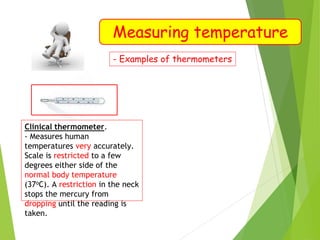
Clinical thermometer.
- Measures human
temperatures very accurately.
Scale is restricted to a few
degrees either side of the
normal body temperature
(37oC). A restriction in the neck
stops the mercury from
dropping until the reading is
taken.
Measuring temperature
- Examples of thermometers
Clinical thermometer.
- Measures human
temperatures very accurately.
Scale is restricted to a few
degrees either side of the
normal body temperature
(37oC). A restriction in the neck
stops the mercury from
dropping until the reading is
taken.
Digital Clinical thermometer.
- Contains a thermistor inside
the probe. As the temperature
rises the thermistor becomes a
much better conductor, causing
a higher current to flow, and so
a higher reading on the meter.
Measuring temperature
- Examples of thermometers
Thermocouple thermometer.
- Two different metals are
joined together to form two
junctions in the probe. A
temperature difference
between the two junctions
causes a tiny voltage, resulting
in the flow of current. The
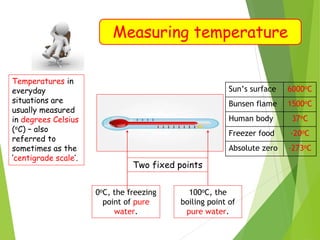
greater the temperature
difference between the two
junctions, the bigger the
current.
http://www.omega.com/pptst/HH11B.
html
X
X

Chapter - Thermal properties and temperature.pptx

  • 1.
    The following pointsare to be discussed: Temperature and heat Measurement of temperature Ideal-gas equation and absolute temperature Thermal expansion Specific heat capacity Calorimetry Change of state Heat transfer Newton’s law of cooling CHAPTER -11 THERMAL PROPERTIES OF MATTER
  • 2.
    LEARNING OBJECTIVES 2.2.1 Thermalexpansion of solids, liquids and gases Core • Describe qualitatively the thermal expansion of solids, liquids, and gases at constant pressure • Identify and explain some of the everyday applications and consequences of thermal expansion 2.2.2 Measurement of temperature Core • Appreciate how a physical property that varies with temperature may be used for the measurement of temperature, and state examples of such properties • Recognise the need for and identify fixed points • Describe and explain the structure and action of liquid-in-glass thermometers Supplement • Explain, in terms of the motion and arrangement of molecules, the relative order of the magnitude of the expansion of solids, liquids and gases Supplement • Demonstrate understanding of sensitivity, range and linearity • Describe the structure of a thermocouple and show understanding of its use as a thermometer for measuring high temperatures and those that vary rapidly • Describe and explain how the structure of a liquid-in-glass thermometer relates to its sensitivity, range and linearity
  • 3.
    Temperature and Heat Kinetictheory – particles are constantly moving and have kinetic energy. The higher the temperature, the faster they move, so the more kinetic energy they contain.
  • 4.
    Temperature and Heat Kinetictheory – particles are constantly moving and have kinetic energy. The higher the temperature, the faster they move, so the more kinetic energy they contain. Higher temperature Lower temperature Energy Energy will flow from a hotter object to a colder one. Particles in the hot object will lose kinetic energy, whereas particles in the cold object will gain energy.
  • 5.
    Temperature and Heat Kinetictheory – particles are constantly moving and have kinetic energy. The higher the temperature, the faster they move, so the more kinetic energy they contain. Higher temperature Lower temperature Energy Energy will flow from a hotter object to a colder one. Particles in the hot object will lose kinetic energy, whereas particles in the cold object will gain energy. Energy will continue to flow until both objects reach the same temperature. Objects at the same temperature will have the same average kinetic energy per particle.
  • 6.
    Temperature and Heat Aretemperature and heat the same?
  • 7.
    Temperature and Heat Aretemperature and heat the same? No, because a spoonful of boiling water (100oC) will have less thermal (heat) energy ….
  • 8.
    Temperature and Heat Aretemperature and heat the same? No, because a spoonful of boiling water (100oC) will have less thermal (heat) energy …. … than a beaker of boiling water (at the same temperature).
  • 9.
    Thermal Expansion http://www.bbc.co.uk/bitesize/ks3/science/images/expansion_solids.g if When heated,solids (and liquids and gases) gain thermal energy. The particles start to move about more – their vibrations take up more space, so there is expansion in all directions. The opposite is true when the temperature falls – the material will get smaller (contract).
  • 10.
    Thermal Expansion http://www.bbc.co.uk/bitesize/ks3/science/images/expansion_solids.g if When heated,solids (and liquids and gases) gain thermal energy. The particles start to move about more – their vibrations take up more space, so there is expansion in all directions. The opposite is true when the temperature falls – the material will get smaller (contract). Material Coefficient of expansion Glass 8.5 Concrete 12 Brass 19 Steel 11 Aluminium 23 Liquids expand more when heated than solids. Gases expand more when heated than liquids (depending upon P, V and T)
  • 11.
    Thermal Expansion - observing expansion Castiron peg Steel bar A strong steel bar is fixed within the apparatus frame by a large nut at one end and a cast iron peg at the other. When the bar is heated the cast iron peg snaps because of the huge force in the bar. It is also possible to make another peg break when the bar contracts on cooling by tightening the nut when the bar expands.
  • 12.
    Thermal Expansion -examples Girders in buildings and bridges are made with gaps at the ends. Glass to be used in cooking has to be a low expansion type such as Pyrex otherwise it would shatter as it got hot. Rivets are heated before they are put in place to hold two metal plates together.
  • 13.
    Thermal Expansion -examples Girders in buildings and bridges are made with gaps at the ends. Glass to be used in cooking has to be a low expansion type such as Pyrex otherwise it would shatter as it got hot. Rivets are heated before they are put in place to hold two metal plates together. High-speed planes are warmed by air friction and so get longer.
  • 14.
    Thermal Expansion -examples Girders in buildings and bridges are made with gaps at the ends. Glass to be used in cooking has to be a low expansion type such as Pyrex otherwise it would shatter as it got hot. Rivets are heated before they are put in place to hold two metal plates together. High-speed planes are warmed by air friction and so get longer. Bridges have gaps to allow for expansion. Rollers may be used at one end so that movement can take place. rollers
  • 15.
    Thermal Expansion -examples Girders in buildings and bridges are made with gaps at the ends. Glass to be used in cooking has to be a low expansion type such as Pyrex otherwise it would shatter as it got hot. Rivets are heated before they are put in place to hold two metal plates together. High-speed planes are warmed by air friction and so get longer. Suspended overhead cables are left slack to allow for contraction that could happen on a very cold day. rollers Bridges have gaps to allow for expansion. Rollers may be used at one end so that movement can take place. Cold day Hot day
  • 16.
    Thermal Expansion -applications Thermometer Mercury or alcohol Expanding liquid Calibration scale As the temperature rises, the liquid in the bulb expands, and so rises up the narrow tube which is calibrated to fixed points (eg. 0oC, 100oC)
  • 17.
    Thermal Expansion -applications Thermometer Mercury or alcohol Expanding liquid Calibration scale As the temperature rises, the liquid in the bulb expands, and so rises up the narrow tube which is calibrated to fixed points (eg. 0oC, 100oC) Bimetallic strip In a bimetallic strip, a low expansion metal (eg. Invar) is bonded to a high expansion metal (eg. Brass). As the strip is heated, the brass expands more than the invar, causing the strip to bend. http://www.schoolphysics.co.uk/age11-14/Heat%20energy/Expansion/text/Expansion_of_solids/index.html
  • 18.
    Thermal Expansion -applications Thermometer Mercury or alcohol Expanding liquid Calibration scale As the temperature rises, the liquid in the bulb expands, and so rises up the narrow tube which is calibrated to fixed points (eg. 0oC, 100oC) Bimetallic strip In a bimetallic strip, a low expansion metal (eg. Invar) is bonded to a high expansion metal (eg. Brass). As the strip is heated, the brass expands more than the invar, causing the strip to bend. http://www.schoolphysics.co.uk/age11-14/Heat%20energy/Expansion/text/Expansion_of_solids/index.html Bimetallic strips may be used in thermostats – devices for maintaining a steady temperature, such as in water heaters.
  • 19.
    Thermal Expansion … andthe mystery of floating ice! As hot water cools, so it contracts (gets smaller). However, as water freezes it actually expands as ice is formed. This expansion can be enough to split water pipes (and rocks).
  • 20.
    Thermal Expansion … andthe mystery of floating ice! As hot water cools, so it contracts (gets smaller). However, as water freezes it actually expands as ice is formed. This expansion can be enough to split water pipes (and rocks). Why does this happen?
  • 21.
    Thermal Expansion … andthe mystery of floating ice! As hot water cools, so it contracts (gets smaller). However, as water freezes it actually expands as ice is formed. This expansion can be enough to split water pipes (and rocks). Why does this happen? In liquid water the water molecules are close together. In ice the water molecules link up in a very open structure that takes up more space than in the liquid.
  • 22.
    Thermal Expansion … andthe mystery of floating ice! The density of ice is lower than that of liquid water, and so ice floats on water. The open structure molecules start to form at about 4oC, just above the freezing point of water. Water therefore expands very slightly between 4oC and 0oC.
  • 23.
    Thermal Expansion andgases So what is the relationship between gas pressure and temperature? At constant volume!
  • 24.
    Thermal Expansion andgases So what is the relationship between gas pressure and temperature? At constant volume! http://www.passmyexams.co.uk/GCSE/physics/pressure- temperature-relationship-of-gas-pressure-law.html Using the apparatus below, a fixed volume of gas is heated. At each temperature point, pressure is measured on the gauge. As the temperature of the gas increases, so does the pressure. Molecules are moving faster, so are hitting the side of the container with greater force.
  • 25.
    Thermal Expansion andgases So what is the relationship between gas pressure and temperature? At constant volume! http://www.passmyexams.co.uk/GCSE/physics/pressure- temperature-relationship-of-gas-pressure-law.html Using the apparatus below, a fixed volume of gas is heated. At each temperature point, pressure is measured on the gauge. As the temperature of the gas increases, so does the pressure. Molecules are moving faster, so are hitting the side of the container with greater force. If a graph is plotted of P against T, the graph is a straight line. If extended backwards, it cuts the temperature axis at -273oC (absolute zero)
  • 26.
    Thermal Expansion andgases Absolute zero ….. Brrr! If the temperature of a gas is reduced, the particles have less energy and move more slowly. Eventually, at a particular temperature, the particles stop moving completely. This temperature is the lowest possible temperature, and is known as absolute zero.
  • 27.
    Thermal Expansion andgases Absolute zero ….. Brrr! If the temperature of a gas is reduced, the particles have less energy and move more slowly. Eventually, at a particular temperature, the particles stop moving completely. This temperature is the lowest possible temperature, and is known as absolute zero. Absolute zero is -273oC. This is also known as zero kelvin, or 0 K. To convert from oC to K, just add 273. Eg. Converting 120oC to kelvin, add 273. 273 + 120 = 393K
  • 28.
    Thermal Expansion andgases The pressure law For a fixed mass of gas at constant volume, the pressure is directly proportional to the Kelvin temperature.
  • 29.
    Thermal Expansion andgases The pressure law For a fixed mass of gas at constant volume, the pressure is directly proportional to the Kelvin temperature.
  • 30.
    Thermal Expansion andgases Charles’s law Links together volume and temperature
  • 31.
    Thermal Expansion andgases Charles’s law Links together volume and temperature For a fixed mass of gas at constant pressure, the volume is directly proportional to the Kelvin temperature.
  • 32.
    Thermal Expansion andgases Charles’s law Links together volume and temperature For a fixed mass of gas at constant pressure, the volume is directly proportional to the Kelvin temperature. Eg: a gas at constant pressure has a volume of 22 litres with a temperature of 280 K. What will the volume be if the temperature increases to 320 K? Answer: V1 = V2 22 = V2 T1 = T2 280 320 V2 = 22 x 320 = 25.1 litres 280
  • 33.
    Measuring temperature Temperatures in everyday situationsare usually measured in degrees Celsius (oC) – also referred to sometimes as the ‘centigrade scale’.
  • 34.
    Measuring temperature Temperatures in everyday situationsare usually measured in degrees Celsius (oC) – also referred to sometimes as the ‘centigrade scale’. Two fixed points
  • 35.
    Measuring temperature Temperatures in everyday situationsare usually measured in degrees Celsius (oC) – also referred to sometimes as the ‘centigrade scale’. Two fixed points 0oC, the freezing point of pure water.
  • 36.
    Measuring temperature Temperatures in everyday situationsare usually measured in degrees Celsius (oC) – also referred to sometimes as the ‘centigrade scale’. Two fixed points 0oC, the freezing point of pure water. 100oC, the boiling point of pure water.
  • 37.
    Measuring temperature Temperatures in everyday situationsare usually measured in degrees Celsius (oC) – also referred to sometimes as the ‘centigrade scale’. Two fixed points 0oC, the freezing point of pure water. 100oC, the boiling point of pure water. Sun’s surface 6000oC Bunsen flame 1500oC Human body 37oC Freezer food -20oC Absolute zero -273oC
  • 38.
    Measuring temperature So howexactly is the thermometer calibrated?
  • 39.
    Measuring temperature So howexactly is the thermometer calibrated? Lower fixed point, 0oC http://jan.ucc.nau.edu/~jkn/235L2ppt1_files/slide0002_image002. 0 degrees Celsius is defined as the melting point of pure ice. Any impurities will affect the value obtained.
  • 40.
    Measuring temperature Lower fixedpoint, 0oC http://jan.ucc.nau.edu/~jkn/235L2ppt1_files/slide0002_image002. 0 degrees Celsius is defined as the melting point of pure ice. Any impurities will affect the value obtained. Upper fixed point, 100oC http://jan.ucc.nau.edu/~jkn/235L2ppt1_files/slide0002_image002. 100 degrees Celsius is defined as the boiling point of pure ice. Boiling must be at standard atmospheric pressure. So how exactly is the thermometer calibrated?
  • 41.
    Measuring temperature Lower fixedpoint, 0oC http://jan.ucc.nau.edu/~jkn/235L2ppt1_files/slide0002_image002. 0 degrees Celsius is defined as the melting point of pure ice. Any impurities will affect the value obtained. Upper fixed point, 100oC http://jan.ucc.nau.edu/~jkn/235L2ppt1_files/slide0002_image002. 100 degrees Celsius is defined as the boiling point of pure ice. Boiling must be at standard atmospheric pressure. Having fixed the 0oC and 100oC the rest of the scale is made by dividing the length into 100 equal divisions or degrees. So how exactly is the thermometer calibrated?
  • 42.
    Measuring temperature Lower fixedpoint, 0oC http://jan.ucc.nau.edu/~jkn/235L2ppt1_files/slide0002_image002. 0 degrees Celsius is defined as the melting point of pure ice. Any impurities will affect the value obtained. Upper fixed point, 100oC http://jan.ucc.nau.edu/~jkn/235L2ppt1_files/slide0002_image002. 100 degrees Celsius is defined as the boiling point of pure ice. Boiling must be at standard atmospheric pressure. Having fixed the 0oC and 100oC the rest of the scale is made by dividing the length into 100 equal divisions or degrees. If the scale is divided up into equal divisions then it is known as a linear scale. So how exactly is the thermometer calibrated?
  • 43.
  • 44.
    Measuring temperature Features of liquid-in-glass thermometers Mostliquids expand slightly when heated. This property is put to use in thermometers filled with alcohol or mercury.
  • 45.
    Measuring temperature Features of liquid-in-glass thermometers Mostliquids expand slightly when heated. This property is put to use in thermometers filled with alcohol or mercury. Sensitivity. - The narrower the tube, the more the liquid inside moves, making the thermometer more sensitive to changes in temperature. Alcohol expands more than mercury, so a mercury thermometer must have a narrower tube than an alcohol one. At any given temperature same increase in volume of liquid alcohol.
  • 46.
    Measuring temperature Features of liquid-in-glass thermometers Mostliquids expand slightly when heated. This property is put to use in thermometers filled with alcohol or mercury. Sensitivity. - The narrower the tube, the more the liquid inside moves, making the thermometer more sensitive to changes in temperature. Alcohol expands more than mercury, so a mercury thermometer must have a narrower tube than an alcohol one. At any given temperature same increase in volume of liquid alcohol. Range – mercury has a freezing point of - 39oC and a boiling point of 356oC. Alcohol freezes at -115oC, but boils at 78oC.
  • 47.
    Measuring temperature Features of liquid-in-glass thermometers Mostliquids expand slightly when heated. This property is put to use in thermometers filled with alcohol or mercury. Sensitivity. - The narrower the tube, the more the liquid inside moves, making the thermometer more sensitive to changes in temperature. Alcohol expands more than mercury, so a mercury thermometer must have a narrower tube than an alcohol one. At any given temperature same increase in volume of liquid alcohol. Range – mercury has a freezing point of - 39oC and a boiling point of 356oC. Alcohol freezes at -115oC, but boils at 78oC. Responsiveness – thermometers with large bulbs or thicker glass around the bulb respond less quickly to changes in temperature.
  • 48.
    Measuring temperature Features of liquid-in-glass thermometers Mostliquids expand slightly when heated. This property is put to use in thermometers filled with alcohol or mercury. Sensitivity. - The narrower the tube, the more the liquid inside moves, making the thermometer more sensitive to changes in temperature. Alcohol expands more than mercury, so a mercury thermometer must have a narrower tube than an alcohol one. At any given temperature same increase in volume of liquid alcohol. Range – mercury has a freezing point of - 39oC and a boiling point of 356oC. Alcohol freezes at -115oC, but boils at 78oC. Responsiveness – thermometers with large bulbs or thicker glass around the bulb respond less quickly to changes in temperature. Linearity – the expansion of mercury is not quite linear compared with alcohol – they differ slightly, but these differences are not significant between 0oC and 100oC.
  • 49.
    Measuring temperature - Examplesof thermometers Clinical thermometer. - Measures human temperatures very accurately. Scale is restricted to a few degrees either side of the normal body temperature (37oC). A restriction in the neck stops the mercury from dropping until the reading is taken.
  • 50.
    Measuring temperature - Examplesof thermometers Clinical thermometer. - Measures human temperatures very accurately. Scale is restricted to a few degrees either side of the normal body temperature (37oC). A restriction in the neck stops the mercury from dropping until the reading is taken. Digital Clinical thermometer. - Contains a thermistor inside the probe. As the temperature rises the thermistor becomes a much better conductor, causing a higher current to flow, and so a higher reading on the meter.
  • 51.
    Measuring temperature - Examplesof thermometers Thermocouple thermometer. - Two different metals are joined together to form two junctions in the probe. A temperature difference between the two junctions causes a tiny voltage, resulting in the flow of current. The greater the temperature difference between the two junctions, the bigger the current. http://www.omega.com/pptst/HH11B. html X X