Paper towel
 Why is paper towel able to absorb so much
water?
 Water adheres to the paper towel due to its
polarity
 In your group, cut your piece of paper towel
into 4 strips (long ways)
 USE PENCIL (NO pen or marker) and writer
your name at the top of one strip
 Color the rest with the markers anyway you
wish
Physical Properties of
Water
* Water statistics
 Covers 75% of Earth’s surface
 97% oceans
 3% freshwater
 2% (of Total) in ice caps and glaciers
 1% in lakes, underground, or in atmosphere (usable by
humans)
 Makes up 70% of the human body
 92% of blood plasma
 80% of muscle tissues
 60% of red blood cells
(why understanding it is important!)
Physical properties
Water:
 Is clear, colorless, odorless, and tasteless
* Colors, tastes and odors are caused by substances
dissolved in the water.
 Boils at 100°C
 Freezes at 0°C
 Density = 1.0 g/mL (at 4°C)
 Water is a Polar Molecule
Polarity of Water
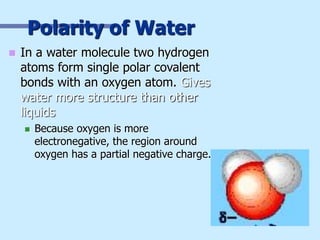
 In a water molecule two hydrogen
atoms form single polar covalent
bonds with an oxygen atom. Gives
water more structure than other
liquids
 Because oxygen is more
electronegative, the region around
oxygen has a partial negative charge.
 Water has a variety of unusual properties
because of attractions between these polar
molecules.
 The slightly negative regions of one molecule are
attracted to the slightly positive regions of nearby
molecules, forming a hydrogen bond.
 Each water molecule
can form hydrogen
bonds with up to
four neighbors.
 The region near the two hydrogen
atoms has a partial positive charge.
 A water molecule is a polar molecule with
opposite ends of the molecule with opposite
charges.
Copyright © 2002 Pearson Education, Inc., publishing as Benjamin Cummings
Fig. 3.1
HYDROGEN BONDS
 Hold water
molecules together
 Each water molecule
can form a maximum
of 4 hydrogen bonds
 The hydrogen bonds
joining water
molecules are weak,
about 1/20th as
strong as covalent
bonds.
 They form, break,
and reform with
great frequency
 Extraordinary
Properties that are a
result of hydrogen
bonds.
 Cohesive behavior
 Resists changes in
temperature
 High heat of vaporization
 Expands when it freezes
 Versatile solvent
http://kingfish.coastal.edu/biology/sgilman/770lecwatersalt.htm
Freezing
 Density of ice (at 0°C) is 0.917 g/mL,
so ice floats in water.
http://www.anglianwater.co.uk/schools/noscript/f1.htm
 Most liquids become more
dense as you cool them.
However, when water
freezes, a large expansion
occurs.
Water
“organizing” with
H bonds as it
freezes.
Forms hexagon
shapes.
* Where have you
see H2O in
repeating
hexagonal patterns
before?
So ice is able to
float (just barely)
Six Phase Changes
SOLID
LIQUID
GAS
B.P.
Temp
(°C)
M.P.
C.P.
F.P.
Water molecules are:
 Bent (or V-shaped)
O
H
H
+
-
O
H
H
+
-
 Polar: have an uneven distribution of e-
A partial (less than +1) positive charge by the H’s
A partial (< –1) negative charge by the O
 Attracted to each other: (+) and (-) charges of one H2O
are attracted to other (+) and (-) of another H2O
 These attractions are called hydrogen bonds
(“H bonds”); occur between H2O molecules
* These are different than ionic, covalent, and metallic
bonds (which occur between atoms)
Main Properties of Water
Polarity
Leads to Cohesion and Adhesion
Cohesion = water molecules
“stick” to each other
Adhesion = water molecules
“stick” to other substances
Adhesion
 The adhesion of water leads to two other
important properties:
1. Water as a “universal” solvent
 Water only dissolves polar molecules
2. Capillary action
Universal Solvent
 Solvent – a substance that dissolves another
substance
 What dissolves in water?
 Salt
 Sugar
 Carbon Dioxide
 Oxygen
 Magic Marker (Paper towel demo)
 MANY more!
 For an object to dissolve in water it must also be a
polar molecule!
 This is why oil and water do not mix, oil is NON polar
Capillary Action
 Capillary action = Water is able to “climb”
objects against the forces of gravity
 Think of the (+) and (-) ends of a water
molecule acting like suction cups, and a
water molecule is using them to climb up a
glass building
 Just like in the Paper Towel Demo
Cohesion
 The cohesion of water molecules leads to
two other important properties:
1. Surface Tension – the attraction
between water molecules at the surface of
the liquid
2. High Specific Heat – it takes a lot of
energy to warm up water and it takes a
very long time for warm water to cool off
Surface Tension
 Resistance of a liquid to an increase in surface area
because H bonds in H2O
 Ex: floating a paper clip, “water striders”, water beading on
waxed car
http://wine1.sb.fsu.edu/chm1045/notes/Forces/Liquids/Forces03.htm
Air
Water
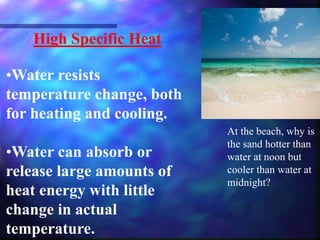
High Specific Heat
•Water resists
temperature change, both
for heating and cooling.
•Water can absorb or
release large amounts of
heat energy with little
change in actual
temperature.
At the beach, why is
the sand hotter than
water at noon but
cooler than water at
midnight?
http://www.ec.gc.ca/water/index.htm
“Water vapor forms a kind of
global ‘blanket’ which helps to
keep the earth warm. Heat
radiated from the sun-warmed
surface of the earth is
absorbed and held
by the vapor.”
Discussion Questions
 Which property of water causes the cracks
in the pavement in cold climates?
 Why does a meniscus form on the surface
of the water in a graduated cylinder?
 What would happen to fish in cooler
climates if the relative densities of ice and
liquid water were reversed?
 What property of water best describes the
ability of water to clean our clothes?
Fill in the Graphic Organizer

water_props.ppt

  • 1.
    Paper towel  Whyis paper towel able to absorb so much water?  Water adheres to the paper towel due to its polarity  In your group, cut your piece of paper towel into 4 strips (long ways)  USE PENCIL (NO pen or marker) and writer your name at the top of one strip  Color the rest with the markers anyway you wish
  • 2.
  • 3.
    * Water statistics Covers 75% of Earth’s surface  97% oceans  3% freshwater  2% (of Total) in ice caps and glaciers  1% in lakes, underground, or in atmosphere (usable by humans)  Makes up 70% of the human body  92% of blood plasma  80% of muscle tissues  60% of red blood cells (why understanding it is important!)
  • 4.
    Physical properties Water:  Isclear, colorless, odorless, and tasteless * Colors, tastes and odors are caused by substances dissolved in the water.  Boils at 100°C  Freezes at 0°C  Density = 1.0 g/mL (at 4°C)  Water is a Polar Molecule
  • 5.
    Polarity of Water In a water molecule two hydrogen atoms form single polar covalent bonds with an oxygen atom. Gives water more structure than other liquids  Because oxygen is more electronegative, the region around oxygen has a partial negative charge.
  • 6.
     Water hasa variety of unusual properties because of attractions between these polar molecules.  The slightly negative regions of one molecule are attracted to the slightly positive regions of nearby molecules, forming a hydrogen bond.  Each water molecule can form hydrogen bonds with up to four neighbors.  The region near the two hydrogen atoms has a partial positive charge.  A water molecule is a polar molecule with opposite ends of the molecule with opposite charges. Copyright © 2002 Pearson Education, Inc., publishing as Benjamin Cummings Fig. 3.1
  • 7.
    HYDROGEN BONDS  Holdwater molecules together  Each water molecule can form a maximum of 4 hydrogen bonds  The hydrogen bonds joining water molecules are weak, about 1/20th as strong as covalent bonds.  They form, break, and reform with great frequency  Extraordinary Properties that are a result of hydrogen bonds.  Cohesive behavior  Resists changes in temperature  High heat of vaporization  Expands when it freezes  Versatile solvent
  • 8.
    http://kingfish.coastal.edu/biology/sgilman/770lecwatersalt.htm Freezing  Density ofice (at 0°C) is 0.917 g/mL, so ice floats in water. http://www.anglianwater.co.uk/schools/noscript/f1.htm  Most liquids become more dense as you cool them. However, when water freezes, a large expansion occurs. Water “organizing” with H bonds as it freezes. Forms hexagon shapes. * Where have you see H2O in repeating hexagonal patterns before?
  • 9.
    So ice isable to float (just barely)
  • 10.
  • 11.
    Water molecules are: Bent (or V-shaped) O H H + - O H H + -  Polar: have an uneven distribution of e- A partial (less than +1) positive charge by the H’s A partial (< –1) negative charge by the O  Attracted to each other: (+) and (-) charges of one H2O are attracted to other (+) and (-) of another H2O  These attractions are called hydrogen bonds (“H bonds”); occur between H2O molecules * These are different than ionic, covalent, and metallic bonds (which occur between atoms)
  • 12.
    Main Properties ofWater Polarity Leads to Cohesion and Adhesion Cohesion = water molecules “stick” to each other Adhesion = water molecules “stick” to other substances
  • 13.
    Adhesion  The adhesionof water leads to two other important properties: 1. Water as a “universal” solvent  Water only dissolves polar molecules 2. Capillary action
  • 14.
    Universal Solvent  Solvent– a substance that dissolves another substance  What dissolves in water?  Salt  Sugar  Carbon Dioxide  Oxygen  Magic Marker (Paper towel demo)  MANY more!  For an object to dissolve in water it must also be a polar molecule!  This is why oil and water do not mix, oil is NON polar
  • 15.
    Capillary Action  Capillaryaction = Water is able to “climb” objects against the forces of gravity  Think of the (+) and (-) ends of a water molecule acting like suction cups, and a water molecule is using them to climb up a glass building  Just like in the Paper Towel Demo
  • 16.
    Cohesion  The cohesionof water molecules leads to two other important properties: 1. Surface Tension – the attraction between water molecules at the surface of the liquid 2. High Specific Heat – it takes a lot of energy to warm up water and it takes a very long time for warm water to cool off
  • 17.
    Surface Tension  Resistanceof a liquid to an increase in surface area because H bonds in H2O  Ex: floating a paper clip, “water striders”, water beading on waxed car http://wine1.sb.fsu.edu/chm1045/notes/Forces/Liquids/Forces03.htm Air Water
  • 18.
    High Specific Heat •Waterresists temperature change, both for heating and cooling. •Water can absorb or release large amounts of heat energy with little change in actual temperature. At the beach, why is the sand hotter than water at noon but cooler than water at midnight?
  • 19.
    http://www.ec.gc.ca/water/index.htm “Water vapor formsa kind of global ‘blanket’ which helps to keep the earth warm. Heat radiated from the sun-warmed surface of the earth is absorbed and held by the vapor.”
  • 20.
    Discussion Questions  Whichproperty of water causes the cracks in the pavement in cold climates?  Why does a meniscus form on the surface of the water in a graduated cylinder?  What would happen to fish in cooler climates if the relative densities of ice and liquid water were reversed?  What property of water best describes the ability of water to clean our clothes?
  • 21.
    Fill in theGraphic Organizer