STRUCTURE AND
PROPERTIES OF WATER
WATER
 Water is essential for life.It covers 2/3 of
the earth’s surface and every living thing
is depend upon it.
 The human body is comprised of over
70% water,and it is a major component
of many body fluids including
blood,urine,and saliva.
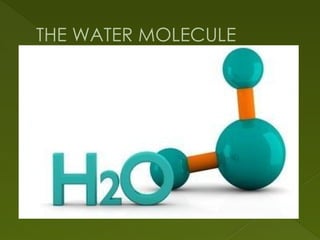
THE WATER MOLECULE
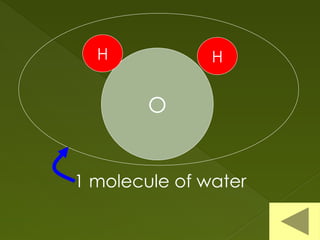
 Water is formed when two hydrogen
atoms bond to one oxygen atom.
 With a total atomic weight of 18 daltons
O
H H
1 molecule of water
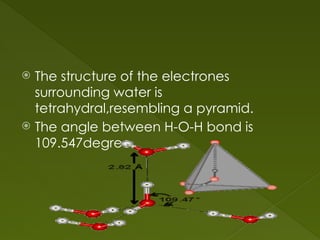
 The structure of the electrones
surrounding water is
tetrahydral,resembling a pyramid.
 The angle between H-O-H bond is
109.547degree.
 There is a great concentration of
electrones around the nucleus of the
oxygen than around the hydrogen.
 There for,the hydrogen end is slightly
positive and the oxygen end is slightly
negative.
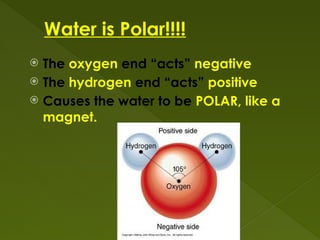
Water is Polar!!!!
 The oxygen end “acts” negative
 The hydrogen end “acts” positive
 Causes the water to be POLAR, like a
magnet.
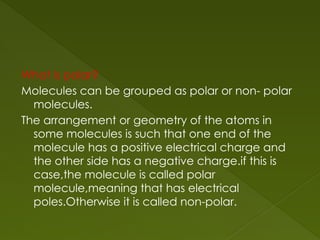
What is polar?
Molecules can be grouped as polar or non- polar
molecules.
The arrangement or geometry of the atoms in
some molecules is such that one end of the
molecule has a positive electrical charge and
the other side has a negative charge.if this is
case,the molecule is called polar
molecule,meaning that has electrical
poles.Otherwise it is called non-polar.
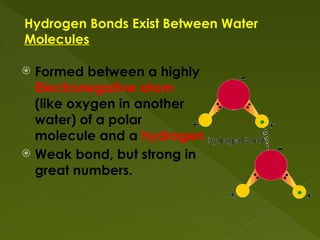
Hydrogen Bonds Exist Between Water
Molecules
 Formed between a highly
Electronegative atom
(like oxygen in another
water) of a polar
molecule and a hydrogen
 Weak bond, but strong in
great numbers.
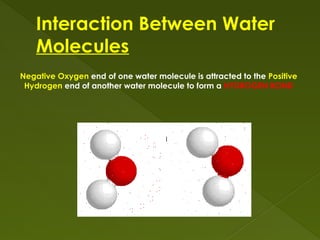
Interaction Between Water
Molecules
Negative Oxygen end of one water molecule is attracted to the Positive
Hydrogen end of another water molecule to form a HYDROGEN BOND
STATES OF WATER
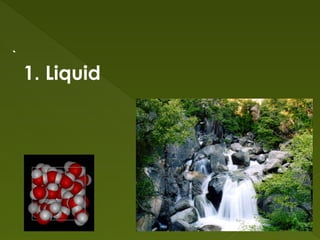
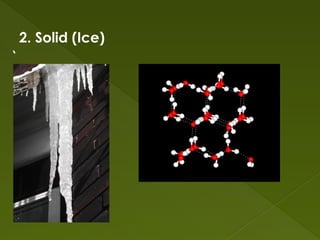
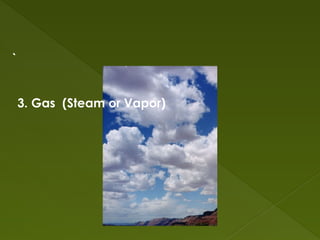
 Water is the only substance found on
Earth in all three states (phases):
1. Liquid
2. Solid (Ice)
3. Gas (Steam or Vapor)
PROPERTIES OF WATER
1.PHYSICAL PROPERTIES
2.CHEMICAL PROPERTIEs
1. Physical Properties
 Polar molecule
 Hydrophilic substances dissolve
 Hydrophobic substances aggregate
 Osmosis
 Cohesion
 Adhesion
Water is a polar molecule
Water is a polar molecule because of the
way the atoms bind in the molecule with
more positive(+) charges on one side of the
molecule and more negative(-) charges on
the other side of the molecule.In other words
the hydrogen atoms group on one side of the
molecule making that more positive,such that
there are more electrons from the oxygen
atom on the other side of the molecule.
 A water molecule is formed when two
atoms of hydrogen bond covalently with
an atom of oxygen.
 In a covalent bond electrons are shared
between atoms. In water the sharing is
not equal. The oxygen atom attracts the
electrons more strongly than the
hydrogen.
 This gives water an asymmetrical distribution of
charge.
 Molecules that have ends with partial negative and
positive charges are known as polar molecules.
 It is this polar property that allows water to separate
polar solute molecules and explains why water can
dissolve so many substances.
 The HOH bond angle is 104.5
 The oxygen nucleus attracts electrons
more strongly than does the hydrogen
nucleus (a proton);
 that is, oxygen is more electronegative.
 The sharing of electrons between H and O
is therefore unequal;
 The result of this unequal electron sharing is
two electric dipoles in the water molecule:
 one along each of the H O bonds:
 each hydrogen bears a partial positive
charge
 And the oxygen atom bears a partial
negative charge equal to the sum of the
two partial positives
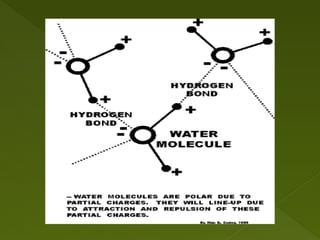
 As a result, there is an electrostatic
attraction between the oxygen atom of
one water molecule and the hydrogen of
another called a hydrogen bond.
 Hydrophilic & Hydrophobic
 Water is a polar solvent. It readily dissolves
most biomolecules, which are generally
charged or polar compounds.
 Compounds that dissolve easily in water
are hydrophilic (Greek, “water-loving”).
In contrast,
 Nonpolar solvents such as chloroform and
benzene are poor solvents for polar
biomolecules but easily dissolve those that
are hydrophobic—nonpolar molecules
such as lipids and waxes.
 Water dissolves salts such as NaCl by hydrating
and
stabilizing the Na and Cl ions, weakening the
electrostatic interactions between them.
 The same factors apply to charged biomolecules,
 Water readily dissolves such compounds by
replacing solute- solute hydrogen bonds with
solute-water hydrogen bonds, thus screening the
electrostatic interactions between solute
molecules.
Amphipathic compounds contain regions
that are:
 Polar (or charged) and regions that are
Nonpolar.
 When an amphipathic compound is
mixed with water, the polar hydrophilic
region interacts favorably with the solvent
and tends to dissolve.
 but the nonpolar, hydrophobic region
tends to avoid contact with the water.
 These stable structures of amphipathic
compounds in water are called micelles,
May contain hundreds or thousands of
molecules.
 Many biomolecules are amphipathic; e.g
Proteins, pigments, certain vitamins, and the
sterols and phospholipids of membranes all
have polar and nonpolar surface regions
Hydrophobic interactions
 The forces that hold the non polar
regions of the molecules together are
called hydrophobic interactions.
 (nonpolar compounds self associate in
an aqueous environment)
 Hydrophobic interactions among lipids,
and between lipids and proteins, are
the most important determinants of
structure in biological membranes.
Hydrophobic interactions between non
polar amino acids also stabilize the
three-dimensional structures of proteins.
0smosis
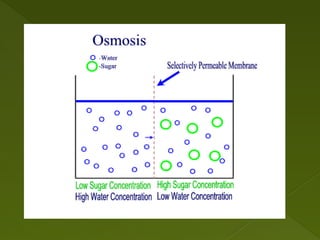
 Osmosis is the passage of water from
a region of high water concentration
through a semi-permeable
membrane to a region of low water
concentration.
osmosis , transfer of a liquid solvent
through a semipermeable membrane
that does not allow dissolved solids
(solutes) to pass.
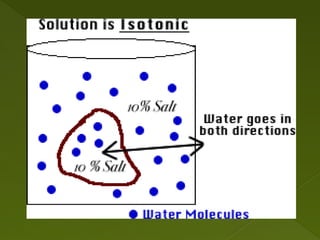
 Salt is a solute, when it is concentrated
inside or outside the cell, it will draw the
water in its direction.
 If the concentration of solute (salt) is
equal on both sides, the water will
move back in forth but it won't have
any result on the overall amount of
water on either side.
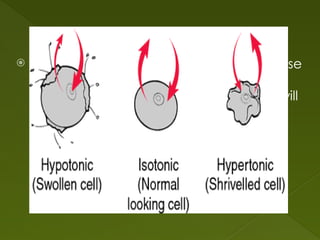
 "ISO" means the same
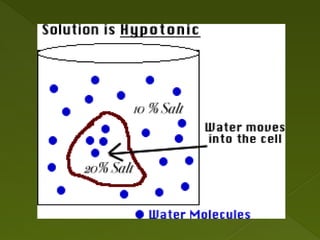
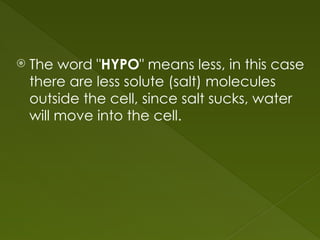
 The word "HYPO" means less, in this case
there are less solute (salt) molecules
outside the cell, since salt sucks, water
will move into the cell.
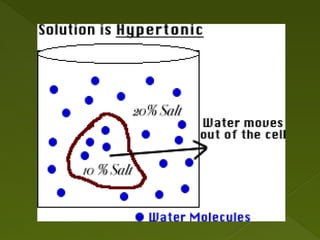
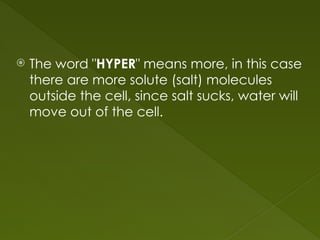
 The word "HYPER" means more, in this case
there are more solute (salt) molecules
outside the cell, since salt sucks, water will
move out of the cell.
 The word "HYPER" means more, in this case
there are more solute (salt) molecules
outside the cell, since salt sucks, water will
move out of the cell.
 The process of osmosis and the factors
that influence it are important clinically
in the maintenance of adequate body
fluids and in the proper balance
between volumes of extracellular and
intracellular fluids.
Cohesion of water
 Have you ever filled a glass of water to the very
top and then slowly added a few more drops?
Before it overflows,the water forms a dome-like
shape above the glass.this dome like shape
forms due to the water molecules cohesive
properties,or their tendency to stick to one
another.
 Cohesive refers to the attraction of molecules for
other molecules of same kind,and water
molecules have strong forces thanks to their
ability to form hydrogen bonds with one another.
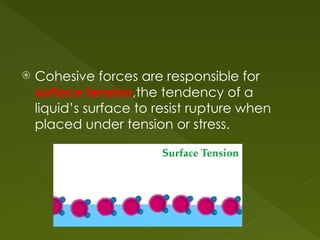
 Cohesive forces are responsible for
surface tension,the tendency of a
liquid’s surface to resist rupture when
placed under tension or stress.
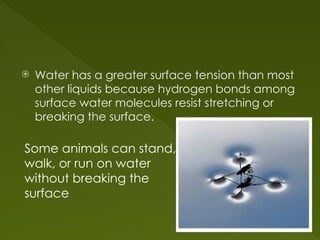
 Water has a greater surface tension than most
other liquids because hydrogen bonds among
surface water molecules resist stretching or
breaking the surface.
Some animals can stand,
walk, or run on water
without breaking the
surface
Adhesion of water
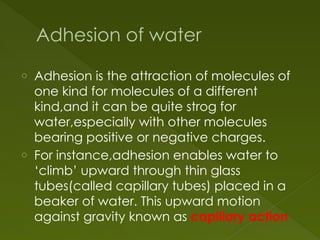
o Adhesion is the attraction of molecules of
one kind for molecules of a different
kind,and it can be quite strog for
water,especially with other molecules
bearing positive or negative charges.
o For instance,adhesion enables water to
‘climb’ upward through thin glass
tubes(called capillary tubes) placed in a
beaker of water. This upward motion
against gravity known as capillary action
 This depends on the attraction between
water molecules and the glass walls of
the tube(adhesion),as well as on
interaction between water
molecules(cohesion)
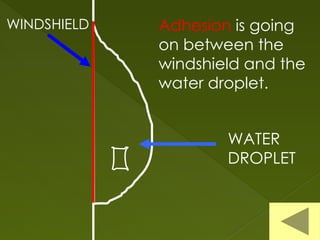
WATER
DROPLET
WINDSHIELD Adhesion is going
on between the
windshield and the
water droplet.
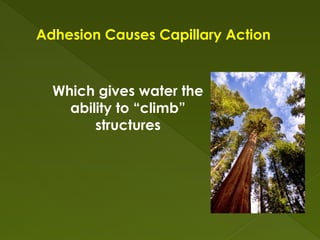
Adhesion Causes Capillary Action
Which gives water the
ability to “climb”
structures
2.Chemical properties
 Dissociation of water molecules
 Acids and bases
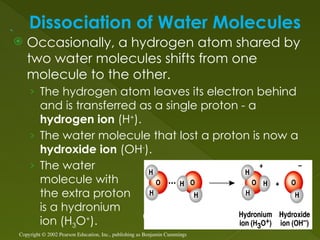
Dissociation of Water Molecules
 Occasionally, a hydrogen atom shared by
two water molecules shifts from one
molecule to the other.
› The hydrogen atom leaves its electron behind
and is transferred as a single proton - a
hydrogen ion (H+
).
› The water molecule that lost a proton is now a
hydroxide ion (OH-
).
› The water
molecule with
the extra proton
is a hydronium
ion (H3O+
).
Copyright © 2002 Pearson Education, Inc., publishing as Benjamin Cummings
Unnumbered Fig. 3.47
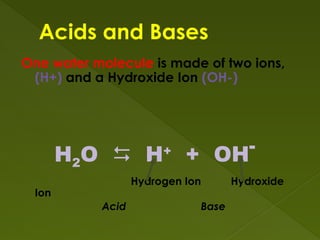
Acids and Bases
One water molecule is made of two ions,
(H+) and a Hydroxide Ion (OH-)
Hydrogen Ion Hydroxide
Ion
Acid Base
H2O  H+
+ OH-
Acid: A solution with lots of H+
ions
• pH 0 up to 7 is acid (acidic)
Base: A solution with lots of OH-
ions
• pH above 7 – 14 is basic
(alkaline)
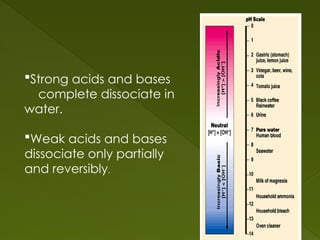
Strong acids and bases
complete dissociate in
water.
Weak acids and bases
dissociate only partially
and reversibly.
THANK YOU

structureandpropertiesofwater-170113090816.pptx

  • 1.
  • 2.
    WATER  Water isessential for life.It covers 2/3 of the earth’s surface and every living thing is depend upon it.  The human body is comprised of over 70% water,and it is a major component of many body fluids including blood,urine,and saliva.
  • 3.
  • 4.
     Water isformed when two hydrogen atoms bond to one oxygen atom.  With a total atomic weight of 18 daltons
  • 5.
  • 6.
     The structureof the electrones surrounding water is tetrahydral,resembling a pyramid.  The angle between H-O-H bond is 109.547degree.
  • 7.
     There isa great concentration of electrones around the nucleus of the oxygen than around the hydrogen.  There for,the hydrogen end is slightly positive and the oxygen end is slightly negative.
  • 8.
    Water is Polar!!!! The oxygen end “acts” negative  The hydrogen end “acts” positive  Causes the water to be POLAR, like a magnet.
  • 9.
    What is polar? Moleculescan be grouped as polar or non- polar molecules. The arrangement or geometry of the atoms in some molecules is such that one end of the molecule has a positive electrical charge and the other side has a negative charge.if this is case,the molecule is called polar molecule,meaning that has electrical poles.Otherwise it is called non-polar.
  • 10.
    Hydrogen Bonds ExistBetween Water Molecules  Formed between a highly Electronegative atom (like oxygen in another water) of a polar molecule and a hydrogen  Weak bond, but strong in great numbers.
  • 11.
    Interaction Between Water Molecules NegativeOxygen end of one water molecule is attracted to the Positive Hydrogen end of another water molecule to form a HYDROGEN BOND
  • 12.
    STATES OF WATER Water is the only substance found on Earth in all three states (phases):
  • 13.
  • 14.
  • 15.
    3. Gas (Steamor Vapor)
  • 16.
  • 17.
  • 18.
    1. Physical Properties Polar molecule  Hydrophilic substances dissolve  Hydrophobic substances aggregate  Osmosis  Cohesion  Adhesion
  • 19.
    Water is apolar molecule Water is a polar molecule because of the way the atoms bind in the molecule with more positive(+) charges on one side of the molecule and more negative(-) charges on the other side of the molecule.In other words the hydrogen atoms group on one side of the molecule making that more positive,such that there are more electrons from the oxygen atom on the other side of the molecule.
  • 20.
     A watermolecule is formed when two atoms of hydrogen bond covalently with an atom of oxygen.  In a covalent bond electrons are shared between atoms. In water the sharing is not equal. The oxygen atom attracts the electrons more strongly than the hydrogen.
  • 21.
     This giveswater an asymmetrical distribution of charge.  Molecules that have ends with partial negative and positive charges are known as polar molecules.  It is this polar property that allows water to separate polar solute molecules and explains why water can dissolve so many substances.
  • 22.
     The HOHbond angle is 104.5  The oxygen nucleus attracts electrons more strongly than does the hydrogen nucleus (a proton);  that is, oxygen is more electronegative.  The sharing of electrons between H and O is therefore unequal;
  • 23.
     The resultof this unequal electron sharing is two electric dipoles in the water molecule:  one along each of the H O bonds:  each hydrogen bears a partial positive charge  And the oxygen atom bears a partial negative charge equal to the sum of the two partial positives
  • 24.
     As aresult, there is an electrostatic attraction between the oxygen atom of one water molecule and the hydrogen of another called a hydrogen bond.
  • 26.
     Hydrophilic &Hydrophobic  Water is a polar solvent. It readily dissolves most biomolecules, which are generally charged or polar compounds.
  • 27.
     Compounds thatdissolve easily in water are hydrophilic (Greek, “water-loving”). In contrast,  Nonpolar solvents such as chloroform and benzene are poor solvents for polar biomolecules but easily dissolve those that are hydrophobic—nonpolar molecules such as lipids and waxes.
  • 28.
     Water dissolvessalts such as NaCl by hydrating and stabilizing the Na and Cl ions, weakening the electrostatic interactions between them.  The same factors apply to charged biomolecules,  Water readily dissolves such compounds by replacing solute- solute hydrogen bonds with solute-water hydrogen bonds, thus screening the electrostatic interactions between solute molecules.
  • 29.
    Amphipathic compounds containregions that are:  Polar (or charged) and regions that are Nonpolar.
  • 30.
     When anamphipathic compound is mixed with water, the polar hydrophilic region interacts favorably with the solvent and tends to dissolve.  but the nonpolar, hydrophobic region tends to avoid contact with the water.
  • 31.
     These stablestructures of amphipathic compounds in water are called micelles, May contain hundreds or thousands of molecules.  Many biomolecules are amphipathic; e.g Proteins, pigments, certain vitamins, and the sterols and phospholipids of membranes all have polar and nonpolar surface regions
  • 32.
    Hydrophobic interactions  Theforces that hold the non polar regions of the molecules together are called hydrophobic interactions.  (nonpolar compounds self associate in an aqueous environment)
  • 33.
     Hydrophobic interactionsamong lipids, and between lipids and proteins, are the most important determinants of structure in biological membranes. Hydrophobic interactions between non polar amino acids also stabilize the three-dimensional structures of proteins.
  • 34.
    0smosis  Osmosis isthe passage of water from a region of high water concentration through a semi-permeable membrane to a region of low water concentration. osmosis , transfer of a liquid solvent through a semipermeable membrane that does not allow dissolved solids (solutes) to pass.
  • 36.
     Salt isa solute, when it is concentrated inside or outside the cell, it will draw the water in its direction.
  • 38.
     If theconcentration of solute (salt) is equal on both sides, the water will move back in forth but it won't have any result on the overall amount of water on either side.  "ISO" means the same
  • 40.
     The word"HYPO" means less, in this case there are less solute (salt) molecules outside the cell, since salt sucks, water will move into the cell.
  • 42.
     The word"HYPER" means more, in this case there are more solute (salt) molecules outside the cell, since salt sucks, water will move out of the cell.
  • 43.
     The word"HYPER" means more, in this case there are more solute (salt) molecules outside the cell, since salt sucks, water will move out of the cell.
  • 44.
     The processof osmosis and the factors that influence it are important clinically in the maintenance of adequate body fluids and in the proper balance between volumes of extracellular and intracellular fluids.
  • 45.
    Cohesion of water Have you ever filled a glass of water to the very top and then slowly added a few more drops? Before it overflows,the water forms a dome-like shape above the glass.this dome like shape forms due to the water molecules cohesive properties,or their tendency to stick to one another.  Cohesive refers to the attraction of molecules for other molecules of same kind,and water molecules have strong forces thanks to their ability to form hydrogen bonds with one another.
  • 46.
     Cohesive forcesare responsible for surface tension,the tendency of a liquid’s surface to resist rupture when placed under tension or stress.
  • 47.
     Water hasa greater surface tension than most other liquids because hydrogen bonds among surface water molecules resist stretching or breaking the surface. Some animals can stand, walk, or run on water without breaking the surface
  • 48.
    Adhesion of water oAdhesion is the attraction of molecules of one kind for molecules of a different kind,and it can be quite strog for water,especially with other molecules bearing positive or negative charges. o For instance,adhesion enables water to ‘climb’ upward through thin glass tubes(called capillary tubes) placed in a beaker of water. This upward motion against gravity known as capillary action
  • 49.
     This dependson the attraction between water molecules and the glass walls of the tube(adhesion),as well as on interaction between water molecules(cohesion)
  • 50.
    WATER DROPLET WINDSHIELD Adhesion isgoing on between the windshield and the water droplet.
  • 51.
    Adhesion Causes CapillaryAction Which gives water the ability to “climb” structures
  • 52.
    2.Chemical properties  Dissociationof water molecules  Acids and bases
  • 53.
    Dissociation of WaterMolecules  Occasionally, a hydrogen atom shared by two water molecules shifts from one molecule to the other. › The hydrogen atom leaves its electron behind and is transferred as a single proton - a hydrogen ion (H+ ). › The water molecule that lost a proton is now a hydroxide ion (OH- ). › The water molecule with the extra proton is a hydronium ion (H3O+ ). Copyright © 2002 Pearson Education, Inc., publishing as Benjamin Cummings Unnumbered Fig. 3.47
  • 54.
    Acids and Bases Onewater molecule is made of two ions, (H+) and a Hydroxide Ion (OH-) Hydrogen Ion Hydroxide Ion Acid Base H2O  H+ + OH-
  • 55.
    Acid: A solutionwith lots of H+ ions • pH 0 up to 7 is acid (acidic) Base: A solution with lots of OH- ions • pH above 7 – 14 is basic (alkaline)
  • 56.
    Strong acids andbases complete dissociate in water. Weak acids and bases dissociate only partially and reversibly.
  • 57.