CHEMICAL BONDING
by
SARANYA S
Reg No: 18214367012
JBMCTE Kayamkulam
Types Of Bonds
There are different types of bonds.
1.Ionic bond
2. covalent bond
3.Metallic bond
Now, we are going to talk about
covalent bonds.
Cooperating Covalents
 What is a covalent bond?
 A bond formed by shared
electrons.
 Also, molecules are groups of
atoms that are held together by
covalent bonds in a specific ratio
& shape
COVALENT BONDS
A covalent bond is formed when
atoms share electrons.
 The bonds between oxygen and hydrogen
in a water molecule are covalent bonds.
 There are two covalent bonds in a water
molecule, between the oxygen and each of
the hydrogen atoms.
 Each bond represents one electron.
 In a covalent bond, electrons are shared
between atoms, not transferred.
For example, in a water molecule,
each hydrogen atom shares its single
electron with the oxygen at the center.
Fancy Bonding
 Fancy Sometimes, atoms share more
than one electron.
 Occasionally, they can share 2 or even
3 electrons.
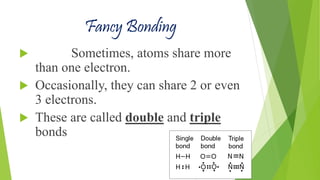
 These are called double and triple
bonds Bonding
A single bond is represented by a bold
short line.
Double and triple bonds are indicated by
double and triple lines
Here are some examples
Power Point presentation

Power Point presentation

  • 2.
    CHEMICAL BONDING by SARANYA S RegNo: 18214367012 JBMCTE Kayamkulam
  • 3.
    Types Of Bonds Thereare different types of bonds. 1.Ionic bond 2. covalent bond 3.Metallic bond Now, we are going to talk about covalent bonds.
  • 4.
    Cooperating Covalents  Whatis a covalent bond?  A bond formed by shared electrons.  Also, molecules are groups of atoms that are held together by covalent bonds in a specific ratio & shape
  • 5.
    COVALENT BONDS A covalentbond is formed when atoms share electrons.  The bonds between oxygen and hydrogen in a water molecule are covalent bonds.  There are two covalent bonds in a water molecule, between the oxygen and each of the hydrogen atoms.  Each bond represents one electron.  In a covalent bond, electrons are shared between atoms, not transferred.
  • 6.
    For example, ina water molecule, each hydrogen atom shares its single electron with the oxygen at the center.
  • 7.
    Fancy Bonding  FancySometimes, atoms share more than one electron.  Occasionally, they can share 2 or even 3 electrons.  These are called double and triple bonds Bonding
  • 8.
    A single bondis represented by a bold short line. Double and triple bonds are indicated by double and triple lines Here are some examples