Surveying I.Lecture 2.
OutlineLevellingStructure of levelsAdjustment of levelsError sourcesProcedure of levelling
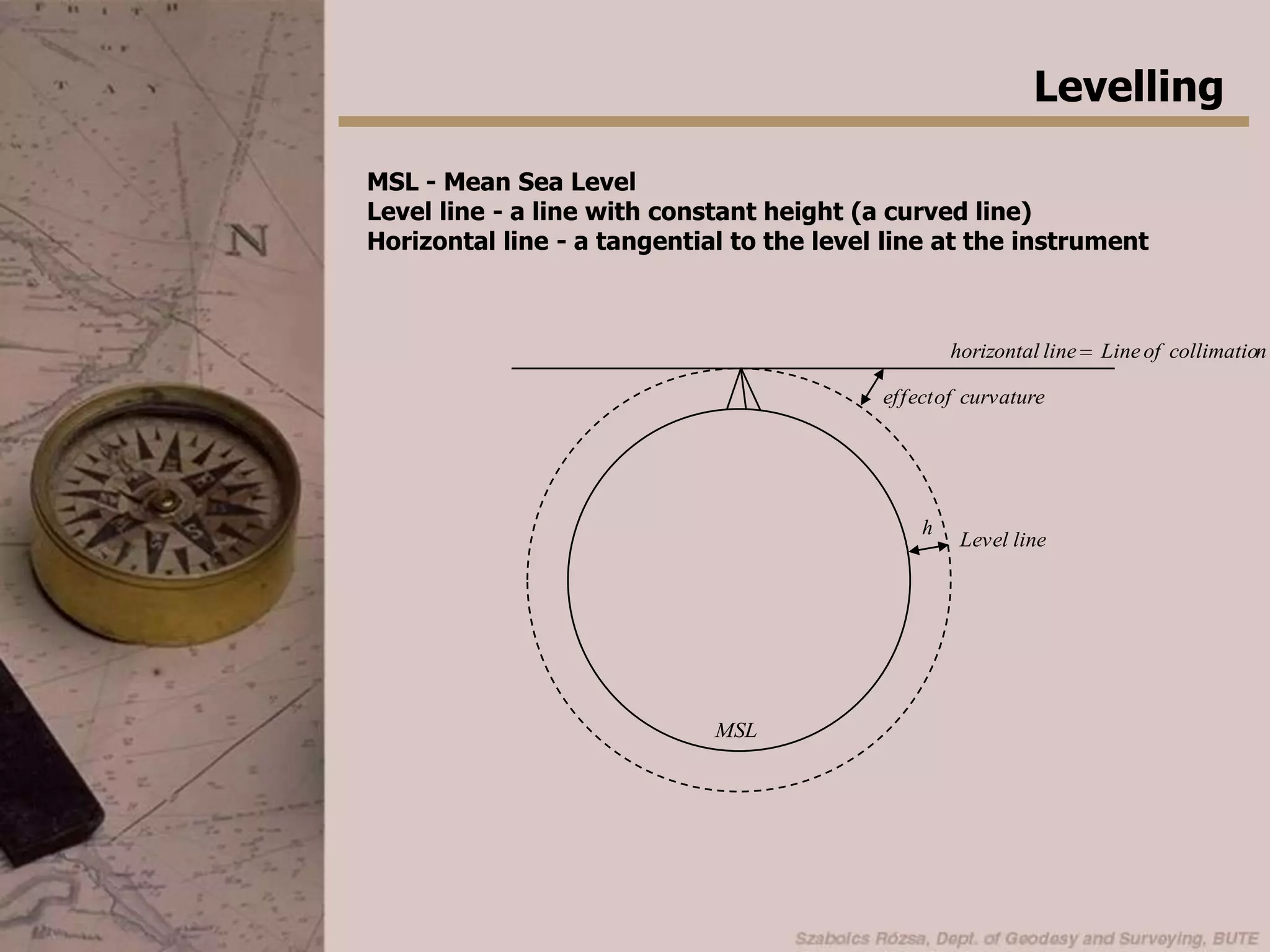
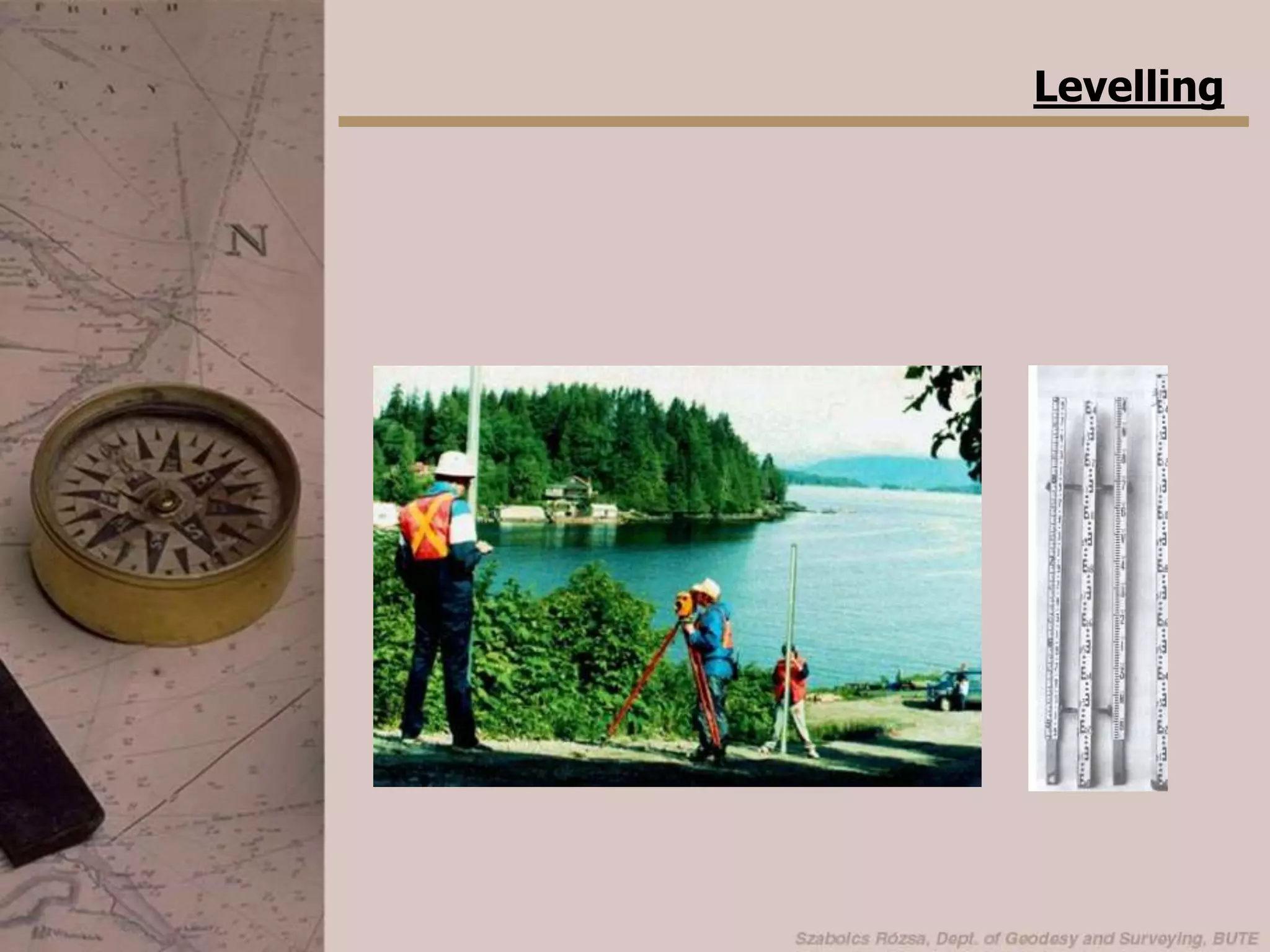
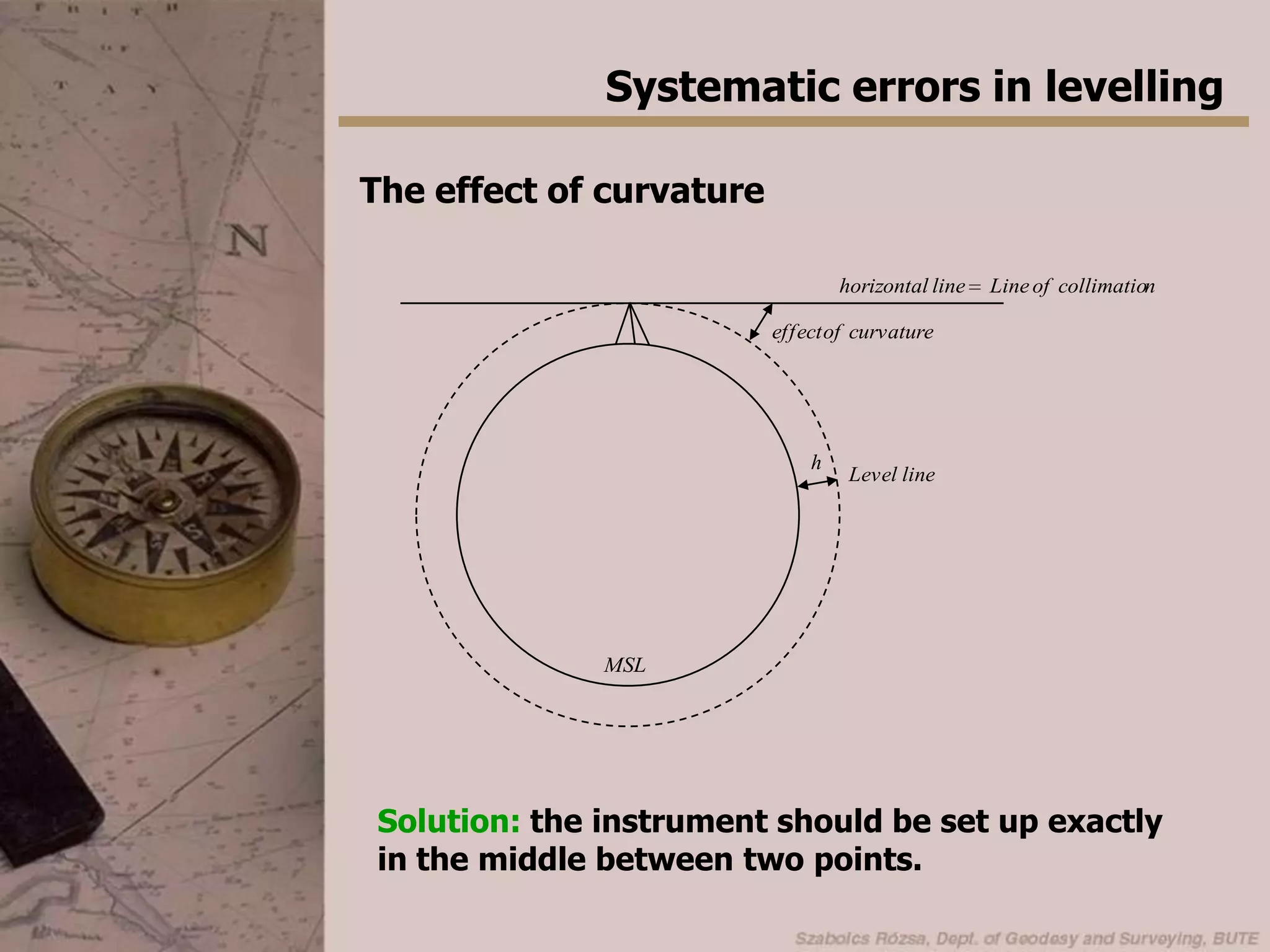
LevellingMSL - Mean Sea LevelLevel line - a line with constant height (a curved line)Horizontal line - a tangential to the level line at the instrument
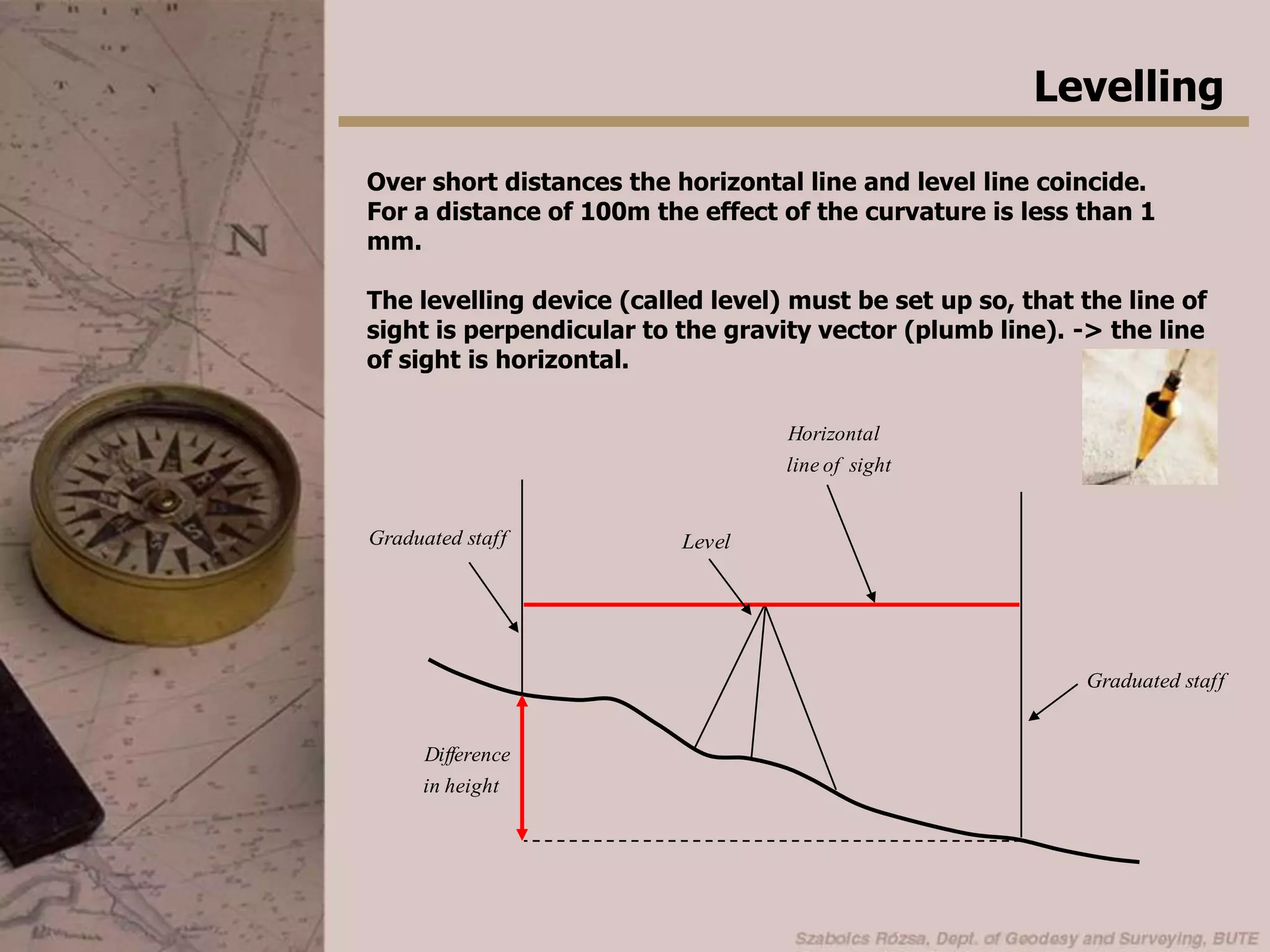
LevellingOver short distances the horizontal line and level line coincide.For a distance of 100m the effect of the curvature is less than 1 mm.The levelling device (called level) must be set up so, that the line of sight is perpendicular to the gravity vector (plumb line). -> the line of sight is horizontal.
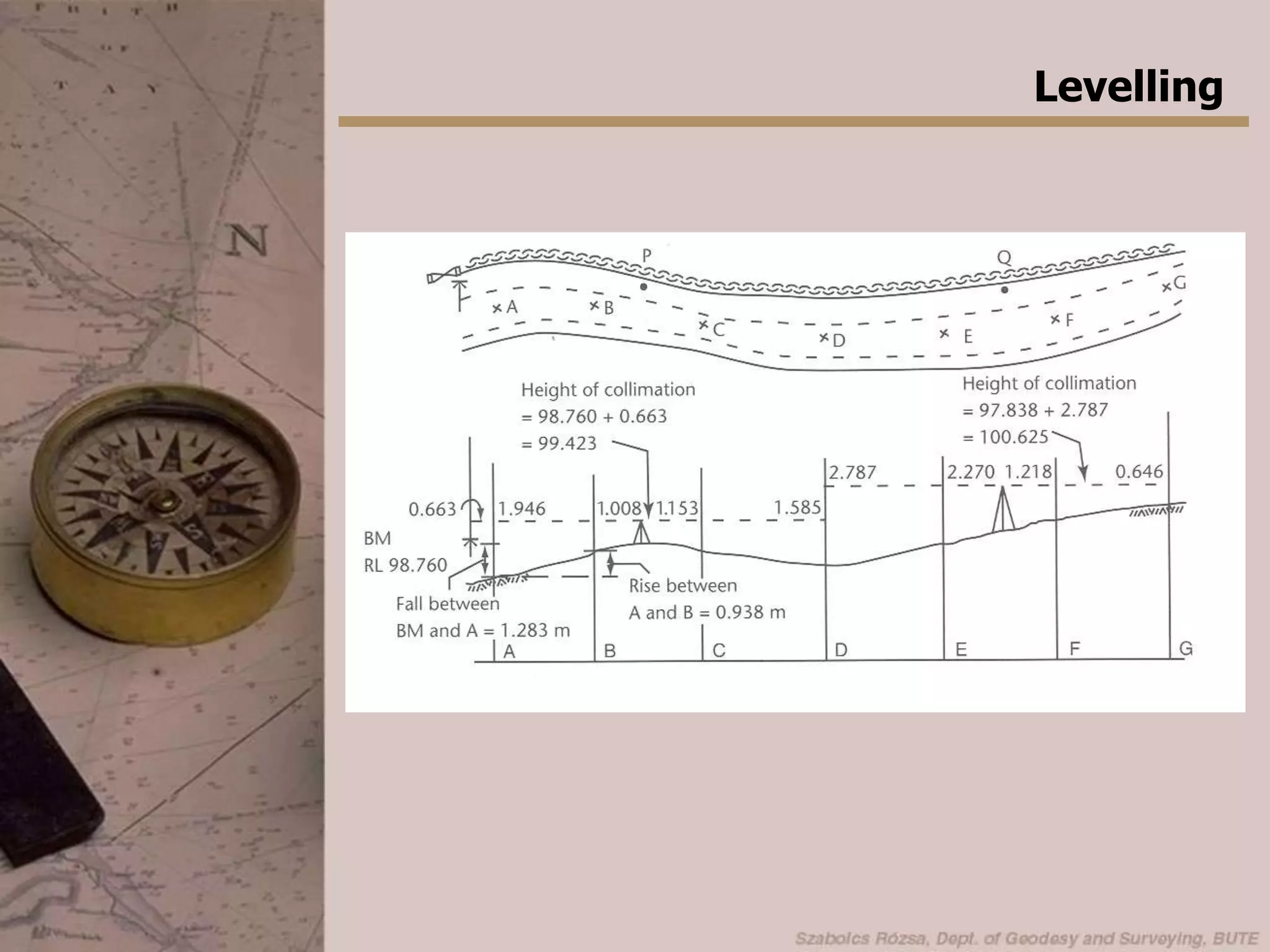
Levelling
Levelling
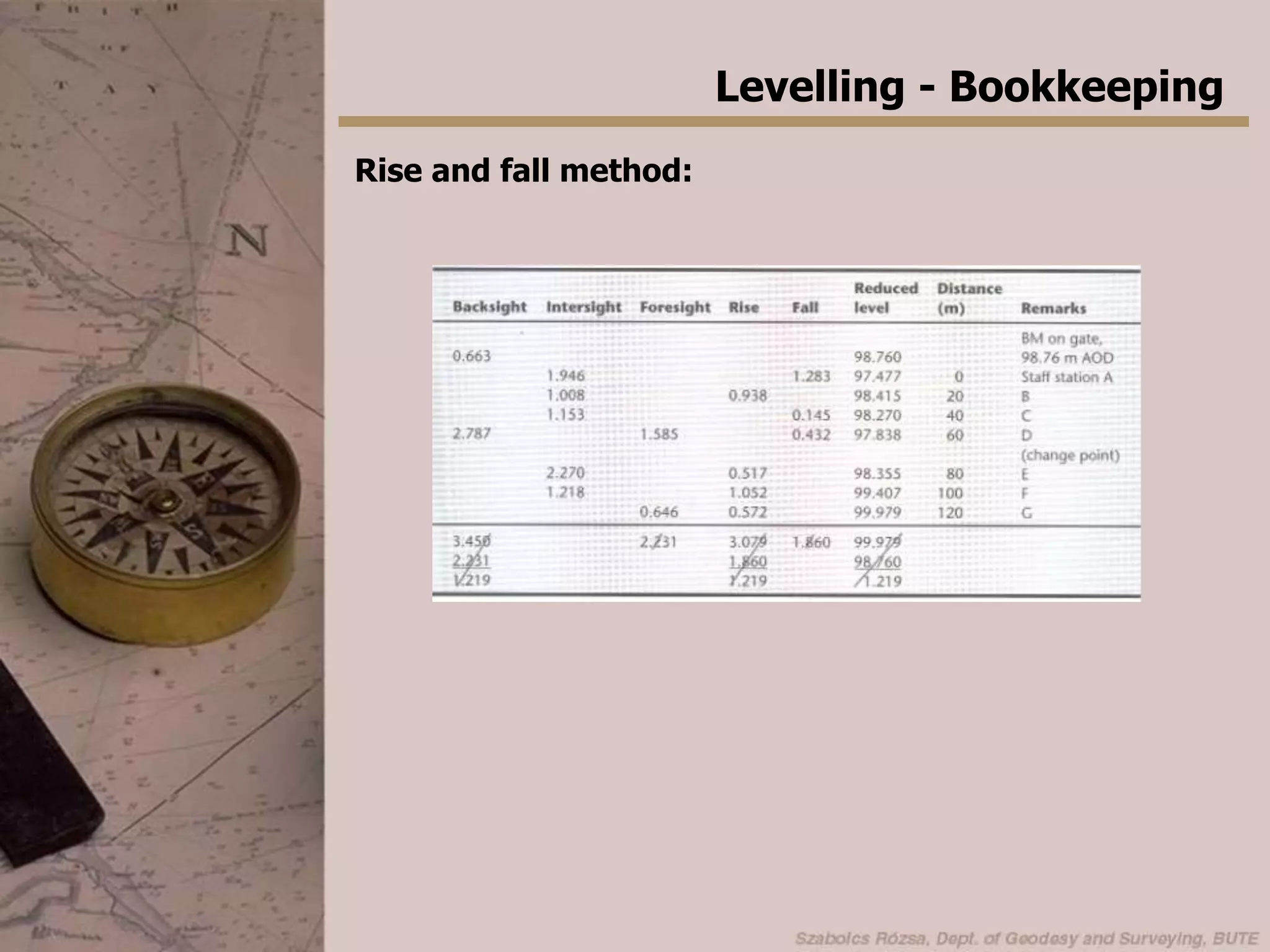
Levelling - BookkeepingRise and fall method:
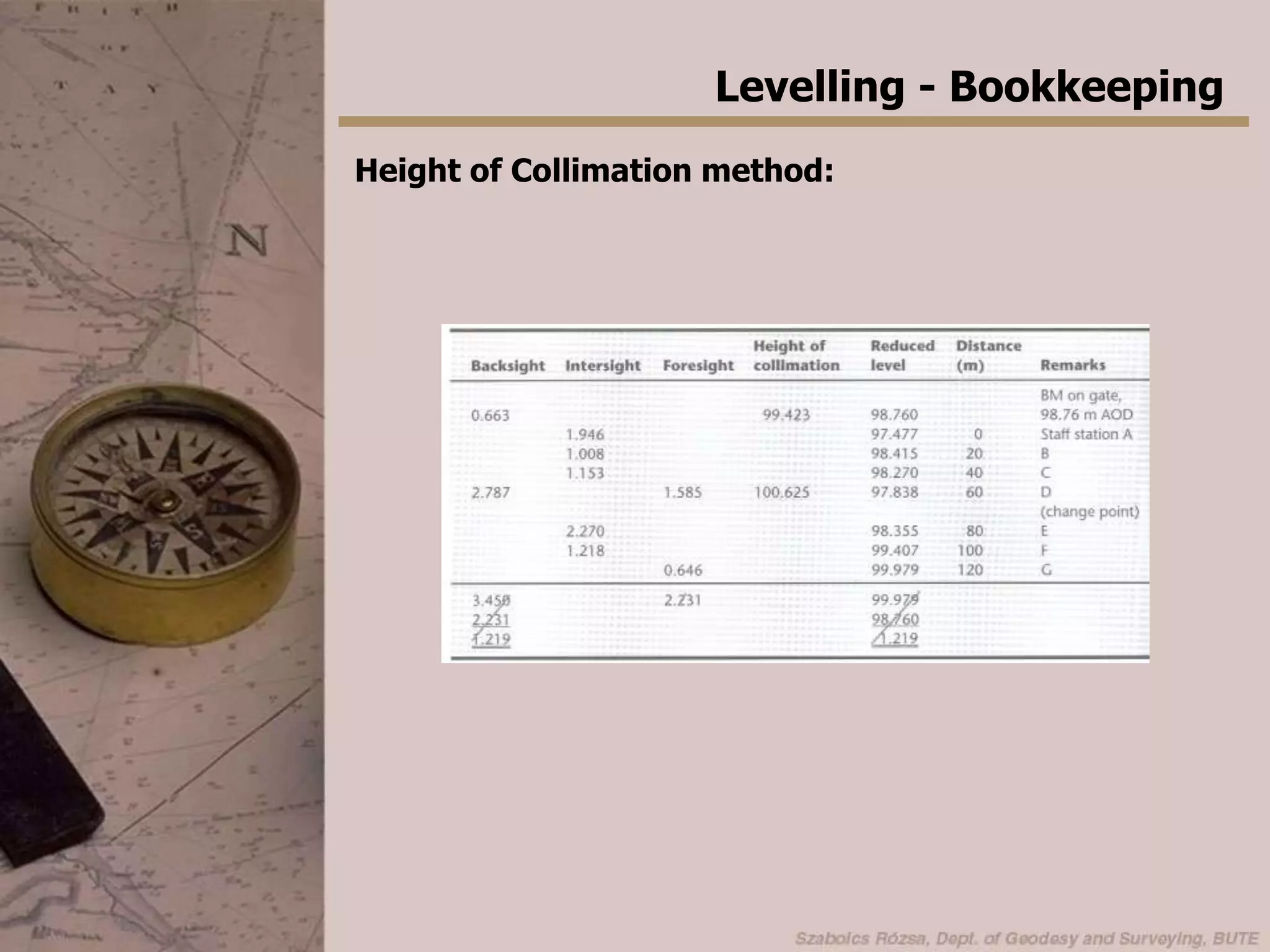
Levelling - BookkeepingHeight of Collimation method:
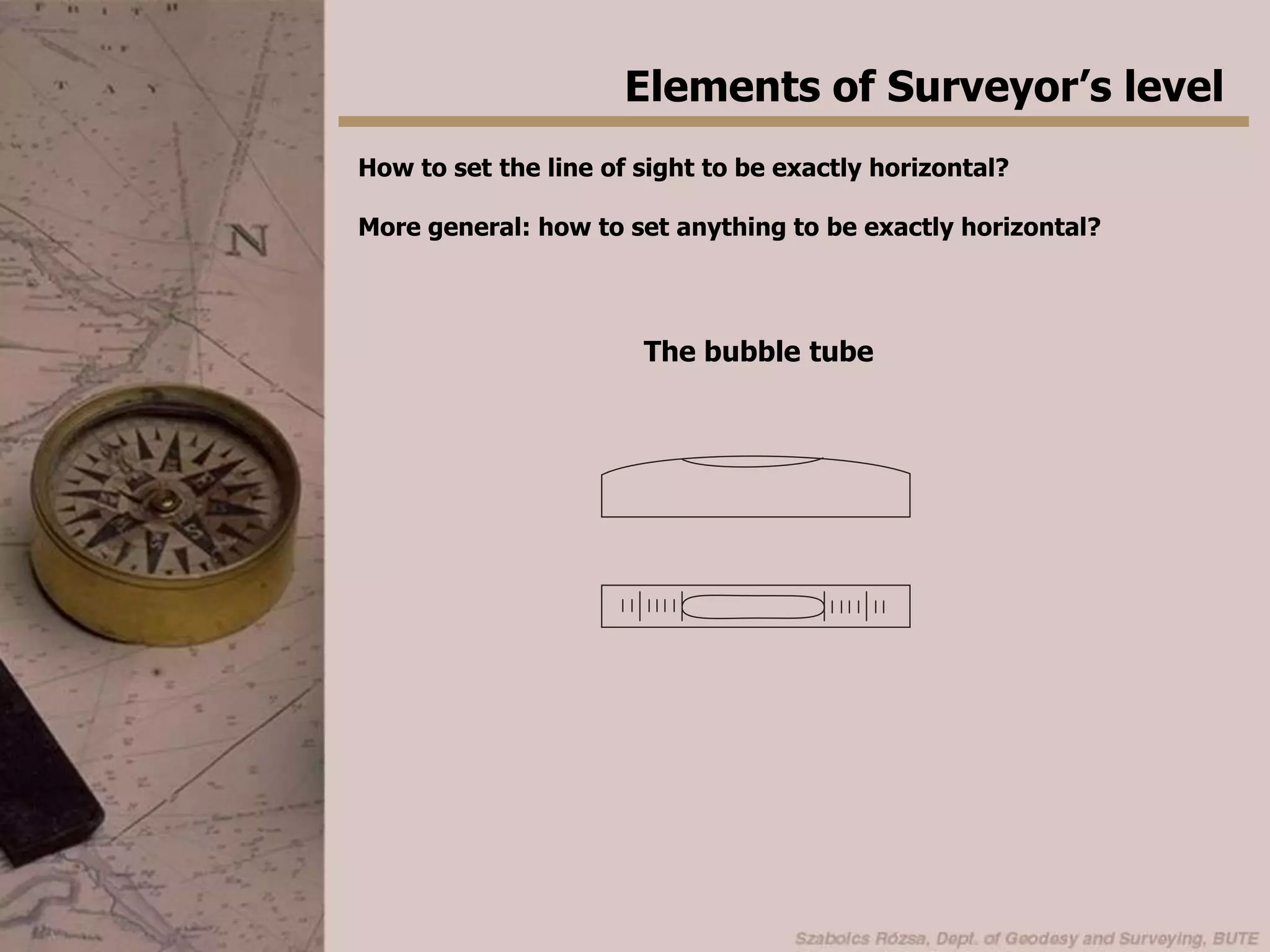
Elements of Surveyor’s levelHow to set the line of sight to be exactly horizontal?More general: how to set anything to be exactly horizontal?The bubble tube
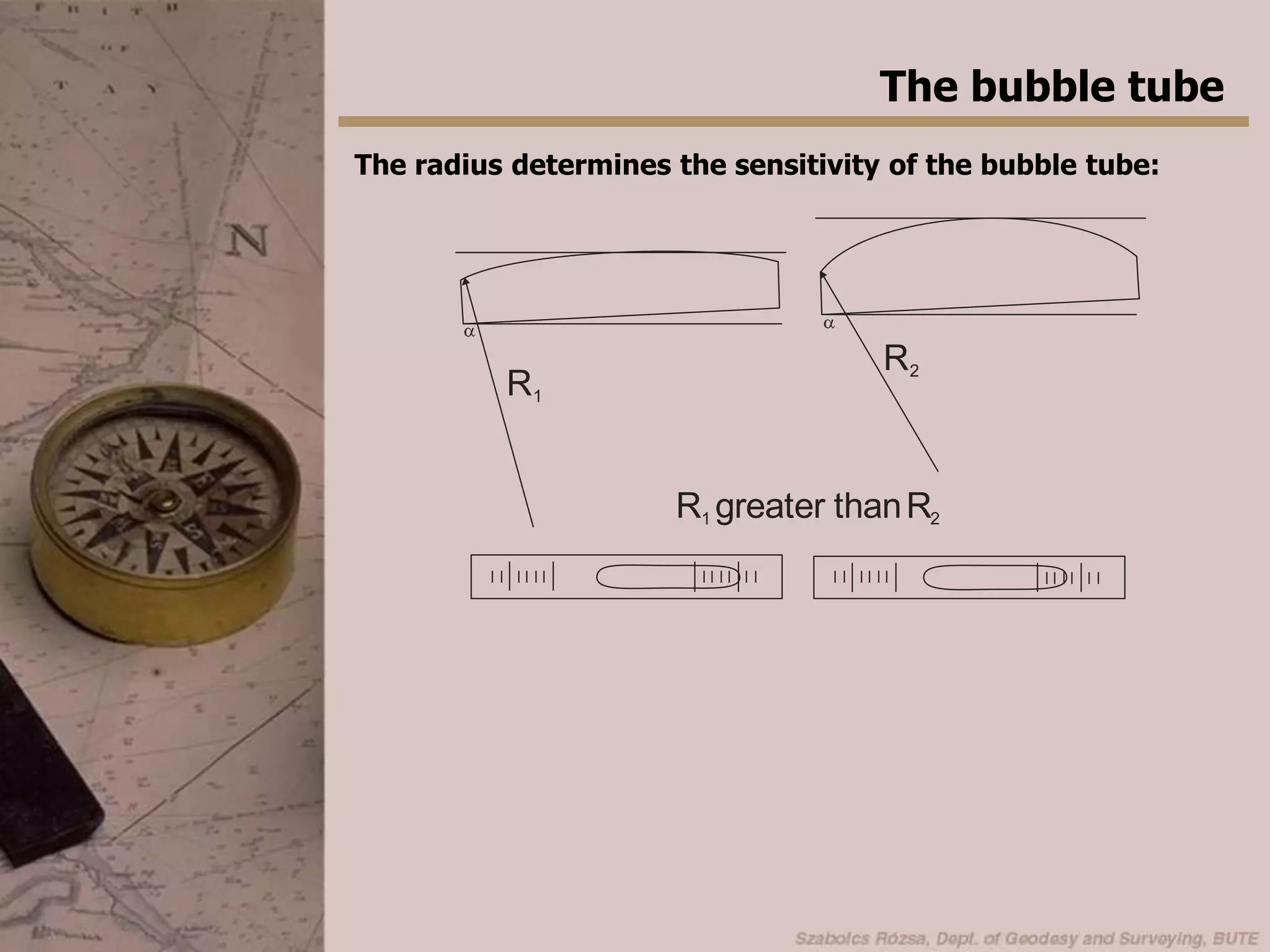
The bubble tubeThe radius determines the sensitivity of the bubble tube:
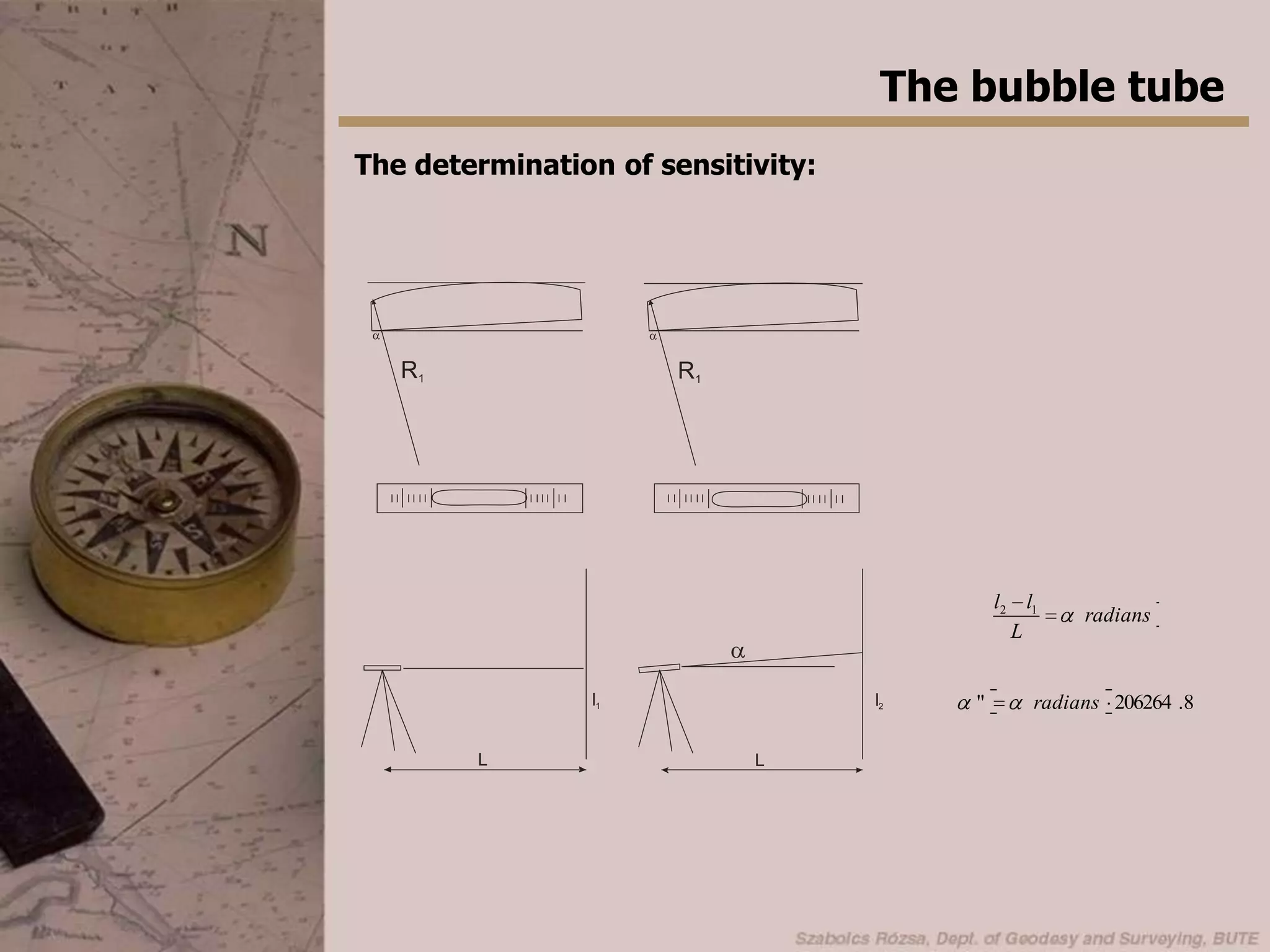
The bubble tubeThe determination of sensitivity:
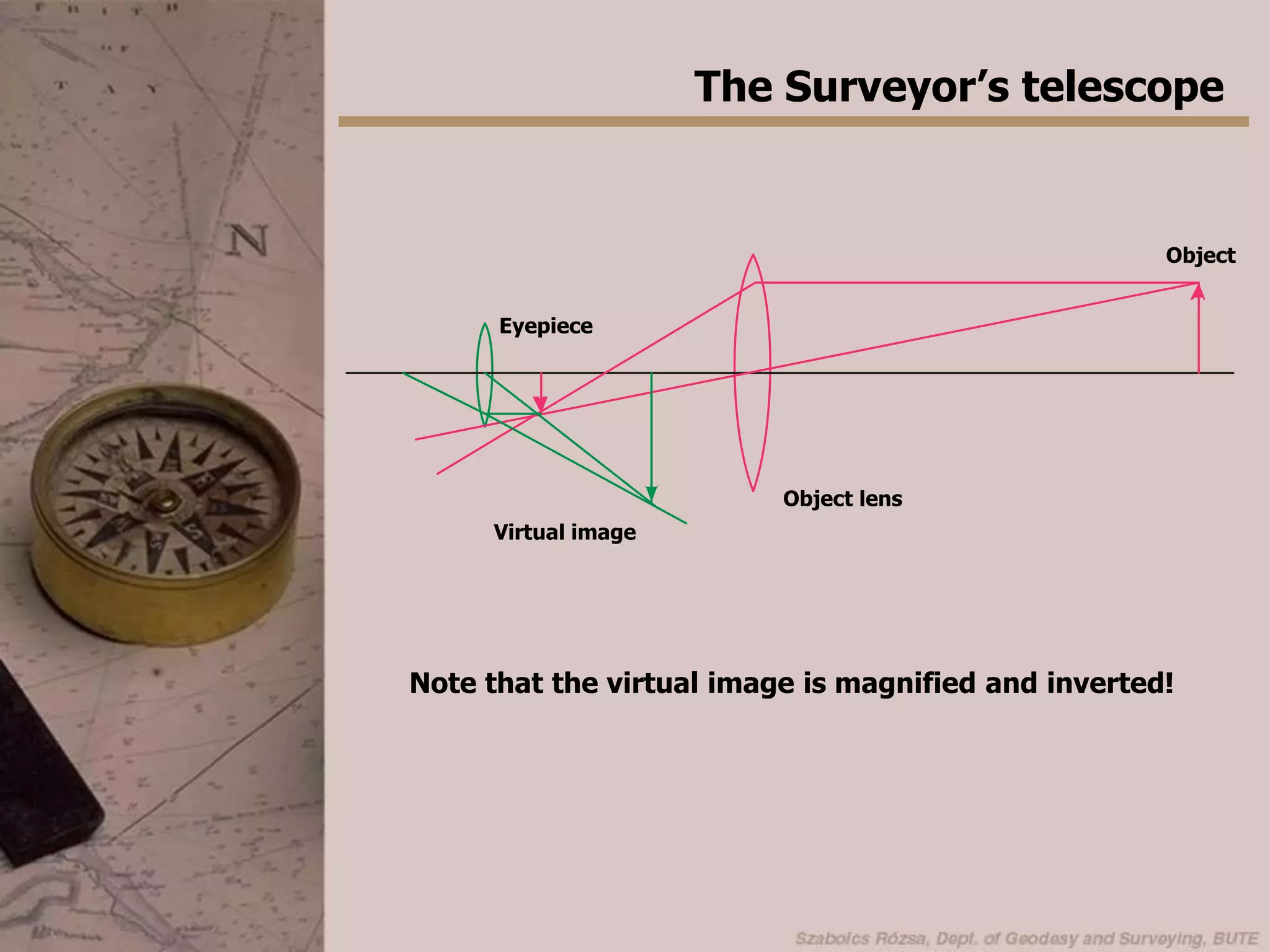
The Surveyor’s telescopeObjectEyepieceObject lensVirtual imageNote that the virtual image is magnified and inverted!
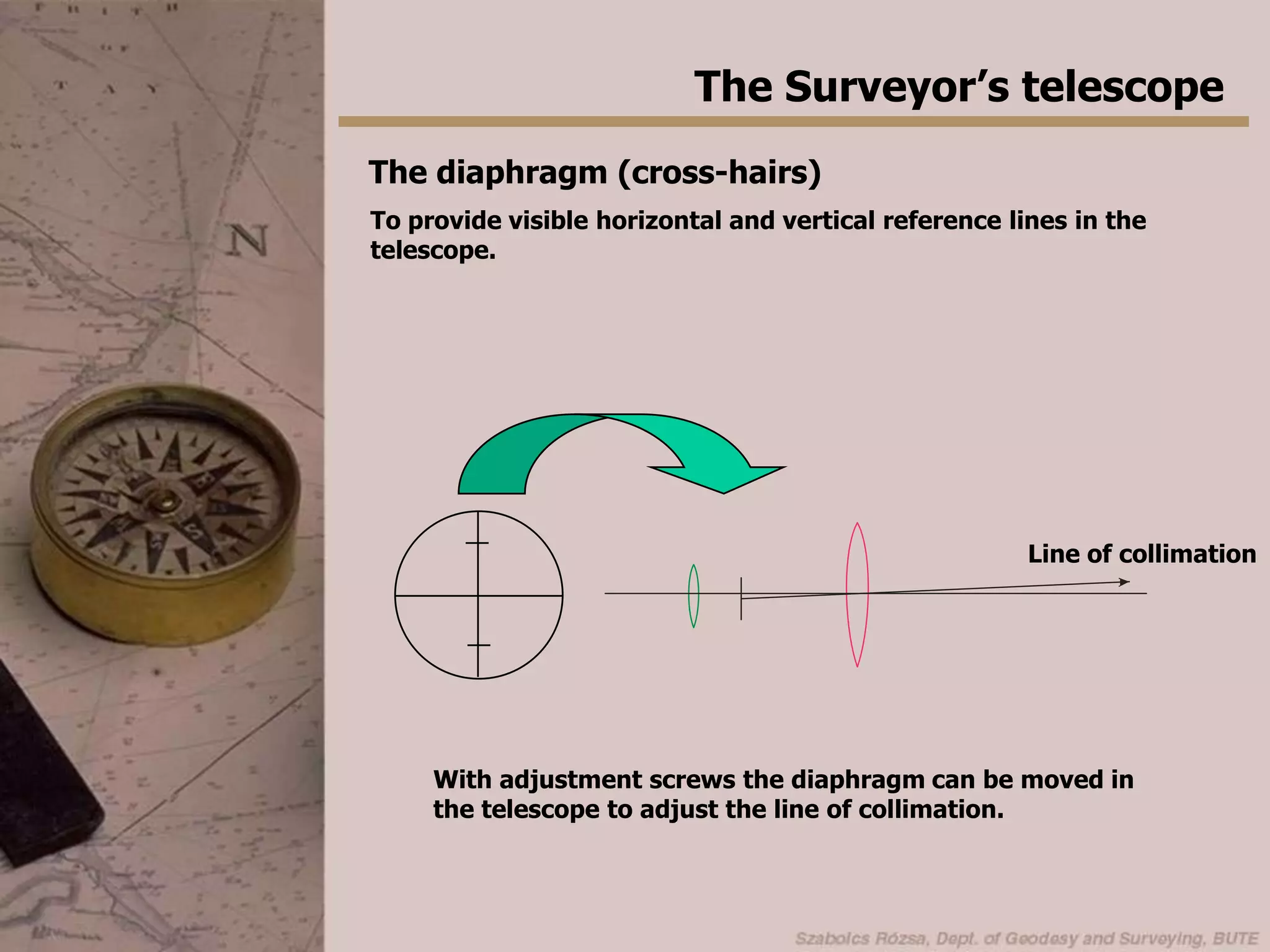
The Surveyor’s telescopeThe diaphragm (cross-hairs)To provide visible horizontal and vertical reference lines in the telescope.Line of collimationWith adjustment screws the diaphragm can be moved in the telescope to adjust the line of collimation.
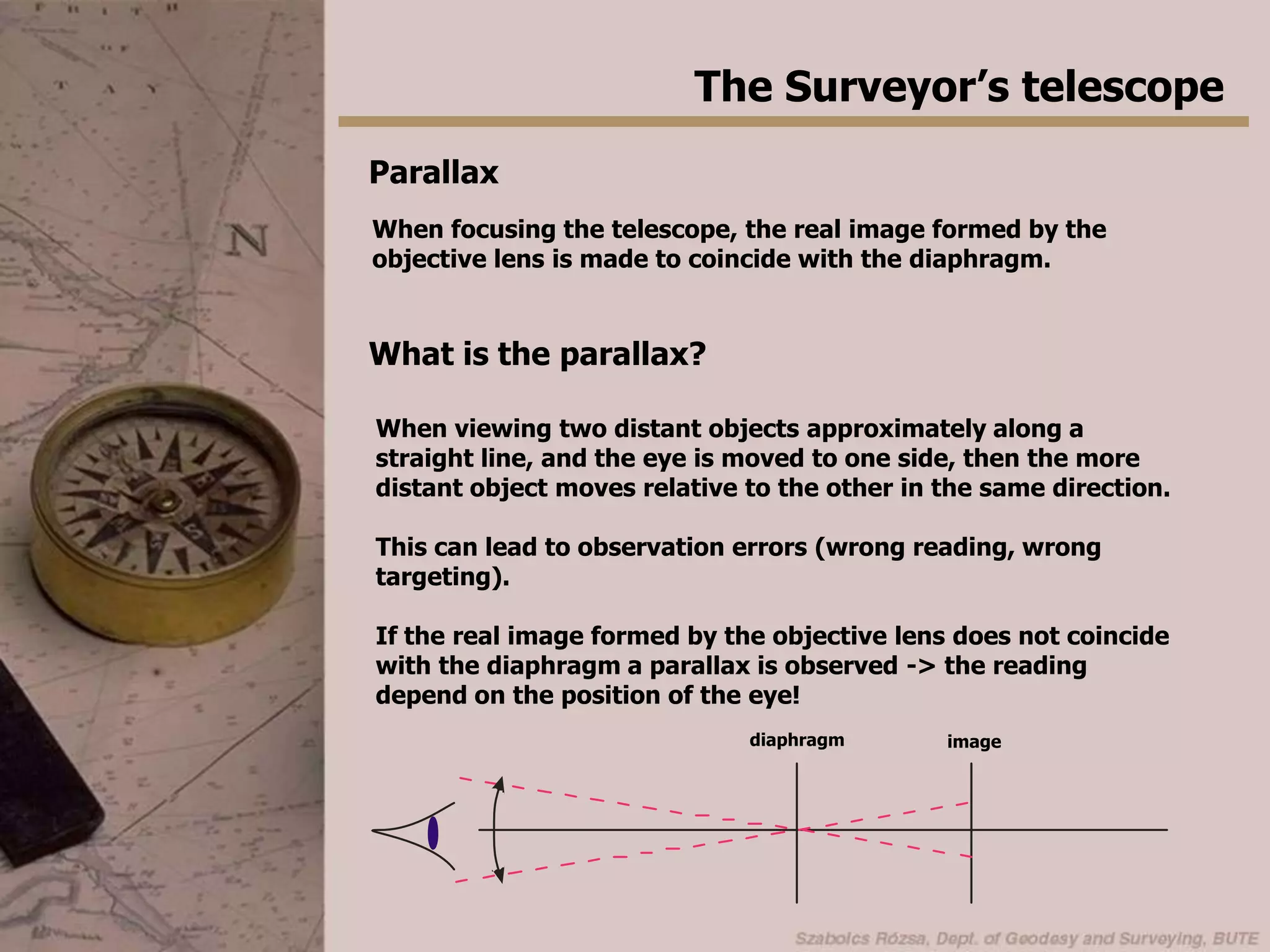
The Surveyor’s telescopeParallaxWhen focusing the telescope, the real image formed by the objective lens is made to coincide with the diaphragm.What is the parallax?When viewing two distant objects approximately along a straight line, and the eye is moved to one side, then the more distant object moves relative to the other in the same direction.This can lead to observation errors (wrong reading, wrong targeting).If the real image formed by the objective lens does not coincide with the diaphragm a parallax is observed -> the reading depend on the position of the eye!diaphragmimage
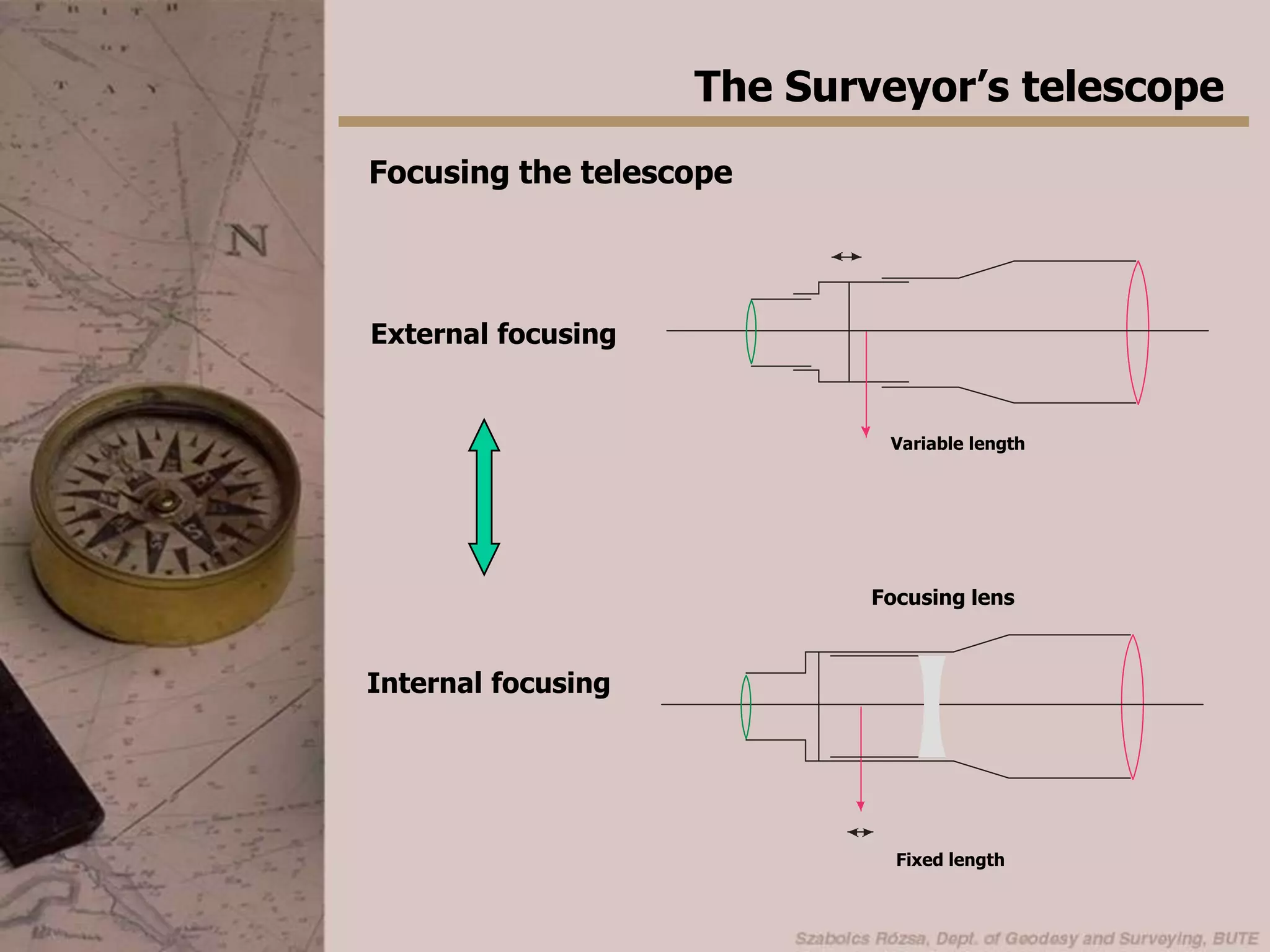
The Surveyor’s telescopeFocusing the telescopeExternal focusingVariable lengthFocusing lensInternal focusingFixed length
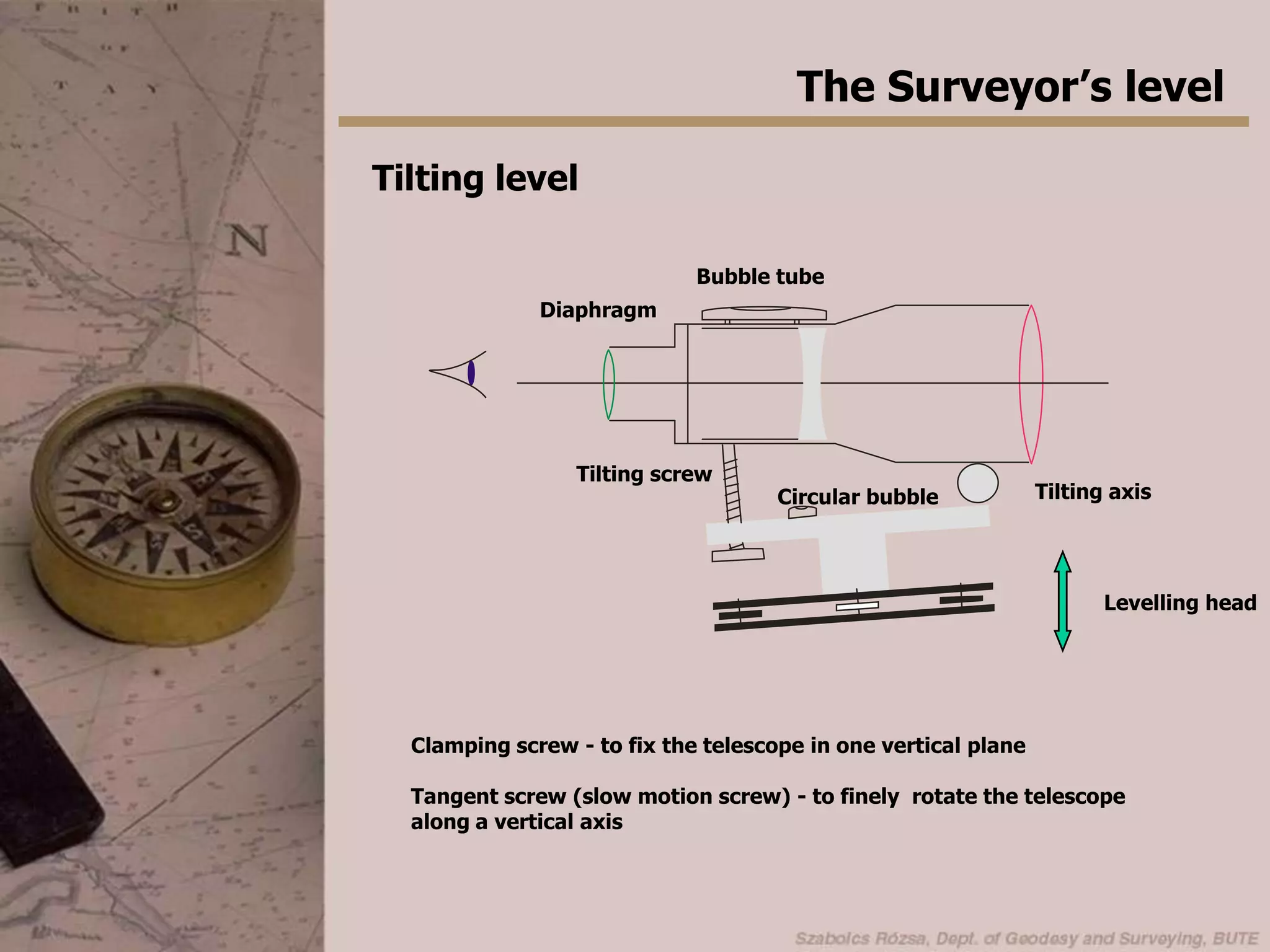
The Surveyor’s levelTilting levelBubble tubeDiaphragmTilting screwTilting axisCircular bubbleLevelling headClamping screw - to fix the telescope in one vertical planeTangent screw (slow motion screw) - to finely  rotate the telescope along a vertical axis
The Surveyor’s levelTilting levelHow can we view the bubble tube? Using a mirror (older instrument)
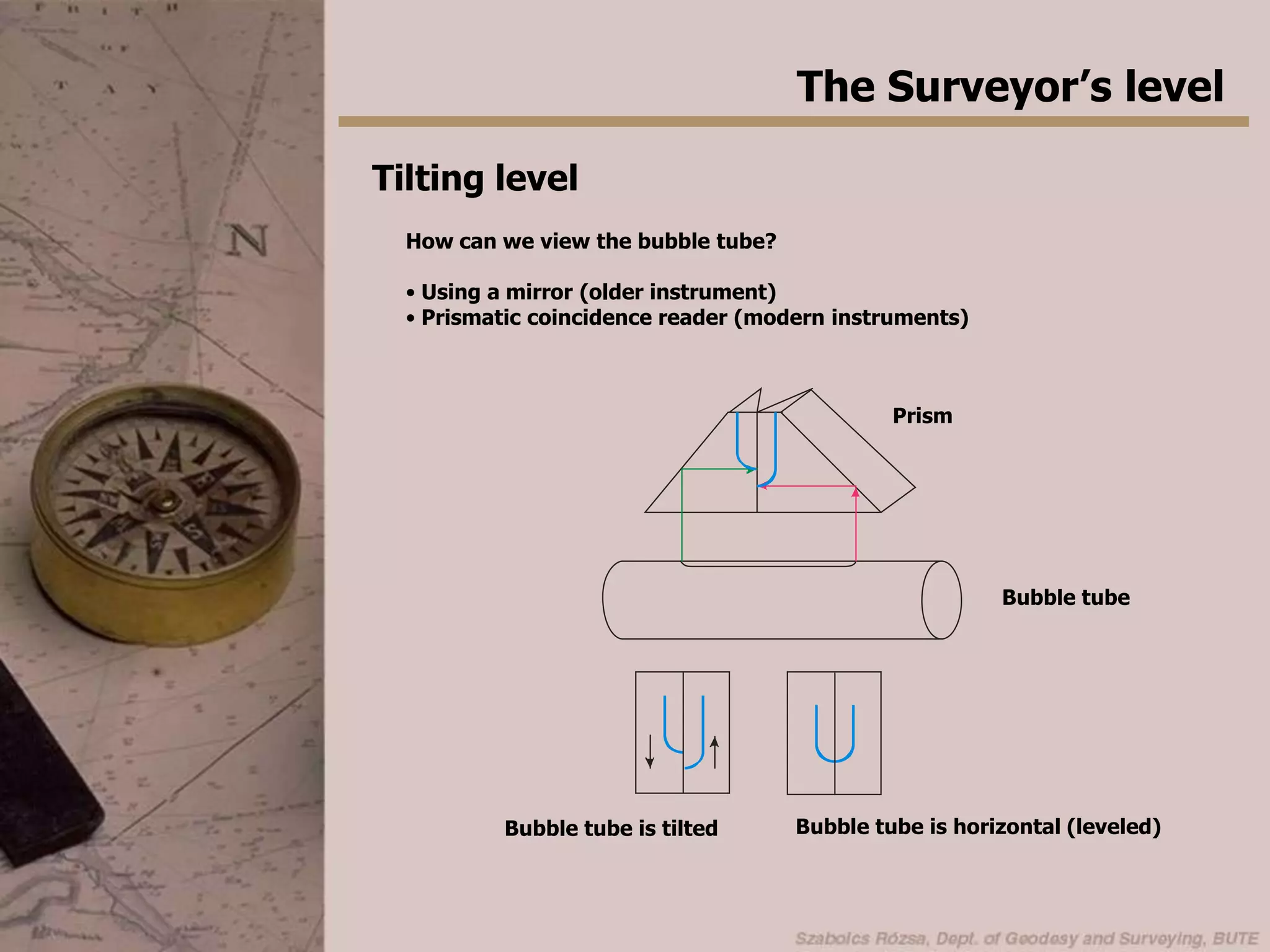
 Prismatic coincidence reader (modern instruments)PrismBubble tubeBubble tube is horizontal (leveled)Bubble tube is tilted
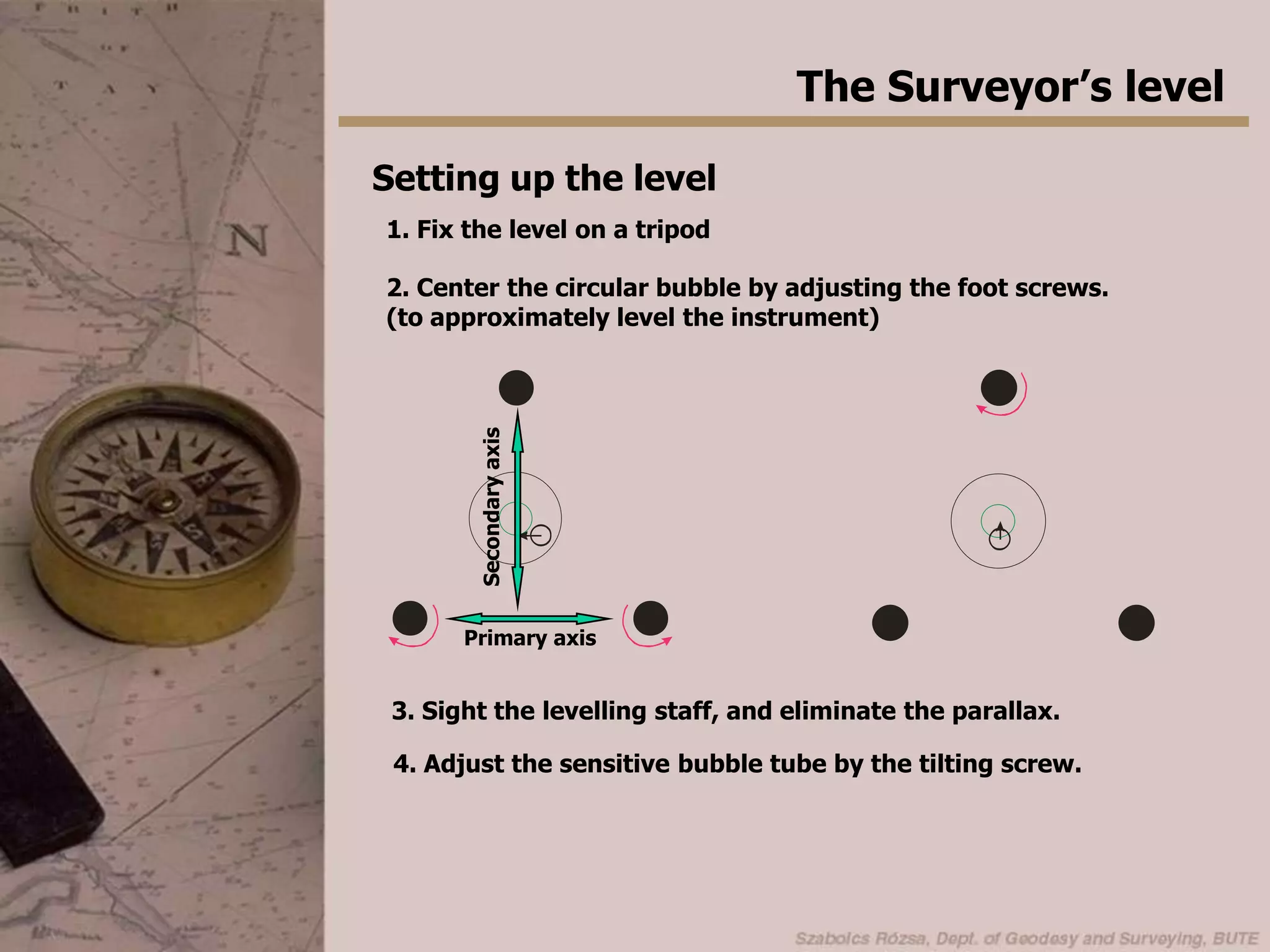
Secondary axisPrimary axisThe Surveyor’s levelSetting up the level1. Fix the level on a tripod2. Center the circular bubble by adjusting the foot screws.(to approximately level the instrument)3. Sight the levelling staff, and eliminate the parallax.4. Adjust the sensitive bubble tube by the tilting screw.
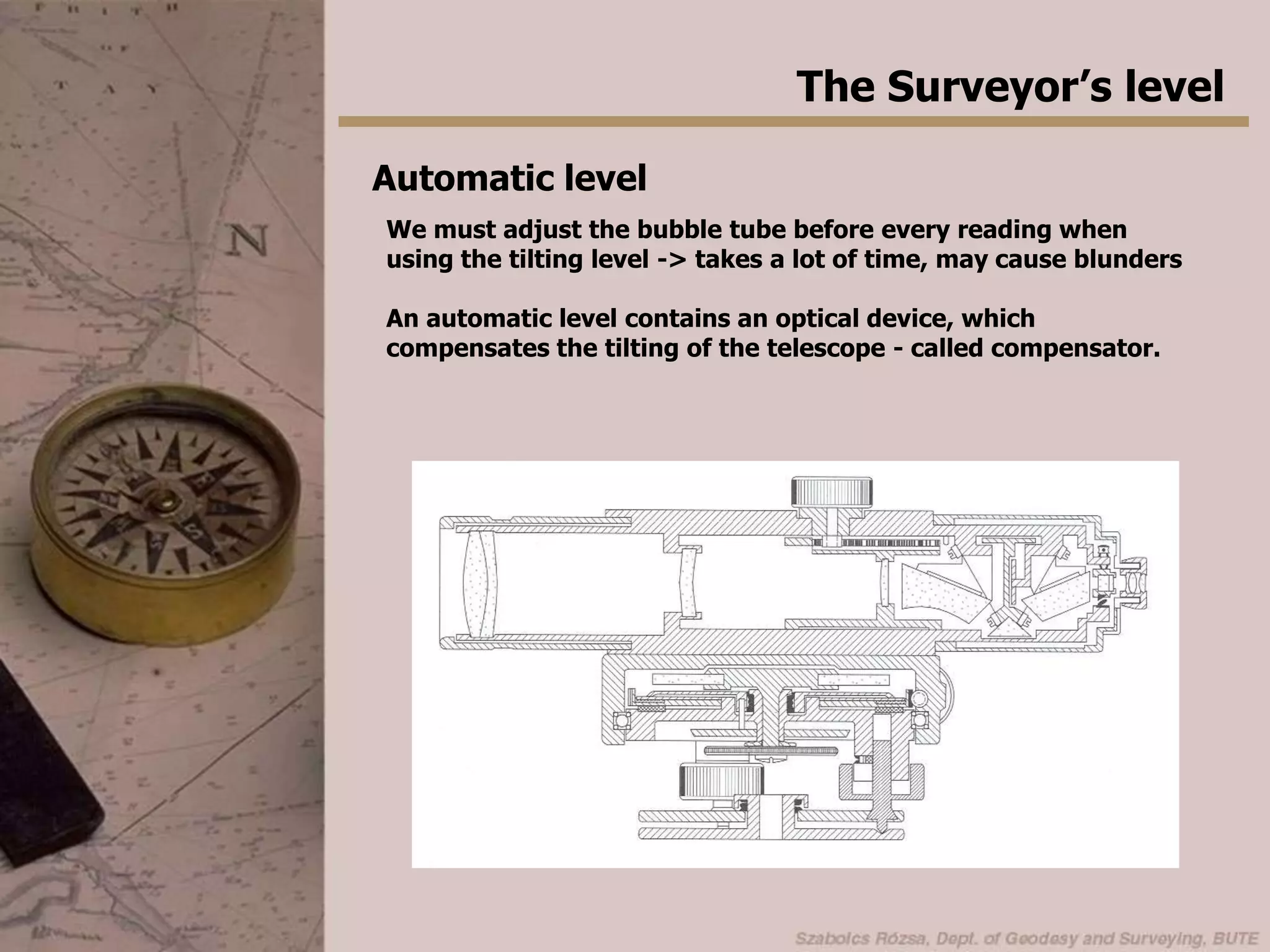
The Surveyor’s levelAutomatic levelWe must adjust the bubble tube before every reading when using the tilting level -> takes a lot of time, may cause blundersAn automatic level contains an optical device, which compensates the tilting of the telescope - called compensator.
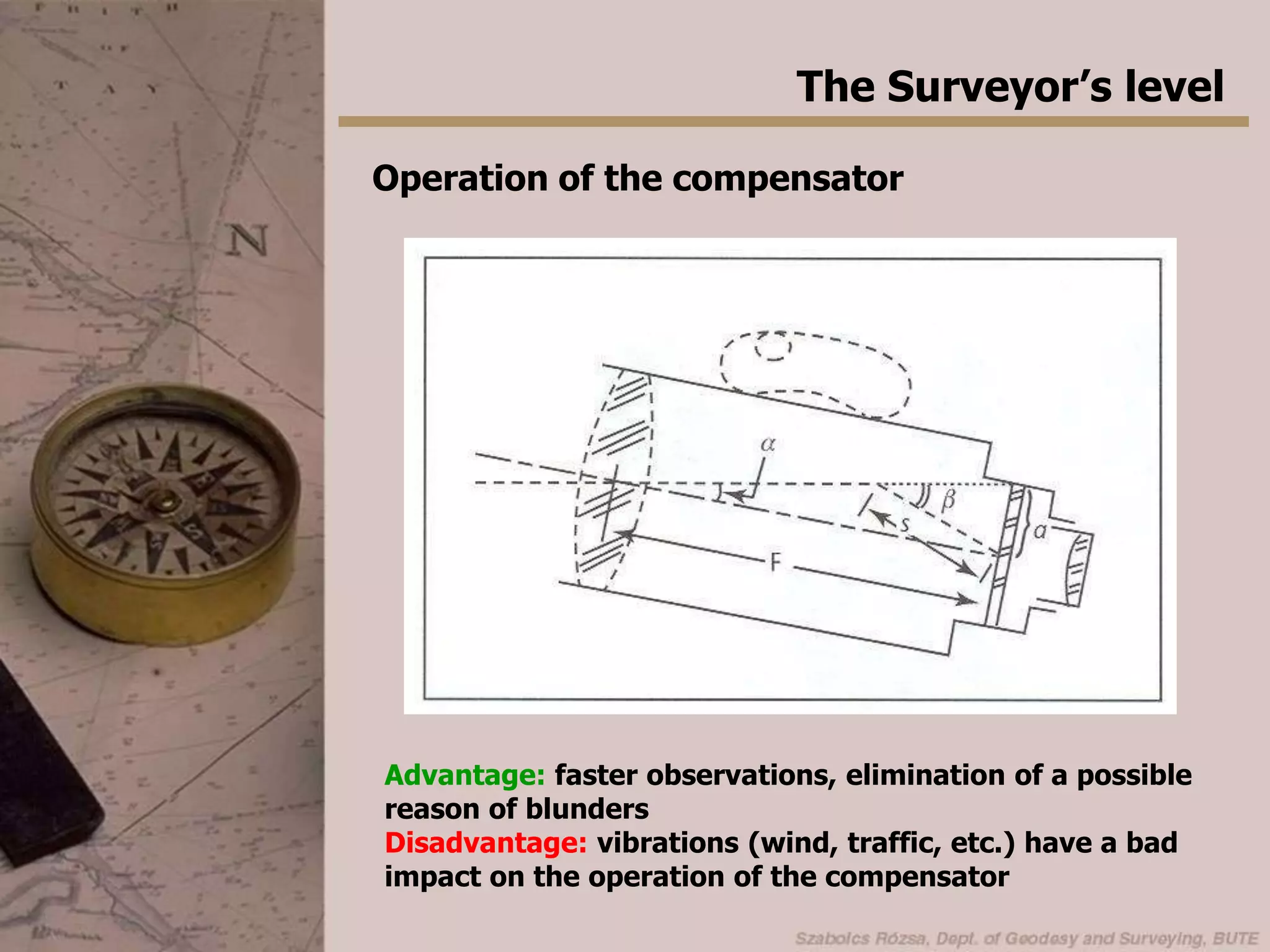
The Surveyor’s levelOperation of the compensatorAdvantage: faster observations, elimination of a possible reason of blundersDisadvantage: vibrations (wind, traffic, etc.) have a bad impact on the operation of the compensator
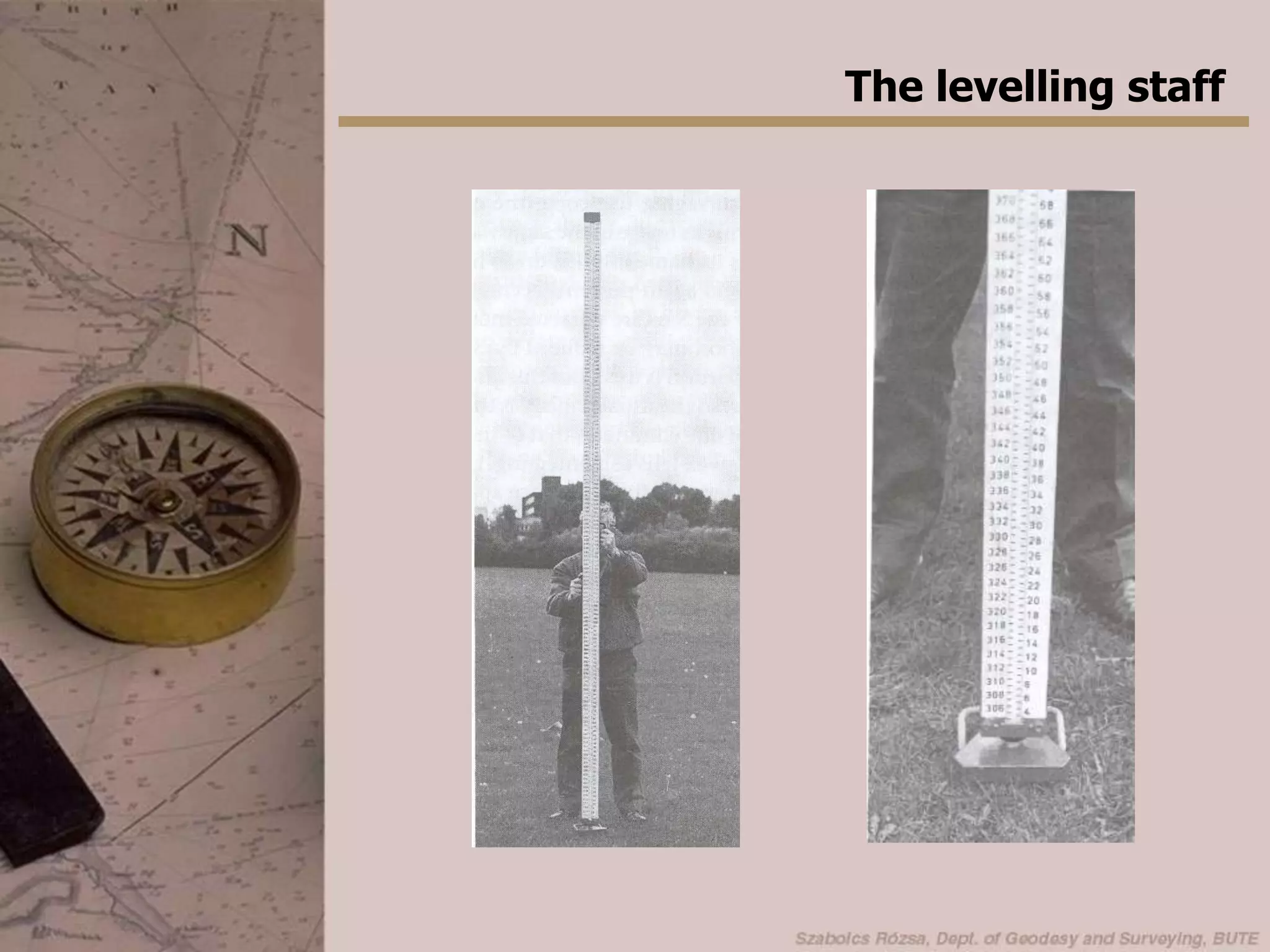
The levelling staff
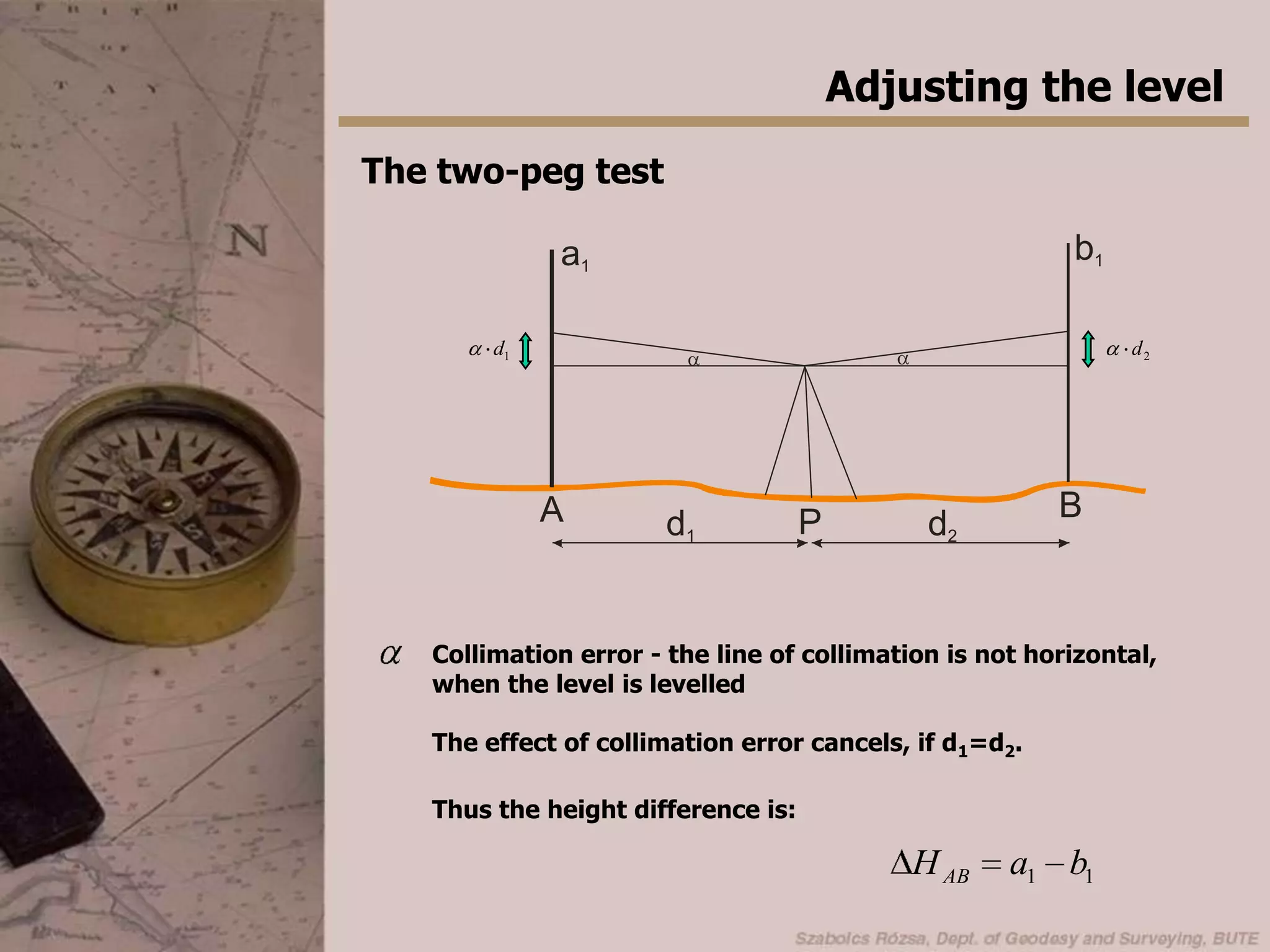
Adjusting the levelThe two-peg testCollimation error - the line of collimation is not horizontal, when the level is levelledThe effect of collimation error cancels, if d1=d2.Thus the height difference is:
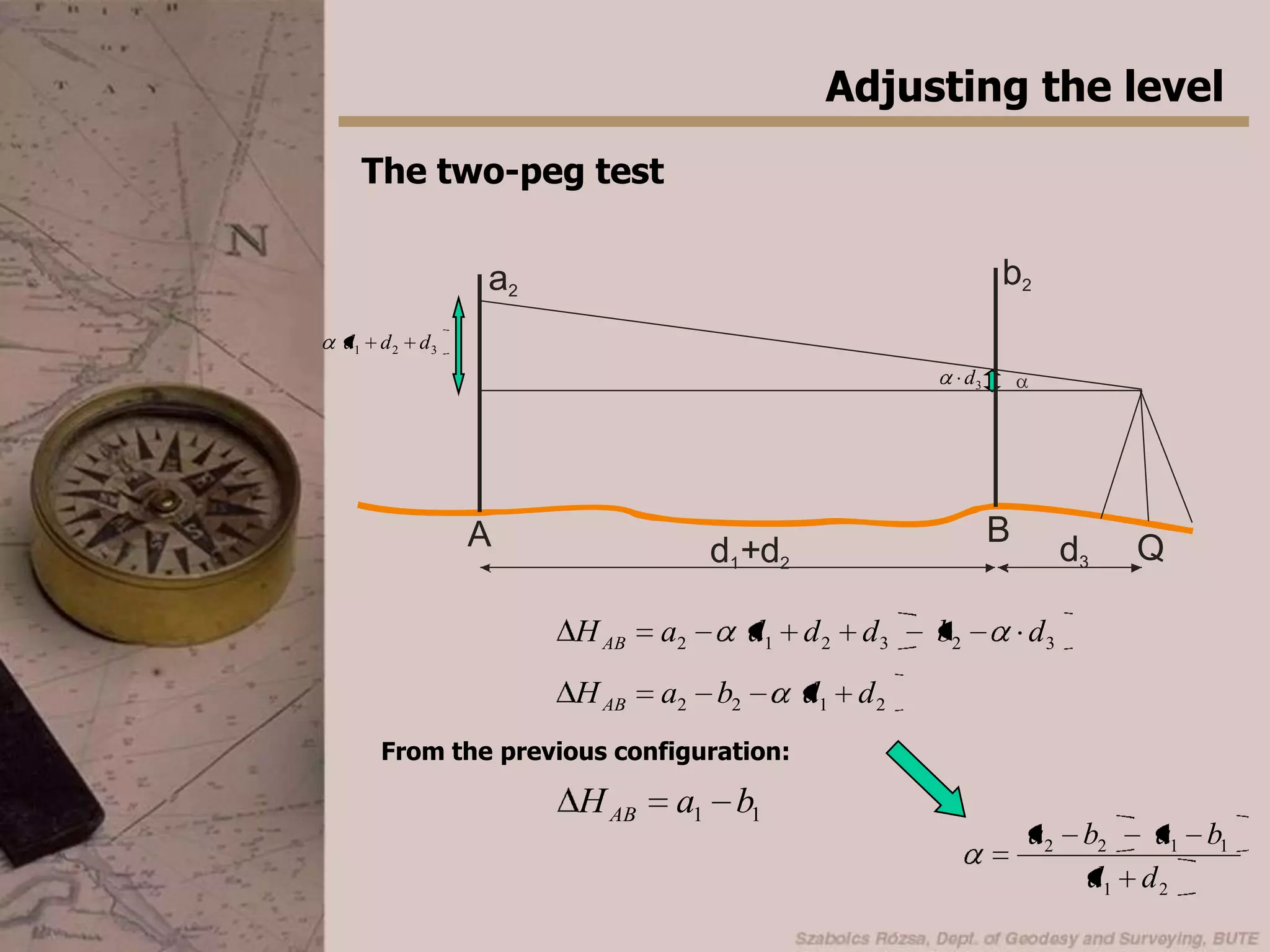
Adjusting the levelThe two-peg testFrom the previous configuration:
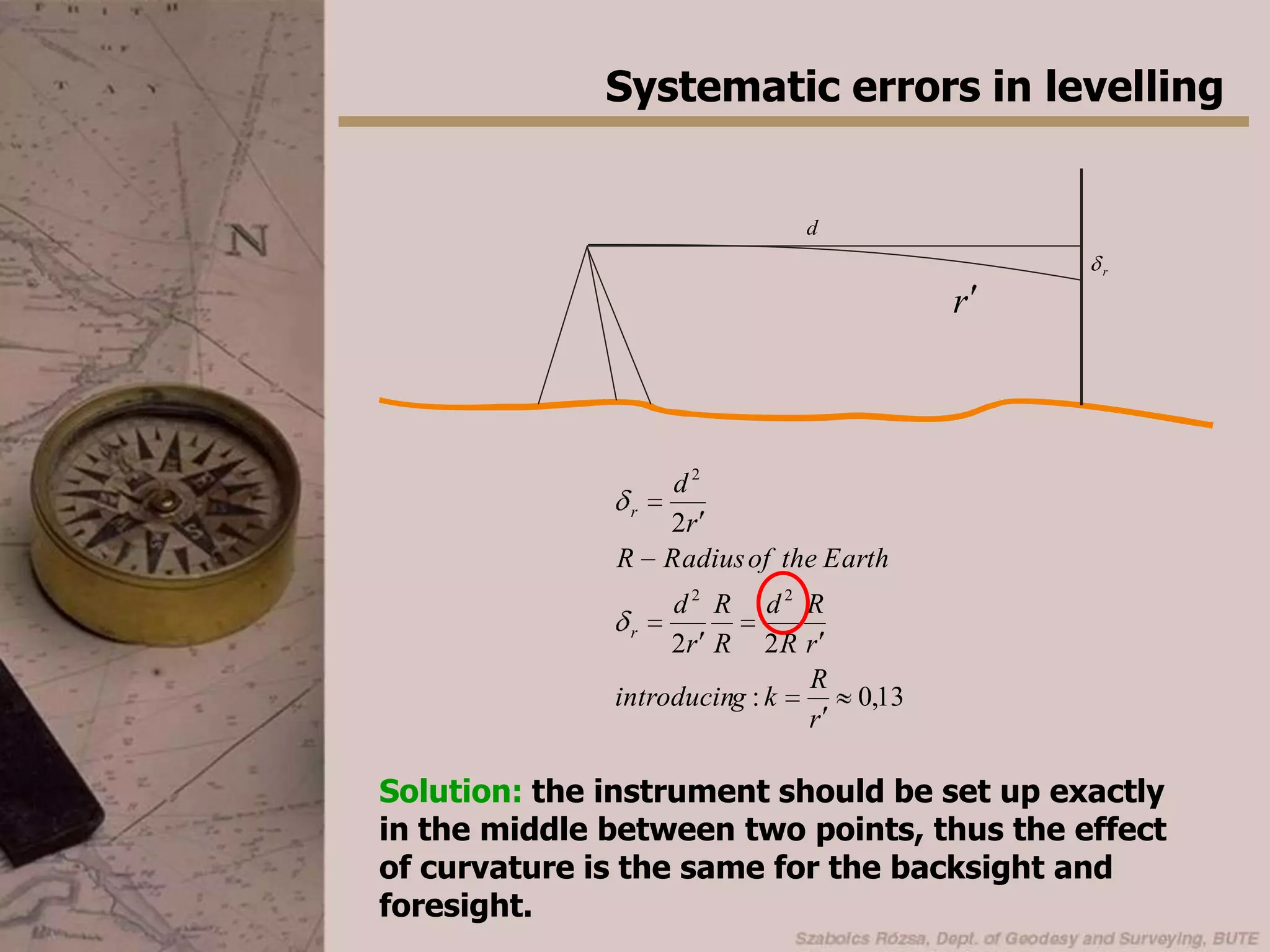
Systematic errors in levellingThe effect of curvatureSolution: the instrument should be set up exactly in the middle between two points.
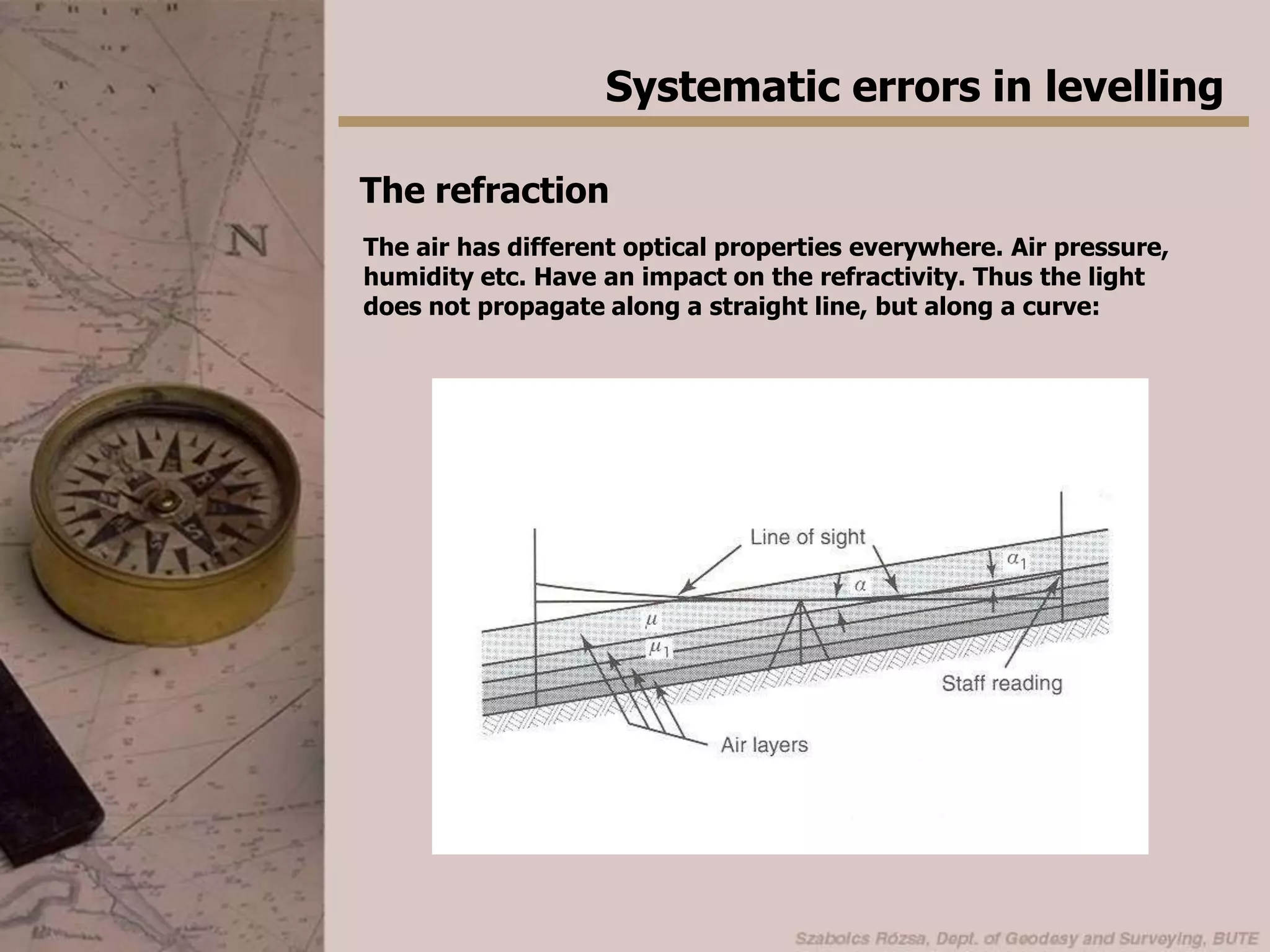
Systematic errors in levellingThe refractionThe air has different optical properties everywhere. Air pressure, humidity etc. Have an impact on the refractivity. Thus the light does not propagate along a straight line, but along a curve:
Systematic errors in levellingSolution: the instrument should be set up exactly in the middle between two points, thus the effect of curvature is the same for the backsight and foresight.
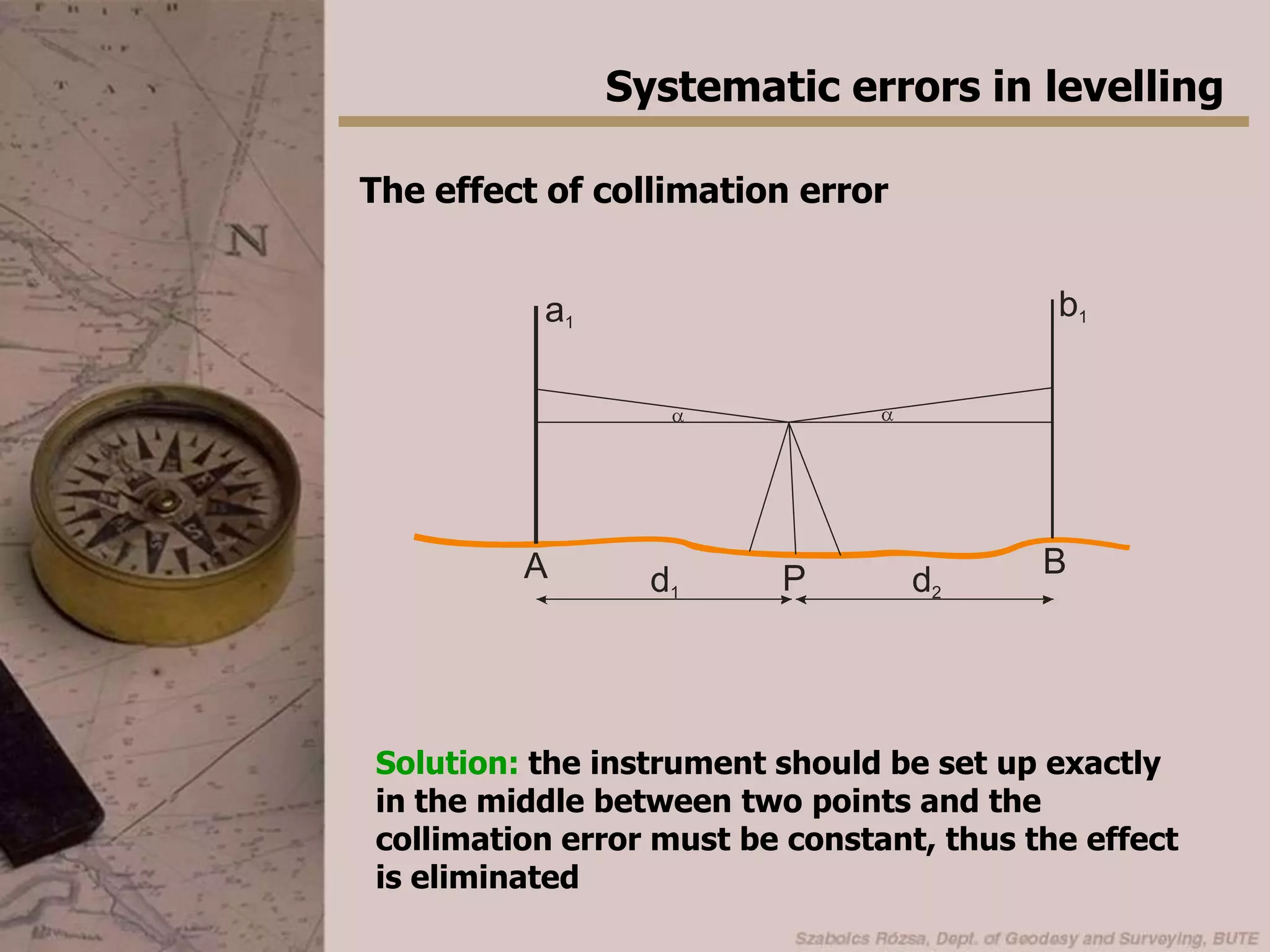
Systematic errors in levellingThe effect of collimation errorSolution: the instrument should be set up exactly in the middle between two points and the collimation error must be constant, thus the effect is eliminated
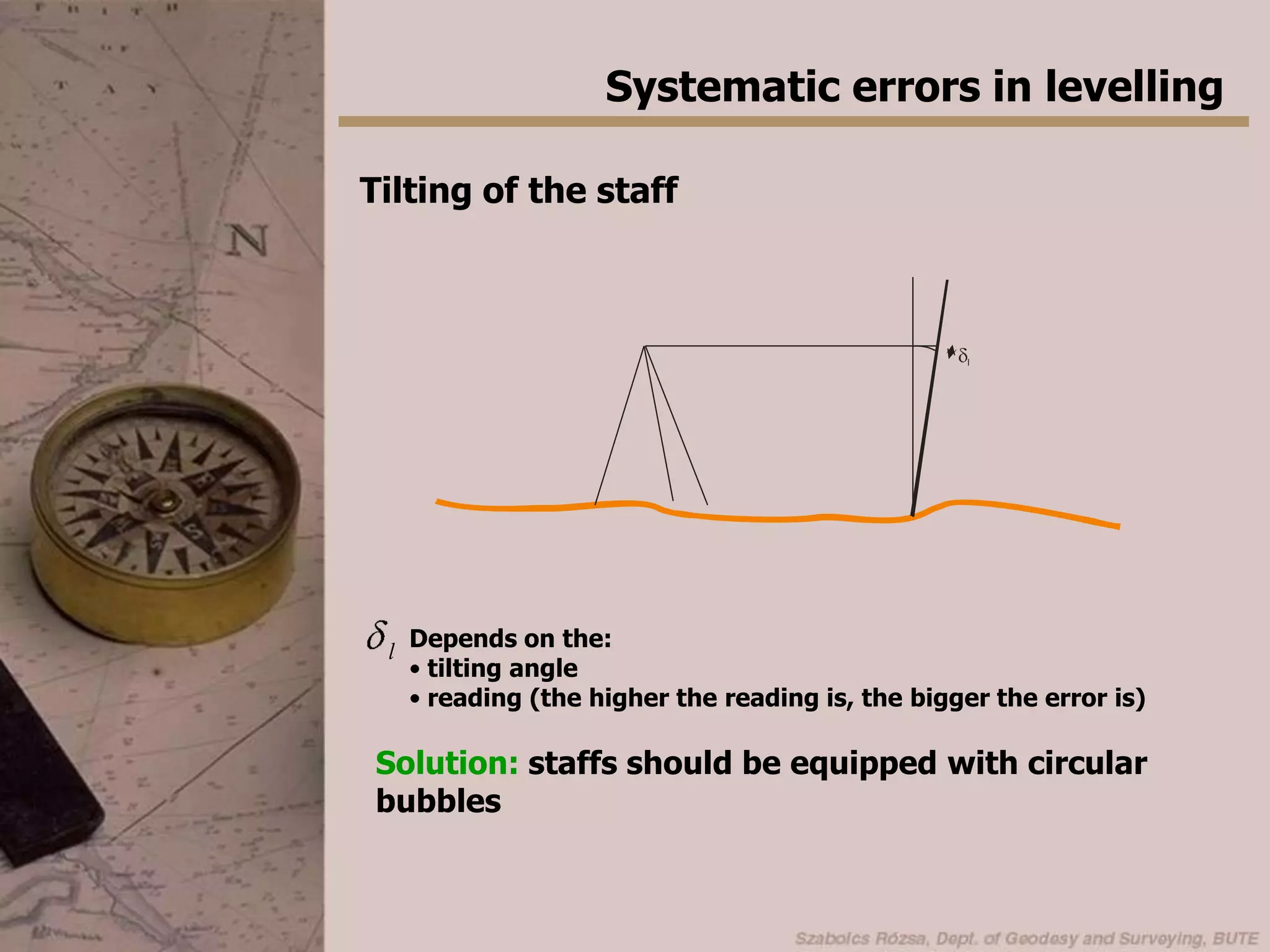
Systematic errors in levellingTilting of the staffDepends on the: tilting angle
 reading (the higher the reading is, the bigger the error is)Solution: staffs should be equipped with circular bubbles
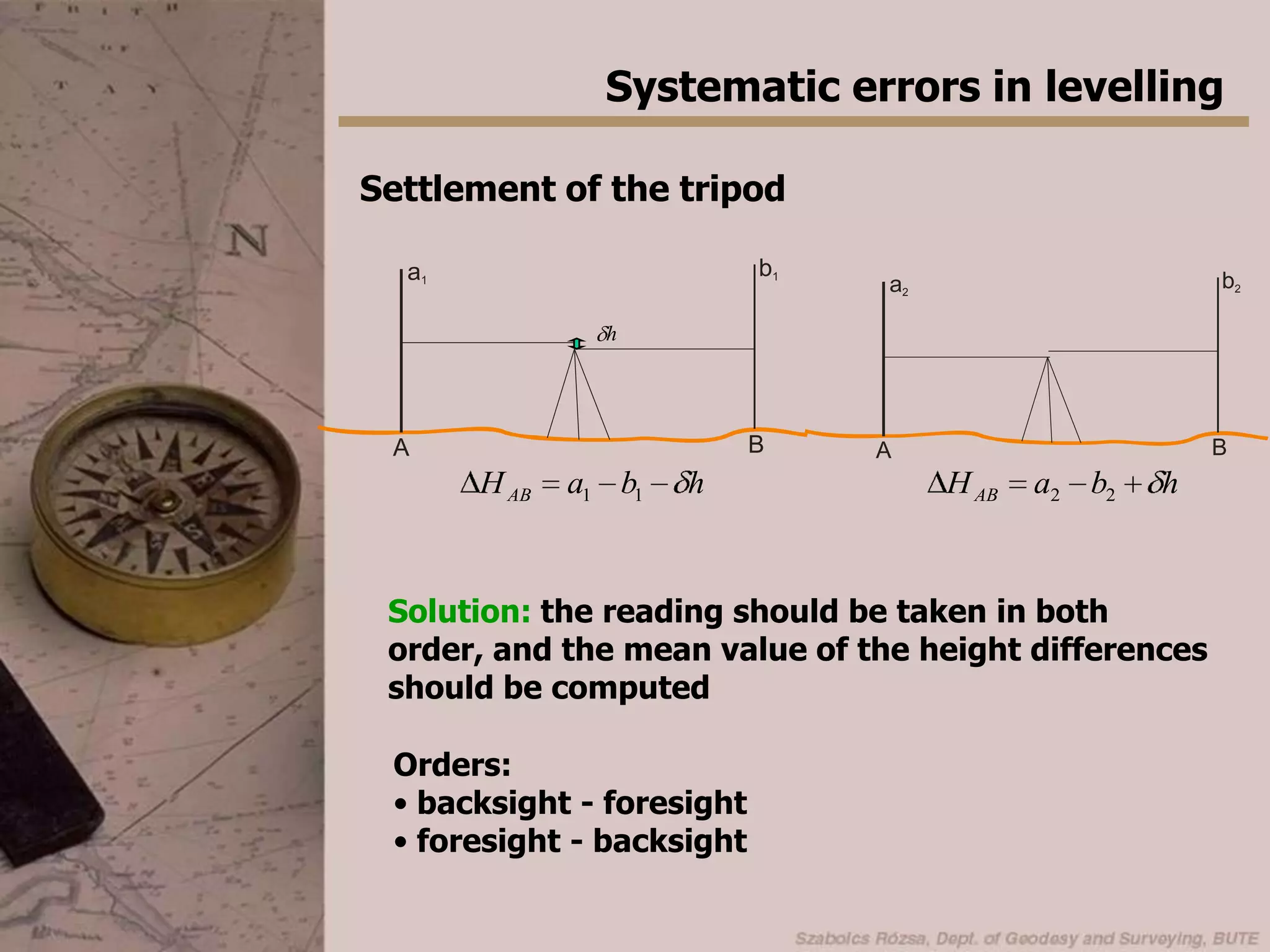
Systematic errors in levellingSettlement of the tripodSolution: the reading should be taken in both order, and the mean value of the height differences should be computedOrders: backsight - foresight
 foresight - backsightSystematic errors in levellingSettlement of the staffSolution: all lines should be run twice in the opposite directions.
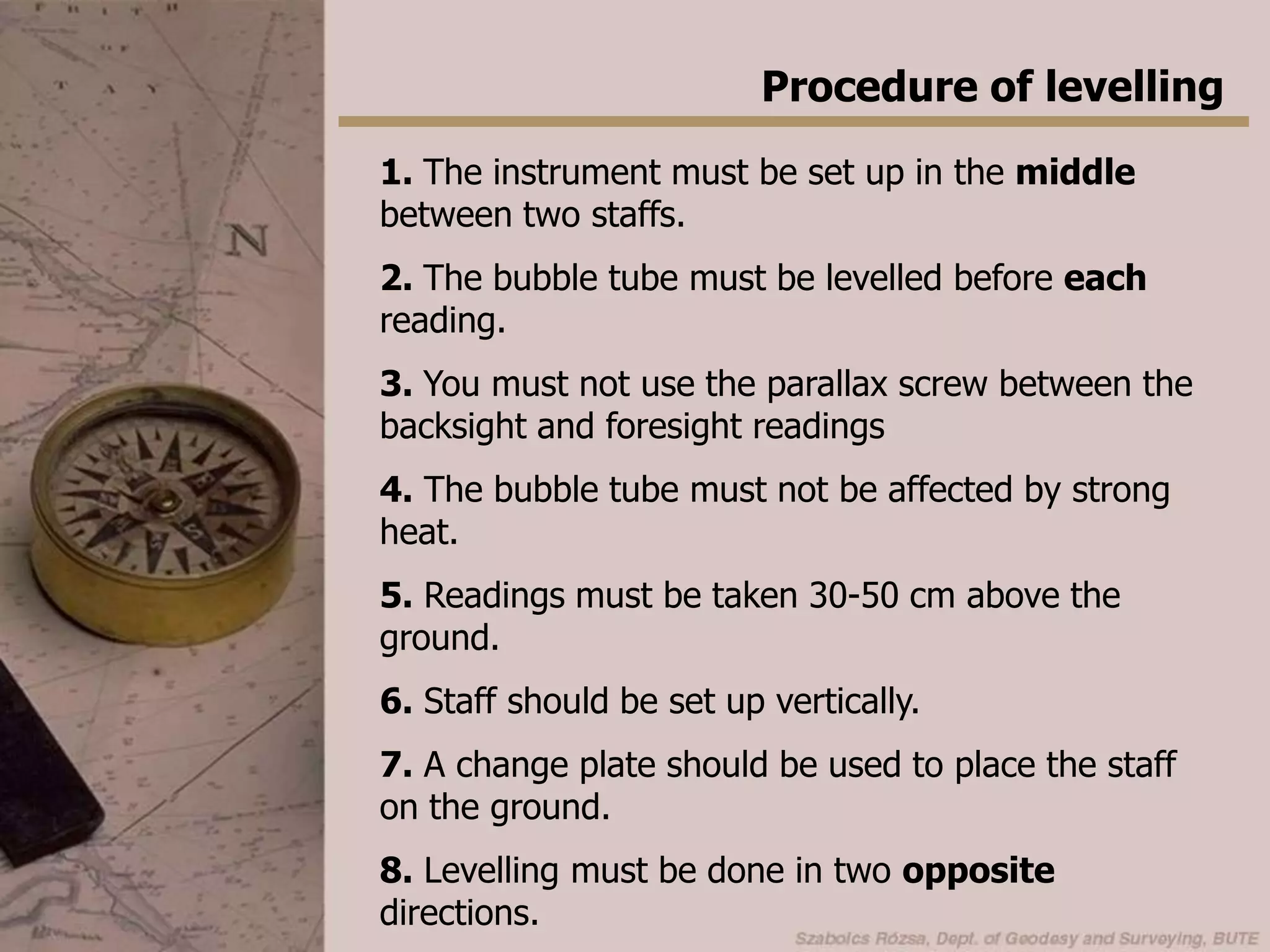
Procedure of levelling1. The instrument must be set up in the middle between two staffs.2. The bubble tube must be levelled before each reading.3. You must not use the parallax screw between the backsight and foresight readings4. The bubble tube must not be affected by strong heat.5. Readings must be taken 30-50 cm above the ground.6. Staff should be set up vertically.7. A change plate should be used to place the staff on the ground.8. Levelling must be done in two opposite directions.

Lecture2

  • 1.
  • 2.
    OutlineLevellingStructure of levelsAdjustmentof levelsError sourcesProcedure of levelling
  • 3.
    LevellingMSL - MeanSea LevelLevel line - a line with constant height (a curved line)Horizontal line - a tangential to the level line at the instrument
  • 4.
    LevellingOver short distancesthe horizontal line and level line coincide.For a distance of 100m the effect of the curvature is less than 1 mm.The levelling device (called level) must be set up so, that the line of sight is perpendicular to the gravity vector (plumb line). -> the line of sight is horizontal.
  • 5.
  • 6.
  • 7.
  • 8.
    Levelling - BookkeepingHeightof Collimation method:
  • 9.
    Elements of Surveyor’slevelHow to set the line of sight to be exactly horizontal?More general: how to set anything to be exactly horizontal?The bubble tube
  • 10.
    The bubble tubeTheradius determines the sensitivity of the bubble tube:
  • 11.
    The bubble tubeThedetermination of sensitivity:
  • 12.
    The Surveyor’s telescopeObjectEyepieceObjectlensVirtual imageNote that the virtual image is magnified and inverted!
  • 13.
    The Surveyor’s telescopeThediaphragm (cross-hairs)To provide visible horizontal and vertical reference lines in the telescope.Line of collimationWith adjustment screws the diaphragm can be moved in the telescope to adjust the line of collimation.
  • 14.
    The Surveyor’s telescopeParallaxWhenfocusing the telescope, the real image formed by the objective lens is made to coincide with the diaphragm.What is the parallax?When viewing two distant objects approximately along a straight line, and the eye is moved to one side, then the more distant object moves relative to the other in the same direction.This can lead to observation errors (wrong reading, wrong targeting).If the real image formed by the objective lens does not coincide with the diaphragm a parallax is observed -> the reading depend on the position of the eye!diaphragmimage
  • 15.
    The Surveyor’s telescopeFocusingthe telescopeExternal focusingVariable lengthFocusing lensInternal focusingFixed length
  • 16.
    The Surveyor’s levelTiltinglevelBubble tubeDiaphragmTilting screwTilting axisCircular bubbleLevelling headClamping screw - to fix the telescope in one vertical planeTangent screw (slow motion screw) - to finely rotate the telescope along a vertical axis
  • 17.
    The Surveyor’s levelTiltinglevelHow can we view the bubble tube? Using a mirror (older instrument)
  • 18.
    Prismatic coincidencereader (modern instruments)PrismBubble tubeBubble tube is horizontal (leveled)Bubble tube is tilted
  • 19.
    Secondary axisPrimary axisTheSurveyor’s levelSetting up the level1. Fix the level on a tripod2. Center the circular bubble by adjusting the foot screws.(to approximately level the instrument)3. Sight the levelling staff, and eliminate the parallax.4. Adjust the sensitive bubble tube by the tilting screw.
  • 20.
    The Surveyor’s levelAutomaticlevelWe must adjust the bubble tube before every reading when using the tilting level -> takes a lot of time, may cause blundersAn automatic level contains an optical device, which compensates the tilting of the telescope - called compensator.
  • 21.
    The Surveyor’s levelOperationof the compensatorAdvantage: faster observations, elimination of a possible reason of blundersDisadvantage: vibrations (wind, traffic, etc.) have a bad impact on the operation of the compensator
  • 22.
  • 23.
    Adjusting the levelThetwo-peg testCollimation error - the line of collimation is not horizontal, when the level is levelledThe effect of collimation error cancels, if d1=d2.Thus the height difference is:
  • 24.
    Adjusting the levelThetwo-peg testFrom the previous configuration:
  • 25.
    Systematic errors inlevellingThe effect of curvatureSolution: the instrument should be set up exactly in the middle between two points.
  • 26.
    Systematic errors inlevellingThe refractionThe air has different optical properties everywhere. Air pressure, humidity etc. Have an impact on the refractivity. Thus the light does not propagate along a straight line, but along a curve:
  • 27.
    Systematic errors inlevellingSolution: the instrument should be set up exactly in the middle between two points, thus the effect of curvature is the same for the backsight and foresight.
  • 28.
    Systematic errors inlevellingThe effect of collimation errorSolution: the instrument should be set up exactly in the middle between two points and the collimation error must be constant, thus the effect is eliminated
  • 29.
    Systematic errors inlevellingTilting of the staffDepends on the: tilting angle
  • 30.
    reading (thehigher the reading is, the bigger the error is)Solution: staffs should be equipped with circular bubbles
  • 31.
    Systematic errors inlevellingSettlement of the tripodSolution: the reading should be taken in both order, and the mean value of the height differences should be computedOrders: backsight - foresight
  • 32.
    foresight -backsightSystematic errors in levellingSettlement of the staffSolution: all lines should be run twice in the opposite directions.
  • 33.
    Procedure of levelling1.The instrument must be set up in the middle between two staffs.2. The bubble tube must be levelled before each reading.3. You must not use the parallax screw between the backsight and foresight readings4. The bubble tube must not be affected by strong heat.5. Readings must be taken 30-50 cm above the ground.6. Staff should be set up vertically.7. A change plate should be used to place the staff on the ground.8. Levelling must be done in two opposite directions.
  • 34.
    Procedure of levelling9.All the observations should be made with a constant speed.10. Observations should be made only in suitable weather: cloudy sky, constant temperature, early morning, or late afternoon.11. Staff should be calibrated.12. If there are three hairs in the diaphragm, one should use all of them to take a reading.
  • 35.
    Thanks for theAttention!