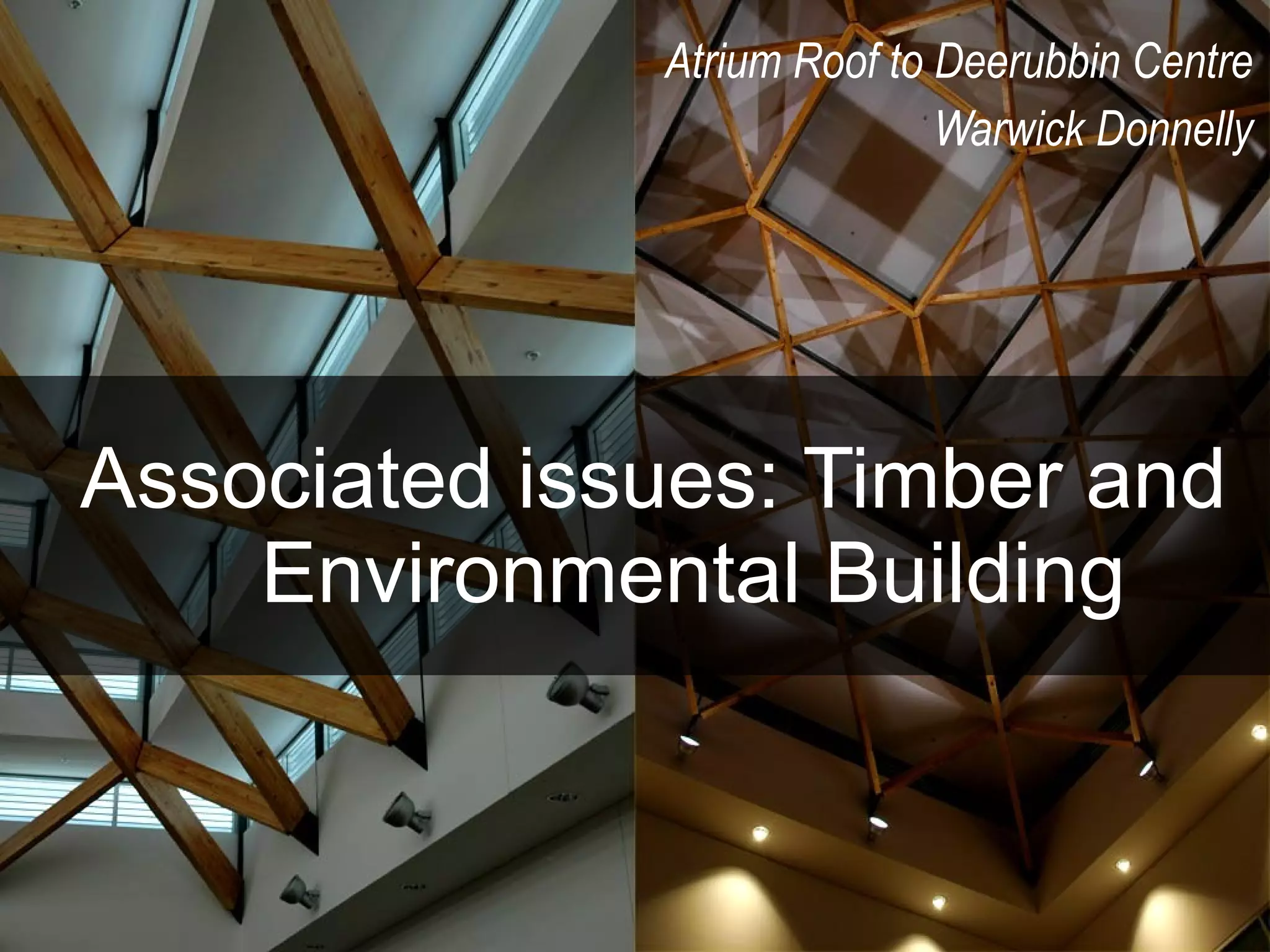
Associated issues: Timber and Environmental Building Atrium Roof to Deerubbin Centre Warwick Donnelly
Issues Engineered timber products Waste  Building Rating Tools Environmental labelling systems
1. Engineered wood products Products manufactured from timber fibres using gluing to produce large sections or long lengths Glued strand products (OSB, LSL, ESL, …)  LVL  - I beams Box beams - Glulam Plywood Often used when large sections are not available. Efficient material use! Portal frames under construction Photo: TRADAC
Benefits Engineered timber products, such as I-beams, glulam beams and plywood offer the builder/designer: design flexibility good environmental performance increased structural ability
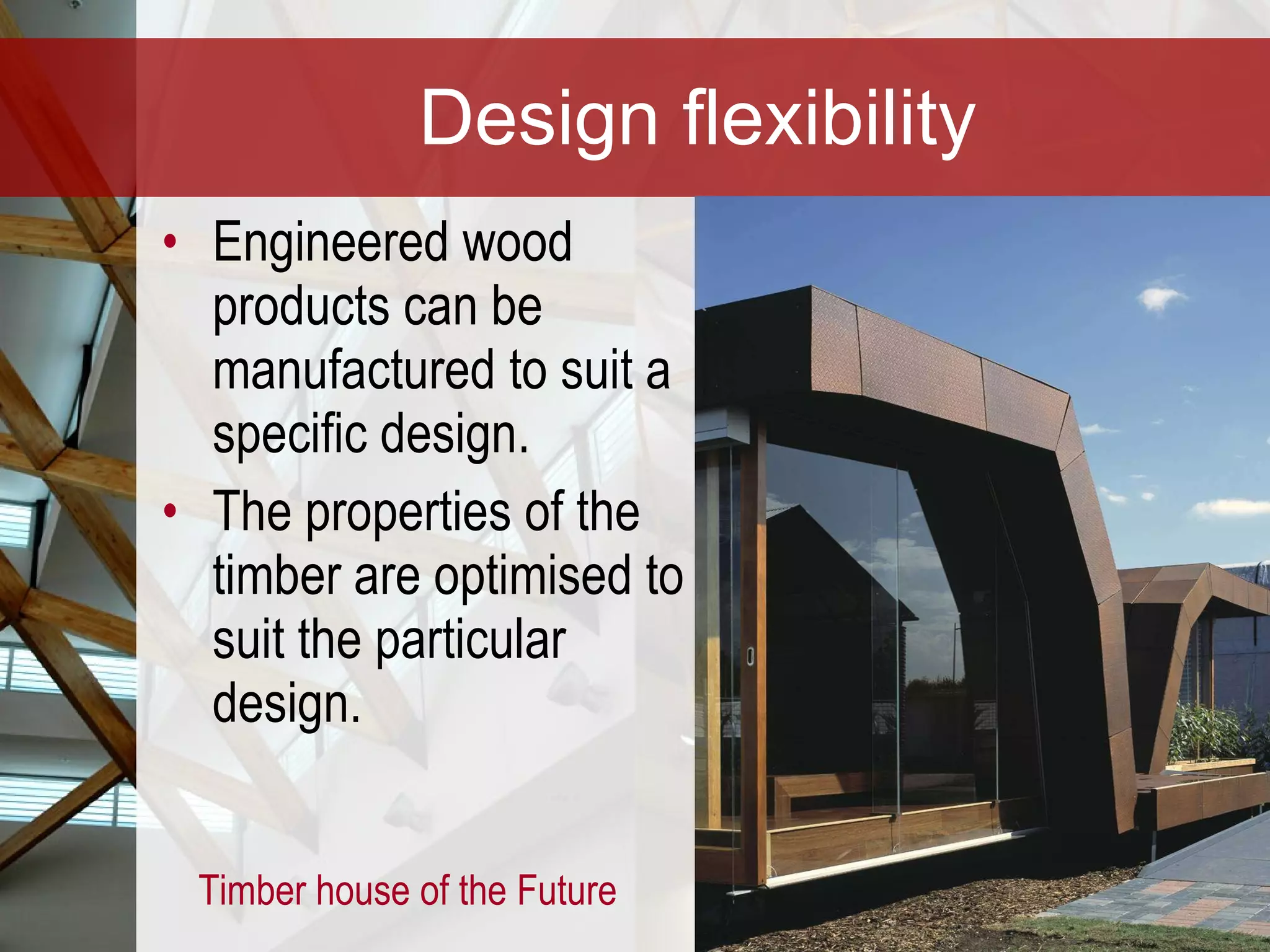
Design flexibility Engineered wood products can be manufactured to suit a specific design. The properties of the timber are optimised to suit the particular design.  Timber house of the Future
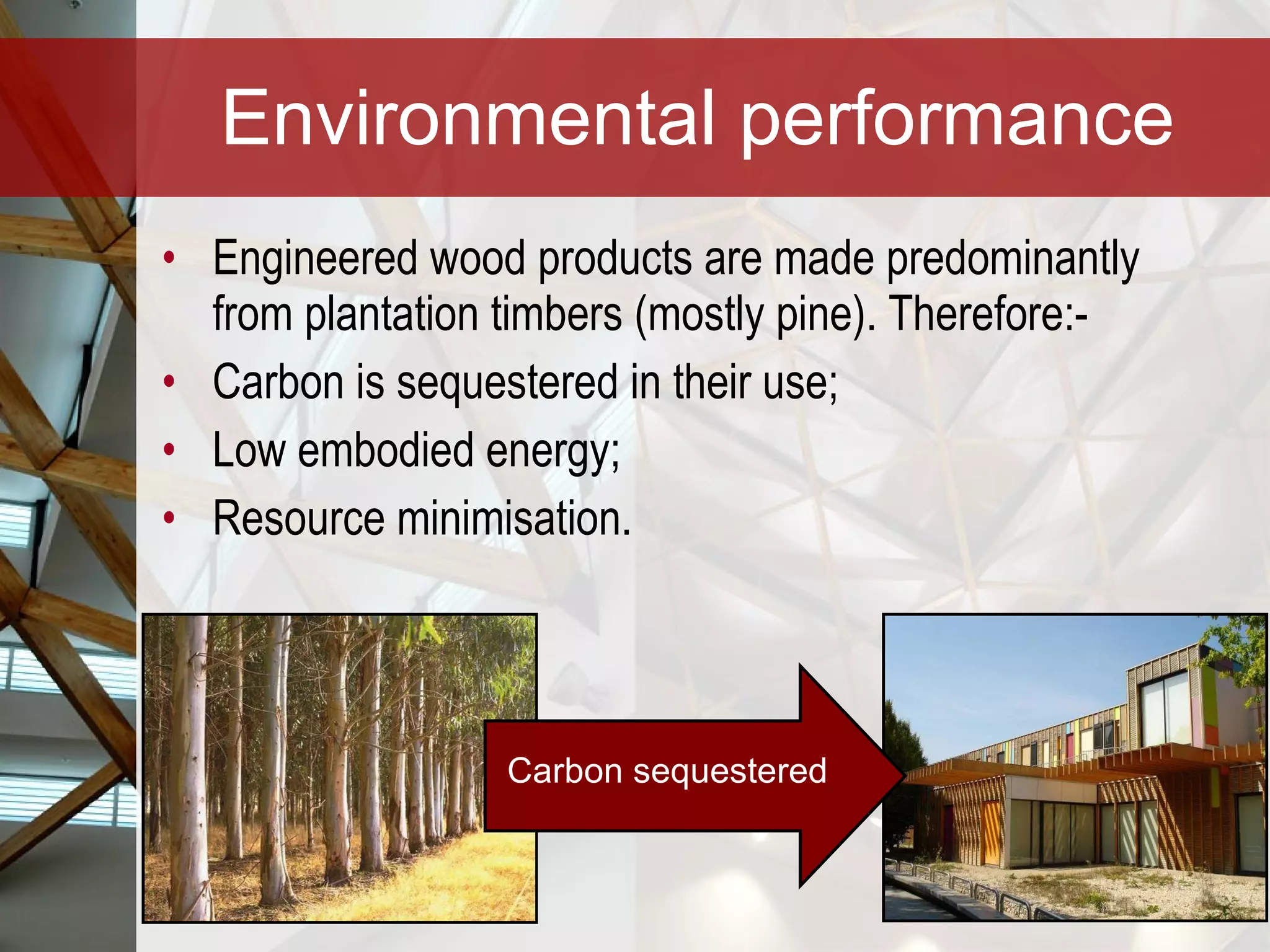
Environmental performance Engineered wood products are made predominantly from plantation timbers (mostly pine). Therefore:-  Carbon is sequestered in their use; Low embodied energy; Resource minimisation. Carbon sequestered
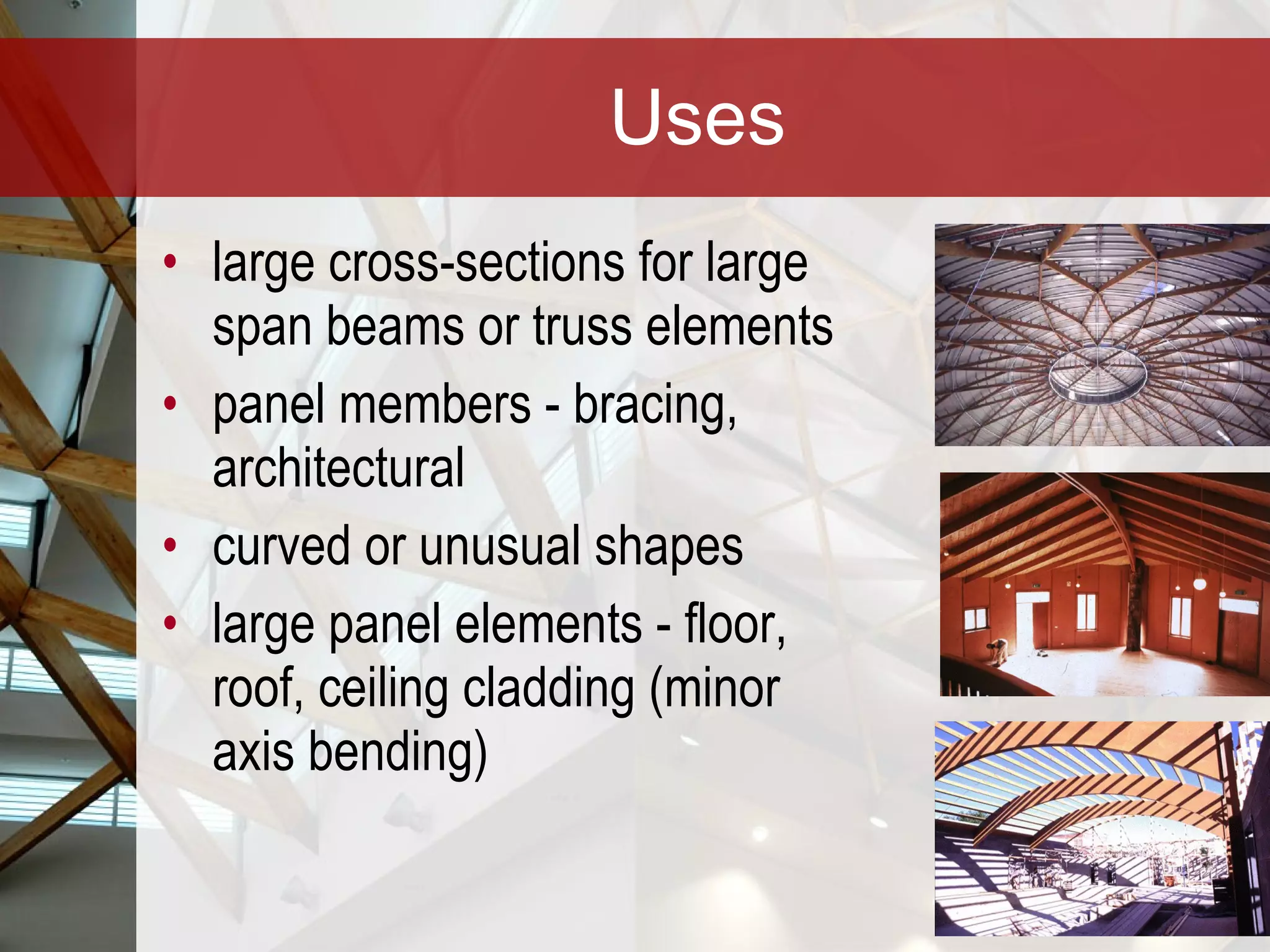
Uses large cross-sections for large span beams or truss elements panel members - bracing, architectural curved or unusual shapes  large panel elements - floor, roof, ceiling cladding (minor axis bending)
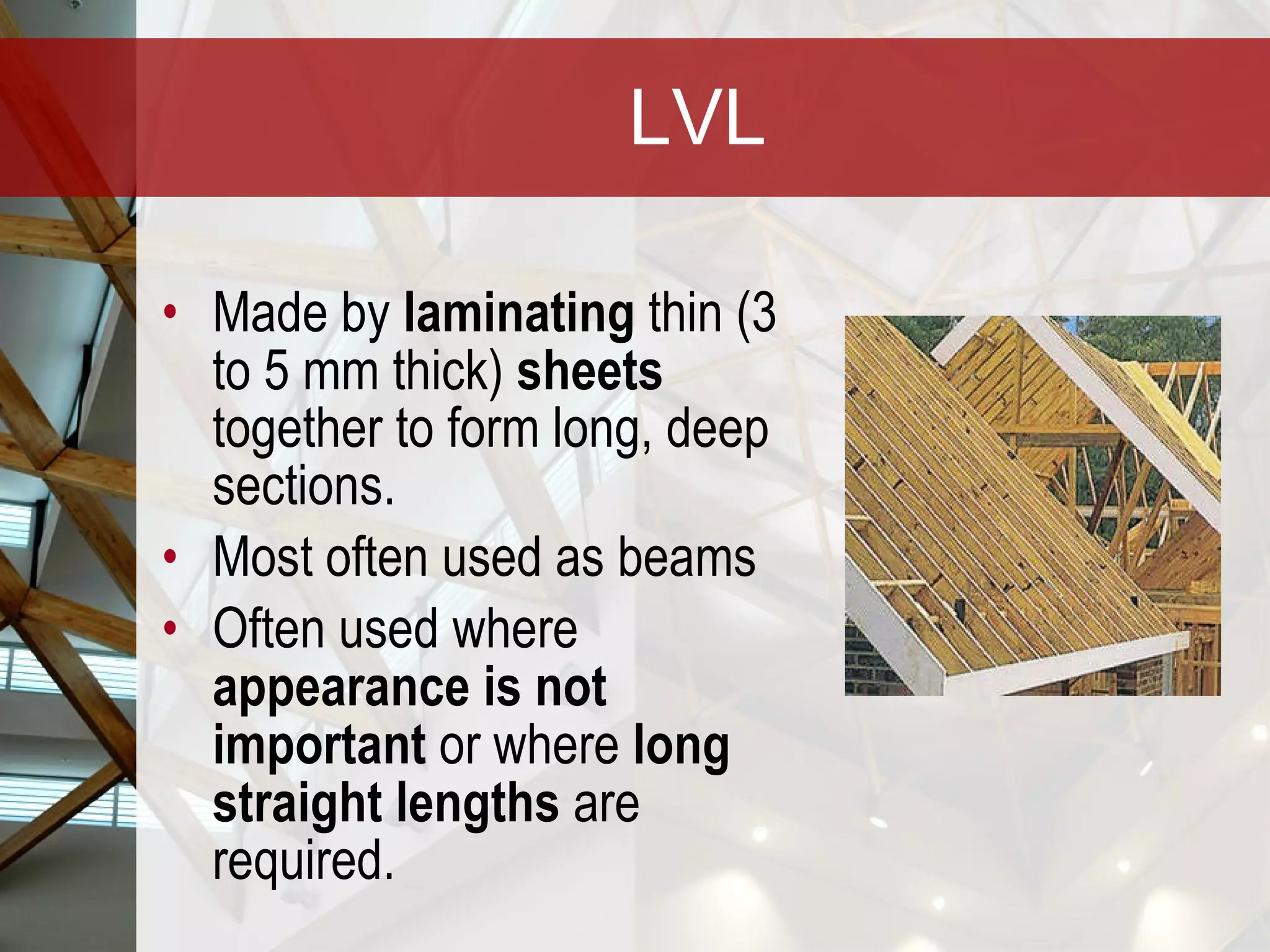
LVL Made by  laminating  thin (3 to 5 mm thick)  sheets  together to form long, deep sections.  Most often used as beams Often used where  appearance is not important  or where  long straight lengths  are required.
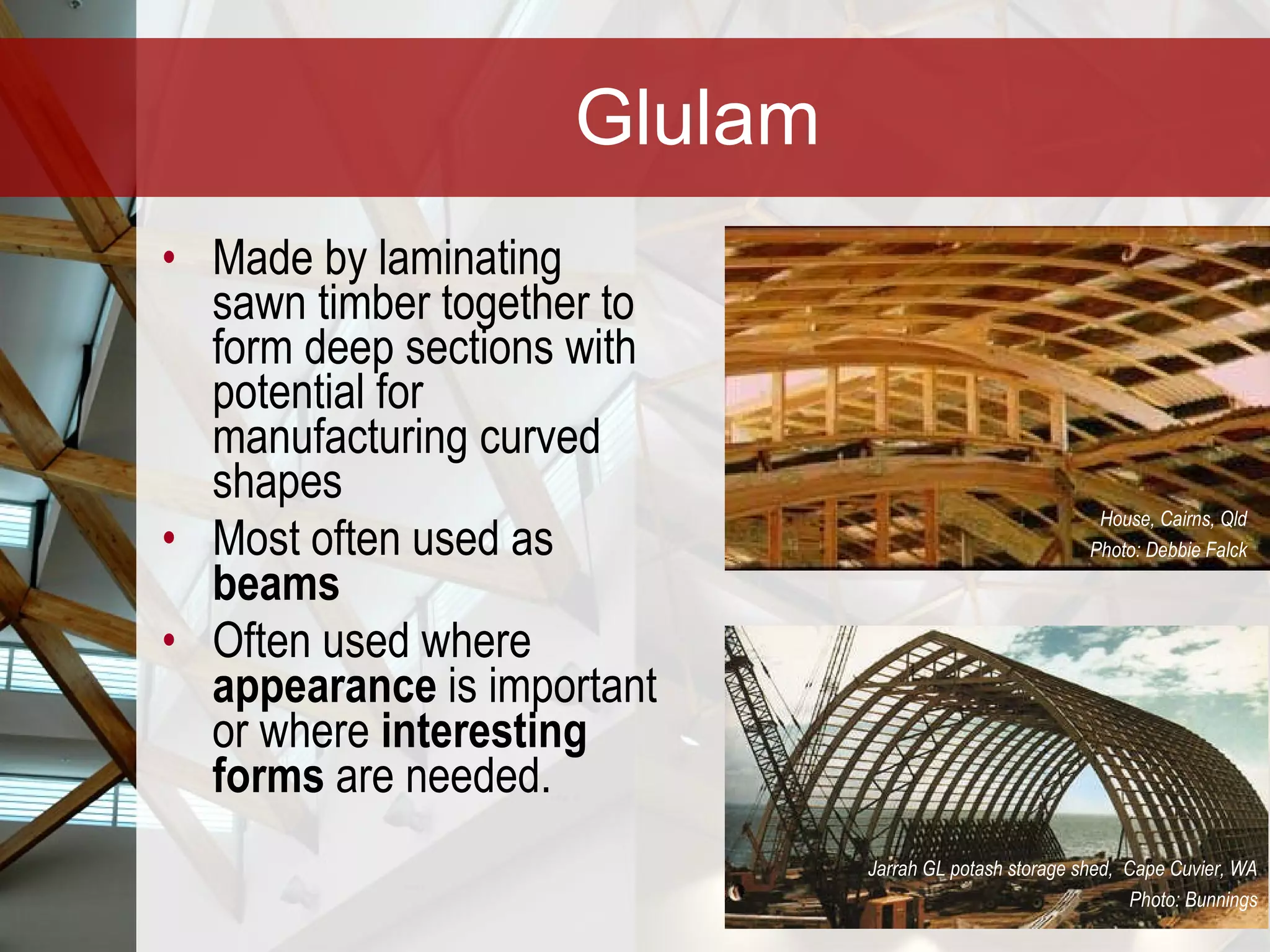
Glulam Made by laminating sawn timber together to form deep sections with potential for manufacturing curved shapes Most often used as  beams Often used where  appearance  is important   or where  interesting forms  are needed. House, Cairns, Qld Photo: Debbie Falck Jarrah GL potash storage shed,  Cape Cuvier, WA Photo: Bunnings
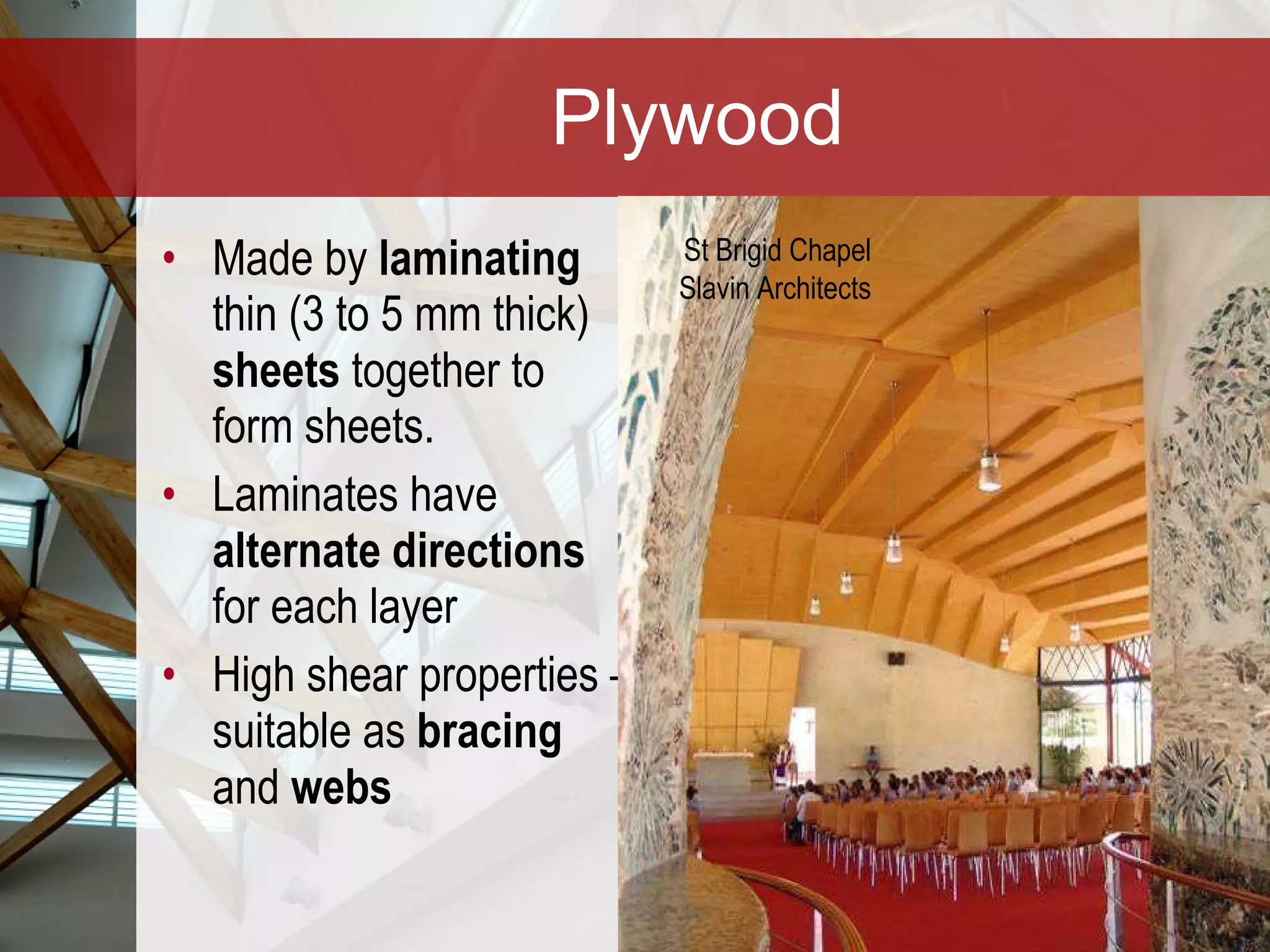
Plywood Made by  laminating  thin (3 to 5 mm thick)  sheets  together to form sheets.  Laminates have  alternate directions  for each layer High shear properties – suitable as  bracing  and  webs St Brigid Chapel Slavin Architects
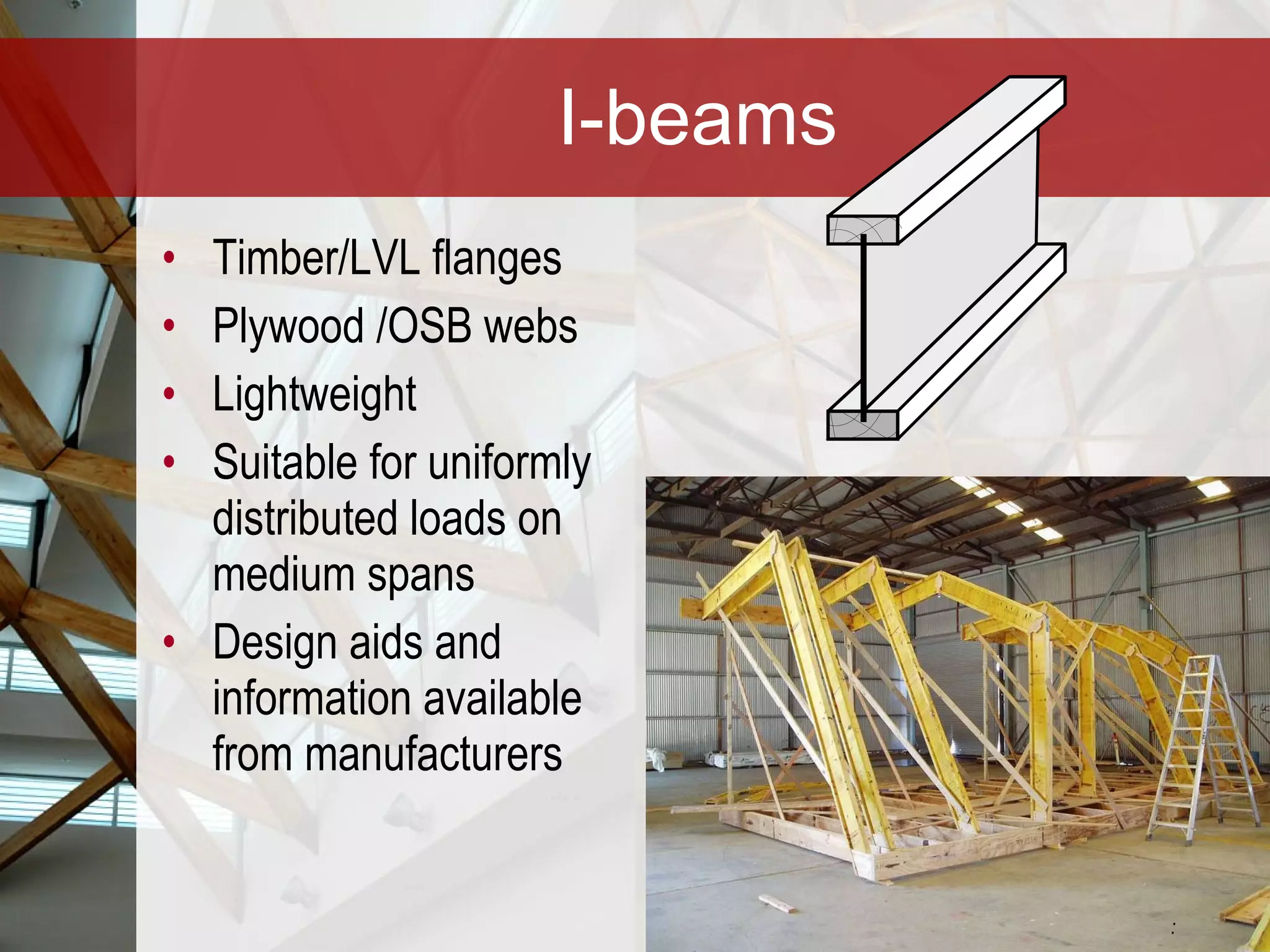
I-beams Timber/LVL flanges Plywood /OSB webs Lightweight Suitable for uniformly distributed loads on medium spans Design aids and information available from manufacturers :
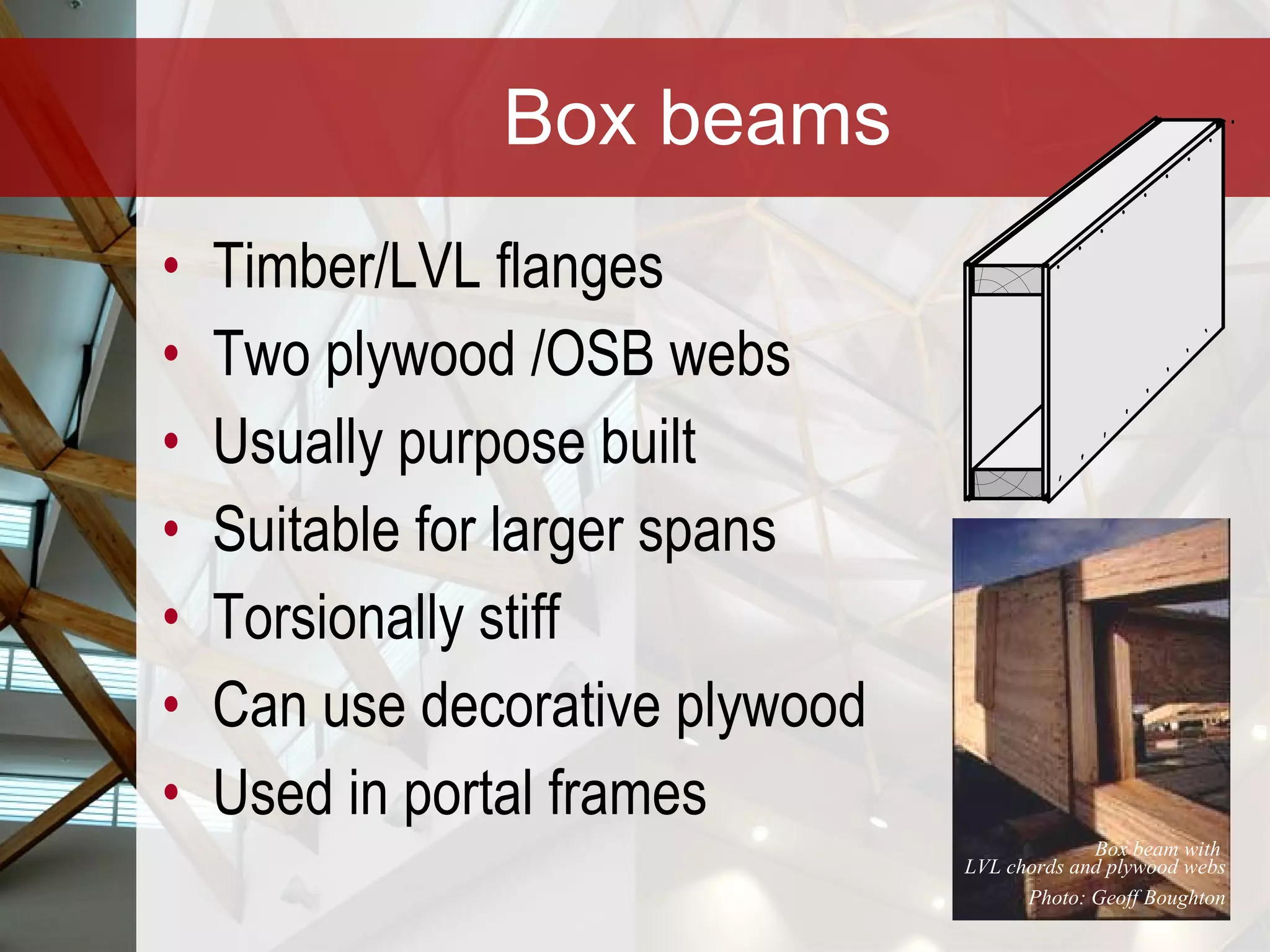
Box beams Timber/LVL flanges Two plywood /OSB webs Usually purpose built Suitable for larger spans Torsionally stiff Can use decorative plywood Used in portal frames Box beam with  LVL chords and plywood webs Photo: Geoff Boughton
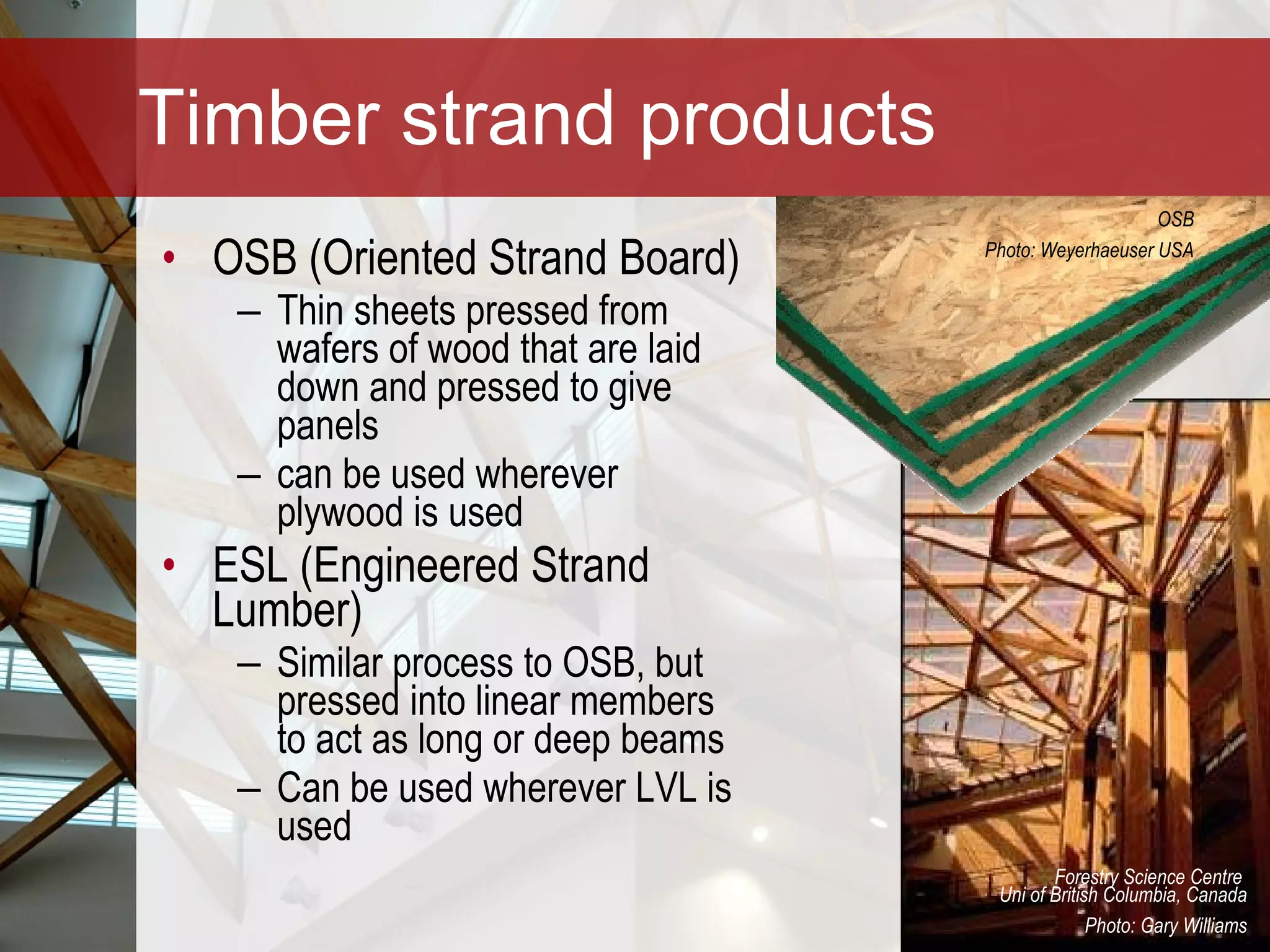
Timber strand products OSB (Oriented Strand Board)  Thin sheets pressed from wafers of wood that are laid down and pressed to give panels  can be used wherever plywood is used ESL (Engineered Strand Lumber)  Similar process to OSB, but pressed into linear members to act as long or deep beams  Can be used wherever LVL is used Forestry Science Centre  Uni of British Columbia, Canada Photo: Gary Williams OSB Photo: Weyerhaeuser USA
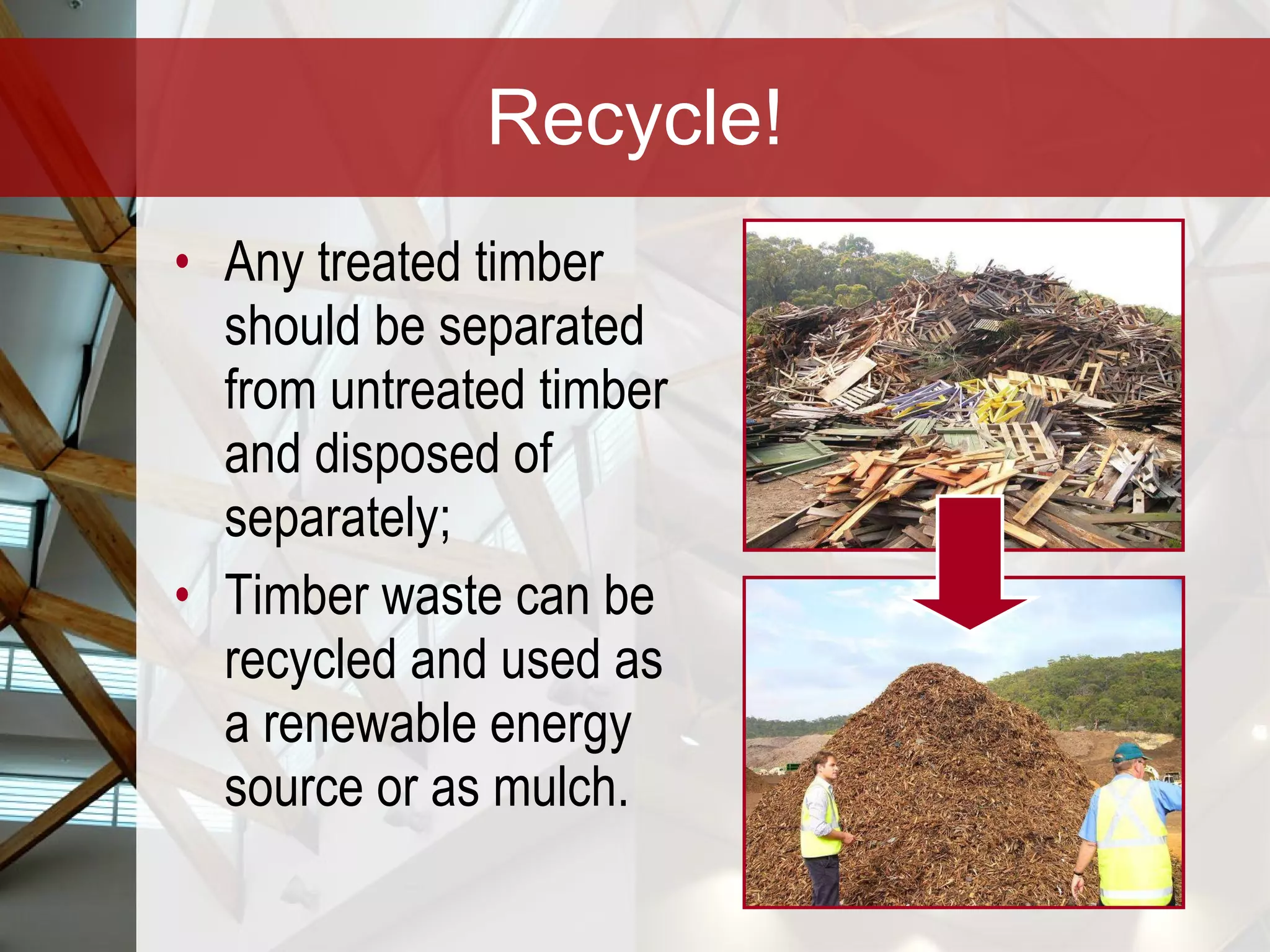
2. Waste Waste is a serious environmental problem in the construction industry. A way to minimise waste is using the waste hierarchy:   Reduce,  Reuse,  Recycle
Reduce! Using a lightweight timber construction option reduces the amount of material used to construct a dwelling in the first place; Timber frames and trusses can be pre-fabricated off-site and delivered, helping centralise and minimise waste at a factory; Careful planning and using waste management plans can minimise waste onsite;
Reuse! Off cuts can be reused on site as smaller components in timber framing;
Recycle! Any treated timber should be separated from untreated timber and disposed of separately; Timber waste can be recycled and used as a renewable energy source or as mulch.
3. Building rating tools There are various building rating tools designed to measure the environmental performance of buildings. These include:- National Australian Built Environment Rating System, NABERS; Nationwide House Energy Rating Scheme, NatHERS; BASIX
National Australian Built Environment Rating System, NABERS NABERS is a flexible rating system, applicable to commercial development and homes, that rates existing buildings against environmental criteria including energy use, water use, air quality, storm water run off; It is a voluntary system that will enable building owners to increase their awareness of sustainability in the built environment; NABERS has been developed by the Australian Government.
Nationwide House Energy Rating Scheme, NatHERS AccuRate is a CSIRO developed tool that rates the design of a building in terms of how well they are designed to minimise energy use to maintain comfort, (thermal efficiency) AccuRate is a second generation thermal efficiency modelling software (update of the first generation software NatHERS); NatHERS is used in BASIX to rate the thermal efficiency component of energy consumption.
The Building Sustainability Index (BASIX) BASIX is a NSW Government initiative that ensures new homes are designed and built to use less potable water and use less energy. One aspect of energy reduction is increasing thermal efficiency.
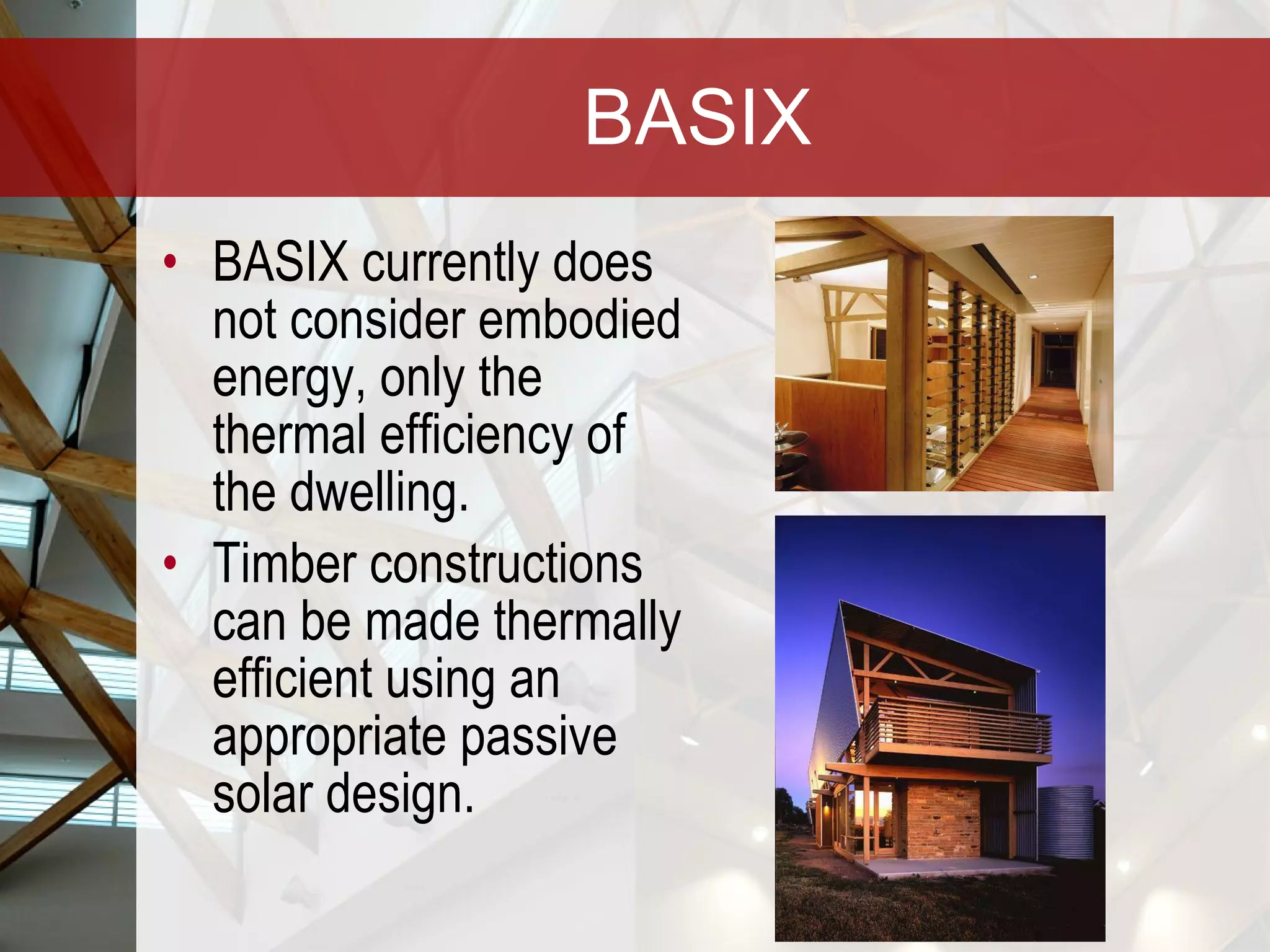
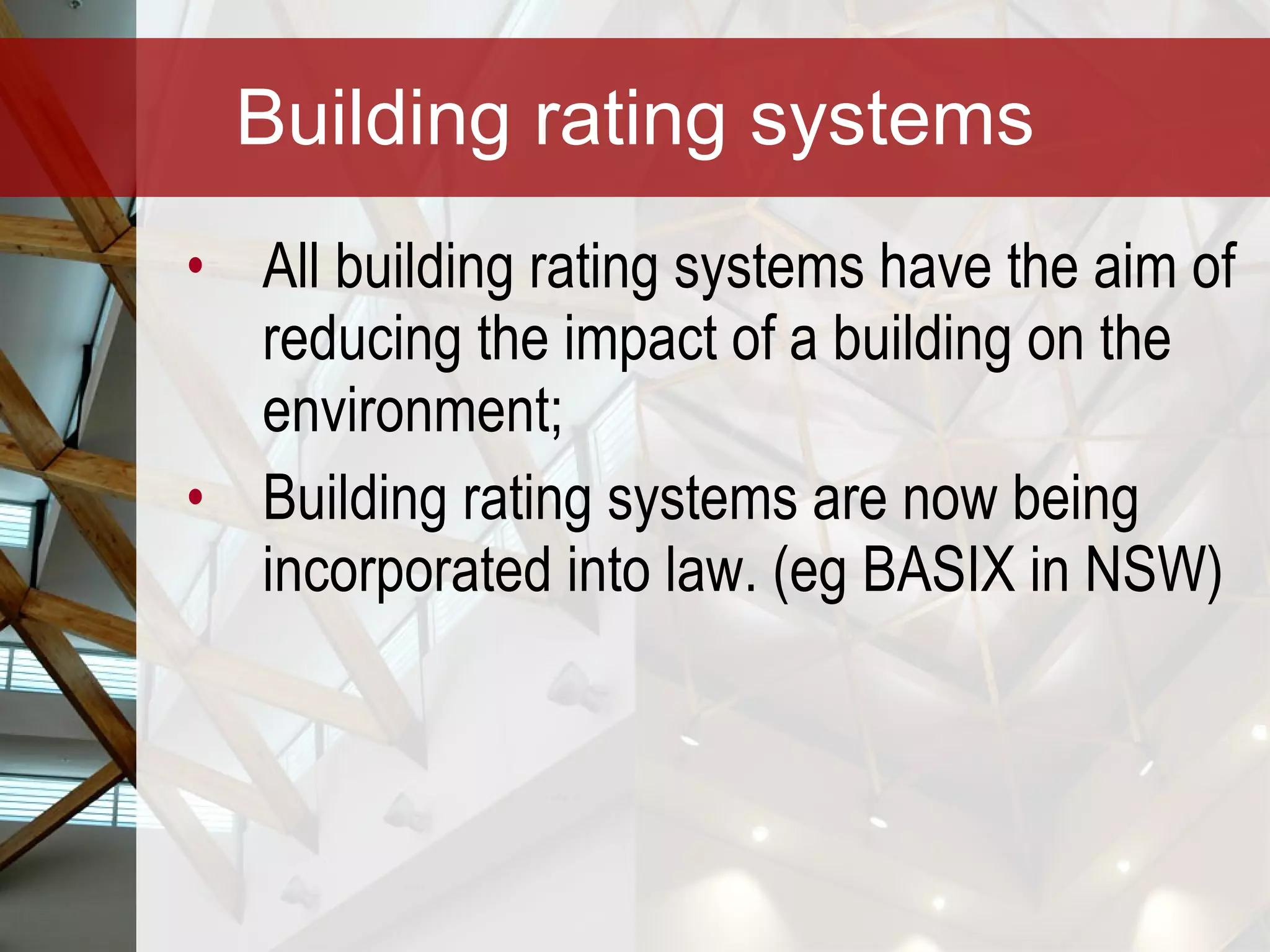
BASIX BASIX currently does not consider embodied energy, only the thermal efficiency of the dwelling. Timber constructions can be made thermally efficient using an appropriate passive solar design.
Building rating systems All building rating systems have the aim of reducing the impact of a building on the environment; Building rating systems are now being incorporated into law. (eg BASIX in NSW)
4. Environmental labelling systems Forestry Certification schemes are run by third parties and aim to ensure that Forests are managed in an Ecologically Sustainable manner Timber sourced from a certified forest can be labelled by the certifying body The two main certifying bodies in Australia are Australian Forestry Standard Ltd (AFS) and the Forest Stewardship Council (FSC)
Certification internationally The two dominant international certification schemes are: the Programme for endorsement of Forestry Certification; previously - Pan European Forest Certification Scheme (PEFC) covering a volume of 5 157 003 ha or forests, &  Forest Stewardship Council (FSC) Certification covering a volume of  535 509 ha of forest.
Certification schemes Once Chain of Custody can be established, (from sustainably managed forest to consumer) the certifying bodies will label timber at point of sale. This will allow builders to choose the environmentally sustainable option for building.
Conclusion Timber is an  environmentally friendly  material that offers the designer and builder  flexibility in its use . An understanding of the properties and applications of timber will aid the designer and builder construct environmentally friendly buildings, and  contribute to a sustainable built environment .

4. associated issues

  • 1.
    Associated issues: Timberand Environmental Building Atrium Roof to Deerubbin Centre Warwick Donnelly
  • 2.
    Issues Engineered timberproducts Waste Building Rating Tools Environmental labelling systems
  • 3.
    1. Engineered woodproducts Products manufactured from timber fibres using gluing to produce large sections or long lengths Glued strand products (OSB, LSL, ESL, …) LVL - I beams Box beams - Glulam Plywood Often used when large sections are not available. Efficient material use! Portal frames under construction Photo: TRADAC
  • 4.
    Benefits Engineered timberproducts, such as I-beams, glulam beams and plywood offer the builder/designer: design flexibility good environmental performance increased structural ability
  • 5.
    Design flexibility Engineeredwood products can be manufactured to suit a specific design. The properties of the timber are optimised to suit the particular design. Timber house of the Future
  • 6.
    Environmental performance Engineeredwood products are made predominantly from plantation timbers (mostly pine). Therefore:- Carbon is sequestered in their use; Low embodied energy; Resource minimisation. Carbon sequestered
  • 7.
    Uses large cross-sectionsfor large span beams or truss elements panel members - bracing, architectural curved or unusual shapes large panel elements - floor, roof, ceiling cladding (minor axis bending)
  • 8.
    LVL Made by laminating thin (3 to 5 mm thick) sheets together to form long, deep sections. Most often used as beams Often used where appearance is not important or where long straight lengths are required.
  • 9.
    Glulam Made bylaminating sawn timber together to form deep sections with potential for manufacturing curved shapes Most often used as beams Often used where appearance is important or where interesting forms are needed. House, Cairns, Qld Photo: Debbie Falck Jarrah GL potash storage shed, Cape Cuvier, WA Photo: Bunnings
  • 10.
    Plywood Made by laminating thin (3 to 5 mm thick) sheets together to form sheets. Laminates have alternate directions for each layer High shear properties – suitable as bracing and webs St Brigid Chapel Slavin Architects
  • 11.
    I-beams Timber/LVL flangesPlywood /OSB webs Lightweight Suitable for uniformly distributed loads on medium spans Design aids and information available from manufacturers :
  • 12.
    Box beams Timber/LVLflanges Two plywood /OSB webs Usually purpose built Suitable for larger spans Torsionally stiff Can use decorative plywood Used in portal frames Box beam with LVL chords and plywood webs Photo: Geoff Boughton
  • 13.
    Timber strand productsOSB (Oriented Strand Board) Thin sheets pressed from wafers of wood that are laid down and pressed to give panels can be used wherever plywood is used ESL (Engineered Strand Lumber) Similar process to OSB, but pressed into linear members to act as long or deep beams Can be used wherever LVL is used Forestry Science Centre Uni of British Columbia, Canada Photo: Gary Williams OSB Photo: Weyerhaeuser USA
  • 14.
    2. Waste Wasteis a serious environmental problem in the construction industry. A way to minimise waste is using the waste hierarchy: Reduce, Reuse, Recycle
  • 15.
    Reduce! Using alightweight timber construction option reduces the amount of material used to construct a dwelling in the first place; Timber frames and trusses can be pre-fabricated off-site and delivered, helping centralise and minimise waste at a factory; Careful planning and using waste management plans can minimise waste onsite;
  • 16.
    Reuse! Off cutscan be reused on site as smaller components in timber framing;
  • 17.
    Recycle! Any treatedtimber should be separated from untreated timber and disposed of separately; Timber waste can be recycled and used as a renewable energy source or as mulch.
  • 18.
    3. Building ratingtools There are various building rating tools designed to measure the environmental performance of buildings. These include:- National Australian Built Environment Rating System, NABERS; Nationwide House Energy Rating Scheme, NatHERS; BASIX
  • 19.
    National Australian BuiltEnvironment Rating System, NABERS NABERS is a flexible rating system, applicable to commercial development and homes, that rates existing buildings against environmental criteria including energy use, water use, air quality, storm water run off; It is a voluntary system that will enable building owners to increase their awareness of sustainability in the built environment; NABERS has been developed by the Australian Government.
  • 20.
    Nationwide House EnergyRating Scheme, NatHERS AccuRate is a CSIRO developed tool that rates the design of a building in terms of how well they are designed to minimise energy use to maintain comfort, (thermal efficiency) AccuRate is a second generation thermal efficiency modelling software (update of the first generation software NatHERS); NatHERS is used in BASIX to rate the thermal efficiency component of energy consumption.
  • 21.
    The Building SustainabilityIndex (BASIX) BASIX is a NSW Government initiative that ensures new homes are designed and built to use less potable water and use less energy. One aspect of energy reduction is increasing thermal efficiency.
  • 22.
    BASIX BASIX currentlydoes not consider embodied energy, only the thermal efficiency of the dwelling. Timber constructions can be made thermally efficient using an appropriate passive solar design.
  • 23.
    Building rating systemsAll building rating systems have the aim of reducing the impact of a building on the environment; Building rating systems are now being incorporated into law. (eg BASIX in NSW)
  • 24.
    4. Environmental labellingsystems Forestry Certification schemes are run by third parties and aim to ensure that Forests are managed in an Ecologically Sustainable manner Timber sourced from a certified forest can be labelled by the certifying body The two main certifying bodies in Australia are Australian Forestry Standard Ltd (AFS) and the Forest Stewardship Council (FSC)
  • 25.
    Certification internationally Thetwo dominant international certification schemes are: the Programme for endorsement of Forestry Certification; previously - Pan European Forest Certification Scheme (PEFC) covering a volume of 5 157 003 ha or forests, & Forest Stewardship Council (FSC) Certification covering a volume of 535 509 ha of forest.
  • 26.
    Certification schemes OnceChain of Custody can be established, (from sustainably managed forest to consumer) the certifying bodies will label timber at point of sale. This will allow builders to choose the environmentally sustainable option for building.
  • 27.
    Conclusion Timber isan environmentally friendly material that offers the designer and builder flexibility in its use . An understanding of the properties and applications of timber will aid the designer and builder construct environmentally friendly buildings, and contribute to a sustainable built environment .