. Starter: Look at the climate map of the British Isles. Where is the best place to live? Why?
Climate graphs In the exam you will have to: Interpret climate graphs to describe the climate of an area You don’t need to be able to draw a climate graph
The average temperature in March is 6 °C The average rainfall in September is 51 mm 1. Calculate the total annual rainfall? 2. Calculate the average annual temperature? 3. Calculate the temperature range? The table below shows the climate data for Leeds . Jan Feb Mar Apr May Jun Jul Aug Sep Oct Nov Dec Average monthly Rainfall (mm) 56 41 46 46 48 53 51 66 51 51 53 53 Average monthly Temperature (°C) 3 3 6 7 11 14 16 16 13 10 6 4
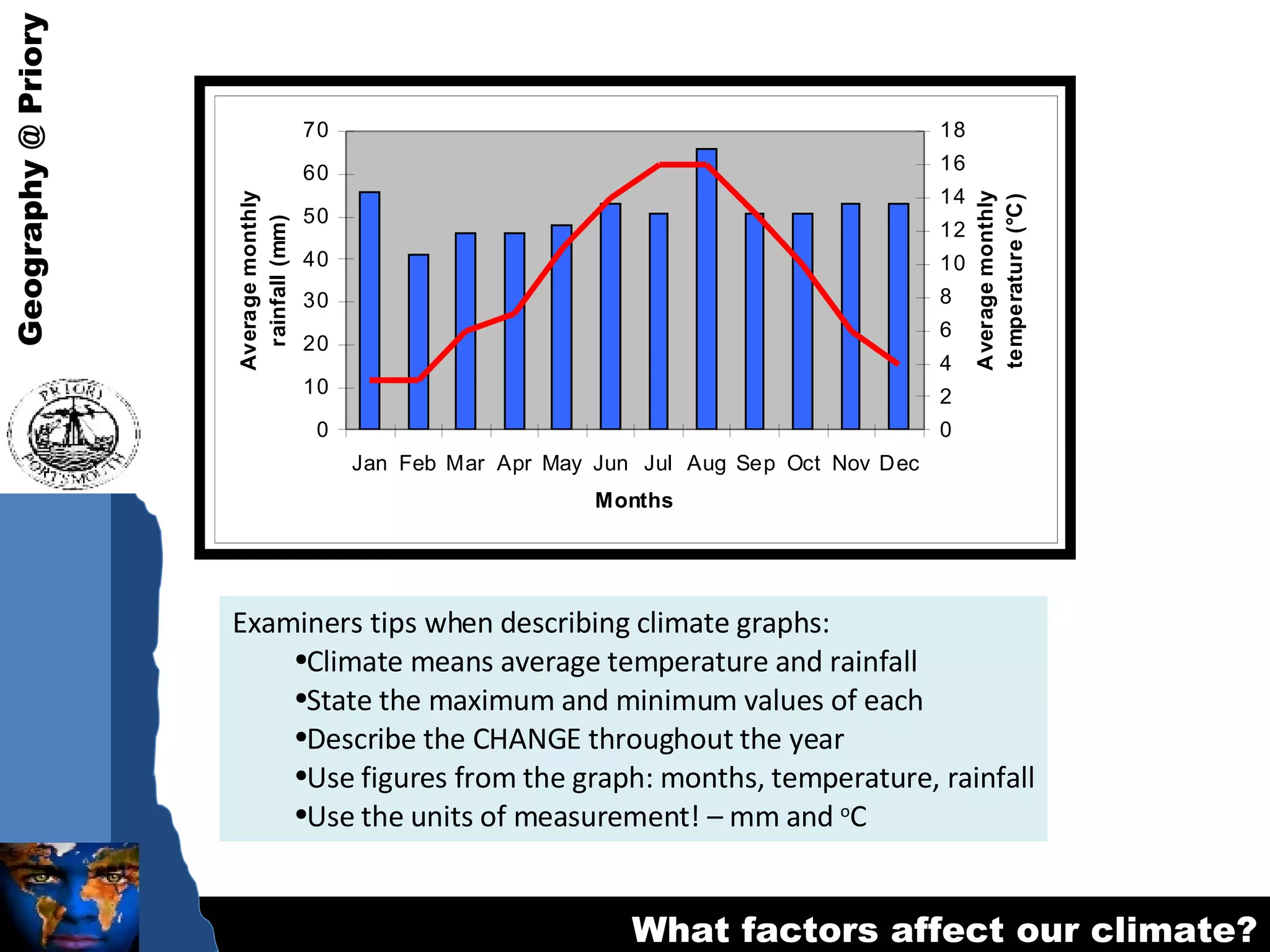
But how do you represent the data above in the form of a graph? The blue bars show average rainfall The red line is the average temperature Jan Feb Mar Apr May Jun Jul Aug Sep Oct Nov Dec Average monthly Rainfall (mm) 56 41 46 46 48 53 51 66 51 51 53 53 Average monthly Temperature (°C) 3 3 6 7 11 14 16 16 13 10 6 4
Interpreting a climate graph The maximum rainfall is 66 mm and the minimum is 41 mm – a range of 25 mm. The driest month is February when an average of 41 mm of rain falls. The wettest month is August when an average of 66 mm of rain falls The maximum temperature is 16 °C and the minimum is 3°C – a range of 13°C. The coldest months are January and February with an average monthly temperature of 3 °C. The temperature peaks in July and August with an average of 16 °C. Remember to describe the  TRENDS , then minimum and maximum values. Question 4: Describe the CLIMATE of Leeds
Examiners tips when describing climate graphs: Climate means average temperature and rainfall State the maximum and minimum values of each Describe the CHANGE throughout the year Use figures from the graph: months, temperature, rainfall Use the units of measurement! – mm and  o C
L A D O L Latitude A Altitude D Distance from the sea O Ocean Currents
L atitude
A ltitude
200m – 8 o C 1100m – -1 o C 800m – 2 o C
Prevailing Winds
Polar Maritime
Tropical Maritime
Polar continental
Tropical continental
Distance from the sea
Ocean Currents
 
Look back at the climate maps of Britain on page 78 Explain the patterns` shown. Can you do the same for selected global climates? (Page 88)

Factors Affecting Climate

  • 1.
    . Starter: Lookat the climate map of the British Isles. Where is the best place to live? Why?
  • 2.
    Climate graphs Inthe exam you will have to: Interpret climate graphs to describe the climate of an area You don’t need to be able to draw a climate graph
  • 3.
    The average temperaturein March is 6 °C The average rainfall in September is 51 mm 1. Calculate the total annual rainfall? 2. Calculate the average annual temperature? 3. Calculate the temperature range? The table below shows the climate data for Leeds . Jan Feb Mar Apr May Jun Jul Aug Sep Oct Nov Dec Average monthly Rainfall (mm) 56 41 46 46 48 53 51 66 51 51 53 53 Average monthly Temperature (°C) 3 3 6 7 11 14 16 16 13 10 6 4
  • 4.
    But how doyou represent the data above in the form of a graph? The blue bars show average rainfall The red line is the average temperature Jan Feb Mar Apr May Jun Jul Aug Sep Oct Nov Dec Average monthly Rainfall (mm) 56 41 46 46 48 53 51 66 51 51 53 53 Average monthly Temperature (°C) 3 3 6 7 11 14 16 16 13 10 6 4
  • 5.
    Interpreting a climategraph The maximum rainfall is 66 mm and the minimum is 41 mm – a range of 25 mm. The driest month is February when an average of 41 mm of rain falls. The wettest month is August when an average of 66 mm of rain falls The maximum temperature is 16 °C and the minimum is 3°C – a range of 13°C. The coldest months are January and February with an average monthly temperature of 3 °C. The temperature peaks in July and August with an average of 16 °C. Remember to describe the TRENDS , then minimum and maximum values. Question 4: Describe the CLIMATE of Leeds
  • 6.
    Examiners tips whendescribing climate graphs: Climate means average temperature and rainfall State the maximum and minimum values of each Describe the CHANGE throughout the year Use figures from the graph: months, temperature, rainfall Use the units of measurement! – mm and o C
  • 7.
    L A DO L Latitude A Altitude D Distance from the sea O Ocean Currents
  • 8.
  • 9.
  • 10.
    200m – 8o C 1100m – -1 o C 800m – 2 o C
  • 11.
  • 12.
  • 13.
  • 14.
  • 15.
  • 16.
  • 17.
  • 18.
  • 19.
    Look back atthe climate maps of Britain on page 78 Explain the patterns` shown. Can you do the same for selected global climates? (Page 88)