10/27/2013

METEOROLOGY

1
Definition of clouds
…03
Formation of clouds
…06
Classification of clouds
…10
Vertically Developed clouds
…16
Categories
…19
1) Cumulus clouds
…20
1) Hmulis
…23
2) Fractus
…26
3) Congestus
…28
4) Castellanus
…29
2) Cumulonimbus clouds
…31
1) Cumulonimbus Incus
…36
2) Cumulonimbus Mammatus …38
3) Cumulonimbus Calvus
…41
6) References
…44
1)
2)
3)
4)
5)

10/27/2013

METEOROLOGY

2
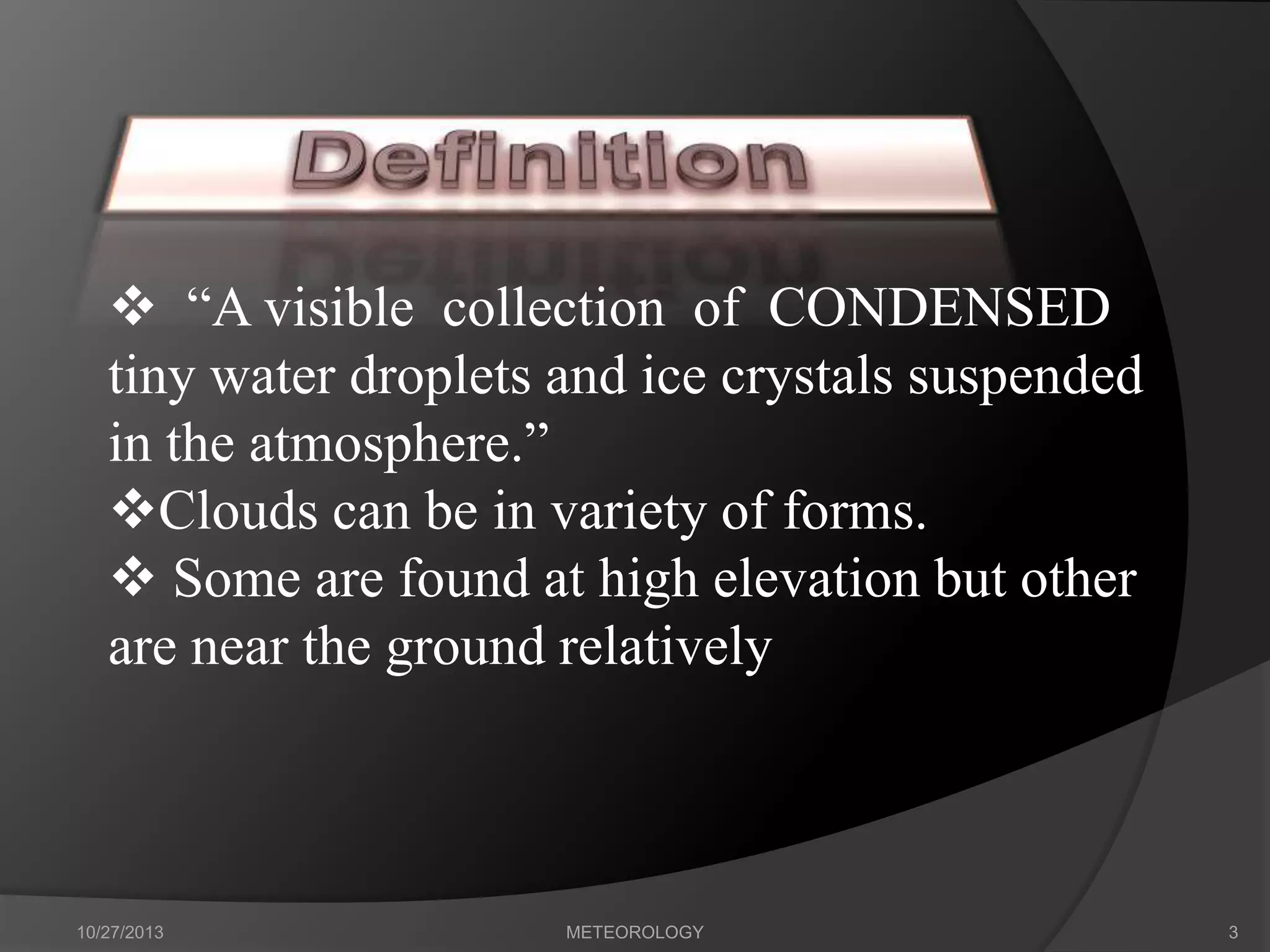
 “A visible collection of CONDENSED
tiny water droplets and ice crystals suspended
in the atmosphere.”
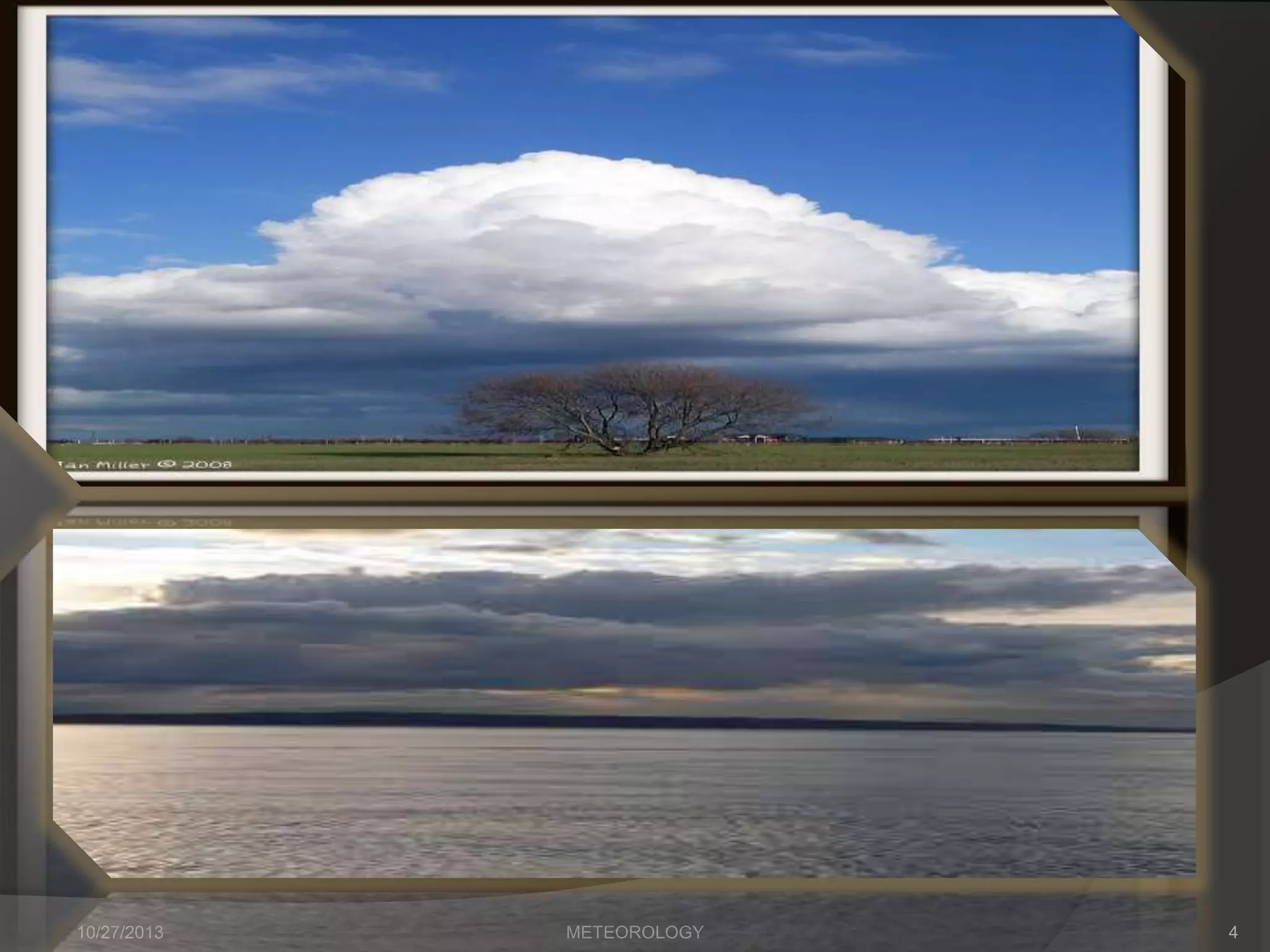
Clouds can be in variety of forms.
 Some are found at high elevation but other
are near the ground relatively

10/27/2013

METEOROLOGY

3
10/27/2013

METEOROLOGY

4
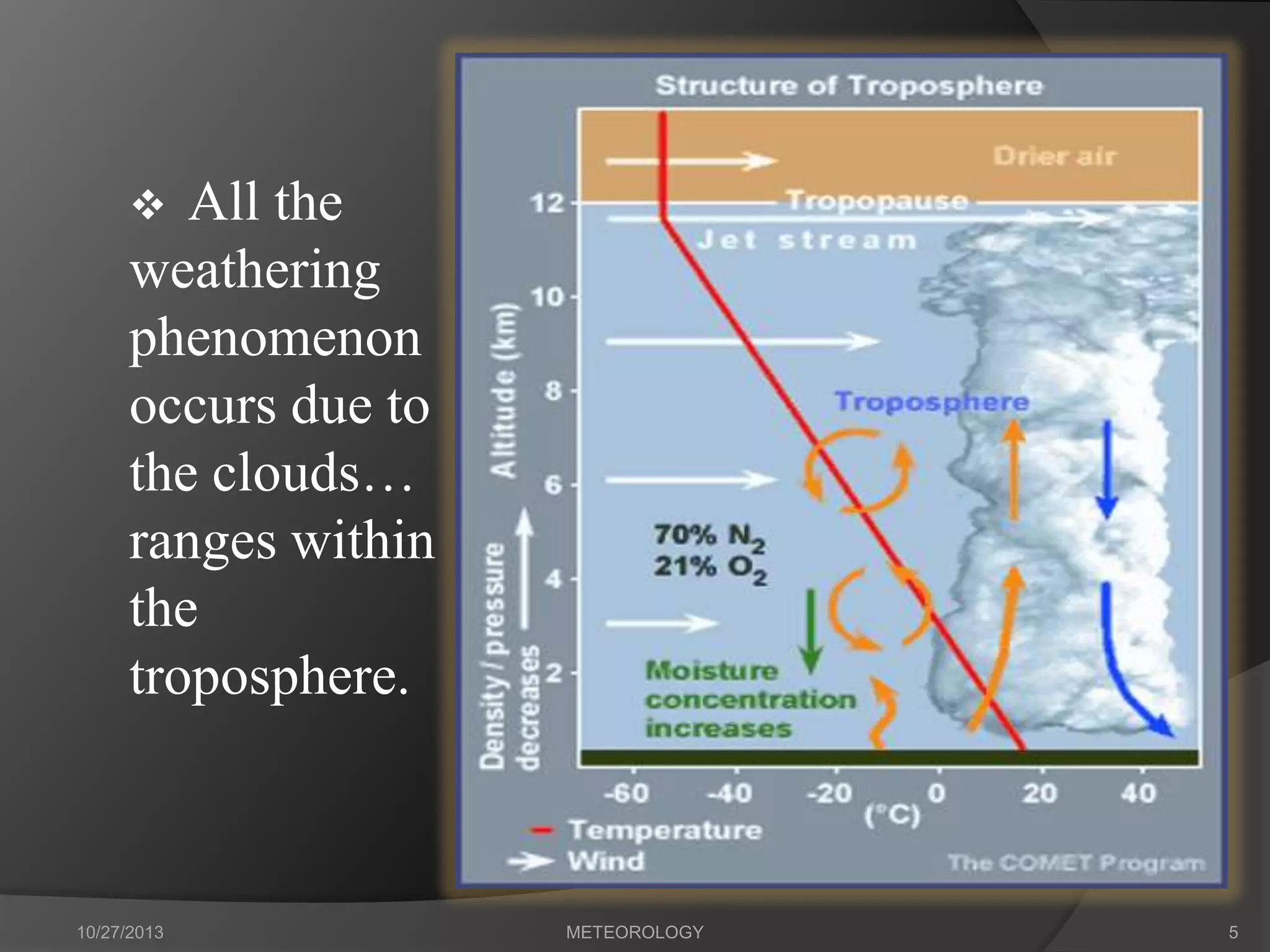
All the
weathering
phenomenon
occurs due to
the clouds…
ranges within
the
troposphere.


10/27/2013

METEOROLOGY

5
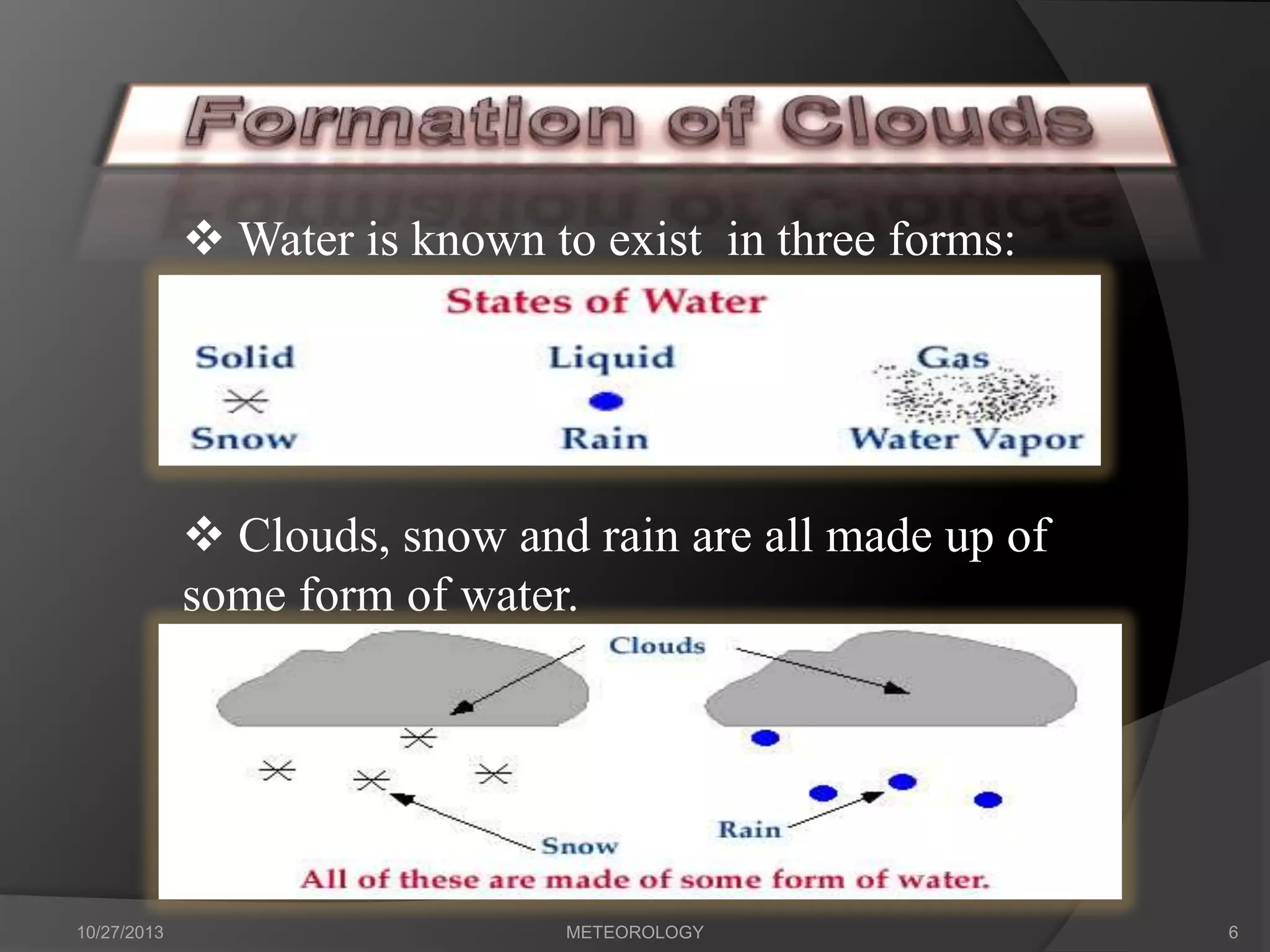
 Water is known to exist in three forms:

 Clouds, snow and rain are all made up of
some form of water.

10/27/2013

METEOROLOGY

6


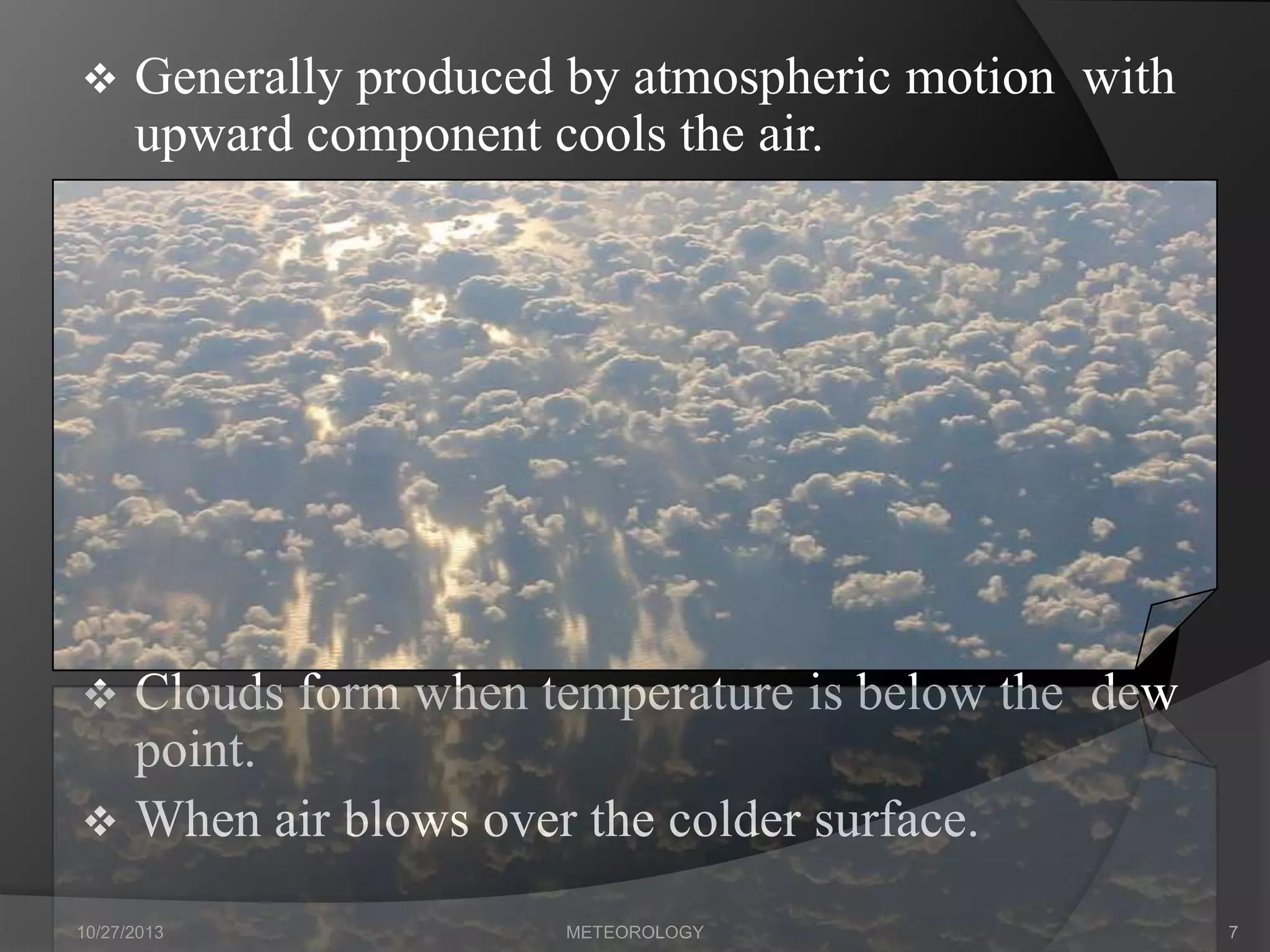
Generally produced by atmospheric motion with
upward component cools the air.



Clouds form when temperature is below the dew
point.
 When air blows over the colder surface.
10/27/2013

METEOROLOGY

7
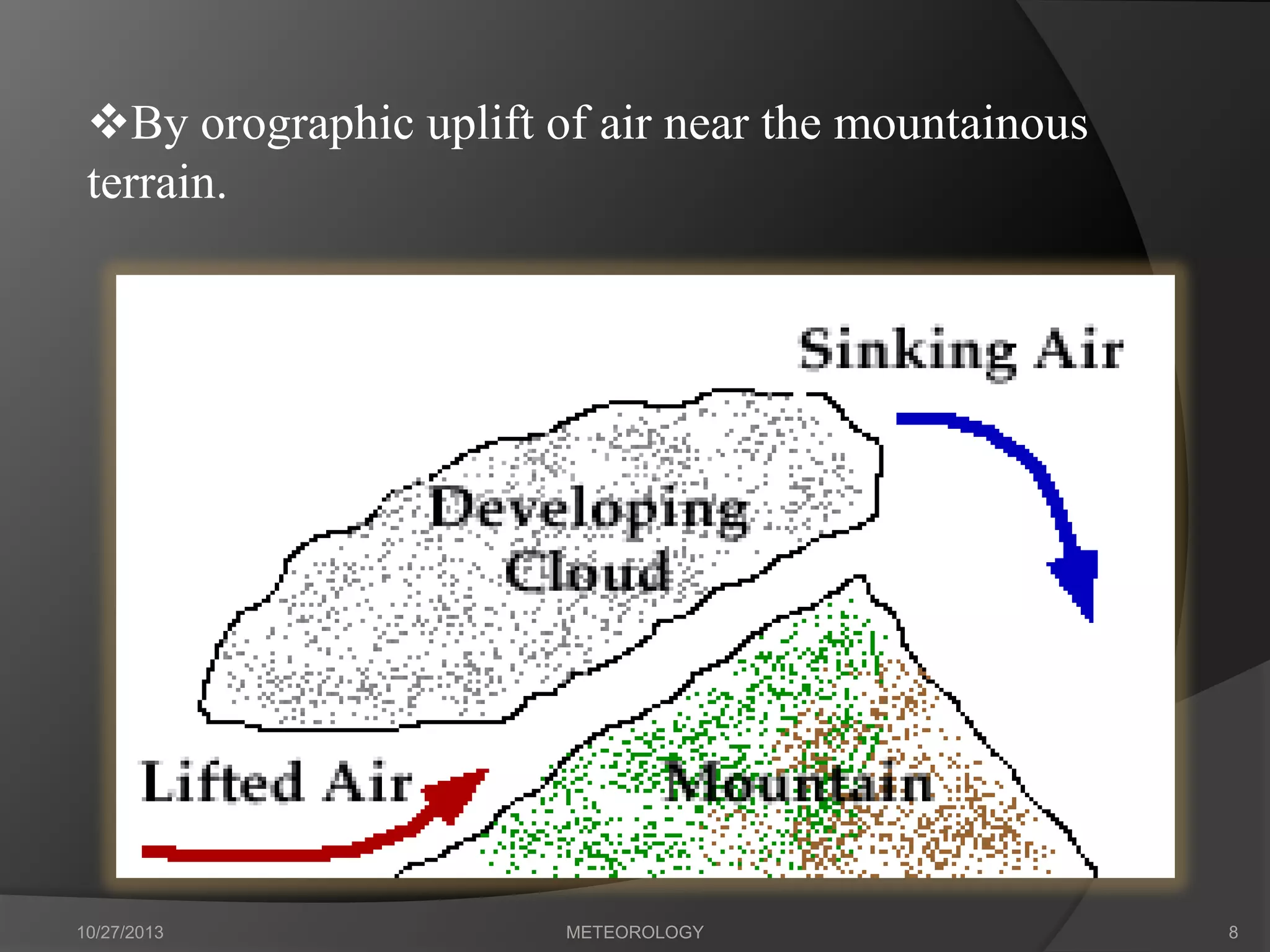
By orographic uplift of air near the mountainous
terrain.

10/27/2013

METEOROLOGY

8
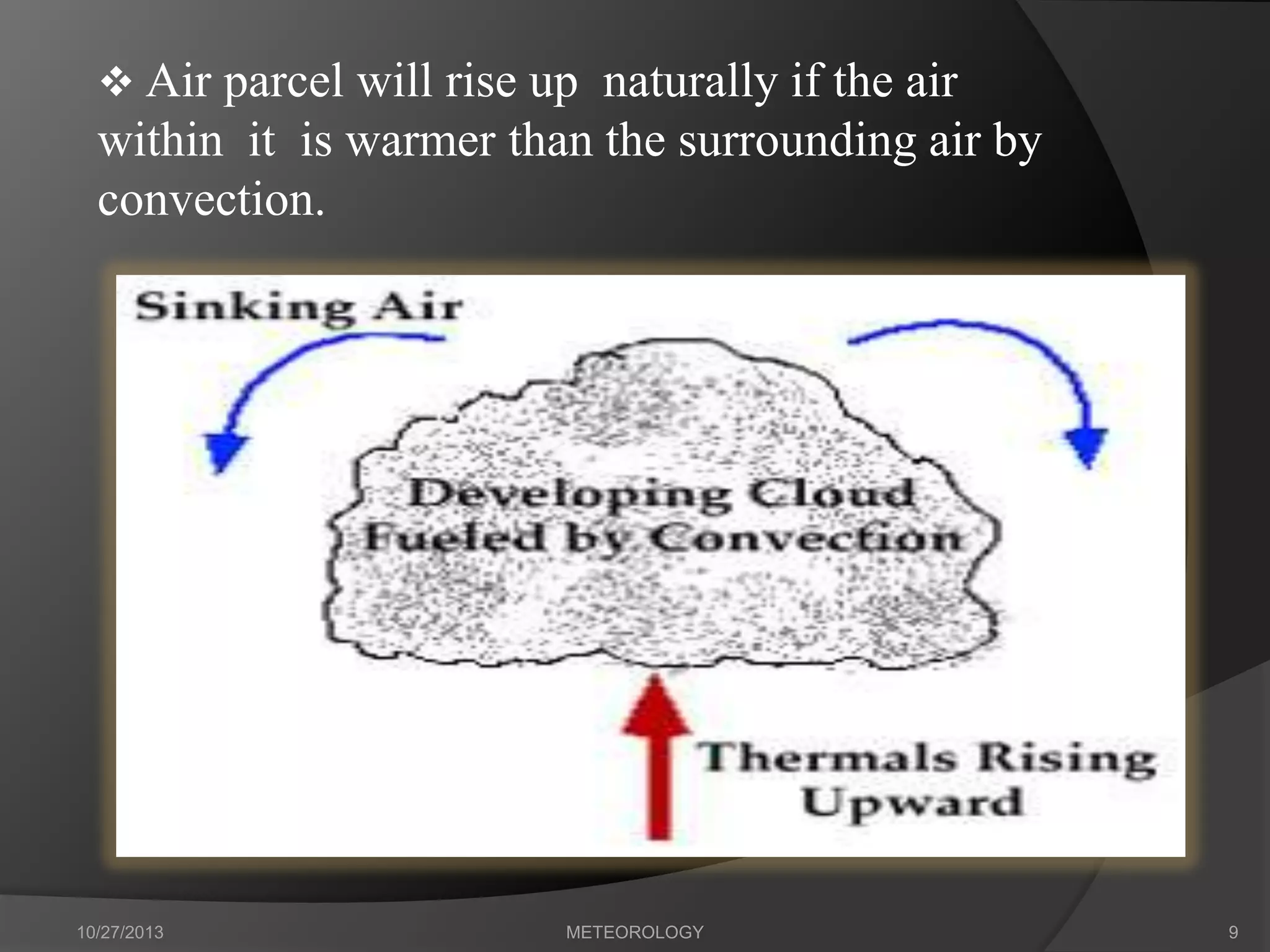
 Air parcel will rise up naturally if the air

within it is warmer than the surrounding air by
convection.

10/27/2013

METEOROLOGY

9
Clouds are classified into a system that uses
“Latin” words to describe their appearances.
They are define on the basis of their
“Heights”.
This was done by an English chemist “Luke
Howard” in 1803.

10/27/2013

METEOROLOGY

10
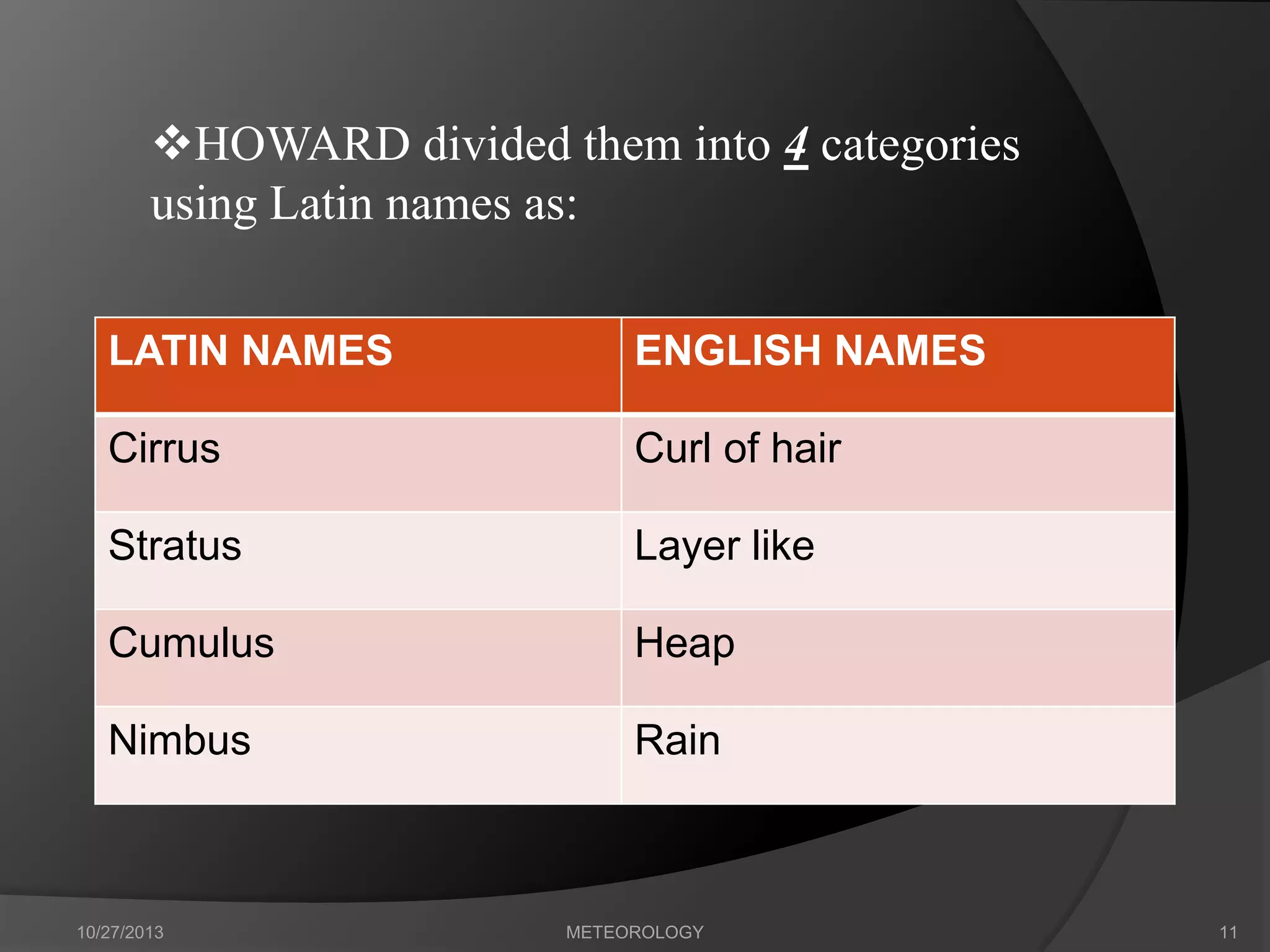
HOWARD divided them into 4 categories
using Latin names as:
LATIN NAMES

ENGLISH NAMES

Cirrus

Curl of hair

Stratus

Layer like

Cumulus

Heap

Nimbus

Rain

10/27/2013

METEOROLOGY

11
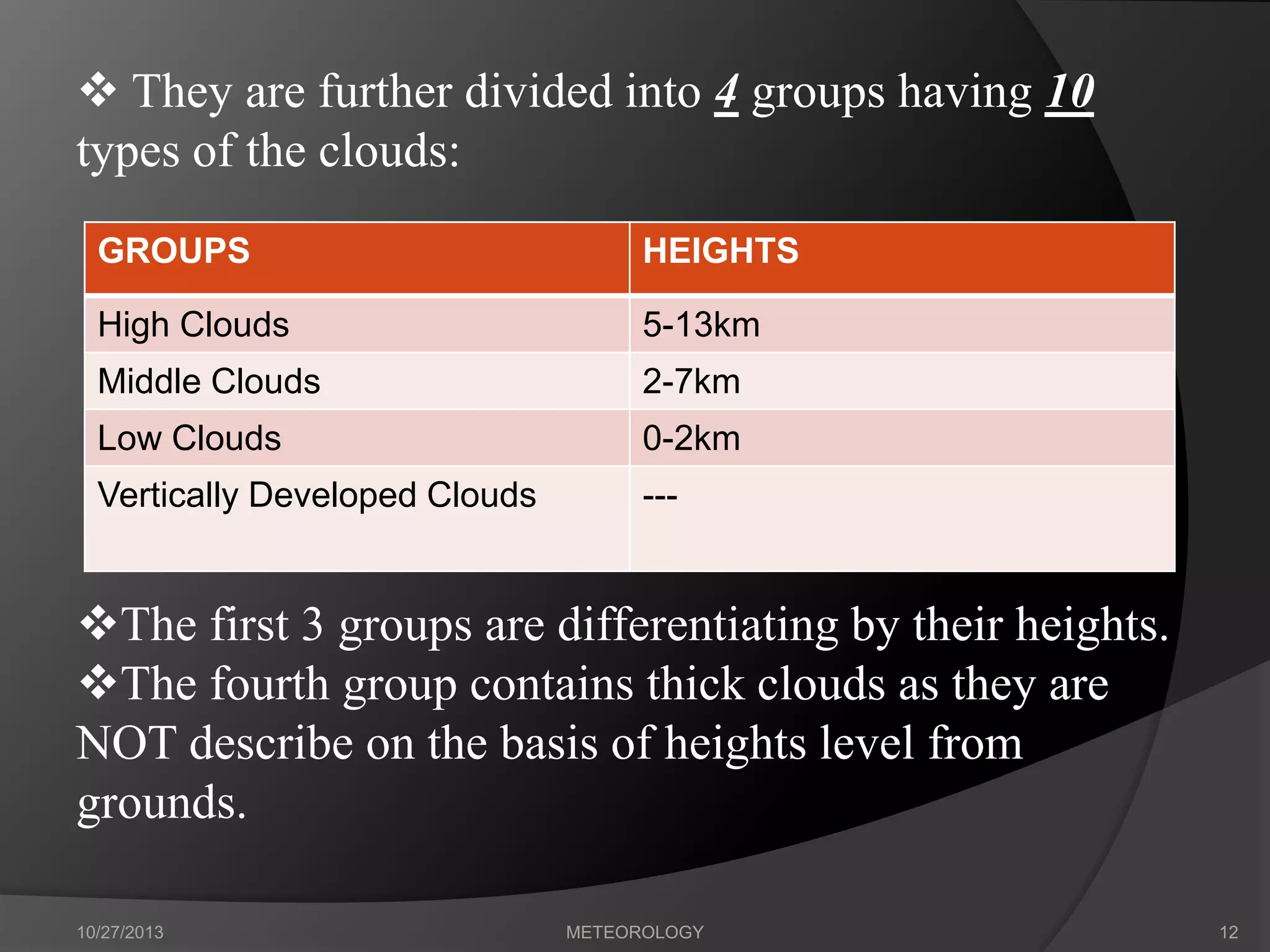
 They are further divided into 4 groups having 10
types of the clouds:
GROUPS

HEIGHTS

High Clouds

5-13km

Middle Clouds

2-7km

Low Clouds

0-2km

Vertically Developed Clouds

---

The first 3 groups are differentiating by their heights.
The fourth group contains thick clouds as they are
NOT describe on the basis of heights level from
grounds.
10/27/2013

METEOROLOGY

12
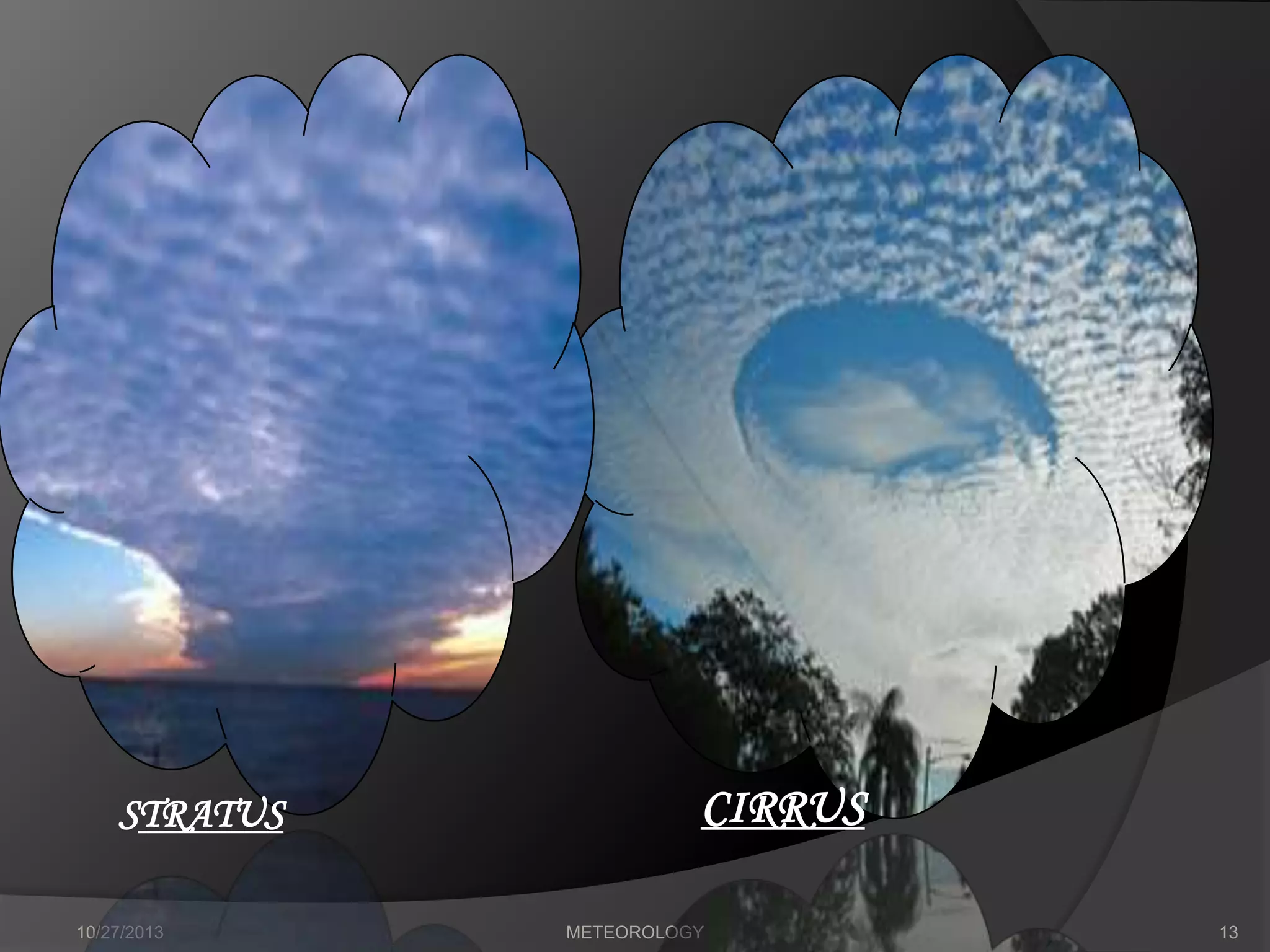
STRATUS
10/27/2013

CIRRUS
METEOROLOGY

13
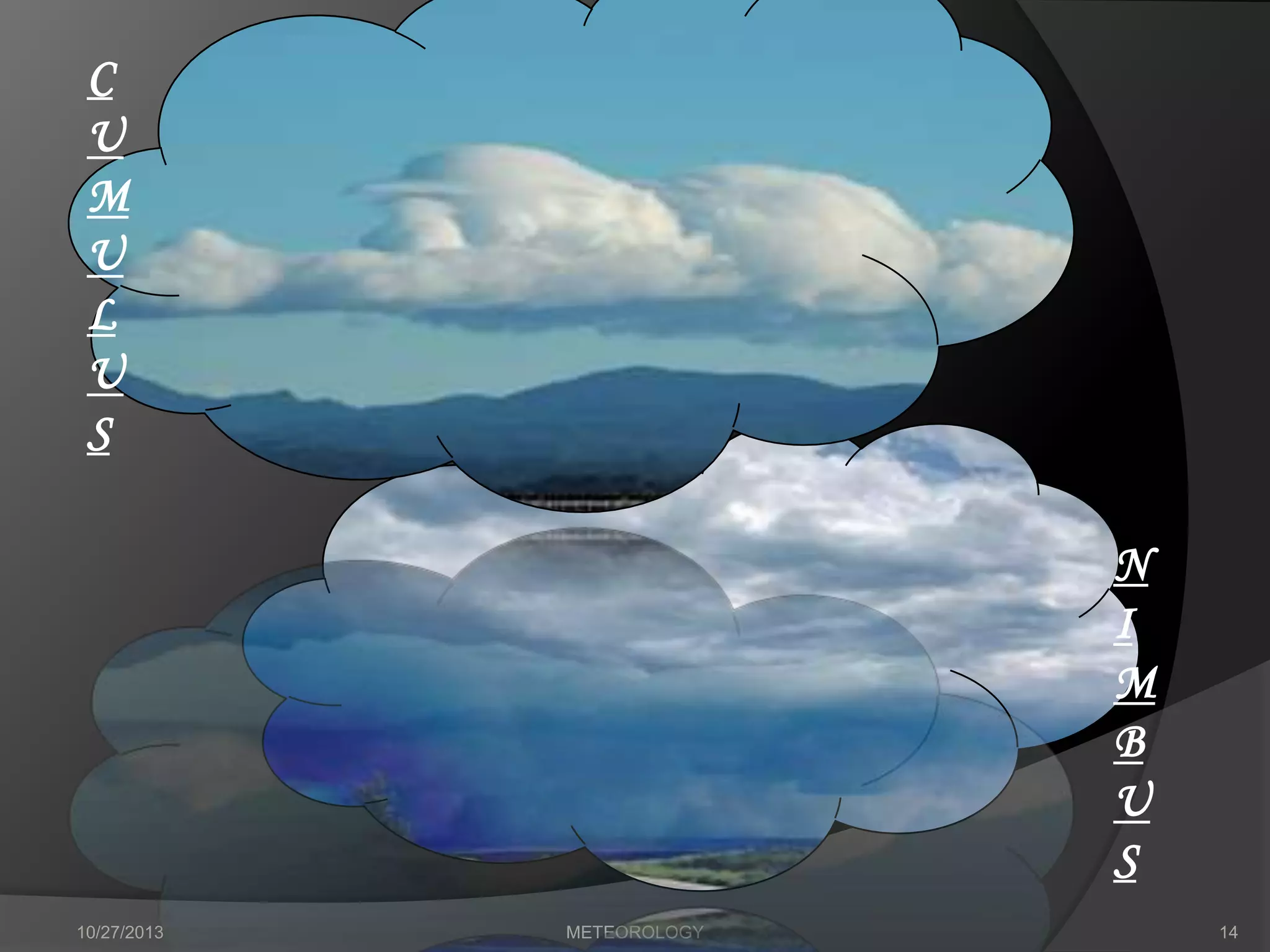
C
U
M
U
L
U
S
N
I
M
B
U
S
10/27/2013

METEOROLOGY

14
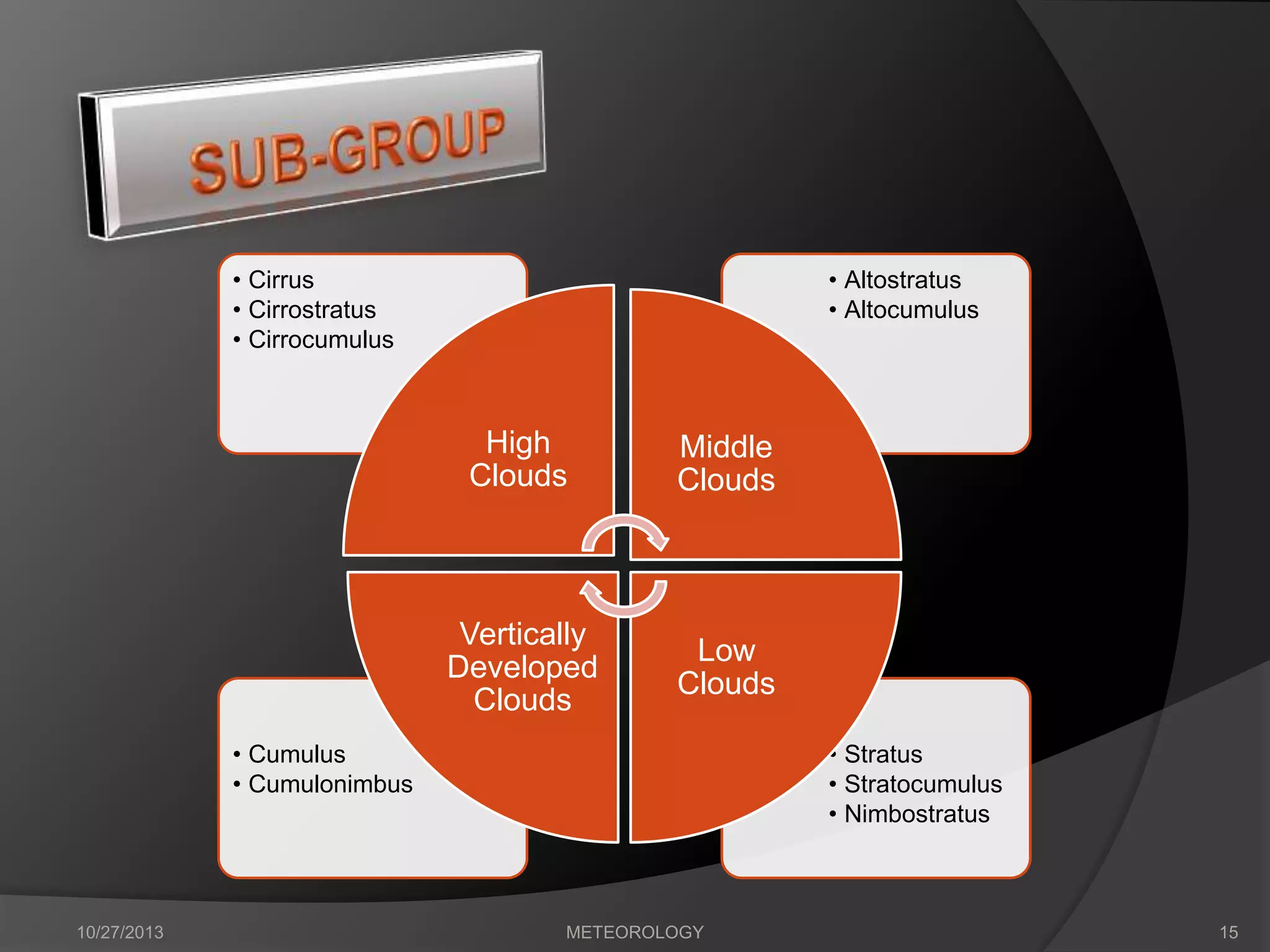
• Cirrus
• Cirrostratus
• Cirrocumulus

• Altostratus
• Altocumulus

High
Clouds

Middle
Clouds

Vertically
Developed
Clouds

Low
Clouds

• Cumulus
• Cumulonimbus

10/27/2013

• Stratus
• Stratocumulus
• Nimbostratus

METEOROLOGY

15
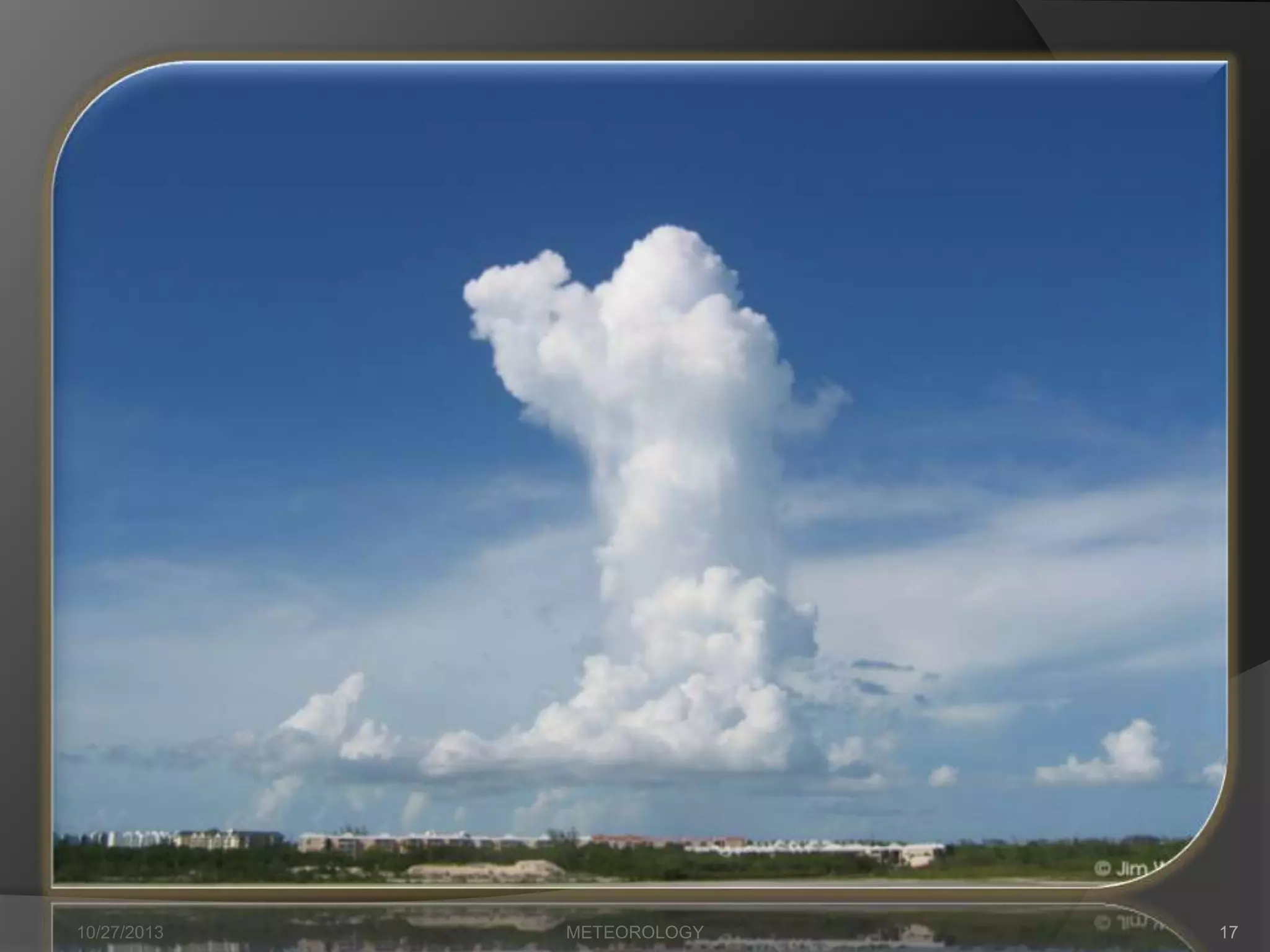
 They

are due to unstable atmospheric
conditions.
Height can range up to 12000m.
Generated most commonly either by
thermal convection or frontal lifting.
Releasing incredible amount of energy to
condensed the water vapor within the clouds.
10/27/2013

METEOROLOGY

16
10/27/2013

METEOROLOGY

17
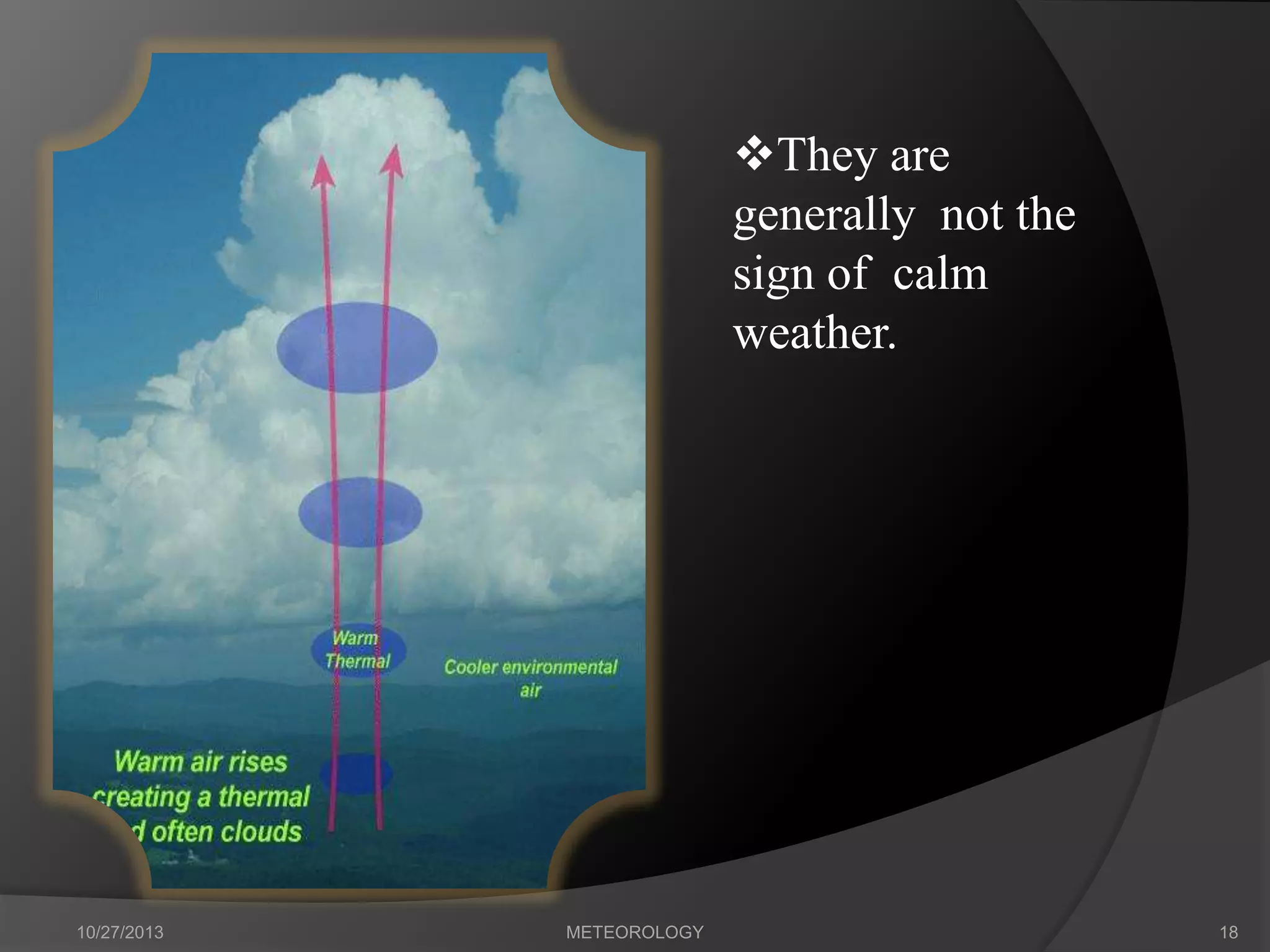
They are
generally not the
sign of calm
weather.

10/27/2013

METEOROLOGY

18
Vertically developed clouds are more
conveniently divided into 2 categories as:
1)Cumulus Clouds
i. Cumulus Humilis Clouds
ii. Cumulus Fractus Clouds
iii. Cumulus Congestus Clouds
iv. Cumulus Constellus Clouds
2)Cumulonimbus Clouds
i. Cumulonimbus Incus Clouds
ii. Cumulonimbus Mammatus Clouds
iii. Cumulonimbus Calvus Clouds
10/27/2013

METEOROLOGY

19
They look like white ball of cotton _ isolated in sky.
Are sign of pleasant weather.
They have flat bottoms and lumpy tops.
Top often is in the form of towers--- shows the limit
of rising air.

Formation :
Rising air is associated with high relative humidity.
Generally they are formed by convection resulting
from solar heating in summers.
Over open lakes in autumn and winters.
10/27/2013

METEOROLOGY

20
10/27/2013

METEOROLOGY

21
They are found as low as 330ft.

10/27/2013

METEOROLOGY

22
Humilis stands for “HUMBLE.”
Generally have flattened bases and slight vertical
development.
Mostly rises up to 5-8km.

Formation :
Once the thermals rise above the surface, the
potential for cloud development increases.
At the condensation level, the relative humidity of
the thermal air will be around 100 percent (saturated).

10/27/2013

METEOROLOGY

23
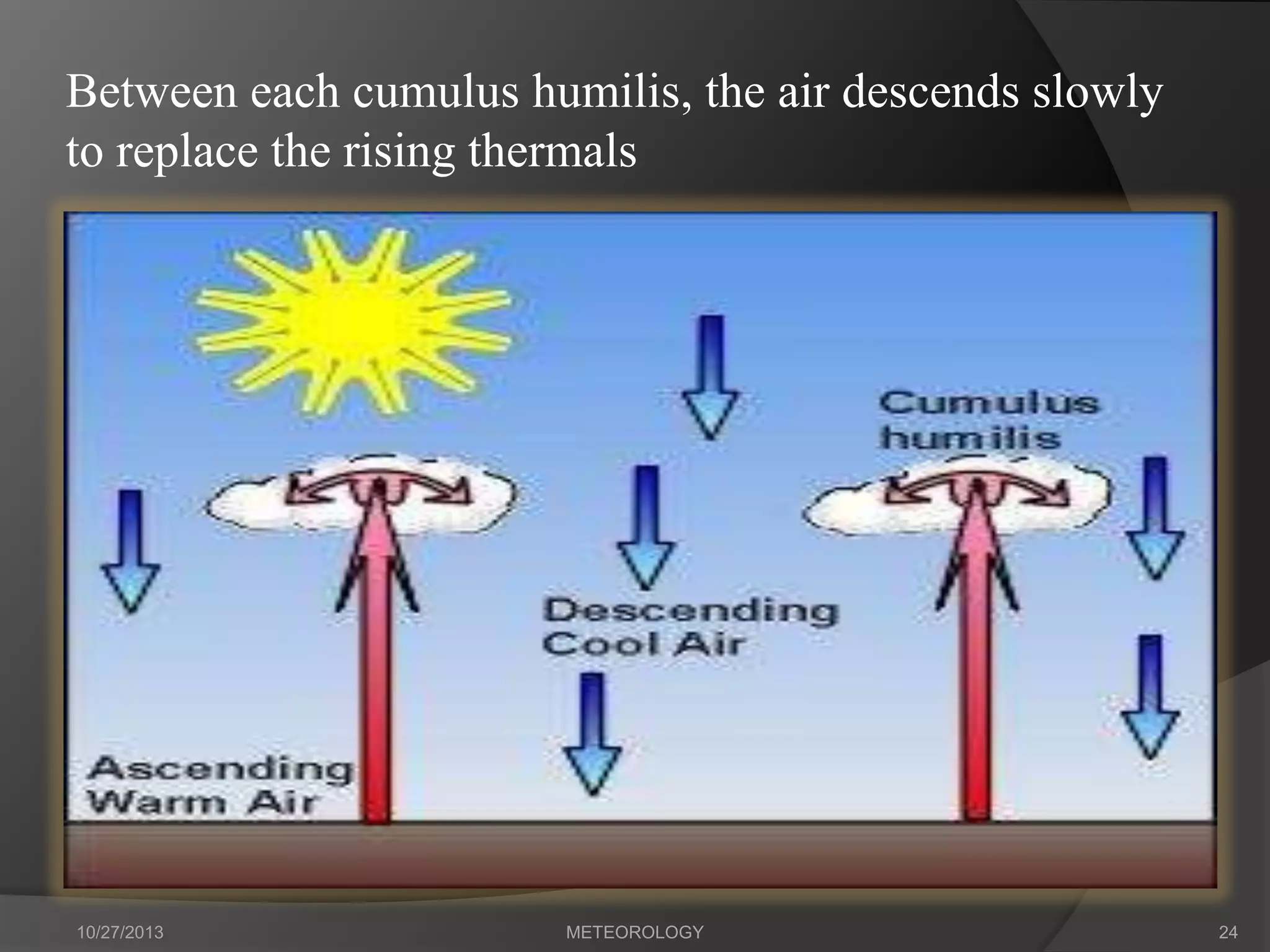
Between each cumulus humilis, the air descends slowly
to replace the rising thermals

10/27/2013

METEOROLOGY

24
As a
result, t
he
cloud field
can
look
very
regularl
-y
Spaced.

10/27/2013

METEOROLOGY

25
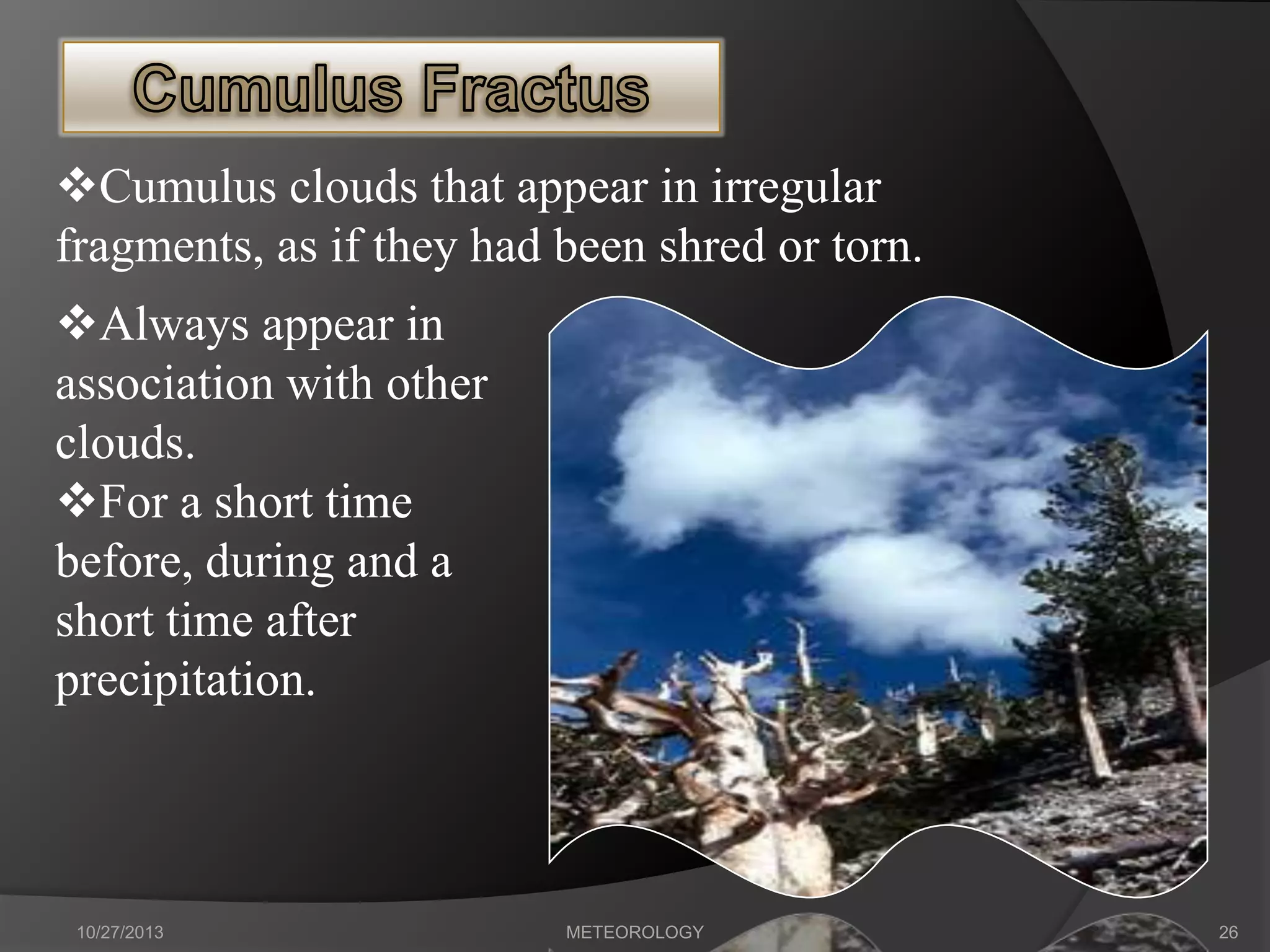
Cumulus clouds that appear in irregular
fragments, as if they had been shred or torn.

Always appear in
association with other
clouds.
For a short time
before, during and a
short time after
precipitation.

10/27/2013

METEOROLOGY

26
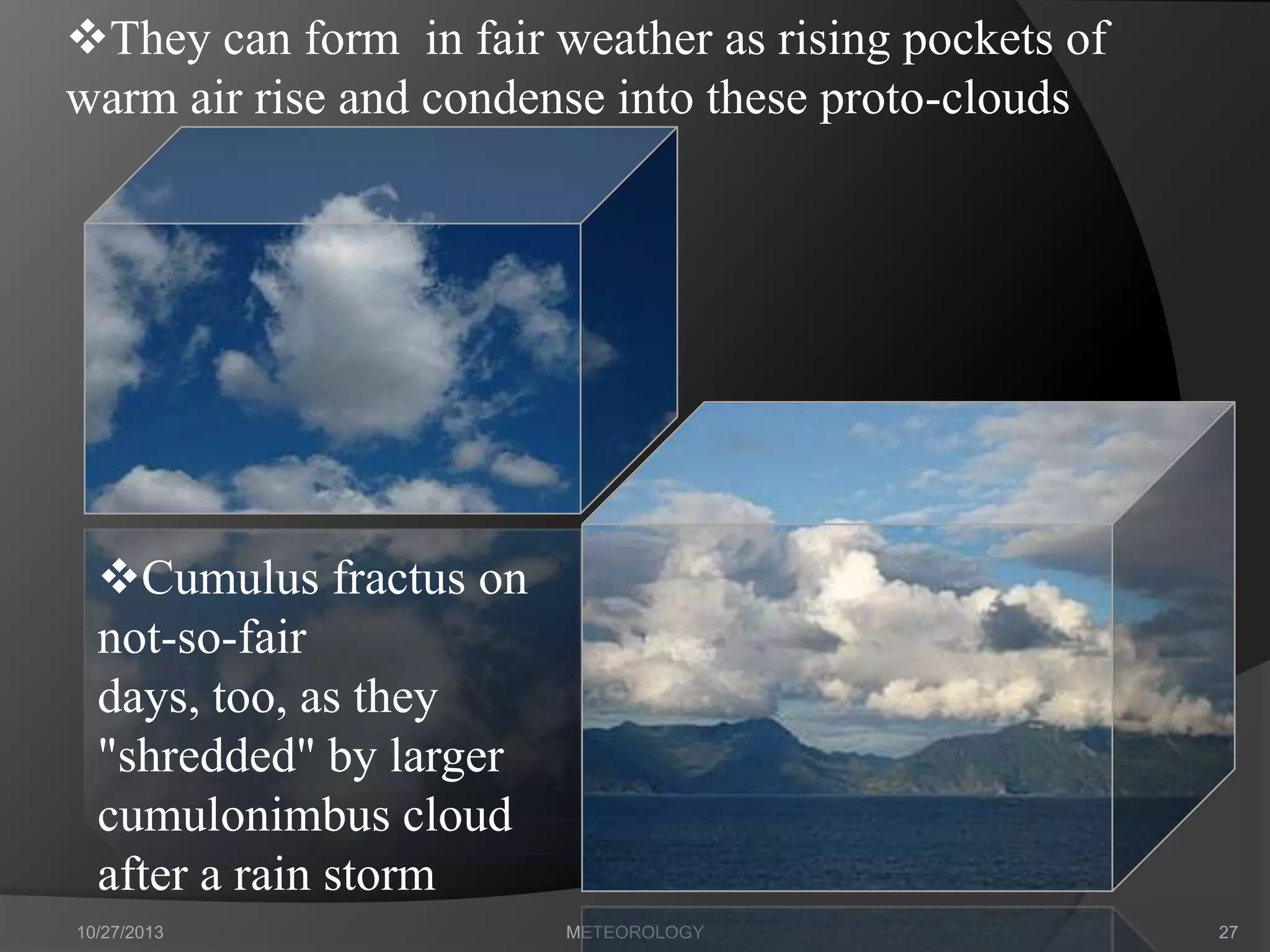
They can form in fair weather as rising pockets of
warm air rise and condense into these proto-clouds

Cumulus fractus on
not-so-fair
days, too, as they
"shredded" by larger
cumulonimbus cloud
after a rain storm
10/27/2013

METEOROLOGY

27
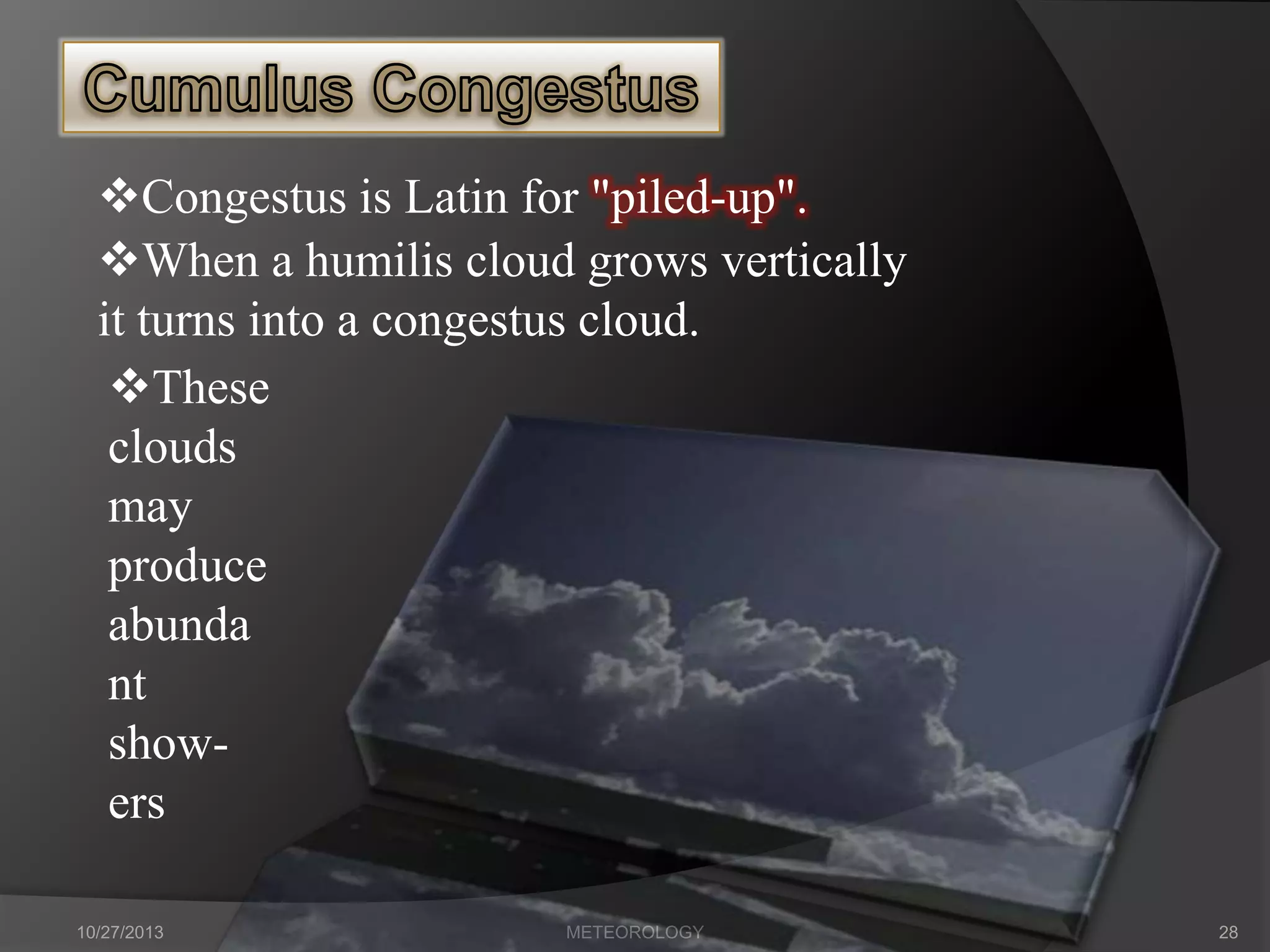
Congestus is Latin for "piled-up".
When a humilis cloud grows vertically
it turns into a congestus cloud.
These
clouds
may
produce
abunda
nt
showers
10/27/2013

METEOROLOGY

28
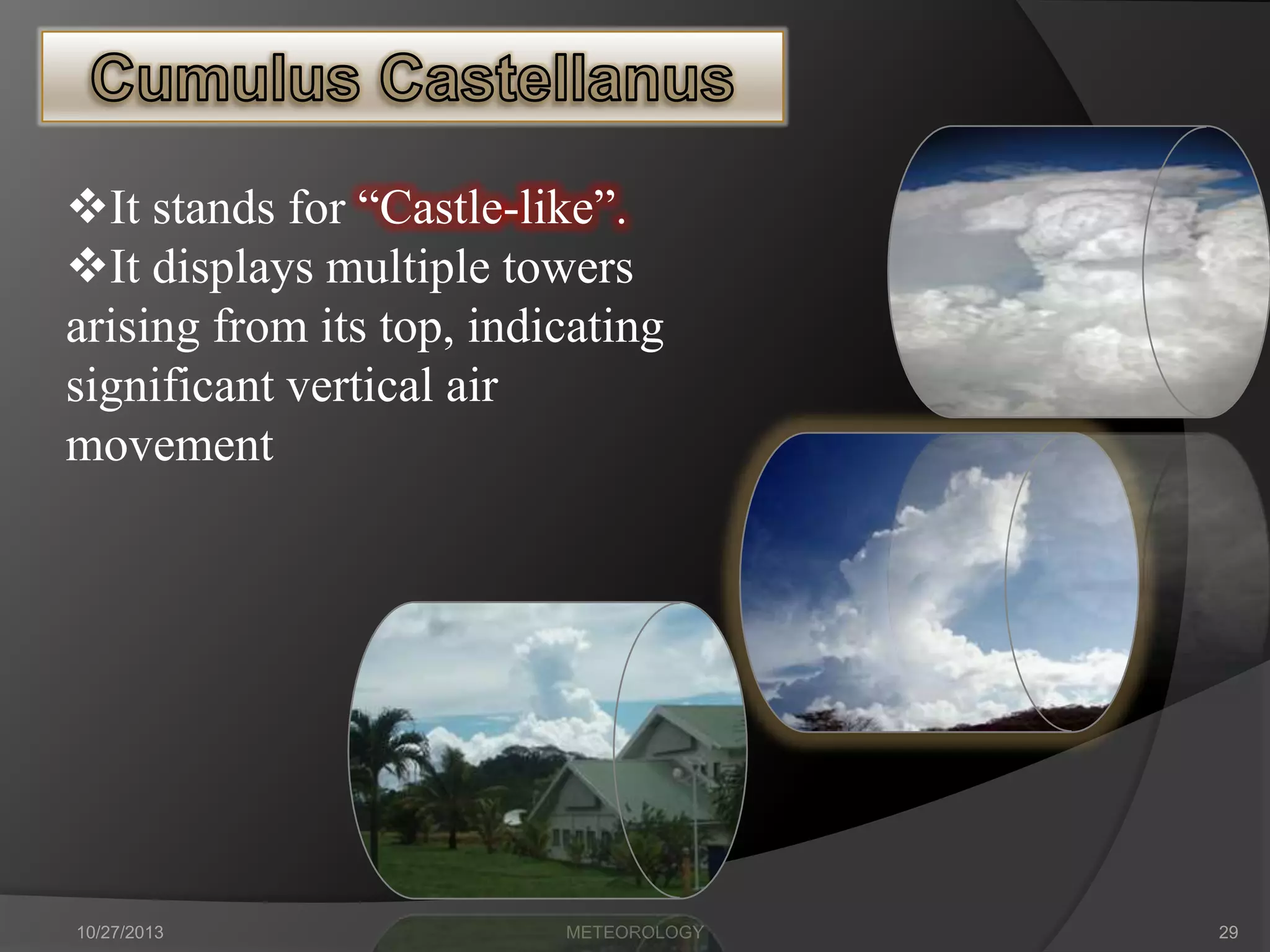
It stands for “Castle-like”.
It displays multiple towers
arising from its top, indicating
significant vertical air
movement

10/27/2013

METEOROLOGY

29
10/27/2013

METEOROLOGY

30
These clouds are named because they are puffy
("cumulo") and because they often are dark clouds
which cause rainstorms ("nimbus").
Cumulonimbus clouds are characterized
as tall, dense clouds

These are more vertically developed than fair
weather cumulus and have tops that can reach up to
39,000 feet (12,000m).
These are fueled by strong updrafts that transfer air
up through the atmosphere.
10/27/2013

METEOROLOGY

31
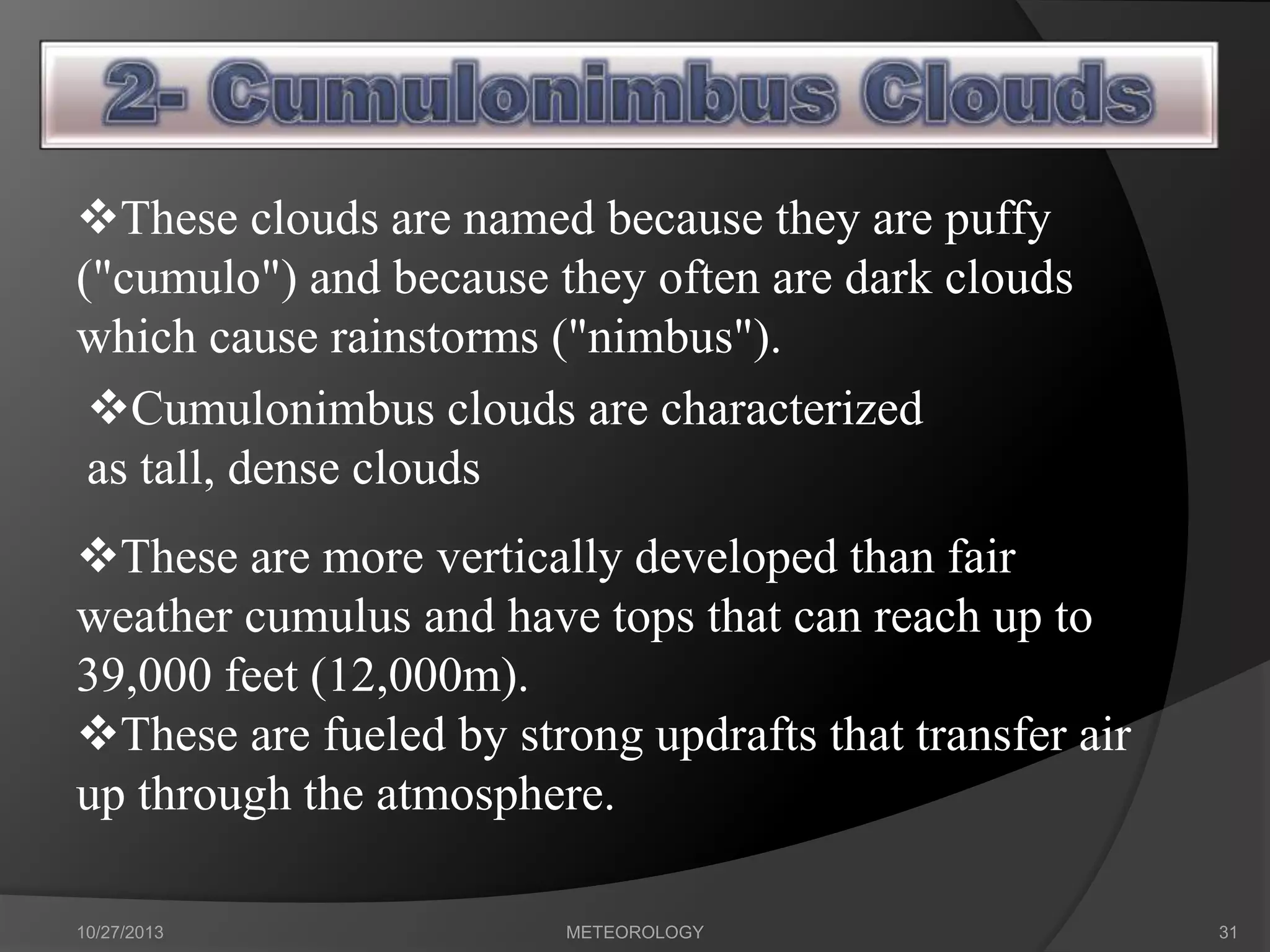
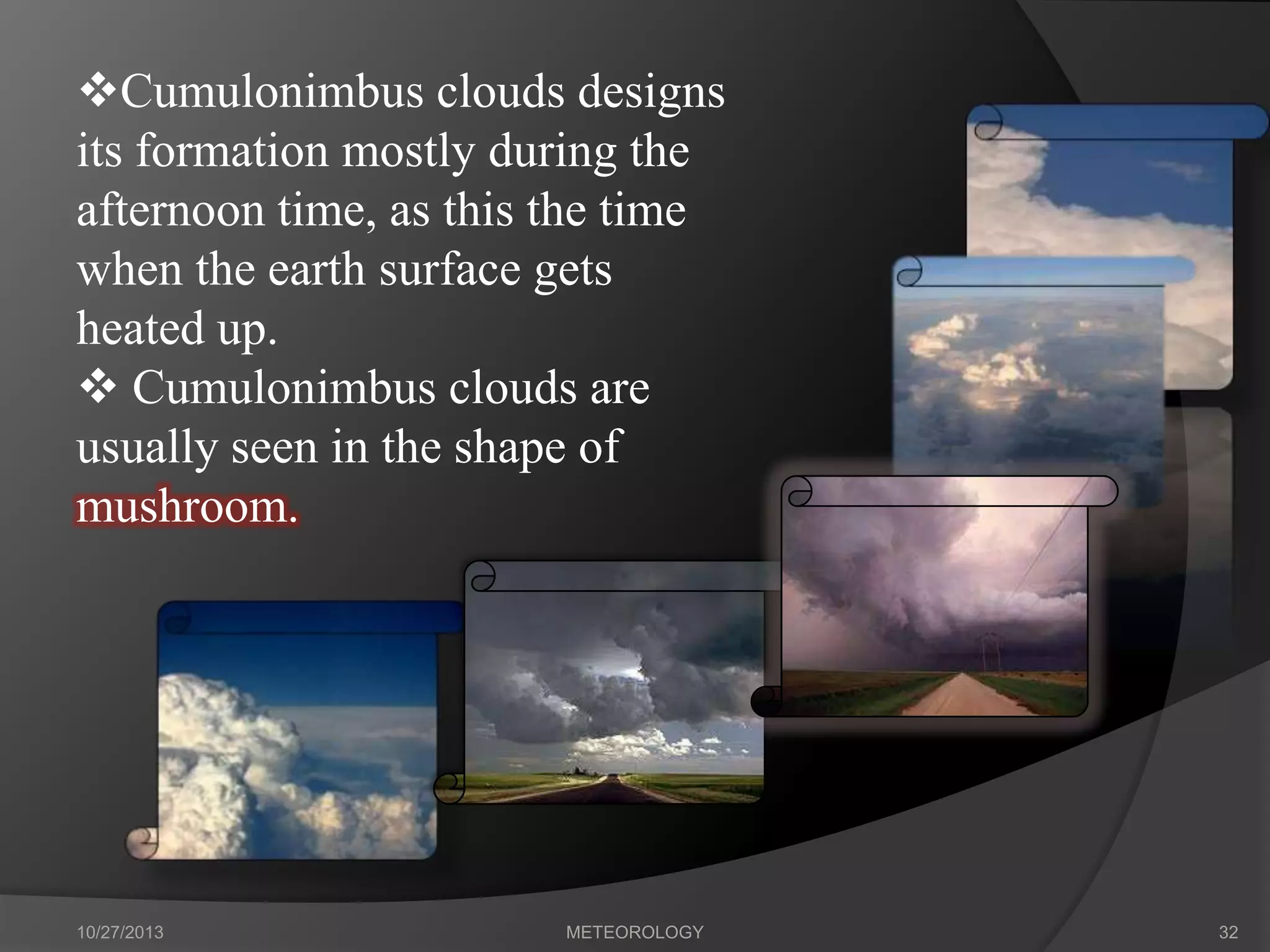
Cumulonimbus clouds designs
its formation mostly during the
afternoon time, as this the time
when the earth surface gets
heated up.
 Cumulonimbus clouds are
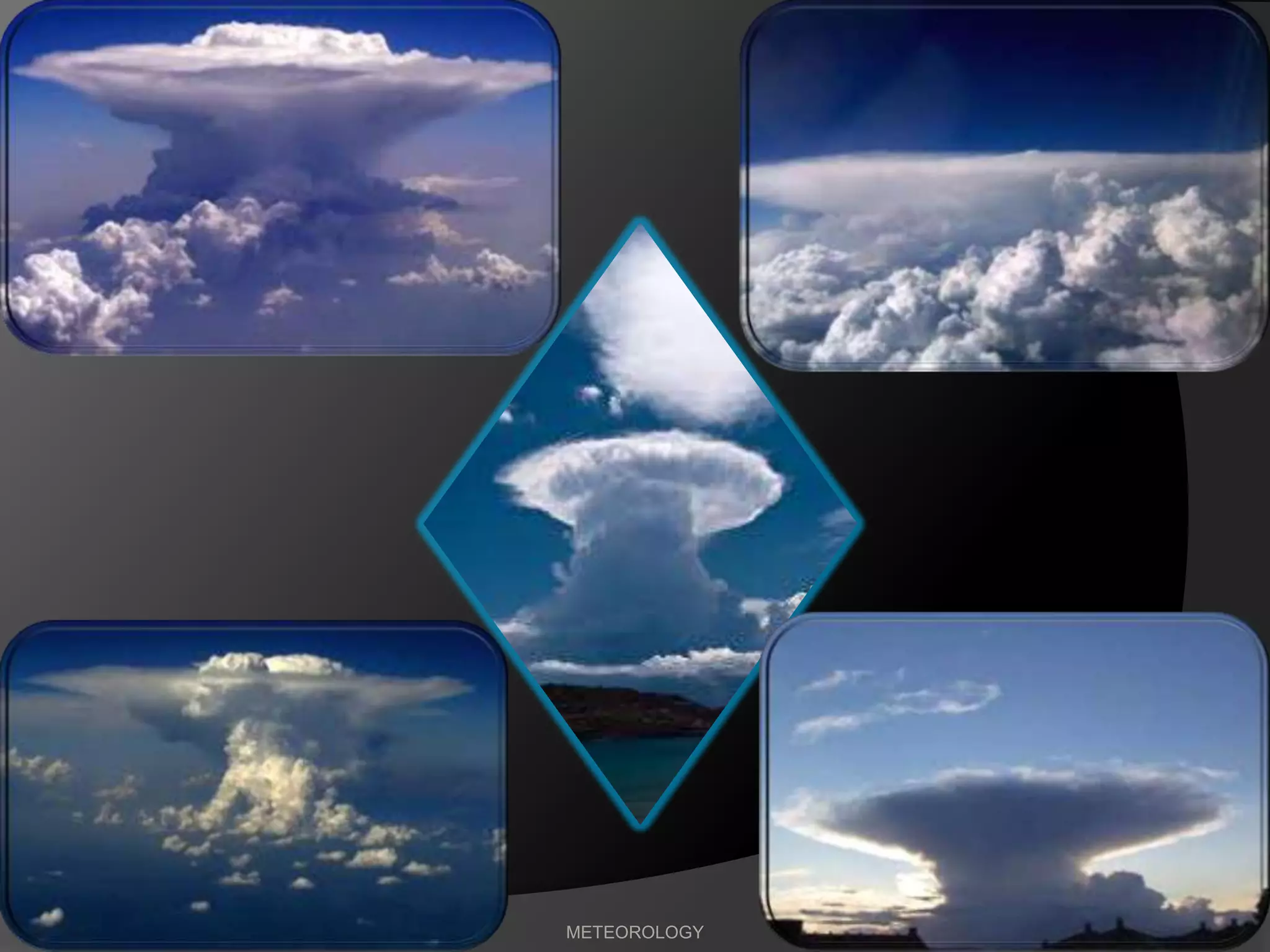
usually seen in the shape of
mushroom.

10/27/2013

METEOROLOGY

32
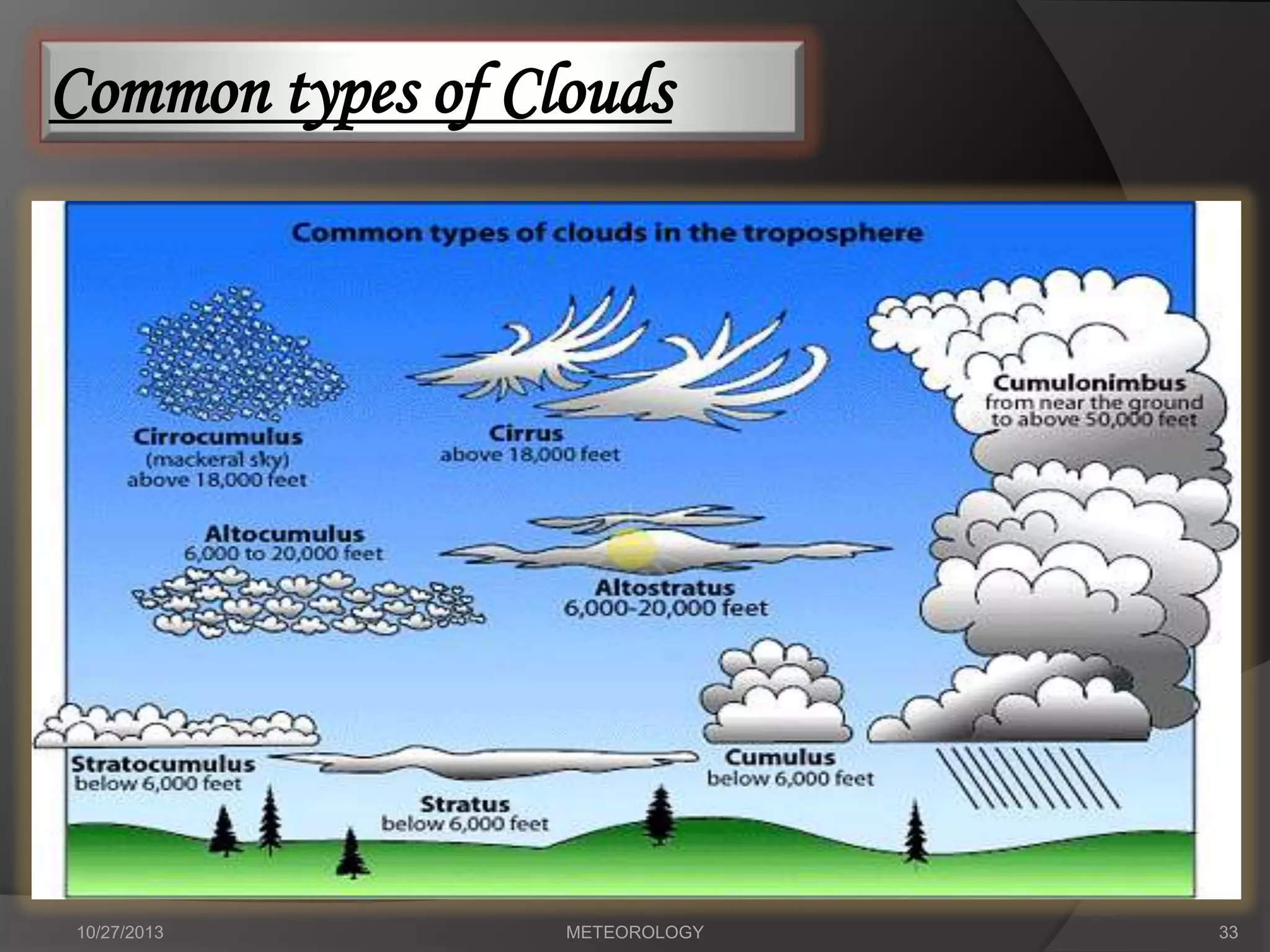
Common types of Clouds

10/27/2013

METEOROLOGY

33
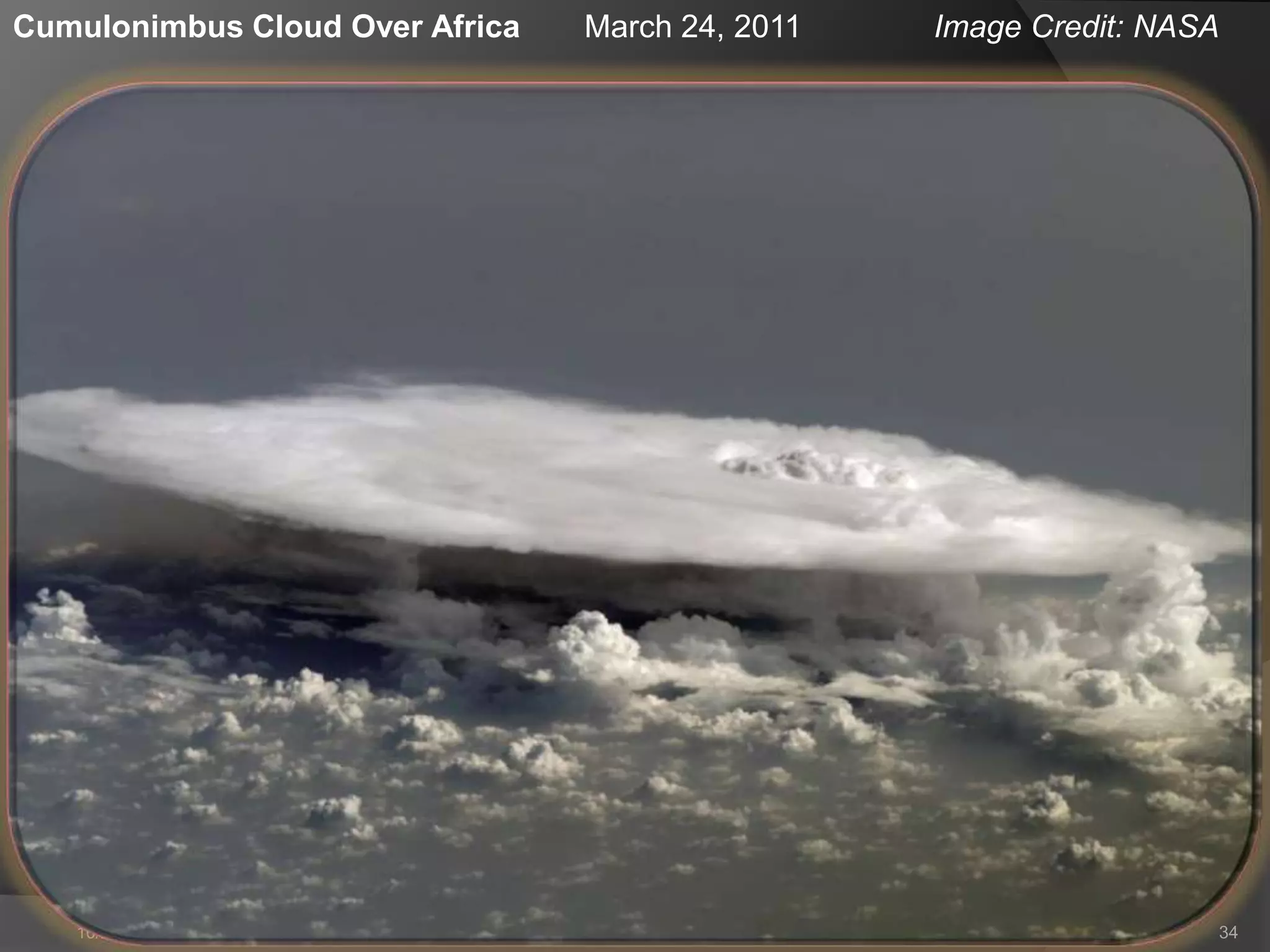
Cumulonimbus Cloud Over Africa

10/27/2013

March 24, 2011

METEOROLOGY

Image Credit: NASA

34
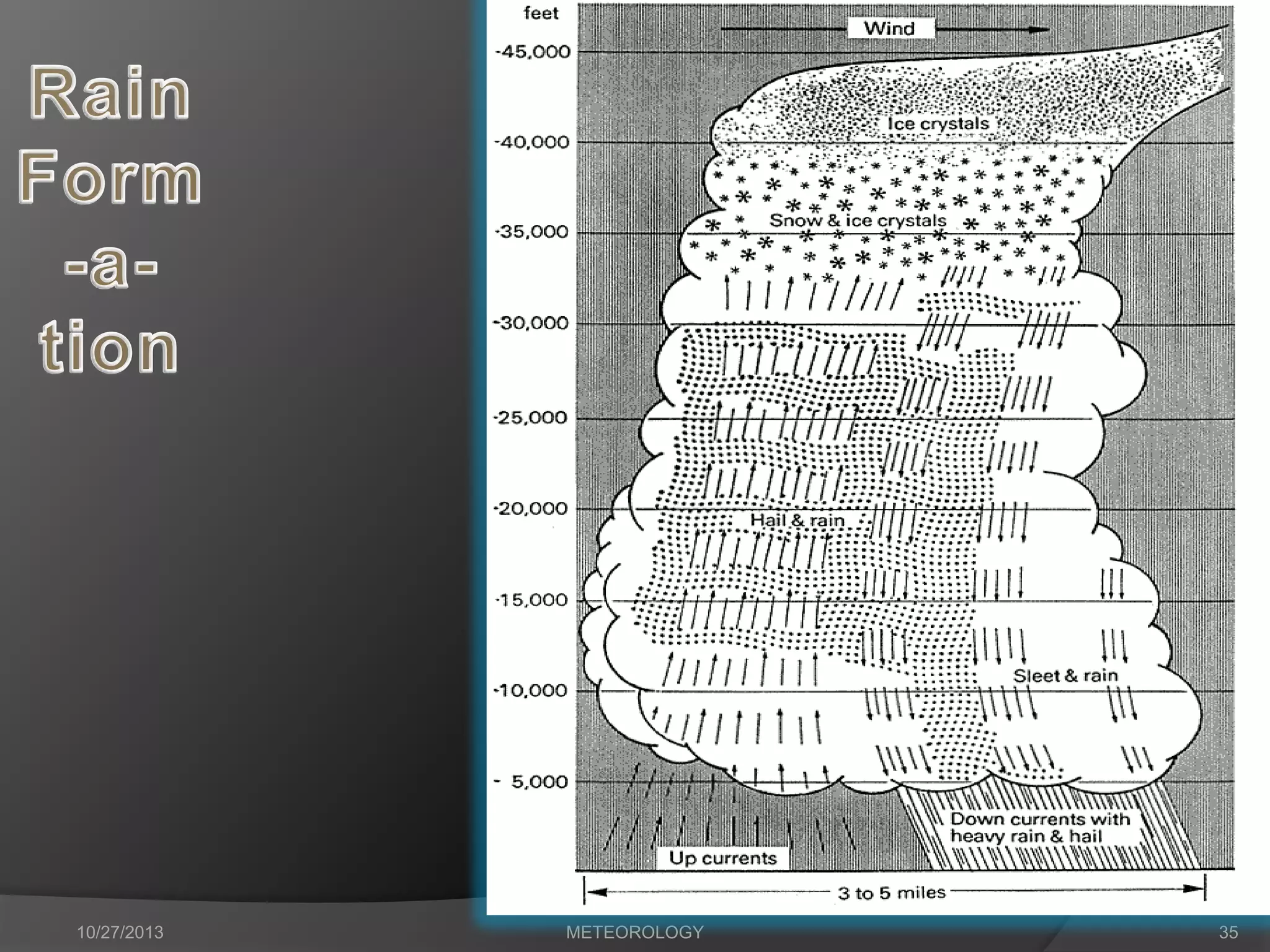
10/27/2013

METEOROLOGY

35
Incus stands for “Anvil”.
A mature cumulonimbus incus is definitely the
“King of Clouds”, and sometimes reaching 60,000 feet
in tropical and subtropical areas.
Formation always be regarded as a significant
aviation hazard because of :
“the powerful air currents involved in its formation and
the potentially damaging effect of the large hailstones it
may produce.”

10/27/2013

METEOROLOGY

36
10/27/2013

METEOROLOGY

37
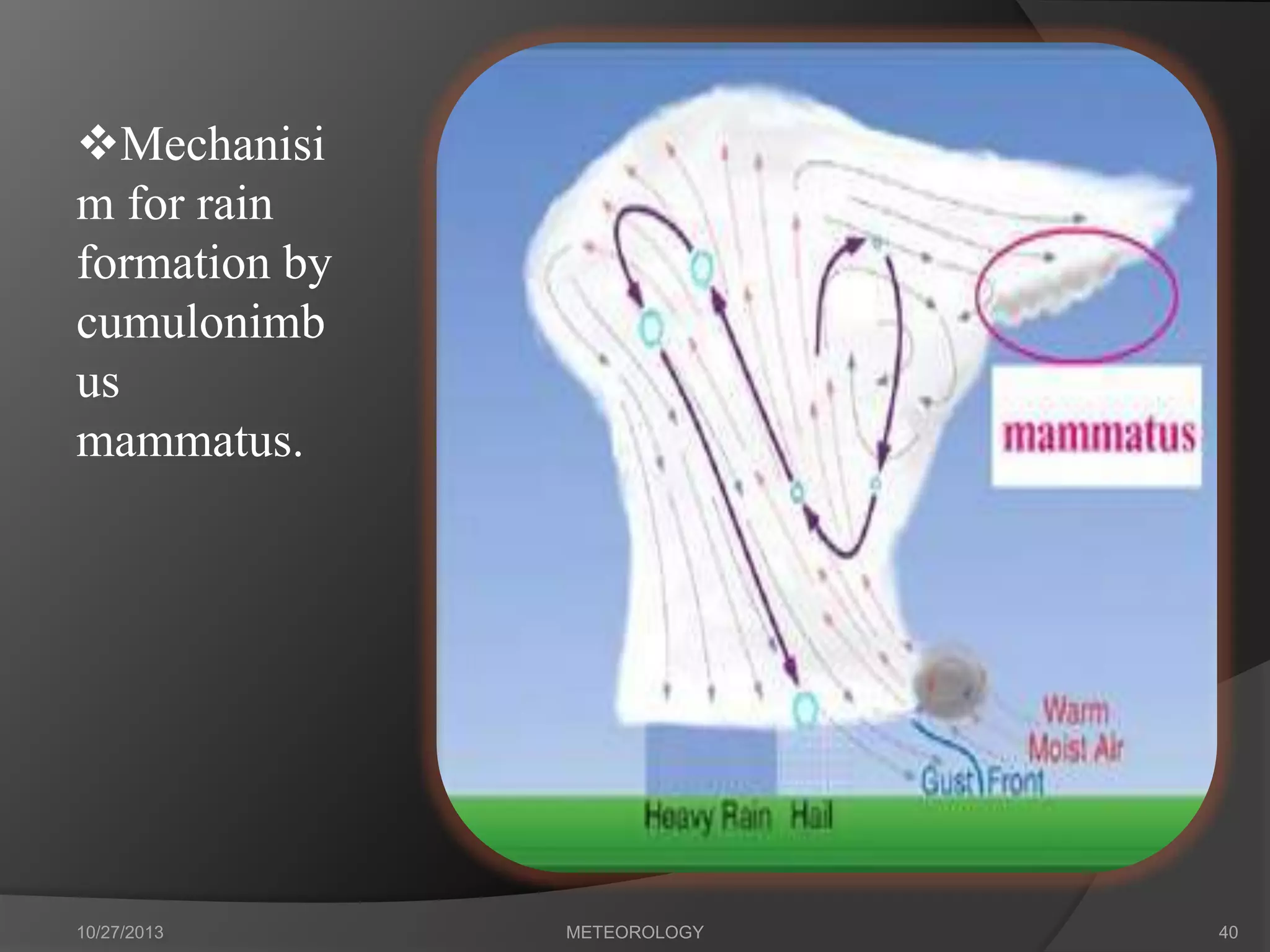
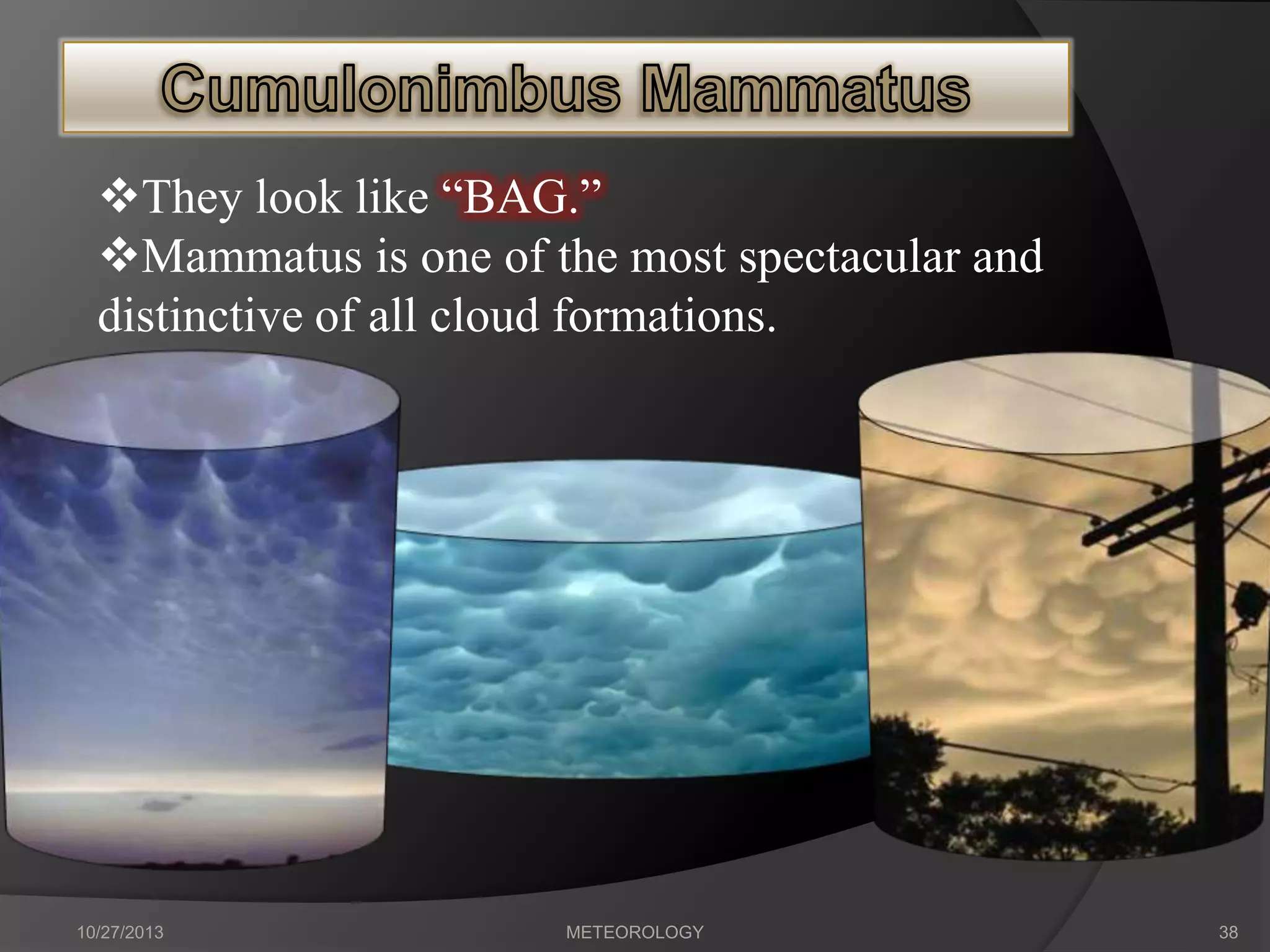
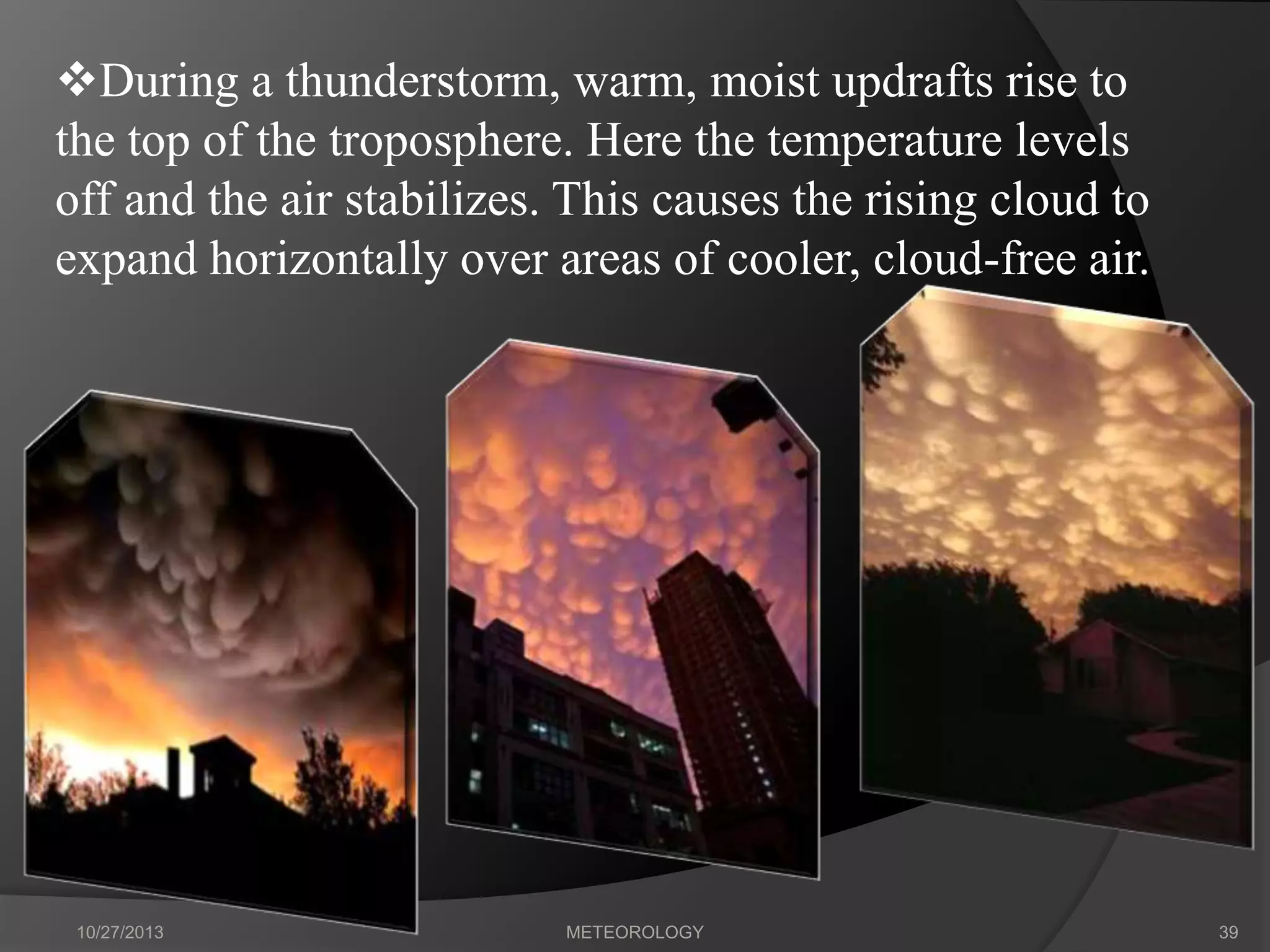
They look like “BAG.”
Mammatus is one of the most spectacular and
distinctive of all cloud formations.

10/27/2013

METEOROLOGY

38
During a thunderstorm, warm, moist updrafts rise to
the top of the troposphere. Here the temperature levels
off and the air stabilizes. This causes the rising cloud to
expand horizontally over areas of cooler, cloud-free air.

10/27/2013

METEOROLOGY

39
Mechanisi
m for rain
formation by
cumulonimb
us
mammatus.

10/27/2013

METEOROLOGY

40
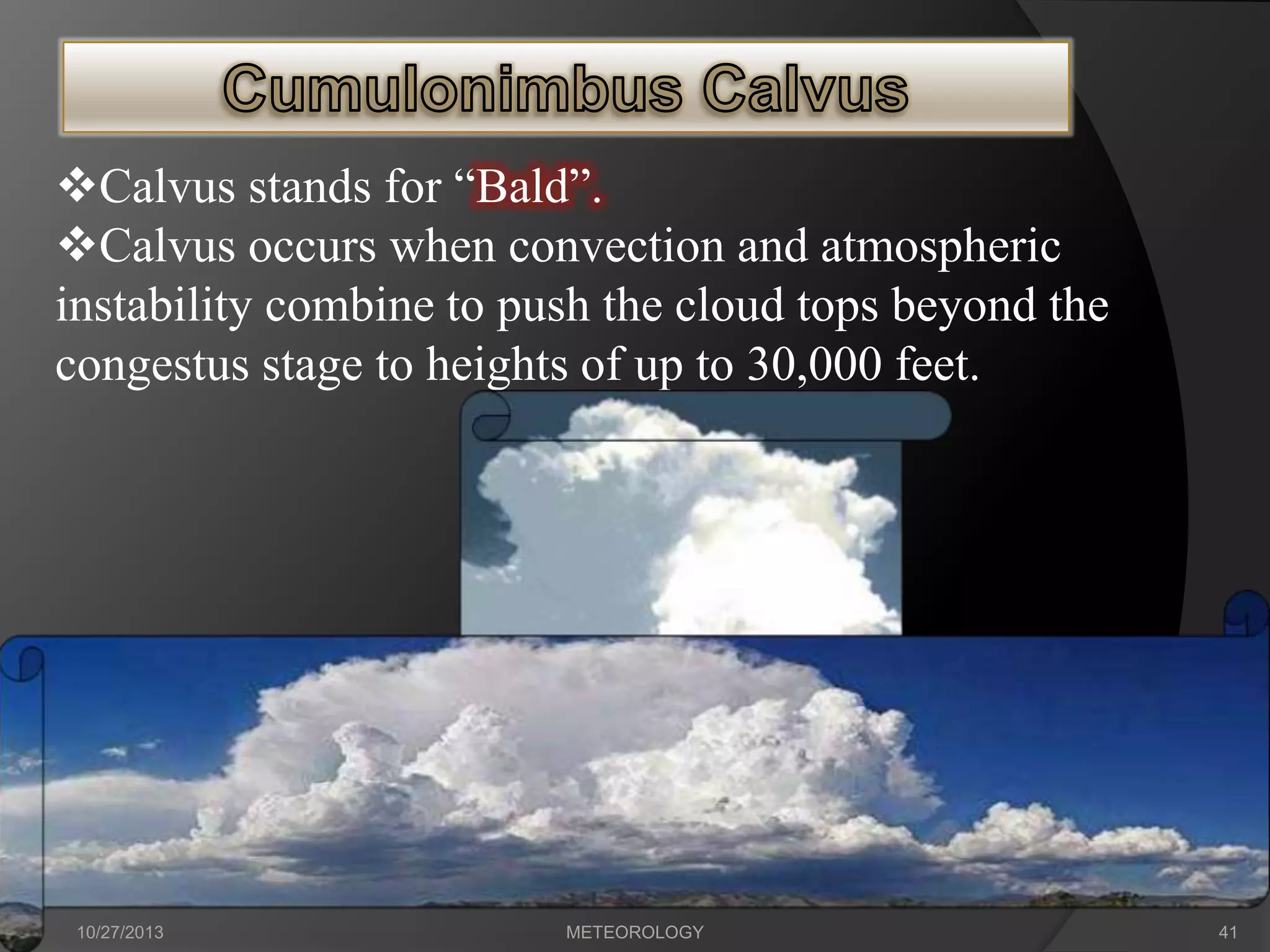
Calvus stands for “Bald”.
Calvus occurs when convection and atmospheric
instability combine to push the cloud tops beyond the
congestus stage to heights of up to 30,000 feet.

10/27/2013

METEOROLOGY

41
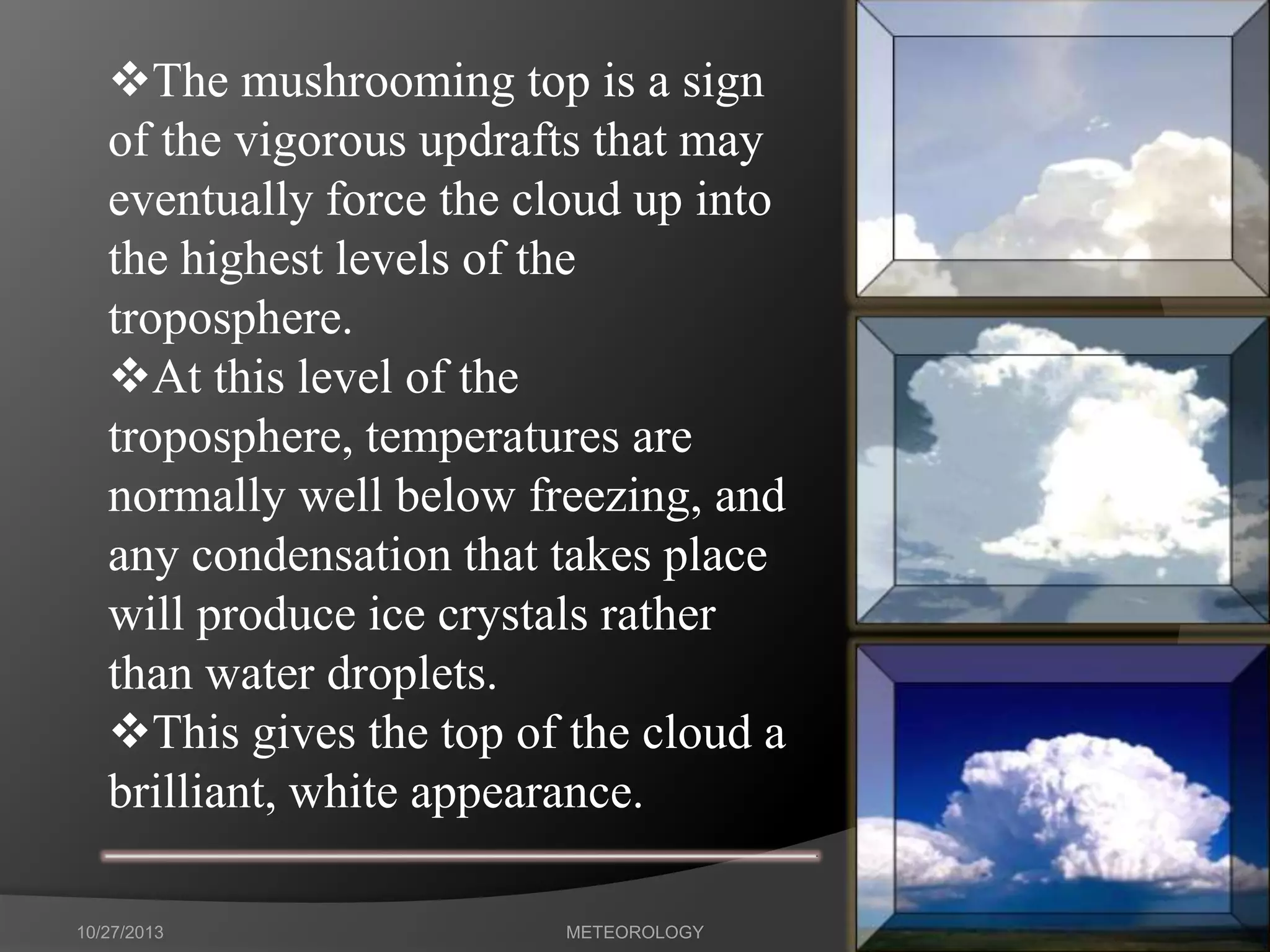
The mushrooming top is a sign
of the vigorous updrafts that may
eventually force the cloud up into
the highest levels of the
troposphere.
At this level of the
troposphere, temperatures are
normally well below freezing, and
any condensation that takes place
will produce ice crystals rather
than water droplets.
This gives the top of the cloud a
brilliant, white appearance.
10/27/2013

METEOROLOGY

42
10/27/2013

METEOROLOGY

43
1. www.buzzel.com
2. www.uwsp.com
3. www.atmosphere.com
4. www.uiuc.com
5. www.climate4you.com
6. www.apollo.com
7. www.merrian.com
8. www.anglefire.com
9. www.cityofportsomuth.com
10.www.mapmakermeteor.com
11.www.islandnet.com
12.www.jeffsweather.com
13.www.mariauthorbooks.com
14.www.chitambo.com
10/27/2013

15. www.trueknowldge.com
16. www.chalkrichmond.co
m
17. www.mapsofworld.com
18. www.airlinepilots.com

1. Google.com

1. Meteorology Today
by C. Donald Ahrens
6th edition
METEOROLOGY

44

Clouds 2011

  • 1.
  • 2.
    Definition of clouds …03 Formationof clouds …06 Classification of clouds …10 Vertically Developed clouds …16 Categories …19 1) Cumulus clouds …20 1) Hmulis …23 2) Fractus …26 3) Congestus …28 4) Castellanus …29 2) Cumulonimbus clouds …31 1) Cumulonimbus Incus …36 2) Cumulonimbus Mammatus …38 3) Cumulonimbus Calvus …41 6) References …44 1) 2) 3) 4) 5) 10/27/2013 METEOROLOGY 2
  • 3.
     “A visiblecollection of CONDENSED tiny water droplets and ice crystals suspended in the atmosphere.” Clouds can be in variety of forms.  Some are found at high elevation but other are near the ground relatively 10/27/2013 METEOROLOGY 3
  • 4.
  • 5.
    All the weathering phenomenon occurs dueto the clouds… ranges within the troposphere.  10/27/2013 METEOROLOGY 5
  • 6.
     Water isknown to exist in three forms:  Clouds, snow and rain are all made up of some form of water. 10/27/2013 METEOROLOGY 6
  • 7.
     Generally produced byatmospheric motion with upward component cools the air.  Clouds form when temperature is below the dew point.  When air blows over the colder surface. 10/27/2013 METEOROLOGY 7
  • 8.
    By orographic upliftof air near the mountainous terrain. 10/27/2013 METEOROLOGY 8
  • 9.
     Air parcelwill rise up naturally if the air within it is warmer than the surrounding air by convection. 10/27/2013 METEOROLOGY 9
  • 10.
    Clouds are classifiedinto a system that uses “Latin” words to describe their appearances. They are define on the basis of their “Heights”. This was done by an English chemist “Luke Howard” in 1803. 10/27/2013 METEOROLOGY 10
  • 11.
    HOWARD divided theminto 4 categories using Latin names as: LATIN NAMES ENGLISH NAMES Cirrus Curl of hair Stratus Layer like Cumulus Heap Nimbus Rain 10/27/2013 METEOROLOGY 11
  • 12.
     They arefurther divided into 4 groups having 10 types of the clouds: GROUPS HEIGHTS High Clouds 5-13km Middle Clouds 2-7km Low Clouds 0-2km Vertically Developed Clouds --- The first 3 groups are differentiating by their heights. The fourth group contains thick clouds as they are NOT describe on the basis of heights level from grounds. 10/27/2013 METEOROLOGY 12
  • 13.
  • 14.
  • 15.
    • Cirrus • Cirrostratus •Cirrocumulus • Altostratus • Altocumulus High Clouds Middle Clouds Vertically Developed Clouds Low Clouds • Cumulus • Cumulonimbus 10/27/2013 • Stratus • Stratocumulus • Nimbostratus METEOROLOGY 15
  • 16.
     They are dueto unstable atmospheric conditions. Height can range up to 12000m. Generated most commonly either by thermal convection or frontal lifting. Releasing incredible amount of energy to condensed the water vapor within the clouds. 10/27/2013 METEOROLOGY 16
  • 17.
  • 18.
    They are generally notthe sign of calm weather. 10/27/2013 METEOROLOGY 18
  • 19.
    Vertically developed cloudsare more conveniently divided into 2 categories as: 1)Cumulus Clouds i. Cumulus Humilis Clouds ii. Cumulus Fractus Clouds iii. Cumulus Congestus Clouds iv. Cumulus Constellus Clouds 2)Cumulonimbus Clouds i. Cumulonimbus Incus Clouds ii. Cumulonimbus Mammatus Clouds iii. Cumulonimbus Calvus Clouds 10/27/2013 METEOROLOGY 19
  • 20.
    They look likewhite ball of cotton _ isolated in sky. Are sign of pleasant weather. They have flat bottoms and lumpy tops. Top often is in the form of towers--- shows the limit of rising air. Formation : Rising air is associated with high relative humidity. Generally they are formed by convection resulting from solar heating in summers. Over open lakes in autumn and winters. 10/27/2013 METEOROLOGY 20
  • 21.
  • 22.
    They are foundas low as 330ft. 10/27/2013 METEOROLOGY 22
  • 23.
    Humilis stands for“HUMBLE.” Generally have flattened bases and slight vertical development. Mostly rises up to 5-8km. Formation : Once the thermals rise above the surface, the potential for cloud development increases. At the condensation level, the relative humidity of the thermal air will be around 100 percent (saturated). 10/27/2013 METEOROLOGY 23
  • 24.
    Between each cumulushumilis, the air descends slowly to replace the rising thermals 10/27/2013 METEOROLOGY 24
  • 25.
    As a result, t he cloudfield can look very regularl -y Spaced. 10/27/2013 METEOROLOGY 25
  • 26.
    Cumulus clouds thatappear in irregular fragments, as if they had been shred or torn. Always appear in association with other clouds. For a short time before, during and a short time after precipitation. 10/27/2013 METEOROLOGY 26
  • 27.
    They can formin fair weather as rising pockets of warm air rise and condense into these proto-clouds Cumulus fractus on not-so-fair days, too, as they "shredded" by larger cumulonimbus cloud after a rain storm 10/27/2013 METEOROLOGY 27
  • 28.
    Congestus is Latinfor "piled-up". When a humilis cloud grows vertically it turns into a congestus cloud. These clouds may produce abunda nt showers 10/27/2013 METEOROLOGY 28
  • 29.
    It stands for“Castle-like”. It displays multiple towers arising from its top, indicating significant vertical air movement 10/27/2013 METEOROLOGY 29
  • 30.
  • 31.
    These clouds arenamed because they are puffy ("cumulo") and because they often are dark clouds which cause rainstorms ("nimbus"). Cumulonimbus clouds are characterized as tall, dense clouds These are more vertically developed than fair weather cumulus and have tops that can reach up to 39,000 feet (12,000m). These are fueled by strong updrafts that transfer air up through the atmosphere. 10/27/2013 METEOROLOGY 31
  • 32.
    Cumulonimbus clouds designs itsformation mostly during the afternoon time, as this the time when the earth surface gets heated up.  Cumulonimbus clouds are usually seen in the shape of mushroom. 10/27/2013 METEOROLOGY 32
  • 33.
    Common types ofClouds 10/27/2013 METEOROLOGY 33
  • 34.
    Cumulonimbus Cloud OverAfrica 10/27/2013 March 24, 2011 METEOROLOGY Image Credit: NASA 34
  • 35.
  • 36.
    Incus stands for“Anvil”. A mature cumulonimbus incus is definitely the “King of Clouds”, and sometimes reaching 60,000 feet in tropical and subtropical areas. Formation always be regarded as a significant aviation hazard because of : “the powerful air currents involved in its formation and the potentially damaging effect of the large hailstones it may produce.” 10/27/2013 METEOROLOGY 36
  • 37.
  • 38.
    They look like“BAG.” Mammatus is one of the most spectacular and distinctive of all cloud formations. 10/27/2013 METEOROLOGY 38
  • 39.
    During a thunderstorm,warm, moist updrafts rise to the top of the troposphere. Here the temperature levels off and the air stabilizes. This causes the rising cloud to expand horizontally over areas of cooler, cloud-free air. 10/27/2013 METEOROLOGY 39
  • 40.
    Mechanisi m for rain formationby cumulonimb us mammatus. 10/27/2013 METEOROLOGY 40
  • 41.
    Calvus stands for“Bald”. Calvus occurs when convection and atmospheric instability combine to push the cloud tops beyond the congestus stage to heights of up to 30,000 feet. 10/27/2013 METEOROLOGY 41
  • 42.
    The mushrooming topis a sign of the vigorous updrafts that may eventually force the cloud up into the highest levels of the troposphere. At this level of the troposphere, temperatures are normally well below freezing, and any condensation that takes place will produce ice crystals rather than water droplets. This gives the top of the cloud a brilliant, white appearance. 10/27/2013 METEOROLOGY 42
  • 43.
  • 44.
    1. www.buzzel.com 2. www.uwsp.com 3.www.atmosphere.com 4. www.uiuc.com 5. www.climate4you.com 6. www.apollo.com 7. www.merrian.com 8. www.anglefire.com 9. www.cityofportsomuth.com 10.www.mapmakermeteor.com 11.www.islandnet.com 12.www.jeffsweather.com 13.www.mariauthorbooks.com 14.www.chitambo.com 10/27/2013 15. www.trueknowldge.com 16. www.chalkrichmond.co m 17. www.mapsofworld.com 18. www.airlinepilots.com 1. Google.com 1. Meteorology Today by C. Donald Ahrens 6th edition METEOROLOGY 44