PowerPoint Presentation Prepared By:
Aneela Khalid & Qurat ul ain
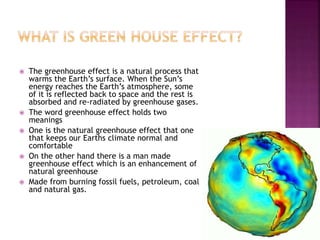
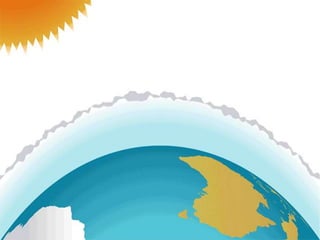
 The greenhouse effect is a natural process that
warms the Earth’s surface. When the Sun’s
energy reaches the Earth’s atmosphere, some
of it is reflected back to space and the rest is
absorbed and re-radiated by greenhouse gases.
 The word greenhouse effect holds two
meanings
 One is the natural greenhouse effect that one
that keeps our Earths climate normal and
comfortable
 On the other hand there is a man made
greenhouse effect which is an enhancement of
natural greenhouse
 Made from burning fossil fuels, petroleum, coal
and natural gas.
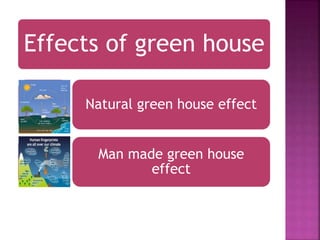
Effects of green house
Natural green house effect
Man made green house
effect
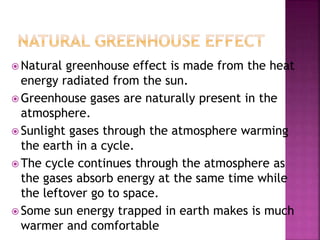
 Natural greenhouse effect is made from the heat
energy radiated from the sun.
 Greenhouse gases are naturally present in the
atmosphere.
 Sunlight gases through the atmosphere warming
the earth in a cycle.
 The cycle continues through the atmosphere as
the gases absorb energy at the same time while
the leftover go to space.
 Some sun energy trapped in earth makes is much
warmer and comfortable
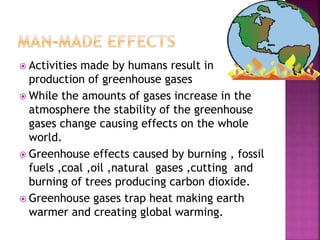
 Activities made by humans result in
production of greenhouse gases
 While the amounts of gases increase in the
atmosphere the stability of the greenhouse
gases change causing effects on the whole
world.
 Greenhouse effects caused by burning , fossil
fuels ,coal ,oil ,natural gases ,cutting and
burning of trees producing carbon dioxide.
 Greenhouse gases trap heat making earth
warmer and creating global warming.
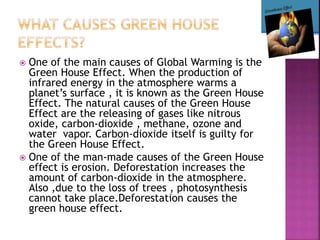
 One of the main causes of Global Warming is the
Green House Effect. When the production of
infrared energy in the atmosphere warms a
planet’s surface , it is known as the Green House
Effect. The natural causes of the Green House
Effect are the releasing of gases like nitrous
oxide, carbon-dioxide , methane, ozone and
water vapor. Carbon-dioxide itself is guilty for
the Green House Effect.
 One of the man-made causes of the Green House
effect is erosion. Deforestation increases the
amount of carbon-dioxide in the atmosphere.
Also ,due to the loss of trees , photosynthesis
cannot take place.Deforestation causes the
green house effect.
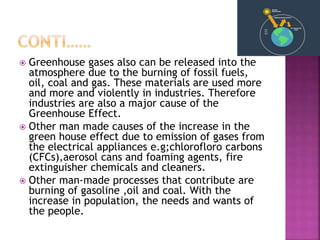
 Greenhouse gases also can be released into the
atmosphere due to the burning of fossil fuels,
oil, coal and gas. These materials are used more
and more and violently in industries. Therefore
industries are also a major cause of the
Greenhouse Effect.
 Other man made causes of the increase in the
green house effect due to emission of gases from
the electrical appliances e.g;chlorofloro carbons
(CFCs),aerosol cans and foaming agents, fire
extinguisher chemicals and cleaners.
 Other man-made processes that contribute are
burning of gasoline ,oil and coal. With the
increase in population, the needs and wants of
the people.
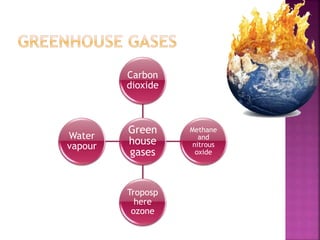
Green
house
gases
Carbon
dioxide
Methane
and
nitrous
oxide
Troposp
here
ozone
Water
vapour
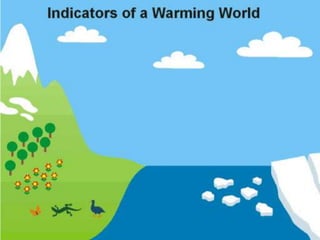
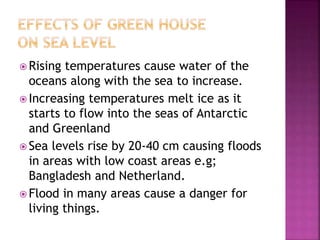
 Rising temperatures cause water of the
oceans along with the sea to increase.
 Increasing temperatures melt ice as it
starts to flow into the seas of Antarctic
and Greenland
 Sea levels rise by 20-40 cm causing floods
in areas with low coast areas e.g;
Bangladesh and Netherland.
 Flood in many areas cause a danger for
living things.
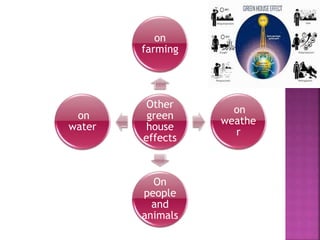
Other
green
house
effects
on
farming
on
weathe
r
On
people
and
animals
on
water
 El Nino and La Nina are opposite phases of what
is known as the El Nino-Southern
Oscillation(ENSO) cycle.
 The ENSO cycle is a scientific term that
describes the fluctuations in temperature
between the ocean and atmosphere in the east-
central Equatorial Pacific(approximately
between the International Date Line and 120
degrees West).
 La Nina is sometimes referred to as the cold
phase of ENSO and El Nino as the warm phase of
ENSO .These deviations from normal surface
temperatures can have large-scale impacts not
only on ocean processes, but also on global.
 El Nino and La Nina episodes typically last for
9 to 12 months, but some prolonged events
may last for years. They often begin to form
between June and August, reach peak
strength between December and April, and
then decay between May and July of the
following year. While their periodicity can be
quite irregular, El Nino and La Nina events
occur about every 3 to 5 years. Typically, El
Nino occurs more frequently than La Nina.
 El Nino means The Little Boy, or Christ Child in
Spanish.
 El Nino was originally recognized by fisherman
off the coast of South America in the 1600s, with
the appearance of unusually warm water in the
Pacific Ocean. The name was chosen based on
the time of year (around December) during
which these warm waters events tended to
occur.
 The term El Nino refers to the large-scale ocean-
atmosphere climate interaction linked to a
periodic warming in sea surface temperatures
across the central and ease-central Equatorial
Pacific.
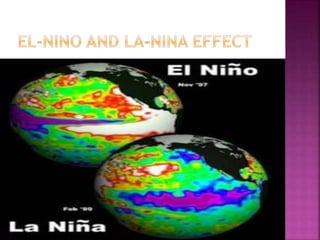
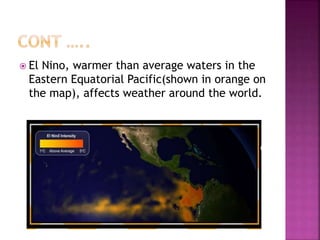
 El Nino, warmer than average waters in the
Eastern Equatorial Pacific(shown in orange on
the map), affects weather around the world.
 Rise in air pressure in the Indian Ocean,
Indoneshia, and Australia.
 A fall in air pressure over Tahiti and the rest
of central and eastern Pacific Ocean.
 The trade winds in the South Pacific
weakened or headed east.
 Warm air rises in Peru.
 Warm water spreads from the West Pacific
and the Indian Ocean to the East Pacific. It
takes the rain with it, causing rainfall in
normally dry areas and drought in normally
wet areas.
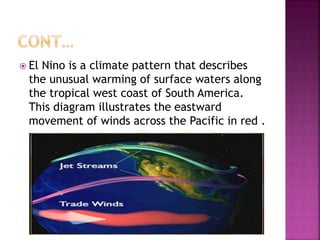
 El Nino is a climate pattern that describes
the unusual warming of surface waters along
the tropical west coast of South America.
This diagram illustrates the eastward
movement of winds across the Pacific in red .
 Wet winters overs south-eastern
United States.
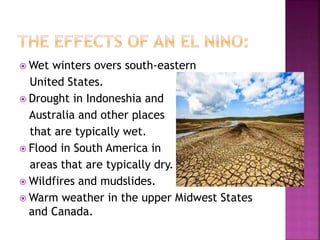
 Drought in Indoneshia and
Australia and other places
that are typically wet.
 Flood in South America in
areas that are typically dry.
 Wildfires and mudslides.
 Warm weather in the upper Midwest States
and Canada.
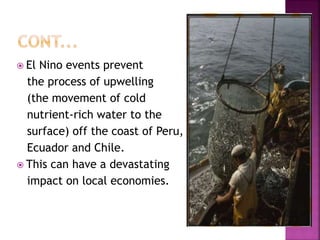
 El Nino events prevent
the process of upwelling
(the movement of cold
nutrient-rich water to the
surface) off the coast of Peru,
Ecuador and Chile.
 This can have a devastating
impact on local economies.
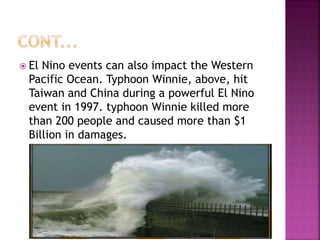
 El Nino events can also impact the Western
Pacific Ocean. Typhoon Winnie, above, hit
Taiwan and China during a powerful El Nino
event in 1997. typhoon Winnie killed more
than 200 people and caused more than $1
Billion in damages.
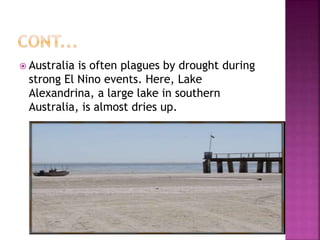
 Australia is often plagues by drought during
strong El Nino events. Here, Lake
Alexandrina, a large lake in southern
Australia, is almost dries up.
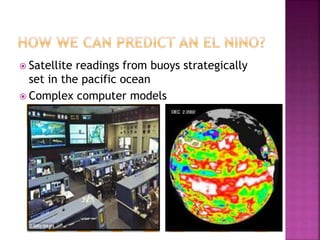
 Satellite readings from buoys strategically
set in the pacific ocean
 Complex computer models
 La Nina means The Little Girl in Spanish.
 La Nina is also sometimes called El Viejo, anti-El
Nino, or simply “a cold event”.
 La Nina episodes represent periods of below-
average sea surface temperatures across the
East-central Equatorial Pacific. Global climate La
Nina impacts tend to be opposite those of El
Nino impacts. In the tropics, ocean temperature
variations in La Nina also tend to be opposite
those of El Nino.
 During a La Nina year, winter temperatures are
warmer than normal in the Souteast and cooler
than normal in the Northwest.
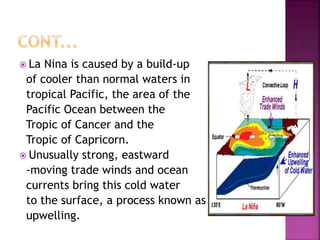
 La Nina is caused by a build-up
of cooler than normal waters in
tropical Pacific, the area of the
Pacific Ocean between the
Tropic of Cancer and the
Tropic of Capricorn.
 Unusually strong, eastward
-moving trade winds and ocean
currents bring this cold water
to the surface, a process known as
upwelling.
 The first signs of an emerging La Nina event are often
observed in the ocean. The Bureau of Meteorology
monitors and reports on a range of ENSO indicators,
including:
 Short term bursts of tropical rainfall activity
 Water temperatures at the sea surface and at depth
 Ocean heat content-measuring the amount of energy
stored in the ocean
 The Southern Oscillation Index
 Atmospheric air pressure
 Cloudiness-measuring the amount of cloud in tropical
regions
 The strength of the trade winds and winds higher in
the atmosphere ocean currents
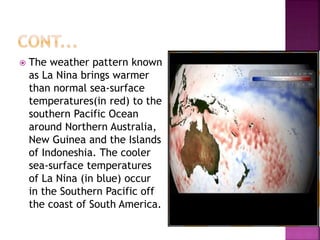
 The weather pattern known
as La Nina brings warmer
than normal sea-surface
temperatures(in red) to the
southern Pacific Ocean
around Northern Australia,
New Guinea and the Islands
of Indoneshia. The cooler
sea-surface temperatures
of La Nina (in blue) occur
in the Southern Pacific off
the coast of South America.
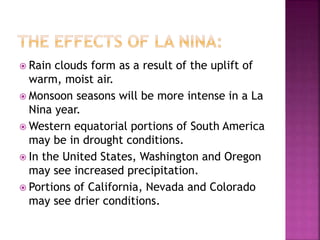
 Rain clouds form as a result of the uplift of
warm, moist air.
 Monsoon seasons will be more intense in a La
Nina year.
 Western equatorial portions of South America
may be in drought conditions.
 In the United States, Washington and Oregon
may see increased precipitation.
 Portions of California, Nevada and Colorado
may see drier conditions.
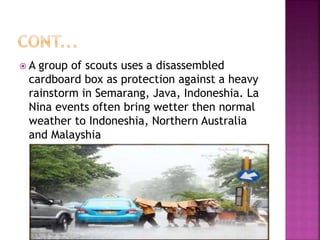
 A group of scouts uses a disassembled
cardboard box as protection against a heavy
rainstorm in Semarang, Java, Indoneshia. La
Nina events often bring wetter then normal
weather to Indoneshia, Northern Australia
and Malayshia
 The National Oceanic and Atmospheric
Administration(NOAA), for instance, operates
a network of buoys which measure sea-
surface temperature, air temperature,
currents, winds and humidity. The buoys are
located in about 70 locations, from the
Galapagos Islands to Australia. These buoys
transmit data to researchers and
meterologists every day. Using buoy data in
conjunction with visual information they
receive from satellites, scientists are able to
more accurately predict ENSO and visualize
its development and impact around the globe
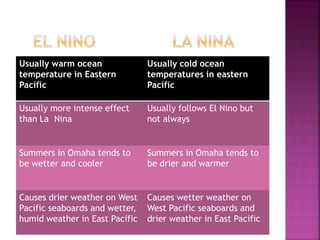
Usually warm ocean
temperature in Eastern
Pacific
Usually cold ocean
temperatures in eastern
Pacific
Usually more intense effect
than La Nina
Usually follows El Nino but
not always
Summers in Omaha tends to
be wetter and cooler
Summers in Omaha tends to
be drier and warmer
Causes drier weather on West
Pacific seaboards and wetter,
humid weather in East Pacific
Causes wetter weather on
West Pacific seaboards and
drier weather in East Pacific
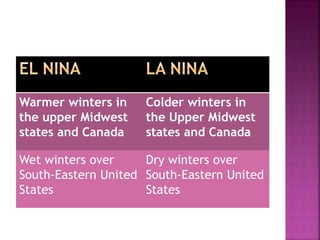
Warmer winters in
the upper Midwest
states and Canada
Colder winters in
the Upper Midwest
states and Canada
Wet winters over
South-Eastern United
States
Dry winters over
South-Eastern United
States
greenhouse_effect_el_nino_la_nino_phenomenon_new

greenhouse_effect_el_nino_la_nino_phenomenon_new

  • 2.
    PowerPoint Presentation PreparedBy: Aneela Khalid & Qurat ul ain
  • 3.
     The greenhouseeffect is a natural process that warms the Earth’s surface. When the Sun’s energy reaches the Earth’s atmosphere, some of it is reflected back to space and the rest is absorbed and re-radiated by greenhouse gases.  The word greenhouse effect holds two meanings  One is the natural greenhouse effect that one that keeps our Earths climate normal and comfortable  On the other hand there is a man made greenhouse effect which is an enhancement of natural greenhouse  Made from burning fossil fuels, petroleum, coal and natural gas.

  • 5.
    Effects of greenhouse Natural green house effect Man made green house effect
  • 6.
     Natural greenhouseeffect is made from the heat energy radiated from the sun.  Greenhouse gases are naturally present in the atmosphere.  Sunlight gases through the atmosphere warming the earth in a cycle.  The cycle continues through the atmosphere as the gases absorb energy at the same time while the leftover go to space.  Some sun energy trapped in earth makes is much warmer and comfortable
  • 7.
     Activities madeby humans result in production of greenhouse gases  While the amounts of gases increase in the atmosphere the stability of the greenhouse gases change causing effects on the whole world.  Greenhouse effects caused by burning , fossil fuels ,coal ,oil ,natural gases ,cutting and burning of trees producing carbon dioxide.  Greenhouse gases trap heat making earth warmer and creating global warming.
  • 8.
     One ofthe main causes of Global Warming is the Green House Effect. When the production of infrared energy in the atmosphere warms a planet’s surface , it is known as the Green House Effect. The natural causes of the Green House Effect are the releasing of gases like nitrous oxide, carbon-dioxide , methane, ozone and water vapor. Carbon-dioxide itself is guilty for the Green House Effect.  One of the man-made causes of the Green House effect is erosion. Deforestation increases the amount of carbon-dioxide in the atmosphere. Also ,due to the loss of trees , photosynthesis cannot take place.Deforestation causes the green house effect.
  • 9.
     Greenhouse gasesalso can be released into the atmosphere due to the burning of fossil fuels, oil, coal and gas. These materials are used more and more and violently in industries. Therefore industries are also a major cause of the Greenhouse Effect.  Other man made causes of the increase in the green house effect due to emission of gases from the electrical appliances e.g;chlorofloro carbons (CFCs),aerosol cans and foaming agents, fire extinguisher chemicals and cleaners.  Other man-made processes that contribute are burning of gasoline ,oil and coal. With the increase in population, the needs and wants of the people.
  • 11.
  • 12.
     Rising temperaturescause water of the oceans along with the sea to increase.  Increasing temperatures melt ice as it starts to flow into the seas of Antarctic and Greenland  Sea levels rise by 20-40 cm causing floods in areas with low coast areas e.g; Bangladesh and Netherland.  Flood in many areas cause a danger for living things.
  • 13.
  • 16.
     El Ninoand La Nina are opposite phases of what is known as the El Nino-Southern Oscillation(ENSO) cycle.  The ENSO cycle is a scientific term that describes the fluctuations in temperature between the ocean and atmosphere in the east- central Equatorial Pacific(approximately between the International Date Line and 120 degrees West).  La Nina is sometimes referred to as the cold phase of ENSO and El Nino as the warm phase of ENSO .These deviations from normal surface temperatures can have large-scale impacts not only on ocean processes, but also on global.
  • 17.
     El Ninoand La Nina episodes typically last for 9 to 12 months, but some prolonged events may last for years. They often begin to form between June and August, reach peak strength between December and April, and then decay between May and July of the following year. While their periodicity can be quite irregular, El Nino and La Nina events occur about every 3 to 5 years. Typically, El Nino occurs more frequently than La Nina.
  • 18.
     El Ninomeans The Little Boy, or Christ Child in Spanish.  El Nino was originally recognized by fisherman off the coast of South America in the 1600s, with the appearance of unusually warm water in the Pacific Ocean. The name was chosen based on the time of year (around December) during which these warm waters events tended to occur.  The term El Nino refers to the large-scale ocean- atmosphere climate interaction linked to a periodic warming in sea surface temperatures across the central and ease-central Equatorial Pacific.
  • 19.
     El Nino,warmer than average waters in the Eastern Equatorial Pacific(shown in orange on the map), affects weather around the world.
  • 20.
     Rise inair pressure in the Indian Ocean, Indoneshia, and Australia.  A fall in air pressure over Tahiti and the rest of central and eastern Pacific Ocean.  The trade winds in the South Pacific weakened or headed east.  Warm air rises in Peru.  Warm water spreads from the West Pacific and the Indian Ocean to the East Pacific. It takes the rain with it, causing rainfall in normally dry areas and drought in normally wet areas.
  • 21.
     El Ninois a climate pattern that describes the unusual warming of surface waters along the tropical west coast of South America. This diagram illustrates the eastward movement of winds across the Pacific in red .
  • 22.
     Wet wintersovers south-eastern United States.  Drought in Indoneshia and Australia and other places that are typically wet.  Flood in South America in areas that are typically dry.  Wildfires and mudslides.  Warm weather in the upper Midwest States and Canada.
  • 23.
     El Ninoevents prevent the process of upwelling (the movement of cold nutrient-rich water to the surface) off the coast of Peru, Ecuador and Chile.  This can have a devastating impact on local economies.
  • 24.
     El Ninoevents can also impact the Western Pacific Ocean. Typhoon Winnie, above, hit Taiwan and China during a powerful El Nino event in 1997. typhoon Winnie killed more than 200 people and caused more than $1 Billion in damages.
  • 25.
     Australia isoften plagues by drought during strong El Nino events. Here, Lake Alexandrina, a large lake in southern Australia, is almost dries up.
  • 26.
     Satellite readingsfrom buoys strategically set in the pacific ocean  Complex computer models
  • 27.
     La Ninameans The Little Girl in Spanish.  La Nina is also sometimes called El Viejo, anti-El Nino, or simply “a cold event”.  La Nina episodes represent periods of below- average sea surface temperatures across the East-central Equatorial Pacific. Global climate La Nina impacts tend to be opposite those of El Nino impacts. In the tropics, ocean temperature variations in La Nina also tend to be opposite those of El Nino.  During a La Nina year, winter temperatures are warmer than normal in the Souteast and cooler than normal in the Northwest.
  • 28.
     La Ninais caused by a build-up of cooler than normal waters in tropical Pacific, the area of the Pacific Ocean between the Tropic of Cancer and the Tropic of Capricorn.  Unusually strong, eastward -moving trade winds and ocean currents bring this cold water to the surface, a process known as upwelling.
  • 29.
     The firstsigns of an emerging La Nina event are often observed in the ocean. The Bureau of Meteorology monitors and reports on a range of ENSO indicators, including:  Short term bursts of tropical rainfall activity  Water temperatures at the sea surface and at depth  Ocean heat content-measuring the amount of energy stored in the ocean  The Southern Oscillation Index  Atmospheric air pressure  Cloudiness-measuring the amount of cloud in tropical regions  The strength of the trade winds and winds higher in the atmosphere ocean currents
  • 30.
     The weatherpattern known as La Nina brings warmer than normal sea-surface temperatures(in red) to the southern Pacific Ocean around Northern Australia, New Guinea and the Islands of Indoneshia. The cooler sea-surface temperatures of La Nina (in blue) occur in the Southern Pacific off the coast of South America.
  • 31.
     Rain cloudsform as a result of the uplift of warm, moist air.  Monsoon seasons will be more intense in a La Nina year.  Western equatorial portions of South America may be in drought conditions.  In the United States, Washington and Oregon may see increased precipitation.  Portions of California, Nevada and Colorado may see drier conditions.
  • 32.
     A groupof scouts uses a disassembled cardboard box as protection against a heavy rainstorm in Semarang, Java, Indoneshia. La Nina events often bring wetter then normal weather to Indoneshia, Northern Australia and Malayshia
  • 33.
     The NationalOceanic and Atmospheric Administration(NOAA), for instance, operates a network of buoys which measure sea- surface temperature, air temperature, currents, winds and humidity. The buoys are located in about 70 locations, from the Galapagos Islands to Australia. These buoys transmit data to researchers and meterologists every day. Using buoy data in conjunction with visual information they receive from satellites, scientists are able to more accurately predict ENSO and visualize its development and impact around the globe
  • 34.
    Usually warm ocean temperaturein Eastern Pacific Usually cold ocean temperatures in eastern Pacific Usually more intense effect than La Nina Usually follows El Nino but not always Summers in Omaha tends to be wetter and cooler Summers in Omaha tends to be drier and warmer Causes drier weather on West Pacific seaboards and wetter, humid weather in East Pacific Causes wetter weather on West Pacific seaboards and drier weather in East Pacific
  • 35.
    Warmer winters in theupper Midwest states and Canada Colder winters in the Upper Midwest states and Canada Wet winters over South-Eastern United States Dry winters over South-Eastern United States