1
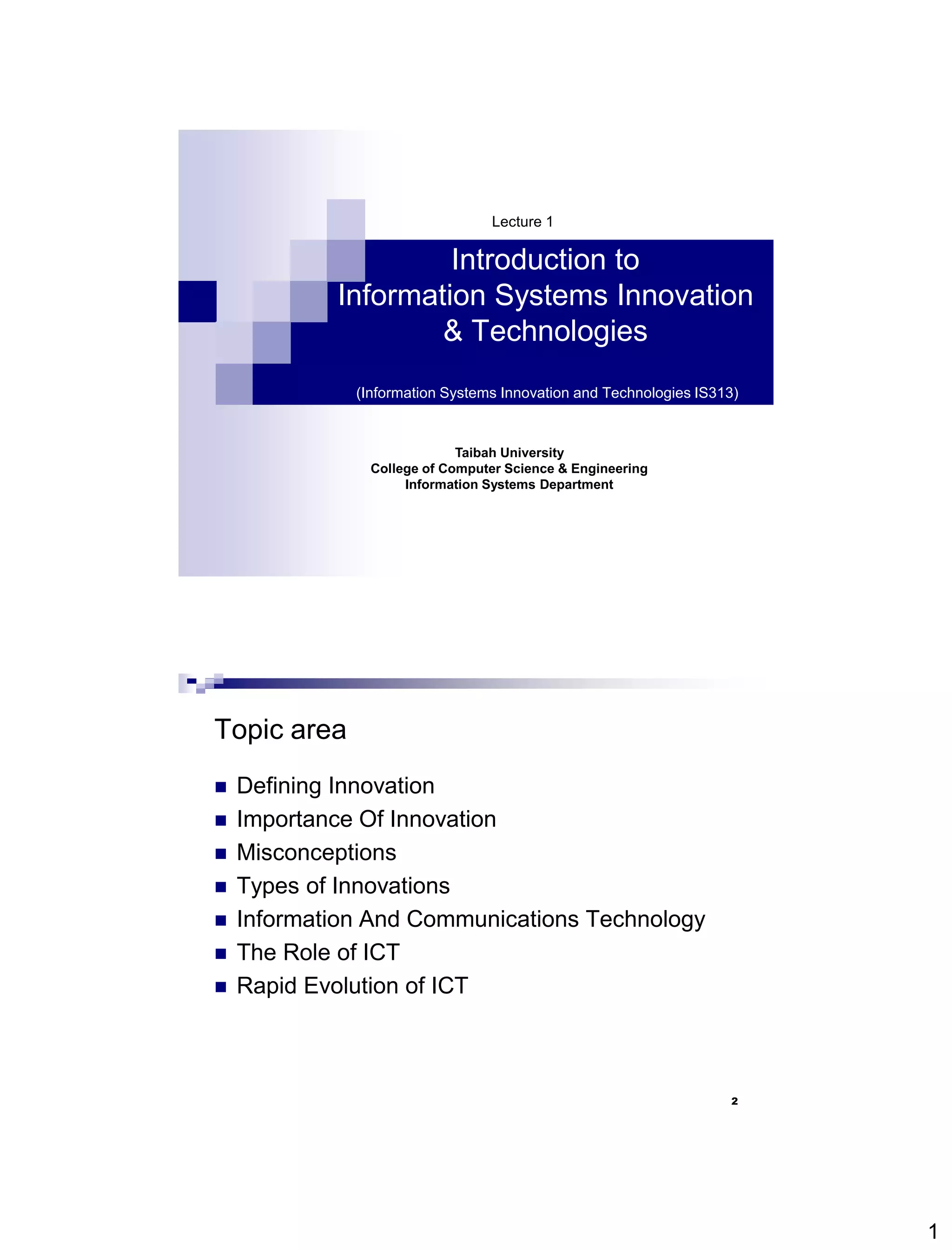
Taibah University
College of Computer Science & Engineering
Information Systems Department
Abdisalam Issa-Salwe, Taibah University
Introduction to
Information Systems Innovation
& Technologies
(Information Systems Innovation and Technologies IS313)
Lecture 1
Topic area
 Defining Innovation
 Importance Of Innovation
 Misconceptions
 Types of Innovations
 Information And Communications Technology
 The Role of ICT
 Rapid Evolution of ICT
Abdisalam Issa-Salwe, College of Computer Science & Engineering, Taibah University
2
2
Defining Innovation
1. Innovation comes from a Latin word INNOVATIO meaning to
RENEW or CHANGE
2. ― New products, business processes and organic changes that
create wealth or social welfare‖ – OECD
3. ― Fresh thinking that creates value‖
4. ― Successful commercilaisation of a novel idea‖
5. ― Application of knowledge in a novel way, premarily for
economic benefit‖ – Economic Intelligence Unit
6. ―Invention implies bringing something new into being;
innovation implies bringing something new into use‖.
Schumpeter
7. Innovation has been defined as the successful introduction
into an applied situation of means or ends that are new to that
situation (Mohr, 1969, quoted in Cummings and O’Connell,
1978, p.34)
3
Abdisalam Issa-Salwe, College of Computer Science & Engineering, Taibah University
Defining Innovation (cont…)
 ―Innovation can be defined as a new product, new process,
or new organizational structure that enhances the chance
for success on the market. The many sidedness of
innovations.‖ Antti Hautamäki (2007).
 ―Ideas, inventions, and innovations are often distinguished
from each other. An idea is a preliminary thought or a
mental image of a new device or solution. An invention, on
the other hand, already exists, but it is not applicable or
commercial as such. An innovation is a novelty that is
applicable in practice. Typically, innovations are
commercialized products or services. The route from an
idea to an innovation is often long and includes a number of
different phases.‖ (Hautamäki 2007, 110)
4
Abdisalam Issa-Salwe, College of Computer Science & Engineering, Taibah University
3
Defining Innovation
 ― Innovation is defined as a process by which varying degree
of measurable value enhancement is planned and achieved ,
in any commercial activity.
This process may be breakthrough or incremental, and it may
occur systematically in a company or sporadically; it may be
achieved by:
 Introducing new or improved goods or services and/or
 Implementing new or improved operational processes and/or
 Implementing new or improved organizational/managerial
processes
 In order to improve market share, competitiveness and
Quality, while reducing costs. (National Knowledge Commission)
5
Abdisalam Issa-Salwe, College of Computer Science & Engineering, Taibah University
What Are Innovations?
 Innovations are new ways to achieve tasks.
 Types of innovations include:
 Mechanical—tractors, cars.
 Chemical—pesticides.
 Biological—seed varieties.
 Managerial—IPM, extra pay for work, overtime.
 Institutional—water users’ association, patents, banks, stock
market, conservation districts, monks.
 It is useful to distinguish between process
innovations (new biotechnology procedures) and
product innovations (Bt cotton).
6
4
Types of innovations
 Product innovation
 Process innovation
 Innovation in business models
 Incremental or breakthrough innovation
 Reverse innovation
7
Abdisalam Issa-Salwe, College of Computer Science & Engineering, Taibah University
Importance of Innovation
 An innovation may therefore be a thing: Whether artifact,
product or process or indeed service.
 Innovation means change: Such changes can be
incremental or radical, evolutionary or revolutionary,
enabling or disruptive. They can have different effects upon
producers and users.
 Distinguish between:
 Product and process innovations
 Technical and organizational innovations
 Radical and incremental innovations system or
infrastructure
8
Abdisalam Issa-Salwe, College of Computer Science & Engineering, Taibah University
5
Importance of Innovation (cont…)
1. Creativity: It is the capabilities or act of
conceiving something original or unusual
2. Innovation: It is the implementation of
something new
3. Invention: It is the creation of something
that has never been made before and is
recognized as the product of some
unique insight
9
Abdisalam Issa-Salwe, College of Computer Science & Engineering, Taibah University
Importance of Innovation (cont…)
1. Creativity – Ideas
Invention – Novel ideas
Innovation – Delivery of novel ideas
2. Every invention is innovation but every innovation is not
invention
3. Invention is conversion of cash into ideas. Innovation is
conversion of ideas into cash
4. Creativity is thinking new things. Innovation is doing new
things.
5. Innovation is applied creativity
6.People are creative. Products or processes are innovative
10
Abdisalam Issa-Salwe, College of Computer Science & Engineering, Taibah University
6
11
Generalisation concept
 A creative (work) environment is challenging,
free, dynamic, supports ideas, is emotionally
safe, and its atmosphere promotes humor.
 In such an environment, debates are considered
positive, conflicts constructive, risk taking is
allowed and, in the end, new ideas have enough
time to take shape.
 Creativity, innovation, and flexible processes of
action currently seem to be highlighted as
essential starting points for developing work life
and the economy, and this will increasingly be
the case in the near future.
12
Phases
1. Problem, challenge, opportunity, outlining:
Understanding that an opportunity to create
something new, something better exists;
intuitive knowledge, as well as a vision, might
be a trustworthy guide at this phase (as well as
in phases 3 and 4), because actual, fact based,
knowledge and its ―mending effect‖ always
come in too late.
2. Fact phase: Digging out the real facts in order
to find the core of the problem that one is about
to solve.
7
13
Phases (cont...)
3. Problem phase: Identifying the actual problem
according to the facts.
4. Idea phase: The shaping of alternative
solutions.
5. Solution phase: Refining and polishing the
chosen solution to make it usable and
implementable.
6. Approval phase: Having all the actors who
need to take part in the actualization of the
chosen solution in order to make it successful
to approve with it.
14
Phases (cont...)
7. Realization phase: The arising (new) problems,
or newly identified parts of the original problem,
may force the process to be started anew or
some phases to be gone through again. Several
phases may have to be run through multiple
times even before the realization phase has
been reached.
8
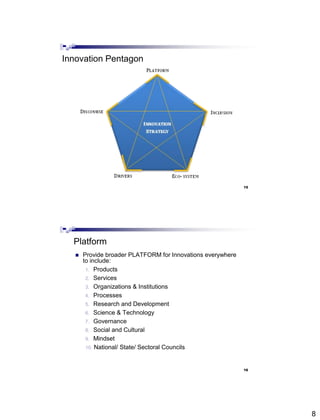
Innovation Pentagon
15
Platform
 Provide broader PLATFORM for Innovations everywhere
to include:
1. Products
2. Services
3. Organizations & Institutions
4. Processes
5. Research and Development
6. Science & Technology
7. Governance
8. Social and Cultural
9. Mindset
10. National/ State/ Sectoral Councils
16
9
Inclusion
 Encourage Innovations for INCLUSION aimed at the
Bottom of the Pyramid:
1. Awareness
2. Access
3. Affordability
4. Availability
5. Scalability
6. Sustainability
7. Quality
8. Pervasive Growth
9. Innovations for/by the people
17
Eco-systems
 Foster necessary Eco System
1. Incentives & Awards
2. Innovation clusters at universities
3. Innovative business clusters
4. Organizational Autonomy & Flexibility
5. Policies & Programmes
6. New Institutions
7. Risk/ Venture Capital
8. Patents
9. Web & ICT as tools
18
10
Drivers
 Focus on DRIVERS
1. Multidisciplinary
2. Collaborative
3. Disruptive
4. Generational Change vs. Incremental Change
5. Durable vs. Disposable
6. Need vs. Demand
7. Nature as Nurture
8. Locally Relevant
9. Globally Connected and Competitive
10.Focus at the Edge
19
Discourse
 Expand Space for Discourse on Innovation in the country
by:
1. Discussions
2. Debates
3. Seminars
4. Conferences
5. Best Practices
6. Subversive Dialogue
7. Irreverent Dialogue
8. New Ideas
9. Media
10.Innovation Portal
11
Information and communications technology
 Technological innovation is essential for
human development.
 From the printing press to the computer,
people have devised tools for facilitating
learning and communication.
 Technology is not inherently good or bad,
the outcome depends on how it is used.
Abdisalam Issa-Salwe, College of Computer Science & Engineering, Taibah University
21
Information and communications technology (cont…)
 Information and communications technology
(ICT) involves innovations in microelectronics,
computing (hardware and software),
telecommunications and opto-electronics —
micro-processors, semiconductors, fiber optics.
 These innovations enable the processing and
storage of enormous amounts of information,
along with rapid distribution of information
through communication networks.
Abdisalam Issa-Salwe, College of Computer Science & Engineering, Taibah University
22
12
The role of ICT
 Telecommunication is a basic infrastructure
necessary for economic and social development
of a country.
 This is even becoming more strong than ever as
information related economic activities are
growing.
 ICT is the support of the central nervous system
of complex societies, transmitting and processing
information and commands among the various
parts of such societies.
 Internet plays a fundamental function in ICT role
Abdisalam Issa-Salwe, College of Computer Science & Engineering, Taibah University
23
Benefits from ICT
 ICT carries on high promise both in human and economic terms.
Benefits could be obtained in:
 Education
 Job training
 Health care
 Food security
 Environment management
 Government efficiency
 Specifically in Science and Technology:
 Speed up dissemination of scientific results world-wide
through scientific knowledge sharing and exchange
 Allows to set up of Virtual Labs for communications and
remote instrument control
Abdisalam Issa-Salwe, College of Computer Science & Engineering, Taibah University
24
13
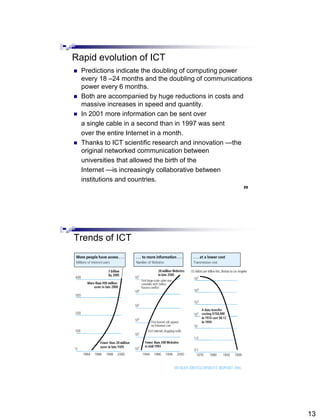
Rapid evolution of ICT
 Predictions indicate the doubling of computing power
every 18 –24 months and the doubling of communications
power every 6 months.
 Both are accompanied by huge reductions in costs and
massive increases in speed and quantity.
 In 2001 more information can be sent over
a single cable in a second than in 1997 was sent
over the entire Internet in a month.
 Thanks to ICT scientific research and innovation —the
original networked communication between
universities that allowed the birth of the
Internet —is increasingly collaborative between
institutions and countries.
Abdisalam Issa-Salwe, College of Computer Science & Engineering, Taibah University
25
Trends of ICT
14
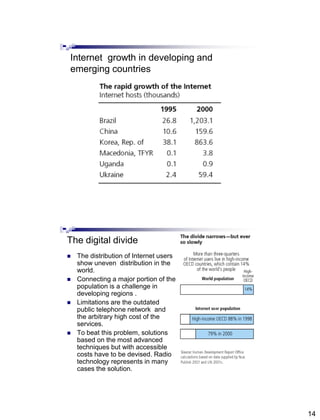
Internet growth in developing and
emerging countries
The digital divide
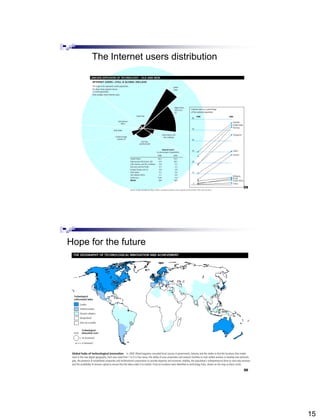
 The distribution of Internet users
show uneven distribution in the
world.
 Connecting a major portion of the
population is a challenge in
developing regions .
 Limitations are the outdated
public telephone network and
the arbitrary high cost of the
services.
 To beat this problem, solutions
based on the most advanced
techniques but with accessible
costs have to be devised. Radio
technology represents in many
cases the solution.
15
The Internet users distribution
29
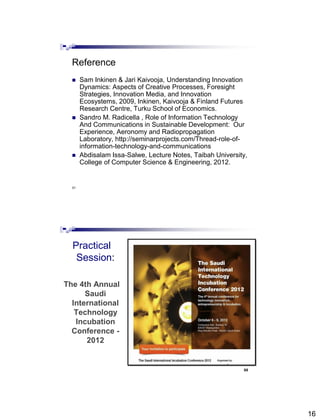
Hope for the future
30
16
31
Abdisalam Issa-Salwe, Faculty of Computer Science & Engineering, Taibah University
Reference
 Sam Inkinen & Jari Kaivooja, Understanding Innovation
Dynamics: Aspects of Creative Processes, Foresight
Strategies, Innovation Media, and Innovation
Ecosystems, 2009, Inkinen, Kaivooja & Finland Futures
Research Centre, Turku School of Economics.
 Sandro M. Radicella , Role of Information Technology
And Communications in Sustainable Development: Our
Experience, Aeronomy and Radiopropagation
Laboratory, http://seminarprojects.com/Thread-role-of-
information-technology-and-communications
 Abdisalam Issa-Salwe, Lecture Notes, Taibah University,
College of Computer Science & Engineering, 2012.
Practical
Session:
The 4th Annual
Saudi
International
Technology
Incubation
Conference -
2012
Abdisalam Issa-Salwe, College of Computer Science & Engineering, Taibah University
32
17
The 4th Annual Saudi International Technology Incubation Conference - 2012
Technology innovation and entrepreneurship are at the heart of all leading economies.
The Kingdom of Saudi Arabia is investing heavily in these two fields as it recognizes
their importance in sustaining the economic growth and prosperity of the country...
KACST and the BADIR Program are organizing the 4th annual Saudi International Technology
Incubation Conference. The aim is to provide stakeholders and practitioners in the incubation
industry with a forum to meet with international and local experts to discuss the latest
developments in technology entrepreneurship, innovation and finance support, and the role
that incubators should play.
The conference will help to develop knowledge and understanding between incubation
practitioners and stakeholders, while providing networking opportunities that support the
development of the Saudi Arabian incubator industry, and its role in the creation of a
knowledge-based economy and a diversified technology industry base.
The conference will be held from 8 to 9 October 2012 (22 to 23 Dhu Al-Qa'dah, 1433 H), at the
KACST Conference Centre, KACST headquarters, King Abdullah Road, Riyadh.
The theme is 'Incubating Technology Innovation and Entrepreneurs' which highlights
that incubation is a major driver of innovation and entrepreneurship.
Home - About Conference
Abdisalam Issa-Salwe, College of Computer Science & Engineering, Taibah University
33

Lecture1 is313-(is-innovation&tech)

  • 1.
    1 Taibah University College ofComputer Science & Engineering Information Systems Department Abdisalam Issa-Salwe, Taibah University Introduction to Information Systems Innovation & Technologies (Information Systems Innovation and Technologies IS313) Lecture 1 Topic area  Defining Innovation  Importance Of Innovation  Misconceptions  Types of Innovations  Information And Communications Technology  The Role of ICT  Rapid Evolution of ICT Abdisalam Issa-Salwe, College of Computer Science & Engineering, Taibah University 2
  • 2.
    2 Defining Innovation 1. Innovationcomes from a Latin word INNOVATIO meaning to RENEW or CHANGE 2. ― New products, business processes and organic changes that create wealth or social welfare‖ – OECD 3. ― Fresh thinking that creates value‖ 4. ― Successful commercilaisation of a novel idea‖ 5. ― Application of knowledge in a novel way, premarily for economic benefit‖ – Economic Intelligence Unit 6. ―Invention implies bringing something new into being; innovation implies bringing something new into use‖. Schumpeter 7. Innovation has been defined as the successful introduction into an applied situation of means or ends that are new to that situation (Mohr, 1969, quoted in Cummings and O’Connell, 1978, p.34) 3 Abdisalam Issa-Salwe, College of Computer Science & Engineering, Taibah University Defining Innovation (cont…)  ―Innovation can be defined as a new product, new process, or new organizational structure that enhances the chance for success on the market. The many sidedness of innovations.‖ Antti Hautamäki (2007).  ―Ideas, inventions, and innovations are often distinguished from each other. An idea is a preliminary thought or a mental image of a new device or solution. An invention, on the other hand, already exists, but it is not applicable or commercial as such. An innovation is a novelty that is applicable in practice. Typically, innovations are commercialized products or services. The route from an idea to an innovation is often long and includes a number of different phases.‖ (Hautamäki 2007, 110) 4 Abdisalam Issa-Salwe, College of Computer Science & Engineering, Taibah University
  • 3.
    3 Defining Innovation  ―Innovation is defined as a process by which varying degree of measurable value enhancement is planned and achieved , in any commercial activity. This process may be breakthrough or incremental, and it may occur systematically in a company or sporadically; it may be achieved by:  Introducing new or improved goods or services and/or  Implementing new or improved operational processes and/or  Implementing new or improved organizational/managerial processes  In order to improve market share, competitiveness and Quality, while reducing costs. (National Knowledge Commission) 5 Abdisalam Issa-Salwe, College of Computer Science & Engineering, Taibah University What Are Innovations?  Innovations are new ways to achieve tasks.  Types of innovations include:  Mechanical—tractors, cars.  Chemical—pesticides.  Biological—seed varieties.  Managerial—IPM, extra pay for work, overtime.  Institutional—water users’ association, patents, banks, stock market, conservation districts, monks.  It is useful to distinguish between process innovations (new biotechnology procedures) and product innovations (Bt cotton). 6
  • 4.
    4 Types of innovations Product innovation  Process innovation  Innovation in business models  Incremental or breakthrough innovation  Reverse innovation 7 Abdisalam Issa-Salwe, College of Computer Science & Engineering, Taibah University Importance of Innovation  An innovation may therefore be a thing: Whether artifact, product or process or indeed service.  Innovation means change: Such changes can be incremental or radical, evolutionary or revolutionary, enabling or disruptive. They can have different effects upon producers and users.  Distinguish between:  Product and process innovations  Technical and organizational innovations  Radical and incremental innovations system or infrastructure 8 Abdisalam Issa-Salwe, College of Computer Science & Engineering, Taibah University
  • 5.
    5 Importance of Innovation(cont…) 1. Creativity: It is the capabilities or act of conceiving something original or unusual 2. Innovation: It is the implementation of something new 3. Invention: It is the creation of something that has never been made before and is recognized as the product of some unique insight 9 Abdisalam Issa-Salwe, College of Computer Science & Engineering, Taibah University Importance of Innovation (cont…) 1. Creativity – Ideas Invention – Novel ideas Innovation – Delivery of novel ideas 2. Every invention is innovation but every innovation is not invention 3. Invention is conversion of cash into ideas. Innovation is conversion of ideas into cash 4. Creativity is thinking new things. Innovation is doing new things. 5. Innovation is applied creativity 6.People are creative. Products or processes are innovative 10 Abdisalam Issa-Salwe, College of Computer Science & Engineering, Taibah University
  • 6.
    6 11 Generalisation concept  Acreative (work) environment is challenging, free, dynamic, supports ideas, is emotionally safe, and its atmosphere promotes humor.  In such an environment, debates are considered positive, conflicts constructive, risk taking is allowed and, in the end, new ideas have enough time to take shape.  Creativity, innovation, and flexible processes of action currently seem to be highlighted as essential starting points for developing work life and the economy, and this will increasingly be the case in the near future. 12 Phases 1. Problem, challenge, opportunity, outlining: Understanding that an opportunity to create something new, something better exists; intuitive knowledge, as well as a vision, might be a trustworthy guide at this phase (as well as in phases 3 and 4), because actual, fact based, knowledge and its ―mending effect‖ always come in too late. 2. Fact phase: Digging out the real facts in order to find the core of the problem that one is about to solve.
  • 7.
    7 13 Phases (cont...) 3. Problemphase: Identifying the actual problem according to the facts. 4. Idea phase: The shaping of alternative solutions. 5. Solution phase: Refining and polishing the chosen solution to make it usable and implementable. 6. Approval phase: Having all the actors who need to take part in the actualization of the chosen solution in order to make it successful to approve with it. 14 Phases (cont...) 7. Realization phase: The arising (new) problems, or newly identified parts of the original problem, may force the process to be started anew or some phases to be gone through again. Several phases may have to be run through multiple times even before the realization phase has been reached.
  • 8.
    8 Innovation Pentagon 15 Platform  Providebroader PLATFORM for Innovations everywhere to include: 1. Products 2. Services 3. Organizations & Institutions 4. Processes 5. Research and Development 6. Science & Technology 7. Governance 8. Social and Cultural 9. Mindset 10. National/ State/ Sectoral Councils 16
  • 9.
    9 Inclusion  Encourage Innovationsfor INCLUSION aimed at the Bottom of the Pyramid: 1. Awareness 2. Access 3. Affordability 4. Availability 5. Scalability 6. Sustainability 7. Quality 8. Pervasive Growth 9. Innovations for/by the people 17 Eco-systems  Foster necessary Eco System 1. Incentives & Awards 2. Innovation clusters at universities 3. Innovative business clusters 4. Organizational Autonomy & Flexibility 5. Policies & Programmes 6. New Institutions 7. Risk/ Venture Capital 8. Patents 9. Web & ICT as tools 18
  • 10.
    10 Drivers  Focus onDRIVERS 1. Multidisciplinary 2. Collaborative 3. Disruptive 4. Generational Change vs. Incremental Change 5. Durable vs. Disposable 6. Need vs. Demand 7. Nature as Nurture 8. Locally Relevant 9. Globally Connected and Competitive 10.Focus at the Edge 19 Discourse  Expand Space for Discourse on Innovation in the country by: 1. Discussions 2. Debates 3. Seminars 4. Conferences 5. Best Practices 6. Subversive Dialogue 7. Irreverent Dialogue 8. New Ideas 9. Media 10.Innovation Portal
  • 11.
    11 Information and communicationstechnology  Technological innovation is essential for human development.  From the printing press to the computer, people have devised tools for facilitating learning and communication.  Technology is not inherently good or bad, the outcome depends on how it is used. Abdisalam Issa-Salwe, College of Computer Science & Engineering, Taibah University 21 Information and communications technology (cont…)  Information and communications technology (ICT) involves innovations in microelectronics, computing (hardware and software), telecommunications and opto-electronics — micro-processors, semiconductors, fiber optics.  These innovations enable the processing and storage of enormous amounts of information, along with rapid distribution of information through communication networks. Abdisalam Issa-Salwe, College of Computer Science & Engineering, Taibah University 22
  • 12.
    12 The role ofICT  Telecommunication is a basic infrastructure necessary for economic and social development of a country.  This is even becoming more strong than ever as information related economic activities are growing.  ICT is the support of the central nervous system of complex societies, transmitting and processing information and commands among the various parts of such societies.  Internet plays a fundamental function in ICT role Abdisalam Issa-Salwe, College of Computer Science & Engineering, Taibah University 23 Benefits from ICT  ICT carries on high promise both in human and economic terms. Benefits could be obtained in:  Education  Job training  Health care  Food security  Environment management  Government efficiency  Specifically in Science and Technology:  Speed up dissemination of scientific results world-wide through scientific knowledge sharing and exchange  Allows to set up of Virtual Labs for communications and remote instrument control Abdisalam Issa-Salwe, College of Computer Science & Engineering, Taibah University 24
  • 13.
    13 Rapid evolution ofICT  Predictions indicate the doubling of computing power every 18 –24 months and the doubling of communications power every 6 months.  Both are accompanied by huge reductions in costs and massive increases in speed and quantity.  In 2001 more information can be sent over a single cable in a second than in 1997 was sent over the entire Internet in a month.  Thanks to ICT scientific research and innovation —the original networked communication between universities that allowed the birth of the Internet —is increasingly collaborative between institutions and countries. Abdisalam Issa-Salwe, College of Computer Science & Engineering, Taibah University 25 Trends of ICT
  • 14.
    14 Internet growth indeveloping and emerging countries The digital divide  The distribution of Internet users show uneven distribution in the world.  Connecting a major portion of the population is a challenge in developing regions .  Limitations are the outdated public telephone network and the arbitrary high cost of the services.  To beat this problem, solutions based on the most advanced techniques but with accessible costs have to be devised. Radio technology represents in many cases the solution.
  • 15.
    15 The Internet usersdistribution 29 Hope for the future 30
  • 16.
    16 31 Abdisalam Issa-Salwe, Facultyof Computer Science & Engineering, Taibah University Reference  Sam Inkinen & Jari Kaivooja, Understanding Innovation Dynamics: Aspects of Creative Processes, Foresight Strategies, Innovation Media, and Innovation Ecosystems, 2009, Inkinen, Kaivooja & Finland Futures Research Centre, Turku School of Economics.  Sandro M. Radicella , Role of Information Technology And Communications in Sustainable Development: Our Experience, Aeronomy and Radiopropagation Laboratory, http://seminarprojects.com/Thread-role-of- information-technology-and-communications  Abdisalam Issa-Salwe, Lecture Notes, Taibah University, College of Computer Science & Engineering, 2012. Practical Session: The 4th Annual Saudi International Technology Incubation Conference - 2012 Abdisalam Issa-Salwe, College of Computer Science & Engineering, Taibah University 32
  • 17.
    17 The 4th AnnualSaudi International Technology Incubation Conference - 2012 Technology innovation and entrepreneurship are at the heart of all leading economies. The Kingdom of Saudi Arabia is investing heavily in these two fields as it recognizes their importance in sustaining the economic growth and prosperity of the country... KACST and the BADIR Program are organizing the 4th annual Saudi International Technology Incubation Conference. The aim is to provide stakeholders and practitioners in the incubation industry with a forum to meet with international and local experts to discuss the latest developments in technology entrepreneurship, innovation and finance support, and the role that incubators should play. The conference will help to develop knowledge and understanding between incubation practitioners and stakeholders, while providing networking opportunities that support the development of the Saudi Arabian incubator industry, and its role in the creation of a knowledge-based economy and a diversified technology industry base. The conference will be held from 8 to 9 October 2012 (22 to 23 Dhu Al-Qa'dah, 1433 H), at the KACST Conference Centre, KACST headquarters, King Abdullah Road, Riyadh. The theme is 'Incubating Technology Innovation and Entrepreneurs' which highlights that incubation is a major driver of innovation and entrepreneurship. Home - About Conference Abdisalam Issa-Salwe, College of Computer Science & Engineering, Taibah University 33