Peter Jones, PhD Jeremy Bowes OCAD University, Toronto OCADU 
Toward the Integration of Visual Languages for Systemic Design
… our thesis 
Systemic thinking is better expressed in design languages than system formalisms. 
Understanding of complex systems is enhanced for a wider variety of stakeholders. 
Visual design languages offer significant potential for social & service systems design. 
Generative bias as opposed to descriptive science
why a design language for systems?… 
design is changing … 
Design thinking is extending beyond design outcomes, but is falling short of systems methods & toolkits. Design approaches differ from systems in many respects: 
• Successive approximations toward emerging goals 
• Continuous interpretation by multiple perspectives 
• Action-oriented, making artifacts & prototypes 
• Visual representations, from sketching to blueprints However we still lack good theory & practices of systemic design.
…an opportunity for COMPLEXITY NAVIGATION 
4 
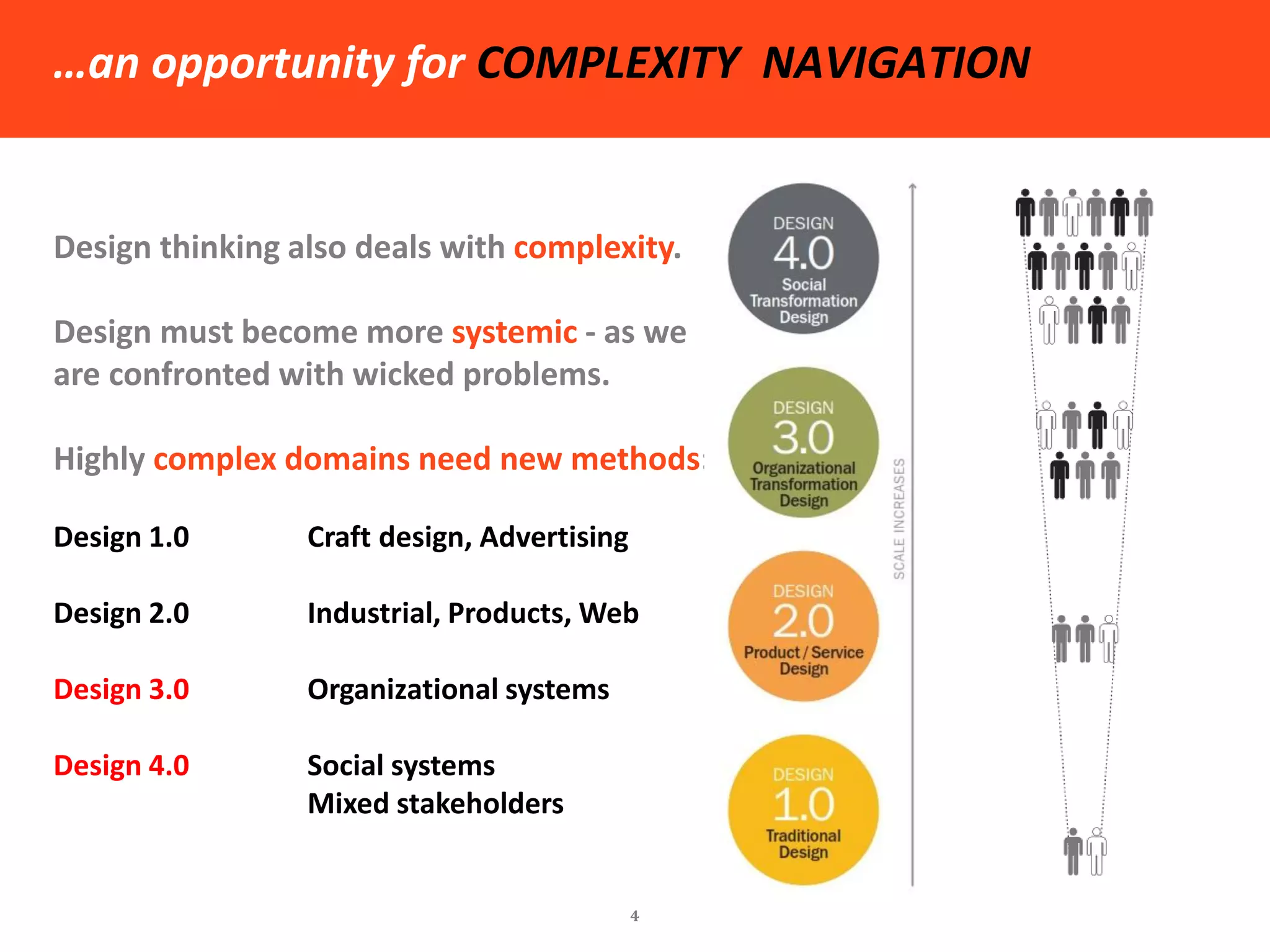
Design thinking also deals with complexity. 
Design must become more systemic - as we are confronted with wicked problems. 
Highly complex domains need new methods: 
Design 1.0 Craft design, Advertising 
Design 2.0 Industrial, Products, Web 
Design 3.0 Organizational systems 
Design 4.0 Social systems Mixed stakeholders
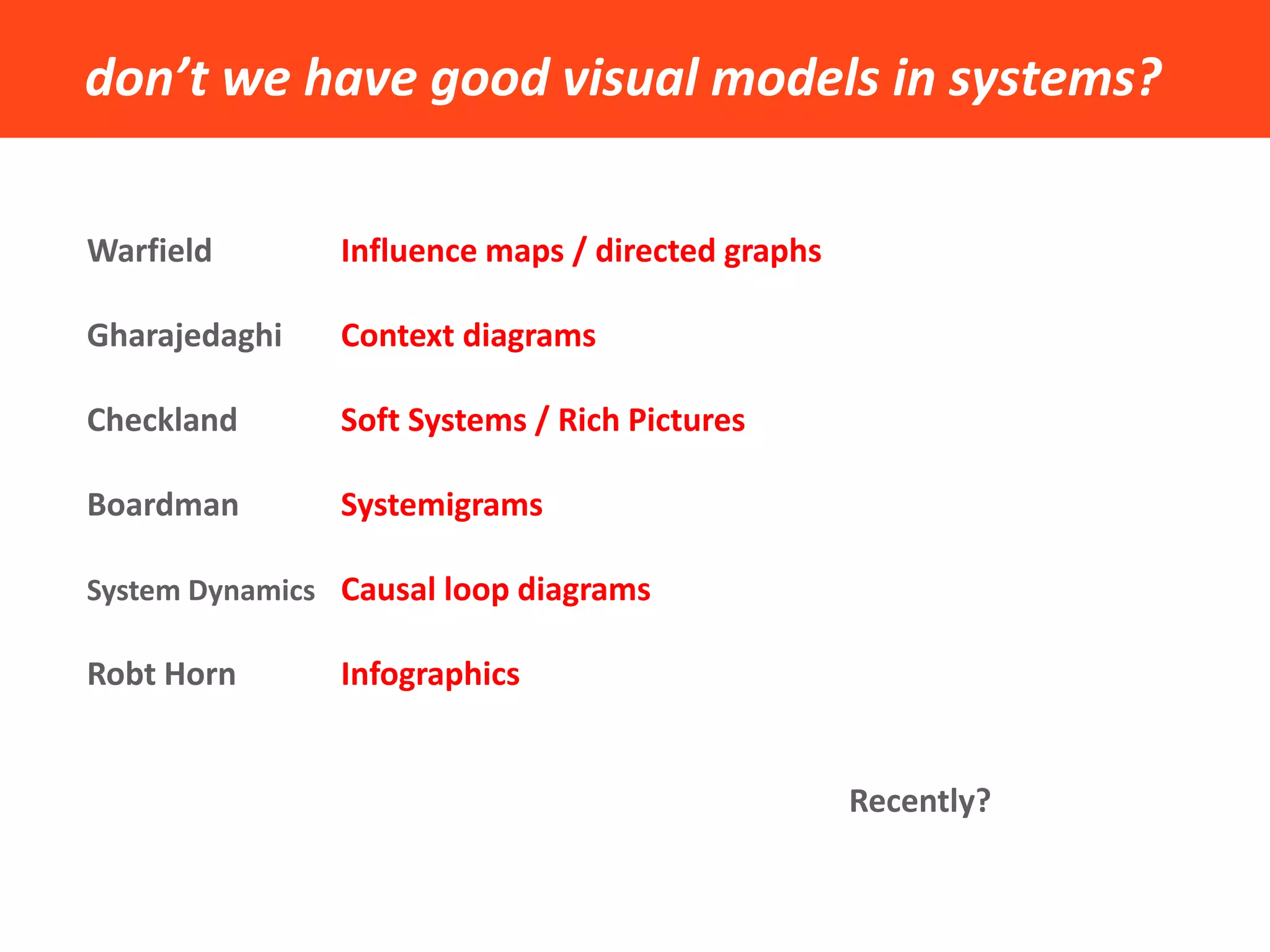
don’t we have good visual models in systems? 
Warfield Influence maps / directed graphs 
Gharajedaghi Context diagrams 
Checkland Soft Systems / Rich Pictures 
Boardman Systemigrams 
System Dynamics Causal loop diagrams 
Robt Horn Infographics 
Recently?
what are the purposes of systems theory? 
To understand actual systemic phenomena in complex systems? 
To better communicate knowledge of systemic patterns affecting social & ecological outcomes? 
To better organize sociotechnical systems? 
Why not innovation, or to design significantly better systems for complex ?
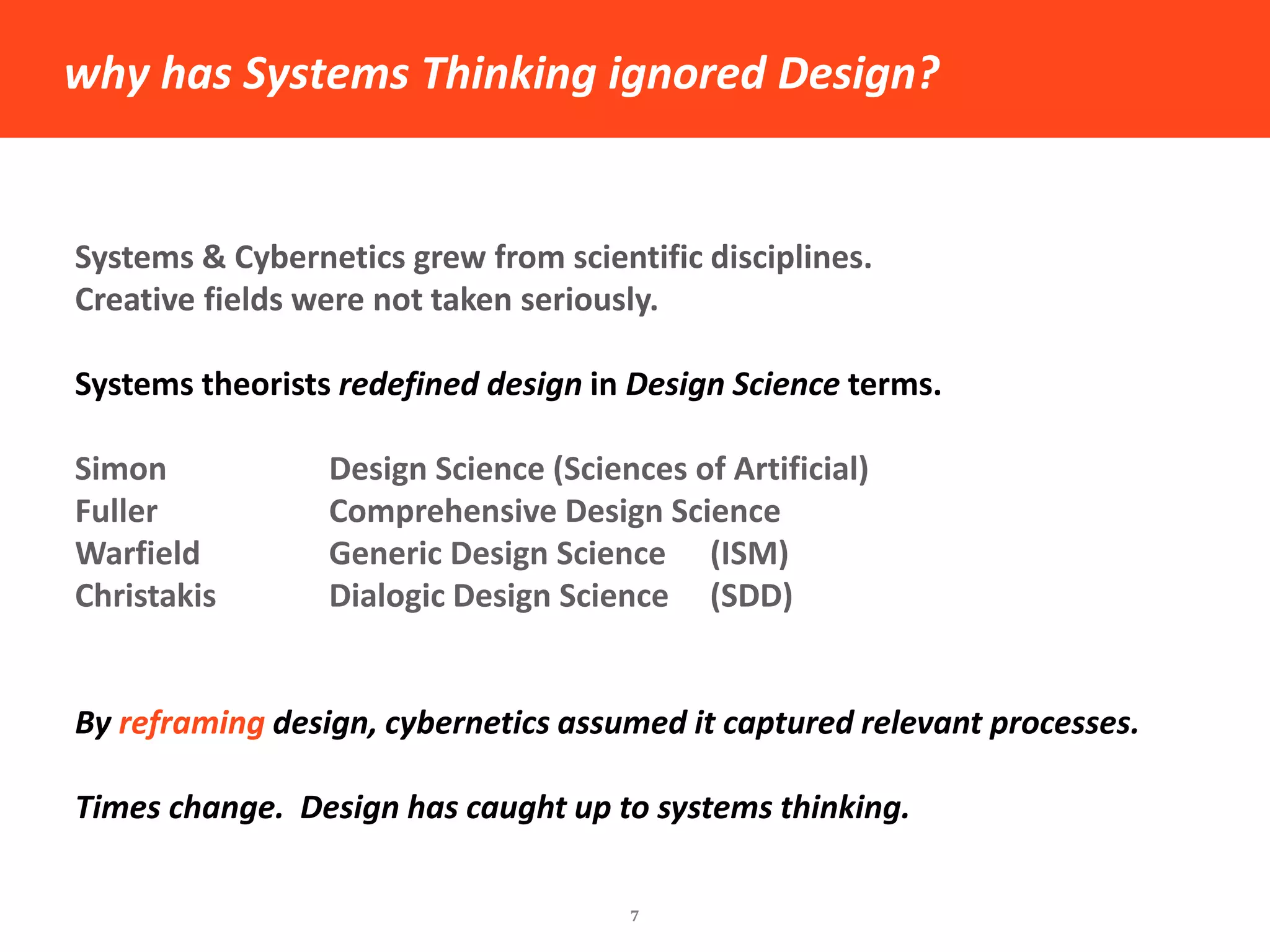
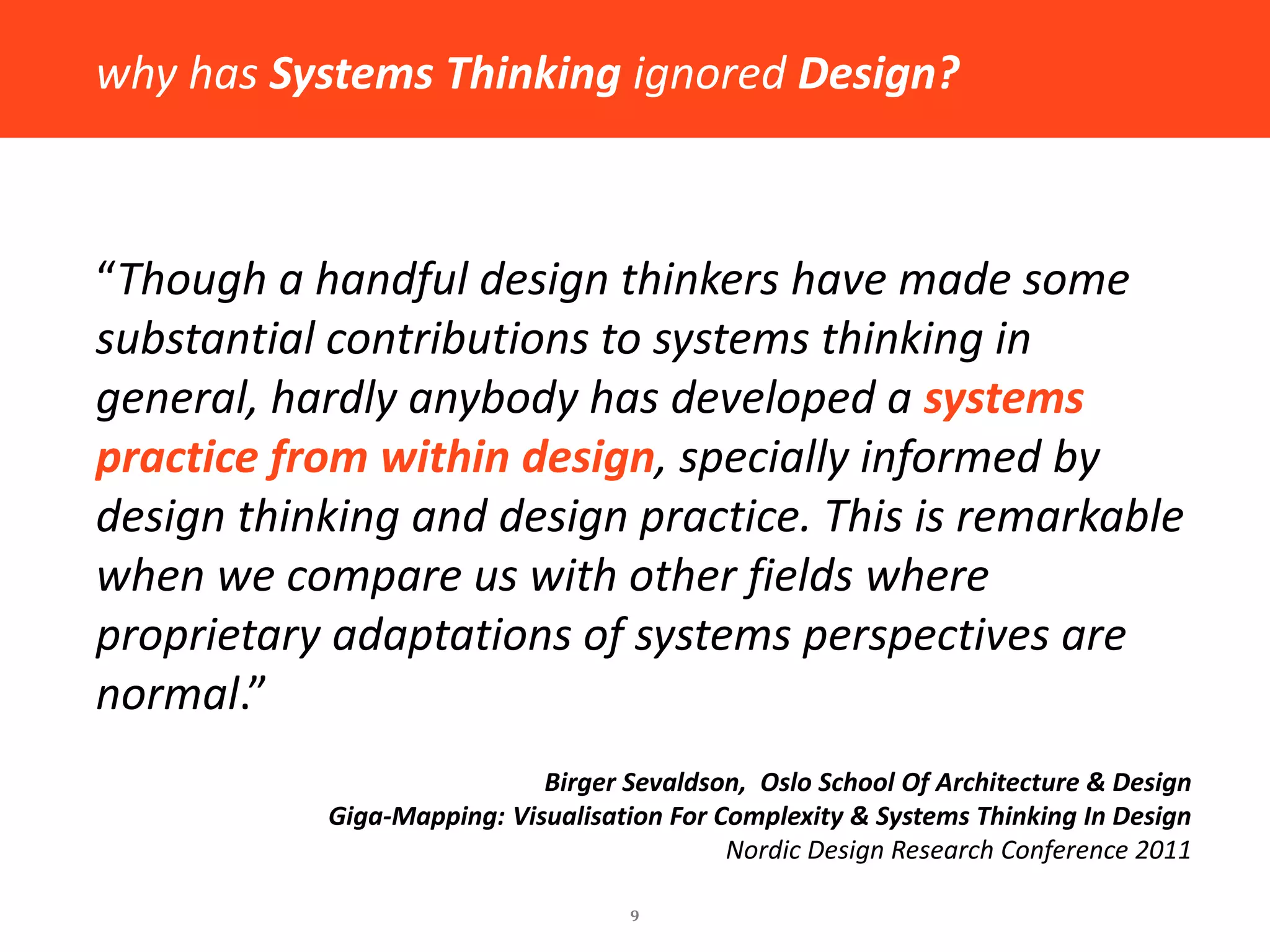
why has Systems Thinking ignored Design? 
7 
Systems & Cybernetics grew from scientific disciplines. 
Creative fields were not taken seriously. 
Systems theorists redefined design in Design Science terms. 
Simon Design Science (Sciences of Artificial) 
Fuller Comprehensive Design Science 
Warfield Generic Design Science (ISM) 
Christakis Dialogic Design Science (SDD) 
By reframing design, cybernetics assumed it captured relevant processes. 
Times change. Design has caught up to systems thinking.
8 
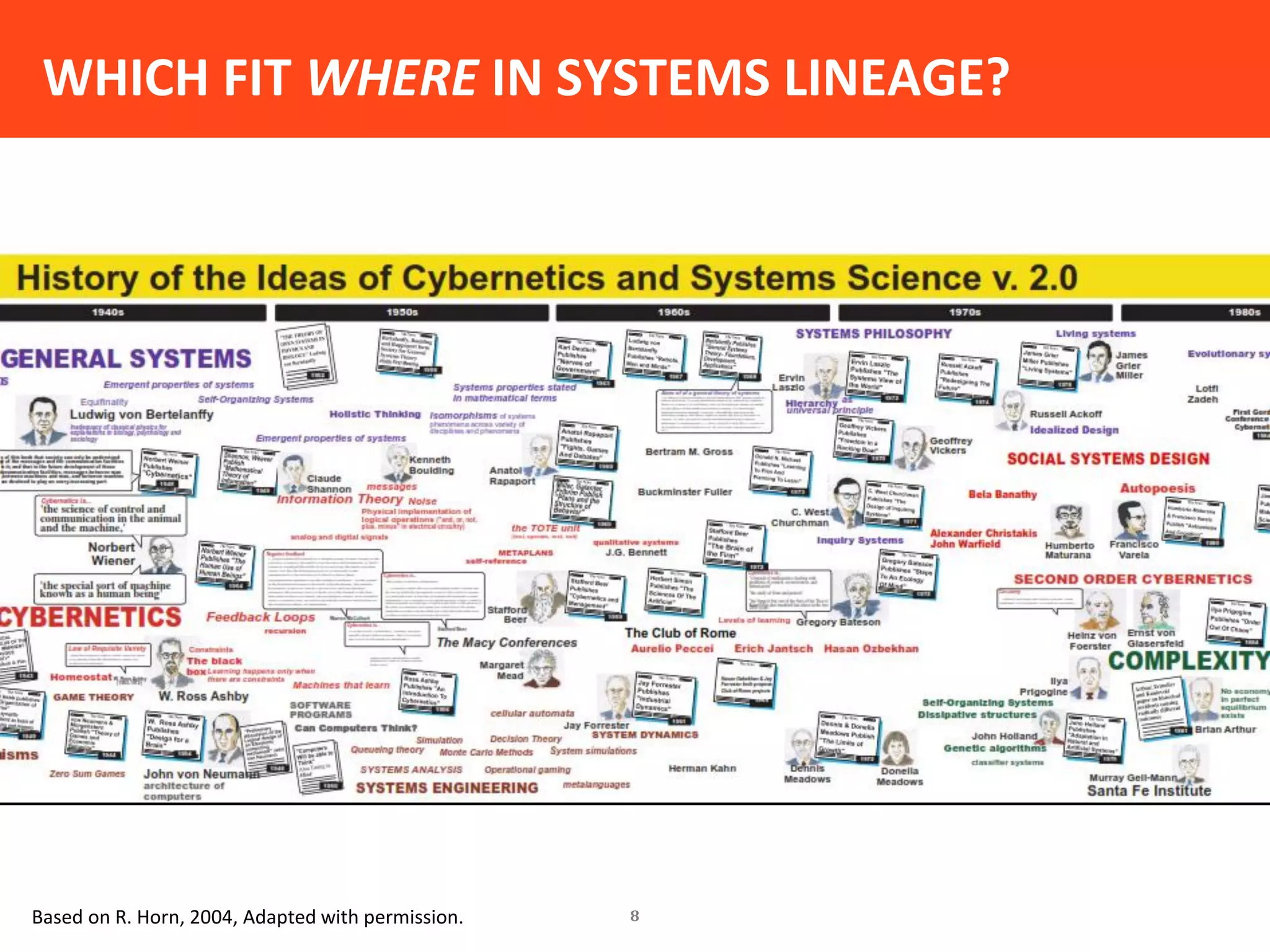
WHICH FIT WHERE IN SYSTEMS LINEAGE? 
Based on R. Horn, 2004, Adapted with permission.
9 
“Though a handful design thinkers have made some substantial contributions to systems thinking in general, hardly anybody has developed a systems practice from within design, specially informed by design thinking and design practice. This is remarkable when we compare us with other fields where proprietary adaptations of systems perspectives are normal.” 
Birger Sevaldson, Oslo School Of Architecture & Design 
Giga-Mapping: Visualisation For Complexity & Systems Thinking In Design 
Nordic Design Research Conference 2011 
why has Systems Thinking ignored Design?
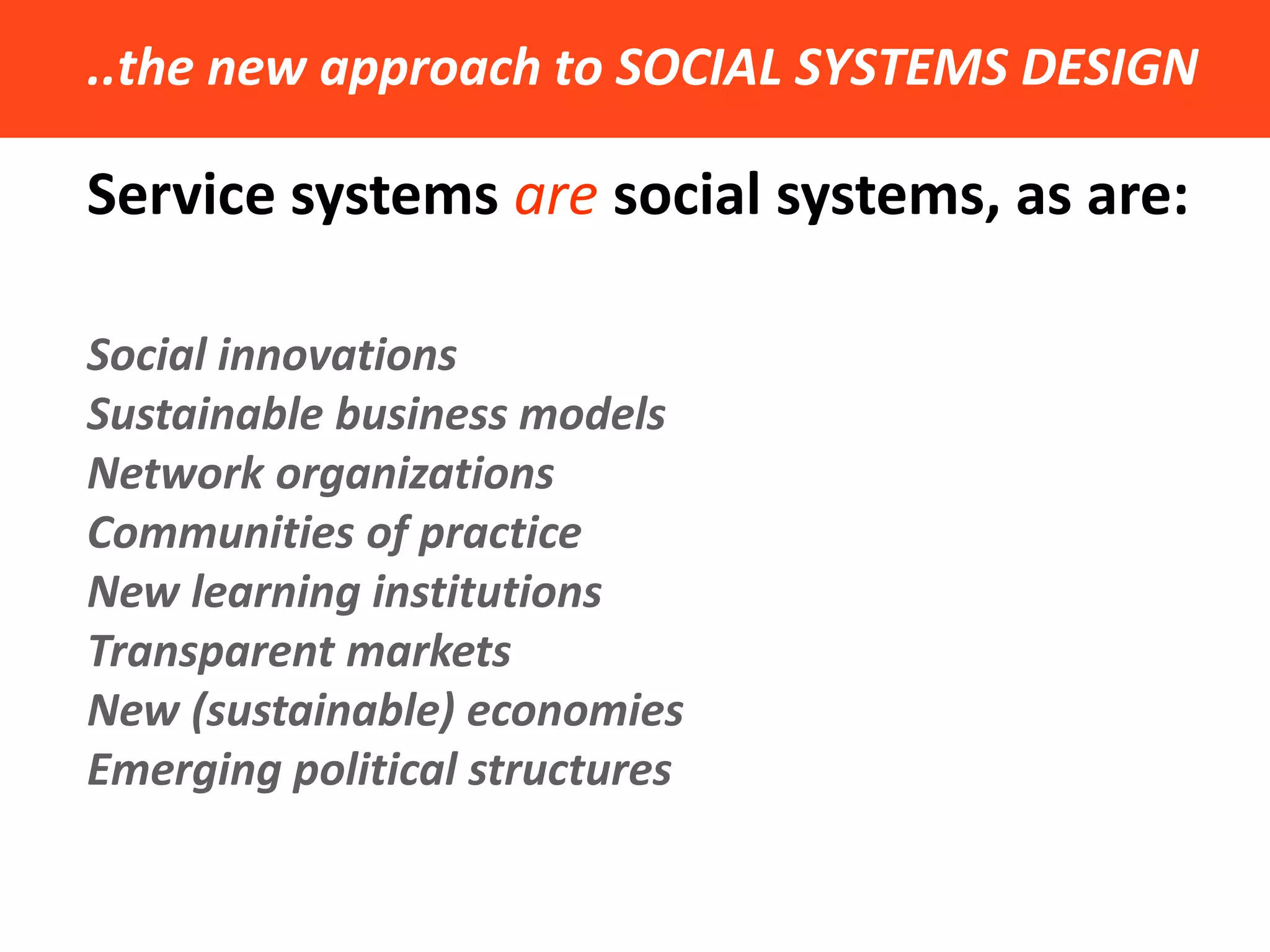
..the new approach to SOCIAL SYSTEMS DESIGN 
Service systems are social systems, as are: 
Social innovations 
Sustainable business models 
Network organizations 
Communities of practice 
New learning institutions 
Transparent markets 
New (sustainable) economies 
Emerging political structures
11 
EXAMPLES 
Design Thinking in 
HEALTHCARE SERVICES
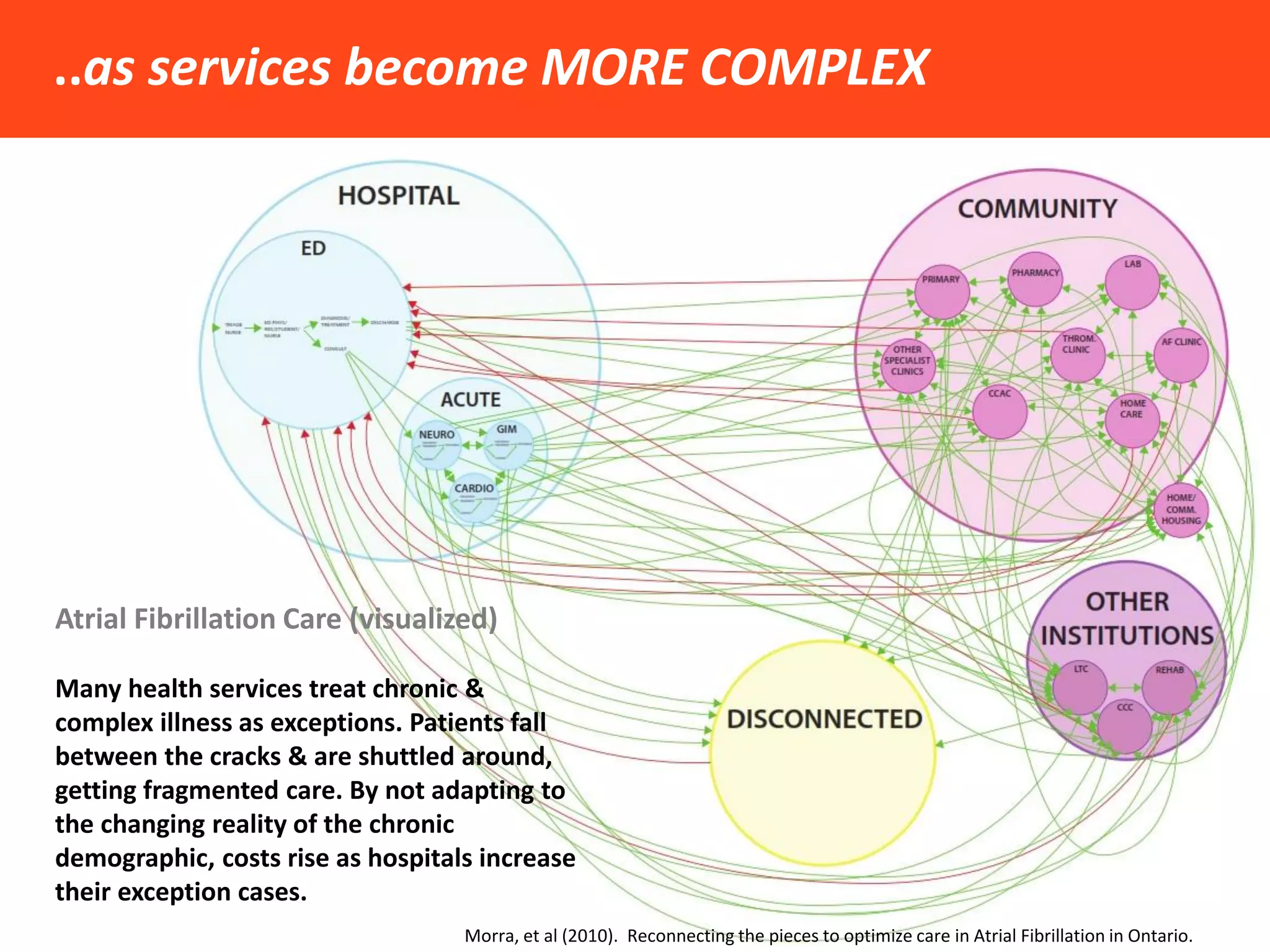
..as services become MORE COMPLEX 
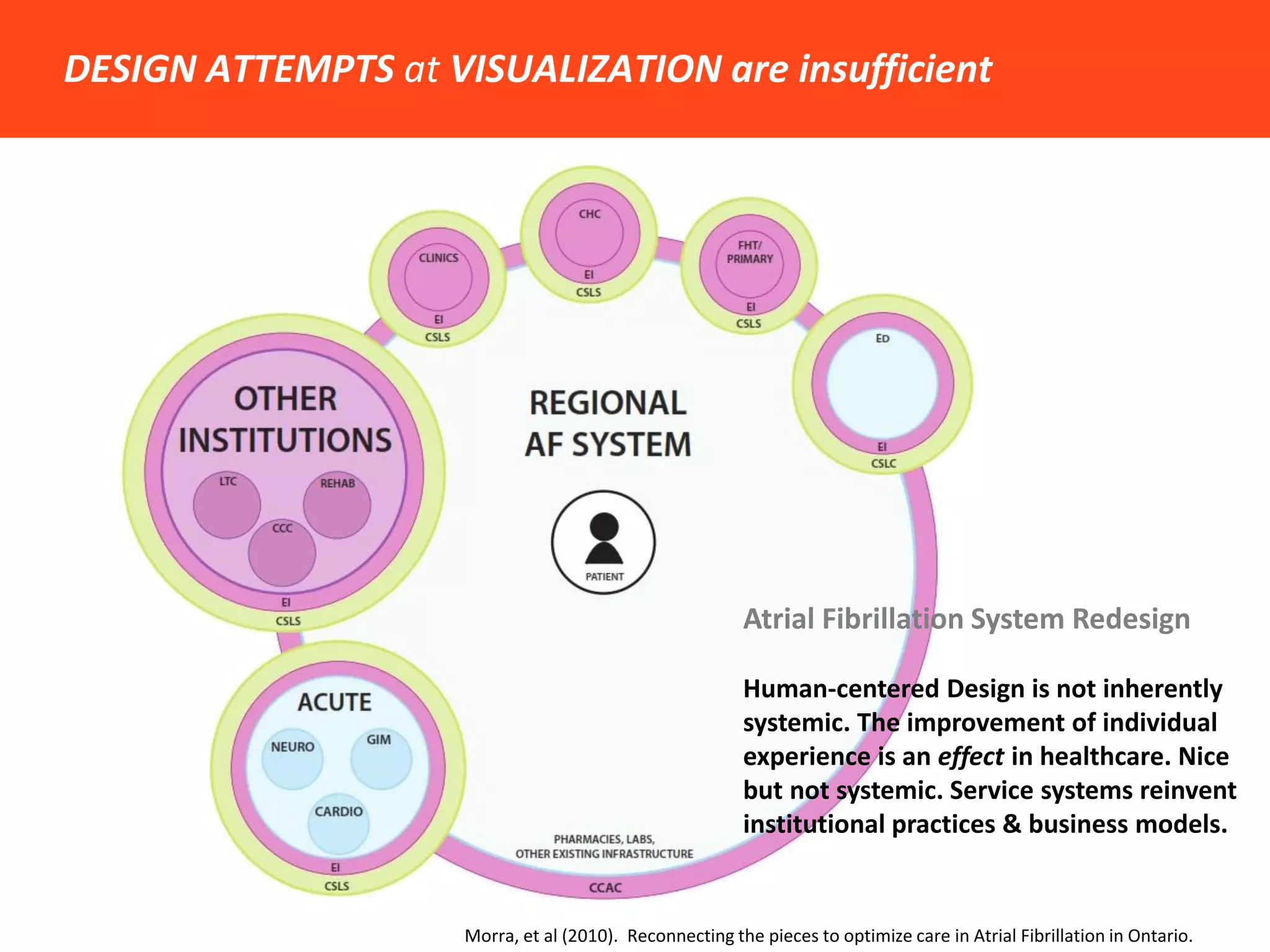
Atrial Fibrillation Care (visualized) 
Many health services treat chronic & complex illness as exceptions. Patients fall between the cracks & are shuttled around, getting fragmented care. By not adapting to the changing reality of the chronic demographic, costs rise as hospitals increase their exception cases. 
Morra, et al (2010). Reconnecting the pieces to optimize care in Atrial Fibrillation in Ontario.
HUMAN-CENTERED SERVICE DESIGN is insufficient 
13 
Atrial Fibrillation Aftercare Pathway 
Human-Centered Design is not inherently systemic. Individual experience enhancement is an outcome of healthcare service.
DESIGN ATTEMPTS at VISUALIZATION are insufficient 
14 
Atrial Fibrillation System Redesign 
Human-centered Design is not inherently systemic. The improvement of individual experience is an effect in healthcare. Nice but not systemic. Service systems reinvent institutional practices & business models. 
Morra, et al (2010). Reconnecting the pieces to optimize care in Atrial Fibrillation in Ontario.
15 
DESCRIPTIVE 
SYSTEMS METHODS 
And 
DESIGNERLY 
PRACTICES
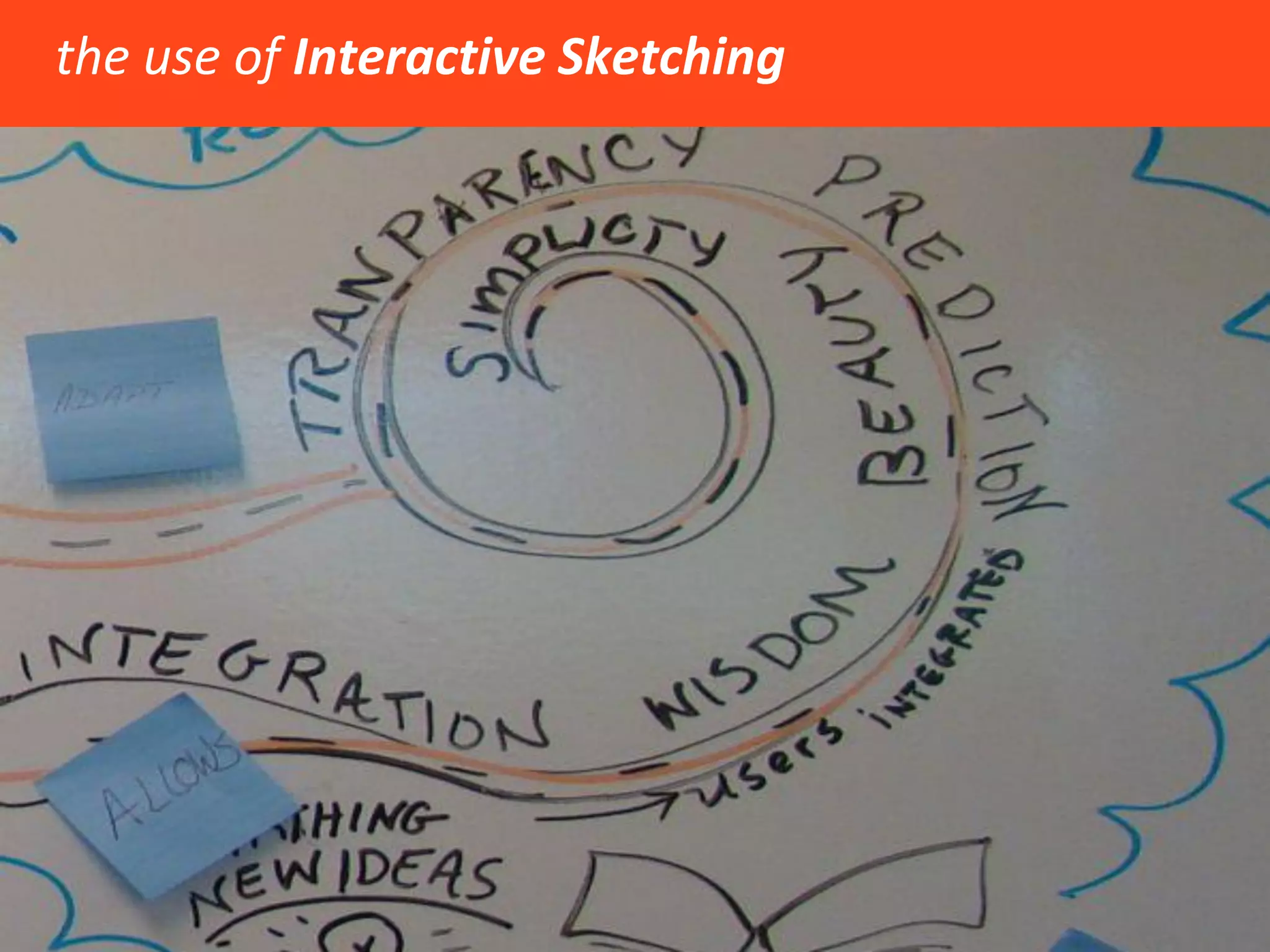
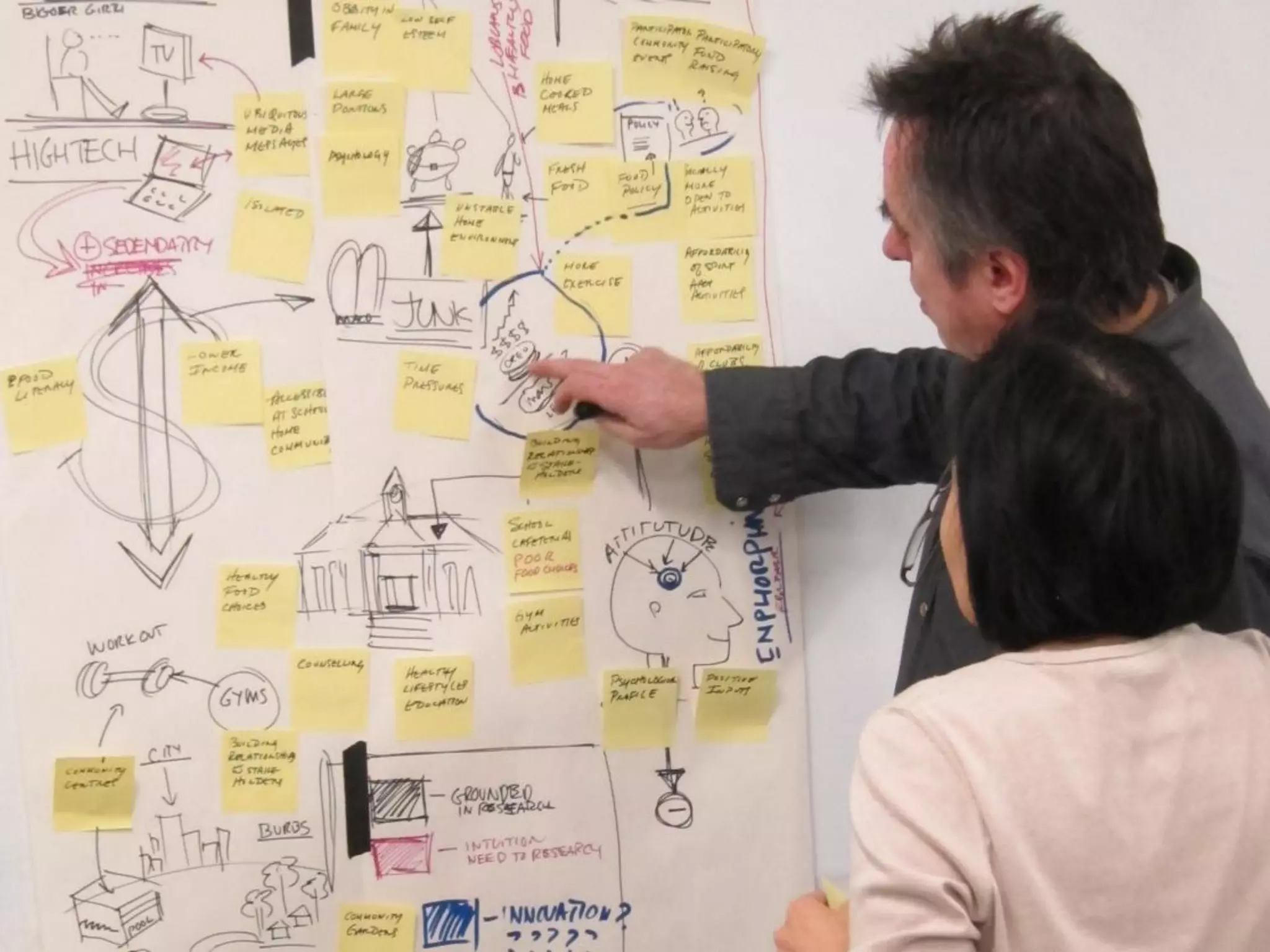
the use of Interactive Sketching
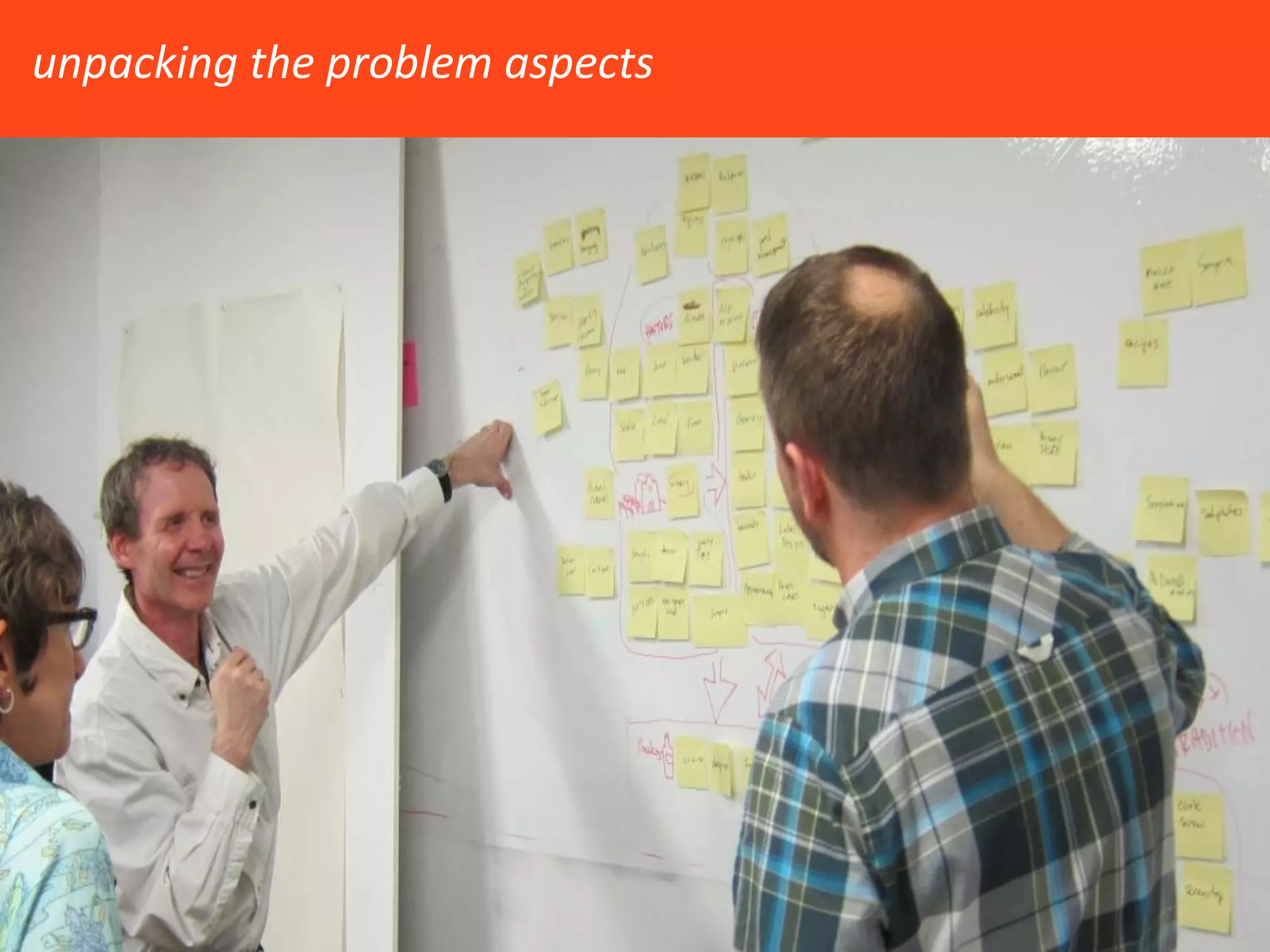
unpacking the problem aspects 
17
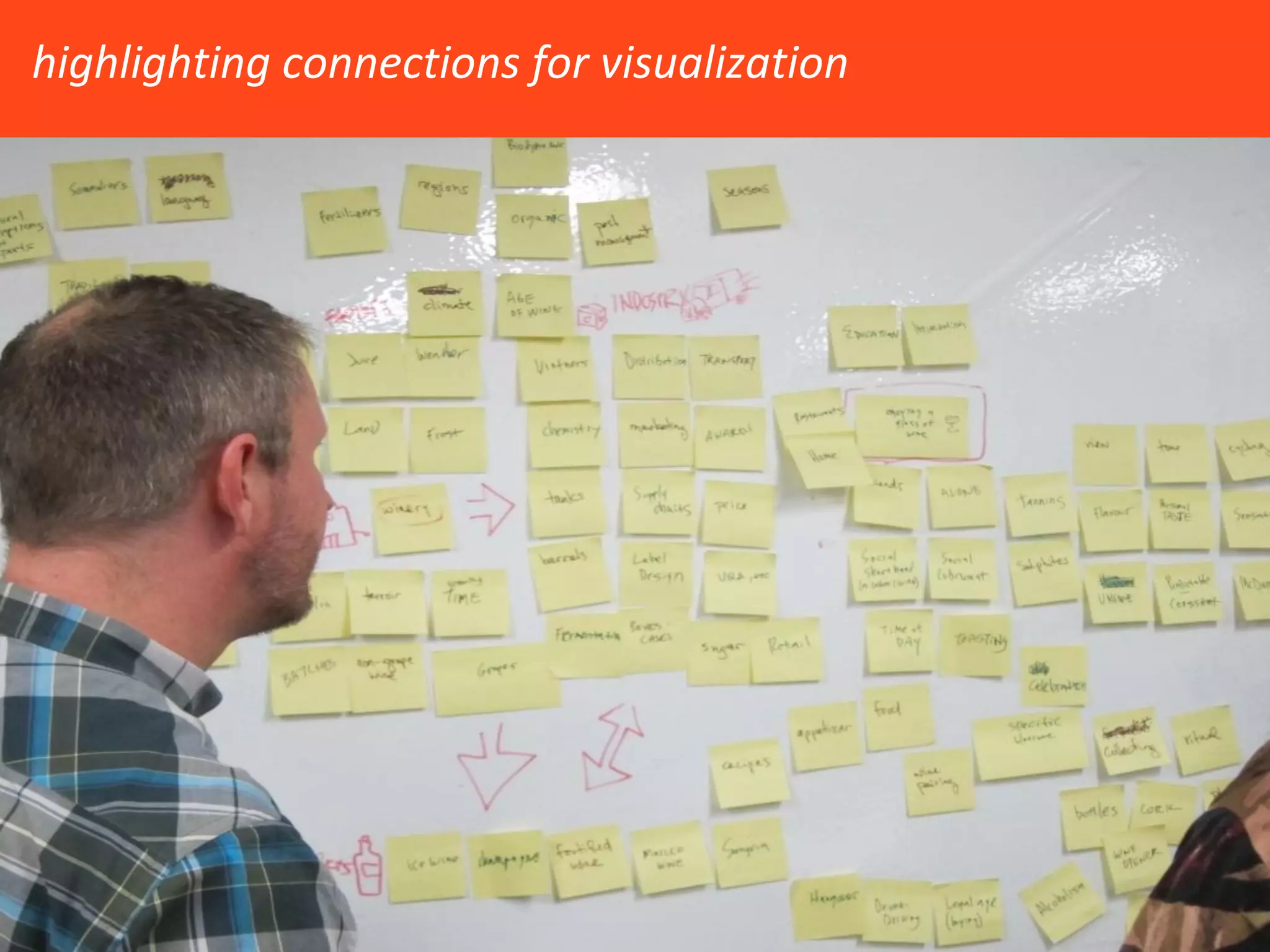
highlighting connections for visualization
19
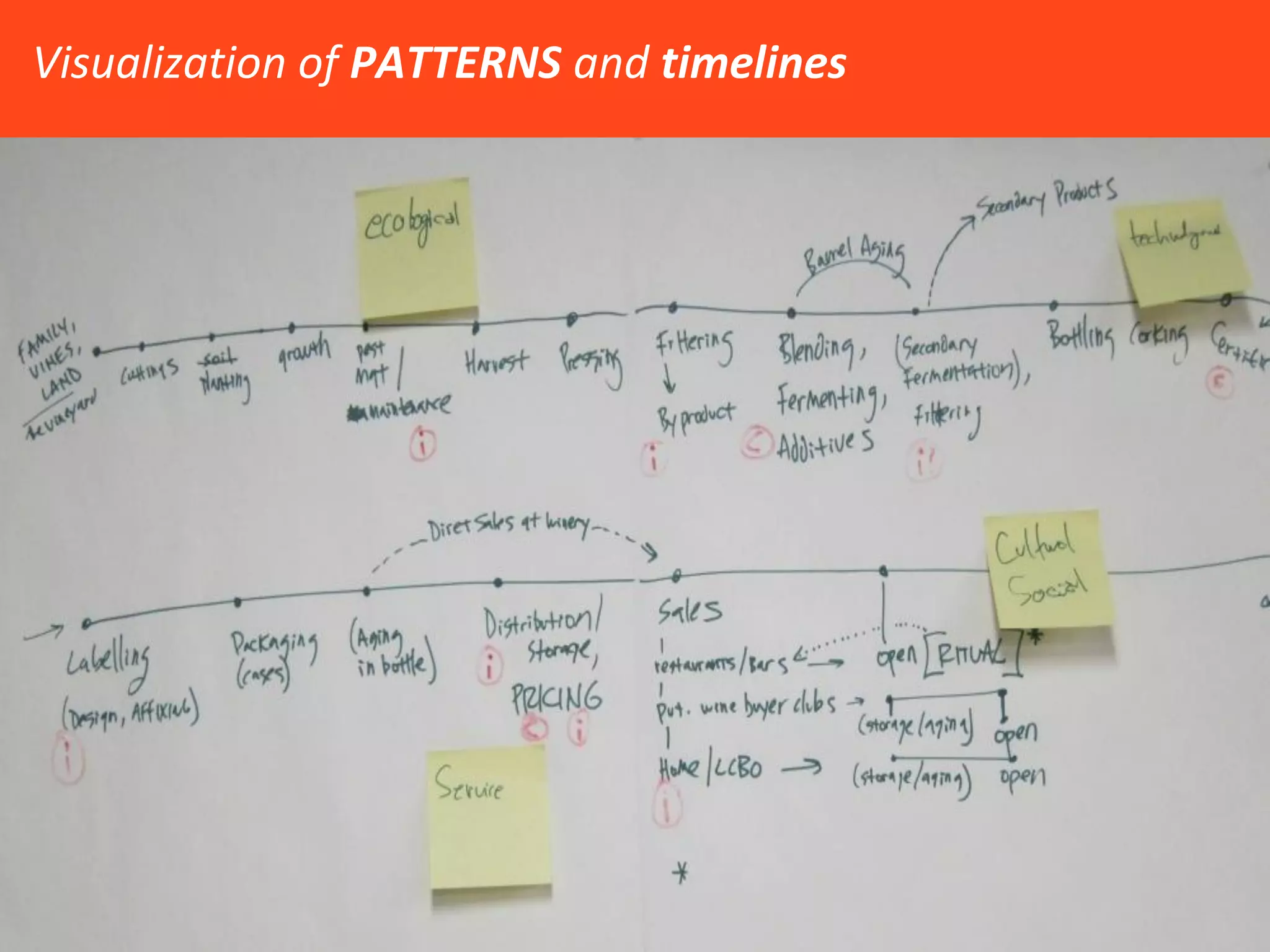
Visualization of PATTERNS and timelines
21 
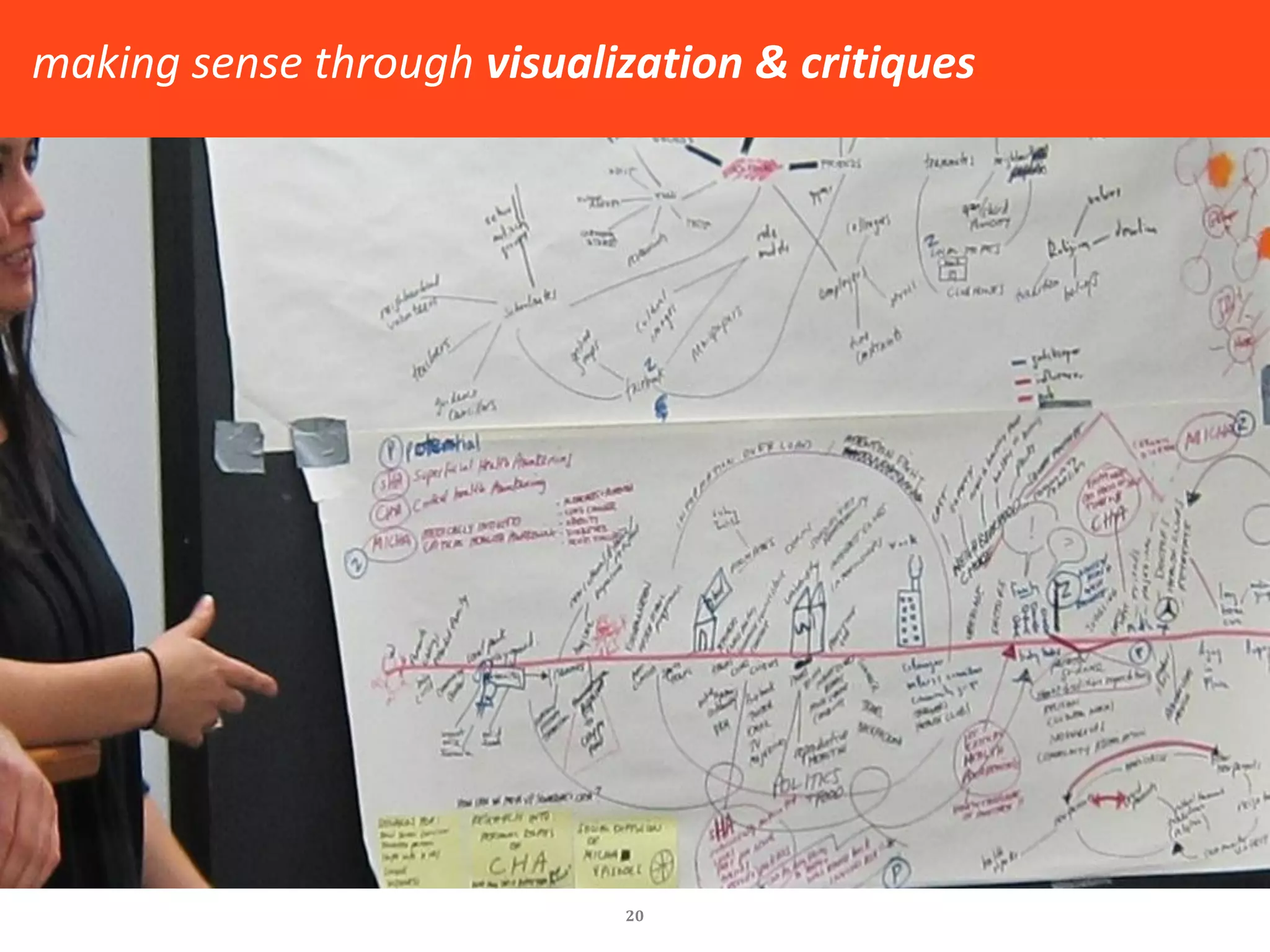
making sense through visualization & critiques
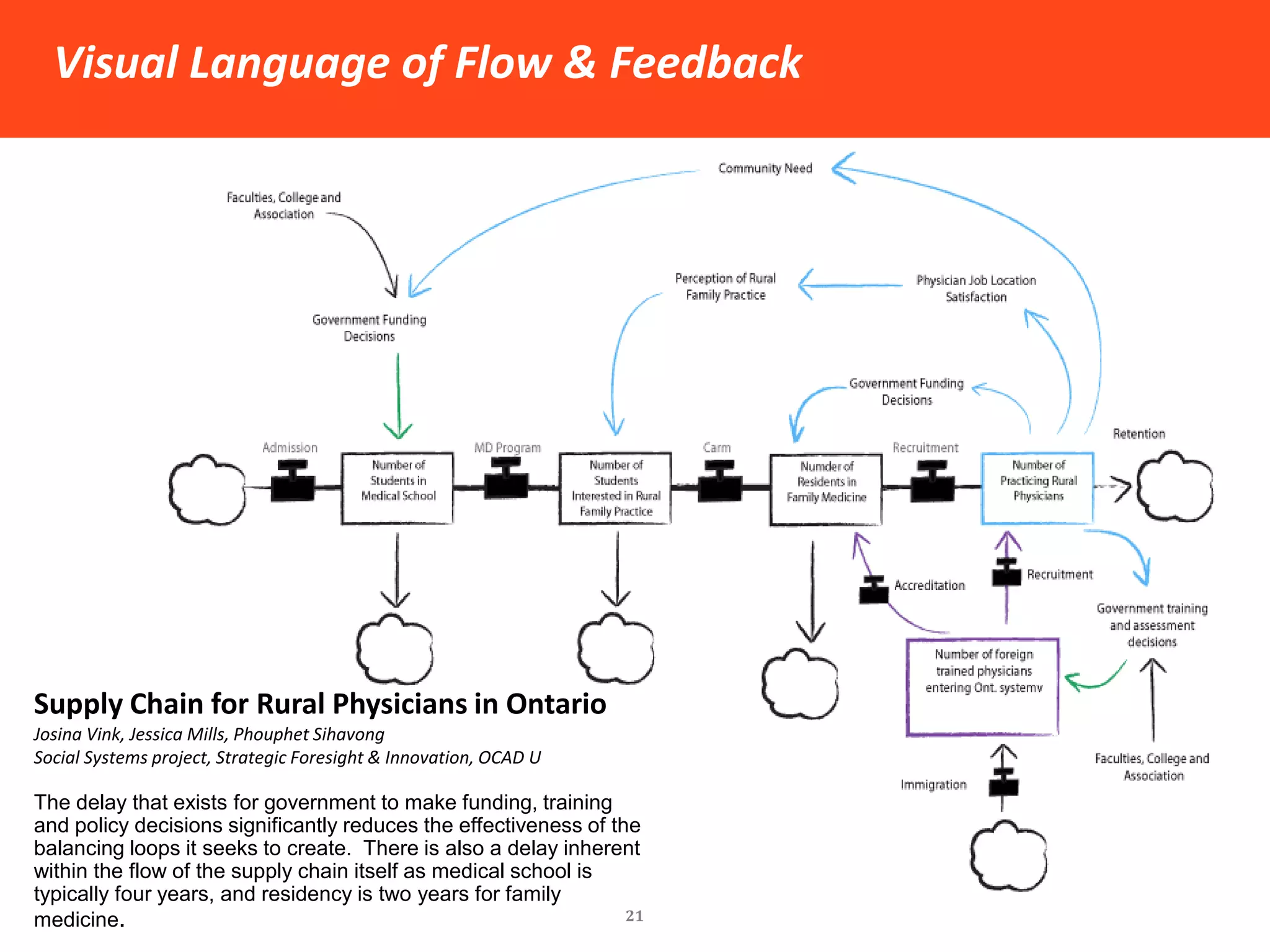
Visual Language of Flow & Feedback 
22 
Supply Chain for Rural Physicians in Ontario 
Josina Vink, Jessica Mills, Phouphet Sihavong 
Social Systems project, Strategic Foresight & Innovation, OCAD U 
The delay that exists for government to make funding, training and policy decisions significantly reduces the effectiveness of the balancing loops it seeks to create. There is also a delay inherent within the flow of the supply chain itself as medical school is typically four years, and residency is two years for family medicine.
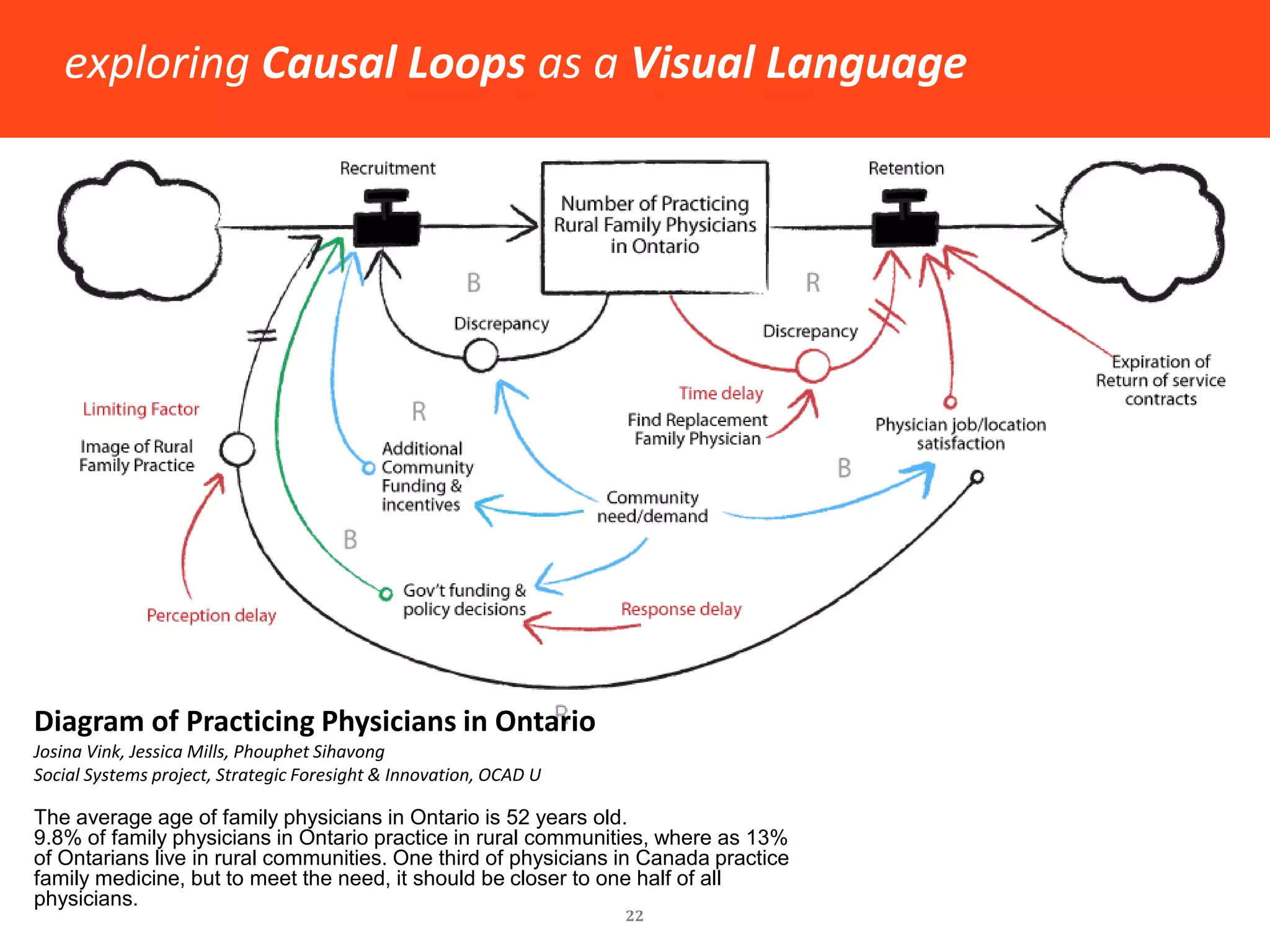
exploring Causal Loops as a Visual Language 
23 
Diagram of Practicing Physicians in Ontario 
Josina Vink, Jessica Mills, Phouphet Sihavong 
Social Systems project, Strategic Foresight & Innovation, OCAD U 
The average age of family physicians in Ontario is 52 years old. 
9.8% of family physicians in Ontario practice in rural communities, where as 13% of Ontarians live in rural communities. One third of physicians in Canada practice family medicine, but to meet the need, it should be closer to one half of all physicians.
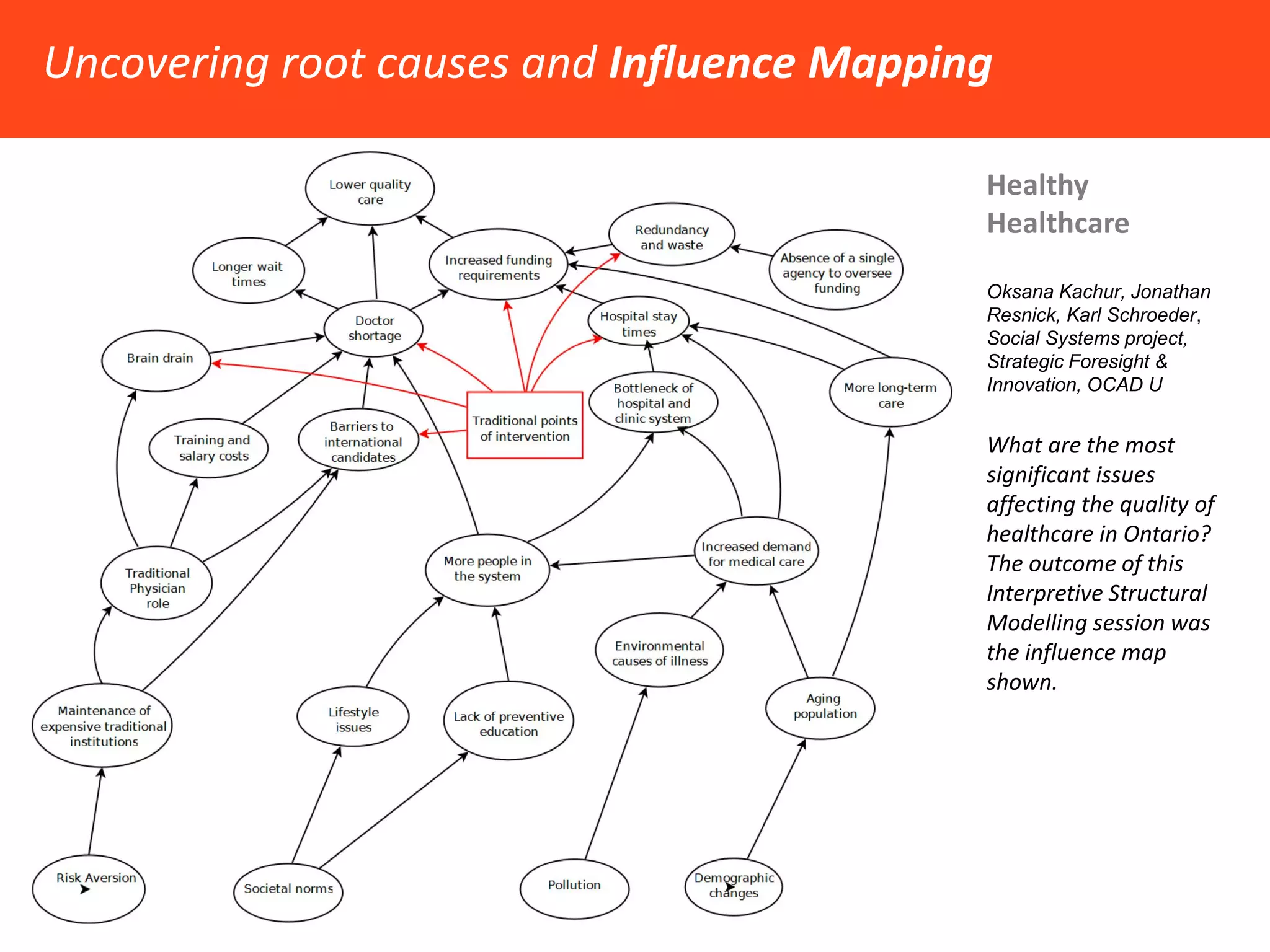
Uncovering root causes and Influence Mapping 
24 
Healthy Healthcare 
Oksana Kachur, Jonathan Resnick, Karl Schroeder, Social Systems project, Strategic Foresight & Innovation, OCAD U 
What are the most significant issues affecting the quality of healthcare in Ontario? The outcome of this Interpretive Structural Modelling session was the influence map shown.
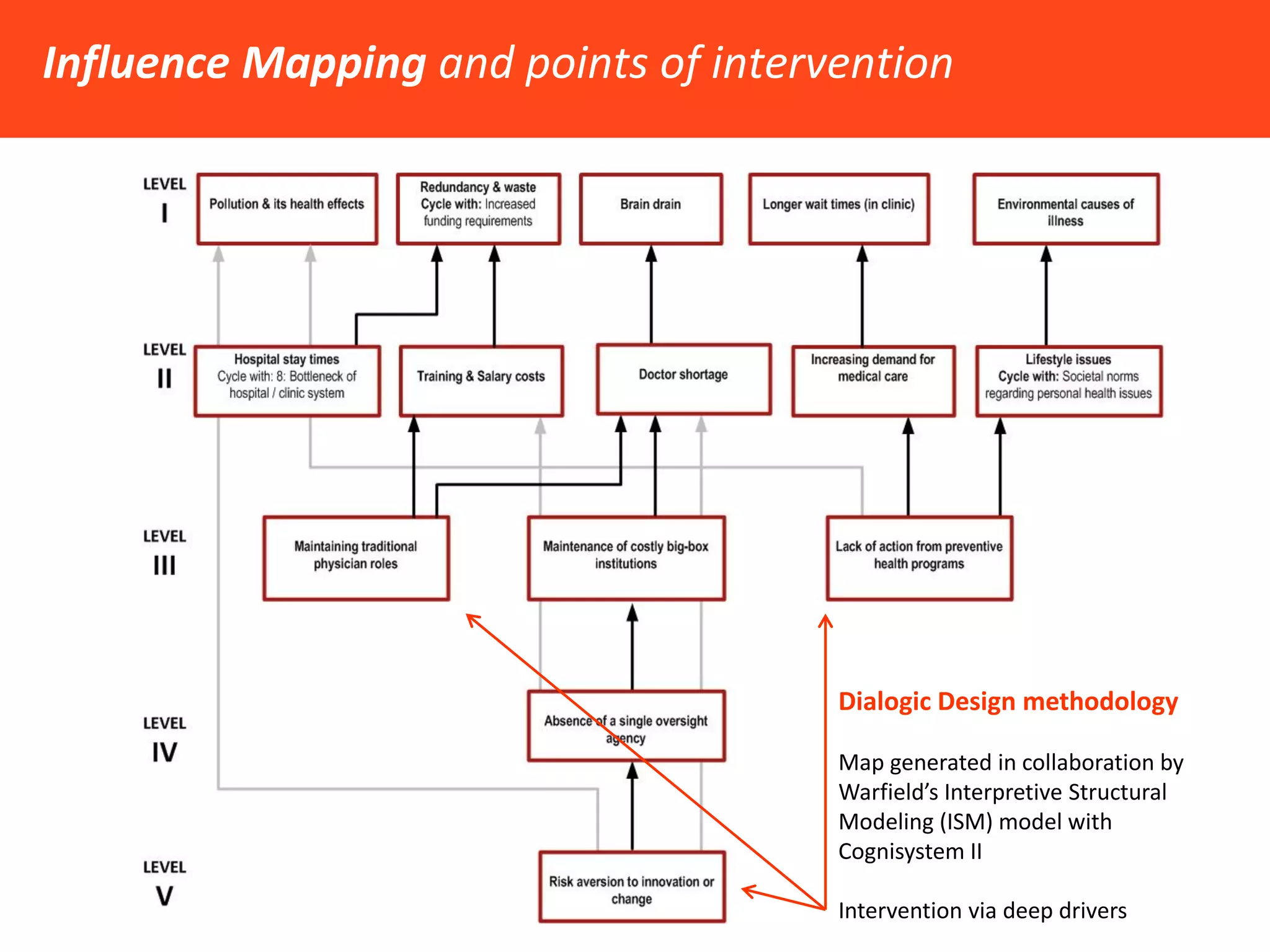
Influence Mapping and points of intervention 
25 
Dialogic Design methodology 
Map generated in collaboration by Warfield’s Interpretive Structural Modeling (ISM) model with Cognisystem II 
Intervention via deep drivers
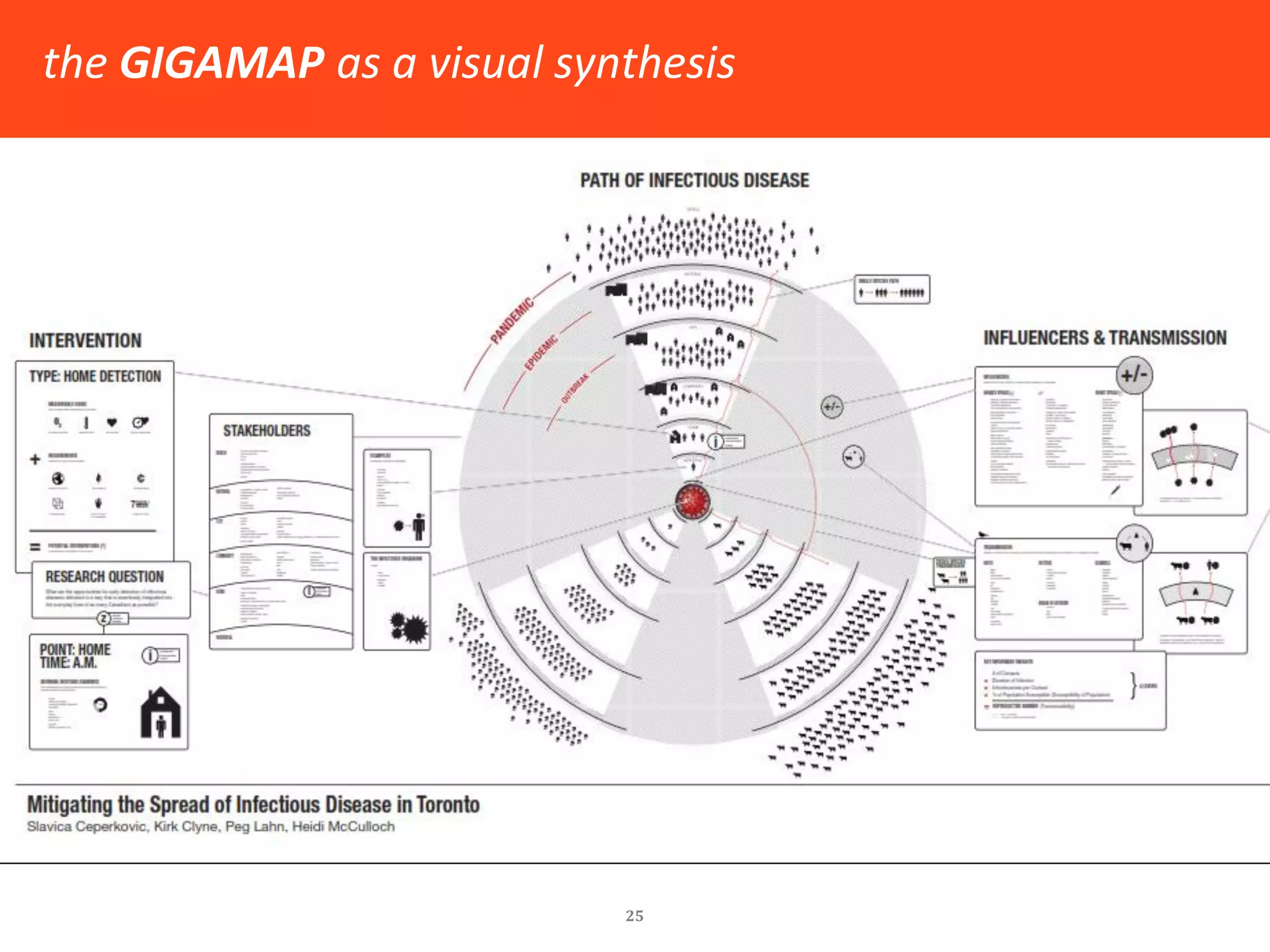
the GIGAMAP as a visual synthesis 
26
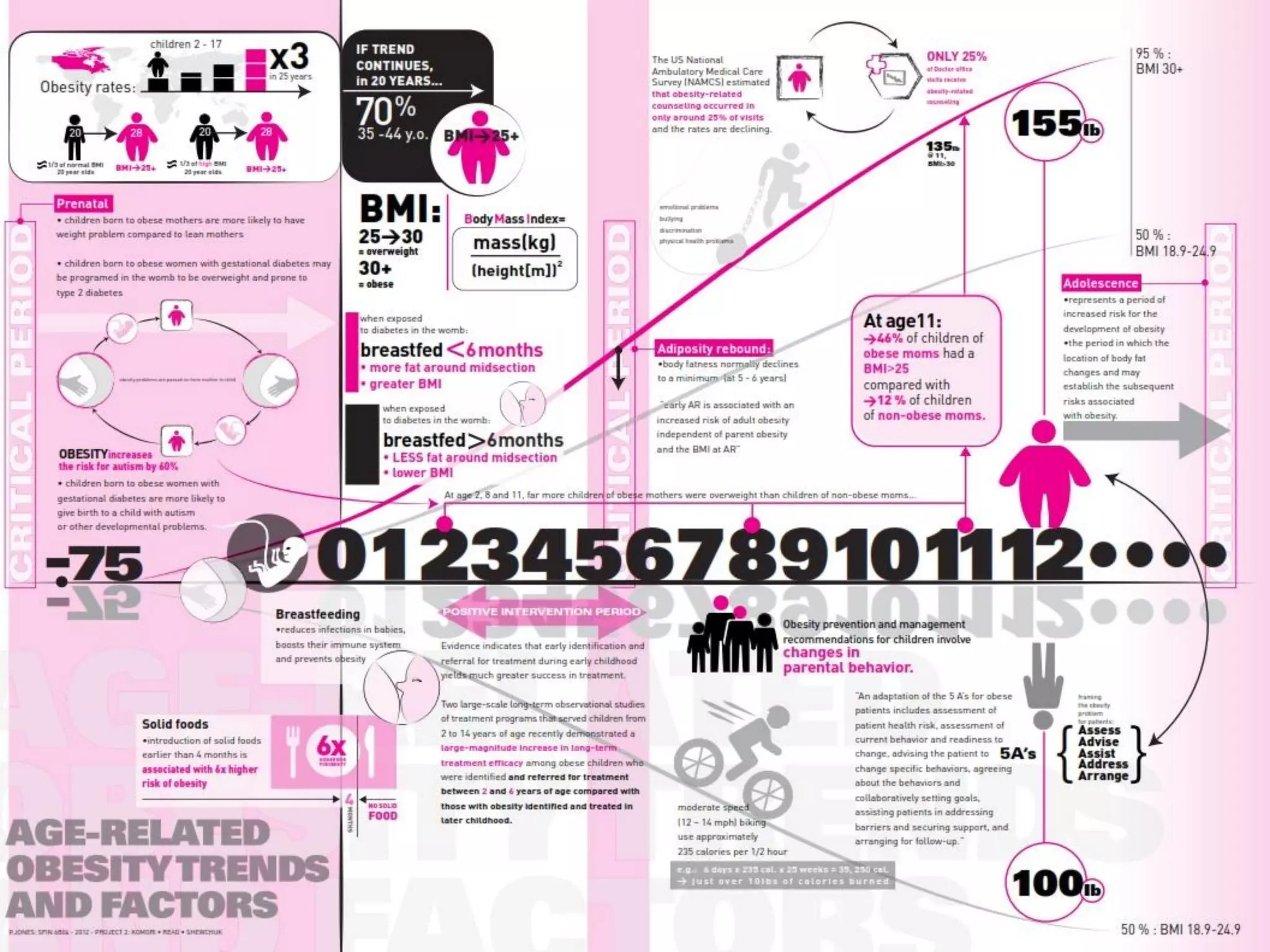
GIGAMAPPING 
27
Rheinfrank, J. and Evenson, S. From Winograd, Terry. 1996. Bringing design to software. New York: Addison-Wesley. 
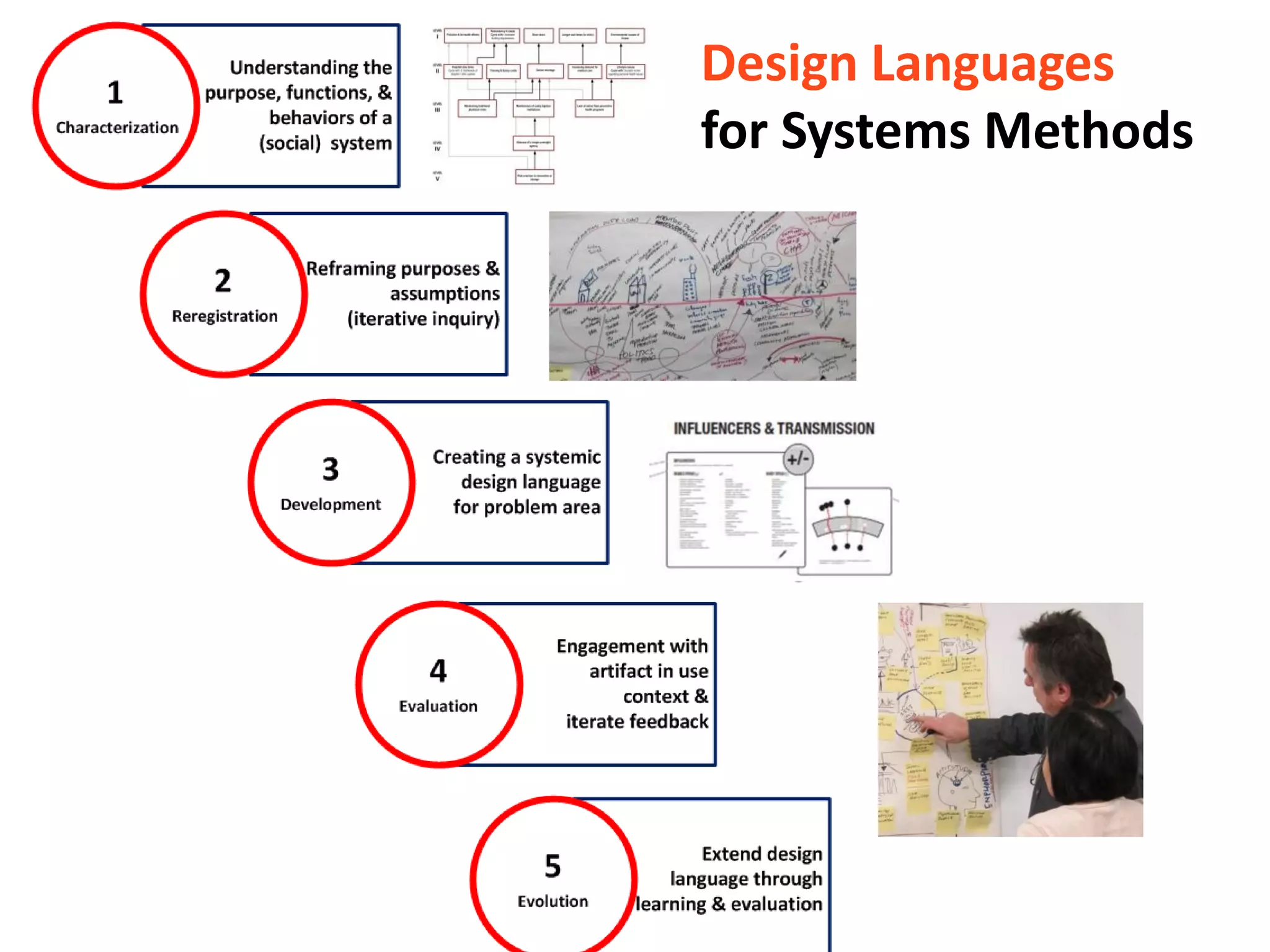
Design Languages for Systems Methods
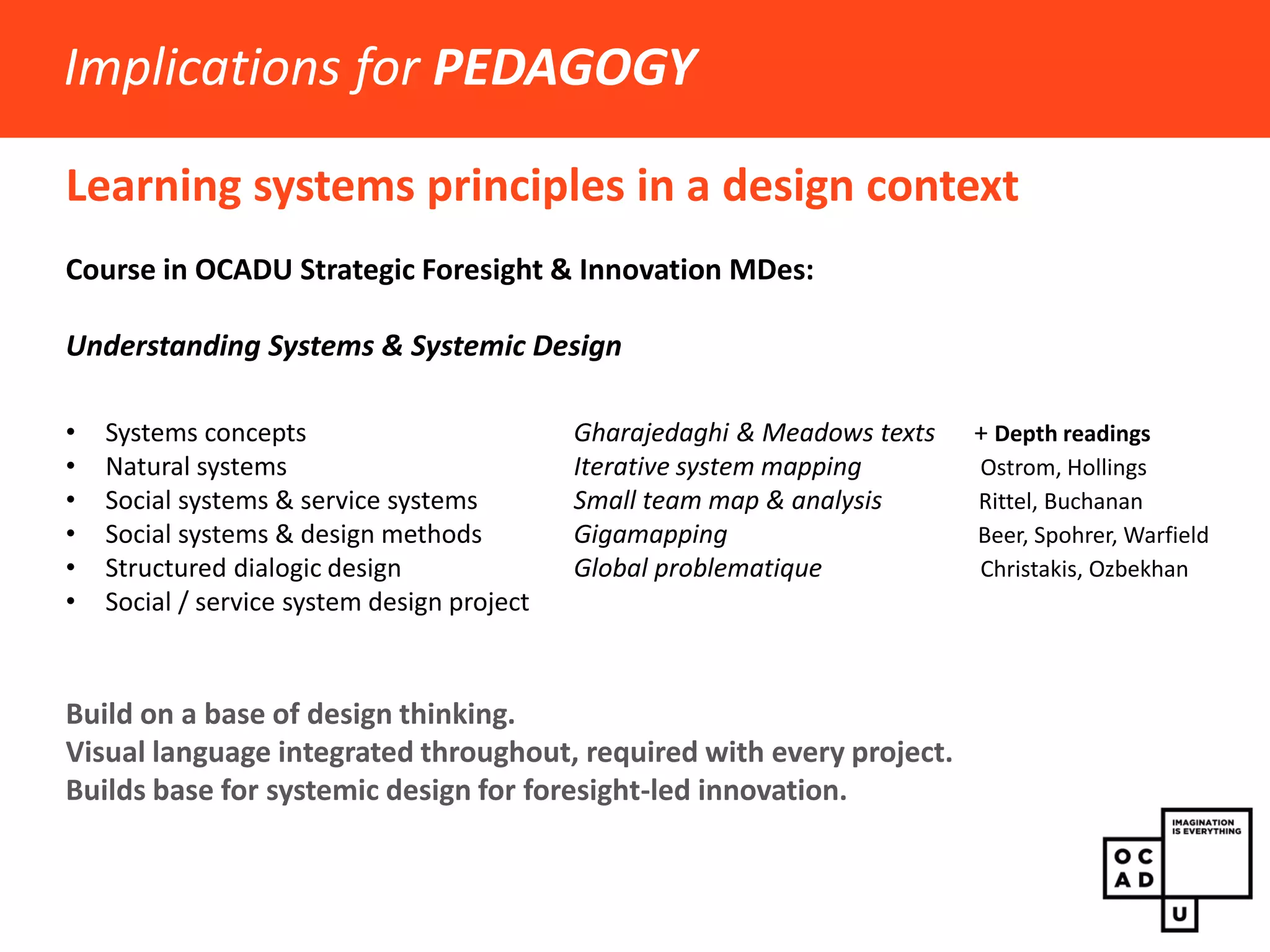
Learning systems principles in a design context 
Implications for PEDAGOGY 
Course in OCADU Strategic Foresight & Innovation MDes: Understanding Systems & Systemic Design Originally 2 courses: 6 modules, 2 projects 
•Systems concepts 
•Natural systems 
•Social systems & service systems 
•Social systems & design methods 
•Structured dialogic design 
Rheinfrank, J. and Evenson, S. From Winograd, Terry. 1996. Bringing design to software. New York: Addison-Wesley.
Learning systems principles in a design context 
Implications for PEDAGOGY 
Course in OCADU Strategic Foresight & Innovation MDes: Understanding Systems & Systemic Design 
•Systems concepts Gharajedaghi & Meadows texts + Depth readings 
•Natural systems Iterative system mapping Ostrom, Hollings 
•Social systems & service systems Small team map & analysis Rittel, Buchanan 
•Social systems & design methods Gigamapping Beer, Spohrer, Warfield 
•Structured dialogic design Global problematique Christakis, Ozbekhan 
•Social / service system design project Build on a base of design thinking. Visual language integrated throughout, required with every project. Builds base for systemic design for foresight-led innovation.
Peter Jones, PhD Jeremy Bowes, AOCA 
OCAD University, Toronto OCADU 
Thanks. 
Peter Jones, PhD @redesign 
OCAD University 
Jeremy Bowes 
Professor, OCAD University 
Strategic Innovation Lab sLab.ocadu.ca

ISSS Visual Languages in Systemic Design

  • 1.
    Peter Jones, PhDJeremy Bowes OCAD University, Toronto OCADU Toward the Integration of Visual Languages for Systemic Design
  • 2.
    … our thesis Systemic thinking is better expressed in design languages than system formalisms. Understanding of complex systems is enhanced for a wider variety of stakeholders. Visual design languages offer significant potential for social & service systems design. Generative bias as opposed to descriptive science
  • 3.
    why a designlanguage for systems?… design is changing … Design thinking is extending beyond design outcomes, but is falling short of systems methods & toolkits. Design approaches differ from systems in many respects: • Successive approximations toward emerging goals • Continuous interpretation by multiple perspectives • Action-oriented, making artifacts & prototypes • Visual representations, from sketching to blueprints However we still lack good theory & practices of systemic design.
  • 4.
    …an opportunity forCOMPLEXITY NAVIGATION 4 Design thinking also deals with complexity. Design must become more systemic - as we are confronted with wicked problems. Highly complex domains need new methods: Design 1.0 Craft design, Advertising Design 2.0 Industrial, Products, Web Design 3.0 Organizational systems Design 4.0 Social systems Mixed stakeholders
  • 5.
    don’t we havegood visual models in systems? Warfield Influence maps / directed graphs Gharajedaghi Context diagrams Checkland Soft Systems / Rich Pictures Boardman Systemigrams System Dynamics Causal loop diagrams Robt Horn Infographics Recently?
  • 6.
    what are thepurposes of systems theory? To understand actual systemic phenomena in complex systems? To better communicate knowledge of systemic patterns affecting social & ecological outcomes? To better organize sociotechnical systems? Why not innovation, or to design significantly better systems for complex ?
  • 7.
    why has SystemsThinking ignored Design? 7 Systems & Cybernetics grew from scientific disciplines. Creative fields were not taken seriously. Systems theorists redefined design in Design Science terms. Simon Design Science (Sciences of Artificial) Fuller Comprehensive Design Science Warfield Generic Design Science (ISM) Christakis Dialogic Design Science (SDD) By reframing design, cybernetics assumed it captured relevant processes. Times change. Design has caught up to systems thinking.
  • 8.
    8 WHICH FITWHERE IN SYSTEMS LINEAGE? Based on R. Horn, 2004, Adapted with permission.
  • 9.
    9 “Though ahandful design thinkers have made some substantial contributions to systems thinking in general, hardly anybody has developed a systems practice from within design, specially informed by design thinking and design practice. This is remarkable when we compare us with other fields where proprietary adaptations of systems perspectives are normal.” Birger Sevaldson, Oslo School Of Architecture & Design Giga-Mapping: Visualisation For Complexity & Systems Thinking In Design Nordic Design Research Conference 2011 why has Systems Thinking ignored Design?
  • 10.
    ..the new approachto SOCIAL SYSTEMS DESIGN Service systems are social systems, as are: Social innovations Sustainable business models Network organizations Communities of practice New learning institutions Transparent markets New (sustainable) economies Emerging political structures
  • 11.
    11 EXAMPLES DesignThinking in HEALTHCARE SERVICES
  • 12.
    ..as services becomeMORE COMPLEX Atrial Fibrillation Care (visualized) Many health services treat chronic & complex illness as exceptions. Patients fall between the cracks & are shuttled around, getting fragmented care. By not adapting to the changing reality of the chronic demographic, costs rise as hospitals increase their exception cases. Morra, et al (2010). Reconnecting the pieces to optimize care in Atrial Fibrillation in Ontario.
  • 13.
    HUMAN-CENTERED SERVICE DESIGNis insufficient 13 Atrial Fibrillation Aftercare Pathway Human-Centered Design is not inherently systemic. Individual experience enhancement is an outcome of healthcare service.
  • 14.
    DESIGN ATTEMPTS atVISUALIZATION are insufficient 14 Atrial Fibrillation System Redesign Human-centered Design is not inherently systemic. The improvement of individual experience is an effect in healthcare. Nice but not systemic. Service systems reinvent institutional practices & business models. Morra, et al (2010). Reconnecting the pieces to optimize care in Atrial Fibrillation in Ontario.
  • 15.
    15 DESCRIPTIVE SYSTEMSMETHODS And DESIGNERLY PRACTICES
  • 16.
    the use ofInteractive Sketching
  • 17.
  • 18.
  • 19.
  • 20.
  • 21.
    21 making sensethrough visualization & critiques
  • 22.
    Visual Language ofFlow & Feedback 22 Supply Chain for Rural Physicians in Ontario Josina Vink, Jessica Mills, Phouphet Sihavong Social Systems project, Strategic Foresight & Innovation, OCAD U The delay that exists for government to make funding, training and policy decisions significantly reduces the effectiveness of the balancing loops it seeks to create. There is also a delay inherent within the flow of the supply chain itself as medical school is typically four years, and residency is two years for family medicine.
  • 23.
    exploring Causal Loopsas a Visual Language 23 Diagram of Practicing Physicians in Ontario Josina Vink, Jessica Mills, Phouphet Sihavong Social Systems project, Strategic Foresight & Innovation, OCAD U The average age of family physicians in Ontario is 52 years old. 9.8% of family physicians in Ontario practice in rural communities, where as 13% of Ontarians live in rural communities. One third of physicians in Canada practice family medicine, but to meet the need, it should be closer to one half of all physicians.
  • 24.
    Uncovering root causesand Influence Mapping 24 Healthy Healthcare Oksana Kachur, Jonathan Resnick, Karl Schroeder, Social Systems project, Strategic Foresight & Innovation, OCAD U What are the most significant issues affecting the quality of healthcare in Ontario? The outcome of this Interpretive Structural Modelling session was the influence map shown.
  • 25.
    Influence Mapping andpoints of intervention 25 Dialogic Design methodology Map generated in collaboration by Warfield’s Interpretive Structural Modeling (ISM) model with Cognisystem II Intervention via deep drivers
  • 26.
    the GIGAMAP asa visual synthesis 26
  • 27.
  • 28.
    Rheinfrank, J. andEvenson, S. From Winograd, Terry. 1996. Bringing design to software. New York: Addison-Wesley. Design Languages for Systems Methods
  • 29.
    Learning systems principlesin a design context Implications for PEDAGOGY Course in OCADU Strategic Foresight & Innovation MDes: Understanding Systems & Systemic Design Originally 2 courses: 6 modules, 2 projects •Systems concepts •Natural systems •Social systems & service systems •Social systems & design methods •Structured dialogic design Rheinfrank, J. and Evenson, S. From Winograd, Terry. 1996. Bringing design to software. New York: Addison-Wesley.
  • 30.
    Learning systems principlesin a design context Implications for PEDAGOGY Course in OCADU Strategic Foresight & Innovation MDes: Understanding Systems & Systemic Design •Systems concepts Gharajedaghi & Meadows texts + Depth readings •Natural systems Iterative system mapping Ostrom, Hollings •Social systems & service systems Small team map & analysis Rittel, Buchanan •Social systems & design methods Gigamapping Beer, Spohrer, Warfield •Structured dialogic design Global problematique Christakis, Ozbekhan •Social / service system design project Build on a base of design thinking. Visual language integrated throughout, required with every project. Builds base for systemic design for foresight-led innovation.
  • 31.
    Peter Jones, PhDJeremy Bowes, AOCA OCAD University, Toronto OCADU Thanks. Peter Jones, PhD @redesign OCAD University Jeremy Bowes Professor, OCAD University Strategic Innovation Lab sLab.ocadu.ca