
Lecture 8 Resources that Grow 1
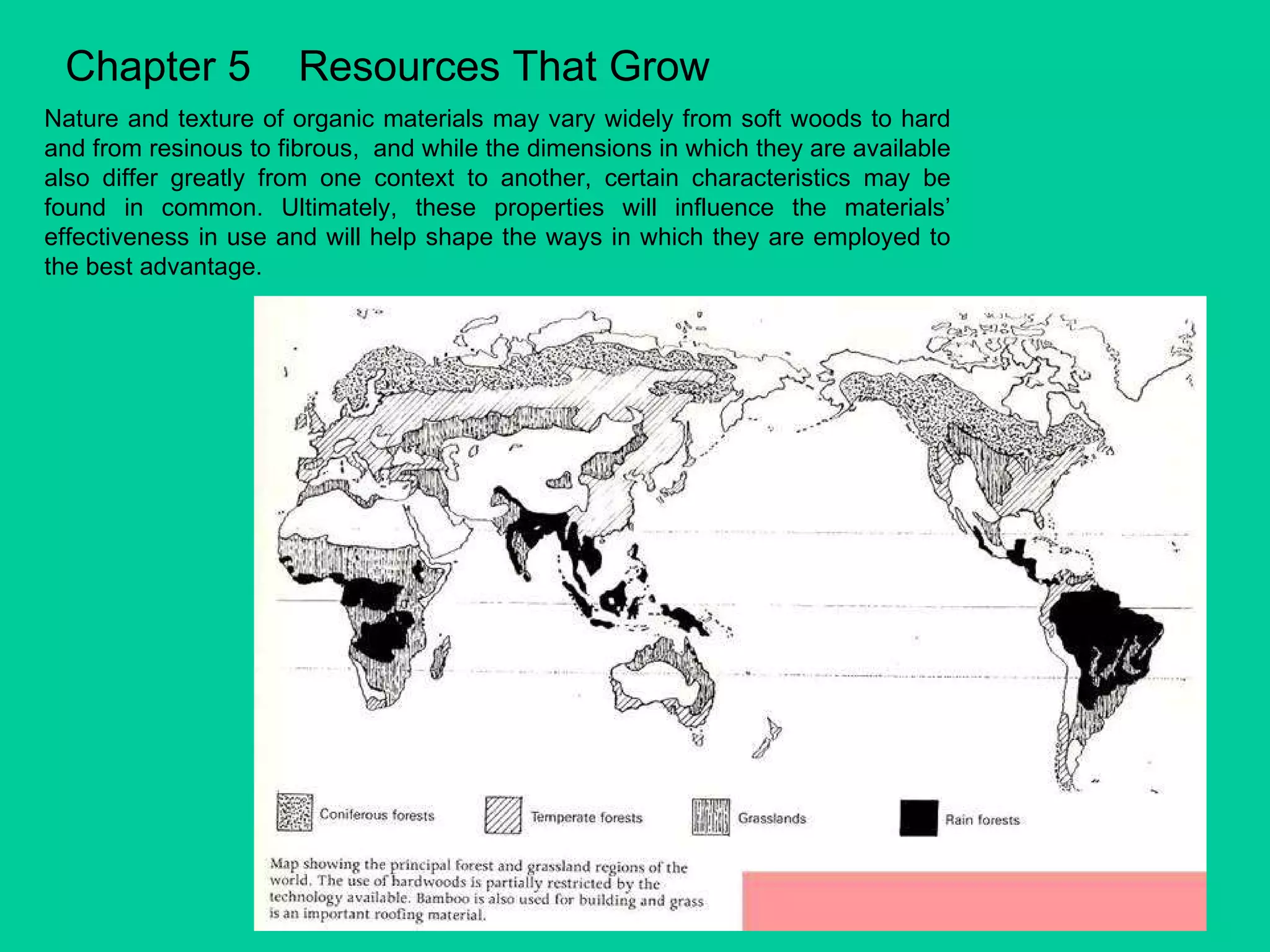
Chapter 5  Resources That Grow Nature and texture of organic materials may vary widely from soft woods to hard and from resinous to fibrous,  and while the dimensions in which they are available also differ greatly from one context to another, certain characteristics may be found in common. Ultimately, these properties will influence the materials’ effectiveness in use and will help shape the ways in which they are employed to the best advantage.
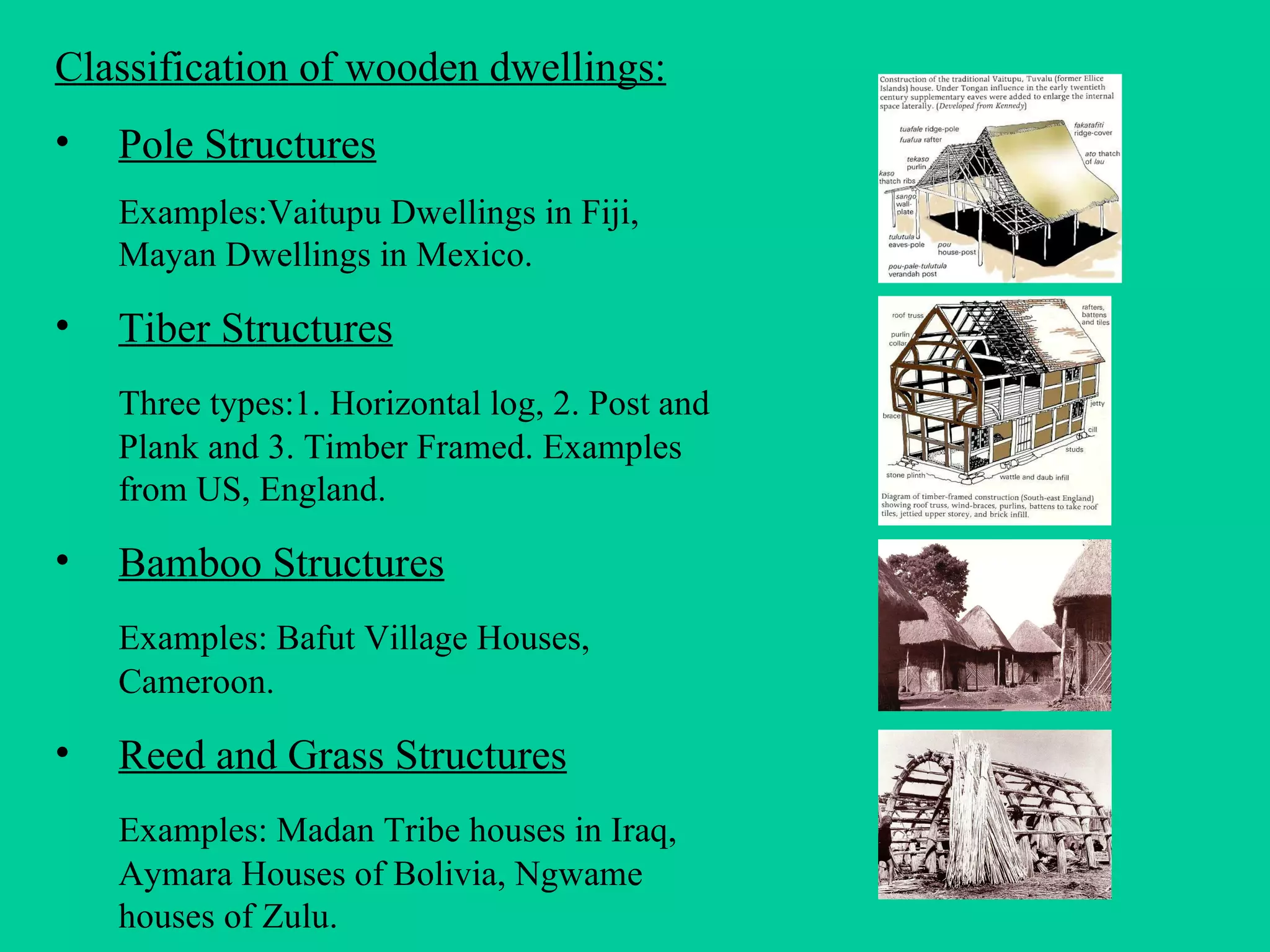
Classification of wooden dwellings: Pole Structures Examples:Vaitupu Dwellings in Fiji, Mayan Dwellings in Mexico. Tiber Structures Three types:1. Horizontal log, 2. Post and Plank and 3. Timber Framed. Examples from US, England. Bamboo Structures Examples: Bafut Village Houses, Cameroon. Reed and Grass Structures Examples: Madan Tribe houses in Iraq, Aymara Houses of Bolivia, Ngwame houses of Zulu.
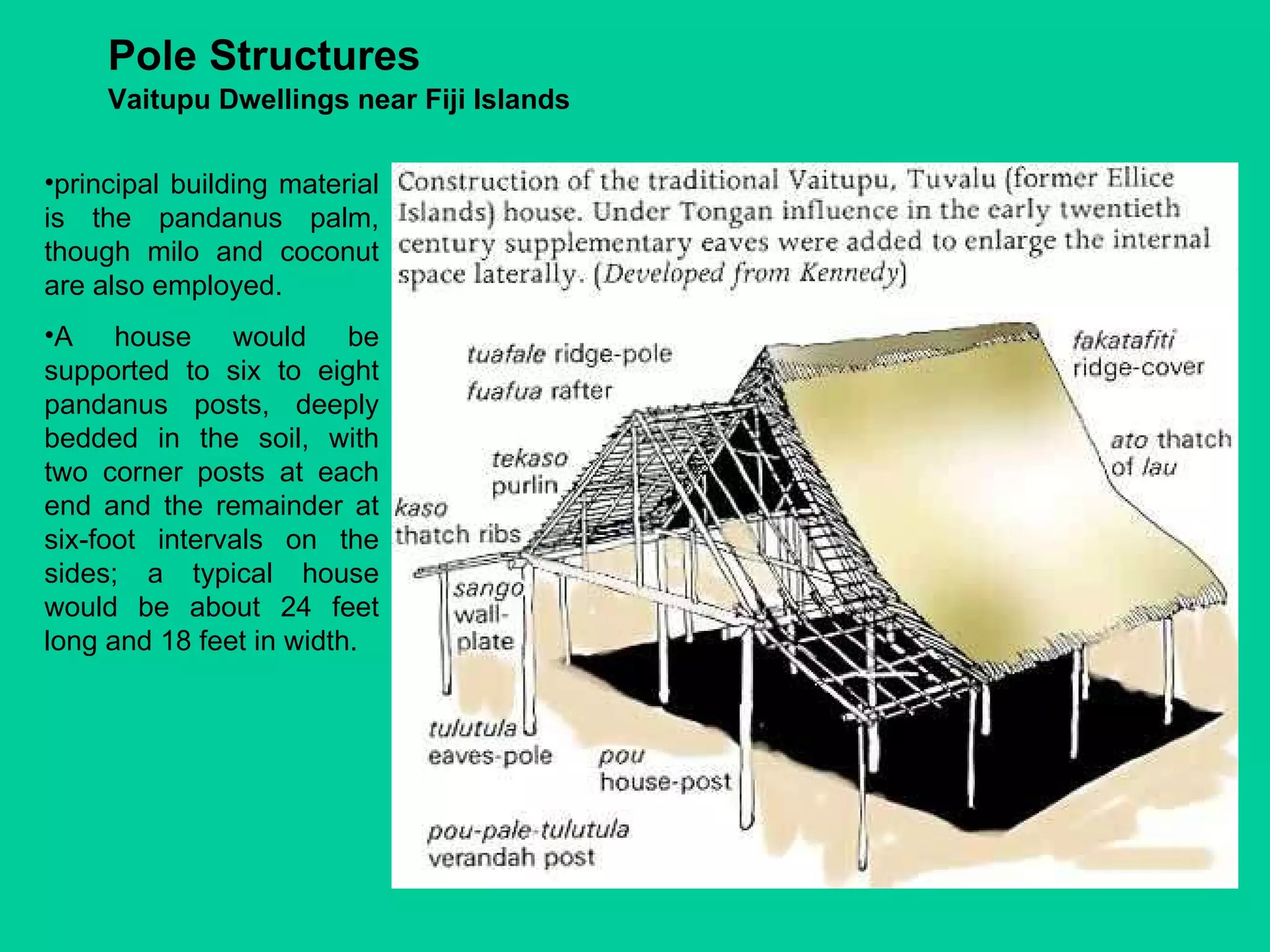
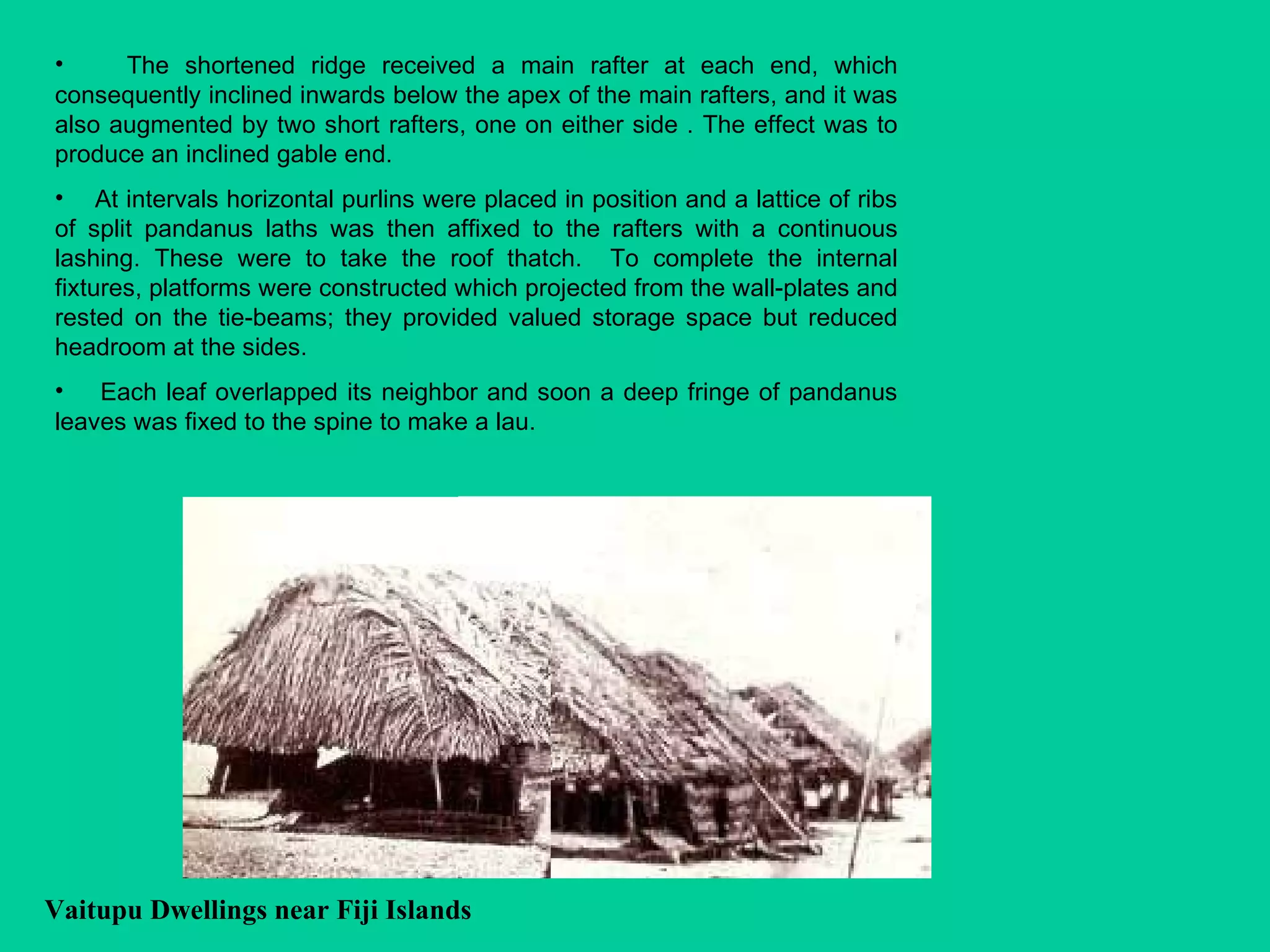
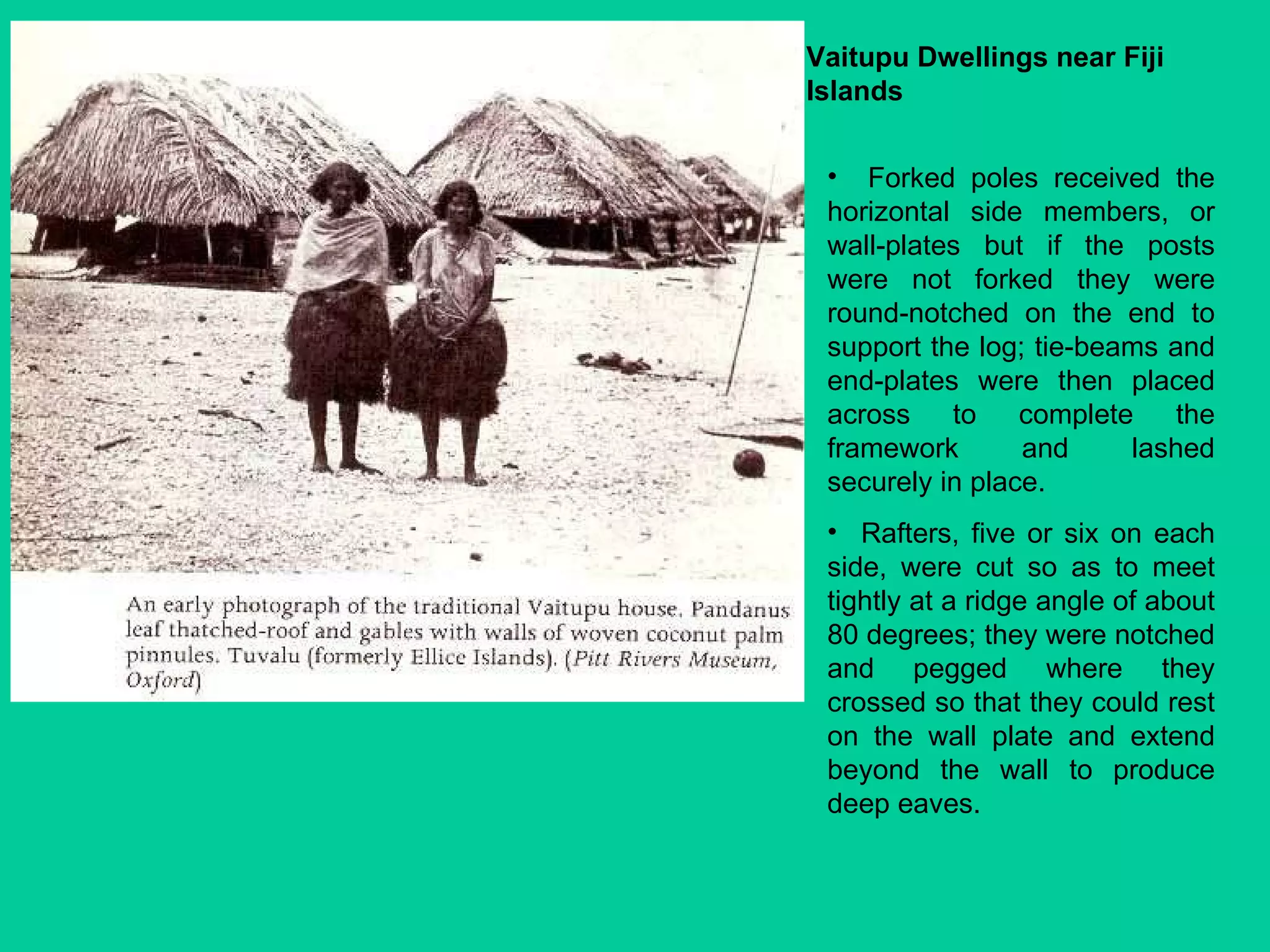
principal building material is the pandanus palm, though milo and coconut are also employed.  A house would be supported to six to eight pandanus posts, deeply bedded in the soil, with two corner posts at each end and the remainder at six-foot intervals on the sides; a typical house would be about 24 feet long and 18 feet in width.   Vaitupu Dwellings near Fiji Islands   Pole Structures
Vaitupu Dwellings near Fiji Islands   The shortened ridge received a main rafter at each end, which consequently inclined inwards below the apex of the main rafters, and it was also augmented by two short rafters, one on either side . The effect was to produce an inclined gable end. At intervals horizontal purlins were placed in position and a lattice of ribs of split pandanus laths was then affixed to the rafters with a continuous lashing. These were to take the roof thatch.  To complete the internal fixtures, platforms were constructed which projected from the wall-plates and rested on the tie-beams; they provided valued storage space but reduced headroom at the sides. Each leaf overlapped its neighbor and soon a deep fringe of pandanus leaves was fixed to the spine to make a lau.
Vaitupu Dwellings near Fiji Islands Forked poles received the horizontal side members, or wall-plates but if the posts were not forked they were round-notched on the end to support the log; tie-beams and end-plates were then placed across to complete the framework and lashed securely in place.  Rafters, five or six on each side, were cut so as to meet tightly at a ridge angle of about 80 degrees; they were notched and pegged where they crossed so that they could rest on the wall plate and extend beyond the wall to produce deep eaves.
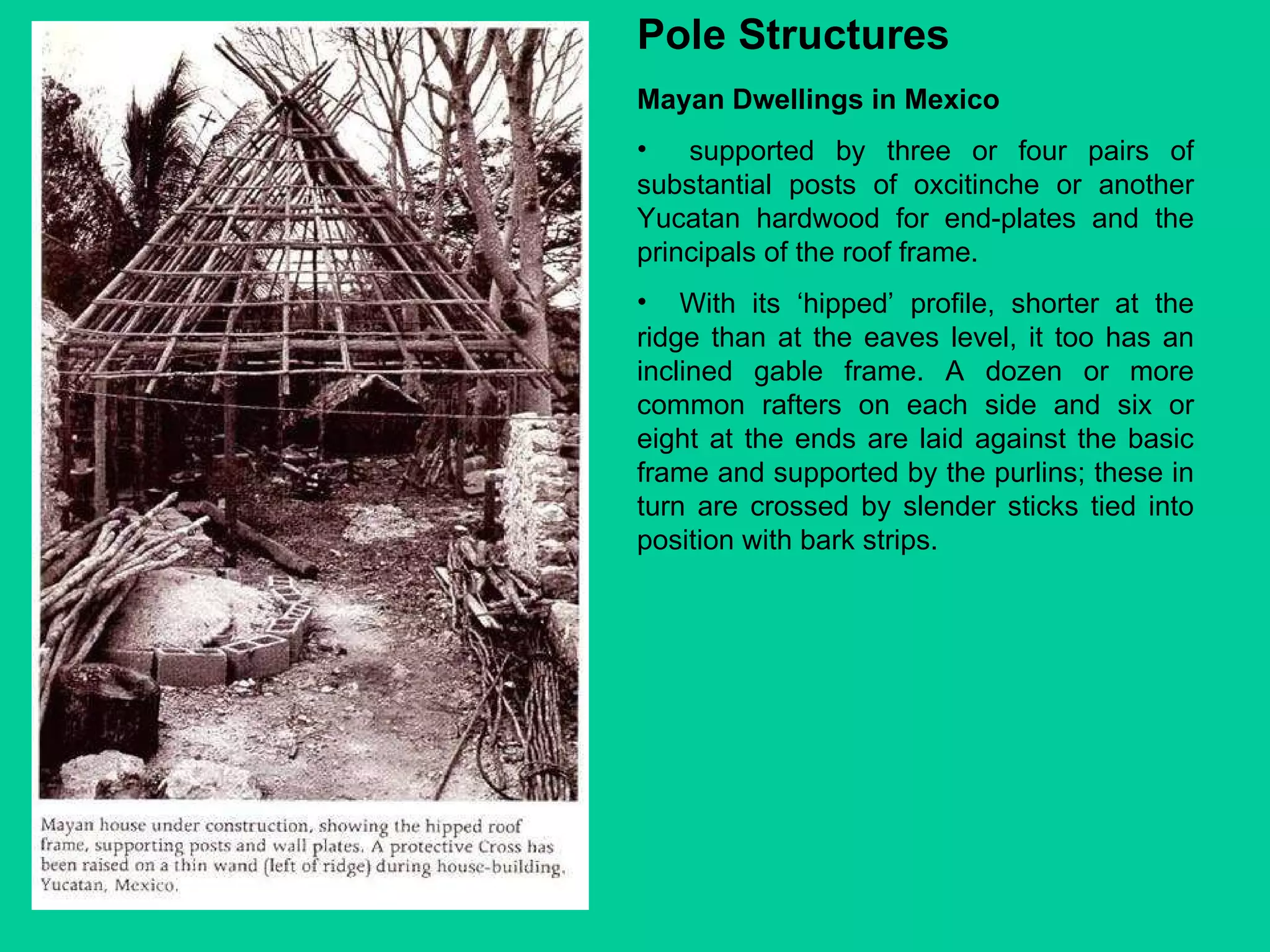
Mayan Dwellings in Mexico supported by three or four pairs of substantial posts of oxcitinche or another Yucatan hardwood for end-plates and the principals of the roof frame.  With its ‘hipped’ profile, shorter at the ridge than at the eaves level, it too has an inclined gable frame. A dozen or more common rafters on each side and six or eight at the ends are laid against the basic frame and supported by the purlins; these in turn are crossed by slender sticks tied into position with bark strips. Pole Structures
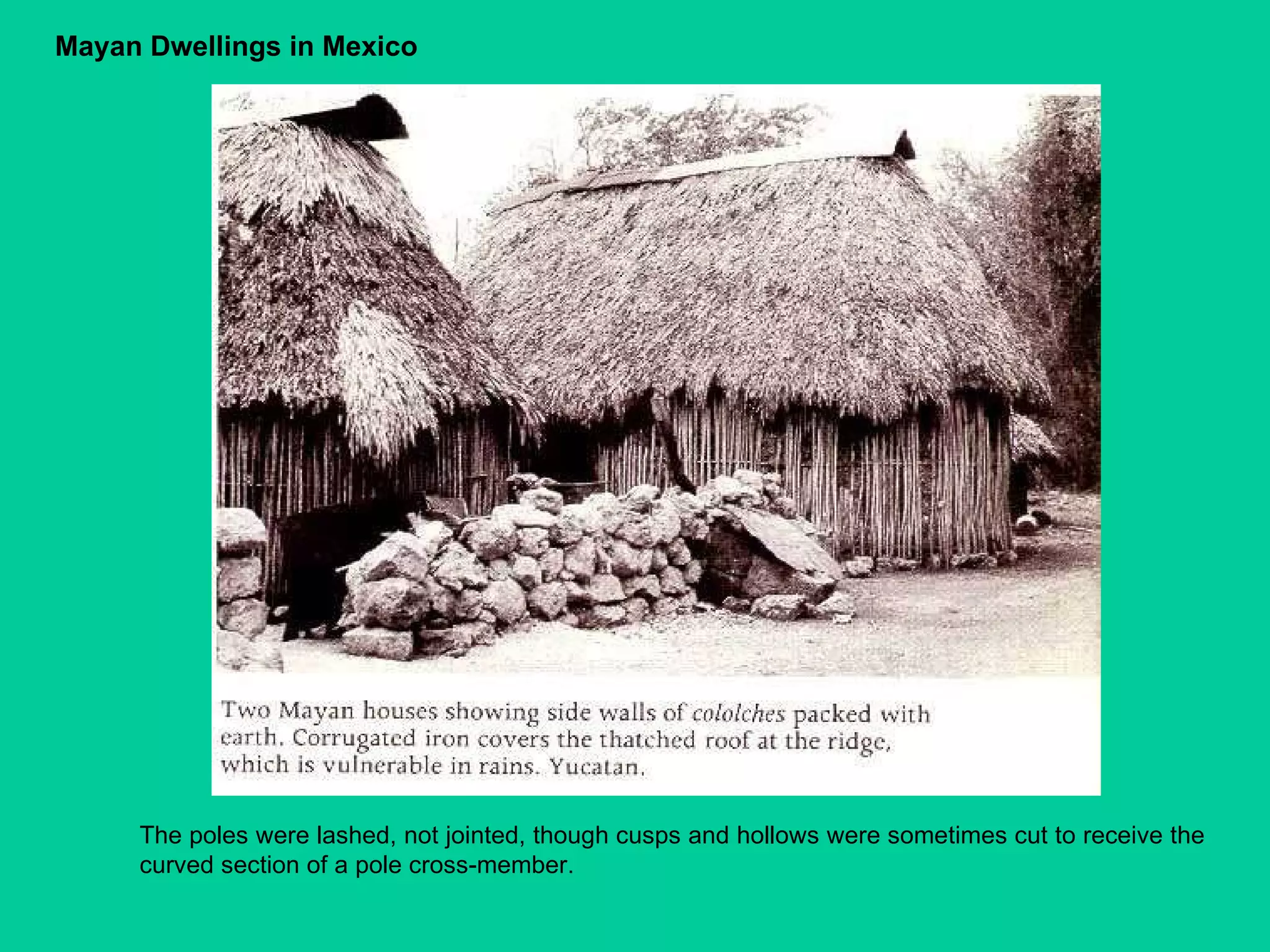
The poles were lashed, not jointed, though cusps and hollows were sometimes cut to receive the curved section of a pole cross-member.  Mayan Dwellings in Mexico
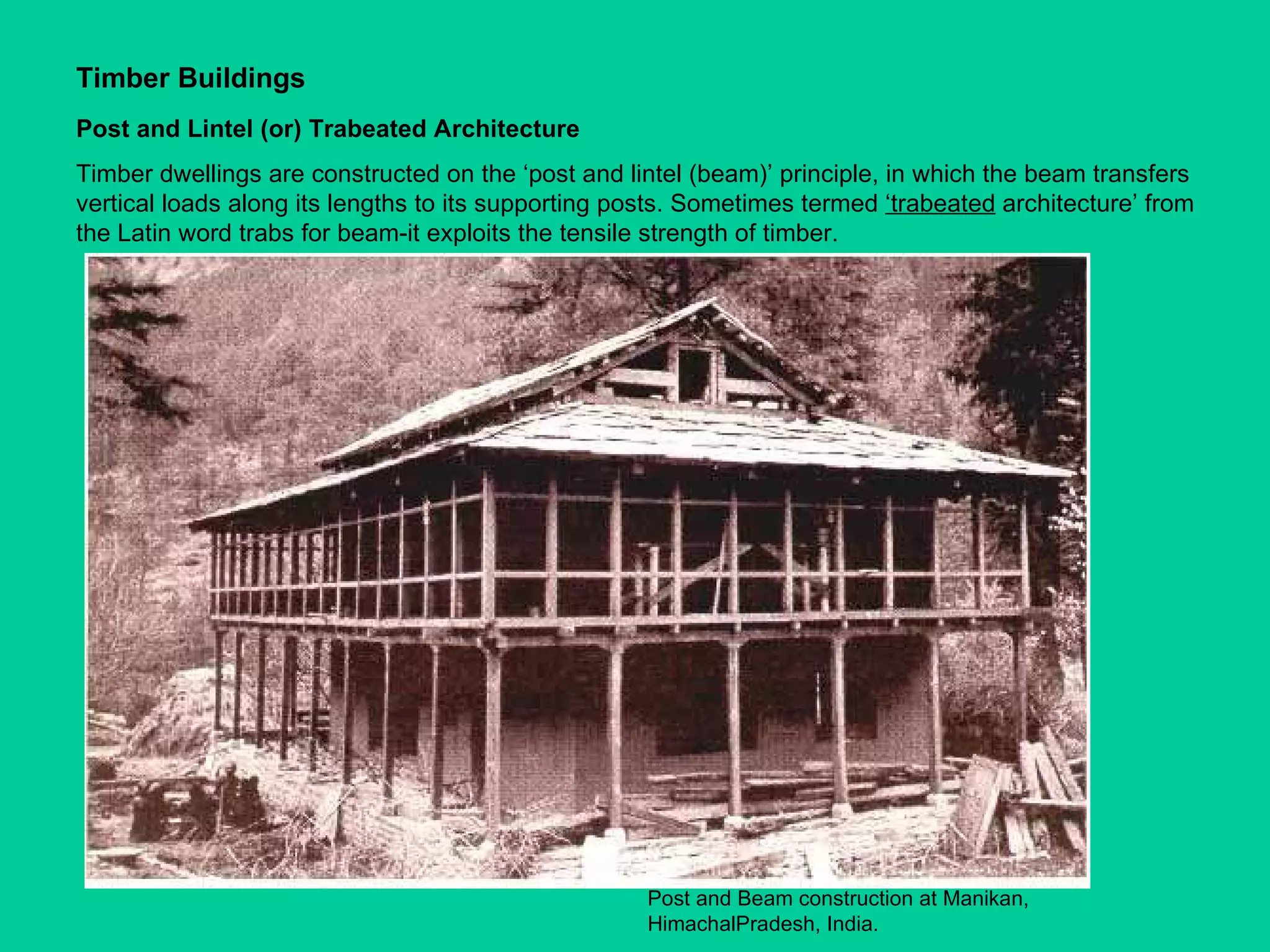
Post and Beam construction at Manikan, HimachalPradesh, India. Post and Lintel (or) Trabeated Architecture Timber dwellings are constructed on the ‘post and lintel (beam)’ principle, in which the beam transfers vertical loads along its lengths to its supporting posts. Sometimes termed  ‘trabeated  architecture’ from the Latin word trabs for beam-it exploits the tensile strength of timber.  Timber Buildings
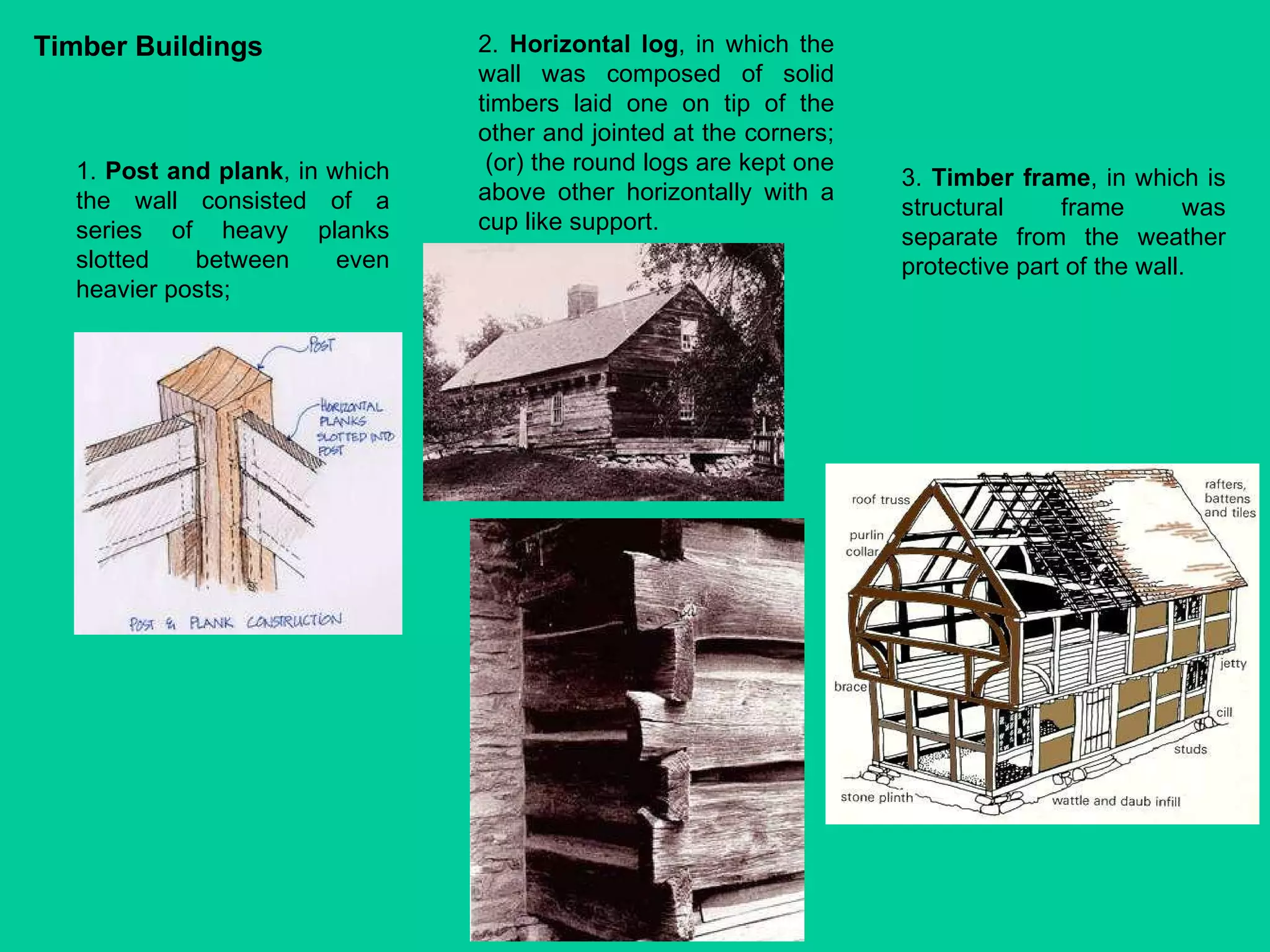
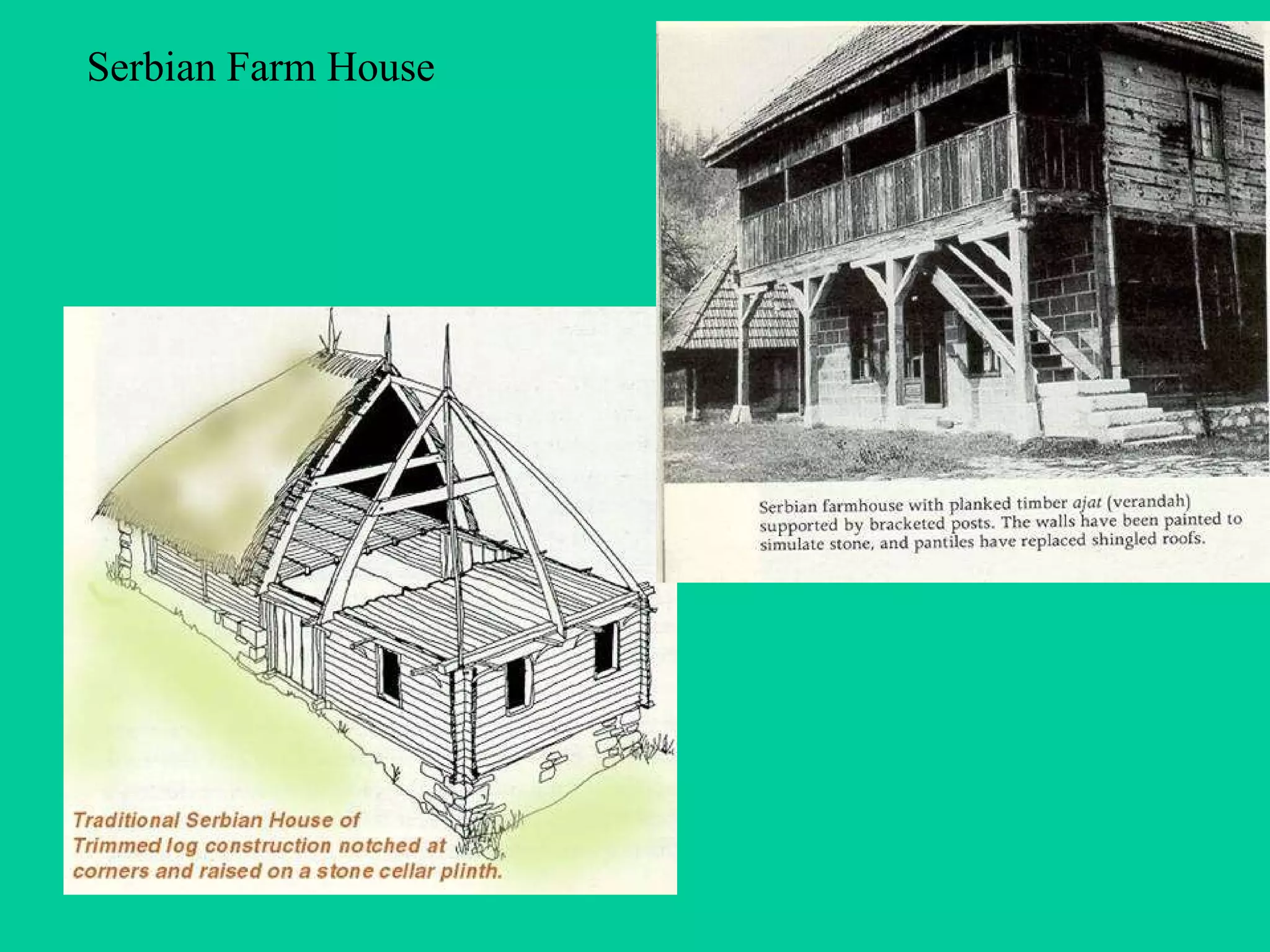
Timber Buildings 2.  Horizontal log , in which the wall was composed of solid timbers laid one on tip of the other and jointed at the corners;  (or) the round logs are kept one above other horizontally with a cup like support. 3.  Timber frame , in which is structural frame was separate from the weather protective part of the wall. 1.  Post and plank , in which the wall consisted of a series of heavy planks slotted between even heavier posts;
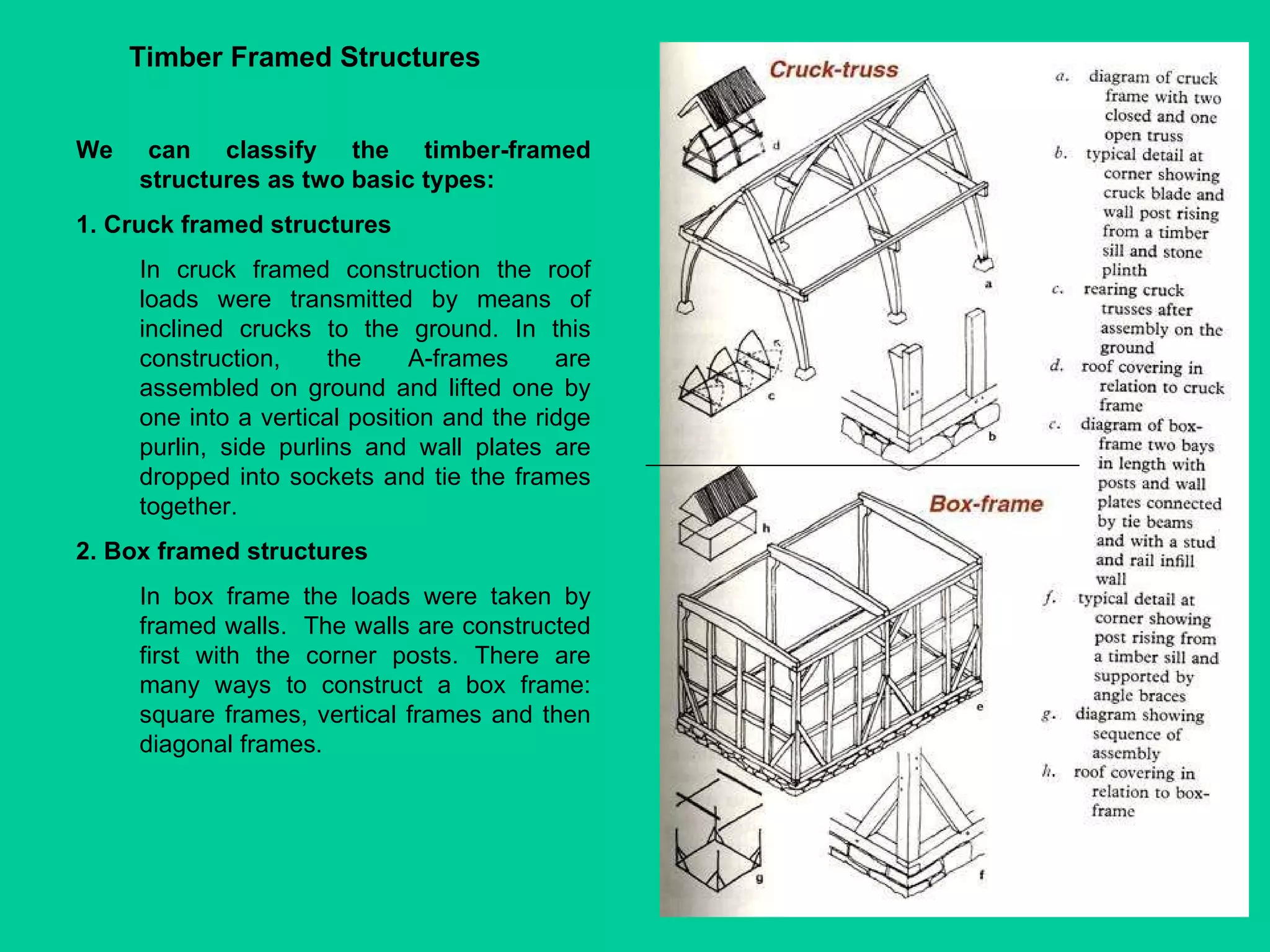
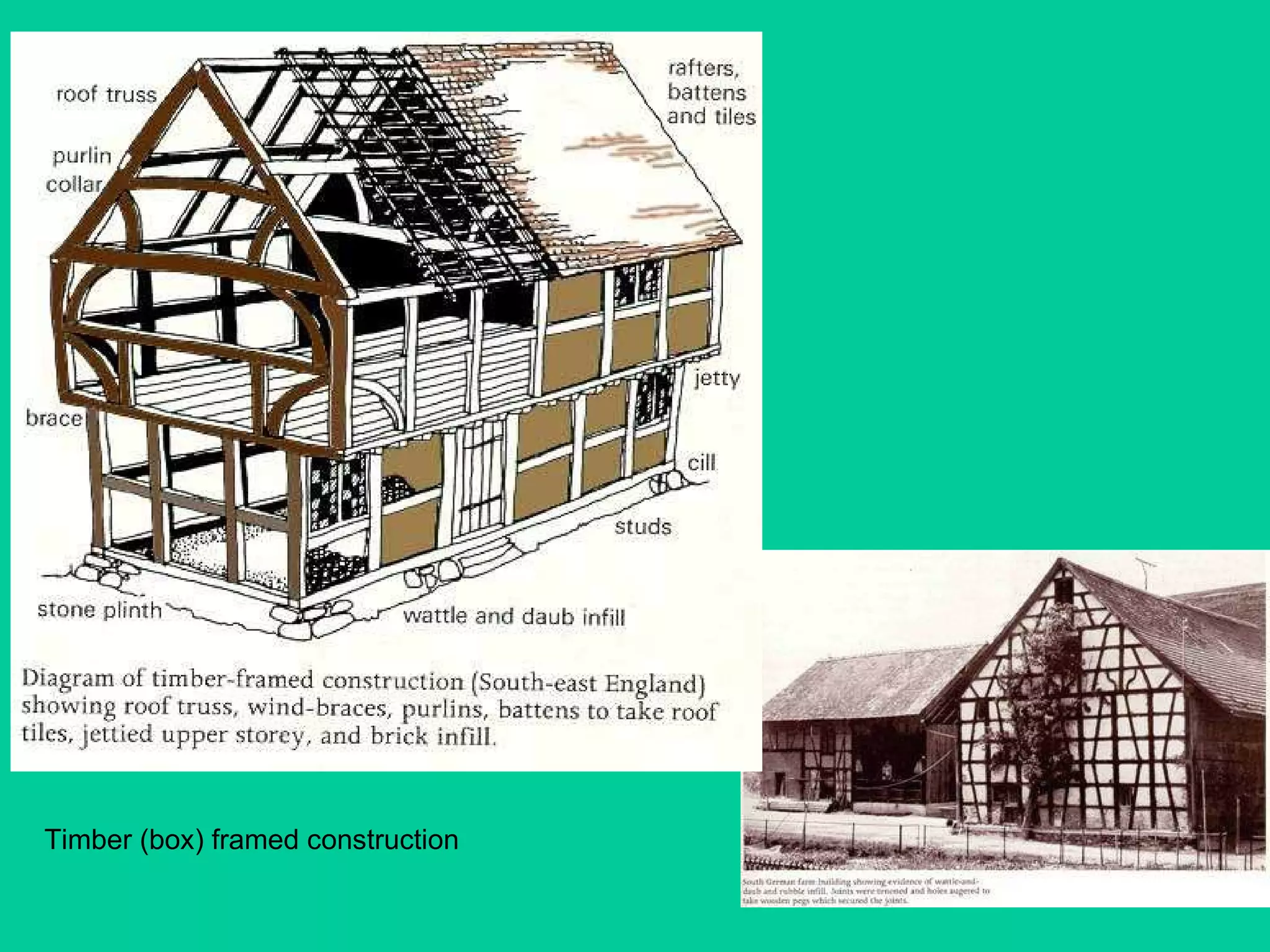
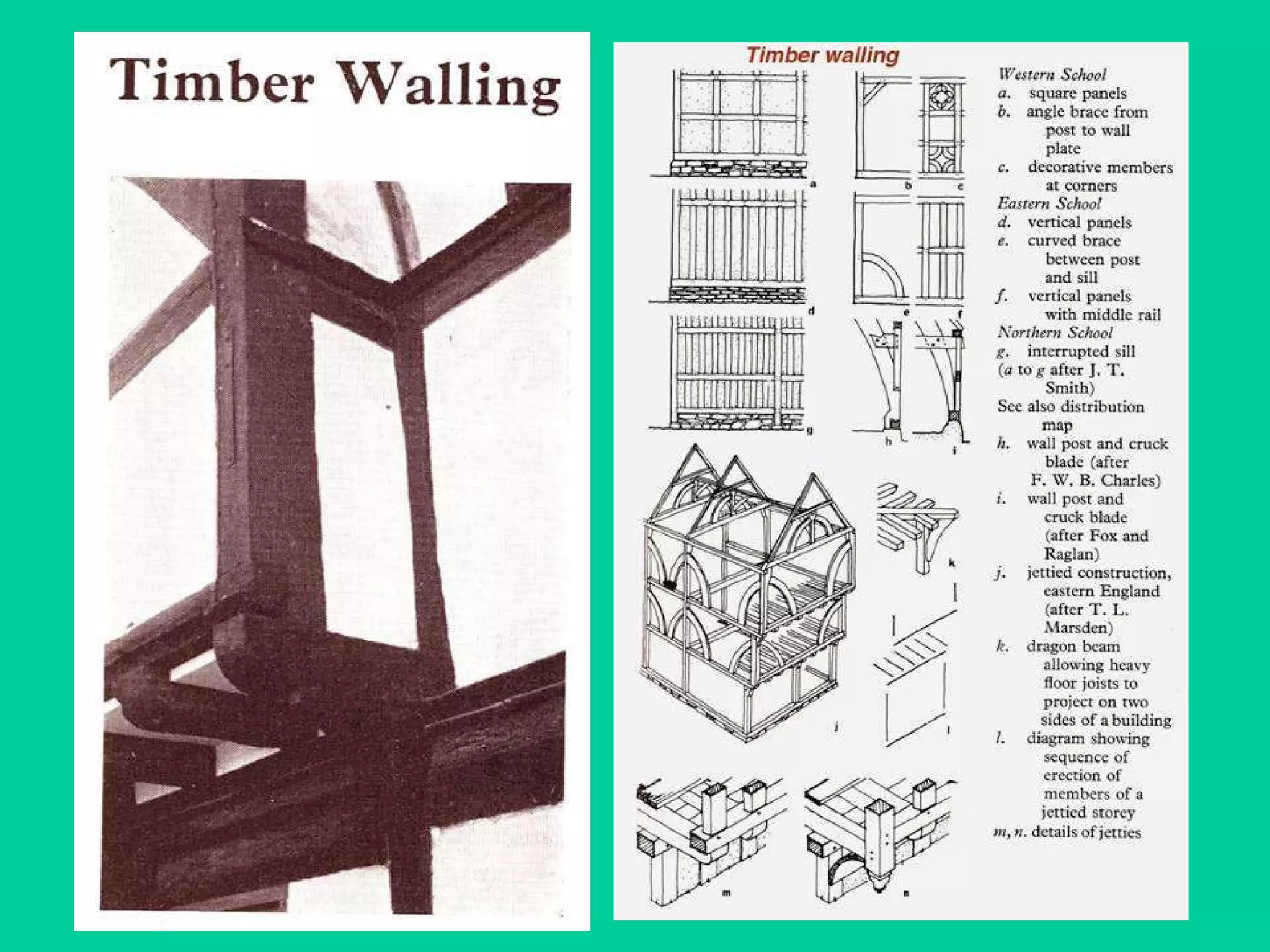
We can classify the timber-framed structures as two basic types:  1. Cruck framed structures  In cruck framed construction the roof loads were transmitted by means of inclined crucks to the ground. In this construction, the A-frames are assembled on ground and lifted one by one into a vertical position and the ridge purlin, side purlins and wall plates are dropped into sockets and tie the frames together. 2. Box framed structures In box frame the loads were taken by framed walls.  The walls are constructed first with the corner posts. There are many ways to construct a box frame: square frames, vertical frames and then diagonal frames. Timber Framed Structures
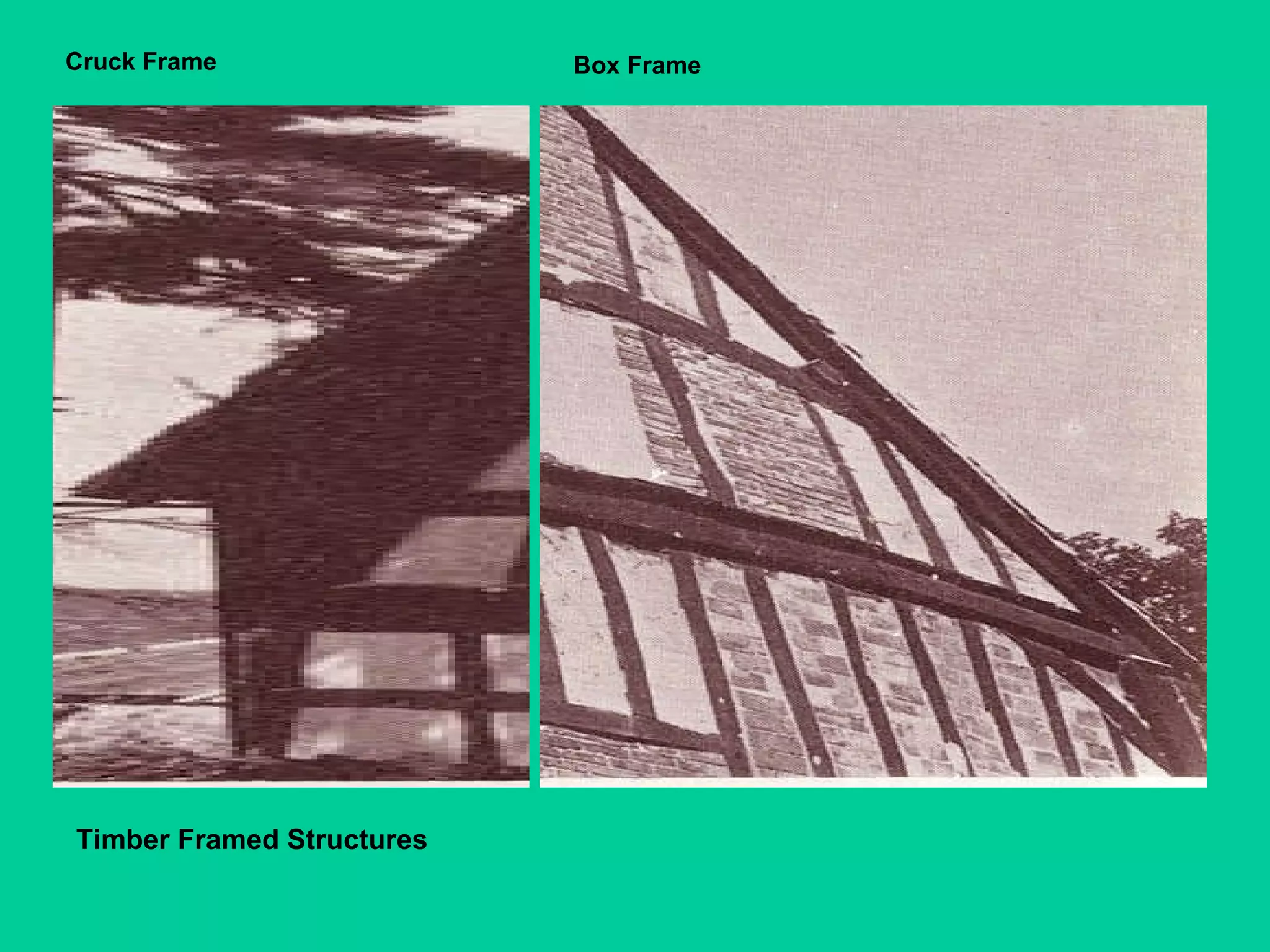
Timber Framed Structures Cruck Frame   Box Frame
Timber (box) framed construction
Serbian Farm House
Lecture 8 Resources that Grow 2
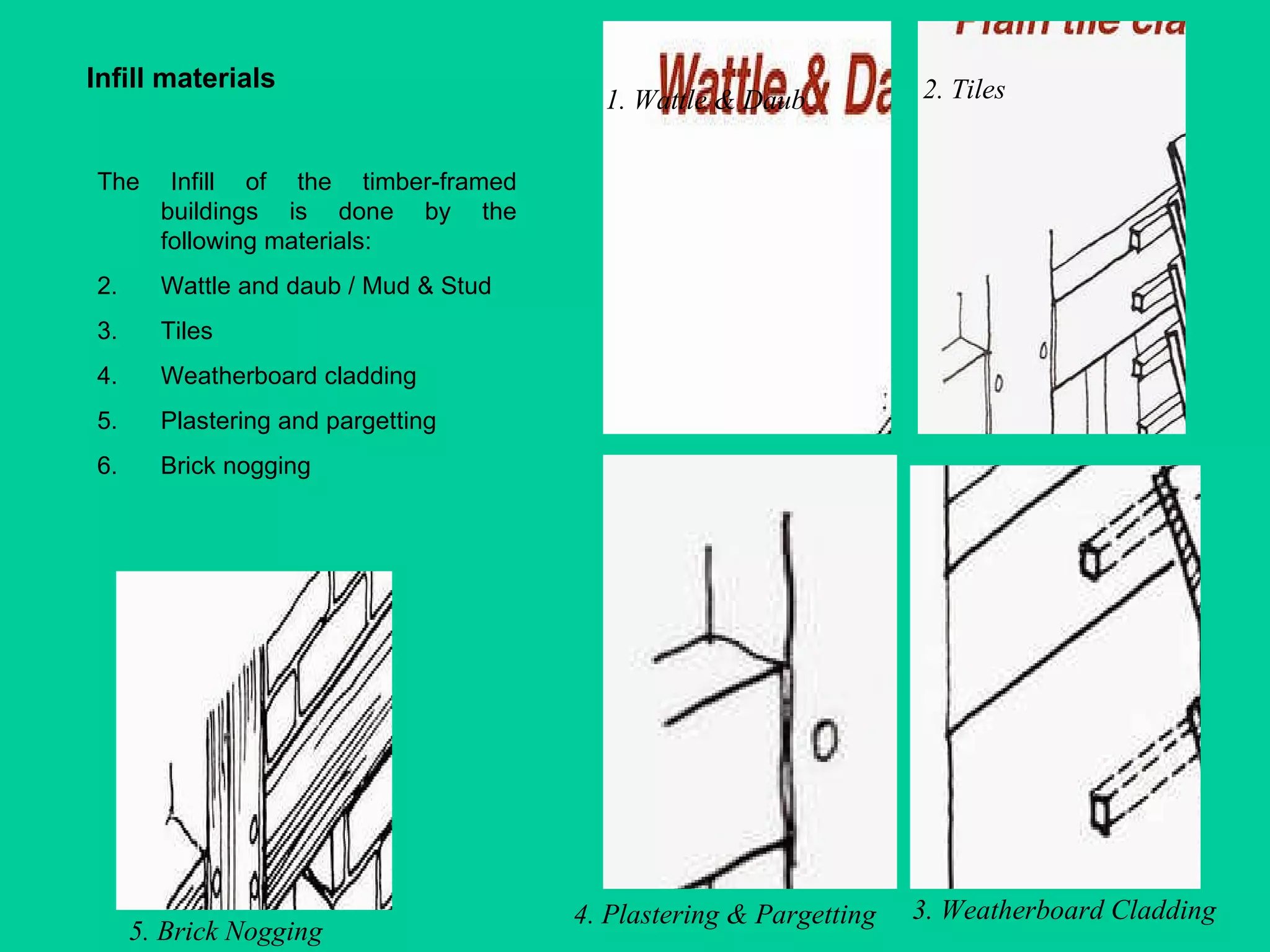
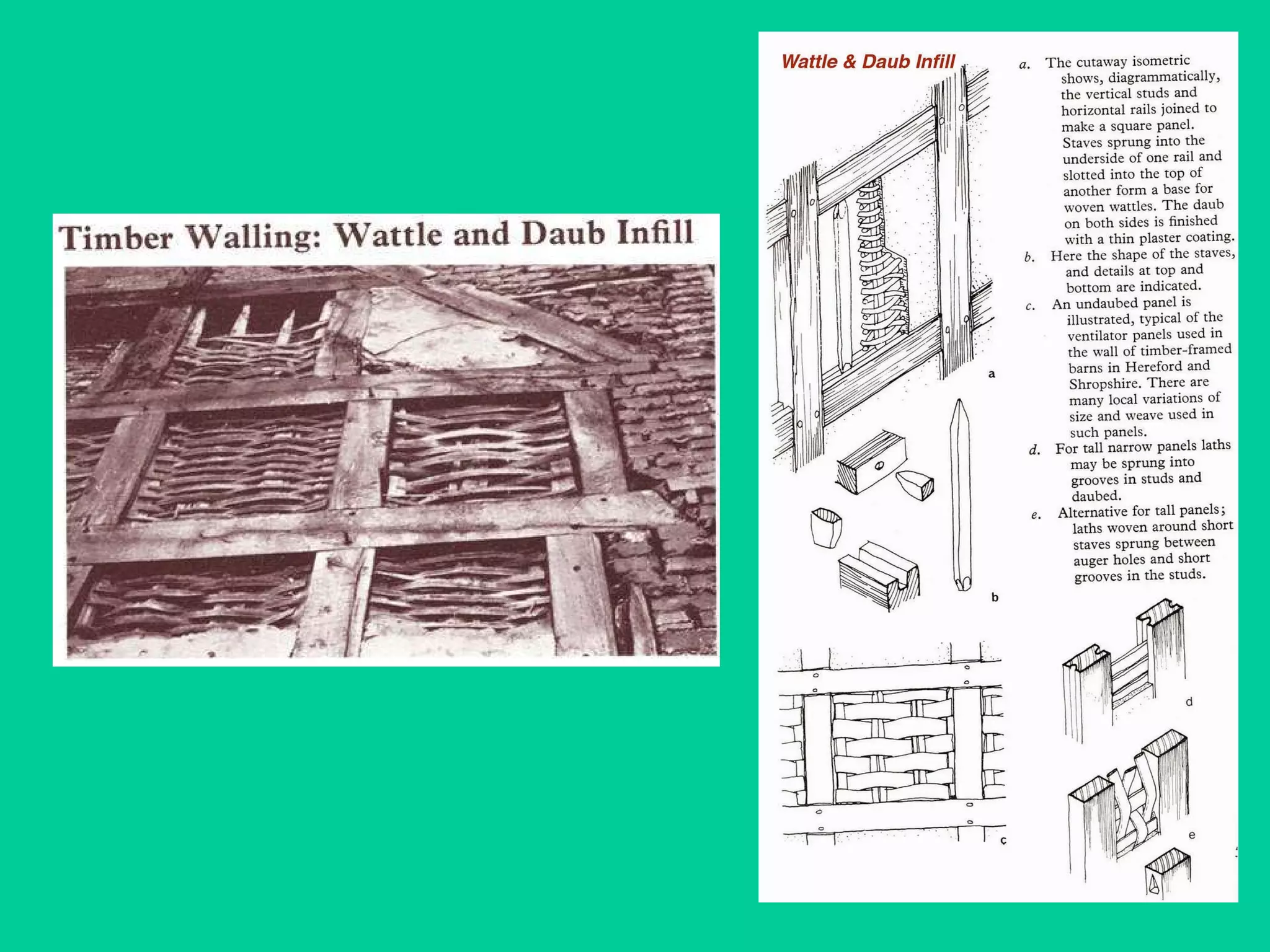
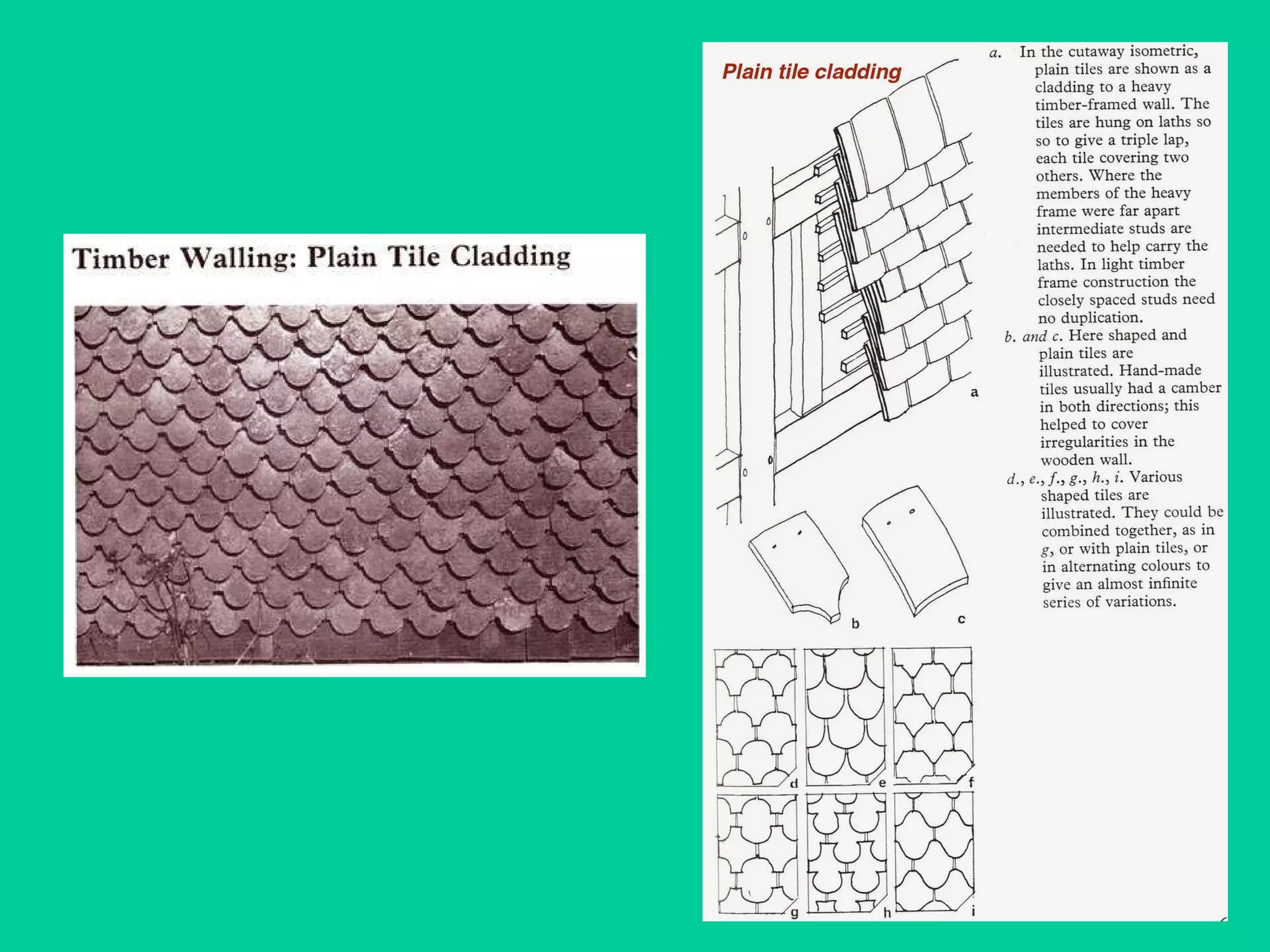
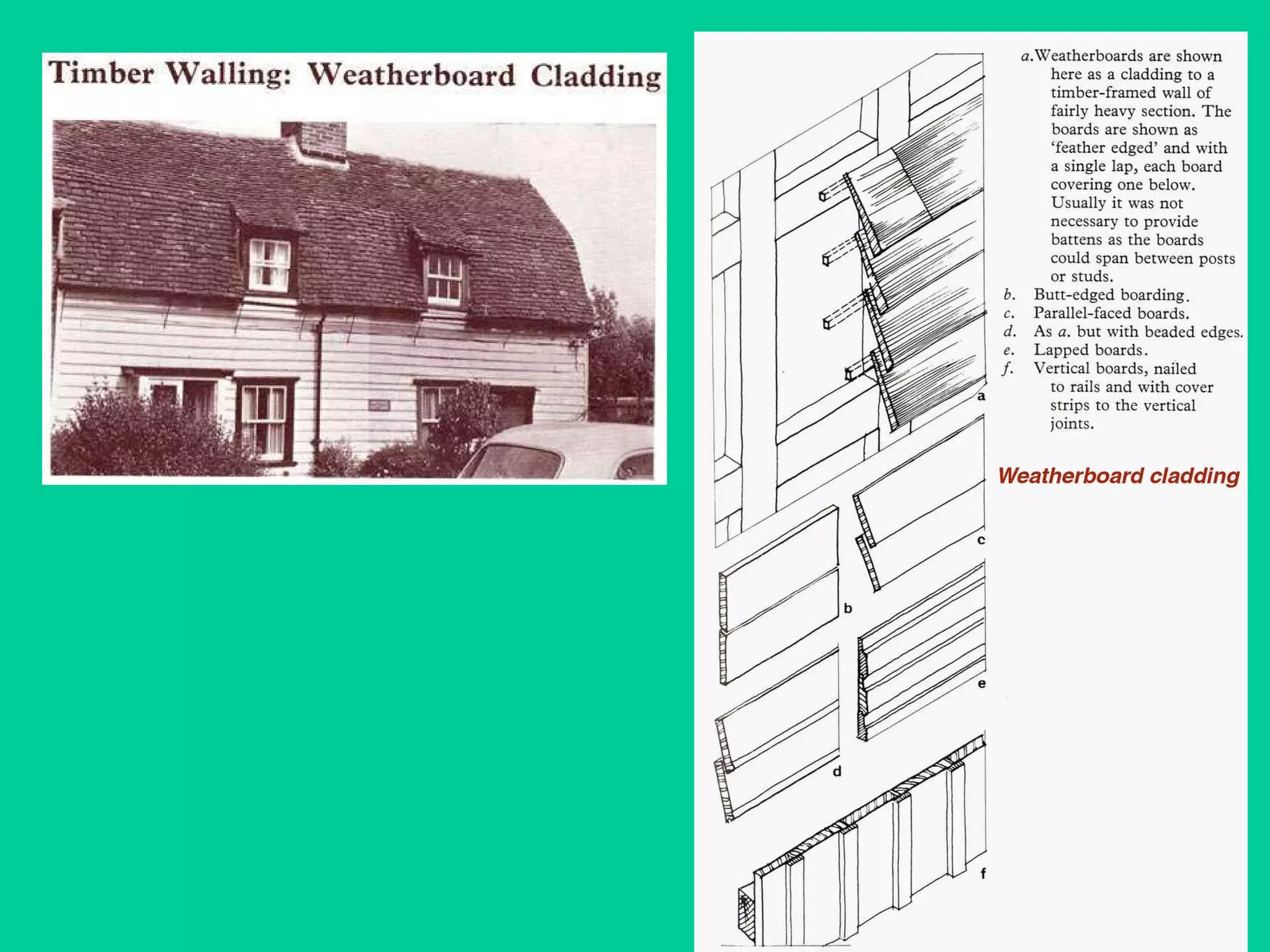
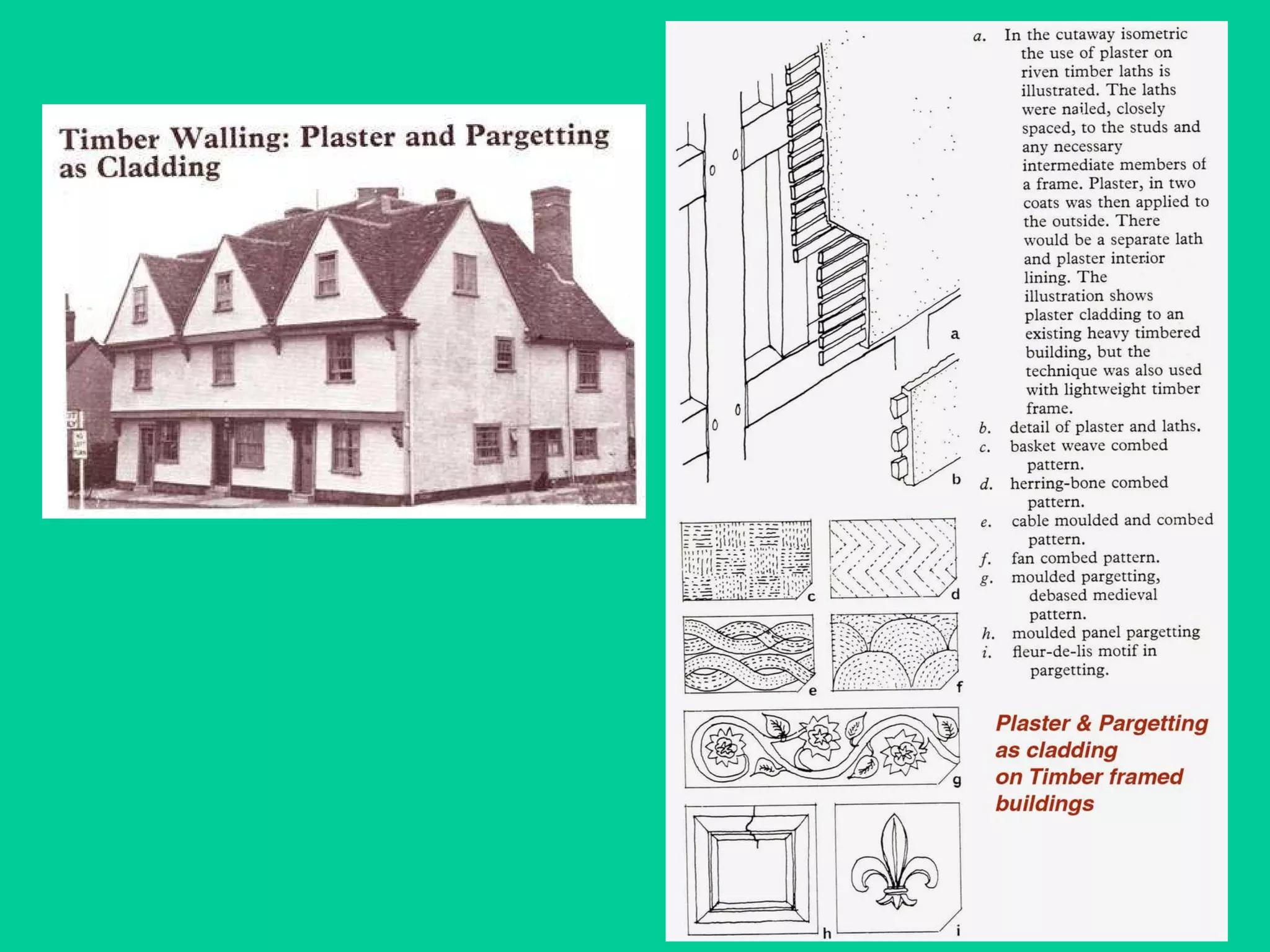
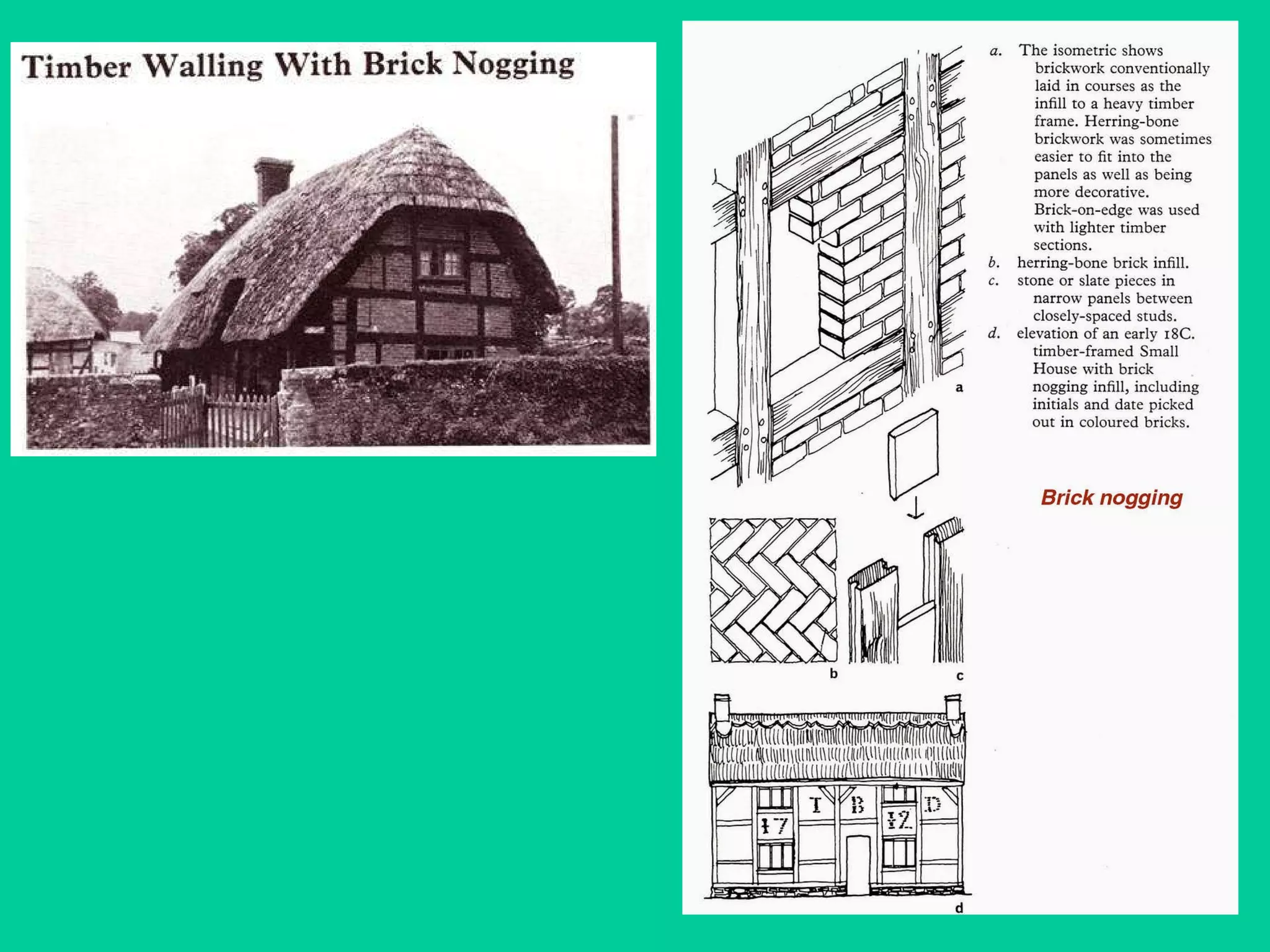
The Infill of the timber-framed buildings is done by the following materials: Wattle and daub / Mud & Stud Tiles Weatherboard cladding Plastering and pargetting Brick nogging 5. Brick Nogging 3. Weatherboard Cladding 4. Plastering & Pargetting 1. Wattle & Daub 2. Tiles Infill materials


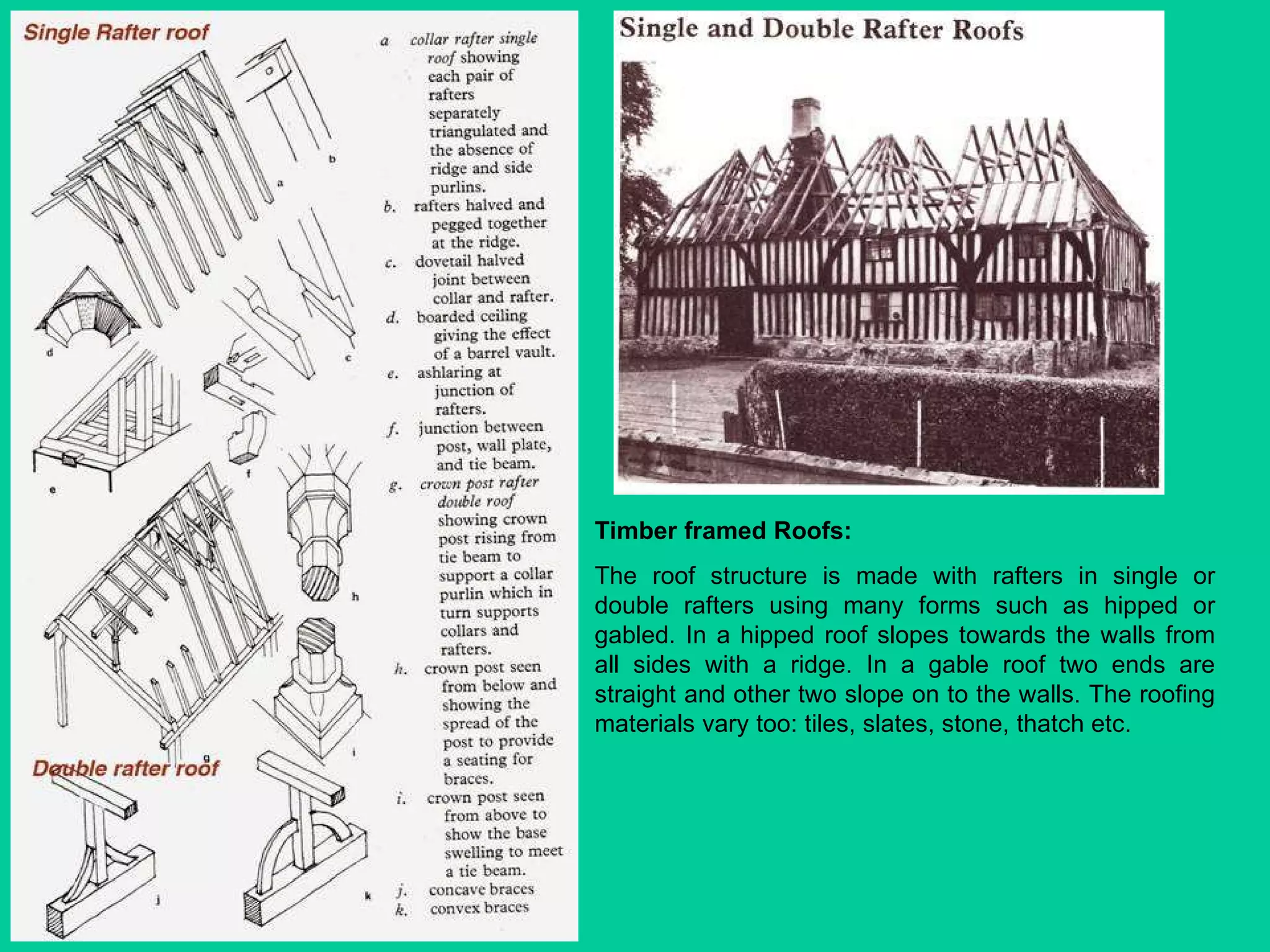
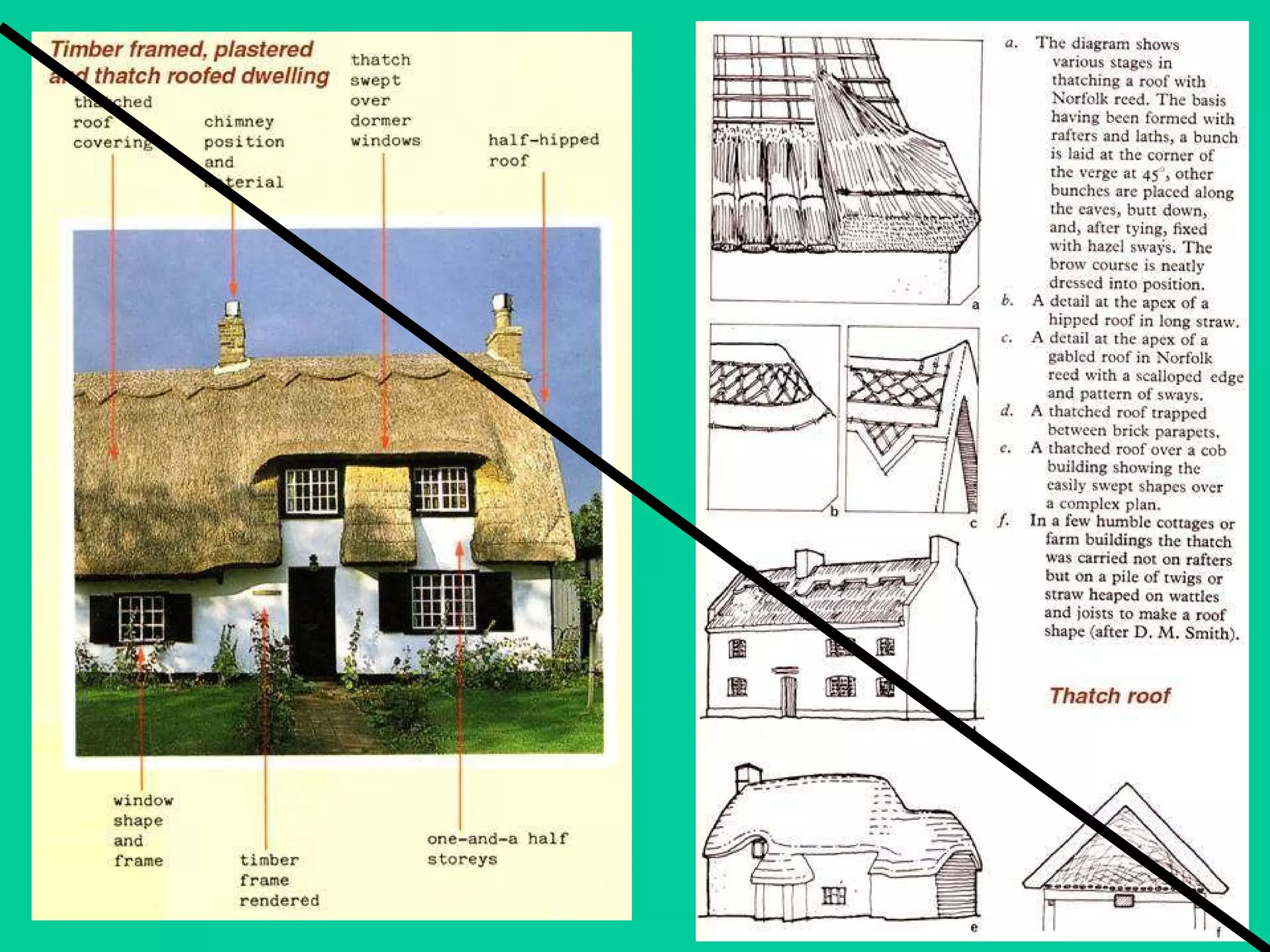
Timber framed Roofs: The roof structure is made with rafters in single or double rafters using many forms such as hipped or gabled. In a hipped roof slopes towards the walls from all sides with a ridge. In a gable roof two ends are straight and other two slope on to the walls. The roofing materials vary too: tiles, slates, stone, thatch etc.
 
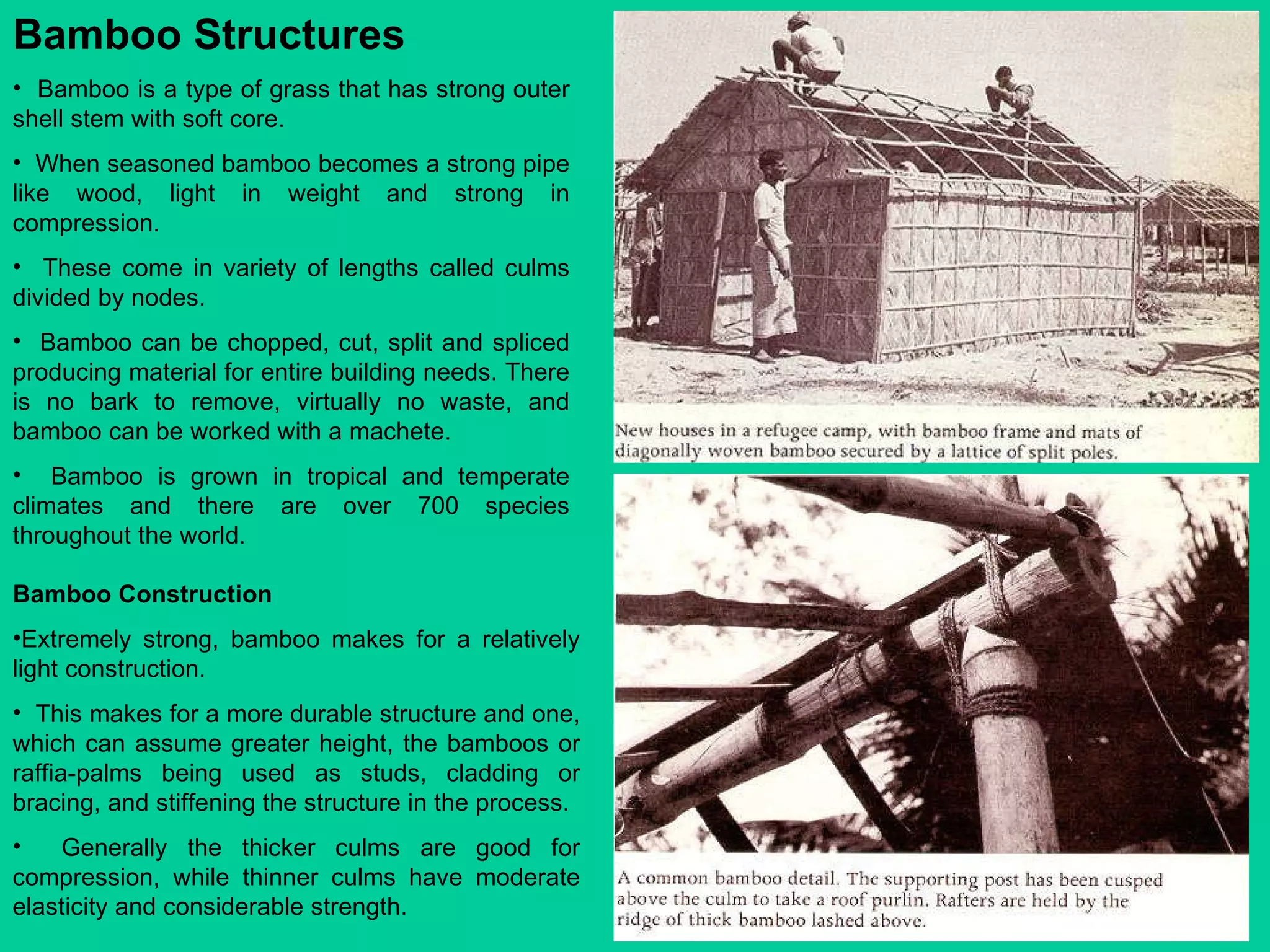
Bamboo Structures   Bamboo is a type of grass that has strong outer shell stem with soft core.  When seasoned bamboo becomes a strong pipe like wood, light in weight and strong in compression.  These come in variety of lengths called culms divided by nodes.  Bamboo can be chopped, cut, split and spliced producing material for entire building needs. There is no bark to remove, virtually no waste, and bamboo can be worked with a machete.  Bamboo is grown in tropical and temperate climates and there are over 700 species throughout the world.  Bamboo Construction  Extremely strong, bamboo makes for a relatively light construction.  This makes for a more durable structure and one, which can assume greater height, the bamboos or raffia-palms being used as studs, cladding or bracing, and stiffening the structure in the process.  Generally the thicker culms are good for compression, while thinner culms have moderate elasticity and considerable strength.
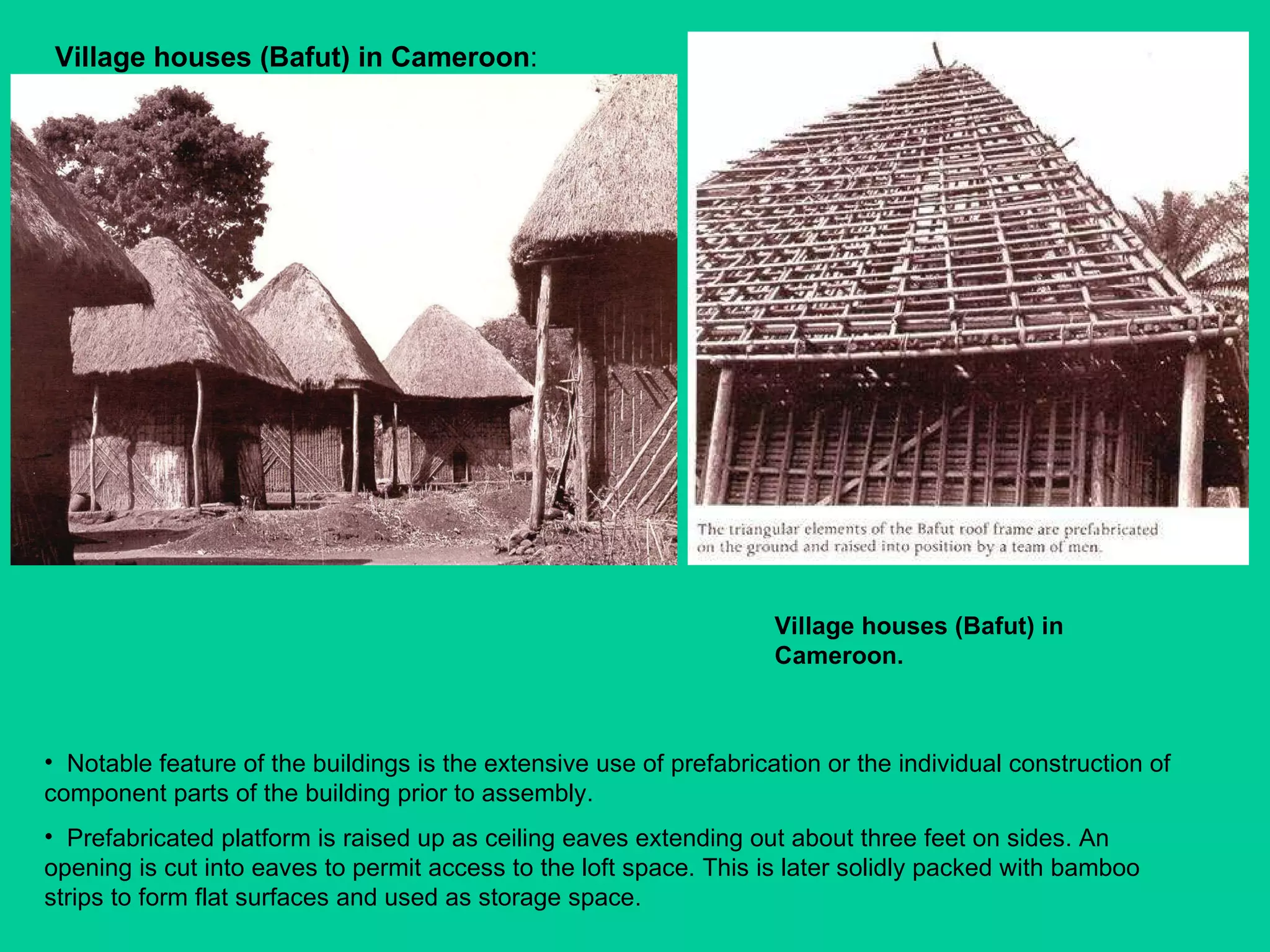
Village houses (Bafut)   in Cameroon :  Notable feature of the buildings is the extensive use of prefabrication or the individual construction of component parts of the building prior to assembly.  Prefabricated platform is raised up as ceiling eaves extending out about three feet on sides. An opening is cut into eaves to permit access to the loft space. This is later solidly packed with bamboo strips to form flat surfaces and used as storage space. Village houses (Bafut)   in Cameroon.
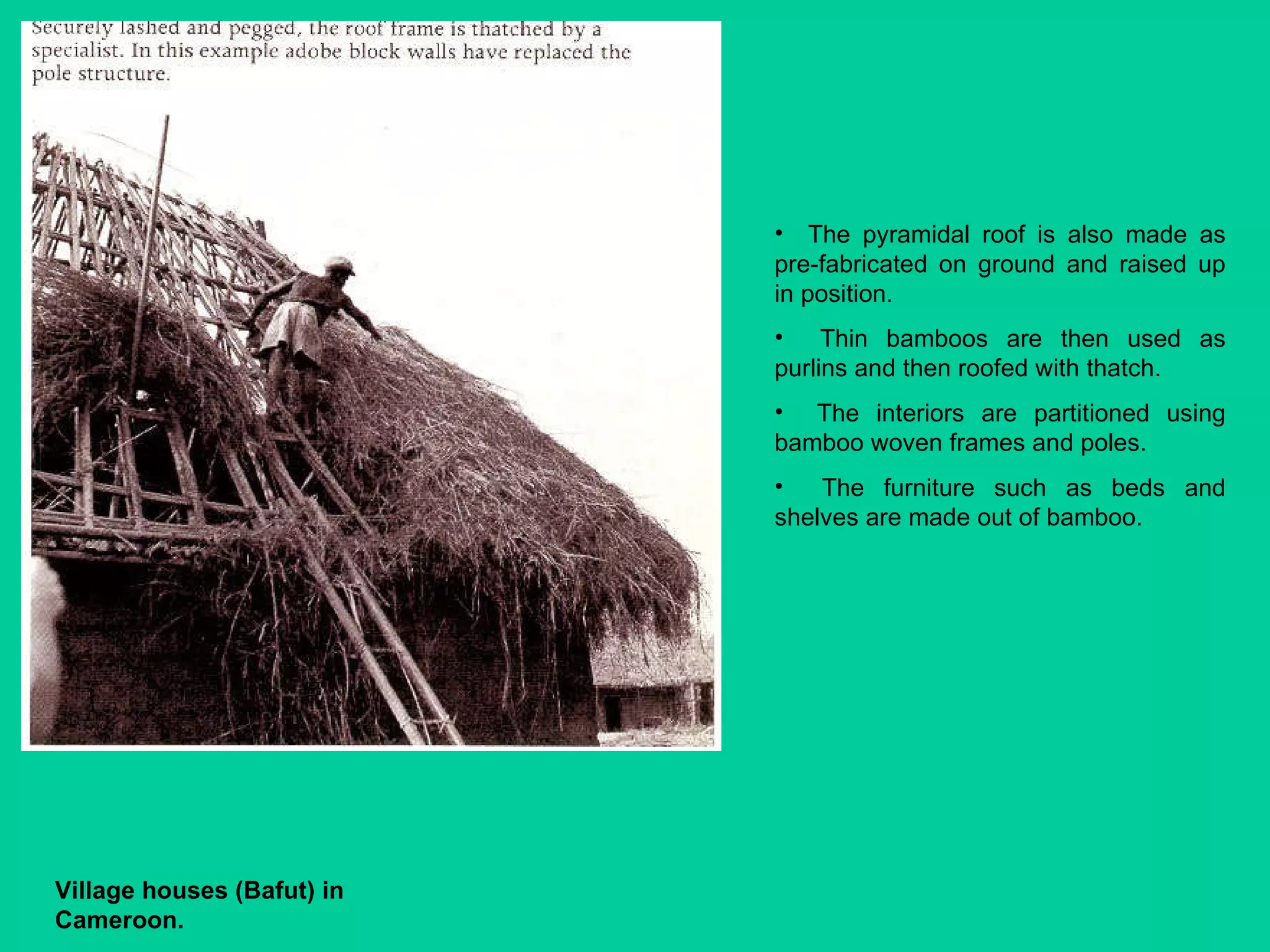
The pyramidal roof is also made as pre-fabricated on ground and raised up in position.  Thin bamboos are then used as purlins and then roofed with thatch.  The interiors are partitioned using bamboo woven frames and poles.  The furniture such as beds and shelves are made out of bamboo. Village houses (Bafut)   in Cameroon.
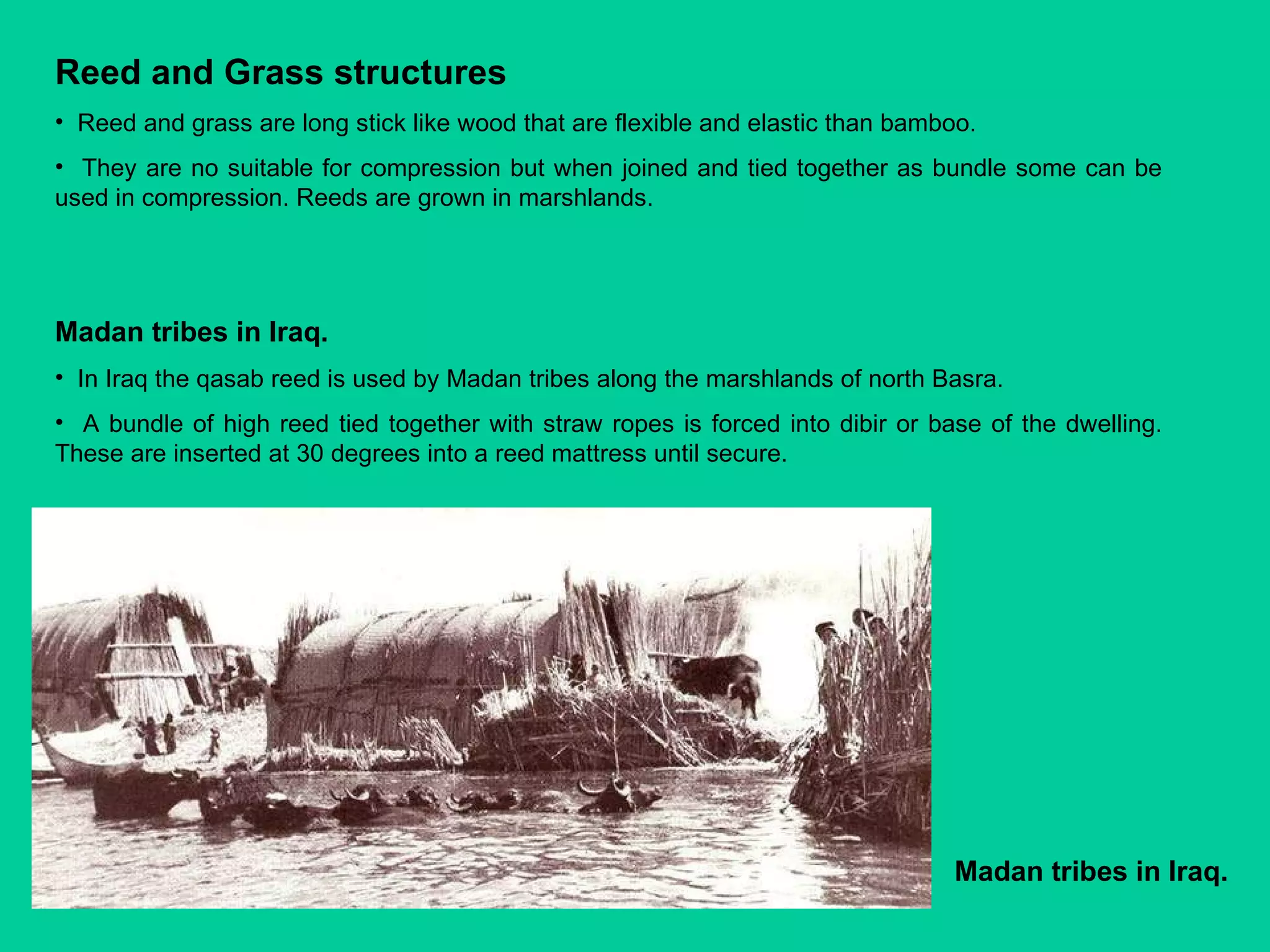
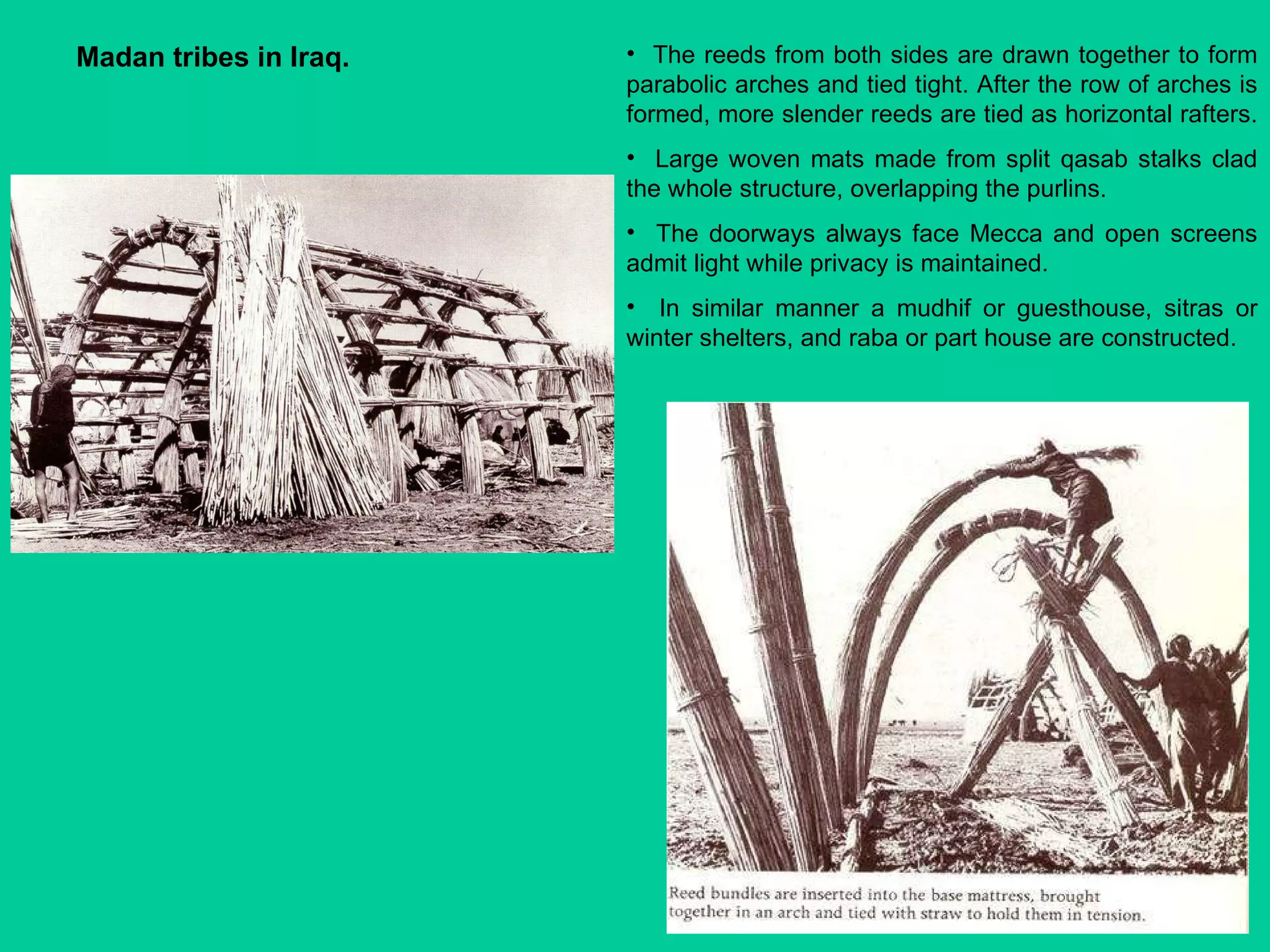
Reed and Grass structures Reed and grass are long stick like wood that are flexible and elastic than bamboo.  They are no suitable for compression but when joined and tied together as bundle some can be used in compression. Reeds are grown in marshlands.  Madan tribes in Iraq.   Madan tribes in Iraq. In Iraq the qasab reed is used by Madan tribes along the marshlands of north Basra.  A bundle of high reed tied together with straw ropes is forced into dibir or base of the dwelling. These are inserted at 30 degrees into a reed mattress until secure.
Madan tribes in Iraq.   The reeds from both sides are drawn together to form parabolic arches and tied tight. After the row of arches is formed, more slender reeds are tied as horizontal rafters.  Large woven mats made from split qasab stalks clad the whole structure, overlapping the purlins.  The doorways always face Mecca and open screens admit light while privacy is maintained.  In similar manner a mudhif or guesthouse, sitras or winter shelters, and raba or part house are constructed.
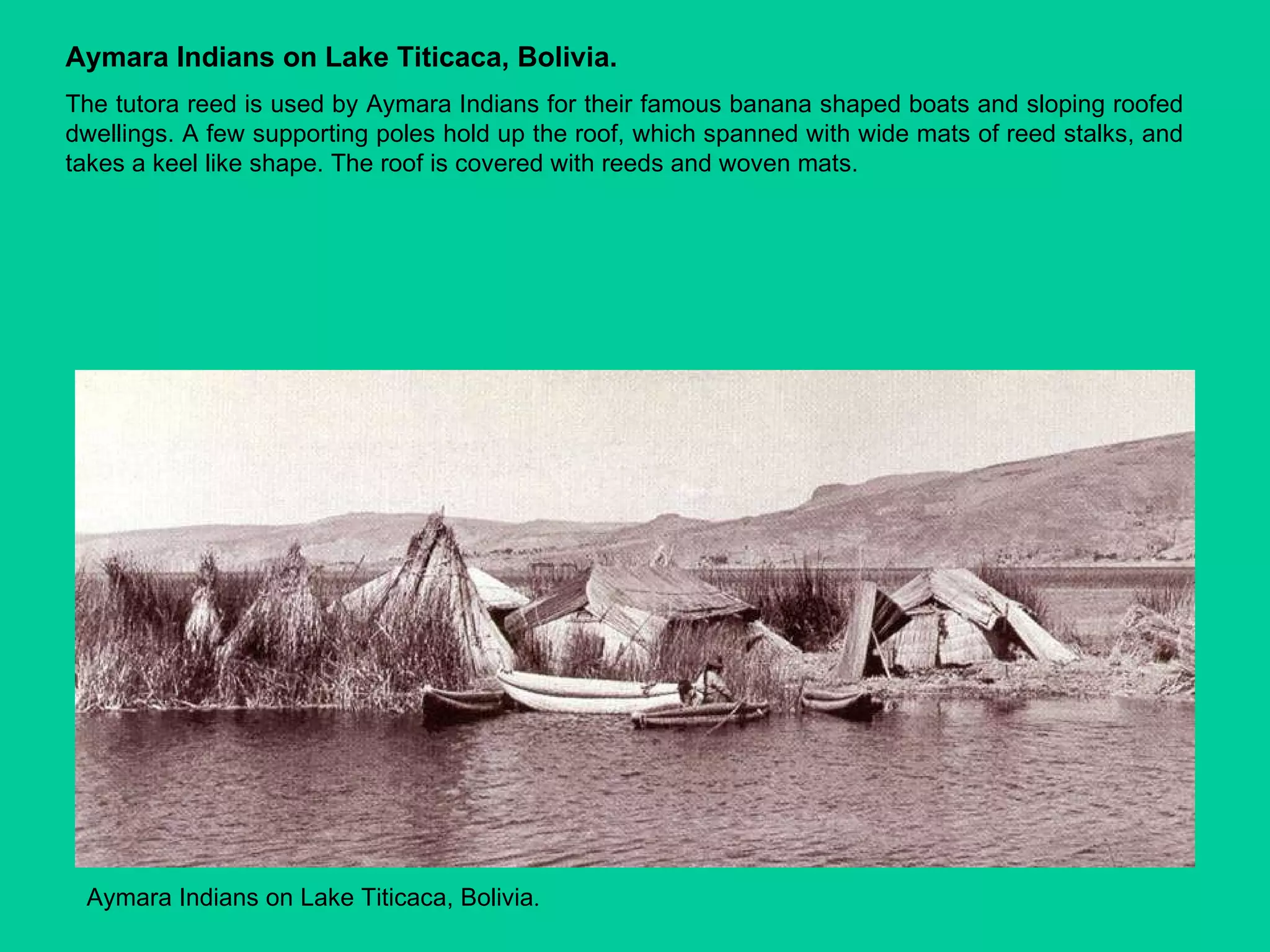
Aymara Indians on Lake Titicaca, Bolivia .   Aymara Indians on Lake Titicaca, Bolivia. The tutora reed is used by Aymara Indians for their famous banana shaped boats and sloping roofed dwellings. A few supporting poles hold up the roof, which spanned with wide mats of reed stalks, and takes a keel like shape. The roof is covered with reeds and woven mats.
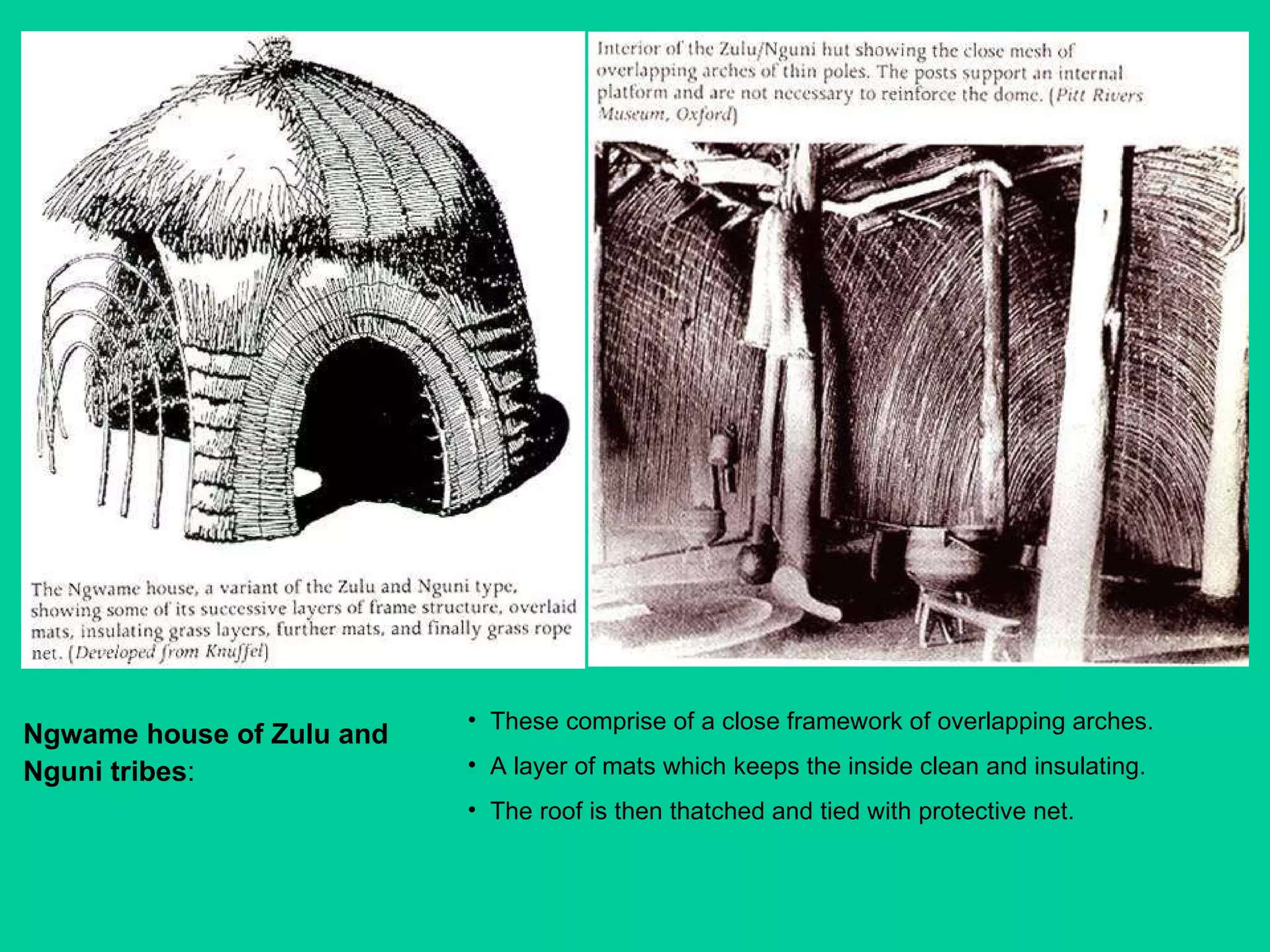
Ngwame house of Zulu and Nguni tribes :   These comprise of a close framework of overlapping arches. A layer of mats which keeps the inside clean and insulating.  The roof is then thatched and tied with protective net.
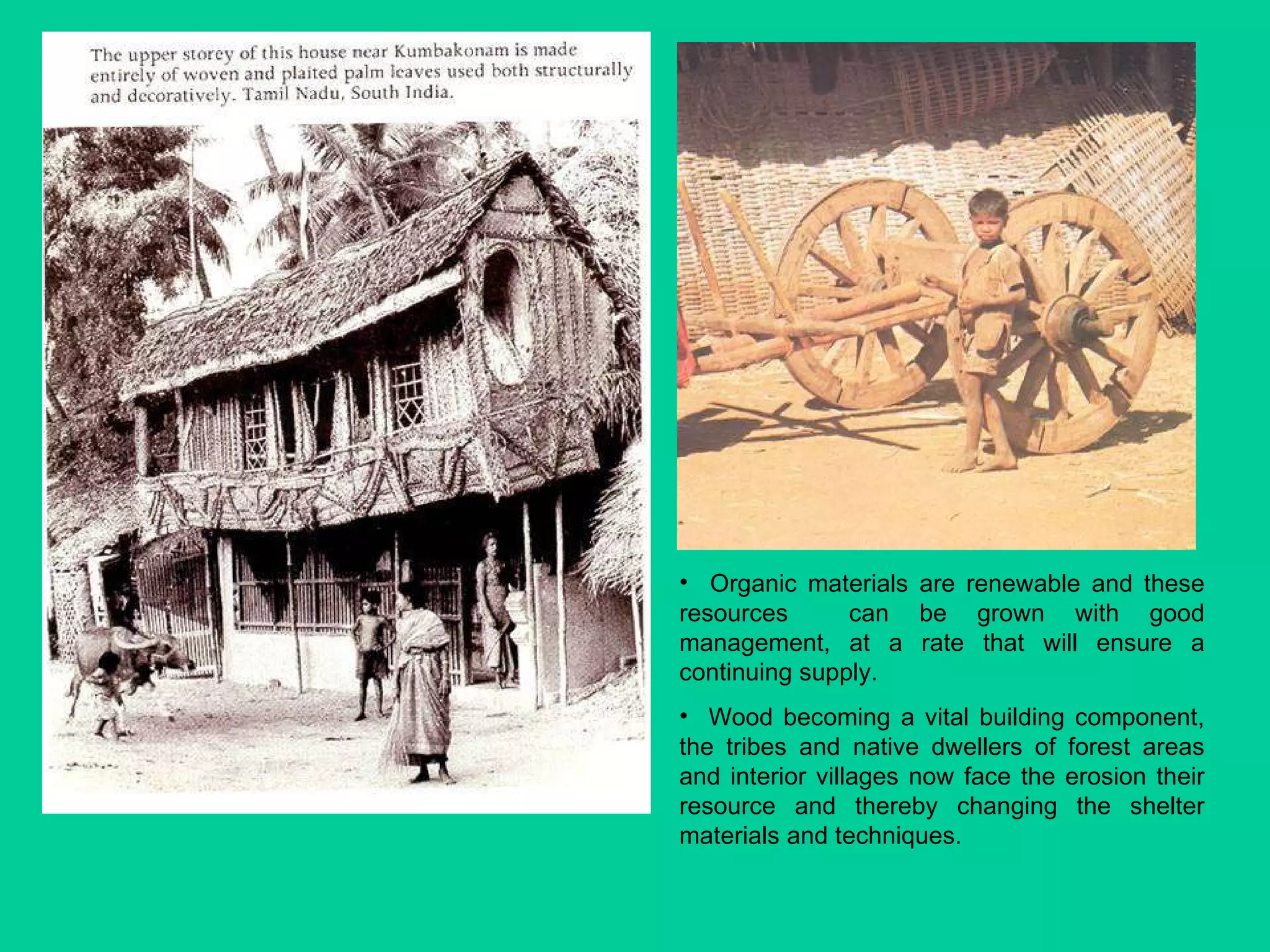
Organic materials are renewable and these resources  can be grown with good management, at a rate that will ensure a continuing supply.  Wood becoming a vital building component, the tribes and native dwellers of forest areas and interior villages now face the erosion their resource and thereby changing the shelter materials and techniques.
END

Lecture09 Resources That Grow Sr

  • 1.
  • 2.
    Chapter 5 Resources That Grow Nature and texture of organic materials may vary widely from soft woods to hard and from resinous to fibrous, and while the dimensions in which they are available also differ greatly from one context to another, certain characteristics may be found in common. Ultimately, these properties will influence the materials’ effectiveness in use and will help shape the ways in which they are employed to the best advantage.
  • 3.
    Classification of woodendwellings: Pole Structures Examples:Vaitupu Dwellings in Fiji, Mayan Dwellings in Mexico. Tiber Structures Three types:1. Horizontal log, 2. Post and Plank and 3. Timber Framed. Examples from US, England. Bamboo Structures Examples: Bafut Village Houses, Cameroon. Reed and Grass Structures Examples: Madan Tribe houses in Iraq, Aymara Houses of Bolivia, Ngwame houses of Zulu.
  • 4.
    principal building materialis the pandanus palm, though milo and coconut are also employed. A house would be supported to six to eight pandanus posts, deeply bedded in the soil, with two corner posts at each end and the remainder at six-foot intervals on the sides; a typical house would be about 24 feet long and 18 feet in width.   Vaitupu Dwellings near Fiji Islands Pole Structures
  • 5.
    Vaitupu Dwellings nearFiji Islands The shortened ridge received a main rafter at each end, which consequently inclined inwards below the apex of the main rafters, and it was also augmented by two short rafters, one on either side . The effect was to produce an inclined gable end. At intervals horizontal purlins were placed in position and a lattice of ribs of split pandanus laths was then affixed to the rafters with a continuous lashing. These were to take the roof thatch. To complete the internal fixtures, platforms were constructed which projected from the wall-plates and rested on the tie-beams; they provided valued storage space but reduced headroom at the sides. Each leaf overlapped its neighbor and soon a deep fringe of pandanus leaves was fixed to the spine to make a lau.
  • 6.
    Vaitupu Dwellings nearFiji Islands Forked poles received the horizontal side members, or wall-plates but if the posts were not forked they were round-notched on the end to support the log; tie-beams and end-plates were then placed across to complete the framework and lashed securely in place. Rafters, five or six on each side, were cut so as to meet tightly at a ridge angle of about 80 degrees; they were notched and pegged where they crossed so that they could rest on the wall plate and extend beyond the wall to produce deep eaves.
  • 7.
    Mayan Dwellings inMexico supported by three or four pairs of substantial posts of oxcitinche or another Yucatan hardwood for end-plates and the principals of the roof frame. With its ‘hipped’ profile, shorter at the ridge than at the eaves level, it too has an inclined gable frame. A dozen or more common rafters on each side and six or eight at the ends are laid against the basic frame and supported by the purlins; these in turn are crossed by slender sticks tied into position with bark strips. Pole Structures
  • 8.
    The poles werelashed, not jointed, though cusps and hollows were sometimes cut to receive the curved section of a pole cross-member. Mayan Dwellings in Mexico
  • 9.
    Post and Beamconstruction at Manikan, HimachalPradesh, India. Post and Lintel (or) Trabeated Architecture Timber dwellings are constructed on the ‘post and lintel (beam)’ principle, in which the beam transfers vertical loads along its lengths to its supporting posts. Sometimes termed ‘trabeated architecture’ from the Latin word trabs for beam-it exploits the tensile strength of timber. Timber Buildings
  • 10.
    Timber Buildings 2. Horizontal log , in which the wall was composed of solid timbers laid one on tip of the other and jointed at the corners; (or) the round logs are kept one above other horizontally with a cup like support. 3. Timber frame , in which is structural frame was separate from the weather protective part of the wall. 1. Post and plank , in which the wall consisted of a series of heavy planks slotted between even heavier posts;
  • 11.
    We can classifythe timber-framed structures as two basic types: 1. Cruck framed structures In cruck framed construction the roof loads were transmitted by means of inclined crucks to the ground. In this construction, the A-frames are assembled on ground and lifted one by one into a vertical position and the ridge purlin, side purlins and wall plates are dropped into sockets and tie the frames together. 2. Box framed structures In box frame the loads were taken by framed walls. The walls are constructed first with the corner posts. There are many ways to construct a box frame: square frames, vertical frames and then diagonal frames. Timber Framed Structures
  • 12.
    Timber Framed StructuresCruck Frame Box Frame
  • 13.
    Timber (box) framedconstruction
  • 14.
  • 15.
  • 16.
    The Infill ofthe timber-framed buildings is done by the following materials: Wattle and daub / Mud & Stud Tiles Weatherboard cladding Plastering and pargetting Brick nogging 5. Brick Nogging 3. Weatherboard Cladding 4. Plastering & Pargetting 1. Wattle & Daub 2. Tiles Infill materials
  • 17.
  • 18.
  • 19.
  • 20.
  • 21.
  • 22.
  • 23.
    Timber framed Roofs:The roof structure is made with rafters in single or double rafters using many forms such as hipped or gabled. In a hipped roof slopes towards the walls from all sides with a ridge. In a gable roof two ends are straight and other two slope on to the walls. The roofing materials vary too: tiles, slates, stone, thatch etc.
  • 24.
  • 25.
    Bamboo Structures  Bamboo is a type of grass that has strong outer shell stem with soft core. When seasoned bamboo becomes a strong pipe like wood, light in weight and strong in compression. These come in variety of lengths called culms divided by nodes. Bamboo can be chopped, cut, split and spliced producing material for entire building needs. There is no bark to remove, virtually no waste, and bamboo can be worked with a machete. Bamboo is grown in tropical and temperate climates and there are over 700 species throughout the world. Bamboo Construction Extremely strong, bamboo makes for a relatively light construction. This makes for a more durable structure and one, which can assume greater height, the bamboos or raffia-palms being used as studs, cladding or bracing, and stiffening the structure in the process. Generally the thicker culms are good for compression, while thinner culms have moderate elasticity and considerable strength.
  • 26.
    Village houses (Bafut) in Cameroon : Notable feature of the buildings is the extensive use of prefabrication or the individual construction of component parts of the building prior to assembly. Prefabricated platform is raised up as ceiling eaves extending out about three feet on sides. An opening is cut into eaves to permit access to the loft space. This is later solidly packed with bamboo strips to form flat surfaces and used as storage space. Village houses (Bafut) in Cameroon.
  • 27.
    The pyramidal roofis also made as pre-fabricated on ground and raised up in position. Thin bamboos are then used as purlins and then roofed with thatch. The interiors are partitioned using bamboo woven frames and poles. The furniture such as beds and shelves are made out of bamboo. Village houses (Bafut) in Cameroon.
  • 28.
    Reed and Grassstructures Reed and grass are long stick like wood that are flexible and elastic than bamboo. They are no suitable for compression but when joined and tied together as bundle some can be used in compression. Reeds are grown in marshlands. Madan tribes in Iraq. Madan tribes in Iraq. In Iraq the qasab reed is used by Madan tribes along the marshlands of north Basra. A bundle of high reed tied together with straw ropes is forced into dibir or base of the dwelling. These are inserted at 30 degrees into a reed mattress until secure.
  • 29.
    Madan tribes inIraq. The reeds from both sides are drawn together to form parabolic arches and tied tight. After the row of arches is formed, more slender reeds are tied as horizontal rafters. Large woven mats made from split qasab stalks clad the whole structure, overlapping the purlins. The doorways always face Mecca and open screens admit light while privacy is maintained. In similar manner a mudhif or guesthouse, sitras or winter shelters, and raba or part house are constructed.
  • 30.
    Aymara Indians onLake Titicaca, Bolivia . Aymara Indians on Lake Titicaca, Bolivia. The tutora reed is used by Aymara Indians for their famous banana shaped boats and sloping roofed dwellings. A few supporting poles hold up the roof, which spanned with wide mats of reed stalks, and takes a keel like shape. The roof is covered with reeds and woven mats.
  • 31.
    Ngwame house ofZulu and Nguni tribes : These comprise of a close framework of overlapping arches. A layer of mats which keeps the inside clean and insulating. The roof is then thatched and tied with protective net.
  • 32.
    Organic materials arerenewable and these resources can be grown with good management, at a rate that will ensure a continuing supply. Wood becoming a vital building component, the tribes and native dwellers of forest areas and interior villages now face the erosion their resource and thereby changing the shelter materials and techniques.
  • 33.