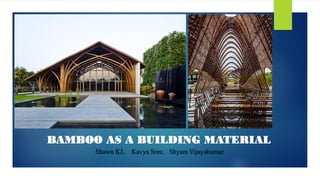
BAMBOO AS A BUILDING MATERIAL
Shawn KJ, Kavya Sree, Shyam Vijayakumar
INTRODUCTION
 It is widely used for many forms of
construction, in particular for housing
in rural areas.
 Bamboo is a renewable and versatile
resource, characterized by high
strength and low weight, and is easily
worked using simple tools.
PROPERTIES
 Tensile strength
 Compressive strength
 Elastic modulus
 Anisotropic
 Shrinkage
 Fire resistance
METHODS OF WORKING ON BAMBOO
 Splitting
The cane is split with a knife frame or a
wedge into four or eight segments.
METHODS OF WORKING ON BAMBOO
 Shaping
Bamboo available in nature is
usually circular in cross section.
METHODS OF WORKING ON BAMBOO
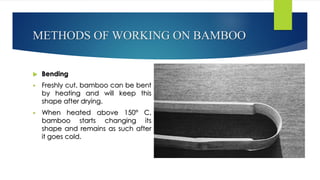
 Bending
▪ Freshly cut, bamboo can be bent
by heating and will keep this
shape after drying.
▪ When heated above 150° C,
bamboo starts changing its
shape and remains as such after
it goes cold.
Bending without heating
APPLICATIONS
Bamboo scaffolding Bamboo houses Bamboo roof
APPLICATIONS
Bamboo mat boards Bamboo truss Bamboo walling
VARIOUS STRUCTURAL SHAPES OF
BAMBOO AS A BUILDING MATERIAL
 Squared cross-section can be
obtained by compressing the growing
stalk of bamboo within a square
section.
VARIOUS STRUCTURAL SHAPES OF
BAMBOO AS A BUILDING MATERIAL
 Arch shapes of bamboo can also be
created by compressing the bamboo’s
growth into the desired shape.
VARIOUS STRUCTURAL SHAPES OF
BAMBOO AS A BUILDING MATERIAL
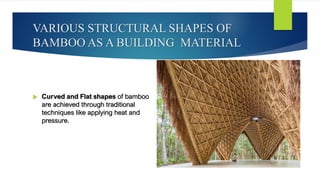
 Curved and Flat shapes of bamboo
are achieved through traditional
techniques like applying heat and
pressure.
BAMBOO AS A BUILDING MATERIAL
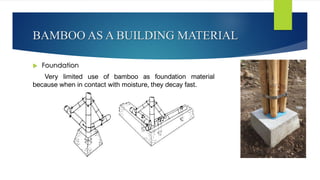
 Foundation
Very limited use of bamboo as foundation material
because when in contact with moisture, they decay fast.
BAMBOO AS A BUILDING MATERIAL
 Column
ROOFING WITH BAMBOO AS A
BUILDING MATERIAL
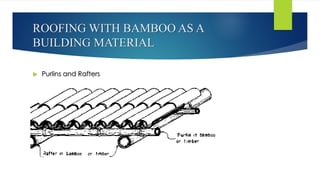
 Bamboo is one of the best roofing
materials and provides ample
sturdiness to the structure. It is a
proven shield against forces of nature
or animals and are considerably light
weighted which makes them easy to
install. The bamboo roofs encompass
purlins, rafters and trusses.
ROOFING WITH BAMBOO AS A
BUILDING MATERIAL
 Purlins and Rafters
ROOFING WITH BAMBOO AS A
BUILDING MATERIAL
 Trusses
SCAFFOLDING WITH BAMBOO AS A
BUILDING MATERIAL
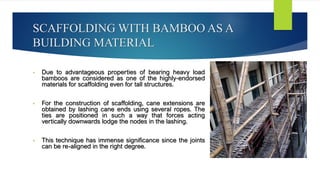
• Due to advantageous properties of bearing heavy load
bamboos are considered as one of the highly-endorsed
materials for scaffolding even for tall structures.
• For the construction of scaffolding, cane extensions are
obtained by lashing cane ends using several ropes. The
ties are positioned in such a way that forces acting
vertically downwards lodge the nodes in the lashing.
• This technique has immense significance since the joints
can be re-aligned in the right degree.
Lashing
REINFORCEMENT WITH BAMBOO AS A
BUILDING MATERIAL
 Reinforcement in RC columns, beams and slabs.
VARIOUS SHAPES AND FORMS
 Flattened bamboo shape which is acquired
by splitting freshly cut bamboo stalks and
then rolling and flattening them.
VARIOUS SHAPES AND FORMS
 Bamboo mats as thin as 5-6mm or 10-
15mm in size are woven according to
design prerequisite. Phenolic resins are
used in structures employing bamboo
mats.
VARIOUS SHAPES AND FORMS
 Bamboo plastic composite is a pioneering technology in which bamboo fibre as raw
material is blended with plastic as the core material. These mats are highly resistant to
moisture and structurally more stable.
STRUCTURES
 Simon Velez is known for his
impressive constructions made of
bamboo. The Colombian architect
is the subject of an outdoor
exhibition at Rossiniere.
STRUCTURES
 Simon Velez constructed a
cathedral in Pereira from
bamboo.
CASE STUDY
conducted by Prof. Satish Pawar
 The building has been built for a Trust in
adivasi area at Bhopoli on western express
highway near Manor.
 Constructed in 2007-08. , it was to be used
as an office and hall. Author was also the
part of its execution team.
 The building constitutes of conventional
RCC column structure with spread footing
& plinth beams in the substructure and RCC
column and floor beams in the
superstructure.
CASE STUDY
ADVANTAGES DISADVANTAGES
 High tensile strength
 Fire Resistance
 Elasticity
 Low wight
 They are cost effective and easy to
use.
 Unlike other building materials like
cement and asbestos, bamboo poses
no danger to health.
 They require preservation
 More Shrinkage
 Less Durability
 Jointing : Structural reliability of
bamboo is questionable
COMPARISON
REFERENCES
 https://theconstructor.org/building/bamboo-as-a-building-material-uses-advantages/14838/
 http://www.simonvelez.net/info.html
 https://en.wikipedia.org/wiki/Bamboo_construction
 https://learningenglish.voanews.com/a/making-bamboo-a-common-building material/3406581.html
 www.youtube.com
THANK YOU

Bamboo as a building material new

  • 1.
    BAMBOO AS ABUILDING MATERIAL Shawn KJ, Kavya Sree, Shyam Vijayakumar
  • 2.
    INTRODUCTION  It iswidely used for many forms of construction, in particular for housing in rural areas.  Bamboo is a renewable and versatile resource, characterized by high strength and low weight, and is easily worked using simple tools.
  • 3.
    PROPERTIES  Tensile strength Compressive strength  Elastic modulus  Anisotropic  Shrinkage  Fire resistance
  • 4.
    METHODS OF WORKINGON BAMBOO  Splitting The cane is split with a knife frame or a wedge into four or eight segments.
  • 5.
    METHODS OF WORKINGON BAMBOO  Shaping Bamboo available in nature is usually circular in cross section.
  • 6.
    METHODS OF WORKINGON BAMBOO  Bending ▪ Freshly cut, bamboo can be bent by heating and will keep this shape after drying. ▪ When heated above 150° C, bamboo starts changing its shape and remains as such after it goes cold.
  • 7.
  • 8.
  • 9.
    APPLICATIONS Bamboo mat boardsBamboo truss Bamboo walling
  • 10.
    VARIOUS STRUCTURAL SHAPESOF BAMBOO AS A BUILDING MATERIAL  Squared cross-section can be obtained by compressing the growing stalk of bamboo within a square section.
  • 11.
    VARIOUS STRUCTURAL SHAPESOF BAMBOO AS A BUILDING MATERIAL  Arch shapes of bamboo can also be created by compressing the bamboo’s growth into the desired shape.
  • 12.
    VARIOUS STRUCTURAL SHAPESOF BAMBOO AS A BUILDING MATERIAL  Curved and Flat shapes of bamboo are achieved through traditional techniques like applying heat and pressure.
  • 13.
    BAMBOO AS ABUILDING MATERIAL  Foundation Very limited use of bamboo as foundation material because when in contact with moisture, they decay fast.
  • 14.
    BAMBOO AS ABUILDING MATERIAL  Column
  • 15.
    ROOFING WITH BAMBOOAS A BUILDING MATERIAL  Bamboo is one of the best roofing materials and provides ample sturdiness to the structure. It is a proven shield against forces of nature or animals and are considerably light weighted which makes them easy to install. The bamboo roofs encompass purlins, rafters and trusses.
  • 16.
    ROOFING WITH BAMBOOAS A BUILDING MATERIAL  Purlins and Rafters
  • 17.
    ROOFING WITH BAMBOOAS A BUILDING MATERIAL  Trusses
  • 18.
    SCAFFOLDING WITH BAMBOOAS A BUILDING MATERIAL • Due to advantageous properties of bearing heavy load bamboos are considered as one of the highly-endorsed materials for scaffolding even for tall structures. • For the construction of scaffolding, cane extensions are obtained by lashing cane ends using several ropes. The ties are positioned in such a way that forces acting vertically downwards lodge the nodes in the lashing. • This technique has immense significance since the joints can be re-aligned in the right degree.
  • 19.
  • 20.
    REINFORCEMENT WITH BAMBOOAS A BUILDING MATERIAL  Reinforcement in RC columns, beams and slabs.
  • 22.
    VARIOUS SHAPES ANDFORMS  Flattened bamboo shape which is acquired by splitting freshly cut bamboo stalks and then rolling and flattening them.
  • 23.
    VARIOUS SHAPES ANDFORMS  Bamboo mats as thin as 5-6mm or 10- 15mm in size are woven according to design prerequisite. Phenolic resins are used in structures employing bamboo mats.
  • 24.
    VARIOUS SHAPES ANDFORMS  Bamboo plastic composite is a pioneering technology in which bamboo fibre as raw material is blended with plastic as the core material. These mats are highly resistant to moisture and structurally more stable.
  • 25.
    STRUCTURES  Simon Velezis known for his impressive constructions made of bamboo. The Colombian architect is the subject of an outdoor exhibition at Rossiniere.
  • 26.
    STRUCTURES  Simon Velezconstructed a cathedral in Pereira from bamboo.
  • 27.
    CASE STUDY conducted byProf. Satish Pawar  The building has been built for a Trust in adivasi area at Bhopoli on western express highway near Manor.  Constructed in 2007-08. , it was to be used as an office and hall. Author was also the part of its execution team.  The building constitutes of conventional RCC column structure with spread footing & plinth beams in the substructure and RCC column and floor beams in the superstructure.
  • 28.
  • 29.
    ADVANTAGES DISADVANTAGES  Hightensile strength  Fire Resistance  Elasticity  Low wight  They are cost effective and easy to use.  Unlike other building materials like cement and asbestos, bamboo poses no danger to health.  They require preservation  More Shrinkage  Less Durability  Jointing : Structural reliability of bamboo is questionable
  • 30.
  • 31.
    REFERENCES  https://theconstructor.org/building/bamboo-as-a-building-material-uses-advantages/14838/  http://www.simonvelez.net/info.html https://en.wikipedia.org/wiki/Bamboo_construction  https://learningenglish.voanews.com/a/making-bamboo-a-common-building material/3406581.html  www.youtube.com
  • 32.