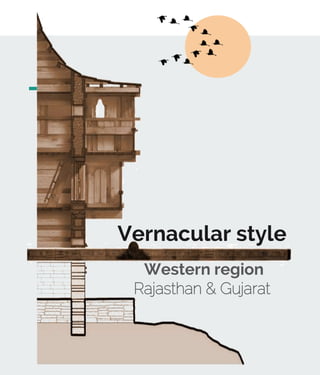
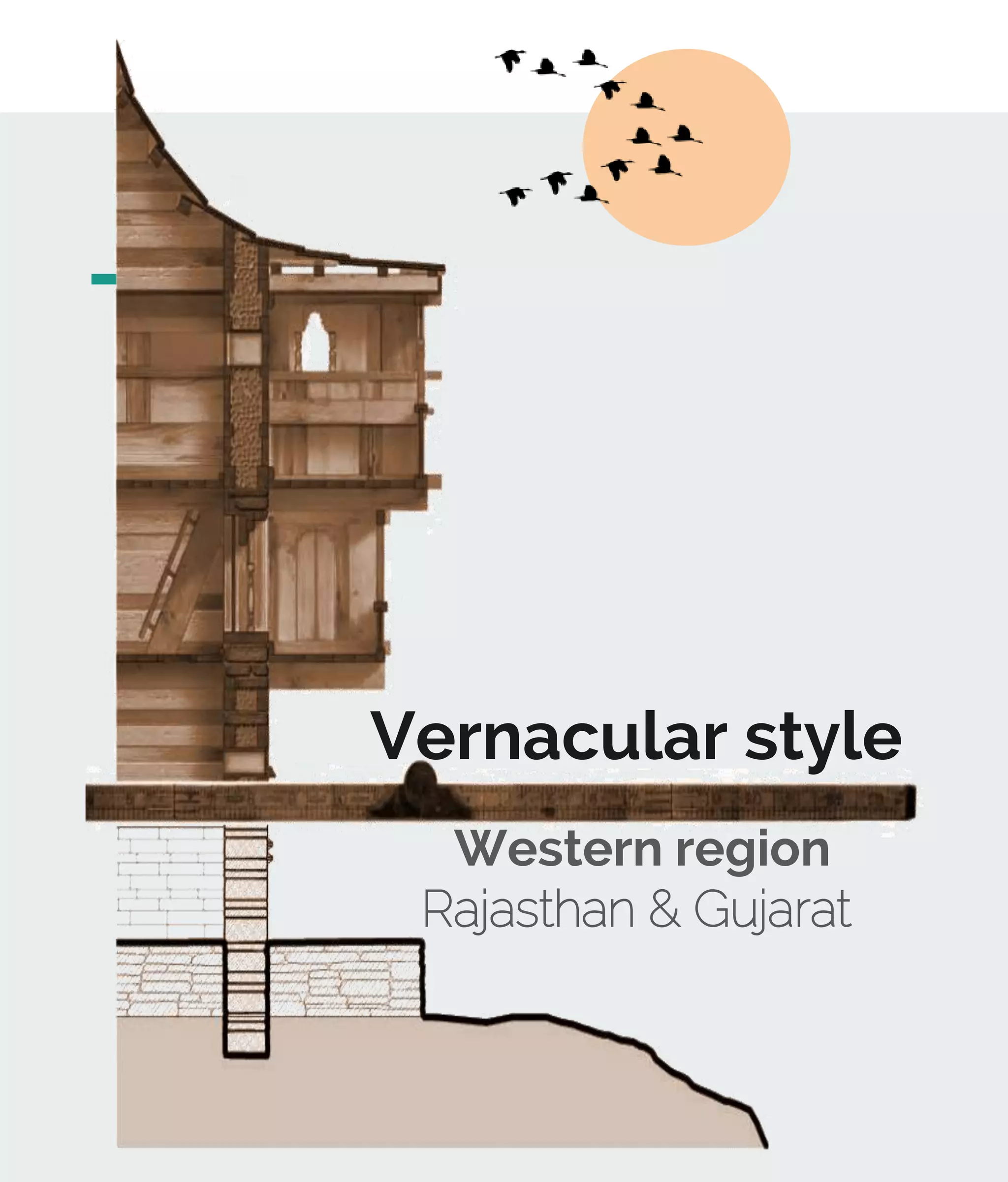
Vernacular style
Western region
Rajasthan & Gujarat
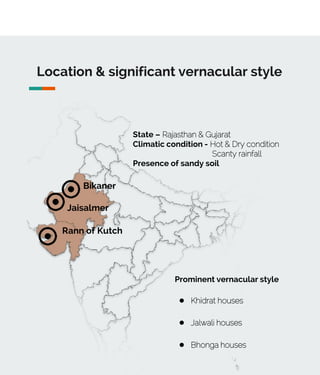
Location & significant vernacular style
State – Rajasthan & Gujarat
Climatic condition - Hot & Dry condition
Scanty rainfall
Presence of sandy soil
Jaisalmer
Rann of Kutch
Prominent vernacular style
● Khidrat houses
● Jalwali houses
● Bhonga houses
Bikaner
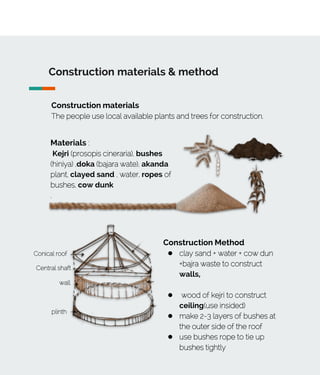
Construction materials & method
Construction materials
The people use local available plants and trees for construction.
Materials :
Kejri (prosopis cineraria), bushes
(hiniya) ,doka (bajara wate), akanda
plant, clayed sand , water, ropes of
bushes, cow dunk
.
Construction Method
● clay sand + water + cow dun
+bajra waste to construct
walls,
● wood of kejri to construct
ceiling(use insided)
● make 2-3 layers of bushes at
the outer side of the roof
● use bushes rope to tie up
bushes tightly
Conical roof
Central shaft
wall
plinth
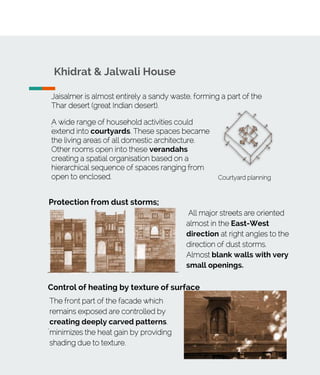
Jaisalmer is almost entirely a sandy waste, forming a part of the
Thar desert (great Indian desert).
.
Khidrat & Jalwali House
A wide range of household activities could
extend into courtyards. These spaces became
the living areas of all domestic architecture.
Other rooms open into these verandahs
creating a spatial organisation based on a
hierarchical sequence of spaces ranging from
open to enclosed.
.
Courtyard planning
Protection from dust storms;
.
All major streets are oriented
almost in the East-West
direction at right angles to the
direction of dust storms.
Almost blank walls with very
small openings.
.
Control of heating by texture of surface
.
The front part of the facade which
remains exposed are controlled by
creating deeply carved patterns.
minimizes the heat gain by providing
shading due to texture.
Khidrat house
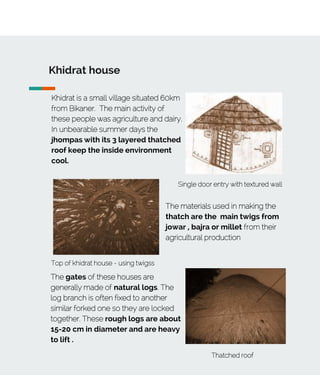
Khidrat is a small village situated 60km
from Bikaner. The main activity of
these people was agriculture and dairy.
In unbearable summer days the
jhompas with its 3 layered thatched
roof keep the inside environment
cool.
Top of khidrat house - using twigss
Single door entry with textured wall
The materials used in making the
thatch are the main twigs from
jowar , bajra or millet from their
agricultural production
The gates of these houses are
generally made of natural logs. The
log branch is often fixed to another
similar forked one so they are locked
together. These rough logs are about
15-20 cm in diameter and are heavy
to lift .
Thatched roof
Khidrat house
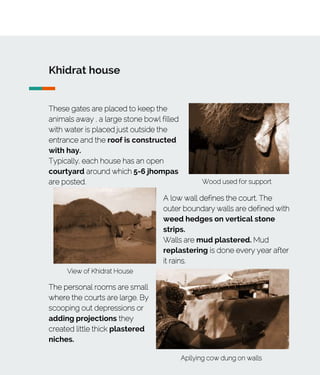
These gates are placed to keep the
animals away , a large stone bowl filled
with water is placed just outside the
entrance and the roof is constructed
with hay.
Typically, each house has an open
courtyard around which 5-6 jhompas
are posted.
View of Khidrat House
Wood used for support
A low wall defines the court. The
outer boundary walls are defined with
weed hedges on vertical stone
strips.
Walls are mud plastered. Mud
replastering is done every year after
it rains.
Apllying cow dung on walls
The personal rooms are small
where the courts are large. By
scooping out depressions or
adding projections they
created little thick plastered
niches.
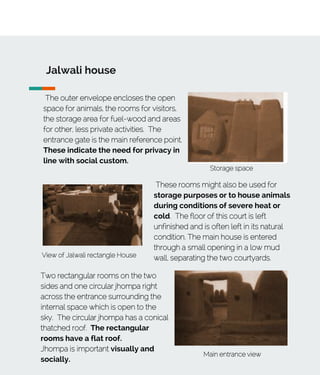
Jalwali house
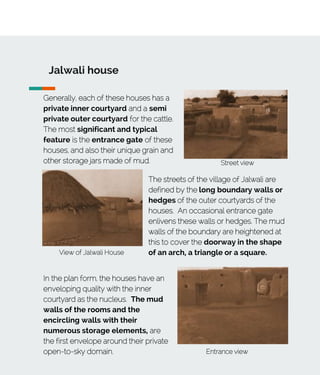
Generally, each of these houses has a
private inner courtyard and a semi
private outer courtyard for the cattle.
The most significant and typical
feature is the entrance gate of these
houses, and also their unique grain and
other storage jars made of mud.
View of Jalwali House
Street view
The streets of the village of Jalwali are
defined by the long boundary walls or
hedges of the outer courtyards of the
houses. An occasional entrance gate
enlivens these walls or hedges. The mud
walls of the boundary are heightened at
this to cover the doorway in the shape
of an arch, a triangle or a square.
Entrance view
In the plan form, the houses have an
enveloping quality with the inner
courtyard as the nucleus. The mud
walls of the rooms and the
encircling walls with their
numerous storage elements, are
the first envelope around their private
open-to-sky domain.
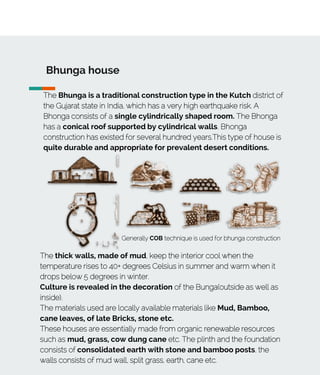
Jalwali house
The outer envelope encloses the open
space for animals, the rooms for visitors,
the storage area for fuel-wood and areas
for other, less private activities. The
entrance gate is the main reference point.
These indicate the need for privacy in
line with social custom.
View of Jalwali rectangle House
Storage space
These rooms might also be used for
storage purposes or to house animals
during conditions of severe heat or
cold. The floor of this court is left
unfinished and is often left in its natural
condition. The main house is entered
through a small opening in a low mud
wall, separating the two courtyards.
Main entrance view
Two rectangular rooms on the two
sides and one circular jhompa right
across the entrance surrounding the
internal space which is open to the
sky. The circular jhompa has a conical
thatched roof. The rectangular
rooms have a flat roof.
Jhompa is important visually and
socially.
Bhunga house
The Bhunga is a traditional construction type in the Kutch district of
the Gujarat state in India, which has a very high earthquake risk. A
Bhonga consists of a single cylindrically shaped room. The Bhonga
has a conical roof supported by cylindrical walls. Bhonga
construction has existed for several hundred years.This type of house is
quite durable and appropriate for prevalent desert conditions.
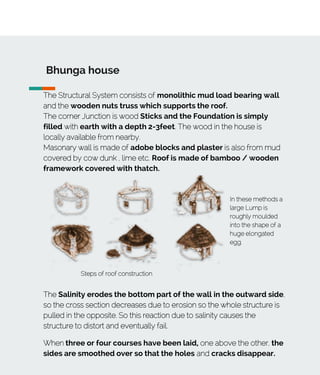
Generally COB technique is used for bhunga construction
The thick walls, made of mud, keep the interior cool when the
temperature rises to 40+ degrees Celsius in summer and warm when it
drops below 5 degrees in winter.
Culture is revealed in the decoration of the Bunga(outside as well as
inside).
The materials used are locally available materials like Mud, Bamboo,
cane leaves, of late Bricks, stone etc.
These houses are essentially made from organic renewable resources
such as mud, grass, cow dung cane etc. The plinth and the foundation
consists of consolidated earth with stone and bamboo posts, the
walls consists of mud wall, split grass, earth, cane etc.
Bhunga house
The Structural System consists of monolithic mud load bearing wall
and the wooden nuts truss which supports the roof.
The corner Junction is wood Sticks and the Foundation is simply
filled with earth with a depth 2-3feet. The wood in the house is
locally available from nearby.
Masonary wall is made of adobe blocks and plaster is also from mud
covered by cow dunk , lime etc. Roof is made of bamboo / wooden
framework covered with thatch.
Steps of roof construction
In these methods a
large Lump is
roughly moulded
into the shape of a
huge elongated
egg.
The Salinity erodes the bottom part of the wall in the outward side,
so the cross section decreases due to erosion so the whole structure is
pulled in the opposite. So this reaction due to salinity causes the
structure to distort and eventually fail.
When three or four courses have been laid, one above the other, the
sides are smoothed over so that the holes and cracks disappear.
Bhunga house
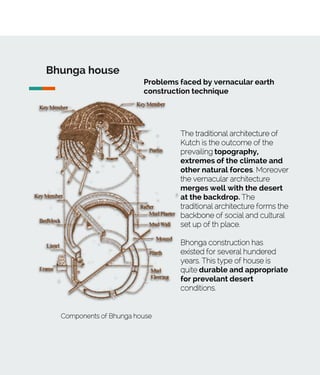
Components of Bhunga house
The traditional architecture of
Kutch is the outcome of the
prevailing topography,
extremes of the climate and
other natural forces. Moreover
the vernacular architecture
merges well with the desert
at the backdrop. The
traditional architecture forms the
backbone of social and cultural
set up of th place.
Bhonga construction has
existed for several hundered
years. This type of house is
quite durable and appropriate
for prevelant desert
conditions.
Problems faced by vernacular earth
construction technique
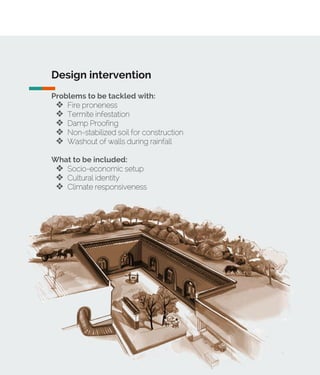
Design intervention
Problems to be tackled with:
❖ Fire proneness
❖ Termite infestation
❖ Damp Proofing
❖ Non-stabilized soil for construction
❖ Washout of walls during rainfall
What to be included:
❖ Socio-economic setup
❖ Cultural identity
❖ Climate responsiveness
Design intervention
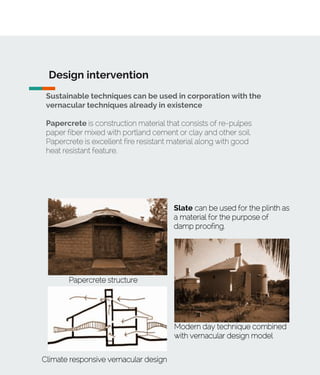
Sustainable techniques can be used in corporation with the
vernacular techniques already in existence
Papercrete is construction material that consists of re-pulpes
paper fiber mixed with portland cement or clay and other soil.
Papercrete is excellent fire resistant material along with good
heat resistant feature.
Papercrete structure
Slate can be used for the plinth as
a material for the purpose of
damp proofing.
Modern day technique combined
with vernacular design model
Climate responsive vernacular design

Vernacular architecture

  • 1.
  • 2.
    Location & significantvernacular style State – Rajasthan & Gujarat Climatic condition - Hot & Dry condition Scanty rainfall Presence of sandy soil Jaisalmer Rann of Kutch Prominent vernacular style ● Khidrat houses ● Jalwali houses ● Bhonga houses Bikaner
  • 3.
    Construction materials &method Construction materials The people use local available plants and trees for construction. Materials : Kejri (prosopis cineraria), bushes (hiniya) ,doka (bajara wate), akanda plant, clayed sand , water, ropes of bushes, cow dunk . Construction Method ● clay sand + water + cow dun +bajra waste to construct walls, ● wood of kejri to construct ceiling(use insided) ● make 2-3 layers of bushes at the outer side of the roof ● use bushes rope to tie up bushes tightly Conical roof Central shaft wall plinth
  • 4.
    Jaisalmer is almostentirely a sandy waste, forming a part of the Thar desert (great Indian desert). . Khidrat & Jalwali House A wide range of household activities could extend into courtyards. These spaces became the living areas of all domestic architecture. Other rooms open into these verandahs creating a spatial organisation based on a hierarchical sequence of spaces ranging from open to enclosed. . Courtyard planning Protection from dust storms; . All major streets are oriented almost in the East-West direction at right angles to the direction of dust storms. Almost blank walls with very small openings. . Control of heating by texture of surface . The front part of the facade which remains exposed are controlled by creating deeply carved patterns. minimizes the heat gain by providing shading due to texture.
  • 5.
    Khidrat house Khidrat isa small village situated 60km from Bikaner. The main activity of these people was agriculture and dairy. In unbearable summer days the jhompas with its 3 layered thatched roof keep the inside environment cool. Top of khidrat house - using twigss Single door entry with textured wall The materials used in making the thatch are the main twigs from jowar , bajra or millet from their agricultural production The gates of these houses are generally made of natural logs. The log branch is often fixed to another similar forked one so they are locked together. These rough logs are about 15-20 cm in diameter and are heavy to lift . Thatched roof
  • 6.
    Khidrat house These gatesare placed to keep the animals away , a large stone bowl filled with water is placed just outside the entrance and the roof is constructed with hay. Typically, each house has an open courtyard around which 5-6 jhompas are posted. View of Khidrat House Wood used for support A low wall defines the court. The outer boundary walls are defined with weed hedges on vertical stone strips. Walls are mud plastered. Mud replastering is done every year after it rains. Apllying cow dung on walls The personal rooms are small where the courts are large. By scooping out depressions or adding projections they created little thick plastered niches.
  • 7.
    Jalwali house Generally, eachof these houses has a private inner courtyard and a semi private outer courtyard for the cattle. The most significant and typical feature is the entrance gate of these houses, and also their unique grain and other storage jars made of mud. View of Jalwali House Street view The streets of the village of Jalwali are defined by the long boundary walls or hedges of the outer courtyards of the houses. An occasional entrance gate enlivens these walls or hedges. The mud walls of the boundary are heightened at this to cover the doorway in the shape of an arch, a triangle or a square. Entrance view In the plan form, the houses have an enveloping quality with the inner courtyard as the nucleus. The mud walls of the rooms and the encircling walls with their numerous storage elements, are the first envelope around their private open-to-sky domain.
  • 8.
    Jalwali house The outerenvelope encloses the open space for animals, the rooms for visitors, the storage area for fuel-wood and areas for other, less private activities. The entrance gate is the main reference point. These indicate the need for privacy in line with social custom. View of Jalwali rectangle House Storage space These rooms might also be used for storage purposes or to house animals during conditions of severe heat or cold. The floor of this court is left unfinished and is often left in its natural condition. The main house is entered through a small opening in a low mud wall, separating the two courtyards. Main entrance view Two rectangular rooms on the two sides and one circular jhompa right across the entrance surrounding the internal space which is open to the sky. The circular jhompa has a conical thatched roof. The rectangular rooms have a flat roof. Jhompa is important visually and socially.
  • 9.
    Bhunga house The Bhungais a traditional construction type in the Kutch district of the Gujarat state in India, which has a very high earthquake risk. A Bhonga consists of a single cylindrically shaped room. The Bhonga has a conical roof supported by cylindrical walls. Bhonga construction has existed for several hundred years.This type of house is quite durable and appropriate for prevalent desert conditions. Generally COB technique is used for bhunga construction The thick walls, made of mud, keep the interior cool when the temperature rises to 40+ degrees Celsius in summer and warm when it drops below 5 degrees in winter. Culture is revealed in the decoration of the Bunga(outside as well as inside). The materials used are locally available materials like Mud, Bamboo, cane leaves, of late Bricks, stone etc. These houses are essentially made from organic renewable resources such as mud, grass, cow dung cane etc. The plinth and the foundation consists of consolidated earth with stone and bamboo posts, the walls consists of mud wall, split grass, earth, cane etc.
  • 10.
    Bhunga house The StructuralSystem consists of monolithic mud load bearing wall and the wooden nuts truss which supports the roof. The corner Junction is wood Sticks and the Foundation is simply filled with earth with a depth 2-3feet. The wood in the house is locally available from nearby. Masonary wall is made of adobe blocks and plaster is also from mud covered by cow dunk , lime etc. Roof is made of bamboo / wooden framework covered with thatch. Steps of roof construction In these methods a large Lump is roughly moulded into the shape of a huge elongated egg. The Salinity erodes the bottom part of the wall in the outward side, so the cross section decreases due to erosion so the whole structure is pulled in the opposite. So this reaction due to salinity causes the structure to distort and eventually fail. When three or four courses have been laid, one above the other, the sides are smoothed over so that the holes and cracks disappear.
  • 11.
    Bhunga house Components ofBhunga house The traditional architecture of Kutch is the outcome of the prevailing topography, extremes of the climate and other natural forces. Moreover the vernacular architecture merges well with the desert at the backdrop. The traditional architecture forms the backbone of social and cultural set up of th place. Bhonga construction has existed for several hundered years. This type of house is quite durable and appropriate for prevelant desert conditions. Problems faced by vernacular earth construction technique
  • 12.
    Design intervention Problems tobe tackled with: ❖ Fire proneness ❖ Termite infestation ❖ Damp Proofing ❖ Non-stabilized soil for construction ❖ Washout of walls during rainfall What to be included: ❖ Socio-economic setup ❖ Cultural identity ❖ Climate responsiveness
  • 13.
    Design intervention Sustainable techniquescan be used in corporation with the vernacular techniques already in existence Papercrete is construction material that consists of re-pulpes paper fiber mixed with portland cement or clay and other soil. Papercrete is excellent fire resistant material along with good heat resistant feature. Papercrete structure Slate can be used for the plinth as a material for the purpose of damp proofing. Modern day technique combined with vernacular design model Climate responsive vernacular design