Homes Around The
           World
      By : Surya, Yehezkiel, and Evelyn
Wooden frame house

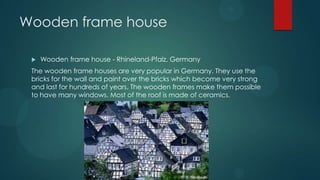
    Wooden frame house - Rhineland-Pfalz, Germany
 The wooden frame houses are very popular in Germany. They use the
 bricks for the wall and paint over the bricks which become very strong
 and last for hundreds of years. The wooden frames make them possible
 to have many windows. Most of the roof is made of ceramics.
Gel

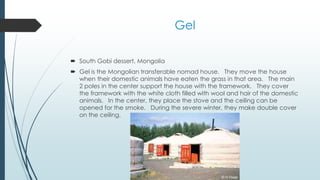
 South Gobi dessert, Mongolia
 Gel is the Mongolian transferable nomad house. They move the house
  when their domestic animals have eaten the grass in that area. The main
  2 poles in the center support the house with the framework. They cover
  the framework with the white cloth filled with wool and hair of the domestic
  animals. In the center, they place the stove and the ceiling can be
  opened for the smoke. During the severe winter, they make double cover
  on the ceiling.
Sun Dried Brick House of Berber Tribe
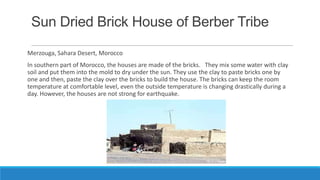
Merzouga, Sahara Desert, Morocco
In southern part of Morocco, the houses are made of the bricks. They mix some water with clay
soil and put them into the mold to dry under the sun. They use the clay to paste bricks one by
one and then, paste the clay over the bricks to build the house. The bricks can keep the room
temperature at comfortable level, even the outside temperature is changing drastically during a
day. However, the houses are not strong for earthquake.
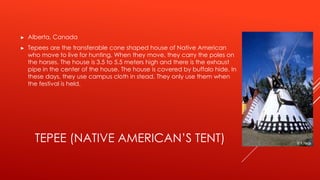
►   Alberta, Canada
►   Tepees are the transferable cone shaped house of Native American
    who move to live for hunting. When they move, they carry the poles on
    the horses. The house is 3.5 to 5.5 meters high and there is the exhaust
    pipe in the center of the house. The house is covered by buffalo hide. In
    these days, they use campus cloth in stead. They only use them when
    the festival is held.


      TEPEE (NATIVE AMERICAN’S TENT)
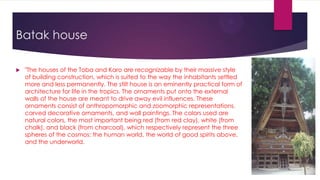
Batak house

   "The houses of the Toba and Karo are recognizable by their massive style
    of building construction, which is suited to the way the inhabitants settled
    more and less permanently. The stilt house is an eminently practical form of
    architecture for life in the tropics. The ornaments put onto the external
    walls of the house are meant to drive away evil influences. These
    ornaments consist of anthropomorphic and zoomorphic representations,
    carved decorative ornaments, and wall paintings. The colors used are
    natural colors, the most important being red (from red clay), white (from
    chalk), and black (from charcoal), which respectively represent the three
    spheres of the cosmos: the human world, the world of good spirits above,
    and the underworld.
Homes around the world

Homes around the world

  • 1.
    Homes Around The World By : Surya, Yehezkiel, and Evelyn
  • 2.
    Wooden frame house  Wooden frame house - Rhineland-Pfalz, Germany The wooden frame houses are very popular in Germany. They use the bricks for the wall and paint over the bricks which become very strong and last for hundreds of years. The wooden frames make them possible to have many windows. Most of the roof is made of ceramics.
  • 3.
    Gel  South Gobidessert, Mongolia  Gel is the Mongolian transferable nomad house. They move the house when their domestic animals have eaten the grass in that area. The main 2 poles in the center support the house with the framework. They cover the framework with the white cloth filled with wool and hair of the domestic animals. In the center, they place the stove and the ceiling can be opened for the smoke. During the severe winter, they make double cover on the ceiling.
  • 4.
    Sun Dried BrickHouse of Berber Tribe Merzouga, Sahara Desert, Morocco In southern part of Morocco, the houses are made of the bricks. They mix some water with clay soil and put them into the mold to dry under the sun. They use the clay to paste bricks one by one and then, paste the clay over the bricks to build the house. The bricks can keep the room temperature at comfortable level, even the outside temperature is changing drastically during a day. However, the houses are not strong for earthquake.
  • 5.
    Alberta, Canada ► Tepees are the transferable cone shaped house of Native American who move to live for hunting. When they move, they carry the poles on the horses. The house is 3.5 to 5.5 meters high and there is the exhaust pipe in the center of the house. The house is covered by buffalo hide. In these days, they use campus cloth in stead. They only use them when the festival is held. TEPEE (NATIVE AMERICAN’S TENT)
  • 6.
    Batak house  "The houses of the Toba and Karo are recognizable by their massive style of building construction, which is suited to the way the inhabitants settled more and less permanently. The stilt house is an eminently practical form of architecture for life in the tropics. The ornaments put onto the external walls of the house are meant to drive away evil influences. These ornaments consist of anthropomorphic and zoomorphic representations, carved decorative ornaments, and wall paintings. The colors used are natural colors, the most important being red (from red clay), white (from chalk), and black (from charcoal), which respectively represent the three spheres of the cosmos: the human world, the world of good spirits above, and the underworld.