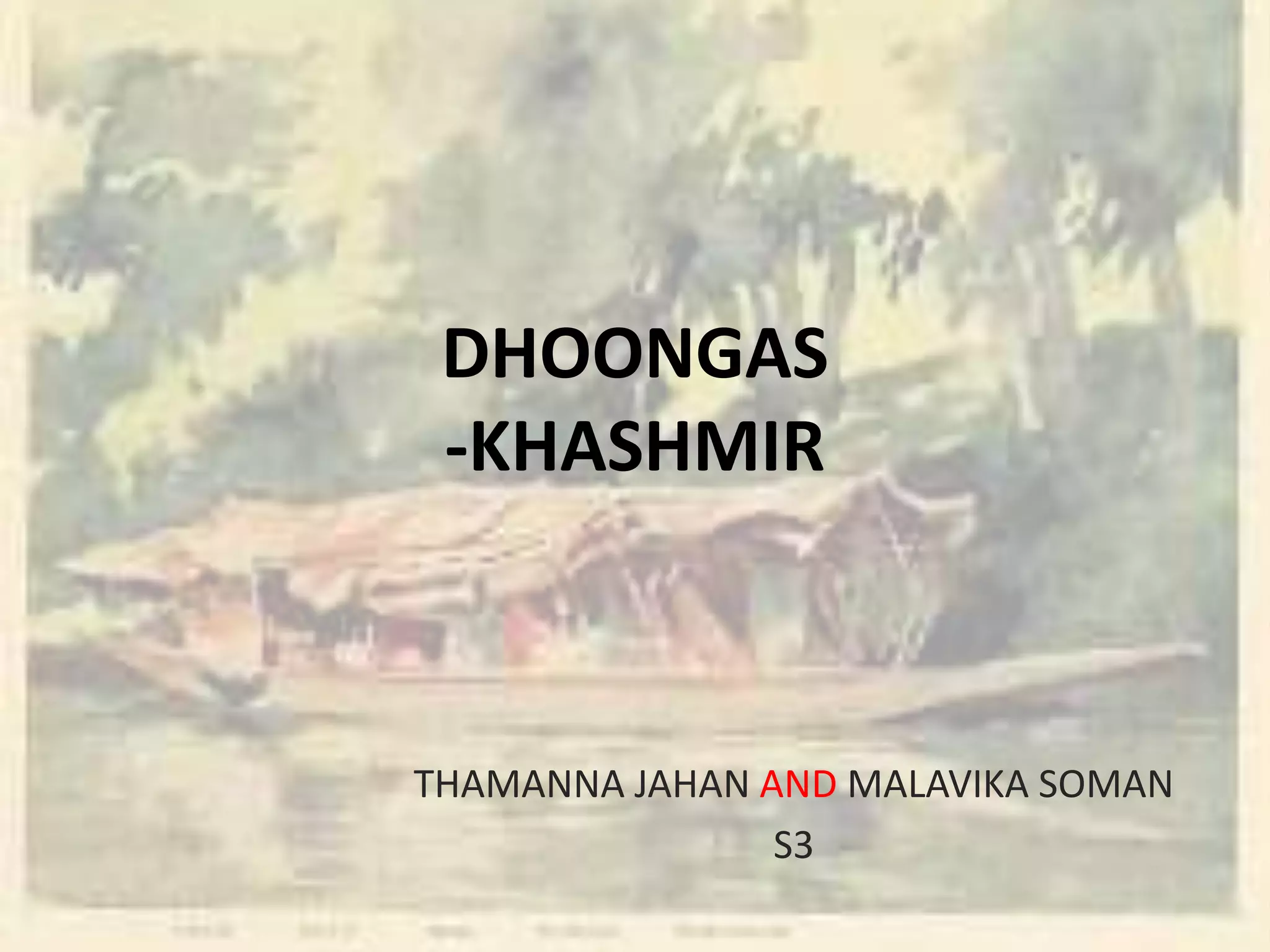
DHOONGAS
-KHASHMIR
THAMANNA JAHAN AND MALAVIKA SOMAN
S3
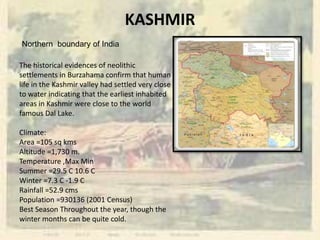
KASHMIR
Northern boundary of India
The historical evidences of neolithic
settlements in Burzahama confirm that human
life in the Kashmir valley had settled very close
to water indicating that the earliest inhabited
areas in Kashmir were close to the world
famous Dal Lake.
Climate:
Area =105 sq kms
Altitude =1,730 m.
Temperature ,Max Min
Summer =29.5 C 10.6 C
Winter =7.3 C -1.9 C
Rainfall =52.9 cms
Population =930136 (2001 Census)
Best Season Throughout the year, though the
winter months can be quite cold.
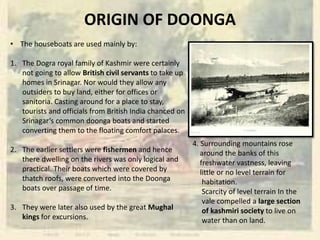
ORIGIN OF DOONGA
• The houseboats are used mainly by:
1. The Dogra royal family of Kashmir were certainly
not going to allow British civil servants to take up
homes in Srinagar. Nor would they allow any
outsiders to buy land, either for offices or
sanitoria. Casting around for a place to stay,
tourists and officials from British India chanced on
Srinagar’s common doonga boats and started
converting them to the floating comfort palaces.
2. The earlier settlers were fishermen and hence
there dwelling on the rivers was only logical and
practical. Their boats which were covered by
thatch roofs, were converted into the Doonga
boats over passage of time.
3. They were later also used by the great Mughal
kings for excursions.
4. Surrounding mountains rose
around the banks of this
freshwater vastness, leaving
little or no level terrain for
habitation.
Scarcity of level terrain In the
vale compelled a large section
of kashmiri society to live on
water than on land.
TYPES OF BOAT
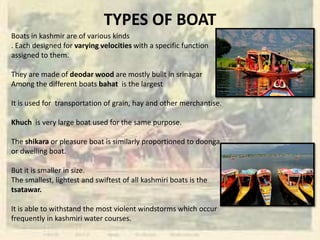
Boats in kashmir are of various kinds
. Each designed for varying velocities with a specific function
assigned to them.
They are made of deodar wood are mostly built in srinagar
Among the different boats bahat is the largest
It is used for transportation of grain, hay and other merchantise.
Khuch is very large boat used for the same purpose.
The shikara or pleasure boat is similarly proportioned to doonga,
or dwelling boat.
But it is smaller in size.
The smallest, lightest and swiftest of all kashmiri boats is the
tsatawar.
It is able to withstand the most violent windstorms which occur
frequently in kashmiri water courses.
CONSTRUCTION
Boat building in kashmir is an ancient craft
passed on from one generation of master
craftsman to the next .
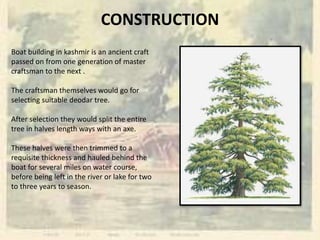
The craftsman themselves would go for
selecting suitable deodar tree.
After selection they would split the entire
tree in halves length ways with an axe.
These halves were then trimmed to a
requisite thickness and hauled behind the
boat for several miles on water course,
before being left in the river or lake for two
to three years to season.
CONSTRUCTION
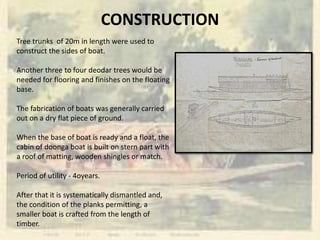
Tree trunks of 20m in length were used to
construct the sides of boat.
Another three to four deodar trees would be
needed for flooring and finishes on the floating
base.
The fabrication of boats was generally carried
out on a dry flat piece of ground.
When the base of boat is ready and a float, the
cabin of doonga boat is built on stern part with
a roof of matting, wooden shingles or match.
Period of utility - 4oyears.
After that it is systematically dismantled and,
the condition of the planks permitting, a
smaller boat is crafted from the length of
timber.
PLAN AND ELEVATION
DOONGA BOAT
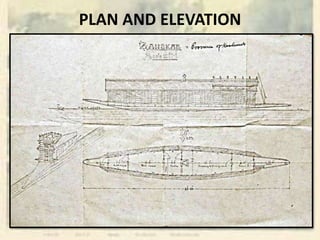
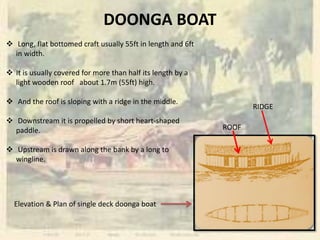
 Long, flat bottomed craft usually 55ft in length and 6ft
in width.
 It is usually covered for more than half its length by a
light wooden roof about 1.7m (55ft) high.
 And the roof is sloping with a ridge in the middle.
 Downstream it is propelled by short heart-shaped
paddle.
 Upstream is drawn along the bank by a long to
wingline.
ROOF
RIDGE
Elevation & Plan of single deck doonga boat
DOONGA BOAT
 The interior is divided by pine planks.
 Their placement is determined by
size of family.
 The front triangular space(nam) on
the deck is used as entrance.
 The rear is used as wash space by
residents.
 In the case of double storied doonga,
the wooden ladder to the upper
deck is from inside the room.
EXAMPLE :
DAL LAKE HOUSEBOATS
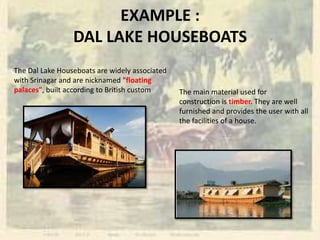
The Dal Lake Houseboats are widely associated
with Srinagar and are nicknamed "floating
palaces", built according to British custom The main material used for
construction is timber. They are well
furnished and provides the user with all
the facilities of a house.
DETAILS
•This houseboat is generally made from local cedar-
wood and measure 24–38 metres (79–125 ft) in
length and 3–6 metres (9.8–20 ft) in width and are
graded in a similar fashion to hotels according to level
of comfort.
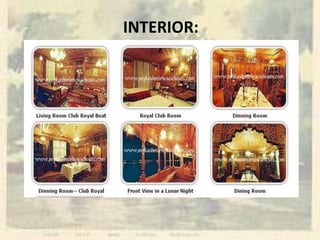
• Many of them have lavishly furnished rooms, with
verandas and a terrace to serve as a sun-deck or to
serve evening cocktails.
•They are anchored individually, with interconnecting
bridges providing access from one boat to the other.
•The kitchen-boat is annexed to the main houseboat,
which also serves as residence of the boat keeper and
his family
•Virtually every houseboat in Srinagar has been
provided with a municipal water connection
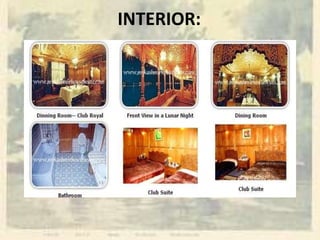
INTERIOR:
INTERIOR:

Dhoongas, kashmir

  • 1.
  • 2.
    KASHMIR Northern boundary ofIndia The historical evidences of neolithic settlements in Burzahama confirm that human life in the Kashmir valley had settled very close to water indicating that the earliest inhabited areas in Kashmir were close to the world famous Dal Lake. Climate: Area =105 sq kms Altitude =1,730 m. Temperature ,Max Min Summer =29.5 C 10.6 C Winter =7.3 C -1.9 C Rainfall =52.9 cms Population =930136 (2001 Census) Best Season Throughout the year, though the winter months can be quite cold.
  • 3.
    ORIGIN OF DOONGA •The houseboats are used mainly by: 1. The Dogra royal family of Kashmir were certainly not going to allow British civil servants to take up homes in Srinagar. Nor would they allow any outsiders to buy land, either for offices or sanitoria. Casting around for a place to stay, tourists and officials from British India chanced on Srinagar’s common doonga boats and started converting them to the floating comfort palaces. 2. The earlier settlers were fishermen and hence there dwelling on the rivers was only logical and practical. Their boats which were covered by thatch roofs, were converted into the Doonga boats over passage of time. 3. They were later also used by the great Mughal kings for excursions. 4. Surrounding mountains rose around the banks of this freshwater vastness, leaving little or no level terrain for habitation. Scarcity of level terrain In the vale compelled a large section of kashmiri society to live on water than on land.
  • 4.
    TYPES OF BOAT Boatsin kashmir are of various kinds . Each designed for varying velocities with a specific function assigned to them. They are made of deodar wood are mostly built in srinagar Among the different boats bahat is the largest It is used for transportation of grain, hay and other merchantise. Khuch is very large boat used for the same purpose. The shikara or pleasure boat is similarly proportioned to doonga, or dwelling boat. But it is smaller in size. The smallest, lightest and swiftest of all kashmiri boats is the tsatawar. It is able to withstand the most violent windstorms which occur frequently in kashmiri water courses.
  • 5.
    CONSTRUCTION Boat building inkashmir is an ancient craft passed on from one generation of master craftsman to the next . The craftsman themselves would go for selecting suitable deodar tree. After selection they would split the entire tree in halves length ways with an axe. These halves were then trimmed to a requisite thickness and hauled behind the boat for several miles on water course, before being left in the river or lake for two to three years to season.
  • 6.
    CONSTRUCTION Tree trunks of20m in length were used to construct the sides of boat. Another three to four deodar trees would be needed for flooring and finishes on the floating base. The fabrication of boats was generally carried out on a dry flat piece of ground. When the base of boat is ready and a float, the cabin of doonga boat is built on stern part with a roof of matting, wooden shingles or match. Period of utility - 4oyears. After that it is systematically dismantled and, the condition of the planks permitting, a smaller boat is crafted from the length of timber.
  • 7.
  • 8.
    DOONGA BOAT  Long,flat bottomed craft usually 55ft in length and 6ft in width.  It is usually covered for more than half its length by a light wooden roof about 1.7m (55ft) high.  And the roof is sloping with a ridge in the middle.  Downstream it is propelled by short heart-shaped paddle.  Upstream is drawn along the bank by a long to wingline. ROOF RIDGE Elevation & Plan of single deck doonga boat
  • 9.
    DOONGA BOAT  Theinterior is divided by pine planks.  Their placement is determined by size of family.  The front triangular space(nam) on the deck is used as entrance.  The rear is used as wash space by residents.  In the case of double storied doonga, the wooden ladder to the upper deck is from inside the room.
  • 10.
    EXAMPLE : DAL LAKEHOUSEBOATS The Dal Lake Houseboats are widely associated with Srinagar and are nicknamed "floating palaces", built according to British custom The main material used for construction is timber. They are well furnished and provides the user with all the facilities of a house.
  • 11.
    DETAILS •This houseboat isgenerally made from local cedar- wood and measure 24–38 metres (79–125 ft) in length and 3–6 metres (9.8–20 ft) in width and are graded in a similar fashion to hotels according to level of comfort. • Many of them have lavishly furnished rooms, with verandas and a terrace to serve as a sun-deck or to serve evening cocktails. •They are anchored individually, with interconnecting bridges providing access from one boat to the other. •The kitchen-boat is annexed to the main houseboat, which also serves as residence of the boat keeper and his family •Virtually every houseboat in Srinagar has been provided with a municipal water connection
  • 12.
  • 13.