BUILDING STONES
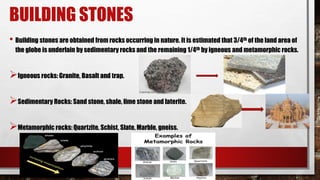
• Building stones are obtained from rocks occurring in nature. It is estimated that 3/4th of the land area of
the globe is underlain by sedimentary rocks and the remaining 1/4th by igneous and metamorphic rocks.
Igneous rocks: Granite, Basalt and trap.
Sedimentary Rocks: Sand stone, shale, lime stone and laterite.
Metamorphic rocks: Quartzite, Schist, Slate, Marble, gneiss.
REQUIREMENTS OF A GOOD BUILDING STONE
A good building stone should posses several characteristics such as
• High strength i.e., crushing strength > 1000kg/cm2
• High durability, sufficient hardness i.e., coefficient >14
• High resistance to wear and good fire resistance
• specific gravity >2.7
• Crystalline structure, High impact value i.e., toughness index>13
• Low water absorption i.e., percentage absorption after 24 hours less than 0.6
• Facility for carving and and dressing, weather resistance and better appearance
PROPERTIES OF PRINCIPLE BUILDING STONES
•Granite
Occurrence : Assam, Maharashtra, West Bengal, Bihar, Ap, J&K, Chennai, Mysore, Orissa, Gujarat,
Punjab, Kerala, Rajasthan.
Specific Gravity= 2.6 to 2.7
Crushing strength or compressive strength = 770 to 1300 kg/cm2.
Uses: Granite is very hard and durable building stone suitable for works like bridge abutments,
piers etc., where weight and durability are essential. It is not suitable for carving.
BASALT AND TRAP
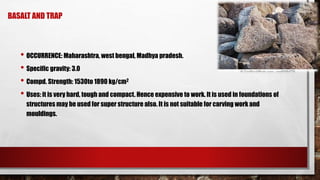
• OCCURRENCE: Maharashtra, west bengal, Madhya pradesh.
• Specific gravity: 3.0
• Compd. Strength: 1530to 1890 kg/cm2
• Uses: it is very hard, tough and compact. Hence expensive to work. It is used in foundations of
structures may be used for super structure also. It is not suitable for carving work and
mouldings.
SAND STONE
• OCCURRENCE : Andaman Islands, Madras, M.P, U.P, Rajasthan, Punjab, Gujarat.
• Specific gravity: 2.65 to 2.95
• Comp. strength : 650kg/cm2
Uses: it is very easy to dress and work. Extensively used in general building construction works
and ornamental carving.
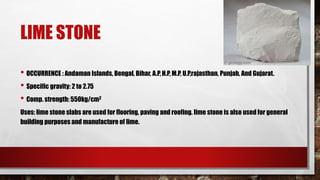
LIME STONE
• OCCURRENCE : Andaman Islands, Bengal, Bihar, A.P, H.P, M.P, U.P,rajasthan, Punjab, And Gujarat.
• Specific gravity: 2 to 2.75
• Comp. strength: 550kg/cm2
Uses: lime stone slabs are used for flooring, paving and roofing. lime stone is also used for general
building purposes and manufacture of lime.
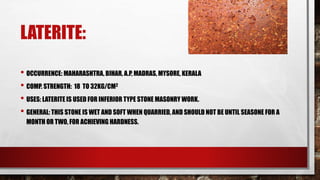
LATERITE:
• OCCURRENCE: MAHARASHTRA, BIHAR, A.P, MADRAS, MYSORE, KERALA
• COMP. STRENGTH: 18 TO 32KG/CM2
• USES: LATERITE IS USED FOR INFERIOR TYPE STONE MASONRY WORK.
• GENERAL: THIS STONE IS WET AND SOFT WHEN QUARRIED, AND SHOULD NOT BE UNTIL SEASONE FOR A
MONTH OR TWO, FOR ACHIEVING HARDNESS.
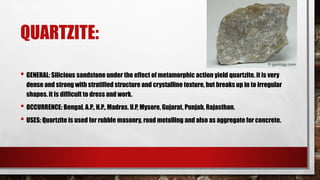
QUARTZITE:
• GENERAL: Silicious sandstone under the effect of metamorphic action yield quartzite. it is very
dense and strong with stratified structure and crystalline texture, but breaks up in to irregular
shapes. it is difficult to dress and work.
• OCCURRENCE: Bengal, A.P., H.P., Madras. U.P, Mysore, Gujarat, Punjab, Rajasthan.
• USES: Quartzite is used for rubble masonry, road metalling and also as aggregate for concrete.
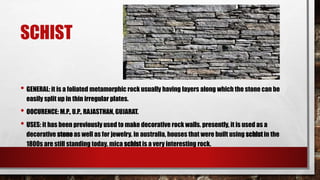
SCHIST
• GENERAL: it is a foliated metamorphic rock usually having layers along which the stone can be
easily split up in thin irregular plates.
• OOCURENCE: M.P., U.P., RAJASTHAN, GUJARAT.
• USES: it has been previously used to make decorative rock walls. presently, it is used as a
decorative stone as well as for jewelry. in australia, houses that were built using schist in the
1800s are still standing today. mica schist is a very interesting rock.
SLATE:
• GENERAL: These are metamorphic laminated clay rocks with planes of cleavage along which they
can be split in to very thin slabs.
• OCCURRENCE : BIHAR, U.P., RAJASTHAN, CHENNAI, MYSORE, M.P.
• SPECIFIC GRAVITY: 2.89
• USES: Slates are used as a roofing and flooring material. harder varieties of slates are used for
dado work (i.e for lining lower part of walls), damp proof materials and steps of stairs.
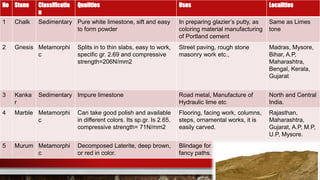
No Stone Classificatio
n
Qualities Uses Localities
1 Chalk Sedimentary Pure white limestone, sift and easy
to form powder
In preparing glazier’s putty, as
coloring material manufacturing
of Portland cement
Same as Limes
tone
2 Gnesis Metamorphi
c
Splits in to thin slabs, easy to work,
specific gr. 2.69 and compressive
strength=206N/mm2
Street paving, rough stone
masonry work etc.,
Madras, Mysore,
Bihar, A.P,
Maharashtra,
Bengal, Kerala,
Gujarat
3 Kanka
r
Sedimentary Impure limestone Road metal, Manufacture of
Hydraulic lime etc
North and Central
India.
4 Marble Metamorphi
c
Can take good polish and available
in different colors. Its sp.gr. Is 2.65.
compressive strength= 71N/mm2
Flooring, facing work, columns,
steps, ornamental works, it is
easily carved.
Rajasthan,
Maharashtra,
Gujarat, A.P, M.P,
U.P, Mysore.
5 Murum Metamorphi
c
Decomposed Laterite, deep brown,
or red in color.
Blindage for metal roads, for
fancy paths.
Same as Laterite.
TESTS FOR STONES
• ACID TEST
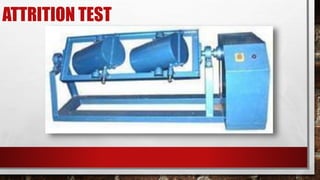
• ATTRITION TEST
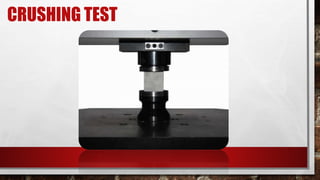
• CRUSHING TEST
• CRYSTALLIZATION TEST
• FREEZING AND THAWING TEST
• HARDNESS TEST
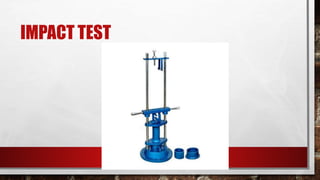
• IMPACT TEST
• MICROSCOPIC TEST
• SMITHS TEST
• WATER ABSORPTION TEST
ATTRITION TEST
CRUSHING TEST
HARDNESS TEST
IMPACT TEST
WATER ABSORPTION TEST
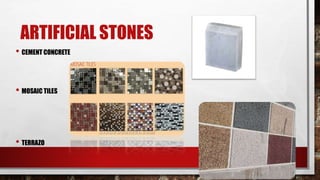
ARTIFICIAL STONES
• CEMENT CONCRETE
• MOSAIC TILES
• TERRAZO
BUILDING MATERIALS AND CONSTRUCTION
TIMBER
TIMBER
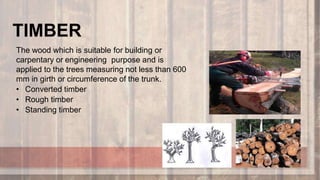
The wood which is suitable for building or
carpentary or engineering purpose and is
applied to the trees measuring not less than 600
mm in girth or circumference of the trunk.
• Converted timber
• Rough timber
• Standing timber
Classification of Timber
© mzs engineering technologies
The following are the important basis for
classification;
(i) Mode of growth
(ii) Modulus of elasticity
(iii) Durability
(iv) Grading
(v) Availability.
Classification Based on Mode of Growth
On the basis of mode of growth trees are classified as;
(a) Exogenous and (b) Endogenous
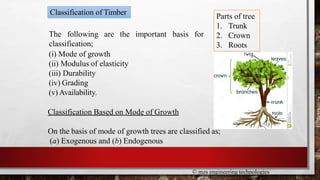
Parts of tree
1. Trunk
2. Crown
3. Roots
EXOGENEOUS
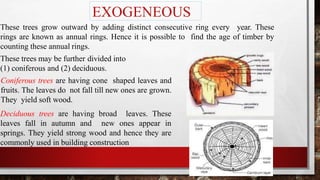
These trees grow outward by adding distinct consecutive ring every year. These
rings are known as annual rings. Hence it is possible to find the age of timber by
counting these annual rings.
These trees may be further divided into
(1) coniferous and (2) deciduous.
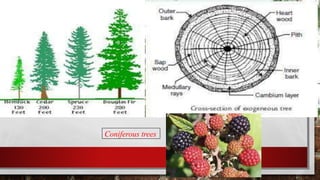
Coniferous trees are having cone shaped leaves and
fruits. The leaves do not fall till new ones are grown.
They yield soft wood.
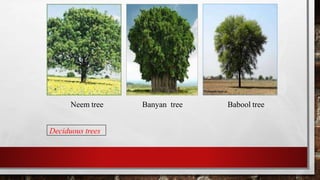
Deciduous trees are having broad leaves. These
leaves fall in autumn and new ones appear in
springs. They yield strong wood and hence they are
commonly used in building construction
Coniferous trees
Deciduous trees
Neem tree Babool treeBanyan tree
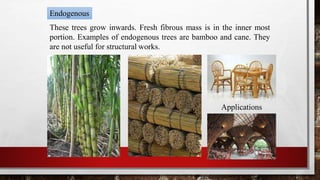
Endogenous
These trees grow inwards. Fresh fibrous mass is in the inner most
portion. Examples of endogenous trees are bamboo and cane. They
are not useful for structural works.
Applications
© mzs engineering technologies
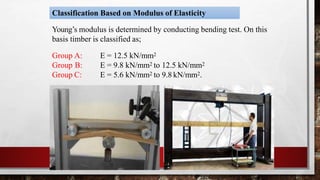
Classification Based on Modulus of Elasticity
Young’s modulus is determined by conducting bending test. On this
basis timber is classified as;
Group A:
Group B:
Group C:
E = 12.5 kN/mm2
E = 9.8 kN/mm2 to 12.5 kN/mm2
E = 5.6 kN/mm2 to 9.8 kN/mm2.
© mzs engineering technologies
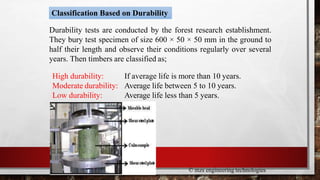
Classification Based on Durability
Durability tests are conducted by the forest research establishment.
They bury test specimen of size 600 × 50 × 50 mm in the ground to
half their length and observe their conditions regularly over several
years. Then timbers are classified as;
High durability:
Moderate durability:
Low durability:
If average life is more than 10 years.
Average life between 5 to 10 years.
Average life less than 5 years.
© mzs engineering technologies
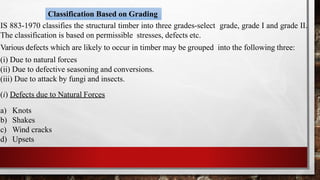
Classification Based on Grading
IS 883-1970 classifies the structural timber into three grades-select grade, grade I and grade II.
The classification is based on permissible stresses, defects etc.
Various defects which are likely to occur in timber may be grouped into the following three:
(i) Due to natural forces
(ii) Due to defective seasoning and conversions.
(iii) Due to attack by fungi and insects.
(i) Defects due to Natural Forces
a) Knots
b) Shakes
c) Wind cracks
d) Upsets
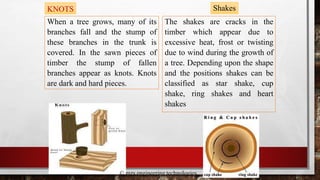
When a tree grows, many of its
branches fall and the stump of
these branches in the trunk is
covered. In the sawn pieces of
timber the stump of fallen
branches appear as knots. Knots
are dark and hard pieces.
KNOTS Shakes
The shakes are cracks in the
timber which appear due to
excessive heat, frost or twisting
due to wind during the growth of
a tree. Depending upon the shape
and the positions shakes can be
classified as star shake, cup
shake, ring shakes and heart
shakes
© mzs engineering technologies
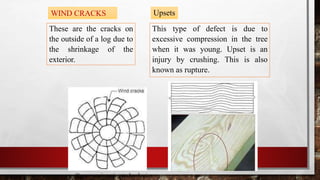
These are the cracks on
the outside of a log due to
the shrinkage of the
exterior.
WIND CRACKS
This type of defect is due to
excessive compression in the tree
when it was young. Upset is an
injury by crushing. This is also
known as rupture.
Upsets
© mzs engineering technologies
Classification Based onAvailability
© MZS
Forest departments classify timbers based on the availability as;
X—Most common. 1415 m3 or more per year
Y—Common. 355 m3 to 1415 m3 per year
Z—Less common. Less than 355 m3 per year.
GENERAL PROPERTIES
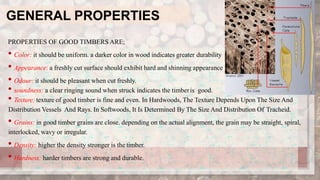
PROPERTIES OF GOOD TIMBERS ARE;
• Color: it should be uniform. a darker color in wood indicates greater durability
• Appearance: a freshly cut surface should exhibit hard and shinning appearance
• Odour: it should be pleasant when cut freshly.
• soundness: a clear ringing sound when struck indicates the timberis good.
• Texture: texture of good timber is fine and even. In Hardwoods, The Texture Depends Upon The Size And
Distribution Vessels And Rays. In Softwoods, It Is Determined By The Size And Distribution Of Tracheid.
• Grains: in good timber grains are close. depending on the actual alignment, the grain may be straight, spiral,
interlocked, wavy or irregular.
• Density: higher the density stronger is the timber.
• Hardness: harder timbers are strong and durable.
GENERAL PROPERTIES
Warping: Good timber do not warp under changing environmental conditions.
Toughness: Timber should be capable of resisting shock loads.
Abrasion: Good timber do not deteriorate due to wear. This property should be looked into, if
timber is to be used for flooring.
Strength: Timber should have high strength in bending, shear and direct compression.
Modulus of Elasticity: Timber with higher modulus of elasticity are preferred in construction.
Fire resistance: A good timber should have high resistance to fire.
Permeability: Good timber has low water permeability.
Workability: Timber should be easily workable. It should not clog the saw.
Durability: Good timber is one which is capable of resisting the
action of fungi and insects attack
Defects: Good timber is free from defects like dead knots, shakes and cracks.
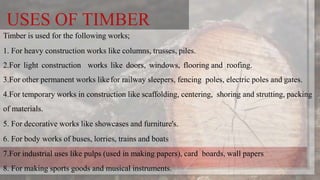
USES OF TIMBER
Timber is used for the following works;
1. For heavy construction works like columns, trusses, piles.
2.For light construction works like doors, windows, flooring and roofing.
3.For other permanent works likefor railway sleepers, fencing poles, electric poles and gates.
4.For temporary works in construction like scaffolding, centering, shoring and strutting, packing
of materials.
5. For decorative works like showcases and furniture's.
6. For body works of buses, lorries, trains and boats
7.For industrial uses like pulps (used in making papers), card boards, wall papers
8. For making sports goods and musical instruments.
MOISTURE OF TIMBER
• Moisture Content - It is one of the most important
characteristics of timber that affects its use on the site
performance.
• Equilibrium Moisture Content (EMC) - moisture content of
wood changes in response to the temperature and humidity of
its surroundings.
• Fibre Saturation Point (FSP) –when the cell cavities are
empty but the cell walls still retain their bound water.
SEASONING
• Fresh timber which is obtained from trees have about 30 to 40
percent sap or moisture. This sap is very harmful for the life of the
timber.
• Therefore it is essential to remove the sap by applying certain special
methods.
• All such methods are collectively termed as seasoning of timber.
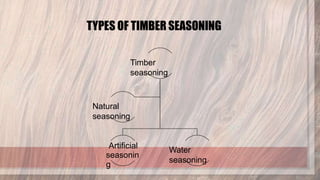
TYPES OF TIMBER SEASONING
Timber
seasoning
Artificial
seasonin
g
Water
seasoning
Natural
seasoning
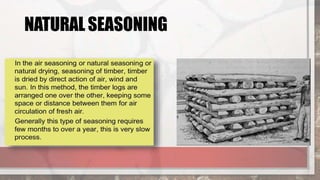
NATURAL SEASONING
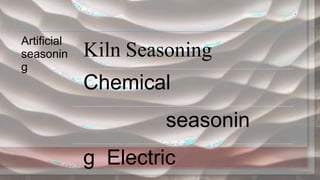
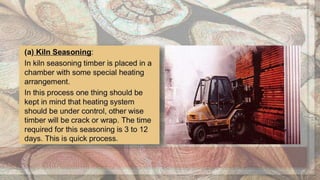
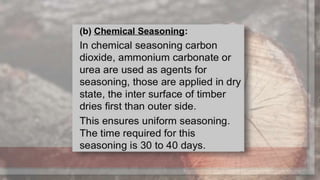
Artificial
seasonin
g
Kiln Seasoning
Chemical
seasonin
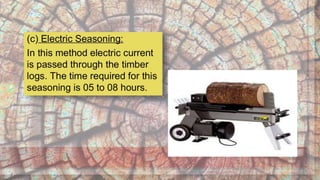
g Electric
ADVANTAGES OF SEASONED TIMBER
• It has reduced weight
• Strong and durable
• Resistance to decay and rot
• Takes high polish
• Easier to work with
• Lasts longer
THANK YOU

STONES AND TIMBER AS BUILDING MATERIAL

  • 2.
    BUILDING STONES • Buildingstones are obtained from rocks occurring in nature. It is estimated that 3/4th of the land area of the globe is underlain by sedimentary rocks and the remaining 1/4th by igneous and metamorphic rocks. Igneous rocks: Granite, Basalt and trap. Sedimentary Rocks: Sand stone, shale, lime stone and laterite. Metamorphic rocks: Quartzite, Schist, Slate, Marble, gneiss.
  • 3.
    REQUIREMENTS OF AGOOD BUILDING STONE A good building stone should posses several characteristics such as • High strength i.e., crushing strength > 1000kg/cm2 • High durability, sufficient hardness i.e., coefficient >14 • High resistance to wear and good fire resistance • specific gravity >2.7 • Crystalline structure, High impact value i.e., toughness index>13 • Low water absorption i.e., percentage absorption after 24 hours less than 0.6 • Facility for carving and and dressing, weather resistance and better appearance
  • 6.
    PROPERTIES OF PRINCIPLEBUILDING STONES •Granite Occurrence : Assam, Maharashtra, West Bengal, Bihar, Ap, J&K, Chennai, Mysore, Orissa, Gujarat, Punjab, Kerala, Rajasthan. Specific Gravity= 2.6 to 2.7 Crushing strength or compressive strength = 770 to 1300 kg/cm2. Uses: Granite is very hard and durable building stone suitable for works like bridge abutments, piers etc., where weight and durability are essential. It is not suitable for carving.
  • 7.
    BASALT AND TRAP •OCCURRENCE: Maharashtra, west bengal, Madhya pradesh. • Specific gravity: 3.0 • Compd. Strength: 1530to 1890 kg/cm2 • Uses: it is very hard, tough and compact. Hence expensive to work. It is used in foundations of structures may be used for super structure also. It is not suitable for carving work and mouldings.
  • 8.
    SAND STONE • OCCURRENCE: Andaman Islands, Madras, M.P, U.P, Rajasthan, Punjab, Gujarat. • Specific gravity: 2.65 to 2.95 • Comp. strength : 650kg/cm2 Uses: it is very easy to dress and work. Extensively used in general building construction works and ornamental carving.
  • 9.
    LIME STONE • OCCURRENCE: Andaman Islands, Bengal, Bihar, A.P, H.P, M.P, U.P,rajasthan, Punjab, And Gujarat. • Specific gravity: 2 to 2.75 • Comp. strength: 550kg/cm2 Uses: lime stone slabs are used for flooring, paving and roofing. lime stone is also used for general building purposes and manufacture of lime.
  • 10.
    LATERITE: • OCCURRENCE: MAHARASHTRA,BIHAR, A.P, MADRAS, MYSORE, KERALA • COMP. STRENGTH: 18 TO 32KG/CM2 • USES: LATERITE IS USED FOR INFERIOR TYPE STONE MASONRY WORK. • GENERAL: THIS STONE IS WET AND SOFT WHEN QUARRIED, AND SHOULD NOT BE UNTIL SEASONE FOR A MONTH OR TWO, FOR ACHIEVING HARDNESS.
  • 11.
    QUARTZITE: • GENERAL: Silicioussandstone under the effect of metamorphic action yield quartzite. it is very dense and strong with stratified structure and crystalline texture, but breaks up in to irregular shapes. it is difficult to dress and work. • OCCURRENCE: Bengal, A.P., H.P., Madras. U.P, Mysore, Gujarat, Punjab, Rajasthan. • USES: Quartzite is used for rubble masonry, road metalling and also as aggregate for concrete.
  • 12.
    SCHIST • GENERAL: itis a foliated metamorphic rock usually having layers along which the stone can be easily split up in thin irregular plates. • OOCURENCE: M.P., U.P., RAJASTHAN, GUJARAT. • USES: it has been previously used to make decorative rock walls. presently, it is used as a decorative stone as well as for jewelry. in australia, houses that were built using schist in the 1800s are still standing today. mica schist is a very interesting rock.
  • 13.
    SLATE: • GENERAL: Theseare metamorphic laminated clay rocks with planes of cleavage along which they can be split in to very thin slabs. • OCCURRENCE : BIHAR, U.P., RAJASTHAN, CHENNAI, MYSORE, M.P. • SPECIFIC GRAVITY: 2.89 • USES: Slates are used as a roofing and flooring material. harder varieties of slates are used for dado work (i.e for lining lower part of walls), damp proof materials and steps of stairs.
  • 14.
    No Stone Classificatio n QualitiesUses Localities 1 Chalk Sedimentary Pure white limestone, sift and easy to form powder In preparing glazier’s putty, as coloring material manufacturing of Portland cement Same as Limes tone 2 Gnesis Metamorphi c Splits in to thin slabs, easy to work, specific gr. 2.69 and compressive strength=206N/mm2 Street paving, rough stone masonry work etc., Madras, Mysore, Bihar, A.P, Maharashtra, Bengal, Kerala, Gujarat 3 Kanka r Sedimentary Impure limestone Road metal, Manufacture of Hydraulic lime etc North and Central India. 4 Marble Metamorphi c Can take good polish and available in different colors. Its sp.gr. Is 2.65. compressive strength= 71N/mm2 Flooring, facing work, columns, steps, ornamental works, it is easily carved. Rajasthan, Maharashtra, Gujarat, A.P, M.P, U.P, Mysore. 5 Murum Metamorphi c Decomposed Laterite, deep brown, or red in color. Blindage for metal roads, for fancy paths. Same as Laterite.
  • 15.
    TESTS FOR STONES •ACID TEST • ATTRITION TEST • CRUSHING TEST • CRYSTALLIZATION TEST • FREEZING AND THAWING TEST • HARDNESS TEST • IMPACT TEST • MICROSCOPIC TEST • SMITHS TEST • WATER ABSORPTION TEST
  • 17.
  • 19.
  • 20.
  • 21.
  • 22.
  • 23.
    ARTIFICIAL STONES • CEMENTCONCRETE • MOSAIC TILES • TERRAZO
  • 24.
    BUILDING MATERIALS ANDCONSTRUCTION TIMBER
  • 25.
    TIMBER The wood whichis suitable for building or carpentary or engineering purpose and is applied to the trees measuring not less than 600 mm in girth or circumference of the trunk. • Converted timber • Rough timber • Standing timber
  • 26.
    Classification of Timber ©mzs engineering technologies The following are the important basis for classification; (i) Mode of growth (ii) Modulus of elasticity (iii) Durability (iv) Grading (v) Availability. Classification Based on Mode of Growth On the basis of mode of growth trees are classified as; (a) Exogenous and (b) Endogenous Parts of tree 1. Trunk 2. Crown 3. Roots
  • 27.
    EXOGENEOUS These trees growoutward by adding distinct consecutive ring every year. These rings are known as annual rings. Hence it is possible to find the age of timber by counting these annual rings. These trees may be further divided into (1) coniferous and (2) deciduous. Coniferous trees are having cone shaped leaves and fruits. The leaves do not fall till new ones are grown. They yield soft wood. Deciduous trees are having broad leaves. These leaves fall in autumn and new ones appear in springs. They yield strong wood and hence they are commonly used in building construction
  • 28.
  • 29.
    Deciduous trees Neem treeBabool treeBanyan tree
  • 30.
    Endogenous These trees growinwards. Fresh fibrous mass is in the inner most portion. Examples of endogenous trees are bamboo and cane. They are not useful for structural works. Applications © mzs engineering technologies
  • 31.
    Classification Based onModulus of Elasticity Young’s modulus is determined by conducting bending test. On this basis timber is classified as; Group A: Group B: Group C: E = 12.5 kN/mm2 E = 9.8 kN/mm2 to 12.5 kN/mm2 E = 5.6 kN/mm2 to 9.8 kN/mm2. © mzs engineering technologies
  • 32.
    Classification Based onDurability Durability tests are conducted by the forest research establishment. They bury test specimen of size 600 × 50 × 50 mm in the ground to half their length and observe their conditions regularly over several years. Then timbers are classified as; High durability: Moderate durability: Low durability: If average life is more than 10 years. Average life between 5 to 10 years. Average life less than 5 years. © mzs engineering technologies
  • 33.
    Classification Based onGrading IS 883-1970 classifies the structural timber into three grades-select grade, grade I and grade II. The classification is based on permissible stresses, defects etc. Various defects which are likely to occur in timber may be grouped into the following three: (i) Due to natural forces (ii) Due to defective seasoning and conversions. (iii) Due to attack by fungi and insects. (i) Defects due to Natural Forces a) Knots b) Shakes c) Wind cracks d) Upsets
  • 34.
    When a treegrows, many of its branches fall and the stump of these branches in the trunk is covered. In the sawn pieces of timber the stump of fallen branches appear as knots. Knots are dark and hard pieces. KNOTS Shakes The shakes are cracks in the timber which appear due to excessive heat, frost or twisting due to wind during the growth of a tree. Depending upon the shape and the positions shakes can be classified as star shake, cup shake, ring shakes and heart shakes © mzs engineering technologies
  • 35.
    These are thecracks on the outside of a log due to the shrinkage of the exterior. WIND CRACKS This type of defect is due to excessive compression in the tree when it was young. Upset is an injury by crushing. This is also known as rupture. Upsets © mzs engineering technologies
  • 36.
    Classification Based onAvailability ©MZS Forest departments classify timbers based on the availability as; X—Most common. 1415 m3 or more per year Y—Common. 355 m3 to 1415 m3 per year Z—Less common. Less than 355 m3 per year.
  • 37.
    GENERAL PROPERTIES PROPERTIES OFGOOD TIMBERS ARE; • Color: it should be uniform. a darker color in wood indicates greater durability • Appearance: a freshly cut surface should exhibit hard and shinning appearance • Odour: it should be pleasant when cut freshly. • soundness: a clear ringing sound when struck indicates the timberis good. • Texture: texture of good timber is fine and even. In Hardwoods, The Texture Depends Upon The Size And Distribution Vessels And Rays. In Softwoods, It Is Determined By The Size And Distribution Of Tracheid. • Grains: in good timber grains are close. depending on the actual alignment, the grain may be straight, spiral, interlocked, wavy or irregular. • Density: higher the density stronger is the timber. • Hardness: harder timbers are strong and durable.
  • 38.
    GENERAL PROPERTIES Warping: Goodtimber do not warp under changing environmental conditions. Toughness: Timber should be capable of resisting shock loads. Abrasion: Good timber do not deteriorate due to wear. This property should be looked into, if timber is to be used for flooring. Strength: Timber should have high strength in bending, shear and direct compression. Modulus of Elasticity: Timber with higher modulus of elasticity are preferred in construction. Fire resistance: A good timber should have high resistance to fire. Permeability: Good timber has low water permeability. Workability: Timber should be easily workable. It should not clog the saw. Durability: Good timber is one which is capable of resisting the action of fungi and insects attack Defects: Good timber is free from defects like dead knots, shakes and cracks.
  • 39.
    USES OF TIMBER Timberis used for the following works; 1. For heavy construction works like columns, trusses, piles. 2.For light construction works like doors, windows, flooring and roofing. 3.For other permanent works likefor railway sleepers, fencing poles, electric poles and gates. 4.For temporary works in construction like scaffolding, centering, shoring and strutting, packing of materials. 5. For decorative works like showcases and furniture's. 6. For body works of buses, lorries, trains and boats 7.For industrial uses like pulps (used in making papers), card boards, wall papers 8. For making sports goods and musical instruments.
  • 41.
    MOISTURE OF TIMBER •Moisture Content - It is one of the most important characteristics of timber that affects its use on the site performance. • Equilibrium Moisture Content (EMC) - moisture content of wood changes in response to the temperature and humidity of its surroundings. • Fibre Saturation Point (FSP) –when the cell cavities are empty but the cell walls still retain their bound water.
  • 42.
    SEASONING • Fresh timberwhich is obtained from trees have about 30 to 40 percent sap or moisture. This sap is very harmful for the life of the timber. • Therefore it is essential to remove the sap by applying certain special methods. • All such methods are collectively termed as seasoning of timber.
  • 43.
    TYPES OF TIMBERSEASONING Timber seasoning Artificial seasonin g Water seasoning Natural seasoning
  • 44.
  • 45.
  • 50.
    ADVANTAGES OF SEASONEDTIMBER • It has reduced weight • Strong and durable • Resistance to decay and rot • Takes high polish • Easier to work with • Lasts longer
  • 51.