VERNACULAR ARCHITECTURE
OF KASHMIR
VERNACULAR ARCHITECTURE OF THE WESTERN
AND NORTHERN REGIONS OF INDIA
Form, Spatial planning, Cultural aspects, Symbolism,
color, Art, Materials of construction and techniques
Ar. S.Bala Hari Krishnan, Assistant Professor,
PMIST
Kashmir is the Northernmost geographical region of the Indian Subcontinent.
The culture of Kashmir is highly influenced by Northern, South Asian, Persian as well as Central Asian culture. Along with its scenic beauty, Kashmir is famous for its
Cultural heritage; it amalgamates Hindu, Sikh & Muslim and Buddhist Philosophies and has involved composite culture based on the values of Humanism and tolerance
which is collectively known as Kashmiriyat.
KASHMIR
The Landscape of the region
follows the Jhelum river.
Settlements are established some
distance away on the steep slopes
of the adjacent mountains.
The climate of the valley of
Kashmir has its own
peculiarities. The seasons are
marked with sudden change.
Prone to Earth quake
and landslides
Agriculture is the occupation of
most of the people. They were also
involved in making artifacts and
artistic works.
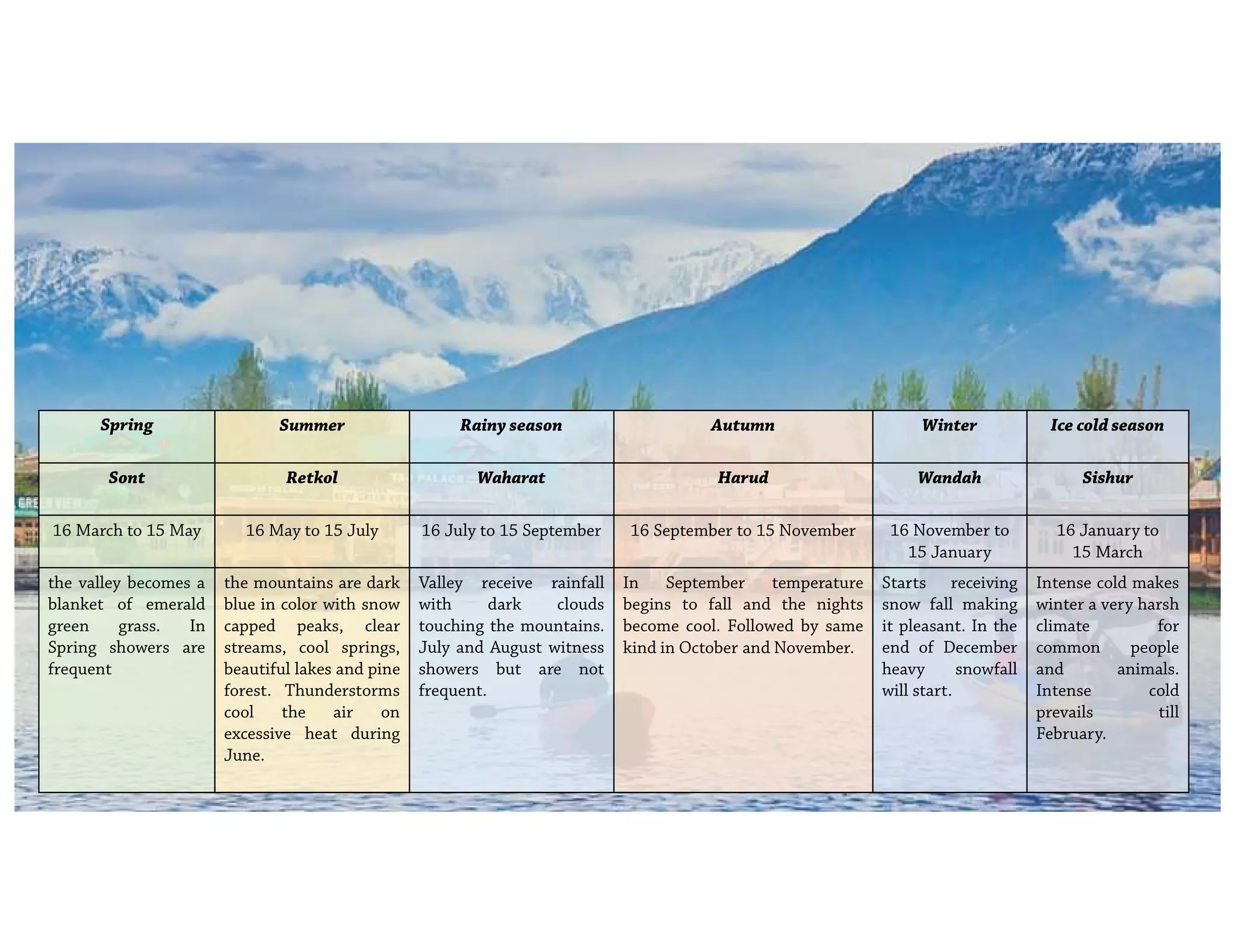
Spring Summer Rainy season Autumn Winter Ice cold season
Sont Retkol Waharat Harud Wandah Sishur
16 March to 15 May 16 May to 15 July 16 July to 15 September 16 September to 15 November 16 November to
15 January
16 January to
15 March
the valley becomes a
blanket of emerald
green grass. In
Spring showers are
frequent
the mountains are dark
blue in color with snow
capped peaks, clear
streams, cool springs,
beautiful lakes and pine
forest. Thunderstorms
cool the air on
excessive heat during
June.
Valley receive rainfall
with dark clouds
touching the mountains.
July and August witness
showers but are not
frequent.
In September temperature
begins to fall and the nights
become cool. Followed by same
kind in October and November.
Starts receiving
snow fall making
it pleasant. In the
end of December
heavy snowfall
will start.
Intense cold makes
winter a very harsh
climate for
common people
and animals.
Intense cold
prevails till
February.
Mohallas – Streets
The streets were developed on the basis of
their Occupation and Clan.
As more and more members of the family
became associated with traditional crafts and
skills, mohallas developed as a close knit
community.
Similarly clan or family based mohallas also
grew in the core areas. By 19th century the
city had mohallas bearing names like
Qalamdanpora, Sheeshgari Mohalla, Banduk
Khar Mohalla, Bhand Mohalla, Razdan
Kucha, Mir Mohalla.
Ziarats, temples and shrines became the focal
points around which large habitations were
established. Worship places became the
center of settlements
The river front and the areas along the canals
like Nala Mar witnessed continuous array of
houses with projecting wooden balconies,
intricate lattice work and window screens
facing the water front.
A significant urban feature of the water front
was in the form of ghats. The ghats served as
landing places for the transportation.
SETTLEMENT PATTERN
The Architecture of Srinagar with its steeply pitched gable
roofs atop brick and wooden structures reminds one of
the medieval European city. Its still alive and lived in as it
has been for centuries.
In vicinity are a mixture of buildings built and rebuilt
over the last 300 years in a compatible style. And with its
economy based on handicrafts and carpet weaving,
Srinagar never had the local wealth necessary to
undertake a massive rebuilding of the city.
Based on method of construction the dwellings were of
Gujjar’s house (Shepherds)
Found along Banihal pass and on mountains.
Rural houses in villages
Urban houses in Town
(Taq & Dhajji Dewari systems of construction)
House Boats.
ARCHITECTURE OF DWELLING UNITS
The traditional buildings are of two categories on the
basis of plan form: Square plan and Linear plan. These
dwellings were occupied by Joint families. Mostly they
were square in plan having windows on all sides.
Distribution of function is symmetrical. Symmetry is a
basic principle for earthquake resistance structures.
Main entrance opening into a centrally located
staircase lobby. Space underneath the centrally located
staircase is used as a storage space (ganjeen).
Typically Door will be placed in the wall separating
private court from the street. The court is flanked by
one or two rooms on either side, in ground as well as first
floor.
Ground floor houses the heated living room with
cooking and dining areas; Bedrooms on first and
second floor.
A part of the lobby on the first floor is usually converted
into a smaller room (kuther) over the main entrance on
ground floor. This in some cases also encloses a
projecting wooden bay window (dub).
Topmost floor is a large room with many windows.
Traditional use of this room is during summers in
order to take advantage of cool breeze. Also used for
gatherings and social events. In winters used for storage.
ARCHITECTURE OF URBAN HOUSES
Ground Floor plan
First Floor plan
Isometric view of the dwelling units
The W.C is usually detached from the house and set in
the corner of the front court, while the bathroom
usually consists of small room next to the hot water
tap behind the kitchen stove.
Internal divisions consist of thinner partition walls
often of wattle and Daub, made from timber framing,
in-filled with reeds and plastered with a mix of mud
and animal dung.
The outer wall of the overall square is constructed as a
heavy stone masonry wall, for both structural and
climatic purposes.
Traditionally windows being closed with two set of
shutters, inside being of solid wood, outside with jalli-
an open filigree of carved wood. Oiled newspaper was
glued onto the jalli shutters to admit light into the
houses during winters.
The building type conserves energy by reducing air
infiltration through windows, by insulation in the
thick earth roof and wall.
In some of the cases, the lower level consists of a
masonry platform which may be occupied by animals and
for grain storage. Clear height 8-9 feet. Upper floors have
high ceiling.
ARCHITECTURE OF URBAN HOUSES
MUD and COW DUNG: The
bonding materials used for
masonry is a mixture of mud and
cow-dung which has adequate
bonding properties with stone and
brick.
The weak mortar perhaps allows a
certain degree of movement and
plasticity in total wall. Kashmiri
houses reflect an adaptation to the
threat of earthquakes through
interlacing of heavy timbers
within the plane of exterior of the
heavy masonry buildings.
STONE : The heavy stone
walls that form the
masonry box at the lower
level are tied horizontally
at various levels with
timber bands. These
bands are usually at sill
and lintel level.
WOOD: Timber structures
have high resistance to
earthquakes. Timber is an
organic material and their
cellulose fiber makes them
highly effective undertake
tensile stresses.
MATERIALS OF CONSTRUCTION
The ‘Dajji Dewar’ is a much thinner and lighter
form of wall construction it consist of timber
framing with in fills of brick. In few cases the infill
will be of Stone masonry.
In this type the walls will have greater ductility
and damping.
In addition to this the horizontal and vertical
cage formed by the timber are braced diagonally
against shear. This cross member is usually at the
corner, but lends the entire framing a resistance
against shear.
The closely placed timber studs prevents
propagation of shear cracks. This framing also
results in breaking up the upper level masonry walls
into smaller multiple panels, each of which are
independent.
The collapse of any one panel will not result in the
complete collapse of the wall and therefore the
structure.
Small masonry panels surrounded by timber
elements have greater safety against out of plane
collapse.
CONSTRUCTION METHODS
DAJJI DEWAR
The principle features of these systems are:
In this system of construction 2’6” – 3’0” thick brick masonry
piers supporting wooden floor beams formed the basic
structural system of the building.
The distance between the two brick piers used to be normally
around 3’0” – 4’0” and was known as taq. The taq thus formed
the basic structural bay of the building.
The gap in between each taq would be filled in with either a
window opening or brick masonry. Normally the inner
facing of the structure would be made of sun dried brick
(kham seer) or rubble infill.
The super structure usually rested on a 3’0” – 4’0” high stone
plinth, constructed in random rubble masonry.
A series of twin wooden (deodar) tie beams as das (plinth)
separated the stone masonry from burnt brick masonry of
the superstructure and acted as an isolated diaphragm in
between two layers.
In many cases the ground floor was also constructed in random
rubble masonry. The super structure thus behaved as a
framed structure, which accounts for considerable success
that these buildings exhibited in withstanding earthquakes.
CONSTRUCTION METHODS – TAQ SYSTEM
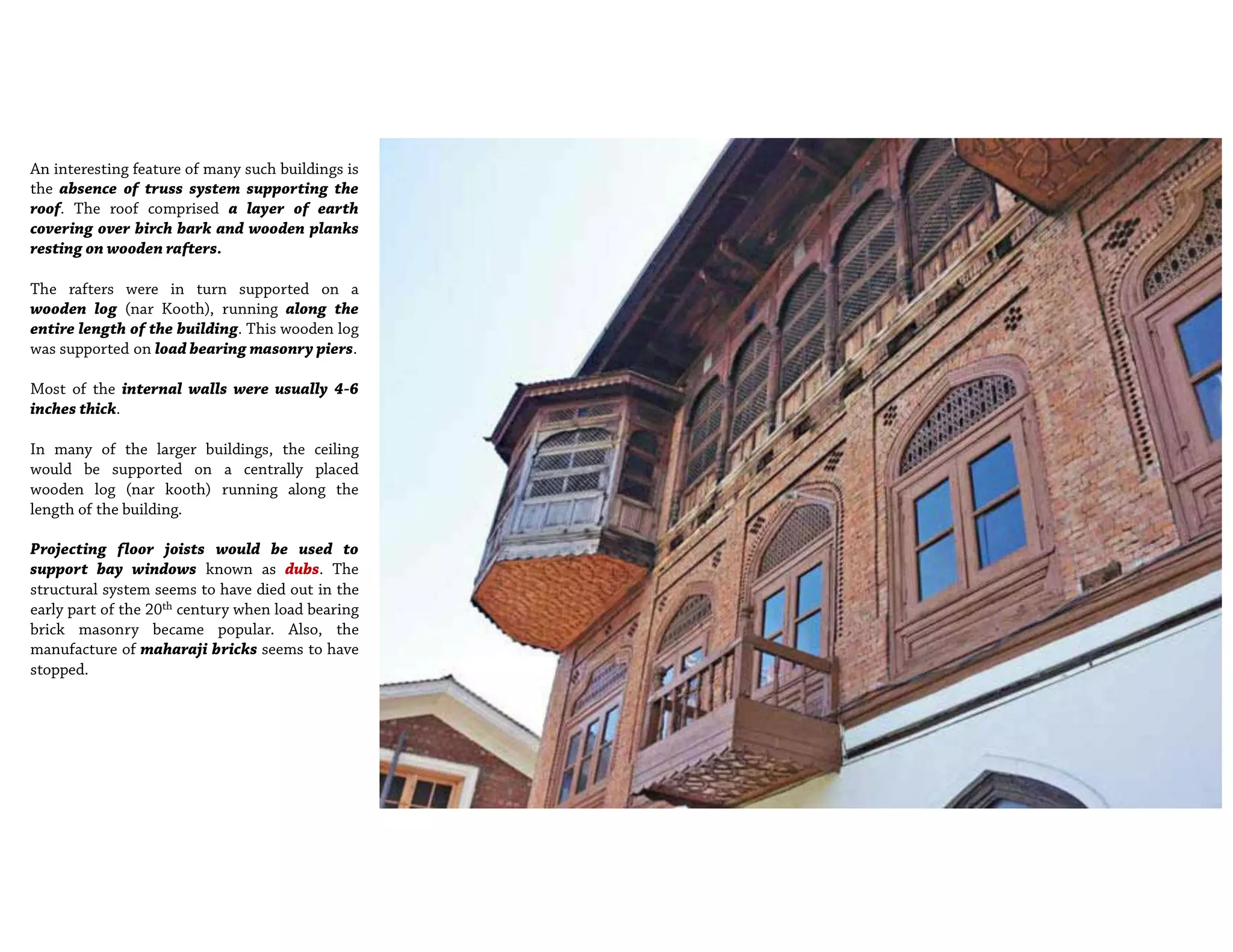
An interesting feature of many such buildings is
the absence of truss system supporting the
roof. The roof comprised a layer of earth
covering over birch bark and wooden planks
resting on wooden rafters.
The rafters were in turn supported on a
wooden log (nar Kooth), running along the
entire length of the building. This wooden log
was supported on load bearing masonry piers.
Most of the internal walls were usually 4-6
inches thick.
In many of the larger buildings, the ceiling
would be supported on a centrally placed
wooden log (nar kooth) running along the
length of the building.
Projecting floor joists would be used to
support bay windows known as dubs. The
structural system seems to have died out in the
early part of the 20th century when load bearing
brick masonry became popular. Also, the
manufacture of maharaji bricks seems to have
stopped.
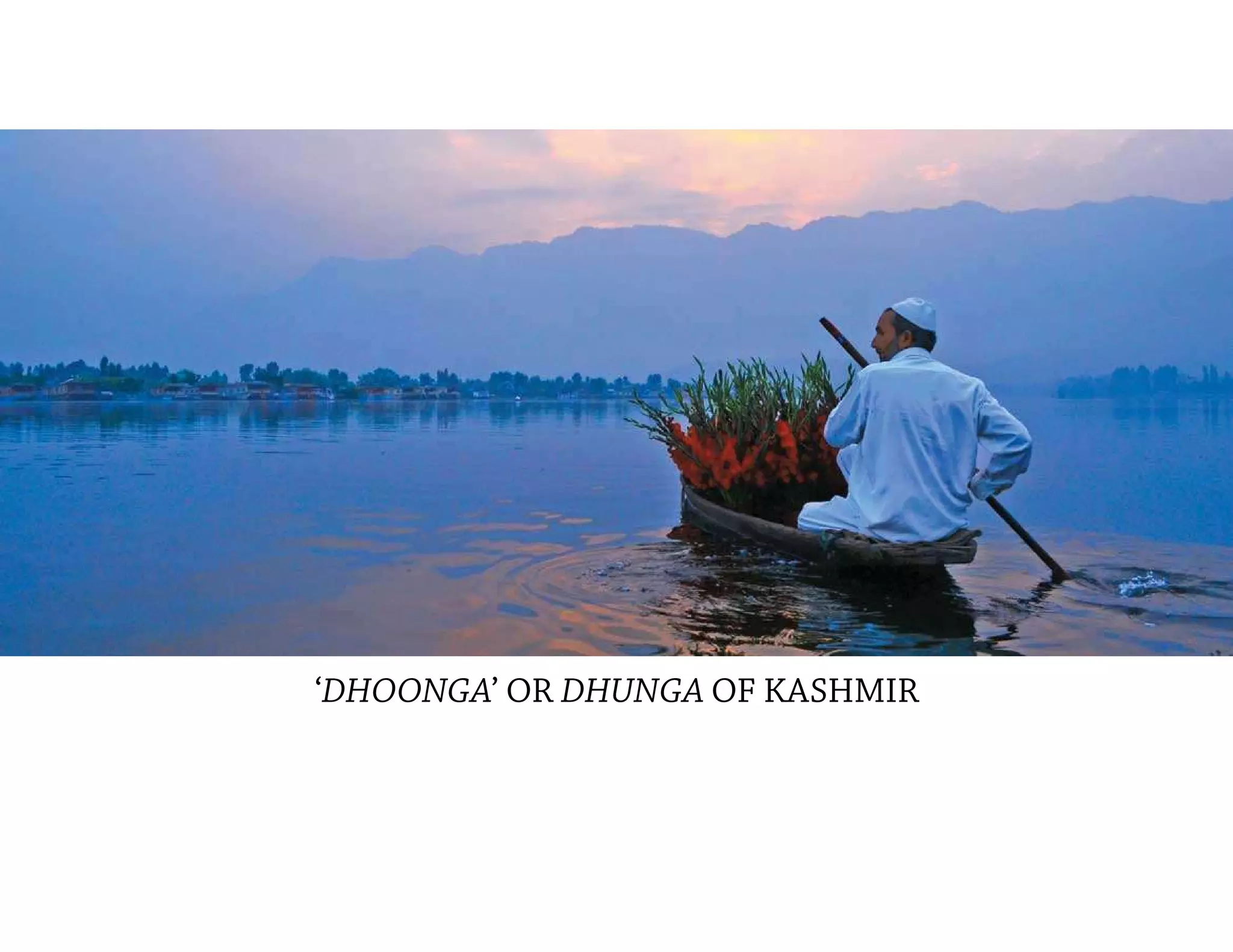
‘DHOONGA’ OR DHUNGA OF KASHMIR
In the initial stage it was a four
pillared pavilion with bamboo
roof.
Traders use small shikaras to
transport the household items,
vegetables, goods and for
commercial activity.
Later also used by the great Mughal
kings for excursions.
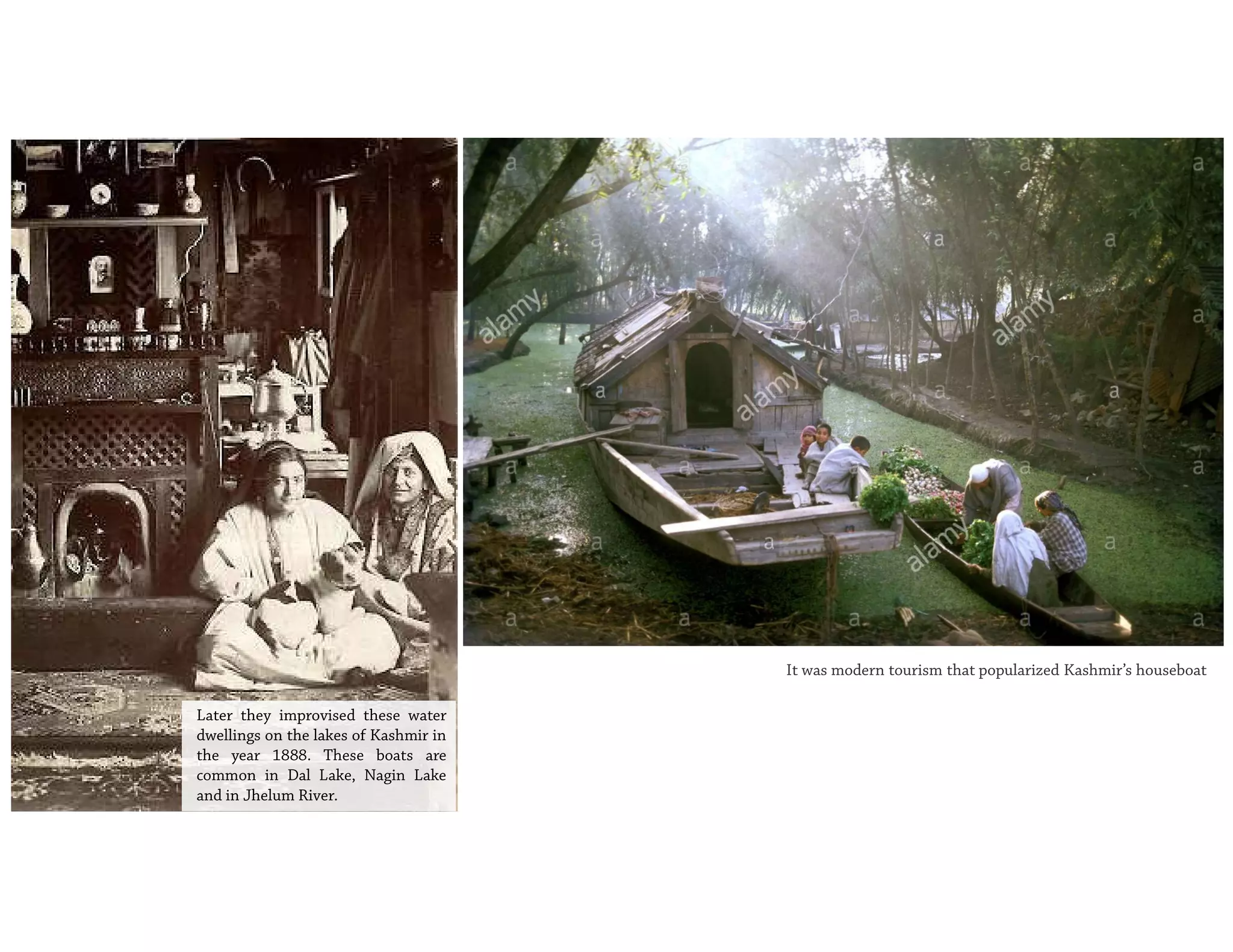
Earlier British's had no right to live on land in Kashmir. House boats were mainly constructed for
them to stay. These House Boats are well decorated and well furnished for comfortable stay
Later they improvised these water
dwellings on the lakes of Kashmir in
the year 1888. These boats are
common in Dal Lake, Nagin Lake
and in Jhelum River.
It was modern tourism that popularized Kashmir’s houseboat
The outer walls were made
of bamboo mats. Using
bamboo poles the outer
structure framework will be
formed.
The top most roofing will be
using slate material.
The front veranda leads to
Living and Dining area. This
further leads to Bedroom.
Adjacent to living area is
Kitchenette. The house boat
was accompanied by a small
boat which was mainly used
for cooking.
Depending upon the
requirement the rooms will
be added. Some of the boats
had ladders leading to the
upper deck area.
Initially the boats were
moving and later some
becomes static houses in
water.
Front Deck
Service Deck
Bedroom
Living and
Dining
Kitchenette Veranda
Boat for cooking
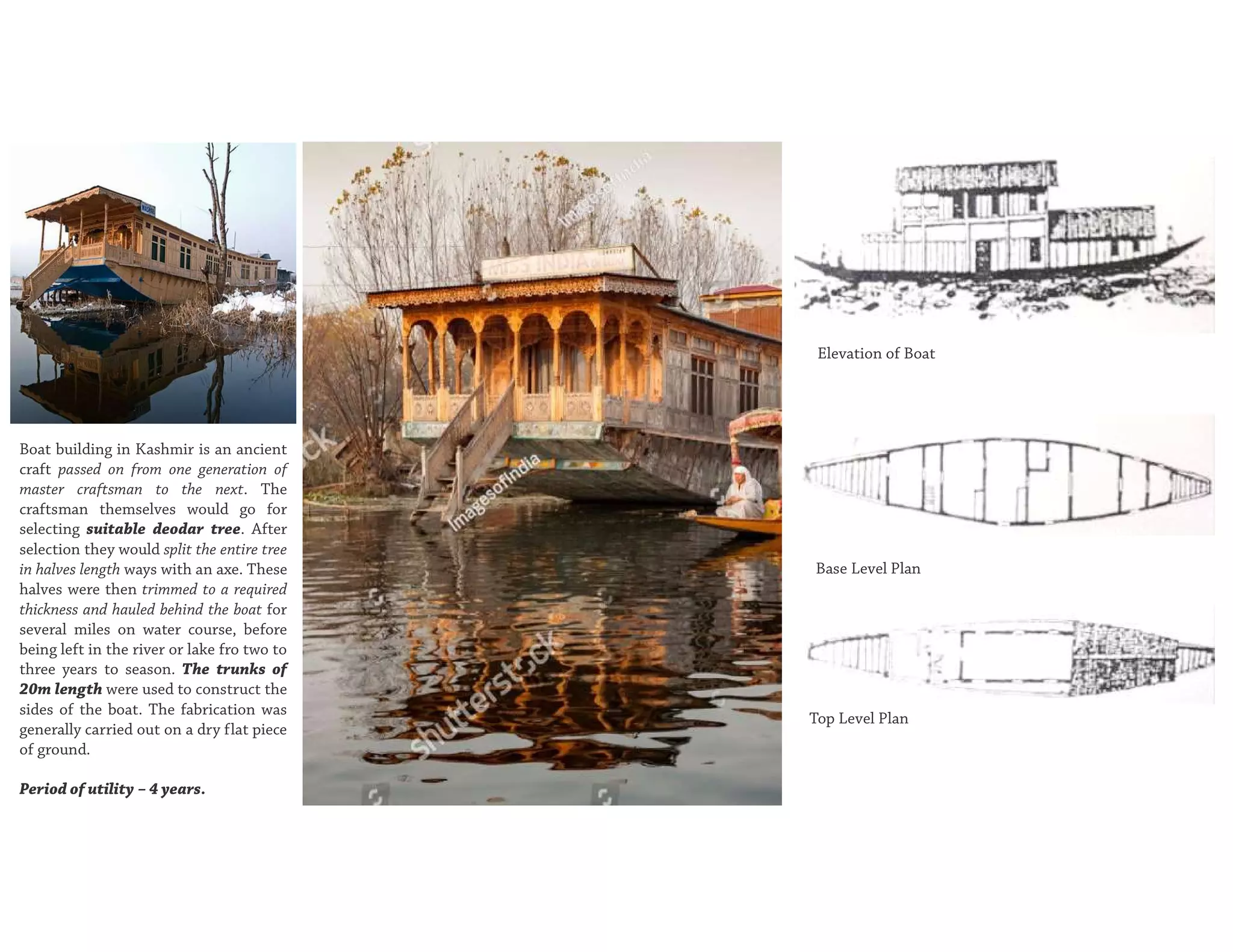
Boat building in Kashmir is an ancient
craft passed on from one generation of
master craftsman to the next. The
craftsman themselves would go for
selecting suitable deodar tree. After
selection they would split the entire tree
in halves length ways with an axe. These
halves were then trimmed to a required
thickness and hauled behind the boat for
several miles on water course, before
being left in the river or lake fro two to
three years to season. The trunks of
20m length were used to construct the
sides of the boat. The fabrication was
generally carried out on a dry flat piece
of ground.
Period of utility – 4 years.
Top Level Plan
Base Level Plan
Elevation of Boat
https://www.arup.com/projects/dhajji-dewari
https://kashmirlife.net/lost-in-modernity-1280/
https://www.frontiersin.org/articles/10.3389/fbuil.2018.00
018/full
http://indayear3studio-
1718s1.blogspot.com/2017/09/ploy-bunyanut-
kemmonta.html
https://www.stirworld.com/inspire-visits-of-taaq-and-
dhajji-dwaris-the-romance-of-kashmiri-wooden-
architecture
https://architexturez.net/doc/az-cf-123817-11
https://kashmirpages.com/wp-
content/uploads/2011/11/KASHMIR-THE-LAND-OF-
STREAMS-&-SOLITUDES-by-piririch.pdf
https://theurgetowander.com/2017/06/07/srinagar-
sukoon-houseboat-review/
https://www.researchgate.net/publication/327401756_Seis
mic_Behavior_of_Timber-
Laced_Masonry_Structures_in_the_Himalayan_Belt
http://akshay-kaul.blogspot.com/2014/10/vernacular-
kashmir-1988-save-its-art.html
REFERENCES
THANK YOU
END OF PRESENTATION

Vernacular Architecture of Kashmir

  • 1.
    VERNACULAR ARCHITECTURE OF KASHMIR VERNACULARARCHITECTURE OF THE WESTERN AND NORTHERN REGIONS OF INDIA Form, Spatial planning, Cultural aspects, Symbolism, color, Art, Materials of construction and techniques Ar. S.Bala Hari Krishnan, Assistant Professor, PMIST
  • 2.
    Kashmir is theNorthernmost geographical region of the Indian Subcontinent. The culture of Kashmir is highly influenced by Northern, South Asian, Persian as well as Central Asian culture. Along with its scenic beauty, Kashmir is famous for its Cultural heritage; it amalgamates Hindu, Sikh & Muslim and Buddhist Philosophies and has involved composite culture based on the values of Humanism and tolerance which is collectively known as Kashmiriyat. KASHMIR
  • 3.
    The Landscape ofthe region follows the Jhelum river. Settlements are established some distance away on the steep slopes of the adjacent mountains. The climate of the valley of Kashmir has its own peculiarities. The seasons are marked with sudden change. Prone to Earth quake and landslides Agriculture is the occupation of most of the people. They were also involved in making artifacts and artistic works.
  • 4.
    Spring Summer Rainyseason Autumn Winter Ice cold season Sont Retkol Waharat Harud Wandah Sishur 16 March to 15 May 16 May to 15 July 16 July to 15 September 16 September to 15 November 16 November to 15 January 16 January to 15 March the valley becomes a blanket of emerald green grass. In Spring showers are frequent the mountains are dark blue in color with snow capped peaks, clear streams, cool springs, beautiful lakes and pine forest. Thunderstorms cool the air on excessive heat during June. Valley receive rainfall with dark clouds touching the mountains. July and August witness showers but are not frequent. In September temperature begins to fall and the nights become cool. Followed by same kind in October and November. Starts receiving snow fall making it pleasant. In the end of December heavy snowfall will start. Intense cold makes winter a very harsh climate for common people and animals. Intense cold prevails till February.
  • 5.
    Mohallas – Streets Thestreets were developed on the basis of their Occupation and Clan. As more and more members of the family became associated with traditional crafts and skills, mohallas developed as a close knit community. Similarly clan or family based mohallas also grew in the core areas. By 19th century the city had mohallas bearing names like Qalamdanpora, Sheeshgari Mohalla, Banduk Khar Mohalla, Bhand Mohalla, Razdan Kucha, Mir Mohalla. Ziarats, temples and shrines became the focal points around which large habitations were established. Worship places became the center of settlements The river front and the areas along the canals like Nala Mar witnessed continuous array of houses with projecting wooden balconies, intricate lattice work and window screens facing the water front. A significant urban feature of the water front was in the form of ghats. The ghats served as landing places for the transportation. SETTLEMENT PATTERN
  • 6.
    The Architecture ofSrinagar with its steeply pitched gable roofs atop brick and wooden structures reminds one of the medieval European city. Its still alive and lived in as it has been for centuries. In vicinity are a mixture of buildings built and rebuilt over the last 300 years in a compatible style. And with its economy based on handicrafts and carpet weaving, Srinagar never had the local wealth necessary to undertake a massive rebuilding of the city. Based on method of construction the dwellings were of Gujjar’s house (Shepherds) Found along Banihal pass and on mountains. Rural houses in villages Urban houses in Town (Taq & Dhajji Dewari systems of construction) House Boats. ARCHITECTURE OF DWELLING UNITS
  • 7.
    The traditional buildingsare of two categories on the basis of plan form: Square plan and Linear plan. These dwellings were occupied by Joint families. Mostly they were square in plan having windows on all sides. Distribution of function is symmetrical. Symmetry is a basic principle for earthquake resistance structures. Main entrance opening into a centrally located staircase lobby. Space underneath the centrally located staircase is used as a storage space (ganjeen). Typically Door will be placed in the wall separating private court from the street. The court is flanked by one or two rooms on either side, in ground as well as first floor. Ground floor houses the heated living room with cooking and dining areas; Bedrooms on first and second floor. A part of the lobby on the first floor is usually converted into a smaller room (kuther) over the main entrance on ground floor. This in some cases also encloses a projecting wooden bay window (dub). Topmost floor is a large room with many windows. Traditional use of this room is during summers in order to take advantage of cool breeze. Also used for gatherings and social events. In winters used for storage. ARCHITECTURE OF URBAN HOUSES Ground Floor plan First Floor plan Isometric view of the dwelling units
  • 8.
    The W.C isusually detached from the house and set in the corner of the front court, while the bathroom usually consists of small room next to the hot water tap behind the kitchen stove. Internal divisions consist of thinner partition walls often of wattle and Daub, made from timber framing, in-filled with reeds and plastered with a mix of mud and animal dung. The outer wall of the overall square is constructed as a heavy stone masonry wall, for both structural and climatic purposes. Traditionally windows being closed with two set of shutters, inside being of solid wood, outside with jalli- an open filigree of carved wood. Oiled newspaper was glued onto the jalli shutters to admit light into the houses during winters. The building type conserves energy by reducing air infiltration through windows, by insulation in the thick earth roof and wall. In some of the cases, the lower level consists of a masonry platform which may be occupied by animals and for grain storage. Clear height 8-9 feet. Upper floors have high ceiling. ARCHITECTURE OF URBAN HOUSES
  • 10.
    MUD and COWDUNG: The bonding materials used for masonry is a mixture of mud and cow-dung which has adequate bonding properties with stone and brick. The weak mortar perhaps allows a certain degree of movement and plasticity in total wall. Kashmiri houses reflect an adaptation to the threat of earthquakes through interlacing of heavy timbers within the plane of exterior of the heavy masonry buildings. STONE : The heavy stone walls that form the masonry box at the lower level are tied horizontally at various levels with timber bands. These bands are usually at sill and lintel level. WOOD: Timber structures have high resistance to earthquakes. Timber is an organic material and their cellulose fiber makes them highly effective undertake tensile stresses. MATERIALS OF CONSTRUCTION
  • 11.
    The ‘Dajji Dewar’is a much thinner and lighter form of wall construction it consist of timber framing with in fills of brick. In few cases the infill will be of Stone masonry. In this type the walls will have greater ductility and damping. In addition to this the horizontal and vertical cage formed by the timber are braced diagonally against shear. This cross member is usually at the corner, but lends the entire framing a resistance against shear. The closely placed timber studs prevents propagation of shear cracks. This framing also results in breaking up the upper level masonry walls into smaller multiple panels, each of which are independent. The collapse of any one panel will not result in the complete collapse of the wall and therefore the structure. Small masonry panels surrounded by timber elements have greater safety against out of plane collapse. CONSTRUCTION METHODS DAJJI DEWAR
  • 12.
    The principle featuresof these systems are: In this system of construction 2’6” – 3’0” thick brick masonry piers supporting wooden floor beams formed the basic structural system of the building. The distance between the two brick piers used to be normally around 3’0” – 4’0” and was known as taq. The taq thus formed the basic structural bay of the building. The gap in between each taq would be filled in with either a window opening or brick masonry. Normally the inner facing of the structure would be made of sun dried brick (kham seer) or rubble infill. The super structure usually rested on a 3’0” – 4’0” high stone plinth, constructed in random rubble masonry. A series of twin wooden (deodar) tie beams as das (plinth) separated the stone masonry from burnt brick masonry of the superstructure and acted as an isolated diaphragm in between two layers. In many cases the ground floor was also constructed in random rubble masonry. The super structure thus behaved as a framed structure, which accounts for considerable success that these buildings exhibited in withstanding earthquakes. CONSTRUCTION METHODS – TAQ SYSTEM
  • 13.
    An interesting featureof many such buildings is the absence of truss system supporting the roof. The roof comprised a layer of earth covering over birch bark and wooden planks resting on wooden rafters. The rafters were in turn supported on a wooden log (nar Kooth), running along the entire length of the building. This wooden log was supported on load bearing masonry piers. Most of the internal walls were usually 4-6 inches thick. In many of the larger buildings, the ceiling would be supported on a centrally placed wooden log (nar kooth) running along the length of the building. Projecting floor joists would be used to support bay windows known as dubs. The structural system seems to have died out in the early part of the 20th century when load bearing brick masonry became popular. Also, the manufacture of maharaji bricks seems to have stopped.
  • 14.
  • 15.
    In the initialstage it was a four pillared pavilion with bamboo roof. Traders use small shikaras to transport the household items, vegetables, goods and for commercial activity.
  • 16.
    Later also usedby the great Mughal kings for excursions. Earlier British's had no right to live on land in Kashmir. House boats were mainly constructed for them to stay. These House Boats are well decorated and well furnished for comfortable stay
  • 17.
    Later they improvisedthese water dwellings on the lakes of Kashmir in the year 1888. These boats are common in Dal Lake, Nagin Lake and in Jhelum River. It was modern tourism that popularized Kashmir’s houseboat
  • 18.
    The outer wallswere made of bamboo mats. Using bamboo poles the outer structure framework will be formed. The top most roofing will be using slate material. The front veranda leads to Living and Dining area. This further leads to Bedroom. Adjacent to living area is Kitchenette. The house boat was accompanied by a small boat which was mainly used for cooking. Depending upon the requirement the rooms will be added. Some of the boats had ladders leading to the upper deck area. Initially the boats were moving and later some becomes static houses in water. Front Deck Service Deck Bedroom Living and Dining Kitchenette Veranda Boat for cooking
  • 19.
    Boat building inKashmir is an ancient craft passed on from one generation of master craftsman to the next. The craftsman themselves would go for selecting suitable deodar tree. After selection they would split the entire tree in halves length ways with an axe. These halves were then trimmed to a required thickness and hauled behind the boat for several miles on water course, before being left in the river or lake fro two to three years to season. The trunks of 20m length were used to construct the sides of the boat. The fabrication was generally carried out on a dry flat piece of ground. Period of utility – 4 years. Top Level Plan Base Level Plan Elevation of Boat
  • 20.
    https://www.arup.com/projects/dhajji-dewari https://kashmirlife.net/lost-in-modernity-1280/ https://www.frontiersin.org/articles/10.3389/fbuil.2018.00 018/full http://indayear3studio- 1718s1.blogspot.com/2017/09/ploy-bunyanut- kemmonta.html https://www.stirworld.com/inspire-visits-of-taaq-and- dhajji-dwaris-the-romance-of-kashmiri-wooden- architecture https://architexturez.net/doc/az-cf-123817-11 https://kashmirpages.com/wp- content/uploads/2011/11/KASHMIR-THE-LAND-OF- STREAMS-&-SOLITUDES-by-piririch.pdf https://theurgetowander.com/2017/06/07/srinagar- sukoon-houseboat-review/ https://www.researchgate.net/publication/327401756_Seis mic_Behavior_of_Timber- Laced_Masonry_Structures_in_the_Himalayan_Belt http://akshay-kaul.blogspot.com/2014/10/vernacular- kashmir-1988-save-its-art.html REFERENCES THANK YOU END OFPRESENTATION