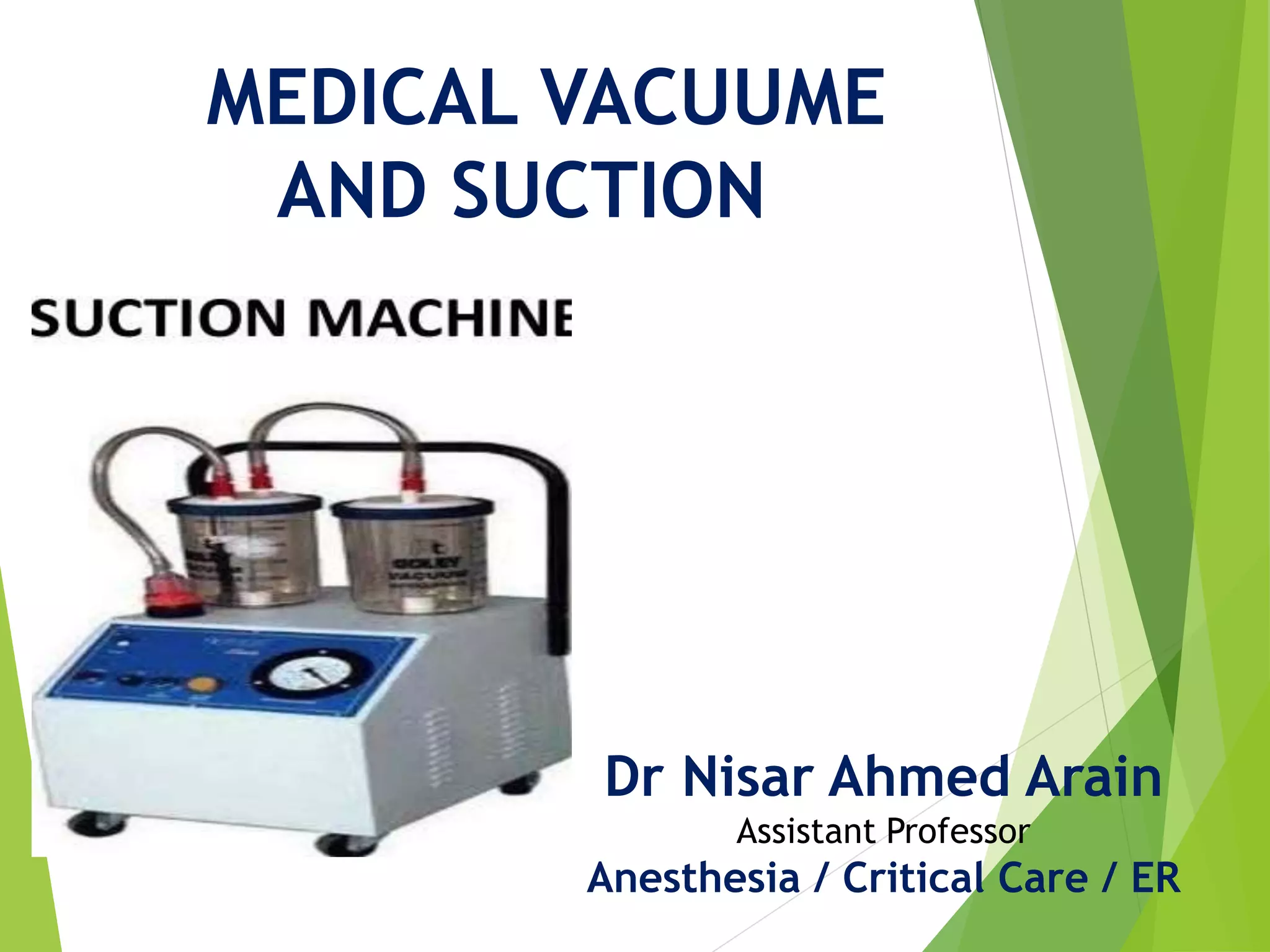
MEDICAL VACUUME
AND SUCTION
Dr Nisar Ahmed Arain
Assistant Professor
Anesthesia / Critical Care / ER
-Airway suction is frequently usedto remove
secretions from the lungs
-suctionofthelungsisdonewhenever secretions canbe heard
in an intubated patient who is unable to cough and
expectorate efficiently
-Before and during the release of the cuffon or
tracheostomy tube
-Presence of alarge plug of mucus in one of the larger
bronchi If the minute volume (MV)drops
INTRODUCTION
Suctionequipment
1. Suctionpumps
2. Tubing
3. Connections
4. Catheter
5. Suctiontrolley
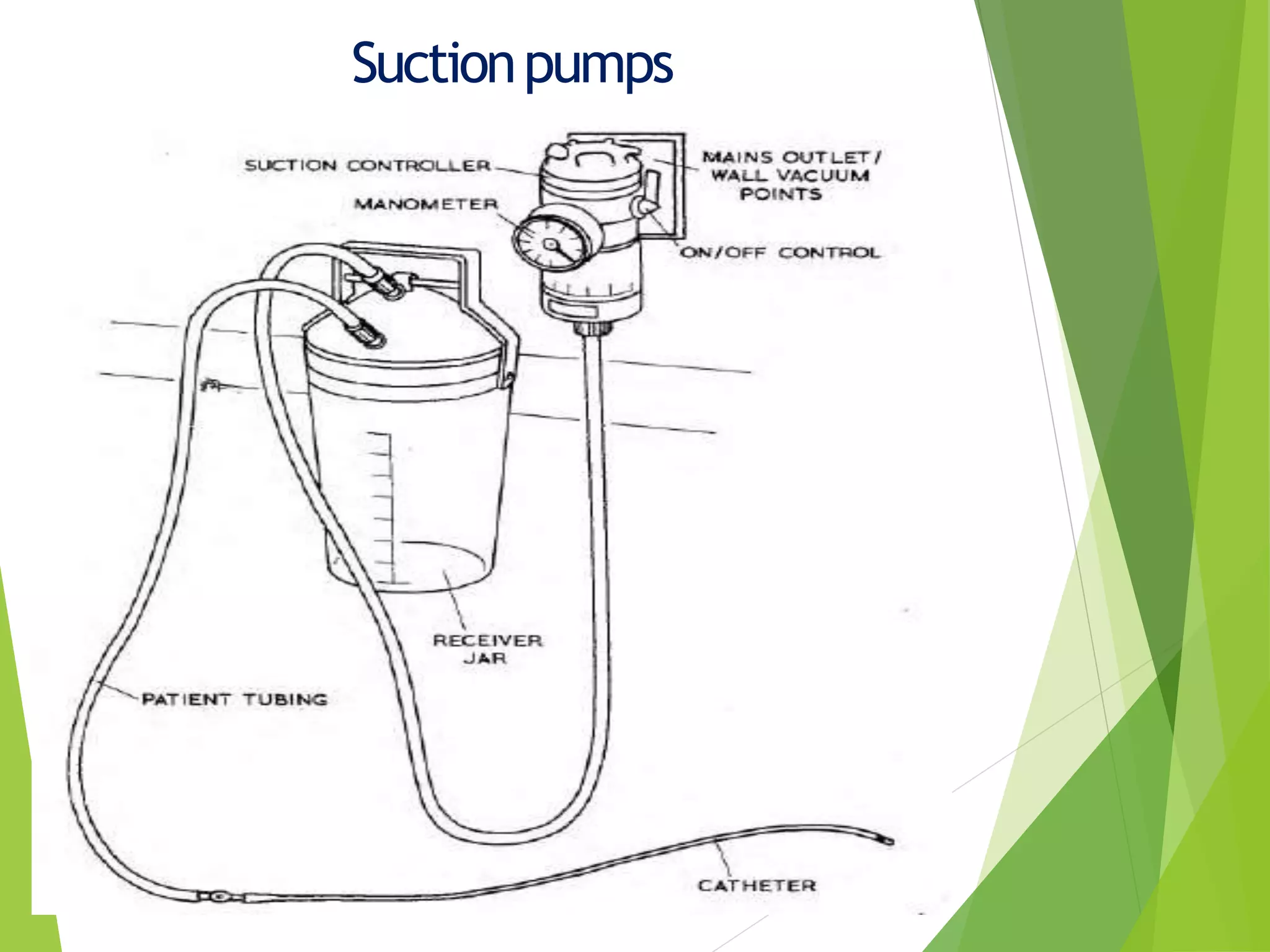
Suctionpumps
- Common vacuum pumps
-A vacuum point is present close to the patient’s
bed
-Thepower is provided by alarge motor situated at
some convenient site within the hospitalgrounds
-Commonly found in ICUsand in wards in modern
hospitals
-An on/off switch is present
-Control dial to set negative pressure tobe increased
or decreasedis present
-A manometer displays the pressure in use
-Theyhave approximately —5o mmHg,— 1oo
mmHg and 300 mm Hg
Suctionpumps
2.
Suctionpumps
- Electrical suction apparatus
-Powered from themains
-Thistype hasits own small motor
with an on/off switch and a control
dial
-Thisis the equipment most
commonly used on wards where
a vacuum point is not available
Suctionpumps
- Portable suction apparatus
-Available powered by rechargeable batteries
-Hasasmall motor and on/off switch
-The machine should be tested at frequent
intervals to check the batteries
Foot pump
- The power is provided by the operator
-Thispump was the only type available in the period when intensive
care was developing
-Modern versions are available and, like the battery operated
pumps, these are suitable for usein the community or for an
emergency resuscitation team.
Suctiontubing
-Thisleadsfrom the suctionbottle to the
connection for the suctioncatheter
-Usuallythe tubing is madefrom clear
plastic for easyviewing of secretions
-Thisis disposabletube
-Sometimesrubber tubing isused
Connections
- Theseare usually plastic and either clear or semi
transparent connections. Most connections have
threeholes.Y-connector has three arms;one at either
ends and athird at the side usedasthe control port
-Thisopening offers lessresistance to the suctionforce
Toapply the suction force to the catheter the operator
placesa finger or thumb over theopening
Catheters
-Mostly are soft, clear plastic, anddisposable
-Itis importantthat the correct sizeof catheter is usedfor eachpatient
-Itshouldnot exceed half the diameter of the endotracheal or
tracheostomytube
-Toolarge acatheter maycausealveolar collapse when suction is
applied
-Soft rubber catheters are still usedin most of the hospitals. Theyare
softer and more flexible than the plastic catheters. Theymaybe too
short for someendotrachealtubes
Catheters cont:
- Coude catheters
-- Sometimes known asbronchoscopy or Pinkerton’s
catheters
--Theseare extra long catheters with acurved tip
usedfor selective suctioning of the leftmain
bronchus
--A straight catheter passedbeyond the carina
--Usingacoude catheter with the head side
flexed tothe right gives agreater chanceof
the catheter entering the left main bronchus
Catheters cont:
-- ArgyleAero-Flo catheters
-- which have aspecially designed
tip to minimize mucosal trauma
-- Thesecatheters have abead
surrounding the distal hole at the
end of the catheter and there are
foursmall holes
Suctiontrolley
-- IMPORTANT ITEMS
-- Sterile plastic gloves
--Disposablesuction catheters
--Appropriate sizesfor thepatient lubricating jelly
water-based only not oil based, for usein
nasopharyngealsuction
-- Sterile gauzeswabs- to transfer jelly to the tip of
the catheter
--Abowl of sodium bicarbonate or sterile water to
flush the secretions from the catheter and the
tubing
-- Plastic bagfor the collection of disposablematerial
-- Bowl of antiseptic solution for the collection of items
to be sterilized
Suctiontechniques
-Sterile technique
-Mode of entry
-Nose
-Mouth
-Tube
-First practice should always be
with the unconscious patients
Suctiontechnique cont:
-Nasopharyngeal
-Neckextended
-Introduce on Inspiration phaseonly
-Not for head injury patient due to leakage of CSF
-Oropharyngeal
-Lessuse
-Plastic airway to avoid catheter bit by patient
-Suction via tube
-catheter is introduced into an endotracheal,
tracheostomy ormini- tracheotomy tube
-Breath hold technique byphysiotherapist
-Tracheostomy mini tube
Procedure
-Whatever the mode of entry, no suction pressure isapplied
while the catheter is beingintroduced. Toavoid tracheal
trauma
-Three-hole connection, catheter itself maybe pinched or
disconnected from the tubing during introduction
-Advanceduntil either acoughreflex is elicited or some resistance
in the trachea ismet
-Apply suction gently catheter withdrawn while with rolling the
catheter
-Observe the patient for signsof hypoxia
-Disconnected for 15 secondsmaximum, then interval technique
-Side lying or with the head rotated to one side to avoid
aspiration of gastric contents should vomitingoccur
Infection avoided by steriletechnique
Trauma- minimized by the correct choice of catheter and
negative pressure combined with goodtechnique
Hypoxia - minimized by the accurate useof the applied
negative pressure,and accuratetiming - not too
powerful or too long
Cardiacarrhythmias –followed by hypoxia, correct hypoxia
it will becorrected
Atelectasis –proper suction force and time
Bleeding –proper technique
HAZARDS OF AIRWAY SUCTION
THANK YOU

#Lecture medical vacuum and suction

  • 1.
    MEDICAL VACUUME AND SUCTION DrNisar Ahmed Arain Assistant Professor Anesthesia / Critical Care / ER
  • 2.
    -Airway suction isfrequently usedto remove secretions from the lungs -suctionofthelungsisdonewhenever secretions canbe heard in an intubated patient who is unable to cough and expectorate efficiently -Before and during the release of the cuffon or tracheostomy tube -Presence of alarge plug of mucus in one of the larger bronchi If the minute volume (MV)drops INTRODUCTION
  • 3.
    Suctionequipment 1. Suctionpumps 2. Tubing 3.Connections 4. Catheter 5. Suctiontrolley
  • 4.
    Suctionpumps - Common vacuumpumps -A vacuum point is present close to the patient’s bed -Thepower is provided by alarge motor situated at some convenient site within the hospitalgrounds -Commonly found in ICUsand in wards in modern hospitals -An on/off switch is present -Control dial to set negative pressure tobe increased or decreasedis present -A manometer displays the pressure in use -Theyhave approximately —5o mmHg,— 1oo mmHg and 300 mm Hg
  • 5.
  • 6.
    2. Suctionpumps - Electrical suctionapparatus -Powered from themains -Thistype hasits own small motor with an on/off switch and a control dial -Thisis the equipment most commonly used on wards where a vacuum point is not available
  • 8.
    Suctionpumps - Portable suctionapparatus -Available powered by rechargeable batteries -Hasasmall motor and on/off switch -The machine should be tested at frequent intervals to check the batteries Foot pump - The power is provided by the operator -Thispump was the only type available in the period when intensive care was developing -Modern versions are available and, like the battery operated pumps, these are suitable for usein the community or for an emergency resuscitation team.
  • 9.
    Suctiontubing -Thisleadsfrom the suctionbottleto the connection for the suctioncatheter -Usuallythe tubing is madefrom clear plastic for easyviewing of secretions -Thisis disposabletube -Sometimesrubber tubing isused
  • 10.
    Connections - Theseare usuallyplastic and either clear or semi transparent connections. Most connections have threeholes.Y-connector has three arms;one at either ends and athird at the side usedasthe control port -Thisopening offers lessresistance to the suctionforce Toapply the suction force to the catheter the operator placesa finger or thumb over theopening
  • 11.
    Catheters -Mostly are soft,clear plastic, anddisposable -Itis importantthat the correct sizeof catheter is usedfor eachpatient -Itshouldnot exceed half the diameter of the endotracheal or tracheostomytube -Toolarge acatheter maycausealveolar collapse when suction is applied -Soft rubber catheters are still usedin most of the hospitals. Theyare softer and more flexible than the plastic catheters. Theymaybe too short for someendotrachealtubes
  • 12.
    Catheters cont: - Coudecatheters -- Sometimes known asbronchoscopy or Pinkerton’s catheters --Theseare extra long catheters with acurved tip usedfor selective suctioning of the leftmain bronchus --A straight catheter passedbeyond the carina --Usingacoude catheter with the head side flexed tothe right gives agreater chanceof the catheter entering the left main bronchus
  • 13.
    Catheters cont: -- ArgyleAero-Flocatheters -- which have aspecially designed tip to minimize mucosal trauma -- Thesecatheters have abead surrounding the distal hole at the end of the catheter and there are foursmall holes
  • 16.
    Suctiontrolley -- IMPORTANT ITEMS --Sterile plastic gloves --Disposablesuction catheters --Appropriate sizesfor thepatient lubricating jelly water-based only not oil based, for usein nasopharyngealsuction -- Sterile gauzeswabs- to transfer jelly to the tip of the catheter --Abowl of sodium bicarbonate or sterile water to flush the secretions from the catheter and the tubing -- Plastic bagfor the collection of disposablematerial -- Bowl of antiseptic solution for the collection of items to be sterilized
  • 17.
    Suctiontechniques -Sterile technique -Mode ofentry -Nose -Mouth -Tube -First practice should always be with the unconscious patients
  • 18.
    Suctiontechnique cont: -Nasopharyngeal -Neckextended -Introduce onInspiration phaseonly -Not for head injury patient due to leakage of CSF -Oropharyngeal -Lessuse -Plastic airway to avoid catheter bit by patient -Suction via tube -catheter is introduced into an endotracheal, tracheostomy ormini- tracheotomy tube -Breath hold technique byphysiotherapist -Tracheostomy mini tube
  • 19.
    Procedure -Whatever the modeof entry, no suction pressure isapplied while the catheter is beingintroduced. Toavoid tracheal trauma -Three-hole connection, catheter itself maybe pinched or disconnected from the tubing during introduction -Advanceduntil either acoughreflex is elicited or some resistance in the trachea ismet -Apply suction gently catheter withdrawn while with rolling the catheter -Observe the patient for signsof hypoxia -Disconnected for 15 secondsmaximum, then interval technique -Side lying or with the head rotated to one side to avoid aspiration of gastric contents should vomitingoccur
  • 20.
    Infection avoided bysteriletechnique Trauma- minimized by the correct choice of catheter and negative pressure combined with goodtechnique Hypoxia - minimized by the accurate useof the applied negative pressure,and accuratetiming - not too powerful or too long Cardiacarrhythmias –followed by hypoxia, correct hypoxia it will becorrected Atelectasis –proper suction force and time Bleeding –proper technique HAZARDS OF AIRWAY SUCTION
  • 21.