Dr / Sherehan Gad
Lecturer of pediatric nursing
1- Definition of suctioning.
2- Sites of suction.
3- Purposes of suctioning.
4- Indications for suctioning.
5- Choosing the right size catheter.
6- Setting the correct pressure.
7- The procedure.
8- Documentation.
9- Complications of suctioning.
Outlines
Suctioning
Definition
Aspirating secretion through a catheter
connected to a suction machine or wall
suction outlet.
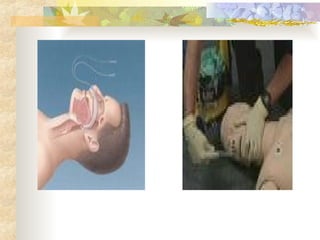
Pharynx
Trachea
(tube
lungs)
Endotracheal suctioning is the removal
of secretions from tracheobroncheal tree
through an endotracheal tube with the help
of mechanical suction device.
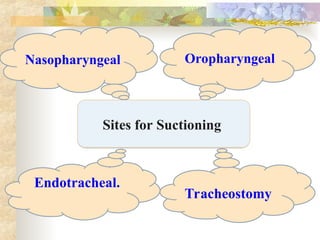
Sites for Suctioning
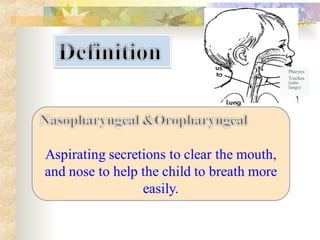
Oropharyngeal
Nasopharyngeal
Endotracheal.
Tracheostomy
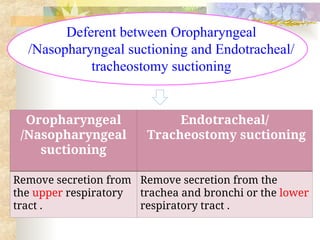
Oropharyngeal
/Nasopharyngeal
suctioning
Endotracheal/
Tracheostomy suctioning
Remove secretion from
the upper respiratory
tract .
Remove secretion from the
trachea and bronchi or the lower
respiratory tract .
Deferent between Oropharyngeal
/Nasopharyngeal suctioning and Endotracheal/
tracheostomy suctioning
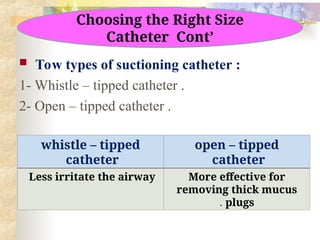
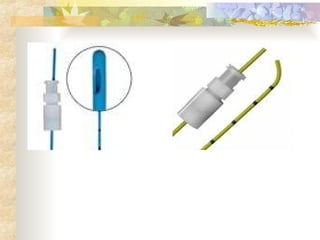
 Tow types of suctioning catheter :
1- Whistle – tipped catheter .
2- Open – tipped catheter .
whistle – tipped
catheter
open – tipped
catheter
Less irritate the airway More effective for
removing thick mucus
plugs
.
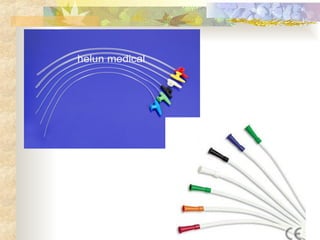
Choosing the Right Size
Catheter Cont’
 To maintain patent air way.
 Remove blood ,vomit and meconium in an
emergency situation.
 prevent infection that may result from
accumulated secretions
Purposes of suction
 To maintain a patent airway by removing retained
tracheobroncheal secretions.
 To prevent lower respiratory tract infection from retained
secretions.
 To provide effective ventilation.
Diagnostic therapeutic
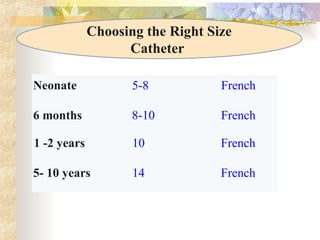
Neonate 5-8 French
6 months 8-10 French
1 -2 years 10 French
5- 10 years 14 French
Choosing the Right Size
Catheter
Wall Unit Portable Unit
Infant 60 mm Hg . 2
to 5 mm Hg
young Child 60
to 80 mm Hg
. 5
to 10 mm Hg
Older child 80
to 120 mm Hg
. 10 to 15 mm Hg
Setting the Correct Pressure
Suctioning is done routinely
The procedure
 Portable or wall suction machine with tubing
and collection container
 Appropriate-sized sterile suction catheter
 Towel or disposable waterproof pad
 Sterile container for sterile fluids used to
lubricate and clear catheter
Equipment
E
Q
U
I
P
M
E
N
T
 Sterile gauzes.
 Sterile gloves
 Goggles or face shield .
 O2 source.
Assessment
Chest physiotherapy
O2
Before suctioning
 Wash hands, put gloves and mask.
 Explain to child and family
 Perform chest physiotherapy.
Position the patient.
Conscious patient Unconscious patient
Semi – Fowler’s
position with
:
head turned to one
side for oral suctioning
.
For nasal suctioning
with the neck
hyperextended.
Lateral position and
the patient facing you .
The procedure Cont’
 Place a towel or disposable waterproof pad
on the child's chest.
 connect the catheter to the suction machine.
 Use proper size of catheter.
 Make sure suction machine is plugged and
working.
 Make on approximate measure of the depth for the
catheter by measuring the distance from the child's ear
to tip of the nose 'prevent airway trauma or vagal
stimulation.
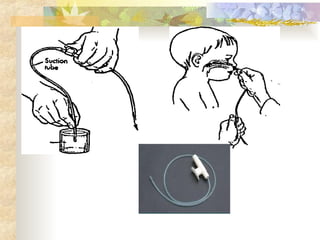
 lubricate the catheter suction
 Insert the tube into the nostril, with no suction.
 Keep your finger off the suction port opening in the tube.
 With the tube in place, place your thumb over the suction port,
and rotate the tube as you slowly move it out of the nostril.
 A suction attempt should last 5 seconds.
 There should be 20-30 second intervals between each
suction
 Limit suctioning to 5 minutes in total
 Alternate nares for repeat suctioning.
 Irrigate the catheter with the sterile water
or saline after each suction pass.
 Re-lubricate the catheter and repeat
suctioning as needed or as tolerated by the
child.
 Assess the child for color, respiratory rate & effort, and Sao2
levels (if monitored) during suctioning.
 Gently clean around the child's nares once all suctioning has been
completed
 Obtain specimen if required.
 Dispose of equipment and ensure availability for the next suction .
 Evaluates effectiveness of suctioning
Documentation
Record the
procedure
 Consistency .
 Color .
 Odor of the mucus .
 Child breathing status
before and after.
Documentation
 Size of catheter used
 Number of passes of the suction catheter
 Condition of the nares and surrounding skin
 Any difficulties during suctioning.
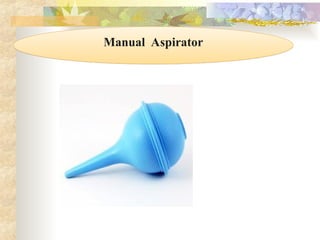
Manual Aspirator
Patient should be monitored prior to, during &
after the procedure for following :
Breath sounds
Oxygen saturation
Respiratory Rate & pattern
Hemodynamic parameters (pulse rate, Blood pressure)
Ventilator parameters.
 Stethoscope
 Vacuum source with adjustable regulator suction jar
 Sterile gloves
 Sterile suction catheter
 Protective goggles, apron & mask
 Sterile normal saline
 AMBU bag for pre & post oxygenation
Suction catheter:
 Catheter can be selected according to the ET tube
size.
 Sterile suction catheter of 8-10 Fr is used for children.
Suction pressure:
 Children-50-100 mmHg.
 Infants-40-60 mmHg.
Patient Preparation:
 Explain the procedure to the patient & importance of
coughing if conscious.
 The patient should receive hyper oxygenation by the
delivery of 100% oxygen for>30 seconds prior to the
suctioning
 Position the patient in supine position.
 Auscultate the breath sounds.
 Hand washing to reduces transmission of
microorganisms.
 Goggles, mask & apron should be worn to prevent
splash from secretions.
 Open the end of the suction catheter package & connect
it to suction tubing (If you are alone).
 Wear sterile gloves with sterile technique
 With a help of an assistant disconnect the ventilator
 Insert the catheter in to the ET tube until resistance
is felt
 Resistance is felt when the catheter impacts bronchial
mucosa, the suction catheter should be withdrawn
2cm out before applying suction
 Apply continuous suction while rotating the suction
catheter during removal
 The duration of each suctioning should be10-15sec.
 Instill 3 to 5ml of sterile normal saline in to the
artificial airway, NOT recommended
 Give four to five manual breaths with bag or
ventilator
 Return child to ventilator
 Flush the catheter with NS
 Suction nares & oropharynx suctioning if needed
 Discard used equipment
 Flush the suction tube with hot water
 Wash hands
 When the procedure is complete hyperventilate the
patient again.
 When the airway becomes clear, return the patient to
ventilator or oxygen
 Documentation.
 Record the time of suctioning, nature & amount of
secretions.
 Document indications for suctioning & any changes in
vitals & patient’s tolerance.
Monitoring :
 Breath sounds
 Respiratory rate and pattern
 Hemodynamic parameters
 Sputum characteristics
– Color
– Volume
– Consistency – Odor
 Ventilator parameters
Complications
Airway
Trauma
Hypoxia
Cardiac
dysrhythmia
Nosocomial
infection
suction in children and its procedures.ppt

suction in children and its procedures.ppt

  • 1.
    Dr / SherehanGad Lecturer of pediatric nursing
  • 3.
    1- Definition ofsuctioning. 2- Sites of suction. 3- Purposes of suctioning. 4- Indications for suctioning. 5- Choosing the right size catheter. 6- Setting the correct pressure. 7- The procedure. 8- Documentation. 9- Complications of suctioning. Outlines
  • 4.
    Suctioning Definition Aspirating secretion througha catheter connected to a suction machine or wall suction outlet.
  • 5.
  • 6.
    Endotracheal suctioning isthe removal of secretions from tracheobroncheal tree through an endotracheal tube with the help of mechanical suction device.
  • 7.
  • 8.
    Oropharyngeal /Nasopharyngeal suctioning Endotracheal/ Tracheostomy suctioning Remove secretionfrom the upper respiratory tract . Remove secretion from the trachea and bronchi or the lower respiratory tract . Deferent between Oropharyngeal /Nasopharyngeal suctioning and Endotracheal/ tracheostomy suctioning
  • 9.
     Tow typesof suctioning catheter : 1- Whistle – tipped catheter . 2- Open – tipped catheter . whistle – tipped catheter open – tipped catheter Less irritate the airway More effective for removing thick mucus plugs . Choosing the Right Size Catheter Cont’
  • 11.
     To maintainpatent air way.  Remove blood ,vomit and meconium in an emergency situation.  prevent infection that may result from accumulated secretions Purposes of suction
  • 12.
     To maintaina patent airway by removing retained tracheobroncheal secretions.  To prevent lower respiratory tract infection from retained secretions.  To provide effective ventilation.
  • 13.
  • 14.
    Neonate 5-8 French 6months 8-10 French 1 -2 years 10 French 5- 10 years 14 French Choosing the Right Size Catheter
  • 16.
    Wall Unit PortableUnit Infant 60 mm Hg . 2 to 5 mm Hg young Child 60 to 80 mm Hg . 5 to 10 mm Hg Older child 80 to 120 mm Hg . 10 to 15 mm Hg Setting the Correct Pressure
  • 18.
  • 19.
  • 20.
     Portable orwall suction machine with tubing and collection container  Appropriate-sized sterile suction catheter  Towel or disposable waterproof pad  Sterile container for sterile fluids used to lubricate and clear catheter Equipment
  • 21.
    E Q U I P M E N T  Sterile gauzes. Sterile gloves  Goggles or face shield .  O2 source.
  • 22.
  • 24.
     Wash hands,put gloves and mask.  Explain to child and family  Perform chest physiotherapy.
  • 25.
    Position the patient. Consciouspatient Unconscious patient Semi – Fowler’s position with : head turned to one side for oral suctioning . For nasal suctioning with the neck hyperextended. Lateral position and the patient facing you . The procedure Cont’
  • 27.
     Place atowel or disposable waterproof pad on the child's chest.  connect the catheter to the suction machine.  Use proper size of catheter.
  • 28.
     Make suresuction machine is plugged and working.  Make on approximate measure of the depth for the catheter by measuring the distance from the child's ear to tip of the nose 'prevent airway trauma or vagal stimulation.
  • 29.
     lubricate thecatheter suction  Insert the tube into the nostril, with no suction.  Keep your finger off the suction port opening in the tube.  With the tube in place, place your thumb over the suction port, and rotate the tube as you slowly move it out of the nostril.
  • 31.
     A suctionattempt should last 5 seconds.  There should be 20-30 second intervals between each suction  Limit suctioning to 5 minutes in total  Alternate nares for repeat suctioning.
  • 32.
     Irrigate thecatheter with the sterile water or saline after each suction pass.  Re-lubricate the catheter and repeat suctioning as needed or as tolerated by the child.
  • 33.
     Assess thechild for color, respiratory rate & effort, and Sao2 levels (if monitored) during suctioning.  Gently clean around the child's nares once all suctioning has been completed  Obtain specimen if required.  Dispose of equipment and ensure availability for the next suction .  Evaluates effectiveness of suctioning
  • 34.
    Documentation Record the procedure  Consistency.  Color .  Odor of the mucus .  Child breathing status before and after.
  • 35.
    Documentation  Size ofcatheter used  Number of passes of the suction catheter  Condition of the nares and surrounding skin  Any difficulties during suctioning.
  • 36.
  • 37.
    Patient should bemonitored prior to, during & after the procedure for following : Breath sounds Oxygen saturation Respiratory Rate & pattern Hemodynamic parameters (pulse rate, Blood pressure) Ventilator parameters.
  • 38.
     Stethoscope  Vacuumsource with adjustable regulator suction jar  Sterile gloves  Sterile suction catheter  Protective goggles, apron & mask  Sterile normal saline  AMBU bag for pre & post oxygenation
  • 39.
    Suction catheter:  Cathetercan be selected according to the ET tube size.  Sterile suction catheter of 8-10 Fr is used for children. Suction pressure:  Children-50-100 mmHg.  Infants-40-60 mmHg.
  • 40.
    Patient Preparation:  Explainthe procedure to the patient & importance of coughing if conscious.  The patient should receive hyper oxygenation by the delivery of 100% oxygen for>30 seconds prior to the suctioning  Position the patient in supine position.  Auscultate the breath sounds.
  • 41.
     Hand washingto reduces transmission of microorganisms.  Goggles, mask & apron should be worn to prevent splash from secretions.  Open the end of the suction catheter package & connect it to suction tubing (If you are alone).  Wear sterile gloves with sterile technique
  • 42.
     With ahelp of an assistant disconnect the ventilator  Insert the catheter in to the ET tube until resistance is felt  Resistance is felt when the catheter impacts bronchial mucosa, the suction catheter should be withdrawn 2cm out before applying suction
  • 43.
     Apply continuoussuction while rotating the suction catheter during removal  The duration of each suctioning should be10-15sec.  Instill 3 to 5ml of sterile normal saline in to the artificial airway, NOT recommended  Give four to five manual breaths with bag or ventilator
  • 44.
     Return childto ventilator  Flush the catheter with NS  Suction nares & oropharynx suctioning if needed  Discard used equipment  Flush the suction tube with hot water  Wash hands
  • 45.
     When theprocedure is complete hyperventilate the patient again.  When the airway becomes clear, return the patient to ventilator or oxygen  Documentation.  Record the time of suctioning, nature & amount of secretions.  Document indications for suctioning & any changes in vitals & patient’s tolerance.
  • 46.
    Monitoring :  Breathsounds  Respiratory rate and pattern  Hemodynamic parameters  Sputum characteristics – Color – Volume – Consistency – Odor  Ventilator parameters
  • 47.