-AIRWAY ASSESMENT
-KNOWLEDGE ABOUT
1-DIFFICULT AIRWAYS
2-THEIR ASSESMENT and
3-TO DEAL THE CASE
-Dr Nisar Ahmed Arain
Assistant Professor
Anesthesia/Critical Care/ER
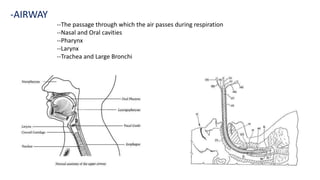
--The passage through which the air passes during respiration
--Nasal and Oral cavities
--Pharynx
--Larynx
--Trachea and Large Bronchi
-AIRWAY
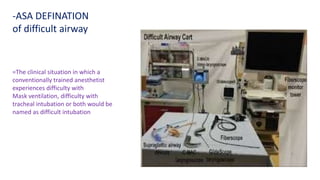
=The clinical situation in which a
conventionally trained anesthetist
experiences difficulty with
Mask ventilation, difficulty with
tracheal intubation or both would be
named as difficult intubation
-ASA DEFINATION
of difficult airway
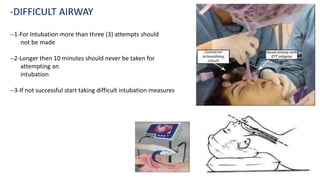
--1-For Intubation more than three (3) attempts should
not be made
--2-Longer then 10 minutes should never be taken for
attempting an
intubation
--3-If not successful start taking difficult intubation measures
-DIFFICULT AIRWAY
--The Obese (body mass index >26 kg/m2
--The Bearded
--The Elderly (older then 55 years of age)
--The snorers
--The Edentulous (=BONES)
-PREDICTORS OF
-DIFFICULT AIRWAY
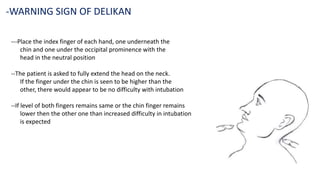
---Place the index finger of each hand, one underneath the
chin and one under the occipital prominence with the
head in the neutral position
--The patient is asked to fully extend the head on the neck.
If the finger under the chin is seen to be higher than the
other, there would appear to be no difficulty with intubation
--If level of both fingers remains same or the chin finger remains
lower then the other one than increased difficulty in intubation
is expected
-WARNING SIGN OF DELIKAN
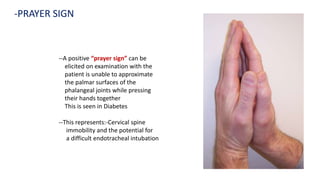
--A positive “prayer sign” can be
elicited on examination with the
patient is unable to approximate
the palmar surfaces of the
phalangeal joints while pressing
their hands together
This is seen in Diabetes
--This represents:-Cervical spine
immobility and the potential for
a difficult endotracheal intubation
-PRAYER SIGN
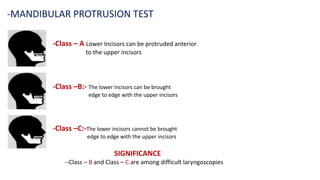
-Class – A Lower Incisors can be protruded anterior
to the upper incisors
-MANDIBULAR PROTRUSION TEST
-Class –C:-The lower incisors cannot be brought
edge to edge with the upper incisors
-Class –B:- The lower incisors can be brought
edge to edge with the upper incisors
SIGNIFICANCE
--Class – B and Class – C are among difficult laryngoscopies
-This can be expressed as
-Thyromental and
-Hyomental space
-This space determines how easily the
Laryngeal and Pharyngeal Axis will fall in
the line when the Atlanto – Occipital joint is
extended
-Assessment of mandibular space
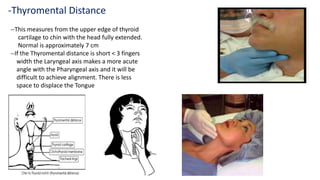
--This measures from the upper edge of thyroid
cartilage to chin with the head fully extended.
Normal is approximately 7 cm
--If the Thyromental distance is short < 3 fingers
width the Laryngeal axis makes a more acute
angle with the Pharyngeal axis and it will be
difficult to achieve alignment. There is less
space to displace the Tongue
-Thyromental Distance
--Inter – incisor distance with maximal mouth opening
Normal value > 5 cm / and Admits three (3) fingers
SIGNIFICANCE
Positive results :-Easy insertion of a 3 cm deep flange of the
laryngoscope blade
--A Less then < 3 cm :-Difficult intubation
--A Less then < 2 cm :-Difficult LMA Insertion
Affected by TMJ and upper cervical spine mobility
-INTER INCISOR GAP
--The distance from the upper border of the
manubrium to the Tip of Mentum, with
neck fully Extended and Mouth closed
--Minimum acceptable value is 12.5 cm
---This is single best predictor of difficult
Laryngoscopy and intubation
(This has a high sensitivity and specificity)
-STERNOMENTAL DISTANCE
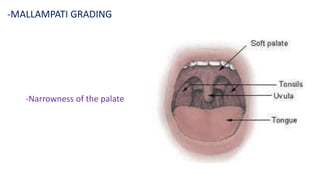
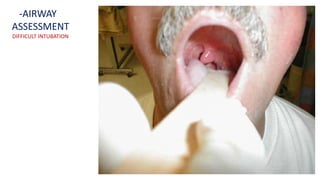
-Narrowness of the palate
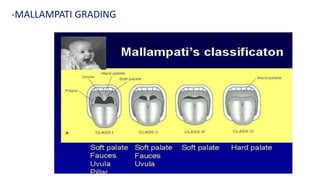
-MALLAMPATI GRADING
-MALLAMPATI GRADING
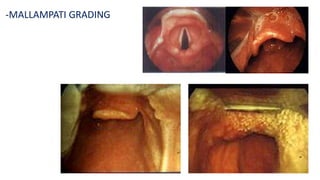
-MALLAMPATI GRADING
--SAGHEI AND SAFAVI TEST
--LEMON ASSESSMENT
-SOME IMPORTANT TESTS
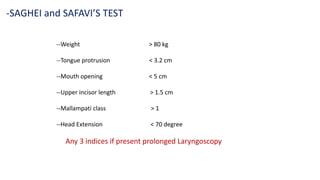
--Weight > 80 kg
--Tongue protrusion < 3.2 cm
--Mouth opening < 5 cm
--Upper incisor length > 1.5 cm
--Mallampati class > 1
--Head Extension < 70 degree
Any 3 indices if present prolonged Laryngoscopy
-SAGHEI and SAFAVI’S TEST
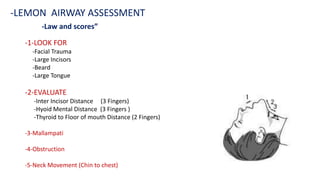
-1-LOOK FOR
-Facial Trauma
-Large Incisors
-Beard
-Large Tongue
-2-EVALUATE
-Inter Incisor Distance (3 Fingers)
-Hyoid Mental Distance (3 Fingers )
-Thyroid to Floor of mouth Distance (2 Fingers)
-3-Mallampati
-4-Obstruction
-5-Neck Movement (Chin to chest)
-LEMON AIRWAY ASSESSMENT
-Law and scores”
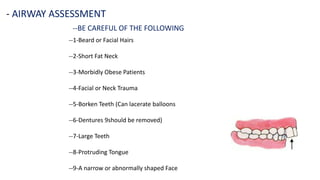
--BE CAREFUL OF THE FOLLOWING
- AIRWAY ASSESSMENT
--1-Beard or Facial Hairs
--2-Short Fat Neck
--3-Morbidly Obese Patients
--4-Facial or Neck Trauma
--5-Borken Teeth (Can lacerate balloons
--6-Dentures 9should be removed)
--7-Large Teeth
--8-Protruding Tongue
--9-A narrow or abnormally shaped Face
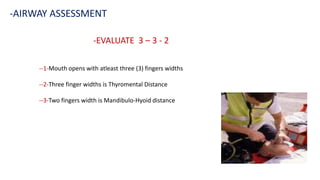
--1-Mouth opens with atleast three (3) fingers widths
--2-Three finger widths is Thyromental Distance
--3-Two fingers width is Mandibulo-Hyoid distance
-EVALUATE 3 – 3 - 2
-AIRWAY ASSESSMENT
--Measure the size of upper Face
as compared to the Lower Face
--Should be roughly the same
--If the lower face is longer than the
upper face then you should anticipate
some degree of difficulty lining up the
structures
-SIZE OF FACE ASSESSMENT
-Upper and Lower Face
-AIRWAY ASSESSMENT
-AIRWAY ASSESSMENT
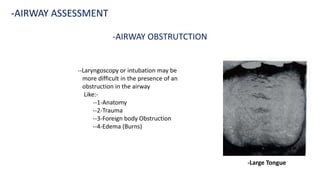
-AIRWAY OBSTRUTCTION
--Laryngoscopy or intubation may be
more difficult in the presence of an
obstruction in the airway
Like:-
--1-Anatomy
--2-Trauma
--3-Foreign body Obstruction
--4-Edema (Burns)
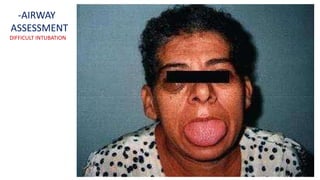
-Large Tongue
-Magboul’s 4 M’s
-AIRWAY ASSESSMENT
--For Intubation remember the 4 (M and Ms) with (STOP) sign
-Mallampati
-Measurement
-Movement
-Malformation and STOP
-M = Malformation of the skull, teeth, obstruction, and Pathology
(The Macros and Micros). We can memorize them with the
word (STOP)
-S =Skull (Hydro and Microcephalus)
-T =Teeth (Buck, Protruded, and Loose Teeth, Macro and Micro
mandibles)
-O =Obstruction (Due to Obesity, short Bull Neck, swellings
around the head and Neck)
-P =Pathology (cranio-Facial abnormalities and syndromes:
Treacher Collins, Goldenhar’s, Pierre Robin, Waardenburg
syndromes)
-What are the 4 D’s
-AIRWAY ASSESSMENT
-The Following 4 D’s also suggest a difficult airway
--Dentition (Prominent upper incisors and receding chin)
--Distortion (Edema, Blood, Vomitus, Tumor, Infection)
--Disproportion (Short Chin – to – larynx distance, Bull Neck
Large Tongue and small mouth)
--Dys mobility (TMJ and cervical spine)
-Difficult Airway (DOA)
-AIRWAY ASSESSMENT
--Disruption
--Distortion
--Obstruction
-These all creates an access Problems
-Disruption
-AIRWAY ASSESSMENT
--Hanging
--Crush injuries
--Penetrating Trauma
--Other soft tissue Trauma
-Burns
-Laceration
-DISTORTION
-AIRWAY ASSESSMENT
--Surgeries
--Radiation
--Therapy
--Scarring
--Burns
-Obstructions
-AIRWAY ASSESSMENT
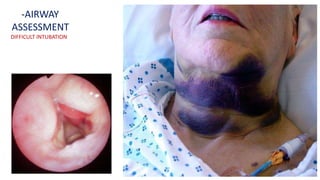
--Hematoma
--Abscess
--Tumor
-Tumors can also create
distortions and extra
bleeding
--Obesity
--Halo
--Short Neck
--SC Emphysema
--Bushy Beard
--Flexion deformity
of the spine
-OTHER ISSUES OF
-DIFFICULT INTUBATION
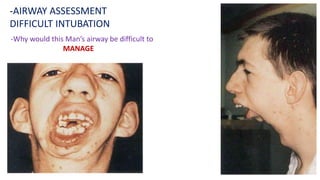
-Why would this Man’s airway be difficult to
MANAGE
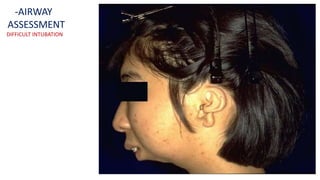
-AIRWAY ASSESSMENT
DIFFICULT INTUBATION
-AIRWAY
ASSESSMENT
DIFFICULT INTUBATION
-AIRWAY
ASSESSMENT
DIFFICULT INTUBATION
-AIRWAY
ASSESSMENT
DIFFICULT INTUBATION
--AIRWAY
ASSESSMENT
DIFFICULT INTUBATION
-AIRWAY
ASSESSMENT
DIFFICULT INTUBATION
-AIRWAY
ASSESSMENT
DIFFICULT INTUBATION
-AIRWAY
ASSESSMENT
DIFFICULT INTUBATION
-TO SUMMARIZE
--Airway assessment is a critical part
--The difficult airway assessment must be
performed prior to ALL attempts While this
criteria helps identify difficult airways it
does not guarantee an easy intubation
--Nothing is more expensive
than the
Missed Opportunity
-Be Prepared !
-AIRWAY
ASSESSMENT
DIFFICULT INTUBATION
Airway assesment part 2

Airway assesment part 2

  • 1.
    -AIRWAY ASSESMENT -KNOWLEDGE ABOUT 1-DIFFICULTAIRWAYS 2-THEIR ASSESMENT and 3-TO DEAL THE CASE -Dr Nisar Ahmed Arain Assistant Professor Anesthesia/Critical Care/ER
  • 2.
    --The passage throughwhich the air passes during respiration --Nasal and Oral cavities --Pharynx --Larynx --Trachea and Large Bronchi -AIRWAY
  • 3.
    =The clinical situationin which a conventionally trained anesthetist experiences difficulty with Mask ventilation, difficulty with tracheal intubation or both would be named as difficult intubation -ASA DEFINATION of difficult airway
  • 4.
    --1-For Intubation morethan three (3) attempts should not be made --2-Longer then 10 minutes should never be taken for attempting an intubation --3-If not successful start taking difficult intubation measures -DIFFICULT AIRWAY
  • 5.
    --The Obese (bodymass index >26 kg/m2 --The Bearded --The Elderly (older then 55 years of age) --The snorers --The Edentulous (=BONES) -PREDICTORS OF -DIFFICULT AIRWAY
  • 6.
    ---Place the indexfinger of each hand, one underneath the chin and one under the occipital prominence with the head in the neutral position --The patient is asked to fully extend the head on the neck. If the finger under the chin is seen to be higher than the other, there would appear to be no difficulty with intubation --If level of both fingers remains same or the chin finger remains lower then the other one than increased difficulty in intubation is expected -WARNING SIGN OF DELIKAN
  • 7.
    --A positive “prayersign” can be elicited on examination with the patient is unable to approximate the palmar surfaces of the phalangeal joints while pressing their hands together This is seen in Diabetes --This represents:-Cervical spine immobility and the potential for a difficult endotracheal intubation -PRAYER SIGN
  • 8.
    -Class – ALower Incisors can be protruded anterior to the upper incisors -MANDIBULAR PROTRUSION TEST -Class –C:-The lower incisors cannot be brought edge to edge with the upper incisors -Class –B:- The lower incisors can be brought edge to edge with the upper incisors SIGNIFICANCE --Class – B and Class – C are among difficult laryngoscopies
  • 9.
    -This can beexpressed as -Thyromental and -Hyomental space -This space determines how easily the Laryngeal and Pharyngeal Axis will fall in the line when the Atlanto – Occipital joint is extended -Assessment of mandibular space
  • 10.
    --This measures fromthe upper edge of thyroid cartilage to chin with the head fully extended. Normal is approximately 7 cm --If the Thyromental distance is short < 3 fingers width the Laryngeal axis makes a more acute angle with the Pharyngeal axis and it will be difficult to achieve alignment. There is less space to displace the Tongue -Thyromental Distance
  • 11.
    --Inter – incisordistance with maximal mouth opening Normal value > 5 cm / and Admits three (3) fingers SIGNIFICANCE Positive results :-Easy insertion of a 3 cm deep flange of the laryngoscope blade --A Less then < 3 cm :-Difficult intubation --A Less then < 2 cm :-Difficult LMA Insertion Affected by TMJ and upper cervical spine mobility -INTER INCISOR GAP
  • 12.
    --The distance fromthe upper border of the manubrium to the Tip of Mentum, with neck fully Extended and Mouth closed --Minimum acceptable value is 12.5 cm ---This is single best predictor of difficult Laryngoscopy and intubation (This has a high sensitivity and specificity) -STERNOMENTAL DISTANCE
  • 13.
    -Narrowness of thepalate -MALLAMPATI GRADING
  • 14.
  • 15.
  • 16.
    --SAGHEI AND SAFAVITEST --LEMON ASSESSMENT -SOME IMPORTANT TESTS
  • 17.
    --Weight > 80kg --Tongue protrusion < 3.2 cm --Mouth opening < 5 cm --Upper incisor length > 1.5 cm --Mallampati class > 1 --Head Extension < 70 degree Any 3 indices if present prolonged Laryngoscopy -SAGHEI and SAFAVI’S TEST
  • 18.
    -1-LOOK FOR -Facial Trauma -LargeIncisors -Beard -Large Tongue -2-EVALUATE -Inter Incisor Distance (3 Fingers) -Hyoid Mental Distance (3 Fingers ) -Thyroid to Floor of mouth Distance (2 Fingers) -3-Mallampati -4-Obstruction -5-Neck Movement (Chin to chest) -LEMON AIRWAY ASSESSMENT -Law and scores”
  • 19.
    --BE CAREFUL OFTHE FOLLOWING - AIRWAY ASSESSMENT --1-Beard or Facial Hairs --2-Short Fat Neck --3-Morbidly Obese Patients --4-Facial or Neck Trauma --5-Borken Teeth (Can lacerate balloons --6-Dentures 9should be removed) --7-Large Teeth --8-Protruding Tongue --9-A narrow or abnormally shaped Face
  • 20.
    --1-Mouth opens withatleast three (3) fingers widths --2-Three finger widths is Thyromental Distance --3-Two fingers width is Mandibulo-Hyoid distance -EVALUATE 3 – 3 - 2 -AIRWAY ASSESSMENT
  • 21.
    --Measure the sizeof upper Face as compared to the Lower Face --Should be roughly the same --If the lower face is longer than the upper face then you should anticipate some degree of difficulty lining up the structures -SIZE OF FACE ASSESSMENT -Upper and Lower Face -AIRWAY ASSESSMENT
  • 22.
    -AIRWAY ASSESSMENT -AIRWAY OBSTRUTCTION --Laryngoscopyor intubation may be more difficult in the presence of an obstruction in the airway Like:- --1-Anatomy --2-Trauma --3-Foreign body Obstruction --4-Edema (Burns) -Large Tongue
  • 23.
    -Magboul’s 4 M’s -AIRWAYASSESSMENT --For Intubation remember the 4 (M and Ms) with (STOP) sign -Mallampati -Measurement -Movement -Malformation and STOP -M = Malformation of the skull, teeth, obstruction, and Pathology (The Macros and Micros). We can memorize them with the word (STOP) -S =Skull (Hydro and Microcephalus) -T =Teeth (Buck, Protruded, and Loose Teeth, Macro and Micro mandibles) -O =Obstruction (Due to Obesity, short Bull Neck, swellings around the head and Neck) -P =Pathology (cranio-Facial abnormalities and syndromes: Treacher Collins, Goldenhar’s, Pierre Robin, Waardenburg syndromes)
  • 24.
    -What are the4 D’s -AIRWAY ASSESSMENT -The Following 4 D’s also suggest a difficult airway --Dentition (Prominent upper incisors and receding chin) --Distortion (Edema, Blood, Vomitus, Tumor, Infection) --Disproportion (Short Chin – to – larynx distance, Bull Neck Large Tongue and small mouth) --Dys mobility (TMJ and cervical spine)
  • 25.
    -Difficult Airway (DOA) -AIRWAYASSESSMENT --Disruption --Distortion --Obstruction -These all creates an access Problems
  • 26.
    -Disruption -AIRWAY ASSESSMENT --Hanging --Crush injuries --PenetratingTrauma --Other soft tissue Trauma -Burns -Laceration
  • 27.
  • 28.
  • 29.
    --Obesity --Halo --Short Neck --SC Emphysema --BushyBeard --Flexion deformity of the spine -OTHER ISSUES OF -DIFFICULT INTUBATION
  • 30.
    -Why would thisMan’s airway be difficult to MANAGE -AIRWAY ASSESSMENT DIFFICULT INTUBATION
  • 31.
  • 32.
  • 33.
  • 34.
  • 35.
  • 36.
  • 37.
  • 38.
    -TO SUMMARIZE --Airway assessmentis a critical part --The difficult airway assessment must be performed prior to ALL attempts While this criteria helps identify difficult airways it does not guarantee an easy intubation --Nothing is more expensive than the Missed Opportunity -Be Prepared ! -AIRWAY ASSESSMENT DIFFICULT INTUBATION