
Earthquake Management
Part-1
Composed by
H.M.A. Mahzuz
Assistant Professor (PhD Fellow),
Department of Civil and Environmental Engineering,
Shahjalal University of Science & Technology, Sylhet,
Bangladesh.
E-mail: mahzuz_211@ yahoo.com
Outline of the lecture
1) Organizations for responsible for earthquake
management.
2) Can we predict an earthquake?
3) Earthquake Management Cycle
4) Seismic Design Philosophy
5) Some unfavorable building configurations
Considering Earthquake
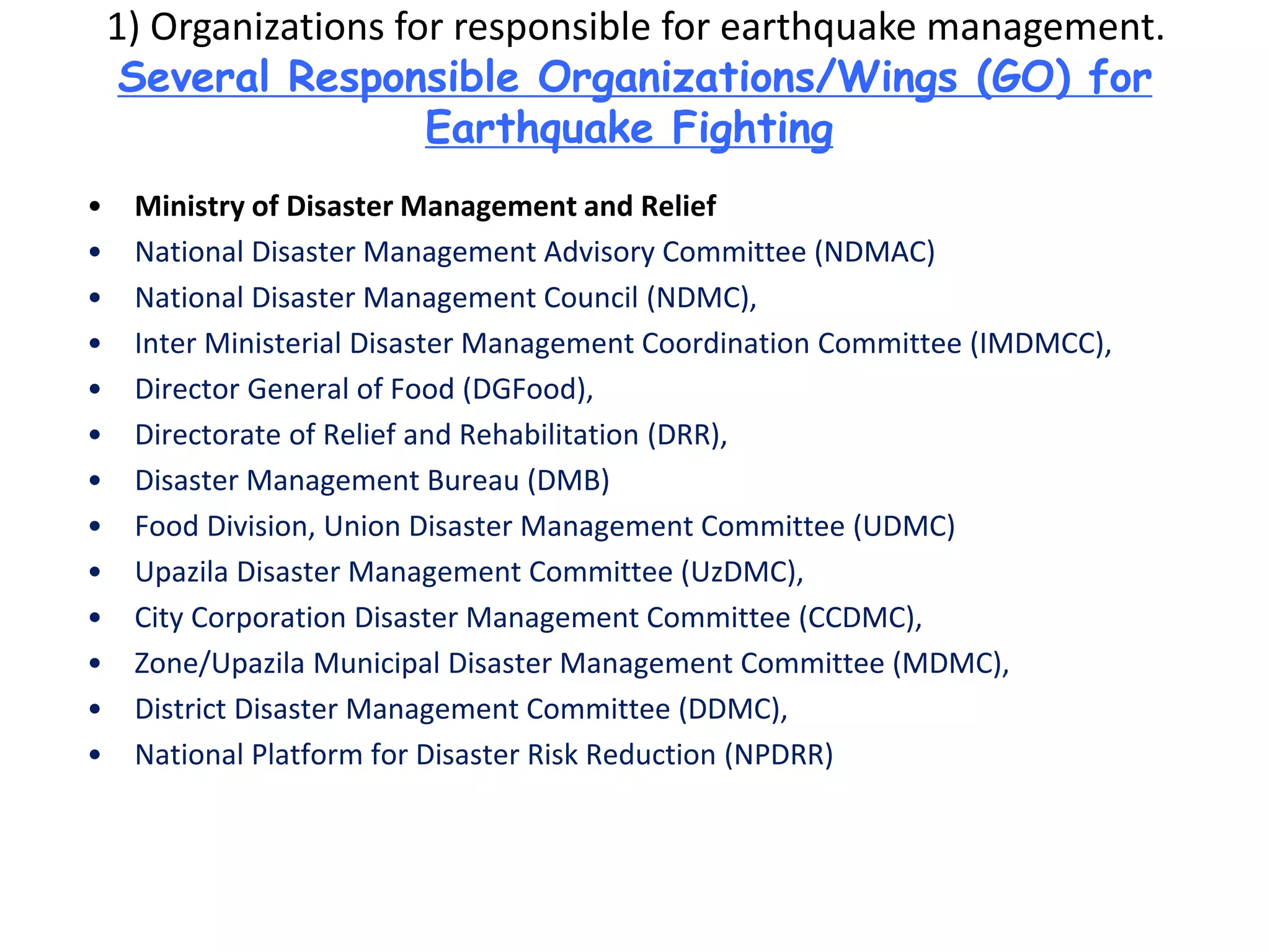
1) Organizations for responsible for earthquake management.
Several Responsible Organizations/Wings (GO) for
Earthquake Fighting
• Ministry of Disaster Management and Relief
• National Disaster Management Advisory Committee (NDMAC)
• National Disaster Management Council (NDMC),
• Inter Ministerial Disaster Management Coordination Committee (IMDMCC),
• Director General of Food (DGFood),
• Directorate of Relief and Rehabilitation (DRR),
• Disaster Management Bureau (DMB)
• Food Division, Union Disaster Management Committee (UDMC)
• Upazila Disaster Management Committee (UzDMC),
• City Corporation Disaster Management Committee (CCDMC),
• Zone/Upazila Municipal Disaster Management Committee (MDMC),
• District Disaster Management Committee (DDMC),
• National Platform for Disaster Risk Reduction (NPDRR)
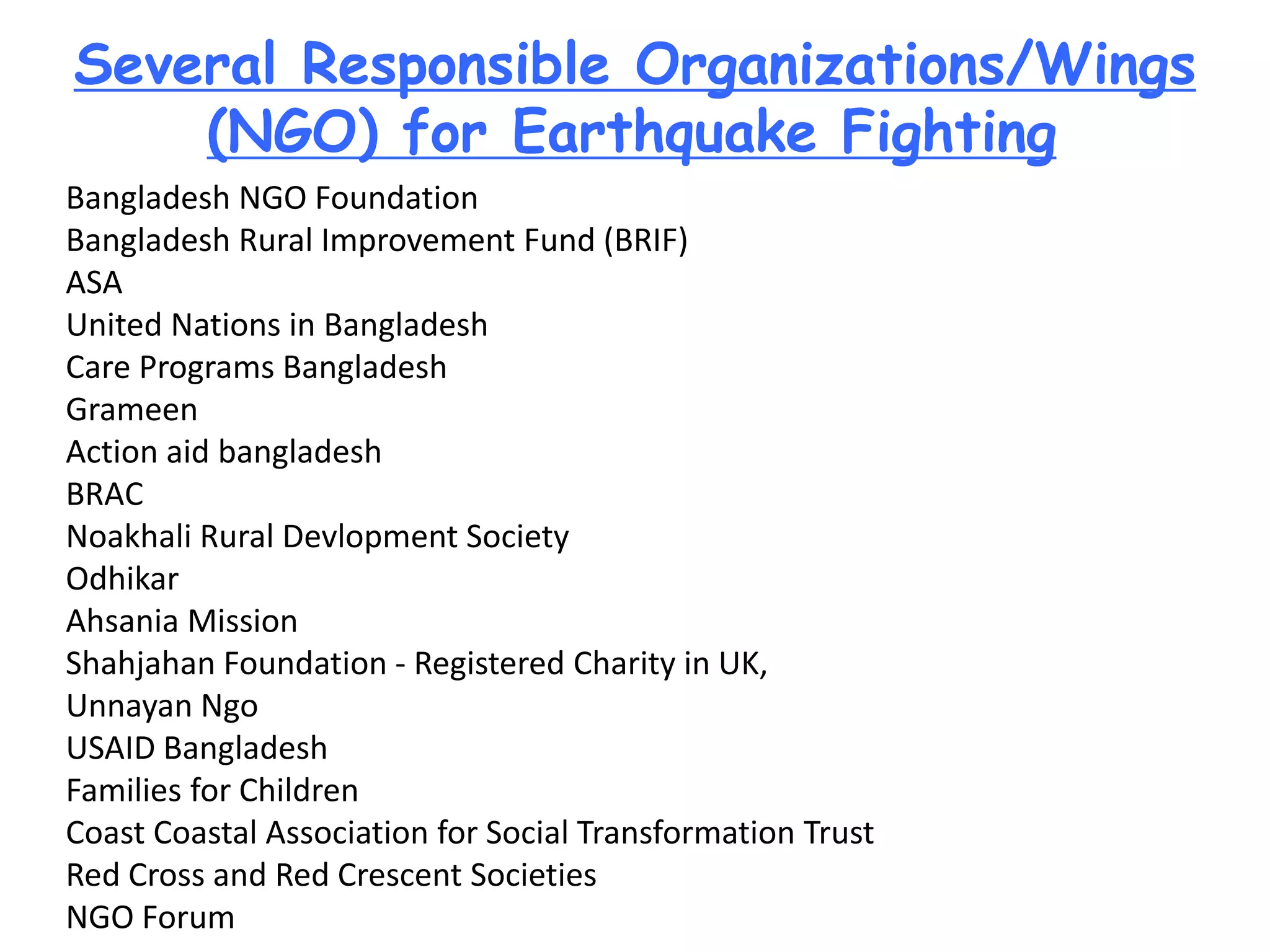
Bangladesh NGO Foundation
Bangladesh Rural Improvement Fund (BRIF)
ASA
United Nations in Bangladesh
Care Programs Bangladesh
Grameen
Action aid bangladesh
BRAC
Noakhali Rural Devlopment Society
Odhikar
Ahsania Mission
Shahjahan Foundation - Registered Charity in UK,
Unnayan Ngo
USAID Bangladesh
Families for Children
Coast Coastal Association for Social Transformation Trust
Red Cross and Red Crescent Societies
NGO Forum
Several Responsible Organizations/Wings
(NGO) for Earthquake Fighting
2) Can we predict an earthquake?
Science has not reached at that stage as
yet!!
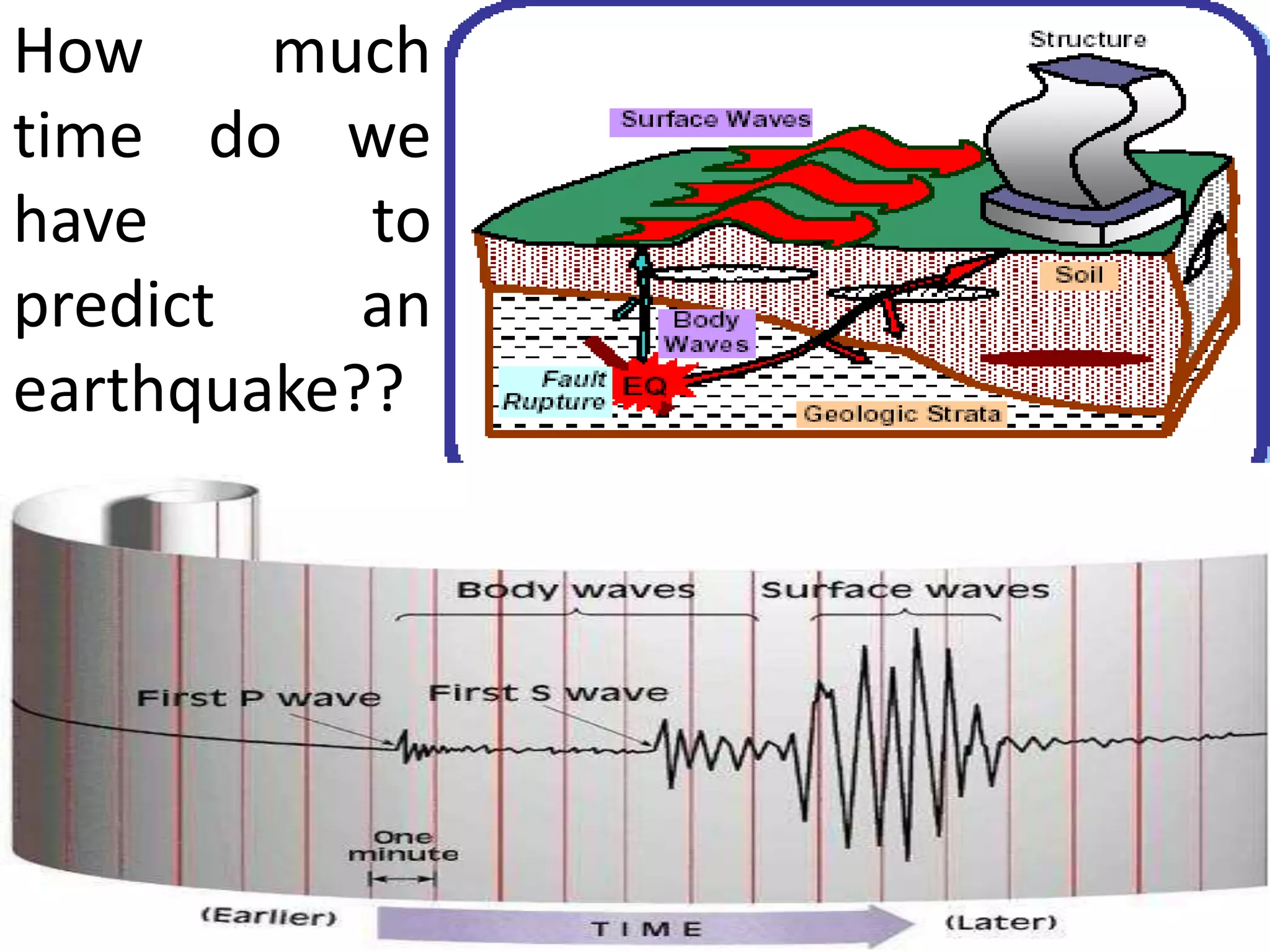
How much
time do we
have to
predict an
earthquake??
What's about the
Land of Earthquake-
Japan????!!!
The Earthquake Early Warning (EEW) is a warning issued just after an earthquake in Japan is
detected. The warnings are issued mainly by the Japan Meteorological Agency (JMA), and they
issue tips on how to react to the warnings.
Hit/ Success rate
JMA announced the hit rate of Earthquake Early Warning (EEW) on 31 May 2012, end of fiscal
year 2011. The hit rate defined here is that the Japan Meteorological Agency seismic intensity
scale number with warning issued immediately upon P-waves detected is fall or hit within plus-
minus 1 Magnitude-Shindo Number, ranges 0 to 7, out of ten numbers actually measured
Magnitude-Shindo Number as the single earthquake.
Fiscal year 2007: 75%
Fiscal year 2008: 82%
Fiscal year 2009: 76%
Fiscal year 2010: 28%
Fiscal year 2011: 56%
Fiscal year 2007 to 2009 hit rate recorded over 75%. Fiscal year 2010 hit rate came down to 28%
due to the number of successive aftershock after 2011 Tōhoku earthquake and tsunami which
occurred almost the end of fiscal year 2010, 11 March 2011. The hit rate was 72% till 10 March
2011 in fiscal year 2010. The reason of hit rate came down to 28% from 72% is very successive
plural number of aftershock judged to single large earthquake. The computer program has been
improved to ignore small scale earthquake from predicting program to increase hit rate and
fiscal year 2011 hit rate increased to 56%.
JMA aims to increase hit rate over 85% in fiscal year 2015.
Prediction:
Earthquake prediction by any geoscientist is far from success; however a
detailed and systematic investigation may lift its prediction. Earthquake
prediction in an area may be carried out under following heads:
a. Lithological characterization and structural setting of the region.
b. Crustal deformational studies.
c. Frequency of fore shock.
d. Repetitive land level survey.
e. Water tube tilt meters.
f. Geomagnetic observation.
g. Geothermal gradient.
h. Gravity survey.
I. Hazard mapping.
A variety of methods have been used for earthquake prediction, ranging
from planetary movement to odd behavior of animal but earthquake
prediction continues to be an elusive goal.
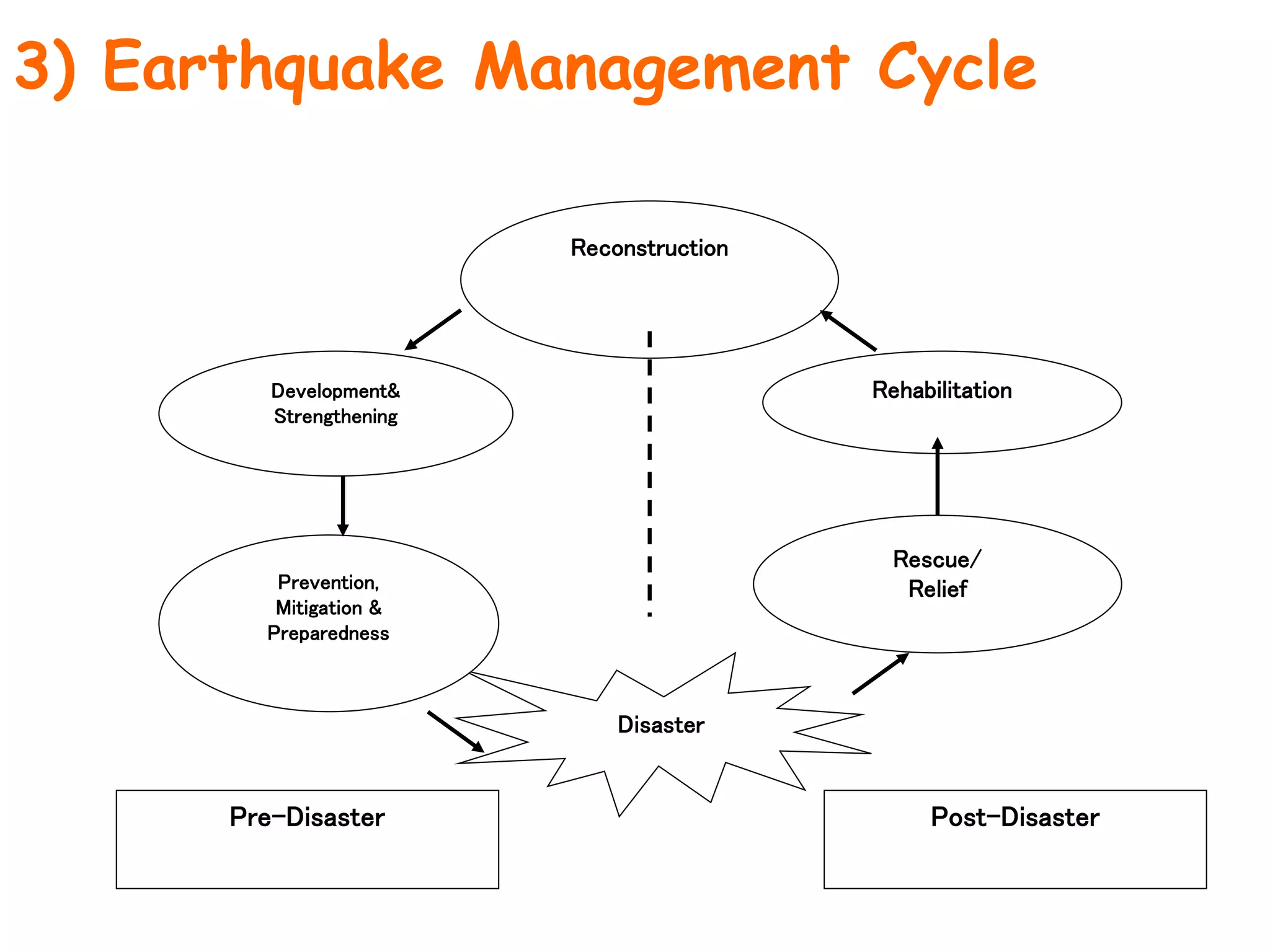
Reconstruction
Disaster
Rehabilitation
Rescue/
Relief
Development&
Strengthening
Prevention,
Mitigation &
Preparedness
Pre-Disaster Post-Disaster
3) Earthquake Management Cycle
►Emergency (During-Disaster) planning and Activities:
→To be mentally strong.
→To wear helmet.
→Just after feeling the first vibration, all the family members should go
out the house at a safe place.
→Don’t dive downward in fear.
→If it is impossible to get out from the house it is necessary to take
shelter near the columns or walls.
→Take shelter at the corner of the room if it is brick built.
→It is safe to take shelter at the room, under the tables, near the
columns.
→Come out quickly from water.
→Stay away from using lift.
→Switched off the gas line and electric line.
→Don‘t stay near high-rise building or electric line.
→ Stop the car while you are in driving.
→Don’t stop the car on the bridge.
Necessary things of pre-management:
→To acquire knowledge about earthquake.
→Achieve earthquake relative training.
→In establishing buildings must follow the building code and the consultancy of
engineers, ensure soil test before construction of building.
→Construct building and houses in strong soil.
→Use construction materials of proper grade.
→Use reinforced concrete column in place of brick.
→Keep in hand torch light and first aid materials.
→In case of multi-storied building provide emergency stairs.
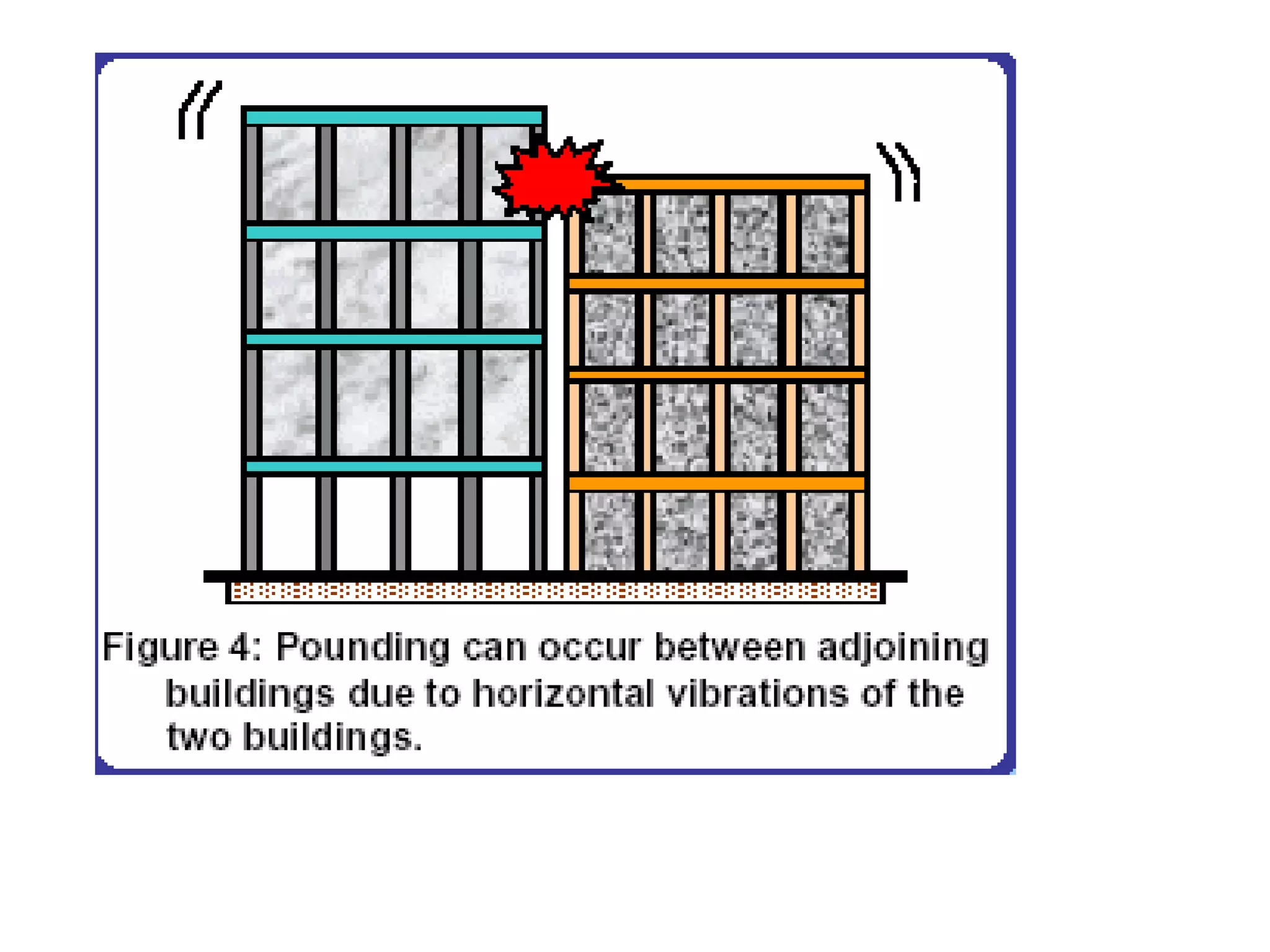
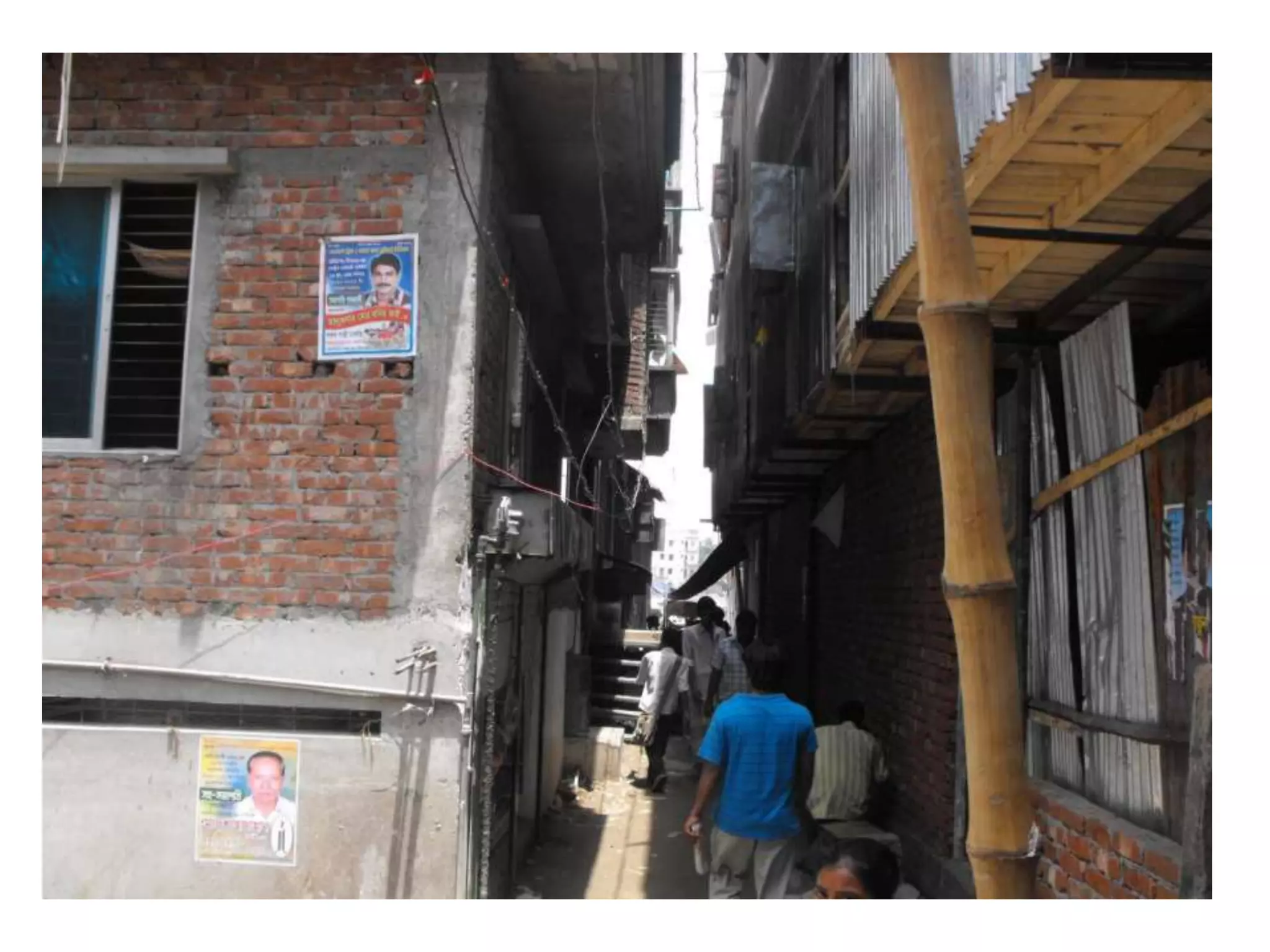
→Keep safe distance between two buildings.
→Ensure more stairs to get out of the building.
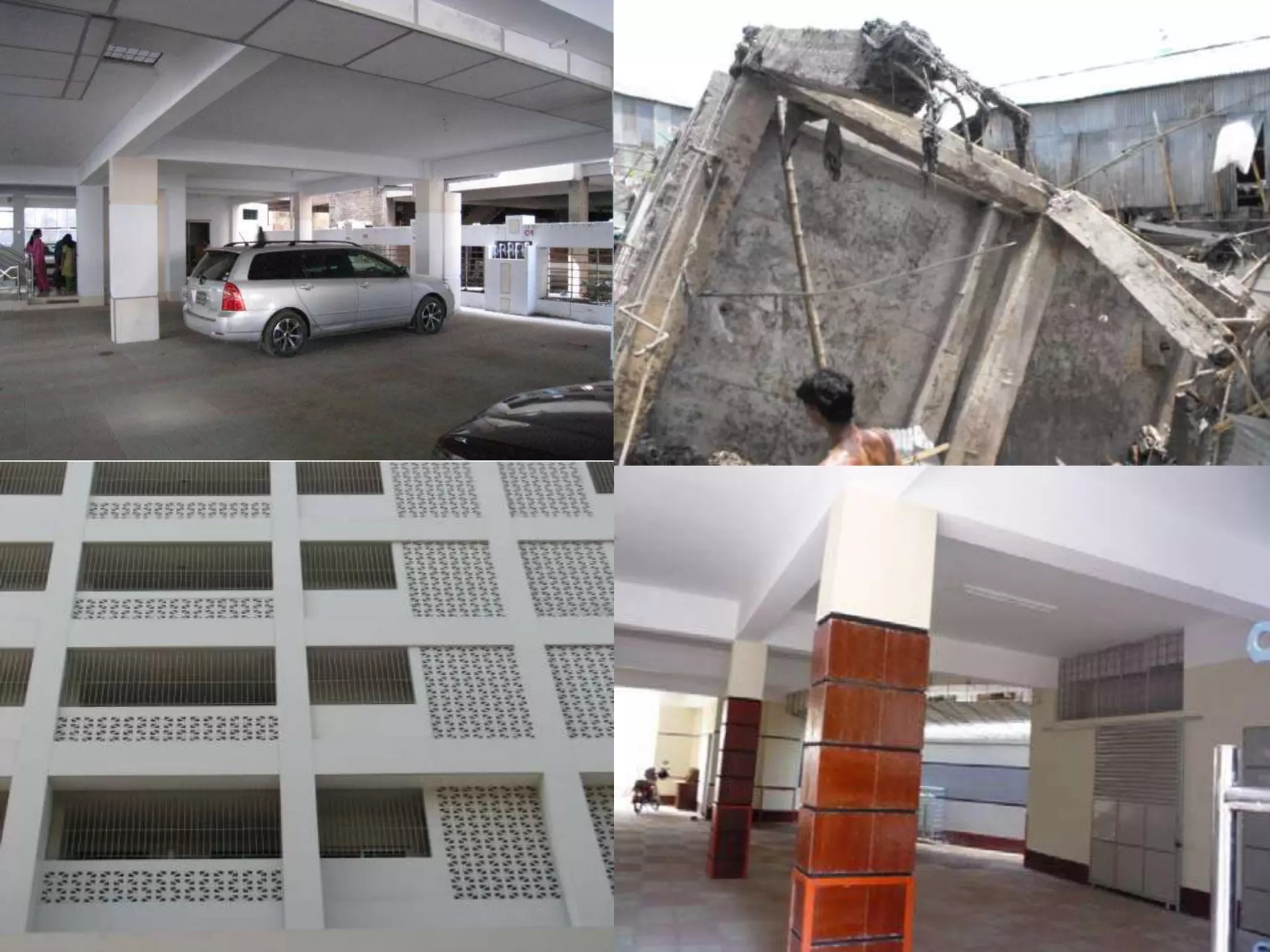
→Incase of high-rise building must provide walls in car parking region.
→To protect old building take consultancy from engineers.
→Electric line and gas line must be kept save, as it is switched off easily.
→Provide helmet for all the members of the family as it can be used during
earthquake.
→Make beds and tables with strong wood as to take shelter under them if necessary.
→Provides more doors in the buildings to go to safe place during earthquake.
→Make conscious all the family members about earthquake.
►Post Earthquake Planning and Activities:
The post-earthquake steps that should be taken in urban centers after
earthquake disasters include:
→Detailed surveys regarding repair, restoration and condemnation
decisions.
→Assessment of socioeconomic conditions, resources.
→Measures and policies for relief, resettlement, rehabilitation, and
redevelopment.
→Re-establishment of government services.
→Institutional framework, implementing agencies.
→Disaster accounting.
→Planning and coordination of rehabilitation and reconstruction
assistance.
→Sitting of new settlements and communities.
→Retrofit of design codes and construction standards.
→Training and education programs.
→Reconstruction.
Severity of ground shaking at a given location during an
earthquake can be minor, moderate and strong.
Relatively speaking, minor shaking occurs frequently,
moderate shaking occasionally and strong shaking rarely.
 Don’t attempt to make EQ proof building (Bld. Will be too
robust and too expensive). Engineering intention shall be to
make EQ resistant building
4) Seismic Design Philosophy for Building
• Sustain little damage in small-to-moderate quakes (M <
5.5)
• Sustain some repairable damage for moderate quakes (5.5
< M < 7.0)
• Not collapse in large earthquakes (M > 7.0)
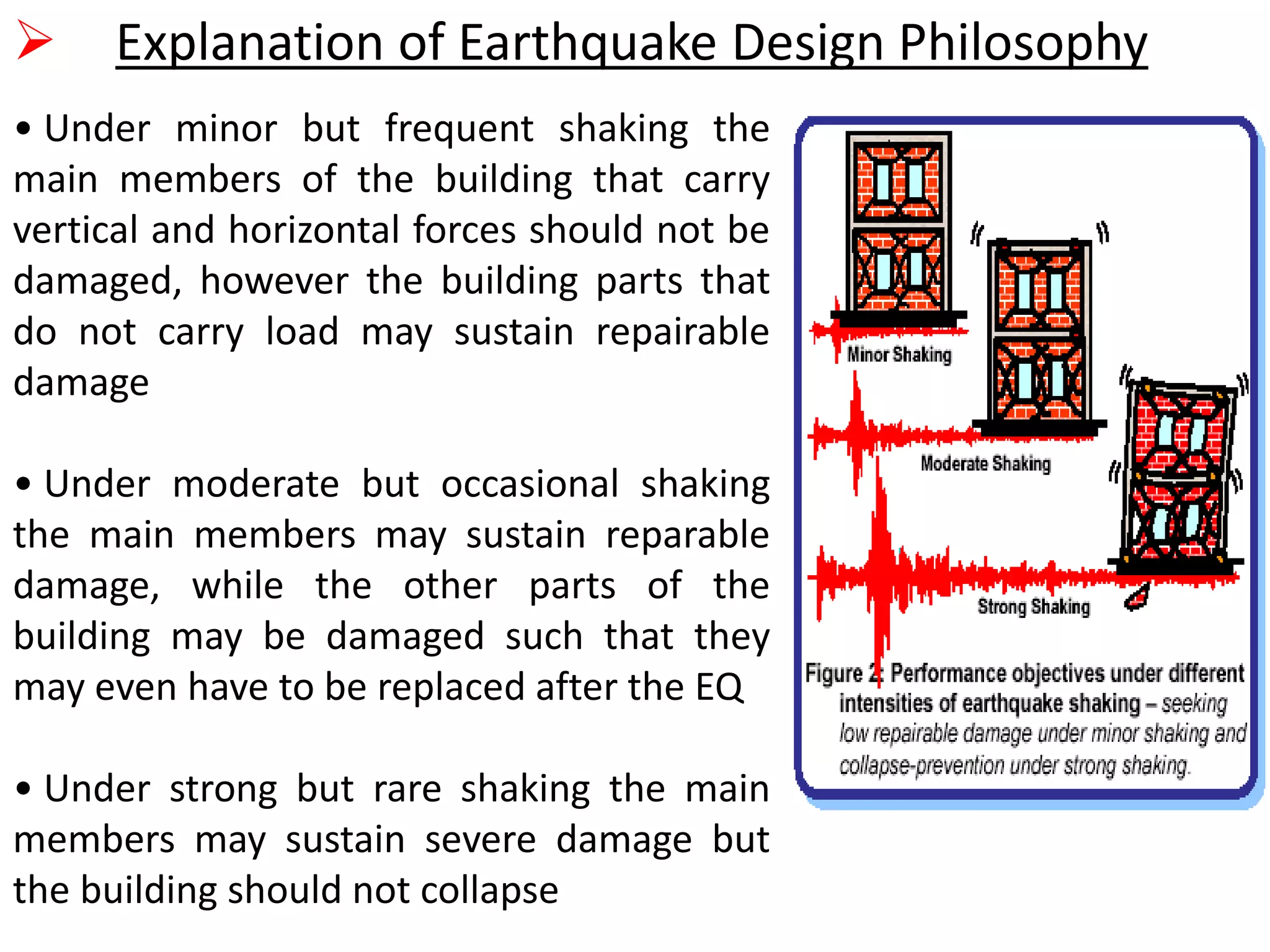
 Explanation of Earthquake Design Philosophy
• Under minor but frequent shaking the
main members of the building that carry
vertical and horizontal forces should not be
damaged, however the building parts that
do not carry load may sustain repairable
damage
• Under moderate but occasional shaking
the main members may sustain reparable
damage, while the other parts of the
building may be damaged such that they
may even have to be replaced after the EQ
• Under strong but rare shaking the main
members may sustain severe damage but
the building should not collapse
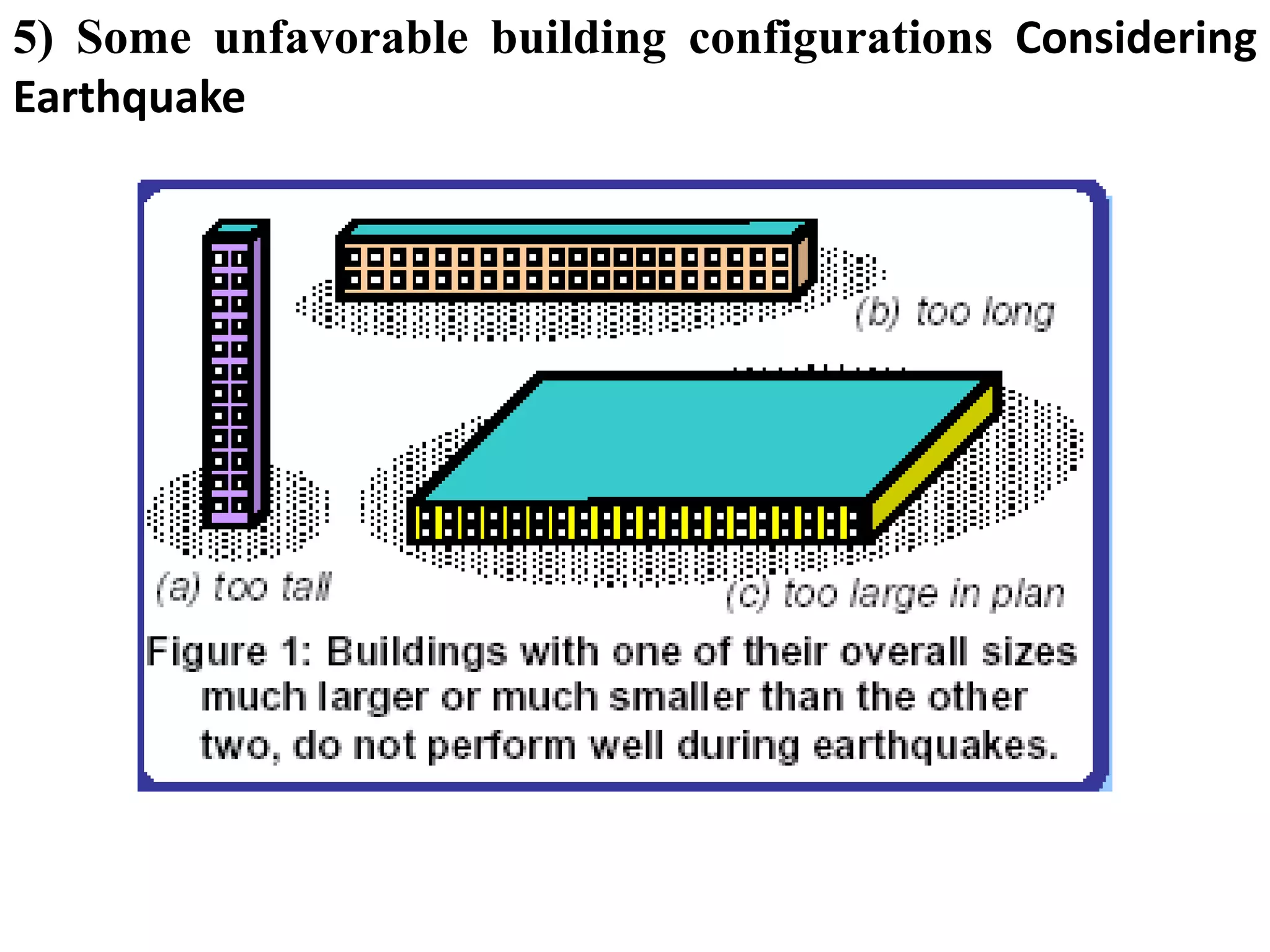
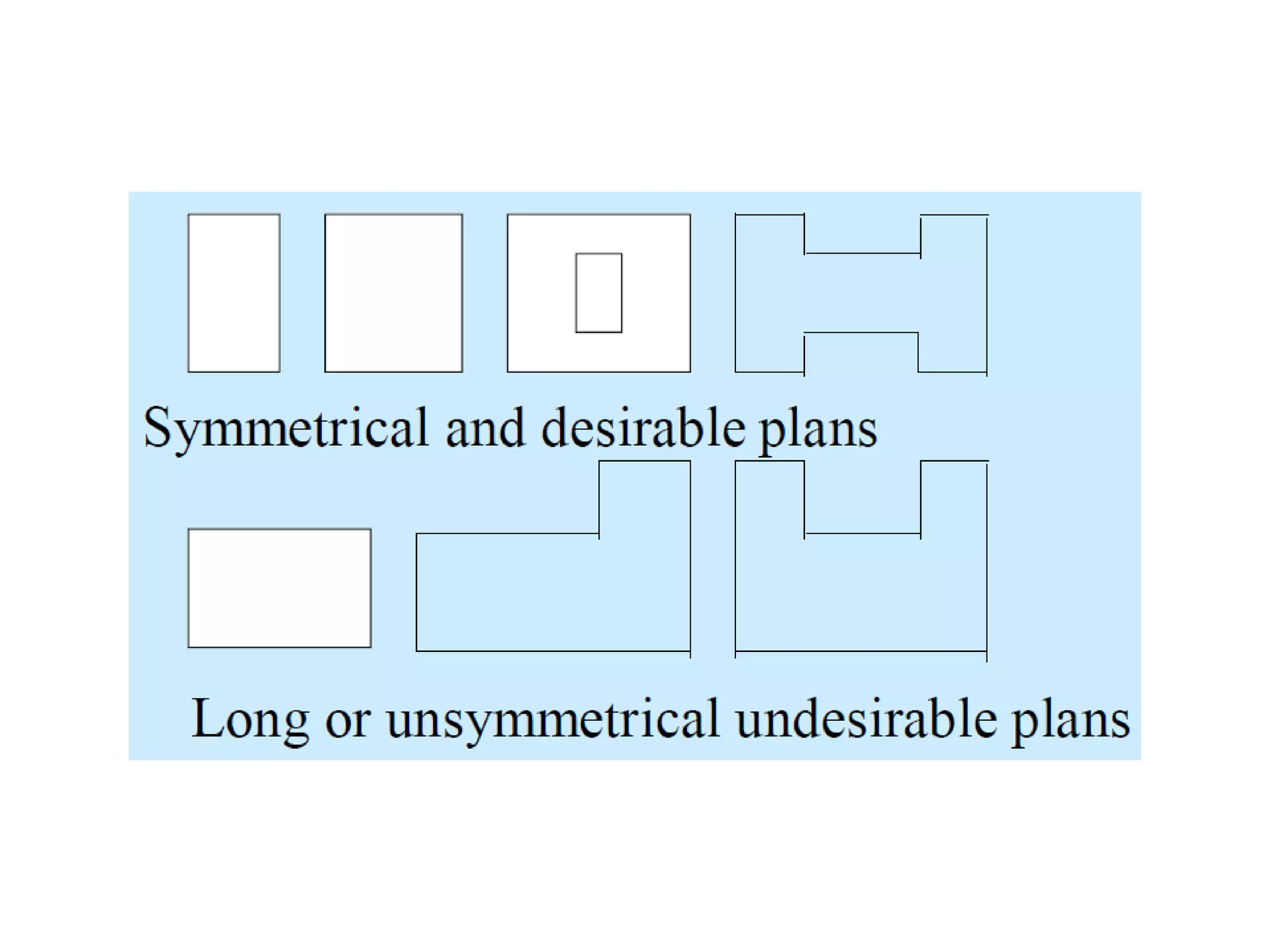
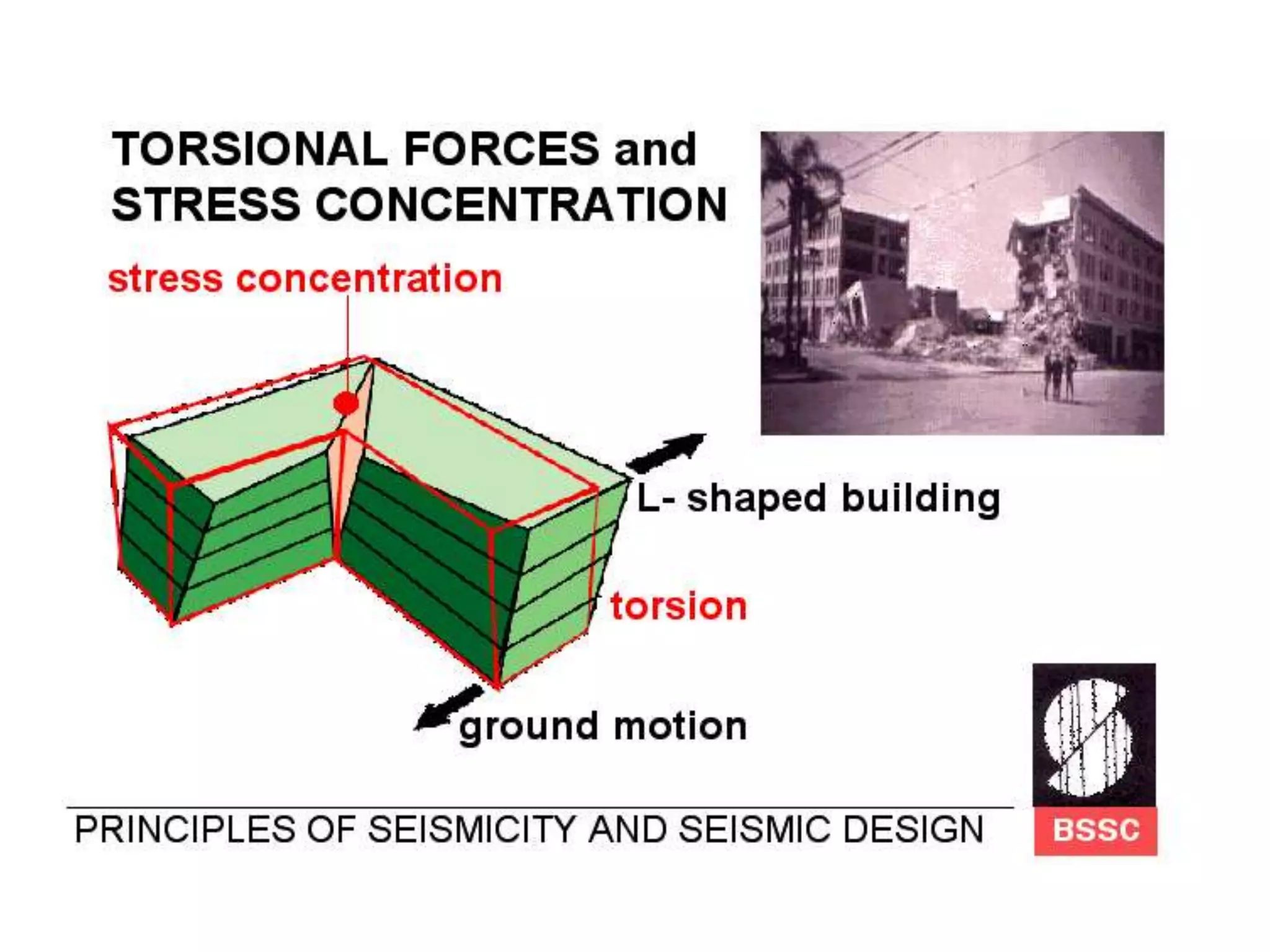
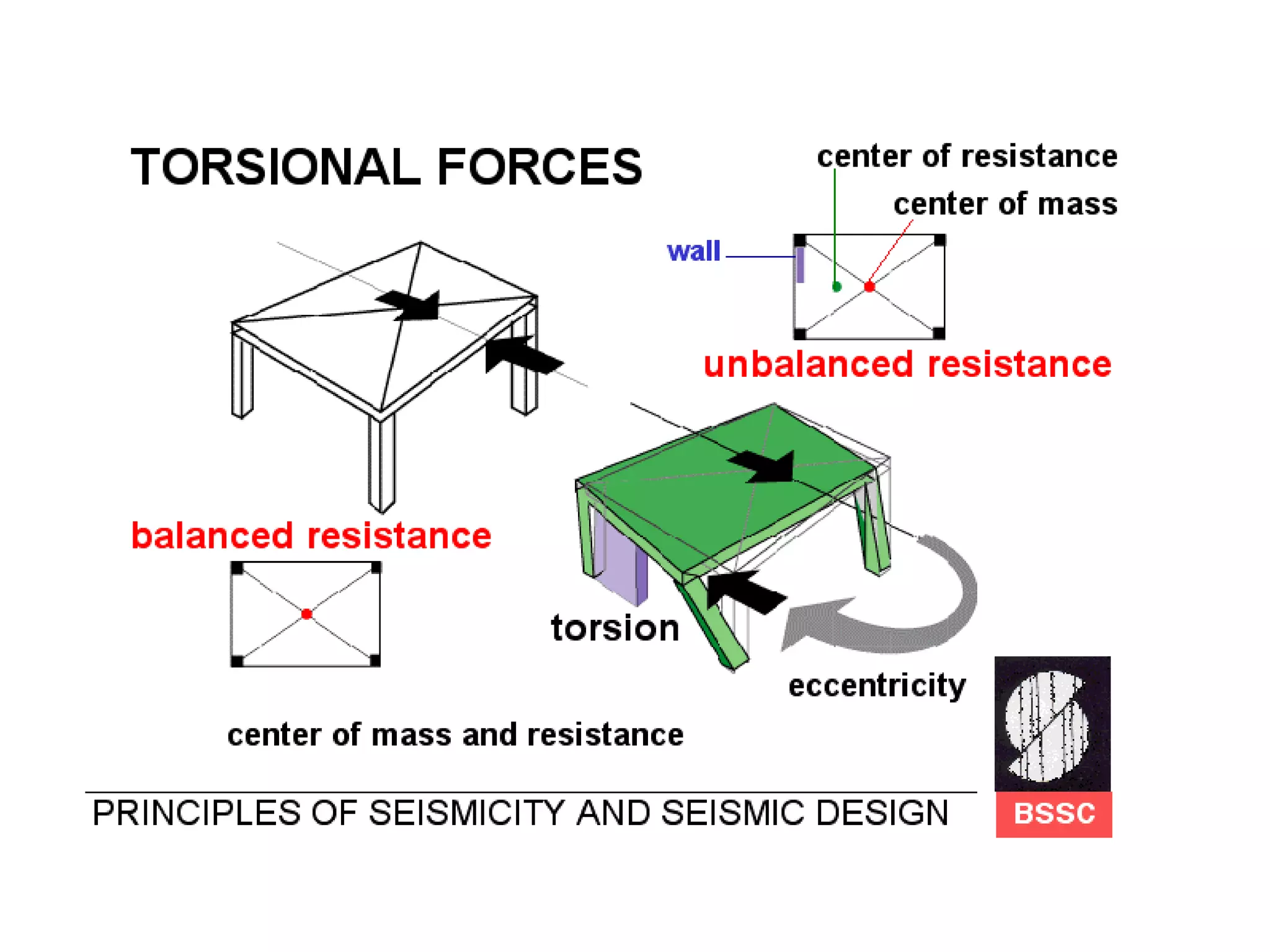
5) Some unfavorable building configurations Considering
Earthquake
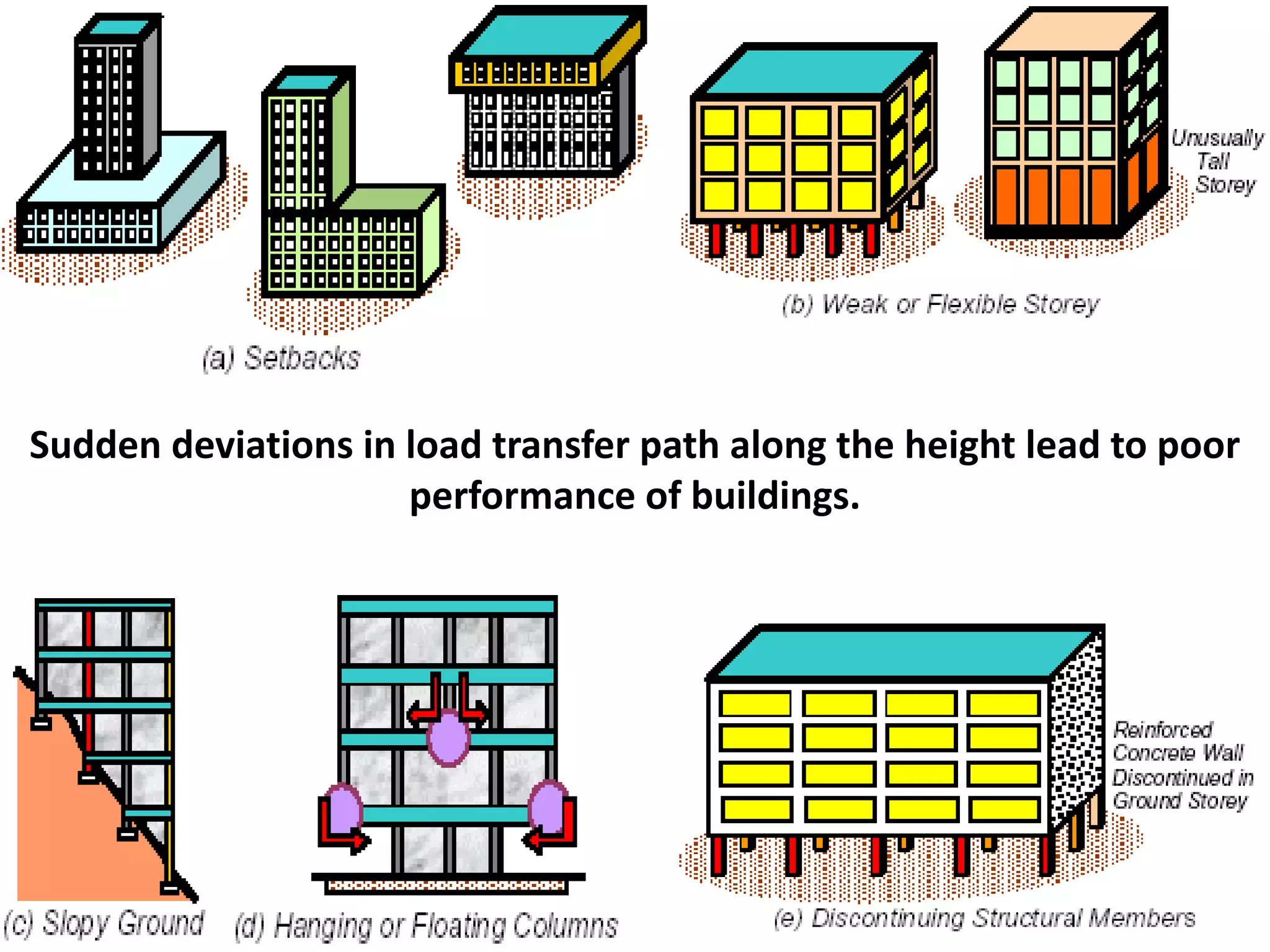
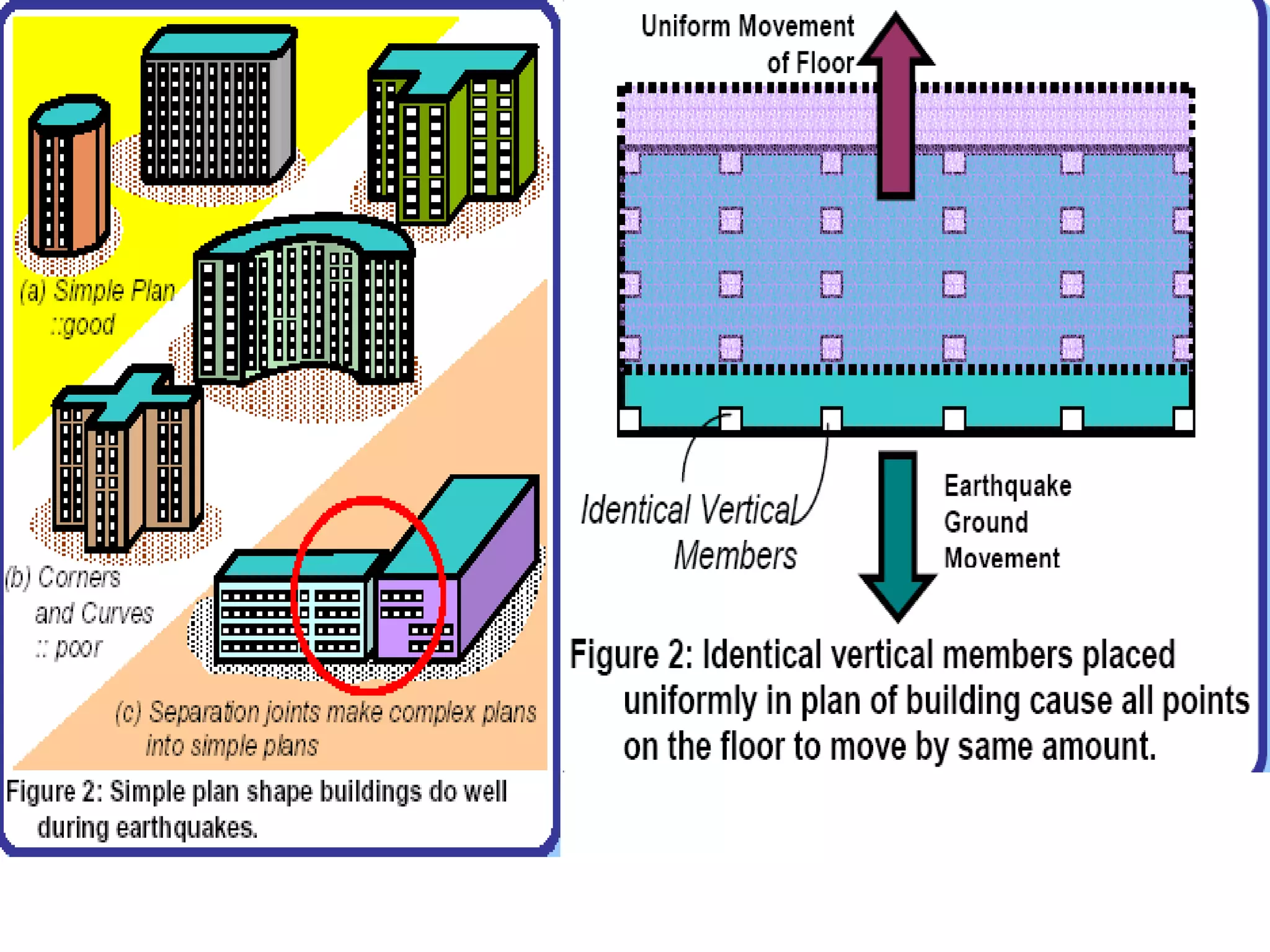
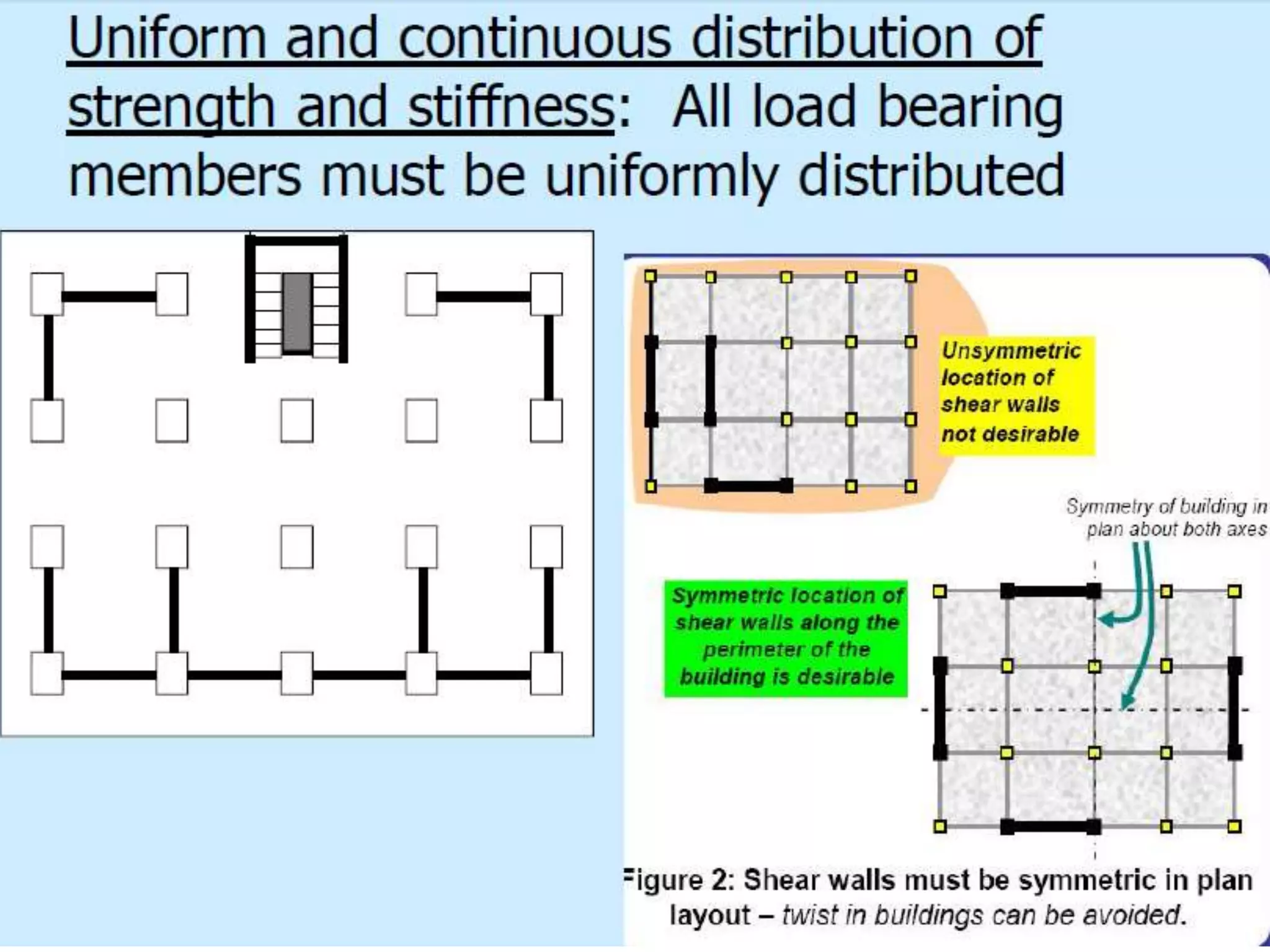
Sudden deviations in load transfer path along the height lead to poor
performance of buildings.
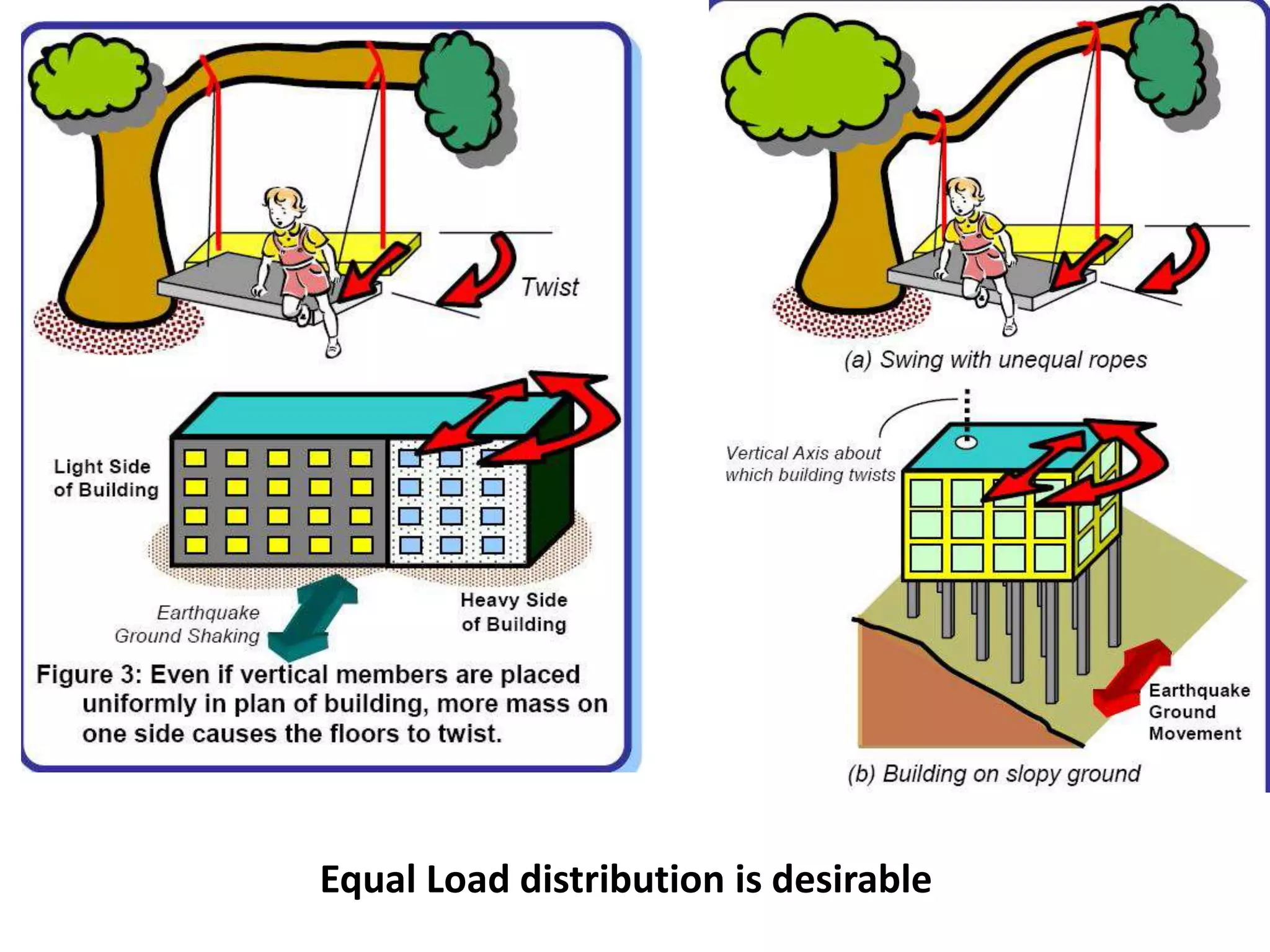
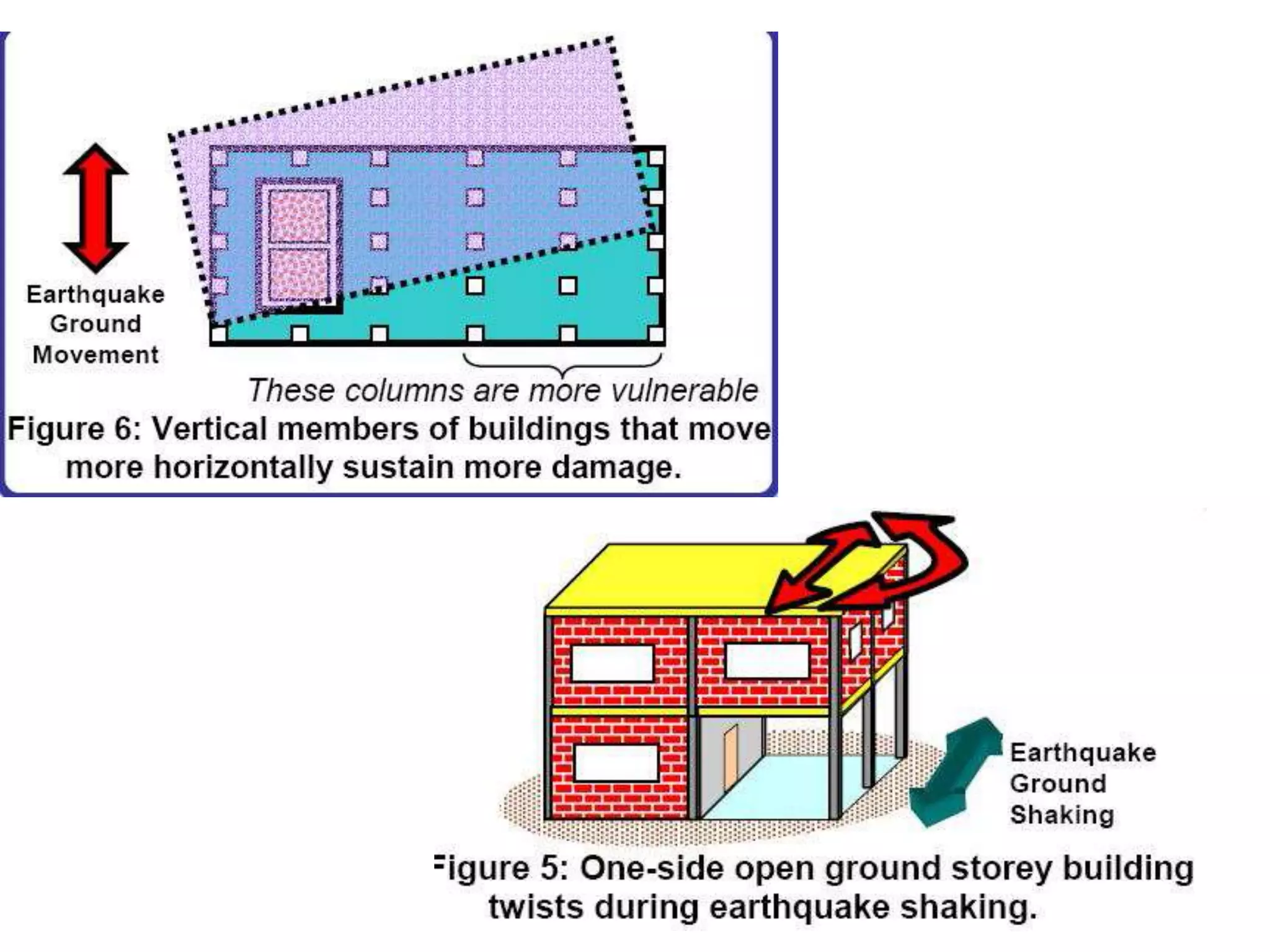
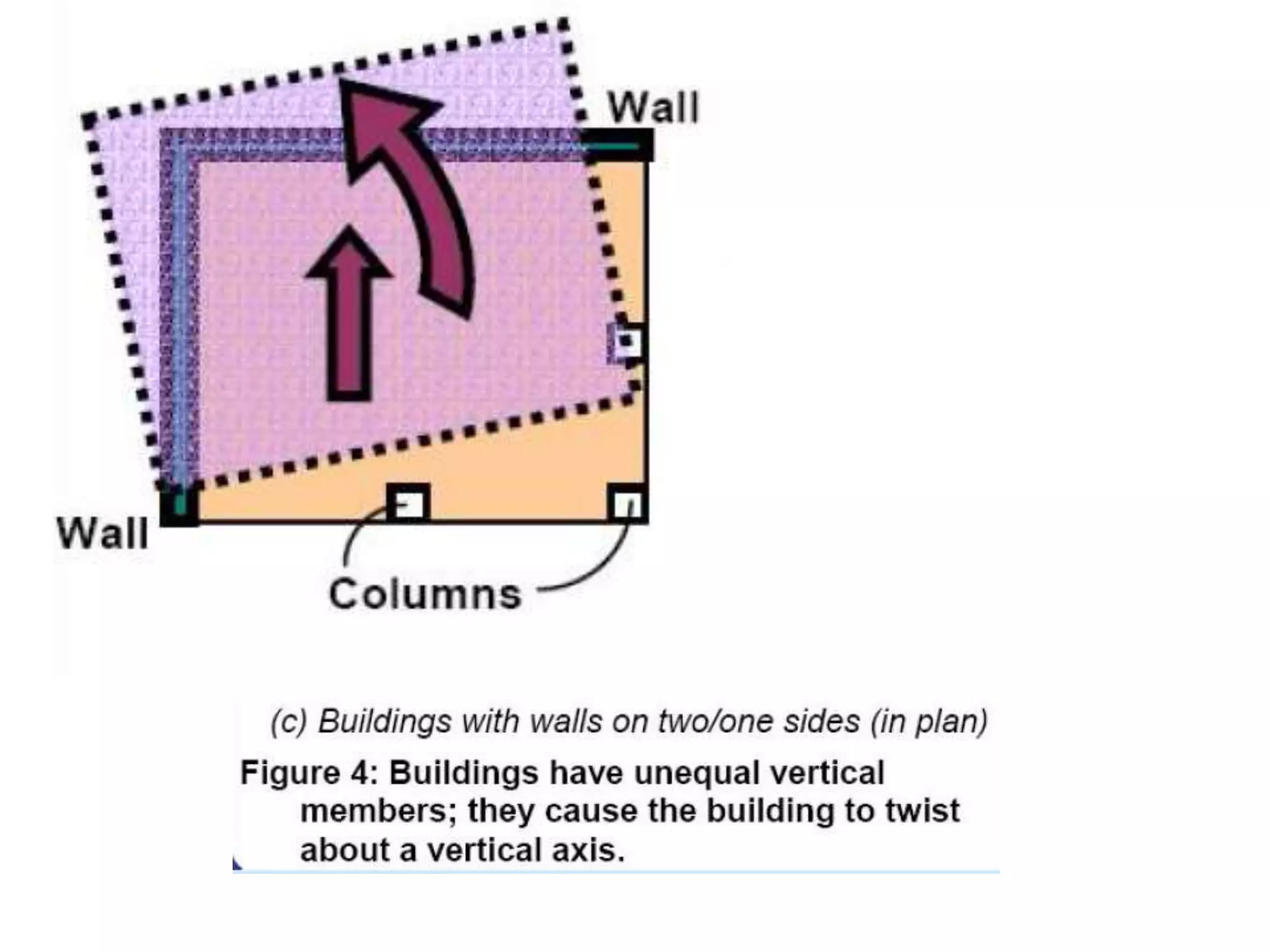
Equal Load distribution is desirable
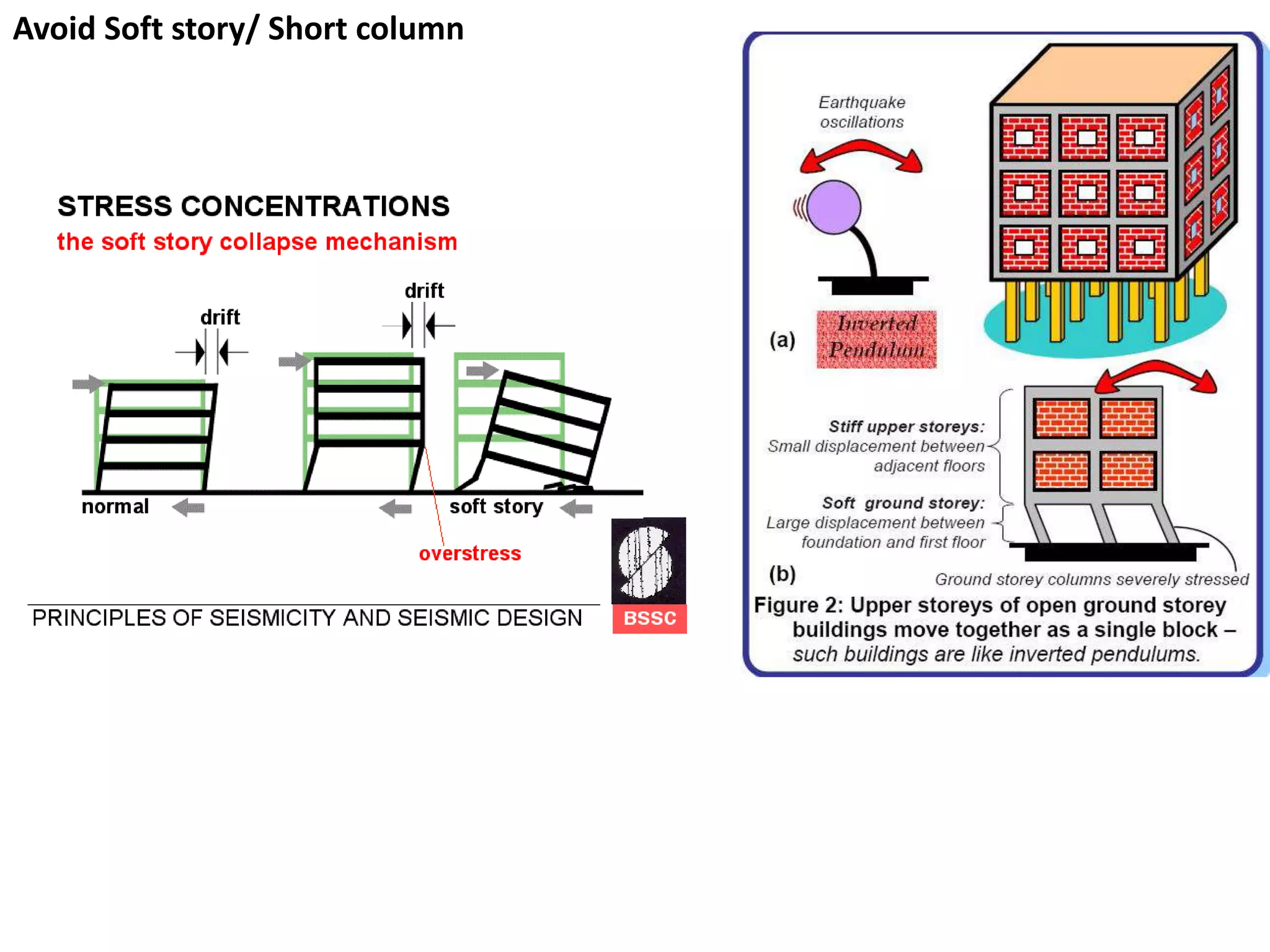
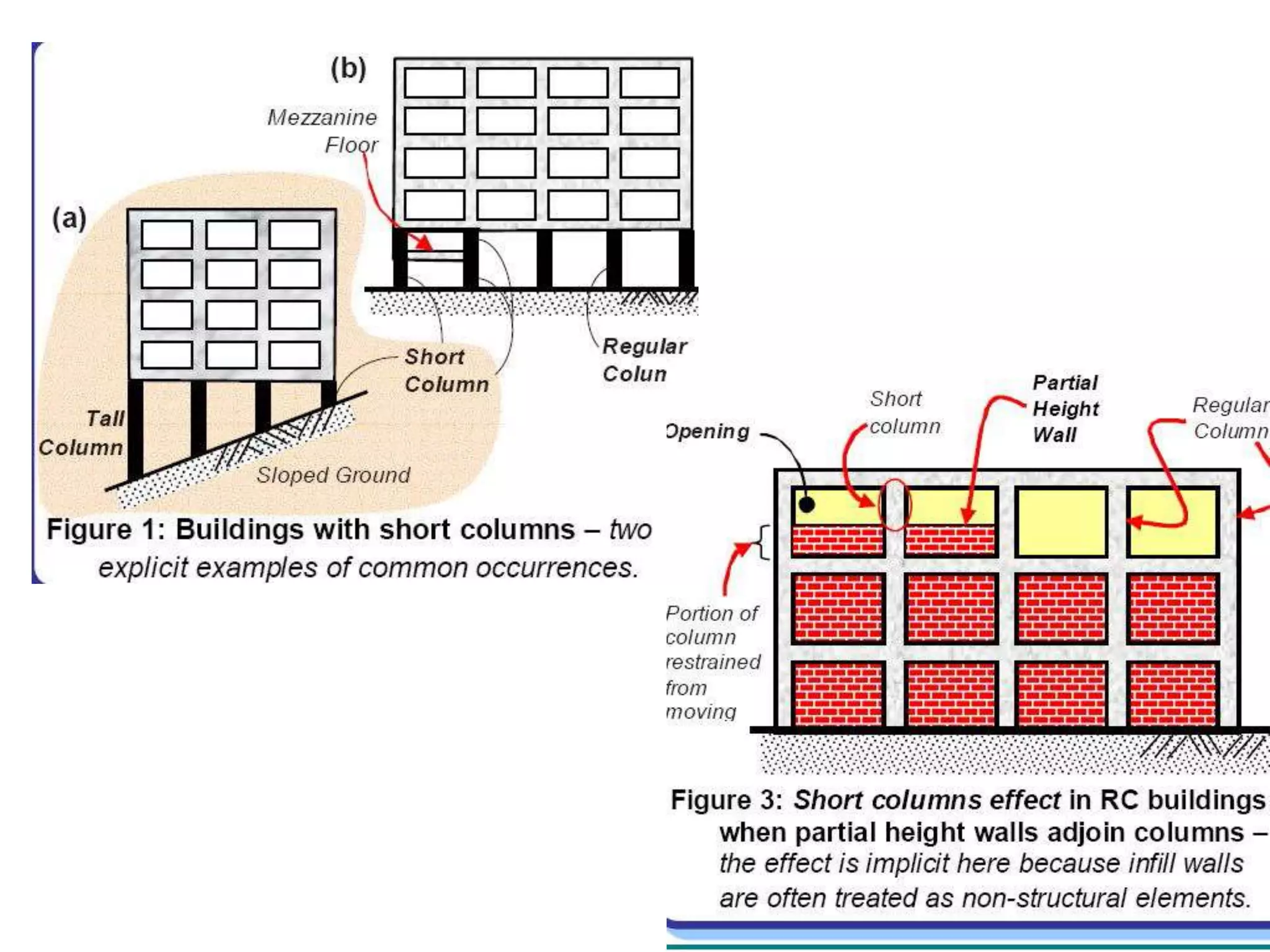
Avoid Soft story/ Short column
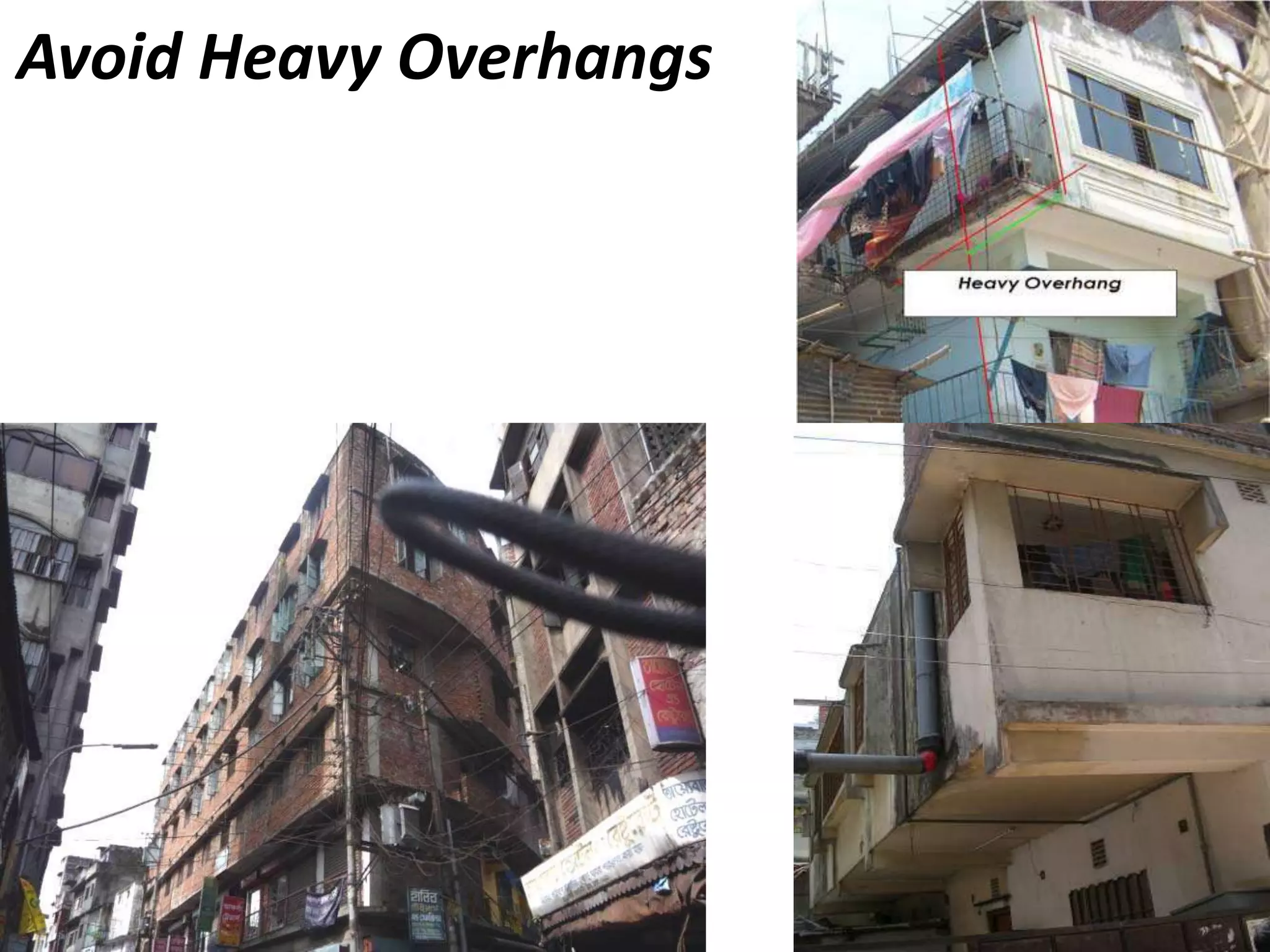
Avoid Heavy Overhangs
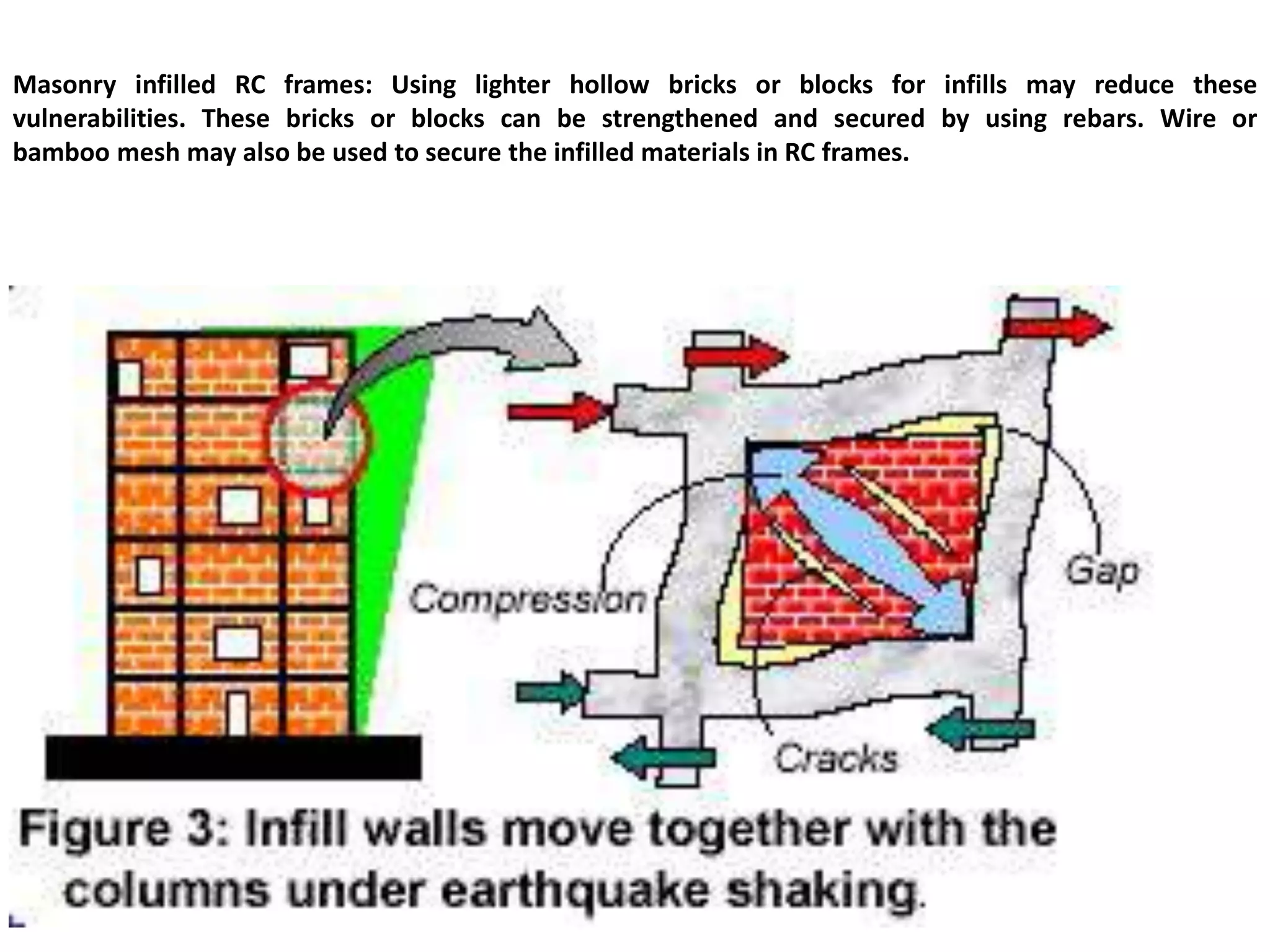
Masonry infilled RC frames: Using lighter hollow bricks or blocks for infills may reduce these
vulnerabilities. These bricks or blocks can be strengthened and secured by using rebars. Wire or
bamboo mesh may also be used to secure the infilled materials in RC frames.
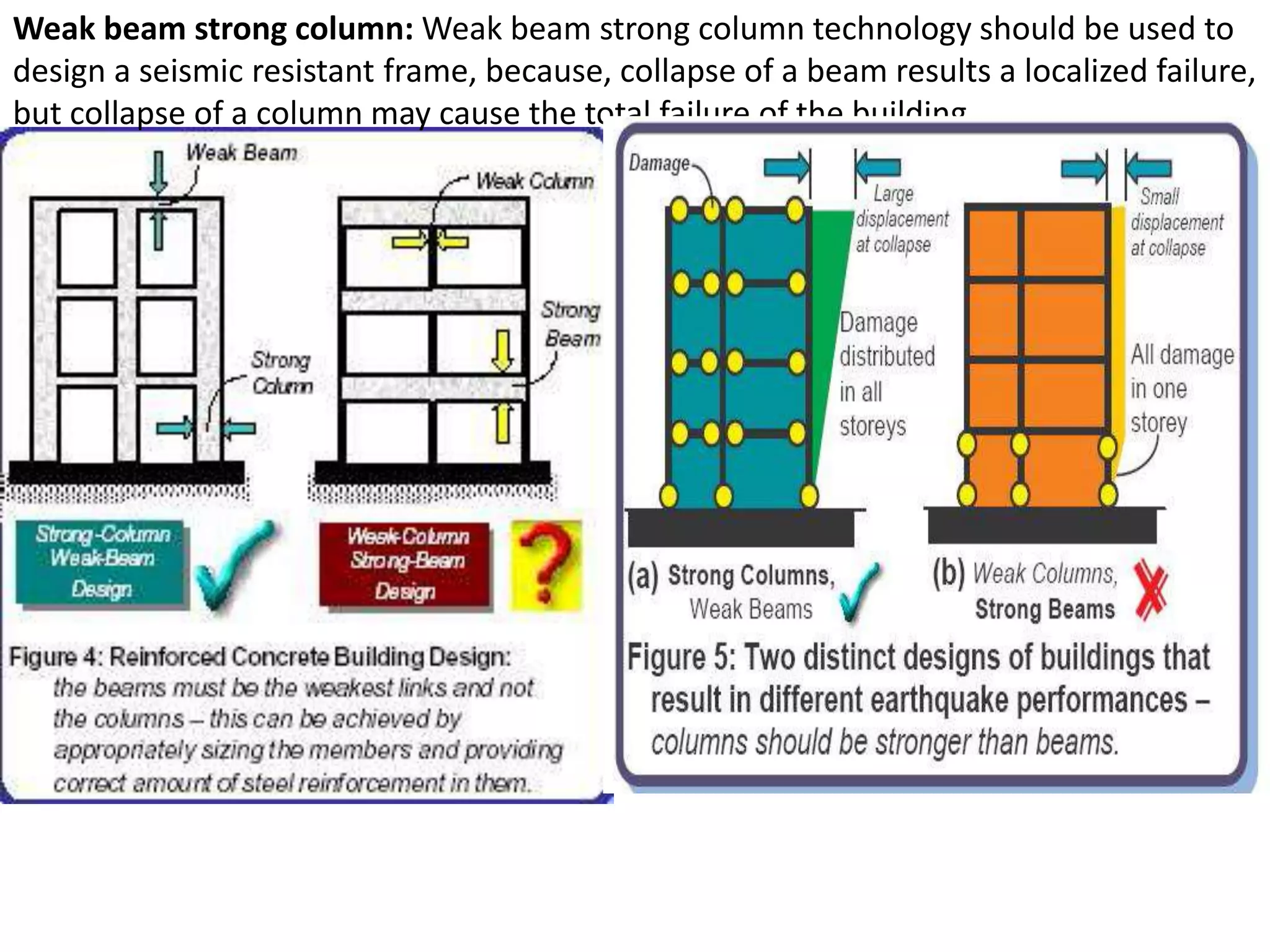
Weak beam strong column: Weak beam strong column technology should be used to
design a seismic resistant frame, because, collapse of a beam results a localized failure,
but collapse of a column may cause the total failure of the building
Few facts about column and beam:
•Seismic Inertia Forces generated at its floor level is
transferred through its beam and column to the ground
• Failure of a column can affect the stability of the whole
building
• Failure of beam causes localized effect
• Correct building components should be ductile
• RC building should be designed using strong column
weak beam design method
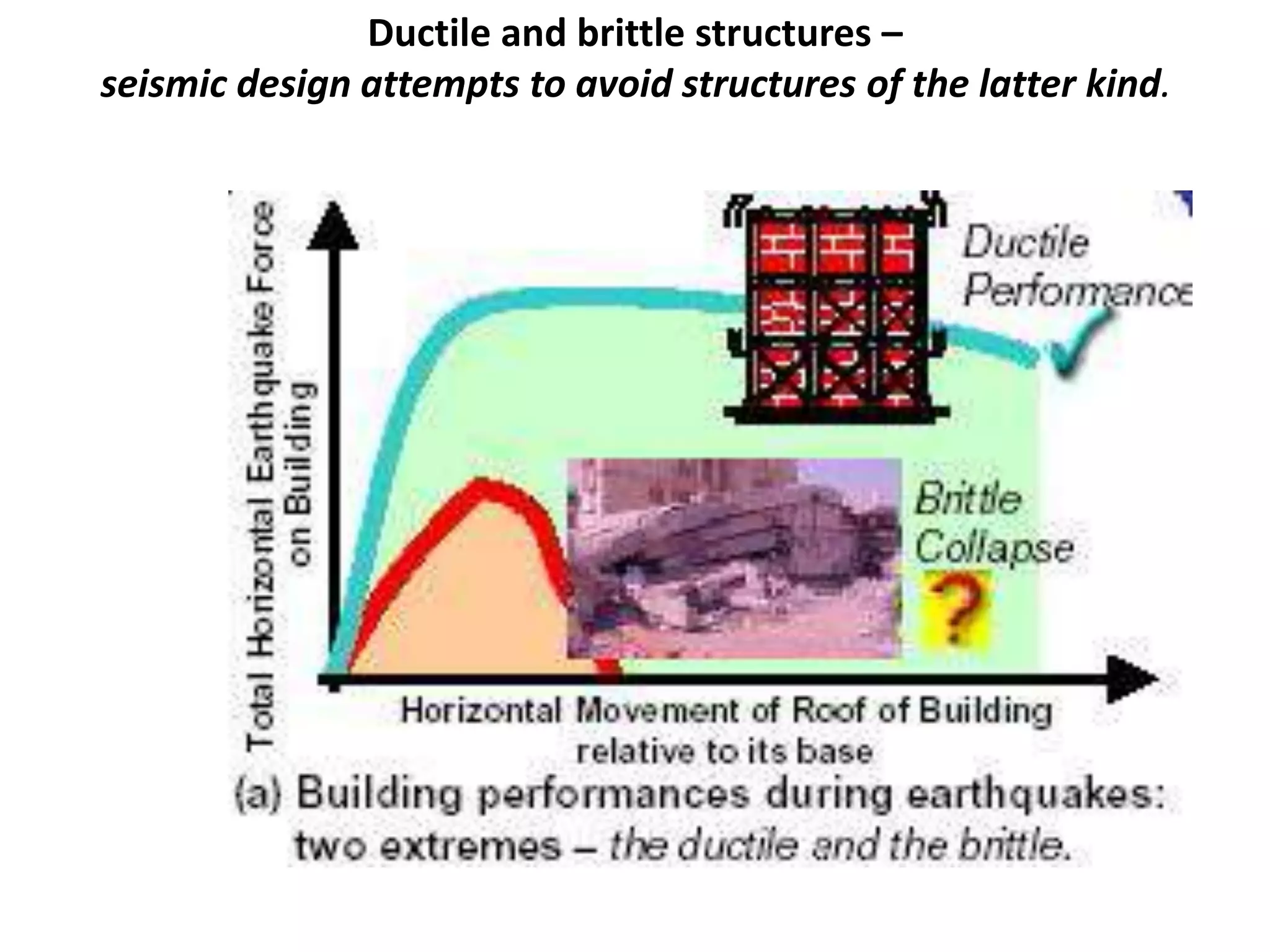
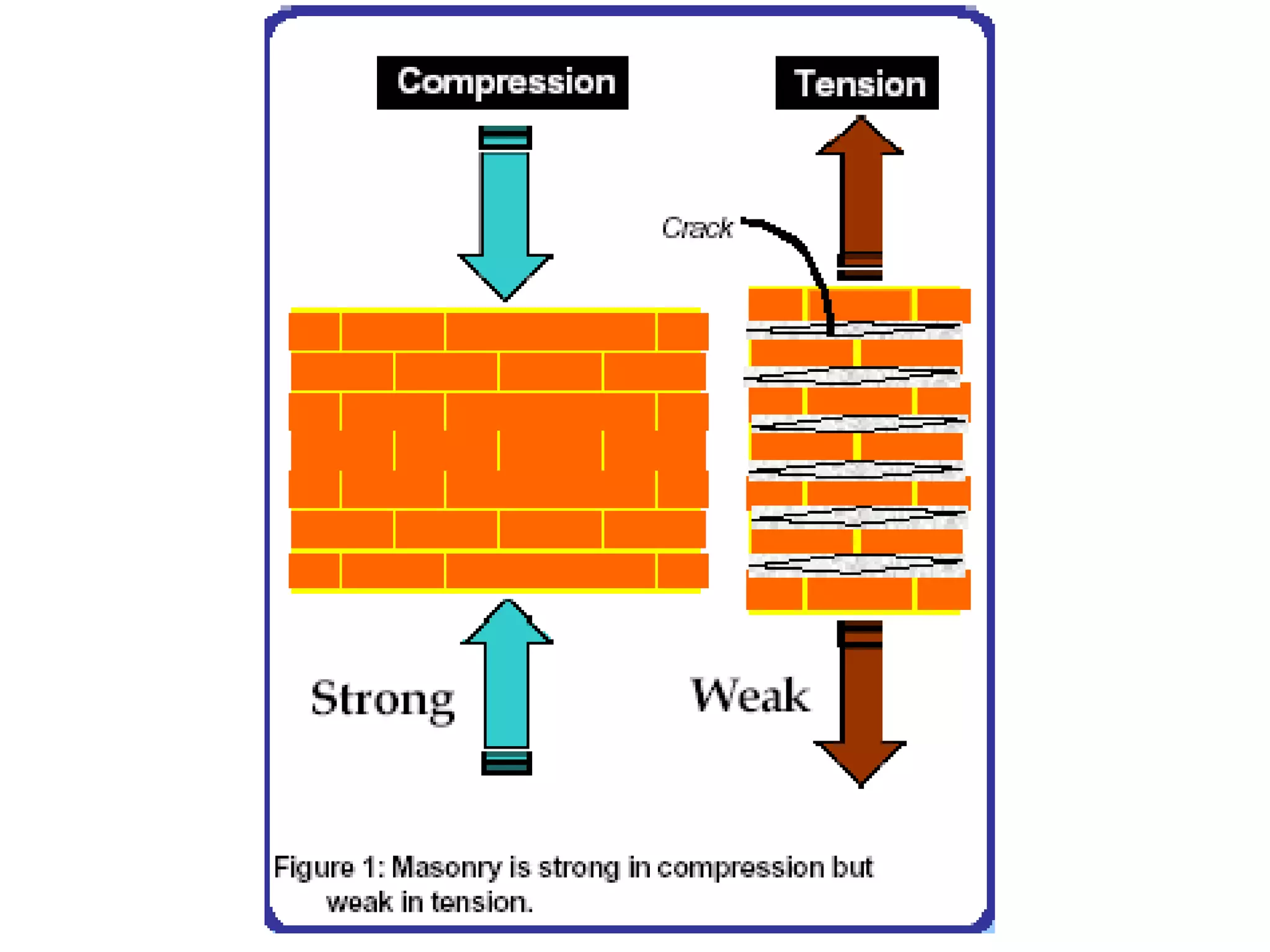
Ductile and brittle structures –
seismic design attempts to avoid structures of the latter kind.
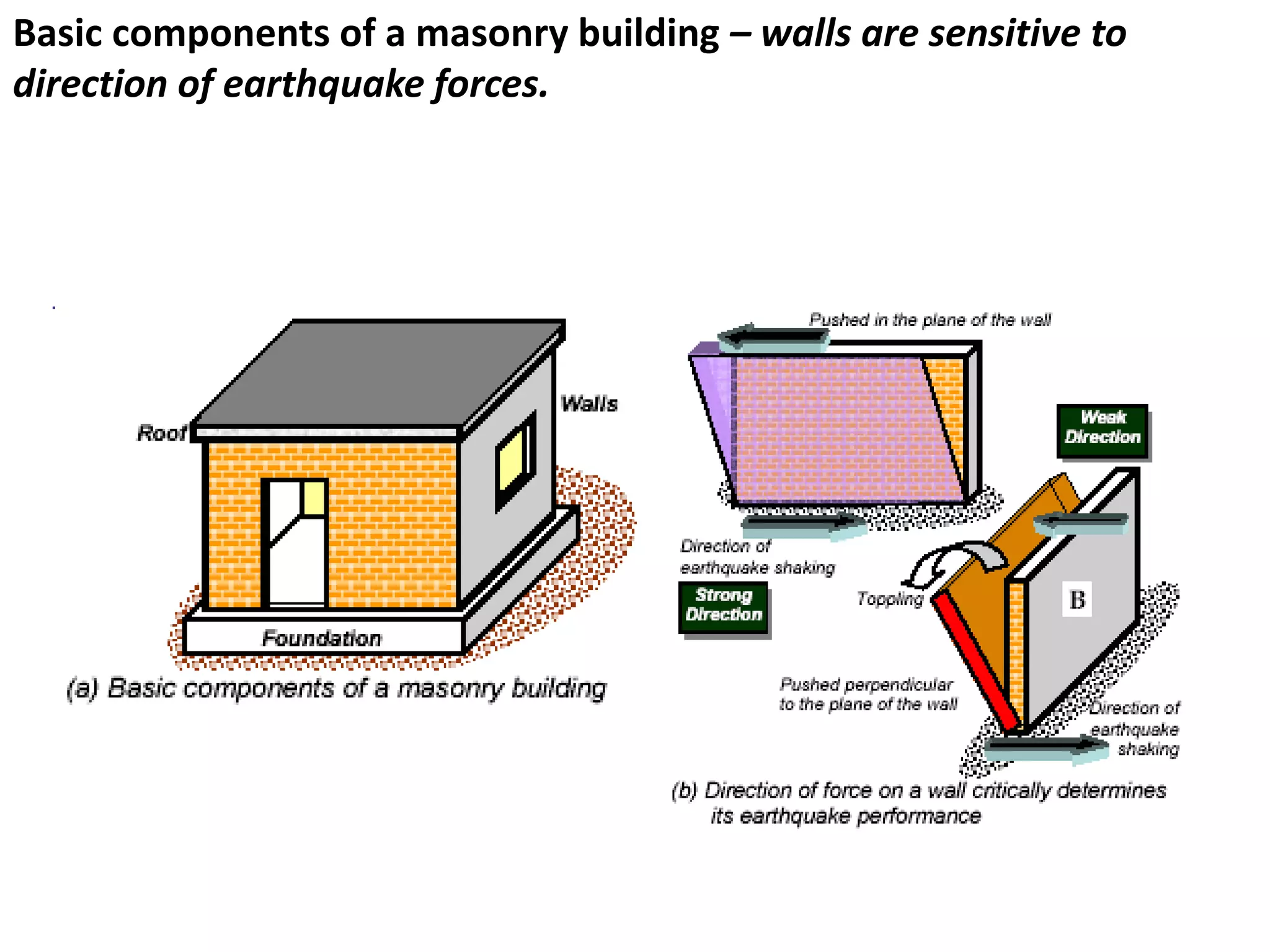
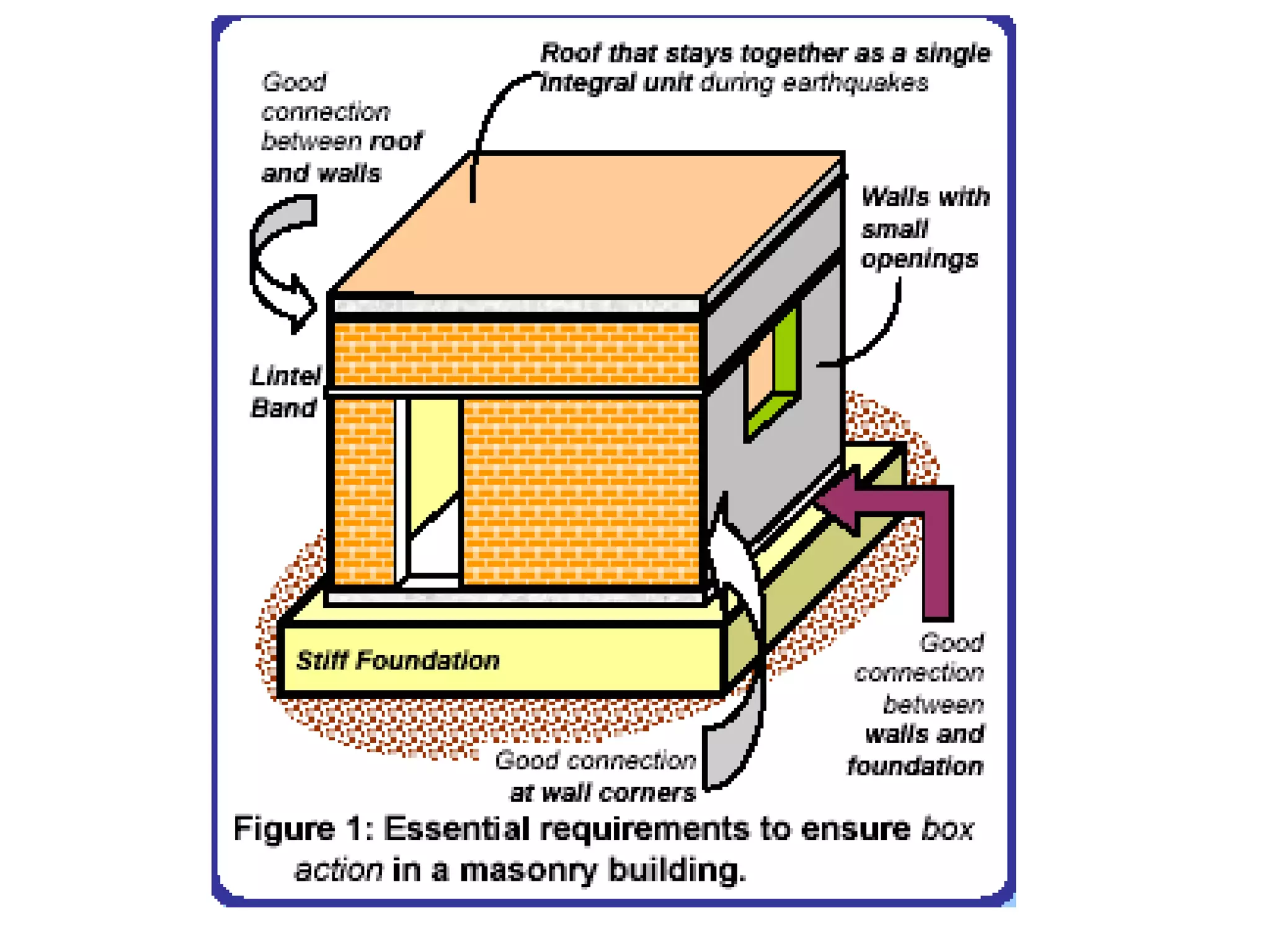
Basic components of a masonry building – walls are sensitive to
direction of earthquake forces.
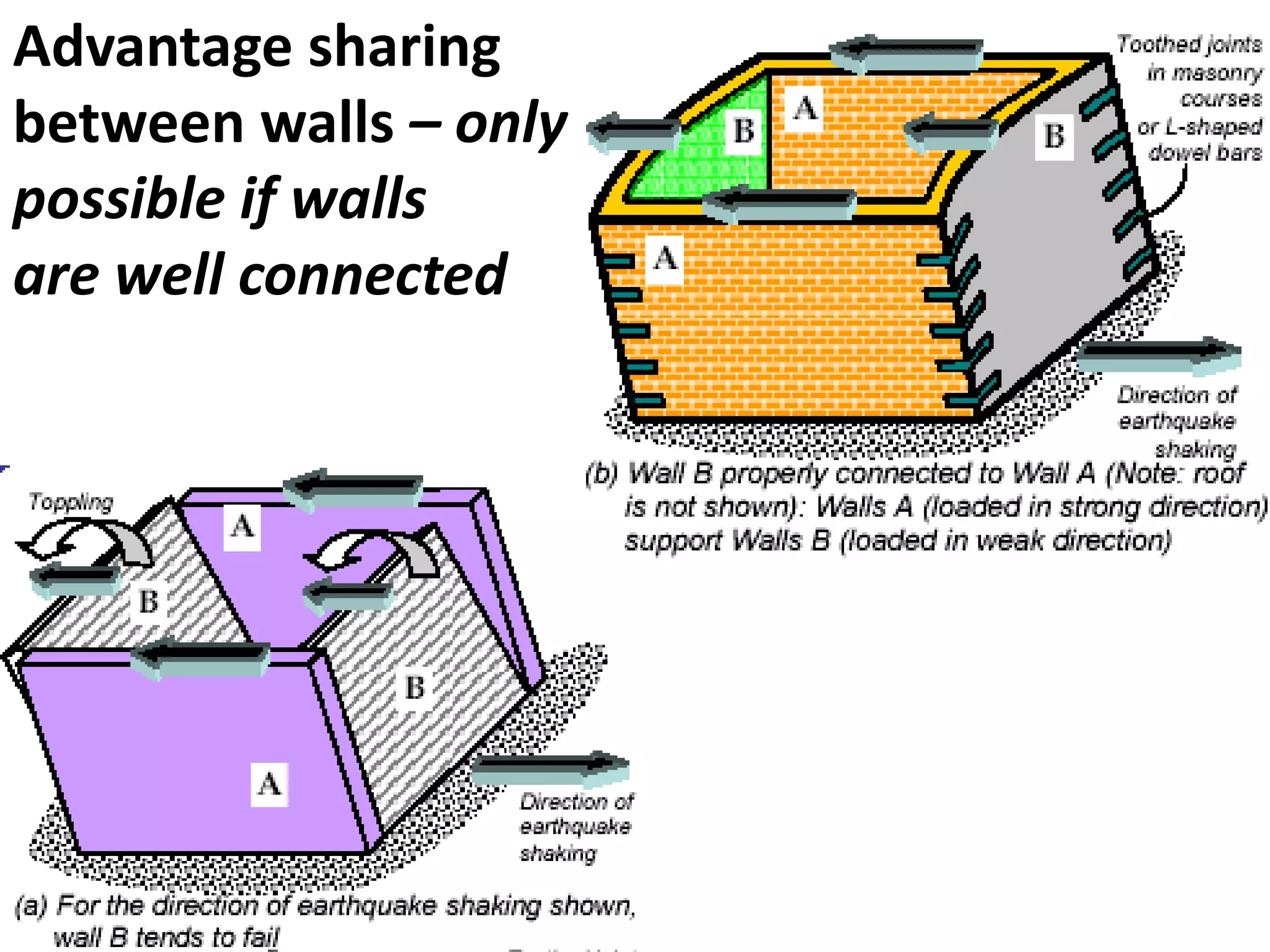
Advantage sharing
between walls – only
possible if walls
are well connected
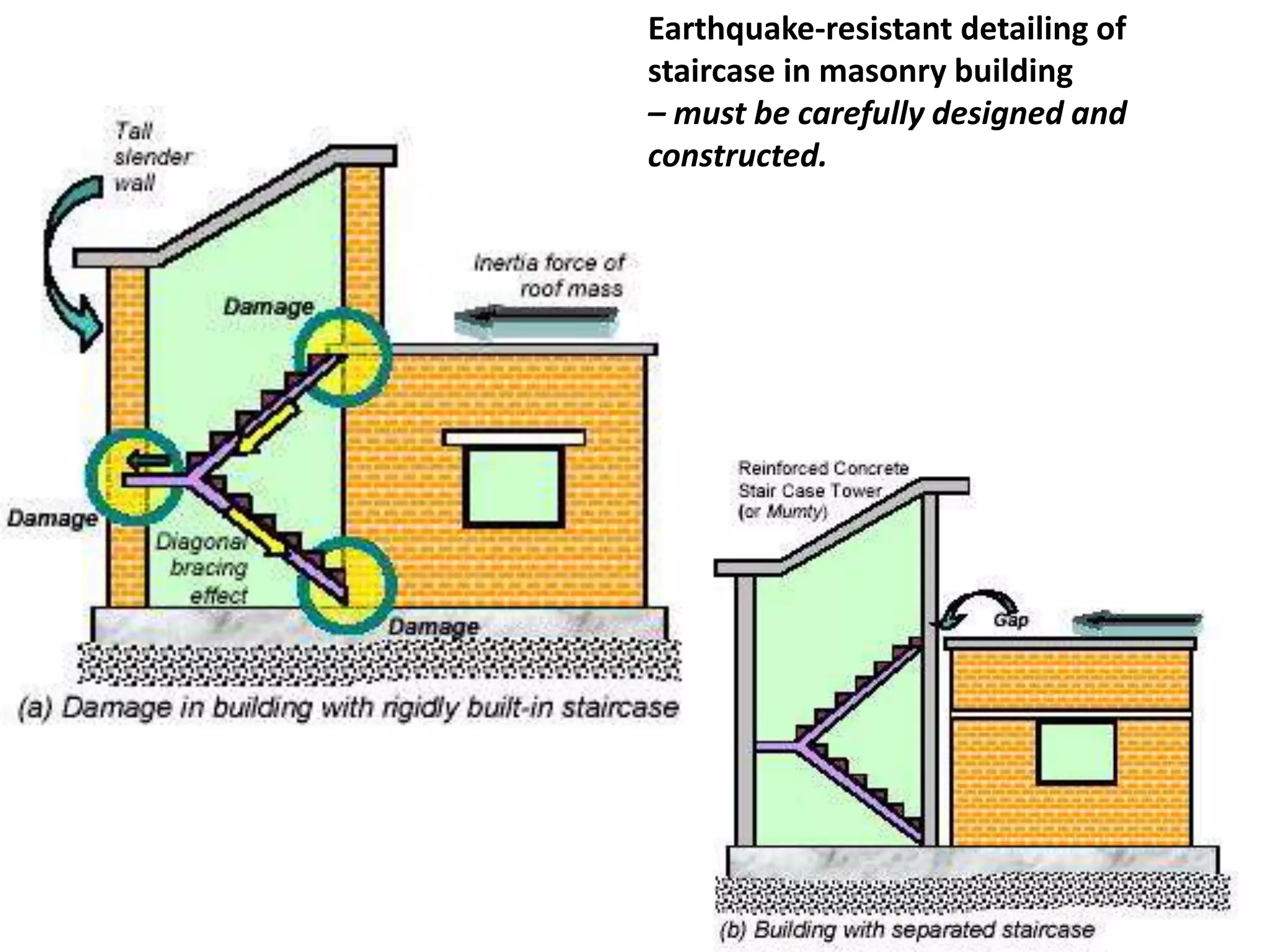
Earthquake-resistant detailing of
staircase in masonry building
– must be carefully designed and
constructed.
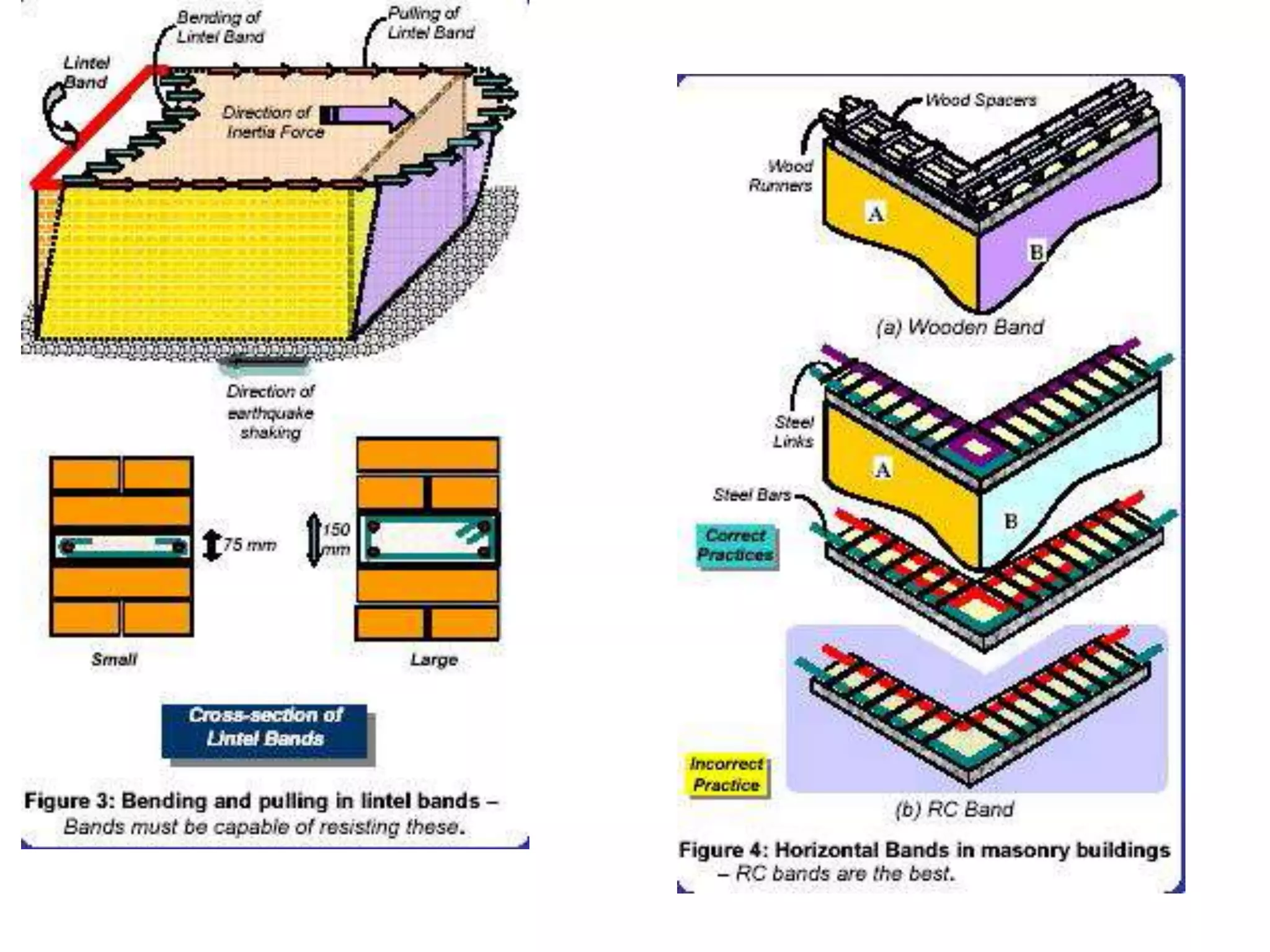
Horizontal Bands in masonry building
–Improve earthquake-resistance.
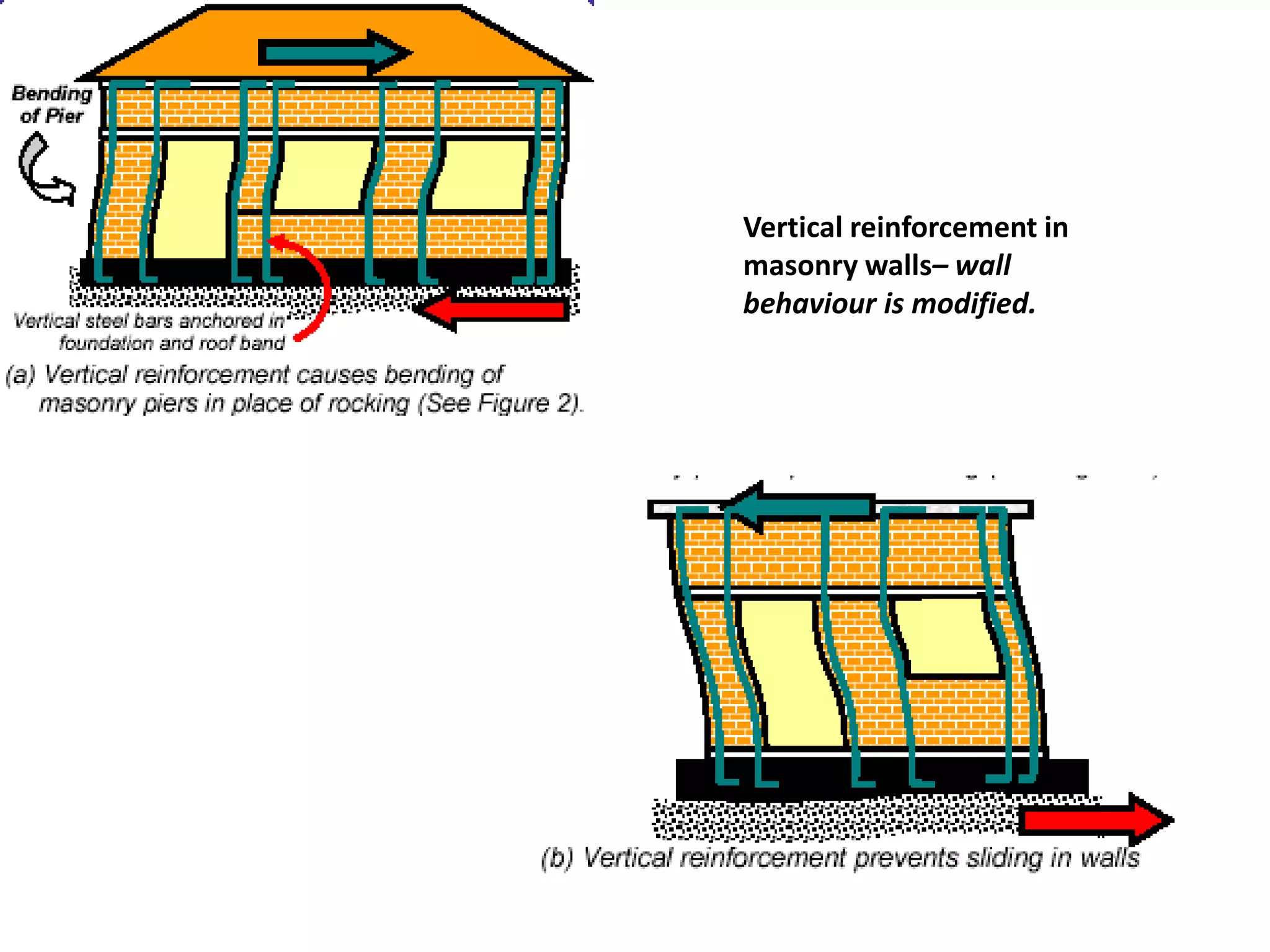
Earthquake response of a hipped roof masonry building – no vertical
reinforcement is provided in walls.
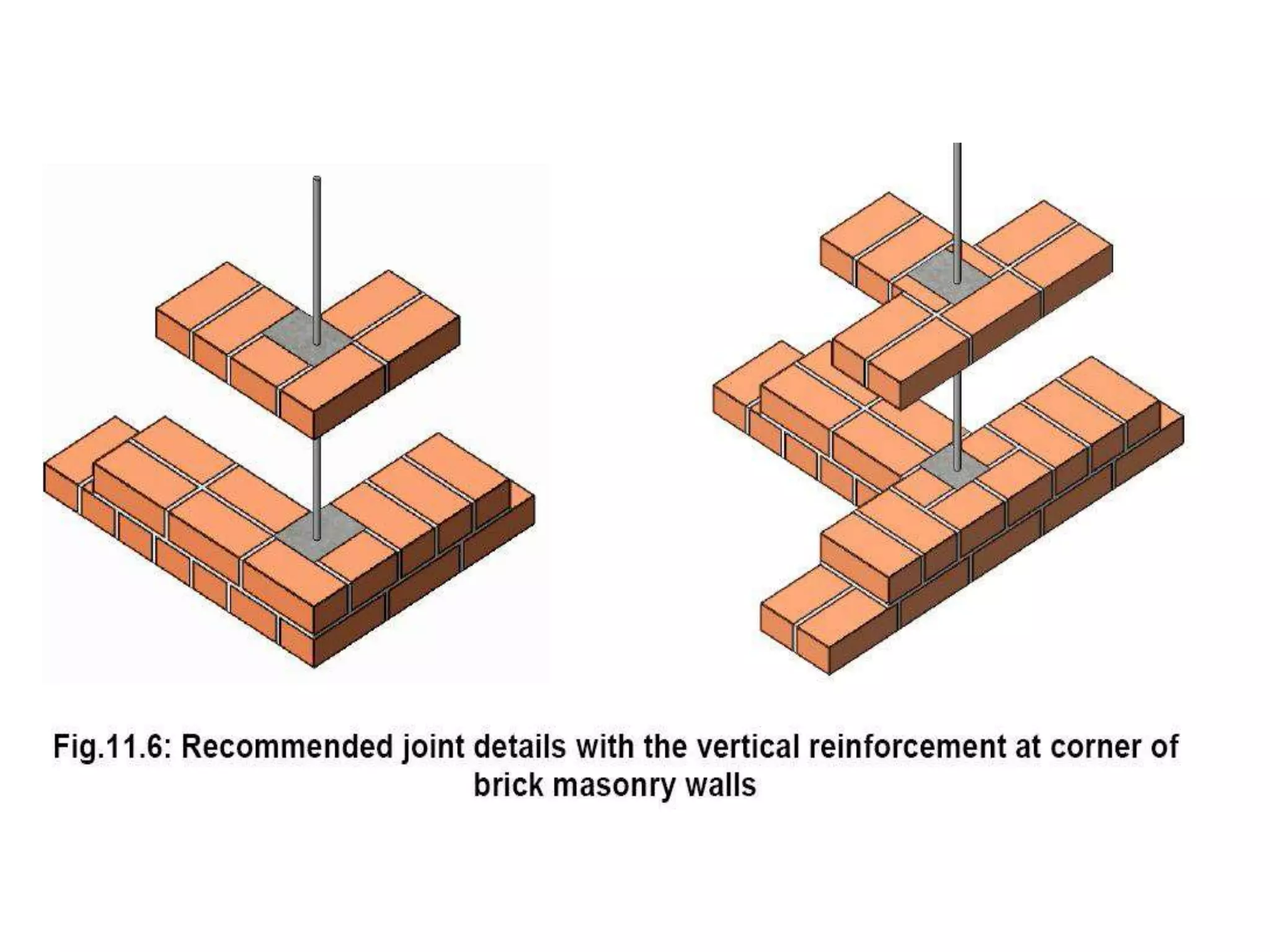
Vertical reinforcement in
masonry walls– wall
behaviour is modified.
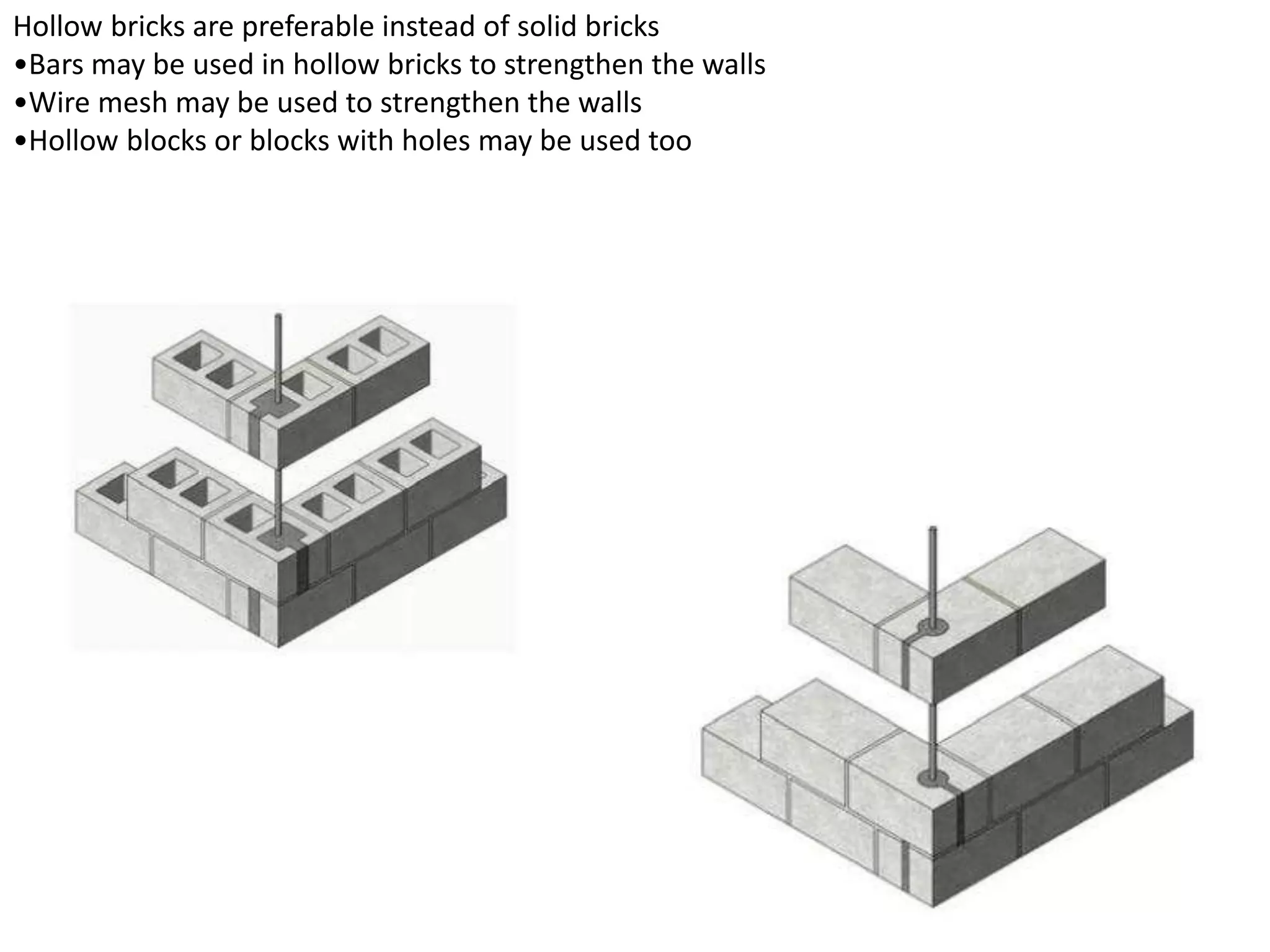
Hollow bricks are preferable instead of solid bricks
•Bars may be used in hollow bricks to strengthen the walls
•Wire mesh may be used to strengthen the walls
•Hollow blocks or blocks with holes may be used too
Thank you

Lecture earthquake-3

  • 1.
    Earthquake Management Part-1 Composed by H.M.A.Mahzuz Assistant Professor (PhD Fellow), Department of Civil and Environmental Engineering, Shahjalal University of Science & Technology, Sylhet, Bangladesh. E-mail: mahzuz_211@ yahoo.com
  • 2.
    Outline of thelecture 1) Organizations for responsible for earthquake management. 2) Can we predict an earthquake? 3) Earthquake Management Cycle 4) Seismic Design Philosophy 5) Some unfavorable building configurations Considering Earthquake
  • 3.
    1) Organizations forresponsible for earthquake management. Several Responsible Organizations/Wings (GO) for Earthquake Fighting • Ministry of Disaster Management and Relief • National Disaster Management Advisory Committee (NDMAC) • National Disaster Management Council (NDMC), • Inter Ministerial Disaster Management Coordination Committee (IMDMCC), • Director General of Food (DGFood), • Directorate of Relief and Rehabilitation (DRR), • Disaster Management Bureau (DMB) • Food Division, Union Disaster Management Committee (UDMC) • Upazila Disaster Management Committee (UzDMC), • City Corporation Disaster Management Committee (CCDMC), • Zone/Upazila Municipal Disaster Management Committee (MDMC), • District Disaster Management Committee (DDMC), • National Platform for Disaster Risk Reduction (NPDRR)
  • 4.
    Bangladesh NGO Foundation BangladeshRural Improvement Fund (BRIF) ASA United Nations in Bangladesh Care Programs Bangladesh Grameen Action aid bangladesh BRAC Noakhali Rural Devlopment Society Odhikar Ahsania Mission Shahjahan Foundation - Registered Charity in UK, Unnayan Ngo USAID Bangladesh Families for Children Coast Coastal Association for Social Transformation Trust Red Cross and Red Crescent Societies NGO Forum Several Responsible Organizations/Wings (NGO) for Earthquake Fighting
  • 5.
    2) Can wepredict an earthquake? Science has not reached at that stage as yet!!
  • 6.
    How much time dowe have to predict an earthquake??
  • 7.
    What's about the Landof Earthquake- Japan????!!!
  • 8.
    The Earthquake EarlyWarning (EEW) is a warning issued just after an earthquake in Japan is detected. The warnings are issued mainly by the Japan Meteorological Agency (JMA), and they issue tips on how to react to the warnings. Hit/ Success rate JMA announced the hit rate of Earthquake Early Warning (EEW) on 31 May 2012, end of fiscal year 2011. The hit rate defined here is that the Japan Meteorological Agency seismic intensity scale number with warning issued immediately upon P-waves detected is fall or hit within plus- minus 1 Magnitude-Shindo Number, ranges 0 to 7, out of ten numbers actually measured Magnitude-Shindo Number as the single earthquake. Fiscal year 2007: 75% Fiscal year 2008: 82% Fiscal year 2009: 76% Fiscal year 2010: 28% Fiscal year 2011: 56% Fiscal year 2007 to 2009 hit rate recorded over 75%. Fiscal year 2010 hit rate came down to 28% due to the number of successive aftershock after 2011 Tōhoku earthquake and tsunami which occurred almost the end of fiscal year 2010, 11 March 2011. The hit rate was 72% till 10 March 2011 in fiscal year 2010. The reason of hit rate came down to 28% from 72% is very successive plural number of aftershock judged to single large earthquake. The computer program has been improved to ignore small scale earthquake from predicting program to increase hit rate and fiscal year 2011 hit rate increased to 56%. JMA aims to increase hit rate over 85% in fiscal year 2015.
  • 9.
    Prediction: Earthquake prediction byany geoscientist is far from success; however a detailed and systematic investigation may lift its prediction. Earthquake prediction in an area may be carried out under following heads: a. Lithological characterization and structural setting of the region. b. Crustal deformational studies. c. Frequency of fore shock. d. Repetitive land level survey. e. Water tube tilt meters. f. Geomagnetic observation. g. Geothermal gradient. h. Gravity survey. I. Hazard mapping. A variety of methods have been used for earthquake prediction, ranging from planetary movement to odd behavior of animal but earthquake prediction continues to be an elusive goal.
  • 10.
  • 11.
    ►Emergency (During-Disaster) planningand Activities: →To be mentally strong. →To wear helmet. →Just after feeling the first vibration, all the family members should go out the house at a safe place. →Don’t dive downward in fear. →If it is impossible to get out from the house it is necessary to take shelter near the columns or walls. →Take shelter at the corner of the room if it is brick built. →It is safe to take shelter at the room, under the tables, near the columns. →Come out quickly from water. →Stay away from using lift. →Switched off the gas line and electric line. →Don‘t stay near high-rise building or electric line. → Stop the car while you are in driving. →Don’t stop the car on the bridge.
  • 12.
    Necessary things ofpre-management: →To acquire knowledge about earthquake. →Achieve earthquake relative training. →In establishing buildings must follow the building code and the consultancy of engineers, ensure soil test before construction of building. →Construct building and houses in strong soil. →Use construction materials of proper grade. →Use reinforced concrete column in place of brick. →Keep in hand torch light and first aid materials. →In case of multi-storied building provide emergency stairs. →Keep safe distance between two buildings. →Ensure more stairs to get out of the building. →Incase of high-rise building must provide walls in car parking region. →To protect old building take consultancy from engineers. →Electric line and gas line must be kept save, as it is switched off easily. →Provide helmet for all the members of the family as it can be used during earthquake. →Make beds and tables with strong wood as to take shelter under them if necessary. →Provides more doors in the buildings to go to safe place during earthquake. →Make conscious all the family members about earthquake.
  • 13.
    ►Post Earthquake Planningand Activities: The post-earthquake steps that should be taken in urban centers after earthquake disasters include: →Detailed surveys regarding repair, restoration and condemnation decisions. →Assessment of socioeconomic conditions, resources. →Measures and policies for relief, resettlement, rehabilitation, and redevelopment. →Re-establishment of government services. →Institutional framework, implementing agencies. →Disaster accounting. →Planning and coordination of rehabilitation and reconstruction assistance. →Sitting of new settlements and communities. →Retrofit of design codes and construction standards. →Training and education programs. →Reconstruction.
  • 14.
    Severity of groundshaking at a given location during an earthquake can be minor, moderate and strong. Relatively speaking, minor shaking occurs frequently, moderate shaking occasionally and strong shaking rarely.  Don’t attempt to make EQ proof building (Bld. Will be too robust and too expensive). Engineering intention shall be to make EQ resistant building 4) Seismic Design Philosophy for Building • Sustain little damage in small-to-moderate quakes (M < 5.5) • Sustain some repairable damage for moderate quakes (5.5 < M < 7.0) • Not collapse in large earthquakes (M > 7.0)
  • 15.
     Explanation ofEarthquake Design Philosophy • Under minor but frequent shaking the main members of the building that carry vertical and horizontal forces should not be damaged, however the building parts that do not carry load may sustain repairable damage • Under moderate but occasional shaking the main members may sustain reparable damage, while the other parts of the building may be damaged such that they may even have to be replaced after the EQ • Under strong but rare shaking the main members may sustain severe damage but the building should not collapse
  • 16.
    5) Some unfavorablebuilding configurations Considering Earthquake
  • 20.
    Sudden deviations inload transfer path along the height lead to poor performance of buildings.
  • 22.
  • 27.
    Avoid Soft story/Short column
  • 33.
  • 35.
    Masonry infilled RCframes: Using lighter hollow bricks or blocks for infills may reduce these vulnerabilities. These bricks or blocks can be strengthened and secured by using rebars. Wire or bamboo mesh may also be used to secure the infilled materials in RC frames.
  • 36.
    Weak beam strongcolumn: Weak beam strong column technology should be used to design a seismic resistant frame, because, collapse of a beam results a localized failure, but collapse of a column may cause the total failure of the building
  • 37.
    Few facts aboutcolumn and beam: •Seismic Inertia Forces generated at its floor level is transferred through its beam and column to the ground • Failure of a column can affect the stability of the whole building • Failure of beam causes localized effect • Correct building components should be ductile • RC building should be designed using strong column weak beam design method
  • 38.
    Ductile and brittlestructures – seismic design attempts to avoid structures of the latter kind.
  • 40.
    Basic components ofa masonry building – walls are sensitive to direction of earthquake forces.
  • 41.
    Advantage sharing between walls– only possible if walls are well connected
  • 43.
    Earthquake-resistant detailing of staircasein masonry building – must be carefully designed and constructed.
  • 44.
    Horizontal Bands inmasonry building –Improve earthquake-resistance.
  • 46.
    Earthquake response ofa hipped roof masonry building – no vertical reinforcement is provided in walls.
  • 47.
    Vertical reinforcement in masonrywalls– wall behaviour is modified.
  • 48.
    Hollow bricks arepreferable instead of solid bricks •Bars may be used in hollow bricks to strengthen the walls •Wire mesh may be used to strengthen the walls •Hollow blocks or blocks with holes may be used too
  • 50.