1
Seismic Disaster Mitigation in Pakistan
Dr. Qaisar Ali
Associate Professor and Deputy Director Earthquake
Engineering Center Department of Civil Engineering NWFP
University of Engineering and Technology, Peshawar Pakistan
2
Roadmap
 Basic terminology - hazard, risk, vulnerability and disaster
 Factors contributing to seismic disaster mitigation
 Hazard assessment in context of the Oct 08 earthquake
 Vulnerability of structures in context of the Oct 08
earthquake
 Recommendations for seismic disaster mitigation in Pakistan
3
Hazard, Risk, Vulnerability
and Disaster ?
How these terms are interconnected
4
Disaster
An event causing widespread human or material
losses which exceeds the ability of the affected
community to cope using its own resources
5
Disaster risk = Hazard x Vulnerability
Source: Satoru NISHIKAWA
Cabinet Office JAPAN
6
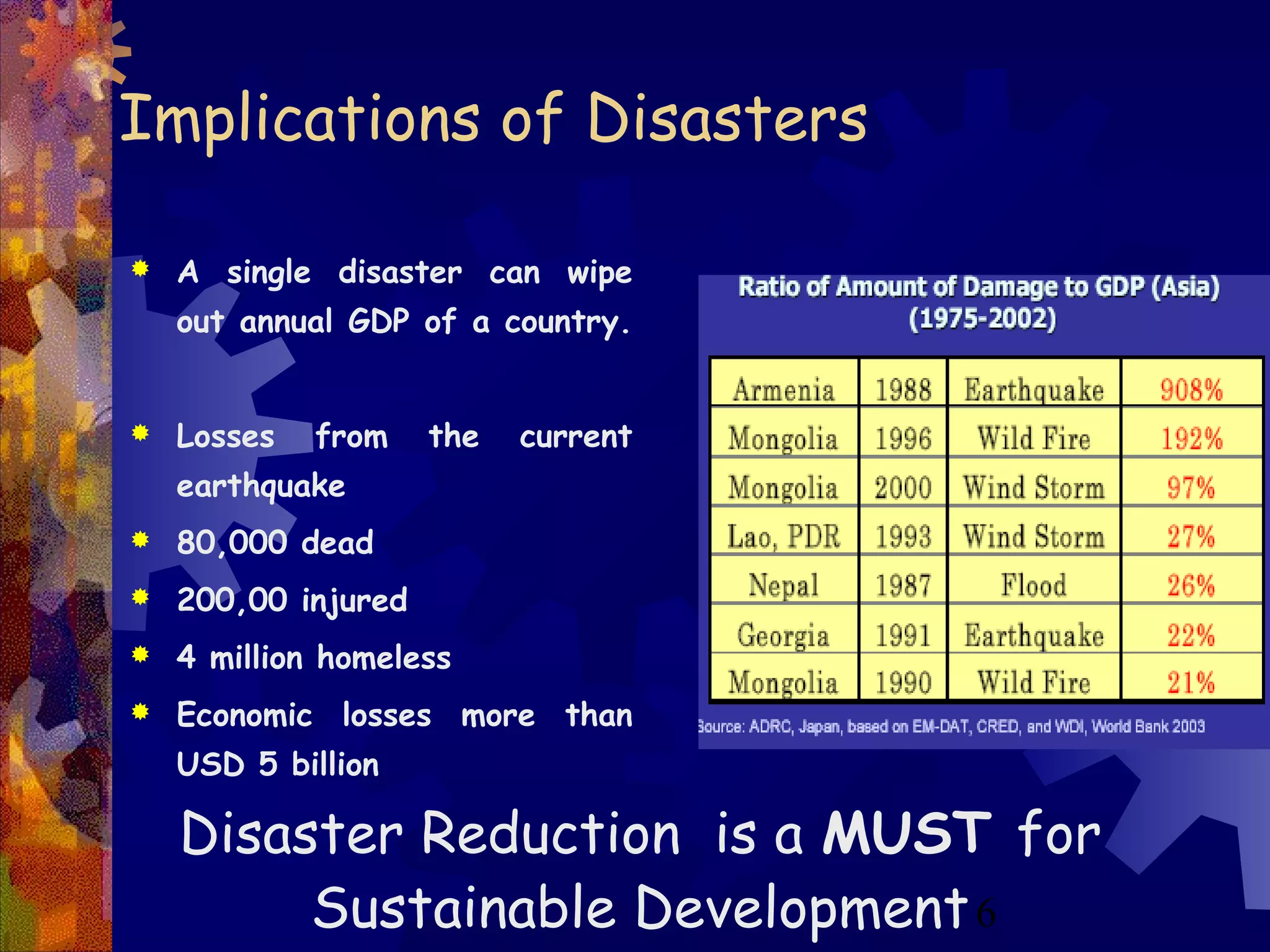
Implications of Disasters
 A single disaster can wipe
out annual GDP of a country.
 Losses from the current
earthquake
 80,000 dead
 200,00 injured
 4 million homeless
 Economic losses more than
USD 5 billion
Disaster Reduction is a MUST for
Sustainable Development
7
Disaster mitigation
Pre-earthquake scenario
 Realistic hazard assessment
 Reducing vulnerability through
 Seismic resistant design of
structures.
 Implementation of code, inspection
and monitoring mechanism.
Post-earthquake scenario
 Emergency preparedness and
planning
8
Seismic hazard zoning of Pakistan and the current
earthquake
Geophysical center Quetta,
Met deptt. of Pakistan
9
Realistic seismic hazard assessment
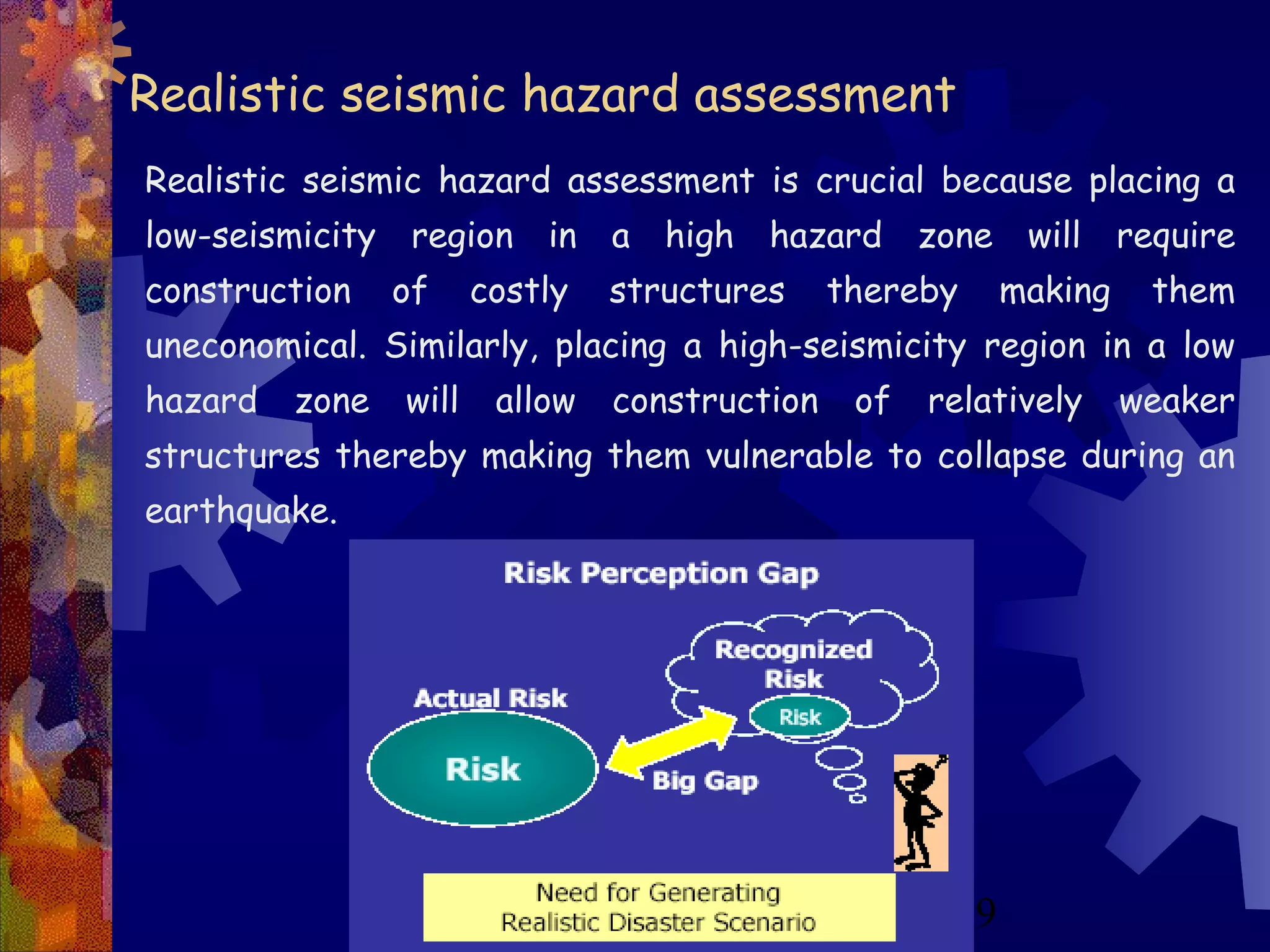
Realistic seismic hazard assessment is crucial because placing a
low-seismicity region in a high hazard zone will require
construction of costly structures thereby making them
uneconomical. Similarly, placing a high-seismicity region in a low
hazard zone will allow construction of relatively weaker
structures thereby making them vulnerable to collapse during an
earthquake.
10
Seismic Vulnerability
Low Seismic capacity of buildings due to low quality
of material, improper design and construction;
buildings constructed on loose soil, or constructed
in areas prone to liquefaction and land slides etc.
will make the structures vulnerable to collapse
during an earthquake.
11
Seismic vulnerability with respect to
the Oct 08, earthquake
12
Stone masonry buildings constitute around 40% of the total building
stock. (20% of it in cities and 80% in villages).
Approx 95 % of buildings either completely collapsed or got severely
damaged.
Undressed stone masonry Dressed stone masonry
Smooth round stones in mud mortar, or low quality cs mortars,
no bond beams, no proper connections
13
30% of the total building stock (100% of it in cities, negligible in
villages) was un-reinforced cement concrete block masonry having
RC roof slab, out of which approx 50% either collapsed or got
severely damaged.
Low quality concrete blocks laid in mud mortar, or low quality
cs mortars, no bond beams, no proper connections
14
Total stock of brick masonry building constitutes around 20%,
(100 % in cities, negligible in villages), out of which less than 5%
collapsed and around 15% got severely damaged.
By and large the brick masonry has performed very well.
Brick masonry building Muzafarabad
15
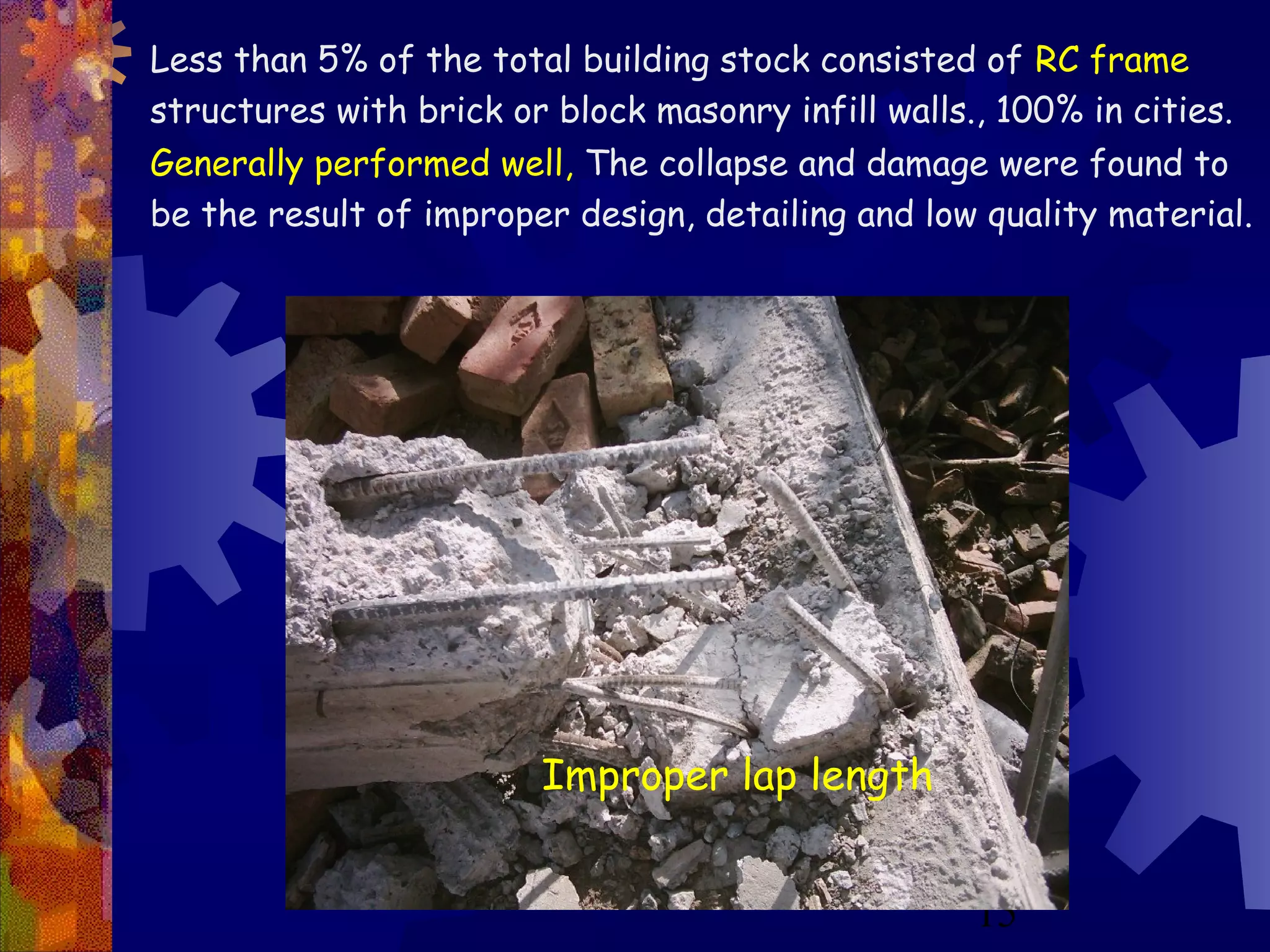
Improper lap length
Less than 5% of the total building stock consisted of RC frame
structures with brick or block masonry infill walls., 100% in cities.
Generally performed well, The collapse and damage were found to
be the result of improper design, detailing and low quality material.
16
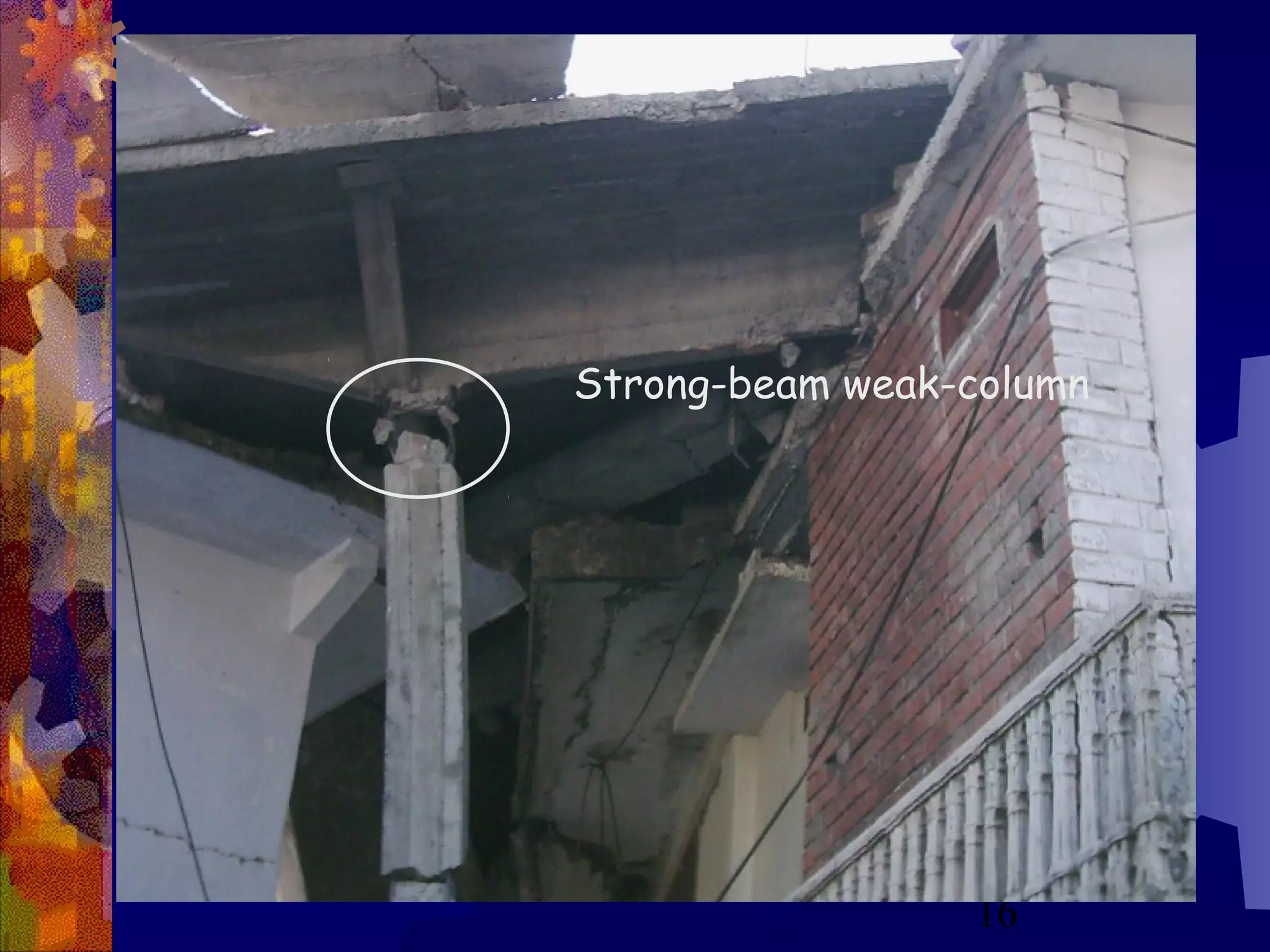
Strong-beam weak-column
17
Incredible
18
Improper lateral reinforcement
19
20
Water tanks collapse occurred as far as 200
km from the epicenter
21
Original position of
deck
1 meter
displacement
Life lines---Bridges
22
Pipe lines transmission lines
23
Massive land sliding washed out entire villages
24
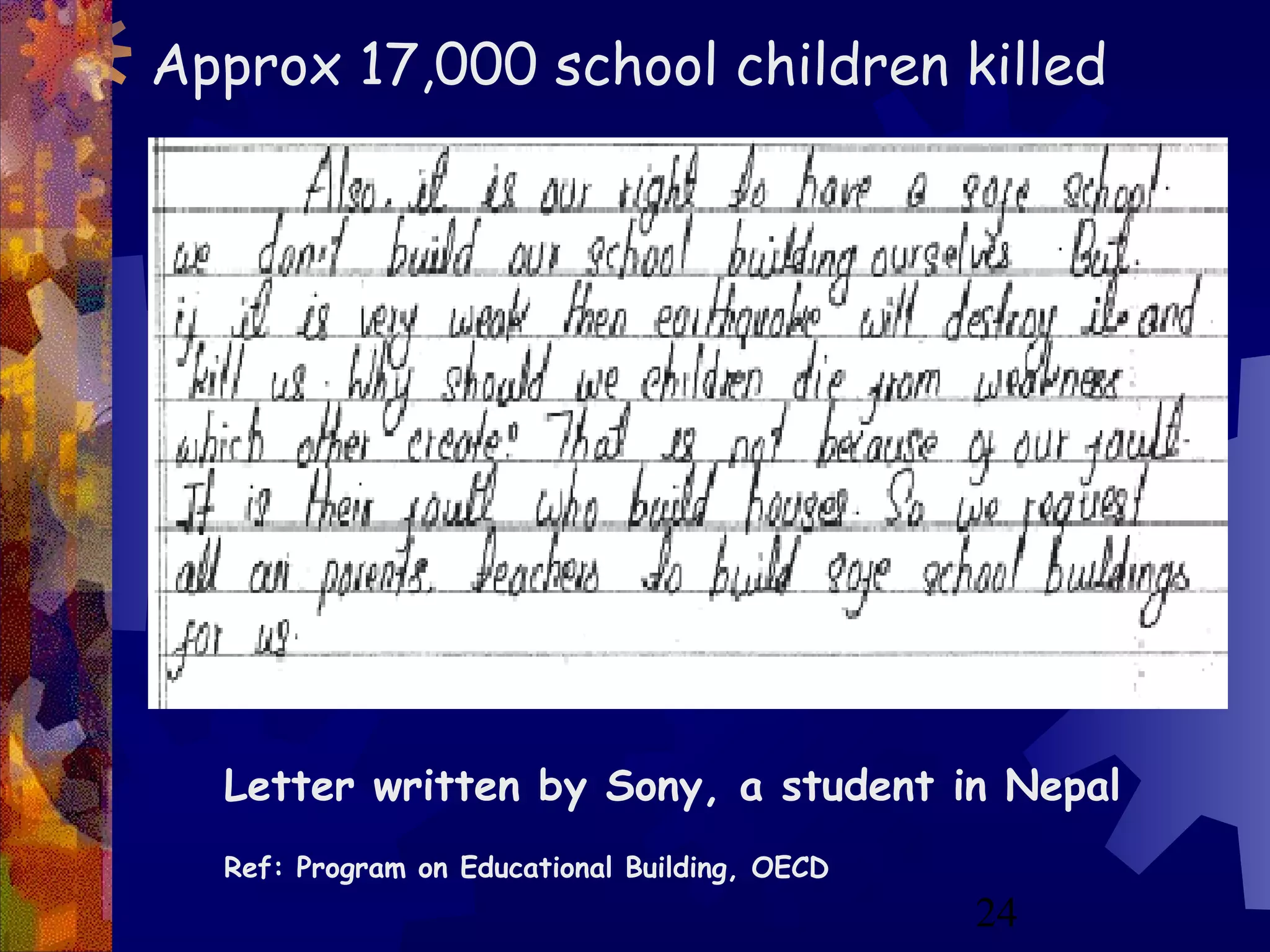
Letter written by Sony, a student in Nepal
Ref: Program on Educational Building, OECD
Approx 17,000 school children killed
25
None-existence of
 seismic design guidelines and building codes.
 site specific ground characteristics for seismic
design.
 scientifically determined indigenous material
properties.
 trained professionals for carrying out construction
activities in seismic prone areas
 awareness of general public for realizing the
seismic risk.
 Implementing/regulating and inspection mechanism
for construction monitoring
Issues contributing towards seismic
vulnerability
26
Emergency preparedness and
planning
In the post-earthquake scenario the
quantum of disaster can increase
enormously due to lack of effective
emergency preparedness and planning
strategies.
27
Measures to be taken to
avoid disasters in future ?
28
29
Short Term measures
 For the reconstruction of the affected areas, general seismic guidelines and building
recommendations can be adapted from already established international codes. This
should act like an interim code and not as a permanent code for the country. To develop a
proper seismic code for the country will take time.
 The enactment of a law for strict enforcement of these recommendations is also
required.
 Training should be imparted to the contractors, masons, construction supervisors and local
government hierarchy at the union council and tehsil level for effective reconstruction
and rehabilitation activities.
 The design and construction of educational institutions, hospitals and other important
government buildings should be given special attention. The EEC should be involved in this
process.
30
Short Term measures---
 Construction of new buildings in the areas prone to landsliding and
liquefaction should be avoided.
 Rapid assessment of damaged public and private buildings is crucial.
There should be authorized qualified technical professionals to carry
out these activities. (Fear among the people is so high that even some
slightly damaged buildings have been declared as uninhabitable.)
 Repair, strengthening and /or retrofitting of existing buildings
deficient in seismic capacity is also vital.
31
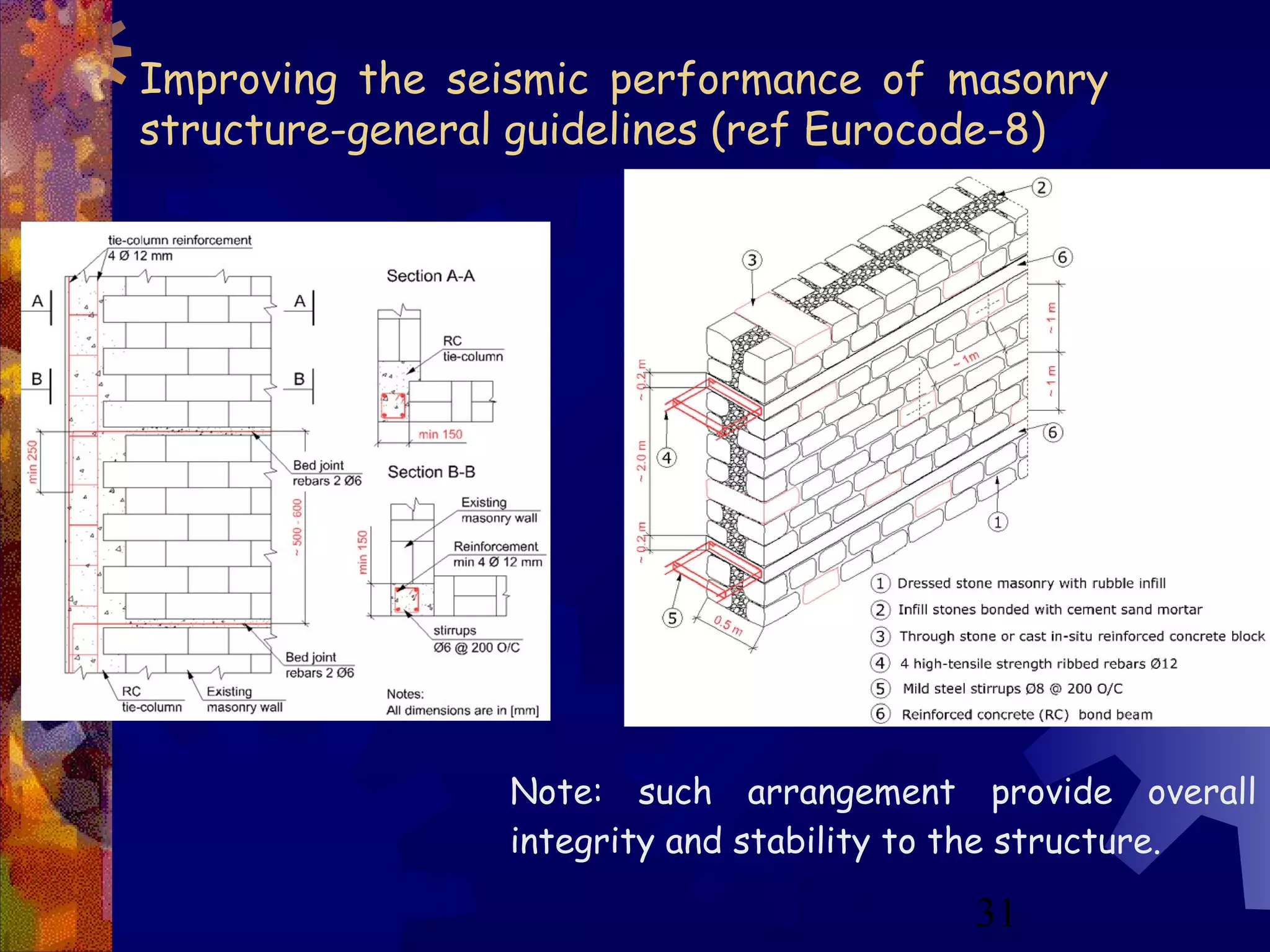
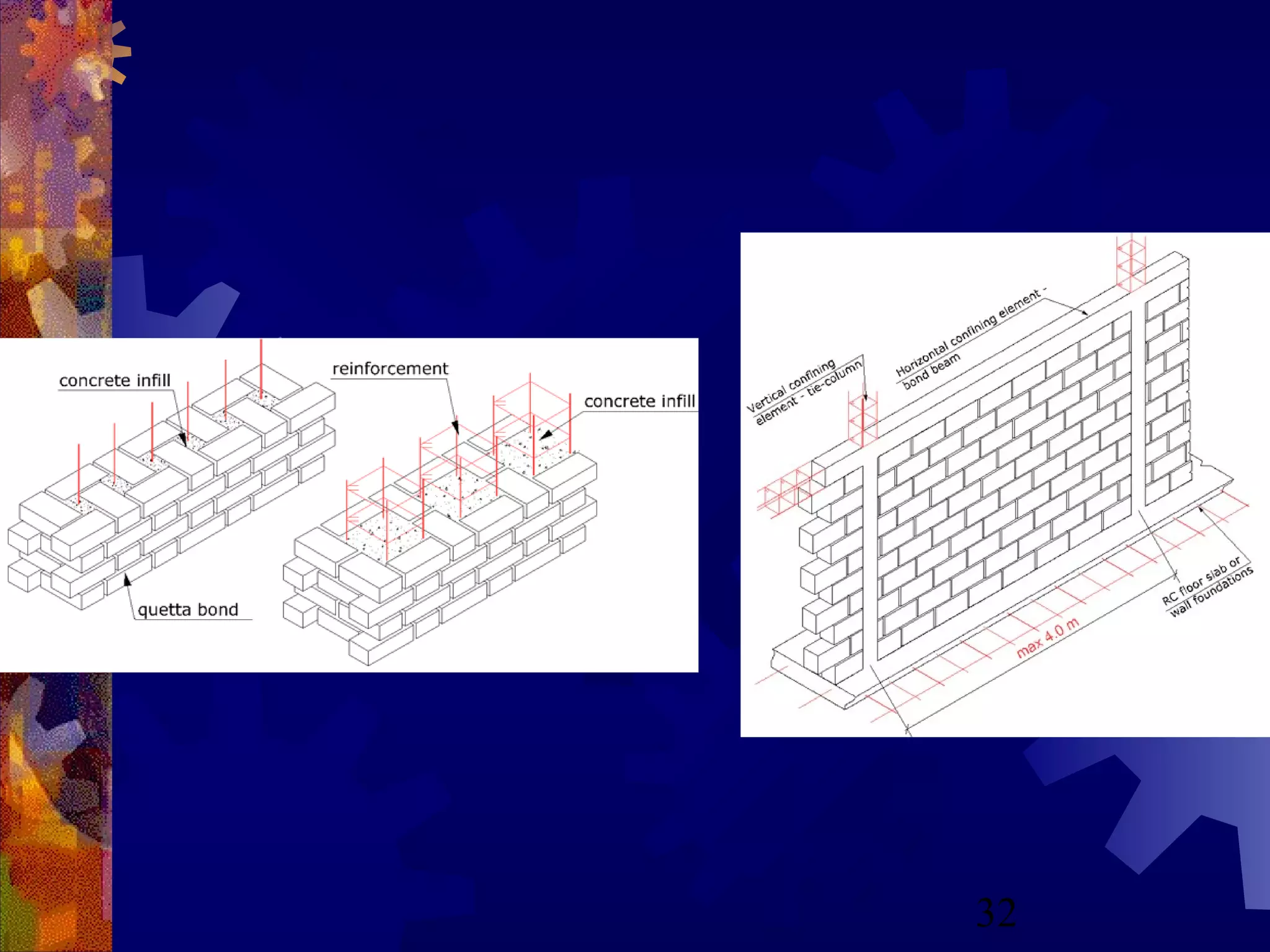
Improving the seismic performance of masonry
structure-general guidelines (ref Eurocode-8)
Note: such arrangement provide overall
integrity and stability to the structure.
32
33
Long term measures
 Installation of strong motion net work
 Development of seismic hazard maps based on PGA and
PGV, liquefaction and landslide maps, micro zoning for
highly seismic prone regions etc.
 Development of seismic code for the country
 Seismic risk assessment for various categories of buildings
and engineering structures.
 Structural assessment of important buildings such as dams,
long span bridges, educational institutions, hospitals,
secretariat etc and their strengthening, if required.
34
Long term measures (contd)
 Technology development for low cost base isolation and
damper systems for brittle structures.
 Development of repair and strengthening techniques for
seismically distressed local structural systems.
 Development of disaster mitigation methodologies.
 Seismic risk assessment for sustainability of life lines
including, highways, railways, Gas, Sewerage and Water pipe
lines and electricity transmission lines etc.
35
Proverb by Japanese Physics Scientist Dr.
Torahiko
“Natural disasters will hit us by
the time people have forgotten
about it”
36
Thanks

Earthquake design

  • 1.
    1 Seismic Disaster Mitigationin Pakistan Dr. Qaisar Ali Associate Professor and Deputy Director Earthquake Engineering Center Department of Civil Engineering NWFP University of Engineering and Technology, Peshawar Pakistan
  • 2.
    2 Roadmap  Basic terminology- hazard, risk, vulnerability and disaster  Factors contributing to seismic disaster mitigation  Hazard assessment in context of the Oct 08 earthquake  Vulnerability of structures in context of the Oct 08 earthquake  Recommendations for seismic disaster mitigation in Pakistan
  • 3.
    3 Hazard, Risk, Vulnerability andDisaster ? How these terms are interconnected
  • 4.
    4 Disaster An event causingwidespread human or material losses which exceeds the ability of the affected community to cope using its own resources
  • 5.
    5 Disaster risk =Hazard x Vulnerability Source: Satoru NISHIKAWA Cabinet Office JAPAN
  • 6.
    6 Implications of Disasters A single disaster can wipe out annual GDP of a country.  Losses from the current earthquake  80,000 dead  200,00 injured  4 million homeless  Economic losses more than USD 5 billion Disaster Reduction is a MUST for Sustainable Development
  • 7.
    7 Disaster mitigation Pre-earthquake scenario Realistic hazard assessment  Reducing vulnerability through  Seismic resistant design of structures.  Implementation of code, inspection and monitoring mechanism. Post-earthquake scenario  Emergency preparedness and planning
  • 8.
    8 Seismic hazard zoningof Pakistan and the current earthquake Geophysical center Quetta, Met deptt. of Pakistan
  • 9.
    9 Realistic seismic hazardassessment Realistic seismic hazard assessment is crucial because placing a low-seismicity region in a high hazard zone will require construction of costly structures thereby making them uneconomical. Similarly, placing a high-seismicity region in a low hazard zone will allow construction of relatively weaker structures thereby making them vulnerable to collapse during an earthquake.
  • 10.
    10 Seismic Vulnerability Low Seismiccapacity of buildings due to low quality of material, improper design and construction; buildings constructed on loose soil, or constructed in areas prone to liquefaction and land slides etc. will make the structures vulnerable to collapse during an earthquake.
  • 11.
    11 Seismic vulnerability withrespect to the Oct 08, earthquake
  • 12.
    12 Stone masonry buildingsconstitute around 40% of the total building stock. (20% of it in cities and 80% in villages). Approx 95 % of buildings either completely collapsed or got severely damaged. Undressed stone masonry Dressed stone masonry Smooth round stones in mud mortar, or low quality cs mortars, no bond beams, no proper connections
  • 13.
    13 30% of thetotal building stock (100% of it in cities, negligible in villages) was un-reinforced cement concrete block masonry having RC roof slab, out of which approx 50% either collapsed or got severely damaged. Low quality concrete blocks laid in mud mortar, or low quality cs mortars, no bond beams, no proper connections
  • 14.
    14 Total stock ofbrick masonry building constitutes around 20%, (100 % in cities, negligible in villages), out of which less than 5% collapsed and around 15% got severely damaged. By and large the brick masonry has performed very well. Brick masonry building Muzafarabad
  • 15.
    15 Improper lap length Lessthan 5% of the total building stock consisted of RC frame structures with brick or block masonry infill walls., 100% in cities. Generally performed well, The collapse and damage were found to be the result of improper design, detailing and low quality material.
  • 16.
  • 17.
  • 18.
  • 19.
  • 20.
    20 Water tanks collapseoccurred as far as 200 km from the epicenter
  • 21.
    21 Original position of deck 1meter displacement Life lines---Bridges
  • 22.
  • 23.
    23 Massive land slidingwashed out entire villages
  • 24.
    24 Letter written bySony, a student in Nepal Ref: Program on Educational Building, OECD Approx 17,000 school children killed
  • 25.
    25 None-existence of  seismicdesign guidelines and building codes.  site specific ground characteristics for seismic design.  scientifically determined indigenous material properties.  trained professionals for carrying out construction activities in seismic prone areas  awareness of general public for realizing the seismic risk.  Implementing/regulating and inspection mechanism for construction monitoring Issues contributing towards seismic vulnerability
  • 26.
    26 Emergency preparedness and planning Inthe post-earthquake scenario the quantum of disaster can increase enormously due to lack of effective emergency preparedness and planning strategies.
  • 27.
    27 Measures to betaken to avoid disasters in future ?
  • 28.
  • 29.
    29 Short Term measures For the reconstruction of the affected areas, general seismic guidelines and building recommendations can be adapted from already established international codes. This should act like an interim code and not as a permanent code for the country. To develop a proper seismic code for the country will take time.  The enactment of a law for strict enforcement of these recommendations is also required.  Training should be imparted to the contractors, masons, construction supervisors and local government hierarchy at the union council and tehsil level for effective reconstruction and rehabilitation activities.  The design and construction of educational institutions, hospitals and other important government buildings should be given special attention. The EEC should be involved in this process.
  • 30.
    30 Short Term measures--- Construction of new buildings in the areas prone to landsliding and liquefaction should be avoided.  Rapid assessment of damaged public and private buildings is crucial. There should be authorized qualified technical professionals to carry out these activities. (Fear among the people is so high that even some slightly damaged buildings have been declared as uninhabitable.)  Repair, strengthening and /or retrofitting of existing buildings deficient in seismic capacity is also vital.
  • 31.
    31 Improving the seismicperformance of masonry structure-general guidelines (ref Eurocode-8) Note: such arrangement provide overall integrity and stability to the structure.
  • 32.
  • 33.
    33 Long term measures Installation of strong motion net work  Development of seismic hazard maps based on PGA and PGV, liquefaction and landslide maps, micro zoning for highly seismic prone regions etc.  Development of seismic code for the country  Seismic risk assessment for various categories of buildings and engineering structures.  Structural assessment of important buildings such as dams, long span bridges, educational institutions, hospitals, secretariat etc and their strengthening, if required.
  • 34.
    34 Long term measures(contd)  Technology development for low cost base isolation and damper systems for brittle structures.  Development of repair and strengthening techniques for seismically distressed local structural systems.  Development of disaster mitigation methodologies.  Seismic risk assessment for sustainability of life lines including, highways, railways, Gas, Sewerage and Water pipe lines and electricity transmission lines etc.
  • 35.
    35 Proverb by JapanesePhysics Scientist Dr. Torahiko “Natural disasters will hit us by the time people have forgotten about it”
  • 36.