A brief story of Concrete
Presented by:
Dr. H.M.A.Mahzuz
Assistant Professor,
Department of Civil and Environmental Engineering
Shahjalal University of Science and Technology, Sylhet
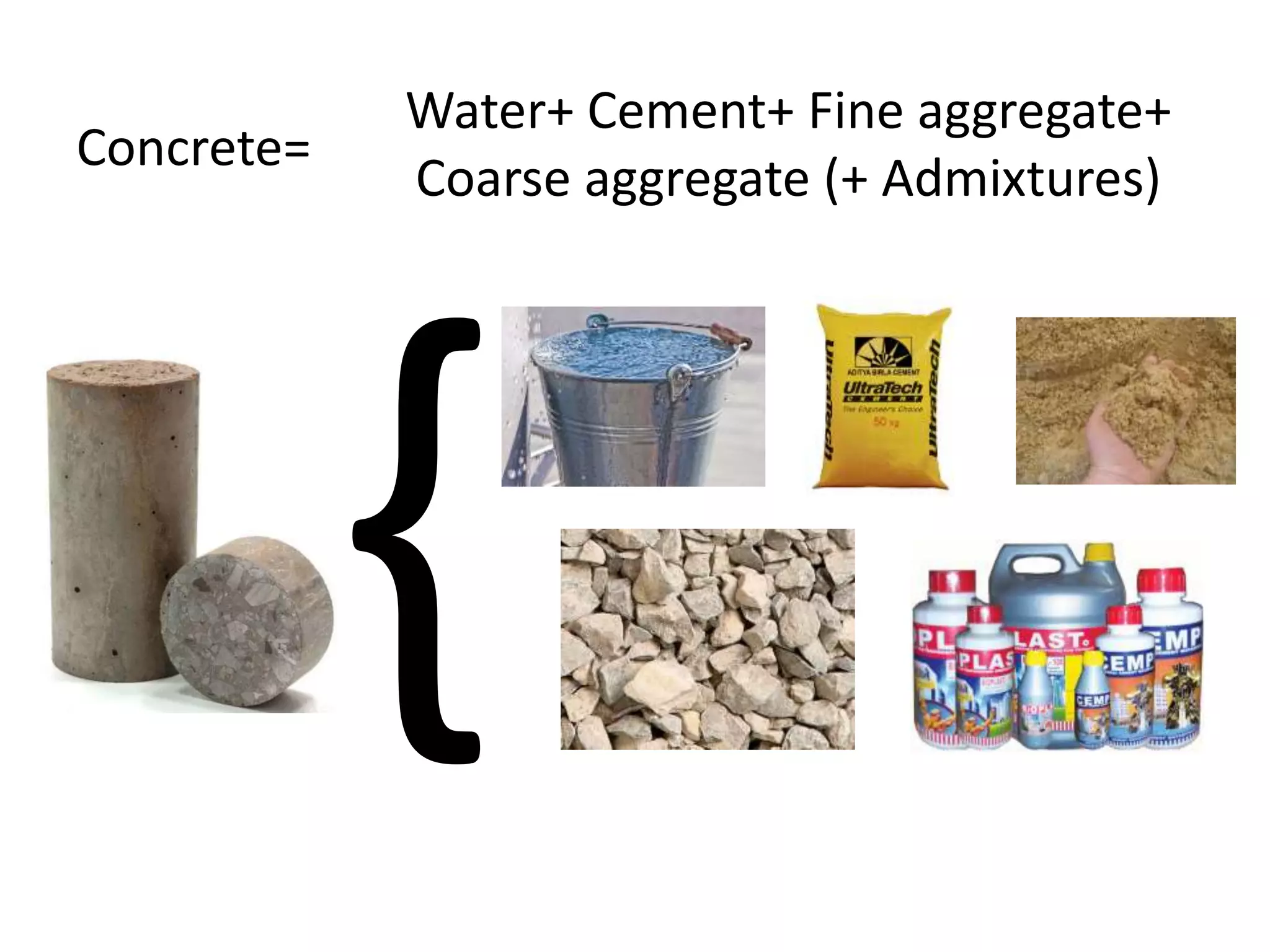
Water+ Cement+ Fine aggregate+
Coarse aggregate (+ Admixtures)
Concrete=
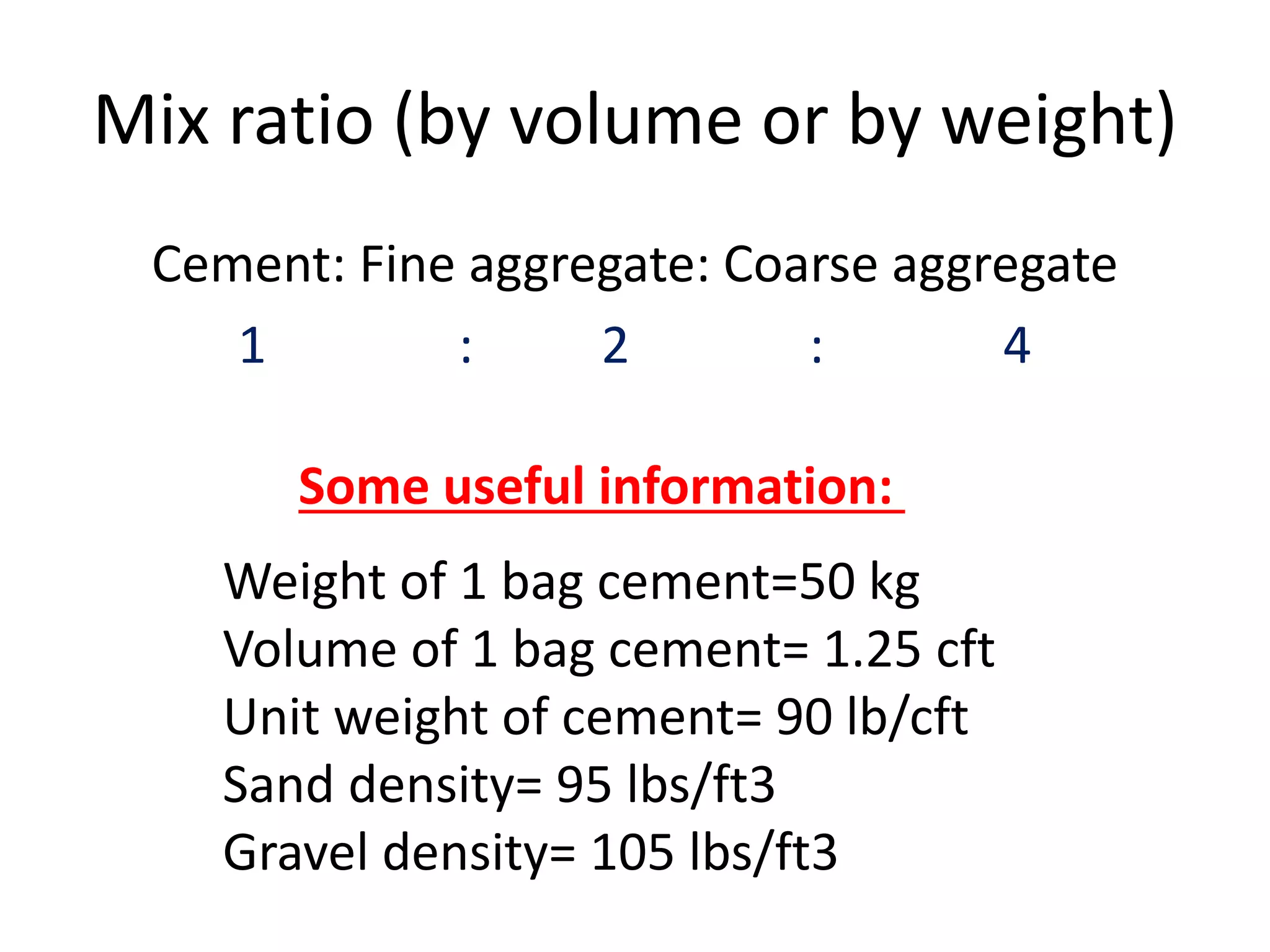
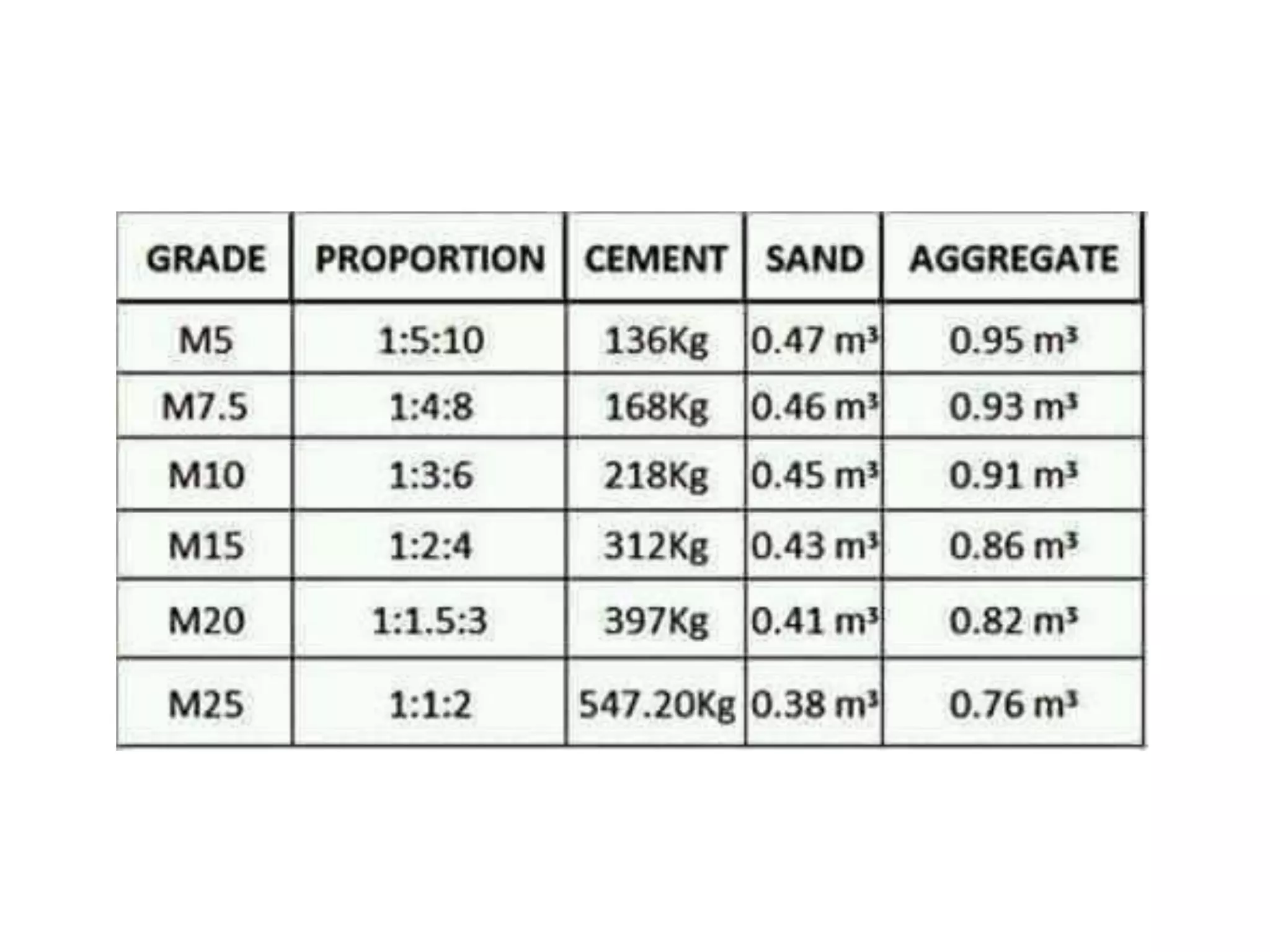
Mix ratio (by volume or by weight)
Cement: Fine aggregate: Coarse aggregate
1 : 2 : 4
Weight of 1 bag cement=50 kg
Volume of 1 bag cement= 1.25 cft
Unit weight of cement= 90 lb/cft
Sand density= 95 lbs/ft3
Gravel density= 105 lbs/ft3
Some useful information:
Types of concrete based on weight:
• Light weight concrete has an density (unit
weight) on the order of 90 to 115 lb/ft3
• Normal weight concrete with a density in the
range of 140 to 150 lb/ft3
Some special term related to concrete
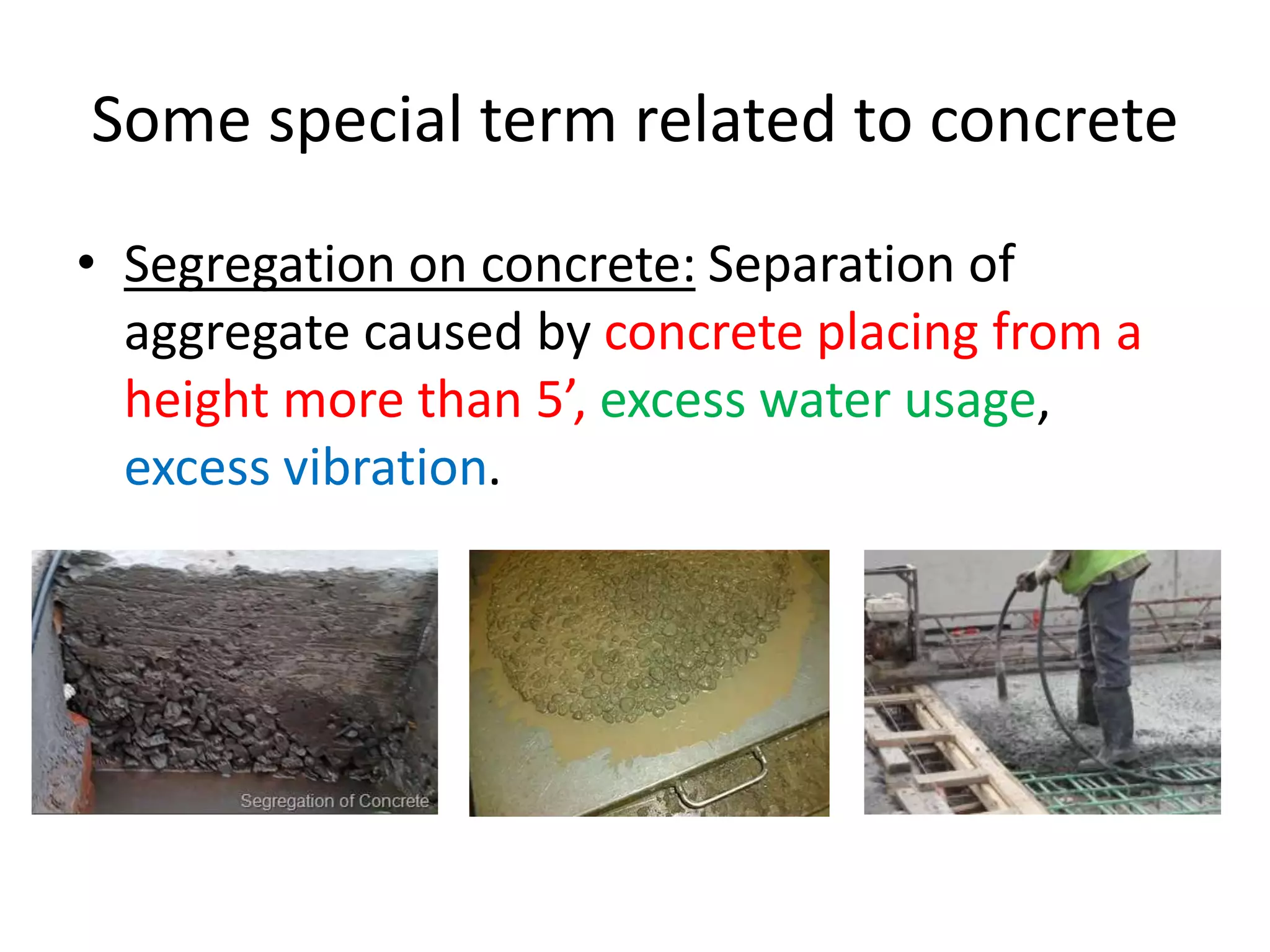
• Segregation on concrete: Separation of
aggregate caused by concrete placing from a
height more than 5’, excess water usage,
excess vibration.
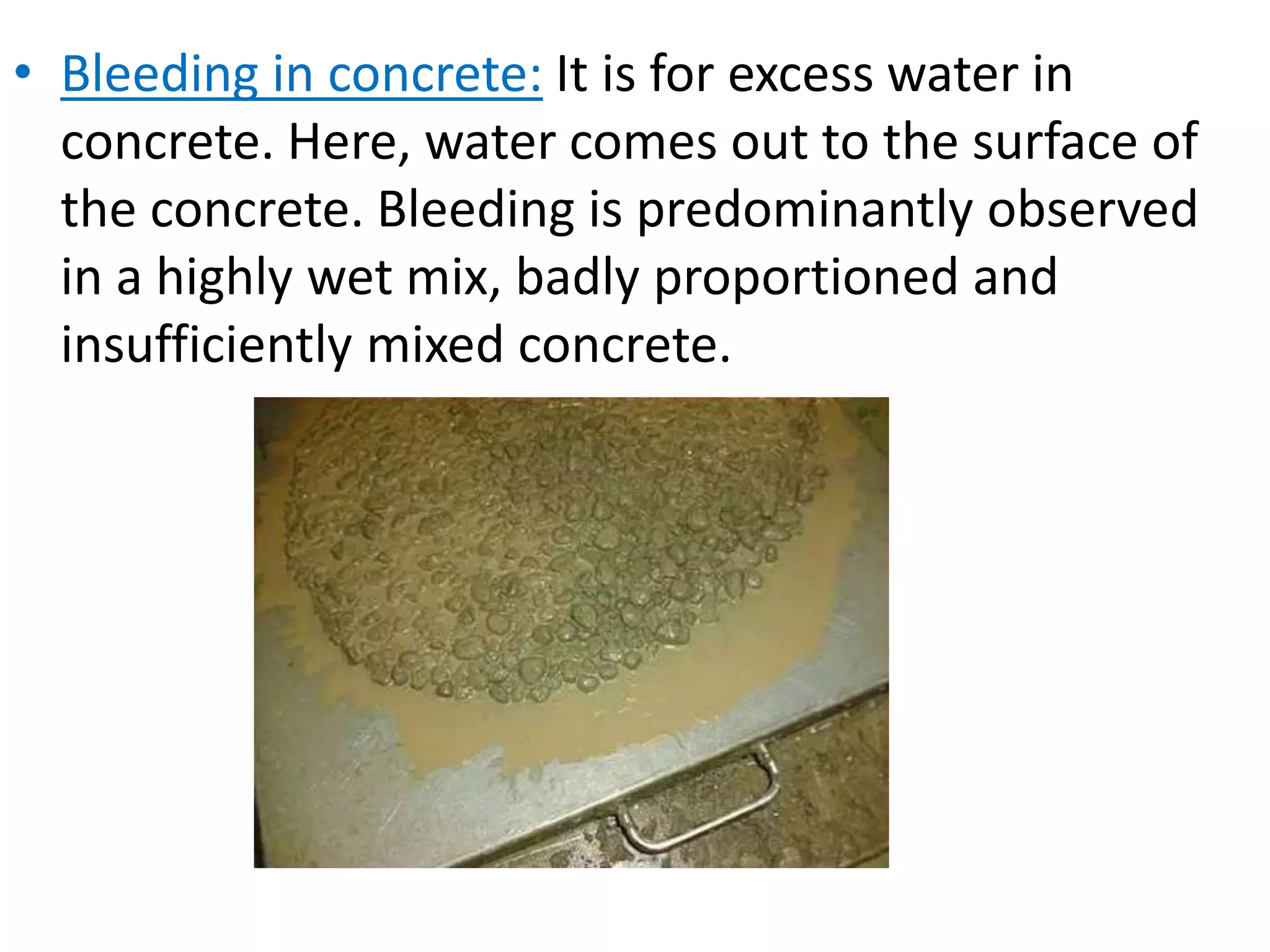
• Bleeding in concrete: It is for excess water in
concrete. Here, water comes out to the surface of
the concrete. Bleeding is predominantly observed
in a highly wet mix, badly proportioned and
insufficiently mixed concrete.
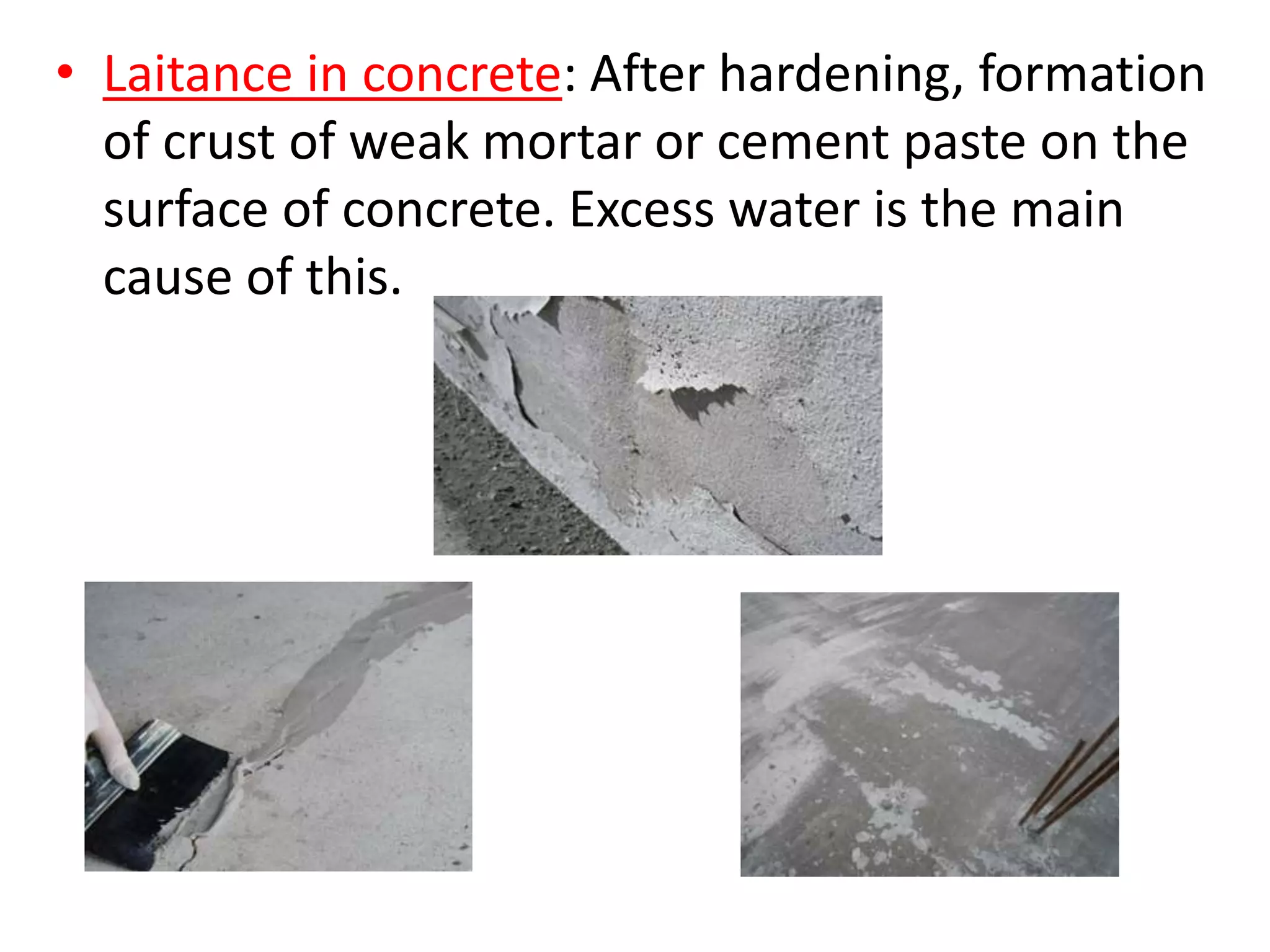
• Laitance in concrete: After hardening, formation
of crust of weak mortar or cement paste on the
surface of concrete. Excess water is the main
cause of this.
Properties of concrete
1) Strength:
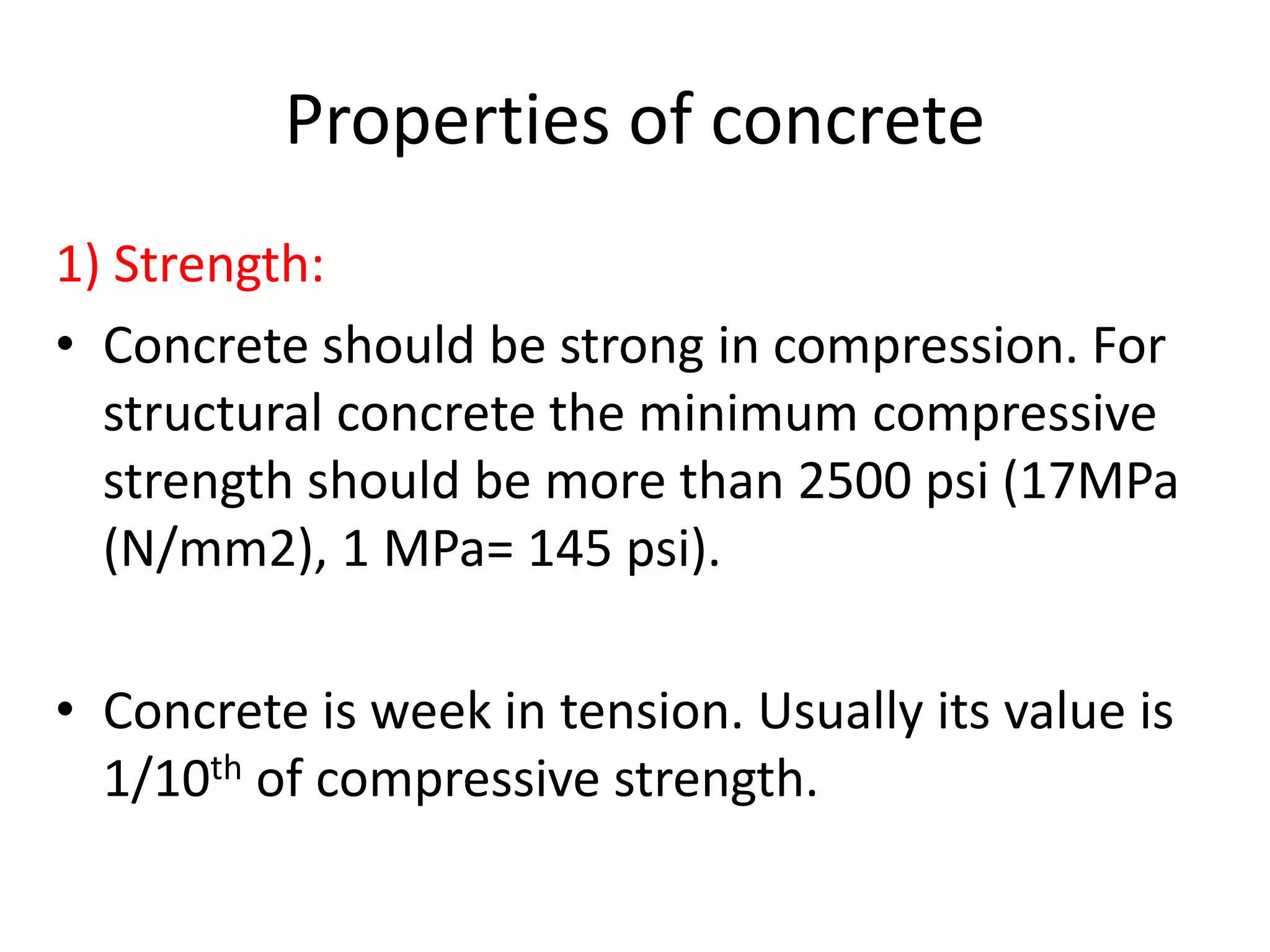
• Concrete should be strong in compression. For
structural concrete the minimum compressive
strength should be more than 2500 psi (17MPa
(N/mm2), 1 MPa= 145 psi).
• Concrete is week in tension. Usually its value is
1/10th of compressive strength.
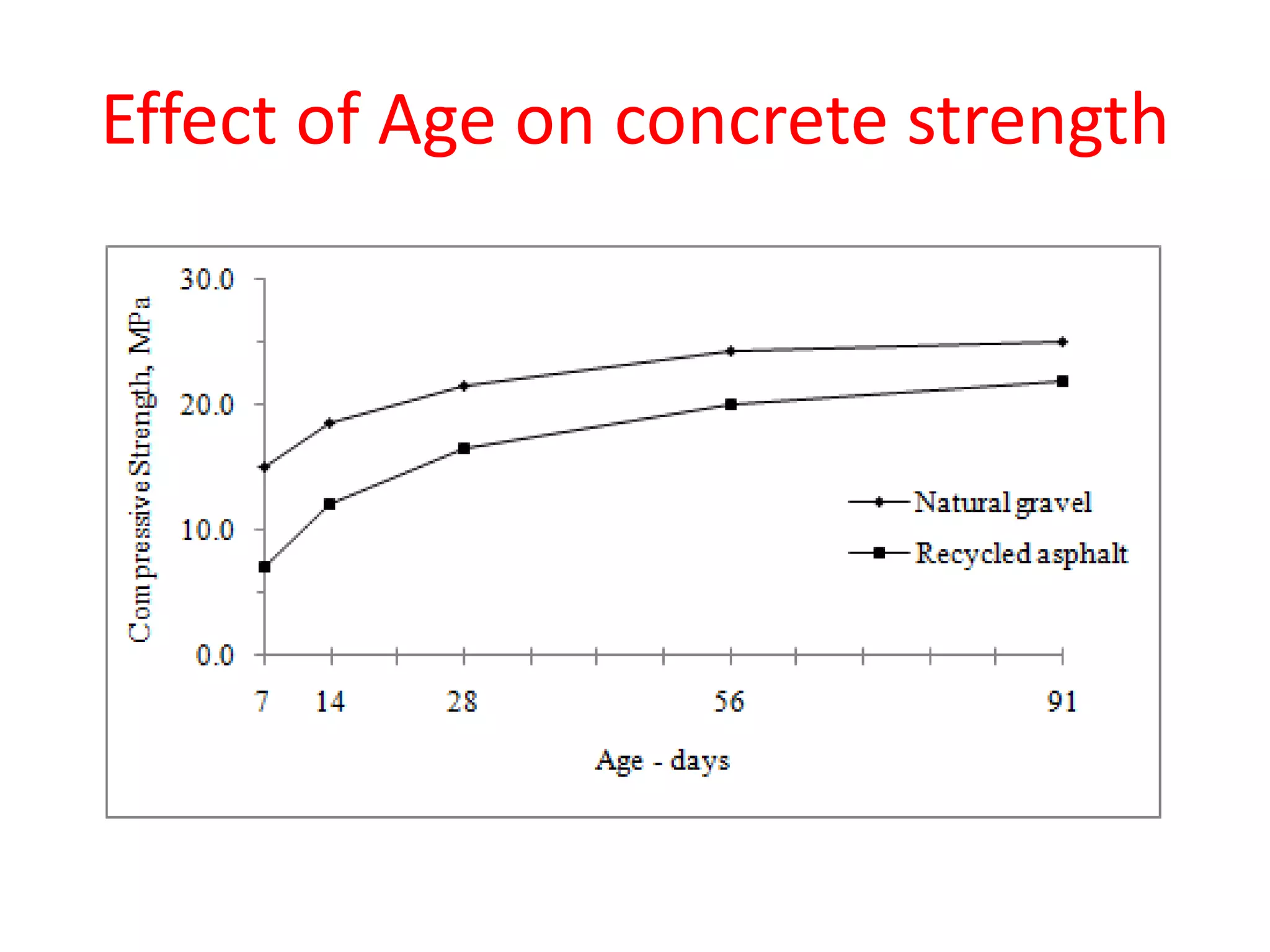
Effect of Age on concrete strength
2) Elastic:
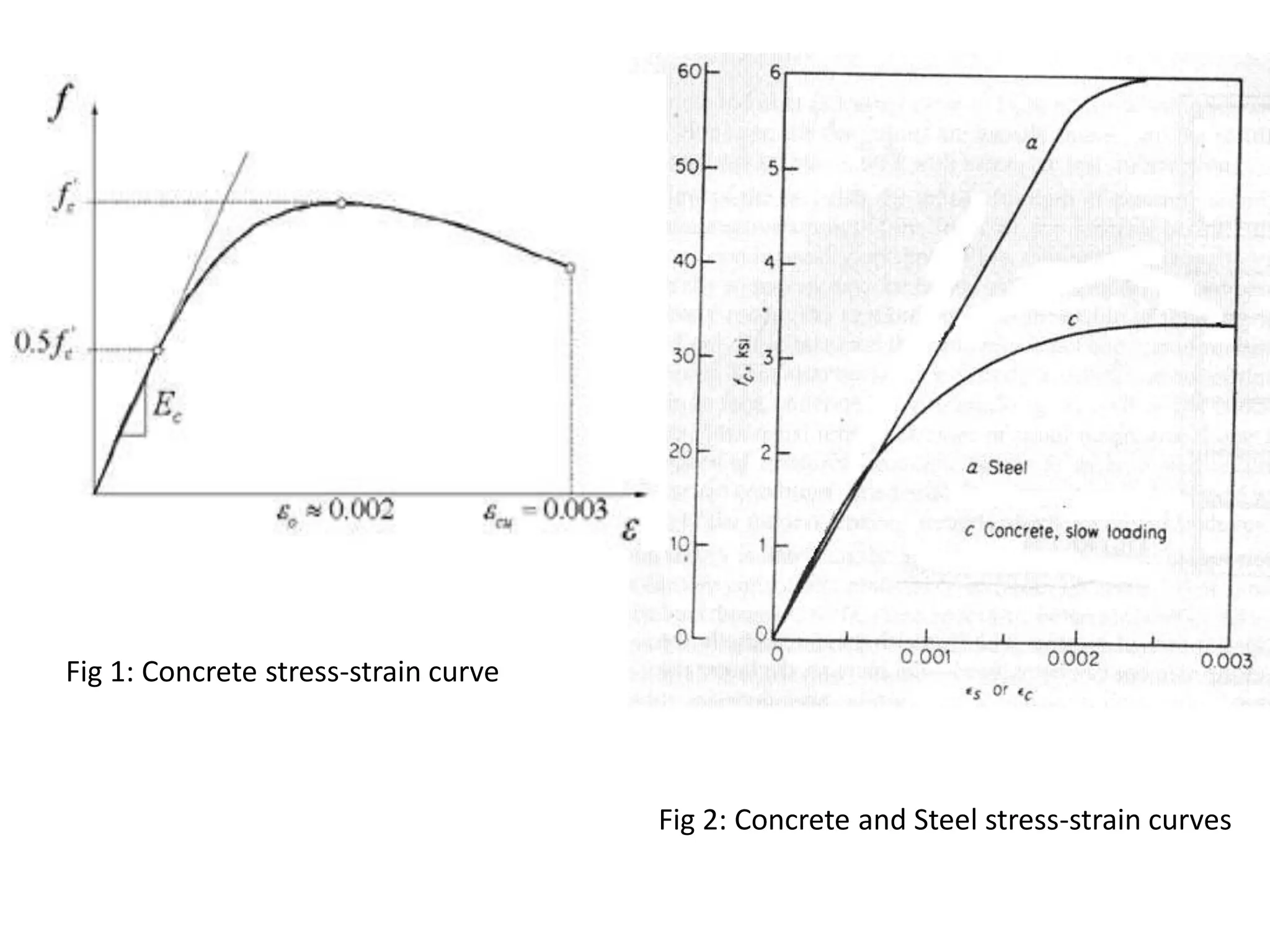
• The modulus of elasticity of concrete is an
important property because of its bearing of
high compression load in a very low
deformation.
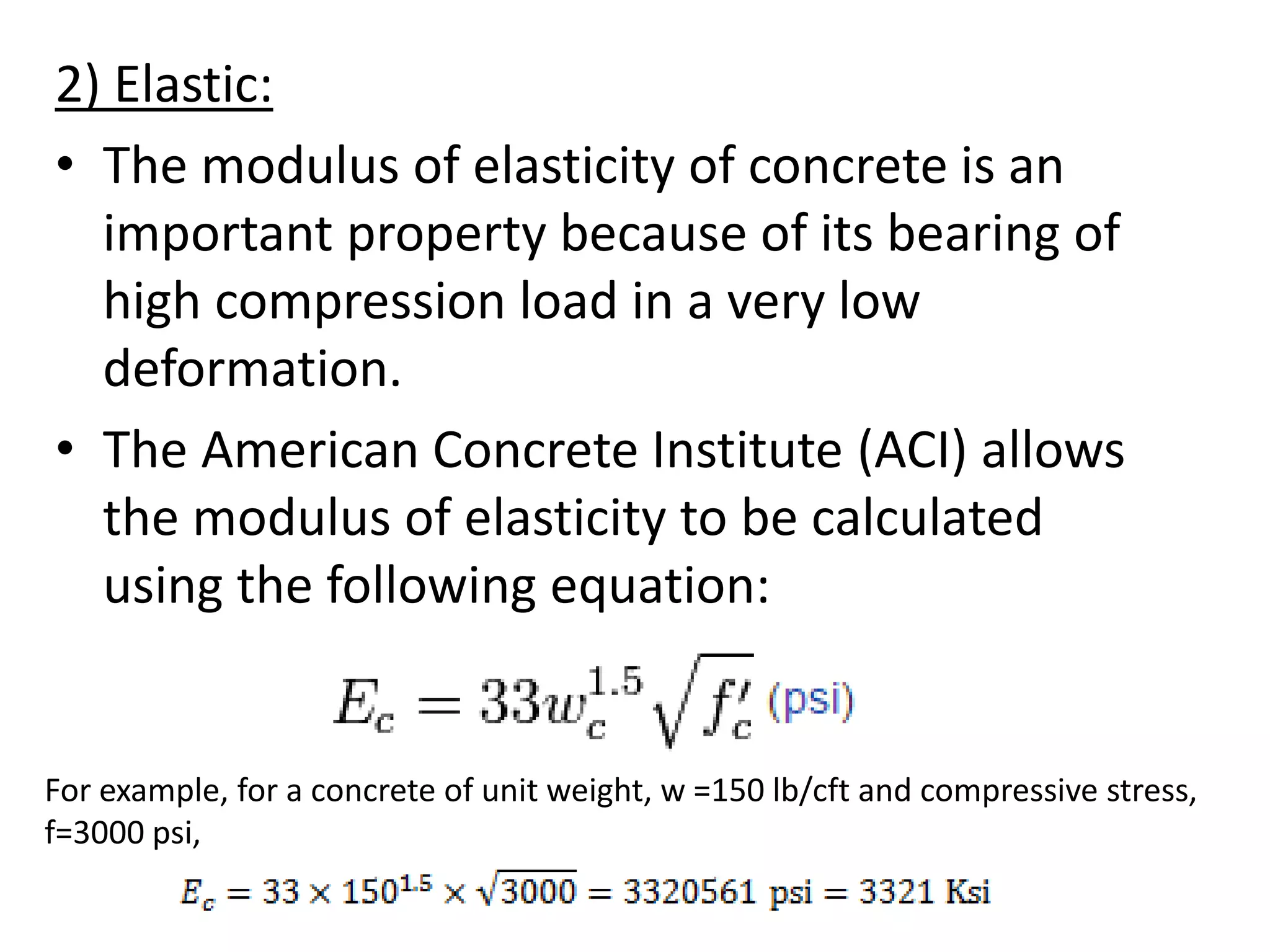
• The American Concrete Institute (ACI) allows
the modulus of elasticity to be calculated
using the following equation:
For example, for a concrete of unit weight, w =150 lb/cft and compressive stress,
f=3000 psi,
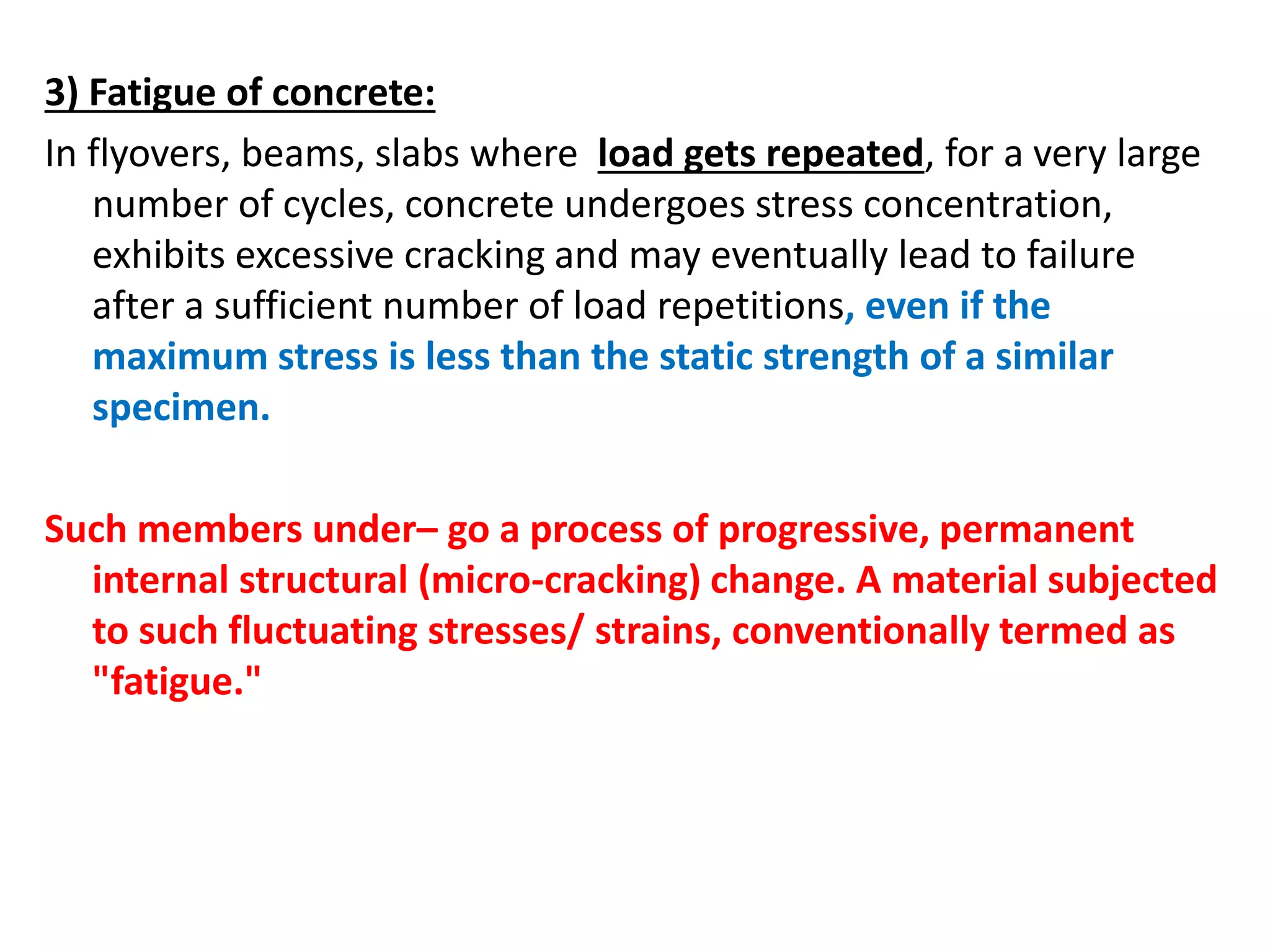
Fig 1: Concrete stress-strain curve
Fig 2: Concrete and Steel stress-strain curves
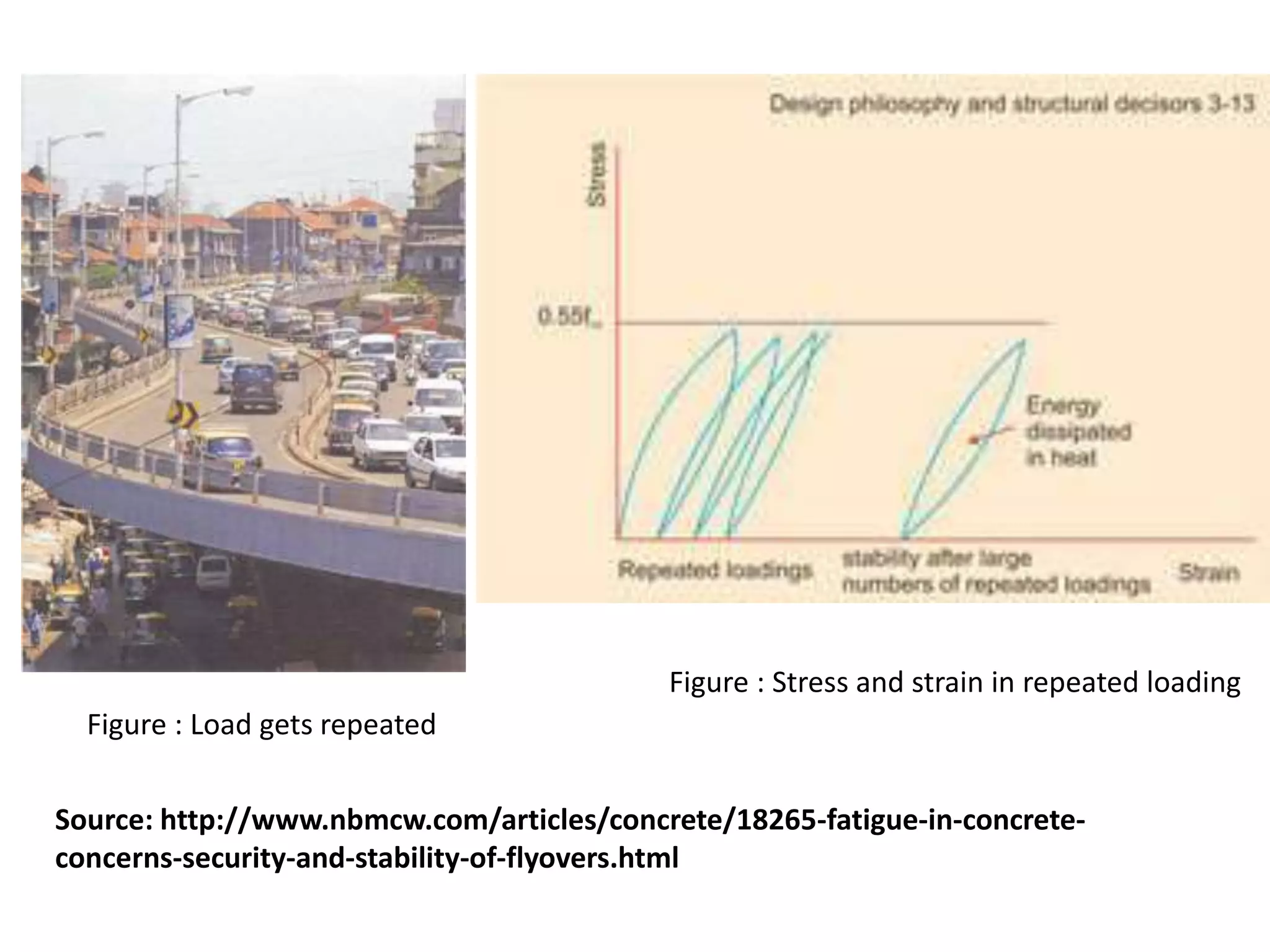
3) Fatigue of concrete:
In flyovers, beams, slabs where load gets repeated, for a very large
number of cycles, concrete undergoes stress concentration,
exhibits excessive cracking and may eventually lead to failure
after a sufficient number of load repetitions, even if the
maximum stress is less than the static strength of a similar
specimen.
Such members under– go a process of progressive, permanent
internal structural (micro-cracking) change. A material subjected
to such fluctuating stresses/ strains, conventionally termed as
"fatigue."
Source: http://www.nbmcw.com/articles/concrete/18265-fatigue-in-concrete-
concerns-security-and-stability-of-flyovers.html
Figure : Load gets repeated
Figure : Stress and strain in repeated loading
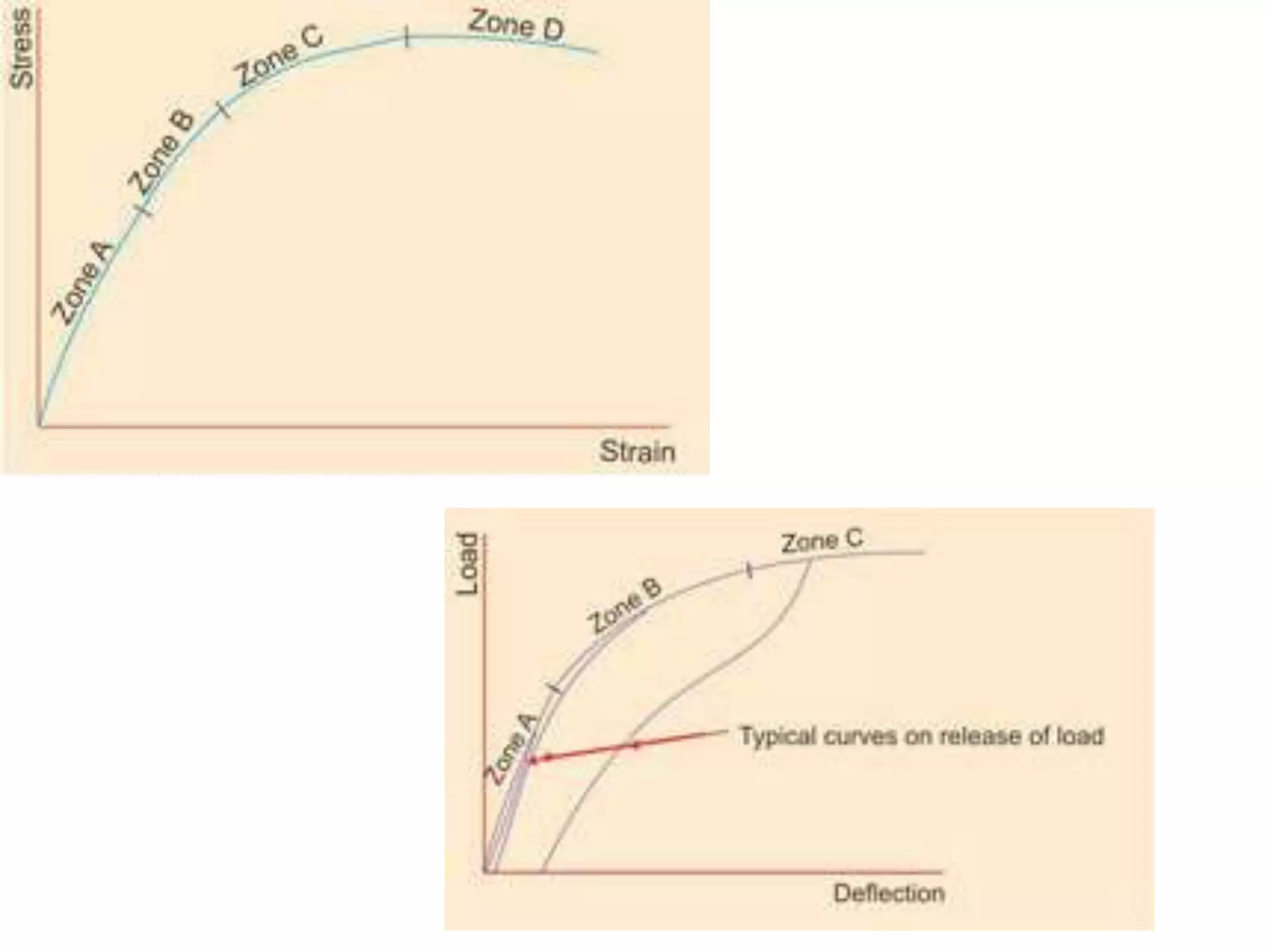
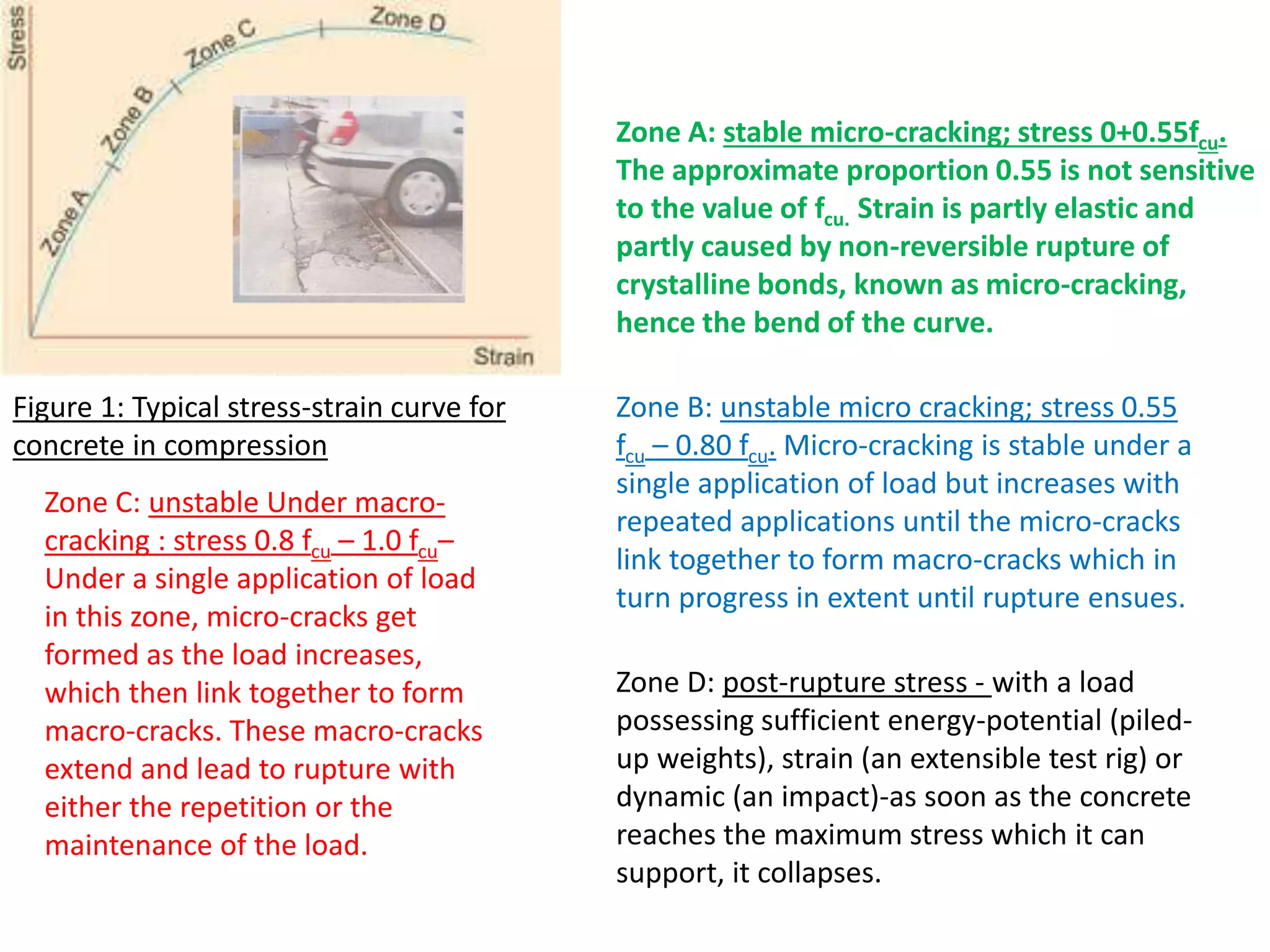
Zone A: stable micro-cracking; stress 0+0.55fcu.
The approximate proportion 0.55 is not sensitive
to the value of fcu. Strain is partly elastic and
partly caused by non-reversible rupture of
crystalline bonds, known as micro-cracking,
hence the bend of the curve.
Zone B: unstable micro cracking; stress 0.55
fcu – 0.80 fcu. Micro-cracking is stable under a
single application of load but increases with
repeated applications until the micro-cracks
link together to form macro-cracks which in
turn progress in extent until rupture ensues.
Zone C: unstable Under macro-
cracking : stress 0.8 fcu – 1.0 fcu–
Under a single application of load
in this zone, micro-cracks get
formed as the load increases,
which then link together to form
macro-cracks. These macro-cracks
extend and lead to rupture with
either the repetition or the
maintenance of the load.
Zone D: post-rupture stress - with a load
possessing sufficient energy-potential (piled-
up weights), strain (an extensible test rig) or
dynamic (an impact)-as soon as the concrete
reaches the maximum stress which it can
support, it collapses.
Figure 1: Typical stress-strain curve for
concrete in compression
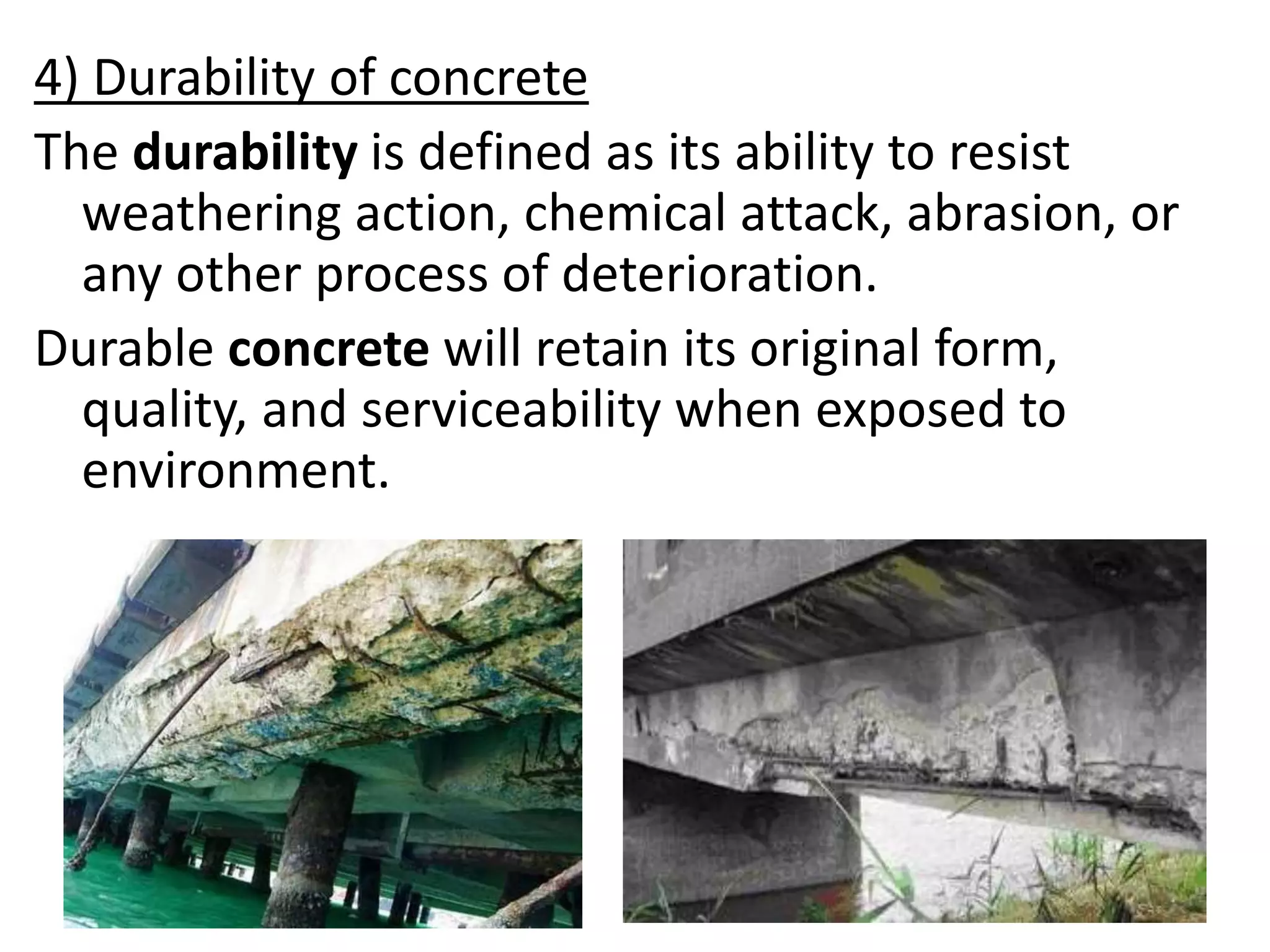
4) Durability of concrete
The durability is defined as its ability to resist
weathering action, chemical attack, abrasion, or
any other process of deterioration.
Durable concrete will retain its original form,
quality, and serviceability when exposed to
environment.
5) Impermeability of concrete
Impermeability of concrete is an ability of concrete
to resist pressurized water penetration.
Penetration of liquids into the concrete has
considerable effect on its durability.
In concrete, penetration of moisture and air causes
corrosion of steel reinforcement, resulting in
volume gain, cracking and peeling of the
protective concrete layer.
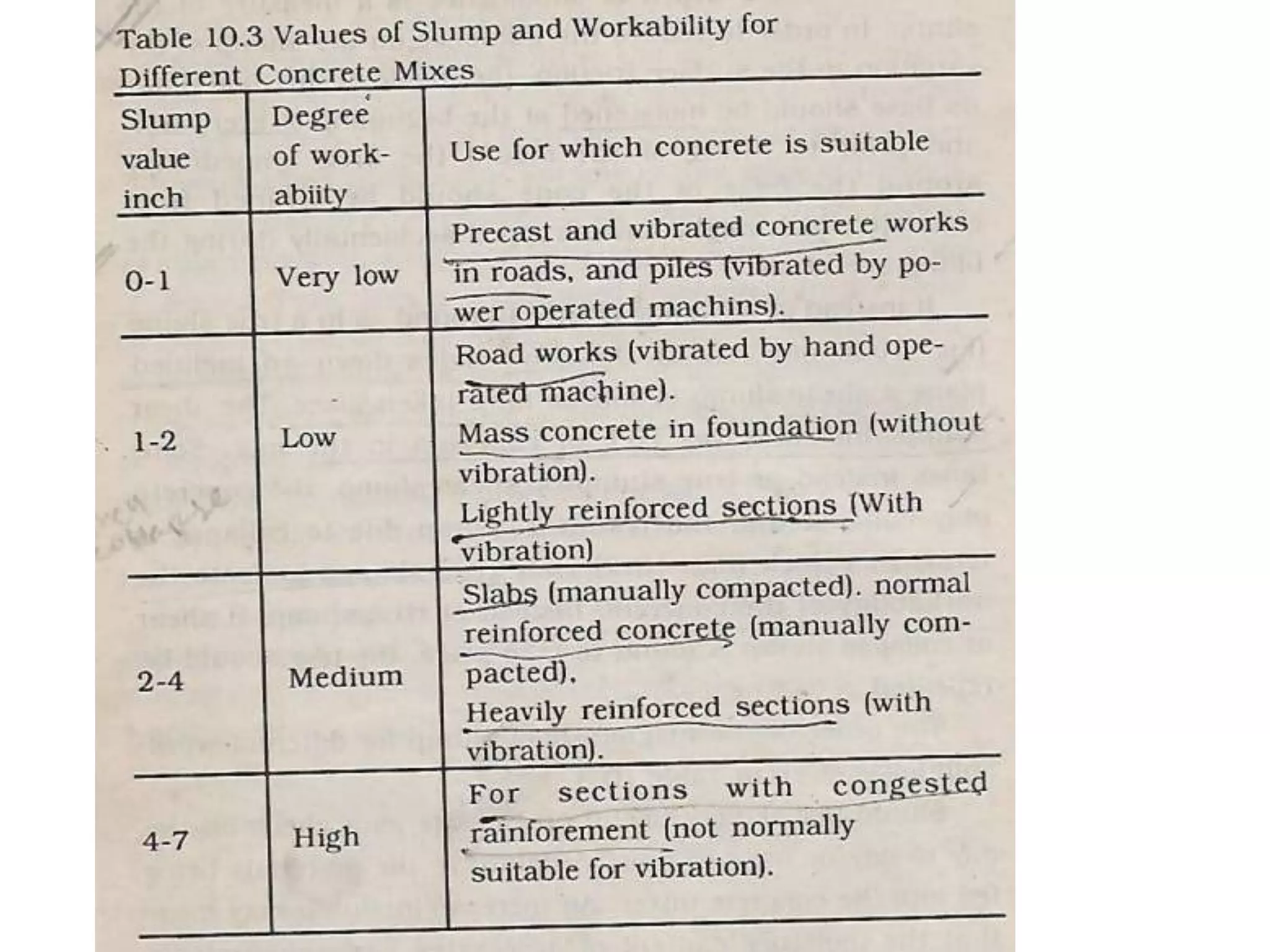
6) Workability of concrete:
A concrete is said to be workable if it is easily transported, placed,
compacted and finished without any segregation. Workability is a
property of freshly mixed concrete, and a concrete is a mixture of
cement, aggregate, water & admixture.
Factors affecting workability of concrete
• Water Content: Workability of concrete increases with increase in
water content.
• Aggregate/Cement Ratio: The higher the aggregate/cement ratio, the
leaner is the concrete (that is slope down or settle down)
• Size of Aggregate: For a given quantity of water and paste, bigger size
of aggregates will give higher workability.
• Shape of Aggregate: Better workability is ensured to rounded
aggregate than Angular, elongated or flaky aggregate
Factors affecting workability of
concrete (continues)
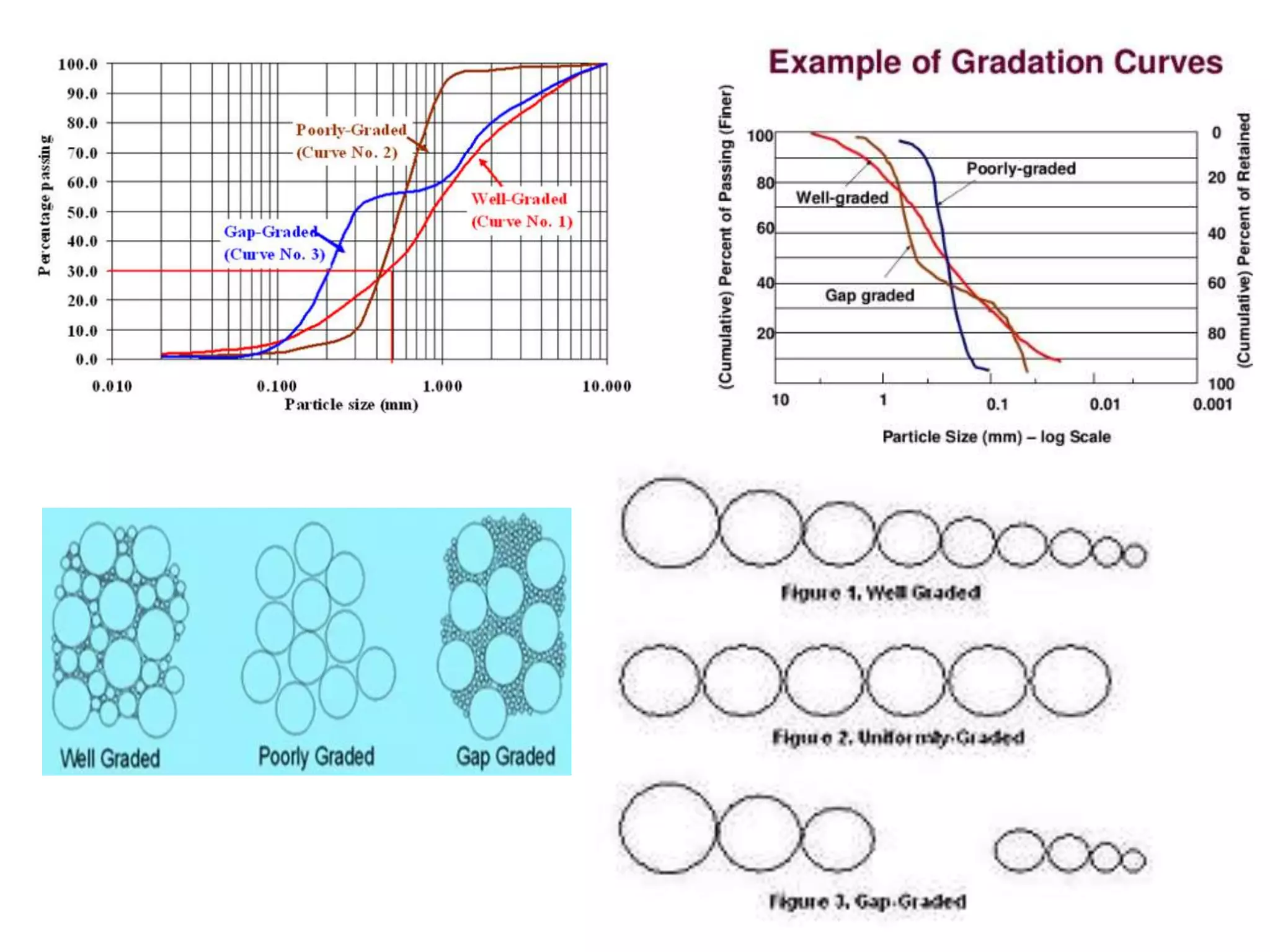
• Grading of Aggregate: This is one of the factors which
will have maximum influence on workability. A well
graded aggregate can lead to good workability.
• Surface Texture of Aggregate: rough textured
aggregate will show poor workability and smooth or
glassy textured aggregate will give better workability.
• Use of Admixture: The right way of improving
workability is to use chemical admixtures such as
plasticizers, super plasticizers, air entraining agents etc
Measurement of workability of concrete
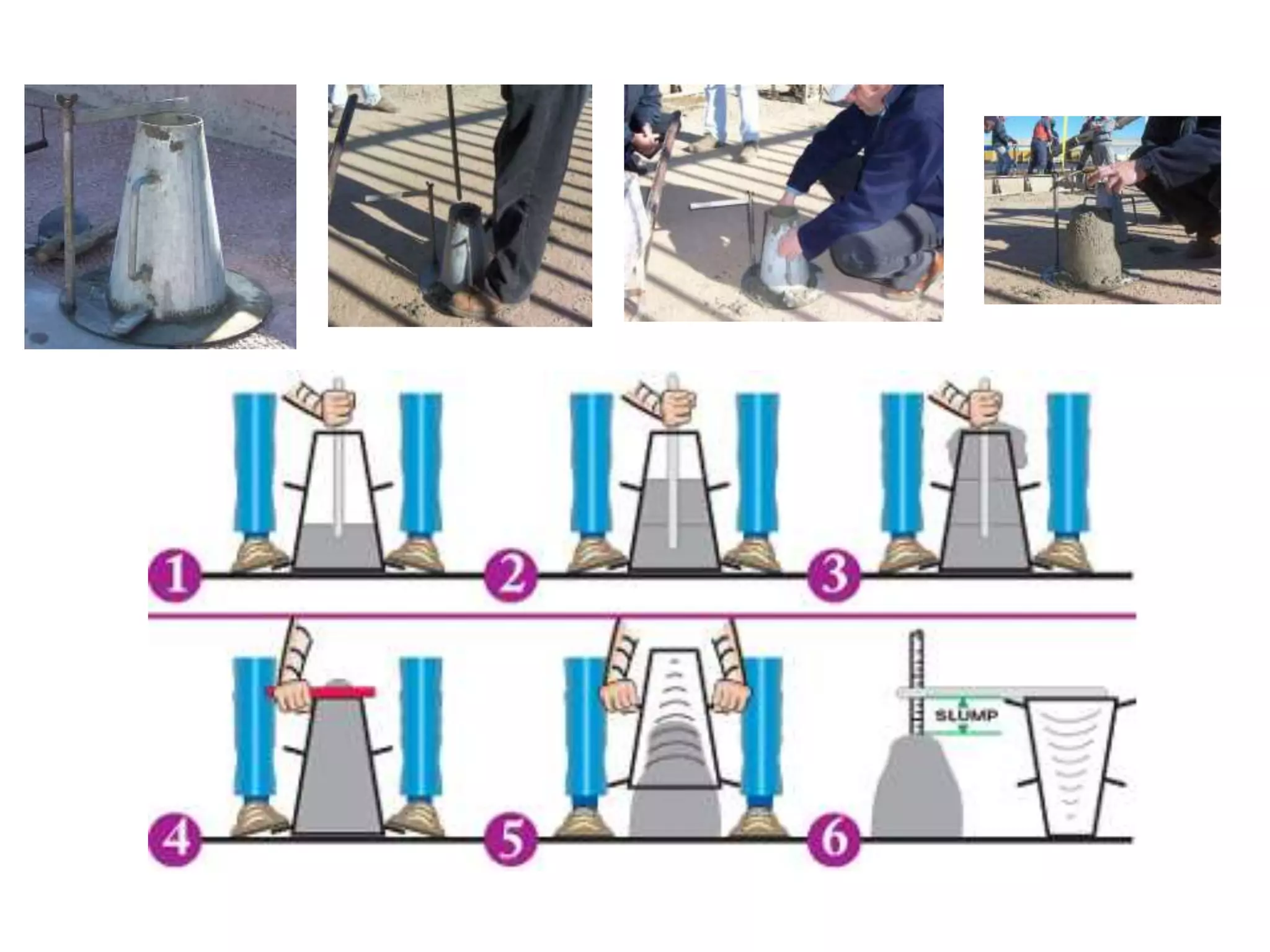
Concrete slump test:
• The concrete slump test is an empirical test
that measures workability of fresh concrete.
Collapse Shear True
In a collapse slump the
concrete collapses
completely.
In a shear slump the top
portion of the concrete
shears off and slips
sideways.
In a true slump the
concrete simply subsides,
keeping more or less to
shape.
Factors affecting properties of
concrete
1. Quality of Raw Materials:
• Cement: Provided the cement conforms with the appropriate
standard and it has been stored correctly (i.e. in dry conditions),
it should be suitable for use in concrete.
• Aggregates: Quality of aggregates, its size, shape, texture,
strength etc determines the strength of concrete. The presence
of salts (chlorides and sulphates), silt and clay also reduces the
strength of concrete.
• Water: frequently the quality of the water is covered by a clause
stating “..the water should be fit for drinking..”. This criterion
though is not absolute and reference should be made to
respective codes for testing of water construction purpose.
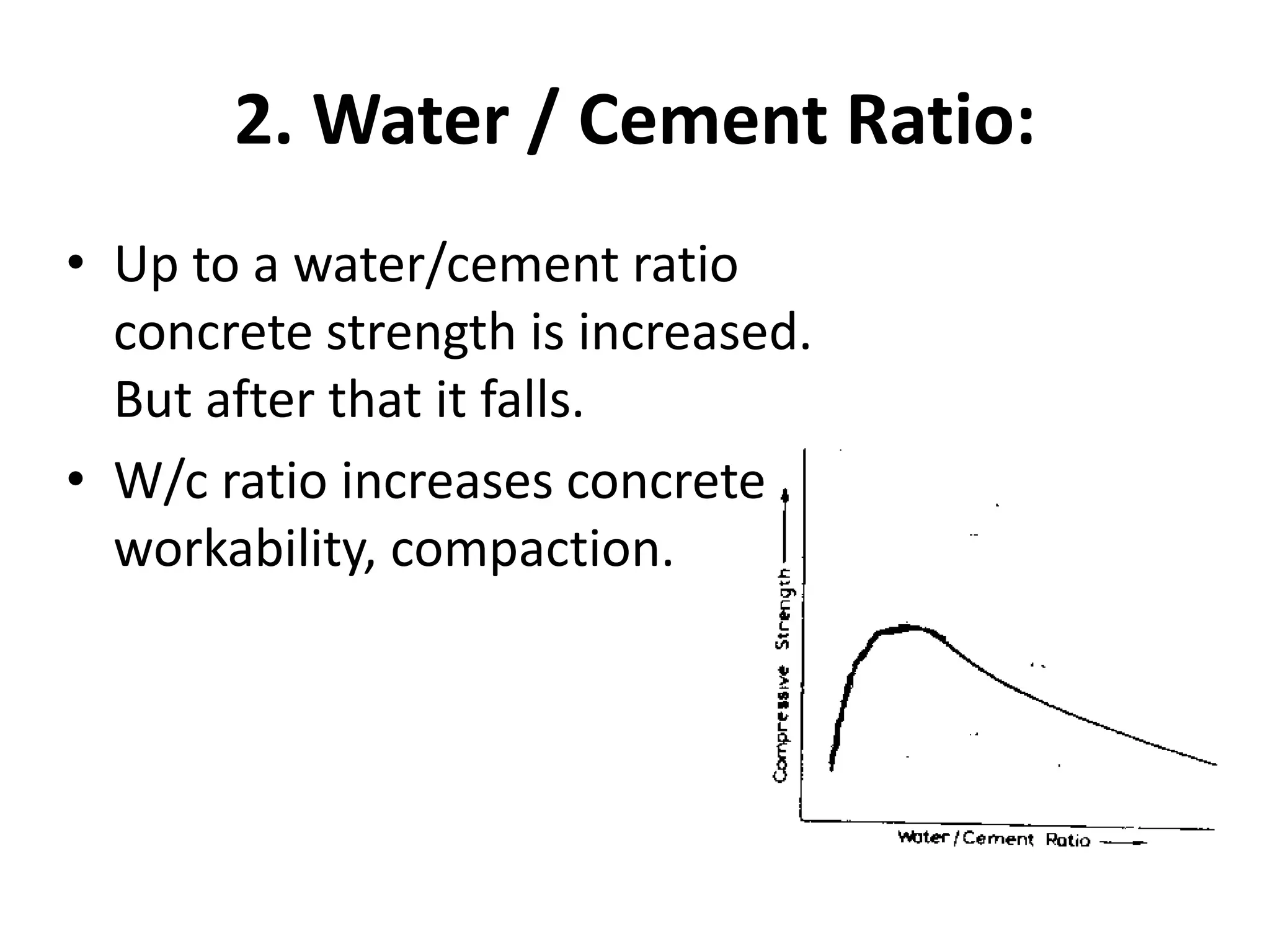
2. Water / Cement Ratio:
• Up to a water/cement ratio
concrete strength is increased.
But after that it falls.
• W/c ratio increases concrete
workability, compaction.
3. Age of concrete:
4. Compaction of concrete:
• Any entrapped air resulting from inadequate
compaction of the plastic concrete will lead to
a reduction in strength. If there was 10%
trapped air in the concrete, the strength will
fall down in the range of 30 to 40%.
5. Size of Coarse aggregate
6. Mixing time
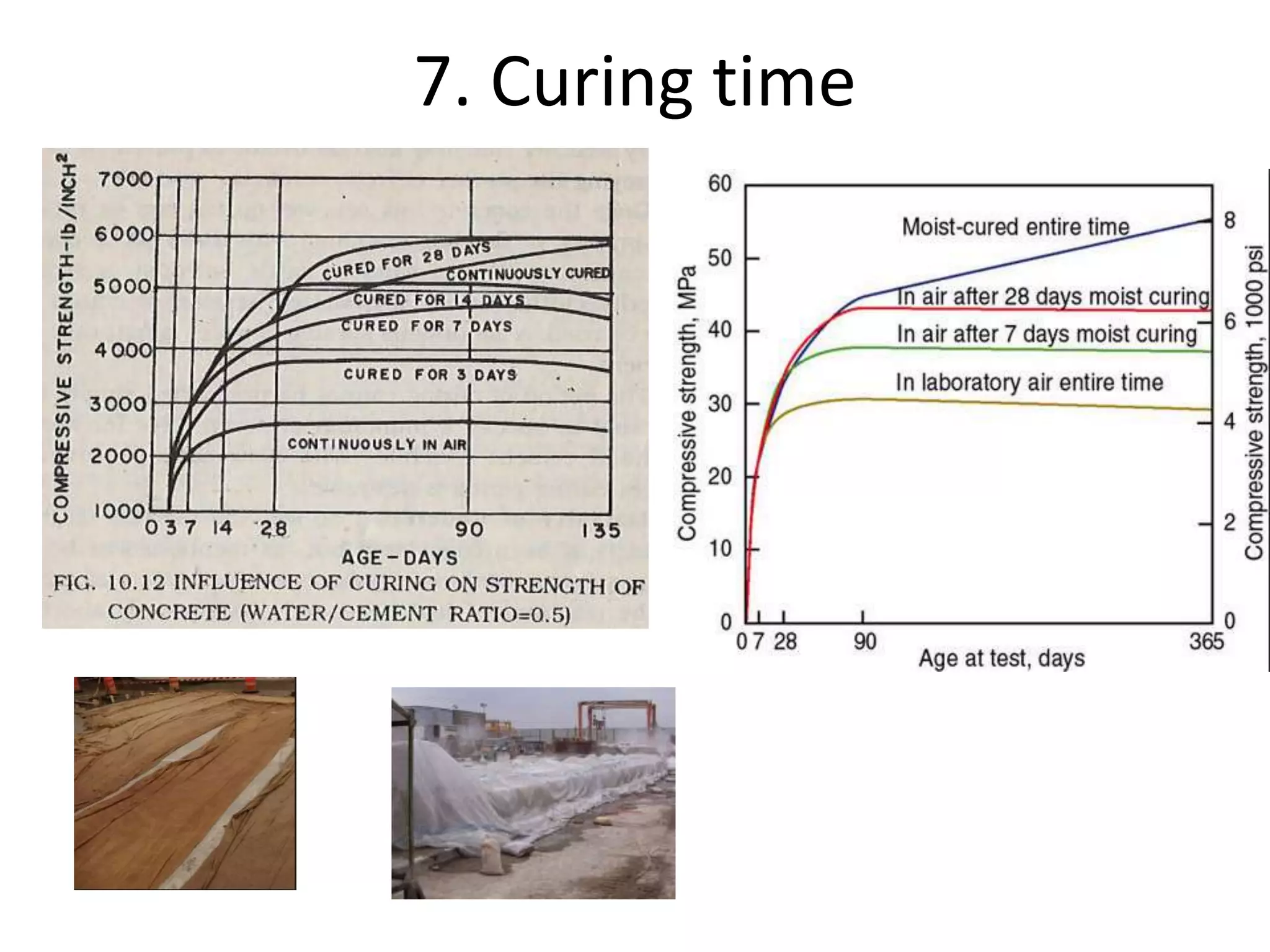
7. Curing time
7. Temperature:
Creep of concrete
Age (day) Minimum compressive strength, (Mpa)
3 12.4
7 19.3
28 27.6
Table: Compressive strength of mortar as per ASTM standard
ACI Mix Design Example
• Given information-
Estimation of mixing water and air content
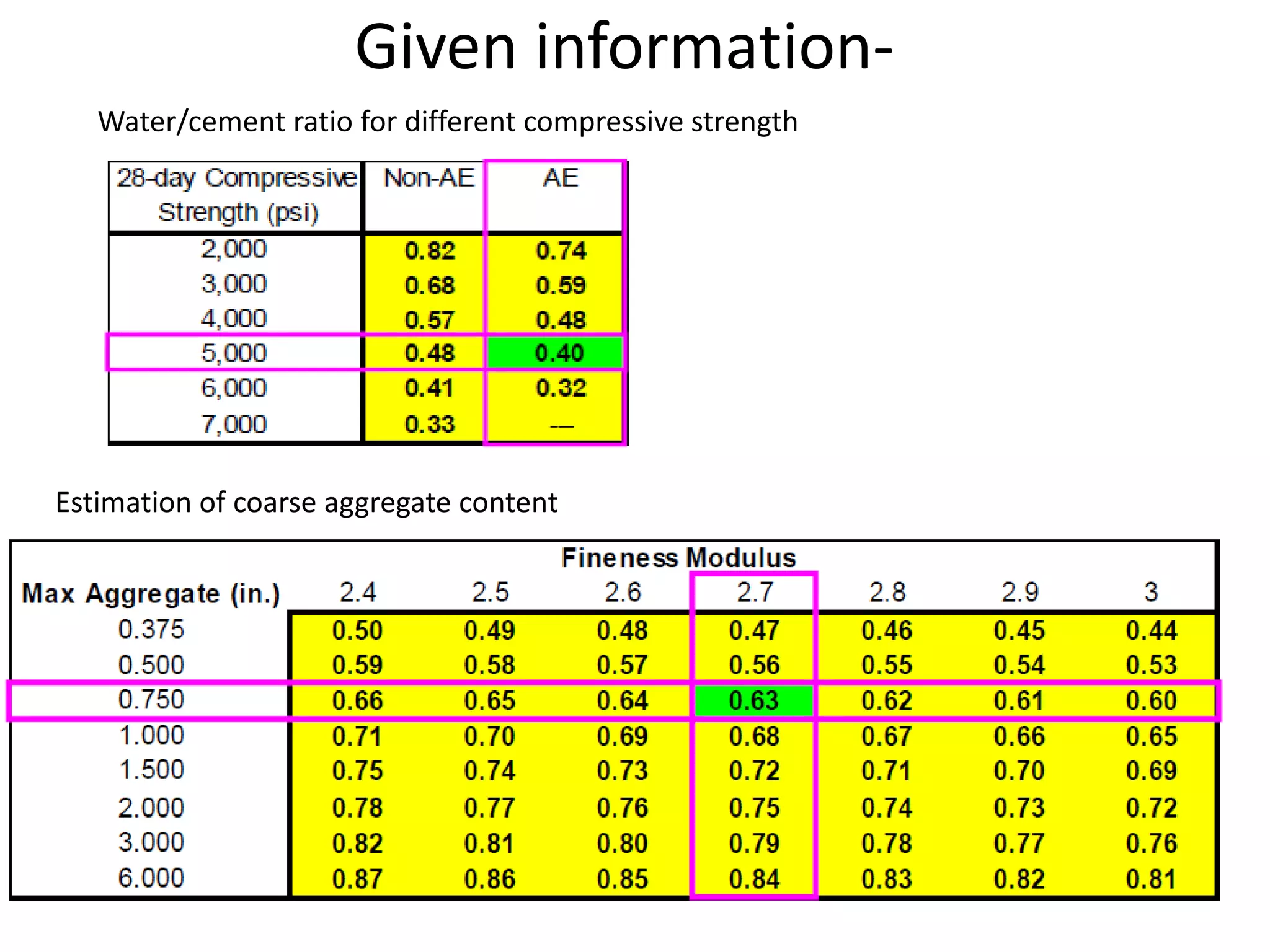
Given information-
Water/cement ratio for different compressive strength
Estimation of coarse aggregate content
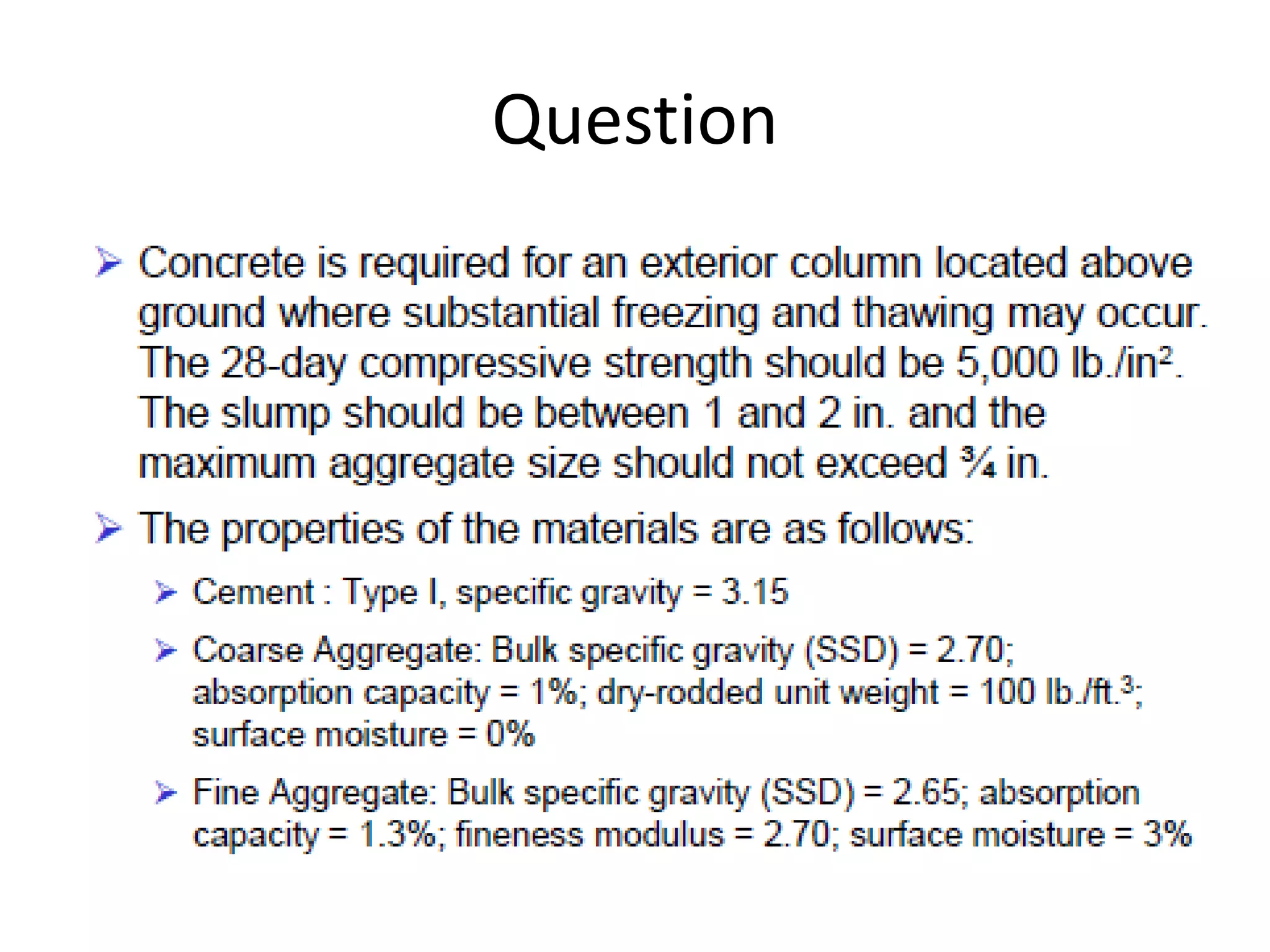
Question
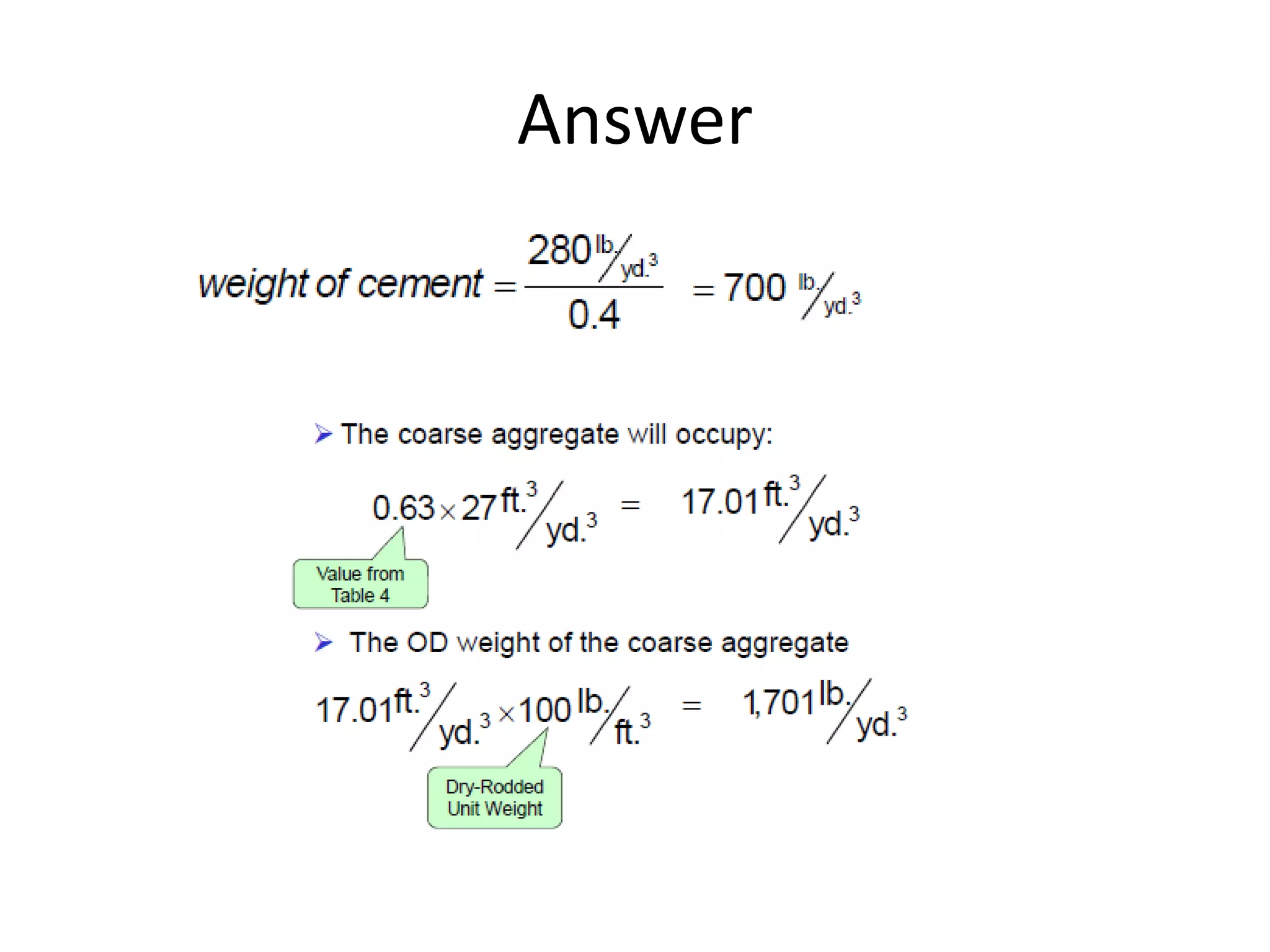
Answer
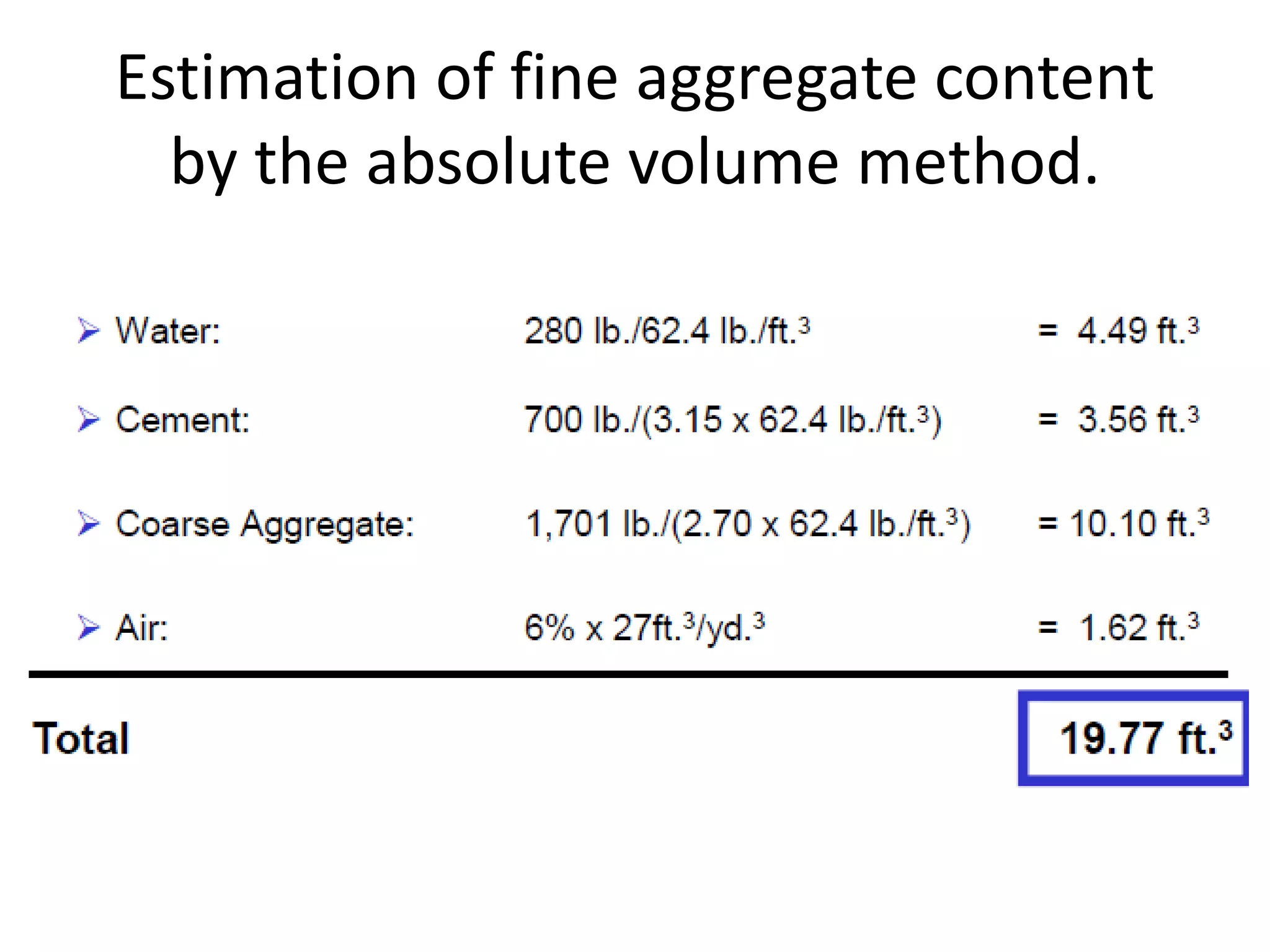
Estimation of fine aggregate content
by the absolute volume method.
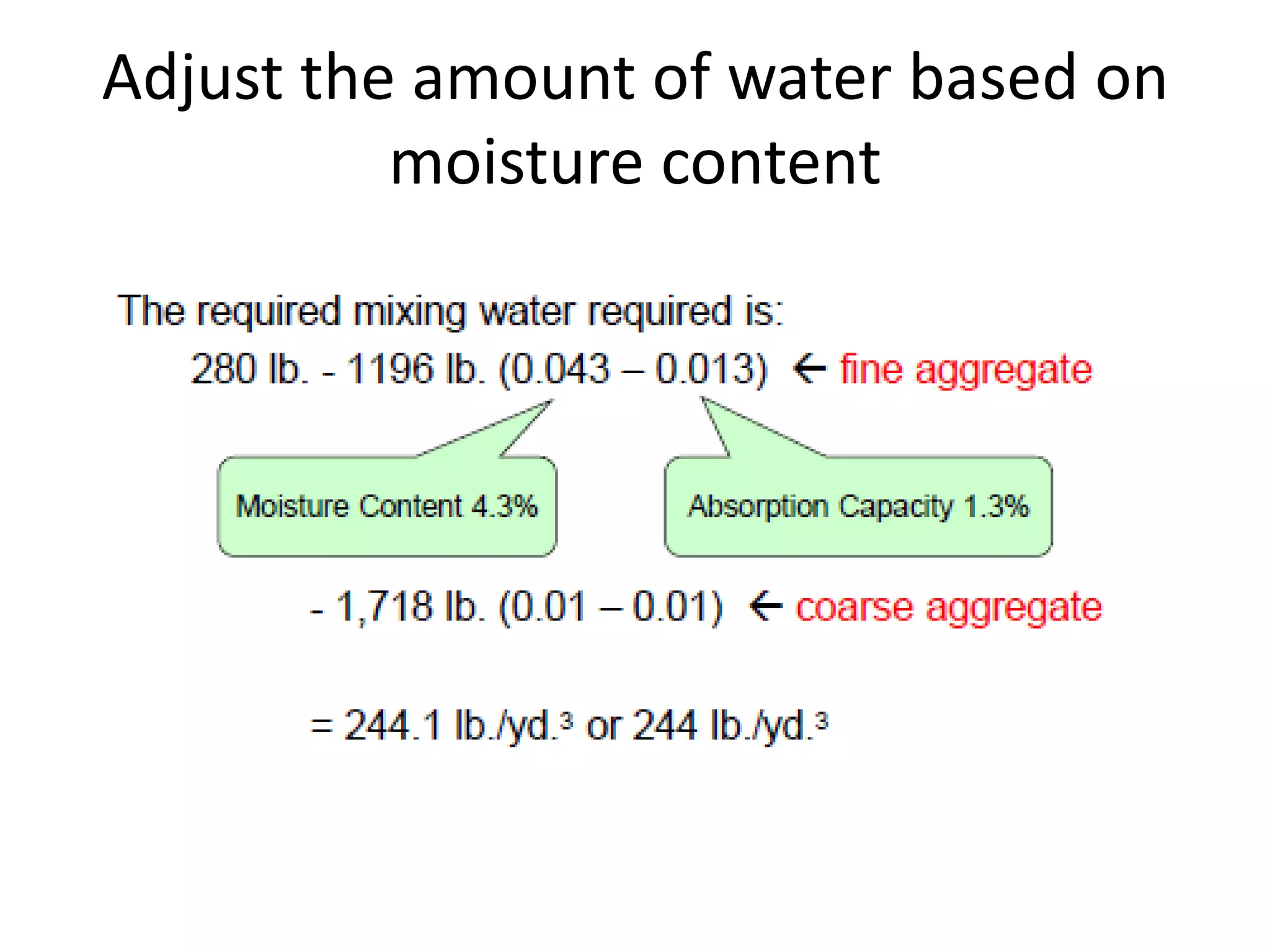
Adjust the amount of water based on
moisture content
Lecture 5, concrete-hmm

Lecture 5, concrete-hmm

  • 1.
    A brief storyof Concrete Presented by: Dr. H.M.A.Mahzuz Assistant Professor, Department of Civil and Environmental Engineering Shahjalal University of Science and Technology, Sylhet
  • 2.
    Water+ Cement+ Fineaggregate+ Coarse aggregate (+ Admixtures) Concrete=
  • 3.
    Mix ratio (byvolume or by weight) Cement: Fine aggregate: Coarse aggregate 1 : 2 : 4 Weight of 1 bag cement=50 kg Volume of 1 bag cement= 1.25 cft Unit weight of cement= 90 lb/cft Sand density= 95 lbs/ft3 Gravel density= 105 lbs/ft3 Some useful information:
  • 6.
    Types of concretebased on weight: • Light weight concrete has an density (unit weight) on the order of 90 to 115 lb/ft3 • Normal weight concrete with a density in the range of 140 to 150 lb/ft3
  • 7.
    Some special termrelated to concrete • Segregation on concrete: Separation of aggregate caused by concrete placing from a height more than 5’, excess water usage, excess vibration.
  • 8.
    • Bleeding inconcrete: It is for excess water in concrete. Here, water comes out to the surface of the concrete. Bleeding is predominantly observed in a highly wet mix, badly proportioned and insufficiently mixed concrete.
  • 9.
    • Laitance inconcrete: After hardening, formation of crust of weak mortar or cement paste on the surface of concrete. Excess water is the main cause of this.
  • 10.
    Properties of concrete 1)Strength: • Concrete should be strong in compression. For structural concrete the minimum compressive strength should be more than 2500 psi (17MPa (N/mm2), 1 MPa= 145 psi). • Concrete is week in tension. Usually its value is 1/10th of compressive strength.
  • 11.
    Effect of Ageon concrete strength
  • 12.
    2) Elastic: • Themodulus of elasticity of concrete is an important property because of its bearing of high compression load in a very low deformation. • The American Concrete Institute (ACI) allows the modulus of elasticity to be calculated using the following equation: For example, for a concrete of unit weight, w =150 lb/cft and compressive stress, f=3000 psi,
  • 13.
    Fig 1: Concretestress-strain curve Fig 2: Concrete and Steel stress-strain curves
  • 14.
    3) Fatigue ofconcrete: In flyovers, beams, slabs where load gets repeated, for a very large number of cycles, concrete undergoes stress concentration, exhibits excessive cracking and may eventually lead to failure after a sufficient number of load repetitions, even if the maximum stress is less than the static strength of a similar specimen. Such members under– go a process of progressive, permanent internal structural (micro-cracking) change. A material subjected to such fluctuating stresses/ strains, conventionally termed as "fatigue."
  • 15.
  • 17.
    Zone A: stablemicro-cracking; stress 0+0.55fcu. The approximate proportion 0.55 is not sensitive to the value of fcu. Strain is partly elastic and partly caused by non-reversible rupture of crystalline bonds, known as micro-cracking, hence the bend of the curve. Zone B: unstable micro cracking; stress 0.55 fcu – 0.80 fcu. Micro-cracking is stable under a single application of load but increases with repeated applications until the micro-cracks link together to form macro-cracks which in turn progress in extent until rupture ensues. Zone C: unstable Under macro- cracking : stress 0.8 fcu – 1.0 fcu– Under a single application of load in this zone, micro-cracks get formed as the load increases, which then link together to form macro-cracks. These macro-cracks extend and lead to rupture with either the repetition or the maintenance of the load. Zone D: post-rupture stress - with a load possessing sufficient energy-potential (piled- up weights), strain (an extensible test rig) or dynamic (an impact)-as soon as the concrete reaches the maximum stress which it can support, it collapses. Figure 1: Typical stress-strain curve for concrete in compression
  • 18.
    4) Durability ofconcrete The durability is defined as its ability to resist weathering action, chemical attack, abrasion, or any other process of deterioration. Durable concrete will retain its original form, quality, and serviceability when exposed to environment.
  • 19.
    5) Impermeability ofconcrete Impermeability of concrete is an ability of concrete to resist pressurized water penetration. Penetration of liquids into the concrete has considerable effect on its durability. In concrete, penetration of moisture and air causes corrosion of steel reinforcement, resulting in volume gain, cracking and peeling of the protective concrete layer.
  • 20.
    6) Workability ofconcrete: A concrete is said to be workable if it is easily transported, placed, compacted and finished without any segregation. Workability is a property of freshly mixed concrete, and a concrete is a mixture of cement, aggregate, water & admixture. Factors affecting workability of concrete • Water Content: Workability of concrete increases with increase in water content. • Aggregate/Cement Ratio: The higher the aggregate/cement ratio, the leaner is the concrete (that is slope down or settle down) • Size of Aggregate: For a given quantity of water and paste, bigger size of aggregates will give higher workability. • Shape of Aggregate: Better workability is ensured to rounded aggregate than Angular, elongated or flaky aggregate
  • 21.
    Factors affecting workabilityof concrete (continues) • Grading of Aggregate: This is one of the factors which will have maximum influence on workability. A well graded aggregate can lead to good workability. • Surface Texture of Aggregate: rough textured aggregate will show poor workability and smooth or glassy textured aggregate will give better workability. • Use of Admixture: The right way of improving workability is to use chemical admixtures such as plasticizers, super plasticizers, air entraining agents etc
  • 23.
    Measurement of workabilityof concrete Concrete slump test: • The concrete slump test is an empirical test that measures workability of fresh concrete. Collapse Shear True In a collapse slump the concrete collapses completely. In a shear slump the top portion of the concrete shears off and slips sideways. In a true slump the concrete simply subsides, keeping more or less to shape.
  • 26.
    Factors affecting propertiesof concrete 1. Quality of Raw Materials: • Cement: Provided the cement conforms with the appropriate standard and it has been stored correctly (i.e. in dry conditions), it should be suitable for use in concrete. • Aggregates: Quality of aggregates, its size, shape, texture, strength etc determines the strength of concrete. The presence of salts (chlorides and sulphates), silt and clay also reduces the strength of concrete. • Water: frequently the quality of the water is covered by a clause stating “..the water should be fit for drinking..”. This criterion though is not absolute and reference should be made to respective codes for testing of water construction purpose.
  • 27.
    2. Water /Cement Ratio: • Up to a water/cement ratio concrete strength is increased. But after that it falls. • W/c ratio increases concrete workability, compaction.
  • 28.
    3. Age ofconcrete:
  • 29.
    4. Compaction ofconcrete: • Any entrapped air resulting from inadequate compaction of the plastic concrete will lead to a reduction in strength. If there was 10% trapped air in the concrete, the strength will fall down in the range of 30 to 40%.
  • 30.
    5. Size ofCoarse aggregate
  • 31.
  • 32.
  • 33.
  • 34.
  • 36.
    Age (day) Minimumcompressive strength, (Mpa) 3 12.4 7 19.3 28 27.6 Table: Compressive strength of mortar as per ASTM standard
  • 37.
    ACI Mix DesignExample • Given information- Estimation of mixing water and air content
  • 38.
    Given information- Water/cement ratiofor different compressive strength Estimation of coarse aggregate content
  • 39.
  • 40.
  • 41.
    Estimation of fineaggregate content by the absolute volume method.
  • 44.
    Adjust the amountof water based on moisture content