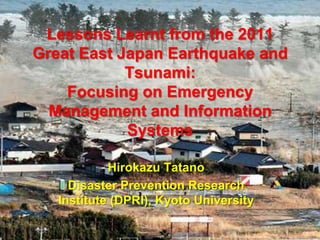
Lessons Learnt from the 2011
Great East Japan Earthquake and
Tsunami:
Focusing on Emergency
Management and Information
Systems
Hirokazu Tatano
Disaster Prevention Research
Institute (DPRI), Kyoto University
Contents
• Overviews of the Great East Japan
Earthquake and Tsunami, March 11th,
2011.
• Earthquake Early Warning System
• Evacuation
• Relief and Recovery
Outline of the Earthquake
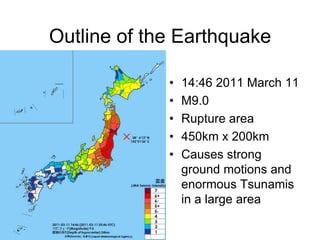
• 14:46 2011 March 11
• M9.0
• Rupture area
• 450km x 200km
• Causes strong
ground motions and
enormous Tsunamis
in a large area
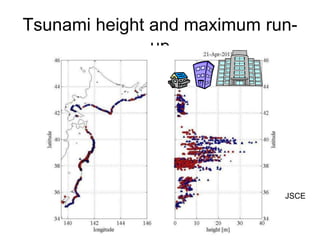
Tsunami height and maximum run-
up
JSCE
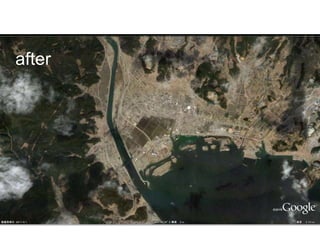
beforeafter
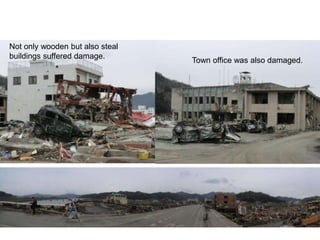
Town office was also damaged.
Not only wooden but also steal
buildings suffered damage.
Triple Disaster
• Earthquake
– M9.0
– Large affected areas
• Tsunami
• Killed or missing persons about 20,000
• Nuclear Accident
Features of the event
• Large Spatial Scale
– Preparation is not enough
– Huge causality, economic losses
– Difficulty in coordinating response, relief and
recovery
• Complex
– Earthquake, Tsunami, Nuclear, NaTech, etc.
• Cascading Impacts
– Production Capacity Decrease, Supply
Chain Disruption, Shortage of Goods and
Services
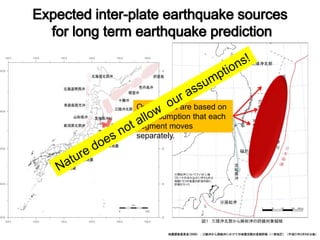
Our models are based on
the assumption that each
segment moves
separately.
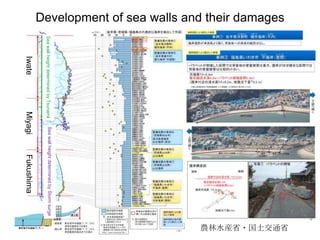
Development of sea walls and their damages
農林水産省・国土交通省
IwateMiyagiFukushima
SeawallheightdeterminedbyTsunamiSeawallheightdeterminedbyStormsurge
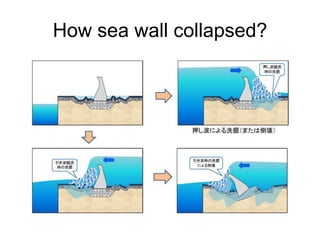
How sea wall collapsed?
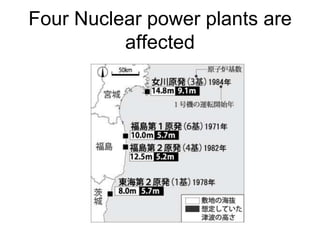
Four Nuclear power plants are
affected
Nuclear Power Plant
Fukushima No.1
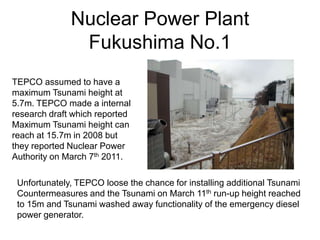
TEPCO assumed to have a
maximum Tsunami height at
5.7m. TEPCO made a internal
research draft which reported
Maximum Tsunami height can
reach at 15.7m in 2008 but
they reported Nuclear Power
Authority on March 7th 2011.
Unfortunately, TEPCO loose the chance for installing additional Tsunami
Countermeasures and the Tsunami on March 11th run-up height reached
to 15m and Tsunami washed away functionality of the emergency diesel
power generator.
Tokai Dai Ni
Nuclear Power plant
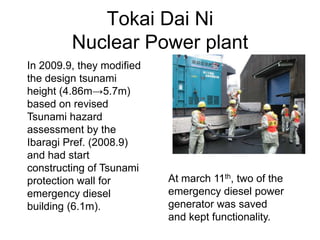
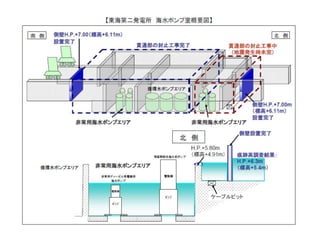
In 2009.9, they modified
the design tsunami
height (4.86m→5.7m)
based on revised
Tsunami hazard
assessment by the
Ibaragi Pref. (2008.9)
and had start
constructing of Tsunami
protection wall for
emergency diesel
building (6.1m).
At march 11th, two of the
emergency diesel power
generator was saved
and kept functionality.
Why we have “expected
surprise”?
• Design external force is used for facility
design.
• If the actual external force exceeds the
design force, it is not a responsibility of the
authority.
No authority don’t want to take risk by
considering force exceeding the design
force.
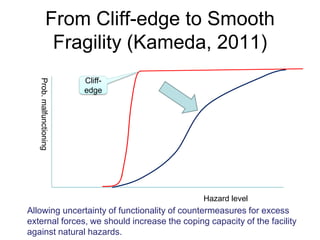
→ This leads to “cliff-edge fragility” problem
(Kameda 2011) .
From Cliff-edge to Smooth
Fragility (Kameda, 2011)Prob.malfunctioning
Hazard level
Cliff-
edge
Allowing uncertainty of functionality of countermeasures for excess
external forces, we should increase the coping capacity of the facility
against natural hazards.
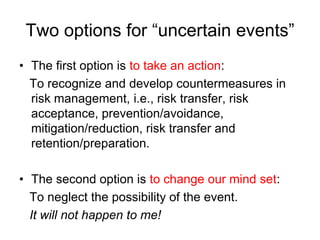
Two options for “uncertain events”
• The first option is to take an action:
To recognize and develop countermeasures in
risk management, i.e., risk transfer, risk
acceptance, prevention/avoidance,
mitigation/reduction, risk transfer and
retention/preparation.
• The second option is to change our mind set:
To neglect the possibility of the event.
It will not happen to me!
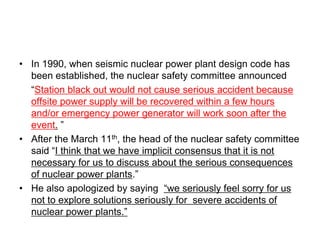
• In 1990, when seismic nuclear power plant design code has
been established, the nuclear safety committee announced
“Station black out would not cause serious accident because
offsite power supply will be recovered within a few hours
and/or emergency power generator will work soon after the
event. ”
• After the March 11th, the head of the nuclear safety committee
said “I think that we have implicit consensus that it is not
necessary for us to discuss about the serious consequences
of nuclear power plants.”
• He also apologized by saying “we seriously feel sorry for us
not to explore solutions seriously for severe accidents of
nuclear power plants.”
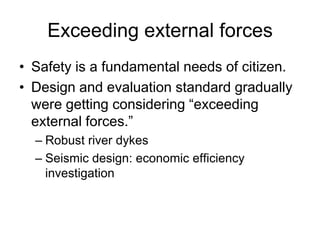
Exceeding external forces
• Safety is a fundamental needs of citizen.
• Design and evaluation standard gradually
were getting considering “exceeding
external forces.”
– Robust river dykes
– Seismic design: economic efficiency
investigation
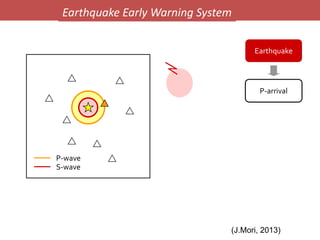
P-wave
S-wave
Earthquake
P-arrival
Earthquake Early Warning System
(J.Mori, 2013)
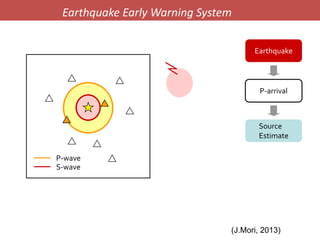
P-wave
S-wave
Earthquake
P-arrival
Source
Estimate
Earthquake Early Warning System
(J.Mori, 2013)
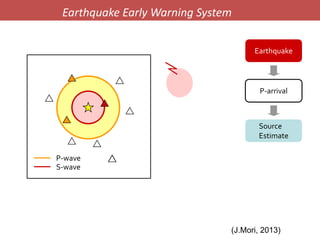
Earthquake
P-arrival
Source
Estimate
S-wave
P-wave
Earthquake Early Warning System
(J.Mori, 2013)
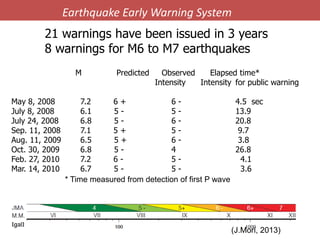
21 warnings have been issued in 3 years
8 warnings for M6 to M7 earthquakes
M Predicted Observed Elapsed time*
Intensity Intensity for public warning
May 8, 2008 7.2 6 + 6 - 4.5 sec
July 8, 2008 6.1 5 - 5 - 13.9
July 24, 2008 6.8 5 - 6 - 20.8
Sep. 11, 2008 7.1 5 + 5 - 9.7
Aug. 11, 2009 6.5 5 + 6 - 3.8
Oct. 30, 2009 6.8 5 - 4 26.8
Feb. 27, 2010 7.2 6 - 5 - 4.1
Mar. 14, 2010 6.7 5 - 5 - 3.6
* Time measured from detection of first P wave
Earthquake Early Warning System
(J.Mori, 2013)
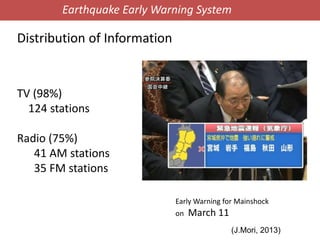
Distribution of Information
TV (98%)
124 stations
Radio (75%)
41 AM stations
35 FM stations
Early Warning for Mainshock
on March 11
Earthquake Early Warning System
(J.Mori, 2013)
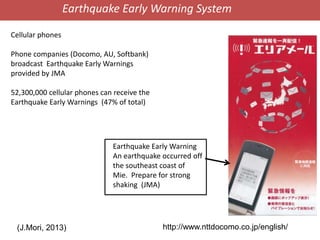
Cellular phones
Phone companies (Docomo, AU, Softbank)
broadcast Earthquake Early Warnings
provided by JMA
52,300,000 cellular phones can receive the
Earthquake Early Warnings (47% of total)
http://www.nttdocomo.co.jp/english/
Earthquake Early Warning
An earthquake occurred off
the southeast coast of
Mie. Prepare for strong
shaking (JMA)
Earthquake Early Warning System
(J.Mori, 2013)
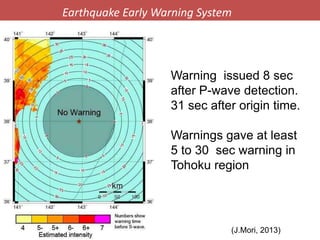
Summary of Early WarningEarthquake Early Warning System
Warning issued 8 sec
after P-wave detection.
31 sec after origin time.
Warnings gave at least
5 to 30 sec warning in
Tohoku region
(J.Mori, 2013)
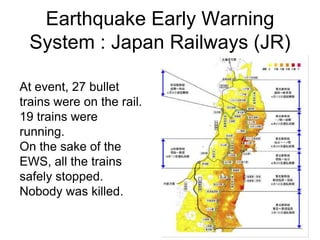
Earthquake Early Warning
System : Japan Railways (JR)
At event, 27 bullet
trains were on the rail.
19 trains were
running.
On the sake of the
EWS, all the trains
safely stopped.
Nobody was killed.
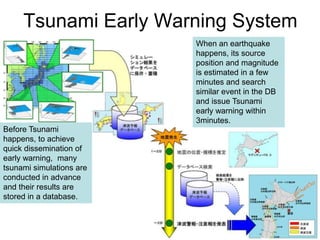
Tsunami Early Warning System
Before Tsunami
happens, to achieve
quick dissemination of
early warning, many
tsunami simulations are
conducted in advance
and their results are
stored in a database.
When an earthquake
happens, its source
position and magnitude
is estimated in a few
minutes and search
similar event in the DB
and issue Tsunami
early warning within
3minutes.
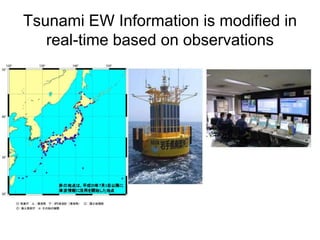
Tsunami EW Information is modified in
real-time based on observations
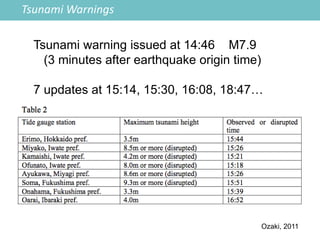
Ozaki, 2011
Tsunami warning issued at 14:46 M7.9
(3 minutes after earthquake origin time)
7 updates at 15:14, 15:30, 16:08, 18:47…
Tsunami Warnings
Preparedness
• Disaster Risk Reduction Planning:
– Regional Disaster Prevention Plan,
Contingency plans for disaster response,
BCP, etc.
• Risk information provision:
– Hazard map, etc.
• Capacity development:
– Disaster education, Risk communication, WS,
Drills, etc.
Regional Disaster Prevention
Plan
 Requested by Disaster Countermeasure
Basic Act (1961) triggered by Isewan typhoon
disaster
 Every level of public sectors shall have a plan
by disaster prevention basic act (legal duty).
 A plan shall include long-term establishment
plan on (1) forecasting system, (2) facilities
for flood fighting, (3) warning criteria, (4)
rescue system, and (5) communications in
emergency.
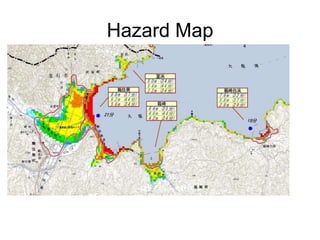
Hazard Map
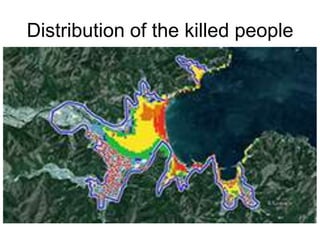
Distribution of the killed people
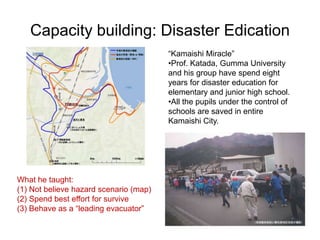
Capacity building: Disaster Edication
“Kamaishi Miracle”
•Prof. Katada, Gumma University
and his group have spend eight
years for disaster education for
elementary and junior high school.
•All the pupils under the control of
schools are saved in entire
Kamaishi City.
What he taught:
(1) Not believe hazard scenario (map)
(2) Spend best effort for survive
(3) Behave as a “leading evacuator”
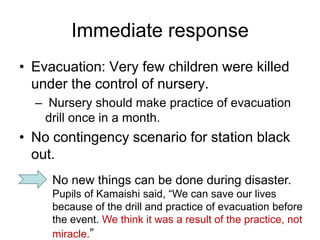
Immediate response
• Evacuation: Very few children were killed
under the control of nursery.
– Nursery should make practice of evacuation
drill once in a month.
• No contingency scenario for station black
out.
No new things can be done during disaster.
Pupils of Kamaishi said, “We can save our lives
because of the drill and practice of evacuation before
the event. We think it was a result of the practice, not
miracle.”
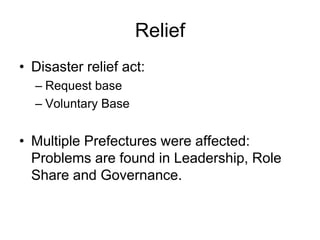
Relief
• Disaster relief act:
– Request base
– Voluntary Base
• Multiple Prefectures were affected:
Problems are found in Leadership, Role
Share and Governance.
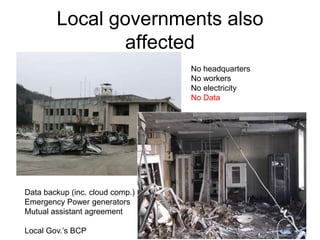
Local governments also
affected
No headquarters
No workers
No electricity
No Data
Data backup (inc. cloud comp.)
Emergency Power generators
Mutual assistant agreement
Local Gov.’s BCP
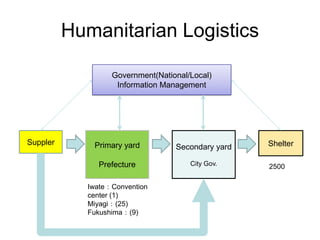
Humanitarian Logistics
Suppler Primary yard
Prefecture
Secondary yard
City Gov.
Shelter
Government(National/Local)
Information Management
Iwate:Convention
center (1)
Miyagi:(25)
Fukushima:(9)
2500
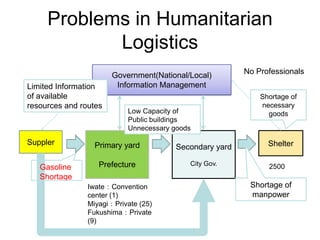
Problems in Humanitarian
Logistics
Suppler Primary yard
Prefecture
Secondary yard
City Gov.
Shelter
Government(National/Local)
Information Management
Iwate:Convention
center (1)
Miyagi:Private (25)
Fukushima:Private
(9)
2500
No Professionals
Limited Information
of available
resources and routes
Gasoline
Shortage
Low Capacity of
Public buildings
Unnecessary goods
Shortage of
necessary
goods
Shortage of
manpower
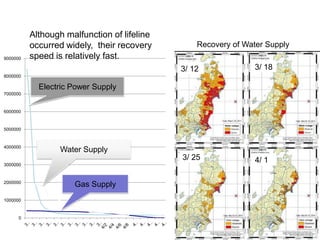
0
1000000
2000000
3000000
4000000
5000000
6000000
7000000
8000000
9000000
3/ 12 3/ 18
3/ 25 4/ 1
Recovery of Water Supply
Water Supply
Electric Power Supply
Gas Supply
Although malfunction of lifeline
occurred widely, their recovery
speed is relatively fast.
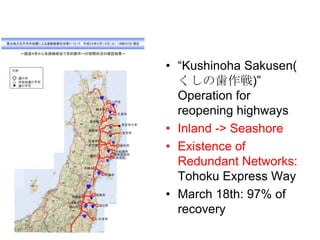
• “Kushinoha Sakusen(
くしの歯作戦)”
Operation for
reopening highways
• Inland -> Seashore
• Existence of
Redundant Networks:
Tohoku Express Way
• March 18th: 97% of
recovery
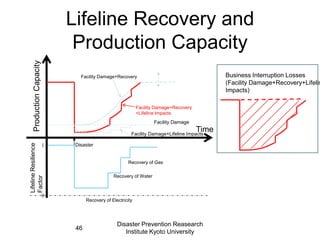
Lifeline Recovery and
Production Capacity
Disaster Prevention Reasearch
Institute Kyoto University
46
Disaster
ProductionCapacity
Time
Facility Damage
Facility Damage+Recovery
+Lifeline Impacts
Facility Damage+Recovery
Facility Damage+Lifeline Impacts
LifelineResilience
Factor
1
0
Recovery of Electricity
Recovery of Water
Recovery of Gas
Business Interruption Losses
(Facility Damage+Recovery+Lifelin
Impacts)
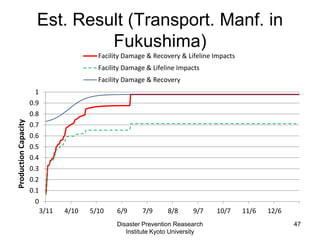
Est. Result (Transport. Manf. in
Fukushima)
Disaster Prevention Reasearch
Institute Kyoto University
47
0
0.1
0.2
0.3
0.4
0.5
0.6
0.7
0.8
0.9
1
3/11 4/10 5/10 6/9 7/9 8/8 9/7 10/7 11/6 12/6
ProductionCapacity
Facility Damage & Recovery & Lifeline Impacts
Facility Damage & Lifeline Impacts
Facility Damage & Recovery
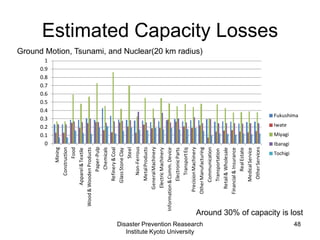
Estimated Capacity Losses
Disaster Prevention Reasearch
Institute Kyoto University
48
0
0.1
0.2
0.3
0.4
0.5
0.6
0.7
0.8
0.9
1
Mining
Construction
Food
Apparel&Textile
Wood&WoodenProducts
Paper-Pulp
Chemicals
Refinery&Coal
GlassStoneClay
Steel
Non-Ferrous
MetalProducts
GeneralMachinery
ElectricMachinery
Information&Comm.Device
ElectronicParts
TransportEq
PrecisionMachinery
OtherManufacturing
Communication
Transportation
Retail&Wholesale
Financial&Insurance
RealEstate
MedicalService
OtherServices
Fukushima
Iwate
Miyagi
Ibaragi
Tochigi
Ground Motion, Tsunami, and Nuclear(20 km radius)
Around 30% of capacity is lost
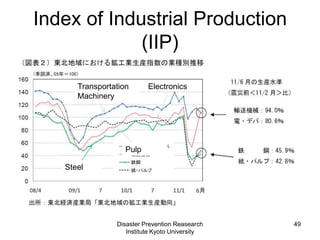
Index of Industrial Production
(IIP)
Disaster Prevention Reasearch
Institute Kyoto University
49
Steel
Pulp
Transportation
Machinery
Electronics
0
0.1
0.2
0.3
0.4
0.5
0.6
0.7
0.8
0.9
1
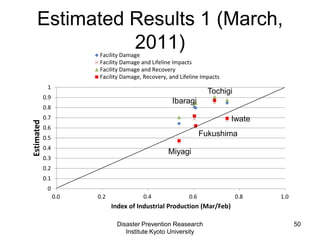
0.0 0.2 0.4 0.6 0.8 1.0
Estimated
Index of Industrial Production (Mar/Feb)
Facility Damage
Facility Damage and Lifeline Impacts
Facility Damage and Recovery
Facility Damage, Recovery, and Lifeline Impacts
Estimated Results 1 (March,
2011)
Disaster Prevention Reasearch
Institute Kyoto University
50
Miyagi
Fukushima
Ibaragi
Tochigi
Iwate
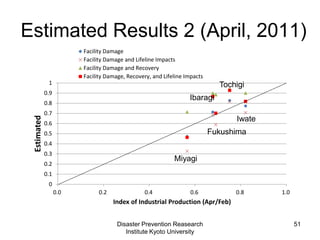
Estimated Results 2 (April, 2011)
Disaster Prevention Reasearch
Institute Kyoto University
51
0
0.1
0.2
0.3
0.4
0.5
0.6
0.7
0.8
0.9
1
0.0 0.2 0.4 0.6 0.8 1.0
Estimated
Index of Industrial Production (Apr/Feb)
Facility Damage
Facility Damage and Lifeline Impacts
Facility Damage and Recovery
Facility Damage, Recovery, and Lifeline Impacts
Miyagi
Fukushima
Ibaragi
Tochigi
Iwate
0
0.1
0.2
0.3
0.4
0.5
0.6
0.7
0.8
0.9
1
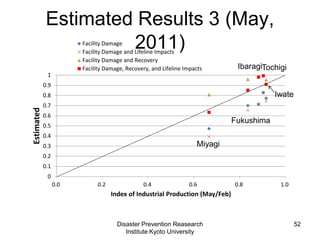
0.0 0.2 0.4 0.6 0.8 1.0
Estimated
Index of Industrial Production (May/Feb)
Facility Damage
Facility Damage and Lifeline Impacts
Facility Damage and Recovery
Facility Damage, Recovery, and Lifeline Impacts
Estimated Results 3 (May,
2011)
Disaster Prevention Reasearch
Institute Kyoto University
52
Miyagi
Fukushima
IbaragiTochigi
Iwate
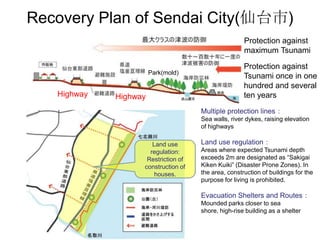
Recovery Plan of Sendai City(仙台市)
Multiple protection lines:
Sea walls, river dykes, raising elevation
of highways
Land use regulation:
Areas where expected Tsunami depth
exceeds 2m are designated as “Sakigai
Kiken Kuiki” (Disaster Prone Zones). In
the area, construction of buildings for the
purpose for living is prohibited.
Evacuation Shelters and Routes:
Mounded parks closer to sea
shore, high-rise building as a shelter
Highway Highway
Park(mold)
Protection against
maximum Tsunami
Protection against
Tsunami once in one
hundred and several
ten years
Land use
regulation:
Restriction of
construction of
houses.
京都大学防災研究所
総合防災研究部門 多々納裕一
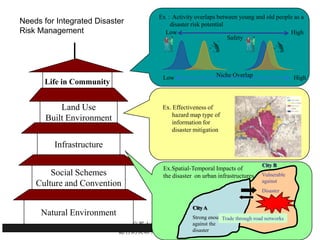
Life in Community
Land Use
Built Environment
Infrastructure
Social Schemes
Culture and Convention
Natural Environment
Ex:Activity overlaps between young and old people as a
disaster risk potential
Safety
Low High
Niche OverlapLow High
City B
Vulnerable
against
Disaster
City A
Strong enough
against the
disaster
Trade through road networks
Ex.Spatial-Temporal Impacts of
the disaster on urban infrastructures
Ex. Effectiveness of
hazard map type of
information for
disaster mitigation
Needs for Integrated Disaster
Risk Management
Challenge
• Establishing Better Risk Governance
– Who takes responsibility for the safety against natural
hazards?
– Can we achieve it by enhancing public private
partnership?
• Establish networks and platforms from
normal periods:
– Local government’s BCP/ District BCM
– Mutual assistance agreement among stakeholders,
including distant local governments
Thank you for your attention.
tatano@imdr.dpri.kyoto-u.ac.jp
http://idrim.org/
IDRiM 2013 @ Northumbria U., UK, Sept. 4-6, 2013
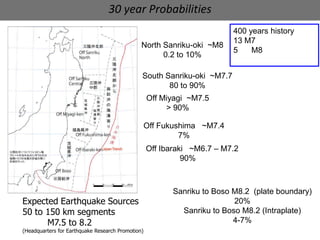
Expected Earthquake Sources
50 to 150 km segments
M7.5 to 8.2
(Headquarters for Earthquake Research Promotion)
North Sanriku-oki ~M8
0.2 to 10%
South Sanriku-oki ~M7.7
80 to 90%
Off Fukushima ~M7.4
7%
Off Ibaraki ~M6.7 – M7.2
90%
30 year Probabilities
Sanriku to Boso M8.2 (plate boundary)
20%
Sanriku to Boso M8.2 (Intraplate)
4-7%
Off Miyagi ~M7.5
> 90%
400 years history
13 M7
5 M8
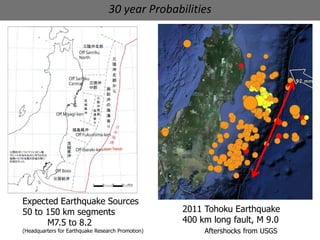
Expected Earthquake Sources
50 to 150 km segments
M7.5 to 8.2
(Headquarters for Earthquake Research Promotion)
30 year Probabilities
2011 Tohoku Earthquake
400 km long fault, M 9.0
Aftershocks from USGS

ISCRAM 2013: Lessons Learnt from the 2011 Great East Japan Earthquake and Tsunami Focusing on Emergency Management and Information Systems

  • 1.
    Lessons Learnt fromthe 2011 Great East Japan Earthquake and Tsunami: Focusing on Emergency Management and Information Systems Hirokazu Tatano Disaster Prevention Research Institute (DPRI), Kyoto University
  • 2.
    Contents • Overviews ofthe Great East Japan Earthquake and Tsunami, March 11th, 2011. • Earthquake Early Warning System • Evacuation • Relief and Recovery
  • 3.
    Outline of theEarthquake • 14:46 2011 March 11 • M9.0 • Rupture area • 450km x 200km • Causes strong ground motions and enormous Tsunamis in a large area
  • 4.
    Tsunami height andmaximum run- up JSCE
  • 5.
  • 6.
    Town office wasalso damaged. Not only wooden but also steal buildings suffered damage.
  • 7.
    Triple Disaster • Earthquake –M9.0 – Large affected areas • Tsunami • Killed or missing persons about 20,000 • Nuclear Accident
  • 8.
    Features of theevent • Large Spatial Scale – Preparation is not enough – Huge causality, economic losses – Difficulty in coordinating response, relief and recovery • Complex – Earthquake, Tsunami, Nuclear, NaTech, etc. • Cascading Impacts – Production Capacity Decrease, Supply Chain Disruption, Shortage of Goods and Services
  • 9.
    Our models arebased on the assumption that each segment moves separately.
  • 10.
    Development of seawalls and their damages 農林水産省・国土交通省 IwateMiyagiFukushima SeawallheightdeterminedbyTsunamiSeawallheightdeterminedbyStormsurge
  • 11.
    How sea wallcollapsed?
  • 12.
    Four Nuclear powerplants are affected
  • 13.
    Nuclear Power Plant FukushimaNo.1 TEPCO assumed to have a maximum Tsunami height at 5.7m. TEPCO made a internal research draft which reported Maximum Tsunami height can reach at 15.7m in 2008 but they reported Nuclear Power Authority on March 7th 2011. Unfortunately, TEPCO loose the chance for installing additional Tsunami Countermeasures and the Tsunami on March 11th run-up height reached to 15m and Tsunami washed away functionality of the emergency diesel power generator.
  • 14.
    Tokai Dai Ni NuclearPower plant In 2009.9, they modified the design tsunami height (4.86m→5.7m) based on revised Tsunami hazard assessment by the Ibaragi Pref. (2008.9) and had start constructing of Tsunami protection wall for emergency diesel building (6.1m). At march 11th, two of the emergency diesel power generator was saved and kept functionality.
  • 16.
    Why we have“expected surprise”? • Design external force is used for facility design. • If the actual external force exceeds the design force, it is not a responsibility of the authority. No authority don’t want to take risk by considering force exceeding the design force. → This leads to “cliff-edge fragility” problem (Kameda 2011) .
  • 17.
    From Cliff-edge toSmooth Fragility (Kameda, 2011)Prob.malfunctioning Hazard level Cliff- edge Allowing uncertainty of functionality of countermeasures for excess external forces, we should increase the coping capacity of the facility against natural hazards.
  • 18.
    Two options for“uncertain events” • The first option is to take an action: To recognize and develop countermeasures in risk management, i.e., risk transfer, risk acceptance, prevention/avoidance, mitigation/reduction, risk transfer and retention/preparation. • The second option is to change our mind set: To neglect the possibility of the event. It will not happen to me!
  • 19.
    • In 1990,when seismic nuclear power plant design code has been established, the nuclear safety committee announced “Station black out would not cause serious accident because offsite power supply will be recovered within a few hours and/or emergency power generator will work soon after the event. ” • After the March 11th, the head of the nuclear safety committee said “I think that we have implicit consensus that it is not necessary for us to discuss about the serious consequences of nuclear power plants.” • He also apologized by saying “we seriously feel sorry for us not to explore solutions seriously for severe accidents of nuclear power plants.”
  • 20.
    Exceeding external forces •Safety is a fundamental needs of citizen. • Design and evaluation standard gradually were getting considering “exceeding external forces.” – Robust river dykes – Seismic design: economic efficiency investigation
  • 21.
  • 22.
  • 23.
  • 24.
    21 warnings havebeen issued in 3 years 8 warnings for M6 to M7 earthquakes M Predicted Observed Elapsed time* Intensity Intensity for public warning May 8, 2008 7.2 6 + 6 - 4.5 sec July 8, 2008 6.1 5 - 5 - 13.9 July 24, 2008 6.8 5 - 6 - 20.8 Sep. 11, 2008 7.1 5 + 5 - 9.7 Aug. 11, 2009 6.5 5 + 6 - 3.8 Oct. 30, 2009 6.8 5 - 4 26.8 Feb. 27, 2010 7.2 6 - 5 - 4.1 Mar. 14, 2010 6.7 5 - 5 - 3.6 * Time measured from detection of first P wave Earthquake Early Warning System (J.Mori, 2013)
  • 25.
    Distribution of Information TV(98%) 124 stations Radio (75%) 41 AM stations 35 FM stations Early Warning for Mainshock on March 11 Earthquake Early Warning System (J.Mori, 2013)
  • 26.
    Cellular phones Phone companies(Docomo, AU, Softbank) broadcast Earthquake Early Warnings provided by JMA 52,300,000 cellular phones can receive the Earthquake Early Warnings (47% of total) http://www.nttdocomo.co.jp/english/ Earthquake Early Warning An earthquake occurred off the southeast coast of Mie. Prepare for strong shaking (JMA) Earthquake Early Warning System (J.Mori, 2013)
  • 27.
    Summary of EarlyWarningEarthquake Early Warning System Warning issued 8 sec after P-wave detection. 31 sec after origin time. Warnings gave at least 5 to 30 sec warning in Tohoku region (J.Mori, 2013)
  • 28.
    Earthquake Early Warning System: Japan Railways (JR) At event, 27 bullet trains were on the rail. 19 trains were running. On the sake of the EWS, all the trains safely stopped. Nobody was killed.
  • 29.
    Tsunami Early WarningSystem Before Tsunami happens, to achieve quick dissemination of early warning, many tsunami simulations are conducted in advance and their results are stored in a database. When an earthquake happens, its source position and magnitude is estimated in a few minutes and search similar event in the DB and issue Tsunami early warning within 3minutes.
  • 30.
    Tsunami EW Informationis modified in real-time based on observations
  • 31.
    Ozaki, 2011 Tsunami warningissued at 14:46 M7.9 (3 minutes after earthquake origin time) 7 updates at 15:14, 15:30, 16:08, 18:47… Tsunami Warnings
  • 32.
    Preparedness • Disaster RiskReduction Planning: – Regional Disaster Prevention Plan, Contingency plans for disaster response, BCP, etc. • Risk information provision: – Hazard map, etc. • Capacity development: – Disaster education, Risk communication, WS, Drills, etc.
  • 33.
    Regional Disaster Prevention Plan Requested by Disaster Countermeasure Basic Act (1961) triggered by Isewan typhoon disaster  Every level of public sectors shall have a plan by disaster prevention basic act (legal duty).  A plan shall include long-term establishment plan on (1) forecasting system, (2) facilities for flood fighting, (3) warning criteria, (4) rescue system, and (5) communications in emergency.
  • 34.
  • 35.
    Distribution of thekilled people
  • 36.
    Capacity building: DisasterEdication “Kamaishi Miracle” •Prof. Katada, Gumma University and his group have spend eight years for disaster education for elementary and junior high school. •All the pupils under the control of schools are saved in entire Kamaishi City. What he taught: (1) Not believe hazard scenario (map) (2) Spend best effort for survive (3) Behave as a “leading evacuator”
  • 37.
    Immediate response • Evacuation:Very few children were killed under the control of nursery. – Nursery should make practice of evacuation drill once in a month. • No contingency scenario for station black out. No new things can be done during disaster. Pupils of Kamaishi said, “We can save our lives because of the drill and practice of evacuation before the event. We think it was a result of the practice, not miracle.”
  • 38.
    Relief • Disaster reliefact: – Request base – Voluntary Base • Multiple Prefectures were affected: Problems are found in Leadership, Role Share and Governance.
  • 39.
    Local governments also affected Noheadquarters No workers No electricity No Data Data backup (inc. cloud comp.) Emergency Power generators Mutual assistant agreement Local Gov.’s BCP
  • 40.
    Humanitarian Logistics Suppler Primaryyard Prefecture Secondary yard City Gov. Shelter Government(National/Local) Information Management Iwate:Convention center (1) Miyagi:(25) Fukushima:(9) 2500
  • 41.
    Problems in Humanitarian Logistics SupplerPrimary yard Prefecture Secondary yard City Gov. Shelter Government(National/Local) Information Management Iwate:Convention center (1) Miyagi:Private (25) Fukushima:Private (9) 2500 No Professionals Limited Information of available resources and routes Gasoline Shortage Low Capacity of Public buildings Unnecessary goods Shortage of necessary goods Shortage of manpower
  • 42.
    0 1000000 2000000 3000000 4000000 5000000 6000000 7000000 8000000 9000000 3/ 12 3/18 3/ 25 4/ 1 Recovery of Water Supply Water Supply Electric Power Supply Gas Supply Although malfunction of lifeline occurred widely, their recovery speed is relatively fast.
  • 43.
    • “Kushinoha Sakusen( くしの歯作戦)” Operationfor reopening highways • Inland -> Seashore • Existence of Redundant Networks: Tohoku Express Way • March 18th: 97% of recovery
  • 44.
    Lifeline Recovery and ProductionCapacity Disaster Prevention Reasearch Institute Kyoto University 46 Disaster ProductionCapacity Time Facility Damage Facility Damage+Recovery +Lifeline Impacts Facility Damage+Recovery Facility Damage+Lifeline Impacts LifelineResilience Factor 1 0 Recovery of Electricity Recovery of Water Recovery of Gas Business Interruption Losses (Facility Damage+Recovery+Lifelin Impacts)
  • 45.
    Est. Result (Transport.Manf. in Fukushima) Disaster Prevention Reasearch Institute Kyoto University 47 0 0.1 0.2 0.3 0.4 0.5 0.6 0.7 0.8 0.9 1 3/11 4/10 5/10 6/9 7/9 8/8 9/7 10/7 11/6 12/6 ProductionCapacity Facility Damage & Recovery & Lifeline Impacts Facility Damage & Lifeline Impacts Facility Damage & Recovery
  • 46.
    Estimated Capacity Losses DisasterPrevention Reasearch Institute Kyoto University 48 0 0.1 0.2 0.3 0.4 0.5 0.6 0.7 0.8 0.9 1 Mining Construction Food Apparel&Textile Wood&WoodenProducts Paper-Pulp Chemicals Refinery&Coal GlassStoneClay Steel Non-Ferrous MetalProducts GeneralMachinery ElectricMachinery Information&Comm.Device ElectronicParts TransportEq PrecisionMachinery OtherManufacturing Communication Transportation Retail&Wholesale Financial&Insurance RealEstate MedicalService OtherServices Fukushima Iwate Miyagi Ibaragi Tochigi Ground Motion, Tsunami, and Nuclear(20 km radius) Around 30% of capacity is lost
  • 47.
    Index of IndustrialProduction (IIP) Disaster Prevention Reasearch Institute Kyoto University 49 Steel Pulp Transportation Machinery Electronics
  • 48.
    0 0.1 0.2 0.3 0.4 0.5 0.6 0.7 0.8 0.9 1 0.0 0.2 0.40.6 0.8 1.0 Estimated Index of Industrial Production (Mar/Feb) Facility Damage Facility Damage and Lifeline Impacts Facility Damage and Recovery Facility Damage, Recovery, and Lifeline Impacts Estimated Results 1 (March, 2011) Disaster Prevention Reasearch Institute Kyoto University 50 Miyagi Fukushima Ibaragi Tochigi Iwate
  • 49.
    Estimated Results 2(April, 2011) Disaster Prevention Reasearch Institute Kyoto University 51 0 0.1 0.2 0.3 0.4 0.5 0.6 0.7 0.8 0.9 1 0.0 0.2 0.4 0.6 0.8 1.0 Estimated Index of Industrial Production (Apr/Feb) Facility Damage Facility Damage and Lifeline Impacts Facility Damage and Recovery Facility Damage, Recovery, and Lifeline Impacts Miyagi Fukushima Ibaragi Tochigi Iwate
  • 50.
    0 0.1 0.2 0.3 0.4 0.5 0.6 0.7 0.8 0.9 1 0.0 0.2 0.40.6 0.8 1.0 Estimated Index of Industrial Production (May/Feb) Facility Damage Facility Damage and Lifeline Impacts Facility Damage and Recovery Facility Damage, Recovery, and Lifeline Impacts Estimated Results 3 (May, 2011) Disaster Prevention Reasearch Institute Kyoto University 52 Miyagi Fukushima IbaragiTochigi Iwate
  • 51.
    Recovery Plan ofSendai City(仙台市) Multiple protection lines: Sea walls, river dykes, raising elevation of highways Land use regulation: Areas where expected Tsunami depth exceeds 2m are designated as “Sakigai Kiken Kuiki” (Disaster Prone Zones). In the area, construction of buildings for the purpose for living is prohibited. Evacuation Shelters and Routes: Mounded parks closer to sea shore, high-rise building as a shelter Highway Highway Park(mold) Protection against maximum Tsunami Protection against Tsunami once in one hundred and several ten years Land use regulation: Restriction of construction of houses.
  • 52.
    京都大学防災研究所 総合防災研究部門 多々納裕一 Life inCommunity Land Use Built Environment Infrastructure Social Schemes Culture and Convention Natural Environment Ex:Activity overlaps between young and old people as a disaster risk potential Safety Low High Niche OverlapLow High City B Vulnerable against Disaster City A Strong enough against the disaster Trade through road networks Ex.Spatial-Temporal Impacts of the disaster on urban infrastructures Ex. Effectiveness of hazard map type of information for disaster mitigation Needs for Integrated Disaster Risk Management
  • 53.
    Challenge • Establishing BetterRisk Governance – Who takes responsibility for the safety against natural hazards? – Can we achieve it by enhancing public private partnership? • Establish networks and platforms from normal periods: – Local government’s BCP/ District BCM – Mutual assistance agreement among stakeholders, including distant local governments
  • 54.
    Thank you foryour attention. tatano@imdr.dpri.kyoto-u.ac.jp http://idrim.org/ IDRiM 2013 @ Northumbria U., UK, Sept. 4-6, 2013
  • 55.
    Expected Earthquake Sources 50to 150 km segments M7.5 to 8.2 (Headquarters for Earthquake Research Promotion) North Sanriku-oki ~M8 0.2 to 10% South Sanriku-oki ~M7.7 80 to 90% Off Fukushima ~M7.4 7% Off Ibaraki ~M6.7 – M7.2 90% 30 year Probabilities Sanriku to Boso M8.2 (plate boundary) 20% Sanriku to Boso M8.2 (Intraplate) 4-7% Off Miyagi ~M7.5 > 90% 400 years history 13 M7 5 M8
  • 56.
    Expected Earthquake Sources 50to 150 km segments M7.5 to 8.2 (Headquarters for Earthquake Research Promotion) 30 year Probabilities 2011 Tohoku Earthquake 400 km long fault, M 9.0 Aftershocks from USGS