Social Science
Research Methodology
Dr. M. Swarna Latha
Director of the Webinar
Vice-Principal,
Univ. Arts & Science College
Chair Person, Board of Studies
Dept. of Sociology and Social Work
Kakatiya University, Warangal
Research Definition
 Research is defined as the creation of new knowledge and/or
the use of existing knowledge in a new and creative way so
as to generate new concepts, methodologies and
understandings. This could include synthesis and analysis of
previous research to the extent that it leads to new and
creative outcomes.
 (Dept. of Education and Training, Western Sydney
Education, Australia,
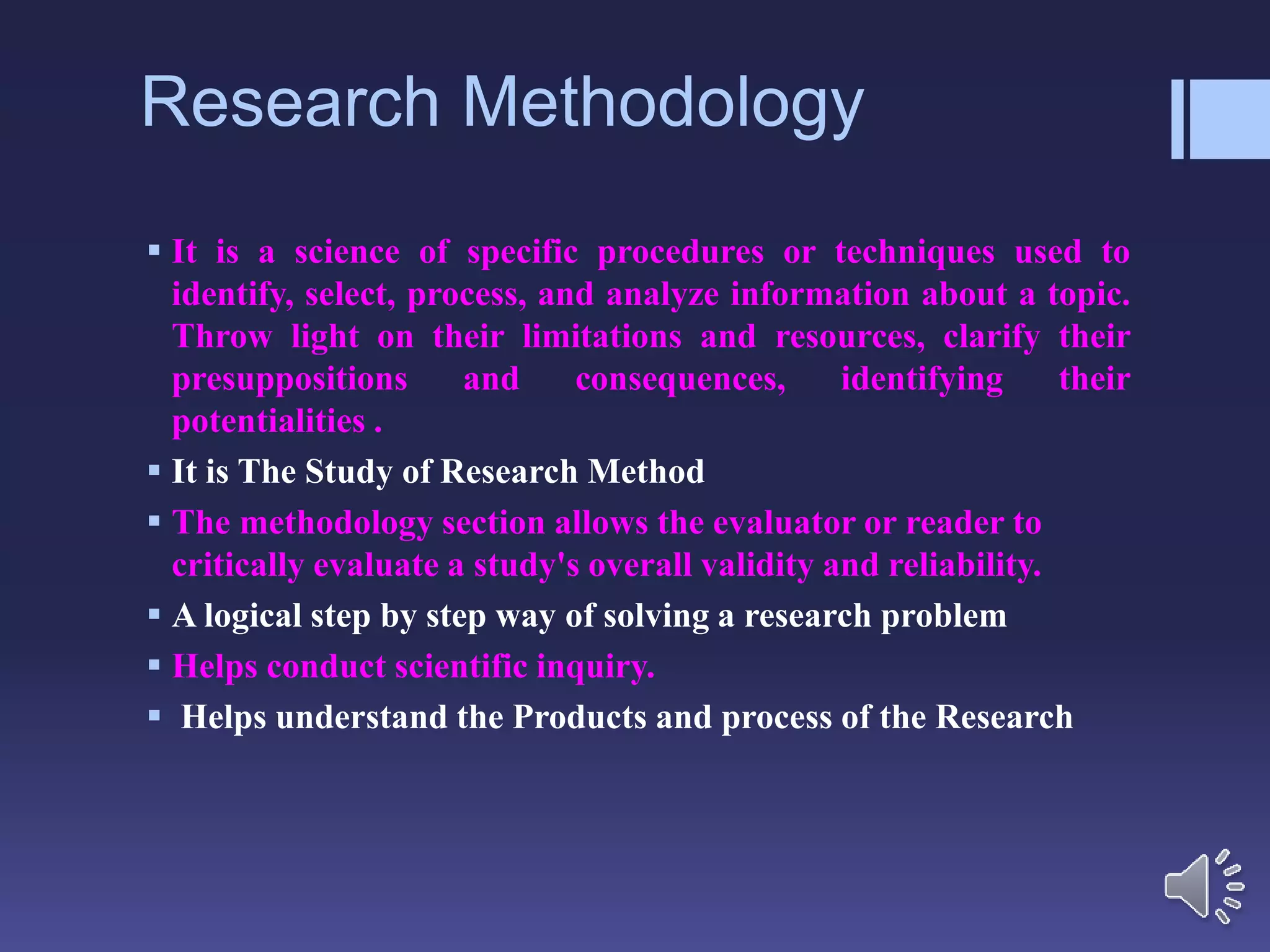
Research Methodology
 It is a science of specific procedures or techniques used to
identify, select, process, and analyze information about a topic.
Throw light on their limitations and resources, clarify their
presuppositions and consequences, identifying their
potentialities .
 It is The Study of Research Method
 The methodology section allows the evaluator or reader to
critically evaluate a study's overall validity and reliability.
 A logical step by step way of solving a research problem
 Helps conduct scientific inquiry.
 Helps understand the Products and process of the Research
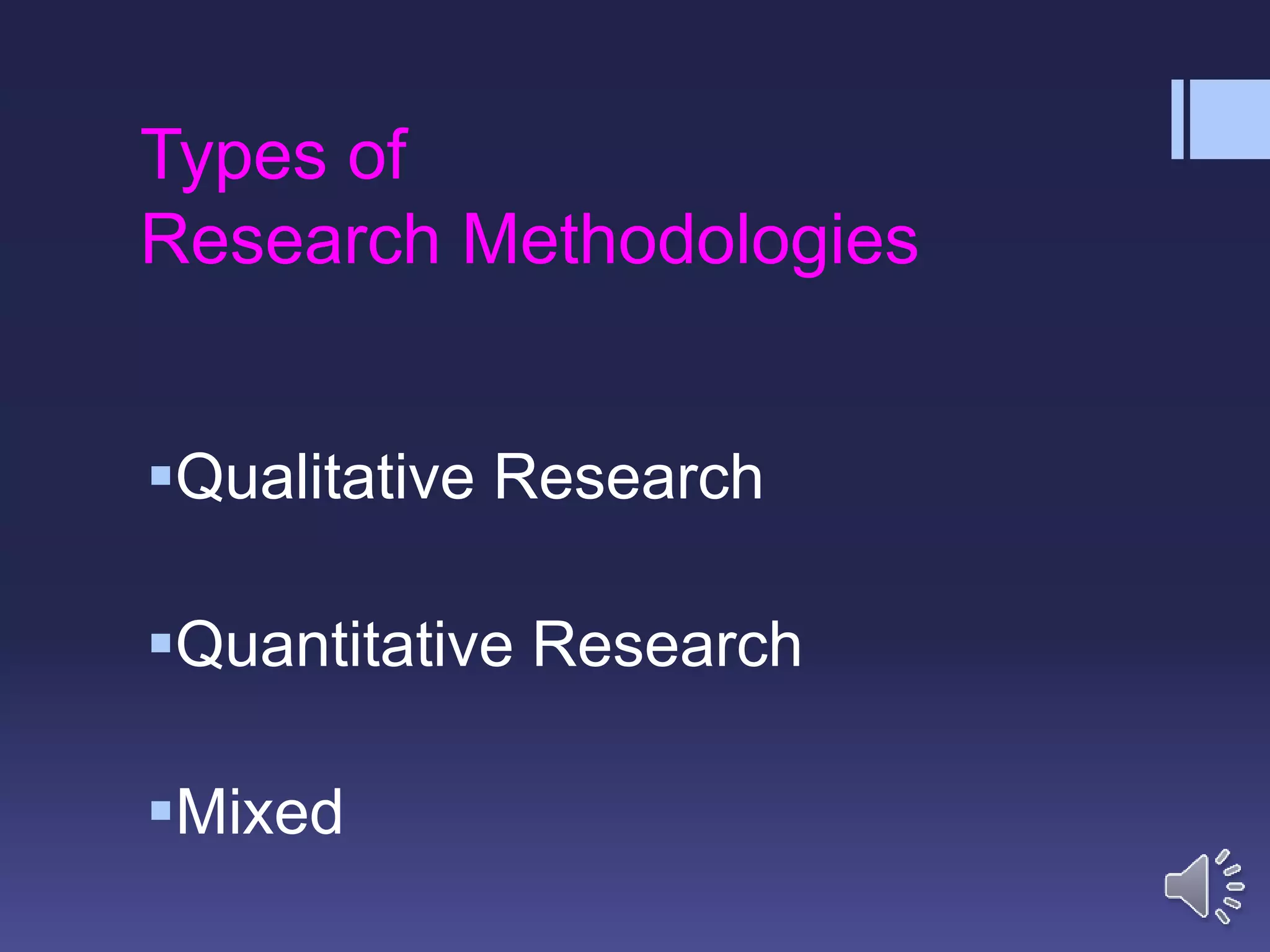
Types of
Research Methodologies
Qualitative Research
Quantitative Research
Mixed
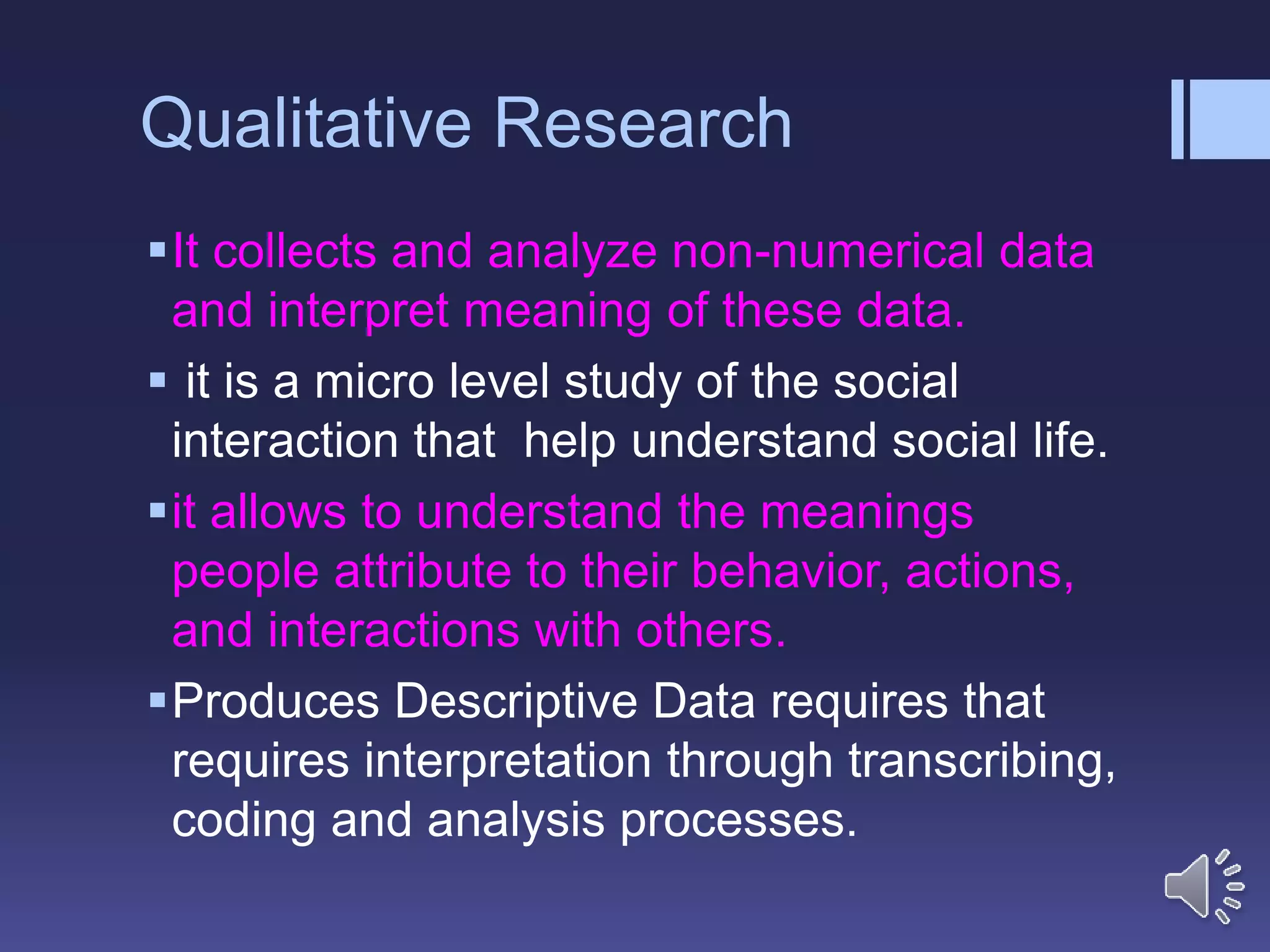
Qualitative Research
It collects and analyze non-numerical data
and interpret meaning of these data.
 it is a micro level study of the social
interaction that help understand social life.
it allows to understand the meanings
people attribute to their behavior, actions,
and interactions with others.
Produces Descriptive Data requires that
requires interpretation through transcribing,
coding and analysis processes.
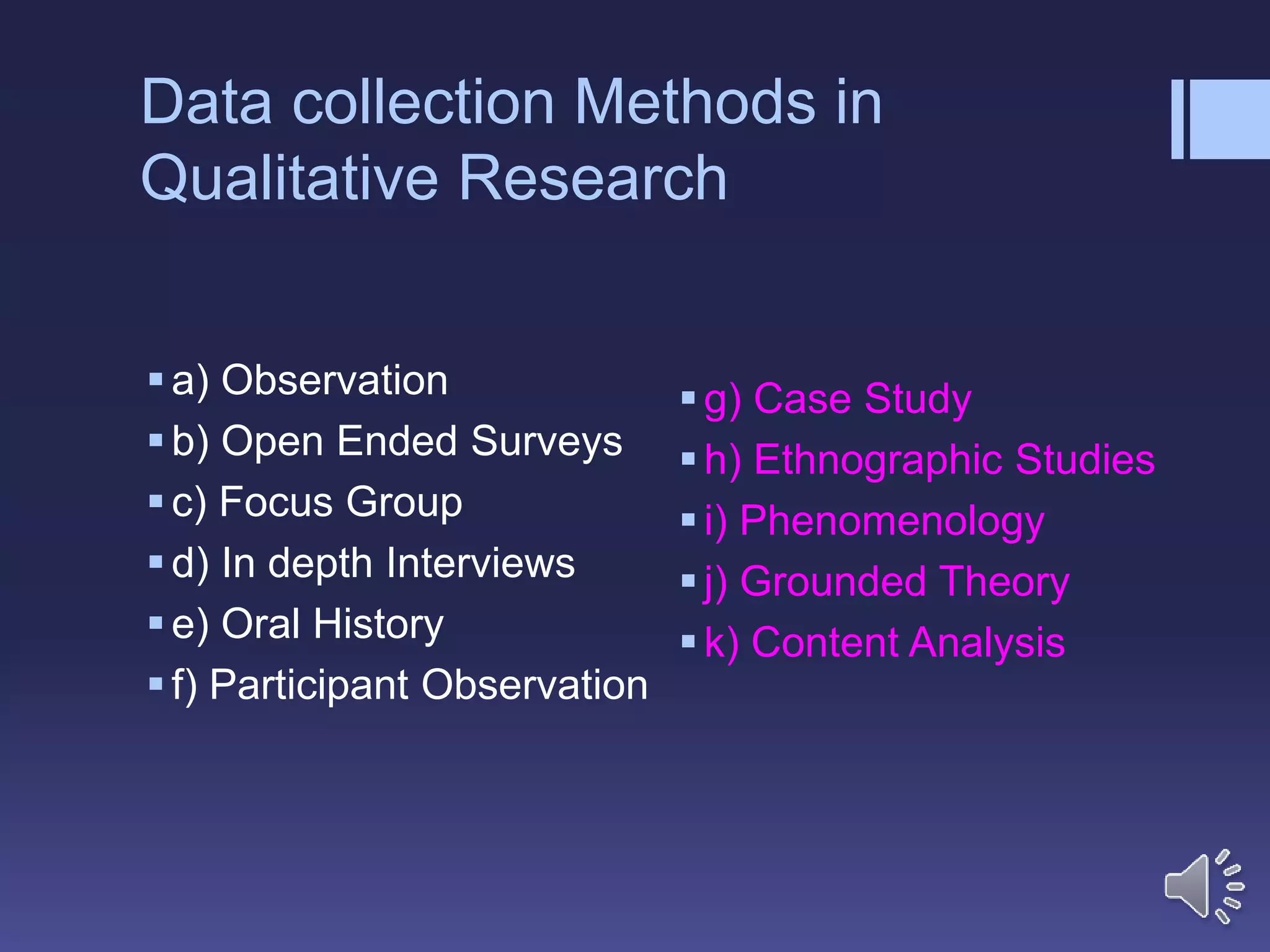
Data collection Methods in
Qualitative Research
a) Observation
b) Open Ended Surveys
c) Focus Group
d) In depth Interviews
e) Oral History
f) Participant Observation
g) Case Study
h) Ethnographic Studies
i) Phenomenology
j) Grounded Theory
k) Content Analysis
Quantitative Research
 systematic empirical investigation of observable phenomena
via statistical, mathematical, or computational techniques.
 The process of measurement is central to quantitative
research because it provides the fundamental connection
between empirical observation and mathematical expression
of quantitative relationships.
 this method is based on August Comte’s theory of Positivism
 Positivism emphasizes the use of scientific method. through
observation and empirical testing of hypotheses, the
research unfolds in explaining and predicting the what,
where, why, how, and when of the observable phenomena
 These studies do not provide reasoning behind participants'
responses, they often do not reach underrepresented
populations, and they may span long periods in order to
collect the data
Quantitative Research objectives
to determine the relationship between one thing
[an independent variable] and another [a
dependent or outcome variable] within a
population.
Quantitative research designs are either
descriptive [subjects usually measured once] or
experimental [subjects measured before and after
a treatment].
A descriptive study establishes only associations
between variables; an experimental study
establishes causality.
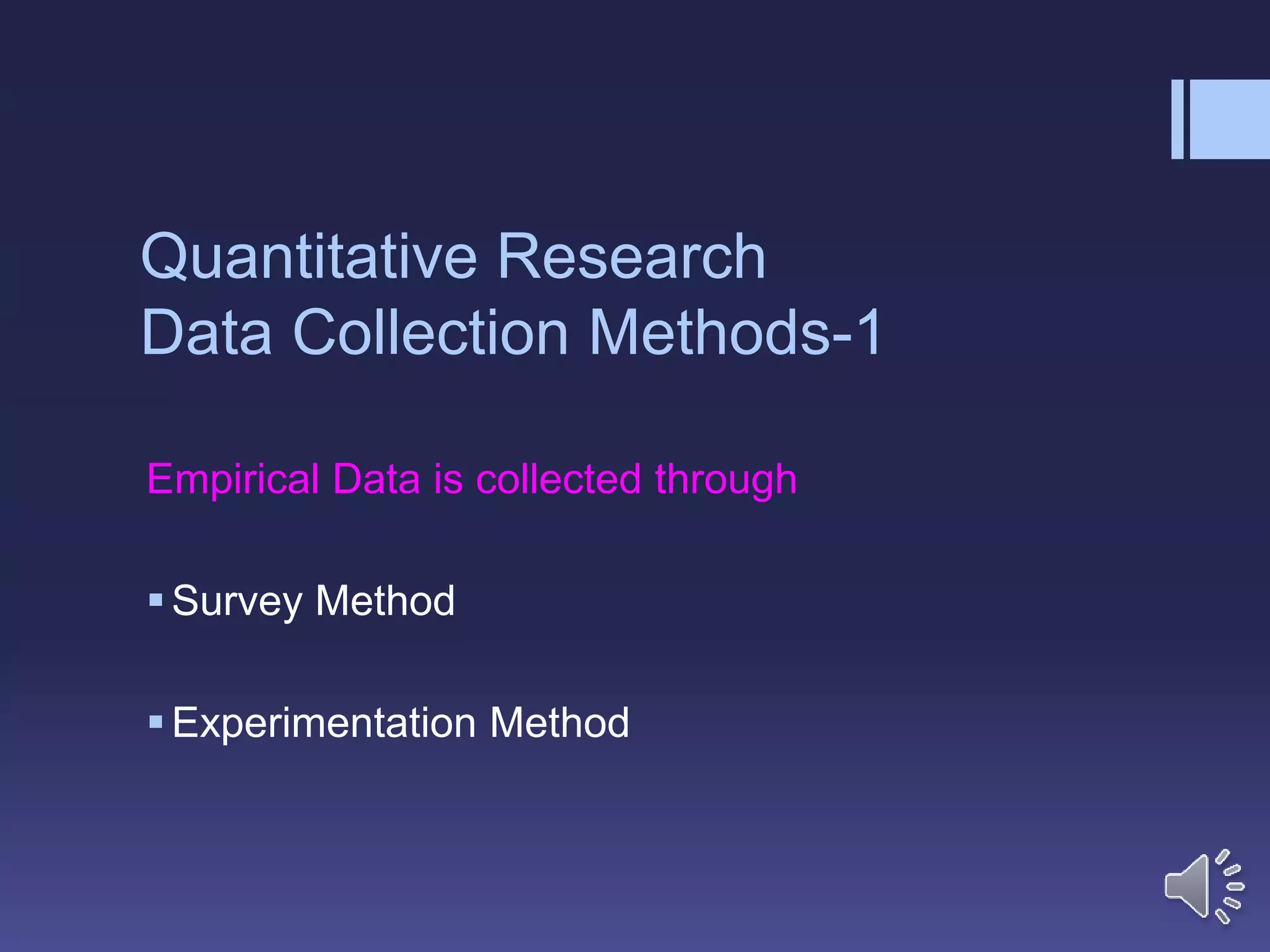
Quantitative Research
Data Collection Methods-1
Empirical Data is collected through
Survey Method
Experimentation Method
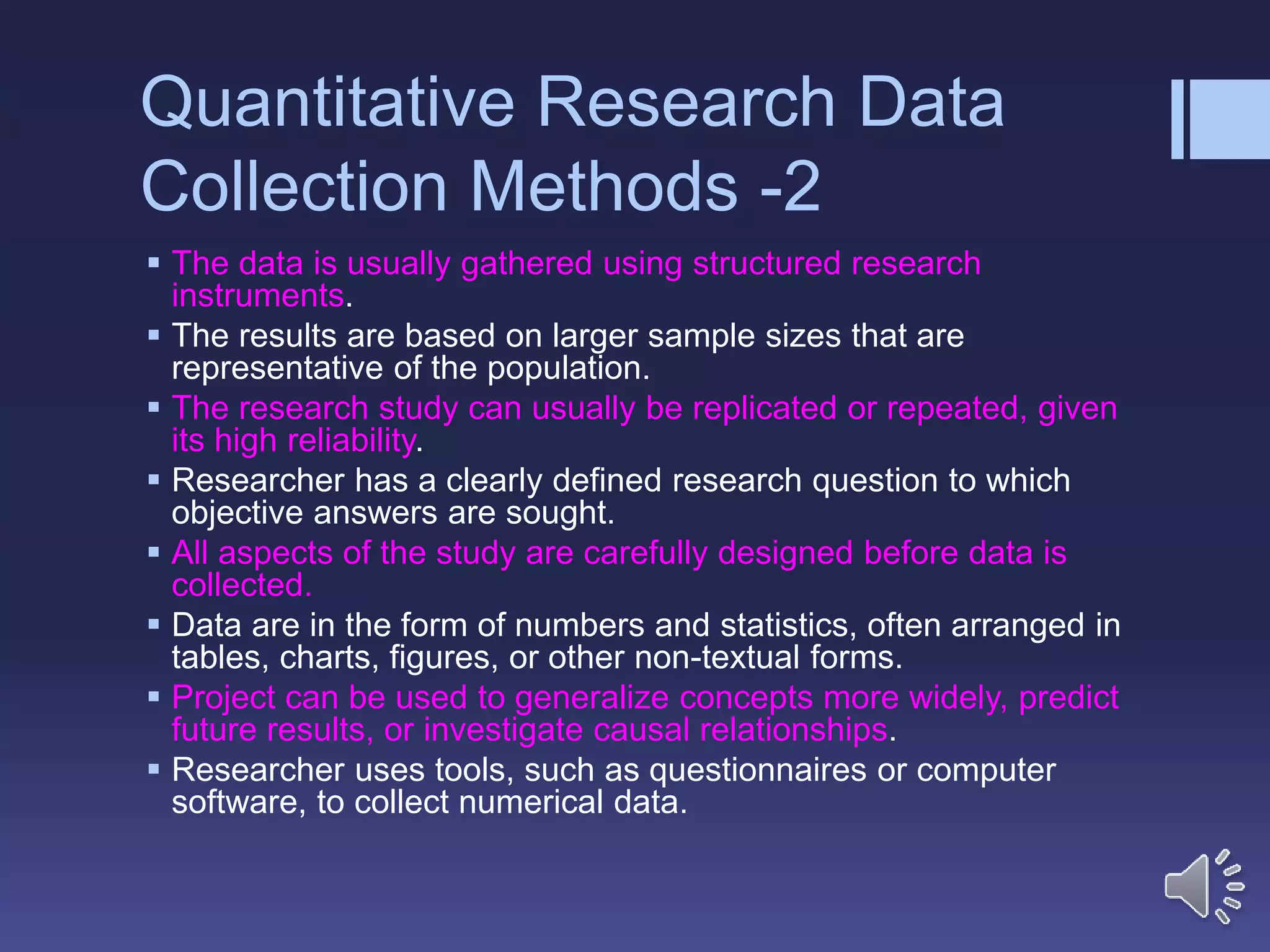
Quantitative Research Data
Collection Methods -2
 The data is usually gathered using structured research
instruments.
 The results are based on larger sample sizes that are
representative of the population.
 The research study can usually be replicated or repeated, given
its high reliability.
 Researcher has a clearly defined research question to which
objective answers are sought.
 All aspects of the study are carefully designed before data is
collected.
 Data are in the form of numbers and statistics, often arranged in
tables, charts, figures, or other non-textual forms.
 Project can be used to generalize concepts more widely, predict
future results, or investigate causal relationships.
 Researcher uses tools, such as questionnaires or computer
software, to collect numerical data.
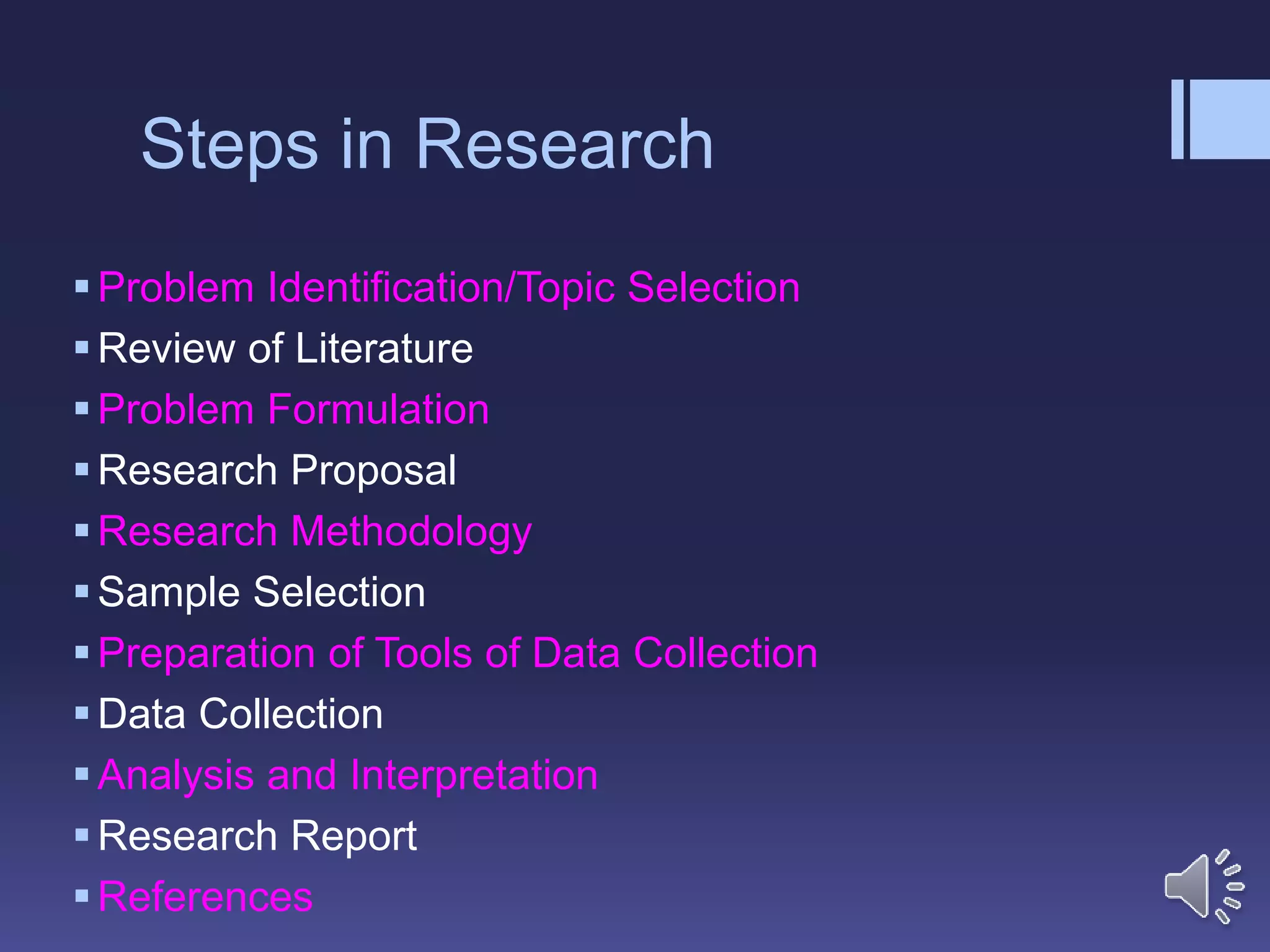
Steps in Research
Problem Identification/Topic Selection
Review of Literature
Problem Formulation
Research Proposal
Research Methodology
Sample Selection
Preparation of Tools of Data Collection
Data Collection
Analysis and Interpretation
Research Report
References
Research Design in Quantitative
Research -1
Introduction
Research Problem
Review of Literature
Theoretical
Framework
Significance of the
Study
Objectives
Hypotheses
Scope and limitations
Future Implications
/expected outcomes
of the study
Operational
Definitions
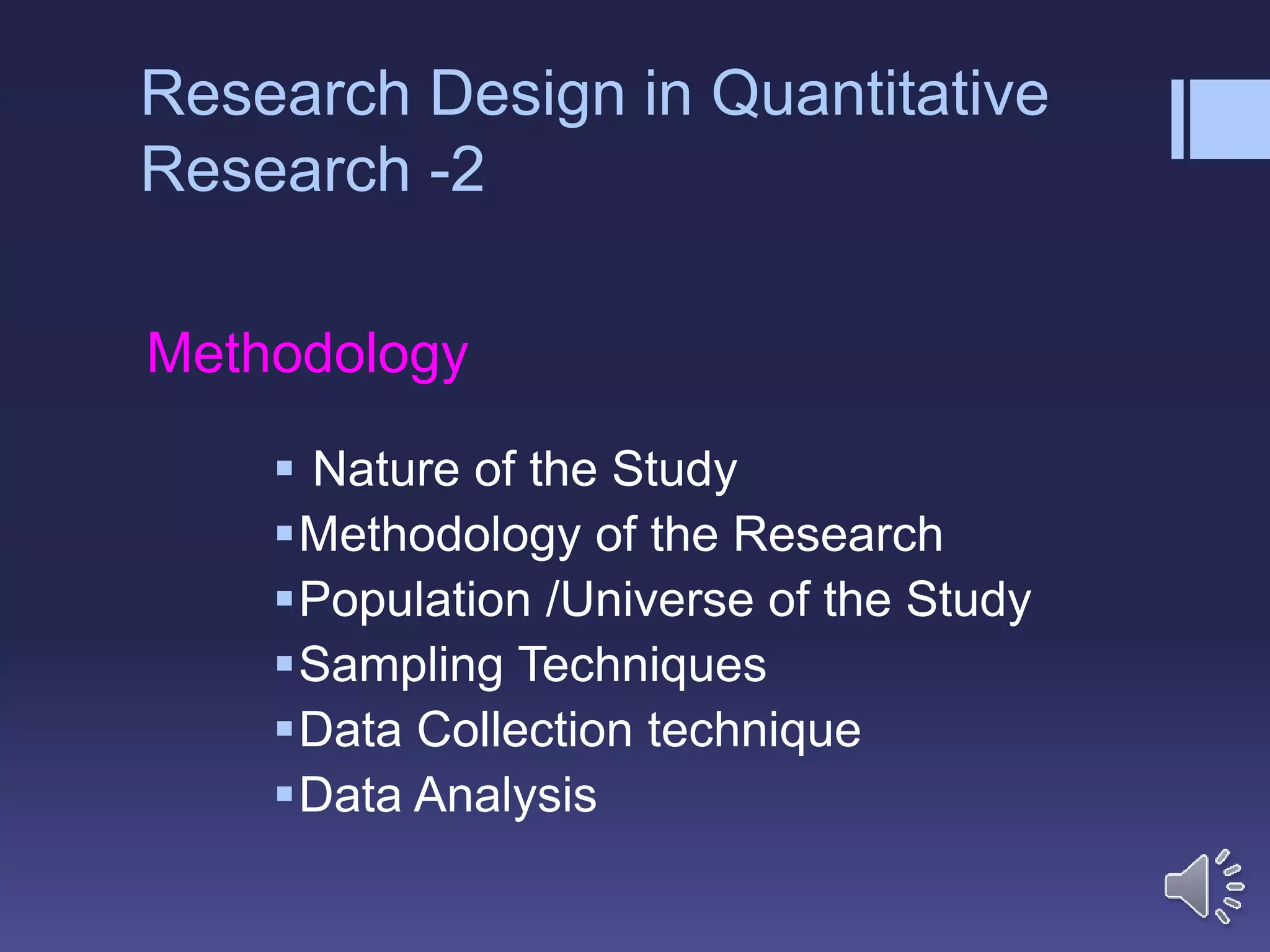
Research Design in Quantitative
Research -2
Methodology
 Nature of the Study
Methodology of the Research
Population /Universe of the Study
Sampling Techniques
Data Collection technique
Data Analysis
Research Design in Quantitative
Research -3
 Results
 Statistical Analysis
 Discussion
 Interpretation
 Description of the data
 Implications of the data findings
 Significance of the study in filling the research gaps
 Limitations
 Conclusion
 Summary of Findings
 Suggestions and Recommendations
 Future implications of the study
Research Report
 Title
 Authorization
 Affiliation
 Year of Report Submission
 Acknolwedgements
 Contents
 Introduction
 Review of Literature
 Research Methodology
 Data Analysis
 Results
 Discussion
 Conclusions and Summary
of Findings
 References
 Bibliography
 Notes
 Glossary
 Appendix
Citation Styles
MLA Style
 Crossman, Ashley. "An Overview of Qualitative Research
Methods." ThoughtCo, Feb. 11, 2020,
thoughtco.com/qualitative-research-methods-3026555
APA Style
Crossman, Ashley. (2020, February 11). An Overview of
Qualitative Research Methods. Retrieved from
https://www.thoughtco.com/qualitative-research-methods-
3026555
Chicago Style
 Crossman, Ashley. "An Overview of Qualitative Research
Methods." ThoughtCo. https://www.thoughtco.com/qualitative-
research-methods-3026555
 (accessed July 29, 2020).
References:
 Crossman, Ashley. (2020, February 11). An Overview of Qualitative
Research Methods. Retrieved from
https://www.thoughtco.com/qualitative-research-methods-3026555
 OECD (2015). Frascati Manual. The Measurement of Scientific,
Technological and Innovation Activities.
doi:10.1787/9789264239012-en. ISBN 978-9264238800.
 https://en.wikipedia.org/wiki/Qualitative_research
 https://en.wikipedia.org/wiki/Quantitative_research
 https://libguides.usc.edu/writingguide/qualitative
 https://libguides.usc.edu/writingguide/quantitative
(viewed on 27.07.2020)
Thank YOU

Social science Research Methodology explained

  • 1.
    Social Science Research Methodology Dr.M. Swarna Latha Director of the Webinar Vice-Principal, Univ. Arts & Science College Chair Person, Board of Studies Dept. of Sociology and Social Work Kakatiya University, Warangal
  • 2.
    Research Definition  Researchis defined as the creation of new knowledge and/or the use of existing knowledge in a new and creative way so as to generate new concepts, methodologies and understandings. This could include synthesis and analysis of previous research to the extent that it leads to new and creative outcomes.  (Dept. of Education and Training, Western Sydney Education, Australia,
  • 3.
    Research Methodology  Itis a science of specific procedures or techniques used to identify, select, process, and analyze information about a topic. Throw light on their limitations and resources, clarify their presuppositions and consequences, identifying their potentialities .  It is The Study of Research Method  The methodology section allows the evaluator or reader to critically evaluate a study's overall validity and reliability.  A logical step by step way of solving a research problem  Helps conduct scientific inquiry.  Helps understand the Products and process of the Research
  • 4.
    Types of Research Methodologies QualitativeResearch Quantitative Research Mixed
  • 5.
    Qualitative Research It collectsand analyze non-numerical data and interpret meaning of these data.  it is a micro level study of the social interaction that help understand social life. it allows to understand the meanings people attribute to their behavior, actions, and interactions with others. Produces Descriptive Data requires that requires interpretation through transcribing, coding and analysis processes.
  • 6.
    Data collection Methodsin Qualitative Research a) Observation b) Open Ended Surveys c) Focus Group d) In depth Interviews e) Oral History f) Participant Observation g) Case Study h) Ethnographic Studies i) Phenomenology j) Grounded Theory k) Content Analysis
  • 7.
    Quantitative Research  systematicempirical investigation of observable phenomena via statistical, mathematical, or computational techniques.  The process of measurement is central to quantitative research because it provides the fundamental connection between empirical observation and mathematical expression of quantitative relationships.  this method is based on August Comte’s theory of Positivism  Positivism emphasizes the use of scientific method. through observation and empirical testing of hypotheses, the research unfolds in explaining and predicting the what, where, why, how, and when of the observable phenomena  These studies do not provide reasoning behind participants' responses, they often do not reach underrepresented populations, and they may span long periods in order to collect the data
  • 8.
    Quantitative Research objectives todetermine the relationship between one thing [an independent variable] and another [a dependent or outcome variable] within a population. Quantitative research designs are either descriptive [subjects usually measured once] or experimental [subjects measured before and after a treatment]. A descriptive study establishes only associations between variables; an experimental study establishes causality.
  • 9.
    Quantitative Research Data CollectionMethods-1 Empirical Data is collected through Survey Method Experimentation Method
  • 10.
    Quantitative Research Data CollectionMethods -2  The data is usually gathered using structured research instruments.  The results are based on larger sample sizes that are representative of the population.  The research study can usually be replicated or repeated, given its high reliability.  Researcher has a clearly defined research question to which objective answers are sought.  All aspects of the study are carefully designed before data is collected.  Data are in the form of numbers and statistics, often arranged in tables, charts, figures, or other non-textual forms.  Project can be used to generalize concepts more widely, predict future results, or investigate causal relationships.  Researcher uses tools, such as questionnaires or computer software, to collect numerical data.
  • 11.
    Steps in Research ProblemIdentification/Topic Selection Review of Literature Problem Formulation Research Proposal Research Methodology Sample Selection Preparation of Tools of Data Collection Data Collection Analysis and Interpretation Research Report References
  • 12.
    Research Design inQuantitative Research -1 Introduction Research Problem Review of Literature Theoretical Framework Significance of the Study Objectives Hypotheses Scope and limitations Future Implications /expected outcomes of the study Operational Definitions
  • 13.
    Research Design inQuantitative Research -2 Methodology  Nature of the Study Methodology of the Research Population /Universe of the Study Sampling Techniques Data Collection technique Data Analysis
  • 14.
    Research Design inQuantitative Research -3  Results  Statistical Analysis  Discussion  Interpretation  Description of the data  Implications of the data findings  Significance of the study in filling the research gaps  Limitations  Conclusion  Summary of Findings  Suggestions and Recommendations  Future implications of the study
  • 15.
    Research Report  Title Authorization  Affiliation  Year of Report Submission  Acknolwedgements  Contents  Introduction  Review of Literature  Research Methodology  Data Analysis  Results  Discussion  Conclusions and Summary of Findings  References  Bibliography  Notes  Glossary  Appendix
  • 16.
    Citation Styles MLA Style Crossman, Ashley. "An Overview of Qualitative Research Methods." ThoughtCo, Feb. 11, 2020, thoughtco.com/qualitative-research-methods-3026555 APA Style Crossman, Ashley. (2020, February 11). An Overview of Qualitative Research Methods. Retrieved from https://www.thoughtco.com/qualitative-research-methods- 3026555 Chicago Style  Crossman, Ashley. "An Overview of Qualitative Research Methods." ThoughtCo. https://www.thoughtco.com/qualitative- research-methods-3026555  (accessed July 29, 2020).
  • 17.
    References:  Crossman, Ashley.(2020, February 11). An Overview of Qualitative Research Methods. Retrieved from https://www.thoughtco.com/qualitative-research-methods-3026555  OECD (2015). Frascati Manual. The Measurement of Scientific, Technological and Innovation Activities. doi:10.1787/9789264239012-en. ISBN 978-9264238800.  https://en.wikipedia.org/wiki/Qualitative_research  https://en.wikipedia.org/wiki/Quantitative_research  https://libguides.usc.edu/writingguide/qualitative  https://libguides.usc.edu/writingguide/quantitative (viewed on 27.07.2020)
  • 18.

Editor's Notes